28.1.12

ACCUMULATING SMALL ADVANTAGES.

On a Passenger Rail corridor, frequency and capacity matter, more than dramatic increases in speed.
Amtrak’s Chicago-Milwaukee Hiawatha Service set a ridership record in 2011, carrying 823,163 passengers. According to the Wisconsin Department of Transportation, that is a nearly 4 percent increase from 2010 when ridership totaled 792,848.

Amtrak’s Hiawatha Service includes seven Chicago-Milwaukee round trips Monday through Saturday and six round trips on Sunday. A one-way 86-mile trip from Chicago to Milwaukee takes about 90 minutes.

In addition to the calendar year record, monthly records for the service were set in every month but August of last year. According to Amtrak’s 2011 fiscal year data, the Hiawatha is the busiest Amtrak corridor in the Midwest and the sixth busiest in the country.  

Hiawatha Service began in 1989. It is jointly funded by the states of Wisconsin and Illinois. The service was to be extended from Milwaukee to Madison, Wis., but last year Wisconsin Gov. Scott Walker refused the federal money that would have paid for the extension.
That 1989 reference is to the state support from Wisconsin and Illinois for operating additional trains, boosting the frequency from three round trips a day to the current six daily and a seventh except Sunday.  At Amtrak's inception, there were two round trips daily and a third except Sunday, a few of which offered lunch-lounge service in Tip Top Taps once in use on the Afternoon and Olympian Hiawathas.  Today's trains are six-car formations, with beverage service from a cart on selected trains.

The California corridors have received new cars in the last few years, the Northeast Corridor has the Acela Expresses, and there are stretches of the Empire Corridor capable of 110 mph speeds.  The Hiawatha and Downeaster services make do with Amfleet or Horizon coaches and top out at 79 mph, yet the riders keep coming.

Another Midwestern corridor that is doing well is the Chicago-St. Louis by way of Normal and Springfield. I understand that Northern Illinois University faces stiff competition for students from Illinois State, one reason given for the marketing and branding initiatives.  Perhaps the prospect of fast frequent trains to Normal matter more.  Whether the absence of a train connecting the northern suburbs of Chicago to Madison affects Wisconsin's recruiting efforts is a topic worthy of further investigation.

26.1.12

RESPONDING TO INCENTIVES.

Daniel Luzer looks at universities contracting out the operation of housing, and sees tradeoffs, some of which trouble him.
While the private dorms may not always be in the students’ best interests, it’s a relatively easy way for the colleges to get new buildings on the cheap.

The University of Kentucky, [New York Times reporter Ronda] Kaysen reports, is considering farming out all of its student housing Education Realty Trust, which would demolish most campus dormitories and replace them in a $500 million construction binge.

The treasurer of the institution, Angela Martin, said UK is considering moving forward because housing isn’t the university’s job. “They can build it cheaper,” Martin told Kaysen. “They can build it faster and they can operate it leaner than we can. This is not the university’s core business.”

Martin has a point; until recently most colleges didn’t have dormitories at all. Students either lived in fraternities and sororities or rented space in boarding houses in town.

But then, in the aftermath of World War II, colleges began to build residence halls. They did this because the vast increase in the student population during that period required the colleges to build affordable housing for them, or the students wouldn’t enroll.

So no, it’s not the university’s core business, but it is one of the things it currently does. It did this, originally, in order to keep costs down, for students. Kentucky can’t say the same thing about the development corporations.
There's a big difference between providing improved accommodation for returning G.I.s, many of whom made do with temporary quarters in Quonset huts at the land-grant colleges that were an improvement on tents on the field, or improving the accommodation to the standard of barracks or high-rise housing projects for the G.I.s children (the Baby Boom era dorms, which by today's standards are austere), or the recent housing, being built with the G.I.s grandchildren or great-grandchildren in mind.  There's such a project under way at Northern Illinois, built with the hope that additional students will come.  As must always be the case with new projects around here, there's a focus group that either rationalizes or makes the case for what is to come.  The list of preferred features doesn't include "keep it cheap", whether that's omitted by design, or whether it doesn't matter, I don't know.

IT TAKES MORE THAN ANGER.

Former Speaker of the House Gingrich is saying a number of the right things to angry people, according to Rush Limbaugh.
We're sick and tired of being called racists and bigots and sexists, when all we want is the best for everybody.  We are sick and tired of this categorization, when, in fact, it is the people leveling the charge who are the racists; who look at these people and see no possibility; who see no potential; who see them only as voters; who want to dumb them down; who want to keep them poor; who want to keep them dependent.  It's not us that want to perpetuate the misery of people who vote Democrat, continue to exist in their lives.

If you look at the entire Democrat constituency, except for Hollywood and Wall Street, it is a never-ending sea of human misery.  And we hate that, and we despise it, and we want it to end because we want a great country, and we know that a great country is made up of great individuals.  Another reason the standing O occurred there, the reason for it, was that a media member got smacked down without being directly spoken to.  In fact, when they went to the after-debate analysis, of course everybody knew that Juan would have his take on it, and he did, and he admitted to being shocked. 
Accept that stance, or not, but recognize that it does resonate with a large part of the Republican base.

Andrew Sullivan, however, finds a cross-section of right-thinking Establishment opinion critical of the Speaker, some of it calling out his tendency to say what's on his mind, diplomatically or not.
You've got Mr Tory, Mr Neocon, Mr Hamiltonian, Mr Tightwad, Mr Theocon, and Miss Thing in rare agreement. But Fox News viewers and many many others in the base want none of it, at least so far. And so we have a fantastically interesting crisis in which the Republican establishment is trying to persuade the base to drop the candidate who now has commanding leads in four of the five first votes.
Sometimes one can fire a sitting president, although there are enough voters with long memories to suggest that the firing is more effective when the replacement has the proper temperament.

THE KEYSTONE CONTROVERSY ISN'T THE ONLY IMPEDIMENT.

It takes a long time to build a pipeline, and there apparently are constraints on their carrying capacity (as well as suffering from fixed endpoints).  In the short run, the railroads will benefit.  The short run, however, lasts a long time.
By 2013, [North Dakota] officials expect to drillers to pump 750,000 barrels per day from the stubbornly hard rock formations and to surpass 1 million by 2015. “Pipelines are by far the safest and most economically efficient way to transport oil, but we are left with a limited number of options if pipelines are off the table,” Tony Clark, chairman of the North Dakota Public Service Commission, told the AP. “Once the oil is flowing, it has to go somewhere.”

Actually, if not by pipeline, producers have but one option: a train. A modern railroad tank car holds 700 or more barrels of crude oil. So a 100-car train can take 70,000 or so barrels of oil wherever the customer wants it to go. Presently, railroads estimate they are loading about 25 percent of North Dakota’s crude oil, the rest going by existing pipelines. But pipeline capacity cannot ramp up quickly. Therefore, for the next couple of years, as production increases at roughly the rate of 10,000 barrels or more per month, you either get the oil out of the state by rail or shut down your pump jacks, and that second option is really not in the cards.

Just do the math. One-fourth of 500,000 barrels a day, the current production, comes to almost two unit trains a day, which is about what BNSF Railway and Canadian Pacific Railway are carrying. By the end of this year, make that three or four trains per day, and in 2013, five or six or seven. At the moment, BNSF has six loading facilities for crude oil in North Dakota, CP two (but CP is also active in Saskatchewan). By 2013, BNSF’s loading capacity will expand to nine facilities in the state, and CP’s to three. So what I thought was overbuilding of these loading docks and associated trackage turns out not to be the case at all.
Perhaps the Midland Continental Railroad, projected to connect Winnipeg to Galveston, but never getting  out of North Dakota, was a hundred years too early.  On the other hand, modern train operating practices favor the concentration of traffic on heavy trains on densely-trafficked lines.  And the upside potential is great.
By the time the XL is built, presuming that it is, it will have room for just one-tenth of North Dakota’s oil output. Other pipelines will be proposed and built into the state, but the pipeline network is aimed primarily at Oklahoma and Texas, whereas prices are higher on the east and west coasts and places in between.

Hess Corp., one of the biggest producers in North Dakota, has begun to run unit oil trains from its loadout in Tioga, N.D., to an idle Sunoco refinery near Camden, N.J. via BNSF and Norfolk Southern. The facility has oil storage and pipeline access, presumably to Hess's U.S. refinery in Woodbridge, N.J. It’s business like this that railroads need to nurture, through pricing that is as competitive to pipelines as possible and with service that is as dependable as a ticking clock.
The German Navy spurred development of the oil pipeline network of the United States in the 1940s, although the war was over before many of those lines were completed.  The railroads picked up the slack then, and they'll pick them up now.

Cheaper domestically produced gasoline, however, works against inducing people to switch to riding passenger trains, even augmented to 90 or 110 mph.  More tank trains, whether containing prairie crude or ethanol, are more reason for the freight railroads to negotiate more aggressively with Amtrak and with regional Passenger Rail authorities over track space.

25.1.12

IT TAKES A LOT TO STEAL A TRAIN.

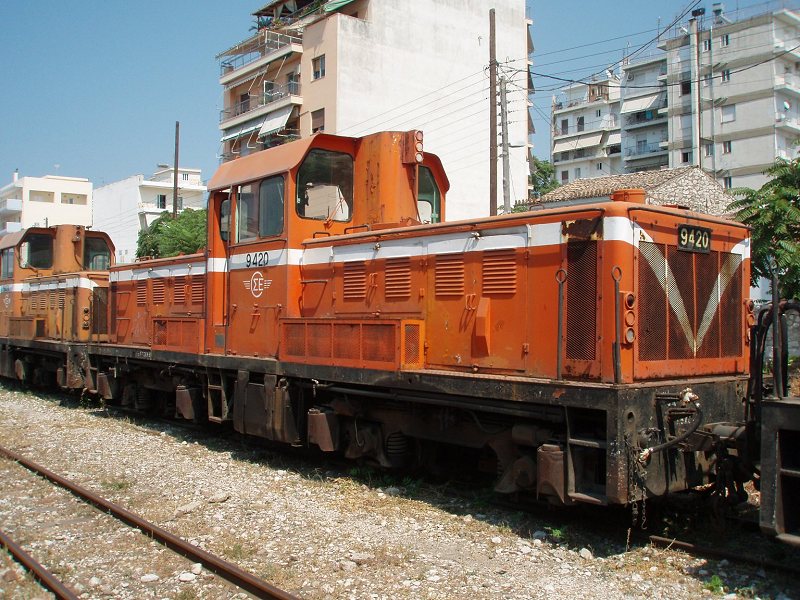
I recently picked up a copy of Today's Railways Europe for November 2011.  It's instructive to read about plans for a freight railroad network that don't include double-stacks, bathtub gondolas, or 100 tank loads of ethanol.  But a story about a number of Greek narrow-gauge center cab diesels of class 9400 that had been moved from dead storage in Patras to the end of a derelict branch line, subsequently to be stolen for scrap, along with some freight cars, track material, and the very track the equipment was stored on, intrigues.  The article (which I have not been able to find at any online source) notes the scrappers made off with about 500 metric tons of material, without anybody noticing or alerting the authorities.  The same article also notes the arrest of gypsies stealing batteries from the control boxes for crossing gates.  When civil order collapses ...

THE GOOD IS OFT INTERRED WITH THEIR BONES.

So let it be with Joe Paterno, according to The RosenBlog.
The only good thing that might come out of this is that money-grubbing college presidents might regain control of their universities’ moral compasses instead of willingly being dictated to by the largely ethically challenged guys in charge of phys. ed.
I wish the critics of big-time sports would keep the table of organization straight. Sometimes coaches teach a class in physical education, although it is rare that they hold a tenured professorship. The players might major in physical education, although kinesiology has some demanding prerequisites. That's where general studies becomes useful.

Teddy Greenstein suggests a more balanced view.
He donated at least $4 million to Penn State. He was fiercely loyal to the school. He didn't use the NFL as leverage and didn't have a "Les Miles clause" stipulating he would make $1,000 more than any coach in his conference if he won a national championship.

He coached because it was his life. By insisting his players go to class and graduate — decades before the NCAA instituted requirements — he helped hundreds of them. That's a true benefit to society.
A Cold Spring Shops source at Penn State confirms that the faculty is having trouble coming to terms with the child abuse, precisely because Mr Paterno had been outwardly supportive of the academic function of the university.

19.1.12

IF YOU ARE LEADER, YOU HAVE RESPONSIBILITY.

Captain Francesco Schettino, master of Costa Concordia, gets unsparing peer review.  "Matter of honor."  "Shameful."  "Abject cowardice."  Just go read it.

MAKING ECONOMICS HARDER THAN IT HAS TO BE.

Bryan Caplan has a useful discussion of the ways students go wrong by generalizing from their own experiences.
Faced with a genuinely difficult question, they answer a different, easier question, then conflate the answer to their question.
Go read, understand, and use it in class next Monday.

THE APPLICATION PROVIDES NO NEW INFORMATION.

Microsoft is working on a new application for smart phones and Global Positioning System receivers to overlay crime data on maps.  That has provoked the president of the Dallas chapter of the National Association for the Advancement of Colored People to preemptively denounce the "Avoid the Ghetto App."
“I’m going to be up in arms about it if it happens,” said Dallas NAACP President Juanita Wallace.

Wallace spent her afternoon at a rally on Martin Luther King Jr. Blvd. and said she felt safe there, but fears the app may project otherwise.

“Can you imagine me not being able to go to MLK Blvd. because my GPS says that’s a dangerous crime area? I can’t even imagine that,” she said.
That's the kind of reaction that provokes former House Speaker Gingrich to make his offer to work with the Association on getting constituents off of food stamps, rather than continuing to elect Democrats whose electoral chances would likely be diminished as those neighborhoods became less impoverished.

The problem, dear reader, rests in the street name, not whether the street name shows up on a screen, with or without a crime-incidence overlay.  The perception of the neighborhood MLK Boulevard runs through is often erroneous, but it is there.
All across Black America, there are Martin Luther King streets, avenues, drives and boulevards and each has one major thing in common with this MLK bridge: they all lead to the most crime-ridden parts of town. What is also shocking are the number of schools named after Dr. King that have metal-detectors, cops, birth control centers and gang containment programs--not to mention tragically low test scores.

How on earth did Dr. Martin Luther King Jr's. name become so attached to the absolute worst in our communities? Well, back in the late 70's and into the early 80's, urban mayors and city councils across this land decided to throw a bone to the Black community by naming something in town after the late Reverend. Sadly, blacks were so impressed by this symbolic gesture that no one stopped to question why Martin Luther King's name seemed to be slapped only on problem areas.
There, also, are the heavily Democratic precincts that have been so badly served by the Democratic politicians repeatedly returned to office from there.  But the Republicans don't have an app for that.

IN DEFENSE OF MILKING THE CASH COW.

I'm skeptical of business fads, including the restructuring that often took away capital for upgrading existing plant and fired the institutional memory.  Daniel Henninger (via Betsy's Page) offers the other side of the story.
Airlines, ground transportation, cable and broadcasting, oil and gas, banking and financial services all experienced regulatory rollback. Meanwhile, a competitive, globalized marketplace was rising. Management at some of America's biggest companies, confused by these rapid changes, found themselves sitting on huge piles of unused or poorly deployed cash and assets.

Thousands of Mitt Romneys allied with huge pension funds representing colleges, unions and the like, plus a rising cadre of institutional money managers, to force corporate America to reboot. In the 1980s almost half of major U.S. corporations got takeover offers.

Singling out this or that Bain case study amid the jostling and bumping is pointless. This was a historic and necessary cleansing of the Augean stables of the American economy. It caused a positive revolution in U.S. management, financial analysis, incentives, governance and market-based discipline. It led directly to the 1990s boom years. And it gave the U.S. two decades of breathing room while Europe, with some exceptions, choked.
Post hoc, nec ergo propter hoc.  "Positive revolution" or twenty years of fads that made merger promoters and a few CEOs rich?  You decide.  And take the time to read and understand Mergers, Sell-Offs, and Economic Efficiency.  Half of the mergers of the late conglomerate, early leveraged buyout eras were sales of divisions of the acquired company to other companies participating in the same or a related market.  The management of an airline conferred no special skill in running hotels or renting cars, and expertise at making steel did not translate well into selling groceries.  Did the efficiency gains from redeploying the cash exceed the management and promotion fees pocketed by the institutional money managers?  Or did those institutional money managers, dizzy with success, become vampire squids?

HOW DO YOU SCOUT BLOCKING AND TACKLING?

Thus did a coach preparing to face Vince Lombardi's Packers (possibly the 1962 team that allowed only four touchdowns and swept almost all before it) describe his difficulties.

The good news is that current coach Mike McCarthy has drawn the correct lessons from last Sunday's debacle.
“The tackling was just not there all year. We did not tackle well enough as a football team. It’s not acceptable,” McCarthy told reporters.
The article notes that the current contract limits tackling drills in practice, which, to my mind, sounds like practicing calculus without doing any proofs.

Coach McCarthy plans to work the problem during the off-season.

17.1.12

FREQUENCY MATTERS.

In the early days of Amtrak, travelers in the Chicago - Twin Cities corridor had a choice of two trains a day each way.  That was a step backwards from the frequencies offered as late as 1968,  but plenitude compared to today's schedule, in which one additional coach east of the Cities riding on the Empire Builder is the only recognition of the corridor.  Despite the political turmoil in Illinois and Wisconsin and the tight budgets everywhere, improvements to the service might be forthcoming.
Wisconsin, Minnesota and Amtrak officials have started talks that could lead to expanding the current passenger train service between Chicago, Milwaukee and Minneapolis-St. Paul.

The two states are working with Amtrak to launch a feasibility study of adding a second daily round trip on the Chicago-to-Twin Cities leg of the national passenger railroad's long-distance Empire Builder line, officials say.

At the same time, a separate Minnesota-led study is advocating a more ambitious - and more controversial - long-range goal: upgrading the same segment to high-speed rail along the current route, bypassing Madison and Eau Claire, disappointing rail backers in both cities.
The current route remained profitable until Interstate 94 was finished in the late 1960s, while through service via Madison and Eau Claire ended in 1963, and the tracks have been removed on both sides of Madison.  Some things don't change.
After comparing more than two dozen possible routes, it concluded the current route - through Columbus, Portage, Tomah and La Crosse - was the best choice, based on cost, geography, projected travel time and population served, [Minnesota passenger rail planning director Praveena] Pidaparthi said.

With Congress balking at new high-speed rail appropriations, Minnesota officials thought it made more sense to improve the current route gradually instead of seeking a major investment in a new route, Pidaparthi said.

Just upgrading the current route would cost $2.4 billion, with track maintenance costs of $10.3 million a year, the study found. Those figures don't include the costs of buying and operating trains or of building or upgrading stations, issues that will be covered in a follow-up study, Pidaparthi said.

High-speed rail advocates disputed the findings.

"Major cities should be within three hours of each other," said Rick Harnish, executive director of the Midwest High-Speed Rail Association. On the selected route, it would take 4 hours 35 minutes to travel from Milwaukee to Minneapolis-St. Paul at 110 mph, and sharp curves on the Minnesota segment along the Mississippi River would prevent an eventual upgrade to 220-mph service, he said.
Regular readers know about the limitations of geography in the Mississippi River valley, and in the driftless area of Wisconsin, as well as the speed potential through the Sand Country and south of Milwaukee.

Faster running times are desirable.  Frequency, however, is more desirable, in order that people have some flexibility in making their trips, and more short-distance trips by rail make sense.  The article doesn't say anything about food service or proper first-class accommodation.  I have some ideas, in case anyone asks.

SEEKING A GEORGE ORWELL FOR CHINA.

In The Road to Wigan Pier, George Orwell describes the condition of Depression-era coal miners in Britain.  A recent documentary suggests working conditions in contemporary China are no better.
In [journalist Yuanchen] Liu's film, the miners venture underground without protective masks. China's mines suffer from inadequate ventilation systems, and Liu told me that dangerous coal dust sparkles like fireflies in the light from the miner's helmets. They use old fashioned pick axes instead of jackhammers, and crouch or lie down in three foot high side tunnels for hours at a stretch, hacking away at the rock faces.

The central government does not lack safety regulations on the books. In practice, however, these rules are often ignored in the rush to get more coal out of the ground.
Columnist Richard Schiffman describes the lot of the miners as "paying in blood for China's economic miracle."  It's possible that there is no Chinese economic miracle, only an increasingly unsustainable mirage, in which case the lot of the miners is the lot of working people in poor countries more generally.

THEY ARE BEGINNING TO CATCH ON.

Self-esteem is the consequence of accomplishment following effort.
A growing body of research over three decades shows that easy, unearned praise does not help students but instead interferes with significant learning opportunities. As schools ratchet up academic standards for all students, new buzzwords are “persistence,” “risk-taking” and “resilience” — each implying more sweat and strain than fuzzy, warm feelings.

“We used to think we could hand children self-esteem on a platter,” Stanford University psychologist Carol Dweck said. “That has backfired.”

Dweck’s studies, embraced in Montgomery [county, Maryland] schools and elsewhere, have found that praising children for intelligence — “You’re so clever!” — also backfires. In study after study, children rewarded for being smart become more likely to shy away from hard assignments that might tarnish their star reputations.

But children praised for trying hard or taking risks tend to enjoy challenges and find greater success. Children also perform better in the long term when they believe that their intellect is not a birthright but something that grows and develops as they learn new things.
Nice to see some new neurons firing in the minds of educational psychologists. Also nice to learn that my resistance to the Zeitgeist is not misguided.

15.1.12

PROTOTYPE LEARNING SPACES?

Cole Hall will reopen for classes on Tuesday.
With the renovation came the new Jameson Auditorium, a “Collaboratory” classroom and new features for the NIU Anthropology Museum.

The Collaboratory classroom includes separate learning pods that seat eight students each. The pods also have 65-inch high definition digital touch screens. Professors can use a larger screen at the front of the classroom that allows them to project and alter images from each pod.

The Jameson Auditorium has 351 pivoting chairs that allow students to participate in large lectures or small groups. High-definition TV monitors are also available for students who sit in the furthest rows of the auditorium.

The Anthropology Museum includes moveable walls, low-iron glass display cases, a 10-foot glass display case in the museum’s exterior wall and humidity and temperature controls to help preserve the museum’s 12,000 artifacts.
The article does not mention whether the Anime Association will regain the use of the workroom they once maintained in the basement.

ASSET REALLOCATION IMPLIES ASSETS GET REALLOCATED.

David (Spengler) Goldman offers the case for corporate raiders.
Want to see what America would look like without private equity? Move to Detroit and contemplate the ruins of a city ruined by the placid conformity of auto industry executives. The  economic impact of the corporate takeover business can’t be measured by the outcome of takeovers as such. Private equity transformed the way American business thought about the world. If managers did a lousy job, outside investors could raise money (a lot of it from trade union pension funds as well as university endowments) and kick them out.
In much of the Rust Belt, the conservative, cash-rich legacy corporations provided a target for outside investors.  Automobile manufacturing might be a special case, but many of the most spectacular conglomerates (until the day they crashed and burned from excess diversification and too many reality checks) came into being as a way of transferring assets out of railroads or steel or textiles or tobacco companies.  There might have been some oligopoly inefficiencies and complacent management practices to wring out, but Mr Goldman's assertion that the resulting lean and efficient corporations are unequivocally for the good is excessive.  One fad gives way to another, while the large companies hive off the institutional memory that might have prevented some of their recent difficulties.

BLANK-OUT.

I've always understood that the Welfare State exists inter alia because private charities are insufficiently liquid or inclusive enough to do the job.  In Greece, however, as the Welfare State runs out of resources, the church is being asked to pick up the burden.
[Ark of the World youth] Centre founder Fr Antonios Papanikolaou told the Mirror: 'Over the last year we've had hundreds of parents who want to leave their children with us. They know us and trust us.

'They say they do not have any money or shelter or food for their kids, so they hope we might be able to provide them with what they need.'
The next paragraph, however, conflates two errors of economic policy.
Further evidence of Greeks feeling the pinch of austerity measures is the lack of aspirin and other medicines now available in the country.

Pharmacists are struggling to stock their shelves as the Greek government, which sets the prices for drugs, keeps them artificially low.

This means that firms are turning to sell the drugs outside of the country for a higher price - leading to stock depletion for Greeks.

Mina Mavrou, who runs one of the country's 12,000 pharmacies, said she spent hours each day pleading with drug makers, wholesalers and colleagues to hunt down medicines for clients.

And she said that even when drugs were available, pharmacists often must foot the bill up front, or patients simply do without.
There's probably some Affordable Care Provision that limits the price a store can post for a bottle of aspirin, and it's an elementary supply-and-demand exercise to illustrate that when the price is below the equilibrium price, excess demand will follow, and suppliers will look for opportunities to obtain a higher price, even if that means evading export controls.  It has nothing to do with austerity.

WILL THE NEW HIRES RESPOND TO THE INCENTIVES?

The Washington Monthly College Guide follows the recruiting habits of the universities further down the food chain.
It looks like, in many ways, however, it’s a great time to be on the hiring committees at some lower-tier schools, who can now take advantage of the economy to attract some rather prestigious junior faculty.
In many cases, these hires are for contingent, non-tenure-track positions, which will preclude many of those hired from participating in departmental, college, and university policy-makings.  The article concludes with the suggestion that universities look, again, at whether their graduate programs are producing excessively many students.

It's also difficult to predict how the presence of Ph.D.s from higher up the food chain will affect policy at those universities, once a few of them make tenure.  Will they argue for raising the academic profile of their department (a good idea at the undergraduate level, possibly futile in some of the graduate disciplines)?  Or will they go along with the we're-not-as-good-as-Ann Arbor (substitute any other flagship) and-there's-no-reason-to-work harder?

TOO MANY MISTAKES.

Packers will begin their next season at the home of the yet-to-be-determined league champion.  Lose as many fumbles in one playoff game as in sixteen regular season games, and home field just gets you booed.

12.1.12

BARACK HUSSEIN OBAMA, NEOCONSERVATIVE.

The most vocal critics of Our President might not be the contenders for the Republican nomination.  Book Review No. 2 suggests that a different dissenting point of view is available in Chris Hedges's Death of the Liberal Class.   The reader must understand, however, that Liberal Class is not about Daniel Patrick Moynihan or Hillary Clinton or Rachel Maddow.  Oh, no, no, no.  Turn to page 122.  The New Left of the 1960s, and French poststructuralism are "political sterility" and a "charade of protest."  (On the right, calling these things a lot of wordnoise, or primeval nostalgia, is good enough.)  Just having a bad day, or perhaps an expensive cup of coffee during thinking time?  Not at all.  The message is one in which the policy impulses of the Social Gospel and the era of muckrakers is crowded out by bipartisanship and the corporate media, with a few "fascist" characterizations thrown in for good measure.  Go forward by going backwards, as this call to action at page 156 suggests.
The best opportunities for radical social change exist among the poor, the homeless, the working class, and the destitute.  As the numbers of disenfranchised dramatically increase, our only hope is to connect ourselves with the daily injustices visited upon the weak and the outcast.  Out of this contact we can resurrect, from the ground up, a social ethic, a new movement. We must hand out bowls of soup.  Coax the homeless into a shower.  Make sure those who are mentally ill, cruelly abandoned on city sidewalks, take their medication.  We must go back into America's segregated schools and prisons.  We must protest, learn to live simply and begin, in an age of material and imperial decline, to speak with a new humility.  It is in the tangible, mundane, and difficult work of forming groups and communities to care for others that we will kindle the outrage and the moral vision to fight back, that we will articulate an alternative.
Set the Wayback Machine to 1848 and start over.  The book was written before the Occupy protesters hit the street.  Plenty of outrage, but not much by way of humility there.  Other recommendations in a similar vein might be, with modifications only to the politics, useful for survivalists seeking to withdraw from a society in collapse because of too much preference for the weak and the outcast.

What about Our President?  That's page 199.
Obama had almost no experience besides two years in the Senate, where his voting record was a dismal capitulation to corporate power.  But, once again, the electronic hallucinations that assault us rendered most voters incapable of thought and response.  The superficial, the trivial, and the sensational mask our deep cultural, economic, political, and environmental disintegration as well as the newest political diversion approved by the corporate state.  We remain hypnotized by flickering images we mistake for reality.
The academic Left likes its false consciousness.  Rush Limbaugh likes to denounce slick marketing and packaging.  You're more likely to hear sniping from the Right about Senator Obama voting present.

Ultimately, though, Mr Hedges gives the impression that it's harder for Nation scribblers to get an audience than it used to be, that is, unless you're dorky-looking enough for MSNBC.  See page 209.
Journalists, once able to sell articles to publications overseas, now see their work flash around the globe without hope of compensation.  We are starving our professional critics and artists. We are turning culture and art over to part-time amateurs.
He continues, trying to have it both ways.  On one hand, he writes of "idiotic distractions that draw huge number of You Tube hits or public-relations created propaganda."  With no shame at all, he follows with, "And any work that cannot gain corporate sponsorship or attract advertising dollars will be ignored."  Next comes a gripe about the weakening of intellectual property rights and the destructive effects of what he calls "digital collectivism."

Perhaps boring institutions such as well-defined rules of ownership and contract, and division of labor, have more potential for improving the lives of people than all the voluntary communities of protest can ever do.

(Cross-posted to 50 Book Challenge.)

SPOT THE ENTITLEMENT.

An Inside Higher Ed post documents some recent Occupy Wall Street protests inside Wall Street job fairs at Ivy League universities.  That's fairly standard stuff.  What intrigues is the restricted sense in which the column uses the expression "entitled".
“There’s a sense among students who easily could feel entitled that they have a responsibility to society, as leaders, to improve that society, and that right now for many people that society doesn’t seem to be working,” [Harvard professor of leadership development Rakesh] Khurana said, adding that the number of students interested in solving the world’s problems – environmental, economic, social – is “amazing.”  “I think what we have to do as an institution is to make it easier for students to see the path by which they can do that. We haven’t created, in many ways, the clarity of the career paths in which you get to go do those things.”
There's one sense of entitlement, in which one gets good grades in high school in order to secure admission to Harvard, and gets good grades there in order to hire out with a trading house, or to secure admission to the right business or law program, in order to rack up the big bucks.

There's another sense of entitlement, in which one gets good grades in high school in order to secure admission to Harvard, and gets good grades there in order to go into "public service," perhaps after that stint in law school, in order to spend the taxpayers' money more sensibly than the taxpayers could on their own.

That a Harvard professor is noting a lack of clarity of the career paths might suggest that all of higher education's egalitarian posturing is for nought.

THE UNREPRESENTATIVE REPUBLIC.

The DeKalb Chronicle opens up a can on the Illinois Tollway Authority, going so far as to allude to taxation without representation.
The Tollway board now has three members from Chicago, whose city limits barely touch one toll road near O’Hare International Airport. They are chairwoman Paula Wolff, James Banks and James Sweeney.

Five members live in the suburbs: David Gonzalez of Chicago Heights, Jeffrey Redick of Elmhurst, Mark Peterson of Lincolnshire, Terrence D’Arcy of Shorewood and Tom Weisner of Aurora.

The only non-Chicago, nonsuburban board member is Carl Towns of Rockford.
The editorial calls for board members who live in counties adjacent to the toll roads.  Whether that would have led to the authority being closed down once the original tollway bonds were paid off, as the statutes creating the authority envisioned, or whether such a board would increase tolls in a different way to pay for a different set of pet projects the editorial does not say.

11.1.12

POLITICAL COMMENTARY DISGUISED AS AN ACTION THRILLER.

The first entry in this year's Fifty Book Challenge will be Tom Clancy's Locked On.  I read it rather quickly, and it has a lot of the usual characters going after the usual suspects, with some of the usual antagonists.  Maybe I should call it a work "in the school of Tom Clancy," as one Mark Greaney is stealthily listed as a coauthor.  Maybe I'm getting jaded with the genre, or maybe the electoral tussle between Jack Ryan, seeking to be the first President since Grover Cleveland to serve non-concurrent terms, and a thinly disguised Edward Kennedy with the policy preferences of Barack Hussein Obama, right down to the Alinskyite allies who are more transparent in the book than in real life, is beginning to crowd out the plot and character development.

(Cross-posted to 50 Book Challenge.)

THE PROBLEM WITH CAPITALISM IS CAPITALISTS.

Ed Driscoll is assisting at Instapundit, and he points to an Irwin Stelzer essay in The Weekly Standard.  Shorter argument: pro-market policies are not the same thing as pro-business policies, and the Big Bankers are notoriously demonstrating their ignorance of that lesson.
Most surprising are the objections of leaders of the banking community to quite sensible reforms, their willingness to sacrifice long-term support for the market system to the desire for short-term profits. It is true, for example, that higher capital requirements for banks, requirements that “don’t go nearly far enough” according to John Cochrane, finance professor at the University of Chicago, will reduce their profits. That is so—but only because requiring banks to hold more capital reduces the risk of failure or the need for bailouts, risks that have until now been borne by taxpayers.

Also difficult to understand is their failure to comprehend that some practices, such as imposing retroactive increases in interest rates on bank credit cards, are deeply objectionable to consumers, even if technically justifiable. And their failure to realize that large bonuses at a time when 25 million Americans can’t find any or enough work are an excess they might want to forgo in the interests of maintaining support for the system that has been kind to them—including bailing them out when they hit the rocks. One investment bank warned its highflyers not to be seen in Porsche showrooms, so it’s not as if these bonus recipients are unaware that something potentially unpleasant is brewing out there in the world beyond their office towers.

Bankers are not alone in their failure to understand that something must be done to prevent the opposition to many features of the current system from creating an atmosphere that will support “reforms” so draconian that the resulting system will retain few of the virtues of the existing one. The corpocracy at times seems equally obtuse, as when its leaders call for repeal of the provisions of the Sarbanes-Oxley law that make it easier for shareholders to rid themselves of underperforming directors, and require that directors be truly independent, rather than chums of the CEO, especially when serving on compensation committees. The breaking of the link between performance and reward that results from friends-of-the-CEO boards of directors does as much to undermine capitalism’s claim to legitimacy as financiers’ obtuseness about their responsibility to act as if they are members of a society that extends beyond executive dining rooms and country clubs.
He offers an observation on the political economy of public policy.
I am not one who sees in the Occupiers the wave of the future. They are not the real worry to those of us who fear for the future of market capitalism in America. It is the failure of the major beneficiaries of the capitalist system to understand that openness to reform, combined with a bit of restraint when carving up the huge pie that capitalism is capable of producing, is the best way to head off those people who would alter market capitalism beyond recognition by imposing punitive taxes, onerous regulations, investment-distorting subsidies, along with a bloated government. Those folks are dangerous enough to America’s future prosperity without being handed the gift of obtuse opposition to needed change.
That is one approach. Be receptive, as well, to the possibility that business might go along with the regulatory state with a view toward capturing the agencies, particularly if those agencies suffer from cognitive hubris.

LET THE CARPING BEGIN.

"Others receiving votes" isn't enough for sportswriter Ryan Wood.
I was surprised NIU didn’t crack the top 25 when the final polls were released Tuesday. Of course, we know voters don’t watch many of the games, making results outside the nation’s top 15 teams flimsy – if they have any meaning at all. And the losses to Kansas and Central Michigan dampen the shine beaming from NIU’s accomplishments, notably the nation’s longest win streak and a title in a conference that was 4-1 this bowl season.

But No. 26 NIU was one of 16 teams in the country to win 11 games. None of the other 15 won their final nine games.

If this was a conversation about the nation’s top 20, NIU wouldn’t belong. But you can’t tell me BYU and Cincinnati – two teams that beat nobody, by the way – are better than NIU.
Whatever. Football offers great play value. Monday to Friday, come here to be an Excellent Student and stick around for the steel band or the Avalon Quartet.

10.1.12

HELLO, NEW READERS.

The Fifty Book Challenge, which started as a temporary community, has continued in operation and Live Journal highlighted it for 2011.  An encouraging cohort of new members has begun posting.

I've been playing along since 2005, and here is the final report for 2011.   I no longer feel any pressure to file fifty reports, so the roundup will stop at 36.  Lots of exciting football and some progress on the model railroad and the continued fruits of downsizing at work make for a tired weblogger some days.  The links for the final seven go to detailed reports at the Challenge.  Some books are particularly good (+), others particularly bad (-).
  1. The Help, 15 October 2011 (+).
  2. Trading Up: The New American Luxury, 16 October 2011 (-).
  3. 11/22/63, 22 November 2011.
  4. That Used to Be Us: How America Fell Behind in the World It Invented and How We Can Come Back, 12 December 2011 (-).
  5. American Nations: A History of the Eleven Rival Regional Cultures of North America, 21 December 2011 (+).
  6. The Time of Our Lives: A Conversation About America, 26 December 2011 (-).
  7. America's Quarterback: Bart Starr and the Rise of the National Football League, 29 December 2011.
The third quarter report is available here, or at the Fifty Book Challenge, or on the European Tribune.

The second quarter report is available here, or at the Fifty Book Challenge, or on the European Tribune.

The first quarter report is available here, or at the Fifty Book Challenge, or on the European Tribune.

The new segments of the bookworm highlight the football season as perceived from here.

Ooooooooooooooooooooooooooooooooooooo


There are more books stacked for review, and year eight of reports will commence shortly, although the fifty is more likely to be a nice-to-have than a must-do.  New members, don't be put off by my lethargy!

(Cross-posted to European Tribune and Fifty Book Challenge.)

BEFORE THE GERM THEORY OF DISEASE.

Voluntary Xchange contemplates the health benefits of beer, or tea.  The transition from being drunk to being wired matters.
People drank all day at that time because the water wasn’t safe to drink. They didn’t understand the mechanism, but there were clear medicinal reasons for a lot of beer and wine (remember that spirits were in their infancy at this point).

Yet, people had the technology to boil their water. The thing is, they didn’t recognize the advantages of this. There’s an unusual research project there for a Ph.D. student: why exactly wasn’t this discovered. Because what’s interesting is that they did learn to boil water to make a mild drug: coffee or tea. So it clearly took a little extra marginal benefit to convince people to drink hot liquids, but not too much.
It's significant, I suppose, that the legend of James Watt and the steam engine begins with the lid on a tea kettle, rather than on a beer fermenter.

THE FUNDAMENTAL CONTRADICTIONS OF TECHNOCRACY.

David Brooks meditates on the tendency of rent-seekers to capture government.
You would think that liberals would have a special incentive to root out rent-seeking. Yet this has not been a major priority. There is no Steve Jobs figure in American liberalism insisting that the designers keep government simple, elegant and user-friendly. Sailors scrub their ships. Farmers clear weeds. Democrats have not spent a lot of time scraping barnacles off the state.
Am I being churlish, or just old, to point out that deregulation in transportation and the utilities began in the Carter administration, with the support of Ralph Nader and Edward Kennedy, and the biggest cuts to the Amtrak network took place under President Carter's watch.  I know I'm old when Mr Brooks's call to "choose a rent-seeker to hold up for ridicule and renunciation" reminds me of Senator Proxmire's Golden Fleece Awards.

RUSH LIMBAUGH SAYS EXPORT FEMINISM.

It's his part-humorous, part-on-point suggestion for putting a stop to the economic successes of Asian countries, and it's probably deliberate to make the heads of some of his listeners explode.

Now comes Via Media with a variation on the same theme.
The rise of business schools in America led to greedy CEOs milking their companies for multimillion dollar benefit packages, to weird financial market transactions that took down some of the biggest names in American business, and to one destructive management fad after another that left dozens of American companies as hollowed out shells.  Business school grads also pioneered exotic new tax dodges that helped bulk up the federal deficit, to say nothing of the kind of corporate ruthlessness that hollowed out the US industrial base in record time.

With Asia now looking to follow this path, Americans can relax: Asia won’t be eating our lunch anytime soon.

The next step? We need to sell them on the need to build law schools.  Lots of them.
The accompanying comments include a suggestion that, as with anything else that seems promising, there are tradeoffs.

WHEN YOU COME FROM TROUBLE, TROUBLE COMES TO YOU.

The Sports Economist contemplates Chicago Bear and former Northern Illinois receiver Sam Hurd's method of supplementing his income.
Hurd earned $1.5 million playing for the Cowboys in 2009, so even after including other costs in the net income calculation, it’s almost certain that his take from dealing was more, maybe far more, lucrative than what he earned on the field.
Standard economics stuff, to be sure, where the expected return compensates for the risk borne.

On the other hand, the current investigation revisits the receiver's previous brushes with the law.
A review of court documents and police reports from around DeKalb County shows former Northern Illinois University football player Sam Hurd once pleaded guilty to battery and was evicted from a DeKalb apartment during his time at the school.

Hurd, 26, was arrested on federal drug charges in December while a member of the Chicago Bears. According to a criminal complaint, Hurd told an undercover agent he wanted to purchase 5-10 kilograms of cocaine and 1,000 pounds of marijuana per week to sell in the Chicago area.

Hurd played for NIU’s football team from 2002-05. Court documents show a civil case filed in 2006 against Hurd and former roommates Shatone Powers and Jasper Turner, all of which were evicted for failure to pay rent; the judgment amount has yet to be paid.
Past performance is no indicator and all that, but perhaps the history matters.

9.1.12

THE MID-MAJOR TITLE GAME.

Northern Illinois's football team gets it done the hard way.  The title belt even says so.


Northern Illinois University photograph, Day 3: Practice album.

Spot the other team thirteen points, have the starting quarterback hop off the field: all in a day's work.
After falling behind 13-0 quickly in the first quarter, the Huskies roared back, scoring 31 unanswered points and never looking back en route to the team’s ninth straight victory.

Harnish hit Perez Ashford on a 9-yard touchdown pass two plays after a disputed spot on fourth down kept the drive alive, pulling the Huskies to 13-7 just before the end of the first quarter.

The Huskies briefly lost Harnish to an injured left ankle early in the second quarter, but backup Jordan Lynch engineered a seven-play, 78-yard drive that ended on his 3-yard touchdown run to give NIU a 14-13 lead with 4:49 left in the first half.

The Huskies added another touchdown just before the half when Doeren gambled on the final play of the drive, going for the touchdown with 2 seconds remaining instead of opting for a field goal.

Jamal Womble plowed forward for a 1-yard touchdown to give Northern Illinois a 21-13 halftime lead.
In the second half: a touchdown pass immediately after the interception, and an interception return for a touchdown. Something Packer-like about all that.

The official clock and the referee's field radio didn't work very well, and the replay officials are becoming an irritation.  On the other hand, with Alabama's victory in the Confederacy Bowl, er, BCS Title Game, the longest collegiate football winning streak in the land belongs to Northern Illinois.

It's also fitting that the university that introduced Homecoming to the United States participate in the opening of Mardi Gras in the city that introduced Mardi Gras in the United States.  (Yes, New Orleans gets more publicity for its Carnival, but it's ahead of Mobile in being sacked by David Farragut, not in holding Carnival.)


Northern Illinois University photograph, Day 4: Mardi Gras Parade and Fireworks album.

The mascots also made the trip.  The university adopts shelter dogs (Siberian Huskies being very high maintenance dogs) and keeps them on the traveling squad as long as they are able.


Northern Illinois University photograph, Victory album.

One popular activity at televised sporting events is to reverse-acronym ESPN.


Northern Illinois University photograph, Victory album.

There is some truth to their claim, and the university's latest strategic plan proposes to increase enrollments and raise the academic profile.  There's one pitfall.  Both Arkansas State and Northern Illinois are on record among the sports pundits as aspiring to be the next Boise State (a phenomenon we've seen in these pages before.)  That's troubling, as one entry in a Historiann roundup of Excellence Without Money comes from Boise State.
My sense is that our students, and particularly our undergrads, are predominantly working class. Last I checked, our four-year graduation rate is 8 percent, and the six-year is 26 percent, but of course that doesn’t say much about reality, as many of our students are transfers from elsewhere, and they don’t figure into graduation rates.* (Cross-reference.) Many of my students are my age (36) or older.  This semester, I have students born between 1957 and 1993, which, as you can imagine, makes for interesting discussions.  Many are veterans.  Many have fought with addiction in various forms.  About one-third are Mormon.  The overwhelming majority are white.  Many are single parents. At least three of my students have initiated divorces this semester; I can’t remember having any married undergrads at Davis.
Commuter universities are like that. Those tales would not be strange to anyone with experience at Wayne State or Illinois-Chicago or Wisconsin-Milwaukee.  The problem, though, is in attempting to raise enrollments and the university's academic profile on the cheap.
I’m not sure why our administration wants to bring in more students, as we’re having a hard enough time graduating the students we already have.  Perhaps it’s because if we’re investing heavily in the sciences, we’re going to need to recoup the costs somewhere–and where better than by making arts and humanities faculty teach more classes, each with a significantly greater number of students?
There's a lot more in that post, and it will reward careful study.  It's corroborated by a Cold Spring Shops source who notes that the existing Boise State library is inadequate for some areas of research.  The good news is that Northern Illinois's administration is, publicly at least, making clear that a larger enrollment will require a larger faculty.

Meanwhile, the former sports information director advises Mid-American fans generally to savor the moment.
Big Ten and BCS envy? Who needs it? With a Northern Illinois victory over Arkansas State in Sunday’s GoDaddy.com Bowl, not only would the MAC wind up an unprecedented 4-1 in this postseason, the league’s four bowl triumphs would double the previous best (2-0 MAC bowl record in 2001 and 2003, 2-3 in 2004, and 2-2 in 2010) and equal this year’s Big Ten bowl win total (4-6). Eat your heart out, WAC (0-3), Pac-12 (2-5) and ACC (2-6) fans.
There's some campaigning (appropriate on Primary Night) to get Northern Illinois out of the "others receiving votes" category.
It’s time for the Huskies 0-and-forever drought of Top 25 finishes to end as well.

I never thought I would write those words this season. Not after NIU’s defense looked unfit for college football – let alone the country’s upper echelon – in the season’s early weeks.
As they say, Developing.

THEY ARE BEGINNING TO CATCH ON.

The latest Destination: Freedom meditation on Amtrak at Forty notes that there are other passenger trains available to travellers in the U.S.
One step that Amtrak management could take is to give potential customers more information that would help them make connections between Amtrak and local transit. While a few Amtrak riders take a long-distance train from one small community to another, many more go to or from a city, or between two cities. This is certainly true in the Northeast Corridor (NEC) region, where almost every stop serves a major city. Other corridors serve hubs such as Chicago or Los Angeles, and every long-distance train goes through a number of medium-to-large cities on the way from one major destination to another.
That's long been a cause at Cold Spring Shops, where regular readers are familiar with the case for connectivity, and the way things work in Britain, where interline ticketing among the passenger train operators, some of which operate competing trains on the same routes (but don't look for the choice of a Zephyr or Hiawatha, generally it's a diesel railcar in a different paint job).  Getting around Boston, where some of the suburban trains are practically intercity trains, is a challenge, and connections among Amtrak's corridor trains radiating out of Chicago are erratic.
It is unreasonable to assume that the casual traveler has the sophistication to plan his or her transit use in the destination city by calling the local transit or using the provider's web site. That site may not be user-friendly for persons who are unfamiliar with the layout of the city or where the transit goes. Amtrak could solve this problem easily and inexpensively, and make many new friends in the process.

Many Amtrak managers spent portions of their careers managing local transit providers, so they are familiar with those providers. Amtrak also works with local transit providers in many cities, often on issues concerning shared track or stations. It would be an easy task for Amtrak to provide more detailed information about local connecting transit in the timetable and on the Amtrak web site. The most important information that Amtrak can provide customers is which transit lines connect with Amtrak at or near the station, and how to get there. Of course, the information must be up-to-date, but it would be easy to present, and presenting it to customers in an understandable format will allow them to plan their trips more effectively. That, in turn, would encourage them to use Amtrak more often.
Admittedly, detailed information on connecting trains in the States has always been hard to come by unless there's an Official Guide handy (the British, on the other hand, have always had a version of Bradshaw's, even though only Sherlock Holmes understood all of its intricacies).  Perhaps there's a market for a travel publisher to put together regional rail timetables.  For instance, the Northeast Corridor services, including those of all the Passenger Rail authorities, could probably fit into a 40 page folio.

Such a book might have great play value: identify all the twenty-minute-missed-connections at Penn Station or Baltimore.

THE JOYS OF SHODDY SERVICE.

A Fresno Bee editorial takes businesses, most frequently the former regulated utilities, to task for their artlessness in imposing fees for services that used to be part of the cost of doing business.
Then once outrage invariably builds, they have to do an embarrassing U-turn, plus damage control to their brand.

The latest mea culpa was almost immediate. Verizon Wireless, the nation's largest cell phone company, pulled the plug on a plan to charge $2 for some customers to pay their bills, just a day after announcing it.

As fees go, this one was more ridiculous than most. Starting Jan. 15, it would have hit customers who choose to make one-time credit or debit card payments, either online or over the phone. To avoid the fee, customers would have to enroll in automatic credit card payments, go into a store to pay, or mail a check.

That's right -- you would have been charged for paying your bill on time. Amazingly, Verizon Communications, the landline phone company that owns most of its wireless cousin, tried last year to introduce a similar fee but was forced to back off after customer complaints.
The good news is that consumers can often get businesses to do the right thing through promiscuous use of the social media.  Business, however, might do well to remember what market tests are for.
At the mercy of short-term investors, corporations are looking for ways to pad their bottom lines. Still, too many have forgotten the fundamentals of growing a business: Provide products or services that people want, make them available at a fair price and treat customers with respect. Charging exorbitant or unnecessary fees is the opposite of those principles.
The comment about short-term investors might be misleading. Even a short-term investor has to be aware  that a policy that alienates consumers or gives them reason to pick a different supplier is a policy that destroys shareholder value.  Otherwise the short-term investor is a guesser: not bull, not bear, not speculator.

BE CAREFUL WHAT YOU ASK FOR.

At Phi Beta Cons, Jason Fertig notes that abolishing academic tenure for its own sake and in spite of possible cost fails to consider the downside of the alternatives.
If tenure goes away, how will this new majority of professors on “multi-year contracts” be assessed? By student teaching evaluations and number of pubs (regardless of quality)? That’s the system we have now. With professors repeatedly fighting for their reappointment, there will be even greater incentives to play it safe, which will only make the classroom experience worse for students.

The current system rewards looking good rather than being good. I’d like to see deans and P&T committees sitting in classes to assess the art of teaching. I’d like to see them reading every word of a professor’s scholarship to separate the meaningful from the fluff.
Alternatively, one can ask the tenure candidate to identify the five or ten best articles, and have the case evaluated on the basis of those.  Most disciplines have a pecking order for the journals and book publishers, and external reviewers know what those are, should a department attempt to pencil-whip a politically-favored but professionally weak case through the committees.

5.1.12

GOOD MEANS POOR.

A dean at Illinois Valley Community College helps judge student projects for the regional history fair.

He's not happy with the performance ratings.
When the Social Studies teacher gave me the grading rubric, I saw only three categories: Superior, Excellent, and Good.

I asked the teacher what I was supposed to do if a presentation was bad or poor. She looked at me and said, with a straight face, "Good means poor." "How so?" I asked. "What kind of semantic gymnastics is that? Does that mean that superior is above average, and excellent is average?" She didn't answer the question, but said that the students worked really hard on their projects and the school didn't want any of them to feel discouraged. If they scored in the 70s, then their presentation was considered bad. "But you're telling them that it is good," I said.
The instructions clearly imply that a project earning a "good" rating is a superficial project. As long as the rankings are ordinal and applied consistently, the tail-enders will be tail-enders.

He's right, though, to suggest that the absence of a strict evaluation system might be evidence of a deeper rot.
This is why so many of our students come to us unprepared. They go through grade school and high school and are told that they are doing a superior, excellent, or very good job when in reality their academic performance is average, bad, or very bad indeed. Of course I can't blame the students. I blame the system that perpetuates this kind of fraud and the Social Studies teacher for not holding her students accountable for the quality of their work. But then, her supervisor probably assures her that she is doing a very good job.
Since participation in the history fair is, as far as I know, not mandatory, it's possible that Illinois Valley, or Northern Illinois University, the host of the regional fair as well as participant in an articulation agreement, do not see the students who don't even submit projects.

WHAT HIGH SPEED RAIL LOOKS LIKE.

Sometimes, railroad maintenance trains recycle classic passenger cars for use as bunk cars or kitchens or crew space.  On occasion, one of those cars remains in something close enough to its original condition to warrant restoration.  Such appears to be the case with an original Hiawatha coach 4448, being rebuilt by the Institute for Small Town Studies in Fairfield, Iowa.


Fairfield is close enough to Cold Spring Shops headquarters to warrant a road trip.  The interior of the coach is in somewhat rougher shape, and the other side has additional doors cut into it, but the restoration appears to be professional.  The car survived in work train service on The Milwaukee Road.  A number of cars went to Mexico, and the Mexicans are reluctant to sell rolling stock back to the States for preservation.  Two went to Chicago Great Western.  They were subsequently purchased by a historical society, then they disappeared.

What intrigues, though, is that several other cars from the 1934 Hiawatha were converted to baggage cars.  I took a picture in Portage about 20 years ago of a maintenance of way car that, if you look at the seams closely, shows a lot of welds in the shape of arched windows on each side.  Wonder where that went, and if that was one of the original parlor-observation cars.  (Maybe that picture will turn up on Cold Spring Shops with a request for further research.)

2.1.12

THE CASE FOR CLEANER INCOME ACCOUNTING.

Paul Krugman takes on some misconceptions about public debt.
Deficit-worriers portray a future in which we’re impoverished by the need to pay back money we’ve been borrowing. They see America as being like a family that took out too large a mortgage, and will have a hard time making the monthly payments.

This is, however, a really bad analogy in at least two ways.

First, families have to pay back their debt. Governments don’t — all they need to do is ensure that debt grows more slowly than their tax base. The debt from World War II was never repaid; it just became increasingly irrelevant as the U.S. economy grew, and with it the income subject to taxation.
Strictly speaking, families don't have to pay their debt back either, if they accumulate assets more rapidly (something that the mortgage-makers were too optimistic about in Professor Krugman's example) and have a good tax advisor. That's one purpose of a trust fund, to ensure that assets in the name of any one family member exist to cover that person's remaining liabilities at death.  The better analogy might be with a corporation, which can refinance old debt with new, and retain its credit rating as long as consumers buy its products.

But family mortgages are balance sheet items: there's an asset, the house, and a liability, the mortgage, and, with correct financial discipline, there's equity in the house.  The same principle applies to the corporation.  But not to the government.  Arguably, the money used to win World War II created an asset, the Pax Americana, which, although it depreciated, it made possible the conditions within which people could work and shop and pay their taxes.  Professor Krugman has the opportunity to make that point, but he opts not to.
Second — and this is the point almost nobody seems to get — an over-borrowed family owes money to someone else; U.S. debt is, to a large extent, money we owe to ourselves.

This was clearly true of the debt incurred to win World War II. Taxpayers were on the hook for a debt that was significantly bigger, as a percentage of G.D.P., than debt today; but that debt was also owned by taxpayers, such as all the people who bought savings bonds. So the debt didn’t make postwar America poorer. In particular, the debt didn’t prevent the postwar generation from experiencing the biggest rise in incomes and living standards in our nation’s history.
That's the return on investment.

There's also a peculiarity of holding government bonds for readers to contemplate.  Cash in the savings bonds, use the proceeds to pay your taxes, by buying the bonds you're effectively prepaying your taxes. Or cash in the bonds, use the proceeds as down payment on a house.  You've converted an asset into a different kind of asset, but the government's balance sheet, because it doesn't exist, doesn't show that, although your action has reduced the national debt.

EVERY JOE AND TITTLE.

The Packers did not dress several of their starters for Sunday's game, one that the Lions really wanted to win.
Sunday's video-game eruption of yards and points and records ended in a 45-41 Green Bay Packers win over Detroit. Inside the locker room, ultra-reserved, shun-the-spotlight Jordy Nelson wore a champion's smirk. A quiet swagger emanated.
There might not have been much defense, but a long-standing record was broken.
Backup quarterback Matt Flynn got the start because the No. 1 seed in the playoffs was locked up. He promptly set Packers records with 480 passing yards and six touchdowns. Flynn became the fourth quarterback in NFL history to throw for at least 475 yards and six touchdowns in a single game — joining Y.A. Tittle (1962), Joe Namath (1972) and Joe Montana (1990).
That's the same Y. A. Tittle who was trying in that season to avenge a drubbing the Giants absorbed fifty years ago, at the end of 1961.


From the Green Bay Press-Gazette archives. Green Bay Packers tight end Ron Kramer (88) drags New York Giants linebacker Sam Huff (70) into the end zone as he scores one of his two touchdowns in the NFL championship game at new City Stadium on Dec. 31, 1961. Giants safety Jimmy Patton (20) is behind the goal post. From left are Giants cornerback Dick Lynch (22) and safety Joe Morrison (40) and Packers receiver Max McGee (85).
A Lambeau Leap, well, City Stadium Leap, was somewhat easier in those days, although Vince Lombardi would not be pleased, and, yes, the field goal posts were over the goal line.

Mr Flynn's performance might lead some pundits to view someone other than Packer starting quarterback Aaron Rodgers as Most Valuable Player, but those individual awards don't mean anything if you come up empty on February 5.

POTTED POLITICAL ECONOMY.

Robert Freeman draws the wrong lessons from the loss of the postwar industrial monopoly the U.S. enjoyed.
At the end of World War II, the U.S. bestrode the world like a colossus. Its only industrial rival, Europe, had blown its brains out 30 years before, in World War I. And it did it again, in World War II, with Japan joining in. In the history of the world, there has never been such asymmetry in power between one country and all the rest.

It was U.S. capital that rebuilt its allies’ economies, through the Marshall Plan in Europe, and through military spending in Asia. U.S. factories boomed, to service not only its own vast and ravenous market, but those of all the rest of the world. All the equipment (and much of the food) to rebuild the industrial world came from America.

It was truly the Golden Age. There was enough wealth so that capital, labor, and government could all drink deeply from the seemingly inexhaustible spring of capitalism.

But by the 1960s something began to go wrong. Our allies’ economies had by then been rebuilt, and with the newest equipment and technologies. Theirs were more efficient than ours. The Volkswagens and Toyotas that would later become a tsunami began to trickle in. Same with the Sonys and Panasonics in consumer electronics. Shipbuilding, steel, machine tools, industrial electronics and other major industries began to migrate out of the U.S. and into the hands of foreign companies.

At the same time, the then-99% began to place serious claims on national resources, and to insist on being a player in major national decisions.
It's interesting how the political economy of the late 1950s and early 1960s changes to suit observers' prejudices.  In the article, evidently that part of the 99% who had union contracts with Big Steel and the Detroit car-makers or a Machinists shop or the cartelized railroads and trucking companies were simultaneously drinking from the "inexhaustible spring of capitalism" and beginning "to place serious claims on national resources".  The notion that oligopolies might be dissipating some of their rents to secure a more productive work force at the expense of consumers is an alien notion, except when it's not.

It's bad history, however, to invert cause and effect in describing the rise of the counterculture.
[President Lyndon] Johnson launched the Great Society program with the goal of eradicating poverty. The women’s rights movement, the civil rights movement, the anti-Vietnam War movement, and the environmental movement all proved dramatically effective in redirecting national priorities and resources away from those favored by the wealthy elites and toward those of the rest of the people.

In other words, at exactly the time the profits of corporations were under assault by growing international competition, the people began to claim a greater share of society’s fruits. It couldn’t square. There was not enough output from the faltering economy to both satisfy people’s expectations of middle class affluence and economic security and capital’s demands for higher and higher returns. Something had to give.

Equally, the elites who had run the country for decades were indignant at the presumption of a mangy mob of un-bathed, pot-smoking, long-haired, bra-less, draft card-burning, tree-hugging hooligans who didn’t even have a job but wanted a seat at the table of national decision-making (sound familiar?). They were certainly never again going to allow such a scabrous cabal to decide that the country should not fight a major war (Vietnam) that was so enriching to the elites who had lied the country into it.

So the elites decided to take “their” country back.
It's true that the various so-called liberation movements (taking a page from the National Liberation Front, perhaps?) drew parallels between their situation and the situation of blacks under Jim Crow or de facto segregation.  Some of these causes drew some of their inspiration from the Vietnam protests, as it became evident that the national economy could not produce larger amounts of guns and of butter, and at the same time allowing The Best and The Brightest to allocate human and material capital in The Best Way.  (There's a reason the military draft is called Selective Service, and it, like Model Cities and the National Endowments, is a way for people who see their calling as ordering others around to justify it in the name of Progress.)

As far as capital demanding higher returns, wouldn't it be easier for that capital to simply go on strike, or build factories in China, than attempt to sell the voting public the bill of goods that Mr Freeman goes on to suggest it did?

THE CASE FOR DIVISION OF LABOR.

Interesting question at Unlocked Wordhoard. "What modern dishes were impossible or impractical in the Middle Ages?" It builds on the recollections of one Waldo Jaquith attempting the do-it-yourself cheeseburger. No joy.
A cheeseburger cannot exist outside of a highly developed, post-agrarian society. It requires a complex interaction between a handful of vendors—in all likelihood, a couple of dozen—and the ability to ship ingredients vast distances while keeping them fresh.
A commenter, correctly, describes the essay as the "I, Pencil" of cheeseburgers.