Happy Thanksgiving.
I give thanks for your readership and your comments.
Spare a few moments thanks for the young people in harm's way around the world, for the people in emergency services who deserve to sit down to the turkey without the alarm ringing, for the people in transportation, tourism, and entertainment passing on their family gatherings to enhance yours.
25.11.14


AN EPITAPH FOR THE FATAL CONCEIT.
George Will, on Nelson Rockefeller.
Presidents Franklin Roosevelt and Harry Truman — Rockefeller served both in significant offices — urged him to become a Democrat. A longtime aide said, “He wasn’t a liberal. He was a problem solver.” But Rockefeller insisted, “There is no problem that cannot be solved.” So he was a liberal, with a progressive’s reverence for “experts.” He gave the impression, his sympathetic but clear-eyed biographer says, of having “more ideas than convictions.”How many "equivalents of war" will it take until voters learn to reject the crisis - legislate paradigm of governing?
Like Lyndon Johnson, who also was born in 1908, Rockefeller as a young man experienced wartime Washington mobilizing the nation’s productivity. Like Johnson, Rockefeller may have embraced the misconception that a free society could and should perform in peacetime the sort of prodigies that America accomplished in 1941–45 as a garrison state. During the 1964 presidential campaign, Johnson exclaimed: “We’re in favor of a lot of things and we’re against mighty few.” As one of Rockefeller’s top assistants said of him, “He’d have solutions going around looking for problems.” Rockefeller was, Smith says, “Too busy doing to entertain doubts.” And he was “a serial alarmist,” trumpeting crises in order to justify spending.
ACADEMIC SANCTIONS AND CRIMINAL SANCTIONS ARE DIFFERENT.
Treating rape as akin to plagiarism trivializes violence against women. Thus, Reason's Robby Soave argues, complaints that universities, most recently Virginia, are not expelling fraternity rapists actually minimize the punishment.
The mother of a UVA student who reported her rape summarized this position thusly: "In what world do you get kicked out for cheating, but if you rape someone, you can stay?"What, then, ought university administrators do (in addition to encouraging the faculty to keep the students too busy to drink?)
That sentiment makes for a great outrage quote, but it’s entirely wrong. Cheating and raping are not related things. The former is in academic infraction deserving an academic punishment, like expulsion; the latter is a violent crime deserving a rigorous police investigation. Students who are confessed rapists shouldn’t be expelled, they should be put in jail.
Merely ejecting rapists from a campus community would be a terrible approach. Rapists, experts tell us, are serial predators. They are public health hazards. Shuffling them from community to community, rather than confronting their misdeeds in a criminal setting, would allow them to claim additional victims. Do the bureaucrats at the Department of Education—who are now mandating that universities at least consider expelling rapists—really sleep any better at night with the knowledge that they have made it more difficult for violent criminals to earn degrees?
Treating rape as akin to plagiarism, or copying off someone else’s test, trivializes violence against women. What UVA administrators did, in listening to students’ accusations and failing to report them to police time and time again, is worse than trivializing: it’s an outright cover-up.
If the government and the colleges were truly interested in addressing the campus rape epidemic, there is one big thing they could do: work together to come up with a saner drinking age. Older students, who enjoy legal access to booze, are the distributors of alcohol on campus; underage students who want to drink have to hit the frats and house-party scenes and accept mystery drinks from people they don’t know. One way to curb the abuses of fraternity parties and campus binge-drinking culture is to give 18-year-olds legal access to bars, something a repeal of the National Minimum Drinking Age Act would accomplish.Rather than, the article notes, the violations of due process that pass for internal student conduct codes.
Absent that proactive step, the best way to confront campus rape is to treat the issue with the seriousness it deserves and make violent crime the business of the normal criminal justice system.
PROPER USE OF A MIXED STRATEGY.
Aaron Rodgers gives a lot of thought to how defenses defend Aaron Rodgers.
Just as valuable an asset as his arm strength, mobility and microprocessor of a brain is Rodgers’s voice, loaded with bass and thump and a tinge of soul. With it, he has coaxed eight neutral-zone infractions this season — including three in the first 21 minutes against Carolina last month — by using rhythm and inflection to exploit defenders’ aggressiveness, a tactic known as a hard count.Mixing, though, can involve establishing what looks like a pattern.
Any gifted practitioner of the hard count must know his audience and convince it that the ball will be snapped. Rodgers strives to do this by making every call sound — and look — the same.And at the same time being careful not to do anything that looks like a routine.
He might use his normal snap count for five, 10, 15 consecutive plays before changing it; for instance, if the ball has been snapped on two, he will adapt by emphasizing the second “hut” and expecting the ball on three.
What makes Rodgers’s count particularly difficult to decode, Vikings defensive end Brian Robison said, is that Rodgers has no perceptible tendencies. And if he did have them, Rodgers would know.The stakes are high, and the return on investment appears also to be high.
Besides reviewing the coaches’ film, which shows all 22 players on the field from above, Rodgers watches the network broadcast of a game. The microphones on the field improve the experience for fans watching on television, but they are anathema to a quarterback like Rodgers, who finds them intrusive, giving teams a starting point in parsing his every utterance for meaning.
He listens to his voice, trying to detect any variations in volume or inflection from his regular snap count to his hard count to his double cadence — the fake signals he chirps in an effort to expose the defensive strategy before he must call the play. When necessary, Rodgers said, he makes changes.
23.11.14
THE VALUE OF PROPER EDUCATION.
Margaret Soltan of University Diaries has been following, closely, the accumulating evidence of entitled young men, whether on football scholarships or in fraternities, behaving in an ungentlemanly way and being enabled along the way by People In Authority.
She's also providing a clinic on the proper use of an English major.
This, too, is proper technique. Just make sense. Don't destroy the universe. Don't get carried away by metaphor. Don't do it in real time. That's not as terse as "brief and clear; in the prescribed forms when applicable; and without erasure, alteration, interlineation or punctuation" and yet the desired result, that the message be read and understood, which ought to be the goal of writing, whether in the service of telling a story or of keeping the railroad fluid.
She's also providing a clinic on the proper use of an English major.
You can change the world with an English major. You can use it to learn how to write like Sabrina Rubin Erdely. From her opening paragraphs:Cite the example, then reinforce the general principle.
She knew to start not with statistics and histories, and not with outrage and disbelief, but right in the thick of the immediacy of the attack: Present tense for Jackie’s ongoing recall (“she remembers”), past for the sober precision of her narration, with the author adding nothing by way of emotion. With this sort of material, you park yourself in neutral and let the tale tell itself. This is what you learn if you study the greats – Orwell, Didion, Capote, Vidal.The master knows how to cut the wood cleanly. The apprentice must master the technique.
You see how she’s opted against commas and semi-colons in the first sentence, in order to let the violent and confusing rush of the events re-present themselves? You see how she’s learned alliteration and assonance (last man sank) along the way, so that our inner ear enters into her poetic rhythm and keeps going?Note, also, the presence of the absence, here absence of the elephantine prose or the theorrhea that too many people confuse with highbrow writing.
This, too, is proper technique. Just make sense. Don't destroy the universe. Don't get carried away by metaphor. Don't do it in real time. That's not as terse as "brief and clear; in the prescribed forms when applicable; and without erasure, alteration, interlineation or punctuation" and yet the desired result, that the message be read and understood, which ought to be the goal of writing, whether in the service of telling a story or of keeping the railroad fluid.
22.11.14
RESTORING THE GARY ROUTE?
Freight train congestion in Chicago is nothing new. The Minneapolis and St. Louis Railway promoted itself as "The Peoria Gateway" and solicited traffic on the basis of avoiding Chicago. What's left of the Minnie and Louie is now secondary lines of Union Pacific. But its operational concept lent itself to some large number of Generic Bankrupt Prairie and Peoria model railroads for which a key feature is a major classification yard in Peoria. The Toledo Peoria and Western also attempted to circumvent Chicago by way of Peoria. These days, it promotes itself as a short line.
New York Central built its own Chicago bypass, the Kankakee Belt, and into Penn Central days a few cars did avoid Chicago. There was a little problem with division of revenue: if a western carrier interchanged cars at Chicago rather than Ladd, Illinois its cut would be smaller and New York Central's larger. Railroads are reluctant to short-haul themselves.
Thus we see Canadian National acquiring and upgrading the Elgin Joliet and Eastern (once built by U.S. Steel to connect the steel plants of Gary, Joliet, and North Chicago) so as to avoid Chicago and keep all the revenue for itself. (Canadian National is the only railroad in North America to reach the Atlantic, Pacific, and Gulf coasts.)
There's still that Chicago congestion, and the flow of grain, ethanol, Powder River coal, and Bakken crude just keeps coming. And thus comes the Great Lakes Basin railroad?
Here's a ferroequinologist who has been thinking about Chicago bypasses. I hope the Great Lakes Basin plan is serious, and carefully thought out. Three to six months to get the maps together? Then the land speculators strike, right?
New York Central built its own Chicago bypass, the Kankakee Belt, and into Penn Central days a few cars did avoid Chicago. There was a little problem with division of revenue: if a western carrier interchanged cars at Chicago rather than Ladd, Illinois its cut would be smaller and New York Central's larger. Railroads are reluctant to short-haul themselves.
Thus we see Canadian National acquiring and upgrading the Elgin Joliet and Eastern (once built by U.S. Steel to connect the steel plants of Gary, Joliet, and North Chicago) so as to avoid Chicago and keep all the revenue for itself. (Canadian National is the only railroad in North America to reach the Atlantic, Pacific, and Gulf coasts.)
There's still that Chicago congestion, and the flow of grain, ethanol, Powder River coal, and Bakken crude just keeps coming. And thus comes the Great Lakes Basin railroad?
A group of businessmen are looking to construct the largest new set of railroad track in more than 100 years and the historic project could be coming through the Stateline.Orfordville? As in southwest of Janesville on the Wisconsin and Southern? And five tracks wide? Throughout? There are four tracks on the Powder River line, many of them in use for parking trains until the mines can get to them. You don't really deal with Chicago congestion by parking trains outside Chicago. Let's see the formal business plan first.
Great Lakes Basin headed by Frank Patton wants to build a railroad bypass to get cargo around Chicago’s congestion. The new set of tracks would begin in Northwest Indiana, extending through Illinois and up through Winnebago County, ending in Orfordville, Wisconsin. The five track wide project would free space in the nation’s rail hub and have a big impact on the Stateline.
The $6 billion project, which is being paid for with 100% private money, could mean big things for Rockford. The plan would be to relocate the downtown Rockford rail yard from its current spot off of South Main.Would that yard be for interchange with CNR? Trains out of Iowa on CNR have their own bypass, the former Elgin Joliet and Eastern.
While the exact route has not yet been determined, early plans show the line heading north along Meridian Road in Western Winnebago County. Patton says beginning next month, his group will start compiling all of the information they need, including maps and studies. Once completed in three to six moths, the information will be turned into the National Surface Transportation Board.The substance of the plan sounds a lot like the old Chicago Milwaukee and Gary, which The Milwaukee Road envisioned as a Chicago bypass (but using existing Milwaukee Road trackage north of Rockford). That line ran through DeKalb, where portions of it that are not a bike trail now have housing or retail built on it.
If that board approves the project, an environmental impact study will be completed. Then actual construction on the tracks can begin. Patton is confident his rail building plan an subsequent Winnebago County job building plan will be okayed and hopes to have construction completed in 2018.
Here's a ferroequinologist who has been thinking about Chicago bypasses. I hope the Great Lakes Basin plan is serious, and carefully thought out. Three to six months to get the maps together? Then the land speculators strike, right?
NANCY SNOW ON THE GRASSY KNOLL.
One would hope that a philosopher would understand the ad populum fallacy, yet Marquette graduate assistant Cheryl Abbate used it badly, and the fireworks began.
Nancy Snow is acting head of the philosophy department at Marquette and she very publicly came to the defense of her graduate assistant.
Inside Higher Ed reports that some of the followup has become angry. At The Daily Nous, we read allegations of a smear campaign. We also see a trenchant observation about the difficulties of teaching the controversies.
On the other hand, the Daily Nous linked indictment of John McAdams surely has that grassy knoll mentality.
I'm not sure how carefully I will watch this story play out. There's more at Marquette Warrior, just keep scrolling.
A student in Abbate’s ethics class objected to her allegedly stating that “everybody agrees” on the issue of gay rights, so “there is no need to discuss it.” After class, he approached her and recorded a conversation with her in which she defended the exclusion of particular viewpoints from the classroom because they might “offend” students.Perhaps Ms Abbate was working under time constraints, or perhaps a student posed a difficult question, or perhaps she was being censorious. Her problem: what appears to be a sufficient track record of censoriousness that the student recorded the conversation. (Ms Abbate recently changed her web log, "Thoughts from a Vegan Feminist Philosopher," from public to by invitation -- I hope out of embarrassment, it was a perfect circus of politically correct shibboleths.)
Nancy Snow is acting head of the philosophy department at Marquette and she very publicly came to the defense of her graduate assistant.
She added “I’m so mad at you” and added “your student is lying.”And now the whole world is watching. Inside Higher Ed offer what strikes me as a balanced analysis of the controversy.
We responded “we have the audio, Nancy.” She repeated “your student is lying.” She further claimed the student should not have recorded the conversation. Suspecting that he was going to be called a liar, he was smart to do so.
We do indeed have the audio, and the quotes we attributed to the instructor are exactly what she said.
As for “picking on a graduate student:” when a department puts a graduate student (or anybody else) in the classroom, in charge of a class, they are responsible for the person acting in a professional manner. Put somebody in a position of power and responsibility and you are responsible when they abuse that power and responsibility.
Excluding certain opinions because they might offend some special interest group, or labeling a student’s views as “homophobic” is unprofessional. Indeed, it’s intolerant.
There’s a clock to watch, student interest to gauge, and facts, opinions and personalities to navigate. Success or flop, though, most of the time those discussions end at the classroom door. But that wasn’t the case at Marquette University over the last month. Thanks to a cell phone and the internet, a graduate student instructor of philosophy there has found herself at the center of a firestorm over how she treated the topic of gay marriage during an ethics theory class.In my experience, the intellectually curious students are precisely the ones most likely to continue the discussion after class (I used to refer to these as "cup of coffee" or "pitcher of beer" questions); the current controversy, however, might represent a bad choice of a hill to die on, on both sides.
Earlier this year, Cheryl Abbate, the teaching assistant, was leading an in-class conversation about the philosopher John Rawls’s equal liberty principle, according to which every person has a right to as many basic liberties as possible, as long as they don’t conflict with those of others. To explore the idea, Abbate asked students to name possible violations of the principle, such as laws that require seat belts and laws that prevent people from selling their own organs. When one student suggested that a ban on gay marriage violated the principle, Abbate quickly moved on to the next topic, as there were more nuanced examples to discuss before the end of class, she said in an email interview. The largest portion of the conversation centered on concealed weapons bans and various drug laws.
The student then said it was his “right as an American citizen” to challenge the idea. Abbate told the student he didn’t, in fact, “have the right, especially [in an ethics class], to make homophobic comments or racist comments.”If you can't play around with difficult ideas in a college classroom, for Odin's sake, where can you? In a bar?
His opinions weren’t homophobic, the student argued. Abbate said he could have whatever opinions he liked, but reiterated that homophobic, racist and sexist comments wouldn’t be tolerated in the class. She said the class discussion was centered on restricting the rights and liberties of individuals, but said that making arguments against gay marriage in the presence of a gay person was comparable to telling Abbate that women's professional options should be limited. She invited him to drop the course if he opposed her policy.
The student asked whether his opposition to gay marriage made him "homophobic" in Abbate's view, and she said that certain comments would "come across" as homophobic to the class.
Inside Higher Ed reports that some of the followup has become angry. At The Daily Nous, we read allegations of a smear campaign. We also see a trenchant observation about the difficulties of teaching the controversies.
There are certainly interesting pedagogical questions about how to discuss potentially offensive topics without violating harassment policies (and I encourage such questions be taken up in the comments). However, the event at the center of this controversy does not appear to be one of speech being shut down because it is offensive. Rather, the comment was off-topic and based on false claims, and the instructor needed to make a decision about how to use limited class time, especially given the topic of the lesson and the subject of the course (which is ethical theory, not applied ethics). Further, as any professor knows, points may be made in offensive and inoffensive ways, and particular students may be more or less skilled at putting their ideas into words that make for a constructive contribution to the lesson. In light of these factors, it is well within the rights and responsibilities of the instructor to manage classroom discussion in a way she judges conducive to learning.I contend, though, that "harassment policies" are useless. Encouraging students to be mannerly, though, is work, and it's a learned skill.
On the other hand, the Daily Nous linked indictment of John McAdams surely has that grassy knoll mentality.
I'm not sure how carefully I will watch this story play out. There's more at Marquette Warrior, just keep scrolling.
THE MIRACLE OF THE LOAVES AND FISHES IS A BIBLE STORY.
The way my parents explained it (Matt. 14: 13-21) to me, in the best Social Gospel tradition, it was all about Sharing, and about Setting a Good Example (dear reader, if you were the oldest child, you know how that is). Or perhaps it was Commerce.
To Pope Francis, however, it might have genuinely been a miracle. "Everyone eats and some is left over: it is the sign of Jesus, the Bread of God for humanity." Unfortunately, His Holiness is less impressed with the means by which more of the hungry are fed.
To Pope Francis, however, it might have genuinely been a miracle. "Everyone eats and some is left over: it is the sign of Jesus, the Bread of God for humanity." Unfortunately, His Holiness is less impressed with the means by which more of the hungry are fed.
While the number of undernourished people dropped by over half in the past two decades, some 805 million people were still affected in 2014.Perhaps those very market priorities is what gives those no-longer-hungry millions their daily bread. "It is not from the benevolence of the butcher, the brewer, or the baker that we expect our dinner, but from their regard to their own interest."
"It is also painful to see the struggle against hunger and malnutrition hindered by 'market priorities', the 'primacy of profit', which reduce foodstuffs to a commodity like any other, subject to speculation and financial speculation in particular," Francis said.
"The hungry remain at the street corner... and ask for a healthy diet. We ask for dignity, not for charity," he said.
The pope has in the past launched several scathing attacks on those who get rich through market speculation, particularly the practice of betting on the price of food commodities which can inflate prices and see poor families go hungry.Oh, if only Joseph had seen a futures contract in that dream of the seven fat cattle. Instead we get divine inspiration for governance by discerning and wise experts, who attempt to simulate the workings of a futures market, without the prospect of mutual gain by correct hedging and speculation. Trade unites and politics divides. Has the Holy Father thought it through? Not yet.
He urged the world's population to have "mutual respect, instead of fighting between themselves, damaging and impoverishing the planet."That might be achieved by the proper institutions and by trading for mutual gain.
The distinguishing feature of capitalism, then, is that the butcher and baker have to please you in exchange for your value because they have no other choice. In Smith’s scenario, if the butcher and baker desire your value, what’s to stop them from taking it? That’s what one African tribe does to another? What the armed samurai did to the unarmed peasants? What Turkish Prime Minister Recep Tayyip Erdoğan does to dissidents that post on Twitter? It’s so much easier to just take stuff away, so why are the butcher and baker busting their tails? Hint: It’s not because of self-interest.Genesis 41, alas, is silent on whether Pharaoh's subjects put forth the same effort in the second year as they did to produce the crop that the Discerning and Wise Overseer took the fifth part of in the first of the fat years.
It would be far more accurate to describe capitalism as a system that — unlike most all others — strongly protects you from the greed and illicit self-interest of others. It is a system of voluntary exchange simply because all the forms of involuntary exchange have been outlawed. The moment the butcher can coerce you out of your value, is the moment you can no longer rely on him to work for your good. So to conclude, a discussion of self-interest is necessary and critical to describing “how capitalism results in prosperity”, but it is deceptive when applied to the question of “what capitalism is.”
20.11.14
FIFTY YEARS OF FAST RAILROADING.
Business Insider presents a photo essay on Japan's Shinkansen, which began service just before the Tokyo Olympics. The original Tokyo to Osaka line now offers service on streetcar headways, almost the length of the big island.
A few items in the essay call for additional clarification.
"When the Shinkansen first appeared, it was unlike anything people had seen before. So they simply referred to it by the shape of its design."
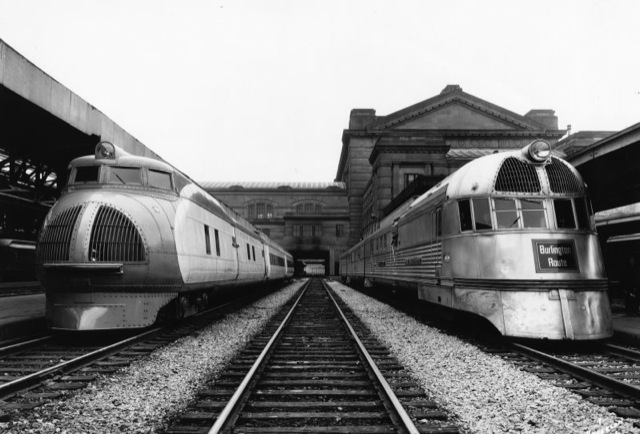
I hesitate to say "unlike anything." In Trains, William D. Middleton characterized the train's appearance as a cross between Union Pacific's M-10000 and a Boeing 707.

The Union Pacific bullet train is at left. The Pioneer Zephyr at right might have inspired the slanted nose that is on the more recent trains.
And I have to quibble about that "innovative propulsion design." In the words of the report, "...engineers placed electric drive motors in each of the train's cars."
You must remember this. There are reasons I call the Electroliner the Mother of All Bullet Trains.

And the same concept is in electric multiple unit sets worldwide.

The original bullet trains offered a full dining car, something that may not be cost-effective given the shorter running times of the accelerated trains today. Perhaps a snack bar serving drinks and light meals would be more useful.

Maybe instead of dancing elephants and giraffes, Pokemon characters?
Clear signals and fast tracks ahead.
A few items in the essay call for additional clarification.
"When the Shinkansen first appeared, it was unlike anything people had seen before. So they simply referred to it by the shape of its design."
I hesitate to say "unlike anything." In Trains, William D. Middleton characterized the train's appearance as a cross between Union Pacific's M-10000 and a Boeing 707.
Omaha, Nebraska
Unattributed photograph courtesy Streamliner Memories.
The Union Pacific bullet train is at left. The Pioneer Zephyr at right might have inspired the slanted nose that is on the more recent trains.
And I have to quibble about that "innovative propulsion design." In the words of the report, "...engineers placed electric drive motors in each of the train's cars."
You must remember this. There are reasons I call the Electroliner the Mother of All Bullet Trains.
Norwich Street, Milwaukee, September 1958.
And the same concept is in electric multiple unit sets worldwide.
The original bullet trains offered a full dining car, something that may not be cost-effective given the shorter running times of the accelerated trains today. Perhaps a snack bar serving drinks and light meals would be more useful.
Maybe instead of dancing elephants and giraffes, Pokemon characters?
Clear signals and fast tracks ahead.
WHY POLITICS DIVIDES AND TRADE UNITES.
The Technocratic Vision is that Good Government means Good Intentions and Expertise. Betsy Newmark doesn't see it in practice.
Here's an essay by Charles Blahous for the Manhattan Institute that explains why expertise is unlikely to produce a lasting resolution through government policy. It's well understood by economists who advise politicians that given a choice of A, which precludes some of B, or B, which precludes some of A, the politician will wish for both (or, with President Truman, for a one-handed economist). But to get legislation passed may require the imposition of A or of B. In his essay, 40 percent of the population each strictly support A or B.
For over a century, liberals have put forth the idea that they have good intentions to help people and when you put those intentions together with running the government through the benevolent actions a disinterested experts, they could achieve great things. Unfortunately, the results don't bear out these assumptions.The fundamental problem, dear reader, is that Governance requires either Consensus, which is unlikely, or Compromise, in which everybody hopes to get everything, but in practice, either nobody gets anything, or the resolution gets deferred, in a way that might be more costly later.
Here's an essay by Charles Blahous for the Manhattan Institute that explains why expertise is unlikely to produce a lasting resolution through government policy. It's well understood by economists who advise politicians that given a choice of A, which precludes some of B, or B, which precludes some of A, the politician will wish for both (or, with President Truman, for a one-handed economist). But to get legislation passed may require the imposition of A or of B. In his essay, 40 percent of the population each strictly support A or B.
An ethically defensible solution would be for public policy makers to choose either A or B, explain the trade-off, and make the case for their preferred choice. This would likely draw the support of at least 40 percent of voters, plus some fraction of the 20 percent that could understand and accept a persuasive explanation of the trade-off.Put more forcefully, individual action might often be more effective at solving individual problems, than collective action is at addressing some aggregation of those problems.
But even this is not the optimal solution. The optimal solution would be to allow those voters who want A to choose A and those voters who want B to choose B, and have the government not attempt to steer either choice. Then at least 80 percent of voters will be happy.
The diverse public attitudes that [Josh] Barro/[Jonathan] Gruber assert require the government to lie in fact argue instead for greater freedom of consumer choice. The progressive agenda of having the government determine answers for everyone introduces the supposed contradictions and incoherence into national health policy.
A MODEL IS ONLY AS GOOD AS ITS EQUATIONS.
Last month, I noted that climate modelling that leaves out the equations of motion for heat flows in the ocean might produce dubious forecasts. Calibration is like that. And thus, there are opportunities for further research.
The biggest mystery in climate science today may have begun, unbeknownst to anybody at the time, with a subtle weakening of the tropical trade winds blowing across the Pacific Ocean in late 1997. These winds normally push sun-baked water towards Indonesia. When they slackened, the warm water sloshed back towards South America, resulting in a spectacular example of a phenomenon known as El Niño. Average global temperatures hit a record high in 1998 — and then the warming stalled.There's nothing wrong with something being amiss in the models, as long as the models provide a better explanation of reality than a coin flip, and as long as the models aren't misused. There is nothing wrong with a scientific tool having large out-of-sample forecast errors, as long as that tool isn't being used as a guide to public policy.
For several years, scientists wrote off the stall as noise in the climate system: the natural variations in the atmosphere, oceans and biosphere that drive warm or cool spells around the globe. But the pause has persisted, sparking a minor crisis of confidence in the field. Although there have been jumps and dips, average atmospheric temperatures have risen little since 1998, in seeming defiance of projections of climate models and the ever-increasing emissions of greenhouse gases. Climate sceptics have seized on the temperature trends as evidence that global warming has ground to a halt. Climate scientists, meanwhile, know that heat must still be building up somewhere in the climate system, but they have struggled to explain where it is going, if not into the atmosphere. Some have begun to wonder whether there is something amiss in their models.
WAR IS THE HEALTH OF THE STATE.
Yes, that's a bromide. Reason's Sheldon Richman recommends the latest corollary proposition, Foreign Intervention as Experimentation in State Control. Sample:
Foreign interventions serve as a testing ground for domestically constrained governments to experiment with new forms of state-produced social control over distant populations. Intervening abroad allows governments to circumvent many of the domestic constraints that end at the nation’s geographic borders. The relative weakness or altogether absence of international constraints allows members of the intervening government to develop and hone new methods of control over citizens. Under certain conditions, these innovations in social control are then imported back to the intervening country through several channels that change the costs and benefits associated with expanding the scope of domestic government activities. The result is that the intervening government becomes more effective at controlling not only foreign populations but the domestic population as well.Thus, there's more than "moral equivalent of war" or "we had the will to win a war in Europe, why not a war on drugs?" in the upward ratcheting of government activity.
MICHIGAN SEEMS LIKE A DREAM TO ME NOW.
So they loaded up the truck and moved to Beverly. Hills, that is. Until California Dreamin' became a nightmare.
But you had to know it was going to come apart when somebody incorporated a community as Los Altos Hills.
"We have a Mediterranean paradise in the Bay area," says James S. Fay, a retired political scientist at California State University, East Bay, "and an economic drought and very hard times in other parts of the state."That Mediterranean paradise, however, isn't what it used to be.
This reflects national trends, which isn't surprising because national trends almost always start here or are starker here. A state that pioneered progressivism in the beginning of the 20th century and modern conservatism in the second third of the last century is living out the divide between rich and poor -- and the crisis of the middle class -- in ways that are more dramatic than elsewhere, but that might herald what will happen elsewhere.
For generations, San Francisco was a bohemian magnet congenial to, in turn, socialism, labor activism, literary daring, drug abuse, cultural escape and digital innovation. Today, monthly rents for small apartments here are roughly the same as the price of a serviceable used car in the Midwest.Put another way, it is no longer the Haight Ashbury California of Jefferson Airplane or the middle-class youth California of the Beach Boys.
"California is not an alternative place to live anymore," says Kevin Starr, a University of Southern California historian and former state librarian who has written a celebrated eight-volume history of the state. "You don't come to California to drop out anymore. You come here to compete in a culture that is upwardly mobile and wealthy."
California dreamin' -- the phrase comes from The Mamas and the Papas song written in New York a half-century ago -- is a peculiar strain of the American Dream. It is rooted in a state that is both a geographical location and a cultural idea -- and a cultural ideal, expressed in the transformation from Sutter's Mill to Silicon Valley in five generations, and from Jack London's "Call of the Wild" to James Collins' "Good to Great" in three.That's just spatial arbitrage. California -- or any other desirable location -- becomes so popular that nobody goes there anymore when that popularity manifests itself in property values, gated communities, and chartered buses for the most creative computer wizards.
For decades people came here to grow rich (the 1849 Gold Rush), to fulfill their dreams (Hollywood), to find middle-class prosperity (the aviation industry that grew up around Los Angeles during and after World War II), to escape privation (the Okies), to talk dirty (the podiatrist's son Lenny Bruce), to identify new cultural icons (seeing the Kingston Trio at the Hungry i before your friends ever heard of them), to live openly without apologies (gays along Castro Street in San Francisco) or to experiment with drugs or alternative lifestyles (Haight-Ashbury).
But you had to know it was going to come apart when somebody incorporated a community as Los Altos Hills.
19.11.14
THE HECK WITH WEEKNIGHT FOOTBALL.
A University of Toledo fan sums it up.
Quick! Name the six Division I, er, FBS teams with more than fifty wins since 2010. The ones that come to mind most quickly play on Saturday. So do Wisconsin, Notre Dame, and USC.
We love watching our team on national TV so the mid-week games give us that opportunity, but we hate the later-than-usual kickoffs and seeing the stands nearly empty. Mid-week games are difficult to attend for season ticket holders that may have work/family obligations and for students to attend who may have class or work/family obligations as well. The decreased ticket sales are off-set by the revenue from the TV contracts, but shots of the empty stands are broadcast to potential commits across the country and does not fairly represent the game day atmosphere that is present at most regularly scheduled (read: 7pm kickoff, Saturday) Toledo football games. All things being equal and from a pure fan perspective, we like our football games on Saturdays where they belong.Indeed.
Quick! Name the six Division I, er, FBS teams with more than fifty wins since 2010. The ones that come to mind most quickly play on Saturday. So do Wisconsin, Notre Dame, and USC.
PRETENDERS.
I watch MSNBC so you don't have to. A few days ago, Ed Schultz experimented with bringing Dana Loesch into a panel featuring nodding-heads Krystal Ball and Korey Hebert.
The segment aired before MIT's Jonathan Gruber became a household word for spinning public policy badly. But a full-on welfare-theoretic analysis of a health insurance reform isn't going to be easy. The reform had no hope of being a Pareto improvement. (Pareto improvements are simple enough to act upon that markets do so routinely, and state action to exploit a Pareto improvement generally isn't controversial.) The professor had to engage in those wisecracks about exploiting ignorance to get the bill passed, because no way could the people doing well under the existing institutional arrangements for health insurance bribe the beneficiaries of the new law from not making the change, nor could the beneficiaries compensate those who preferred the status quo for the change.
That's way too wonkish for a cable talk show, even one that few people watch, and as one might expect, it deteriorated quickly.
How did it break down?
First, Mr Schultz wanted to exploit a Congressional Budget Office study that suggested more people now have insurance. That's a misleading aggregate, as that population includes both people who now have insurance who previously didn't, as well as people who have less insurance than they used to, and people who had to buy more insurance than they once did.
The received wisdom, according to a player coached by Don Morton who is 0-3 against Scott Walker, is that it's OK for some people to lose their plan, either because they were participating in "junk" insurance, or because their physicians withdrew from the network their carrier paid for.
Try this: a few people who didn't have cars now have basic Fords, but some people who had Smart Cars had to give them up for a Corolla complete with a child-restraint seat in the back, and some owners of crew-cab pickups discovered they couldn't drive them on some streets. Improvement in net economic welfare?
Then his guest, Dr. Hebert, committed the "if only one person" fallacy, arguing it is fine that some people are pushed out of coverage (per corollary, is it desirable that some hospitals close?) because a few people that didn't have coverage now do.
But in the weird world that is the Ed Show, moral preening is more important than, oh, increasing economic welfare.
The segment aired before MIT's Jonathan Gruber became a household word for spinning public policy badly. But a full-on welfare-theoretic analysis of a health insurance reform isn't going to be easy. The reform had no hope of being a Pareto improvement. (Pareto improvements are simple enough to act upon that markets do so routinely, and state action to exploit a Pareto improvement generally isn't controversial.) The professor had to engage in those wisecracks about exploiting ignorance to get the bill passed, because no way could the people doing well under the existing institutional arrangements for health insurance bribe the beneficiaries of the new law from not making the change, nor could the beneficiaries compensate those who preferred the status quo for the change.
That's way too wonkish for a cable talk show, even one that few people watch, and as one might expect, it deteriorated quickly.
How did it break down?
First, Mr Schultz wanted to exploit a Congressional Budget Office study that suggested more people now have insurance. That's a misleading aggregate, as that population includes both people who now have insurance who previously didn't, as well as people who have less insurance than they used to, and people who had to buy more insurance than they once did.
The received wisdom, according to a player coached by Don Morton who is 0-3 against Scott Walker, is that it's OK for some people to lose their plan, either because they were participating in "junk" insurance, or because their physicians withdrew from the network their carrier paid for.
Try this: a few people who didn't have cars now have basic Fords, but some people who had Smart Cars had to give them up for a Corolla complete with a child-restraint seat in the back, and some owners of crew-cab pickups discovered they couldn't drive them on some streets. Improvement in net economic welfare?
Then his guest, Dr. Hebert, committed the "if only one person" fallacy, arguing it is fine that some people are pushed out of coverage (per corollary, is it desirable that some hospitals close?) because a few people that didn't have coverage now do.
But in the weird world that is the Ed Show, moral preening is more important than, oh, increasing economic welfare.
Doing good is often harder than do-gooders realize, but doing good is also more about the doing and the doer than it is about the good. Too often, as a result, liberals are content to treat gestures as the functional equivalent of deeds, and intentions as adequate substitutes for achievements.That is, if there even is a hint of this increased participation in insurance.
It turns out [insurance reform] did neither. It created more uninsured people than it gave insurance to. And it promises to create even more.Ed Schultz, if you believe that extending coverage to a few people while more people lost the coverage they preferred is a social gain, you can just keep on pretending.
EMPTY THE COACH YARDS, THANKSGIVING IS COMING.
Although Amtrak remains chronically short of coaches, the carrier will be adding trains in the Chicago regional area, particularly on the routes that serve numerous colleges.
This season, the Michigan services will feature an additional Kalamazoo turn commencing Wednesday from Chicago, last trip to Chicago on the Monday after; an Ann Arbor turn out of Chicago Wednesday, Black Friday, Saturday and Sunday; and a Chicago and Holland turn on the Pere Marquette Wednesday and Sunday. The Kalamazoo turn lays over in Kalamazoo, but on-time turns of the Ann Arbor and Holland trains depend on Norfolk Southern providing clear paths between Chicago and Porter.
The Sunday Illinois services will again see modified schedules of the Quincy trains to provide a third, mid-day trip each way (there are enough passengers on this service that chartering the Nebraska Zephyr, appealing though that might be to the ferroequinologist, and morning departures at each end of the Alton Route moved forward so as to turn a rake quickly for an additional train on that line.
This season, the Michigan services will feature an additional Kalamazoo turn commencing Wednesday from Chicago, last trip to Chicago on the Monday after; an Ann Arbor turn out of Chicago Wednesday, Black Friday, Saturday and Sunday; and a Chicago and Holland turn on the Pere Marquette Wednesday and Sunday. The Kalamazoo turn lays over in Kalamazoo, but on-time turns of the Ann Arbor and Holland trains depend on Norfolk Southern providing clear paths between Chicago and Porter.
The Sunday Illinois services will again see modified schedules of the Quincy trains to provide a third, mid-day trip each way (there are enough passengers on this service that chartering the Nebraska Zephyr, appealing though that might be to the ferroequinologist, and morning departures at each end of the Alton Route moved forward so as to turn a rake quickly for an additional train on that line.
A CONSENSUS AGAINST THE RENT-SEEKERS?
The Tea Party might be yesterday's news, and more than a few observers still see libertarians as diplomatic cover for potheads and dopers. All the same, the results of the recent midterm election have provoked some thinking about what sort of corrective the electorate seek. (In my view, the people who didn't vote also matter: they might not have seen anything worth voting for, and parties seeking to increase their vote can do so, and increase turnout in train, by identifying what voters might prefer.
From the left, Isaiah Poole suggests the "populist and broadly progressive" majority slept through it all. But in his lament is a recognition that Government is not automatically For the People.
From the right, Maggie Gallagher envisions a conservative populism, which she strains to distinguish from libertarian populism.
Jay Rosen suggests that observers might want to get past the idea that "governing" is the same thing as "passing legislation."
From the left, Isaiah Poole suggests the "populist and broadly progressive" majority slept through it all. But in his lament is a recognition that Government is not automatically For the People.
Of course there are a lot of people who lack faith that government can get things done, and mistrust that government can once again be a good steward of the dollars it deducts from increasingly stressed paychecks. That is where bold progressive populist leadership comes in, to unmask the special interests that capture agencies and politicians, to call out the obstructionists who stand in the way, to highlight the things that work in spite of it all – and to open the public’s eyes to ways we can build a nation of shared prosperity.There are elements of that passage the most cynical adherent of public choice theory would enthusiastically concur with. And perhaps a modest and limited set of public actions might be a way to credibly commit government to being a good steward of dollars. (We'll leave changes in the withholding rates as a way of reducing that stress for another day.)
From the right, Maggie Gallagher envisions a conservative populism, which she strains to distinguish from libertarian populism.
Conventional conservatives are going to sound a lot alike, and I predict most will say little that sounds new or gripping to the average voter. Our ideologies are disconnected from ordinary voters’ lives. But this in itself is a clear opportunity, one that some candidate is likely to figure out and seize, to demonstrate that the conservative Republican base is not really libertarian. At the core of our concern is the value of hard work, innovation, and economic growth that reaches down to the average American family.There's nothing in the above that a libertarian would find a deal-breaker. Certainly a left-populist might favor breaking up the money center banks (and applying the same medicine to other too-big-to-fail companies) as she proposes; the libertarian might advocate shutting down the Federal Reserve, a bit of Jacksonian populism that might play well in parts of the left. Again, though, a modest and limited set of projects for government.
What might this new conservative populism look like? Its distinguishing characteristic will be seriousness about creating the economic conditions that raise the standard of living of the middle class, and a willingness to violate pure libertarian symbolic policies to get there.
Call it a coalition of the hardworking (janitors, waitresses, dentists, small-business owners and entrepreneurs) against the emerging coalition of cronies who prefer to work Washington relationships and siphon off bundles of cash.
Jay Rosen suggests that observers might want to get past the idea that "governing" is the same thing as "passing legislation."
Asserted as a fact of political life, “Republicans must show they can govern” is a failure of imagination, and a sentimentalism. It refuses to grapple with other equally plausible possibilities. For example: that declining to govern will produce so much confusion about lines of responsibility and alienation from a broken political system that voters can’t, won’t, or in any case don’t “punish” the people who went for obstruction.Perhaps the voters who voted were not in favor of Doing Anything More, and at least some of the eligible voters who didn't vote didn't see that What Was Done worked. If What Was Done had more than a little rent-seeking in it, all the better.
WE DO MORE WITH LESS, AND WE DON'T MEAN THAT IN A LOVING WAY.
At West Virginia University, a new productivity measure has faculty members policing their own offices, and separating their recyclables, just like at home. An Inside Higher Ed post suggests the policy has done nothing for morale, although commenters suggest there are more important things to become upset about, such as an out of control drinkin' - 'n - couch burnin' student culture.
At Norfolk Southern, doing more with less leads to a clogged railroad and legal proceedings. Thus far, nobody is noting the analogous breakdown of higher education, perhaps because what's gone missing hasn't mattered, yet.
It will.
At Norfolk Southern, doing more with less leads to a clogged railroad and legal proceedings. Thus far, nobody is noting the analogous breakdown of higher education, perhaps because what's gone missing hasn't mattered, yet.
It will.
18.11.14
AMTRAK PUSHES BACK.
The freight railroads have been delaying Amtrak all summer, and Norfolk Southern did a particularly bad job of getting my Capitol Limited to Pittsburgh.
There is a case on the freight railroads' obligations to Amtrak heading for the Supreme Court. There's also a Surface Transportation Board, holding a few of the regulatory powers once entrusted to the late, unlamented Interstate Commerce Commission.
In like manner, here is an opportunity for Passenger Rail advocates to mention to their representatives in Congress that Amtrak is incurring additional costs for substitute buses, hotels, and legal counsel in order that freight railroads can get their crews on short hours into terminals first. It's corporate welfare or a hidden subsidy or theft, depending on how you wish to describe it.
I will report on the results of the letters I send.
There is a case on the freight railroads' obligations to Amtrak heading for the Supreme Court. There's also a Surface Transportation Board, holding a few of the regulatory powers once entrusted to the late, unlamented Interstate Commerce Commission.
Amtrak filed the complaint under Section 213 of the federal Passenger Rail Investment and Improvement Act, which calls for the STB to initiate an investigation upon the filing of a complaint by Amtrak if the on-time performance (OTP) of an intercity passenger train falls below 80 percent for two consecutive quarters, according to an Amtrak press release.Surface Transportation Board hearings have in common with the old Interstate Commerce Commission a long lead time, and Fred Frailey at Trains notes that such proceedings are not to be entered into lightly.
Amtrak also has a federal statutory right to preference in the dispatching of intercity passenger trains before freight trains, Amtrak officials said.
"Due to persistent excessive delays caused by [Norfolk Southern] and CSXT freight train interference, the OTP of the Capitol Limited at its endpoint terminals was 2.7 percent for the quarter ending Sept. 30, down from an already substandard 33.6 percent the previous quarter," Amtrak officials said in the release. "The delays are continuing as Amtrak had to provide bus transportation between Toledo and Chicago for six days in October to better accommodate passengers when Capitol Limited trains had often been eight to 10 hours late."
This is the second such case Amtrak has filed under PRIIA Section 213. In 2012 it took Canadian National to task over unacceptable delays to the Illini and Saluki between Chicago and Carbondale, Ill. More than two years later, CN and Amtrak are still in the early stages. You get a flavor of the proceeding’s endless corridors of inquiry from this recent filing by Amtrak’s attorneys, the same Nossaman lawyers: “Any discovery directed by a Board decision on CN’s Second Motion to Compel Production and CN’s Appeal of the Board’s decision on CN’s first Motion to Compel can be produced once the Board issues its decisions on those Motions.” That’s correct, the case isn’t close to being argued because both sides are still busy collecting evidence from each other.Mr Frailey notes that Amtrak is likely to spend more in legal fees than it will ever recover in revenues or avoided compensation for delayed connecting passengers, for proceedings that will bring Charles Dickens and Jarndyce v. Jarndyce to mind. Here, dear reader, is opportunity to get involved politically. The pending Amtrak service to Rockford might have involved Illinois calling in favors with Union Pacific, and Senator Durbin explicitly called out Canadian National for its reluctance to work with Illinois and Amtrak.
Section 213 is obviously not a weapon to be used lightly. As we are seeing in the CN case, resolution can take years, and the STB is always free to side with the freight railroad. And Joe Boardman, Amtrak’s president, has no appetite to pick fights with his host railroads. On the other hand, the long distance name trains this year got slaughtered, and a continuation of this pattern into 2015 and perhaps beyond would clearly ruin the long-distance franchise. I would be surprised if more such cases, involving the Lake Shore, Empire Builder and California Zephyr in particular, were not in the works.
In like manner, here is an opportunity for Passenger Rail advocates to mention to their representatives in Congress that Amtrak is incurring additional costs for substitute buses, hotels, and legal counsel in order that freight railroads can get their crews on short hours into terminals first. It's corporate welfare or a hidden subsidy or theft, depending on how you wish to describe it.
I will report on the results of the letters I send.
THE POSTER BOY FOR THE FATAL CONCEIT.
Various writers for National Review have given MIT health economist Jonathan Gruber fifteen minutes of fame, but probably not of the kind he dreamed of in graduate school. Start with Charles Krauthammer, characterizing what might be imprecise seminar inside jokes as world-class cynicism.
Remember: The whole premise of Obamacare was that it would help the needy, but if you were not in need, if you liked what you had, you would be left alone. Which is why Obama kept repeating — Politifact counted 31 times — that “if you like your plan, you can keep your plan.”Wealth being redistributed precludes changes in the health insurance market being a Pareto improvement (in business jargon, win-win-win), but does not rule out a Marshallian improvement or a policy change that satisfies either the Hicks-Kaldor or the Scitovsky criterion for a gain in aggregate social welfare. That's a little wonkish for so late on a Tuesday football night. I will be returning to this point again, so come back again.
But of course you couldn’t, as millions discovered when they were kicked off their plans last year. Millions more were further shocked when they discovered major hikes in their premiums and deductibles. It was their wealth that was being redistributed.
NEW ADMINISTRATION, OLD RESULTS.
Chicago State University has long been an example of a subprime dropout factory. Five years ago, I linked to a Chicago Tribune editorial weighing in on a search for a new president, because the existing president had a very good gig. "Living like a Third World dictator and running an access-assessment-remediation-retention scam is nice work, if you can get it." That president, Elnora Daniel, took her pension and handed the mace and medallion to Wayne Watson, who had himself retired as chancellor of the City Colleges of Chicago. Five years on, Mr Watson lives like a Third World dictator and runs an access-assessment-remediation-retention scam that continues to hemorrhage students.
But de-recognizing the Faculty Senate is one of the plays in the Third World Dictator's Handbook, as is ignoring the advice from external advisors. (I actually have one and might get around to posting a review of it.)
The administrative failure to take the necessary steps to ensure compliance with the provisional requirements imposed on the university by the [U. S. Department of Education] will subject the school to possible termination of its ability to grant financial aid. How many students will we have then? How many students are going to register for courses on the west side if the school cannot provide them with financial assistance?The Department of Education did not invoke double-secret probation: the internal control problems in Chicago State financial aid have been a matter of public record since sometime in 2011.
But de-recognizing the Faculty Senate is one of the plays in the Third World Dictator's Handbook, as is ignoring the advice from external advisors. (I actually have one and might get around to posting a review of it.)
PROJECTION?
Bridget Johnson finds an instructive quote from our Secretary of State.
Declaring that [the Sillies] “cannot live on hate alone,” Secretary of State John Kerry declared today that stopping the terror group includes choking off the fertile recruitment grounds of “people who are gullible enough to believe that terrorists enjoy a glamorous lifestyle and pliable enough to do whatever they are told.”Given the view Democrat court intellectuals hold about Democrat voters, the Secretary might understandably be generalizing from his own experience.
17.11.14
THAT WEAK NATIONAL NETWORK.
It's my impression, from a recent rail journey, that the long-distance Amtrak trains are comfortable, if slow, but the national network is weak. Here's a recent Destination: Freedom essay elaborating on the point.

That looks like four trains each way between Chicago and Pittsburgh, three on the revised Norfolk Southern via Cleveland, and one via the traditional Baltimore and Ohio. But the Skyline Connection, intended as a mail train, never ran; the Three Rivers, because even Amtrak couldn't call that service the Broadway Limited, died with the end of some of the mail contracts, and the Pennsylvanian retrenched to its New York and Pittsburgh routing.
There is still upside potential in the long-distance network, but it may never be realized. And the freight carriers are likely to be pleased if it is not.
By contrast, in addition to the New York and Chicago schedules the essay mentioned, there were Washington and Pittsburgh schedules on Penn Central and Baltimore and Ohio, as well as Baltimore and Ohio's Capitol Limited on to Chicago, and New York or Washington and St. Louis schedules on Penn Central and Baltimore and Ohio in cooperation with Chesapeake and Ohio.
The Research Department is putting together an analysis of the Southeast that will appear soon.
Today’s network of long-distance trains is remarkably similar to the one that Amtrak initiated on May 1, 1971. The nation’s passenger-rail system was significantly smaller that day than it had been the day before. Two-thirds of the trains that left their points of origin on April 30th did so for the last time. Virtually all medium-distance trains disappeared, except for some on routes that have become state-supported corridors in California, Washington State or around the Chicago hub. Many long-distance trains died that day, as well.Yes, and those parts of the country in which the railroads had successfully dropped trains, most notably Dixie and Ohio, had few or no existing trains to preserve. The long-distance trains, despite having some of their intermediate stops eliminated, became part of the regional network, such as it was, although even the national network was much diminished.
On April 30, 1971, there were three trains between New York and Chicago on the historic Pennsylvania Railroad route through Philadelphia and Pittsburgh, and three on the historic New York Central route through upstate New York and Cleveland. The next day, only the Broadway Limited through Pennsylvania survived. It lasted until 1995. The Lake Shore Limited through Cleveland came back, ran for another 207 days beginning in June,1971, died again at the beginning of 1972 and came back permanently in 1975. For twenty years, there was a train between New York and Chicago on each route. Again today, only one train links the nation’s two largest cities.One-and-one-half, if one counts the Cardinal, which connects New York and Chicago by way of Charlottesville, Cincinnati, and Indianapolis. The Lake Shore, however, is all that is left of the New York Central side. On the Pennsylvania side, from two to nothing in under fifteen years.
Amtrak Form W23/65M effective May 21, 2000.
That looks like four trains each way between Chicago and Pittsburgh, three on the revised Norfolk Southern via Cleveland, and one via the traditional Baltimore and Ohio. But the Skyline Connection, intended as a mail train, never ran; the Three Rivers, because even Amtrak couldn't call that service the Broadway Limited, died with the end of some of the mail contracts, and the Pennsylvanian retrenched to its New York and Pittsburgh routing.
There is still upside potential in the long-distance network, but it may never be realized. And the freight carriers are likely to be pleased if it is not.
By contrast, in addition to the New York and Chicago schedules the essay mentioned, there were Washington and Pittsburgh schedules on Penn Central and Baltimore and Ohio, as well as Baltimore and Ohio's Capitol Limited on to Chicago, and New York or Washington and St. Louis schedules on Penn Central and Baltimore and Ohio in cooperation with Chesapeake and Ohio.
The Research Department is putting together an analysis of the Southeast that will appear soon.
OVERREACH IS GOOD
In my lifetime, midterm elections have significantly changed the makeup of the House or the Senate. Let's consider a few.
1974: Joe Biden elected to the Senate, and a number of the Democrats who took office that year remain in the leadership today. At the time, the pundit class interpreted the Democrat wave as a repudiation of Richard Nixon, who had stepped down in the aftermath of Watergate, despite an electoral wipeout of George McGovern in 1972.
1986: Rumbles of the Iran-Contra deal, and worries about rising national debt leads to Democrats regaining a Senate majority. I believe the 1986 tax code reform predated that election.
1994: Republican "Contract with America" might have prompted President Clinton to triangulate, thereby permanently antagonizing the True Believers in the Democrat left.
2002: Would President Bush have gone forward with regime change in Iraq without a larger majority in the House?
2006: The same President Bush describes the outcome as a "thumping". Democrats secure majorities in both House and Senate. It will be up to future researchers to determine whether fears of a less-incrementalist legislative agenda or lax monetary policy, or wishful thinking crashed the economy late in 2007.
2014: Republicans add to their House majority and establish a substantial majority in the Senate.
Perhaps in anticipation of that outcome, two New York Times columnists proposed to eliminate midterm elections.
1974: Joe Biden elected to the Senate, and a number of the Democrats who took office that year remain in the leadership today. At the time, the pundit class interpreted the Democrat wave as a repudiation of Richard Nixon, who had stepped down in the aftermath of Watergate, despite an electoral wipeout of George McGovern in 1972.
1986: Rumbles of the Iran-Contra deal, and worries about rising national debt leads to Democrats regaining a Senate majority. I believe the 1986 tax code reform predated that election.
1994: Republican "Contract with America" might have prompted President Clinton to triangulate, thereby permanently antagonizing the True Believers in the Democrat left.
2002: Would President Bush have gone forward with regime change in Iraq without a larger majority in the House?
2006: The same President Bush describes the outcome as a "thumping". Democrats secure majorities in both House and Senate. It will be up to future researchers to determine whether fears of a less-incrementalist legislative agenda or lax monetary policy, or wishful thinking crashed the economy late in 2007.
2014: Republicans add to their House majority and establish a substantial majority in the Senate.
Perhaps in anticipation of that outcome, two New York Times columnists proposed to eliminate midterm elections.
The main impact of the midterm election in the modern era has been to weaken the president, the only government official (other than the powerless vice president) elected by the entire nation. Since the end of World War II, the president’s party has on average lost 25 seats in the House and about 4 in the Senate as a result of the midterms. This is a bipartisan phenomenon — Democratic presidents have lost an average of 31 House seats and between 4 to 5 Senate seats in midterms; Republican presidents have lost 20 and 3 seats, respectively.What is the unstated premise: presidents never get their programs wrong?
WHERE THE JOBS ARE
One cannot have a flat world and agglomeration economies. A few years ago, I speculated that there would have to be negative space. "Before [the Rust Belt] was "flyover country" it was the territory the transcontinental de luxe trains crossed with their headlights on." (There's a longer version, with more detail, here). Now comes a DeKalb Daily Chronicle story out of Danville, Illinois, suggesting that spatial separation economic stratification appear to go together. Thus, the ambitious kids leave.
That noted, the Rust Belt communities would still like to keep some of their kids around.
Manufacturers that provided thousands of well-paying, middle class jobs — General Motors, General Electric, Hyster — were closing. Neighborhoods were crumbling. By the time [Tara] Holycross graduated from high school in 2004, a city best known for its massive downtown grain elevator and as the hometown of actors Dick and Jerry Van Dyke was scrambling to create new opportunities.I'll defer for another day discussion of whether a world in which people have to work fewer hours for the stuff they desire than used to be the case is an improvement or a step backwards from a world in which the wealth gaps were narrower. Perhaps there are new agglomeration economies in the financial and information technology sectors, or perhaps the emergence of two or three United States's worth of middle-class people in Asia, Latin America, and the former Soviet Bloc is a net loss to social welfare.
Ten years later, this city of 32,500 still is struggling. But Holycross and some of her classmates are doing just fine — because they moved.
They're doctors and athletic trainers, software specialists and financial advisers. They're living all over the country — from Chicago to Charleston, South Carolina, to Boulder, Colorado — where they found solid jobs that reward the kind of education they have. Though still early in their careers, they've surpassed Danville's median household income of $35,000 and expect to do much better. Holycross and four classmates interviewed said about half of their class of fewer than 50 left town, and those they're in touch with landed good positions.
"I knew there wasn't an opportunity for me to have my career" in Danville, said Holycross, 28, a third-generation native who now works as an athletic trainer for a hospital system in Beloit, Wisconsin, about 90 miles northwest of Chicago.
Their experience is a counterpoint to the desperation gripping so many rural and manufacturing communities in the Midwest that have been hard hit by global economic changes. The flow of educated workers from struggling communities to areas with brighter job opportunities might, to some extent, help shore up the U.S. middle class, which has been squeezed by a widening gap between the richest Americans and everyone else.
While Wall Street traders and software CEOs soared to enormous affluence, waves of people fell out of the middle class as manufacturing's share of the economy shrank. Following the downside arc of the wealth gap was inevitable for many who stayed in stricken factory towns where jobs disappeared. For others, though, escaping meant separating their own fate from that of their hometowns."Wealth gap" suggests that financialization, or perhaps the Big Cities, are the cause, not the improved living conditions for some of that Third World working class. The article suggests, though, that the opportunities to pick up and leave correlate with the human capital.
The trend of more-educated people moving and less-educated staying began to emerge several years ago. A Census Bureau study found that more than half of highly educated workers who moved between 2005 and 2010 left their counties. By contrast, 70 percent of people without high school diplomas who moved did so within the same county.On the other hand, we've noted previously the difficulty states that export human capital face in providing decent universities whilst sending graduates to other states. The article does not tackle this issue, although it notes the phenomenon.
Decades ago, many unskilled workers were able to migrate to capitalize on better conditions elsewhere, as when field workers moved from the South to the Midwest for factory jobs after World War II.
But good blue-collar jobs are now harder to find anywhere — one factor that may help explain why mobility overall has been declining for several decades and why it dropped sharply during the recession.
"If we pushed someone who's stayed in Detroit to suddenly hit the road and move to Chicago, would that person suddenly do better? Or has that person stayed behind exactly because he or she can't find a good-paying job in Chicago?" said Danny Yagan, a University of California economist who studies mobility.
A survey of nearly 3,000 2012 graduates of 15 public universities in Michigan — a state especially afflicted by manufacturing's decline — found that 37 percent were living in another state a year later. That was down from 49 percent in a similar 2007 survey. But those who did move were far more likely to have a full-time job: 86 percent compared with 68 percent of those who stayed put. And they tended to earn significantly more.Research is like that: it depends. (Note that the article describes "doctors and athletic trainers, software specialists and financial advisers," not tattoo artists, philosophy majors, teachers, or Feminist Studies specialists.)
Those who moved from Michigan to Illinois upgraded from a state median income below $47,000 to one over $55,000 in 2012. Research indicates that people who moved to places with stronger economies often do about as well as the workers already there. Less clear is whether such a move translates into more overall wealth or a better lifestyle.
That noted, the Rust Belt communities would still like to keep some of their kids around.
Danville's population has dipped by about 1,000 residents in the past 20 years. Whatever influx it has had has come mainly from lower-income people seeking cheap housing. The poverty rate has reached 29 percent, compared with 18.1 percent in 2000.Indeed not, and there might be some passages of Sinclair Lewis or F. Scott Fitzgerald or Sherwood Anderson to suggest that "doesn't really compare" might be about more than jobs.
Warehousing and distribution centers have replaced some of the manufacturing jobs. Local businesses are funding scholarships for students who agree to stay home after graduation.
But vacant and dilapidated homes scar big chunks of neighborhoods, the historic downtown still has scores of vacant buildings and unemployment is almost 10 percent. City officials are hoping legislators allow the city to build a casino to bring in more jobs.
"It's taken a long time to stabilize, and it will take years before we start moving in the next direction," said Mayor Scott Eisenhauer.
The situation is much the same in Flint, Michigan, where about 80,000 once worked in GM factories, but where the population has dropped from 200,000 to below 100,000 since most of those jobs dried up. Mayor Dayne Walling said his town's master plan now includes razing entire neighborhoods.
Struggling towns are emphasizing college and trade school to many young people, hoping that a higher-quality workforce will attract employers yet also aware that education makes it easier for young people to leave.
For Stephanie Shinn Gaydos, a 2004 high school graduate from Danville who now practices medicine in Charleston, South Carolina, moving back to Danville isn't an option.
"That's a shame because I'm close to my family," she said, "but I am so happy with the opportunities (in Charleston). It doesn't really compare.
TEND TO YOUR KNITTING.
I have long been sympathetic to the view that accrediting agencies exist to allow academic administrators and their fellow travellers on the faculty to remain comfortable with their prejudices. Whether I am being harsh or not, the accreditors have not covered themselves with glory in the emerging Tar Heel eligibility tar pit.
The events at UNC should remind us that accreditors exercise, at once, too much and too little power. Though perfectly willing to bully schools about matters that have little to do with academic quality, our regional accrediting agencies often fail to use their authority to fulfill their primary mission of quality control.The long march through the institutions has been one in which higher education has captured its regulatory bodies. The surprise would be if no further such scandals emerge.
It is clear by now that some change will be coming to UNC in the near future, and that is well and good. But if change doesn’t come to America’s broken accreditation system soon, we shouldn’t be surprised to see more scandals like this in the years to come.
THE TRUSTEES BACK DOWN.
Chicago State University's Faculty Senate is re-recognized by the trustees. There is still work to do. And plenty going on there that requires continued exposure.
THE CASE FOR BETTER PROOFREADERS.
The first team at the Milwaukee Journal-Sentinel must have been busy with the Packers. Somebody had to file a story on women's basketball, as there was a game Sunday. Thus, Big flurry by Badgers snows Cardinals under. Oh, did Ball State make a trip to Madison?
Wisconsin's opponent on Sunday was Illinois State, which the coach had right. "'It's nice to beat the tough, scrappy team (like) Illinois State,' Kelsey said."
Illinois State did play Northern Illinois, in DeKalb, on Friday evening.
For the philosophers: if a series of typographical errors go out into cyberspace, but nobody notices, are they really errors?
University of Wisconsin women's basketball coach Bobbie Kelsey had a pretty nice day of scoreboard watching.Last time I checked, Northern Illinois were Huskies, not Cardinals.
That's because her team opened up a 30-point lead in the second half and cruised to a 71-60 victory over Northern Illinois Sunday in their regular season opener at the Kohl Center.
The Badgers used a 20-3 flurry in the second half to snow the Cardinals under.
Wisconsin's opponent on Sunday was Illinois State, which the coach had right. "'It's nice to beat the tough, scrappy team (like) Illinois State,' Kelsey said."
Illinois State did play Northern Illinois, in DeKalb, on Friday evening.
Kelly Smith, women’s basketball freshman forward, didn’t expect to play 36 minutes in her first collegiate game.Right opponent, right nickname, wrong day. Redbirds thus had a rough trip through the State Line (that happened to more than a few football teams as well). Next up for Northern Illinois, Illinois-Chicago late on Monday afternoon.
Smith scored a game-high 17 points in those 36 minutes as the Huskies (1-0) beat the Illinois State Redbirds (0-1), 55-51, Saturday at the Convocation Center.
For the philosophers: if a series of typographical errors go out into cyberspace, but nobody notices, are they really errors?
16.11.14
RESTORING THE DOWN EASTER?
Among the Amtrak projects on the Cold Spring Shops wish list is an extension of the New England services. Once upon a time, the summer-season Bar Harbor carried sleepers from Philadelphia to Rockland, and the steam-era Down Easter and East Wind had cars from New York for Rockland.
These days, the Amtrak Downeaster offers a single-seat ride from Boston as far as Brunswick, and in the summer of 2014, the Maine Eastern offered connecting service to Rockland. "Now, about that roomette on the Rockland section of the Bar Harbor ..."
Ask, and perhaps you shall receive.
These days, the Amtrak Downeaster offers a single-seat ride from Boston as far as Brunswick, and in the summer of 2014, the Maine Eastern offered connecting service to Rockland. "Now, about that roomette on the Rockland section of the Bar Harbor ..."
Ask, and perhaps you shall receive.
There are no plans to expand regular commuter service to Rockland, but a company spokesman said Amtrak is always looking at opportunities to expand.Amtrak may always be seeking new business opportunities. Without ongoing support from Congress and some additional rolling stock, service extensions will be hard-won indeed. All the same, I would be delighted to report that there is a roomette available on the Rockland section of the Bar Harbor.
Amtrak spokesman Craig Schulz said Friday that the company was invited by Maine Eastern Railroad to tour the line that runs from Brunswick to Rockland. Amtrak provides service as far north as Brunswick.
Aboard the train were representatives of Amtrak, Pan Am Railways, Maine Eastern and the Maine Department of Transportation.
“The trip was informative and valuable,” Schulz said.
He said considerable discussions would be required and a lot of work done before Amtrak service could extend to Rockland.
ELECTIONS DO HAVE CONSEQUENCES.
Sometimes, though, the message might be "the Governed withdraw their Consent from further attempts at Governing us." To columnist Leonard Pitts, that's a bug.
It was the Year of No Ideas. The Democrats had nothing to say and said it ineptly, running from the achievements of recent years — the Affordable Care Act, falling unemployment rates, a soaring stock market — and the president who presided over them like Usain Bolt from a house fire, defending themselves from Republican attack about as effectively as the Iraqi Army defends Iraq. Which is to say, not very. The party presented no compelling argument for itself. It didn't just lack the courage of its convictions; it also lacked its convictions.It's not necessary to resort to such hyperbole to point out Our President's detached governing style or misguided policies. On the other hand, we might not be seeing the typical whining Dennis Prager suggests is coming from people making arguments along the lines Mr Pitts takes.
The Republicans also had nothing to say, but they said it loudly and with great certitude: "Obama caused Ebola! Obama caused ISIS! Obama is going to give your job to an illegal! GOP: 2014!"
Since last Tuesday’s elections, commentator after commentator on the Left has declared American politics “dysfunctional.” When Democrats win by a landslide, the Left regards the vote as testimony to the great message of the Left and the good sense of the American people. Only when Republicans win by a landslide does the vote reflect dysfunction.Or, perhaps, ignorance about what systems of governance are supposed to do. Tyrannical government is effective government, all too often effective at doing the wrong things. Representative republics, no matter the system of voting or the system of representation, sometimes require the withdrawal of some consent in order for the powers the government exercises to be considered just. I have a longer post along these lines coming; for tonight, consider Ira Stoll's suggestion that sometimes the voters want their representatives to "do no harm."
Call me a contrarian, or accuse me of low expectations, but my idea of a successful Republican Congress isn’t one that passes 10 new laws. It isn’t one that passes six new laws, or five. In fact, we’d probably be lucky to get away with a Republican Congress that abstained from law-passing altogether.That column hit the internet before news of MIT's Jonathan Gruber describing bounded rationality and welfare economics badly to audiences of economists did. And thus, there is a strong possibility that legislation isn't even intended to improve matters, other than by tricking people. More anon.
We’ve got more than enough laws already. So many, in fact, that it’s basically impossible for an American individual or business who wants to abide by the law to keep track of all of them.
Don’t get me wrong. I’d be happy enough if a new Congress repealed some of the old bad laws. I suppose they need to pass some budget to keep the soldiers from going barefoot. In my ideal world, there’d be some legislation cutting taxes, reforming welfare, increasing legal immigration, allowing oil and liquid natural gas exports, and reducing government spending and bureaucracy.
But setting “zero” as at least the symbolic goal for new laws in the new Congress would have the virtue of being humble.
It would be a signal that Congress understands the law of unintended consequences: that actions intended to improve matters may wind up making them worse in ways initially unimagined.
WORK-LIFE SEPARATION.
I've long suggested that there are limits to how much work people will take on to the exclusion of enjoying the fruits of their labors. But if less stressful working lives are not purely an emergent phenomenon, perhaps the knowledge that being on call all the time is bad for your health will change a few minds. There's even a new term of art, telepressure, and Northern Illinois psychology professor Larissa Barber estimates the unintended and unanticipated consequences.
Thus, dear reader, if you have to deal with colleagues whose greeting is more often "did you get my e-mail" than "How about those Packers," print off the description of the study, or the abstract of the study, and distribute it to those people.
“Over the past few decades, we’ve seen organizations increasingly rely on email or text messages for conducting business,” Barber says. “The main benefit is that employees have lots of flexibility about when they can work, including at home.Reason suggests that there is grant money available from the German government for such research.
“But this flexibility can sometimes have unintended costs,” she adds. “Employees start to feel like they should be available and responsive to work requests at all times. This type of continuous connection does not allow people enough time to recover from work.”
European labor unions, in particular, have raised concerns about the time spent by employees answering work emails outside of traditional working hours. This has prompted the German government to commission a study assessing the economic and psychological cost of workplace stress, with possible legislation to follow.Their suggestion: avoid one-size-fits-all legislation. I think, though, that there are ways for professionals, customers, and labor organizations to distinguish genuine emergencies from ordinary annoyances. Physicians and plumbers understand what it means to be on call, and can set up duty rosters accordingly. The deputy assistant-to that is crashing on a presentation at the last minute might benefit from the occasional "Give it a rest" or an electronic mail languishing until the next morning.
Thus, dear reader, if you have to deal with colleagues whose greeting is more often "did you get my e-mail" than "How about those Packers," print off the description of the study, or the abstract of the study, and distribute it to those people.
13.11.14
THE RAILROADS' VICTORY.
I confess to seeing too much Albert Speer in the National World War II Memorial.
And yes, the dedication stone continues today's fashion for the excessively grandiloquent.

Viewed in isolation, the arches and columns do have that Albert Speer quality about them.

But on that same trip, I arrived at and later departed from Washington Union Station, and then the penny dropped.

I wonder if the designers of the World War II Memorial had Union Station in mind at all. Daniel Burnham well-predates Albert Speer, and those colums may predate Franklin D. Roosevelt.
If there is an allusion to Union Station, and to the railroads, in that monument, it is apt.
One day during the 1944 Christmas rush, nearly four hundred thousand people, many of them in service, passed through Pennsylvania Station in New York.

And as part of the U.S. war effort, any recruit or trooper travelling more than four hundred miles went Pullman.

That's not to mention the tons of raw materials headed to the various assembly plants and the guns, tanks, jeeps, locomotives, rations, medical supplies and more than a few landing craft billed to the ports.
And yes, the dedication stone continues today's fashion for the excessively grandiloquent.

Viewed in isolation, the arches and columns do have that Albert Speer quality about them.

But on that same trip, I arrived at and later departed from Washington Union Station, and then the penny dropped.

I wonder if the designers of the World War II Memorial had Union Station in mind at all. Daniel Burnham well-predates Albert Speer, and those colums may predate Franklin D. Roosevelt.
If there is an allusion to Union Station, and to the railroads, in that monument, it is apt.
One day during the 1944 Christmas rush, nearly four hundred thousand people, many of them in service, passed through Pennsylvania Station in New York.
New York Pennsylvania Station, July 1944.
And as part of the U.S. war effort, any recruit or trooper travelling more than four hundred miles went Pullman.
Unidentified troop train courtesy Kingly Heirs.
That's not to mention the tons of raw materials headed to the various assembly plants and the guns, tanks, jeeps, locomotives, rations, medical supplies and more than a few landing craft billed to the ports.
Subscribe to:
Posts (Atom)