Showing posts with label ferroequinology. Show all posts

8.9.26

THERE'S A PROTOTYPE FOR EVERYTHING.

Illinois Railway Museum operated its night trains Saturday and Sunday.  The "coach train" included several of the usual heavyweight coaches, plus sleeper lounge Villa Real, dining car Galt House, not carrying passengers; and ten section observation Inglehome.  Power for the evening was a recently acquired Amtrak F40PH with Operation Lifesaver additional markings.


I wonder if George Gershwin got the idea for Rhapsody in Blue while riding a twelve-wheeled heavyweight car.  Inglehome had a drumhead for the evening.


I could put together a reasonable facsimile of this train, perhaps with a rainbow of paint jobs, and have it orbiting the basement during the upcoming open days.

Hicks Car Works have two photo albums featuring the daytime Saturday operations.

4.9.26

OUR SILVER JUBILEE YEAR BEGINS.

Cold Spring Shops opened for business on the afternoon of Tuesday, 5 September, 2002, the day after Labor Day.  Our Silver Jubilee year will thus commence during the long weekend.


Britain's investor owned railways recognised the Silver Jubilee of King George V with a train named, er, titled, as they have it there, Silver Jubilee and a series of mixed traffic locomotives named for the countries and colonies of the Dominion and the Commonwealth and for prominent figures or events.  Canadian Pacific got in on the honours with two classes of 4-4-4 fast passenger locomotives.  A representative of the smaller series occasionally polishes the rails at Cold Spring Shops headquarters.

We'll see what the upcoming year brings.  There are a lot of things I carried on about early on that I can still carry on about, although I cannot characterize all the developments of the past quarter century as for the worse.

3.9.26

AROUND, NOT THROUGH, MAJOR CITIES.

A city produces and receives a lot of rail traffic.  It's also not the best place to sort freight cars or interchange them, which was the rationale for Canadian National acquiring Elgin Joliet & Eastern to connect all four coasts of North America without going through Chicago, and it was the hope behind the ill-conceived Great Lakes Basin railroad of a few years ago.

The same logic works in the steppes of Central Asia.  "Construction of a 127 km railway bypass to divert freight traffic including hazardous goods away from Ulaanbaatar is progressing."  The avoiding line transits the Khushig river valley between Emeelt and Bagakhangai.  I'm not sure how planned Mongolia's economy is some thirty years after their freedom from the Evil Empire: the railway will expedite the passage of trade goods between China and Siberia, and perhaps divert traffic off the roads.  "Once completed, the bypass is expected to remove up to 1 800 heavy lorries per day from Ulaanbaatar’s roads. It is initially designed to handle around 3.5 million tonnes of freight annually, with capacity potentially increasing to 20 million tonnes."  We're talking about a single track avoiding line with three passing sidings, not the double tracking of the Chicago Outer Belt that Canadian National have been undertaking.

And yet, it is refreshing to read about a railway project that is taking place and is not some hero project for fast passenger trains.

5.8.26

RESTORING THE CLASSIC WOODEN INTERURBAN.

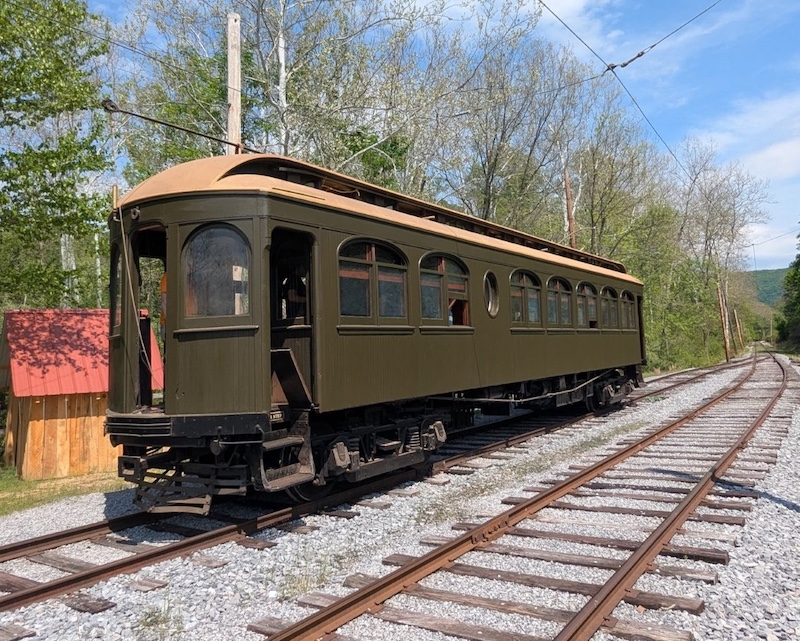
After abandonment, the wooden cars of the Chicago Aurora and Elgin could be obtained cheaply, and Kuhlman car 315 made its way to the Rockhill Trolley Museum, which operates on a stretch of East Broad Top Railroad track, and after years of deliberation, that museum has been restoring that car to its as-built appearance.


We recently noted Jewett-built car 316, similarly backdated, with a different paint scheme, at our nearby Fox River Trolley Museum.


Another Jewett car, 320 at the Old Threshers grounds in Mt. Pleasant, Iowa, has also had its arch windows restored.

The Old Threshers hold their annual gathering Labor Day weekend, and the other preservation railways will be operating as summer winds down.

After Labor Day, the vintage cars might be back in the car barns for winter work.  Enjoy the remaining days of the preservation railway season.

1.8.26

AMTRAK, THIS IS NOT GOOD ENOUGH.

In the wintertime, in the summertime, ain't we got fun?
Travelers who count on Amtrak long-distance trains to reach far-flung destinations continue to be disappointed by reliability issues this summer, often because of factors not under the passenger operator’s control.

Of late, the issues have been particularly pronounced for the Empire Builder and California Zephyr.
Seven, four hours delay on 24 July account failures of assigned and replacement locomotives; storms on 27 July lead to three hours of delay before reaching Glenview;  unexpected delays stretching to over two hours reaching Brookfield on 28 July.

14.7.26

DOES ANYBODY KNOW WHAT TIME IT IS?

Fittingly, a troupe that debuted as Chicago Transit Authority (the eponymous agency brought legal action to get that name changed) asked that question.  For years, the South Shore Line, properly the Chicago South Shore and South Bend, issued all-year-around printed timetables, advising that all published times shown were those in effect in Chicago.  When both Indiana and Illinois were on Standard Time, the South Bend passenger had to mentally add an hour; for that part of the year when Illinois and the Indiana Region observed Central Daylight Time, the South Bend passenger might not have had to make any changes, as Indiana was far enough west in the Eastern Time Zone for those counties on Eastern Standard Time to stay on Eastern Standard Time.  Those changes might not have inconvenienced too many passengers on the east end of the railroad, as, well into the 1960s, the railroad offered a memory pattern schedule with hourly South Bend Limiteds, with Gary Expresses on the half hour.  Conditional and positive stops for the morning Limiteds sufficed to serve any passengers from LaLumiere or Hudson Lake or New Carlisle for Bendix or downtown South Bend.  These days, the conditional stops are gone, although with all trains pulling out of Michigan City to form South Bend departures, there are morning departures for any local passengers so inclined.

Conditions were more complicated on the North Shore Line, the much-lamented and more than a little bit missed Chicago North Shore and Milwaukee.  Yes, the railroad operated entirely in the Central Time Zone.  After the War, though, Illinois observed Daylight Saving Time whilst Wisconsin did not.  So much for agricultural interests favoring Daylight Saving Time.  The cock crows at sunup, irrespective of what's on the clock, and farm kids know about morning chores before they head off to school.  Thus, when Wisconsin did adopt Daylight Saving Time, that ended on the final Sunday in September, whilst Illinois stayed with it until the final Sunday in October.

13.7.26

RAILROADS, CONNECTING PEOPLE.

Union Pacific's Semiquincentennial Steam Tour cheered up Northeasterners.  Trains posted a photo gallery, complete with a photograph that longtime editor David P. Morgan would surely have hailed, showing the articulation principle at work, with the lead engine helping Big Boy bend the corner around.


Steve Smedley photograph retrieved from Trains Magazine.

Big Boy and Reading and Northern T-1 Northern 2102, a different sort of War Baby, ran a side by side excursion in advance of Big Boy's visit to Steamtown and an Independence Day event in Philadelphia.  The excursion also acknowledges the 1976 American Freedom Train, as sister engine 2101 was on the head pin east of Chicago.

10.7.26

NO MIRACLE, ONLY PREPARATION.

Rideshare users bore the brunt of World Cup’s opening-night travel mess. Organizers say the plan worked.  The XXVIII International Eucharistic Congress this wasn't.
The World Cup’s opening night in New Jersey ended with hundreds of fans stranded outside MetLife Stadium in East Rutherford past midnight, wandering the grounds in search of rideshares that couldn’t reach them.

On Sunday, the organizers responsible for getting them home said the plan worked.

Uber, the local World Cup host committee and NJ Transit each framed Saturday’s result as a qualified success — while pointing in different directions to explain why fans were still waiting for rides three hours after Brazil and Morocco played to a 1-1 draw.

The host committee called its transportation efforts “very successful,” according to a source with knowledge of the planning, while acknowledging “some issues getting people back late.”
When the process is the most important product, that's the way things go.
NJ Transit moved 21,578 fans by bus and rail in 90 minutes — a number the agency trumpeted on social media Saturday night but one that fell well short of its own target of up to 40,000 riders.

The source close to planning said NJ Transit proved its “efficiency” but said part of the reason for the clogged traffic was more people didn’t use the agency‘s rail or bus options and turned to other forms of transportation.

”Absolutely,” the source said when asked if the NJ Transit passenger shortfall created a domino effect. “The fact the host committee was able to move 16,000 people on school buses in and out of there because there was more congestion on the roads is pretty effective.”

The host committee pushed back on the characterization of the night as a transportation disaster, noting that the stranded fans numbered in the hundreds — a fraction of the roughly 80,000 in attendance.

But the scenes at the Meadowlands racetrack, which served as the designated rideshare pickup area, told a different story for the people living it.

Fans reported waiting more than an hour after drivers who accepted their rides couldn’t reach the pickup zone. By 10:15 p.m., stadium workers told fans that no more Ubers were being allowed into the area.
Look, we're not talking about a quarter-million pilgrims making a day trip to St. Mary of the Lake, or four hundred thousand passengers at The Pennsylvania Station during the War.

A few more tilts, including the 19 July final match, will take place at the Meadowlands.

8.7.26

A RAINY FREEDOM WEEKEND FOR RAILWAY PRESERVATION.

The Chicago Aurora and Elgin Railroad quit business on 3 July 1957 upon receipt of a favorable court ruling.  The Wheaton Shop blackboard is now property of the Fox River Trolley Museum.


Preservation operations began on a short stretch of electrified trackage in 1966.  For Indepedence Day, visitors were offered rides at the 1966 price of fifty cents.


A short stretch of the Aurora Elgin and Fox River Railroad remained in service as a diesel-powered railroad to move coal from an interchange with Illinois Central to the state hospital in South Elgin.  The Railway Electric Leasing and Investment Company made a deal with the railroad to operate trolley cars, initially on a very short stretch of electrified track.

7.7.26

CLOSING DOWN AHEAD OF THE RAIN.

In 1957, the Chicago Aurora and Elgin Railroad abruptly suspended all service just past noon on 3 July.  Passengers at Desplaines Avenue were more than a little bit cranky when the train they were hoping to board all of a sudden was moved past the platform without boarding, and nobody offered any substitute transportation.  Things got more interesting as offices closed for the holiday.

These days, the Illinois Railway Museum offer visitors a chance to experience living history, as we documented for 2016 and 2017.  Everybody is in on the plot and there's no unpleasantness when the trains set down at the Seemann Road platform.

Last week Friday, the show was ready to go on, but the weather gods had their own say.  For safety reasons, no electric cars operate during thunderstorms, and to protect the vintage cars, the wood interurbans, which the cash-strapped interurban continued to operate right up to the end, do not run in the rain.

At about 11.30, it looked like business as usual at Wheaton, where steel cars from Elgin and Aurora combined to make up a mid-day Chicago Express.


A few Chicago and North Western Bi-Level Commuter Streamliners were operating in those days, although the control cab cars and push-pull operation came later.  The smoke is rising off Shay 5, which was pulling a short coach train.  The threatening skies are to the northwest.

1.7.26

ACROSS THE CONTINENT AND TO THE MOON.

Less than a century after American Independence, a by-then continental country survived a second British invasion that involved a sack of its capital, followed a great civil war that tested whether such a country could long endure, and spiked down a railroad from Council Bluffs to Sacramento.

Within a century, men from Planet Earth first set foot on the Moon.

This year, the semiquincentennial of American Independence, another crew of astronauts launched from that nation again circled the Moon, and Union Pacific's Big Boy has gone east to participate in the Independence festivities.


It is only fitting and proper that the railroads participate.  The last surviving signer of the Declaration of Independence, Charles Carroll of Carrollton, laid the first stone of the Baltimore and Ohio on Independence Day, 1827 supposedly remarking that so doing was at least as significant, if not moreso, than signing the Declaration.  Railroad lawyer Abraham Lincoln authorized construction of the Pacific Railroad, while the country was engaged in a great civil war.  He chose a central route in consideration of the military exigencies of the times.  That chalking on 4014's smokebox door, "Big Boy" above a V-for-Victory, predates United States participation in the War, and yet, without the big steamers, moving men and material to ports on two coasts would not be as easy.  Legend has it that a German war prisoner, late in the War and being transported to the forests of the Pacific Northwest, it being the practice to offer prisoners an opportunity to earn money by assisting at civilian work, noticed a Big Boy on a nearby track, counted the wheels, and lamented that it would not be possible to defeat a nation that had locomotives such as those.  Not even, to crack wise for a moment, with rocket scientists that did the engineering for the Moon missions of the late 1960s. 

29.6.26

A TRUMPY AMTRAK?

Pajamas Media contributor Ashley McCulley offers "Make Amtrak Great Again."  Her central thesis is sensible national politics.
If Amtrak is the national rail operator of the United States, then it should serve the United States. Not just the Northeast Corridor. Not just the West Coast. For too long, the national agency has been serving only a handful of our population: people who live and work in major coastal cities and rely on rail for daily commuting — you and I both know the dominating voting demographic there. Having lived in Southern California, I can tell you that Amtrak is the best way to get between San Diego and Los Angeles unless you enjoy wasting away in traffic. When we lived in Fredericksburg, Va., Amtrak was a fantastic option for stress-free trips to D.C., Philadelphia, and New York City. All of that said, relegating Amtrak to mere commuting purposes is a disservice to the rail and the taxpayers who fund it.
The challenge is in the how best serve the United States.  There has never been a coherent business model for covering the national network.  The Northeast Corridor get their rolling gated community in the form of Acela trains with premium and business class seating, as well as Northeast Regional trains offering business and coach class seating, and no honoring of the commuter train tickets operated by regional authorities.  The regional operators in North Carolina, Chicagoland, and California have to come up with state money to offer train service that is reasonably comfortable and dependable.

24.6.26

SIXTY YEARS TO GET FROM SKOKIE TO HARMSWOODS.

Perhaps the only thing longer than a forever war or a negotiation with Iranians is the procedural wrangling over restoring a few miles of rapid transit track through the Skokie Valley.

Please indulge me my sarcasm.  "Yellow Line extension in Skokie could take ‘decades’ but CTA is studying it."  It's more accurate to say that the studying has already been going on for close onto seventy years.  What today's flatlanders understand as the "Yellow Line" is the first segment of North America's first high speed electrified railroad, which continued to Deerpath and onward on existing tracks to Milwaukee.  And yes, I've taunted Chicago officialdom for studying a relatively short restoration of service at a pace that would please neither Charles Yerkes nor Samuel Insull.
When the North Shore filed for abandonment in 1958, Chicago Transit Authority (public ownership came in 1945) considered purchase of the high speed line as far as Waukegan. North Shore's own ridership studies had a plurality of the commuters boarding at Dempster Street with relatively light loads north of Briergate. As the Transit Authority has a large maintenance facility along the North Shore just west of the drainage canal in Evanston, it was relatively inexpensive to buy only the North Shore property from west of that facility to Dempster. But no sooner was the North Shore gone than some people wanted it back.
Getting even the next section, to somewhere near the Old Orchard mall, which somehow still exists as a mall, has been newsworthy for years. "Sometime in the late 1980s a friend, in making conversation, asked if I was aware the Transit Authority wanted to extend the Skokie Swift to Old Orchard. My reaction: it used to go to Milwaukee. Surprised reaction. No surprise."  At the time, there were a few more people still living who had ridden the North Shore Line.

22.6.26

TRANSPORTATION MIRACLES REQUIRE PREPARATION.

Reason contributors, including Liz Wolfe, have a troubling blind spot where road socialism is concerned.  "New Jersey Transit is preparing backup ferries to help with demand as fans try to make it to the World Cup. I kind of love how they assume public transit will buckle under the pressure."

Not-a-tall.  I heard one senior law enforcement official describe the World Cup as "multiple Super Bowls" in multiple cities in three countries over six months.  Let's bear in mind that the National Football League unaccountably scheduled a Super Bowl for the Meadowlands, and more people than New Jersey Transit anticipated rode the trains.  Lesson learned.

It is not, however, the World Cup, or the Super Bowl, or New Jersey Transit that concerns me.  Rather, it is a centennial.  "In 1926, the North Shore Line built a much larger temporary station, and borrowed rolling stock from the Chicago Rapid Transit Company, for a one-day International Eucharistic Congress at Mundelein.  A rainstorm provoked an early departure for many pilgrims, and the railroad handled it."


In less than ten score years, Chicago went from "mission" territory to birthplace of a Pope.  Strictly speaking, the aforementioned XXVIII International Eucharistic Congress took place in Chicago and at St. Mary of the Lake seminary, then east of a village called Area (pronounced a-REE-a) and subsequently renamed for George Cardinal Mundelein, who made no small plans.  Neither did the seminary, now known as the University of St. Mary of the Lake, not to be confused with the California university that keeps turning up in intercollegiate sports tournaments.  Nor did Samuel Insull, whose country farm was near the seminary.  For that matter, the cardinal offered the Vatican the use of St. Mary of the Lake as emergency quarters during the War.  The Pope might not have had any divisions, but he was no coward.

15.6.26

ONE STEAMER GOOD, TWO STEAMERS BETTER.

On its way to an extended visit with a second Big Boy at Steamtown, Union Pacific 4014 participated in an excursion on Reading and Northern that featured one of the preserved Reading T-1 Northerns.
Yes, the virtual train enthusiasts were thick on the grounds, and on the trains.
Please indulge the enthusiastic language.

8.6.26

WHERE ARE YOU HEADED, BIG BOY?

Last week Tuesday offered fine weather for setting a lawn chair under a tree and watching trains.  Big Boy was expected out of Rochelle around 3.15.  The vagaries of railroading.  Union Pacific dispatchers threaded the special through freight traffic in both directions, including a Bird, loaded and empty hoppers, and Dead Freight.


Over the weekend, Union Pacific allowed Norfolk Southern pilots into the cab, and an expanded train with Norfolk Southern's America 250 diesel and several additional office cars set off for Philadelphia.

5.6.26

STEAMING INTO THE WEEKEND.

The downtown crossing of the Lincoln Highway (Illinois 38) and Fourth Street (Illinois 23) is a good place to photograph trains, with favorable sun angles most of the day.  Several photographers (videographers? smart 'phone owners?) set up there for Big Boy's passage on Tuesday.  Stand back, the engineer is blowing the boiler down!


Yes, I am still preparing a video that will feature a few of the moneymakers before and after Extra 4014 East's passage.

PROGRESS OF A CENTURY.

North America's first stretch of electrified high speed railroad opened in June of 1926.  In the winter of 1960, rail enthusiasts were gathering for final rides.


Unattributed photograph, probably a Kodachrome, retrieved from The Trolley Dodger.

The North Shore Line built this section of railroad in order to offer service between Milwaukee and Chicago that wasn't jousting with automobiles on street trackage and subject to franchise restrictions requiring limited trains to stop on the streets of Wilmette.

3.6.26

STEAM TRAINS CONNECT PEOPLE.

Union Pacific's Big Boy once again demonstrated that proposition on its way across Illinois en route to a rendezvous with brother locomotive 4012 in Scranton and an Independence Day event in Philadelphia.


That WBBM-TV report showed one of several freight trains that were going about their business on Tuesday afernoon.  As has become my custom of late, I'll let others do the train chasing, and pick a comfy spot to watch.  The weather was favorable for hanging out under a tree, and in due time there will be a video forthcoming featuring the freight trains before and after the steamer.