29.2.16
AVOID THE STRAIN, TAKE THE TRAIN.
Your vacation begins when you get on. Travel and Trains's Jim Loomis knows this; his tablemate in the dining car discovers it while taking some system improvement time at the Greenbrier. Plus flying to the Greenbrier takes more time or money than even a high roller might like.


THE CRASH HAS BEEN A LONG TIME COMING.
Dean Dad looks at the continued standoff in Springfield over the lack of an appropriation bill for the state universities.
From an administrator’s perspective, it’s a colossal nightmare. Chicago State has sent out a raft of layoff notices to all employees, including the president, and cancelled Spring Break so it could wrap up the Spring semester (and stop paying employees for Spring) sooner. Southern Illinois University is in “full-on fiscal triage mode,” according to its president, and looking to cut tens of millions of dollars from a budget that had already been cut badly.That's mostly true. The political battle has historic roots, however, and the institutions mentioned above are not blameless in the matter.
What makes it a nightmare, beyond the obvious, is that they have remarkably little agency, but will be held responsible for whatever happens. Some have already declared “financial exigency,” which allows for the layoff or termination of tenured faculty and staff. Even if the money comes through in enough quantity, and early enough, to say “never mind,” you can’t un-ring that bell. Illinois is still heavily unionized, and I expect that the unions will be watching like hawks for any procedural irregularities.
Worse, the funding shortfall is essentially collateral damage from a political battle, meaning there’s no way of knowing the exact size of the problem. It may end tomorrow, or it may go into next year.
28.2.16
URBAN STRUCTURE IS EMERGENT.
Complex adaptive systems tend to do what they d**n well please, including the complex adaptive systems we know as cities, or as metropolitan areas. And somewhere (perhaps it goes back to Daedalus sketching pretty lines in the sand) comes the idea that something so built must require intelligent design.
For most of the field’s history, prominent urban planning theorists have taken for granted that cities require extensive central planning. With the question framed as “To plan or not to plan?” students and practitioners answer with an emphatic “Yes,” subsequently setting out to impose their particular ideal order on what they perceived to be, as Lewis Mumford put it, “solidified chaos.” Whether through the controlled centralization of Le Corbusier or the controlled decentralization of Ebenezer Howard and Frank Lloyd Wright, cities were to be just that: controlled. When in 1961 Jane Jacobs set out to attack the orthodox tradition of urban planning, it was this dogma that landed squarely in her crosshairs. With her characteristically deceptive simplicity, she invites us to ask, “Who plans?”At the Market Urbanism post, the answer is "Not the Wise Experts."
Where grand plans of this kind are necessary, planners should emphasize flexibility in order to support the dynamism of decentralized planning. Where grand plans are not necessary, planners should stick to the trial-and-error of decentralized planning. Jacobs makes this case when she argues for embedding individual subsidized housing units into already functioning neighborhoods rather than tearing down and replacing whole neighborhoods. While an individual building may fail, its failure won’t be nearly be catastrophic as the failure of a grand housing project plan. Meanwhile, a small success can be studied, replicated, and scaled up when appropriate.Where the concrete hits the forms, there are encouraging signs. Start in Chicago, where Marisa Novara makes a provocative statement about gentrification driving homeowners of more modest means out. "If I told you that the key to minimizing displacement of long-time, working-class residents is to build housing that’s not for them, would you believe me?" That's straightforward for anyone who understands economics (even a relatively un-nuanced version.) Build houses for the people who want to buy houses.
As Hayek did in the case of economics, Jacobs stood up to an urban planning orthodoxy that enjoyed the support of policymakers, academics, and all the “Very Serious People.” She celebrated the wisdom of everyday people when the relevant experts found answers only in statistical aggregates and economic calculus. Hayek and Jacobs defended the importance of local knowledge, illustrated the power of decentralized planning, and celebrated the sublime spontaneous orders that organize our lives. Yet their theoretical innovations went largely unnoticed long after their respective publications. Here, the two thinkers diverge: while Hayekian ideas have largely driven centralized economic planning into the dustbin of history, I suspect the Jacobsian urban revolution has only just begun.
GIVING BULLSHIT A BAD NAME.
The latest Higher Education Watch posted at The American Interest asserts, Academia Is Losing Its Mind. The conclusion: it's not just the yahoos of the Angry Right that have a point.
At a time when tuition and student debt are reaching crisis levels, the public is right to demand that the work it is funding (both directly, at public universities, and indirectly, at private universities, by subsidizing student loans) has some bearing on reality and some benefit to the rest of society. It’s time for academics to stop turning up their noses at reasonable critiques, and actually get their house in order.You want to find the bullshit? Head to the barnyard. No, head to the "Absence of Absences" conference, which, a few years ago, was scheduled for Tokyo. This was too much for policy academician (it's complicated) Peter Dreier. He had some fun with the conference (think Alan Sokal and Social Text) and decided that readers of The American Prospect ought to be in on the story.
Sokal’s ruse was more ambitious than mine. He wrote an entire article. I simply wrote a 368-word abstract. He submitted his for publication. I just submitted mine to a conference. Although his paper was filled with absurd statements, it actually reached a conclusion—however bogus—that gravity was still an idea open to serious debate. In doing so, Sokal actually had a serious point to make about the silliness of much “post-modern” thinking that viewed science as a version of the humanities where all views should be given equal weight.Mr Dreier decided that filling thirty pages with violations of every rule of good writing was too much, and he bailed on the conference. Other participants in the panel took the theme seriously, and their papers are in print.
My paper had no point at all. It was filled entirely with non-sequiturs. I didn’t even bother to mention anything about “the absence of absences,” because I had no idea what it meant and would have thus revealed my ignorance of the panel’s organizing theme.
In writing my abstract for the “Absence of Absences” panel, I violated every rule of good writing to which I usually try to adhere.
NEVER CHECK ELECTRONIC MAIL IN THE MORNING.
That advice has been present for over ten years. But it still appears to be honored more in the breach than the observance. And, if anything, the ability to send communications cheaply (is it really cheaply? Why do I keep hearing about $400 a month for data plans? So clueless I am, doing everything the old fashioned way, with a landline and a desktop computer) lowers the barrier to sending clueless communications, one of the things I was grateful to walk away from once I got out of the university.
But the people still attempting to meet classes and conduct research and deal with the administrivia are still grappling with electronic mail hell.
Ultimately, though, any new norms involving wired work away from the office or bench will be emergent.
But for today's fun read, note how Huffington Post's Five Things You Don't Owe Your Boss becomes Six Things You Don't Owe Your Boss at Forbes. It's the same Travis Bradberry column at both sites, and it relies on the workplace telepressure research that came out of Northern Illinois University just after I ran away with the circus. I'm not sure what to make of "integrity" coming in at the bottom of the list, or the ways in which being barraged with clueless inquiries at all hours destroys your integrity. But without integrity, none of the others matter.
But the people still attempting to meet classes and conduct research and deal with the administrivia are still grappling with electronic mail hell.
To be fair, electronic communication has radically transformed the spatial boundaries in which we can work and collaborate with others. But it’s hard not to see the practice of sending an old-fashioned interoffice memo and receiving a response a week or two later as a lost gift. What proportion of today’s emails would never have materialized if the sender had to type out a memo or arrange a meeting?And it takes a bit of the Crusty Old Roundhouse Foreman to make "I never check electronic mail before noon" a standard operating practice.
By lowering the barriers to communication, email has encouraged hyperimpulsive messaging behaviors. Such escalating work transactions are further exacerbated by the asynchronous nature of email, which allows messages to pile up at all hours of the day and night. It’s no wonder our colleague wants email therapy.
Technologies like email demand the intentional adoption of good practices to ensure that we get the most out of email, rather than letting email get the most out of us. Some professors take a stand by posting their policies and expectations of email communication in their syllabi. But like any tragedy of the commons, a real solution requires institutional change. Standardization of email culture should be directed not just at students, but also at administrators, faculty members and staff members.A number of useful suggestions follow. I'm glad to see that the plague of document attachments comes up.
The convenience of email sometimes leads people to think that they needn’t plan ahead. Wrong. One common complaint from faculty members is receiving an attachment with no time to read it. As one professor told us, “They think that because they can send you an attachment instantly, you can read it instantly.” We recommend that meeting-related documents be sent at least two working days prior to the meeting time.The internet is a sewer of viruses and malware and Microsoft office products are vectors. I thus had a line in my course outline to the effect that assignments were due in class on paper at the specified time, with language (less strong) about viruses, and I enforced it. So, dear reader, can you.
Ultimately, though, any new norms involving wired work away from the office or bench will be emergent.
To a certain extent, email is simply a bellwether of the cultural work overload that already exists. But it has also introduced altogether new forms of labor that pile on top of our collective workload.It's difficult to push back. The high achiever can probably negotiate terms of work that include "leave me alone from six pm to seven am." But that's not how high achievers get recognized in the first place. Even high achievers have to establish boundaries.
But for today's fun read, note how Huffington Post's Five Things You Don't Owe Your Boss becomes Six Things You Don't Owe Your Boss at Forbes. It's the same Travis Bradberry column at both sites, and it relies on the workplace telepressure research that came out of Northern Illinois University just after I ran away with the circus. I'm not sure what to make of "integrity" coming in at the bottom of the list, or the ways in which being barraged with clueless inquiries at all hours destroys your integrity. But without integrity, none of the others matter.
THE FRONTIERS OF THE CULTURE WAR.
This morning on Meet the Press, somebody speculated that Donald Trump's tax returns aren't yet public because there might be an inconvenient truth in them. Perhaps a yuge donation to Planned Parenthood. It's the Sunday shows, and it's still the silly season, although Mrs Clinton's victory speech in South Carolina last night sounded a lot like a convention acceptance speech.
Meanwhile, the Republicans might either be close to having Mr Trump bringing enough delegates to Cleveland to win, or to having a convention that doesn't ratify a primary outcome, which would be precious, precisely because the Republicans have done a lot of tweaking to their primary schedules precisely to have a definitive primary outcome. The Democrats, on the other hand, have a lot of party elders who get to vote their conscience, the votes of primary participants or not.
It's to that Planned Parenthood speculation, though, that I wish to speak. Here's Rebecca Hagelin, illustrating the contested culture war frontier.
But it's not intentions that matter, it's outcomes. And a man who brags in his writings about cuckolding other men is a man who is going to benefit from contraception and abortion. Sex without consequences, forsooth! Whether that is what the base of Planned Parenthood contributors wants, or not.
Meanwhile, the Republicans might either be close to having Mr Trump bringing enough delegates to Cleveland to win, or to having a convention that doesn't ratify a primary outcome, which would be precious, precisely because the Republicans have done a lot of tweaking to their primary schedules precisely to have a definitive primary outcome. The Democrats, on the other hand, have a lot of party elders who get to vote their conscience, the votes of primary participants or not.
It's to that Planned Parenthood speculation, though, that I wish to speak. Here's Rebecca Hagelin, illustrating the contested culture war frontier.
It's no wonder that Donald Trump still supports and extols the virtues of Planned Parenthood, the organization that betrays women and girls at the most vulnerable time in their lives; the organization that encourages our teen daughters to be sexually active; the organization that is now notorious for selling baby body parts. It is the very philosophy of Planned Parenthood that Donald Trump uses to justify his decadent lifestyle choices. To both, women are largely sexual objects and men are allowed to treat them that way.There's a lot of clickbait in that passage. There are also defenders of Planned Parenthood who will protest, perhaps correctly, that explaining options to sexually active teenagers is not the same thing as encouraging teenagers to be sexually active. Undoubtedly the more rigorous old-style feminists will see in protecting those options, for women of all ages, anything but converting women into objects.
But it's not intentions that matter, it's outcomes. And a man who brags in his writings about cuckolding other men is a man who is going to benefit from contraception and abortion. Sex without consequences, forsooth! Whether that is what the base of Planned Parenthood contributors wants, or not.
27.2.16
ENGINEERING IS HUMAN CAPITAL, SOCIOLOGY IS SIGNALLING.
In the course of arguing against the soft bigotry of low expectations, Naomi Schaefer Riley swerves into a case for insisting that the elementary and secondary schools, no matter where they might be, do their jobs.
Who doesn’t realize computer engineers get paid well? The real problem is that too many black students are getting a hopelessly inadequate K-12 education and by the time they get to college, their best bet is to major in a subject whose exams have no wrong answers and whose professors engage in rampant grade inflation.Study a technical discipline in a class of your intellectual peers, you and your peers master it. Study a technical discipline as the weakest student in the class, you might struggle or wash out. But mightn't there still be a premium to having a technical degree from an institution featured in the U.S. News rankings? Not necessarily.
Carnevale also argues that’s because blacks are concentrated in open-access schools that have fewer choices of majors. But this, too, is questionable. Plenty of open-access universities offer courses and majors in STEM fields.
The implication is that black students at lower-tier universities are actually less likely to graduate in STEM majors than those at higher-tier ones. Which is patently false. Indeed, the historically black colleges and universities, many of which aren’t selective at all, tend to have among the highest rates of graduating STEM majors.
And if you want to get a job in a lucrative STEM field, your chances of completing your degree are much better at a lower-tier school. But here’s the real kicker: A recent survey by the Wall Street Journal found that in “fields like science, technology, engineering and math, it largely doesn’t matter whether students go to a prestigious, expensive school or a low-priced one — expected earnings turn out the same.”Thus my provocative post title.
For instance, if you go to Manhattan College, where the average SAT score is around 1620, and major in engineering, your mid-career median pay will be $140,000. If you go to Rice, where the average SAT score is 2180, and major in engineering, your pay will be $145,000.
If you want to know why there’s still a big salary difference for kids majoring in humanities and social sciences between elite and non-elite schools, it probably has something to do with the substance of the major.Likewise, policy makers will do better to focus on strengthening the primary and secondary schools, no matter where those might be, in order that the youngster who enrolls at Metropolitan Regional or Directional Comprehensive will be able to handle physics or calculus and finish that engineering degree.
Since most employers have no idea what you learned in your sociology classes, they’ll just assume the kids who went to Harvard are smarter.
But they’ll know exactly what you learned in your math and science classes and so they’ll compensate you well if you did reasonably well no matter where you took them.
If liberal elites really were concerned about increasing the graduation rates and career earnings of minority students, they would realize that the Ivy League is not the answer.
BE CAREFUL WHAT YOU WISH FOR.
Slate's Ashley Balcerzak reports on efforts in several of the states to call an Article V convention to amend the Constitution of the United States of America. There's the obligatory fretting about the John Birch Society, the American Legislative Exchange Council, and for all I know the non-sailing Koch brothers and the Freemasons. There's also evidence of participants, working from a left-wing perspective, seeking such a convention to clarify the distinction between natural and legal persons. The article reinforces a warning I recently issued. "Would make for an interesting constitutional convention if the libertarians and the non-vanguardist leftists showed up in force."
For bills to count toward the necessary 34 applications, though, they must seek the same amendment to discuss at the convention. So far, a balanced budget amendment is the closest to that requirement. But bills have also called for conventions about a cornucopia of issues, ranging from reforming campaign finance to congressional term limits. Critics are concerned that other topics could be introduced once the convention begins.Perhaps, gridlock, or the difficulty true believers have in compromising, will more effectively preserve the existing Constitution than the political class or the courts can.
RECLAIMING THE WORLD.
It is difficult for me to believe that income inequality or inadequate schooling matter that much, when the marquee capital project in a school district is a 12,000 seat high school football stadium or a locker room that would put many a small college basketball program to shame, and when the bulk of educational coverage on the local television stations comes on Friday or Saturday nights during football and basketball season.
Here's Bardiac, thinking about the same phenomenon. In her neighborhood, letter of intent signing day gets a lot of coverage. The fawning coverage isn't present for other kinds of achievers.
Here's Bardiac, thinking about the same phenomenon. In her neighborhood, letter of intent signing day gets a lot of coverage. The fawning coverage isn't present for other kinds of achievers.
In my fantasy, come graduation season, the local news broadcasts would go to each graduating class and do similar short interviews with the valedictorians or top students (in various ways, top math student, maybe, or top art student, or student with an outstanding record of service) about their plans, future schools, whatever. And they'd put these little interviews on the news with the same attention that they put the football players on the news.More to the point, the interviews might be part of a larger, "where are they now?" feature.
And then, here's the real fantasy: in six years, they'd reinterview the same students, the football players, the art students, the valedictorian, all of them they could find, and they'd ask about the past six years and the students' future plans.Indeed. We can not speak of returns to human capital that is not being developed. Nor should we be surprised that dual to the proposition "what we reward we get more of" is the proposition "what we don't reward we get less of." Probably easier to ask the band to play the fight song one more time.
And I bet they'd learn that those valedictorians were graduated or graduating, had jobs, grad school, or other stuff planned going forward, and had become the sorts of adults we hope our K-12 educational programs will help create. My guess is that a lot of the football students will have become those sorts of adults, too, and will be doing good stuff. But I bet it would be exceedingly rare for the football student to still be playing football, while the art student would still be making art, and the student noted for outstanding service would still be doing good service work.
And then they'd actually think out loud about the supposed "career" oriented education that so many of our governmental folks desire and about what sorts of high school activities we should support with our attention and money and such. Maybe, just maybe, instead of having a football coach and two or three assistants, the local high schools would hire another art teacher.
26.2.16
ORPHANED TRAINS.
The first modernization of Amtrak service came with fixed-formation RTG turbotrains, imported from France. They were first assigned to regional service out of Chicago, with the most common assignment being the Milwaukee service. Yes, in those days, the Milwaukee service featured food service.
 Here is such a train leaving Milwaukee sometime in 1979. One power coach was configured with 2-1 business class seating, although that was never sold as such, and the food service car had a cafeteria setup that later appeared in the Superliner lounges.
But a fixed formation train is not easily adapted to peak loading, such as the morning departure for and evening return from Chicago, or for the holiday rushes. The power plants weren't adapted to cold weather, and a small fleet of trains equipped with French parts and metric fittings isn't going to make the Master Mechanic happy. All the same, Rohr Industries later built similar trains for use in New York service, and some of the French units received new cabs to look like the Rohr units. And some of the New York trackage was upgraded to permit the trains free rein to 110 mph, something that did not happen on the Chicago-based services.
Now, all are gone. A cab car and possibly another car or two are still in a scrapyard somewhere in Indiana.

As of late 2012, the New York sets were idle but offered for sale by the state government.

By the end of 2012, the trains were sold for scrap.

But a fixed formation train is not easily adapted to peak loading, such as the morning departure for and evening return from Chicago, or for the holiday rushes. The power plants weren't adapted to cold weather, and a small fleet of trains equipped with French parts and metric fittings isn't going to make the Master Mechanic happy. All the same, Rohr Industries later built similar trains for use in New York service, and some of the French units received new cabs to look like the Rohr units. And some of the New York trackage was upgraded to permit the trains free rein to 110 mph, something that did not happen on the Chicago-based services.
Now, all are gone. A cab car and possibly another car or two are still in a scrapyard somewhere in Indiana.

Mike Woodruff photograph retrieved from Destination: Freedom.
As of late 2012, the New York sets were idle but offered for sale by the state government.

Nathaniel Brooks photograph courtesy New York Times.
By the end of 2012, the trains were sold for scrap.
A SPECIAL CATEGORY FOR MISSOURI'S TRUSTEES.
Not too long ago, we noted another rogue's gallery of illiberal institutions of higher learning. Missouri at Columbia did not make the cut, although departed president Tim Wolfe made an earlier list of worst college presidents.
The University of Missouri's Board of Curators recently voted to fire assistant communication professor Melissa Click. You may remember her.

The way in which the board proceeded, however, is another administrative usurpation.
The University of Missouri's Board of Curators recently voted to fire assistant communication professor Melissa Click. You may remember her.

The way in which the board proceeded, however, is another administrative usurpation.
The board voted 4-2 to dismiss Click. [Board Chairwoman Pam] Henrickson said she voted against the decision, but did not say why when asked. She said the board had been hoping that a faculty member would file a complaint against Click to be reviewed by an elected body of faculty members, according to university policy. But when no faculty members filed such a complaint, she said, the board moved forward on its own.It has long been my position that misbehaving faculty members be disciplined or brought before a for-cause hearing through established channels. Arbitrary procedures for getting rid of troublesome leftists, whether they are Melissa Click or Ward Churchill or Richard T. Ely are arbitrary procedures, procedures that can be unleashed against individuals with less use to the professional protest communities.
If Dean Curly and Provost Moe and President Larry say nothing about a dishonest faculty member when all that dishonest faculty member is doing is raising Colorado's retention rates in the Department of Cooling Out the Mark, they have forfeited all right to say anything about it when the evidence comes to the attention of individuals less willing to look the other way at the identity politics fraud being committed in prominent universities?But Department Head Shemp or Dean Curly or Provost Moe all have standing to review faculty conduct, whether, as is the case with Ms Click, in a tenure review, or in the case of Mr Churchill, in a dismissal-for-cause hearing. Thus Ms Henrickson's statement suggests something else at work. A Chronicle of Higher Education report suggests it's cowardice.
The news of Ms. Click’s firing may be a step toward repairing the university’s strained relationship with the General Assembly, said State Rep. David Wood, a Republican and chairman of the Joint Committee on Education, in an interview with The Chronicle.Intrusive legislatures are an occupational hazard for the governing boards of state universities. Sometimes, the intrusion is over controversial faculty members who are doing something much more subversive than anything Melissa Click ever did. It's called teaching the controversies. And when the controversies are about socialism, and the legislature wants the university to get rid of Richard T. Ely, there is only one possible response.
"I support their move," said Representative Wood, who oversaw a recent committee hearing at which several legislators asked university officials about the terms of Ms. Click’s contract and what actions they were taking to respond to her actions as caught on video.
Mr. Wood said he didn’t think legislators were necessarily intent on having Ms. Click fired, but they wanted to know if the university was taking steps to make sure a similar occurrence didn’t take place in the future. "Her actions were not justifiable in any way," said Mr. Wood.
WHATEVER MAY BE THE LIMITATIONS WHICH TRAMMEL INQUIRY ELSEWHERE, WE BELIEVE THAT THE GREAT STATE UNIVERSITY OF WISCONSIN SHOULD EVER ENCOURAGE THAT CONTINUAL AND FEARLESS SIFTING AND WINNOWING BY WHICH ALONE THE TRUTH CAN BE FOUND.Although I still maintain that academic freedom too often serves as cover for trendy grievance scholarship, and that the diversity boondoggle is creating an academic environment devoid of intellectual diversity, none of which is consistent with the public interest, I must also object to Missouri's board of curators conceding powers to a legislature that will almost certainly be used in a situation where curricular integrity, rather than excessively zealous protesting, is at stake.
THAT TRAIN HAS ALREADY LEFT THE STATION.
We go into the weekend with USA Today commentary editor Jill Lawrence lamenting the Donald Trump phenomenon.
It's a little too late for the Mature Adults to engage in sober reflection and the issuance of policy papers. That has been business as usual, and it hasn't worked too well. Former Reagan speechwriter and Wall Street Journal regular Peggy Noonan recognizes what's really at work. Think of it as the Mature Adults having to check their privileges.
At present, the discontent of Republican leaning voters, and Reagan Democrats, is more evident. But the Democrats' turn is coming, suggests Chicago's John Kass, a man with much experience with corrupt Democrats.
To really appreciate the fix we’re in, imagine an entire nation of Donald Trumps.The classrooms have been like that in too many places for a long time already. You want baiting, scapegoating, sneering, just tune in to opinion radio or television or a culture-studies class.
Anarchic classrooms filled with child bullies flinging insults at kids cowering in corners. Marauding adults in a 24/7 frenzy of baiting and scapegoating. Everyone feeling they have license to attack everyone else — journalists, women, immigrants, Muslims, companies, political leaders, foreign nations. Just make sure to laugh as you’re hurling the sneers and mockery. If you’re tweeting, finish off with an exclamation point.
It's a little too late for the Mature Adults to engage in sober reflection and the issuance of policy papers. That has been business as usual, and it hasn't worked too well. Former Reagan speechwriter and Wall Street Journal regular Peggy Noonan recognizes what's really at work. Think of it as the Mature Adults having to check their privileges.
The protected make public policy. The unprotected live in it. The unprotected are starting to push back, powerfully.Thus, when Mr Trump refers to the ruling class as stupid people, or when Mr Sanders goes after hedge fund managers, there's more to it than policy failures (and there are many.) Her thesis is that the mockery is permissible among the ruling class, and one ruling class privilege was to mock with impunity. No more.
What marks this political moment, in Europe and the U.S., is the rise of the unprotected. It is the rise of people who don’t have all that much against those who’ve been given many blessings and seem to believe they have them not because they’re fortunate but because they’re better.That last line might generalize too much. The "racism" smear is still comfort for Democrats wishing their way past Trumpmania, and perhaps among transnational Euroweenies. There has been, however, discontent among the unprotected for some time. It might have emerged first among the Republicans, in the form of the Tea Party. But the conventional wisdom, to use Nick Gillespie's words at Hit and Run, is "cartoonish and self-evidently phony and overblown." And, pace Ms Lawrence, the political media are part of the protected class. Thus, suggests Chris Lehmann at The Baffler, they're part of the problem.
You see the dynamic in many spheres. In Hollywood, as we still call it, where they make our rough culture, they are careful to protect their own children from its ill effects. In places with failing schools, they choose not to help them through the school liberation movement—charter schools, choice, etc.—because they fear to go up against the most reactionary professional group in America, the teachers unions. They let the public schools flounder. But their children go to the best private schools.
This is a terrible feature of our age—that we are governed by protected people who don’t seem to care that much about their unprotected fellow citizens.
And a country really can’t continue this way.
In wise governments the top is attentive to the realities of the lives of normal people, and careful about their anxieties. That’s more or less how America used to be. There didn’t seem to be so much distance between the top and the bottom.
Now is seems the attitude of the top half is: You’re on your own. Get with the program, little racist.
The media wants to be treated, much like our lawyers and hedge funders, as a group that merits unquestioned deference in our top-heavy political economy.The lawyers, who have everything tied up in process or converted into a Federal case. The hedge funders, who get themselves caught up in rational expectations bubbles. The media, who sit around under pictures of the Capitol forever talking about the same things. Check your privilege, pressies.
At present, the discontent of Republican leaning voters, and Reagan Democrats, is more evident. But the Democrats' turn is coming, suggests Chicago's John Kass, a man with much experience with corrupt Democrats.
Trump's arguments about Iraq resonate with the Republican voters. And that's a dramatic shift among the rank and file, coming only over the past few years.Perhaps sooner, if the senator can flip some of the superdelegates.
The anger you see on the Republican side will hit the Democrats in the next election cycle. As much as I'd hoped, I think it's too early for that kind of revolt this year. The liberal media ripped on the GOP for having so many candidates running for president, but it is the Democratic Party that has insulated itself against democracy.
All those millennials feeling the bern for Bernie Sanders will soon realize that Clinton and the Democratic Party have already rigged the game with all her superdelegates and Wall Street cash.
But that's in the next cycle.
25.2.16
THE GOVERNMENT AS CRIMINAL CONSPIRACY.
Yes, that might be true of any government, but that was the special task of counsel for the prosecution at the Nuremberg war crimes trials, as documented by Joseph Persico in Nuremberg: Infamy on Trial. It will make for a brief Book Review No. 4, as most of the history related therein is relatively well known. The prosecution had to make the case that the defendants were acting on behalf of a lawless government, so as to make the trials about the motives for the war, rather than about the methods of war (which is cruelty, and you cannot refine that, even if it is necessary to destroy Dresden to stop Nazism.) That's where most of the legal and procedural action is, for example, establishing that the government conditioned otherwise moral Germans to see the Slav or the Jew as less than human. But along the way, the reader discovers that the American assault on the English language did not begin with MBAs in the sixties. Here's Sir Norman Birkett, alternate British justice. "Words I never intend to use again while life lasts: concept, applicable, ideology, and contact (as a verb!)" Plus "privatize, finalize, visualize, argumentation, and orientation." Perhaps because the Yanks never had a proper classical education.
(Cross-posted to 50 Book Challenge.)
(Cross-posted to 50 Book Challenge.)
A NEW KIND OF TRIGGER WARNING.
The latest microaggression folly appears to be preemptive. Here's a story out of the University of Houston, as reported by the house organ for business as usual.
That happens to be precisely the rubric of issuing trigger warnings or purging microaggressions from your course outlines and your presentations. This time, though, it's scary.
It's all particularly silly, as the Texas law allows private universities can invoke private property rights, and public universities can impose restrictions on carry (as is the case at Northern Illinois University, where Illinois now issues carry permits.)
As far as the fears some of the people interviewed in these stories raise about engaging in self-censorship because the possible (not actual) presence of a revolver is "intimidating," come off it. It's more likely that the pistol-phobic weenies might learn a little politeness, such as not snarking at gun owners (or evangelicals or home-schoolers or conservatives) and expecting that everyone will go along with it.
For those snarks, after all, are also micro-aggressions, and as such, covered under the new dispensation on campus.
A PowerPoint slide in the presentation, arranged by the president of the central campus’s Faculty Senate, Jonathan Snow, provides suggestions for faculty members to alter their behavior, among other things, when the law takes effect for all four-year public colleges in the state, on August 1.Without irony:
You may want to
- Be careful discussing sensitive topics
- Drop certain topics from your curriculum
- Not "go there" if you sense anger
- Limit student access off hours
That happens to be precisely the rubric of issuing trigger warnings or purging microaggressions from your course outlines and your presentations. This time, though, it's scary.
"It’s a terrible state of affairs," Mr. Snow, a professor of isotope geochemistry, said in an interview with The Chronicle. "It’s an invasion of gun culture into campus life. We are worried that we have to change the way we teach to accommodate this minority of potentially dangerous students.""Changing the way we teach" to accommodate head cases or snowflakes prone to getting the vapors, though, is de rigueur. At least there are a few sensible Chronicle subscribers pointing out in the comments that permit holders are vetted, perhaps more thoroughly than professors of isotope geochemistry.
It's all particularly silly, as the Texas law allows private universities can invoke private property rights, and public universities can impose restrictions on carry (as is the case at Northern Illinois University, where Illinois now issues carry permits.)
As far as the fears some of the people interviewed in these stories raise about engaging in self-censorship because the possible (not actual) presence of a revolver is "intimidating," come off it. It's more likely that the pistol-phobic weenies might learn a little politeness, such as not snarking at gun owners (or evangelicals or home-schoolers or conservatives) and expecting that everyone will go along with it.
For those snarks, after all, are also micro-aggressions, and as such, covered under the new dispensation on campus.
The list includes "race, color, language, national origin, age, marital status, sex, sexual orientation, gender identity, gender expression, disability, religion, height, weight, veteran's status and other social identities and identity markers."Better for the advocates of concealed carry, whether in Texas or elsewhere, to jam the bias reporting system with complaints about the usual smugness all too many academics demonstrate.
IT'S ALL ABOUT THE TRADEOFFS.
Going on eight years ago, Newsweek got involved in the work-life balance debate then raging in the presidential campaign with an attempt to be provocative about upscale working moms.
Sarah Palin has nothing on Christopher Ruhm. On Thursday, the University of North Carolina, Greenboro, economist published a study showing that kids from high-socioeconomic-status families take a long-term hit when their moms work outside the home—at ages 10 and 11, they perform more poorly on cognitive tests and are also more likely to be overweight than those whose high-status mothers leave the workforce. Children from low-status families, on the other hand, don't seem to suffer as much when their moms work. In fact, many of them do better on the same tests, and they're more fit, than similarly disadvantaged kids with stay-at-home moms.Like everything else in social science, it's in the details. Mr Ruhm, who has since moved to the University of Virginia, provides the necessary disclaimers early in the paper.
The findings are surprising, and it's easy to read them as a warning to affluent, educated mothers: if you want the best for your child, don't work. (Conversely, if you're not well-off: get your kid to day care.) But those are dangerous conclusions to draw from the study, and even Ruhm—whose own wife worked while raising their children—says so. "This comes down to a fundamental principle of economics: something has to give. We can't have it all," he says. "But I would never tell anybody what to do or not do about that. I certainly wouldn't tell my wife." So what are women facing a choice between work and home—and those many more for whom work is an economic necessity—supposed to make of these findings?
As with all non-experimental analyses, caution must be taken in providing a causal interpretation to these findings. Compared to most previous research, however, particularly comprehensive controls for non-random selection into maternal employment are included and some effort is made to investigate reverse causation – where child outcomes influence future labor supply. Remaining omitted variables biases may lead to underestimates of the adverse effects and reverse causation is probably more important for low than high SES families. The qualitative pattern of results, however, seems unlikely to be strongly affected.There's a good deal of prior research on the topic, although a quick check of Google Scholar doesn't turn up any obvious ripostes or extensions. Here's how Mr Ruhm frames his finding.
The results suggest that maternal employment has small average effects but sharply disparate impacts across categories of youths. Moderate labor supplies is estimated to have no impact or to benefit “disadvantaged” children and long hours, which occur rarely, are unlikely to leave them much worse off. By contrast, maternal job-holding is predicted to have deleterious consequences for “advantaged” adolescents. One reason for the negative effects on cognitive development is probably that these children are removed from enriching home environments when their mothers work. The elevation in obesity is less easily explained, although the data suggest a role for determinants common to both the child and mother (like family eating habits).The translation into more laymanlike language at Newsweek elaborates, but says the same thing.
Why do mothers' choices have such different effects on kids, depending on their socioeconomic situations? Most likely, says Ruhm, the low-status kids get more intellectual stimulation in day care or with other caretakers, such as grandparents, than they do at home. Meanwhile, the high-status kids may find day care less enriching than being with their highly educated mothers. When these moms go back to work, "you're pulling the [high-status] kids out of these really good home environments," says Ruhm, "and a lot of the alternatives just aren't as good."Capital assets matter. Some are physical, some are human, and some are social.
The same pattern was true of weight: low-status kids weren't any thinner or fatter depending on what their mothers did, but high-status kids with working moms did have a slightly higher risk of being overweight at 10 or 11. The biggest effect on weight came when mothers were working during their high-status children's school years. Maybe, says Ruhm, these moms didn't have time to cook healthy dinners and after-school snacks: "If you're working a lot and you're eating out and buying fatty food, that could have an effect on obesity later in the child's life." Or maybe those kids were left unsupervised more often, and thus had more opportunities to eat cookies in front of the TV—and fewer opportunities to run around outside. "Parents who are working but want to make sure their kids are supervised and safe will often load up the house with sedentary activities, since they can't always be there to take them to sports or to the park," says Karen Eifler, an associate professor of education at the University of Portland. "Their kids are more likely to have a TV or computer and videogames in their room—and also, the higher your economic status, the more likely you are to have those three machines in your house."
SUMMIT CAUSEN, SUMMIT DUX.
An oldie from Voluntary Xchange suggesting that special advisors to the president get a title other than "tsar."
Obama is the Caesar, cabinet secretaries are analogous to Roman governors, and the Roman dux to our czar.The dux, though, isn't necessarily loyal to the Frankish king, if this year's story arc in Vikings continues. Rollo has the local authorities crossbow his temporarily not nomadic subjects, but there's likely to be more side-shifting as the season progresses.
The part of this that is missing (and I'm not expert enough to add it) is that under the Franks, a dux was named as the local (and loyal) representative of the Frankish king to rule over captive peoples who were still tribal, but while no longer nomadic didn’t really have a fixed geographic region either (for example Chrodobert was dux of the Alemans in the 7th century).
THE COMING LIBERTARIAN MOMENT?
The recent death of Justice Scalia turns the upcoming national general election into one more consequential. Perhaps, though, the best consequence might be less consequence, or less reliance on a one size fits all public policy, whether arrived at through bipartisan consensus or codified by nine votes.
24.2.16
A CASE FOR IMPROVING THE TRAINS.
The most frequently delayed air route in the country is the fifty minute hop between South Bend and Chicago's O'Hare. That South Bend gets slammed by lake effect snow each winter has a lot to do with it.
A fifty-minute, approximately 100 mile plane trip, however, doesn't make much sense. And there's the beginning of a better way to get South Bend passengers to O'Hare.

In my experience, it's common for some South Bend air passengers (there are cross-country flights out of the airport) to begin or end their journey on the South Shore Line.
South Bend to O'Hare or Midway, though, is a pokey proposition, with a change from the interurban to the L in downtown Chicago, with several blocks walk or a costly taxi ride, and the L service to the airport is on normal-service, all-stop trains. That's where Chicago's Cross Rail project ought to come in.
A fifty-minute, approximately 100 mile plane trip, however, doesn't make much sense. And there's the beginning of a better way to get South Bend passengers to O'Hare.
In my experience, it's common for some South Bend air passengers (there are cross-country flights out of the airport) to begin or end their journey on the South Shore Line.
South Bend to O'Hare or Midway, though, is a pokey proposition, with a change from the interurban to the L in downtown Chicago, with several blocks walk or a costly taxi ride, and the L service to the airport is on normal-service, all-stop trains. That's where Chicago's Cross Rail project ought to come in.
THE CULTURE OF AUTHENTICITY BITES THE PERPETUALLY AGGRIEVED.
Ben Shapiro writes about the unmanning of American politics. (It's not quite as graphic as a scene from the first episode of Vikings a few nights ago, but it's still not for the faint of heart.)
That is, the very people who are most shocked! outraged! appalled! at the way Mr Trump carries on are precisely the least capable of objecting. Forty years of celebrating epater-les-bourgeois behavior and the artistic avant-garde and gender-bending and the pernicious affirmation of thug culture as authentic will do that. Mr Trump is simply being authentic. Authentically not politically correct, to be precise.
Normally, the masculinity gap in American politics could be filled by an upstanding man -- a man, yes, but one tied to values, a man who uses the aggressive instinct in pursuit of defending the innocent and punishing the guilty. But the feminist movement has made such men obsolete. Men were simply too dangerous; it was safer to emasculate them. Now men are expected to be betas; the only alphas left are toxic alphas willing to break every taboo and violate every standard.That's one possibility. I submit, though, that the cowed betas drew the wrong inference.
There's still a space for masculinity in American politics. But thanks to the vacuum of decent men, indecent men rise. Men like Donald Trump.
That is, the very people who are most shocked! outraged! appalled! at the way Mr Trump carries on are precisely the least capable of objecting. Forty years of celebrating epater-les-bourgeois behavior and the artistic avant-garde and gender-bending and the pernicious affirmation of thug culture as authentic will do that. Mr Trump is simply being authentic. Authentically not politically correct, to be precise.
THOSE ECONOMIC LAWS OF CONSERVATION.
No matter how many times I stress this, there's still reason to reinforce the lesson. Here's Best of the Web's James Taranto, back before that service went behind a paywall, four years ago, suggesting that population growth has a different effect on wages than changes in labor force participation, specifically by increased female labor force participation.
For the purpose of our point, however, there is a very substantial difference between population growth and participation growth. The latter disrupts the labor market in a way that the former does not.No, but the nature of production and the nature of consumption change. And Income = Wages + Interest + Rent + Profit. Thus, it's irrelevant whether the demand for labor changes differently than the supply of labor in the presence of increased participation, compared with increased population. What matters is that prices adjust.
That's because growth in the population adds consumers as well as workers to the economy. In fact, since every worker is a consumer but not every consumer is a worker, population growth adds more consumers than workers to the economy. More consumers mean more demand for goods and services, and in turn for labor to provide them. That increase in demand countervails the increase in labor supply.
By contrast, women were consumers even before they entered the workforce en masse. And while a two-income household (or two one-income households) may consume more than an old-fashioned household with one breadwinner would, it is counterintuitive to suggest that a woman's entering the workforce, on average, increases the demand for labor as much as or more than it increases the supply.
To be sure, there are industries that have boomed as the result of the commercialization of what were formerly women's domestic duties. If you told someone in 1960 that you were planning to go into business running a "day-care center," you'd probably get a puzzled look.Contemporary day care centers might have appropriated many of the gains to participation. "At the margin, oughtn't the equilibrium working mom be indifferent between staying attached to the labor force (which makes the so-called pay gap go away) or leaving the labor force (which depresses lifetime earnings)." Likewise, there's a margin to optimize between home cooking or outsourced cooking. Here's Mr Taranto. "Another example is prepared food, especially from fast-food restaurants. With Mom and Dad both busy at the office (assuming Dad is around at all), home-cooked meals are far less common than they used to be."
THIS IS THE WAY THE WORLD ENDS.
Taxpayers in Katy, Texas, recently approved a $748m school bond package. News reports describe the "centerpiece" of the planned capital expenditures as a twelve thousand seat football stadium with an expected first cost of $59m up to about $70m.
I may have to look into the curricular offerings at Allen and Katy (the latter is part of the Houston sprawl) to see if students have the option of calculus, astronomy, or advanced physics.
The school district's current stadium is 34 years old and was built when there were only three high schools in the area. Now seven schools must share it, and school officials say the time to build a new one is now.Judge for yourself whether the project is out of control. The current stadium seats around ten thousand fans. The new one will include a two-story press box, a Jumbotron, and a field house with space set aside for a future hall of fame. But it will be shared among several high schools, unlike the 18,000 seat stadium serving Allen, Texas, that has "has a state-of-the-art scoreboard, 42 concession stands, and 192 public toilets."
When its game day in Katy, the Tigers can roar with the best of them, but the defending state champs share their aging facility with six other football teams.
School officials say the district has outgrown it. They want voters to approve the sale of bonds to kick off construction of the 14,000-seat stadium.
Asked about critics concerns that is a luxurious, kind-of-out-of-control stadium, John Eberlan, a project committee member, said: "That's not what we've designed -- not at all."
So what is what they've designed?
"We told the architects that what we needed was a stadium that would pass, and so we needed to present to the community a reasonable, conservative construction," Eberlan said.
Surprisingly, one of the plan's loudest critics is in the stands. Cyndi Lawrence is a local tea party leader. Her son -- a junior high school quarterback -- could eventually play in the proposed stadium.
"It comes out to be $5,000, almost $5,000 per seat," Lawrence said. "At 14,000 seats, I have real issue with that price tag. It's outlandish and I think the taxpayers are starting to realize its way too much."
I may have to look into the curricular offerings at Allen and Katy (the latter is part of the Houston sprawl) to see if students have the option of calculus, astronomy, or advanced physics.
23.2.16
RECLAIMING THE CULTURE.
Here's Paige Lewis, suggesting that traditional Democrat identity politics might be failing.
While Republicans identify voters by issues, Democrats identify voters by race, ethnicity, sex, and sexual preferences.Failures, by the way, that seven years of Hope and Change have failed to undo.
A suspicious and significant number of black Democrats are quietly leaning toward the Republican Party, and that could possibly defy conventional wisdom’s prognostications. With leading black Republicans in elected office and serving as community leaders, the shift away from the Democrats is largely based on failing schools, lack of economic opportunity, and traditional values, particularly religious beliefs.
While listening to Democrats bemoan the lack of leadership in their party, we also hear them express deep disappointment in Obama’s two-terms in the White House, who undoubtedly set himself up for failure by promising nearly impossible superlative achievements, such as taming the oceans, but also moderate goals of a transparent administration, holding big business responsible for the banking collapse that set off the Great Recession, and his overall lack of ability – or willingness – to solve long-term issues in the rising national debt and the illegal immigration crisis. Mr. Obama kept U.S. troops in Iraq longer than George W. Bush’s exit plan, and he still has not closed Guantanamo Bay as promised. In regards to environmental policy, the sky is still scheduled to fall on January 20, 2017.It's something that socialists who ordinarily argue with Democrats, but still vote for them, recognize. Thus Katrina VanDen Heuvel.
Across the world we see Japan in decline, China slowing, Europe stagnant at best and Russia and Brazil headed into depression. Whether the United States can remain an island of slow growth in a troubled world remains to be seen.Perhaps she, too, is not seeing the quiet defection of parts of the old rainbow coalition toward especially Mr Trump.
What Democrats better learn — and learn fast — is that more and more people get that the rules have been rigged for the very few. They see the corrupted politics, the revolving door between Wall Street and Washington. They see that entrenched interests clean up while average Americans get cleaned out. And increasingly, Americans are in revolt against the establishments of both parties that have led us down this road.
That is the power of Sen. Bernie Sanders (I-Vt.) and Donald Trump.
Democratic candidates enjoy a natural demographic advantage in this fall’s elections, as Republicans continue to offend the rising American majority — people of color, young people, single women.Ms VanDen Heuvel has elsewhere endorsed Senator Sanders in the primaries, which makes her "not the candidate of continuity" claim particularly amusing. What is the senator doing, if not advancing the same agenda of nanny-statism, technocracy, and centralized government that has passed as "progressive democracy" for the past 125 years?
The one challenge for any Democratic candidate is that he or she must be the candidate of fundamental change, not the candidate of continuity. The rules are still rigged; our politics still corrupted. Republicans stand in the way. Democrats will win if their voters come out to vote. And the only way to inspire that is to champion the change we need, not the progress we’ve made.
A LIBERTARIAN MANIFESTO.
Reason's Nick Gillespie quips that Bernie Sanders and Hillary Clinton Are Running For President of Geritol Nation. Donald Trump, too.
While Trump and Sanders benefit from a sense of pent-up frustration and social and political lassitude, it's also clear they have no way forward. They are the last gasp of what might be called the long 20th century. They're not harbingers of a new way of looking at the world and reshaping our policies to engage how technology and other forces have changed our economy, our culture, and our politics. They—and their true-believing, ardent fans—are the equivalent of old men yelling at clouds. The anger is real and meaningful and needs to be appreciated, but it hardly provides a path to a future where power has been disrupted, decentralized, and disintermediated.And the major political parties are more about preserving their perquisites than about securing the blessings of liberty.
Conservatives at least have the excuse of wanting to maintain the status quo or, better yet, return to the status quo of five or 10 or 15 years ago. That's their whole point as an ideological group and it explains their consistent resistance to virtually all forms of social change that give more power to individuals.That's Alan Vanneman, with seven sensible steps that neither major party will take. Go. Read. Understand.
Liberals are at least supposed to be less hung up on the past and captivated by efficiency that makes life better for all of us, especially the poor. And yet, as Vanneman points out, their politics seem much more focused on keeping things exactly as they are for a middle- to upper-middle class group.
IT'S SO HARD TO GET GOOD HELP.
Thus do the powers that be at Northern Illinois University defend retaining headhunters.
It appears as if Northern Illinois University switched consultants as a way of inoculating itself against serial administrators.
Likewise, perhaps the interim leaders are capable of elevation to permanent positions.
Northern Illinois University has spent almost $1 million in the past five years to hire search firms to help fill a handful of executive-level positions, records show, at a time when other workers complain of not receiving raises and student tuition and fees increased.The principal beneficiary of the money appears to be Atlanta-based Parker Executive Search, whose efforts at placing college presidents and athletics directors sometimes identify clunkers. This passage is salient.
The newspaper's report also highlighted the National Collegiate Athletic Association's relationship with Parker, which one sports economist called "the old boys' club." The NCAA used Parker to hire Mark Emmert as its president in 2010. Emmert, who also used Parker when he was president of the University of Washington, then used the firm to fill several other administrative vacancies in the NCAA.Put another way, there used to be inter-institutional cooperation in identifying rising stars. The executive search firm might be a way of introducing phony objectivity into the searches, but it's still business as usual, complete with compliant faculty committees rubber-stamping the candidates.
It appears as if Northern Illinois University switched consultants as a way of inoculating itself against serial administrators.
NIU previously hired two admissions directors who were found by The Spelman and Johnson Group (SJG), based in Easthampton, Massachusetts. But Brandon Laguna, hired November 2009 at a $98,000 base salary, left the post in September 2011. Then Kimberley Williams got the job, and was paid $106,000, according to NIU records, but left two weeks shy of being in the position for a year.I don't pay a lot of attention to every deanlet and deanling that was brought in, but why couldn't someone already in Admissions be promoted?
Ted Dabrowski, of the Illinois Policy Institute, a nonpartisan conservative research group, said that using search firms often is a way to go for many organizations such as NIU looking to fill high-level positions.Somewhere in the records of prior searches are lists of the sites and publications on which the announcements ran, as well as copy (a lot of which ought to be in a standard form that will satisfy scrutiny from the legal department.) Come off it.
“The bigger issue is that the university may be spending money that it should actually be using to help bring tuitions down,” Dabrowski said. “If universities are really struggling with their expenses, they need to look at every single expense. And one of those, of course, is if they’re spending lots of money on recruitment alone.”
Despite the money NIU has spent on searches for some staff, other positions that it would retain a firm to help fill are being staffed now by interim leaders. Baker cites the school’s current fiscal challenges – because of the state budget impasse and expectations of losing state aid when the state does adopt a spending plan – as reasons for not pursing permanent replacements.
At the NIU Board of Trustees’ December 2015 meeting, Trustee Cherilyn Murer cautioned that NIU should slow down on its reliance on search firms. She noted that the university’s proximity to Chicago should be helpful in the recruitment process.
“I really encourage us, to the best of our ability, to lessen our dependency on outside search firms,” Murer said. “We’re a large university. We have a lot of skills, a lot of capabilities.”
Phillips told the Daily Chronicle that it isn’t cheaper for the university to search for candidates on its own. The search firms’ expenses include creating ads and announcements for the positions, placing the ads in various job boards and listings, and prescreening applicants, among other efforts. Phillips said NIU doesn’t have resources to do all that.
Likewise, perhaps the interim leaders are capable of elevation to permanent positions.
22.2.16
POSTURE LIKE A DEMOCRAT, LIVE LIKE A REPUBLICAN.
Naomi Schaefer Riley (via College Insurrection) parses a recent study of the collegiate mindset.
Sadly for their Marxist professors and Bernie Sanders, it seems these kids, even at the age of 18, have already embraced the middle-class bourgeois values of most other Americans.There's not much learning going on. Over the weekend, news has reached Cold Spring Shops of the crybullies at Brown University expecting accommodation (the latest euphemism for "deadlines waived") for time spent protesting. As Katherine Timpf quips, "Honestly, I don’t see why a social-justice activist would need to spend money on an education anyway . . . it’s so clear that they’re already so much smarter than the rest of us."
According to the survey, 82 percent of freshmen considered it “very important” or “essential” to be “very well off financially.” That’s the highest number since the survey started 50 years ago (when it was only 47 percent) and it’s 5 points higher than just five years ago.
You can chalk up that rise to a stagnant economy, though in 1975 things were not exactly looking rosy. More likely it’s the fact that a lot more kids are going to college now and a higher percentage of them are from working-class backgrounds. They’re staking everything on college boosting them into the upper, or at least the middle, classes.
Whether their college education will accomplish that is another story. Their professors and administrators seem sadly focused on creating the next revolutionary vanguard rather than teaching them how to be better readers and writers.
OFFICIAL WASHINGTON AT WORK.
The city's department of transportation offers a streetcar primer.
The video’s hero is a young man eager to learn the ropes before a date with a streetcar obsessive. He’s trained by a lovely trolley instructor whose patience, energy, and general transit wisdom makes you wonder how he doesn’t realize she’s the one I really loved all along. Then again, this is a young man who can’t figure out how to ride a streetcar on his own.The one thing the department got right, concludes the post, was disabling the comments to the video.
18.2.16
PASS THE RED SIGNAL AT RESTRICTED SPEED.
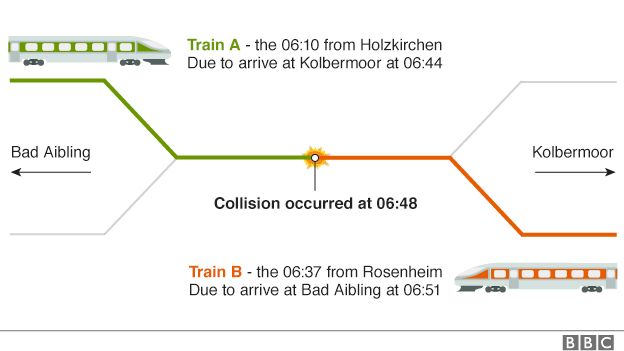
The BBC offers analysis of the Bad Aibling interurban collision. In short, a dispatcher mistakenly opened the track to the two trains.

The diagram appears to be in error, given what I learned in a discussion at The Local Germany.
That is, Train A is due Kolbermoor at 6.44. Train B is scheduled to leave Kolbermoor at 6.45.
Without any safety appliances, archaic superiority of train rules are sufficient to preclude a crash. If Train A is the superior train, train B must wait at Kolbermoor for train A. If train B is the superior train, train A has authority to leave Kolbermoor, with train A obligated to clear for train B at Bad Aibling or, if it is sufficiently late, at a siding closer to Holzkirchen.
Under train order operation, the dispatcher can change the location of the meet. But he must notify the train that is losing its right first. With centralized traffic control, he is only able to change the location of the meet once train A has accepted the signal at Bad Aibling by changing the signal at Bad Aibling to STOP, then waiting for the machinery to allow him to clear a signal at Kolbermoor. Dispatchers and operators refer to this as "running time," the purpose of which is precisely to prevent somebody from doing something rash and creating a collision. The usual running time interval is five minutes; for the line in question delaying a train at Bad Aibling for the purpose of resetting the meet loses more time than simply letting the train proceed to the meet at Kolbermoor.
What none of the reports explain, thus far, is the way in which the dispatcher overrode whatever safety appliances were in place.
Two trains, running at track speed on the strength of a manual override? The actions of the dispatcher and the motormen would astonish a Harry Bedwell or an E. S. Dellinger, whose short stories often involved the Railroad By The Book official tangling with the agent or operator whose corner cutting might have proven fatal, or might have demonstrated a capability for improvisation when it's necessary.
A manual override to automatic safety systems is something not to be taken lightly, which is why procedures to do so involve additional safeguards such as running time, or granting authority to pass the signal at restricted speed.

Illustration retrieved from BBC.
The diagram appears to be in error, given what I learned in a discussion at The Local Germany.
That is, Train A is due Kolbermoor at 6.44. Train B is scheduled to leave Kolbermoor at 6.45.
Without any safety appliances, archaic superiority of train rules are sufficient to preclude a crash. If Train A is the superior train, train B must wait at Kolbermoor for train A. If train B is the superior train, train A has authority to leave Kolbermoor, with train A obligated to clear for train B at Bad Aibling or, if it is sufficiently late, at a siding closer to Holzkirchen.
Under train order operation, the dispatcher can change the location of the meet. But he must notify the train that is losing its right first. With centralized traffic control, he is only able to change the location of the meet once train A has accepted the signal at Bad Aibling by changing the signal at Bad Aibling to STOP, then waiting for the machinery to allow him to clear a signal at Kolbermoor. Dispatchers and operators refer to this as "running time," the purpose of which is precisely to prevent somebody from doing something rash and creating a collision. The usual running time interval is five minutes; for the line in question delaying a train at Bad Aibling for the purpose of resetting the meet loses more time than simply letting the train proceed to the meet at Kolbermoor.
What none of the reports explain, thus far, is the way in which the dispatcher overrode whatever safety appliances were in place.
The track was fitted with an automatic braking system. The system is meant to alert the driver when a train is approaching a red light. If the driver does not respond quickly enough, or if the train goes through the red light, the brakes are activated.It's possible that the motormen can acknowledge the signal without reducing speed, under some types of train control. I'm still looking for a more complete description of the safety appliances in place on this line.
Officials say the system had passed safety checks and the investigation did not find evidence of any technical malfunction, pointing to the actions of the controller.
Two trains, running at track speed on the strength of a manual override? The actions of the dispatcher and the motormen would astonish a Harry Bedwell or an E. S. Dellinger, whose short stories often involved the Railroad By The Book official tangling with the agent or operator whose corner cutting might have proven fatal, or might have demonstrated a capability for improvisation when it's necessary.
Trains are equipped with layers and layers of safety features. But even the very last available precaution seems to have failed in this case.Every line in the Book of Rules has been written in somebody's blood. Thus it will be in Germany.
Officials say they assume both train drivers also had no visual contact before the crash, as the site is on a bend, so they did not apply the brakes manually.
Analysts say there now appears to be a case for making restrictions on manual overrides to the automatic safety systems tighter.
A manual override to automatic safety systems is something not to be taken lightly, which is why procedures to do so involve additional safeguards such as running time, or granting authority to pass the signal at restricted speed.
CONCURRENCE?
Here's the state of the world, as viewed at the beginning of the Obama Administration. Victor Davis Hanson sees decline and fall.
We are starting to fathom that when times got iffy, we lacked the resilience of the proverbial Joads and the grit of that tough Depression-era generation, and certainly we seem different sorts from those who built and flew B-17s amid the Luftwaffe.Here we are, with the front runners for the presidency seeking either to taxing the rich to subsidize business as usual, or to starting a trade war with China. The common culture hasn't gotten any better, either.
Instead, this generation has gone quite stark raving mad the last seven months, hysterical, and decided we would simply borrow, charge it, print money, blame, accuse—almost anything other than roll up our sleeves, take a cut in our standard of living, pay off what we owe, admit that we lived too high on the hog, and find a certain nobility in shared sacrifice.
So again, here we are reduced to begging the Chinese to subsidize our life-styles, while 500 million of their own poor make their American counterparts of the lower classes here seem like well-heeled grandees.
I was always an advocate of informality, of casualness, but now when on a plane, in a restaurant, at Starbucks, I am struck by the rare well-dressed person who does not crowd. How odd the extra-polite woman, who conducts herself with charm and grace at the counter, or the gentleman who opens doors, says excuse me, and whose intelligent conversation I enjoy listening in on—like a dew drop to someone thirsting in the desert. In contrast, when the punk walks by, with radio blaring, mumbling obscenities, flashing the 'I'll kill you' stare,” it all leaves me in depression.The monuments we've destroyed ... it began with Penn Station. Then it got worse.
Worse still, on the opposite end of the scale, is the master of the universe who elbows his way onto a plane while he blares on the telephone and blocks the aisle. I feel creepy after walking through an electronics store and seeing some of the video game titles and covers.
We all seem to stare at the rare genius under a semi, working on the transmission, or someone on a catwalk riveting a girder, or a teacher who can wade into an unruly class and say "damn it, we are going to learn calculus one way or another".From about the same time, Chris Hedges, who likely disagrees with Mr Hanson on almost any area of political economy or foreign policy,also saw the rot.
In decaying societies, politics become theater. The elite, who have hollowed out the democratic system to serve the corporate state, rule through image and presentation. They express indignation at AIG bonuses and empathy with a working class they have spent the last few decades disenfranchising, and make promises to desperate families that they know will never be fulfilled. Once the spotlights go on they read their lines with appropriate emotion. Once the lights go off, they make sure Goldman Sachs and a host of other large corporations have the hundreds of billions of dollars in losses they incurred playing casino capitalism repaid with taxpayer money.This is before anyone even conceived of Donald J. Trump turning a bad comedy schtick into a presidential run or Hillary Clinton accepted honoraria because Goldman Sachs offered.
We live in an age of moral nihilism. We have trashed our universities, turning them into vocational factories that produce corporate drones and chase after defense-related grants and funding. The humanities, the discipline that forces us to stand back and ask the broad moral questions of meaning and purpose, that challenges the validity of structures, that trains us to be self-reflective and critical of all cultural assumptions, have withered. Our press, which should promote such intellectual and moral questioning, confuses bread and circus with news and refuses to give a voice to critics who challenge not this bonus payment or that bailout but the pernicious superstructure of the corporate state itself. We kneel before a cult of the self, elaborately constructed by the architects of our consumer society, which dismisses compassion, sacrifice for the less fortunate, and honesty. The methods used to attain what we want, we are told by reality television programs, business schools and self-help gurus, are irrelevant. Success, always defined in terms of money and power, is its own justification. The capacity for manipulation is what is most highly prized. And our moral collapse is as terrifying, and as dangerous, as our economic collapse.I submit that the universities have been complicit in that trashing, with the instrumental students recognizing that too many of the traditional liberal arts have become cults of the self, without job prospects for the majors. That noted, the moral collapse continues. There has been no economic recovery, but that's another matter. Mr Hedges is prescient, however, about where the moral collapse leads.
Our elites are imploding. Their fraud and corruption are slowly being exposed as the disparity between their words and our reality becomes wider and more apparent. The rage that is bubbling up across the country will have to be countered by the elite with less subtle forms of control. But unless we grasp the "societal play of forces that operates beneath the surface of political forms" we will be cursed with a more ruthless form of corporate power, one that does away with artifice and the seduction of a consumer society and instead wields power through naked repression.We are not yet there, but the ominous signs proliferate.
17.2.16
THE FUNDAMENTALS MATTER.
In the study of economics, it's useful to understand price theory and political economy. Income theory is a sub-field of applied political economy. In Quartz, Allison Schrager argues the controversies of income theory make no sense without their historical context.
Post-Crash Economics appear to have done so.
Two extraordinary things happened to the economics profession in the last 20 years. Economics became the most popular course at many universities and the financial crisis seriously damaged the field’s credibility.News flash: there have been episodes of secular stagnation, capitalist crises of overproduction, and speculative bubbles before. Without awareness of that past, and knowledge of the controversies over the years, the Keynesian Cross and the Hicks-Hansen synthesis and rational expectations and dynamic stochastic general equilibrium are simply devices for torturing people without the visual-spatial strengths to follow them.
No wonder there’s a major rethink underway on how economics is taught. But the traditional economics taught to undergraduates held up better than many people realize. In order to help today’s students understand the new economic order, we don’t need to throw out existing models. Instead we need to teach more economic history. One of the best parts of my economics education was the two years of economic history I took as an undergraduate. Those courses still influence how I understand the evolution of markets. Most important, they gave me a long-term perspective and awareness that understanding the economy requires both a solid intellectual framework and an openness to new ideas.
Economics offers a series of parables to help us understand how the economy works. The parables are abstractions that make many simplifying assumptions because the world is too complicated to capture in a simple model. Economists may argue about which assumptions are appropriate or what the best framework is to describe a problem, but this does not mean any one approach is totally wrong. Often it’s not that one model is wrong, it is just applied to the wrong problem.Without knowledge of exchange, arbitrage, indifference, and opportunity cost, it's even possible to go wrong.
For instance, most undergraduates are introduced to Keynesian ideas through the IS/LM model. The model describes a snap-shot of an economy in a recession. But it is less useful to understand how an economy develops over the long term or how risk and uncertainty matter. It’s a great model to answer some questions, but terrible for others. But it is not always obvious, even to top economists, when to use what model. That is where the divisions arise.
Post-Crash Economics appear to have done so.
Schrager goes on to characterise economics as “a series of parables to help us understand how the economy works.” Firstly, this is an incredibly weak characterisation of economic theory: are we supposed to be enthusiastic that what we’re learning equates to little more than mathematical ‘parables’? Does this not create the type of ‘anything goes’ situation that the scientific method is supposed to prevent? We actually believe and hope that economics as a field is better than this.It is. The mathematics provides precision to the parables, generating testable implications. The quickest way to call out a parable is to identify an unexploited gain from trade or a dominant strategy not used or wishful thinking. That does not preclude considering macroeconomic models other than the Keynesian Cross and its offspring.
ANOTHER ROGUE'S GALLERY.
At the beginning of the year, Minding the Campus called the roll of the worst campus administrators of 2015.
That was before Mount St. Mary hedge fund manager Simon "I'll drown the bunnies, and if you object, I'll drown you too" Newman put his institution on the map. And at the top of the Ten Worst Colleges for Free Speech list compiled by Greg Lukianoff of the Foundation for Individual Rights in Education.
There is some overlap between the worst administrators and the most repressive colleges and universities, as in Marquette's continued attempt to banish John "Marquette Warrior" McAdams. (What's the over-under on Marquette sitting on the results of its dismissal hearing until March Madness distracts coverage?)
Sometimes, though, institutions that harbor petty tyrants at least respect the ancient verities.

Missouri did not make the top ten, either, despite having the poster girl for petty tyrants on faculty.
That was before Mount St. Mary hedge fund manager Simon "I'll drown the bunnies, and if you object, I'll drown you too" Newman put his institution on the map. And at the top of the Ten Worst Colleges for Free Speech list compiled by Greg Lukianoff of the Foundation for Individual Rights in Education.
There is some overlap between the worst administrators and the most repressive colleges and universities, as in Marquette's continued attempt to banish John "Marquette Warrior" McAdams. (What's the over-under on Marquette sitting on the results of its dismissal hearing until March Madness distracts coverage?)
Sometimes, though, institutions that harbor petty tyrants at least respect the ancient verities.
But because the university did publicly defend the professors' free speech and academic freedom rights, we decided that Yale did not edge out the 10 schools who made the list this year. FIRE will, however, keep a close eye on Yale to see if it lives up to its glowing promises of freedom of speech.That despite Janet "Big Sis" Napolitano making the administrators list.
Another university, or, in this case, university system, that did not quite make this year's list, but easily could have, is the University of California (UC) system.

Missouri did not make the top ten, either, despite having the poster girl for petty tyrants on faculty.
Subscribe to:
Posts (Atom)