For a long time, I have suggested that the aesthetic sensibilities of learned people bring contempt for their otherwise inclined neighbors or former neighbors in train. That's a suggestion. If you'd like that argument codified, clarified, and extensively supported, pick up Fred Siegel's The Revolt Against the Masses: How Liberalism has Undermined the Middle Class.
I'll keep Book Review No. 30 brief. Mr Siegel is writing about the pernicious effect of the aesthetic sensibilities of learned people, or at least people who have persuaded themselves that their credentials, or their tone, or their hosts or guests at the right kind of parties qualify themselves as learned, or somehow better equipped to lead. (We understand that they are not: and I have devoted fifteen years to counting the ways in which they are not.) The usual suspects are there: Herbert Croly, Sinclair Lewis, H. L. Mencken, Walter Lippmann, Susan Sontag. His purpose is straightforward. "Liberals believe that they deserve more power because they act on behalf of people's best interests -- even if the darn fools don't know it." (Paperback edition, xvi.)
But the story is less about policy or winning elections than it is about the evolution of the cluster of ideas most easily summarized under the rubric of "fatal conceit." It's also the growing frustration of the remnant of the middle class at their treatment by their self-appointed betters, and the growing frustration of those supposed betters at losing arguments, as well as elections.
The index notes no mentions of Donald Trump or Hillary Clinton. They're not necessary. The frustrations documented by Mr Siegel were in place long before those Wisconsin and Michigan electoral votes went on the board.
(Cross-posted to 50 Book Challenge.)


28.11.17
MORE IMPORTANT TO MOVE CARGO THAN TO KEEP SCHEDULE?
It's a metaphor I learned years ago, in the context of ensuring that students are learning, rather than fretting about getting through all the material.
Apparently there are people at CSX Transportation who get it.
Apparently there are people at CSX Transportation who get it.
Toyota Canada on Nov. 17 withdrew generally positive comments it made to federal regulators in October, saying they no longer reflect the service the automaker is receiving from CSX.All that talk about "efficiency, safety, and customer service" is as of nothing when General Mills goes to drones to get those Cheerios right to your door.
And under pressure from lawmakers, CSX last week reversed plans to curtail service to General Mills facilities, including a mill in Buffalo, N.Y., that makes Cheerios, The Buffalo News reported. CSX had planned to switch the Cheerios plant once a day, down from the current twice-daily service.
“As we progress the adaptation of Precision Scheduled Railroading across our network, CSX continues to respond to individual customer issues when they emerge,” spokesman Rob Doolittle says. “A good case in point is General Mills, where CSX has agreed to continue providing twice-daily service to General Mills' Buffalo facility as the company prepares for proposed changes to the rail-service schedule at its Buffalo plant. CSX remains committed to working with General Mills and all of our customers to meet their service requirements as we makes changes across our network to improve efficiency, safety, and customer service.”
CSX officials have said [new chief operating officer James] Foote is an important addition to the management team, particularly since he brings a deep background with Precision Scheduled Railroading.
He replaces both Chief Operating Officer Cindy Sanborn and Chief Marketing Officer Fredrik Eliasson, who left CSX on Nov. 15 along with Ellen Fitzsimmons, who was the railroad’s chief legal officer.
DONALD TRUMP IS NOT REPUBLICAN IS NOT CONSERVATIVE.
I've been attempting to find clarity for years. "Put another way, theological conservatism, or pro-business conservatism, or national-greatness conservatism, are all at odds with libertarian conservatism. These four mind-sets could make common cause against Soviet Communism, and there are ways for those mind-sets to make common cause against whatever the Democrats are currently up to." And the Republicans and the Democrats alike continue to get by without the libertarians in the room.
The conservative temperament, Dalibor Rohac argues, bets on emergence.
Emergence is harder work, but more likely to produce less unsatisfactory outcomes.
The conservative temperament, Dalibor Rohac argues, bets on emergence.
Radicalism instead requires making leaps of faith, and often making impossible promises to mobilize the masses. But that sets in motion a dynamic that inevitably appears in the context of revolutions driven by utopian ideologies. Once the impossibility of promises made becomes apparent, a search for saboteurs and traitors gets underway in order to identify those responsible for derailing the will of the people from being translated into effective policy. At some point, shifting the blame around becomes unsustainable. The revolutionary edifice collapses and is replaced by reactionary backlash.That's a contemporary abuse of the term "radical" to mean "trying extraordinary methods" or "relying on vanguards" (heck, you could subsume the entire cult of the presidency under either of those rubrics) rather than "looking for the underlying structure."
Emergence is harder work, but more likely to produce less unsatisfactory outcomes.
Intellectuals and political leaders still have the responsibility to make the case for more open immigration and trade regimes if their social benefits outweigh the costs. However, there is a difference between carefully building support for that case and taking such support for granted, while dismissing dissenters as bigots and protectionists. The experience of the past decade shows that particularly in environments of zero-sum politics—which are usually associated with periods of sluggish or absent economic growth—utmost care needs to be exercised in making decisions that can be seen, albeit wrongly, as benefitting foreigners at the expense of “our people.”Let us remember that the Puritans liked to use names such as Prudence and Patience and Temperance and Thankful and Increase. The bourgeois virtues.
In themselves, prudence, humility, and moderation are hardly winning political messages. But in a world of complexity and unintended consequences, they are necessary components of any honest right-of-center politics. Let us remember it when the time comes to rebuild on the ashes of the current conservative radicalism.
THE ROAD TO HELL.
Learn Liberty's Ninos Malek clarifies. "Good intentions do not always lead to good outcomes. In fact, many times, they lead to dire consequences." Read and understand.
Pinned to the bulletin board in Cafe Hayek.
Pinned to the bulletin board in Cafe Hayek.
IT IS BETTER TO GOVERN IN ILLINOIS THAN TO SERVE IN INDIANA?
That despite Illinois being the canonical example of Getting the Blue Model Wrong.
But well-heeled entrepreneurs, rent-seekers, and heirs are pouring money into gubernatorial campaigns as if a football franchise or a tech company office park at stake.
Mr Pritzker is running against Christopher Kennedy, son of the late attorney general. And Mr Rauner has been attempting to make of Michael Madigan what Our President is attempting to make of Elizabeth Warren. There's a recent commercial in which the Rauner campaign has Republican governors of neighboring states saying "Thanks, Madigan" for the migration of voters and businesses into Indiana, Missouri, and Wisconsin.
George Will, confessed Cub fan, hopes that Illinoisans can arrest the decline before it's too late. "The nation has a huge stake in this brawl because the 'blue model' is bankrupting cities and states from Connecticut to California, so its demolition here, where it has done the most damage, would be a wondrous story enhancing the nation’s glory."
The story has been nailed to Newmark's Door.
No acknowledgment that this is a state government that is ranked last by almost every objective and measurable standard. A state government that fails every single one of its residents, day after day — and has failed its residents for decades. A state government that demands more and more money each year, to deliver increasingly less value to Illinoisans. A state government that cannot pay its bills, cannot make good on its promises, cannot help people in need.The author wasn't fired as a whistleblower. She quit.
But well-heeled entrepreneurs, rent-seekers, and heirs are pouring money into gubernatorial campaigns as if a football franchise or a tech company office park at stake.
Self-government has failed in the nation’s currently fifth-most populous state (Pennsylvania soon will pass it). Republican Governor Bruce Rauner will seek re-election with a stark warning: The state is approaching a death spiral — departing people and businesses suppress growth; the legislature responds by raising taxes; the exodus accelerates.Those retirees might be subject to state income tax in Texas or Florida: even the reality that pension payments are exempt from Illinois income tax isn't reason enough to stay. (You can't build basements in much of Florida or Texas, thus I'm still here.)
Rauner, whose net worth earned as a private-equity executive is $500 million, give or take, probably will be running against someone six times richer. The race might consume $300 million — “maybe more,” Rauner says — eclipsing California’s $280 million gubernatorial race in 2010, when that state’s population was three times larger than Illinois’.
The strangeness of the contest between Rauner and the likely Democratic nominee (J.B. Pritzker, an heir to the Hyatt hotel fortune) is that Rauner’s real opponent is a Democrat who has been in the state assembly since Richard Nixon’s first term (1971) and has been speaker all but two years since Ronald Reagan’s first term (1983). Michael Madigan from Chicago is the “blue model” of government incarnate. This model is the iron alliance of the Democratic party and government workers’ unions. Madigan supports Pritzker, who is committed to the alliance. This is the state of the state under it:
Unfunded state and local government retirement debt is more than $260 billion and rising. Unfunded pension liabilities for the nation’s highest-paid government workers (overtime starts at 37.5 hours) are $130 billion and are projected to increase for at least through the next decade. Nearly 25 percent of the state’s general funds go to retirees (many living in Texas and Florida). Vendors are owed $9.5 billion. Every five minutes the population — down 1.22 million in 16 years — declines as another person, and an average of $30,000 more in taxable income, flees the nation’s highest combined state and local taxes. Those leaving are earning $19,600 more than those moving in. The work force has shrunk by 97,000 this year. There has not been an honestly balanced budget — a constitutional requirement — since 2001. The latest tax increase, forced by the legislature to end a two-year budget impasse, will raise more than $4 billion, but another $1.7 billion deficit has already appeared.
Mr Pritzker is running against Christopher Kennedy, son of the late attorney general. And Mr Rauner has been attempting to make of Michael Madigan what Our President is attempting to make of Elizabeth Warren. There's a recent commercial in which the Rauner campaign has Republican governors of neighboring states saying "Thanks, Madigan" for the migration of voters and businesses into Indiana, Missouri, and Wisconsin.
George Will, confessed Cub fan, hopes that Illinoisans can arrest the decline before it's too late. "The nation has a huge stake in this brawl because the 'blue model' is bankrupting cities and states from Connecticut to California, so its demolition here, where it has done the most damage, would be a wondrous story enhancing the nation’s glory."
The story has been nailed to Newmark's Door.
BEING A GENTLEMAN IS HARD.
That's Andrew Klavan, shortly after the news that Harvey Weinstein is a cad broke. But there used to be a way of dealing with cads and bounders.
Mitch "Shot in the Dark" Berg has a number of new epithets, including "Toxic Eunuchism" and "Genderquislings." It's a marvellous rant, and it includes a link to Matt Walsh, with another marvellous rant.
If a manly man finds out Harvey Weinstein abused his wife or girlfriend, Harvey Weinstein gets his lights punched out. Of all the people involved in this story, the only one I've admired at all so far is Brad Pitt. When Pitt found out Weinstein had made advances on his then-girlfriend Gwyneth Paltrow, at least he went and confronted the producer and told him never to do it again. That may not be the last scene of High Noon, but, manhood-wise, I'll take what I can get. Good for Brad Pitt.Mr Klavan is the moderate today.
Mitch "Shot in the Dark" Berg has a number of new epithets, including "Toxic Eunuchism" and "Genderquislings." It's a marvellous rant, and it includes a link to Matt Walsh, with another marvellous rant.
What we need in our society are chivalrous, strong, respectable, productive, and self-sacrificial men. Real men, in other words. Men who protect, provide, and do all of the things that society has always depended upon men to do. If you are that sort of man, you certainly should not shut up, step to the side, or consider yourself "trash." Our culture needs your input and leadership more than ever.Being a gentleman is hard.
It may be pointed out that there are fewer and fewer of these men available today. Again, I agree. That’s why we must raise our boys to embrace their masculinity — not apologize for it or feel ashamed of it — and carry themselves with dignity. The abuser and harasser never learned this lesson. He is an empty shell. He couldn't be a man so he decided to be a cartoon instead. He is not fueled by “toxic masculinity” or any kind of masculinity at all. He is a twisted, emotionally stunted little boy who never grew out of puberty.
The issue is not that he is a man but that he never became one. That's his problem, and ours.
CLOTHED WITH A PUBLIC INTEREST.
I've sometimes wondered whether the Civil Rights era might have had a better outcome, fifty years on, had the national government used its Constitutional authority to limit the power of states, under the principle that "separate but equal" is contrary to "equal treatment under the law." Thus any state or local segregation statutes would be unconstitutional, and state and local authorities would no longer have the power to compel transportation companies or eateries to provide segregated seating or to refuse service.
What happened, instead, was an extension of the public accommodation doctrine, perhaps because of the visual effect of young collegians sitting-in at lunch counters. And that extension well might have made perfect legal sense, given Supreme Court rulings on the ability of Congress and of state and local legislatures and common councils to use whatever criteria they wanted in finding property clothed with a public interest.
That approach converts any business into a common carrier (well, sort of: no service whether you're wearing shoes or not; no cheap watches at Sharper Image) and perhaps that ought to be the understood contract. That argument has purchase to the extent that business owners might otherwise be willing to indulge their prejudices despite the voluntary sacrifice of business that accompanies those prejudices.
In Let Them Bake Cake, Richard Epstein suggests that market tests might be simpler.
And all this over bakers and photographers who have qualms about same-sex weddings? Particularly when there are likely other bakers and photographers who would be delighted to cater and record same?
What happened, instead, was an extension of the public accommodation doctrine, perhaps because of the visual effect of young collegians sitting-in at lunch counters. And that extension well might have made perfect legal sense, given Supreme Court rulings on the ability of Congress and of state and local legislatures and common councils to use whatever criteria they wanted in finding property clothed with a public interest.
That approach converts any business into a common carrier (well, sort of: no service whether you're wearing shoes or not; no cheap watches at Sharper Image) and perhaps that ought to be the understood contract. That argument has purchase to the extent that business owners might otherwise be willing to indulge their prejudices despite the voluntary sacrifice of business that accompanies those prejudices.
In Let Them Bake Cake, Richard Epstein suggests that market tests might be simpler.
When does it make sense to impose an obligation of universal service? The time-honored answer, as I have urged elsewhere, is in the case of common carriers and public utilities, which are not in a position to refuse service because they are the only supplier of standardized, impersonal, but essential services such as rail transportation, electricity, power, and communication, without which participation in ordinary life is exceedingly difficult. Historically, these services were supplied most cheaply by a single provider, which therefore had the correlative duty to serve all customers on what are known as FRAND standards—fair, reasonable, and nondiscriminatory terms.That sounds like a standard legal brief argument. A half century after the Freedom Rides, however, there are still people who perceive the country as just one bad Supreme Court ruling away from the Confederate Restoration, or something.
The necessary corollary is that duties of service should never be compelled in a well-organized competitive market, an issue that lies at the heart of the Masterpiece dispute. We are far removed from the days of Jim Crow when the unified exercise of state power and private violence blocked the entry of new firms to serve black citizens who were systematically deprived of rights to vote or to participate in public affairs. We are long past the days when local governments could covertly, and without effective judicial review, deny power and electricity to any firm that chose to integrate its workforce. Our brief pointed out the thriving market supplying services for same-sex marriages both in states that prohibit discrimination on grounds of sexual orientation and those that do not.
In this environment, moreover, the prospect of open entry—never mentioned in the behavioral economics brief—will encourage a sufficient number of merchants to target underserved sections of the market. The behavioral economics brief shows an ideological blindness when it assumes that the rigid totalitarianism of Jim Crow has its analogue today in the hostile social response to gay and lesbian weddings by, of all people, Jack Phillips. That outsized claim inexcusably ignores and trivializes the lynchings, lootings, and humiliations that turned the old South into a police state.There's good work in behavioral economics, considering such things as endowment effects (the option value of keeping what you currently have). But you get people seizing on the stylized fact that simple models of behavior don't apply in all circumstances and using that as grounds to toss out the received models of economics under any circumstances, including those circumstances where the model is good enough.
And all this over bakers and photographers who have qualms about same-sex weddings? Particularly when there are likely other bakers and photographers who would be delighted to cater and record same?
WHEN HIGHER EDUCATION BREAKS THE SOCIAL CONTRACT.
(Edited and bumped) The provisions in the current, not yet ready for a floor vote, tax code revision that will treat tuition waivers as income are not playing well in the common room and the administrative offices. One might say the proposals are concentrating minds.
Perhaps, though, a quarter century of higher education breaking the social contract that used to ensure that students would learn, and taxpayers would support the enterprise, is behind the proposal. Peter Wood suggests as much.
That's not to say that the trendy leftists with their intersectionality and culture studies and French rot and BLTGQUINOA and the rest of it aren't partly responsible. Mark Bauerlein doesn't quite say "We told you so." But we told you so. "If the conservatives and traditionalists predicted a dark future of the humanities, well, that was just because they didn’t have the acuity to understand how rich and cutting-edge theory and cultural studies had become."
Facts are stubborn things, and shrinking enrollments and angry normals are real.
Perhaps, though, a quarter century of higher education breaking the social contract that used to ensure that students would learn, and taxpayers would support the enterprise, is behind the proposal. Peter Wood suggests as much.
We are in deep educational trouble, much of which does not appear to be a matter of excessive tuitions or government programs. The erosion of intellectual standards, the rise of shout-downs and student-led censorship, the disappearance of regard for Constitutional rights and responsibilities are conspicuous evidence that something is amiss in our colleges and universities. The price of education doesn’t all by itself explain this descent into the maelstrom, but it is a key factor that is often overlooked. Let’s, for a change, consider it.Most of his essay concentrates on the ways in which tuition waivers are part of a much more complicated framework by which nobody pays list price. We've seen that erosion, midwived in part by political correctness, for better than a quarter century. And the conversion of universities from places of learning to summer camps with beer 'n circus and maybe the odd imposition of a class here or there antagonizes politicians who want to be seen as fiscally responsible. Maybe, as Mr Wood suggests, it's not so much the nests of court intellectuals for Democrats and latter-day juveniles dressing up as Leon Trotsky (!) that antagonize the legislators as it is climbing walls and water parks (while the classroom buildings and the libraries decay). "Congress’s decision to start cutting the subsidies is what happens at the end of the river."
That's not to say that the trendy leftists with their intersectionality and culture studies and French rot and BLTGQUINOA and the rest of it aren't partly responsible. Mark Bauerlein doesn't quite say "We told you so." But we told you so. "If the conservatives and traditionalists predicted a dark future of the humanities, well, that was just because they didn’t have the acuity to understand how rich and cutting-edge theory and cultural studies had become."
Facts are stubborn things, and shrinking enrollments and angry normals are real.
I haven’t seen any of the people who mocked conservatives and traditionalists for their sky-is-falling rhetoric say in response to the catastrophes of the last few years that they were wrong. They can’t. When you dispute an opponent over the facts, but stick to those facts and hold off on raillery, you can change your mind and make admissions. But when you desire not only to prove your adversary wrong but to discredit him, you can’t go back.And discrediting adversaries is a game anyone can play.
A SPONTANEOUS EMBARGO?
It has long been a fantasy of the Perpetually Aggrieved that they can End War and Bring About Harmonic Convergence by ... sitting in front of trains. Which is stupid, especially if you think that your statement will be more dramatic if you begin your sit-in as the train approaches. That's a good way to lose, at a minimum, a foot. That actually happened, in the San Francisco Bay area, during the Reagan years, but interfering with trains to disrupt the military-industrial complex goes back at least to the late Vietnam War era. On the other hand, when real enemy agents attempted to interfere with real trains, in a real war, some of them got to sit in an electric chair.
But the fantasy lives on from the Weathermen down, most recently in the port of Olympia, Washington.
But there's that little problem of using hydro power to help make atomic bombs ...
There's also that little problem that the Perpetually Aggrieved do not make friends or influence wavering people with their certitude and their virtue signalling.
But the fantasy lives on from the Weathermen down, most recently in the port of Olympia, Washington.
Among the protestors' demands is that the rail line no longer be used to transport fossil fuels or anything that's part of "military infrastructure." They are demanding "democratic" control of the port by the community as a whole -- which would not be "democratic," but socialist.Once upon a time, The Milwaukee Road, which once served Olympia, used white coal to power trains, and a Milwaukee branch served Hanford, Washington, where the research that made nuclear steam electricity a reality took place, and both nuclear and hydro power are realistic responses to the cinders that blind and the carbon dioxide that accompanies the burning of coal and other fossil fuels.
They also want to transition port employees over to mythical "green" jobs.
But there's that little problem of using hydro power to help make atomic bombs ...
There's also that little problem that the Perpetually Aggrieved do not make friends or influence wavering people with their certitude and their virtue signalling.
These folks have a right to protest, but they don't have a right to trespass on property and they have no right to inhibit commerce. They need to be either arrested, or at the very least dragged away from the tracks so business can get back to normal.It might be that they're protesting at the wrong port, anyway. I have some stories ... But Olympia is close to Seattle, and Seattle is full of Perpetually Aggrieved types, and the trains get blocked.
What these Leftist protestors don't understand is that they're never going to actually win with these tactics. All they're doing is pissing people off. Do that enough and no one will give a damn why you're protesting.
27.11.17
YES, VIRGINIA, THERE IS A PERMANENT BIPARTISAN ESTABLISHMENT.
Or so Accuracy in Academia's Malcolm A. Kline contends, quoting journalist Neal B. Freeman. "We know what they’re against: the sad and widely unremarked fact that Obama is conducting what looks to many people very much like a third Bush term—bailouts, stimulus, entitlement expansion, war escalation, wall-to-wall Tenth amendment overreach from the school to the hospital to the bank to the gas station." Meanwhile, in Panem the Capitol District, "Republican Capitol Hill staffers were as disconsolate as their Democratic counterparts."
That swamp was not filled in one presidential term, nor will it be drained in one term.
That swamp was not filled in one presidential term, nor will it be drained in one term.
26.11.17
SHIRER'S GIBBON?
Shortly after the War ended, William Shirer, who had observed the rise of the Third Reich, wrote The Rise and Fall of the Third Reich, and that's been the go-to source for generations of readers. Thirty years later, Richard J. Evans has the opportunity to read through materials unavailable to Mr Shirer, including records held by various Soviet era authorities who lost their power and their monopoly on violence, fortunately without any nukes being released. Yes, we're talking forty years after Shirer's work, not five centuries or so as in The Decline and Fall of the Roman Empire, and we have only three thick books to constitute Book Reviews No. 27, No. 28, and No. 29, rather than the six volumes of Gibbon. (That despite typesetting technologies that are far more productive and less eyestrain-inducing than those available in the eighteenth century.)
SANTA CLAUS IS COMING TO TOWN.
Railroads' holiday trains deliver gifts, food and joy.
We've given extensive coverage to Canadian Pacific's Holiday Train, which works northern Illinois and southern Wisconsin.

You can see a lot of the hidden misery in the United States and Canada from the rails, and that's what gives Canadian Pacific's trains their mission. "The CP Holiday Train's mission has remained constant ever since: to raise as much money, food and awareness as possible in the fight against hunger, [CPR spokesman Andy] Cummings added."
In addition, there are trains running at museums, and sometimes on regional Commuter Rail operators, for the purpose of giving children of all ages an excursion and a chance to talk to Santa Claus.

Yes, that's from a long time ago.
As far as I know, no retail chains have hired a train to call shoppers' attention to the beginning of the Christmas buying rush.

The prototype for this train was commissioned by Milwaukee's Schuster's department store, and their carpenters added trimmings to interurban work equipment at Cold Spring Shops. In this December, 1992 reenactment at East Troy, the locomotive, L9, is a product of Cold Spring Shops.
An earlier version of the train used a different locomotive.
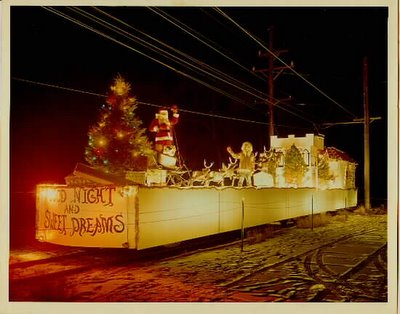
He's making a list, and checking it twice ...
We've given extensive coverage to Canadian Pacific's Holiday Train, which works northern Illinois and southern Wisconsin.

You can see a lot of the hidden misery in the United States and Canada from the rails, and that's what gives Canadian Pacific's trains their mission. "The CP Holiday Train's mission has remained constant ever since: to raise as much money, food and awareness as possible in the fight against hunger, [CPR spokesman Andy] Cummings added."
In addition, there are trains running at museums, and sometimes on regional Commuter Rail operators, for the purpose of giving children of all ages an excursion and a chance to talk to Santa Claus.
Yes, that's from a long time ago.
As far as I know, no retail chains have hired a train to call shoppers' attention to the beginning of the Christmas buying rush.

The prototype for this train was commissioned by Milwaukee's Schuster's department store, and their carpenters added trimmings to interurban work equipment at Cold Spring Shops. In this December, 1992 reenactment at East Troy, the locomotive, L9, is a product of Cold Spring Shops.
An earlier version of the train used a different locomotive.
He's making a list, and checking it twice ...
MALE CHIVALRY, NOT MALE CHAUVINISM.
Bourgeois conventions confer evolutionary advantage generally, and their absence has led to the toxic workplace environment for women specifically. Matthew Continetti is thinking in general terms.
The slightest glance at political, entertainment, and business headlines demonstrates that the bourgeois virtues of restraint, frugality, reticence, self-control, self-discipline, and fidelity are not only absent in our public life. They are denigrated. Nor is this a mere political phenomenon. The liberation of the sovereign self transcends race and creed, religion and party. It has bloated our waistlines along with our national deficits, tossed families into a spin cycle of disorientation and breakdown, and endangered and addled children. And though a great many families of schooling and wealth have been able to insulate themselves from the gale-force winds of instant gratification and narcissistic self-expression, those in the middle and lower ends of our society do not have the luxuries of loving two-parent families, good schools, safe neighborhoods, well-paying jobs, and welcoming churches.Yes, or Harvey Weinstein rationalizing his piggishness as merely what "do your own thing, man" implied.
According to [Irving] Kristol, personal indiscretions and obnoxious behavior, sexual or otherwise, are intimately related to ferment and strife within society and government. Human nature being the crooked thing it is, one would expect some degree of selfishness, greed, and immorality at all times and in all places. And so it has been. What made our civilization different, Kristol argued, was that it not only originated but also granted honor and pride to bourgeois norms and behavior, and so created a specific type of citizen proper to liberal democracy. Distort the norms, change the behavior, and you create a different sort of character befitting a different sort of government. One very unlike the constitutional republic the Founders envisioned.
YOUR TAX DOLLARS AT WORK.
That complaint by university endowment managers about taxes meaning fewer edifices being erected for development officers to then sell naming rights got me to thinking about the west campus project at Northern Illinois University. "The $286.5 billion transportation bill signed into law by President Bush [in August 2005] in Aurora includes $8.32 million to plan, design and build new roads on the west side of campus." Mr Bush was in Aurora to demonstrate that he could work with Congress, in this case with the then speaker of the House, J. Dennis Hastert of Yorkville. Perhaps the earmark got Mr Hastert an honorary degree, or perhaps not, but it's moot as Mr Hastert subsequently lost his degree for conduct unbecoming. The federal government did come through on the construction (albeit without those obnoxious Obama era signs). "The roads paid for in an earmark to the porkulus transportation bill of the early 2000s continue to hurry traffic through otherwise unimproved land the university once intended to build buildings to sell naming rights to."
THE AXE REMAINS IN MADISON.
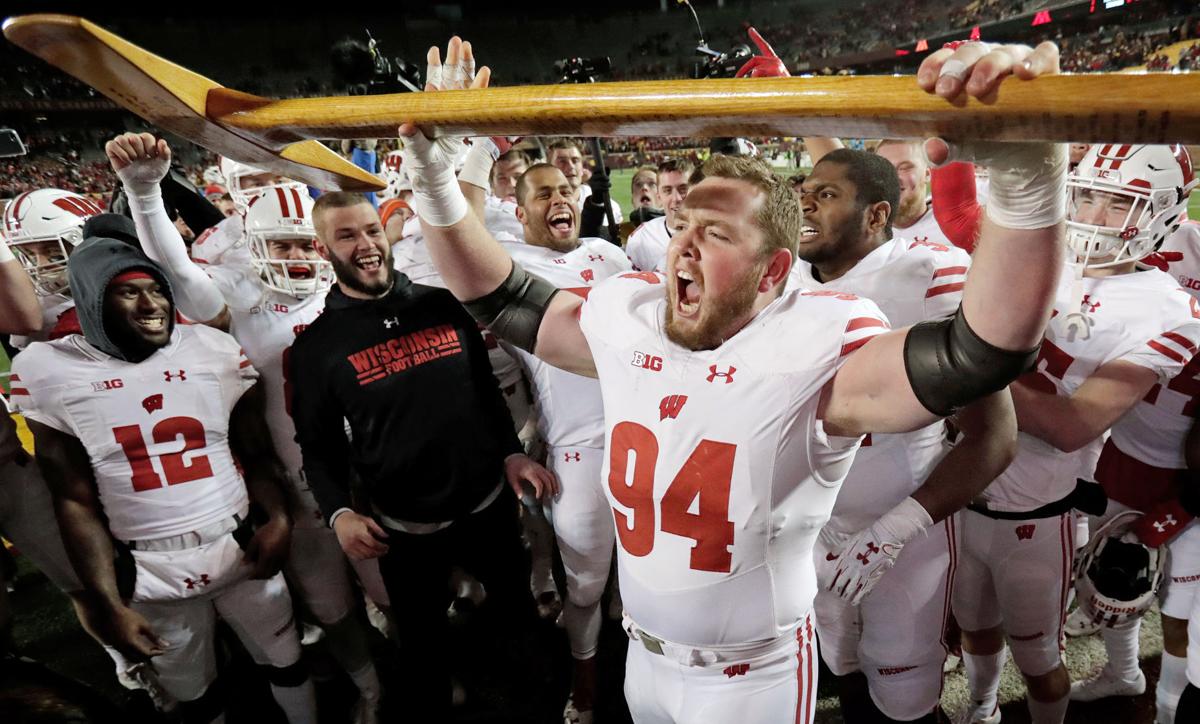
It has been in Madison almost as long as Cold Spring Shops has been posting. Wisconsin blocked a Minnesota punt in an October, 2005 game to retain possession (wiser heads have since prevailed, and Wisconsin plays Minnesota the last game of the season, the way Elroy Hirsch and Harry Stuldreher would have it) and the streak of successful defenses of the Axe is now fourteen seasons. Wisconsin also have a pretty good winning streak for this season.

There has been a Northern Illinois connection to the Minnesota program ever since the Goophs hired Jerry Kill away in 2010, just after Northern Illinois secured a bone in the Cities and before Northern Illinois went to Boise to play on the blue field. We wished Mr Kill well, apart from games involving the Axe, and we extend the same courtesy to current Minnesota coach and onetime Northern Illinois receiver P. J. Fleck.
Run the ball 'round Minnesota, touchdown sure this time!

Wisconsin State Journal photograph by M. P. King.
There has been a Northern Illinois connection to the Minnesota program ever since the Goophs hired Jerry Kill away in 2010, just after Northern Illinois secured a bone in the Cities and before Northern Illinois went to Boise to play on the blue field. We wished Mr Kill well, apart from games involving the Axe, and we extend the same courtesy to current Minnesota coach and onetime Northern Illinois receiver P. J. Fleck.
Run the ball 'round Minnesota, touchdown sure this time!
22.11.17
THANKSGIVING.
Word has reached Cold Spring Shops that some of today's regional trains are sold out.
We repeat our annual message of good wishes.
Spare a few moments thanks for the young people in harm's way around the world, for the people in emergency services who deserve to sit down to the turkey without the alarm ringing, for the people in transportation, tourism, and entertainment passing on their family gatherings to enhance yours.
As Matt "Dean Dad" notes, "There’s something civilized about a holiday built around reflection and gratitude."
Thank you for your readership, and your comments.
We will return with food for thought at the weekend.
We repeat our annual message of good wishes.
Spare a few moments thanks for the young people in harm's way around the world, for the people in emergency services who deserve to sit down to the turkey without the alarm ringing, for the people in transportation, tourism, and entertainment passing on their family gatherings to enhance yours.
As Matt "Dean Dad" notes, "There’s something civilized about a holiday built around reflection and gratitude."
Thank you for your readership, and your comments.
We will return with food for thought at the weekend.
REPURPOSING COMMUTER CARS AGAIN?
Rochelle's Nippon Sharyo were unable to produce a prototype bilevel corridor coach that could pass its compression test. Thus, Amtrak's regional services out of Chicago continue to make do with fortyish Amfleet cars and Horizon Fleet cars, themselves based on eastern commuter coach shells, that are themselves approaching middle age.
Now the California and Illinois Departments of Transportation, which under the current dispensation must finance the regional trains (although Amtrak handle reservations and cross-country ticketing) have made a deal with Siemens to build a fleet of coaches and club cars.
The article speculates the coaches will be similar to those recently erected for Florida's Brightline service. We note that Brightline is, at heart, a commuter service, that despite it having opportunities to engage in real estate development that Amtrak is precluded from by law.
Now the California and Illinois Departments of Transportation, which under the current dispensation must finance the regional trains (although Amtrak handle reservations and cross-country ticketing) have made a deal with Siemens to build a fleet of coaches and club cars.
The article speculates the coaches will be similar to those recently erected for Florida's Brightline service. We note that Brightline is, at heart, a commuter service, that despite it having opportunities to engage in real estate development that Amtrak is precluded from by law.
LOSING THE GOOD OF THE INTELLECT.
Hyperspecialized savants lose their perspective, asserts John Naughton. "If our supersmart tech leaders knew a bit more about history or philosophy we wouldn’t be in the mess we’re in now." His focus is on the alacrity with which people were able to exploit social media algorithms for their own purposes, that is to say, on the continued manifestation of the Law of Unintended Consequences. And why were these savants caught flat-footed? Perhaps because Unintended Consequences were not in their course of study.
As a consequence, the new masters of our universe are people who are essentially only half-educated. They have had no exposure to the humanities or the social sciences, the academic disciplines that aim to provide some understanding of how society works, of history and of the roles that beliefs, philosophies, laws, norms, religion and customs play in the evolution of human culture.Perhaps, as Mr Naughton's source Bob O'Donnell puts it, "While seemingly democratic at a superficial level, a system in which the lack of structure means that all voices carry equal weight, and yet popularity, not experience or intelligence, actually drives influence, is clearly in need of more refinement and thought than it was first given."
We are now beginning to see the consequences of the dominance of this half-educated elite.
20.11.17
THAT'S AVELIA, NOT ACELA.
It's a new Pendolino train, soon to go into service Frankfurt - Basel - Milan.
I note that these trains have adjustable seats, which is an advance over Britain's Virgin Pendolino sets.
Is it too much to ask for a spiffed-up version to run Paris to Venice via the Simplon as a latter-day Venice Simplon-Orient Express?
The Avelia Pendolino for SBB is a seven-car train that can transport up to 420 passengers at a maximum operating speed of 250km/h. The train offers its passengers easy access and high comfort due to wide gangways and corridors, adjustable seats, individual reading lamps and sockets as well as large panoramic windows. The train is equipped with the latest generation of flexible bogies reducing track and wheel wear. It also benefits from Alstom’s unique tilting technology, which allows trains to run 35 per cent faster and more safely through curves on conventional lines.Regenerative braking is not a new thing on electrically operated railroads, although providing the circuitry to rectify and invert and chop and then unchop and convert back to the catenary power and frequency is.
The Pendolino’s environmentally-friendly design is recyclable up to 95 per cent, and is equipped with an electric brake system allowing reducing energy consumption by almost 10 per cent.
I note that these trains have adjustable seats, which is an advance over Britain's Virgin Pendolino sets.
Is it too much to ask for a spiffed-up version to run Paris to Venice via the Simplon as a latter-day Venice Simplon-Orient Express?
SCHADENFREUDE IN BOSTON.
I happened across the lamentations in Boston's Globe about taxing college endowments and all the rest because that headline caught my eye at a news-stand in North Station.
Howie Carr has to live in the Kultursmog all the time. And he's not playing nice.
Howie Carr has to live in the Kultursmog all the time. And he's not playing nice.
Here’s how you know that there’s at least one beautiful new provision in the Republicans’ tax bill: Harvard is screaming bloody murder, ditto Yale, Wellesley, Smith and all the rest of the pampered-puke rich-kid private colleges.He gets to be the provocateur. I'm simply an observer passing through. But we're having similar thoughts.
The GOP must be doing something right!
Hilariously, the same eggheads who are always denouncing the Republicans as the party of “the rich” are now sounding like ... Republicans, defending their vast billion-dollar tax breaks.Tax incidence is messy, but, yes, ultimately, all income accrues to people.
Here’s the statement from the shocked, shocked president of Harvard, Drew Faust: “A tax on university endowments is really a tax on the people who make up these institutions and the work they do: donors, alumni, staff, students and faculty.”
THE TINGLE IS GONE.
Last year, even before the surprise presidential election results, we noted that Hardball's Chris Matthews had some doubts about the Democratic coalition of academics, celebrities, and assorted peoples who perceived themselves to be marginalized. "Biden talked today about what he calls the pedigree problem, how the Democratic Party at the top views anyone not an Ivy Leaguer as below intellectual consideration. How the party has kind of forgotten about ordinary Americans out there, how those people are smarter than they`re given credit for." I'll leave for another day the way the snobs have treated the assorted marginalized populations as mascots. Today, we note Mr Matthews again suggesting the Donks not forget an important part of the New Deal coalition. "I am not sure if he realizes that his intra-party battle has been lost, and the home of the working class is now the GOP." I'm not sure of that, and there are likely more electoral surprises to come. (From my perspective, there's not much in either of the major parties at the national level to appeal to me.)
But Mr Matthews has what would make an excellent "Let Me Finish" in his chewing out of the quiche-eaters.
The full talk is available on C-Span. (I wonder how people ever get anything done, if they're spending all their time watching public affairs programming in real time, or streaming it later.)
But Mr Matthews has what would make an excellent "Let Me Finish" in his chewing out of the quiche-eaters.
“You know, ever since we started this Archie Bunker thing in the early ’70s, making fun of white working people, we kissed them goodbye,” he said. “You make fun of people, you look down on them? They get the message. You call them deplorables? They hear it. You bet they hear it. You say they cling to their guns and their religion? Oh yeah, I cling to my religion. OK. I’m a little person, and you’re a big person. Thank you, I’ll be voting for the other guy this time.”Even at the age of fifteen or sixteen, or whatever I was when "All in the Family" came out, I was put off by Meathead's condescending and hectoring of Archie. Maybe condescending and hectoring is all Our Progressive Betters ever had.
The full talk is available on C-Span. (I wonder how people ever get anything done, if they're spending all their time watching public affairs programming in real time, or streaming it later.)
ARE YOU SURE THE OLD BOWLS WERE INCONCLUSIVE?
Slate's Ben Mathis-Liley doesn't like the football conference divisions and the algorithm-driven national championship. "College football divisions dilute traditional rivalries and reward weak schedules." To him, it's an outrage that Wisconsin's Badgers have an opportunity to win their way into the final four.
For now, let's stick to football.
That the conferences are different sizes affects the ability of conference contenders to schedule cupcakes, too.
It all makes a case for returning to the days of traditional bowls, and leaving the matter of a "national champion" as something to argue about over a few beers, or, these days, on social media.
Michigan has not itself beaten a team with a winning record and got blown out by approximately 400 points in its only game against an elite competitor this year.The divisional arrangement benefits Wisconsin this year, but that might not be the case if Nebraska or Iowa can restore normal operations, or if Minnesota and Northwestern get their rebuilding done.
Michigan, the most formidable of the 12 regular-season opponents faced by an ostensible title contender, is an above-average Big Ten team, but seemingly not much more than that; it will probably end up in a second-tier bowl game sponsored by an appetizer-oriented restaurant chain. But if the Badgers beat the Wolverines and defeat mediocre Minnesota the following weekend, they will enter the Big Ten title game, likely against Ohio State, with an undefeated record despite not having played anyone who’s any good. If Ohio State beats Wisconsin, there’s no guarantee it will make the playoff; having faced a tough schedule, OSU has a number of impressive wins but also two losses. But if Wisconsin wins, it will almost certainly be chosen for the four-team playoff despite playing a schedule that’s bereft of decent competition.
The Big Ten West, like the Big Ten East, has seven teams, meaning the Big Ten as a whole is made up of 14 universities. (Please trust that you are not the first person to recognize that this is deeply stupid.) The West is currently weaker than the East because of both random fluctuation (Michigan State is on an upswing while Nebraska is cratering) and geographical circumstance (the traditional powerhouse East teams in Michigan, Ohio, and Pennsylvania have denser local populations to draw talent from than West squads like Wisconsin, Iowa, and Minnesota). Each Big Ten team plays the other six teams in its division every year, but only three of the seven teams from the opposite division. This year, that arrangement has allowed the Badgers to dodge tough matchups against the Big Ten’s three highest-ranked non-Wisconsin teams: No. 9 Ohio State, No. 10 Penn State, and No. 17 Michigan State. Meanwhile, they’ve played all five Big Ten teams that will go into this weekend with conference records of 2-5 or worse.I sometimes suspect that all this conference realignment is a way for four power conferences of sixteen teams each to bypass March Madness and be done with Davidson and George Mason and Marquette and the like for once and for all.
For now, let's stick to football.
Before the Bowl Championship Series and now the four-team playoff, we could very easily identify the best teams in the South and the Midwest and the Far West, because they all played each other. It was much more difficult to figure out the best team in the country. Now, it’s somehow easier to identify the best team in the country—it’s hard to fake your way through a four-team playoff—than it is to identify the best team in each region. We have no idea if Wisconsin is the best team in the Big Ten, because Wisconsin hasn’t played any of the other good teams in the Big Ten. This is an odd state of affairs.No matter how you narrow the field, you're going to have this problem. But it's easier to argue the merits of say, Wisconsin beating UCLA in the Rose Bowl as a better claim to a title than whoever was playing for bragging rights in the Old Confederacy in the Orange Bowl, when there are no meaningful head-to-head records, then when you're griping about algorithms.
That the conferences are different sizes affects the ability of conference contenders to schedule cupcakes, too.
Wisconsin has done this egregiously, and its nonconference schedule this year was characteristically uninspiring: Utah State, Florida Atlantic University, and BYU, none a consistent top 25 program. If you’re going to ask national pundits and fans for RESPECT, your best nonconference opponent can’t be the FAU Owls. (For what it’s worth, nonconference schedules have generally been improving now that the four-team playoff allows more one-loss, and maybe sometimes two-loss, teams to have a shot at a national title.)These schedules get set many years in advance, although the power teams sometimes chicken out (hence the occasional early bye in a Northern Illinois schedule, that even before this year's win in Lincoln). But the Wisconsin sports broadcasters complain that in a fourteen-team B1G, teams play more conference games than, for example, the Southeastern Conference teams do, which gives Alabama, Auburn, and Louisiana State more opportunities to eat cupcakes in September.
It all makes a case for returning to the days of traditional bowls, and leaving the matter of a "national champion" as something to argue about over a few beers, or, these days, on social media.
CLOSE ENCOUNTERS WITH THE FALSE ECONOMY.
I've posted, repeatedly, on the errors of cost cutting for its own sake, whether or not it's announced with some bafflegab about "better service" or "enhanced productivity."
Today, we'll turn the forum over to Laura "11-D" McKenna, whose eldest son has just started at Rutgers, you know, the public university in New Jersey that liked being a crash-test dummy for Penn State so much that they followed Penn State into the Big Ten, which, with regional divisions, means they regularly play Michigan, Michigan State, and Ohio State as well as you-know-who.
Here's what the enhanced productivity looks like on the academic side.
The false economy, though, is that the entering class are as lost when it comes to schedule completion as a Rutgers defensive coordinator preparing to face Wisconsin will be.
The comments at the post are instructive. Happy Thanksgiving Break.
Today, we'll turn the forum over to Laura "11-D" McKenna, whose eldest son has just started at Rutgers, you know, the public university in New Jersey that liked being a crash-test dummy for Penn State so much that they followed Penn State into the Big Ten, which, with regional divisions, means they regularly play Michigan, Michigan State, and Ohio State as well as you-know-who.
Here's what the enhanced productivity looks like on the academic side.
The good side is that he has totally drunk the kool-aid. Every item of clothing that he wears has the college logo. He proudly tells me that his school is damn tough. The kids are smart enough to go to Ivy League schools. Many of his friends were admitted to Ivy League schools. They just didn’t want to waste their money.The land-grants and mid-majors are in the same business as Harvard, and the continued success of Jonah's cohort has a name, Spielberg Effect.
The false economy, though, is that the entering class are as lost when it comes to schedule completion as a Rutgers defensive coordinator preparing to face Wisconsin will be.
I’m pretty appalled at everything else. The advisement office put him in the wrong Intro to Physics class. There are two Intro to Physics classes at his school – one has a calculus pre-requisite. He took him a week to figure out that he was in the wrong class. It was too late to get into the non-calc Physics class, so they put him in the Intermediate German class and didn’t warn him that the class was pretty much only for advanced students majoring in German.I'm resisting the temptation to suggest that taxing graduate tuition waivers might be a way of draining the adjunct swamp. It's sufficient, here, to suggest that some of those kids who were admitted to the Ivies might seek to transfer for junior year, once they recognize that the Rutgers -- heck, it's all of the state flagships -- bargain is no bargain.
All of his teachers are adjuncts. And they tell the students that are over worked and under paid all the time. One got fired in the middle of the semester and was replaced by a very, very old adjunct who complains all the time about his physical pains. He said that he can’t do office hours, because his wife has to drive to him school.
His bio and calc classes have 400 students.
A small private college would easily cost another $35,000. So, I still think we did the right thing provided we make some changes. I’m taking over academic advisement for him. I spent two hours going over all the course guides, syllabi, and major requirements for the spring terms. I called Deans. I yelled at some. We’ll pay for a math tutor. After we pick his classes, we going to lean into Rate My Professor and make sure that he gets better teachers next semester.That's part of it, but these are the difficulties the motivated students face. We're not talking about the Distressed Material and the Greek letter organization cohorts here.
Perhaps this is why only 58% of students graduate in four years.
The comments at the post are instructive. Happy Thanksgiving Break.
19.11.17
RENT-SEEKERS GOTTA RENT-SEEK.
In Boston, the economic interests of local industry have to be protected. And Boston likes to think of itself as the country's largest college town. I think Chicago could give them a run for that, with DePaul, Loyola, and Illinois-Chicago each admitting more students than Harvard or those hockey schools across the Charles turn down in a year, but you don't get the kind of special pleading out of higher education in Chicago, where there are plenty of other special-pleaders ahead in the queue. Here's how the house organ for deep-blue smug by the deep-blue sea characterizes the planned tax treatment of higher education. "The proposed new tax on endowments at Harvard and Yale won’t generate much money, but it does play the signature trick of Trump-style Republicanism: It sets up a symbolic confrontation with the elite, even as it systematically enriches the wealthiest." There are other parts of that tax bill that come off as strange, including the treatment of tuition waivers as an imputed income. That's wonky. A quarter-century ago, Clinton era rewrites of the tax code sought to tax the imputed rent on owner-occupied houses as a form of income. Both the tuition waivers and the imputed rent qualify as income under the Haig-Simon definitions, and both are very hard to identify in practice.
But what's funnier is the way the people of the high tax states change their tune when it's their tax breaks at risk. From that same editorial, read and enjoy this.
Then there's some reporting on the deleterious effect ending the tax-exempt status of those collegiate endowments on the local economy.
But what's funnier is the way the people of the high tax states change their tune when it's their tax breaks at risk. From that same editorial, read and enjoy this.
The Senate bill, which at least preserves existing tax breaks for student loans, would eliminate the deduction for state and local taxes. Instead of college kids, Senate Republicans are thumbing their nose at blue states that pay for education and infrastructure out of their own funds. (Not coincidentally, states like Massachusetts, California, and Connecticut already contribute far more to federal coffers than they get back, because they’re more productive than states that refuse to invest in themselves.)But asking the "more productive" states to pay more in federal taxes, which is what eliminating those property and income or sales tax deductions will do is a bit much. Thus do people with lower incomes, living in less-heavily-taxed states, contribute to those investments Massachusetts, California, and Connecticut are making, or not, with Connecticut trying to become the next Illinois even now.
Then there's some reporting on the deleterious effect ending the tax-exempt status of those collegiate endowments on the local economy.
“These schools use endowments to build buildings, which employ our workers, and use it to subsidize student financial aid,” said Representative Michael Capuano, whose Cambridge district includes Harvard.What, taxing wealth less aggressively trickles down? Apparently that's not a discredited idea when it's tax benefits for Democratic hedge funds. But if you're a railroad or a printing company, you don't count.
“If Harvard has a smaller endowment, they are less likely to build a building. And that hurts my construction industry, that hurts my financial services industry,” Capuano said.
CATTLE ARE NOT ENDANGERED. ELEPHANTS ARE.
We've already noted that circuses are not inherently detrimental to the welfare of elephants.
And we maintain that elephants contribute to the welfare of children of all ages.

But the idea of managing hunting preserves as a strategy for conserving wild elephant bothers people. When you have a philosopher's freedom to play with ideas without having to respect the box of existing institutions (whether those be of property rights or of bribes and favors) you can propose some interesting things.
It's likely, though, that there might be some interesting Thanksgiving conversations about the ethics of hunting at Our President's house.
And we maintain that elephants contribute to the welfare of children of all ages.
Last call at Kingston, Illinois.
But the idea of managing hunting preserves as a strategy for conserving wild elephant bothers people. When you have a philosopher's freedom to play with ideas without having to respect the box of existing institutions (whether those be of property rights or of bribes and favors) you can propose some interesting things.
According to conservationism, scarce and precious resources should be conserved and used wisely. According to preservation ethics, we should not think of wilderness as merely a resource. Wilderness commands reverence in a way mere resources do not. Each philosophy, I argue, can fail by its own lights, because trying to put the principles of conservationism or preservationism into institutional practice can have results that are the opposite of what the respective philosophies tell us we ought to be trying to achieve. For example, if the wisest use of South American rainforests is no use at all, then in that case conservationism by its own lights defers to preservationism. Analogously, if, when deprived of the option of preserving elephants as a resource, Africans respond by not preserving elephants at all, then in that case preservationism by its own lights defers to conservationism.The article gets into the meaning of "waste", asking, for instance if the harvest of a large, rare tree produces benefits in the form of housing or furniture does in fact confer net benefits. That argument becomes more interesting if it's possible to fence off the trees, and sell harvesting rights, and replant the grounds. And in the absence of incentives to manage the hunt, the end outcome might be no elephants preserved in Africa at all.
It's likely, though, that there might be some interesting Thanksgiving conversations about the ethics of hunting at Our President's house.
NO QUIT IN THIS TEAM.
Yesterday's team reunion and banner reveal didn't get off to a good start for Northern Illinois. The opponent was Western Illinois, now campaigning under the same "Leathernecks" moniker as the guys, rather than the previous Westerwinds. Swirling winds, Marines storming beaches, what have you: they got off to a good start, hitting three-point baskets or recognizing driving opportunities, then being disruptive on defense. It got so bad that the Northern Illinois coach had to call a time out just before the end of the first quarter to recombobulate. And after the intermission, the visitors built as much as a fourteen point lead.

That's not edited in the camera. Northern's kids took a 92-91 lead with under two minutes to play. Score is tied at 94 with under two seconds to play. Three times-out used in those final two minutes: under the new rules, the team runs its out-of-bounds play in the forecourt. "The play was exactly what was drawn up and these players have run that a million times," said NIU Head Coach Lisa Carlsen. "From a coaching standpoint Coach [John] McGinty did a great job of drawing up the play, these players did a great job of executing and Kelly [Smith] did a great job of sticking it in the basket."
Note, at upper left, a gap between displayed banners. The unveiling, a half hour after game's end, proved to be more festive that it appeared much of the game.

That's not a bad way to get down to serious basketball, and start thinking about March.

That's not edited in the camera. Northern's kids took a 92-91 lead with under two minutes to play. Score is tied at 94 with under two seconds to play. Three times-out used in those final two minutes: under the new rules, the team runs its out-of-bounds play in the forecourt. "The play was exactly what was drawn up and these players have run that a million times," said NIU Head Coach Lisa Carlsen. "From a coaching standpoint Coach [John] McGinty did a great job of drawing up the play, these players did a great job of executing and Kelly [Smith] did a great job of sticking it in the basket."
Note, at upper left, a gap between displayed banners. The unveiling, a half hour after game's end, proved to be more festive that it appeared much of the game.

That's not a bad way to get down to serious basketball, and start thinking about March.
18.11.17
TIMED TO THE SECOND.
It's not enough, in Japan, to post departure times to the nearest minute (e.g. the 5.04 Elburn 400.) "Operator ‘deeply’ sorry for inconvenience to passengers after the 9.44.40am Tsukuba Express pulled away at 9.44.20am." But when the trains run on Chicago streetcar headways of years ago, the only inconvenience might be to a few passengers having to stand further along the line. "Passengers who might have made the train had it left on time in fact suffered little inconvenience: the next one arrived just four minutes later."
There's no word in the story of whether the conductor and motormen were called on the carpet for violating Rule Five. A train has no authority to leave a station before its scheduled leaving time.
There's no word in the story of whether the conductor and motormen were called on the carpet for violating Rule Five. A train has no authority to leave a station before its scheduled leaving time.
WOULD YOU LIKE SMUG WITH THAT?
A trip to Boston is an opportunity to get a sense of just how Our Progressive Betters think.
Actually, it starts on the train, where there are free copies of the Amtrak magazine for the reading. I have to wonder how well the content, whether of the articles or the advertisements (buy artisanal wine, some of the proceeds go to some environmental effort, for instance) plays with coach passengers, particularly once one is off the Acela routes.
Then there's the Globe, and I'm going to have even more fun with them before I'm done.
But it's suppertime, and we'll start with the Globe's alleged food reporter, Devra First.
But in Boston, it's just another day.
Actually, it starts on the train, where there are free copies of the Amtrak magazine for the reading. I have to wonder how well the content, whether of the articles or the advertisements (buy artisanal wine, some of the proceeds go to some environmental effort, for instance) plays with coach passengers, particularly once one is off the Acela routes.
Then there's the Globe, and I'm going to have even more fun with them before I'm done.
But it's suppertime, and we'll start with the Globe's alleged food reporter, Devra First.
I was a Chick-fil-A virgin.Are we finally ready to talk about the food? Not when there's virtue to be signalled.
If you want a mark of my Yankeetude, there it is. I made it well into adulthood without ever having a chicken biscuit or a Spicy Deluxe sandwich or the distinctively lump-shaped nuggets or the waffle fries. One summer my family took a road trip through the South, but we just kept driving past the battalion of buildings adorned with the company’s crimson-combed logo. (There are a lot of them: more than 200 in the chicken chain’s home state of Georgia alone.) On to the truck stops we loved, where we ordered 18-wheeler breakfasts and my sister and I hoped for gift shops where we could buy T-shirts emblazoned with cheesy wolves and country-western cassette tapes. And then home again, to delis with bowls of half-sours on every table and takeout Chinese on Friday nights.
Then, a few weeks ago, Chick-fil-A opened in Dedham.
Two years before he died, Mayor Thomas Menino sent a fiery letter to Chick-fil-A chairman and CEO Dan Cathy, who had spoken out against same-sex marriage. “I urge you to back out of your plans to locate in Boston,” Menino wrote. Now there’s a Chick-fil-A about 2 miles from his Hyde Park house.The business isn't opposed to gay marriage: the CEO has reservations, and those reservations might be a function of the term "marriage" referring to a legal status for the bequest of property and the establishment of lineage as well as to a religious ritual. Now can we EAT MOR CHIKIN?
Generally speaking, put in front of me a food I haven’t tried that has a hold on the hearts of a large swath of America, and I am there. But also, I have no interest in supporting a business that has opposed gay marriage.
The official corporate purpose is thus: “To glorify God by being a faithful steward of all that is entrusted to us and to have a positive influence on all who come into contact with Chick-fil-A.” It’s as loving on the surface as it is open to interpretation, but as a culturally Jewish agnostic who attends the Temple of Live and Let Live, I’m willing to give it a chance.Let us give thanks that she is crying before her mouth is full. And the Chick-fil-A is doing a good business, catering to normals.
So on a recent afternoon — when, if logistics had only cooperated, I would have been in Mexico, bawling into my champagne flute at one of the very same-sex marriages Cathy decried (on my planet simply referred to as “a wedding”) — I found myself pulling into the parking lot of Chick-fil-A for the first time.
I was not alone. There was a backup at the drive-through. There was a guy directing traffic. There was nowhere to park. There was a line out the door. People were taking selfies with the sign in the background.Annoy a liberal: post a selfie from Chick-fil-A on your social media platforms. This prologue has gone on longer than the invocation at a Puritan Thanksgiving. Can we eat already?
The interior was bright, spotless, more stylish than I’d imagined — more midscale chain brewpub than fast-food restaurant. And everyone was here: parents with tattoo sleeves, church ladies, people comparing notes on military life, a doppelganger for Poussey on “Orange Is the New Black,” obnoxious teenage boys flirting with plaid-kilted Catholic-school girls. We all waited in line together. Then our food was delivered right to our tables by sweet kids who will grow up to be good citizens.
I wasn’t going to do anything crazy. It was my first time, after all. I ordered the original Chick-fil-A sandwich: a squishy bun, toasted and buttered; a crisp fried cutlet; a necessary layer of tart dill pickle chips. I had the waffle fries, which had a unique cardboard texture. It was all pretty satisfying, in its way. I asked for the Chick-fil-A sauce, which was like barbecue sauce blended with French dressing and mayonnaise — which is to say vile, to my taste.I don't know, lady, you sound pretty full of yourself, well into writing your column. Not to mention full of it. I had hoped that advice on how to conduct yourself at Thanksgiving went away with the Obamas.
Because I didn’t grow up eating it.
This wasn’t my food. I couldn’t lay claim to it. It had no deeper meaning for me. Half the people in this Dedham Chick-fil-A were curious, like me, or simply hungry. But the other half were here for a taste of home. (Several queer friends have recently confessed to sneaking guilty orders of waffle fries or spicy biscuits or nuggets.) We are willing to overlook a lot for love, as some of us will soon be reminded while avoiding political talk at Thanksgiving. Something as simple as chicken sandwiches can bring us to the same table, too.
I left Chick-fil-A full, and I stayed that way well into the next day.
But in Boston, it's just another day.
HOW COLD WAS IT?
Cold enough that ESPN's #MACtion crew were issuing special commendations to their camera crews, and acknowledging that when people in DeKalb say it's cold, it's cold.
And thus did Northern Illinois defeat Western Michigan in football last week Wednesday, to the entertainment of more than a few patrons of Boston sports bars who were inside and quaffing their Sam Adams or what have you.
But the cold conditions are cold comfort for retired Northern Illinois sports information director Mike Korcek, who is already on record as wanting to see off the football on a school night.
Weeknight football was a dumb idea when it started, it was a dumb idea even with that Orange Bowl bid, conference powers-that-be recognize it's a dumb idea, and yet the dumb goes on. I suppose we should be grateful that the weeknight football is done for the season, because now it's time for football on Black Friday morning.
And thus did Northern Illinois defeat Western Michigan in football last week Wednesday, to the entertainment of more than a few patrons of Boston sports bars who were inside and quaffing their Sam Adams or what have you.
But the cold conditions are cold comfort for retired Northern Illinois sports information director Mike Korcek, who is already on record as wanting to see off the football on a school night.
In our community, the past two NIU midweek home game attendance numbers (an announced 8,872 vs. Eastern Michigan and 6,603 vs. Ball State) speak volumes. This nonsupport for a proud, high-profile Northern Illinois program that has been bowl-eligible nine times in the past 10 years doesn’t jive. Strange. Is this what the MAC really wants?It's kind of hard to carry out that directive, when, by late in the third quarter, the only students remaining in the student section -- the east stands -- were members of the Huskie Marching Band.
If anything, this fall on TV the MAC leads the country in exposed aluminum seats, which belies the ESPN recruiting aspect I’ve heard. “Son, come play in the MAC before 15,000 empty seats” doesn’t make much sense. Yes, the weather in the Midwest is cold in November – even worse at night. I’m sure there’s a league memo to ESPN (or vice versa) to minimize the crowd shots on TV. Sad aspect of #MACtion, sorry.
Weeknight football was a dumb idea when it started, it was a dumb idea even with that Orange Bowl bid, conference powers-that-be recognize it's a dumb idea, and yet the dumb goes on. I suppose we should be grateful that the weeknight football is done for the season, because now it's time for football on Black Friday morning.
17.11.17
TO REALLY FOUL THINGS UP REQUIRES A COMPUTER.
Cold Spring Shops have been on holiday, checking out real trains that run on rails, for much of the past week.
The occasion was a trip to Boston to gather information relevant to the model railroad, and to ride the Boston and Maine to Glosta for chowda and a lobsta. Missions all accomplished.
They are decking the Great Hall in Chicago Union Station for the season, and the Polar Express excursions that will run (using gallery cars and diesels, sorry, no steam) between Thanksgiving and Christmas.

At the food court, I chatted briefly with the engineer of the Lake Shore as far as Toledo, who mentioned that Norfolk Southern are now implementing some sort of artificial-intelligence dispatching algorithm. It reduces the train dispatcher to an appendage of a machine; his responsibility apparently being to put in the estimated starting time of the train, its destination, power and tonnage, and the algorithms work out an optimal path for the train given the power, conflicting trains, the ability of the receiving yard to receive the train, the probability of a penny on the rails, and unusual occurrences not otherwise indexed by number. The algorithms are also supposed to be adaptive, although he quipped something to the effect that they haven't seen much learning yet. On the other hand, he noted, it was Sunday.
But it is Norfolk Southern and you know what is going to happen.
First, though, let's chill in the new Metropolitan Lounge until train-time.
It's on two levels now, with an upstairs entrance, if Amtrak are able to spend the money on staffing it. And that upstairs room, also decked for the season, is called The Pennsylvania Room, honoring one of the three original railroads that owned Union Station.

So what will we see first, restoration of a through Chicago - Pittsburgh - Philadelphia train, or the construction of a from-scratch new T1, or should I just stick to improvising in my basement.
First, though, let's go for a train ride.
Amtrak 448-48 Lake Shore Limited, Chicago to Albany and on to Boston, 12-13 November 2017.
Genesis diesels 177-60
Boston cars: new baggage car 61067, Viewliner sleeper 62004, Business Class lounge car 48171, Amfleet II long-distance coaches 25060, 25108.
New York cars: Amfleet II coaches 25118, 25124, 25063, 25025, Amfleet I dinette conversion 28005, which the carrier calls Diner Lite (Less filling? Tastes good?), Viewliner sleepers 62005, 62039, new baggage car 61002.
Away OK at 9.30. It's Sunday, thus there's no adult beverage sale once the lounge car opens, as that opening is close to the Indiana state line. Car attendant has made down my upper. That's a recommended option on Viewliners as the uppers have windows. Rolling well until just past Gary, then it's time for the algorithm to learn a lot. Watch a South Shore train pass eastbound. Still waiting. Watch a South Shore train pass westbound. Want to doze off, but dozing off while aggravated over delays isn't easy.
My best guess: Elkhart wants to send the per diem trains west, but the algorithm incorrectly hopes that a per diem train off one of the western carriers can get into Elkhart without laying out the Lake Shore too badly. No such luck: we spent more time stopped than rolling between Chicago and Elkhart, and you know you're in trouble when the first call for breakfast comes just east of Sandusky, Ohio (due out at 4.12.) Worse, that late running puts the train into a signal maintenance window on CSX between Ashtabula and west of Buffalo, meaning we're doing the stop-and-proceed, or, at interlocking signals, the "after stopping authorized to proceed at restricted speed ..." and all the passengers intending to connect with regional trains or buses at Boston are screwed as those have all been long gone by 1.13 Tuesday morning, when we reach South Station.
I also have to wonder if Amtrak's use of the business class and lounge car as the food service on the Boston and Albany isn't engendering some ill will. The attendant announces a closure, eastbound out of Albany, westbound out of Framingham, of the cafe section in order to serve the sleeper passengers supper or lunch. It's a train, and people mostly don't get too worked up about stuff ... the over-wrought sorts are up in the air, or perhaps they're on the Acelas.
Missions accomplished, time to head home on Thursday. Rainy day, thus no car details, plus the dining car crew offered to seat the Boston sleeper passengers during the Albany stop, where that was an across the platform walk.

Even so, why does it take the better part of an hour to combine the two parts of the train at Albany? The Boston cars are at left, and motors 103 and its follower will run through to Chicago, whilst the dual-mode 709 will come off. The odd layout of the train, with sleepers at both ends, means there's only one cut (the New York motor) and one shove (the Boston cars onto the front of the New York cars) and off we ought to be able to go. It would take three cuts and four shoves to assemble a train in the proper order (baggage, coaches, lounge, diner, sleepers) and current regulations on the inspection of passenger cars after coupling and uncoupling make for a more complicated evolution than docking the Command and Lunar Modules.
That operational convenience, though, means that the Boston sleeper passengers have a lengthy walk from the diner back to their accommodation, and we had some older and infirm passengers along. They managed, but there has to be a better way.
Overnight, my impression is that the train was waiting for time at Rochester, at Erie, and possibly at Toledo. Elkhart coming up, and yes, the fun begins. An hour late into Chicago, but the passengers intending to go further west today did make their connections.
And Amtrak sent me a link to a survey, my impressions of the eastbound trip. I hope there's a section to comment on those delays west of Elkhart.
We hope to resume regular commentary over the weekend.
The occasion was a trip to Boston to gather information relevant to the model railroad, and to ride the Boston and Maine to Glosta for chowda and a lobsta. Missions all accomplished.
They are decking the Great Hall in Chicago Union Station for the season, and the Polar Express excursions that will run (using gallery cars and diesels, sorry, no steam) between Thanksgiving and Christmas.

At the food court, I chatted briefly with the engineer of the Lake Shore as far as Toledo, who mentioned that Norfolk Southern are now implementing some sort of artificial-intelligence dispatching algorithm. It reduces the train dispatcher to an appendage of a machine; his responsibility apparently being to put in the estimated starting time of the train, its destination, power and tonnage, and the algorithms work out an optimal path for the train given the power, conflicting trains, the ability of the receiving yard to receive the train, the probability of a penny on the rails, and unusual occurrences not otherwise indexed by number. The algorithms are also supposed to be adaptive, although he quipped something to the effect that they haven't seen much learning yet. On the other hand, he noted, it was Sunday.
But it is Norfolk Southern and you know what is going to happen.
First, though, let's chill in the new Metropolitan Lounge until train-time.
It's on two levels now, with an upstairs entrance, if Amtrak are able to spend the money on staffing it. And that upstairs room, also decked for the season, is called The Pennsylvania Room, honoring one of the three original railroads that owned Union Station.

So what will we see first, restoration of a through Chicago - Pittsburgh - Philadelphia train, or the construction of a from-scratch new T1, or should I just stick to improvising in my basement.
First, though, let's go for a train ride.
Amtrak 448-48 Lake Shore Limited, Chicago to Albany and on to Boston, 12-13 November 2017.
Genesis diesels 177-60
Boston cars: new baggage car 61067, Viewliner sleeper 62004, Business Class lounge car 48171, Amfleet II long-distance coaches 25060, 25108.
New York cars: Amfleet II coaches 25118, 25124, 25063, 25025, Amfleet I dinette conversion 28005, which the carrier calls Diner Lite (Less filling? Tastes good?), Viewliner sleepers 62005, 62039, new baggage car 61002.
Away OK at 9.30. It's Sunday, thus there's no adult beverage sale once the lounge car opens, as that opening is close to the Indiana state line. Car attendant has made down my upper. That's a recommended option on Viewliners as the uppers have windows. Rolling well until just past Gary, then it's time for the algorithm to learn a lot. Watch a South Shore train pass eastbound. Still waiting. Watch a South Shore train pass westbound. Want to doze off, but dozing off while aggravated over delays isn't easy.
My best guess: Elkhart wants to send the per diem trains west, but the algorithm incorrectly hopes that a per diem train off one of the western carriers can get into Elkhart without laying out the Lake Shore too badly. No such luck: we spent more time stopped than rolling between Chicago and Elkhart, and you know you're in trouble when the first call for breakfast comes just east of Sandusky, Ohio (due out at 4.12.) Worse, that late running puts the train into a signal maintenance window on CSX between Ashtabula and west of Buffalo, meaning we're doing the stop-and-proceed, or, at interlocking signals, the "after stopping authorized to proceed at restricted speed ..." and all the passengers intending to connect with regional trains or buses at Boston are screwed as those have all been long gone by 1.13 Tuesday morning, when we reach South Station.
I also have to wonder if Amtrak's use of the business class and lounge car as the food service on the Boston and Albany isn't engendering some ill will. The attendant announces a closure, eastbound out of Albany, westbound out of Framingham, of the cafe section in order to serve the sleeper passengers supper or lunch. It's a train, and people mostly don't get too worked up about stuff ... the over-wrought sorts are up in the air, or perhaps they're on the Acelas.
Missions accomplished, time to head home on Thursday. Rainy day, thus no car details, plus the dining car crew offered to seat the Boston sleeper passengers during the Albany stop, where that was an across the platform walk.

Even so, why does it take the better part of an hour to combine the two parts of the train at Albany? The Boston cars are at left, and motors 103 and its follower will run through to Chicago, whilst the dual-mode 709 will come off. The odd layout of the train, with sleepers at both ends, means there's only one cut (the New York motor) and one shove (the Boston cars onto the front of the New York cars) and off we ought to be able to go. It would take three cuts and four shoves to assemble a train in the proper order (baggage, coaches, lounge, diner, sleepers) and current regulations on the inspection of passenger cars after coupling and uncoupling make for a more complicated evolution than docking the Command and Lunar Modules.
That operational convenience, though, means that the Boston sleeper passengers have a lengthy walk from the diner back to their accommodation, and we had some older and infirm passengers along. They managed, but there has to be a better way.
Overnight, my impression is that the train was waiting for time at Rochester, at Erie, and possibly at Toledo. Elkhart coming up, and yes, the fun begins. An hour late into Chicago, but the passengers intending to go further west today did make their connections.
And Amtrak sent me a link to a survey, my impressions of the eastbound trip. I hope there's a section to comment on those delays west of Elkhart.
We hope to resume regular commentary over the weekend.
5.11.17
THE ILLOGIC OF COLLECTIVE ACTION.
In my continuing quest to understand the ways the punditocracy come to terms with the surprise election of Donald Trump, I devote Book Review No. 26 to Mark Lilla's The Once and Future Liberal: After Identity Politics. (I got it on the cheap as the local book store, which opened not so long ago, is going out of business.) Mr Lilla, a professor of humanities at Columbia, has advanced parts of his thesis previously, with some push-back from the people supposedly on his side. And the identitarian faction that argues with, then mostly votes for, Democrats, continues to advocate for more of the same.
MODEL RAILROADING IS FUN.
Of course it is, and a determined proprietor at Esther's Hobby Shop in Millvale, Pennsylvania is determined to keep it that way.
With Christmas coming, may there be trains under and around your trees.
Like Esther’s, Millvale is a town in the middle of transition. The transition that appears to be going well, considering everything that has gone wrong for this town over the past few decades: job losses, a flood that wiped out half of the Main Street businesses, an aging population that was dying off.And model railroading is no longer -- if ever it was -- a niche business for obsessive craftsmen only.
For years, people have been writing off the town as mired in the past and unable to grow – sort of like model railroading, for which story after story suggests the hobby is dying and unable to sustain itself.
Both stories are only partly true. For 30 years, Millvale had been on the decline but — given its proximity to the river, a trail that connects to Washington, D.C., and its charming Main Street grid filled with historic buildings graced by unique architecture — young people noticed and started investing in the town.
Bob Leonard of Ft. Lauderdale visited the store on his way to Altoona, Pa., for a structure show. “What they have done with technology today to help the hobbyist to construct buildings is transforming the industry,” he explains. He and four friends marvel at [proprietor Bob] Mehler’s stock as they walk up and down the aisles of the store.That reference to running trains from smart 'phones is correct. I saw a control system called Blue Rail at a recent convention. The application allows for control of the train from the swipe pad on the 'phone, and the sound of the locomotive comes from the 'phone, obviating the speaker and sound module that would otherwise have to be hidden somewhere in the model.
Technology now allows savvy enthusiasts to run their trains from their iPhones, and 3-D printing will soon empower hobbyists to create scenery, custom trains, and track systems.
Mehler raised six children on the third floor of his business that kept them all fed, educated, and safe. He chokes up, recounting the highs and lows of his life here behind the counter of this hobby shop, from the struggles his mother faced to the loss of the love of his life nearly two decades ago.
With Christmas coming, may there be trains under and around your trees.
Subscribe to:
Posts (Atom)