28.3.22

USENET WITH BETTER GRAPHICS.

I was troubled enough by the doddering ficus seemingly calling for regime change in Russia (which he and his crew have been walking back ever since) to dust off an old meme and launch it on social media.

Not a bad ratio, for those who worry about such things, and 32,062 "engagements" is likely a personal best.  What's intriguing about the comments, which people who worry about ratios treat as possible negatives, is that in addition to the predictable "But Trump" (the medium is not a good place to offer my thoughts about the past thirty years of uninspiring presidents) and "Russian stooge" there are supportive comments, as well as social media style rivet counting, e.g. "ice cream, not pudding."

Whether any minds get changed on social media, or if it exists to be cathartic, and everybody understands it as such, is more thinking than I want to do right now.

THE BASKETBALL TOURNAMENT GENERATES THE RENTS.

The woketards will figure out how to dissipate them.
With March Madness in full swing, you may have noticed more than usual mainstream sports media coverage devoted to the National Collegiate Athletic Association women’s swimming finals last week. The coverage largely focused on “concerns” about the possibility of new records being broken by Lia Thomas, a varsity swimmer at the University of Pennsylvania who also set records for varieties of outrage generated by simply existing and thriving as an elite transgender athlete.

Thomas became the first known transgender athlete to win an NCAA Division I championship by winning the 500-yard freestyle last week. Before this event—and every other event in which she swam—swimmers are customarily introduced and cheered one by one, but the crowd reportedly was “noticeably quiet” for Thomas’s introductions. This silent treatment continued at the 500 free winners’ podium, with what seemed like deliberately more applause for every other finisher.
It's more polite to call attention to an affront by shunning it, rather than booing or otherwise making the interloper into a martyr.

HOW PARETO DISTRIBUTIONS EMERGE.

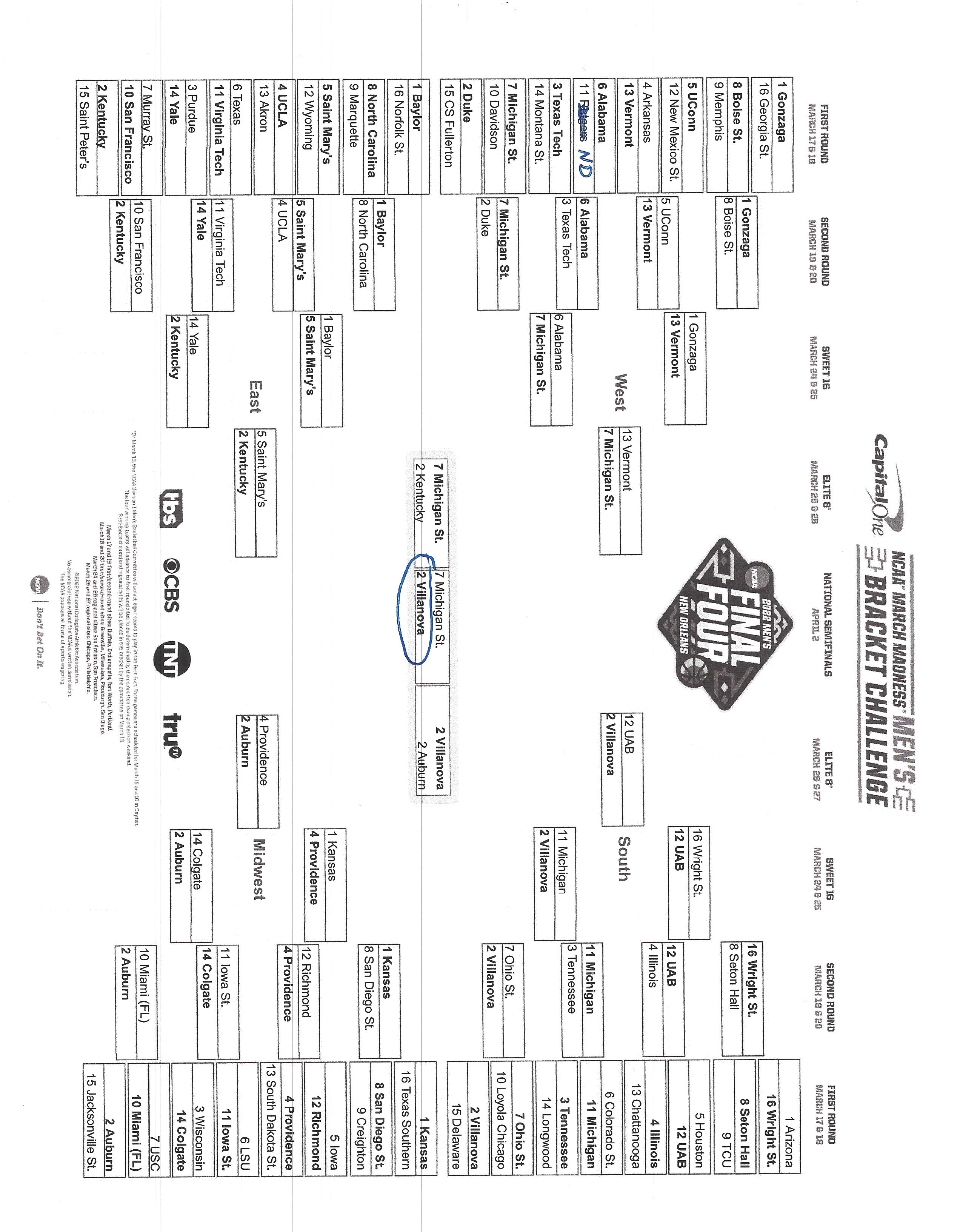
It might not be possible to fill in a perfect bracket, and yet, a fan has a better chance of having a shot at the big prize if the entry has traditional strong programs, even if not high seeds, in the Final Four.
The Final Four is headed to New Orleans, and if you aren’t on the short list of college basketball’s “haves” — as in having it all, including lots of blue in your uniforms — you’re just not invited.

Villanova, Duke, Kansas and North Carolina.
Lots of past championships among those teams.  More than a few allegations of cheating to go with those blue uniforms as well.  In a world of relatively few pundits appearing on Meet the Press or relatively few law schools sending graduates to the high bench, perhaps a relatively small set of tournament finalists is logical.

DELAY IS THE DEADLIEST FORM OF DENIAL.

Last week, Mark J. Perry issued a call for lawsuits. "Higher education has a major civil rights problem, and it’s so widespread that it’s nothing short of systemic and structural."  Perhaps the deanlets and deanlings who run the division of diversity and special education will dither and delay and hope the problem goes away.  Prepare to fight it out on that line if it takes seventeen summers.
In February 2005 the University of Wisconsin Board of Regents ignored my complaints that several financial aid programs violated Title VI of the Civil Rights Act of 1964. These programs restricted eligibility to students based on their race, color, and national origin even though Title VI explicitly prohibits discrimination based on “race, color, and national origin” in programs or activities receiving federal funds.

The Board of Regents’ brushoff led me in March 2005 to forward my complaints to the US Department of Education’s Office for Civil Rights (OCR), which is charged with enforcing Title VI. I expected a quick ruling because the evidence of UW’s discrimination was so clear cut. But, now, seventeen years later, OCR, specifically its Chicago Office, still has not ruled on my complaints. It nonetheless claims to be moving “as expeditiously as possible” in ruling on my complaints, which it has said involve “complex legal issues.”

The nature of these “complex legal issues” has never been explained to me. The language of Title VI could not be stated more clearly, nor could the violations by the University of Wisconsin be more obvious.
A lengthy excursion into process worship follows.
The time has come to enforce the law. I hope that Catherine Lhamon, the new Assistant Secretary for Civil Rights, will move quickly to see that Title VI of the Civil Rights Act of 1964 is enforced. However, it is difficult to be optimistic since Lhamon took no action on my complaints when she served in this position previously.

How long must a citizen wait before his well-documented complaints are ruled on by the very organization established by the Civil Rights Act of 1964 to enforce the law?
The author of the essay is Wisconsin economist Lee Hansen, once upon a time a New Frontier man, who has called attention to numerous education policy follies coming out of Bascom Hall over the years.

25.3.22

WATCH THIS SPACE.

The Chicago area O Scale swap meet might have been one of the last public events of March 2020 before the politicians panicked.  The Gloucester Branch was available for layout tours during the show.

The show, which hobbyists refer to as the "March Meet," will take place during the first weekend of April.  Between the corona restrictions and the shakeout of capacity in travel and entertainment business over the past two years, lining up host hotels has become more difficult, and at least one of the larger shows will not take place in future.

The Gloucester Branch will be holding open days during the meet.  This year, it's not going to be the Plywood Central everywhere.


There's a possibility of more than a cameo appearance by a project some 20 years in the making.


Expect a situation report after the show.

FRIDAY short TAKES.

Did Joe Biden inadvertently demonstrate the emptiness of his pledge to senior Democrat James Clyburn by fulfilling it with ludicrously unprepared appointments? “The hypocrisy and absurdity of this is that she was nominated by President Biden in large part because she is a woman.”  I'm not a veterinarian, but I know a dog when I see one.


A roundup of pithy distillations of traditional Cold Spring Shops themes, with or without refreshers, follows.

A CALL TO ACTION.

"Higher education has a major civil rights problem, and it’s so widespread that it’s nothing short of systemic and structural," according to Mark J. Perry, and he's calling for lawsuits.  The gravamen:
Typical and frequent illegal violations of Title IX that have gone unchallenged for many decades include various single-sex female-only scholarships, fellowships, awards, study spaces, mentoring, tutoring, special freshman orientations, industry meetings, summer STEM programs, summer STEM camps, coding clubs, leadership programs, entrepreneurship programs, gym hours, etc. that operate exclusively for women while illegally excluding and discriminating against boys and men. Over the last several years, it has also become increasingly common in higher education for universities to introduce illegal, racially segregated, or racially preferential events, affinity groups, theater performances, campus housing, course sections, music programs, scholarships, summer internships, and other academic programs that violate Title VI.

Those violations of Title IX and Title VI reflect what is a clear, hypocritical, and selective double standard in higher education for the enforcement of federal civil rights laws. The civil rights of certain preferred groups are vigorously protected – women and persons of color – while the civil rights of un-preferred groups are routinely violated – men, whites, and Asians.
The title references are to the 1972 Civil Rights Act.  What have I been telling you, dear reader, about the way to demonstrate the folly of a rule.
The University of Chicago’s quick correction of its Title VI violation following an internal complaint and publicity on Twitter is an example of an all to frequent and troubling occurrence in higher education today. Like I mentioned above, colleges and universities are constantly demonstrating that they are either unaware of their legal obligations to enforce Title VI and Title IX, or they purposefully and deliberately violate federal civil rights laws to promote their commitment to the flawed trilogy of “diversity, inclusion, and equity (DIE)” under the assumption that nobody will notice or complain. Whether it’s an unacceptable unawareness or a deplorable indifference to enforcing Title VI and Title IX, the longstanding history of schools violating Title VI and Title IX with impunity illustrates the necessity for increased efforts like those of Professor Abbot to challenge and expose the thousands of examples of civil rights violations on campuses across the country.
If nothing else, such grassroots action by disgruntled students, faculty, or alumni will give the diversity deanlets work that might keep them from issuing ukases. Or, perhaps their job satisfaction will deteriorate and they'll mope off.

23.3.22

TODAY IN URBAN PROGRESSIVE PRIVILEGE.

The Urban Weenie Aesthetic includes periodic efforts to deplorable-shame people for their transportation choices by holding Toxic Car Commercial contests.  Sometimes the category is "toxic masculinity" (understand as Real Guys doing Difficult Things) and sometimes the category is "unrealistic road rage" (understand as peeling rubber or otherwise going fast on uncrowded urban streets or highways.)

Fine, Urban Weenies can have their tournaments.  In that spirit, perhaps there ought to be another category, for Urban Weenie Snobbery.  First nominee, Infiniti's "Beautiful Mess."


That's right, dear reader, you can block out the sound of middle schoolers struggling to play Strauss by activating your power windows and the reclining seat.  There are some favorable comments, although sentiment strikes me as more negative than positive.  For example, "I'm sure the person who came up with the idea was at their kids recital like this is so horrible Ive got an idea." The best Infiniti have by way of apology is "It was never our intention to denigrate the arts or art educators in any way."

UNDERSTANDING THE CORRELATION OF FORCES.

Frederick W. Kagan offers a primer on the terms of art military analysts use.
The technical terms “stalemate,” “campaign,” and “culmination” can confuse the lay reader unfamiliar with military terminology. This note offers an explanation of those terms with reference to historical examples in World War I and World War II, recognizing that historical analogies are always limited.

A campaign is a major military undertaking launched as part of a war effort to achieve one or more objectives that are necessary but not necessarily sufficient to achieving the overall war aims. The Russian invasion of Ukraine that began nearly a month ago was such an undertaking—its aims of seizing Kyiv and Ukraine’s other major cities were part of a larger effort to replace the government of Ukraine, destroy the Ukrainian military, and allow Russian President Vladimir Putin to set political, economic, and security conditions in Ukrainian territory to his liking.
The "part of a war effort to achieve one or more objectives" matters.  In the current case, the overarching objective is the creation of a more Russia-friendly Ukrainian state.  Given the size of Ukraine, it might make sense to think of the movement on Kiew as analogous to the Vicksburg campaign, with the southerly push an attempt to connect the Russian-aligned populations along the Sea of Azov and the Black Sea.  (If you're into counterfactuals, what would have happened had McClellan taken Richmond in 1862, with much of the cotton South untouched?)

"Culmination" is the interesting term.  It refers to a situation in which the addition of resources to a campaign fail to achieve results.
It is useful to compare Putin’s initial campaign with the German invasion of the Soviet Union (USSR) that began in June 1941. The German objectives were to seize Leningrad (today’s St. Petersburg), Moscow, and Ukraine to knock the USSR out of the war quickly. The Germans destroyed huge portions of the Soviet military, besieged Leningrad, reached the outskirts of Moscow, and then the campaign culminated in winter 1941. Like the Russians in Ukraine today, the Germans in 1941 continued to try to get more combat power to the front and launch increasingly hopeless attacks against Moscow well past the point of diminishing returns—which is one sign that a campaign has culminated. The Germans failed to take any of their objectives.
That remains to be seen. It took Grant and Sherman a long time to invest Vicksburg, and Northerners grew frustrated with the pace of operations outside Petersburg.  In neither case could the rebels be resupplied, though.  It's still possible for outsiders to supply Ukraine, and that turns culmination into stalemate.
Stalemate describes a condition in war in which neither side can change the front lines dramatically no matter how hard it tries. WWII never reached stalemate in Europe. The opponents alternated offensive and defensive campaigns but were almost always moving. World War I epitomized stalemate. Stalemate in that conflict, as in others, saw lots of very hard and nasty fighting with many casualties on both sides. The front lines became generally (but not completely) static, with very little movement. There was always some movement of the lines even in World War I, but never enough to change the situation materially.

But stalemate often involves large and bloody battles. The Battles of the Somme, Verdun, and Passchendaele took place in conditions of stalemate. Hundreds of thousands were killed in those battles that moved the front lines a little, but not much. And stalemates can ultimately be broken, as the one in World War I eventually was. One side or the other can lose its will. One side or the other can gain a new ally (like the US in World War I). One side or the other can gain a technological advantage, although that’s less common (and was less important in World War I than the entry of the US). One side or the other can just be ground down and collapse (like Russia in 1917). Many things can happen in the context of a huge amount of fighting and dying, all in conditions of stalemate.
Note that the military meaing of "stalemate" differs from the chess meaning.  "Stalemate is one of the drawing rules of chess. It happens when the player who has to move has no legal moves available. The game then ends immediately in a tie, and each player is awarded half a point."  Often, that arises when the player with an overwhelming advantage in material or position leaves his opponent with no legal move, an embarrassing mistake that even the Grandmasters sometimes make.  (They get to write about those instructive errors in their books.)  It's a useful technique that even beginning players can develop.  Consider the simplest of King and Pawn endgames: one student has to promote the Pawn, the other has to stop it.  To win, maneuver the King ahead of the Pawn, with the opposition.  The other player must move his King, and then the player with the Pawn can take a step forward with the King and advance the Pawn.  But if it's a Rook Pawn or Bishop Pawn, even that isn't good enough.

PRESIDENTIAL MALPRACTICE.

How big an asterisk do you append to the title "Associate Justice Ketanji Brown Jackson?"

A big f***in asterisk, according to Lawrence J. McQuillan.
President Joe Biden’s promise to select a Black woman for the U.S. Supreme Court committed the country to a social experiment involving only 70 people for one of the most critical positions in the federal government. Perhaps Ketanji Brown Jackson would have emerged as the best nominee among all qualified candidates. We’ll never know because of Biden’s self-imposed political-pandering stunt, which equates to presidential malpractice.
That could be a Friday short Take, but for Jeff Kouba, a new contributor at Shot in the Dark, chiming in.
Our current vice president is a dopey gigglebox whose morning calisthenics consist of struggling to find a coherent thought. Feel the burn! She was picked solely on the basis of her skin color and gender.

Now, our current president, whose Biden Doctrine “I can’t have oatmeal before 8 am because I get gassy” will soon be of interest only to the nurses who wheel him down to the solarium, has nominated Ketanji Brown Jackson to the Supreme Court, the Left’s favorite unaccountable super-legislature. What’s more, she was picked for the exact same reasons as Harris. Given that first steaming example of affirmative action, as fresh as objets d’art on a San Francisco sidewalk, and how that is working out, might Jackson be worth a few pointed questions from a co-equal branch of government before she takes her lifetime appointment, Mr. Waldman?
Today, the nominee had to take a pass on attempting a legal definition of "woman."

Our governing class is pathetic.

PICKING WINNERS IS HARD.

We know that is true about industrial policy, but we now know that twenty million predictions of the outcome of the college basketball tournaments is operationally pretty far from infinity, in case anyone wants to work out how many monkeys it would take, in how much time, to come up with the works of Shakespeare.
Creighton guard Lauren Jensen stunned Iowa and busted the last perfect entry in the CBS Sports Bracket Challenge in the first game of the second round of the Women's NCAA Tournament. Jensen, a transfer from Iowa, hit a game-winning three-pointer with 15 seconds on the clock to help No. 10 seed Creighton upset the No. 2 seed Hawkeyes.

The last perfect entries in the men's Bracket Challenge had were eliminated on Friday.

All other brackets were busted over an insane first round in which eight lower-seeded teams advanced, including two No. 12 seeds (Florida Gulf Coast and Belmont) for the sixth time in the women's tournament's history.
That's right, the tournaments didn't even get out of the first round before all the brackets were busted.  That's also true, thanks to Michigan State being excused, of Inside Higher Ed's picks.  The talent pool in the women's tournament appears to be getting bigger, with those twelve seeds doing what has become usual and customary in the men's tournament of late.

If only the rest of higher education had the kind of churn we see in the basketball tournaments.  Who knew that relatively small Catholic institutions (St. Peter, St. Mary Gaels, Mount St. Mary) could achieve where the Ivies were one-and-done?  If you want to smack Yale around some more, because of corona protocols, their band could not travel to Milwaukee.  Greendale High School's band filled in.  Maybe admissions officers in New Haven will look more favorably on applications from Greendale.

In addition, once again the power conferences punched below their weight.  Perhaps the algorithm for issuing at-large bids is flawed, and second place teams in the likes of the Mid-American ought be considered in preference to middling teams from the power conferences.

22.3.22

THE CORRELATION OF FORCES IN UKRAINE.

Chicago Boyz contributor Jay Manifold offers a lengthy analysis.  "Trust only reports of failure, not reports of success" has a Friday short take vibe to it.  In addition, those conscripts Russia has been sending to war might not have had as much basic training as the training manuals prescribe. From a school trip through Siberia a few years ago:
[A] platoon of army recruits were riding in the 3rd class cars forward of our much nicer 2nd class accommodations. Some of the students talked with them (we had three fluent Russian speakers in the group, so we were not dependent on hired interpreters) and quickly learned that much of the recruits’ training was skipped over because they were forced to do construction work on an officer’s dacha. I remember hearing that and thinking, if this country gets into a real war, these kids are going to be like straw in a bonfire. Eighteen- and nineteen-year-olds.
There are all sorts of perspectives on offer in the bull session.

A JOB ACTION ON THE CANADIEN PACIFIQUE DE MEXICO.

Currently, the job action appears limited to Canada based train crews, although the movement of bulk commodities throughout North America (in anticipation of the merger, Canadian Pacific and Kansas City Southern have been coordinating their freight trains) is at risk.  Because of certain elected officials reluctance to authorize pipelines, a lot of crude oil moves by rail, and with the planting season about to begin, the fertilizer dealers are stocking up.
Crude oil and fertilizer are also two of the products most affected by the war between Russia and Ukraine, which are the “major agriculture producing nations” the senators were referencing in the letter. Oil has been at the center of media attention, but as Andrew Stuttaford has written about before, fertilizer shortages could end up being much more damaging. Food is truly a universal input.
Yes, and there's nothing like a good crisis to encourage people to ask for better working conditions.
Given the war, U.S. and Canadian grain producers are under pressure to produce more than normal this season to at least partially compensate for the lost production in Russia and Ukraine. That means they’ll need a lot of fertilizer. Saskatoon, Saskatchewan, is home to Nutrien, the world’s largest fertilizer company, and is served by one of the densest parts of CP’s rail network. Without CP operating as normal, many farmers on both sides of the border will have a hard time getting fertilizer.

This work stoppage might only be a foreshadowing of what is to come, however. The International Longshore and Warehouse Union (ILWU), which represents West Coast dockworkers in the U.S. and Canada, has been gearing up for labor negotiations when its current contract expires on July 1.
Just watch, some Washington politician will accuse the fertilizer producers (themselves a concentrated industry?) of price gouging.

THE END OF THE WORLD WILL COME IN 2030.

I remember when the end of the world was supposed to be by 2000, and maybe it was ice and not fire or famine that would be the end, and then it was supposed to come in 2016 (which would have spared us the Clinton - Trump election follies, but I digress.)  Now, we'll see if the world ends in my lifetime.
Dire new research published Tuesday estimates that rich countries must end oil and gas production entirely by 2034 to give the world a 50% chance of limiting warming to 1.5°C by the close of the century—the Paris accord's most ambitious climate target.

Assembled by experts at the United Kingdom-based Tyndall Centre for Climate Change Research, the report finds that "immediate and deep cuts in the production of all fossil fuels" are needed worldwide to avert the worst of the ongoing climate emergency.
If I'm still around then, I'll call attention to those readers who are around that we are still around.

Make of it what you will, dear reader, that the poorer countries, which tend to be more polluted, get to take more time weaning themselves off of fossil fuels.  "A transition based on principles of equity requires wealthy, high-emitting nations to phase out all oil and gas production by 2034 while the poorest nations have until 2050 to end production."

GETTING THE ECONOMICS RIGHT.

Let the record show that the last major outbreak of Official Brow-Furrowing about corporate concentration leading to higher prices through an exercise of market power was during the Carter presidency.  (The Soviet Union invaded another country in hopes of installing a friendly government back then, but I digress.)  That brow-furrowing often focuses on specific sectors, such as food processing, and some of that was at work during the Obama administration.  Back then, though, the troubling developments might have been better living through chemistry.  "Concentration in the food business is not in the public interest -- now-a-days advanced genetic modification is the latest way of enhancing profits despite making the food cheaper and more plentiful."  I tend to file that sort of stuff as "Demand your right to pay higher prices from independent suppliers."  That's what we have farmers' markets, artisanal breweries, and the like for.

But then, the senile potted plant inserts himself in the discussion, and it appears he's arguing that we all end up paying more for meat because the meat packers are paying ranchers less for meat.
Given Biden’s incoherence, it’s up to us to make some assumptions about what he meant here. He most likely meant to say there are four major meatpacking companies, not facilities. And given he said four, he probably means beef specifically, not meat in general. The four major beef companies in the U.S. are Tyson, Cargill, National Beef, and JBS. If you branch out into other meats, companies such as Smithfield, Hormel, and Perdue are big players as well.

The Big Four beef companies are responsible for about 70 percent of total U.S. beef production. The reason for the consolidation is economies of scale. Larger facilities are able to slaughter more cattle at lower cost than smaller facilities.

More consolidation means fewer options for farmers, however, and they may have no choice but to accept prices for their meat that they deem too low. More meat used to be priced through public auction, which allowed for greater transparency and gave farmers more power. Now, more meat is priced through exclusive contracts, with terms set by the processing companies that farmers then take or leave.

Farmers are upset about this, which is nothing new. There has always been and will always be tension between farmers and the companies that purchase their goods and bring them to market. Sellers (farmers) will always want prices to be higher, and buyers (marketers and processors) will always want prices to be lower.
As an exercise, work out the welfare implications of a seller's oligopoly that has oligopsony control of a primary input. For extra credit, identify the incentives producers of that input might have to bypass the oligopsony.

Now consider the populist impulse.  If ranchers get paid more, under what circumstances will consumers pay less?
What’s curious here is that Biden is implicitly taking the sellers’ side while complaining that prices are too high. Note that the attorneys general are writing on behalf of producers, not consumers. Farmers want the prices to be higher because they make more money that way. That makes perfect sense for them, and they have every right to ask for it. But Biden wants prices to be lower, so taking the farmers’ side in this dispute is counterproductive for him.

More fundamentally, emphasizing repeatedly that there are “only four” major beef companies raises the question: How many major beef companies should there be? Biden’s answer, implicitly, is “more than four,” but it’s not really clear why or how we should go about increasing the number of companies.
Particularly, as the article notes, if there are substantial economies of scale in packing and shipping beef.

21.3.22

THERE IS NO HERMAN HAUPT IN BELARUS.

The Russians would probably like to have railroad transport to the front, but that doesn't appear to be the case.  "There is currently no rail traffic from Belarus into Ukraine, and Russia is not using the railways between the two countries to bolster its invasion force in Ukraine, according to the head of the Ukrainian state railway."  Some of that might be job actions by railway workers, and I keep hearing of free agents hacking into Soviet era dispatching systems.

THE FOLLIES OF ROAD SOCIALISM.

With real gasoline prices approaching all time highs, an accumulation of technocratic follies interacts in predictable ways.  Start with Slate's Henry Grabar asking readers, "Is Your Car Too Big?"  Let us be grateful what he offers is relatively straightforward, without the sissy aesthetics and pickup truck shaming that often accompanies such editorializing.
It hasn’t been that long. The last time we had a run of high gas prices was from 2011 to 2014. True, prices then maxed out at just under $4 a gallon. But adjusted against wages or inflation, prices felt even higher then. It was a major issue in the 2012 presidential campaign. We adapted—by fracking the hell out of the Great Plains and becoming the world’s top oil producer — and the issue was basically forgotten.

Until now. Spurred by post-pandemic demand and Russia’s invasion of Ukraine, oil prices have gone vertical. Some Democrats want a gas tax holiday; Joe Biden has blamed oil companies for not taking him up on the permits he’s offered, and drilling; Republicans say environmental policy is at fault. Some economists think Congress needs to offer financial guarantees to the fracking industry.

Obviously, everyone and their mother is mad, mad, mad about the high price of gas, in part because Americans now are back to driving just about as much as they did before the pandemic. We’re not going to the office, but we’re not staying home. From Virginia to Colorado, drivers are liable to pull up to the pump and be greeted with a sticker of Joe Biden, pointing at their total: “I DID THAT!”
Because he did, and his administration is still of two minds on the rising fuel prices.  Some members appear to be willing to let the price increases induce the kinds of substitutions price increases, particularly permanent price increases, do, and some want to soften the blow to people who made decisions based on price levels that were more or less customary apart from disruptions of the oil supply driven by world events.  (I'd be more inclined to view price increases as permanent if I saw something like the Hotelling pricing principle for exhaustible resources at work.)  Because it's not, consumers keep responding to gasoline prices differently as they rise when some world event gets in the way and fall when the background noise becomes manageable.
A look back at 2011 suggests an interesting counterfactual: What if, facing those high prices, we had made changes on the demand side instead? Believe it or not, this was what some people thought might happen. President Barack Obama took that moment (and the conditions created by the auto bailout) to set new Corporate Average Fuel Economy standards, known as CAFE, which put in place ambitious fuel efficiency goals for automakers. “Slowly but surely Detroit is shifting its attention from SUVs to cars,” All Things Considered reported in March of that year.
Yes, we've seen that dynamic before, as well as the difficulty of a one-size-fits-all fuel efficiency standard.  Mr Grabar will get back to us on some of that.  First, though, he raises yet another tradeoff.
Another artifact of that heady time not so long ago was the widespread sense that the American city was reclaiming its long-lost allure, prompted by a combination of those high gas prices, low crime rates, and generational change. In an emblematic column in the Harvard Business Review, “Celebrating $4 Gas,” the economist Matthew Kahn wrote that “some people (especially the young, older households, and those who work in the center cities) will increasingly live an urban life, occupying high density apartment buildings close to public transit and walking to stores.”

Of course, Americans did not wind up driving smaller cars, taking more public transit, living in smaller homes, or inhabiting more walkable places. In fact, we did exactly the opposite.

Had any of those things come to pass, we’d be much better positioned to weather sticker shock at the pump. It’s only going to get worse come summer, as road trip season arrives and pricier “summer blends” arrive from refineries. (Yeah, there’s a winter blend and a summer blend of gasoline, adjusted to evaporate at different temperatures.)
We have the environmental lobby to thank for that seasonal blending of fuels, and there are predictable higher prices this time of year as the refiners stop refining the winter stuff and the dealers attempt to stretch out their stocks of it so as to sell the last of it out just ahead of the day it must be off the market.  The allure of thickly settled areas isn't at great if there is a contagious disease about, particularly a contagious disease that the professional managerial classes attempted to depict as really scary.  In addition, higher transportation costs lead to steeper rent gradients, pricing some of the people who might want to live in the cities further from the city centers.

20.3.22

GOOD NEWS FOR CHILDREN OF ALL AGES.

The convention, years ago, was that the kids could play outside after school until the streetlights came on.

Under standard time, play time ends early much of the year.  Under all-year-round daylight saving time, play time ends at a reasonable supper time during the winter, and there's plenty of after-supper play time much of the year.


That diagram is from a Steven Taylor post in Outside the Beltway, with this summary.  "Further, the main issue of contention is the morning, as everyone gets a better sunset situation with DST."  The tradeoff is generally one of child welfare, as that extended playtime comes with a lot of school bus pickups (or kids walking to school, where that still happens) in morning darkness.  The end of two changeovers per year, though, means an end to that foolishness about gaining or losing an hour of sleep.  "[T]he change really does require a physical and mental reset twice a year."  Yes, and kids notice that they have to come in long before supper, and dogs probably notice the same thing, even though supper still comes at 5.30.

DON'T REOPEN THE CONCENTRATION AND PROFITS RESEARCH TOOLKIT.

Here's where we were, six years ago.
Once upon a time, before powerful computers and all matter of advanced methods for decomposing residuals, empirical research in economics looked relatively simple. For instance, one could dip into the Census of Manufactures, come up with a return on assets, regress it against the four-firm concentration ratio, and make an inference about the exercise of monopoly power. The economic tricks have gotten better over the years, but as a research question, this one appears to have gone out of fashion about thirty years ago.
In part, that's because the original research methods weren't precise enough to satisfy the econometricians, and in part it might be because the research findings didn't support popular narratives. "William G. Shepherd, then of the University of Michigan, published a paper arguing that about three-fourths of national income originated in "effectively competitive" industries by 1980; that improvement over about half of the income over the preceding twenty years reflecting antitrust enforcement and increased international competition."

Six years ago, it was political economists in the Obama administration suggesting the concentrated industries were taking an unreasonable toll.  Now, it's political economists from the Obama administration, and they're likely to be disappointed.
If the president and a gaggle of officials with Ivy League degrees say the market is overly concentrated – that we are being squeezed by the harmful effects of monopoly – does that make it a fact?

Not according to a new study sponsored by the U.S. Chamber of Commerce and conducted by NERA, which Harvard Law Professor Emeritus Laurence Tribe has called “one of the foremost economic consultancies.” When NERA’s economists analyzed these claims, they found no general trend towards increasing industrial concentration in the U.S. economy from 2002 to 2017.
That's useful to know, as that's a trend of forty years of increased competition in the U.S. economy.

It's important to distinguish rising prices by exercise of monopoly power from rising prices by printing money.
A little history shows why: From 1979 to now, the prevailing standard for regulators and judges has been the Consumer Welfare Standard – by which mergers, acquisitions, and business practices have been judged solely by their impact on consumers. Under this standard, inflation had been at historic lows since the early 1980s. What changed in the last year? Did all the CEOs of America bump into each other on the golf course and decide to conspire against the American consumer? Or is it more likely we’re facing the consequences of historic levels of debt, “quantitative easing” and money printing, and record spending?
Higher prices that follow from an exercise of market power are reductions in economic welfare.  The economic welfare effects of monetary inflation are harder to capture, as well as to tie to specific companies.

GOOD LUCK WITH THAT.

Judge Bans Alcohol at Eastern Michigan Fraternity.
A Michigan county judge issued a preliminary injunction banning alcohol and limiting the number of guests at a fraternity at Eastern Michigan University on Wednesday, The Detroit News reported.

The preliminary injunction against Delta Tau Delta was sought by city officials in Ypsilanti, the town where Eastern Michigan University is located, and Washtenaw County prosecutor Eli Savit, who filed a lawsuit against the fraternity in January. The lawsuit alleges Delta Tau Delta created a public nuisance in its fraternity house or on nearby properties “where 15 reported sexual assaults and other crimes fueled by ‘copious’ amounts of alcohol consumption have been reported,” according to The Detroit News.
All such injunctions do is move the parties further out of view, or perhaps to spring break settings.

TODAY'S CRACKER LINE.

During the American Civil War, the federal Anaconda Plan intended to take away the rebellious states' ability to supply themselves, and the rebels attempted the same trick to get rid of forces supposedly surrounded in Chattanooga in order to prolong the rebellion.  That didn't work out so well, did it?

Now Vladimir Putin is attempting his own Anaconda Plan, but he doesn't control enough of Europe's geography to make it happen.
The convoy was carrying 45 vehicles — retrofitted Jeeps, ambulances, an armored bank truck and an army field kitchen — as well as 24 tons of diesel. It had traveled overnight from Lithuania as part of a swelling supply network racing to catch up with the return of war to Europe. More than a dozen volunteer drivers, including one whose relief work was normally limited to helping motorists stranded on the highway, had driven hood-to-taillight almost around-the-clock to rendezvous with Ukrainian fighters.

While governments negotiate over fighter jets and high-end weapon systems, soldiers on the ground are struggling to fill more basic needs. With Ukraine’s own factories shut down by shelling, its forces rely increasingly on volunteer, pop-up supply chains like this one for vital gear, including body armor, medical supplies and the pickup trucks and SUVs they covet as fighting vehicles.

A second convoy was scheduled to arrive later in the day, packed with generators, radios, surveillance drones, night-vision gear and, most coveted of all, almost 7,000 bulletproof vests and helmets. For the soldiers, it is a lifeline.
These are primarily civilian efforts, although civilians in the former Captive Nations have long memories.
“I heard they needed bigger vehicles and four-wheel drives,” said Dainius Navikas, 43, a Vilnius management consultant who immediately thought of his black 2015 Grand Cherokee. “I had no choice. The Ukrainians are fighting for us.”

Navikas and wife drove the Jeep — along with an extra set of winter tires — to a designated garage on the outskirts of the Lithuanian capital. They found a lot packed with dozens of vehicles ready to be processed and shipped to Ukraine.

Some had been signed over by their owners. Others had been bought by Blue and Yellow.

“When they hear we are buying for Ukraine, a lot them of them drop the price immediately,” said Lukas Pacevicius, the owner of the garage, who has largely suspended his regular business activities.
Then relays of drivers get the materiel to the front.
With the sun still high, the convoy pulled out, flanked by a pair of Lithuanian police cars. Just outside of Vilnius, a group of people on a pedestrian bridge shouted and pumped their fists when the odd parade rolled under.

“It feels very important,” said one of the drivers, who like several volunteers spoke on the condition of anonymity due to a combination of modesty and security concerns. “We still have a lot of crazy Fifth-Column types around,” said another driver, referring to Russian sympathizers.

The convoy moved as fast as its slowest truck, about 50 miles an hour on average. At a gas station just before the Polish border, Lithuanian police handed off to their Polish counterparts. Sometime after 2 a.m., everyone pulled into a rest area north of Warsaw for two hours of sleep.

By dawn, forests had given way to rolling fields. The police escort kept their lights flashing and sounded their sirens as the trucks rumbled through red lights. Surprised locals stared from village sidewalks.

Nineteen hours and many cans of Red Bull later, the convoy pulled up at the unmarked entrance to Ukraine.
What we don't get to see might be more significant.

18.3.22

SOMETIMES RAILWAY PRESERVATION IS SIMPLY RAILWAY PRESERVATION.

I had originally flagged Steven Hayward's "So we can’t say 'steam engines' anymore with the frisson of a P.G. Wodehouse character?" for a Friday short take.  (I suspect Mr Hayward is Power Line's resident ferroequinologist.)  Then Reason's Liz Wolfe tied on to the story.
Richard Trevithick did not own slaves. He was a barely literate engineer, born toward the end of the 18th century, who grappled with—and ultimately solved—the question of how to improve the steam engine's size and efficiency. He's still getting canceled, though, or at least linked to the slave trade he played no part in.
Apparently, because Locomotion and the Steam Elephant and the rest helped Britannia rule the waves, and ships carrying slaves rode those waves, even Trevithick's work had to be "contextualized."  Does that contextualization include "reducing carbon dioxide emissions?"
The steam-powered locomotive was born out of necessity; in Cornwall, where Trevithick lived and worked at the time, there were few coal deposits, but lots of ore mining. Mine operators needed to conserve fuel and needed lightweight, more efficient engines to better transport materials to mining sites.
It's all so stupid, only an academician would believe it. "That he is now receiving posthumous dishonor, for sins of the British empire that he played no personal part in, is more a reflection of the social justice–obsessed times we live in than any fault of his."  And how interesting are museums going to be when every exhibit has to be "contextualized" by the most tendentious manifestations of presentism?

A HOLODOMOR READING.

It's the tradition at Common Dreams to publish an essay on the Irish potato famine as their St. Patrick's Day observation.  It's the nature of leftists to kill the buzz.  "For better or worse, St. Patrick’s Day is a brief period when people pay attention to all things Irish. It is a good time to revisit Ireland’s Great Famine and the refugee exodus it unleashed."  It continues in predictable ways.
During the first winter of famine, 1846–47, as perhaps 400,000 Irish peasants starved, landlords exported 17 million pounds sterling worth of grain, cattle, pigs, flour, eggs, and poultry — food that could have prevented those deaths.

The shape of the wound of famine was British colonialism and the capitalist system, which prized profit over the Irish poor. See our role play, “Hunger on Trial,” which can bring this insight to life in the classroom — and help students consider the roots of today’s unnatural disasters.
Note, though, the Contemporary Relevance that follows.
Michael Pollan notes in The Botany of Desire, “Ireland’s was surely the biggest experiment in monoculture ever attempted and surely the most convincing proof of its folly.” But if only this one variety of potato, the Lumper, failed, and other crops thrived, why did people starve?

Thomas Gallagher points out in Paddy’s Lament, that during the first winter of famine, 1846-47, as perhaps 400,000 Irish peasants starved, landlords exported 17 million pounds sterling worth of grain, cattle, pigs, flour, eggs, and poultry — food that could have prevented those deaths. Throughout the famine, as Gallagher notes, there was an abundance of food produced in Ireland, yet the landlords exported it to markets abroad.

The school curriculum could and should ask students to reflect on the contradiction of starvation amidst plenty, on the ethics of food exports amidst famine. And it should ask why these patterns persist into our own time.

More than a century and a half after the “Great Famine,” we live with similar, perhaps even more glaring contradictions.
Maybe something that happened halfway between the potato famine and today is relevant.  Hungry Irish who had the means to emigrate did.  Hungry Ukrainians during collectivization did not.  Applying Taylorist notions of standardization to agriculture, without market tests, tends not to end well.

FRIDAY short TAKES.

Despite nuclear weapons now being available, natural boundaries are still useful for political divisions.  Even if somebody's going to suggest I'm a Russian agent for noting that to be true of the Dniepr.


Another short course in traditional Cold Spring Shops themes follows.  Some of the links are to longish articles.

KARMA COMES FOR THE LEGACY MEDIA.

No, the Sunday show panelists and moderators aren't Democrat operatives, not at all.  "During a rowdy and contentious panel segment on Sunday’s Meet the Press, panelist and NBC chief Washington correspondent and MSNBC host, Andrea Mitchell made the hilarious claim that she’s a journalist and not a Democrat."  A squabble of Crossfire-esque proportions ensued.
The lone Republican on the panel, Danielle Pletka, a Senior Fellow at the American Enterprise Institute, finally had a chance to weigh in. “I think President Trump's judgment on Russia and on Putin has not been awesome. I think Mike Pompeo misspoke,” Pletka said briefly before being cut off by Mitchell who took issue with what she said. “He said it several times,” Mitchell claimed.

Pletka replied: “I know Andrea, but I don't think that's what he believes.” Then the entire panel erupted and started shouting at Pletka as Todd failed to do his job as the "moderator."

Clearly flustered from being shouted at and not allowed to get a word in, Pletka put her foot down: “Hang on. First of all, there are four of you and one of me. I'm the only Republican sitting here. Hang on a second.”

Mitchell did not like being outed as a Democrat even though she outs herself every day on national television, including numerous times on the panel moments before.

She snapped back: “We're not Republicans or Democrats, we're journalists.” Todd then followed up gesturing towards Mitchell, Welker, and himself “well, three of us are.”

The truth is none of them are. They have proven time and again that they are leftist hacks who are disguised as journalists.
Danielle Pletka's role on Meet the Press is that of Kenny Jay or George Gadaske in wrestling, but the Sunday shows try not to deteriorate to squabbles of Seinfeld-esque proportions, let alone to jumping off the top rope, although it might be amusing to watch the truculent chipmunk, let alone Andrea Mitchell, jump off the top rope, or any rope.

Think that "leftist hacks who are disguised as journalists" is harshThink again, dear reader.
It took the Gray Lady nearly 17 months to grudgingly concede even a fraction of what New York Post readers learned in October 2020. Of course, [New York] Times readers would have learned all that too if their paper was still in the news business instead of being a running dog for Democrats….And what’s the Times going to do about the e-mail where Hunter [Biden] complains to his daughter that his father takes half of his income from him?
To paraphrase Mohandas Gandhi, objective journalism would be a good thing.

TODAY IN ABNORMAL PSYCHOLOGY.

National Review's Madeleine Kearns chats with Harvard swimmer Schuyler Bailar, a female-to-male crosser who still swims with the real girls and failed to qualify for the national championships.
I think a lot of people think that they’re experts. I think most people do not care at all about women’s sports, for the most part. And we can see that by the fact that nobody watches the WNBA. . . . A lot of these people who are here do not care about the wage gap between professional women athletes, professional men athletes. People are not fighting against this rampant sexual abuse of girl athletes that’s happening all around the country. So, there’s a lot of things that people don’t care about within women’s sports until a trans woman wants to play, and suddenly everybody is a woman sports-fairness advocate. So, I don’t think that there’s much validity to their arguments.
Such a bundle of non-sequiturs.  It's possible that more people would watch the WNBA if that league would offer a value proposition to the general public, rather than the cloying wokery that makes their games high-end date night for lesbians.  Wage gap notwithstanding, a biologically confused mediocre basketball player might not be able to make any kind of a salary playing against the men, and yet turn into an instant dominating post player in the WNBA.  Likewise, Olympic gymnasts have done yeoman service calling attention to the grooming and pedophilia among team doctors.  That's unlikely to be a sport in which crossers will have an advantage, the former men being too clunky and the former women being too weak.

On the other hand, if you're a track mom or a swim dad, and you've given a lot of early mornings over to getting your girl to practice, you're going to be cheesed off if somebody who is not right in the head crashes your kid's sport.  Here's a British feminist, Kellie J. Keen-Minshull, who the alphabet people would likely smear as TERF, making that case.
I think that women have often been in a defensive position, trying to defend the attack on our rights. And I think actually, we need to be far more on the front foot, far more taking the conversation to the trans activists. The reason I had a confrontation in Atlanta today was the woman who calls herself a man sat in front of me and started cheering on Lia, you know, Will Thomas in a women’s race. And so, I felt it was necessary to actually have that conversation. Our rights are totally attacked, so we can never truly be agitators because our situation is presented by others and formed by others; we are merely responding to the attacks.
That "we can never truly be agitators" is woke silliness with a British accent.  By that logic, only people with privilege can be agitators, but to do so on behalf of people lacking privilege is inauthentic??

Ukrainian cities are on fire, and such is the state of intellectual discourse?  Let's see, when the final whistle sounds, whether the Ivy League is relevant in swimming.

16.3.22

A CRIME AGAINST HUMANITY.

From 15 Days to Two Years.
In March 2020, once-free citizens around the world surrendered their liberty and livelihoods in a futile attempt to “stop” a virus. The most technologically advanced civilization in the history of mankind quickly adopted medieval fixes that bordered on quackery, sold by snake oil salesmen in the credentialed class and news media, codified through executive fiat by elected leaders of both parties.
Tell us what's on your mind, Julie Kelly.
Trump’s catastrophic decision to acquiesce to the demands of Drs. Anthony Fauci and Deborah Birx—the former a charlatan, the latter a dunce—and shut down the country two years ago this week was by far the worst moment in his presidency and rivals the worst moment in any presidency. As usual, however, Trump’s first instinct (the one he suppressed to appease those demanding we honor The Science™) was the right one. The cure should not be worse than the disease, he fretted. He knew it, but he listened to the quacks anyway.

The cure, of course, got worse. Emboldened by their success in forcing Trump to authorize the first 15-day shutdown, the then-adored Fauci and Birx took it a step further. With two dubious projection models in hand, the pair went to the White House at the end of March 2020 and convinced Trump to extend the lockdowns another month.
Bend over, here it comes again.
In the past couple of weeks, the UK and several countries in Europe, including Germany, France and Switzerland, are experiencing a new wave. At least 12 countries, geographically extending from Finland to Greece, are experiencing new increases in cases, some quite marked, such as Austria exceeding its pandemic peak, and Finland with an 85% increase from the prior week. Many of these countries are also showing a rise in hospital admissions.

This is the sixth warning from the UK and Europe to the United States.

Indications within the United States support the idea that new wave is already getting started.
You can bet the fearmongers will be back at it.
Add to all this is what is happening in China, which has fully relied on a zero-Covid policy, resulting in very little natural immunity, and vaccines that have weak efficacy against Omicron. Now this country is facing major outbreaks in two of its most populous cities, Shanghai and Shenzhen, and undoubtedly the whole country will be affected. We learned in 2019 that what happens in China doesn’t stay in China.

The time for American Covid denialism is long past.
You can bet the Karens will get back to doing what they do best.
Democrats didn’t reverse their COVID panic until they saw dismal polling results.

But will the public fall for it? Given what we’ve witnessed over the past two years, unfortunately, the answer might be “yes.” Millions of our countrymen have revealed themselves to be miserable sociopaths gratified by human suffering, especially that of children. These ghouls still rage at the sight of unmasked kindergarteners and college football stadiums filled with joyous students.

A healthy, or rather, unhealthy, portion of the American public will gladly do this all over again. They now mourn the fact that life is slowly returning to normal, continuing to wear two face masks in a sign of defiance and solidarity with their fellow nutcases. For its part, the Biden regime is keeping the re-entry door to lockdowns open just enough to blow it wide open again months from now if necessary; the useless face mask mandate on airplanes and mass transit, for example, has been extended until at least April 18.
Never mind the collateral damage to the children who are allegedly the reason for Democrats being Democrats.

ON THE LIGHTER SIDE.

Putin Receives Nobel Prize In Medicine For Ending COVID Pandemic.
News of the swift and nearly-miraculous end to a years-long pandemic came at a serendipitous moment for members of a certain American political party.

“While Putin should receive credit for ending this pandemic, President Biden also deserves praise for ending the pandemic and fulfilling yet another campaign promise like all of the other campaign promises he totally keeps fulfilling,” said Jen Psaki to a journalist and future coworker at MSNBC, “Yes, Putin’s magical ability to end this pandemic bodes well for any democrat running for reelection this November, but that’s just a happy, happy coincidence.”

Thanks to the Russian President’s decisive blow against the COVID pandemic, Democrat-run states across the U.S. immediately began lifting draconian, life-crushing, and statistically racist mask and vaccine mandates in workplaces, restaurants, and even schools. This great news about the scientifically plausible and immediate end to the pandemic is sure to be one of President Biden’s main talking points during his first State of the Union speech.

President Putin showed up in person to receive the Nobel Prize, and then asked to stay in the "super-secret Nobel Prize Compound" as he was hiding from mobs of angry Russian citizens for no apparent reason.
Reality, alas, is less funny.

LET'S MAKE THE OFFICIAL GUIDE GREAT AGAIN.

The High Speed Rail Alliance have released their Christmas list, er, recommendations for a national system of faster passenger trains.
The Federal Railroad Administration should create a national plan, as directed in the Passenger Rail Investment and Improvement Act. The FRA’s existing regional plans are a good start, but large portions of the country are not accounted for. The most glaring omissions are connections between the Midwest and the Northeast Corridor; Texas and surrounding states; and many western states.
Those omissions are holdovers from the privately operated railroads. Missouri Pacific discontinued almost all of its once-extensive service from St. Louis through Little Rock and into Texas, and Texas to Denver is a bit of a traffic desert, while Penn Central eliminated any semblance of a corridor service west of Harrisburg on the former Pennsylvania Railroad lines or west of Buffalo on the former New York Central.

If you have a railroad atlas showing the principal trunk lines, circa 1950, you will understand the reference in the title to my post.
Our technical advisory committee in particular drew parallels to the planning of the Interstate Highway System. While construction began under President Eisenhower in the 1950s, the planning began in the 1930s. The interstate highway network was constructed by a variety of project sponsors and owners, but a national plan ensured that the system would work together as a whole and provide a similar experience nationwide. An integrated national rail plan can serve the same function, ensuring that passengers can travel throughout the country by train.

The national plan (as in the FRA’s regional plans) should also use the Integrated Network Approach: recognizing the power of network connections to create more opportunities to use the system and therefore increase ridership and revenue on each segment. Basically, this means offering connecting bus and other intermodal connections to boost ridership and make travel anywhere in the network as quick and convenient as possible.
Just as we have been saying for years.

In addition, this list would like some passenger-specific trackage under the tree.
The most glaring example is the need for a South-of-the-Lake Reroute (SOTL): a new passenger-dedicated mainline across northern Indiana. Several corridors linking Chicago to cities such as Detroit, Toronto, Cleveland, Columbus, Pittsburgh, and New York funnel around Lake Michigan through northern Indiana. The FRA’s Midwest Regional Rail Plan recognizes that several of these city pairs have sufficient volume to warrant the construction of a 186-mph or faster high-speed line through this region.

This need for the SOTL has been recognized for decades. It would benefit many states, and would indirectly benefit the entire country. In fact, Amtrak first designed a new routing in the mid-1990s. However, the current state-driven process for seeking funding has meant that this project has not moved forward. In large part, this is because most of the needed infrastructure will be located in Indiana, where top political leaders to date have had little interest in the project.

We can’t allow individual states to hold up progress for the rest of the country. The FRA should identify a way within current law to actively lead this on projects like this, and seek a sponsor to implement their construction. In this way, ordinary changes in political control and priorities in individual states need not hold up what the rest of us need.
I wonder if there's a way to subcontract such a project to Brightline?  A purely governmental operation is too likely to be hamstrung by rent-seekers.  On the other hand, the right sort of offer to the freight railroads, perhaps involving the restoration of tracks that were once there, is not off the shopping list.
Our technical committee argues against investing in major improvements to core routes that would need to be shared with privately owned freight railroads. Sharing the same lines for both freight and passengers has certainly led to many woes and delays for Amtrak and its riders.

Nonetheless, the Alliance has long argued that our plans must make sense for America’s largest freight railroads (sometimes referred to as the Class 1 railroads—companies you might have heard of, including Union Pacific, BNSF, or Canadian National). These railroads, which currently own most of the track that Amtrak uses, have a vested interest in improvements to their infrastructure. The FRA should encourage the railroads to take the lead in creating a service development plan for the Amtrak routes they operate.
Let's see what happens, or if improved passenger trains again become a political hobbyhorse.

VILLANOVA BEATS MICHIGAN STATE.

That's not an implausible outcome for the ongoing men's basketball tournament. and it's not unknown for Arizona to be an early out.  I'm referring, though, to Inside Higher Ed's Academic Performance Tournament, which has some play value, subject to the disclaimer, "We wouldn’t suggest using our bracket predictions to guide your office pool picks, let alone to bet your paycheck."

THE TECHNOCRATIC VISION BACKFIRES.

Another decade, another fuel price scare, another misinterpretation of suburbanization.
“In the US we really saw an increase in automobile use in the post-world war two period, the baby boom generation. At that point in time, we had this new availability of relatively inexpensive mass-produced automobiles, this is the first time that people from middle income households can purchase a motor vehicle,” said Gregory Rowangould, the director of the Transportation Research Center at the University of Vermont and an associate professor in civil and environmental engineering.

“And at the same time you have soldiers returning from world war two, starting families, we have a huge population boom, so there’s also a need for more housing.”

At the time many cities were polluted, noisy and generally less attractive, Rowangould said. It led to a boom in the construction of suburban housing: cars and the suburbs went hand in hand.

“That has just been a pattern in the US that, once started, it’s been really persistent.”

The construction and planning of these new suburbs rarely included viable bus or train options. Many new neighborhoods didn’t have walkable amenities either. Now, people needed cars to go shopping, or take their kids to the swimming pool, and certainly to get to work.
Residential density makes getting to work or going shopping using the transportation company easier, perhaps at a greater risk of a plague running rampant. At the same time, though, orderly zoning appealed to the brains trusts of the era, and the rapid transit services that might have been laid down in anticipation of people building further from the cities was gone, a Depression era casualty of the Public Utility Holding Company Act.   Thus we get the exurban development pattern.

That's not to say people might not change their behavior if the incentives are right.
Many of the people in those areas live in homes in the suburban sprawl, rather than in the city itself, however, and to really successfully implement a shift away from cars, some believe there has to be a shift in the very way we live – by moving people back towards the center of cities.

“If we really want to move the needle on this, we are talking about people’s lives changing and we are talking about people living differently, and I don’t want to understate that,” [planning company engineer Christof] Spieler said.
It's possible that the needle might move for a variety of reasons, and the best thing for the Wise Experts to do is to lie down until the urge to micromanage goes away.  "In the same way that the American High built environment emerged piecemeal, whatever comes next is also likely to take shape piecemeal, although some experiments might be more successful than others."  In addition, thinking about your regional transportation authority like a business might work: connect the nodes where the most potential riders are first.

14.3.22

3.14159 ...

Today was a gorgeous day for a walk to the coffee shop during the three p.m. hour, so no Pi Day post at just before 4 pm.  Here's a recollection from a few years ago, about the role of pi in the trigonometric funtions.  Although radians aren't intuitive, particularly if you're brought up on degrees, there are a few tricks following therefrom for capturing the jagged with the smooth.

And, if you're worried about having some pie during Lent, recall that sin(Ï€) = 0; and if you've had some pie, your sin actually decreases if you have a little more!

Apparently, today is also National Potato Chip Day.  Time to sine off and chow down.

NO PENN CENTRAL UNIVERSITY.

We had some fun last year with Pennsylvania university officialdom pursuing some operational economies, or something, combining a few state colleges that will not be busting any brackets anytime soon.  "We could call the first grouping the Great Western and the second grouping the Great Northeastern."

Almost.
The Pennsylvania State System of Higher Education Board of Governors has chosen a name for the new institution that will oversee Bloomsburg, Lock Haven and Mansfield Universities: the Commonwealth University of Pennsylvania.

The board voted in July to merge six universities into two. Bloomsburg, Lock Haven and Mansfield now exist under one umbrella institution in the northeastern part of the state, while California, Clarion and Edinboro Universities have become one institution in the western part of the state. Each campus will retain its own name and brand identity. Existing foundations and alumni associations will also remain separate, and each campus will continue its athletics programs, logos, colors and mascots.

In October, the board decided on Pennsylvania Western University as the umbrella name for California, Clarion and Edinboro Universities.
Reality has not yet weighed in.

GOVERNOR PRITZKER TRAILS BY 19,580.

The geographic area and population of Illinois are both similar to those in Sweden, and there are similarities of the Chicago and Stockholm metropolitan areas.  But  Springfield politicians are hazardous to your health.  Although the indoor mask mandate for eateries and the like expired at the end of February, and the school kids are being allowed to breathe again, Governor J. B. Pritzker (D-Lake Geneva) has not relinquished his ability to micromanage and destroy local businesses.  I am pleased to report that the indoor mask mandate for eateries and the like will be expiring in two weeks, on 28 February, although children of all ages will still be subject to the Biden muzzles.


It is time for a reckoning.  Kevin "Healthy Skeptic" Roche counts the ways.
On behalf of the public, I would like an apology from those responsible for the disastrous handling of the epidemic response.

Our public health experts owe us a very, very large apology for seeming to be completely ignorant of basic tenets of respiratory virus disease and epidemiology. These experts and our political leaders were the worst of the worst during the epidemic, in large part because they planned and implemented the terror campaign.

Every message and pronouncement invoked danger and safety. We were basically encouraged never to leave our homes and never interact with friends, family, or strangers. We were led to believe that if we contracted the virus we would certainly be hospitalized, die or transmit it to some vulnerable person.

In their monomaniacal obsession with Covid-19, these public health dunces also ignored the broader health of the citizenry, to which they have done immense and lasting harm. They hid data, made up data, and ignored research, all to support their beliefs, and they were just beliefs, about how best to address the epidemic. The actions of the public health authorities we are told to rely on were disgraceful and frankly all but a few should be fired.
There's much more at the link, including this indictment, which could be applied with little amendment to the potbellied dictator in Springfield.
Our own governor was a classic case: the inestimable Incompent Blowhard and Prevaricating Weasel, using a model known to be flawed to terrify Minnesotans into believing tens of thousands of them would die even if we followed his complete shutdown orders, at every briefing promoting fear, lying about the effectiveness of his suppression orders, hiding and massaging data to support those orders, even when he had evidence they made no difference, and never, ever once taking responsibility for the consequences of his actions. Unfortunately, he fit right in with most of our other governors and the federal administrations during the epidemic.
The good news is, the people have a say.
Gov. J.B. Pritzker is the “favorite” to win a second term but it won’t be a “walk in the park” —no matter how deep his billionaire pockets.

Mayor Lori Lightfoot is in so much political trouble she may want to consider not even trying to get reelected.

That’s the no-holds-barred assessment from David Axelrod, an astute political strategist who has helped to elect mayors, senators and the nation’s first Black president.
Turf them out. There are others.

A service called Worldometers has been keeping track of coronavirus infections and deaths, disaggregated in a number of ways.  With local, state, and federal governments in the United States changing the way they count infections (and they might be rethinking how they classify deaths) I'm not sure how valid any numbers, even from a service consistently used from month to month, is.

The latest report from Sweden counts 2,466,577 infections, up by 69,247 from last month, and 17,765 deaths, a change of 1,120 from that report.  The logic in Sweden is that the spike of the latest variant is over.

The latest report from Illinois counts 3,048,042 infections, an increase of 46,271 over last month, and 35,998 deaths, adding 1,347 to the Pritzker Body Count in one month.  Fewer additional infections, more deaths.  Tell me again how effective all the extra mitigations have been.

As of this afternoon, the state counts just over 21 million doses of the various vaccines administered; they've updated their talley to disaggregate among finished and partial vaccinations.  The state no longer counts the scary variants.  The current mix of infections is low on Delta, and high on Xi Omicron.

These posts will continue, less frequently, as long as update information is available.

At Valentine's Day, the governor trailed by 19,533.
At the National Day of Service, the governor trailed by 17,062.

Note the time series: a margin of terror that used to be growing by hundreds in a week was growing by  less, that is, until the ukases went back into effect.  We're still adding around a thousand in a month.  The details for earlier in 2021 and the end of 2020 are on page 2.  Tell me again how all this micromanagement is for our benefit?

13.3.22

TODAY ON THE UNUSUAL OCCURRENCE REPORT.

It's always important to have the brakes set, the reverser centered, and the controls disabled by taking the brake and reverse levers with you.  Otherwise, somebody might be led into temptation.
On Friday morning, March 7, 1958, at 2:10 a.m. at the Calumet Rail Yards, a Chicago and Northwestern Railroad train crew, with their train parked and running, disembarked to take a breakfast break.

When they returned after breakfast, the engine and nine cars were gone.

The train traveled 10 miles and went through 20 crossings before the engine and two box cars smashed through a dead-end obstruction, traveled 60 feet, and plunged into 18 feet of water in the Two Rivers harbor.
It wasn't the sort of neglect that led to Lac Megantic being destroyed. Nor was it an Andrews raid. But somebody tampered with the train. "Further investigation by police found that someone had boarded the engine and advanced the throttle. The train was traveling at an estimated 50 to 60 mph before it took the plunge into the harbor." It's still an unsolved cold case.