30.6.16

THERE'S MONEY IN POVERTY

Years ago, when I was studying for a Ph.D. at Wisconsin, and Wisconsin was home to the Institute for Research on Poverty, we'd mentor incoming graduate students arriving without financial aid to "talk to the poverty people, they have money."  Yes, those who hired out spent a lot of time keypunching and offloading data from tape decks, which is how one trolled through the Panel Study and the other resources available for empirical research in those days.  It's possible that more than a few careers might have been launched that way.

Today, it's still true that there's money in poverty, but that gets Minding the Campus's Marc Joffe worked up.
Scholars from the University of California at Berkeley have played a pivotal role in making income inequality a major political issue. But while they decry the inequities of the American capitalist system, Berkeley professors are near the top of a very lopsided income distribution prevailing at the nation’s leading public university.
It's true, former Secretary of Commerce Robert Reich is there, and Edward Saez, who has worked with Thomas Piketty is there, and former Institute director Eugene Smolensky moved to Berkeley during one of the previous periods of austerity to hit Wisconsin.

But Mr Joffe decides to focus on the symbolism, not the substance.
Income inequality at Cal extends to the university’s inequality research arm, the Center for Equitable Growth mentioned earlier. According to 2014 data from Transparent California, Center Director Emmanuel Saez received total wages of $349,350. Its three advisory board members are also highly compensated Cal professors: David Card (making $336,367 in 2014), Gerard Roland ($304,608) and Alan Auerbach ($291,782). Aside from their high wages, all four professors are eligible for a defined-benefit pension equal to 2.5% times final average salary times number of years employed. It is also worth noting that all four are in the top 2% of UC Berkeley’s salary distribution, and that Saez is in the top 1%. It could be that an effective researcher has to know his or her subject: thus to the study the top 1%, we suppose one has to be in the top 1%.
Yes, there are market tests for good researchers, whether they be economists, political scientists, or astronomers. There are also market tests for coaches, who don't enjoy the protections of academic tenure.

But there has to be a better way to end the column than with a subtle charge of hypocrisy aimed at the poverty researchers.
So if UC Berkeley economists are really opposed to income inequality and are concerned about low-paid workers, they might consider sharing some of their compensation with the teaching assistants, graders, readers and administrative staff at the bottom of Cal’s income distribution.

We’re not saying income inequality is a bad thing; we’re not saying that Reich, Saez and other Berkeley professors should make less than they do, or that student teachers ought to make much, much more. In fact, there are reasonable arguments that income inequality is not only inevitable and even ethical, but that it’s also a generally positive feature of advanced economies.

We are saying there’s something unusual in the Berkeley phenomenon – the high-profile role of high-income earners in criticizing income inequality.
Let's try something more direct. Such as, Why has the policy advice coming from these court intellectuals for Democrats been so bad that Hillary Clinton has to somehow offer a continuation of Hope and Change whilst making progress helping all the people hurt by Hope and Change?

MORE MATERIAL FOR THE NIMBYS.

Five years ago, I flagged a story warning of railway tunnelling posing a risk to Michelangelo's David.
The statue is riddled with tiny cracks, particularly in the ankles of the boy warrior, and could collapse as a result of vibrations from the 1.4 billion euro project, which is due to start in the summer.

The threat of serious damage being done to one of the world’s most famous statues has prompted calls for it to be moved to a purpose-built museum away from the construction work.

“The tunnel will pass about 600 meters (2,000ft) from the statue of David, the ankles of which, it is well known, are riddled with micro-fissures. If it’s not moved before digging begins, there is a serious risk that it will collapse,” said Fernando De Simone, an expert in underground engineering.

The cracks in the marble are mostly in David’s left ankle and in the carved tree stump which bears part of the statue’s weight.

They are thought to have developed because for more than a century the statue leant at an angle, and because the marble used in the statue was not of a high standard.
Five years on, the Bologna - Florence - Rome passenger rail project continues, and David still stands, as far as I know, in the same place.

The European Union, not so much.

29.6.16

A FOURTH TURNING MANIFESTO.

Commentary's Sohrab Ahmari writes about illiberalism as the worldwide crisis, but there's something deeper at work.
Since World War II, the U.S. has overseen a liberal world order, promoted and protected free trade, including at home, and viewed democratic development abroad as essential to its own prosperity and security. The strength of the Trump and Sanders presidential candidacies has revealed the hollowness of this liberal consensus in the 21st century.
The hollowing out began long ago. Perhaps it's the victory dividend resource curse in another form.  The social destruction that erupted in the 1960s began with the premise that the machinery of prosperity would always be working, no matter how outrageous the mockery of the avant-garde or the hippies or the race hustlers was.  Woodstock could always coexist with moon shots.

Thus the unintended consequences of free trade and globalization are only a part of the story.  Here's M. Ahmari's hypothesis.
Planet Trump is what happens when liberalism’s capacity to absorb and dilute enmity falters, and when liberals neglect to give politics, ideology, and enmity their due—when they take a little too seriously their own claim to stand outside and above ideology. To see Planet Trump as merely a reaction to social, economic, and legal developments is to reproduce this common error, and some of Trumpism’s sharpest critics and most sympathetic observers are equally guilty of it.

Both camps are caught in liberalism’s blind spot, in other words, because they fail to discern the simpler if more discomfiting explanation. What if Planet Trump represents the emergence of a serious ideological alternative to liberalism—one that echoes the illiberal and authoritarian movements of the previous century but, crucially, isn’t an exact replica?
The simpler explanation, dear reader, is that what M. Ahmari calls "liberalism" has already brought in its own illiberalism, in the form of a self-despising multiculturalism under which others are allowed to behave badly.  And in the three organizing points the author offers to make sense of what he calls illiberalism, we see the possibility of a corrective.

1.  Restoration of a prouder, more wholesome, more coherent past.

Put another way, there are people who remember when the institutions worked and people got along.  Perhaps there were difficulties, but the conceit that there is only one direction for change has to encounter a reality check.  Restoration of good health, or a state of good repair on a railroad, is not turning the clock back.

2.  Collective grievance and a desire for national recognition.

The self-despising multiculturalists recognise some grievances, whilst dismissing others, and marginalising some people to celebrate others.  The logic of push-back is relatively simple.  How long can the gentry stick their fingers in some people's eyes and get away with telling them they're racist, or unenlightened, or (pick your epithet) and expect those people to take it?

3.  Politics reflect the dark realities of the present.

Otherwise known as the tragic vision.  And the gentry establishment has to learn that some of its constructions are not evolutionary stable.

There's much more in the essay.  It will reward careful study.

28.6.16

CATHARSIS.

A Texas entrepreneur sells women the opportunity to break stuff with an axe or sledgehammer in a rage room.


The entrepreneur notes that her modal clients are stay-at-home moms and schoolteachers, and the number one reason for clients booking time is a divorce.

The clip also features a Columbia academic griping that the service "lowers the bar for behavior."  That's after the interviewer asking the proprietor about what happens if somebody with "serious mental health issues" books the room.

I conjecture that stay-at-home moms and schoolteachers have better impulse control, as well as more reasons to want to release their rage, than most people; that it's better for people who are experiencing divorce in the days of marriage as notarized dating to take out their frustrations on somebody else's junk rather than their soon-to-be-ex's collection of beer mugs; that people with "serious mental health issues" are going to act out in ways that don't require an appointment and an expenditure; and that there's a lot worse people are now "allowed to do in public" for the fretful academics to fret about and write about.

WHEN THE INSTITUTIONS FRACTURE.

Charles Marohn of Strong Towns posts "The Ignorant and The Elites."  The elaboration, dear reader, will reward careful study.
Here's what's not absurd: Politicians have wanted to make college more affordable yet, after decades of government intervention, tuition (not to mention public  spending on education) rises far higher than the rate of inflation. Politicians have wanted to make housing more affordable yet, after decades of government intervention, home ownership rates among the poor are as low as ever and middle class families must have two working adults to afford a median home. Politicians have wanted to make medical coverage more affordable, yet the more government intervenes in the medical system, the more unaffordable it becomes for the average blue collar person.

It's not unreasonable for someone working two part-time jobs to make ends meet to believe this system isn't working for them. It's not a leap to see them looking at the people in the education system -- salary earners who encouraged that now blue collar wage earner to take out student loans that paid the educators' salaries but does little for the wage earner -- with suspicion and envy.
Thus it's not a "temper tantrum" or "nihilistic" or "false consciousness" to "shake the etch-a-sketch and reset the drawing."  Plus fifty or a hundred years of Four of Five Experts Agree on Policies That Fail.
I'll just add to that, while many young and educated people believe that the deficiencies of our current system can be corrected after-the-fact through proper tax rates and redistribution programs (and maybe some job training programs or free tuition), many blue collar workers are beyond skeptical of such schemes. The skepticism is not based on the theory behind the policy but on the fact that the policy doesn't originate from a place of true respect.
My comparative advantage is in identifying the ways the policies don't work. Others, possibly including Donald J. Trump and Boris Johnson, do a better job of pointing out the ways in which the Acela-riding gentry hold the people they're supposedly "fighting" for in contempt.

THE WAY IT USED TO BE FOR EVERYBODY.

Global Inequality Robbing Millions of Children of 'What It Is to be a Child'.  That's how a Common Dreams article introduces a United Nations report on the state of the world's children.
"As we look around the world today, we're confronted with an uncomfortable but undeniable truth: Millions of children's lives are blighted, for no other reason than the country, the community, the gender or the circumstances into which they are born," UNICEF executive director Anthony Lake writes in his introduction to the report (pdf).

"Before they draw their first breath," he continues, "the life chances of poor and excluded children are often being shaped by inequities. Disadvantage and discrimination against their communities and families will help determine whether they live or die, whether they have a chance to learn and later earn a decent living. Conflicts, crises and climate-related disasters deepen their deprivation and diminish their potential."
All true. But you have to have children experiencing childhood differently in order to see blighted lives, opportunities to earn a decent living, and the rest.
"Taken together," the report reads, "these deprivations effectively cut childhood short, robbing millions of children of the very things that define what it is to be a child: play, laughter, growth and learning."
That used to be the reality for children everywhere.  At best, a few opportunities to mess about with a hoop and a stick, or to hang out whilst fetching water.  Neither the Common Dreams article nor the home page for the UN report get into policy implications.

That's my job.  We have some children able to be children (that is, if their parents don't overschedule them) because some children grow up in productive economies and some don't.  But it's going to take a great intellectual transformation for the people at Common Dreams and in the United Nations to start encouraging people in the third world to thrive in bourgeois society rather than agitating to wreck it.  Thus Knowledge Problem.
Market processes and the price system enable people pursuing their own life projects to coordinate their actions and plans in ways that allocate the resources that enable people to fulfill those projects. That’s how we flourish. That’s part of how we lead fulfilling lives. That’s a big part of how we live together in peace.
Yes, and market processes reduce global poverty and lift up the middle class.  More on that in a few days.

26.6.16

THE CRAFTSMANSHIP OF THE ORIGINAL COLD SPRING SHOPS.

There's always opportunity to provide illustrations.


Yes, we feature the East Troy Electric Railroad regularly,  and yes, line car D-23 still does the work it has been doing since Cold Spring Shops built it out of a flat-car motor in 1929, and locomotive L-8 is capable of pulling the hayride train, which is less exertion than shifting coal hoppers at Port Washington or pulling the ash to a dump southwest of town.

NOT ENOUGH FREAKAZOIDS?

Now it's Oberlin offering early retirements to faculty and administrators.
Oberlin offered the Voluntary Separation Incentive Plan to employees, including 100 faculty, in April. The college expects about 85 individuals to accept the offer, spokesman Scott Wargo said in an email.

The program goes into effect for staff on Dec. 31 and for  faculty on June 30, 2017. Wargo said he did not know how many faculty accepted the offer.

"For individuals, the program will offer an opportunity for those who are considering retirement, but are uncertain whether they can do so financially," Wargo wrote. "For the college, the primary purpose of the VSIP is to expedite voluntary attrition with the goal of decreasing long-term operational costs."
The retirement incentive originally included hush money.
Oberlin did remove a clause in the retirement agreement that had concerned faculty and staff. The clause had made it illegal for anyone who takes the severance to publicly criticize the college or other signees, according to the Elyria Chronicle-Telegram.

Faculty had raised concerns that that the adoption of a non-disparagement clause by an academic institution undermines principles of academic freedom and faculty governance.
Gosh, what's going on at Oberlin that might provoke a retired professor to dish, in an interesting way, on former colleagues and administrators?

YOU CAN'T PROVIDE ENOUGH LANES TO ALLEVIATE HIGHWAY CONGESTION.

They're catching on, deep in the heart of Texas.
Texas Central Partners, a private company armed with technology from Japan’s largest rail provider, has already proposed building a high-speed line from Dallas to Houston. That project, which could cost $10 billion or more but would be privately funded, is on course to be completed in 2022 — although it is opposed by many elected leaders. Last week, state Rep. Bryon Cook, R-Corsicana, asked the attorney general’s office to rule on whether Texas Central Partners would have the power of eminent domain, to take land needed for the bullet trains.
Such a project would be a major improvement over today's Texas Eagle service, which, while a decent train, doesn't offer the seating capacity the corridor could use. Neither, apparently, can the air carriers.  "Texas needs trains that can fill a void left by airlines, who are putting more emphasis on international and other long-distance flights and less emphasis on intrastate travel, [Arlington mayor Jeff] Williams said."

What intrigues in the story is that fast passenger train technologies are to some extent proprietary.  That's true, in particular, of Japan's trains.  "'If Texas goes with the Japanese technology, it will create a monopoly in the process,' [Alain] Leray said. 'Anytime you need to replace train sets, you will have only one supplier, and that will drive up the price for Texans.'" M. Leray represents SNCF America, and he'd no doubt like to sell some TGV clones in North America, open technologies notwithstanding.

Where are the heirs to Charles Kettering, E. G. Budd, K. F. Nystrom, and C. H. Bilty to develop a uniquely North American fast electric train that doesn't ride like a rolling bank vault?

SPORTS BUBBLE UPDATE.

From time to time, Hartland, Wisconsin's Arrowhead High School serves as foil for the country's disinterest in building human capital.  This high school hit the booster club and the taxpayers up for a quarter of a million dollars to upgrade their athletics facilities (still not at the extravagant level of Texas, but as my dad would put it, "why compare yourself to the worst?") despite requiring only mathematics through advanced algebra for graduation, and not having a planetarium, nor offering astronomy nor organic chemistry for advanced placement seniors.

The people who put up the money doubtless think it well-spent, as in the 2015-2016 school year Arrowhead is the Milwaukee Journal-Sentinel's sports school of the year, for the fifteenth straight year.

I'm still waiting for the first public report from the state universities identifying the school districts that send students to college without proper preparation.

23.6.16

THERE ARE NO COACH SEATS ON THE ACELA EXPRESS.

That might symbolize the disconnect between the gentry liberals and the disaffected people they claim to be "fighting" for.  Perhaps that's not the smoothest way to introduce Book Review No. 16, which is Steve Fraser's The Limousine Liberal: How an Incendiary Image United the Right and Fractured America.  Well, that sounds like a lot of gentry special pleading, and to an extent that's what Mr Fraser offers.  And yet, after you work through the manifestations of Failed Governance by Wise Experts, for which there's plenty of evidence long before New York populist Mario Procaccino hung the tag on John Lindsay in the 1960s, and that evidence has only accumulated into the era of Hope and Change, there might be recognition that in the push-back against the gentry liberals there's more than enough evidence that good intentions neither imply nor are implied by good policy results.  As such, despite the provocative and polemical title, the book might reward careful study, particularly by people who might be less than impressed by conservative or libertarian arguments, or who might go so far as to hear dog whistles and all the "phobias" that the Anointed call out rather than deal with substance.

THE SPEECH REPUBLICANS WANTED TO HEAR.

Donald Trump opened up a can on Naggin' Crooked Hillary, and the rants and raves came in.  You'd expect a rave from Rush Limbaugh.
He's not with the Democrat Party.  He's not with the insiders. He's not with the elites. He's winning.  He went back to that, zeroed back to that or circled back to it countless times.  He spoke positive... You know, this is another thing.  I made the point yesterday that I've never seen pessimism so successfully sold as the Democrats and the progressives and the left of today are doing it.  Barack Obama and the Democrat Party convince people that America's best days are over.

They've convinced people that America's best days are in the past and we're a nation in decline, that we deserve to be in decline in some ways, and it's up to the right people now to manage that decline.  And so we have a president and a Democrat Party which seems obsessed with telling people that it's as good as it's gonna get. "And in order protect yours from 'as good as it's gonna get,' you need to vote for us. You need to let us run your affairs, and you need to let us handle the tough things in life while you go out and cruise and do whatever you do."

That's Hillary's message. "Yes, she tried to make it better. Only government can.  You can't.  You're not capable.  This country's greatness does not rest on your shoulders.  This country's greatness relies on government programs administered by experts in Washington, DC."  Trump said the exact opposite today.  "Everywhere I look," he said, "I see the possibilities of what our country could be, but we can't solve any of these problems by relying on the politicians who created them.  We will never be able to fix a rigged system by counting on the same people who rigged it in the first place."
Mr Trump is too much of a rent-seeker to make the strong case against Governance by Wise Experts, whether the experts are rigging things to their own advantage (that's why so many economists avoided poverty by studying poverty) or not, or whether the Wise Experts are Really Stupid People.

Mara Liasson concurs in part and dissents in part.
It's the speech Republicans have been itching to hear, in a crystallized way, since the 1990s. Trump gave them exactly what they wanted and likely quelled some fears about his candidacy. They might not be totally behind him, but Republicans are virulently opposed to her.
Yes, it's refreshing. Perhaps "I won't be politically correct" is a winning formula. But as a creature of the Beltway, Ms Liasson indulges the usual fretting.
Trump showed he is willing to act just enough like a general election candidate for GOP donors, political professionals and nervous members of Congress to heave a little sigh of relief.

Whether it makes a difference with anyone outside the base is a different question.
Mr Trump invited Senator Sanders voters to get on board. All the usual expectations about the Republican base have been overtaken by events. What surprises await in the general?

CALLING THE ROLL.

None (in authority) dare call it Islamist terrorism.
[Orlando] is the 22nd plot or attack since the start of 2015, and the sixth this year. The massacre in Orlando is also the 20th attack or plot aimed at large public gatherings, such as bars and restaurants, shopping malls, parks, and conventions.
That's based on a Heritage Foundation analysis of reported plots and attacks, which might not include all the plots the authorities broke up.

There's a bit of a religious argument going on in the comments.

21.6.16

HERDING CATS REQUIRES TECHNIQUE AND INCENTIVES.

After 35 years in higher education, I developed some proficiency.


Here's an expert at work.


The art of animal training is inducing the animals to do something they'll do anyway, such as rolling over, on your schedule, such as having four tigers rolling during a performance.

The highest form of teaching people, by contrast, is in equipping people with a larger set of activities they can do of their own volition, and withdrawing your inducements.

EMERGENCE IS MESSY.

Let's start with the latest fretting from New York's Times.  For U.S. Parents, a Troubling Happiness Gap.
The happiness gap between parents and nonparents in the United States is significantly larger than the gap found in other industrialized nations, including Great Britain and Australia. And in other Western countries, the happiness gap is nonexistent or even reversed. Parents in Norway, Sweden and Finland — and Russia and Hungary — report even greater levels of happiness than their childless peers.

The researchers, led by the University of Texas sociology professor Jennifer Glass, looked for factors that might explain the international differences in parental happiness, and specifically why parents in the United States suffer a greater happiness penalty than their peers around the world.

They discovered the gap could be explained by differences in family-friendly social policies such as subsidized child care and paid vacation and sick leave. In countries that gave parents what researchers called “the tools to combine work and family,” the negative impact of parenting on happiness disappeared.

“We comprehensively tested every other alternative,” said Dr. Glass, the lead author of the study, which will be published in the American Journal of Sociology in September. “The two things that came out most strongly in explaining the variation were the cost of care for the average 2-year-old as a percent of wages and the total extent of paid sick and vacation days.”
Plus, take your pick of too little freedom.
“There’s an incredible anxiety around parenting here that I just don’t feel in other countries,” said Christine Gross-Loh, the author of “Parenting Without Borders,” a comprehensive look at modern parent culture across the developed world, who is raising her children between the United States and Japan. She points to Americans’ anxiety around children’s college and future prospects, and also to our emphasis on keeping children physically safe, and the harsh judgment of parents who are perceived to be doing a poor job of it.

“In Japan, my 6-year-old and my 9-year-old can go out and take the 4-year-old neighbor, and that’s just normal,” she said, while in the United States that kind of freedom can draw criticism and even lead to interventions by Child Protective Services.
Or is it too much freedom?
In countries where there is a strong agreement about the norms around parenting, parents may worry less about their own choices. Without a single overarching parenting tradition, American parents may feel like they have “too many choices” as compared to parents in more homogeneous cultures, says W. Bradford Wilcox, an associate professor of sociology and the director of the National Marriage Project at the University of Virginia. “A clear and well-defined script can be psychologically comforting,” he said, and its lack can leave parents feeling “unmoored.”

Dr. Glass agrees that cultural differences add to the greater relative parent and nonparent happiness gap — but she notes that those cultural differences are also reflected in our family policies. Much of our anxiety around our children in the United States, she said, is very clearly a reflection of our policy choices.

“We have to compete for good child care. We compete to live where there’s a good elementary school,” she said. “We compete for activities because a child’s entire fate seems to depend on where he goes to college, because there’s no guarantee — if we don’t, our child might be left behind.”
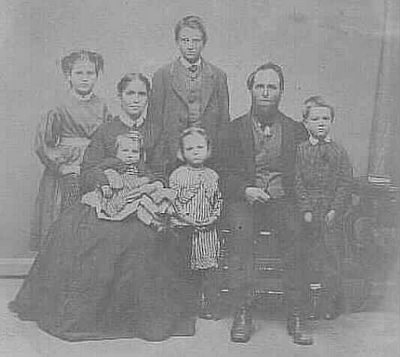
For centuries, there was a clear and well-defined script.  Plus a well-defined division of labor, reflecting the reality that it was the women who went into labor.  Work-life balance?  What was that down on the farm?


That's my great-grandfather Ira Lincoln Hopkins at far right of the picture.  He raised dairy cattle the same way his father Francis Hopkins, with the beard, did, following a well-defined script that first appeared in Plymouth Colony in the seventeenth century.  But he was able to serve as county assessor and retire to a house in Sheboygan Falls with electric lighting (controlled by funky spring-loaded push-buttons that would cause apoplexy in a modern building instructor) and running city water (albeit with a cistern down cellar, imagine the funky stuff that might have come with saving rain water.)  Plus automobiles and aeroplanes.  And two of his daughters watched Moon landings.  On the farm, there was no such thing as work-life balance.  "Sunday might have been the Sabbath day, and the Lord might have rested, but those cows had to be milked -- by hand -- before and after church."

TRUTH WILL OUT.

Steven Hayward notes that there's more than one way to get the word out about trendy and stupid scholarship.
Over the last few weeks we’ve offered various academic absurdities, drawn from the fine work of the Twitter account of RealPeerReview. The anonymous person behind this Twitter account posted abstracts from publicly available academic journals. And that was precisely the problem: the mere exposure of the mediocre and politicized “scholarship” that emerges from the campus dens of identity politics is all that is necessary for the wider world to see how preposterous it is.

Apparently even the academic crusaders against the neo-liberal cis-patriarchy don’t actually want people reading their junk either, because, as the Daily Caller reports, the RealPeerReview Twitter feed has been shut down amidst threats to expose the identity of the person behind it (who is apparently an academic social scientist).
Back in the day, the Evil Empire could suppress samizdat by regulating the use of copy machines. Regulating the use of the internet is harder, and the current crop of social justice warriors isn't as competent as the old NKVD.  Thus there's a NewRealPeerReview providing the trendy and stupid scholars with eyeballs they'd probably just as soon not have.

FARES, PLEASE!

A useful guide to using the suburban trains, subways, trolleys, and buses of Germany.  But don't treat those open platforms as a chance to steal a ride.
You thus may be tempted to skip buying a ticket, but Germany’s “honor system” for public transport operates on the “trust but verify” principle. You never know when plain-clothes controllers will suddenly flash their badges and say the dreaded words: “Fahrkarten bitte!” (“Tickets please!”) If you get caught without a valid (stamped) ticket or pass, you’ll have to pay a fine on the spot – tourists included!
There are two devices to become familiar with, the ticket vending machine (these are not at all stations, and many require correct change) and the validating machine, which might be on the platform or on the car.
It is important to know that just having a ticket in your possession isn’t enough. Your ticket must be validated, either before you board the train (using machines at the station entrance or on the platform), or immediately after you board a bus or tram (using machines in the aisle). The “Entwerter” stamps your ticket with a code for the date and time. A ticket without a stamp from the Entwerter is not a valid ticket.

Practices in Europe vary, but in Germany you can usually buy a ticket from the bus driver when you board (cash only, exact change), or using the ticket machine on trams. (In some Swiss cities you must have a ticket before you board a bus or tram.) If you already have a valid ticket, show it to the bus driver when you get on. Buses have front and rear doors. You always board in the front (“Einstieg”) and exit in the back (“Ausstieg”). Trams often have two or more cars, and you can board any one of them.
The time stamp establishes the "good until" condition of carriage, which rules out the presentation of a blank ticket you purchased yesterday as valid transportation today. Works the same way as the time limit on a paper transfer (for those transit operators that still issue transfers.)

THE ANOINTED HECTORING THE UNWASHED.

I've long had fun with the process-worshippers and their sugar-coating of indoctrination as "conversation" and "dialogue."

Here's Jonah Goldberg.
Even when liberals call for an "honest conversation" about this, that or the other thing, what they really mean is they want everyone who disagrees with the prevailing progressive view to fall in line.

Almost invariably, when I hear calls for "frank talk," "honest dialogue" or a new "national conversation," I immediately translate it as, "Let the next chapter of indoctrination begin." It's a way of luring dissenters from political correctness out into the open so they can be smashed over the head with a rock.
It is the role of the Unwashed to be hectored, and the role of the Anointed to hector.

ANOTHER ATTEMPT TO REFLATE THE BUBBLE?

How best deal with the dominance of the Southeastern Conference and the embarrassing presence of weak teams in some of the other power conferences?  Create a hierarchy of teams, with footie-style promotion and relegation.
College football's heavyweights, distributed through five conferences, are in the process of separating themselves from the rest of the sport. They want as big a slice as possible, and they are enacting benefits for players (full-cost-of-attendance scholarships) and for themselves (waterfalls in facilities) other schools can't afford.

These conferences are littered with dead weight. All five -- the ACC, Big 12, Big Ten, Pac-12, and SEC -- have programs that are there because they chose the right friends 80 years ago, are located near large population bases, or were good right when a major conference was looking for one more team.

Meanwhile, well-run small programs languish because their timing was bad or they don't bring big TV markets.

In the last 10 seasons, since Dan Hawkins left Boise State for Colorado, BSU has gone 15-6 against current power-conference teams and finished in the AP's top 11 five times. CU has gone 19-77 against power teams and attended one minor bowl. Which belongs to a power conference?
There's a lot of intellectual energy going into these relegation schemes. It's summer session -- if I were still active in the classroom it's likely there'd be an if-you'd-spend-half-the-time-you-spend-parsing-relegation pep talk or two going on.  The SB Nation version attempts to assign all the college football programs either to one of the five power conferences or to feeder leagues for such a conference.  In principle, Presbyterian (one of last year's crash test dummies for Northern Illinois) could work its way up and get a shot at a January prime-time game, trading places with Rutgers along the way.

Garret Heinrich of CBS Sports tries something different.  "Blow it up."  And reapportion.
Four regions. North, South, East And West. We are all familiar with those I assume.  Each region has 32 teams in it. This isn’t the perfect set up because the South (everything South of Kentucky, East from Georgia to Texas) would be 44 FBS football teams in it. The West would have 25 teams, the East has 27 and the north has 31.  So the South had to share a bit.  Georgia to the east. Some of Tennessee to the East and North. Half of Texas to the West.
For example, in the Great Lakes, you get the B1G plus the Mid-American.
The North looks a lot like the Big Ten now. Add Missouri, Kansas State and Kentucky. Remove the teams that didn’t make sense like Rutgers. Kansas is horrible at football and they start in the second tier.
Northwestern also got relegated, which isn't going to sit so well... And there won't be any purposeless bowls.  I fear, though, that the promotion round bowl games (in order that a Northern Illinois or Kansas can take the spot of a relegatee among the upper sixteen) may draw the same kind of ratings the six-win power team playing a mid-major gets.
Nineteen total games, if you include the 2nd Tier championships, seems like a lot more fun than the current 734 (approx.) bowls games we have to suffer through at the end of the season.  You would keep the big bowls, just like you do with the current playoff system. Make the Semi-Finals and Championship game stick with the three classic bowls, Rose, Sugar & Orange. They rotate between those 3 every year. Biggest bowls, good weather areas, they work the best.
There's yet another version being mooted by Tom Fornelli of CBS Sports.  But in his proposal are the seeds of college football's destruction.
Don't teams that play for national titles already have that advantage? Recruiting has never been an even playing field, and this system won't change much. If you move up in conference, your recruiting will likely improve, and as you drop, it'll likely become more difficult. All of which is basically the same way it works now.
Yes, and the way it works now, there's Idaho self-relegating, and Eastern Michigan, which is a consensus relegation candidate in all three proposals, might take a long hard look at continuing to spend money for not much success.

Perhaps, though, such a conference structure might offer university administrators a face saving way to get out of the positional arms race.  Take a hard look at the expenses required to earn a promotion, and decide whether or not to field any kind of a team.

14.6.16

HIGHER EDUCATION CIRCLES THE DRAIN IN ILLINOIS.

The faculty union organizing at Northern Illinois University has been certified by the Illinois Labor Relations Board.  Overweening managements are the unions' best friends.

Western Illinois University's philosophy major will not go quietly.
Some faculty members worry the eliminations reflect a university more focused on meeting a metric favored by state officials and less about creating well-rounded students. Prominent among critics is Christopher Pynes, a professor of philosophy and chair of the Faculty Senate. The programs were reviewed because they were flagged under a state reporting requirement for programs with low enrollments, he said. But Western Illinois did not have to eliminate them.

“What’s happened is the administration sees this legal reporting requirement as a mandate for how we have to run the university,” he said. “It’s not a mandate. It’s a legal reporting standard. We just have to report.”

Departments spent months putting together proposals on how to reorganize and what to do to boost enrollment, Pynes said. Philosophy went from about 16 majors to 26 in two semesters this year, he said.
Years ago, a colleague quipped that after state government scaled back the compass direction universities, and augmented the vocational focus therein, truth in packaging would require new names, Northern Illinois Technical School and Western Illinois Technical School, or NITS-WITS, brought under one central administration.

DePaul's president Dennis Holtschneider, last seen going along with the campus snowflakes,  will be resigning the presidency.  College Insurrection's Aleister suggests "after protests from the campus left."  Reality is even worse.
Holtschneider, who has been at the helm for 12 years, said he initially planned to step down in 2019, at the end of his contract, but decided earlier this year that that wouldn’t fit well with DePaul’s “planning cycle.”

“I believe, therefore, it’s best for DePaul if I step aside in the summer of 2017 so that a new leader can assist the institution to name and ambitiously pursue its next set of strategic objectives,” Holtschneider wrote.
The article notes continued push-back from the snowflakes, but at universities run by stupid people, the deanlets, deanlings, and strategic planning consultants from outside must never lack for work, and the appearance of creativity to justify all the (unjustifiable) meeting and retreating must go on.  Never mind if the enrollments go away, and the football teams (basketball, in DePaul's case) are money sucks.

BOUTIQUE MULTICULTURALISM KILLS.

I've suggested that for years, but the recent shooting at the Orlando bar, where intersectionality appears to have taken a deadly turn, is provoking a number of commentators to question the oppression league tables, particularly where the possible oppression of Moslems collides with the possible oppression of homosexuals.  We'll start with the nuance, from John R. Schindler of the Observer.
For years, too many Americans – including the lion’s share of our elite media and most of our politicians — have been content to deny the obvious, namely that quite a few Muslims espouse beliefs that are deeply at odds with what the vast majority of Americans believe. Some of those Muslims openly advocate violence and, if they are otherwise maladjusted, the odds they may murder in the name of Islam increase commensurately. We need to have a robust national debate on this important issue. Donald Trump has opened the door to that discussion, in his customary brusque, ham-handed way. More tact is required, but we cannot put off talking about radical Islam and jihadism any longer.
Yes. And part of winning this war (and, unconventional though it is, it is war) is enlisting the help of people who practice Islam without wishing death to America, or praying for a restoration of the seventh century.

WHEN HISTORY HAS IRREGULAR CADENCES.

There's a passage in a Jonathan Cole article from The Atlantic Monthly, dealing with the social forces shaping the snowflake rebellion among the gentry's spawn. starting with the way the youngsters have been helicopter-parented and otherwise overscheduled into a positional arms race they might not have chosen.
Many of the young adults at highly selective colleges and universities have been forced to follow a straight and narrow path, never deviating from it because of a passion unrelated to school work, and have not been allowed, therefore, to live what many would consider a normal childhood—to play, to learn by doing, to challenge their teachers, to make mistakes. Their families and their network of friends and social peers have placed extreme pressure on them to achieve, or win in a zero-sum game with their own friends.
That passage echoes a canonical Strauss and Howe argument, whether in Fourth Turning or in Generations, in which children passing through adolescence in an era of saecular crisis become an "Adaptive" (Generations terminology) or "Artist" (Fourth Turning) generation.  Or perhaps cohort is more accurate, as the longer the current set of secular challenges goes on, the more ad-hoc the generational analysis appears to be.

Strauss and Howe summarize the life cycle of the Adaptive cohort in Generations, at page 74.  "A recessive ADAPTIVE GENERATION grows up as overprotected and suffocated youths during a secular crisis; matures into risk-averse, conformist rising adults; produces indecisive midlife arbitrator-leaders during a spiritual awakening; and maintains influence (but less respect) as sensitive elders."

That sentence summarizes the reasons I scorn the Silent Generation, the people who inherited the Pax Americana and squandered it in ways the resource curse manifests itself.  That cohort is old, and mostly out of positions of influence, which in the generational analysis, suggests it's time for a replacement cohort to be born.  That may be at work, or maybe not.  Back to Mr Cole.
Born in the mid-1990s, seniors in my Columbia University undergraduate seminars today likely have not experienced major national threats, except for their vague memories of the 9/11 terrorist attacks. Yet these “millennials” might better be labeled “children of war and fear.” During their politically conscious lifetime, they have known only a United States immersed in protracted wars against real and so-called terrorists, a place where fear itself influences their attitudes toward other civil liberties. Students are asked to pit freedom of expression or privacy against personal security. During times when elected officials have exploited the public’s fear of terrorism for political gain, students seem more willing to trade civil liberties for a sense of security.

Since the 9/11 tragedy, the use of fear is still pervasive in the United States.
We see in Mr Cole's use of "millennials" the difficulty of identifying the cycles of history. Strauss and Howe anticipated a new Hero (or Civic) generation in the Millennials.  That cohort was born during the secular unraveling, which they thought would run from the mid-1980s to the early 2000s, and they would be replacement cohort for the G.I. era "Greatest" generation.  Thus, if we're into the saecular crisis, it's now time for the new Artist (or Adaptive) cohort to be born.

But do we really have the objective conditions for a saecular crisis?  Strauss and Howe first raised the possibility that the hung presidential election of 2000 or the September 11 terror raids signalled the Fourth Turning.  A later exploration of the possibility sees the signal as the financial crash of 2007.  I was not impressed at the time.
The Silent Generation's Watergate Caucus, continuing that cohort's string of unearned triumphs in securing a Democratic majority for not being Richard Nixon, now calls the shots for a new Democratic majority secured for not being George W. Bush. Baby Boomers? Look at the latest crop of pension advertisements: redefining retirement, pensions for people who serve the greater good, pensions that the ex can't mess up. Thirteeners? Family? Millenials? Hookups, binge drinking, I-pods?
And now Snowflakes with their privilege-checking.  Yes, there are now rumbles of more "nativism" in the culture and less "globalism" in the commerce, but these come bundled with enhanced doses of celebrity culture.

Perhaps that's the one encouraging thing.  I have trouble envisioning either Donald Trump or Hillary Clinton as the Gray Champion, who, in the legend, is an aged member of an Idealist (or Prophet) generation.  Perhaps Barack Obama will be the warning from the Thirteenth Generation, and that will be the last of that cohort until the saecular crisis is behind us.

THE BURDEN OF BAD IDEAS.

In "Trump and Critical Theory," UCLA's (motto: On! Wisconsin!) Mark Bauerlein extends the identity-politics arguments structuring the presidential aspirant's attempts to disqualify a judge.
Anyone who has worked in academe for a measure of time has to wonder at the shock and ire of these critics. What's the big deal? We have heard the premise of Trump's gripe repeated so many times that it has become a standard part of the stagecraft of public and private debate. No concept has undergone more dismantling in the last half century than objectivity. And no criticism against objectivity has had greater popular impact than the one that says judgment is inevitably swayed by racial/ethnic/gender/sexual factors.

That line of thinking is the sole legal basis for affirmative action in college admissions, for instance.
Yes, although the course of affirmative action reflects a prior history in which the composition of a jury matters more in providing a black man than a white man with a fair trial.  And the identity politics enterprise might be a way of achieving objectivity, or it might be an argument that there is no objectivity.
College and universities may practice discrimination because of the reality of racially conditioned minds.

The grounds for that assumption reach back to the Marx and Freud, among others, especially to their critique of the liberal dream of cognitive freedom. The dream allowed that, with enough education and a cosmopolitan disposition, you could transcend your circumstances and reach an unbiased viewpoint. Familial, tribal and national interests would fade, identitarian limits (racial, etc.) would fall away, and a universal human eye would be achieved.

Readers of Inside Higher Ed don't need a rehearsal of how that objectivity collapsed. Hegel historicized it, Marx materialized it, Freud psychoanalyzed it. Forever after, the liberal mind was considered a pretense -- an effort to transcend history, class or psychic repression. Race/class/gender/sexuality critics of the 1980s and ’90s gave these grand undoings an identity twist, an easy step to take in the wake of civil rights, women's lib and the Gay Liberation Front.
Let's save for another day the challenges of uprooting emerged and entrenched norms of behavior, some codified legally, others less so, in the presence of objective conditions under which we might be able to live differently than our ancestors, who first adopted those norms.
For identity arguments are not equal opportunity. You can raise the objectivity problem when a white man is in power, but you may not do so when a woman or person of color is in power. In other words, Trump has crossed one of the prohibitions that sustain the identity regime. He dares to challenge a man of color on the grounds of his color; also, he reveals the double standards of those who routinely challenge white men on the grounds of their color (and sex).
No. Identity arguments arise as a way of dealing with previous absence of equal opportunity.  Whether granting privilege to some identity arguments as a way of expanding opportunities works, or whether they deteriorate into Oppression Olympics are also for other days.  But one feature of the Trump movement has been its willingness to take on the Kultursmog's default setting, under which the transgressiveness of a protected status individual is OK, but it's not for someone more sure of his status.
Group thinking and the bad-straight-white-male image have never enjoyed so much popularity. I believed in 1992 that nobody but a transient subset of humanities professors would pay attention to identity theory after the fashion went away, but I was wrong. The feminism and neopragmatism and critical race theory and queer theory that assailed objectivity and dominated the seminar room have settled into dogma in the press, the courtroom, the art world, the White House. The counterculture is now the hegemony.

Trump is an intervention in that spread. He breaks the rules, breaches decorum, says the unsayable. He is precisely the transgressive figure that critical theory in the ’90s exalted. If they were principled in their assumptions, academic theorists wouldn’t join the universal denunciation of Donald Trump by the elite and the establishment. They would situate him in a framework of taboo and totem, interdiction, madness and civilization, or the scapegoat. I’m pretty sure that if Foucault were alive today, he would have been fascinated and amused by the phenomenon of the Republican primary winner -- and utterly bored by the other side.
The ensuing bull session features the usual mix of "Seriously" and "Shut Up."

Five months to run.

13.6.16

COMPARE AND CONTRAST.

Here are the America's Cup practice boats (AC45 catamarans) waiting for the wind to build on Saturday.  For the first time ever, an America's Cup qualifying regatta took place on fresh water.  There's a State Line connection to the Heart of America challenge with Twelve Meters in 1986-1987,  and the AMERICA3 defenses in 1992 and 1995.


Keep this image in mind while you watch the Olympians sailing in the poop off Rio later this summer.  Story via Betsy Newmark, who notes,
The Olympic Committee put a lot of faith in Brazil's promises to clean up its polluted waterways. They regularly allow the waste from hospitals and households to flow into storm drains and rivers which have then spread the super bacteria throughout the beaches in the city. Sadly, the situation has just gotten worse since Brazil won the bid.
Chicago got the poop out of Lake Michigan (well, unless there are really heavy rains) over a century ago. Yes, the Sanitary and Ship Canal brings other problems. But Chicago's Democrat politicians are less incompetent than Rio's equivalents.

And the wind did come in, and there was spectacular sailing, particularly for the people who attended the Friday practice races, or the Sunday races.  The race committee did get one race in on the Saturday.

HEALING OF HIGHER EDUCATION BEGINS IN THE LAND-GRANTS AND THE MID-MAJORS.

Apparently Western Illinois have been doing their own form of program prioritization, and the cost-benefit ratio is unfavorable for a number of the boutique degrees.
Western Illinois University trustees on Friday voted to eliminate African-American studies, women's studies and two other degree programs due to poor enrollment and low graduation rates.

The university will allow students to minor in the eliminated program areas, which also include philosophy and religious studies.

The trustees' vote follows a recommendation by Provost and Academic Vice President Kathy Neumann and a study by a program elimination committee. Trustee board Chairwoman Cathy Early said the decision to eliminate the majors was not one the board took lightly.
Strictly speaking, much of the work being done in the "studies" disciplines might better be part of the mission of philosophy, perhaps sociology, and as part of political science courses.  But students, for whatever reason, are not flocking to these courses.
Western's registrar's office says no degrees in African-American studies, two degrees in philosophy, two degrees in women's studies and one degree in religious studies were conferred in May.
Aleister of College Insurrection notes, "Expect to see more of this as the higher ed bubble grows."

Perhaps, although, as is the case with any bubble, people have the opportunity to opt out, rather than keep hoping for some greater fool to pay even more for that beachfront house or victim studies degree.  Perhaps in the scaling back of the faddish disciplines we see the emergence of a proper "default major" even if nobody wants to admit that a restoration of a core curriculum is what's really going on.

A RAILROAD WORTHY OF THE VANDERBILTS.

Amtrak and New York restore the second main, Albany and Schenectady.  More details here.  It's still going to take the better part of a year to get it done.

It's encouraging, though.  The report also notes that the track layout at Albany, which I have complained about previously, will be rearranged to allow more passenger trains to occupy platforms at the same time.


Albany - Rensselaer, 22 July 2008.

I wonder, though, if the new Plasticville-inspired station at Schenectady will have two platform tracks.

Next on my Christmas list: extend the Free Rein to 110 beyond Schenectady.  Legend has a steam locomotive achieving 112.5 east of Buffalo; we should expect no less of today's diesel trains.

POVERTY IS WINNING.

Something has gone very wrong, notes Dean Dad.  "In America, having 'only' 38 percent of public school kids require financial aid for lunch is considered good."  Well, the objective conditions haven't been very good in the past seven years.  "In the wealthiest country in the world -- the one undisputed superpower, the global hegemon, the winner of the Cold War, coming off a seven-year economic expansion, a country so rich that it pays farmers not to grow food -- more children can’t afford lunch than can."  Yeah, there's lots of political hay to make there.  What seven year economic expansion?  Not once in the era of hope and change has the gross domestic product managed a three percent annual growth.  Very rarely have there been more than a quarter million new jobs in a month.  Wealthiest country in the world?  Depends how you measure it.  And brain-brothers of the people who thought Ronald Reagan's "evil empire" meme was helping Yuri Andropov still in charge?  No wonder the kids in government schools have it rough.

But the concentration of the poor in the government schools has been long in coming.  I was just clearing out more old magazines, and found "The Newest Minority," printed in The Atlantic Monthly in 1993.  It's about the women having no children, and the men losing reason and faith.  Starting in Belmont, Massachusetts.  (Yes, that Belmont.)  It's written by then Massachusetts state senator Michael Barrett.
The very community that was such a good place to raise a family in the 1960s is the most likely to have a large complement of empty-nesters in the 1990s, many of whom will be less interested in the schools than they once were.

The district I represent in the Massachusetts state senate includes Belmont, a middle-class and upper-middle-class suburb of 24,720. Belmont is a wonderful town, home to many people, once blue-collar, who have moved out over the years from the urban environs of Cambridge and Boston, and to others who hail from around the country and have been drawn to professional opportunities in the nearby cities or along the Route 128 technology belt.

Belmont takes great pride in both the reputation and the appearance of its gracefully landscaped high school, complete with duck pond, which lies near the town center. More than 90 percent of the school's juniors and seniors take the SATs, the average combined verbal and mathematics score is over a thousand, and 87 percent of the graduating class at least begin a four-year college education.

But the Belmont schools are caught in the demographic squeeze. In 1960, the postwar influx having supplied a stream of young settlers, 42.0 percent of the households had children under eighteen. Ten years later the figure had declined to 35.7 percent. It was down to 28.7 percent by 1980 and 26.4 percent by 1990. Outside observers would hardly call Belmont a retirement community, yet sometime around 1975 it reached a watershed for an American town: the proportion of its households containing people over sixty-five exceeded the proportion of its households with children under eighteen.
The electoral math, Mr Barrett argues, works against Belmont's government schools.
Belmont is a healthy, thriving place, and it may well be that the citizenry will rally behind its tradition of fine education. But the going will be tough, because the problem remains: in cities and towns across the country a demographic bulge once operated to keep the schools at the center of community life, and now it is gone. Today the presence of kids in every other house on the street is something out of the past, and the parents of schoolchildren, middle-class and poor alike, are the country's newest minority group. At a historic moment when the schools need to be better than ever, they are instead treading water, even slipping back a bit, and by world standards genuine excellence is a long way off.

One has to wonder, then: Will communities like Belmont, composed of growing proportions of nonparents and empty nesters--people more likely to insist on quality health care than on quality education--continue to support their schools? To put the matter simply, will the votes be there? And if they are not, what does American democracy do then?
Mr Barrett (yes, it's what you'd expect an elected official to do) suggests that the national government increase its contributions to local school funding.

I fear, though, that the intervening quarter century of ethnic balkanization, identity politics, trendy and failed educationist fads, residential self-segregation, and homeschooling are going to make any reversal of government schools as schools of last resort, with all the attendant challenges that accompany such a status, a long time in coming.

Start with a recent report from New York City, where there are more applicants for the charter schools than there are seats.
City charter school operators will open 16 new facilities in the coming school year, bringing the total number of city charter schools to 221.

Mayor de Blasio has brawled with some operators of the privately run, publicly funded charters over funding, oversight and classroom space for their schools.

City Education department spokeswoman Devora Kaye said all city kids deserve quality educations.

“Every student deserves access to a great school, whether district or charter,” Kaye said.
That may be, but people, whether they have enough votes to get the local schools funded properly or not, prefer a choice, notes Stephen Moore.
We know in Washington, D.C., where voucher programs already exist, voucher kids are more likely to graduate and go on to college than those stuck in the public schools.

The unions hate vouchers because it means fewer jobs and union dues for the labor bosses. But who are the schools for? The teachers or the kids?

Thanks to the Obama administration’s radicalism, millions of children will be now stuck in schools that the parents believe are unsafe and immoral. Millions more are stuck in failing schools that are racially segregated. Fifty years ago George Wallace wouldn’t let minority poor children into the public schools. Now the unions and others on the left won’t let minorities and poor children out. ‎It’s hard to know which is worse.
Via Craig Newmark.

How much longer can the Democrat nachalstvo claim to "fight" for the rainbow coalition and the teachers' unions and the boutique multiculturalists whilst actually rendering people helpless by Democrat policies, and sending their spawn to the likes of Sidwell Friends rather than have them associate with their constituents.  None of which will immediately help the kids getting their government issued crappy lunches to go with their government issued simulacrum of schooling.

HISTORY RHYMES.

Austin Bay comments on a planned Atlantic Alliance exercise to be conducted in the old Livonia.
Anaconda 2016 is the largest—though annual exercises by Polish military forces and Romanian military forces could conceivably be larger in absolute numbers. It is very probable that this is NATO’s largest field exercise in Europe east of the current German-Polish border since 1992. The Guardian seems to recognize that this is “the biggest movement of foreign allied troops in Poland.”

Anaconda is big: 31,000 soldiers from 24 countries are exercising for ten days, with 14,000 American troops participating.
Mr Bay focusses on the message the exercise sends to Tsar Vladimir.
The U.S. Army Europe map of Anaconda 2016 is very likely an act of information war that supports NATO political goals. Note phase three on the U.S. Army Europe exercise map. Phase three is scheduled for execution on June 10. Alliance troops and vehicles will cross the Vistula River and enter Lithuania. Come one, come all. Lithuania is a NATO member.

However, the maneuver explicitly cuts off Russia’s Kaliningrad Oblast. Kaliningrad was once the Prussian city of Konigsberg. Russia kept the city and its environs as a special Kremlin reward for winning World War Two.

Anaconda 2016’s conclusive fictional thrust isolates and surrounds Kaliningrad.

NATO officials may deny that the exercise is designed to send that message. Let them do so. However, the maneuver delivers a useful political warning. The Russian exclave can be taken by NATO military forces. So hey there, Vladimir Putin of the tight tee shirts, don’t miscalculate. Putin, you seized the port of Sevastopol in Crimea and then swallowed the entire Crimean peninsula. Would a Polish-controlled Kaliningrad on the Baltic Sea be a fair trade?
Early on in the history of Cold Spring Shops, I alluded to Anaconda in a brief reference to the proposed expansion of the Atlantic Alliance into southeastern Europe. Perhaps something similar is still at work.

The ongoing exercise might be a warning to Tsar Vladimir, or perhaps it reflects the permanent interests of Poles and Lithuanians, or is an opening gambit for a restoration of Prussia, or not, is for experts in international relations (two countries screwing each other) to parse.

Focus, dear reader, on the exercise name.  In United States military practice, it dates to Winfield Scott and Gideon Welles, and it was implemented by Farragut, Grant, and Sherman.

A SPIFFY FRONT PORCH ON A SHOTGUN SHACK.

Jeremy Harper of something called Underdog Dynasty talks sense about the deflating college football bubble. The Idaho Vandals did the right and brave thing, and Eastern Michigan should follow.

There are a number of connections (including the use of unconstitutional speech codes)between Northern Illinois and Idaho, with current president Doug Baker previously serving in administration there, and Idaho's football team, parlous reputation or not, sometimes playing the spoiler, and sometimes serving as a pre-conference crash test dummy (that is, to the extent we can speak of any Mid-American team scheduling crash test dummies.)

But when a writer at a sports weblog notes that professors might have a gripe when it comes to spiffing up that front porch, perhaps reality is dawning, even among the True Fans (who often have much to learn about generalizing from their own experience.)
First of all, the campus faculty is almost always the group opposed to unchecked athletics. After all, it's the professors working in 1970s-era science labs and moldy classrooms with wheezing AC. You can't blame professors for feeling marginalized at what is supposed to be an institution of higher learning.
The reality also dawns on Doug Baker's successor.
Which lead us to the University of Idaho, who recently announced its intentions to drop from FBS- to FCS-level athletics. "Our relevance will be complemented by our football program," said University President Chuck Staben, "not defined by it."

When the Sun Belt declined to bring Idaho into the conference early this March, it clamored the death gong for a program too small and too isolated to find another FBS conference or go it alone as an independent. The Vandals grabbed their football and returned to the Big Sky.

For 20 years, the football Vandals have averaged less than 4 wins per season and were left out in the cold (along with New Mexico State) when the WAC dissolved in 2012. The Vandals accepted a less-than-ideal "football only" invite to the Sun Belt, only to see the arrangement fold once conference officials fully absorbed the weight of the Vandal problem: Idaho was too damn far, didn't win enough, and it didn't spend enough money (about $19M annually).
The author suggests the weakest prop in the Mid-American, Eastern Michigan, observe and emulate.
Idaho did what many of us, for lack of fortitude or forethought, cannot: step back into a situation that fits. About 2,100 miles east of Moscow, Idaho, the Eastern Michigan Eagles are considering following Idaho's lead. The Eagles spend about $34M, which is roughly the standard in the MAC, but it is subsidized more than 80 percent.

For the past 19 years, the Eagles have enjoyed one winning season. One! In 2009, they were a perfect 0-12. Eastern Michigan joined the MAC in 1972, but it has just one conference championship (1987) to show for it. Last year, the Eagles reported the lowest attendance of any FBS program: 4,897 souls per game. The Eagles aren't winning, and there are no fans to care.
More on Mid-American subsidies, and Eastern Michigan serving as crash test dummy, in my archives.

Mr Harper suggests, however, that Eastern Michigan administrators clinging to their football (perhaps because they don't want to write off their indoor practice facility, which served as a reason for Northern Illinois to build one) are living in Wolkenkuckucksheim.
If you're an FBS program, you are, technically, a member of the same fraternity as Oregon and Michigan and Alabama and Texas. It would punch quite a dent in your ego to admit that you simply cannot afford to drink with these guys every night.

But consider the slope EMU must climb to be relevant even in its own city. Michigan, the Horrendous House of Harbaugh, is a 16-minute drive. The state of Michigan is home to five FBS football programs, two of which play in the mighty Big 10. Securing the second-best or third-best or even fourth-best talent in the state is a Herculean task. Even in football-rich Michigan, that has to suck. Why not drop down and enjoy the thrill of competing?

It's hard to give up that BMW. Take another look at EMU's statement in response to calls for dropping down: "(We) have the opportunity to compete at the highest levels with neighboring institutions in the Midwest."  The Eagles haven't competed since the 1980s! Real Sports just made your campus look like a soup kitchen!
No joke about the soup kitchen ... there's a food bank for students, which the article calls "unfunded."

I have to wonder how much the deanlets and deanlings spent on that "education first" tagline, which the administration's revealed preference for athletics gives the lie to.

Our universities are being run by stupid people.

8.6.16

STILL AT A DISTANCE FROM EQUAL JUSTICE UNDER LAW.

Until yesterday, putative Republican nominee Donald Trump appeared more interested in getting a judge disqualified than in, oh, making political hay about the continued non-recovery economic recovery, in which the unemployment rate decreases by subtracting discouraged workers from the work force.

There might be something else at work.  Here's Neil Steinberg, in Chicago's Sun-Times, calling out Mr Trump's error in suggesting there's a connection between a judge's ancestry and his ability to conduct a fair trial.
What Trump is too stupid to understand is this: if we begin to denounce our fellow citizens as being incapable of doing their jobs because their parents were Mexican immigrants, or because they’re Muslim, or Catholic, or whatever lineage or credo is disagreeing with Donald Trump at the moment, then the country unravels and we become just another balkanized hellhole.
Perhaps that ship has already sailed: see nominee Sonia Sotomayor, Wise Latina.

Or perhaps the ship has not yet docked: see Foster v. Chapman.  The prosecutor shalt not disqualify all potential black jurors when a black man is on trial (the case is out of Georgia; that might be material.)

And yes, there's a history of Most-Favored-Nationality legislation in the country's history.  But codifying hierarchies of Privilege, Oppression, and Protected Status cannot end well.

Jonah Goldberg notes, though, that demonstrating the absurdity of essentialist identity politics by using essentialist identity politics is an absurdity too far.
Trump is not battling identity politics here, or even undermining it. Trump is capitulating to it, and bringing the Republican party along with him. Sure, it’s interesting, even entertaining, to watch Trump use the logic of identity politics against its entrenched practitioners. But he’s not condemning this way of thinking, he’s embracing it.

By all means, conservatives should use this episode to point out the fallacies and contradiction of identity politics. But Trump is not a hero in that effort, he’s a cautionary tale.
He has links to commentators who suggest that the reductio is more serious, or more purposeful, than that, in case you're interested.