Perversely, aggressive winter road treatments with salt—beyond their documented harm to the environment, infrastructure of all kinds, and human health—also appear to make us less safe by converting icy conditions into wet ones. Not because of the treatment itself but, I believe, because it diminishes the natural traffic-calming effect of snow and ice. It shifts us from cautious drivers in slick conditions—who simply cannot drive too fast for those conditions—back into ordinary drivers on over-designed roads.That's not a surprise. "The safer people perceive their cars to be, the more risks they take with them." But fitting passenger automobiles with a spear on the steering column to encourage less aggressive acceleration and braking, or using cosmetic curves, trees, the full suite of traffic taming methods, all of which produce fewer crashes and longer travel times, are not easy policies to sell.
Chuck Marohn of Strong Towns has previously written about the increase in traffic injuries and fatalities that occurred during the COVID-19 pandemic, and how the actual cause of increased danger was reduced congestion and therefore greater freedom to drive at unsafe speeds on roads that were designed to prioritize speed over safety. I believe these statistics about winter driving reflect the same phenomenon. As with crashes in congested traffic, winter weather crashes, while possibly more frequent, tend to occur at slower speeds and are correspondingly less deadly.
Winter weather causes all of us to drive carefully and patiently, alert for the unexpected. It reduces the illusory margin of safety provided by wide lanes and excessive shoulders. Just as snow throws leafless trees into stark relief against a background of white, so it also exposes the dangers of conventional roadway design.
27.2.26
SNOW CLEARING MAKES DRIVERS LESS VIGILANT.
Well, why not? Automobiles go faster because they have brakes, and safety appliances make drivers less vigilant. So, too, with snow clearance.


THE ADVERTISING PRISONERS' DILEMMA.
I was under the impression that metaphor was well-known. There's a Minimal Publishable Unit, at least, in rediscovering it.
Auto insurance companies are some of the largest advertisers, with top brands spending upward of $1.5 billion per year, even though they’re household names. When Geico runs another spot featuring its ubiquitous gecko mascot, or Progressive cranks out another Flo ad, are they wasting their money?Some of what the researchers did to influence their research subjects to follow insurance company links comes close to treating those shoppers as fish to be hooked. That concluding paragraph suggests the repeated prisoners' dilemma is at work: although the messages look duplicative and repetitive (and among the property and casualty insurance companies, often silly) they serve as counter-programming to the other company's silly messages. Although their work is about strategies for staying in consumers' minds, and they wonder if the work generalizes, their discussion does not contemplate another possibility, which is that repeated advertising is an expensive signal of permanence. Ask yourself, as Steven Landsburg once did in his Armchair Economist, whether a fly-by-night company would hire a celebrity to endorse a product of unknown quality.
“That’s where the puzzle starts,” says Navdeep Sahni, a professor of marketing at Stanford Graduate School of Business. After a century of research on advertising, scholars still don’t have an empirically solid grasp of exactly how or why it works. One leading theory suggests that advertisements provide consumers with new information. If that’s the case, why do the most prominent brands need to advertise? Another influential theory suggests that advertisements create associations in consumers’ minds, hitching a particular brand to a category.
“But if you push that thinking further, it doesn’t actually tell you what to expect,” Sahni says. “If you’re primed to think about Geico, that might also make you think about Progressive because the two things are associated. Or it might make you think about Progressive less. The theory isn’t diagnostic or precise in what it says.”
Sahni and doctoral candidate Yifan Yang go a long way toward resolving these issues in a new working paper that shows the dramatic benefit of auto insurance advertising. They found that ads not only boost visits to an advertiser’s website but also interfere with consumers’ recall of alternative brands, dislodging the competition from their minds. The findings help explain why spending millions on repetitive campaigns, even by well-known brands, is essential to remaining in people’s memories.
TRUTH IN PACKAGING.
Immediately before the Festive Season, home improvement store Menards settled a lawsuit.
Recently, Menards agreed to a multi-state settlement totaling over $4 million after regulators determined its 11% rebate advertising misled shoppers. Wisconsin received $750,000 under the agreement, along with changes that clarified and simplified the store's terms.On the one hand, stores promoting a net price after rebate have been around for years, and many of them use a variation on the send-in-a-ticket for a store credit rather than awarding the discount at the cash register. In some ways it's less troublesome than clipping coupons to get the lower price at checkout, and it's less intrusive than having your telephone number or your electronic mail on file to qualify for the lower price. On the other hand, when your store's tagline is "You'll save big money" and that jingle is on a continuous loop right there with the Festive Season mix, somebody might interpret that claim as meaning a bargain now, not later.
The presentation was the core issue; signs highlighted a reduced price that appeared to shoppers as immediate. At checkout, they paid the full price, with the savings arriving weeks later as a store credit after mailing the applicable forms. Many customers believed the discount was instant, not after paperwork and weeks.
When a store advertises a discounted price, it suggests you can pay that lower price today. A rebate suggests a delayed benefit tomorrow. For years, Menards blurred that distinction, leaning on bold percentages while burying the mechanics in smaller, fine print.
Legally precise language didn't repair the emotional response; shoppers compared shelf prices and made informed decisions based on what they found. Later, they learned that the deal worked differently. Even customers who eventually received credit felt they were misled because of the expectations formed at the shelf, not in the mail weeks later.
The settlement demands clearer signage and extends the rebate claim window to at least one year, reducing the odds that customers might miss out after the fact.
26.2.26
"DO YOUR OWN THING" WAS NEVER LIBERATING.
Reason's Brian Doherty went to Tuesday night's "State of the Swamp" rally in the Federal Capital, where the antics of a performer calling himself Robby Roadsteamer led him to that understanding.
Roadsteamer used various references that limned the depressing extent to which America's cultural battles have been consistent for at least 60 years now as he called on memories of the cultural and political rebellion of the '60s antiwar and civil rights and general counterculture movements. The same questions of race and ethnicity, war and peace, decorum vs. vulgarity (though the political valences of that particular division have nearly reversed from 1966 to 2026), the social status of anyone who's not a straight white man, and whose values should dominate media and education, are still haunting America now.Well, why not? The New Left of the era adopted countercultural stylings, but their politics were derivative. Second wave feminism: we can vote, but a credit card in our own names? Maybe that can be fixed. Corporate jobs in proportion to our share of the population? Aspirational, but better at riling people up than at getting anything done. The lavender lobby: we can't engage in public displays of affection, won't the authorities leave our pick-up bars alone? Maybe that can be fixed. Genderfluidity? So much for any sort of intersectional coalition. Disagree, and face guilt-tripping, or cancellation, or perhaps fists.
Roadsteamer used images from America's still-remembered boomer counterculture past for the energy he's hoping to recreate for the anti-MAGA movement. "We don't have to be angry or violent," he said. "We just need to create the new Grateful Dead parking lot." Later, he said the progressive resistance needs "less V for Vendetta masks and blowing up Teslas and more of a Grateful Dead, Haight Ashbury scene."
A CASE FOR EMERGENCE.
Strong Towns contributor Norman Petersman asks, "What happens when the teacup cracks?" It's a metaphor to get people thinking about excessively planned urban, suburban, or exurban development. Excessive planning fails, but regular readers of Cold Spring Shops know we quibble with Strong Towns on the meaning of "finished state." "It might be more subtle than that: the tract houses, supermarkets, and shopping centers might have had some evolutionary advantage, but when the Powers that Be decided to pick winners, bad stuff happened." It's hard for Powers that Be to square two simple maxims. "No neighborhood should be subject to radical change. No neighborhood should be exempt from change."
JEFF MACNELLY WAS CALLING ATTENTION, NOT ADVOCATING.
Fifty years ago, he was taking a dig at the United Nations.
 I've been carrying on about education so inclusive nobody learns anything for years.

[C]ontemporary efforts to make writing and figuring more "inclusive" sure look like efforts to compensate for something other than biases in standardized tests. "The disparity year after year, decade after decade, in math competency, reading proficiency, test scores, honor roll status, and graduation rates, in virtually every U.S. school system, between African American students and other students is disturbing." That's Townhall columnist Jeff Davidson, with a reiteration of something I've only told you what feels like every week. "This disparity encompasses such issues as the number of hours the television is on in given households, family or parental encouragement for completing homework assignments, a regular workspace, and established hours for studying in a quiet environment, among other factors."And the beat goes on. What the United Nations did very publicly, the National Council of Teachers of English did in obscurity.
Instead, what the critical studies types do is propose approaches to education suitable mostly for mockery. In mathematics, being called upon to "show your work" is culturally biased, or something, probably intersectional. "Thus, requiring students to show their work reinforces worship of the written word as well as paternalism."
Perhaps it's not so much the written word, though, as it is those pesky rules of construction. “[S]ubmissions will not be judged on traditional literary or grammatical standards.” The projects must still conform to length limits, and be compelling.
It's almost enough to make one think that the people pushing "inclusive education" have among their priors that their protected-class charges don't have the necessities to write a coherent essay or derive a proper proof.
The battle over how to teach English has been going on since 1974, when NCTE’s Conference on College Composition and Communication issued this stunner:Years ago, John Molloy offered young adults "dress for success" advice, which, paraphrasing broadly, meant presenting yourself the way the corporate Establishment did, and that might have extended to taking up the hobbies and sports they pursued and the way they spoke. That was building cultural capital. His phrasing included a passage, again paraphrasing, to the effect that the people who will offer you a job wear those clothes. That might not always be true: if you seek work in information technology or entertainment, Brooks Brothers might be a turn-off.We affirm the students’ right to their own patterns and varieties of language—the dialects of their nurture or whatever dialects in which they find their own identity and style. Language scholars long ago denied that the myth of a standard American dialect has any validity. The claim that any one dialect is unacceptable amounts to an attempt of one social group to exert its dominance over another. Such a claim leads to false advice for speakers and writers, and immoral advice for humans. A nation proud of its diverse heritage and its cultural and racial variety will preserve its heritage of dialects. We affirm strongly that teachers must have the experiences and training that will enable them to respect diversity and uphold the right of students to their own language.That was the NCTE’s earliest warning that endorsing only one standard of English is “immoral” and need not be the goal of a college education. That notion betrays the very students whose “varieties of language” the NCTE meant to uphold.
25.2.26
WOE CANADA.
What are the identifying features of a proper social democracy? Long vacations? Generous public assistance? Mandatory parental leave from work? Health care as a "right?" High speed intercity trains?
Oops. "VIA equipment shortage leads to cancellations, sellouts." That refers to troubles offering services to the Maritime Provinces and other hinterland areas, where the carrier makes do with legacy rolling stock such as Budd Rail Diesel Cars and long distance cars initially built for Channel Tunnel services. None of that comes up to the standard of European regional rail, and most European passengers use services other than the bullet trains the casual transportation advocates carry on about.
Read on, though, and note the troubles along that thickly settled stretch of Canada along the two eastern Great Lakes and the St. Lawrence River.
The Ocean and RDC issues follow numerous VIA cancellations in the Quebec City-Windsor, Ont., corridor, attributed primarily to failures of newly acquired Siemens trainsets [see “Weather issues with Siemens equipment …,” Feb. 8, 2026]. Neither VIA nor Siemens have responded to Trains inquiries seeking details on the issues, attributed to “harsh weather conditions.” The current problems mean VIA finds itself unable to meet its commitments on all three of its forms of service: long-distance, corridor, and remote.In These United States, there is a simulacrum of a bullet train linking Boston with Washington, weather permitting, and it has to hurt when a Trains reader compares VIA Rail unfavorably with the New Haven. "Growing up and later traveling to college, I traveled the bankrupt, decrepit, failing New Haven Railroad. There was always enough rolling stock to cover the schedules, even if the windows were broken and the upholstery worn. Sometimes there were standees in the aisles, but the trains did run."
At the same time, Alto, the high-speed rail project, continues to conduct an elaborate, publicly funded initiative. Its proposed, largely rural right-of-way would serve corridor population centers where current service is deteriorating. Alto’s website features videos of fast trains and an “online consultation platform” to garner feedback for a route where land acquisition is not likely to begin until years of expensive consultant studies are completed.
The closest thing to a standard North American passenger train consist these days is a Siemens Charger diesel and a rake of Siemens coaches. The Siemens stock might not be built for extreme cold. That's probably not the best state of affairs for trains serving Canada.
LET THE NIT-PICKING BEGIN.
The Speech from the Throne delivered the longitude as expected, and the platitude unburdened by Trumpian vamping. Then came the nit-picking. "CBS News fact checked President Trump's 2026 State of the Union address Tuesday night, in which he highlighted his record on the economy, immigration and tariffs, and also assessed a claim made by Virginia Gov. Abigail Spanberger during her Democratic response." Read it if you would like, if it's not nit-picking, it might be ankle-biting, or it might be rivet-counting.


The speech featured two centenarians, two Congressional Medals of Honor awarded, two Purple Hearts conferred, one posthumously, a Legion of Merit, and a Presidential Medal of Freedom by unanimous consent of the Olympians present. Air Force aviator Royce Williams was one of the centenarians and earned a Medal of Honor for making ace against a fleet of Soviet MIG jets during the Korean War. Nobody wanted to call attention to his exploit at the time as those jets had Soviet pilots and the United States officially were involved in a United Nations police action on behalf of the Republic of Korea.
CONSIDER THE SOURCE.
National Review's Noah Rothman asks, "Has Contrived Coarseness Jumped the Shark?" He's had his fill of potty-mouthed Democrats.On former Twitter, she's being ratioed at least as far as former Miller Park, perhaps all the way to Lambeau Field. She wraps her spot up noting she's from Chicago's South Side. That's where generations of her constituent base have been rendered unemployable by Democrat policies.
I’ve been fighting a losing battle on this front for years. There comes a point at which any act gets stale, and the shtick loses its audience. Hopefully, the tactical deployment of profanity by our politicians is one of those phenomena that has reached the terminal phase.There's an open Senate seat in Illinois this year, with Dick Durbin taking his pension. The lieutenant governor is one of the Democrats seeking the nomination (the party primary is St. Patrick's Day) and she asked a few of her friends to sound off.
In her bid for the U.S. Senate, Illinois Lieutenant Governor Juliana Stratton may have done the country a great service. Her debut campaign ad is so gratuitously obscene that it may push past its breaking point a trend in which politicians attempt to convey authenticity via the liberal use of four-letter words.
They said it. We’re all thinking it. pic.twitter.com/AOARPLHGCB
— Juliana Stratton (@JulianaStratton) February 19, 2026
More precisely, this is how ward-heeler politicians operate. There's a symbiosis between desperate people who like having a ward-heeler "fighting for them" and a ward-heeler who mau-maus the rest of the polity about the continued parlous condition of his or her constituents. A ward-heeler cannot call out the constituents for engaging in self-destructive behavior, nor get re-elected in a district in which constituents discover, or re-discover bourgeois habits. Better to have constituents rendered helpless by years of Democratic policies.There has been enough outmigration of productive people from Illinois that the Democrat primary electorate residually comprises helpless constituents who want the public assistance to continue.
ASK AND YE SHALL RECEIVE.
Who really wins the Olympics? "The convention is to count medals won by sports, meaning one figure skater counts the same as twenty hockey players in the gold medal count." People with more time to work the problem, or perhaps paid to work the problem, such as Reason's Jason Russell, take on the convention. He asked his wise and worldly readers (thanks, Matt!) for advice and they delivered.
Another popular idea that several of you suggested was splitting up the subjective sports into a new category, including sports where judges are the primary determinants of the winner, such as gymnastics and figure skating. One of you even suggested giving those sports their own separate Olympics.HellYES!
24.2.26
GETTING THROUGH.
Cold Spring Shops got a heavy dose of snow at the beginning of Advent, which melted by Christmas, and there wasn't much snow during the late January cold snap. It's different on the coasts. Passenger Rail advocates have been making much about "I-80 closes, but California Zephyr gets through Sierras." True though that is, it isn't impressing many people.
The eastbound California Zephyr arrived in Truckee today (Feb. 20) just after 1 a.m. Pacific Time, 11 hours late. But it won the battle against massive snowdrifts that had shut down parallel Interstate 80 through the Sierra Nevada mountains.The off-peak Zephyr consist is two Superliner coaches and two or three sleepers. There might not be many seats available, depending on who is booking coach seats for longer trips. Donner Summit no longer has the snow sheds that once protected trains. On the other hand, three score and fourteen years ago a westbound City of San Francisco was stuck in the snow up there for several days.
Televised news reports like this one described multiple I-80 closures throughout a week that saw trapped cross-country skiers lose their lives in an avalanche. But they almost never mentioned that Union Pacific track crews kept the route open for its freight trains and the Zephyr despite the conditions.
Thursday afternoon’s train no. 6 had departed Colfax, Calif., two hours late. Westbound counterpart no. 5 had been running an hour behind schedule leaving Truckee and lost two hours heading though the increasingly heavy snow as I-80 was being closed to all traffic. Status reports from Amtrak and other sources indicate that the eastbound’s lead locomotive stalled out on the climb between Colfax and Truckee. A relief engine was called and the Zephyr was finally able to proceed. As of Friday afternoon, it remained more than 11 hours late approaching Salt Lake City.
The avalanche that closed highways and prompted travel restrictions beginning Tuesday, Feb. 17, had resulted in delays to eastbound Zephyrs no more than one hour and 45 minutes until the rescue of no. 6 Thursday evening. The longest westbound delay occurred Wednesday when the CZ arrived almost seven hours late into Colfax.
More than 90 inches of snow has fallen in the Sierra Nevada since midweek; another storm is predicted this weekend. Zephyr coach seats were sold out in both directions between Sacramento and Reno on Friday and Sunday.
Elsewhere in mountain railroading, a Swiss passenger train had a close encounter with a snow slide.
Avalanches from heavy snowfall in the European Alps claimed more lives over the weekend, as a train was derailed by a snow slide in Switzerland on Monday and roads and villages around Mont Blanc were closed or placed under evacuation orders.The Goppenstein snow slide took passengers by surprise. There was one passenger recorded as referring to it as "normal" (given the way the railway is laid out, perhaps) until it proved to be a little stronger than normal. But Switzerland was spared a replay of the Wellington disaster on the old Great Northern crossing of Stevens Pass.
As large areas of the western Alps remained under a high risk of avalanche – following a week in which alerts reached category 5, the highest level – Swiss police said a train derailment caused by an avalanche injured five people near the town of Goppenstein.
The incident in Switzerland followed a series of deadly avalanches in the Alps in recent days involving skiers.
On Friday, two Britons were among three skiers killed in an avalanche while being accompanied by an instructor in Val d’Isère, in south-east France.
A French national, who was skiing alone, was also killed. The Albertville prosecutor, Benoît Bachelet, said the ski instructor, who avoided injury, tested negative after taking blood and drug tests. He added that another Briton had sustained minor injuries.
In another incident on Sunday, an avalanche claimed the lives of two skiers on the Italian side of Mont Blanc.
The incident occurred at about 11am in the Couloir Vesses, a popular off-piste route in Courmayeur, located in the upper Val Veny, near the border with France and Switzerland.
Back country skiing can be dangerous on any mountain. Condolences to the families of the skiers lost.
THE LIGHTER SIDE OF LOGICAL FALLACIES.
That's been a theme at Cold Spring Shops almost from the beginning, a quarter century ago. Mitch "Shot in the Dark" Berg, who has experience in radio, recently offered a series of funny variants on the conventional fallacies.
We’re all (*) familiar with the basic “logical fallacies” – flaws in reasoning that weaken or invalidate arguments. Things like the “ad hominen” (attacking the person rather than their argument), “appeal to authority” (comparing credentials rather than arguing the facts), “tu quoque” (comparing an argument with previous argument) and so on.Some of them call attention to illogical arguments that might be best understood as "stray voltage" or non sequitur. To wit:
“The Epstein Fallacy” – claiming that someone’s argument on an unrelated matter is false because the Epstein Files haven’t been released.That "full stop" might be a way of saying "here I stand, I can do no other," or perhaps "my priors are so tight there is no evidence that would move me from them." "Prove me wrong" is silly: isn't that the purpose of an argument, to identify the weak points?
“Argumentum ad Terminus” – believing that ending an argument by saying or typeing “Period” or “Full stop” makes an argument, whatever its merits, absolutely solid.
“Faux Possibilitus – starting a claim with “What if I told you that…” does not make the claim true”.
The Shifted Burden Fallacy: Ending a claim – solid or absurd – with “prove me wrong”.
OUR PROFOUNDLY UNSERIOUS POLITICIANS.
Our President will deliver another Speech from the Throne tonight. A year ago, it wasn't officially a "State of the Union Address," because reasons, but in longitude and platitude it was right up there with the official ones. Plus Trump-deranged Democrats acting like jackasses. "This year, the San Francisco Democrats are still in the saddle, but the country has not had a serious president in this century."
This year, the Trump-deranged Democrats are as deranged at ever, but some of them are opting not to bray in the Federal Capitol, preferring to hang out with their herd and nurse their grievances out of the public eye. Some things are unlikely to change. "It's investing in politically connected rent-seekers and consultants and hoping for the benefits to trickle down." That was Dementia Joe yelling at us two years ago, motivating all the fluffers to assure us that he was just fine and ready to govern for another four years.
23.2.26
JULIA'S EMPTY LIFE.
Fourteen years ago, the Morale Conditioners of the Obama Regime released their case for a life succoured by government, from the cradle to the grave.
As long as Julia has Barack Obama, she can get by without a man.Yes, dear reader, before there was a Donald Trump in politics for Jennifer Rubin to be deranged about, she wasn't deranged!
There's a hilarious send-up of the presentation, which has been laughed unto scorn all over the internet, at Reason. Here's Jennifer Rubin, unimpressed by those fish. "I would briefly note the irony of the liberal feminists’ idealized single woman: no husband and utterly dependent on government. This is progress?" She endorses a William Bennett reaction.Julia's entire life is defined by her interactions with the state. Government is everywhere and each step of her life is tied to a government program. Notably absent in her story is any relationship with a husband, family, church or community, except a "community" garden where she works post-retirement. Instead, the state has taken their place and is her primary relationship.Indeed so, but Mr Bennett notes it takes something more substantive than Not Obama to replace Our President. "Conservatives must be able to provide Julia an alternative vision for a better future. Without it, Julia might have nowhere else to turn but to the government, and that is nothing to laugh about."
Now comes Common Dreams contributor Lindsay K. Saunders, demonstrating precisely how little suckling at the public mammary is to laugh about. "As life becomes less and less affordable for working people, we need to restore and expand our social safety net so those of us who work for a living can keep our families affordably housed, fed, and healthy."
DISPATCHES FROM THE NEW COLD WAR.
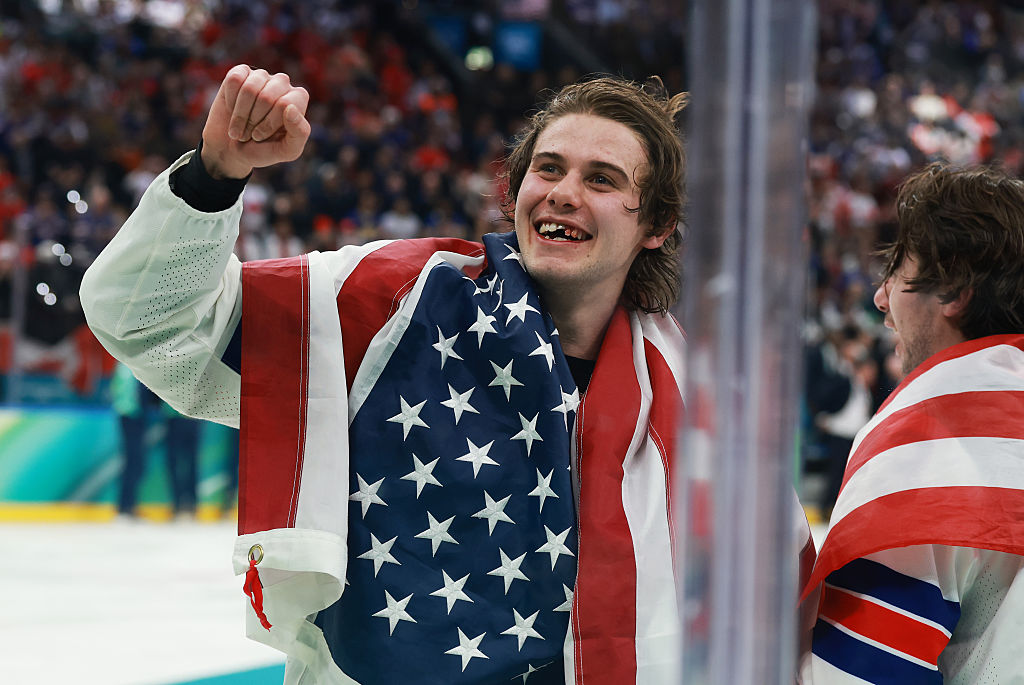
The Games of the XXV Winter Olympics, to use the full and pretentious title (cue the bugles) wrapped up over the weekend. Both men's and women's hockey tournaments concluded with Team Canada playing Team U.S.A. For the first time in any Olympiad, Team U.S.A. won both games, which has not been the case for either squad of late.


Photo by Elsa for Getty Images retrieved from Washington Free Beacon.
Both games ended 2-1 in overtime. The women played on Thursday. During pool play, they beat Canada 5-0 (which was a common margin of victory all the way to the gold medal game). Years ago, Wisconsin's men's team won the Western Collegiate Hockey Association tournament final, putting up ten on North Dakota. Sure enough, North Dakota got another shot at Wisconsin for the national title, and won that game.
The men played on Sunday. Both teams arrived at the gold medal game undefeated. On paper, Team Canada looked like the better squad, and during much of the game all the play was in the United States' zone. But after Canada got the equalizer in the second period, no team scored in regulation, that despite Team U.S.A. having a four minute power play after Jack Hughes, pictured above, had a close encounter with a high stick. During that power play, a United States player committed a penalty, and Canada, rather than go on the attack with five skaters and an empty net, went with five skaters, one of whom did his best Bobby Orr impression skating circles in his own zone to facilitate a longer power play for their side. Nobody scored. Nor did Canada score on a subsequent five-on-three power play. Thus it went to overtime, and on occasion the team that looks to be exerting the most pressure comes up short in overtime. Ask the Minnesota men how their title games against Harvard, Union, and Quinnipiac turned out. Jack Hughes got the winning goal, hustling into position to convert a two-on-one goal rush into a three-on-one.
20.2.26
BABY STEPS TOWARD A STATE OF GOOD REPAIR.
This morning, the United States Supreme Court ruled against Our President's tariffs-by-ukase. A week ago, Craig "Streetwise Professor" Pirrong got off a doozy. "On economics, he's often Dumb Donald."
Although I broadly support Trump on foreign policy and many domestic issues (notably immigration) I find his pronouncements and policy proposals on economic issues to be cringey at best, and downright idiotic at worst. As I discuss below, the emphasis is on “his”–many administration policies are actually quite laudable. But when he pontificates on economics–oi.In "Supreme Court Strikes Down Tariffs," Power Line's John Hinderaker notes,
Tariffs are obviously front and center of any discussion of Trump policies. Here matters are more complex, precisely because one cannot evaluate them purely in terms of economic policy. Yes, like most economists, I believe tariffs qua tariffs are objectionable (with a caveat–see below). But with Trump, tariffs are a negotiating tactic, and even as such not just a means of extracting trade concessions from other countries. He employs them to achieve geopolitical objectives, such as forcing India to wean itself from Russian oil.
Even though one cannot evaluate Trump tariff-o-philia in purely economic terms, certain aspects of his tariff policies are positively daft. The most principled economic argument one can offer for tariffs is derived from the “theory of the second best.” Specifically, yes, tariffs are distorting, but so are other taxes. It is at least conceivable that raising revenue via tariffs is preferable to doing so through other taxes (including future income taxes, capital gains taxes, etc.).
On a 6-3 vote, the Supreme Court ruled this morning that the International Emergency Economic Powers Act does not empower the President to impose tariffs. As a result, President Trump’s “drug trafficking” and “reciprocal” tariffs have been struck down.The first step toward a state of good repair is in the Court holding that when the Federal Constitution grants Congress the authority to levy taxes, it takes an Act of Congress to levy taxes.
Today’s decision is not a surprise.
The majority opinion ultimately agrees with the main argument of the plaintiffs, a slate of small businesses suing the government on the grounds that Trump’s IEEPA tariffs are illegal. Tariffs are a tax, the plaintiffs had argued, and taxing authority rests solely with Congress.Although Our President's most vocal detractors hail the ruling, they also note he is already working on a new executive order. "This leaves open the possibility that Trump will use some other contorted legal mechanism to set tariffs, but we don’t yet know what that is or why the SCOTUS wouldn’t strike that down also. The Constitution is crystal clear that the authority to set tariffs belongs only to Congress." Hot Air's Ed Morrissey concurs in part: "The 6-3 decision this morning at least makes them mostly dead." Read his essay to get an idea of how successful Our President's lawyers might be at drafting a work-around.
Quoting Alexander Hamilton, the majority noted that the nation’s founding was inspired in large part by “taxation without representation.” Congress would not have delegated its taxation power to the executive branch using ambiguous language like “regulate,” Roberts wrote.
The Court also referenced its own decision in the 2023 student loan forgiveness case, in which the Court used the major questions doctrine to rule former President Joe Biden did not have the authority to cancel more than $400 billion in student loan debt. The major questions doctrine holds that in the event a president issues a policy dealing with what the court labels as an issue of “vast economic and political significance,” the statute used must explicitly grant the executive those powers. Scholars had referenced that case when considering how the Supreme Court might rule on this one, recalling that the Court blocked Biden’s executive authority to cancel student loans, but weighing the conservative Court’s tendency to contort itself to Trump’s will.
Roberts’ majority opinion lingered on the government’s opinion that specific words in IEEPA, “regulate” and “importation,” granted the president tariff powers.
“It does not,” the opinion said.
MAGNIFYING SMALL DIFFERENCES.
Olympic skier Mikaela Shiffrin secured a gold medal in the slalom, which we distinguish from the "giant slalom" by the tightness of the space between the gates.What that image fails to tell you is how thin those margins are, and how little margin for error that is on the run.
Shiffrin skied impeccably in both runs to win by 1.50 seconds over Camille Rast of Switzerland, the third-largest margin of victory in a women's Olympic slalom. Anna Swenn-Larsson of Sweden took bronze.By skiing standards, that margin of victory is a horizon job.
Shiffrin is now one of just a handful of Alpine skiers to win three career Olympic gold medals and the only American ever to do so.
THIS MIKAELA SHIFFRIN STAT IS BONKERS. 🤯 #WinterOlympics pic.twitter.com/nLxCb8wasG
— NBC Sports (@NBCSports) February 19, 2026
Four hours later, Shiffrin stood at the starting gate for her second and final run, knowing she was less than 51 seconds away from her first medal since 2018.In the first race, the skiers are seeded in a form similar to the pairing of chess tournaments, with the higher-rated skiers getting preference for an early start, the better to make a run on snow that has not been carved up by everyone else. The thirty fastest times qualify for the second race, which goes off in reverse order. Thus, the person fastest down the mountain in race one, which was Ms Shiffrin, is the final starter in the second race, and she knows how fast a run she has to make to secure the gold. Note from that article there were at least two racers who had made a faster first run than Ms Rast, and Saint Stochastica intervened on their second runs. Otherwise that margin would not been as large. That we reckon ski races in fractions of a second illustrates how small, though, the difference is between international star and also-skied.
It was by no means guaranteed. The second-to-last rider before Shiffrin broke a pole halfway down the course. And the skier immediately preceding her, Germany’s Lena Duerr, who was in second place after her first run, hooked the first gate and immediately stopped her run within seconds.
Shiffrin’s final run, in contrast, was a surgical performance that left her pumping her fist over her head at the finish line.
Starting in perfect rhythm, Shiffrin had a one-second lead over Camille Rast of Switzerland, the reigning world champion, one minute into her run. Entering the flat portion of the course, that lead had grown to 1.5 seconds.
In Sochi in 2014, Shiffrin became the youngest Olympic slalom champion at 18. Now 30, she is one of the oldest.So it is with power rules.
Of her record 108 World Cup wins, 71 have come in slalom, more than any skier in any discipline. She has won seven of eight World Cup races this season and already clinched a ninth slalom Crystal Globe.
We may be observing the phenomenon John S. McGee studied at length in In Defense of Industrial Concentration: a few economists do most of the publishing, a few actors get most of the leading roles. I'm sure there are plenty of culture-studies Ph.D.s who could do Katha Pollitt's column as well as she could, yet, there she is, month in, month out. For that matter, there are plenty of universities other than the Ivies from which The Nation could recruit interns.A fraction of a second better, consistently: endorsement opportunities, red-carpet passes for Hollywood events, and in sport at least, little whingeing about inequities. Don't shave that second off? "Almost as good as Mikaela Shiffrin? Do you have a college coaching or ski-instructor at a major resort gig lined up?"
19.2.26
TAKE PRESIDENTS DAY. PLEASE?
Five years ago, Reason's Billy Binion got it about right. "On This Presidents Day, Stop Worshiping the Imperial Presidency." You'll get no disagreement from me. What has changed in the past few years is that Republicans have gotten as obnoxious as Democrats have long been at running presidential cults.
Similar to the idolatrous presidential merchandise, the bloating of the executive is not a problem exclusive to Republicans or Democrats. "Early in the 20th century, it was the left, the progressives, that wanted a dominant and domineering presidency," Gene Healy, a vice president at the Cato Institute, observed in a recent Reason TV documentary. "Later in the 20th century, it's the conservatives that see their political salvation in a strong executive branch."Mr Healy once wrote the book on presidential cults, and his history is correct, although he elides the role of the professional-managerial class types in journalism and the academy, with their tendency to turn minor irritations into crises and advocate for an expansion of presidential powers in the form of an allocation czar or something similar, or perhaps to codify what they view as a bundle of conflicting local powers by expanding federal powers beyond what the Federal Constitution permits.
Healy notes that "crisis tends to give you power on steroids." And, if history is any sort of indication, that's certainly true. "World War I, the Great Depression, World War II, the Cold War, 9/11, and the financial collapse of 2008: All of these led to a concentration of power in the executive branch," he says. "There's a ratchet effect when it comes to presidential power. Each new executive power grab that a new president makes is rarely given back."
Congress often declines to fight such expansions when the majority shares a party affiliation with the president. But little thought is given to what will happen when future leaders—ones without their ideological priors—have those same powers.
It's an attitude that appears to be lost on the bulk of partisans today.
At the time Mr Binion wrote the article, a Democrat court intellectual said the quiet part out loud. "A weakened presidency would hamper national governance, and Democratic policies in particular." In the past quarter-century plus of pathetic presidents, though, it's been executive order undoing prior executive order, da capo al fine.
That cognitive dissonance isn't going away anytime soon, and it will take quite some time before we see the air let out of the presidency. Maybe we never will. But we can apply that same mindset to how we approach the office. So celebrate this Presidents Day for what it is: a three-day weekend with time to recharge.That is, if you rate a Monday holiday. Rush Limbaugh used to loudly proclaim his show proceeding as usual on several of those Federal Mondays, and that continues to be a talking point among Militant Normal radio talkers. But too many of them are so into their Trump-praising that they're not advocating for letting that air out of the presidency.
A CASE FOR MORE CAPITALISM.
Common Dreams contributor Ginger Cassady, a blonde with the Rainforest Action Network, gripes, "Oreo’s Sweet Image Hides a Bitter Truth About Forests and Human Rights." Why? "Oreo may seem harmless. But when palm oil is sourced from destroyed rainforest or land taken without consent, the cost is not just environmental—it is human." That's what markets, property rights, and rules of contract are for. Their absence leads to bad outcomes.
Oreo is marketed as “milk’s favorite cookie.” But behind that familiar blue package is a supply chain tied to rainforest destruction and violence against the people who defend their land.Catch the non sequitur bridging those paragraphs? The "people," presumably tropical natives, don't have the property rights to "defend their land," which would mean selling the palm oil on their property to the highest bidder. That highest bidder might well be Mondelēz, but the blonde ginger would rather rile up readers by invoking the grasping food conglomerate rather than the absence of property rights that lead to the destruction of the rain forests, with the ultimate depletion of the palm oil, and thus, the Oreo.
Mondelēz International, the corporate giant that makes Oreo, has built a global snack empire worth nearly $40 billion a year. Its products line grocery shelves across the country. What most consumers never see is the palm oil that goes into those products—or the damage connected to its production.
18.2.26
ATLAS SHRUGGED IS NOT AN INSTRUCTION MANUAL.
The process worship documented therein was supposed to be parody.
In Atlas Shrugged, an influential politician called Kip Chalmers, bound for a rally in California, is on Taggart Transcontinental's premier train, the Comet, and it breaks down. Mr Chalmers, who has influential friends in Washington and leverage over railroad president James Taggart, does the "don't you know who I am?" routine to get the train moving again. That involves assigning a relief steam locomotive to drag the train through the eight-mile tunnel, which is not going to turn out well, although it provided James Fallows with a bit of "sublime black comedy" in which "the public service types rise, in true form." That is, "They rush around in a desperate race against the clock — not to save the people, but to get the right memos on the record so that, after the catastrophe takes place, the investigating committee will not be able to blame them."No, this is not about another round of Amtrak winter cancellations, nor will a mini-dissertation in the Randian fashion follow. Rather, it's a simple story of deflecting the blame for a broken sewer. "How many people know that a significant sewer line in the DC area ruptured four weeks ago? As in, raw sewage is flooding the Potomac River. Yet, how many Democrat politicians or news media have spoken of it or covered it? Very few. Like hardly any." The spill continues, with bypass pumps diverting some of the effluent into the C&O Canal. No recreational boating or fishing in the Potomac, and no walking along the canal towpath.
SOCIALIST IT GIRL RESURRECTS THE MEME.
Lauren Caitlin Upton worked for years to get her answer to "Recent polls have shown a fifth of Americans can't locate the U.S. on a world map. Why do you think this is?" off her permanent record. Then one of the younger Members of Congress attempted to be profound at an international affairs gathering in Germany, and all she did was top the former Miss South Carolina Teen in gaining international notoriety for an incoherent response. Julie Banderas of Fox News might have been the first political media type to make the connection and the social media team for Clay Travis and Buck Sexton did the mash-up.It is altogether fitting and proper that they do so, as it might have been Rush Limbaugh first recoginzed Miss South Carolina for a national audience.
Who gave the better answer to a foreign policy question: AOC or Miss South Carolina? Listen and decide: pic.twitter.com/V5LrWHc4JU
— Clay Travis (@ClayTravis) February 16, 2026
17.2.26
AM ASCHERMITTWOCH IST ALLES VORBEI.
Enjoy an animated explainer of the Nubbel taking away all the sins the revelers committed during Karneval.
(At least I hope they are all sins of commission.)
(At least I hope they are all sins of commission.)
The participants playing the role of clergymen might require a scrubbing of their permanent records.
PREDATORY SPEED TRAPS?
Reason discovers one. "Brookside, Alabama, made national news in 2022 after investigations revealed it was bankrolling itself through predatory traffic enforcement."
Advantage, Cold Spring Shops? "Financially strapped suburbs shaking poor people down with all sorts of niggling fines (a Strong Towns theme)?"
MUCH ADO ABOUT NOTHING.
Campus Reform lodges a complaint. "Marxist ideologies found in University of Utah's economics department." That prompts Glenn "Insta Pundit" Reynolds to quip, "Leaves found on trees."
Here's how Campus Reform's Austin Brown reports.
The University of Utah’s Department of Economics claims to prepare students for a wide variety of economics-related careers, yet it appears to place an emphasis on promoting left-wing political ideologies.It might be, as Mr Brown suggests, that the course content of “Political Economy of Race, Class, & Gender” or “The United States of Inequality: Political and Economic Remedies and Challenges” can be taught from a perspective of tight priors in which whatever inequalities or disparate outcomes exist are the consequences of an entrenched Ruling Class deploying its powers to keep the Oppressed oppressed. They do not necessarily have to be taught that way: the challenge is to establish whether a student could ask whether sex roles or labor market outcomes or the amassing of fortunes is in part emergent.
The department has gained a reputation over the years for the amount of time dedicated to teaching students about Marxism. An article published in 2018 in The Daily Utah Chronicle stated that it “has been labeled a center of Marxist thought” and that its “Marxist characterization has been documented by numerous publications.”
One doctoral student told the Chronicle that nearly everything in the department is “built on Marxism.”
In defense of its economics curriculum, the school asserts that it “offers students an exposure to an unusual breadth of economic thought, as is reflected in elective offerings that examine feminist, historical, and institutional approaches.”
MY COUNTRY, RIGHT OR WRONG.
Victory Girl Toni Williams deploys the double negative positively. "It Is NOT Patriotic To Root Against Anti-American Olympians." Olympians, like any other citizens, have the right to hold opinions, and provocative reporters of a certain stripe like to deploy athletes as endorsers of political positions, and sometimes they sound off in colorful ways. Predictably, in the Age of Trump, there will be Trump-critical sports reporters looking for like-minded athletes to sound off, and, predictably, the culture warriors will sound off about the athletes sounding off.
Better, she urges, to consider the source and bestow obscurity on the athlete.
Whine. It’s so hard. Whine more. Spoiled athletes. Angry because someone didn’t give them enough love. Or, enough ice time.Yes, it's a strange sort of socialism that pays one Stanford student more to ski than all the tea farmers in Guangxi earn. But then I remember Lieutenant Vladislav Tretyak of the Red Army hockey club. But the ones who express their opinions on national affairs, which are as valid as Toni Williams's, or mine, or, dear reader, yours, but different: let them earn obscurity by their politics.
I am an old-fashioned girl. Even when I think my country and its leaders are wrong, I still love it. Every year I buy the White House Historical Society ornaments, even when I intensely dislike the President, like Biden and Obama. I still root for my country to win when I don’t like or despise athletes. I don’t cheer on the creeptacular athletes, just my country.
Don’t drag your country when you are outside of its borders AND find someone from your country you can cheer for. We have soldiers competing in the Olympics. Cheer for them. Don’t cheer for pay-for-play Eileen Gu either.
Don’t root against Olympic athletes from the USA, just ignore them. It is not patriotic to root against them. That diminishes you. Don’t do that. Don’t root for them and, for pity sakes, don’t buy any products they endorse. Go USA!Indeed, particularly with the Border Battle coming up Thursday. Canada will play Team USA, meaning divided squads from the University of Wisconsin and Ohio State will seek Olympic Gold in women's hockey.
PĄCZKI DAY, FASCHING DIENSTAG, MARDI GRAS.
You don't have to wait until today to enjoy a pączek or two.


Maybe there will be a few on hand for the next day or so as well. Waste not, want not.
16.2.26
A QUARTER CENTURY OF PATHETIC PRESIDENTS.
Nothing more clearly illustrates our political class attempting to conceal that reality than the faux holiday called Presidents Day, which we observe today with furniture sales and no mail delivery. February used to be for Lincoln's Birthday on the 12th and Washington's Birthday on the 22nd, and you'd mix in St. Valentine for the triumph of hope over experience on the 14th and because of the workings of the paschal full moon you could count on Pączki Day and the closing events of Karneval or Fasching or Mardi Gras sometime during the month, and then the faithful get their foreheads marked on Ash Wednesday.
I forgot the history. Officially, today is Washington's Birthday for scheduling of government holidays. Country Living's Jill Gleeson has the full story of how the day came to be known as Presidents Day. Omit the apostrophe. There was bipartisan agreement on the principle that another three-day weekend made more sense than two holidays tied to the calendar, and wasn't George Washington born before the British Crown switched from the Julian to the Gregorian calendar making his birth day and year ambiguous? If you do family history back to the seventeenth and early eighteenth century you know of what I describe.
It has been my position, more or less, that the last serious president was George H. W. Bush, naval aviator, and somehow the Republic has made do since the end of the Cold War with a saxophone-playing philanderer, a legacy, a token who really didn't like his constituents very much, and his sock puppet; and a reality show host bracketing the sock puppet.
DON'T BRING GRANDMA'S O-CEDAR ANGLER TO THE BONSPIEL.
As surely as the East German judge will screw over the American figure skater and somebody will wipe out on the ski slopes, the coverage of curling during the Olympics will inspire wiseacres to find a slippery flat surface and something that will slide and parody the sport. This year's wiseacres have used a Roomba or a teakettle or a baby in a basket. The infant appeared to enjoy the experience.
Dig out your squidgy mop, a few pots and pans — or a robotic vacuum if you have one — and a pair of slippers.Whether any of those social media attention hounds actually take up the sport I don't know. It's not that hard to get involved, particularly if you live in a northern city. The local curling club probably occupies a nondescript building in an industrial area of town, unless the town is Green Bay, where the nondescript building is literally in the shadow, at least during summer sunsets, of Lambeau Field. And yes, there are some light industrial buildings as well as several sports bars you might have heard of nearby.
It’s curling time!
Social media has been ablaze with people deploying common household wares to mimic what the world’s top curlers are doing at the Winter Olympics.
“Every four years, it blows up,” American curler Tara Peterson said. “Everyone’s like, ‘We want to do it,’ and then, yes, they get creative with things, so it’s awesome.”
Curling has distinctive jargon, which means they'll refer to a tournament as a "bonspiel." That sounds Teutonic but judging by this announcement from Milwaukee, the theming is Scottish. Logical, the sport probably got started when somebody wondered if he could slide a chunk of granite across Loch Ness on a boring winter day with not much sunlight. There's a full schedule of such tournaments, some for the club members and some open for other clubs, in Chicago. Milwaukee's club claim to be the oldest club in continuous existence in the States, although not in continuous existence at one location, as is true of a model railroad club in Sudsville.
Grandma's O-Cedar Angler enters the conversation because in this year's Olympic coverage, I didn't see anything that looked like you could use it on the kitchen floor or to remove snow from switch points. In previous years, I recall pictures of competitors holding something like that. That got me wondering, were the competitors using association-sanctioned tools?
ROSENMONTAG.
As we've noted previously, "Why should Mobile or New Orleans or Rio monopolize the street parades? There's usually a fun one in Köln." Or several. One paid tribute to the horsecar!

Yes, as Karneval winds down, some of the parade floats tend to the raunchy, and those can surely be seen again this year. We'll keep it fun this year.

And yes, there are pączki in the larder. "If you don't eat at least one pączek, you will be unlucky all year long." I'm taking no chances.

Photo by Stephan Anemüller © KVB/ retrieved from Stadt Köln

Kölner Rosenmontagszug 2026
Unattributed photograph retrieved from Festkommitee Kölner Karneval.
Unattributed photograph retrieved from Festkommitee Kölner Karneval.
13.2.26
WATCH THIS SPACE.
Two months ago, the benchwork for the staging peninsula circling the workbench was in place.


Here come the tracks.

First, ensure that the tracks line up without any annoying kinks or seriously tight curves. Trust me, I've learned about that second challenge the hard way, more than once!

Here, a few sections of tie strip cannibalized from older Atlas flex track will serve as anchors for the handlaid turnouts to be built. A curved 83" with a 63" diverging route and two conventional No. 10 will bring the four staging tracks into one to cross the liftout section.

Here we are two weeks later, with the points and throw bars installed and most of the spiking done. Note that I use two strips of circuit board, one for the throw bar and another to hold the alignment. There is more fettling to do yet. I have hand-powered some cars through the special work, sometimes without incident. Good cars will run on questionable track, and questionable cars will run on good track. I'd rather get the track good as it's installed, and deal with the questionable cars from swap meets, of which there are many, later.

The connecting curve and lift-out section in place. There will be additional terrain to the right of that curve, to keep anything from going on the floor should the worst happen. There's another month of working time in advance of the Lombard O Scale show.
GOODER AND HARDER, ILLINOIS?
Ira Stoll files "Not Just California: Washington State and Illinois Eyeing Millionaire Taxes."
[T]he Illinois Federation of Teachers is planning to descend on the state capitol in Springfield on Feb. 17 for its annual lobby day. The union says it will give the state’s governor, Democrat J.B. Pritzker, a letter touting "Massachusetts' early results from its millionaire’s tax." In a Jan. 14 statement, Stacy Davis Gates, who is president of both the Chicago Teachers Union and the Illinois Federation of Teachers, also cited the Bay State example, writing, "Massachusetts’s 4% surtax on millionaires generated nearly $6B billion for public services since its passage — Illinois can do the same."Until you chase more productive people out. So far, the Combine continue to win state elections.
Long before the genial socialist succeeded the crabby socialist as ward-heeler-in-charge of Chicago, I noted, "Meanwhile, the conventional wisdom in Chicago is that residents and businesses don't pay enough in taxes for the privilege of living, working, and profiting in Illinois." Illinoisans have had several chances to vote the Combine out, and they haven't. "George Will, confessed Cub fan, hopes that Illinoisans can arrest the decline before it's too late. 'The nation has a huge stake in this brawl because the 'blue model' is bankrupting cities and states from Connecticut to California, so its demolition here, where it has done the most damage, would be a wondrous story enhancing the nation’s glory.'"The gubernatorial and legislative primaries are about a month a way, and we'll see who emerges to take on the potbellied dictator, and to serve in the legislature.
MEANINGFUL POLITICS IS OFTEN LOCAL.
So I've argued, mostly futilely. "Thus we focus on the presidency, er, the gerontocrats seeking the office, and neglect the dog-catcher and the school board and the city council." I think that focus is bothering retired political scientist Steven Taylor of Troy well outside the beltway.
G. Elliot Morris provides an empirical example of what it means for our politics to be presidentialized: The less voters knew, the more they liked Trump in 2024. Not Anymore. Specifically, he notes how “low-knowledge voters” have shifted their views on Trump. His definition of “low-knowledge voter” is not being able to correctly identify which party controls the House and Senate.He's using "low-knowledge" rather than "low-information," and there's probably a great deal of "whip up unhappiness with the current president" unleashed by the out party in each presidential cycle.
What such a data point tells us is that a lot of voters don’t pay much attention to the news or to very basic issues of governance. They don’t really have a strong understanding of partisan politics, and they are not making voting decisions based on messaging in congressional campaigns, i.e., what “The Democrats” or “The Republicans” are saying. What they do know is who the president is and what their general feelings are about politics, society, and the economy.
Such voters are basically reacting to how they feel about the incumbent president and vote accordingly. So, for example, if they are unhappy with inflation and have lingering frustrations over COVID, and Biden is the incumbent president, they are likely to vote for the challenger.
A lot of those voters who were unhappy with Biden in 2024 are now unhappy with Trump.
WHAT'S THE MOSLEM VERSION OF A KAREN?
In "First They Came for the Plastic Pigs, but I Was Not a Plastic Pig, so I Said Nothing," Robert Spencer of Pajamas Media sees a creeping caliphate ... in Italy.


This time, it's not about the tempting odors from the smoker wafting into your house, the way it can be Stateside. Mr Spencer suggests it's the followers of Mohammed seeking to impose the same empty life on their neighbors they live themselves.
Nowadays, however, the warriors of jihad are not besieging the cities of Europe and attempting to breach their walls. Instead, the conquest is taking place in a vastly different manner. Leftist open-borders policies have allowed millions of Muslims to stream into Europe, where the European left’s dogged commitment to “diversity” and “multiculturalism” has foreclosed on any effort to convince the migrants to assimilate and adopt European values. Meanwhile, as adherents of a supremacist ideology, those migrants are doing just the opposite of assimilating.Maybe Mr El Mauoed ought light a candle to Saint Anthony of Padua, see if that will help.
The latest example of this is a dispute in Italy over a most unthreatening item, a plastic pig. The European news service Remix News reported Thursday that “a plastic pig displayed in the window of a newly opened delicatessen on the Piazza dei Signori in the Italian city of Padua has triggered a local controversy after a senior representative of the city’s Muslim community called for its removal, arguing that it is offensive and inappropriate.”
The loutish pig in question is actually the Italian cousin of the happy, chef’s hat-wearing pigs that adorn the signs of barbecue joints all over our own fair land, and is no more offensive and inappropriate than they are. But if you’re trying to establish and enforce the principle that everyone must always and in every case bow to Islamic sensibilities, then the Padua pig might end up becoming a thorn in your side.
Remix notes that the pig, “placed in the window of the deli Mortadella… e Non Solo, is used to advertise the shop’s sandwiches and cured meats, which are primarily made from pork.” Nothing offensive or inappropriate about that, but Salim El Mauoed, who is the regional vice president of the Muslim community in Padua, nevertheless “urged both the shop’s owners and local authorities to intervene, describing the display as ‘in bad taste’ and offensive to Muslims who pass through the area.”
Now, you might notice that “Salim El Mauoed” is not exactly a conventional Italian name. The man is from somewhere else, yet he does not hesitate to dictate to the Paduans regarding the kind of items they are permitted to have in their shops. Should he succeed in compelling the deli Mortadella… e Non Solo to remove the plastic pig from its window (as well as from its logo and promotional materials), it is not remotely inconceivable that Salim El Mauoed and his fellow Muslims in Padua will then demand that Mortadella… e Non Solo stop selling pork as well. If you can get a beer or a glass of wine at this deli, those are going to have to go, too.
Salim El Mauoed issued his demand in the name of “diversity,” but ultimately, the “diversity” for which he stands is decidedly monochromatic. He says that the plastic pig in the window is “in bad taste” and offensive to Muslims who might pass by, but he has no concern whatsoever for the possibility that some native Italians might find the removal of the pig to be just as offensive and inappropriate as he regards the pig itself. The Padua of Salim El Mauoed’s dreams will be entirely stripped of material that is offensive to Muslims, but the sensibilities of everyone else will not be taken into consideration.
The reason I seek the Moslem version of a Karen is that a few years ago we documented the woke wine women of Austin, in the act of gentrifying a neighborhood, who were less than happy about weekend impromptu car shows with tailgating and ethnic music. Those protests of immigration operations? Support them in the abstract, but keep their traditions out of the neighborhoods we're taking over. When the Salims of Padua tell the local wine women to cover their heads and abstain from the mortadella, let it be said that the judgements of the Lord are true and righteous altogether.
12.2.26
GIVE LOGIC AND CONTENT A CHANCE.
"Let’s Return to Teaching Students How to Argue," argues Gregory Roper for the Martin Center. He raises a variant on the "it's silly to make your identity the basis of your argument" so popular among the Culture Studies types.
A Hispanic student, for example, can write only out of his Hispanic-ness, writing what “they” know and experience from that “position.” And how dare anyone presume to judge from outside of that position whether the result is “good writing” or a “coherent argument”? But maybe that’s the point: Asking her to “improve her writing” is to impose alien standards upon her. Such a philosophy is designed to persuade students that they can’t have thoughtful arguments with anyone unlike them. And test scores have declined all the way through.His essay is a bundle of points, as is often the case with polemical material, and yet, within it is a case for the proper way to make an argument.
What if the solution to our republic’s woeful rhetorical culture lies in learning from the best rhetorical educators of the ancient Roman republic?There has been a lot of damage done to the intellectual tradition since, whether it is the "incommensurable methodologies" of Kuhn's paradigms, or those cultural-epistemic positions that you had to experience in order to hold, or perhaps the trendy foolishness of deploying sneer quotes whenever somebody says evidence or truth or proof. "So it always is with people who are so wedded to their priors that to ask 'what evidence would lead you to change your mind?' is heresy." The "what evidence" question, though, is the key to conducting an argument. That is the task Professor Roper sets for higher education. "Maybe the problem with a rancorous republic isn’t with our politics. Maybe it’s that we’ve educated students for the past 40 years without teaching them how, calmly and patiently, to argue with their opponents. Instead of teaching students that debate is impossible, let’s teach them how to do it."
Consider: Rome was a place of astonishing cultural diversity, stretching from Spain to Gaul to North Africa to Egypt and Asia Minor, and all had to find a way to do business together. That meant law, and that meant lawyers, and that meant ways for lawyers to argue effectively for their clients. That, finally, meant teaching the art of rhetoric—the technical skill of persuading others with one’s words to think something, to change their minds, and to make something happen.
For example, no Syrian could afford to come to Rome and say, “Well, I can articulate this only from my Syrian cultural-epistemic position, and you Italics trained by Greeks will never really enter into my cultural mindset because of your biases; furthermore, your conceptions of rational argument are oppressive, so I will speak in a Syriac way that is neither rational, nor logical, nor presents evidence as a way to support its arguments.”
Nope, that Syrian had to learn rhetoric and how to persuade using logos, pathos, and ethos. He had to learn how to structure an argument, how to present it well, and how to appeal to his audience. Quintilian and Cicero taught all of these, and this conception of rhetoric became the most popular way of training those who spoke and wrote. It’s what we need today.
It was called stasis theory, and it worked on a simple principle: You can’t have a productive argument unless you figure out precisely what the two sides are arguing about.
Rhetors were taught to explore a dispute through a series of questions: What are the facts? What is this? What caused it, and what effects did it have? Is it a good or bad thing? What should be done? The point in asking these questions is to discover the point of stasis—that is, the place where the two sides need to stop, for there is where they have their differences and can engage in productive debate.
Faster, please.
Subscribe to:
Posts (Atom)