30.3.18

NO RESTORATION OF THE DOWN EASTER.

For a brief season, Amtrak's Boston to Brunswick, Maine service connected with a Maine Eastern train, offering a rail connection for Wiscasset or Rockland.

Brunswick, Maine, August 2014.

A different operating company that now holds the freight franchise between Brunswick and Rockland (primarily serving a cement plant, also the shipyard at Bath) begged off operating the tourist trains.  Local interests have not given up on restoring through passenger service.

Not this season.
Patricia Quinn, executive director of the Northern New England Passenger Rail Authority, said the planned extension of the train was cancelled because Amtrak could not conduct a risk assessment of the 58 miles of track between Brunwick and Rockland, Maine, that was to be used for the extension. The authority had announced plans to extend the train to Rockland for three weekends in August, with additional stops in Bath, Wiscasset, and Newcastle, Maine.

Quinn told the Daily News that Amtrak would conduct its assessment later this year, and that the authority was aiming to offer the service in summer 2019 with a schedule that “hopefully can be more robust than three round trips.”
Delay is the deadliest form of denial, particularly with the changes taking place at Amtrak.

The full Bangor Daily News report notes the planned operation would include the weekends of the Maine Lobster Festival and the Maine Boats, Homes and Harbors Show.  Sixty years ago, the through car service was a single coach detached from a Boston to Bangor train at Portland to be forwarded on a later local train.  Three through trains a day might make the trains great again.

WHEN "GRANDMA'S FOOD" IS A FEATURE.

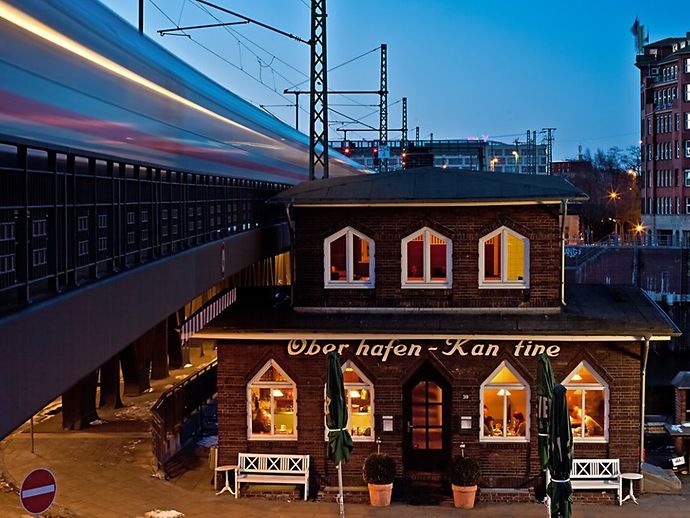
Moin aus Hamburg. So lecker wie aus Omas Küche, specifically, splendid traditional food served by Oberhafen-Kantine.

Looks like a great train-watching spot once summer is here (and, that far north, there's lots of daylight.)


Daniel Rosch photograph retrieved from Hamburg official site.

There are a number of other possibilities listed at the link.

29.3.18

GOING GREAT WESTERN.

The Heathrow Express train service, which meant electrification of the platform tracks at Paddington Station, will be operated by Great Western.  I'm not sure I understand how construction of the cross-London high-speed train route, which will go under the streets of London between Paddington and somewhere Doverside of the Thames, affects tenancy in the Old Oak Common coach yard, but there it is.  "The agreement means there is no need to build a new depot to replace the current facility at Old Oak Common which Heathrow Express must vacate by the end of 2019 as part of the High Speed 2 project."

THERE ARE LAWS OF CONSERVATION IN ECONOMICS.

At any time, there are more tasks to be done than there are resources available to do it.  Some fraction of the nation "ill-housed, ill-clad, ill-fed" coexisting with people looking for work?  The challenge is matching the tasks to be done with people possessing the skills to do them.  "Jobs can neither be created nor destroyed, only changed in form."  In economics, we refer to a "lump of labor" fallacy, and it frequently emerges in discussions of trade policy, where those nasty foreigners are destroying our jobs.  Here is Donald "Cafe Hayek" Boudreaux, with the corrective, and from a very prominent platform.  "Relative to overall routine job destruction and creation — 'job churn' — the number of American jobs destroyed by trade is minuscule."  We see the factories closing or staying open, we don't necessarily see the office parks or warehouses that take their place, and provide different sorts of jobs, and yes, we ought be sensitive to adjustment costs.
Clearly, trade is a trifling source of job loss when compared with other sources. These other sources are ordinary economic changes that, like trade, fuel our high standard of living.

Every time our tastes as consumers change, we alter the way we spend our money. The number of jobs producing things that we lose our taste for, such as cigarettes, decreases, while the number of jobs producing things that we now have a greater fancy for, such as exercise gear, increases.
Yes, and there are adjustment costs attached to expanding the output of exercise gear, everything having an opportunity cost.
When consumers buy less of a particular product, they spend or invest more money elsewhere, thus creating not only new and better products but also new jobs. Consumers’ freedom to change how they spend their money prompts entrepreneurs and investors to produce things that consumers value most highly, and to do so as efficiently as possible. The result is economic growth.

Fears of losing jobs to trade are inconsistent with our larger embrace of innovation and competition. More ominously, given that trade-induced job losses are a tiny portion of all job losses, such fears are wildly overblown — so much so that they now have America and the world on the brink of a potentially calamitous trade war.

And all for naught. President Trump’s protectionism will simply not create the multitude of jobs that its champions predict. Far worse, however, is the fact that the longer we tolerate this hostility to one particular source of economic change and growth, the more likely we are to grow hostile to technological innovation and other more significant sources of economic change and growth. And it would then become impossible to make America great again.
That train might already have left the station, as political economy has long contemplated the effects of innovation and competition, particularly when those effects turn out not necessarily to the advantage of beneficiaries of the existing dispensation.

CULTURE IS EMERGENT.

The Week's Paul Waldman might be deconstructing a so-called gun culture.  There's a deeper message, early in his essay.
Whatever policy changes liberals might be proposing, it's important to communicate to gun owners that you respect their culture and you don't mean to wage an assault on their way of life. When someone like retired Supreme Court justice John Paul Stevens writes an op-ed in The New York Times calling for the repeal of the Second Amendment, it only convinces people that you're a bunch of gun-grabbers.

I'm all for respecting other people's cultures and taking their feelings into account. But when was the last time you heard someone implore conservatives to respect the culture of coastal or urban-dwelling liberals?

We're told that if you grew up around guns, then you're right to worry that your culture could be eroded, and we need to understand and sympathize with your perspective. But here's something that might surprise you: For millions of Americans, not having guns around is an important cultural value. It's part of how we define the kind of places we'd like to live. Since most Americans don't own guns, maybe that's worthy of respect and consideration, too.
I'd suggest that Mr Waldman check his privilege, as the "culture of coastal or urban-dwelling liberals" is the default setting for Educated Opinion as well as the baseline for all news and public affairs journalism.  Those rustics with their guns and their bass boats and their pickup trucks?  Not quite exotic enough to be celebrated in the way of Third World migrants, and thus deplorables to be put in their place.  "Respect and consideration," my eye.  Read on:
[W]hen you say something is part of your culture, you're placing it beyond reasoned judgment. Its status as a component of culture infuses it with value that can't be argued against. I don't tell you that your religious rituals are silly, because they have deep meaning for those within that culture. Your ethnic group's traditional music may not be pleasing to my ears, but I'm not going to argue that it sucks and you ought to start listening to real music, defined as whatever I happen to like. The food your parents taught you to make from the old country might not be to my taste, but I'll appreciate it (at least once or twice) as a window into another aspect of our rich human tapestry.

In other words, when you place something in the sphere of culture, you automatically afford it a kind of conditional immunity from criticism. And you can demand that it be respected.

Nobody understands this better than gun advocates, who have been working to change the culture around guns, and our expectations about them, for some time.
It came to this, dear reader, when that default setting of Educated Opinion embraced an unthinking multiculturalism, celebrating "diversity" even if that involved honor killings or clitorectomies or arranged marriages between pre-teen girls and sixty year old men or forms of music that celebrated rape or dead cops.  Fall for all those other things, why not fall for the "construction" of a gun culture?
But the "gun culture" promoted by gun advocates today is toxic. It's paranoid, angry, hostile, and is built on the idea that even the most modest restrictions on guns represent a cataclysmic evisceration of liberty. It's constantly fed fantasies of oppression and righteous violence in order to maintain its power — which of course keeps the customers buying more and more guns.

So let's ask a different question: What kind of a society do we want to create? If accepting your culture means that I also have to accept that 30,000 Americans are going to continue to be killed by guns every year, then that's just something I can't bring myself to respect.
The generalization to other dysfunctional cultural "constructions" is left to the reader as an exercise.

IT DIDN'T BEGIN WITH DONALD TRUMP.

Just before the electoral vote was cast, I teased the Clinton campaign and the data-driven wizards of smart for not taking the campaign into friendly territory.  "Comrade Putin had to encourage Hillary Clinton to tie up traffic raising money on Manhattan and in Hollywood, and then go back to Chappaqua for a nap, rather than to Wisconsin, where a friendly audience might be had in Madison, or at Serb Hall in Milwaukee, which used to be traditional for Democrats."

I don't remember if Our President had an event at Serb Hall (but never on a Friday, that would antagonize enthusiasts of their fish fry) but populist Republicans began contesting the territory a long time ago.  Let Milwaukee politics guru Bob Dohnal tell the story.
When Ronald Reagan walloped Jimmy Carter in the 1980 presidential election, political experts “discovered” those voters for the first time: traditionally Democratic, working-class whites in Northern industrial states whose swing to Reagan blew open what had looked like a close election.

I could have told them about the Reagan Democrats months earlier, because I helped organize their coming out party. It took place on March 26, 1980, at the American Serb Hall on Milwaukee’s Southwest Side.

As chair of Reagan’s 1976 and 1980 campaigns in Wisconsin’s old 4thCongressional District, which covered the southern half of Milwaukee County, I was convinced this traditional Democratic stronghold was ready to respond to Reagan.

I had a drug store in West Allis, a predominantly Democratic blue-collar suburb, and dealt every day with the people who eventually became the Reagan Democrats. They were plumbers and workers at factories like Allis-Chalmers and Kearney and Trecker. They tended to be very patriotic. Many had served in the military. They were hunters and liked to fish. They drove pickups, something country club Republicans in Milwaukee never did.

Previous Republican presidential campaigns had been reluctant to reach out directly to these voters. But as far back as Richard Nixon’s successful races, I knew that a GOP candidate speaking at Serb Hall, where no Republican office-seeker had ever tread, would have a tremendous impact on southern Milwaukee County.

“Serb Hall,” former vice president Hubert Humphrey said in 1972. “If these walls could talk, what stories they could tell of the great Democrats who have campaigned here.”
Those pickup trucks were practical, how else schlep tool boxes and coils of wire around and bring home the deer in November?  Mr Dohnal had to cue his Republican regulars to code-shift without seeming condescending.
Before they came, I told the people from Brookfield—a strongly conservative, upscale suburb—“don’t come in a suit.” We didn’t want to look like the John Anderson crowd that had met elsewhere on the south side the week before.

Describing the south siders who packed Serb Hall that night, [Reagan biographer] Craig Shirley remarked that the Milwaukee telephone directory was “jammed with listings of people whose names looked as if they’d gone through a Mixmaster. The scions of the Republican Party didn’t want these people with funny last names traipsing around their country clubs. These people drank cheap beer and ate kielbasa! Slavs who could or should have been Republicans were not, largely because the snobby Republicans didn’t want them.”

Donald Pfarrer wrote in the Milwaukee Journal that “it wouldn’t be accurate to say that Reagan had tailored his speech to the Serb Hall crowd. He struck the same themes and adopted the same tone as on earlier campaign stops in Wausau, Waupaca and Neenah.”

But that didn’t matter. As Pfarrer wrote, “the place was as jammed as it had been that night in 1972 when the campaigns of Humphrey and George McGovern met there. If there was a so-called country club Republican among the 500 or 600 working people, he had left his Harris tweeds at home.”
You'll find a lot of consonant clusters, Pabst-drinkers, and eaters of kielbasa or bratwurst in Wausau (paper mills), Waupaca, and Neenah (garbage trucks and manhole cover lids).  Mr Reagan's message likely was "the Democrats left me," and these days the coastal deplorable-shamers might not belong to country clubs, but they've brought the snobby attitude to the Democrats.

28.3.18

EL PASO'S HERITAGE TROLLEY.

The streamlined Presidential Conference Committee streetcar, the PCC Car, as traction enthusiasts have it, continues to be a good platform for retro-look transit.

There's a preserved Chicago version not far from Cold Spring Shops.


Illinois Railway Museum, 1 September 2007.

Now, El Paso will be getting restored cars.  Once upon a time, the city had an international route, with cars looping across two bridges into Ciudad Juarez, Mexico.  These are original El Paso cars, rebuilt at a railway equipment dealer in Pennsylvania.  They're not grandpa's PCC.  "No. 1506 has been fully restored for daily use and outfitted with modern amenities, including air conditioning and Wi-Fi." Each car will be painted to honor a different paint scheme of the original El Paso service.  (There's another El Paso tribute car running on San Francisco's Market Street line.)

The original international service was the casualty of a trade dispute.  "Mexico put a stop to it, scuppering the line by abruptly tearing out the rails overnight on the Mexican side of the border. Shopkeepers in Juárez had complained that it was too easy for Mexicans to do their business in the U.S."  The cars stopped running on the Texas side in 1974.  Such cars were then still in service in Boston, Philadelphia, San Francisco, and Pittsburgh, and a few of the Boston cars are still running today.  Now the PCC returns to El Paso.

REDISCOVERING THE GOOD OF THE INTELLECT.

Hollins University president Pareena Lawrence elaborates.
[A student] organization wanted to invite former Breitbart editor Milo Yiannopoulos to speak on campus in late spring or early fall 2016. Fortunately, the administration has to review all such invitations. We debated and did not just rubber-stamp this particular invitation. We asked the student leaders to engage in a conversation.

That conversation went as follows: as a college, we will not prevent Yiannopoulos from speaking, but we want to know, what teaching purpose do you believe will be served? What will he contribute to academic discourse? And how likely is it that he will persuade other students to adopt your point of view? If you truly believe in the positions you’re promoting, then why bring in a speaker who’s just a flamethrower? Why not bring in someone who is capable, in open discussion, of winning hearts and minds?

And the student leaders responded with, “You know, you’re right.” Engaging them in conversation before they brought in the speaker enabled our community to head off a potential problem.
It's called teaching the controversies, and too often, this columnist's concluding remarks are honored in the breach. "The best learning often happens during debate, disagreement and controversy. We do well to remember that our educational missions are part of a continuing process intended to result in graduates more capable of navigating the world than when they first entered our campuses."

SORRY, HILLARY.

Stephen Moore, "For at least the last two decades, most of the dynamism and growth -- as measured by population movements, income growth and job creation -- has been fleeing from the once economically dominant blue states that Clinton won and relocating to the red states that Trump won."

Yes, the urban agglomeration economies still favor the states with the big cities.  That is, until the taxing authorities in those states use their power destructively.
The Clinton states are in a slow bleed. That is in no small part because their governments have adopted the entire "progressive" playbook: high tax rates; high welfare benefits; heavy hand of regulation; excessive minimum wages; and war on fossil fuels. These states dutifully check all the progressive boxes.
These states are also nowhere near as optimistic, dynamic, or forward looking as Mrs Clinton would have her audience in India believe. "Clinton wanted to make America look more like Illinois and Connecticut. Maybe that's the real reason why she lost."

That's Illinois, just watching Wisconn Valley take shape.  (Yeah, I threw in some more Spanferkl and Dunkelbrau for the fun of it!)

GRANDMA'S FOOD?

Traditional German food is too heavy, or something, for the trendy set.
When you think of the quintessential German restaurant in the United States, you’re thinking of a place like Karl Ratzsch. Ever since it was founded by German immigrants in 1904, it had a menu full of schnitzel, spaetzle and hearty Bavarian staples. The interior was dark wood, with German coats of arms, hand-painted beer steins, a beautiful Bavarian cuckoo clock and servers in dirndls. The place was a Milwaukee institution: Frank Lloyd Wright, Liberace and President Nixon dined there. Karl Ratzsch’s was handed down through generations, and reached such acclaim that in 1980, members of the Ratzsch family were invited to a state dinner with President Jimmy Carter and the chancellor of West Germany, Helmut Schmidt.
As everyone in Washington now understands that the elective road to National Office leads through Wisconsin, let us note that Gus Mader is still serving, that Fred Usinger still sell sausages, and that Spanferkl and large mugs of beer are on offer at numerous places in and around Milwaukee.

Along the route of the new streetcar, the building that once housed John Ernst's cafe is now divided between a Chipotle and a Panera: that's a step up from ramen, and yet ...  "Young people checked [a spruced up Ratzsch's] out but didn’t come back, opting instead for ramen and Korean tacos and the kind of bright, casual spots where all of the servers look like models and avocado toast is on the menu."  Emergence is at work, and there are new selections out there.
German food’s decline “reflects the cultural mix of this country toward more Latin American, Asian and African American culture, and less of the mainstay Germanic culture that influenced this country for many decades,” said Arnim von Friedeburg, an importer of German foods and the founder of Germanfoods.org. “The cultural shift is going on, and German culture has to fight or compete to keep its relevance.”

The cuisine’s long history here might be part of the reason, too. It’s “Grandma’s food,” Hauck said. At a time when American eaters seem interested in sampling new-to-them cuisines from around the globe — Native American food is the new poke is the new Uighur is the new Filipino— German food seems stodgy. Not to mention that in the age of Instagram, it suffers from an acute case of brown.

It’s also hearty, heavy and boasts enough starches to make ketogenic, gluten-free Whole 30 adherents lose their minds — which makes it seem out of place in our current food culture.

“In German, it’s called gut bürgerliche küche,” said Alex Herold, the owner of Old Europe, a German restaurant in Washington celebrating its 70th anniversary this year. “Translated, it’s country-style comfort food,” what most Americans think of when they think about German food. “It’s that meat and potatoes stigma,” Herold said, even though in northern Germany, dishes are lighter and have much in common with trendy Scandinavian food.
That might be, and yet the article notes Gemütlichkeit lives on, as proper German-style beer gardens have also become a thing.  "Biergartens have high-volume beer sales and a limited menu; German restaurants have more table seating, a wider variety of traditional dishes, and an atmosphere closer to fine dining. Plenty of places started out as the latter, and ended up as the former."  (Note: at a proper Biergarten your choices are not going to be limited to colored water in a silver can, colored water in a blue can, or headache in a glass!)  Prosit!

27.3.18

A STRONG TOWNS MOMENT AT THE TRAIN SHOW.

State of the Planet notes California’s Misguided Attempt to Force Urban Density.

It's the reliance on Wise Experts with their Mandates that causes the trouble.
In America, a government edict will not work. If a community doesn’t want density, government should not make them accept it. But if a community won’t accept greater population density, they should not receive the benefit of a new train station either. Instead, we should build a train station where a community is interested in building a town square with higher densities than the surrounding area. In fact, we could have the same rule for new highway exits. Government should provide incentives for density; it should not try to mandate it.

The idea that sustainability requires unwanted lifestyle changes dooms the politics of sustainability. We need to approach sustainability positively. Sprawl development was not an accident. Yes, people liked the idea of more living space and their own backyards, but government built highways that subsidized their transportation, made mortgage interest and property taxes deductible, and developed federal insurance for home mortgages. People were paid to move to the suburbs. Suburban development was not an accident, but a national public policy.
Once upon a time, there were streetcar suburbs, but even those emerged organically, with a town form conducive to walking or taking the trolley to the store, or to catch a commuter train.  Something like this.

Modular display at last weekend's swap meet in Belvidere.

Look closely, this community is already infected by the ample-parking virus.  For now, this is still a community that a modeller could serve with commuter trains, and the accompanying industries and warehouses support retail freight railroading.  (Retail freight railroading might have been a losing proposition, but that's for another day.)

Today, though, the Wise Experts have saddled people with rigorously planned and strictly zoned land use patterns, more like this.


If you're driving to the White Castle or Howard Johnson's or the Arches already, why bother finding a parking spot at the station to catch the 8.15 to the city?  Moreover, the zoning code has likely ruled out any commercial use nearby, thus no factory or warehouse for the local freight to switch.
Public policy is not like solving an equation or testing a hypothesis. It is not neat and rational. It is messy, incomplete, partial, and remedial. We don’t actually solve public policy problems, we make them less bad. The air is cleaner in New York today than it was in 1970, but it is far from pristine. Crime has been dramatically reduced here, but it will never be eliminated. Sustainable cities will be built gradually over the coming decades. The process can be accelerated with sophisticated, carefully designed public policies. California needs more renewable energy, more electric vehicles, and as much increased density as they can attractively design. But people should be encouraged to live this way, not compelled to. For a sustainable lifestyle to truly take root, it needs to be seen as a more interesting, exciting and fashionable way of living than today’s typical suburban living.
Perhaps, the way to reverse the compulsion is to repeal the existing set of compulsions.  That's easier on a model railroad, where the owner of a modern-image tract such as the one above can remove the drive-ins, install switches and spurs, and bring in the operating interest of retail railroading.

In life at 12 inches to the foot, it's harder, because convincing Wise Experts to bet on emergence is asking the Wise Experts to limit their ambitions.

THE WOUNDS HAVE NOT YET HEALED.

A SUNY-Binghamton professor of electrical and computer engineering has a lapse of judgement.
Binghamton University engineering Professor Victor Skormin has been roundly condemned by his campus community after his quip to the campus chapter of the National Society of Black Engineers didn’t go over too well.

It all started when the NSBE club recently sent out a mass email about their planned fundraiser at a local steakhouse. Professor Skormin replied back to all, saying: “Please let me know about a dinner of the National Society of White Engineers. Thank you.”
That reminded me of a column by Milwaukee Journal (the Sentinel being a separate morning paper in those days) columnist Edward H. Blackwell that Trains reprinted in its January 1971 issue.  The writing is old enough that the Journal-Sentinel have no current archive of it, although it's available on the Trains CD of their first 75 years.

Mr Blackwell was the son of a Pullman porter, and sometimes an engineer colleague would take along an unauthorized rider.  "When I went to school one day, I suddenly found myself 'in.'  A schoolmate had seen me riding a locomotive."  In the late Twenties or early Depression years of this recollection, that was a very big thing.  But locker room talk could be cruel.
I was in the boys' locker room telling all who would listen about my ride from St. Paul.  The grade between St. Paul and Minneapolis is steep, and on this ride we couldn't make it and had to wait for a helper engine.

As I was telling my tale of how the engine was slipping and finally had to give up when we ran out of sand used on the rails for traction, the tale was getting mixed up with my fantasy of becoming a locomotive engineer.  A white student snapped my fantasy:

"Don't you know there aren't any n****r engineers?"
Mr Blackwell served in the Merchant Marine in the War, worked his way through college as a dining car waiter, and began writing for the Journal in 1963.

The National Society of Black Engineers started in 1975, and current members suggest there is still work to be done, getting young people the STEM chops.
Siaki Tetteh-Nartey, a student member of Binghamton’s National Society of Black Engineers, told WBNG.com that she doesn’t want to see Skormin fired, since it wouldn’t change anyone’s mind about the issues at hand. Instead, she said she wants a “dialogue about why these [diversity-based] groups are still relevant in this day and age, in addition to what they do.”

She added, “We cannot expect people to learn from their misstep if we do not sit down with them.”
A joke gone awry might be the simplest explanation of the continued social value of such societies.  Perhaps their continued presence in another twenty or fifty years might illustrate something else gone wrong.

DISARMING IN THE POSITIONAL ARMS RACE?

Now that both representatives of the Mid-American Conference have exited the women's tournament, and the round of four comprises the four top seeds from the regional rounds, the powers that be are thinking about competitive balance.
In the landscape of women’s college basketball, the major programs dominate the polls, the NCAA Tournament, and the headlines. While the sport is still struggling to get attention from the media, schools such as UConn, South Carolina, Notre Dame, Tennessee and Mississippi State, among few others, dominate the limited coverage.

Because of this, one of the sport’s biggest criticisms that the NCAA Tournament isn’t exciting because the best teams always win and there are never any upsets or Cinderella runs. But that just simply isn’t true.
I suspect the absence of above-the-rim play and fandom's preference for defensive breakdowns leading to spectacular stuff shots has more to do with that "isn't exciting" gripe.  The pool of talent probably follows a power rule, which makes strengthening an up-and-coming team not among the usual suspects a challenge.
For South Carolina head coach Dawn Staley, who spent eight seasons as head coach at Temple, she understands how difficult it is for these mid-major programs to find success in the tournament.

“The struggle for me was to make the tournament and then advance through at least the second weekend of the tournament, and you need talent,” Staley said. “Ten years ago when I was at Temple, you really couldn’t get the talent.”
Somewhere, too, the "Connecticut's success is bad for the sport" people appear to be living in Connecticut coach Geno Auriemma's head.
While these runs from mid-majors are beginning to become more commonplace, Auriemma hopes to see it happen even more frequently.

“I think that’s the best thing that ever happened,” Auriemma said, referring to the two 11-seeds in the Sweet 16. “I think that’s the best thing that could happen to our game.”

Staley echoed those sentiments and noted how every upset inspires the potential for another one in the future.

“The fact that Buffalo and Central Michigan are here, playing in the Sweet Sixteen, gives other coaches hope to keep on coaching,” she said. “It gives them a little boost of energy to know that it could happen. It can happen. You can get out of the first week and on to the second week and compete at the highest level.”

One of the best parts of March Madness is the upsets that happen throughout the month as well as the annual Cinderella runs by smaller, lesser-known schools.
Thus, a call for a scholarship limitation treaty?
Auriemma suggests lowering the scholarship limit from 15 to 13, allowing more good players to make an impact at a small school instead of riding the bench at one of the powerhouses. At the moment, mid-major coaches have to be creative in their recruiting — many recruit international players heavily.

“Sometimes you have to go that route in order for you to get some quality players,” Staley said. “When it comes down to it, it’s not [a fair game]. To be able to play for a Power-Five school is always greater in most people’s eyes.”

Another key for these schools is targeting the players they think best fit the program and building relationships with said players as opposed to selling recruits on history or facilities.

“I think kids want to play for people and they want to go to a school to learn,” [Buffalo coach Felisha] Legette-Jack said. “They don’t talk to buildings, they talk to the assistant coaches.

However, another issue is a lack of coverage for smaller programs. They’re rarely on television and never have photos taken of their games for use.
In order: assistant coaches and head coaches likely have a good idea of who their opponents are starting, are recruiting, and thus who among the recruits are likely to be four-year reserves elsewhere.  "Ride the bench at Connecticut or sign with us at DePaul, and pay them out" might work for some kids.  Next, if facilities aren't that important, there's probably a sports economics paper identifying the role of all those financially strapped convocation centers in the Mid-American in getting teams capable of getting to the round of sixteen.

A THING'S A PHALLIC SYMBOL IF IT'S LONGER THAN IT'S WIDE.

I thought that sort of analysis went away years ago, with Melanie's "Glory, glory, psychotherapy."


The id must go marching on, particularly under the imperative of publish or perish.
This article provides a critical vegan reading of the comedy animation film Sausage Party (2016), directed by Conrad Vernon and Greg Tiernan and starring Seth Rogen and Kristen Wiig. Such a reading is situated within an emerging vegan studies framework (Wright 2015) that is sensitive to the reproduction of unequal power relations between humans and other species, but also how those power inequalities intersect with intra-human power relations along the lines of gender, sexuality, “race,” age, class, different experiences of embodiment and so on.
Five months from submission to publication, likely devoid of any empirical content, and derivative of an idea, itself not supported by rigorous evidence, from thirty years ago.

Meanwhile, the shills for Business as Usual in Higher Education wonder why Wisconsin-Stevens Point is turfing out a few unproductive (and empirically empty) majors.

26.3.18

THE SUB-ROADBED MAKES THE TRAIN FAST.

The article is in German.  The illustration suggests a mighty iron road.


To the left: new style track structure with cross-ties laid on a slab roadway of asphalt or concrete.

To the right: traditional track structure with ballasted cross-ties.

The new approach is good for faster running, with more years between track renewals.  "Dank der modernen Bauweise können Züge mit bis zu 300 km/h auf neu gebauten Strecken fahren."

A BRAIN THAT LEAKS.

The more I see of Parkland media darling David Hogg, the more I keep getting this ear-worm.


The Federalist's Robert Tracinski calls for a privilege check.  "Dear Annoying Parkland Kids: We Gave You A Pretty Awesome World, Try Not To Mess It Up."  A sampler.
The world we older generations have given today’s kids is actually pretty awesome. We can’t protect them from every danger and every risk, and we can’t stop every tragedy like the Parkland shooting. But by historical standards, our kids will be safer, healthier, and wealthier, and they can expect to live longer and more untroubled lives than we did, or than our parents did, or than our grandparents did.

I can see, though, why they wouldn’t realize any of this, because there are some who have a political interest in making things look worse.
Plus a caution. History rhymes, often in a bad way.  "The fastest way to mess up the world the older generations gave them is to think that they are all experts at age 17 because they read some lefty rhetoric and got 'woke.' You know who also thought that? The Baby Boomers." The d**n hippies, to be precise about it.  "Spoiler alert: they didn’t keep those promises, and everything turned out just fine. But now the same people who were wrong about war, wrong about poverty, wrong about capitalism, and wrong about guns want to get the grandkids to give one more shot at fixing what isn’t broken."But when the kids decide to play in the adult arena, they ought be held to adult standards, and called out when they don't measure up, or resor to hectoring and deplorable-shaming.
Suffering through a terrible crime gives a person no special insight into its causes, and Hogg has no special insight into its causes — or, frankly, into anything else. He’s ignorant about basic civics; he’s liable to backward reasoning; and, unable as he is to synthesize the evolving talking points upon which he relies, he has increasingly come across as slippery. In perhaps his most embarrassing moment thus far, he shifted from arguing that the cop on duty who stood outside and did nothing while his classmates were slaughtered was correct to demur (not a great message, all told) to making the opposite case when he sensed an opportunity to lay the blame at the feet of Governor Scott — who, of course, had nothing to do with running the sheriff’s department responsible for failing to save his classmates. Demosthenes he is not.

Even worse has been Hogg’s attitude toward those who have had the temerity to disagree with him. Here, one suspects, he has been let down by those around him, the loudest of whom have evidently led him to believe that our complex political discourse can be circumvented by the blunt issuing of demands. The gun debate in America remains intractable, consisting not only of difficult legislative questions, but of elaborate constitutional, sociopolitical, historical, and criminal inquiries, too. For some reason, David Hogg has come to suppose that he can slice through this reality by issuing threats: Give me what I want, or I’ll stop using FedEx; give me what I want, or I won’t go back to school; give me what I want, or Florida’s economy gets it. And, by the way, I’m going to outlive you…
There's a word for that.  "Though a junior, he brings to life the roots of the word ‘sophomore.’"  Is anyone surprised?  What have I been telling you all along?  "Democrat cliches are emotional appeals calculated to move sophomores, and their witticisms are at about the same level." Why should last weekend have been any different from the weekend of Our President's inauguration, or the Days of Rage?
Hogg is basking in his 15 minutes of fame at an embarrassingly early age, and so we might avert our eyes from his much-viewed display of ingratitude, sanctimony, and profanity, except that we can’t, because manipulative adults in the media are deploying him as a useful idiot. Older useful idiots are also in attendance: George Clooney, Dennis Rodman, and of course Kim Kardashian. But people who cherry-pick the tragic, the emotional, and the strange to form a national narrative have cast their klieg light on David Hogg, and so in predictably sophomoric fashion he believes himself to be an oracle.
What else, though, expect of the common schools?
Most of high school is terrible. Teens feel insecure, and their feelings of insecurity are further heightened by the insecurity they detect in each other and on it goes. Teens probably did much better before the Industrial Revolution, working alongside their elders and mentoring their younger siblings. For a long time, schools had some justification in laying a unifying foundation and a standard base of skills, even if it did hold back the development of most students most of the time. But now, online learning can be as varied and individualized as the millions of students who might use it, with goals achieved years earlier at a fraction of the cost.

A strong subtext of the recurrent school-shooting story is the obsolescence of schools and our unwillingness to address it. Sophomores, your righteous indignation is a false consciousness created by a cynical media who have cast you in a role for their own purposes. The anti–Second Amendment hysteria of the Left is portraying an exceptional tragedy as an epidemic. But there is something within your purview which deserves your scrutiny. Take a critical look at those mind-numbing factories you’re forced to attend.
This time, take a more respectable tone.  "Sure, march and protest. It is your right. But you are not taken seriously any longer, young ones. Time to move along." Class dismissed.

FREDERIC BASTIAT GOES TO THE DENTIST.

Hilarious.
Losing one’s teeth, even in rich America, was far more common in the good ol’ days than it is today.  And while most of us celebrate this victory over tooth decay and other dental ailments, someone of a protectionist bent is likely unhappy about this improvement in living standards.

“After all,” wonders the protectionist, “what about all those unfortunate workers who lost their jobs as a result of this advance in dental health?  What about the hard-working men and women – all of whom played by the rules – who were laid-off from their jobs making dentures?
Read, enjoy, understand.

CHECK YOUR PRIVILEGE, VOX.

Access to clean water is a basic human right.  Yes, for anyone who has a rain barrel.  When the clean water makes use of expensive treatment plants and pipelines, it makes more sense to view it as a commodity.

Unless you write for Vox, where you can believe in Santa Claus and the Easter Bunny.
After World War II, America went on something of an infrastructure kick, building an expansive network of water pipes in cities across the country. But now these pipes are more than 60 years old and in many instances are in desperate need of repair.
That "infrastructure kick?" The victory dividend resource curse. Desperate need? Political spin for "this is something I want, and I want somebody else to pay for it."

That's not, however, how those European social democracies, you know, those shining examples of how to do governance right, roll.
Tracy Mehan, executive director of government affairs at [the American Water Works Association (yep, even trade associations of government agencies engage in rent-seeking)], has pushed for an increase in federal funding but says we can’t avoid higher water rates. “We’ve coasted for decades in most places around the country. Our rates are half that of northern European cities,” he said. “Rates are going up and need to go up.”
That might also encourage conservation, or perhaps migration. Look at the Vox map.  A number of "high risk tracts" where people might be losing their affordable water are in deserts, for crying out loud.

There's a concept in public utility pricing called lifeline rates, under which the first block of consumption bears a lower price than additional blocks.  Perhaps that principle, used generally, might do more to change the behavior of golf courses in Arizona or California than all the moral suasion.

25.3.18

REBOOTING.

Positive train control is coming to the Burlington Racetrack.  As a consequence, it will take longer to turn a train.
Under [positive train control] the crew of a train must initialize the system before each individual run. This includes entering information about the size and makeup of the train (because its weight affects its stopping distance) and any other details about conditions along the route (such as work zones or speed restrictions) that could affect the safe operation of the train. The initialization process is expected to take about six minutes.

On the current BNSF schedule there are about 30 instances in which a train completes a run and turns around to start a new one in less than 10 minutes, typically at the ends of the line but occasionally mid-route. In those 10 minutes, the engineer must move from the cab car to the locomotive or vice versa, and the crew must clear the train, perform a brake test and conduct a job briefing. With the added task of initializing the PTC system, these “flips” are expected to take 12 to 15 minutes, so the schedule of many trains must be adjusted for increased turn times, and those changes, in turn, will affect nearly all other trains on the schedule.
During the busiest hours on the line, those flipping trains must move smartly, generally completing a run from Chicago, then crossing from the northerly main track to the southerly main track to return to Chicago to become another train.  Commuters can load fairly expeditiously in Chicago.  In the morning, though, often that flipping train becomes a local train for a few stops, and if it's taking longer to turn back at Congress Park or Downers Grove, that's going to get in the way of a train coming from farther west that would like to get onto the center track to run express into Union Station.  Under the new dispensation, there will be an additional Naperville Zephyr.

DENY COHERENT BELIEFS, ENJOY THE INCOHERENCE.

That's long been a claim here, and it's leading to a "Post-Truth Civilization."  "Thus irrationalism will avail itself of the privileges accorded to science by a rationalist civilization in order to undermine the entire fabric of that civilization."  Just read the post, and follow the link.  The kerfuffle is about a student at Providence College, a Catholic institution, standing up for Catholic doctrine, but the unraveling as a consequence of excessive transgressivity applies more generally.

PAYING THE PRICE FOR THEIR PREJUDICE.

In all the years of the collegiate basketball tournament, there has been only one winner from the state of Illinois.  Loyola of Chicago are again in the final four (nobody referred to a final four in 1963) and the history is being told to a new generation.
“The whole nation must be sort of sitting on the edge of their chairs tonight,” said Sister Jean Dolores Schmidt, Loyola’s 98-year-old team chaplain.

Sister Jean has become a celebrity during the tournament. The National Bobblehead Hall of Fame and Museum, in conjunction with Loyola University Chicago, unveiled an officially licensed, limited edition Sister Jean bobblehead Friday.

Yes, the Loyola bandwagon has gained that much momentum.

And this squad is inescapably being linked to the 1963 team. [Team captain emeritus Jerry] Harkness and three other members of that squad – Les Hunter, John Egan and Rich Rochelle – were in Atlanta for the Sweet 16 game.

Loyola coach Porter Moser accompanied members of that 1963 team on a 2013 visit with President Barack Obama at the White House and said he was “just blown away by their character, about the stories they told, just sitting there listening to the whole story behind the “Game of Change.”

“I love that this run is sparking the renewed conversation of what that team meant to our country and integration, and to hear the stories firsthand from them and to hear the brotherhood that they had, the black guys, the white guys, everyone together. It was a brotherhood; it was a high character. They embraced the Loyola education.”

Townes said he has enjoyed visits from players on the ’63 team in practices and games.
The "Game of Change," slated for Michigan State's Jenison Field House (I'm trying to remember when the tournament moved the regional and final games to a professional basketball arena or a domed football stadium) required some maneuvering worthy of a spy-master to get Mississippi State on the floor. "Segregationists had the injunction issued by a chancery-court judge late Wednesday afternoon seeking to ban Mississippi State from playing against Negroes in the East Lansing tournament."  Yeah, you read that right.  Mississippi State's coach had this play drawn up.
Assistant coach Jerry Simmons kept the team's regulars in seclusion at a dormitory. As departure time neared, Simmons had five second stringers and a team trainer, Dutch Lachsinger, go to the airport. The idea was that if the order were served to that group, Simmons would be notified by phone and he would hustle the regulars to a private plane for a flight to Nashville, where a regular flight would be made to East Lansing. [Head coach Babe] McCarthy would have accompanied the team from that point.
Law enforcement wasn't at the airport, neither was the plane, but the plane arrived and the game took place.
Third-ranked Loyola, 26-2, playing four Negroes all the way, easily defeated the sixth-ranked Southeastern Conference champions 61-51 in the opening round of the Mid-East regionals.

"They were perfect gentlemen — just like any other team we played," said Joe Dan Gold, Mississippi State captain. "They beat us on the offensive backboards. They just had too many big men for us and they won it by taking all those rebounds."

The game began with the usual handshakes between the opposing players. It ended with Mississippi State's players congratulating the Ramblers with traditional pats on the back.

Only 31 fouls were called, 17 on Loyola and 11 on Mississippi State.

"Let's talk about the way they played basketball, not their color," said Coach Babe McCarthy.
Again, that's in the language of the day.  Slowly, the coaches of the southeast figured out that their state segregation policies were depriving their teams of talented players.

24.3.18

CLEANER THAN THE AVERAGE HINEY?

A nod to "smarter than the average bear?"


(Via Voluntary Xchange.)

REPURPOSING TRADITIONAL COACHING STOCK.

Passenger train operators in Germany compete for slots on popularly traveled routes, and, as is the case in other countries where the railroads operate under some sort of open access rules, sometimes one carrier gives way to another, and the coaching stock gets a new coat of paint.

Although Germany's Flix Train is the rail arm of a bus operator, they have purchased stock that looks like what European coaching stock has long looked like.


A fresh coat of paint, a new operator.
FlixTrain is operated by BahnTouristikExpress, which owns the rolling stock which was used on the same route by Hamburg-Köln-Express until it suspended operation last year. The coaches, of older compartment types, have been rebranded in FlixTrain’s bright green livery. Traction is provided by MRCE.
The article expects the reader to understand that MRCE are a locomotive leasing company.

Flix will soon be picking up a second franchise.  "The Berlin – Stuttgart open access service which was launched by Locomore and is now operated by LEO Express in partnership with FlixMobility is also to become part of the FlixTrain brand from April."

Once upon a time, there were railroad companies that set up feeder bus services, until the Wise Experts said no.  Bus companies taking over Passenger Rail services?  Why not?

CATHARTIC.

Ammo Grrrll deplorable-slaps Hillary Clinton.
Hillary, seriously, we can’t take much more. Reach deep down and find a little dignity. Apparently, nobody told you the Deplorable Speech probably lost you ten million votes. Minimum. Let’s see if the Dumb Racist Red States Full of Idiot White Women Speech can outdo that! Let us count all the ways in which you are wrong.
It gets better. Just go enjoy it.  Yes, even if you are a Hillary fan, these are the new rules.

One remark calls for a clarification.
George W. Bush said after candidate Trump’s attacks on “low-energy Jeb!” that “Donald, you can’t insult your way to the Presidency.” That turned out to be wrong. But, Hillary, you would do well to heed that advice. You can’t insult half the ELECTORATE to a third bite at the apple. Oh, how we wish you could! I would love to see President Trump (how that must rankle to see that in print every day…) take you on again. And I especially would love to see a real down-and-dirty catfight in the Democratic primary – you and Bernie and Kamala and the Indian Maiden on the Land O’ Lakes Butter Box – all scratching and biting and hissing for the right to see who will lose to The Donald again. Popcorn City!

One would think that these wretched remarks about white women would constitute the low point of your analysis of how you lost the election. But one would be wrong. These were nothing compared to the boring, repetitive, infuriating slander that Red State residents are racists.
Mr Trump simply said about politicians what a lot of voters likely think of politicians.  You can insult some or all of your opponents: heck, that's why all we see toward the end of primary season are attack ads (never mind that in Illinois nobody got attacked for letting the Amazon warehouse or the Foxconn factory get away.)  Insulting voters is another matter.  (Crooked Hillary has a long history of this, see her "stayed home and baked cookies" from 1992.)

One extended remark translates, effectively, as "Step out of line and disappear."
I offer to Hillary the severely-truncated words of Oliver Cromwell in his speech to the House of Commons – April 20, 1653 – on the occasion of the Dissolution of the Long Parliament. It’s been 365 years, and I can no way improve on it. I am also taking the liberty of changing the plural aimed at the members of Parliament into the singular aimed at Mrs. Clinton. Oliver, forgive me; it’s in a good cause!

“Ye are a mercenary wretch, and would, like Esau sell your country for a mess of pottage, and like Judas betray your God for a few pieces of money.…ye are grown intolerably odious to the whole nation. You have sat too long for any good you have been doing lately… Depart, I say; and let us have done with you. In the name of God, go!”
So mote it be.

IT'S NOT FOR LACK OF MONEY.

Talk Poverty's Mara Pellittieri pens her farewell to middle-school teaching.
During my first faculty meeting, I found out that my new colleagues had not received a raise in three years. The administration gave the union a choice when the recession hit: either lay off teachers, or give up their raises for the foreseeable future. The union voted for the latter, not knowing that their wages would be frozen for the better part of a decade. Our school—one of the only low-income schools in an otherwise affluent district—was failing, and if we didn’t raise test scores people were going to start losing their jobs anyway. But the new principal had some big ideas, she told us, and we were going to do this together.

Her first idea was ending all out-of-class discipline. Research shows that students of color and students with disabilities are punished too often and too harshly, so we were going to stop as much punishment as we could. Any behavioral issues were to be addressed in the classroom, no matter how severe.
We could stop the story right here. That's not going to end well.  But when the village combines all the redeeming features of a hippie commune and a trailer park, the difficulties will only mount.
The next was to use lunch periods as extra tutoring time. Administrators called names in the cafeteria of any student with outstanding work or low test scores, and sent them back up to their teachers. Our lunches were at the same time, so we ate with students while they worked through assignments.

Then the school implemented a universal breakfast program. Most of our students already depended on school lunches, so offering breakfast doubled their chances to get something to eat. We didn’t have enough cafeteria staff to cover that, so breakfast happened in our classrooms too—our first-period students came in a half-hour earlier and ate in the rooms.

The new initiatives kept piling on: We added after-school tutoring, academic mentoring, and open office hours. Every single one of these ideas was good—every time we offered a new support, a few kids did a little bit better. But every single one of these ideas was also the sole responsibility of the teachers. By the end of the year I had students in my classroom for 12 hours a day, with no time to plan the next day’s lessons or grade papers until the last kid went home.

In theory, that type of schedule is exactly what a union is supposed to prevent. Our contract mandated breaks, planning periods, and additional staff in the classrooms to support students with disabilities. But our union was doing its best to keep its members employed in the face of a budget crunch—dealing with contract violations was a luxury. So our list of responsibilities kept growing until teachers buckled under the pressure.
Stop enabling the dysfunction and pretending it's authentic.  There isn't a union in the world can fix this school's problems.  "Teachers make their living by getting people to pay attention. So when they say they can’t do their jobs anymore without more money and more support, and state legislators respond by jamming their fingers in their ears and passing yet another tax cut, teachers will do what it takes to be heard."

Until that support begins with a commitment by the teachers and the school districts that they will inculcate the habits of the middle class, and get tough with the recalcitrants, those wildcat strikes will be for naught.

YOU JUST REALIZED YOU CAME TO THE WRONG SCHOOL.

Wright Thompson of ESPN psychoanalyzes does a profile of Connecticut basketball coach Geno Auriemma.  Coach says, "I got issues."  But he understands how much work there is in achieving, let alone, maintaining, excellence.
Recently he railed against a player who couldn't or wouldn't box out: What if we need one rebound to win a national title? A memory from the 2012 semifinal against Notre Dame fueled his anger. "The kids look at me," he says his voice rising to a scream. "I go, 'Yeah, you know why I said that? That happened to us. We had to get one f------ rebound. If we do, we win. The kid didn't get it. And we lost.'"

Auriemma has a curious, creative basketball mind but his greatest talent is understanding and preventing self-destruction.
If bringing out the best in people was easy, wouldn't the formula be common knowledge by now?
He knows his own worst enemy, like his team, has always been himself. Since childhood, he's spent so much time trying to see himself clearly that it's given him deep insight into others. Despite his frequent raging, empathy is his strongest trait; the ability to peer into people's most private, insecure selves and make their weak places strong. His success comes from seeking to fix in others what he longs to fix in himself. The teams are proxies. Nothing as extreme as the Huskies dynasty ever springs from a normal place.
That sounds a lot like Vince Lombardi. As does this tale.
Sue Bird says one day he hid beneath the bleachers, despondent, refusing to come back out. The team wasn't grasping some simple basketball concept and it broke something in him. He told them that maybe he'd lost the ability to teach, and that he was having a nervous breakdown.
Perhaps that's just acting. Lombardi's line was "I must be a lousy teacher."

THE FORTRESS AT THE CHEDDAR CURTAIN.

The Mars Cheese Castle, named for founders Martha and Mario Ventura.
Having grown up working at the castle, [Mario's grandson] Michael says he didn’t appreciate what a landmark it was until later in life. “I went to Italy, and we were talking to people and trying to tell them where we were from in Kenosha. We were saying we’re in between Milwaukee and Chicago, and they went ‘Oh! Mars Cheese Castle!’ And then it started to hit home, how many people drive by and see us,” he says.

In 2011, the cousins had a chance to really leave their mark. The highway was expanding and the castle was in its way. Their grandfather had the foresight to purchase land surrounding the business, so they decided to relocate just up the road and build anew.
The castle still caters to flatlanders who can purchase items not available for sale in Corruptistan.
In the bar, they’re pouring Mars Red Planet Ale, created for the castle by Milwaukee’s Lakefront Brewery, and serving complimentary King of Clubs cheddar, a spread created by Mario Sr. in the early days.

Nearly 200 types of meat are on offer, including their exclusive bratwurst, a recipe devised nearly 70 years ago by Mario Sr. and Fritz Usinger, of Usinger’s Famous Sausage in Milwaukee.

In the bakery you’ll find kringle pastries and that only-at-Mars cheddar cheese bread. Pop into the beer section for a six-pack of New Glarus Spotted Cow (many Chicagoans drive here just for that only-in-Wisconsin purchase) and grab an “eat cheese or die” shirt and cheesehead foam hat (it’s a best-seller) in the gift and souvenir section.
Ah, the joys of trade barriers. New Glarus do not export Spotted Cow, but the Wisconsin dairy cartel still makes it difficult to get Irish butter.  Fortunately, the Cheddar Curtain is more a state of mind than a frontier.  It's a state of mind, though, that is favorable to business.
Just south of the castle is the sprawling Amazon Fulfillment Center, which opened on 165 acres in 2015. And Foxconn Technology Group’s flat-screen manufacturing complex, which is expected to employ up to 13,000 people, will open just a few miles north.

Throughout its time, Mars Cheese Castle has catered to travelers headed from Chicago to Milwaukee and back. Now, the community around it is booming, and the castle is getting — and giving — a piece of the cheese.
The summer tourist season is soon to begin.

20.3.18

MOBILITY DOES NOT HAVE TO BE EXPENSIVE.

A German bus operator proposes a cheaper, and probably slower, rail alternative to the ICE speedsters.
The "Flixtrains", decked out in the trademark bright-green of the company's low-cost buses, will travel from Hamburg to Cologne from March 24th, while the Stuttgart to Berlin line will open in April.

Prices will start from €9.99, lower than those of rival Deutsche Bahn.

"We already proved with Flixbus that mobility doesn't have to be expensive," company founder Andre Schwaemmlein said in a statement.

"With the integration of Flixtrain, the options for German travellers are becoming even more attractive."

Germany's rail sector was liberalised in 1994 but remains dominated by Deutsche Bahn, which still accounts for 99 percent of all long-distance rail journeys.

The Flixbus company will not own its Flixtrains, partnering instead with Czech rail operator Leo Express and Nuremberg operator BahnTouristikExpress.
Mobility doesn't have to be expensive, but perhaps it doesn't have to be comfortable, either.


Unattributed DPA photograph retrieved from The Local Germany.

A long time ago, I suggested, "You don't want a train to look like a bus."  Perhaps, though, it's the trains that look like buses that connect to the expresses.  And Germans will ride trains that look like strings of buses, as long as there's room to bring the bicycles along.

THAT FRONT PORCH IS SHOP-WORN.

Athletics directors and unthinking college presidents will refer to the sports programs as the "front porch" of the university.  Competing to have the spiffiest front porch is participating in a positional arms race and Eastern Michigan has been to the athletics arms race as the old Soviet Union was to the nuclear arms race for a long time.  But disarmament is difficult.  "In an effort to stem some of their budget woes, Eastern Michigan University has announced its decision to cut four sports from their athletics program at the end of the 2018 spring athletic season." That's $2.4 million not spent, but students are likely going to be on the hook for athletic fees (for games they opt not to attend) all the same.

The old Soviet Union sort of went out of business, with Vladimir Putin doing what he can to become the next iteration of Alexander III or Josef Stalin.  It's apparently harder for Eastern Michigan.
In order to maintain Division I status with the NCAA, they had to keep 16 spots. In order to remain full membership in the MAC, they had to keep football, men’s and women’s basketball and women’s volleyball. So I can understand why those sports were not cut.

Some people have suggested that Eastern Michigan drop football. I can say with some degree of certainty, that is not going to happen. While football is probably the biggest cost, it is also the biggest generator of revenue for the athletics department. They might be able to trim the budget though but I’m not sure that would save the above programs.
That, dear reader, is why sports pundits ought to understand economics. If your "biggest generator of revenue" doesn't cover that "biggest cost" you're better off shy of the costs and the revenues, particularly, as the essay notes, with an athletics operating deficit of some $27 million per year. And Wisconsin-Green Bay could use some competition in women's basketball.

The article notes Buffalo (the old State University of New York at Buffalo) also confronting its athletics costs.  "In April 2017, Buffalo announced it would cut four varsity sports affecting 120 athletes, including its incredibly successful men’s soccer and women’s rowing programs, in an effort to save $2 million." Buffalo is only recent to Division I football, in the Mid-American, and they're notorious for generating revenue helping other teams become bowl-eligible.

At Eastern Michigan, the sports restructuring will accompany an academic reduction.  "The cut in athletics is linked to a university-wide initiative which is expected to attempt to make up a projected $4.5-to-5.5 million gap in the budget. That initiative is expected to eliminate 42 faculty jobs and lay off 17 others."  That's going to affect more than 133 students.

PRIVILEGE IS CIVILIZATION.

I told you so.

Now the University of San Francisco (didn't they used to be a basketball school -- oh, wait, they got a participation trophy?) confirms it.


Retrieved from University of San Francisco.

The announcement includes a candidate for Understatement of the Week.  "We realize that the posters cannot truly encompass the full complexity of privilege."

Perhaps they'll reflect (and, this being the Jesuit institution in San Francisco, pray) on the subtleties therein.  They could start with a statement from Simmons.
Systems of oppression run through our language, shape the way we act and do things in our culture, and are built around what are understood to be “norms” in our societies. A norm signifies what is “normal,” acceptable, and desirable and is something that is valued and supported in a society. It is also given a position of dominance, privilege, and power over what is defined as non-dominant, abnormal, and therefore, invaluable or marginal.
That "are built around" is telling.  Language is emergent.  Culture is emergent.  Norms are emergent.  "Valued and supported" follows from evolutionary advantageDeconstruct at your peril.

KEEP NATTERING, GRANDMA.

Hillary Clinton's ill-advised remarks in India continue to inspire scorn.

Ben Shapiro, "Democrats wonder why they had trouble winning Michigan, Pennsylvania and Wisconsin."  With supporting logic.
Married women vote differently than single women not because of pressure from their menfolk but because they often have children, value family over career more than single women, and are older than single women on average.

But here's the point: Clinton represents a nasty, vengeful take on populations she has trouble winning over. That nastiness has filtered through the Democratic Party, which is firmly convinced that it'd be better off drilling down into population groups it thinks are interested in tearing down the system along with them than reaching out to populations it has lost. If Democrats continue with that quest, they'll alienate the very voters who gave Trump victory in 2016.
For "tearing down the system," read "create a third world country along Californian lines."

Jim Treacher never lacks for work.  "Even her fellow Democrats are now begging her to shut her stupid trap and stop making life tougher for them."  He's less than impressed with the clarification she subsequently issued.
What she clearly said out loud wasn't what she actually meant, and if you didn't like it, you can choke on her rambling, unconvincing excuse. She meant no disrespect when she accused you of hating black people and women and Indian-Americans. She had the best intentions when she said you were everything that's wrong with America. She was defending you!
Precisely. It is the role of the Anointed to be the Nurturant Parent. It's for your own good.

Sorry, no.
If you want me to stop talking about Hillary, try convincing her to take up another pastime that doesn't involve speaking in public. If she's going to keep spouting this nonsense where people can hear her, she's fair game. I can't stand the sound of her voice, but the resulting lamentations of the Democrats are music to my ears. They couldn't drag her over the finish line, and now they can't get her to shut up about it.
Finally, Victory Girls compare Herself with the kind of weak student who couldn't write a coherent paragraph to save her grade, but thinks the professor has infinite time to listen to "But I really meant to say ..."
I have to say, definitely not offended by Hillary’s remarks. I’m laughing because she really can’t help herself! Seriously, she’s said and meant crap like this for YEARS. She meant it during the campaign when she called voters Deplorables. She meant it when she slammed stay at home moms with her baking cookies remarks during Bill’s first Presidential campaign. So, no what she says now, she meant exactly what she said in India. In other words,

‘I said that, but you deplorables and misguided women just don’t have the brains to understand what I really meant.’

Hillary as you continue your worldwide whine fest tour, let me give you something to think about. Many Deplorable women, including myself, know exactly who is to blame for not voting for you. Look in the mirror for your answer if you dare.
If that be lookism, make the most of it!