22.2.07

REVEALED PREFERENCES. Don't you know there's a war on?


The events of the past few weeks prompt me to revisit a column Fourth Turning authors William Strauss and Neil Howe posted in October 2001, with commentary in green.

Within the next year, we'll know. Here's a checklist. If the following trends deepen, then America will be in the Fourth Turning, a new era of crisis.

  • Are leaders describing the problem in larger rather than smaller terms, proposing grand solutions, and seeking to destroy (and not just contain) enemies?
Buzz. Non-binding resolutions of disapproval, non-defeat defeat, and nation-building efforts no more effective with a Democratic Congress and a Republican President than they were with a Republican Congress and a Democratic President.
  • Is there a shift away from individualism (and civil liberties) toward community purpose (and national survival)?
Buzz. Resurrected "Fairness Doctrine" arguments and campus speech codes from the right to counteract those of the left neither unify nor revitalize.
  • Are the old "culture wars" arguments beginning to feel lame, ridiculous, even dangerous to national unity?
Buzz. Unity?
  • Is the celebrity culture feeling newly irrelevant? Is youth fare becoming less gross and less violent?
Buzz. Messrs. Strauss and Howe held Kato Kaelin forth as exemplar of the trashy mid-1990s "celebrity culture" and a former Mouseketeer named Britney was supposedly the leading edge of that more wholesome youth fare.
  • Is immigration reversing? Are mobility and openness declining? Is there more nativism in our culture and less "globalism" in our commerce?
In some circles, immigration is the source of lessened social mobility, but none dare raise nativist objections that can be construed as racist, and the objections to "globalization" remain on the fringe.
  • Is there a new willingness to pay a human price to achieve a national purpose? Will we harness technology only to reduce casualties and inconvenience, or also to achieve a total and lasting victory.
Buzz. The cosmic weight-and-balance scale on which military deaths correspond one-for-one to World Trade Center deaths appears to be more influential than any calculation of whether those deaths could either have been avoided or incurred in more forceful actions.
  • Is each generation entering its new phase of life with a new attitude? Are aging boomers overcoming narcissism? Are Gen-Xers on the edge of midlife, circling their wagons around family? Are Millennials emerging as a special and celebrated crop of youth?
Buzz. The Silent Generation's Watergate Caucus, continuing that cohort's string of unearned triumphs in securing a Democratic majority for not being Richard Nixon, now calls the shots for a new Democratic majority secured for not being George W. Bush. Baby Boomers? Look at the latest crop of pension advertisements: redefining retirement, pensions for people who serve the greater good, pensions that the ex can't mess up. Thirteeners? Family? Millenials? Hookups, binge drinking, I-pods?
SECURE THE RHUMB LINE. No posts Wednesday as I was occupied with a basketball game. The officials are conferring here to determine whether the game is over, or if Northern Illinois took a timeout with 0.7 seconds remaining.


The dramatics arose after the team took seriously the concept of staying between their opponent and the mark.
In a wacky final sequence, Jessie Wilcox blocked a three-pointer, the officials put seventh-tenths of a second back on the clock and the Northern Illinois women's basketball team hung on for a 73-70 victory over Toledo at the Convocation Center.
In victory, there can also be learning opportunities.

Just four days after losing a winnable Mid-American Conference game at Central Michigan, the Huskies nearly let another game slip away on Wednesday, but pulled out their 17th win of the season to match their highest win total since 2001-02.

After the Huskies, still battling for a first-round bye in the MAC tournament, took a 16-point lead four minutes into the second half, the Rockets battled back to within one point on four occassions, but never captured the lead.

That big lead, and a comparable big lead in the first half, established a seasonal best.

NIU wasn't done with the threes yet, as it hit five more in the second half, ending the game 13-28 from beyond the arc.

NIU's thirteen makes from 3-point range is a season high for the Huskies, breaking their previous best of 12 against Illinois State opening night.

Ultimately, the team's success followed from solid defense.

From the rest of the game, the two team battled with the largest lead for either team being six by NIU.

Yet in the end, one was the closest Toledo ever came to regaining the lead thanks [to] Toledo turning the ball over six of it's [c.q] last 11 possessions.

There is more work ahead.
BACK THE STRONG HORSE. Meet Col. Sean B. MacFarland, recently returned from Iraq.

“If you talk to these sheiks, they’ll tell you that they’re in no hurry to see the Americans leave al-Anbar,” he said.

“One thing Sheikh Sattar keeps saying is he wants al-Anbar to be like Germany and Japan and South Korea were after their respective wars, with a long-term American presence helping ... put them back together,” MacFarland said. “The negative example he cites is Vietnam. He says, yeah, so, Vietnam beat the Americans, and what did it get them? You know, 30 years later, they’re still living in poverty.”

(Via Jules Crittenden out of Alphabet City.)
YOU HAVE TO GIVE THE BLIGHTERS HELL ALL THE TIME. The dean at Anonymous Community makes a statement that calls for a protest flag.
If my blog has an underlying theme, it's that academics are employees and colleges are employers.
Academics, however, are supposed to be managers, and deans are supposed to be guided by the management. Facilitators and coordinators and other impedimenta are, well, impedimenta. To his credit, the dean (who is making two completely valid points about laying up funds for retirement and walking away from bad jobs) also notes,
Why is your college being so obtuse? I have no idea. It may be fear that anything that could be construed as 'advice' could come back to haunt them if it doesn't work. It may be that some key administrators simply aren't very bright.
Quite so, particularly when they perceive their mission as to bring in additional impedimenta and pretend it's motivation. (Hey, why not: in an environment where admitting the unprepared is "access" and non-challenging majors are "retention" and elastic non-standards for admission is "holistic," why not go completely Dilbert?) Fortunately, my colleagues at Southern Illinois are able to see through the wordnoise. The editors at the campus newspaper have some learning to do.

The administration paid $20,000 for this speaker. This is $20,000 that could have gone to deferred maintenance, technology or to the return of some of Morris Library's journals that had to be cancelled for lack of money.

But the university chose to spend this money to try to inspire those whose job it is to inspire, and re-instill a sense of pride. It was a noble gesture, and it disappoints us that it may not work out.

Let me revise and extend the Scathing Online Schoolmarm's eloquent characterization of these efforts briefly: the restoration of even $20,000 (have you priced institutional subscriptions recently?) in journals, without fanfare, or the purchase of $20,000 in equipment for smart classrooms, or even an ample supply of dry-erase markers, would do more for morale than getting a convex combination of Vince Lombardi and Robert Maynard Hutchins to make those motivational presentations.
THE BEAT GOES ON. Meet the Avalon String Quartet.
The quartet joins the NIU School of Music as artist faculty quartet-in-residence this fall. They have served in a similar role at Indiana University at South Bend since 2003. The Avalon String Quartet held graduate quartet residencies at the Juilliard School (2001-03), Hartt School (1998-2000) and NIU (1996-98).
The way to establish a long reputation for a quartet is to sign a young quartet.
But the Avalon's solidly Generation X musicians want audiences to know they aren't trying to replace the Vermeer Quartet: Indeed, none of the four musicians in their late 20s to mid-30s was alive when the Vermeer began its residency some 38 years ago.
The signing reflects one donor's commitment delivered on.
The Avalon Quartet, formed in 1995 at the Norfolk Chamber Music Festival, will come to NIU thanks to generous financial support from an anonymous donor.
Although it's not unknown for academic units to sell naming rights, the principle of making something possible without trumpeting it refreshes.

20.2.07

HAUPTMANN STANDISH IST KAPUT. Inside Higher Ed engages in conspicuous navel-gazing over the retirement of a University of Illinois exotic dancer.
REVIEWING THE WHEEL REPORT. A service called Eponym Blog Directory rates Cold Spring Shops at 77 overall, with a "hot" rating of 71, a "cool" rating of 74, and a "fresh" rating of 90 (and I haven't made a pass at ...) I'm not sure what the universe of discourse is or the metrics are. We're the second stop for "different kinds of paczkis" (pronounced poonch-kus), fittingly enough for Fasching Dienstag. And I'm waiting for The Torch to give me a reciprocal link: scroll down to "Referers" and see who their biggest individual traffic generator is! (Where's the Interstate Commerce Commission when I want it?)

19.2.07

WHERE THE PUDDLE-JUMPERS CANNOT LAND. There are economies of scale in running a corridor service.

Double-digit ridership gains on state-supported passenger trains held steady in the first three months that Amtrak ran additional service on a trio of downstate rail corridors, statistics from the Illinois Department of Transportation show.

Trains on the Chicago-to-St. Louis line tallied the biggest increases. The newly named "Lincoln Service" carried monthly passenger loads ranging from 22,460 in November, 23,088 in December and 18,730 in January. Those figures represented increases of 91 percent, 93 percent and 103 percent, respectively, compared with ridership levels during the same months a year before.

That's despite the service being subject to the tender mercies of Union Pacific dispatching.

Ridership on the Carbondale line increased an average of 68 percent from November through January, compared to the same period a year before, according to the IDOT numbers. The "Illini" and "Saluki" trains carried 19,406 riders in November, 20,314 riders in December and 15,996 in January.

The ridership increase on the Quincy route averaged about 40 percent during the last three months, compared with the same period the previous year. The "Illinois Zephyr" and "Carl Sandburg" trains carried 14,103 riders in November, 14,650 riders in December and 11,126 riders last month.

These are encouraging numbers. I'm going to repeat my call for better connectivity.

What matters is that policy makers are also encouraged by the numbers.

Sen. Jeff Schoenberg, an Evanston Democrat who pushed for the rail expansion, said continuing state support is warranted, based on the ridership numbers IDOT has reported. In fact, he said, the results justify additional rail expansion.

[Rick] Harnish said [the Midwest High Speed Rail Association] will urge lawmakers to support rail connections to large Illinois cities such as Rockford and Peoria. He said the advocacy group has proposed a roughly $1.25 billion capital plan to broaden the rail network and upgrade tracks and equipment over five years.

(Via Passenger Rail.)
BRACKET SOCIALISTS. Milwaukee's mayor proposes a state basketball tournament featuring the Badgers, Panthers, Phoenix, and Warriors Golden Porcupines as a way of someday attracting the Final Four. But check out the list of sweeteners the basketball cartel wants before it could award the tournament to Milwaukee: enough arriving planes to bring in 35,000 people (the Hiawatha service, which gets a lot closer to the stadium and downtown hotels, doesn't count); heating and basketball-friendly seating and press facilities at the stadium; and a lot more hotel rooms. But it's amateur athletics and it has nothing to do with money.
ON TIME? Not if you're attempting to fly during the winter. In particular, not on JetBlue.

Congressional leaders excoriated JetBlue Airways on Thursday [February 15] for forcing hundreds of passengers to sit aboard grounded airplanes for up to 10 hours because of weather-related delays in New York City, and they vowed to investigate airline customer service.

The delays Wednesday at John F. Kennedy International Airport sparked renewed interest in a "passengers' bill of rights" that would allow air travelers to deplane if an aircraft is on the ground more than three hours.
The carrier has not yet resumed normal operations.

A schedule-busting siege at Kennedy Airport's JetBlue terminal that left many travelers dismayed, disheartened and distrusting seemed to ease on Monday.

A relative calm enveloped the JetBlue terminal as travelers whose flights weren't canceled managed to come and go uneventfully on Day Six of the carrier's weather-related woes.

The company said it was canceling almost a quarter of its flights on Monday but had hopes of getting back to full operations on Tuesday, almost a week after a Valentine's Day snowstorm created its travel meltdown.

Staff are discovering that you can't play tiddlywinks with aircraft.

David G. Neeleman, the company's founder and chief executive, told The New York Times in Monday's editions that he was "humiliated and mortified" by the breakdown in the airline's operations. He promised that the company would pay penalties if customers were stranded on a plane for too long.

He said the crises was the result of poor communications and reservation systems. He said the ice storm had left many of the airline's 11,000 pilots and flight attendants a great distance from where they could operate the planes. He also said JetBlue lacked trained staff to coordinate the flight crews. The reservation system had also been overwhelmed.

The airline had scheduled 600 flights for Presidents Day, even more than the 550 to 575 flights on a normal Monday. Of those, 139 flights have been canceled, JetBlue announced late Saturday night.

JetBlue Airways Corp. spokesman Sebastian White said headway was being made on Sunday, but that the cancellations on Monday were needed to make sure all flight crews had gotten the legally mandated amount of rest before taking to the skies again.

Winter storms can wreak havoc on the most meticulous of schedules, but commercial aviation is not terribly dependable as a fair-weather mode of transportation.

For December, 2006, this Bureau of Transportation Statistics piechart shows that about 71% of all flights arrived on time. The chart breaks out late-arriving inbound planes (9% of flights) from air carrier delays (8% of flights). The air traffic control system is the source of delays to another 8%, with weather delaying 1% of all flights. The Bureau has another site for additional tables.

On average, Amtrak has better on-time performance, and its on-time performance is substantially better in corridors.

The air carriers' poor on-time performance is leading to calls for a flier 'bill of rights'

Aviation delays are hardly unusual, but delays of planes that have been boarded and are sitting on runways generate unique frustration and bitterness.

And federal records show they're getting worse. In 1995, 72% of flights took off within 15 minutes of leaving an airport gate, according to the U.S. Department of Transportation. In 2006, that figure was down to 63%.

Nearly 67,000 flights were delayed at least an hour last year after they left the gate, Transportation Department figures show. That's about 1% of total flights.

One would think that with three dimensions of mobility, one could get a plane airborne and pointed in the general direction of its destination. There are capacity constraints at work.
Weather typically delays flights that have been boarded. But a more complex set of issues leads airlines to keep boarded flights on runways instead of returning them to a gate so passengers can deplane.
But there is also a breakdown in procedures.

Most airlines follow a set of voluntary guidelines they wrote in 1999 to improve service at a time when delays were prompting Congress to consider a "passengers' bill of rights." The guidelines call for airlines to inform customers regularly about delays.

But a report in November by the Transportation Department's inspector general found that, in about 50% of cases, information provided about delays "was not timely or adequate." JetBlue, which was founded in 1999 and started flying in 2000, did not sign the guidelines, the report says.

The JetBlue incident renewed congressional interest in a bill of rights. "Combined with similar incidents over the holidays, the industry has two strikes against it," said House Aviation Subcommittee Chairman Jerry Costello, D-Ill., who plans hearings on the issue. "The third strike will mean Congress considers legislation to create such a policy."

The delay that intensified pressure on airlines in 1999 involved the so-called "prisoners of Northwest" — thousands of passengers who sat grounded in airliners during a winter storm at Detroit Metro Airport. Some planes had no food or water and overflowing toilets.

On Jan. 2, 2002, passengers on dozens of planes at Hartsfield-Jackson International Airport in Atlanta waited up to 10 hours during a snowstorm. Delta apologized for inconveniencing 50,000 passengers, saying it had underestimated the storm and the time it would take to de-ice planes before departure.

Two weeks ago, Bob Thompson sat on a Continental plane in Houston's Bush Intercontinental for five hours. "The real frustration was once we got onto the runway … we sat for an hour with nothing happening," Thompson said.

The pressure to reregulate is growing.
A group called the Coalition for an Airline Passengers' Bill of Rights wants a mandatory three-hour cap on wait times as part of an 11-point list of requirements, including adequate food and water and working toilets.

The group is led by a California-based passenger whose American Airlines flight was diverted from Dallas to Austin during December storms and sat on the ground for eight hours.
The editors at USA Today concur in part.
Granted, these are extreme situations spurred by bad weather. But the airlines' response exposes such a staggering disregard for their customers that it makes you wonder if deeper forces are at work. And, indeed, they may be. Last November, the Transportation Department's inspector general reported that many airlines were failing to live up to some commitments made in 1999 to improve basic customer service.
A spokesman for the carriers' trade association offers a somewhat lame rebuttal.

We appreciate that Congress, responding to public concerns, will want to know more about the airlines' plans. We look forward to substantive discussions. One thing we all want to avoid is the imposition of inflexible government standards, which could unintentionally result in greater customer inconvenience.

Finally, delays are a forewarning: America's antiquated air traffic control system must be modernized. We need to act now, before growth in demand results in even more unavoidable delays.

Catch that Divine Passive, "must be modernized?" By whom? [Blank-out.] I'm waiting for the air carriers to offer to buy the additional traffic control equipment. Oh, wait a minute, the legacy carriers are in bankruptcy and the startups are consolidating. You mean there's no private money to improve the control system that allows the carriers to make money? So does that mean Congress appropriates money, and the taxpayers pay money, to modernize the air traffic control system? Let's do some research first. Might some of those delays be ameliorated by, for example, appropriating money for Class Six track in the Offical Region and the Great Lakes, so that a rail passenger might be able to go Chicago to Detroit in three hours or Chicago to the Cities in five or Cleveland to Indianapolis or Cincinnati at all? There's the potential to relieve a lot of pressure on the mid-continental hub airports. (Might there be a way to use some of that money as well to restore some rail-banked and abandoned freight lines so as to ease the passage of containers and reduce the call for maintenance of the Interstates for the transcontinental truckers?) Hmm, how many paper topics have I just identified?
QUOTE OF THE DAY. Rate Your Students.
Teachers in higher education may be many things, but we aren't the hired help.
Read the rest.
DOWNSIZING. More evidence of flight from Milwaukee's government schools.

Edison Middle School on North 37th Street would close its doors and send students to Muir Middle School on North 72nd.

[The system] would also take students at Walker Middle School on South 32nd Street, and ship them to Bell Middle School on West Warnimont Avenue.

It has been a while since I looked at the geography of Milwaukee's junior highs. There used to be a James J. Audubon on 39th Street south of Oklahoma, which would be closer to Walker.
STRATEGIES OF CONFLICT. A. Michael Spence, an Economics Nobelist for 2001, interviews his advisor Thomas Schelling, who won the prize in 2005.

Condoleezza Rice went to East Asia to organize a punitive response to the North Koreans. In [Professor Schelling's] view that should have been the second priority.

"The first mission should have been to encourage the three countries most threatened, Taiwan, South Korea and Japan--all of whom have the capacity to develop nuclear weapons--to reaffirm their commitment to the NPT and non-nuclear status with support from the U.S. and the leading nuclear powers, signaling that they had no intention of using North Korea as an excuse to start building weapons. I view this as a significant missed opportunity on the part of the international community and the U.S. to reaffirm the deep importance of the non-proliferation regime."

Tom Schelling expects Iran to get nuclear weapons. "Once a country becomes the owner of nuclear weapons, it is imperative that they learn to deal with them responsibly." He pointed out that it took the U.S. 15 years after World War II to learn to think seriously about the security of its weapons. Before that, weapons did not have combination locks, let alone complex electronic security codes. Now, most weapons will not detonate even if given the codes unless they are at their designated targets.

Read the rest.
THE RIGHT WAY AND THE WRONG WAY TO TEST HYPOTHESES. Although evidence consistent with anthropogenic global warming is sometimes evidence consistent with other hypotheses, polemical amateurs ought tread carefully in interpreting that evidence. A journalist asks a climate scientist a number of loaded and polemical questions (is that a redundancy) and a Northern Illinois colleague fires back.

Ultimately, it's about understanding the processes and mechanisms by which global climate is maintained. It's not about politics or about squabbling over different people's views of temperature records. The scientists involved in the IPCC study are speaking from the analysis of how the climate system works’ and what models of climate process fit with observation.

There certainly was a Little Ice Age’ in the 1400s to 1600s, that resulted in cooling of particular regions of the earth. This affected the northern hemisphere, especially in the Atlantic sector, most significantly. Other parts of the globe registered less cooling, and the cooling at any location was small on the scale of climate change involved past glacial epochs, or compared to the temperature changes likely with greenhouse warming. Global-warming deniers bring up the Little Ice Age constantly as a full explanation of the climate changes over the past few centuries. What is missed here is that it is truly unfortunate that human-driven warming is superimposed on a natural warming cycle. That only increases the potential for adverse results as the natural and the human-caused processes combine. It is ironic that warming deniers make such a case of the Little Ice Age.

And at the same time, researchers face the difficulty of specifying a model capable of disentangling the solar from the anthropogenic effects. There's a lot of multicollinearity in the observations.
There is little doubt that solar activity played a role in the Little Ice Age. But records of solar activity cannot explain the climate change we have experienced over the past 200 years. The topic has been examined in detail, and certainly not ignored or denied by climate scientists.
Left as an open question: how much of that residual is attributable to human activity? Within that human activity, what is the partial effect of increasing CO2 as distinct from the partial effect of cutting (or regrowing) forests or from building permanent settlements?
HIRE THE VET. More employers recruit the military work ethic.
Employers looking to hire workers with strong work ethic, leadership skills and diverse backgrounds are increasingly turning to a select group of recruits: members of the military.
All four of the big U. S. railroads are among the top 50 "military-friendly employers."

The article goes on to note that returning veterans are weighing their job offers carefully. Equilibrium unemployment as an employer discipline device, anyone?
THE BIG TWO AND THE LITTLE NINE? Wisconsin and Ohio State, sharing 1/2 in the basketball poll!!!
The split vote sets up a rare 1 vs. 1 match up when the teams play Sunday afternoon at 3 o'clock in Columbus, Ohio.
That's unusual. It's also unusual to have the hockey team flirting with .500, although recent developments are encouraging.

Despite having to settle for a 2-2 Western Collegiate Hockey Association tie Saturday night at the Kohl Center, UW showed again it is a better team than its sub-.500 record.

But for a team fighting to secure home ice for the first round of the WCHA playoffs, any missed opportunity can prove to be costly.

It's often the case in sports that on any given day, any team can show up.
Where has this hockey team been hiding for most of the Western Collegiate Hockey Association season?
Learning a few things? SIEVE!

18.2.07

PLAYING WITH ICE. In one of last year's book reviews, I learned about the Medieval Warm Period.
Better ships, better nets, and better navigational methods expanded the cod fishery, although keeping the monasteries and the masses provisioned with sufficient fish was still a struggle. Global climate changes affected both the location and the access to the fishing grounds as the Medieval Warm Period gave way to the Little Ice Age (global warming and cooling without SUVs or nuclear weapons?)
Some people are thinking more systematically about that question. I'll start with a few questions Charlie Sykes asked. What he's doing here is identifying the anomalies in the anthropogenic global warming hypothesis. Science progresses by making sense of the anomalies. A recent Ohio State university project (via Milt Rosenberg) identifies Antarctic anomalies if the current generation of anthropogenic global warming models are correct.
David Bromwich, professor of professor of atmospheric sciences in the Department of Geography, and researcher with the Byrd Polar Research Center at Ohio State University, reported on this work at the annual meeting of the American Association for the Advancement of Science at San Francisco.

"It's hard to see a global warming signal from the mainland of Antarctica right now," he said. "Part of the reason is that there is a lot of variability there. It's very hard in these polar latitudes to demonstrate a global warming signal. This is in marked contrast to the northern tip of the Antarctic Peninsula that is one of the most rapidly warming parts of the Earth."

Bromwich says that the problem rises from several complications. The continent is vast, as large as the United States and Mexico combined. Only a small amount of detailed data is available – there are perhaps only 100 weather stations on that continent compared to the thousands spread across the U.S. and Europe . And the records that we have only date back a half-century.

"The best we can say right now is that the climate models are somewhat inconsistent with the evidence that we have for the last 50 years from continental Antarctica.

"We're looking for a small signal that represents the impact of human activity and it is hard to find it at the moment," he said.
"Hard to find it" is not the same thing as "not there." I suspect that's the point Donald Sensing is raising on Winds of Change.
What the media have generally failed to distinguish in their coverage of global warming issues is the difference between the consensus that the earth is warming overall, and the lack of consensus about the causes of the warming, especially the degree of warming attributable to human activities.
Teasing out those causes is difficult. Here's how I once phrased the problem (JSTOR).
Since the decision ... may depend on one or more of the four influences, I specify an econometric model which tests for the partial effect of each.
The problem climate scientists face is similar, disentangling the incremental effect of increased CO2 content on earth temperature from other incremental effects including solar activity. But in doing so, it misleads, as a commenter at ShrinkWrapped suggests, to look for confirmations. The comment is an instructive methodological error.
What you do is try to rule out the positive by experiment and observation. Science operates by ruling things out. I'm mystified as to why so many people in public fora of this debate fail to remember this very basic fact. Karl Popper's famous thought experiment regarding the white swan hypothesis is apposite in this regard: He began by stating the hypothesis that all swans are white. He then pointed out that you don't prove the hypothesis by looking around and counting white swans. You look, instead, for a single non-white swan. In similar fashion, the proper way to approach the global warming debate would be to postulate a cause and then try, by experiment or observation of real-world data, to rule it out. That which is not disproven remains possible. Enthusiasts of anthropogenic global warming ignore this single step. Instead, they amass large amounts of data that support their argument (counting white swans) and ignore or fail to search for a single thing that might rule it out (a single black swan). They even (oh, the horror!) cherry-pick their data--the famous, and now-discredited, hockey-stick graph is a case in point. Further, they fail--indeed, they refuse--to consider and test for any of the other possibilities, of which there are at least a few: Solar cycles, orbital peculiarities, and on and on.

Another problem with the global warming enthusiast position is that it purports to explain everything. Many times I've asked friends who accept the global warming ideas things like, "What about the record snowfalls, the near-record low temperatures lately, the very quiet tropical storm season last summer?" The answer always is, well, global warming explains that, too. Two comments: (1) a theory that explains everything explains nothing. (2) If it predicts and explains everything that might happen, it can't be tested--that is, it must be falsifiable to be scientifically useful, or to even be scientific at all (refer to the white swan hypothesis above).
Not quite. If you do see rapid warming of the northern tip of the Antarctic Peninsula, you cannot immediately exploit it as the "Aha!" moment. But you can ask whether that warming is best explained by solar activity or by increased CO2 or transitory effects of the ozone hole. Falsifiability proceeds by asking whether the other Antarctic anomalies prove fatal to the anthropogenic climate change argument, or whether the argument as currently posed is mis-specified. David Tufte has a more succinct statement.
I'm not unsympathetic to the arguments for anthropogenic global warming, but there are real problems in the correlations (or lack thereof) that they've found. They don't seem to have figured out that prima facie causality isn't sufficient to conclude that there is causality.
Read the post and the other comments.

Whether or not anthropogenic climate change is meaningful and in progress, there is another debate, over what to do about it. Now the tools of economics are relevant. Harvard's Martin Weitzman (yes, that Martin Weitzman) has been commissioned by the Journal of Economic Literature to comment on The Stern Review of the Economics of Climate Change (the lead author is economist Nicholas Stern, the title is not implicit editorial content) and Arnold Kling summarizes his conclusions thus:
For the policy objective of mitigating climate change within the usual range of forecasts, the costs exceed the benefits for any sensible set of discount rates.
In a longer essay, Mr Kling notes,

Two facts are known. One is that the level of atmospheric carbon dioxide has been climbing exponentially. In fact, the overall level of human activity, as measured by total Gross Domestic Product, is perhaps 50 times higher than it was one hundred years ago.

Another fact is that over the past 30 years, the average global temperature has increased in total by between 0.5 degrees and one degree centigrade. That means that the average annual rate of increase has been less than one-tenth of one degree per year.

The global warming that has taken place so far is minor. The improvement in living standards that has taken place in the past one hundred years is enormous.

In yet another post, he compares and contrasts the gains and losses from dealing with anthropogenic climate change, if in fact there is any, with the gains and losses from changing Social Security's funding methods.
PLAYING WITH FIRE. The House of Representatives has passed what many news sources characterize as a rebuke of President Bush's dispatch of reinforcements to Iraq.
The resolution, though non-binding, is the strongest congressional rebuke of Bush since the war began nearly four years ago.
The resolution has provoked strong reaction from troops in Iraq. Friday night's Hannity and Colmes included a report from Iraq in which Geraldo Rivera elicited a critical reaction from the unit he was visiting. That's unusual. The Constitutional principle of civilian control of the military is strong enough that the usual reaction from the field is a "no comment" or an "outside my pay grade." The title I chose for my post is deliberate. Neither the military nor the Democratic majority in Congress will be well-served if "stab in the back" arguments gain traction among disgruntled troops or among critics of Congress. Although that argument has not yet surfaced, there are disgruntled rumblings among weblogs with military connections.

First, an observation from Greyhawk at Mudville Gazette.
Democrats in congress and al-Qaeda leaders in Iraq, while not officially allied in this cause, do share a certain sense of urgency, recognizing that their best opportunity to stop this plan is now - before the remaining three brigades deploy and full implementation has occurred. But thus far al Qaeda appears to be laying low, and while the Democrats have passed a "non-binding resolution" opposing General Petraeus' plan, their talk of cutting off funding remains just that - perhaps until the weekend poll results are in from Americans who know little of the conflict beyond what they see in headlines and soundbites.
Interspersed with his roundup of recent achievements in theater is this assessment of the correlation of forces.
The greatest threat may be from the U.S. Congress, as al Qaeda can at least be confronted.
At Blackfive, Uncle Jimbo's evaluation of Iranian provocations includes both a realistic assessment of the situation and additional discontent with Congress.
We are not going to invade Iran, although not for the reason often given that their Army is too large and advanced for us to defeat. That is silly; actually a straight up fight against a traditional opponent would show just how bad our military really is. We could destroy the Iranian military like child's play; it's that occupation thing that makes invasion a very bad idea. But what about the training camps near the Iraqi border, what about the factories where the IEDs are manufactured, or what about a military facility chosen just as an example? A reminder that actions have consequences seems to be in order, as the Mullahs seem to be acting with impunity in ways we should not tolerate.

I think a few unexplained, uncredited explosions inside Iran would go a long way toward reminding that regime that the press and Nancy Pelosi do not command the US military or protect US national security, that would be W's job. They can snipe from the sidelines, but they have shown they don't want the accountability that comes with taking concrete steps to stop the President from doing his job. If we do nothing to stop Iran from actively warring on us in Iraq, we can hardly expect to prevail. Initial reports from Iraq suggest that this whole surge thing might just not be so crazy after all. Mookie and many of his leaders have hightailed it to Iran and we should make sure he stays there, his thugs are now leaderless and about to spend some quality time with US combat forces, we are capturing and killing goodly numbers of those foolish enough to engage us and the populace in areas we clear welcomes the fact that our troops are hanging around to keep things safe.
Austin Bay's assessment of the Senate non-vote on the non-binding resolution includes a similarly harsh evaluation of the House.
Remember, we are in the wonderland of “non-binding” resolutions. Why? I suspect the defeat caucus is hedging its bets. GEN David Petraeus has a six-month window to help the Iraqi government stabilize itself. The so-called surge is proving to be a welcome change in ROE (see this from last month). GEN David Petraeus (I am given to understand) is a Democrat. He could prove to be the biggest political winner.
The reference to "defeat caucus" is a deliberate parallel construction. Here's Cassandra at Villainous Company introducing the parallel.
The recent uptick in violence in Baghdad is directly related to the dissent and division here at home. Our enemies depend on the fact that we remain unable to pull together as a nation, and some among us seem determined to give them every assurance that we are on their side. Please join The Victory Caucus.
That parallel is an insurgency in progress in the United States, complete with artwork.


And in the civilian commentary, Jules Crittenden comments,
While Congress Was Voting …

… for defeat and surrender, other people were taking care of business in Iraq. Mudville rounds up the door-kicking, head-breaking, name-taking fun here.
There are some cooler heads at work. Armed Liberal at Winds of Change wants to have a civil conversation.
Well, given that it's an insurgency, and that public stances matter because in part it's a matter of convincing a population at risk that we're serious about protecting them, so yes there is some cost to be borne in the perception of our seriousness because powerful interests are tugging at our sleeve and trying to pull us back from the table. So no, I reject the notion that calling for withdrawal or redeployment or whatever is treasonous or a betrayal - but I also reject the notion that it has no consequences in the conduct of the war.
Democratic Senators Biden of Delaware and Levin of Michigan appeared on some of the morning's talk shows, with what might be a way forward. Their suggestion recognizes that the objectives of the Iraq Liberation Act have been achieved, and the remaining mission for the U.S. military is one of dealing with al-Qaeda elements in Iraq, and only of dealing with al-Qaeda elements, rather than continuing to police a sectarian war. Whether that is possible remains to be seen.
THE MORE THINGS CHANGE. Streetcars again to bend the corner around in Milwaukee?
Modern streetcars would link downtown attractions and express buses would connect workers to jobs in a new Milwaukee transportation plan advanced by Mayor Tom Barrett.
The plan will not be a reprise of the historic car lines (many of which provided the route numbers for the buses.)
A 3-mile streetcar loop would run along St. Paul Ave., N. 4th St., Juneau Ave. and the combination of N. Jackson St. and N. Van Buren St., linking the Amtrak station, Summerfest, the Shops of Grand Avenue, the Midwest Airlines Center, the Bradley Center and other downtown destinations with service every eight to 10 minutes.

Modern streetcars are a hybrid between the vintage streetcars that run in Kenosha - and once ran in Milwaukee - and the full-scale light rail systems found in Minneapolis, St. Louis and other cities. Like light rail, streetcars run on tracks in streets and are powered by overhead electric wires. But compared with light rail, streetcars cost far less, don't require tearing up streets as much and can run in traffic without a reserved lane, according to streetcar studies in Albuquerque, N.M., and Tucson, Ariz.
That distinction seems extremely fine. To a large extent, what we understand by "light rail" transit often involves investment in electric wire infrastructure and on-car collection devices worthy of the German ICE trains. The Electroliners did well enough, thank you, with trolley poles.

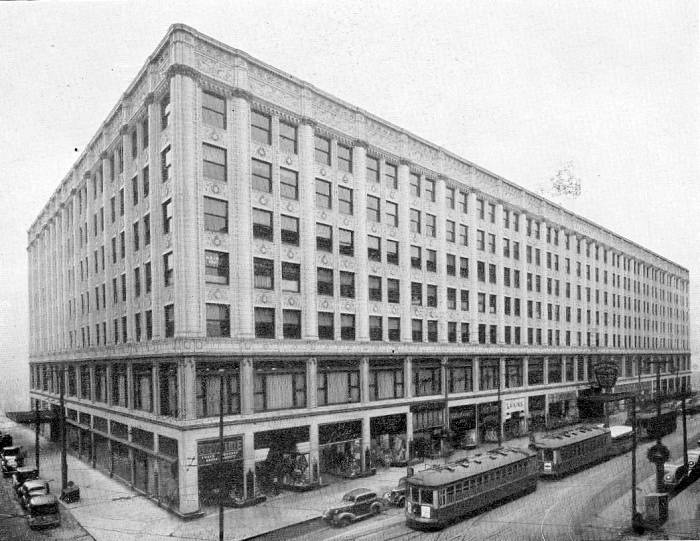
The plan does not envision returning streetcars to Wisconsin Avenue. The photo shows the Plankinton Building, which was an enclosed mall (in those days a "shopping arcade") long before that became The Rage in Downtown Redevelopment.


EXPECT THE RED BARON. That's a piece of advice I heard on some television documentary about the Battle of Britain. It was given to British fighter pilots as part of their preparation. Put simply, it means "Your opponent is not a patsy." The grade for failing the lesson is death.

In chess, a move that has among the ensuing variations a refutation must be annotated ?!, and if the player who makes the move goes on to win, somewhere the opponent has made a move that rates at least a ?

In game theory, the advice to expect the Red Baron is one way to motivate the concept of subgame perfection (each player picks the best available response at each decision node, whether that node is on the equilibrium path of play or not.)

Although the advice sounds logical, it's not necessarily easily followed. Thus a weaker team defeats a stronger team.
"Our seniors had a tough game," [Northern Illinois] head coach Carol Owens said. "We just didn't show up to play. There's no explanation for it. We played down to the level of our opponent and that's not acceptable."
Expect the Red Baron. Vince Lombardi struggled with the way to get the message out. Here he is (from Instant Replay) getting the Packers ready to play an expansion team in late September 1967.
"I've never had to talk to a team like this. I never had to holler at them before a game. They were always ready. But you people aren't ready. You've got a lackadaisical attitude. You're just gonna go out there tomorrow and get the hell kicked out of you. I tell you, it's going to be a hell of a game. Those Falcons aren't going to lie down for you."
Author Jerry Kramer summed up the game.
Everybody seemed to feel it was one of those situations where you have to show up, you have to play, and you have to win. If you lose, you look like a dummy. We showed up, we played, and we won, 23-0, but it was a real mediocre effort.
There is a corollary to Expect the Red Baron that professors and teachers neglect at their peril. Never describe a concept as "easy." That's the quickest way to lose students, simply because the characterization will lead some people not to bother with the subtleties, while others, upon confronting the subtleties, will interpret their frustration as evidence of their own lack of ability. Sure, some concepts are easier than others, but the prudent course is to introduce each one as if it were the Principle of Comparative Advantage or the General Theory of Relativity.