21.12.06

LIVING AT THE EXPENSE OF OTHERS? The Southeast Wisconsin Regional Transit Authority is considering a special sales tax to pay for the commuter trains.

The rail line, meanwhile, has attracted relatively little controversy to date, but that could change once new taxes are on the table, [authority chairman Karl] Ostby conceded.

"I think everybody loves things until they have to pay for them," Ostby said.

By comparison, the five-county sales tax levied to pay for building Miller Park is 0.1% - twice the rate under consideration for commuter trains alone, or one-fifth of the combined bus and train tax. The stadium tax drew bitter opposition when the Legislature imposed it in 1995.

Sales taxes are among the most common ways of funding new commuter rail lines nationwide and transit systems in metropolitan areas about the same size as Milwaukee, the Southeastern Wisconsin Regional Planning Commission staff has told the authority.

Editorial writers at the Milwaukee Journal-Sentinel approve of the sales tax (which is the way Chicago's Metra receives funding.)

Milwaukee is one of the largest transit systems in the nation that relies on the property tax; most transit systems rely on sales taxes. The result: a steady deterioration of the system.

So the RTA proposed that the three-county authority consider asking for legislative authority to levy a 0.05% sales tax to cover the local share of building and operating the rail line. The authority would also consider asking the state to give each of the three counties the option of levying up to 0.45% more in sales taxes to replace property tax support for their buses.

They'd like to go a bit further.

These are legitimate concerns. Fortunately, there are other options, including an idea that Walker likes - as do we - by Rep. Jeff Stone (R-Greendale) to earmark part of state sales tax on motor vehicles for transit purposes.

The RTA isn't wedded to its proposal, a spokesman says, but would like to hear other suggestions and not just grumbling.

Good point. The region needs commuter rail and has the continuing need to fund other transit. The property tax is overburdened. A sales tax should be on the table, but it shouldn't be there alone. Let's look at that tax on motor vehicles as well.

Pigouvian taxation? Countervailing subsidies? Discuss.
MY VISIT HAD NOTHING TO DO WITH IT. Inside Higher Ed reports on a Presidential Ouster at Quincy.

Quincy University, a Roman Catholic liberal arts institution in Illinois, has dismissed its president, who had seen the enrollment drop steadily during her term.

The total head count at Quincy slipped to 1,250 this fall from more than 1,350 a year ago. Over the past two years, freshman enrollment has gone down by about 30 percent. Tuition is $18,450, but with a full-time undergraduate population of only 863 students, almost all of whom receive some financial aid, drops in enrollment can have a major impact on the college.

It's rather difficult for a religious college to exile its president to a convent. On the other hand, Sister Margaret M. Feldner might have something in common with Larry Summers.
The Quincy Herald-Whig reported that faculty returned a no-confidence vote this fall for Feldner and the head of admissions, who was placed on administrative leave with pay earlier this month. Yates said he is unaware of the vote, and the Faculty Senate chair didn’t return calls for comment.
For $18K, one can buy a spot at Marquette or DePaul, where there's a shot at seeing a decent basketball team, or one can go out of state to a flagship university going after the Coastie trade. Is Quincy's admissions trouble evidence of excess capacity in the obscure parts of higher education?

Rest assured, when I go train riding, it's not as traveling hatchet man for small-college trustees.
ENERGY PRICE FORECAST? I recently received a gas bill in which the optional fixed budget payment amount I could pay was approximately the same as the payment based on usage. I also received an offer from the regulated gas distributor's affiliated gas supplier to lock in the next twelve months of payments. This offer included a $60 cash payment if I signed up. That's not a put option I'd like to sell to the gas company.
SOLSTICE. Go frolic and play, the postmodern way, walkin' 'round in women's underwear.

19.12.06

BUILD IT AND THEY WILL COME. A corridor operation generates additional passengers, rather than stealing passengers from existing trains. The Quincy Herald Whig has good news and bad news about the expanded Chicago-Quincy service.

Marc Magliari, a spokesman for Amtrak, said total ridership for both the new Carl Sandburg train and the long-established Illinois Zephyr was 14,103 passengers during November. That's up from 10,469 passengers in November 2005 when the Zephyr was the only local option.

"The good news is that the Carl Sandburg appears not to be taking passengers away from the Illinois Zephyr, which I presume means we're attracting more passengers," Magiliari said.

David Johnson, assistant director of the National Association of Railroad Passengers, agreed that the new trains do not seem to be draining many riders from the existing routes.

"Imagine that. You add routes and give people convenient times and you get more riders," Johnson said.

Amtrak officials are excited about the 34.7 percent increase in passengers between Quincy and Chicago. They've got even more good news along other routes that got new trains — all debuting on Oct. 30. During the first month there were 61 percent more passengers along the Chicago-to-Carbondale corridor and 49 percent more riders between Chicago and St. Louis.

"All the new Illinois trains are off to strong starts," Magliari said.

The bad news is that freight train interference is still a problem.
Although ridership numbers were good, Amtrak had a disappointing 53 percent on-time performance in November. Some of the late arrivals during the month were caused by railway congestion. A single track is available over most of the corridor between Quincy and Galesburg.
That single track line once hosted the Kansas City Zephyr and American Royal Zephyr as well as Burlington's Kansas City - Chicago freight business, presumably that mostly uses the more direct former Santa Fe line.

Contemporary timings are not bad for a single-track line without the safety appliances required for speeds in excess of 79 mph. For example, the evening departure from Quincy is carded at 48 minutes over the 56 miles to Macomb: 70 mph. Macomb to Galesburg is 40 miles in 38 minutes and Galesburg to Kewanee 31 miles in 28 minutes.

As a present for finishing the grades, I decided to explore this route, which is new territory for me beyond Galesburg. It's easier to drive to Mendota to catch this train rather than ride a suburban train into Chicago. The morning train leaves Chicago at 8.00, covering the 83 miles to Mendota in 85 minutes inclusive of two stops. I left DeKalb just after 8.00 and intercepted the morning Illinois Zephyr, running a few minutes late, at Mendota.


Mendota is one step up from what the British would call a "halt" in that there is an enclosed, heated station building with washrooms that is open at train time, as well as when the town's railroad museum is open. There is neither a station agent nor a ticket machine.
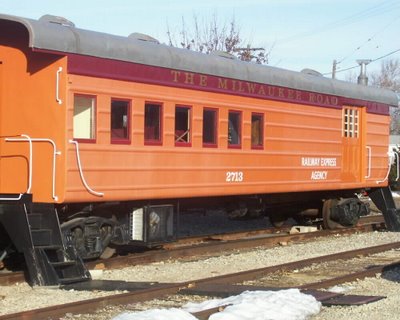

The Milwaukee branch-line combine is not out of place in Mendota. It's part of the museum collection, parked on former Illinois Central trackage used by Milwaukee across the Burlington. The Illinois Central's original Centralia - Freeport line and Milwaukee's Rockford - Rochelle - Ladd line were all lifted in the early 1980s.
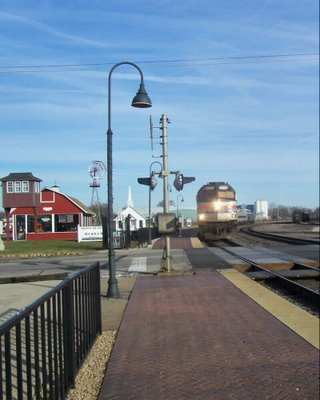

In time the westbound Carl Sandburg showed up, with a cabbage car in the lead. Time for a second cup of coffee, another book review, and an approximately on-time arrival at Quincy. The Quincy station is another of Amtrak's new-style stations located on the edge of town. Quincy is not that large a city, although it is on some hills, and I estimate my total walking to the riverfront downtown and back to the station as five or six miles. The legs are still objecting.

Quincy is home to a Franciscan college now known as Quincy University (with masters' programs in business and education) housed in a few buildings on the northeast side of town, with a baseball and football field along the way to the station.
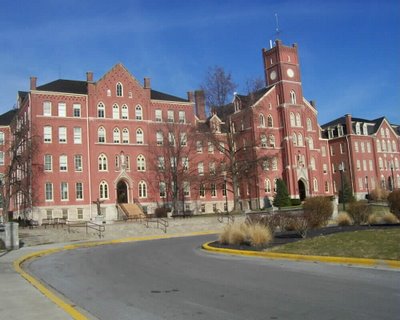

The related St. Francis Solano school building has the kind of motto that would provoke questions that got my fourteenth great-grandfather tossed out of the Anglican Church.


GOD'S WILL. THE END OF MAN
Repunctuate. Discuss.
"That's enough out of you, Mr Brewster."

There's also this rather imposing St. Francis Church, in the German style, complete with a clock that chimes the quarters in the German fashion.


(There's another chiming clock on the university building that chimes quarters in the Westminster fashion. The two clocks are not synchronized. The German clock goes first.)

I also found a neat-looking boat club, but the photo-upload isn't working at the moment.
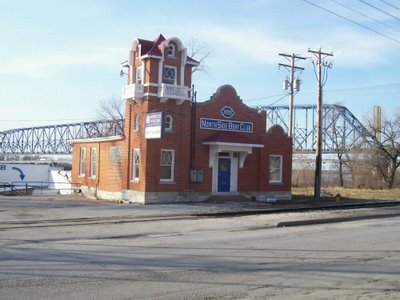

But on Thursday night, the upload took. Enjoy.

Then it was time to walk back to the station and head home. The train didn't get into the station until 5.32 (the layover tracks are somewhere in West Quincy, Missouri, and at one time this train was called the "Quincy Local" and its station was in West Quincy.)

Amtrak 382 Carl Sandburg, Quincy-Mendota, December 18, 2006: Genesis diesel 128, Horizon coaches 54441 - 51000 - 54561, Amfleet dinette-business class car 48165, cabbage car 90222. Temperature approximately 32o (F), dry rail.

Leave Quincy 5:36:55, Macomb 6:30:13-6:33:13, Galesburg 7:10:34-7:12:20, Kewanee (a halt) 7:39:26-7:40:41, Princeton 8:03:34-8:04:17, Mendota 8.24, seventeen minutes late.
STOP THE WORLD, I WANT TO GET OFF. My purchase of The I Hate Corporate America Reader, which I reviewed here, came bundled with The I Hate the 21st Century Reader, which gets a somewhat shorter and somewhat crankier Book Review No. 45. I'll let one quotation from an essay that begins on p. 335 speak for the entire book.
The invention of agriculture is itself a runaway train, leading to vastly expanded populations because of two inevitable (or nearly inevitable) consequences. The first is biological: the population grows until it hits the bounds of the food supply. The second is social: all civilizations become hierarchical; the upward concentration of wealth ensures that there can never be enough to go around. The economist Thomas Malthus explored the first dilemma, and thinkers from Christ to Marx have touched on the second.
As with the companion volume, this reader ought best be viewed as a statement of faith for people who might have argued themselves into or who are disposed to accept the argument that we'd all live well but for a few greedy people who seek everything for themselves. Life-extending research is a bad idea, not because it's contrary to Gaia's plans but because rich sesquicentenarians will buy up all the life-prolonging technologies and the researchers should be providing cheaper HIV treatments to the Third World, even though antibiotics induce selection for resistant bacteria. (Yes, that sounds incoherent, but read the book, especially the Grimmer Harper's Index stuff between essays.) The book also illustrates the hazards of making economic forecasts. It reprints the usually sensible James Fallows envisioning a future near-Depression in which the Dow closed at its all-time high of 11,090 just after the first Bush administration tax cut bill became law.

Although the book is long on complaint, it is short on suggested improvements or course changes.
SOMEBODY WILL TAKE THIS IDEA SERIOUSLY. Despite the Swiftian title, I can see some enrollment manager viewing Edward F. Palm's Inside Higher Ed article as a Great Suggestion.

Colleges and universities were bursting at the seams with more students than they could handle, and the sky seemed to be the limit for the expansion of programs and the hiring of new faculty members. What did we have going for us then in the American academy that we don’t have now? We had a Selective Service System — a draft — that until 1971 featured a calculated system of deferments for college and graduate school.

We need to restore that system today — the most significant refinement being that, in keeping with today’s more enlightened sensibility, today’s draft would extend to young women as well as men. The advantages would be obvious and undeniable.

The Department of Defense would have more than enough fresh troops with which to “stay the course.” This should satisfy the critics on the right and the left who would use the current exhaustion of the all-volunteer military as an excuse to “cut and run.” The number of college deferments would remain relatively low compared to the number of young people available, especially if we made deferment contingent upon maintaining a passing grade-point average. We could even make deferment contingent on enrolling in programs that lend themselves to the kinds of assessment approved of by the Spellings commission — if those classics and philosophy departments want to hold on to their students, they’ll come around to believe everything can be measured in tests or your post-graduation income.

Patriotic appeals and current threat levels notwithstanding, the prospect of being drawn into a shooting war in Iraq or Afghanistan, or even Iran, will continue to appeal to a limited spectrum of American youth. Matriculation and retention rates in American colleges and universities, then, are likely to soar, thereby alleviating one concern of the Secretary of Education and her Commission. We are also likely to see a war dividend in terms of increased accountability, as students and faculty alike face a clear and present incentive to assess and document student learning.

There must exist some member of the intelligentsia who will take up this proposal as holy writ.
THE TIMES THEY ARE A-CHANGIN'. Look back at forty years of campus rioting. University Diaries links to Northampton Republican (yeah, right) coverage of a riot that broke out at the University of Massachusetts (now ZooMass; my dad left the engineering faculty there at the end of the 1955-1956 academic year for heavy industry.) The cause of the riot: ZooMass lost their bowl game to Appalachian State. "NCAA Division I title game" is kind of underwhelming: why not call it the "Amateur Bowl" or the "Not Ready for the Mid-American Bowl"?

What's instructive is that campus officials are describing this riot as bad.

Eleven people, including 10 UMass-Amherst students, were arrested. Their arraignments were scheduled for yesterday and today in Eastern Hampshire District Court in Hadley, with charges including disorderly conduct, resisting arrest, assault and battery with a dangerous weapon, failure to disperse in a riot, minor in possession of alcohol, possession of marijuana, breaking and entering, mistreatment of a police horse or dog and destruction of property.

About 60 campus, town and state police officers in riot gear were needed to squelch the riot that drew more than 1,800 students to the plaza of the Southwest residential area. Students threw bottles, cans, bricks, pieces of concrete and other items at the officers and yelled obscenities.

So much for generational morphology. This riot reminds me of a brawl that erupted at Massachusetts when the New York Mets defeated the Boston Red Sox in the World Series. That brawl probably strengthened the hands of diversity hustlers at Zoo Mass as Mets and Sox fans differed along racial as well as geographic lines. Millennial crudity, just more of the same Thirteenth Generation crudity. But back up another 20 years: possession of marijuana was a political act, breaking and entering was expropriation of the capitalists, and mistreatment of police animals a display of courage. Maybe in another 40 years the football yobs will have a Feinberg Family Distinguished Lecture celebrating their efforts and there will be a special reference collection in the library.
DEAN AHMEDWORMERJAD? Via Best of the Web, citing a Guardian article about Iranian students protesting their fuhrer's visit.
"Witnesses say Mr Ahmadinejad also tried to ridicule the students by referring to the university disciplinary code, under which those with three penalty points are suspended from studies. 'He joked that he was going to issue a presidential order for those with three stars to be enlisted as sergeants in the army. That made the students really angry,' said Mr Zamanian."
"And I have advised all of your draft boards that you are immediately eligible for military service."

But don't you have to put the students on double-secret probation first?

Do view the Guardian article, the photograph of Dean Ahmadwormerjad's supporters is instructive.
OUCH. College bowl season is underway, with Texas Christian besting Northern Illinois in the Poinsettia Bowl, 37-7. (This prognosticator came close with the final score, and got the total points right.) Northern Illinois special teams set a new team record, with three blocked kicks, one a punt block for a touchdown. Team members did have sightseeing opportunities. Three weeks to go and already the ennui sets in.

18.12.06

WHILE OTHERS FRET ABOUT PRACTICE PLAYERS. Final exams are behind us, graduation ceremonies are committed to pixels, and the Lady Huskies have quietly extended their winning streak to five, at the same time ending Bradley's home winning streak.
RESOURCE WARS IN THE LAKE DISTRICT. The ridge dividing the Lake Michigan watershed from the Fox River basin, connected to the Mississippi River, is in some places within sight of Lake Michigan. By international treaty, water taken out of Lake Michigan must be returned to Lake Michigan. That treaty requires water-hungry suburbs of Milwaukee and Chicago to return any Lake Michigan water to Lake Michigan.

The Lake Beulah water management district has recently passed a law inspired by that treaty, to prevent the rapidly-growing Municipality of East Troy from tapping an aquifer that might feed Lake Beulah.
The new ordinance also says that water pumped out of the basin, above or below ground, must be returned to the basin, a directive that reflects a hotly debated issue in Waukesha's attempt to divert water from Lake Michigan.
At the moment, the disputes and debates are in public hearings and in courts. The Winchesters have not yet been broken out.
THE HOUSE IS ON FIRE. LET'S REDECORATE THE SUN-ROOM. The National Collegiate Athletic Association faces Congressional challenges to its not-for-profit, tax-exempt status, and bowl guarantees no longer suffice to cover the incremental costs of delivering the team, to say nothing of the band and the sugar-daddies. Sounds like an excellent time to deal with an existential threat to college athletics: male practice players for womens' basketball teams. The topic has crowded out almost all other coverage at Women's Hoops. Now Phi Beta Cons have picked up the story (via SCSU Scholars.) Washington Post columnist Sally Jenkins is not impressed with the efforts.
Anyone who thinks [the guys are] automatically superior ought to go to a practice at U-Conn. or Tennessee and watch the women beat the snot out of the male scrubs in a scrimmage. Last year, Connecticut's Ann Strother gave one a busted nose.
She's also less than pleased with the folks pushing the reforms.
This brings us to the second reason why the committee's position is not funny: It reveals the broken workings of the NCAA. This is a perfectly lucid window into who runs the organization: deputy administrators from smaller schools, with a tendency toward chronic and wrongheaded attempts to legislate parity. My bet is some folks on the committee are just paranoid that male practice players might give someone an edge.
Per corollary to Munger's First Law of Time Allocation, the best way to prevent others from working on their edge is to tie them up in more meetings.

Hurry up, sailing season. (I have been schooled by collegiate sailors of both sexes, and one-design dinghies are not gender-biased.)
WHAT TEAM WILL SHOW UP THURSDAY? The Packers have not done too well in Green Bay this year, but the Detroit Lions have not done well anywhere. Result: a win for the Packers, despite Detroit attempting a quarterback sneak in a long-yardage situation. (Why not? Years ago, a Detroit quarterback turned a sneak in an obvious sneak situation into a long gain, part of a 40-0 Lions win.)

Thursday? Yes, the Packers will be hosting Minnesota on Thursday. Thursday night football is not any better an idea for the professionals than it is for the universities. Repeat after me: Friday is for the high schools, Saturday is for the universities, Sunday is for the professionals, and Monday is for the water-cooler league.

17.12.06

ON MY WORKBENCH. The early December snows might all have melted, but it is modelling season. First up, two budget projects I've been working on. The outside-braced automobile boxcar might be scratchbuilt. I paid $25 for it at a nearby hobby store a few years ago.


This tank car is brass. I don't know the manufacturer's particulars yet.


It's smaller than the tortoise-shell 20,000 gallon Jones and Laughlin car (which I have in kit form) but looks enough like one that I've assigned it to coal-tar service at Midvale Steel.
A PUBLIC SERVICE ANNOUNCEMENT. From EclectEcon, who got the word from somebody at CBS.

I wanted to give you a heads-up on a story that will be running this Sunday, Dec. 17 (7PM ET/PT on CBS) on "60 MINUTES" about a long-secret German archive that houses a treasure trove of information on 17.5 million victims of the Holocaust. The archive, located in the German town of Bad Arolsen , is massive (there are 16 miles of shelving containing 50 million pages of documents) and until recently, was off-limits to the public.

But after the German government agreed earlier this year to open the archives, CBS News' Scott Pelley traveled there with three Jewish survivors who were able to see their own Holocaust records. It's an incredibly moving piece, all the more poignant in the wake of this week's meeting of Holocaust deniers in Iran.

CONTEMPLATING ILLEGAL IMMIGRATION. Here's another catch-up post, now that grades are in and Ph.D.s have been hooded. (Or is it a jump-start post for another research paper, now that there's a month of thinking time.)

I'll start, however, with recent empirical evidence that illegal immigration provides a cheap labor subsidy.

When hordes of police and immigration officials stormed meatpacking plants in six states this week, the illegal workers arrested may not have been the only victims.

Consumers and the industry itself may be feeling the repercussions in a shortage of meatpackers, higher wage costs and, ultimately, higher prices for the beef that lands on America's tables at home and in restaurants.

I'm not sure what this crackdown says about the model immigration policy makers are using. In my theoretical research, "probabilistic amnesty" refers to illegal immigrants devoting their entire working lives to work in the rich country's underground economy. I suppose the model could refer to periodic and unpredictable raids of employers hiring in that underground economy. In that case, the following paragraphs from the news report make sense.

Some analysts see the current emphasis on enforcement in the meatpacking industry as the precursor to getting an immigration bill through Congress - by demonstrating the government's capability to enforce laws at the work site.

"The meatpacking industry has become dependent on an unauthorized labor force, and it is not good government to destroy an entire industry. In some way, there is going to be a meeting of the minds," said Mark Reed, a former immigration regional director who now runs his own consulting business, Border Management Strategies, in Tucson, Ariz.

We're looking at precisely my modeling efforts. (.pdf) Employer sanctions lower the subjective probability of an amnesty, which reduces the flow of illegal immigration for rich-country welfare benefits. At the same time, the cheap labor subsidy in relatively unpleasant jobs (anybody else remember when beef boning was a skilled trade?) becomes one of the benefits the U.S. government has to consider in defining its immigration policy. But, contrary to what editorial writers at USA Today assert, the policy is a success.

Those who favor a rigid approach argue that the traditional immigration-reform bargain — amnesty for those already here coupled with rigorous enforcement forevermore — has proved to be a lie. And so it has. In 1986, for example, a congressional compromise gave amnesty to 2.7 million illegal immigrants and set up a new enforcement scheme. Today's illegal immigrants are eloquent evidence of its failure.

The reason it failed, however, was not the amnesty. It was Congress' unwillingness to create and fund a viable enforcement system.

No, Congress has to balance the potential burdens on social services against the cheap labor subsidies and the admission of entrepreneurial people who might not possess the verifiable credentials of a university graduate. Representative Mike Pence, offering the counterpoint at USA Today, still has that to learn.
Some argue that putting border security first and asking millions of illegal immigrants to leave the country is unrealistic. I submit that it is unrealistic to assume that another round of amnesty will not result in another wave of illegal immigration in the years ahead. We must address illegal immigration, but we must do so in a way that reasserts the principle that the only way to enter the United States is under the law.
Is it cheaper to build the fence (using the underground economy?) or to revise the laws? The existence of a rich country with both ample opportunities for entrepreneurial people and generous social services is in itself temptation to residents in countries less rich.

That's not to deny the existence of serious tradeoffs in any change in immigration policy, as the concluding paragraph of Heather Mac Donald's "Seeing Today's Immigrants Straight" in City Journal notes.
Many of the costs imposed by Mexican immigrants are a function of their lack of education, their low incomes, and their own and their children’s behavior, not their legal status. Without question, we must balance those costs against the immigrant generation’s admirable work ethic. But immigration reform that institutionalizes the present immigration mix—or, worse, increases its volume by three to five times—is certain to expand the Hispanic underclass. There are many educated foreigners patiently waiting for permission to migrate to the United States. The United States can better honor its immigrant heritage by accelerating their entry rather than by continuing to favor the most low-skilled of our neighboring populations.
Her essay favors a tougher stance on border enforcement; she might also be making the case for instilling the Habits of Highly Effective People, rather than Gang Nation, in immigrant children. The tough part, however, is that nowhere else in the world does a rich country have so long a border with a country relatively much poorer. (There are gradations of poverty as one proceeds from the European Union countries east into Siberia, southeast into the Middle East, and across the Mediterranean Sea.)

Also in City Journal, Steven Malanga suggests that the cheap labor subsidy is relatively small.
America does not have a vast labor shortage that requires waves of low-wage immigrants to alleviate; in fact, unemployment among unskilled workers is high—about 30 percent. Moreover, many of the unskilled, uneducated workers now journeying here labor, like Velasquez, in shrinking industries, where they force out native workers, and many others work in industries where the availability of cheap workers has led businesses to suspend investment in new technologies that would make them less labor-intensive.
That induced-innovation hypothesis is a topic of research in progress. Stick around.
FOURTH TURNING ALERT. Bill Quick.
In order to win a war, you first have to have the will and intention to wage a war. Nobody, [Victor Davis] Hanson included, has demonstrated anything like the will needed to defeat our Islamist enemies. Instead, to a lesser or greater degree, none of these people - from the Hansons to the Bushes - are talking about actually waging a war.
And what has been going on offers depressing confirmation of Candidate Bush's doubts, in the October 2000 presidential debates, about the usefulness of U.S. involvement in nation-building, or of the utility of using the military for that job.
JUST TELL THE STORY. The first rule of military writing ought to be, wherever possible, to let the action reports do the talking, and the second rule, if there is call for a second rule, is to keep the prose spare. In Bitter Ocean, author David Fairbank White disregards these rules in such a way as to render Book Review No. 44 not particularly favorable. The book tackles, in approximately 300 pages, the Battle of the Atlantic. The topic is one that easily requires two volumes, Hitler's U-Boat War: The Hunters, 1939-1942, Hitler's U-Boat War: The Hunted, 1942-1945, to describe in some depth. There is also a book-length treatment of the turning point of the battle in Black May : The Epic Story of the Allies' Defeat of the German U-Boats in May 1943. The narrative in Bitter Ocean will be of necessity less detailed, but I wish the author had toned down the elegant variation or hired a Scathing Online Schoolmarm to do some editing. Consider this passage from page 102.
Night had fallen. The black shroud of evening had slipped over the ships and as dark had settled, they had plodded along like a caravan of camels, one shuffling beast following the one before it. Now they lumbered along, hulking giants, hooded in the night, rolling slowly east.
Plodding, shuffling, lumbering, rolling: we're not in the sixth grade writing picturesque sentences for Miss Weidemann. Convoy SC-26 is about to get clobbered. What happens to the submariners, sailors, and merchant mariners, and what the survivors recall, is more important than the fog of elegant variation.

It's no less painful when Convoy SC-100 gets clobbered, at page 171.
Elsewhere, eight other ships not with the main body of the convoy were scattered like hay, blown across a vast area of the sea. Some ships were out ahead, far in front of SC 100; some were behind, straggling, dispersed by the three day blow to a flurry of points on the field.
A submarine attack and a North Atlantic storm foul up the station keeping and there are going to be plenty of stragglers for the follow-on submarines. Let the participants tell the story. It requires no embellishment.

Several times, for reasons not always evident, the author sees fit to mention a sunken ship's radio call signal being permanently silenced. But (see p. 106) in the Battle of the Atlantic, it was not OSCAR NOVEMBER JULIET ALPHA, it was OBOE NAN JIG ABLE. Do the research.

The trials of the crew of San Demetrio in an early convoy qualify as a classic sea story, as in "no s***, this really happened," without need for embellishment, and German submarine ace Otto Kretschmer carried out his responsibilities as a prisoner of war to attempt escape almost as well as he carried out his duties as submariner. He also served ably in the German Navy in NATO, retiring as an admiral.

Mr White suggests that the convoy escorts, which he refers to as corvettes, have been neglected in the construction of World War II monuments. Perhaps the confusing nomenclature for escort ships, including destroyer escorts and frigates (not here referring to a ship of war with three masts) impedes the effort to get such a memorial together.

In the absence of a formal monument, consider renting The Enemy Below or watching for its rebroadcast on one of the cable channels. The plot, a destroyer escort (U.S. Navy terminology) tangling with a U-boat, is true to several of the battle reports noted in Bitter Ocean and the other sources I've referenced. The Battle of the Atlantic was about submarines and escorts, particularly after Germany converted its capital ships into floating forts.

16.12.06

HAPPY BEETHOVEN'S BIRTHDAY. Milt Rosenberg recommends the Op. 16 Quintet in E-flat.
MOVING ON UP. Badgers knock off No. 2 Panthers.

In beating second-ranked Pittsburgh, 89-75, in front of a raucous crowd of 17,190 at the Kohl Center, the Badgers proved that they can not only play with the best teams in the nation but also beat them handily.

The three-headed monster of seniors Alando Tucker and Kammron Taylor and junior Brian Butch did the heavy lifting as seventh-ranked Wisconsin improved to 11-1. It was Wisconsin's highest victory over a ranked opponent since it beat No. 2 Minnesota, 66-65, March, 8, 1997.

That March 8 win came under very different circumstances, as the tournament pairings were settled by then.
CONTEMPLATING METHOD. At Blogs for Industry, a useful clinic on the use and abuse of "moral relativism" as a category.
The truth or falsity of moral judgments, or their justification, is not absolute or universal, but is relative to the traditions, convictions, or practices of a group of persons.
That stance is useful for the observer who wishes to understand why people do the things they do: note that it does not validate, let alone excuse, those practices.
CHEAP LABOR SUBSIDIES ... HERE??? Border Fence Firm Snared for Hiring Illegal Workers.
A fence-building company in Southern California agrees to pay nearly $5 million in fines for hiring illegal immigrants. Two executives from the company may also serve jail time. The Golden State Fence Company's work includes some of the border fence between San Diego and Mexico.
Via Marginal Revolution.

The article goes on to note,
It is exceptionally rare for those who employ illegal immigrants to face any kind of criminal prosecution, let alone jail time. Earlier this week, for example, immigration raids on six meat-packing plants netted almost 1,300 suspected illegal workers. But no charges were leveled against the company that runs the plants: Swift.
More on that story tomorrow.
THE JOYS OF SERIES. Years ago, strings of Christmas tree lights came wired in series, with house current powering a string of usually twenty low-voltage bulbs, each of which received 1/20 of the voltage and thereby burned cool enough so as to not set the tree on fire. Although the lights were a tremendous improvement over candles, when one bulb failed, that would disrupt current through the entire string and one faced the ritual of replacing bulbs one-by-one until the string again worked. If more than one bulb was bad, the frustration could be great. (The simplest fix would be to have a battery handy and some short pieces of wire to test each bulb. Those that lit could be returned to the string.)

After the Second World War, scaled-down, cooler-burning bulbs that could be wired in parallel became available. These strings pose a bit of a shock hazard as the full voltage is delivered to each socket, but when one bulb failed, it could easily be identified and replaced. At your store, these are the No. 7 colored bulbs.

The miniature lights that became available in the early 1970s were again wired in series, but with a circuit in each socket to shunt power around a bulb that failed, which would enable the owner to identify and replace a failed bulb. (I suspect that if too many bulbs failed at once, the shunts would not be able to protect the remaining bulbs from being fried by the higher voltage.)

To make maintenance easier, there is a gadget that enables the owner to work around a fried shunt. Voluntary Xchange marvels over this gadget.

There are other options. The small tree at the center of my train display has a string of 20 light emitting diodes powered by four batteries. There appear to be two circuits each of 10 diodes, wired in parallel. Service life of the diodes, 15,000 hours.

14.12.06

WHERE THE STREETCAR BENDS THE CORNER AROUND. In a recent European Tribune post, DoDo shows readers around the tram network of Budapest. The article opens with a picture of a new high-capacity six-section Siemens unit the locals call "giant caterpillar."


The unit is demonstrating the behavior I refer to in the post title. In Milwaukee, the expression, which may be an adaptation of a German phrase, originated in a radio comedy act. It could refer simply to the act of a streetcar going around a corner, although Milwaukee did have streetcars capable of bending the corner around.

This site, titled guess what? illustrates one such unit. Milwaukee Electric took a large fleet of turn-of-the-twentieth century streetcars and rebuilt them -- at their Cold Spring Shops -- into three-truck articulated cars, doubling the productivity of a two-man crew.


Robert Genack photograph
West Allis Station, 8 January 1932.

By the Depression, more productive cars would be hauling more empty seats around and using more electricity. These units were placed in storage and subsequently scrapped.

Milwaukee Electric also bought some duplex streetcars new from St. Louis Car. These were originally intended for the South Milwaukee suburban service (a very long tram route from downtown Milwaukee via Kinnickinnic Avenue and Packard Avenue practically to the Racine County line) but they did most of their work during the war. Afterwards they were reconfigured for rapid transit service to Waukesha and Hales Corners.


Budapest also operates trackless trolleys (known elsewhere as "trolley coaches" and colloquially in Milwaukee as "trolley buses.") There is some discussion of them here, and regular readers are familiar with the St. Petersburg Tram Collection's trolley bus models.


Budapest, however, still has its streetcars and trolleybuses. The best I can offer for Milwaukee, apart from the well-known collections at East Troy and Union, are some old work of mine using a railroad-network simulation called Bahn. The program is shareware and free downloads will time out once the grace period expires. But an owner can look at other peoples' networks or build his or her own. The Milwaukee network, based on the fall 1929 timetable, is available as a free download here. (Download the Bahn program first, unzip it, then save the network files to the Bahn network subdirectory.)

(Cross-posted at European Tribune.)

THE GRANDMASTER DOES NOT SEE BAD MOVES. Malcom Gladwell generalizes that (not always true) observation about abilities to spot what looks right or what looks wrong in a situation very quickly in Blink: The Power of Thinking Without Thinking. For Book Review No. 43 I suggest that the subtitle misleads. The book argues that we are capable of sizing up a situation and reaching the correct conclusion with relatively little information, and that it is possible to overanalyze and get things wrong. In chess, that's called "developing sight of the board," and the frustration of overanalyzing is summed up in the Law of the Too Solid Goof and its corollaries. But that ability, which Mr Gladwell characterizes as "thin-slicing", is something that must be encouraged and cultivated. We're all capable of it, but we require practice at developing it, at observing slices that look right so as to be able to conclude that a slice doesn't look right.

There are cautionary tales for the reader to consider, including the risk of making the wrong thin slices (try classifying something as either "male" or "domestic" as in one famous psychology experiment) or of inferring that because someone looks presidential, he ought to be presidential (Warren G. Harding, meet Barack H. Obama?) or of assuming that disrupting an enemy's command-and-control infrastructure means the enemy can't fight back. (You mean Pentagon planners suffer from "victory disease?" I thought they'd learned from the rigged Japanese war games preceding Operation MI.) No spoilers to follow: check the book out from your library. I got through it in about two hours.
NOT QUITE A FISKING. At Economist's View, an extended response to an essay titled "The Autistic Economist." It's not quite a fisking as the concluding paragraph qualifies for the Quote of the Day.
Please don't confuse being annoyed with the way the message is delivered with a refusal to consider alternative viewpoints. I'm more than willing to listen, but it would be easier if the criticism showed more comprehension of our models and methods and how they've evolved through time, and a little more respect for those who do their very best to approach economic problems in the most scientific way possible. Their intent is to add to our knowledge, not push an agenda. I'll leave it at that for now.
NO __________ NEED APPLY? At Inside Higher Ed, news of a spat in the American Economic Association.
When professors at the University of Vermont sent information about a job opening to the American Economic Association this fall about a tenure-track opening, they didn’t think their notice was unusual. After describing the position, the notice said that the university “welcomes applications from women and underrepresented ethnic, racial and cultural groups and from people with disabilities.”
That final sentence is standard affirmative-action boilerplate, although good luck claiming "bowling-shirt factory rat" or "non-quiche-eating Real Guy" deserve protected status as an "underrepresented cultural group" in the academy.

It's also contrary to the American Economic Association's policies on job announcements.
Those words never made it into the economics group’s job notice list because they were deemed discriminatory by the association. That view has angered enough economists that the association’s board will be meeting next month to consider changing its policies on job listings, but for now economists are trading charges of discrimination, censorship and insensitivity.
And quite the spat has broken out.

The International Association for Feminist Economics has written to the AEA questioning the group’s policy and saying that it has the potential to hurt recruiting efforts. “Economics has been described as a discipline with a particularly hostile climate for women and members of underrepresented ethnic minorities,” the letter said. ” We urge the AEA to do everything it can to dispel this image.”

Adding to the controversy is anger among some non-traditional economists who believe the association is squeezing them out of its annual meeting. The AEA meeting had in recent years featured more sessions from various groups of economists with specialties and areas of interest than from the AEA as a whole, and the larger association has begun taking back more meeting slots. While AEA officials insist that groups are having meeting sessions eliminated based on attendance and not on politics, some left-leaning groups — particularly the Union for Radical Political Economics — charge that their ideas are being set aside. Some professors see the conference and job notice disputes pointing to larger problems with the association.

The annual conference is in Chicago. I'm going to be pretty busy with recruiting but if I see any fights breaking out in the hotel lobby, I'll report on those upon my return to active posting.

(On the lighter side, is there any interest in an economics webloggers' meetup on Thursday or Friday of the conference?)
SOME CLEAR THINKING ABOUT PRICE DISCRIMINATION. The topic of rising college tuitions came up in Professor Mankiw's class.
The student wonders whether the article's claim that college popularity rises with tuition is related to our study of Giffen goods and perversely sloped demand curves. I don't think so. The phenomenon about college popularity, to the extent it exists, does not rely on an odd combination of income and substitution effects but, instead, imperfect information. Consumers may use price to judge quality. Would you choose a surgeon that advertised having the cheapest rates in town?
That presupposes competitive models in which prices reflect marginal costs and consumers are able to infer quality from price. It's somewhat less convincing in the presence of a status system that a college can game by encouraging via a lower price more applications than it will admit, so as to look selective.

This I'll agree with.
Colleges have gotten increasingly good at price discriminating. (Recall the discussion of price discrimination in chapter 15 of my favorite economics textbook.) The list price is set high, and then many customers are offered a discount called "financial aid" based on their ability to pay. Here's the secret plan: In the future, Harvard will cost $1 billion a year, and only Bill Gates's children will pay full price. When anyone else walks through the door, the message will be "Special price, just for you."
The balance of the post and the comments are worth your time, and there are links to related posts to follow.
LEAVE IRAQ VIA TRIPOLI. American Thinker's Patrick Poole reacts to the Iraq Study Group report.

The Iraq Study Group has recommended that we engage the other powers in the region, namely Syria and Iran. Well, how about we engage the Syrians with several US Army and Marine divisions? The Baathist regime in Damascus would undoubtedly soil their trousers at such a sight. If President Bush is truly serious about taking out the dictatorships in the region, why don't we go after the only remaining Baathist regime? And the simple truth is that we wouldn't have to stay in Syria for any length of time, and there would certainly be no need to chase Bashar Assad around the Syrian countryside like we did Saddam Hussein. These Middle East dictatorships exist solely on the presence of their armies to subdue their people; once the Syrian army and air force is dispatched, let the Syrians sort their political situation out themselves. Any subsequent regime that would arise, even an Islamist one, would be severely weakened for the foreseeable future without a military.

Then we could keep rolling into Lebanon, where we have a blood debt to settle with Hezb'allah (recall the 1983 suicide bombings of the US Marine barracks and the US Embassy in Beirut). Having severed the Syrian and Iranian military hardware pipeline into Lebanon, a joint assault against Hezb'allah by the Americans from the east and the Israelis from the south could squeeze the life out of the terrorist organization, perhaps permanently. And as our troops loaded up in the port of Beirut to return home, we can pass along to Israel the Iraq Study Group's recommendation for them to engage Iran as they see fit.

Admittedly, the scenario I've just painted for Bush's Great American March to the Mediterranean Sea is laughably naïve and fraught with all kinds of logistical problems and diplomatic consequences. But the simple fact of the matter is that biggest obstacle to pulling such an operation off is the will of our leaders to do it. Not only could the American military win such an operation, but they would win decisively on both counts. Such a plan plays to the strengths of our military. And the eviction of the Baathist regime in Syria and placing a stranglehold on Hezb'allah in Lebanon would undeniably be in the long-term interests of the United States in the region. It is a reasonable to assume that Jordan and Turkey would not be eager to throw their lot with the Syrians, and no other power in the Middle East would be in a position to stop us if we chose to do so.

The full article offers additional cautions, demurrals, and qualifications.

I offer one quibble with this.
The only reason Americans care about a civil war is if our military gets caught in the middle of it and more Americans are killed. Once we are out of Iraq, very few Americans are going to lose sleep over a Sunni-Shi'a civil war. The hard reality is that such a civil war is in our best national interests, not unlike the Iran-Iraq War was in the 1980s. Such a conflict keeps Iran occupied and depletes their energies and resources.
It did not, however, secure the early release of the diplomats held captive in Tehran, nor did it go on without let or hindrance to oil exports by other countries in the neighborhood. The proposal also strikes me as somewhat optimistic: there's nothing to prevent terrorist organizations from going about their business in the middle of a civil war, much like burglars and muggers in urban turf contested by drug gangs.
CAN'T WIN FOR WINNING. The Missouri Tigers join other football programs that will not cover the incremental costs of playing a bowl game. But some of the burden falls on the conference.
Athletic department and football officials are right to be concerned. The lack of fans affects bowl bids in future years. I don't blame them for cutting prices. But it's easier when you're being subsidized...
Repeat with me: Amateur sport. It has nothing to do with money. Amateur sport. It has nothing to do with money.

12.12.06

PRIMEVAL GENSETS. Somebody was doing some research on Baldwin Centipedes and came across my work, including the post on early genset locomotives. That research also turned up an instructive report (.pdf) Michael Iden of Union Pacific presented to the American Society of Mechanical Engineers. There is a great deal of content on North American diesel locomotive practice. The report also includes a number of historic genset locomotives, including the Centipede, and predecessor hybrid locomotives including the North Shore's trolley-battery motor and New York Central's diesel - third rail - battery electric switchers for the West Side of Manhattan. A careful reader will also discover that the genset concept is not yet a good idea for a road locomotive.

CHECKPOINT CHEDDAR?

Remember this sermon?
Midwestern politicians cannot get their brains around the idea that graduates of Big Ten universities competing in the global economy by relocating elsewhere on the globe attest to the strength of those universities.
Charlie Sykes characterizes a proposal to keep Wisconsin's in-state students in-state as "indentured servitude." It is difficult to disagree with that characterization.
As the theory goes, a captive work force of college graduates would attract new industry to Wisconsin, along with higher-paying jobs. Those workers, in turn, would pay more income taxes and sales taxes, providing the state with the millions of dollars needed to offer free tuition.
That worked real well in East Germany, didn't it? Fence in all those engineers and stitch engineering symbols on your flag and produce the world's greatest motorcar, nicht wahr?

Owen Robinson at Boots and Sabers has more.
If the graduates are forced to stay in Wisconsin and there still aren’t enough jobs for them, what happens? We will either end up with a bunch of unemployed college graduates living at home or a bunch of underemployed college graduates working as dealers at the casinos. Meanwhile, their peers from other states will be racking up experience in their fields and leaving Wisconsin’s kids a decade behind.
I can also imagine strategies Northern Illinois could use to capture more of that State Line trade. (Wisconsin does not bear quite the same commercial relationship to Illinois that Canada does to the United States; however a large share of Wisconsin's population lives within 50 miles of the Cheddar Curtain, and there are a number of the state's universities in that border zone.)
STAY IN THE SAME MODEL. If you're going to argue that universities engage in first-degree price-discrimination to bring in more revenues, and in rationing by queue rather than by price so as to game a "selectivity" ranking, argue consistently.

Here's Richard Vedder using a Veblen effect argument to make sense of some journalists looking at college tuitions.
Jonathan Glater and Alan Finder suggest in today’s (and tomorrow's) New York Times that the tuition explosion may partly be a consequence of a snob effect in higher education: higher tuition charges are perceived to mean higher quality, and with higher quality comes greater numbers of applications. The authors give examples (e.g., Ursinus College in Pennsylvania), that seemingly fit that description.
But he goes on to note that the Veblen effect is irrelevant.

Two factors might help explain the results reported by the Times. First, massive amounts of third party payments, including institutional aid financed by the universities themselves by charging the very affluent through the nose, has reduced the sensitivity of customers to price. Usually, we think that means customers go from being highly sensitive (elastic demand) to becoming insensitive (inelastic demand), but it might even go further --customers become "snobs", wanting to buy "the best" and equating price with quality.

A second factor is that elite colleges are social networks, sort of academic country clubs, and that jobs often come from contacts developed at the university. The more expensive the school, the more elite the student body is likely to be, the more "pull" their parents have, and the greater the probability that graduates will get good jobs through university-developed social connections. Universities that jack up their sticker prices a lot can sock it to the rich legacy candidates for admission who have indifferent test scores, without overtly accepting bribes (which, however, if enough money is on the table, they will do via "development admits", as Dan Golden has so vividly shown us).

The irony in all of this is that perceptions about quality may in fact be way off. It is
interesting that the very best schools as perceived by the public -- the Princeton’s and Harvard’s --charge little or no more than the merely "pretty good" schools like, say, Notre Dame, George Washington University or the University of Southern California. They (the top schools) use a relatively low price (relative to demand conditions) to turn down a huge proportion of applicants, allowing them to cherry pick amongst the rest, taking a majority of students on merit considerations and the rest for other reasons, including their ability to increase already obscenely large endowments via tax deductible gifts.

That last sentence, however, suggests that tuitions at the top schools are inefficiently low, not "jacked up."
NOT QUITE GALLERY CARS. The Occasional Train Blogging by DoDo has resumed at the European Tribune, with among other goodies a two parter on double deck push-pull trains. The first part was inspired by the visit of a German demonstration train (in Rock Island coloration) to Hungary. It notes that the contemporary practice originated in Chicago, with a fine shot of a Commuter Streamliner at Davis Street, Evanston, after the center track had been lifted. (I wonder if restoration of that track might come with the creation of the Kenosha-Milwaukee service.) The first gallery cars were Burlington's, and theirs and the Chicago and North Western's ran behind steam. (Some of the early C&NW cars went as far as Madison or Wyeville or Ashland to strengthen the intercity trains.) The second part focuses on double-deck electric multiple units, with some interesting historical photographs.

See also the Budapest trams: I see reason to assemble some material on primeval duplex trams and trackless trolleys.
WHAT IF THE CONCLUSIONS AREN'T FAVORABLE? At Durham-in-Wonderland, some clear thinking about the genuine tradeoffs that hiring for "diversity" entail.

“Diversity” is a prized commodity on contemporary college campuses. In recent years, some institutions have used the concept to mask redefining quality away from standard measurements and toward ideological conformity—of the type that we saw from the Duke faculty last spring.

Take, for example, a program for “diversity” cluster hiring at the University of Arizona. A campus “diversity committee” proposed “recruiting not just one or even two diverse faculty members as isolated ‘targets of opportunity,’ but rather a critical mass of diverse professors who have shared intellectual interests.” “Diversity,” therefore, became little more than a mask to ensure ideological conformity among the new faculty.

The plan, part of a broader emphasis on diversity in hiring at Arizona, envisions a university in which “diversity” rather than academic quality becomes the primary motive for hiring, promotion, and tenure. According to the campus diversity plan, in faculty personnel matters, “In order to make significant progress in creating a more diverse faculty and a campus that truly embraces diversity, the advancement of diversity must be established as a primary indicator of quality.” Until diversity, the report concludes, “is included in the institutional family of primary indicators of quality, other indicators will continue to trump it – especially in the hiring of new faculty.” The U of A contends that “this does not mean lessening our commitment to excellence in research and teaching,” but such a claim is absurd: research and teaching, according to the “diversity” plan, will have to meet an ideological litmus test before being judged on their quality. Indeed, the plan argues, “Depending upon the discipline,” new faculty should be required to “conduct research and contribute to the growing body of knowledge on the importance of valuing diversity.”

Let's take that last sentence seriously. If "valuing diversity," whatever that means, makes universities that "value" diversity more productive, then administrators and hiring committees that fail to do so are leaving money on the table. On the other hand, if the research quantifies the opportunity costs (perhaps measured as lost output or reduced rates of productivity growth) of hiring for diversity rather than for teaching effectiveness or grant-getting or dissertation directing, do those negative findings invalidate the research.

The post goes on to note,

The U of A is one of three major universities (Virginia Tech and Kansas State are the others; the University of Oregon is considering the move) to implement the diversity theories of Harvard Education School researcher Cathy Trower. In a talk at Chicago summarizing her findings, Trower listed a variety of subtle developments in the academy that she contends undercut efforts at diversity, including the “single-minded devotion to professional pursuits” and excessive value placed on research. “To compound the problem,” she continued, “some members of the majority, for reasons of self-interest or self-defined notions of ‘quality,’ are reluctant to grant newcomers a toehold.” Arguing that “merit is socially constructed by the dominant coalition,” Trower has recommended requiring white male (and only white male) job candidates to demonstrate a commitment to diversity before being hired.

Trower’s proposals are extreme—but they illustrate how standard notions of quality have been displaced in the academy in recent years. Her analysis envisions a radically different type of university, one based on the promotion of a specific ideological agenda, and designed to train a generation of social activists rather than teach students knowledge from traditional academic disciplines.

Perhaps it's time for some guerrilla theater. Each spring, there's a day on which people are encouraged to wear pink triangles to show their support for the sexual underground. Per corollary, why not yellow elephants during diversity week?

And as far as that "reluctance to grant newcomers a toehold," come off it. Responsible and reliable people are too busy cleaning up after the shirkers and malingerers to spend a lot of time making life difficult for newcomers that are willing to pitch in. On the other hand, come in with a belly full of grievances and no initiative, and don't be surprised when you get lumped with the other shirkers and malingerers.
THE FRUSTRATION LEVEL RISES. Must be exam week.

At Rate Your Students, a gripe about the obligatory legal content of course outlines.
The syllabus has morphed into a document more closely resembling a contract than a source of information on the course and a part of my time and is spent checking for loopholes when I compose a new one. I'm spending a disproportional amount of energy for a small percent of students. The insult to injury is that most students don't even read their syllabus.
That's despite the poster (because these posts are anonymous, there is no way to document the claim) giving a for-credit syllabus quiz.

Arnold Kling is supposed to be thinking about income inequality, but he gets off some gripes.

I think I understand what is going on at the top of the income distribution. I see stable, affluent families acting like machines for cranking out wealthy, assortively-mating kids.

I think I understand what is going on at the bottom of the income distribution. I see very dysfunctional people having very dysfunctional kids, out of wedlock.

In between? Not so clear. What is going to happen to my writing-challenged students at George Mason? Are they headed for middle-class jobs in nursing or social work, or for something worse?

11.12.06

WE SOLICIT YOUR ASSISTANCE. A few years ago, a PBS affiliate produced a seasonal short titled "Classical Symphony" or something similar. It featured an orchestra performing Prokofiev's Classical Symphony, with cameo appearances by characters playing Sergei Prokofiev and Mikhail Gorbachev. If any readers can refresh my memory about the title and point me to a source of the program on DVD, I offer thanks in advance.
PLUG COMPATIBILITY. In my working life, I have shifted data from printed pages to punch cards to magnetic tape to 5 1/4" floppy disks to 3 1/2" semi-floppy disks, and earlier this semester I prepared one of the latter with some data for a graduate assistant whose computer didn't have a floppy drive. As I understand it, information exchange uses a memory stick, which sounds somewhere between erotic and gross. (Put your memory stick in my USB slot?!)

Now consider this year's Cold Spring Shops virtual Christmas card. Those are Lionel 252 and Lionel 253 manual reverse electric locomotives leading two different early period 603 Pullmans and an early period 604 observation car. (Lionel later used the numbers 603 and 604 on somewhat more ornate and slightly larger cars.)


The track is a 1950s vintage O-27 circle (same eight segments to a full circle) and the locomotives have series-wound universal motors that will run on battery power, juice from a dynamo hooked up to your farm's windmill, or stepped down house current, here by a Lionel Type W tap-changer transformer wired to feed 11-17 volts to the track in 1 volt steps. (The transformer also has a 17-22 setting, but that's a good way to send the trains to the floor.) The motors produce a distinctive aroma of ozone and hot 3-in-1 oil that ought to be part of everybody's Christmas.

But we were talking about plug compatibility. I could take this train to the layout of a contemporary Hi-Railer with the O-72 broad gauge track and the low-profile third rail, and it would run. For that matter, somebody could bring over the Lands' End Flyer or the O-27 Polar Express (Amazon reviews) or the Thomas, Annie, and Clarabel set and they'd respond to the Type W and stay on the track. Play value in eighty year old toys.

Some of the equipment is unusual. The orange 252 with terra-cotta frame and the orange 603 with black roof are well-documented. The 253 and the bright orange 603 and 604 appear to be Lionel repaints of green cars, using the 1930s apple green for trim (and an attempt at streamstyling?) But I have seen no documentation of these cars in the collectors' books.
QUOTE OF THE DAY. Voluntary Xchange:
One of the great things about economics is that it can quickly highlight where the clear thinking of others has stopped too soon.
Ayup.
THEY ALWAYS BLAME AMERICA FIRST. In honor of Ambassador Jeane Kirkpatrick, honorary non-quiche-eating Real Guy, go read her speech at the 1984 Republican Convention. (Via Betsy's Page.)

EAGERLY ANTICIPATED AND MALICIOUSLY INTENDED CONSEQUENCES.

Advocates of limited government, lower taxes, or deregulation face the objection that such policies, while appealing in their intent, have the effect of making it more difficult to be poor, for want of social insurance even limited in duration and scope, or of making it easier to become rich. In $ervants of Wealth: The Right's ASSAULT on Economic JUSTICE, John Ehrenberg argues that the court intellectuals behind such policy changes had the rich getting richer as a goal in itself. The book is marketed by Rowman and Littlefield as a polemic, which it is, but this Book Review No. 42 contends that, as polemic, it is more likely to argue into supporting libertarian economic policies and neoconservative foreign policies those susceptible to contrary arguments, than it is to argue people who came to be persuaded of the usefulness of such policies of their shortcomings. In making this argument, I'm alerting readers that social policy analysis from the left doesn't automatically fall into the trap of calling anyone to the right stupid: what Professor Ehrenberg fails to do is to provide those sympathetic to his position with the intellectual ammunition to take on the positions he summarizes fairly carefully.

10.12.06

WESTWARD LEADING, STILL PROCEEDING. The Canadian Pacific Holiday Train made its Gurnee call on Saturday. I overtook it on the Tri-State Tollway near Abbott Park. A few drivers appear to have been surprised to see it, but for the most part drivers were up to their usual exceed the speed limit, nobody's watching.

Behind the motive power (a single GE) four large boxcars lettered Canadian Pacific Holiday Train using the 1950s script lettering.


Most of the consist is along to provide additional braking power and to give the appearance of a real train. Passenger accommodations are in three office cars and a coach at the rear. Those reflective heralds really work.


The stage car, midtrain, appears to be a boxcar with additional doors. The entertainment: country singers, more references to Christmas than a government agency would be comfortable with, lots of opportunities to sing along to the seasonal standards.


In Gurnee, the stop was for the benefit of the Northern Illinois Food Bank. Donation boxes were available, and I did see several truckloads of in-kind contributions as well.
WHAT DO I MAKE OF THIS QUOTE? In a game with neither draft-order nor playoff implications, the Packers defeated the Seven-by-Sevens.
Packers coach Mike McCarthy was the coordinator for San Francisco's awful offense last season, but he came up with plenty of ways to embarrass former boss Mike Nolan's defense - and Favre executed nearly all of them.
Do I infer that performance tests really aren't that important for professional football coaches, in much the same way that it doesn't appear to be too important for university presidents or baseball managers? Lee Bollinger as Gene Mauch. Discuss.
REIMAGINING GENTLEMEN. Herewith another catch-up post, this one started some months ago in response to the release of Harvey Mansfield's Manliness. On one hand, Feminist Law Professors commend a lengthy Martha C. Nussbaum review generally unfavorable to the book. I leave it to readers to decide whether Professor Nussbaum's fact-checking early in the review highlights flaws in Professor Mansfield's research or rises to the standard of rivet-counting. Rather, it is to some of the Culture Wars arguments I wish to turn. On one hand, Professor Nussbaum suggests that Professor Mansfield has carefully selected his foils.
Feminism (exemplified in Mansfield's book by a few carefully selected bits of early 1970s authors) wants women to reject virtue and to seek sexual satisfaction promiscuously. In effect, it teaches women to be as "nihilistic" as men. But women are doomed to dismal failure at this task, because their manliness is puny. Meanwhile, they will lose the hold they once had on men through modesty and virtue.
On the other hand, her review suggests that perhaps, just perhaps, not all the recent changes in social norms have been for the better.
If this is right, and if we want to produce young people who have the sort of courage that these rescuers embody, then we will want to be sure that boys and girls both grow up with the capacity for concern and care, and the ability to take responsibility for the situation of others -- traits that seem to be sorely lacking in American society at present. It would have been nice to have a book on manliness that focused on this problem. Clearly ordinary people can become virtuous in the way that Aristotle recommends, and clearly neither gender has a monopoly on the virtue in question. The problem we have is that so many young people in our money- and fame-focused society do not get much experience taking care of anyone or anything, and are all too lacking in a sense of responsibility, as has been clearly shown in Dan Kindlon's Too Much of a Good Thing and other recent social scientific research on American adolescents.
Christina Hoff Sommers's review makes a similar point.
Mansfield's analysis of women's nihilism gives us the lens to understand these developments as caricatures of the feminist will to "empowerment." It is a form of manly assertiveness unmoderated by Aristotelian ideals. Here we have an example of women imitating masculinity in its lower range. It is the dark side of the "gender neutral society" in which we now live.

The women who champion Eve Ensler's production are rightly concerned about the problem of male violence. But the known solution is to teach boys (and men) to be gentlemen. "A gentleman," says Mansfield, "is a man who is gentle out of policy, not weakness; he can be depended upon not to snarl or attack a woman when he has the advantage or feels threatened." And any gentlewoman or "lady" is naturally more suited for the task of civilizing a vulgar, barbarous male than a whole army of gender warriors.
That's a Culture Wars theme of long standing, one, however, that continues to matter. Here's John Ray's PC Watch, noting that lower range in a different way (warning: accompanying illustration is neither alluring nor safe for work.)
Why would a man respect a woman who doesn't respect herself, when most of society's traditional protections for women have been torn down, often by women themselves, in the name of freedom? But freedom to flash your genitalia to the world is not liberating. It's just sad and ugly, reducing womanly allure to the level of a baboon and giving men no reason to behave well.
Ann Althouse quotes Camille Paglia, with a different take on the same behavior.
These girls are lowering themselves to the level of backstreet floozies. It angers me because I fought a bitter fight to get feminism back on track and be pro-sex at the same time. This is degrading the entire pro-sex wing of feminism.
Her riposte:
I love the way she thinks: 1. that she caused the whole trend, and 2. that she could start a trend and then keep it right in the ideal zone where it would benefit but not hurt women.
And thus the heart of the matter: what incentive do men have to act like gentlemen?
LEARNING TO WIN. The maxim in the Western Collegiate Hockey Association has long been "sweep at home, split on the road." The Badgers, attempting to make good on last year's national championship despite graduations and injuries, broke out of an early season slump at Grand Forks, winning 4-3 on Friday and 4-2 on Saturday.

SIEVE! SIEVE!

The womens' team, also with a national championship to defend, earned a road split with a Friday 2-2 tie followed by a Saturday 3-3 tie in St. Cloud.

What, no sudden victory overtime?
DOOMSDAY. Illinois might be among the states that have increased higher education appropriations, but editorialists at the Chicago Tribune note the state's continued borrowing and alert readers with Your share of the bill: $8,800.

Illinois is headed toward "financial implosion." The state owes $106 billion, about $8,800 for each resident. Unless something dramatically changes, that massive gap will continue to grow quickly, because the state chronically fails to pay what it owes.

Those are the somber conclusions released Wednesday by the Civic Committee of the Commercial Club of Chicago, which includes 80 of the most prominent business leaders in the Chicago area. The conclusions of its task force on state finance demand attention now.

The business leaders say that Illinois will need to look at an increase in personal and corporate income taxes and the state sales tax--but should do so only if the state makes drastic changes in its spending.

Gov. Rod Blagojevich's administration quarreled on Wednesday with some of the Civic Committee's numbers but not its overall message: The state has a serious structural deficit.

Yet the state's financial peril was something Blagojevich and state legislative leaders didn't really want to acknowledge during the November election campaign. Goodness knows this page tried to force them to acknowledge it, but they wouldn't.

They wanted voters to think it was morning in Illinois. It is not. It is midnight.

The state has billions of dollars in unfunded liabilities, particularly in pensions and health care. It has taken on a massive debt load.

And yet, what was all the talk during the election? How we're going to spend more money for education and health care. The money isn't there for what we're spending now. State revenues are growing about 4 percent a year, but state expenses will grow by 7.5 percent each of the next three years, the Civic Committee says.

The Commercial Club is a long-standing organization, and if you want to go beyond the boosterism on the Civic Committee's homepage, the full report is available as a .pdf.
FOLLOW THE MONEY. State governments appear to be sending more money higher education's way.
State appropriations for higher education rose almost across the board in the 2006-7 fiscal year, according to data compiled annually by the Center for the Study of Education Policy at Illinois State University.
Whether that will translate into additional sections of smaller classes or sufficient dry-erase markers in the smart classrooms remains to be seen. Phil Miller at Market Power has done additional research.
I poked around the Grapevine website and could not find any information whether the dollar figureson which the conclusions are based are nominal or real values. From what I read, I assume they are not inflation-adjusted figures.