Our historical tour of the claim that Social Security is a Ponzi scheme confirms what we already knew: Rick Perry’s remarks are uncharacteristically bold for a politician, most especially a candidate in the midst of a presidential race. Yet Perry’s Ponzi-scheme claim is in no way unprecedented. On the contrary, the Ponzi comparison has been a staple of conservative warnings about Social Security’s financial soundness for decades. More intriguing, the Ponzi scheme analogy was popularized by a liberal Nobel Laureate economist, who initially offered it as a defense of the system, acknowledging only later that his defense was at least partially flawed. In the decades that followed, many honest liberals have made the Ponzi scheme comparison in the course of calling for systemic reform. Those liberals have bemoaned bipartisan deception and timidity on the Social Security issue, and praised those rare and courageous political souls, such as Alan Simpson, who were willing and able to call a Ponzi scheme by its real name.As I type this, Ed Schultz is making the don't worry, be happy argument: the so-called trust fund is good for 25 years, and raising the cap on earnings subject to tax makes it good for 75 years. Yes, and lowering the return on investment in a Madoff hedge fund makes it good for more years too.
So the question today is not simply whether Rick Perry will be punished or rewarded for showing the honesty even many liberal commentators once pined for. The more interesting issue raised by this historical investigation may be the fate of the Democratic party and the media. Where today are the liberal and centrist Democrats who only yesterday called Social Security a Ponzi scheme and supported bold reforms? Where now are the columnists and editors at Newsweek and the New York Times willing to reward truth-tellers and to criticize reporters who cover for cowardly politicians? The fate of Rick Perry’s blunt talk may tell us more than we want to know, not only about Social Security, but also about who we are and what we have become.
12.9.11
MORE PONZI POINTS.
Another lengthy summary of other arguments, this time by National Review's Stanley Kurtz.


CRUMBLING INFRASTRUCTURE.
My roof's got a hole in it and I might drown. (Apologies to The Serendipity Singers.)
The maintenance for the leaky ceilings is on the docket, but is incurring problems with funding.Looking for those crooked nails and a crooked little bat ...
"NIU has over $400 million in deferred maintenance," said Lesley Rigg, associate dean for Research & Graduate Affairs. "This means all maintenance issues are put into a queue."
Rigg is aware of the severity of the leaking, however.
"Leaking ceilings are a serious concern for the college of liberal arts and sciences," Rigg said. "Especially on Zulauf's tenth floor."
The school's issues with government funding extend to even minor repairs. The lack of sufficient state funding means things like this are put on put on hold, Rigg said.
Rigg was unsure when their spot in the queue would be reached, but said she was sure it would be repaired eventually.
The NIU Maintenance Department did not return messages as of press time.
11.9.11
BACK TO SCHOOL.
Professor Mead offers an update of an essay he originally released a year ago. It's more efficient for readers to go there, read, and understand, but, for the intellectually lazy, here's reason not to be.
Timothy Dalrymple's advice to incoming freshmen is also worth your time, particularly before the distractions of examinations and homecoming become overwhelming.
Your competition isn’t sitting in the next library carrel. Your competition is in China and India – and your competition isn’t hanging out at frat parties or sitting around watching sitcoms with dorm-mates. It isn’t getting stoned and it isn’t putting its energy into chasing the opposite (or apposite) sex. Your competition isn’t taking lots of courses on gender studies; it isn’t majoring in ethnic studies, or (unless it is planning to go into movie making) the history of film.That "goofing off in the traditional American way" is disquieting in its own way, but, that's reason to go there and read on.
Your competition is working hard, damned hard, and is deadly serious about learning. There’s nothing written in the stars that guarantees Americans a higher standard of living than other people. Those of you who spend your college years goofing off in the traditional American way are going to pay a much higher price for this than you think.
Publications are not going to be able to continue paying editors to spin straw into gold; if you want to have a public voice in the next generation you are going to have to learn to write well. This is a hard skill to acquire, but it can be taught. Most schools don’t do this well; it is expensive and academics generally don’t value clear and attractive prose writing as much as they should.And time-slipping the English Department is likely to be more difficult, if the English Department is going to be down-sized out of existence...
Timothy Dalrymple's advice to incoming freshmen is also worth your time, particularly before the distractions of examinations and homecoming become overwhelming.
Colleges and universities are replete with intelligent fools, because academia worships the intelligent. You should know better. Seek out people of wisdom. The wise are harder to find because they are fewer and they do not advertise their wisdom (they may not recognize it as such). Intelligence, like physical strength, is a morally neutral capacity that can be bent in any direction, and it’s most often bent in the direction of personal advancement. Wisdom’s native movement is toward the true, the good and the beautiful. So darken the doors of many professors, and return most often to those professors — whether or not they’re the most renowned or powerful — who have true wisdom to impart. But bear in mind that those who teach you the most, your true mentors, may not be professors at all. They may be staff, coaches, campus ministers, and especially your friends. Invest in these relationships. These are the people who will guide you through the many — and there will be many — difficult and consequential decisions you’ll face in these years. For pragmatic, social and spiritual reasons, invest deeply in a handful of relationships that you will intentionally pursue for the rest of your life. It’s better to come away from college with five true friends and mentors than with fifty playmates you’ll barely recognize at the tenth reunion.Quality, not quantity. If you have the chance to take Learn to Ski and Learn to Sail and the third semester of calculus, take them.
Go to a Taiko concert, write a piece for the school newspaper, watch an obscure foreign film, sign up for that sailing (or golf or Swahili or classical guitar) class, attend that public lecture (public lectures are among the most powerful and the most underutilized resources you can tap at college), go bungee jumping or apply for overseas study in Europe or a research trip to the Amazon. Countless students can attest that the most important things they did in college took place outside the classroom. If you’re faithful with your classes, you’ll receive your education and training. But if you’re faithful with the other opportunities college affords you, your horizons, your sensibilities, your sense of yourself and your world will expand exponentially.Note, in those paragraphs, what is unseen. Online college, or marketing of higher education as something to be done in your pajamas or when the kids are asleep, simply validates those enslaving addictions, particularly of the horizon-diminishing online and wireless kind. Or reflect: to what extent does the pursuit of returning or non-traditional or what-have-you students lead to an intake of individuals that have dimished their potential, no matter their more mature perspective going forward.
The important corollary here is that you should not do those things that diminish you or enslave you to addictions. No decision is isolated. The decisions you make in these years will form patterns and momentum for the decisions you’ll make for decades to come. If you throw yourself into drinking or drugs or even the addictive pursuit of love and sex, you may awaken four years later and find that you’ve squandered your opportunities and wasted your potential.
PONZI?
A link-rich evaluation of "Social" "Security" by Professor Munger.
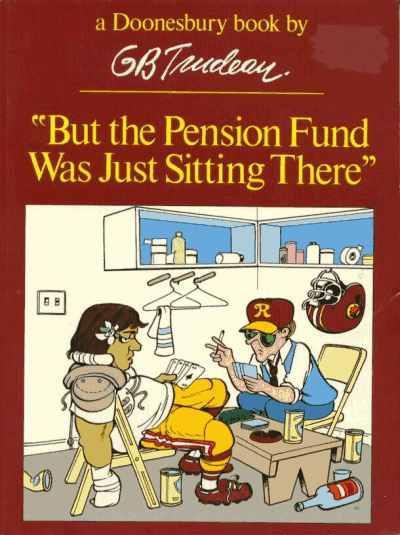
Stepping back: I admit that originally, Soc Sec was not a Ponzi scheme, by my definition. But then Congress realized that there was a huge Baby Boom bubble, and created the Trust Fund. And THEN Congress realized that while one could not get reelected by doing the right thing and leaving the Trust Fund alone, one certainly COULD get reelected by looting the Trust Fund now and giving much larger benefits, especially in the Disability and Supplemental categories. (As Coach Duke said, "The pension fund was just sitting there!")Quite. Check the cross-references while you're there.
So, when the Baby Boom bulge in retirements happened, Soc Sec became a Ponzi scheme. The benefits were much too large, the Trust Fund was actually debt, not assets, in a period of large deficits. And we don't have nearly enough new people entering the system to keep you fat ass 'Boomers in scones and lattes.
Now, our President, who seems to think every day is "Opposite Day," proposes to solve the Soc Sec problem and the unemployment problem by... by... (I can't say it)... cutting the taxes that finance Soc Sec. Not, mind you, as part of an overall plan with offsetting cuts to make Soc Sec NOT a Ponzi scheme.
Now it will be a Ponzi scheme on stilts, with gold plating.

10.9.11
PYRAMIDS AND CONTINGENT LIABILITIES.
Professor Mankiw reminds readers of an observation Paul Samuelson made a long time ago.
Governor Perry will probably say a great many foolish things in his quest for the nomination. His characterization of "Social" "Security", however, is trenchant in the same way that the eight year old's observation of the emperor's clothes was.
Social Security is squarely based on what has been called the eighth wonder of the world -- compound interest. A growing nation is the greatest Ponzi game ever contrived.At the time, both output per worker and the population of workers was growing, ensuring that receipts from current workers were more than sufficient to cover benefit payments to current retirees. That might have sufficed to satisfy New Dealers, and nostalgists such as the ever-more-agitated Chris Matthews.
“You pay for it while you work. When you retired and have no other form of income, this will help you out. In fact, a lot were impoverished in the old days without Social Security. It’s a great anti-poverty program. But then people started to live past 65. Even the great Franklin Roosevelt didn’t make it to 65. In those days, if you made it to 65, you were lucky. You got a few bucks on Social Security.”The eligibility age for full Social Security remains 65, which deprives the program of another form of economic growth. Population growth rates tend to track life expectancies closely, and older workers bring additional experience and productivity gains in jobs that don't require a great deal of muscle power. Retirements to obtain Social Security eligibility chop off the revenue from taxes on those forms of population growth and economic growth.
As for whether it's a Ponzi scheme, well, when the program was adopted, there were 17 workers for every retiree, and the average life expectancy was 58 for men and 62 for women. By 2035, there will be an estimated 2.1 workers for every retiree, and life expectancy -- even if it remains at 2011 levels (male 75, female 80) -- will still be about 18 years longer. What Perry said was the simple truth -- there will be no funds for 25 year-olds to draw upon when they reach retirement age.However, to call "Social" "Security" (a policy that pits generation against generation in a commingling of funds subject to the kind of raiding Congresses of both parties have engaged in is neither social nor secure) a Ponzi scheme might be an insult -- to Charles Ponzi and Bernie Madoff.
There was a time when Social Security was a net asset to the government, which is why the federal government routinely raided the funds raised by the Social Security payroll tax to spend on other programs. But that is no longer true. As the Social Security Trustees' 2011 report documents, Social Security added $49 billion to last year's budget deficit and is projected to add $46 billion to this year's deficit. And $2.6 trillion of our $14 trillion national debt is owed to the Social Security trust fund or rather "trust fund."
This reality was dramatized during the debate over raising the debt ceiling, when President Obama attempted to scare seniors by warning that Social Security checks might not go out on time if recalcitrant Republicans continued to refuse to raise taxes. He thus exposed the naked truth -- the trust fund is bare and that the checks to current and future beneficiaries depend upon taxes and borrowing.
One, a Ponzi scheme collects money from new investors and uses it to pay previous investors—minus a fee. But Social Security collects money from new investors, uses some of it to pay previous investors, and spends the surplus on programs for politically favored groups—minus the cost of supporting a massive bureaucracy. Over the years, trillions of dollars have been spent on these groups and bureaucrats.Thus, the return on your investment is subject to reduction by Act of Congress, whether by increase of taxes or change of benefit formula or means-testing or subjecting benefit payments to tax.
Two, participation in Ponzi schemes is voluntary. Not so with Social Security. The government automatically withholds payroll taxes and “invests” them for you.
Three: When a Ponzi scheme can’t con new investors in sufficient numbers to pay the previous investors, it collapses. But when Social Security runs low on investors—also called poor working stiffs—it raises taxes.
The commingling of funds and the erosion of benefits is all perfectly legal.In addition, at least until the final collapse of his scheme, Ponzi was more or less obligated to pay his early investors what he promised them. With Social Security, on the other hand, Congress is always able to change or cut those benefits in order to keep the scheme going.
Social Security is facing more than $20 trillion in unfunded future liabilities. Raising taxes and cutting benefits enough to keep the program limping along will obviously mean an ever-worsening deal for younger workers. They will be forced to pay more and get less.
In a decision the following year upholding the Social Security Act, the Supreme Court confirmed what anyone who read the law would already have discovered: Payroll taxes weren't held by the government solely for the benefit for retirees. On the contrary: Social Security taxes "are to be paid into the Treasury like internal revenue taxes generally, and are not earmarked in any way."Remind me again, why allowing young workers the opportunity to park some of the money withheld from their paychecks (we'll deal with the fiction of the employer contribution some other day) in other productive assets is a bad idea.
Likewise, for all the talk of Social Security as an "entitlement," retirees have no ironclad right to that monthly check. "Congress can change the rules" whenever it wants to, the Social Security Administration's website acknowledges. "Benefits which are granted at one time can be withdrawn." That too was explicit in the law FDR signed in 1935. There are no "accrued property rights" in the Social Security system, the Supreme Court ruled in 1960. Payroll taxes withheld from your wages today don't confer on you a contractual right to benefits when you retire tomorrow.
Yet is it any wonder so many Americans believe the opposite? They have been assured for years that Social Security's considerable surpluses have been piling up in a trust fund worth about $2.6 trillion at last report. With assets like that, insist the status quo's defenders, there will be enough money to pay retirees' benefits for decades to come.
But the trust fund's assets are an illusion. Social Security doesn't own $2.6 trillion in gold bars or real estate or shares of Google. All it has are Treasury IOUs. Those IOUs represent $2.6 trillion that the government has already spent and promises to spend again. But in order to spend it again -- to redeem those IOUs -- Congress will have to raise taxes, cut spending, or go deeper into debt. Which is exactly what Congress would have to do if the Social Security trust fund didn't exist.
A US government bond is a sound and valuable asset -- for anyone but the US government. Just as you don't increase your wealth when you write yourself a check, the government cannot sock away $2.6 trillion by promising to pay itself $2.6 trillion. "The assets of the Social Security trust fund," the Congressional Budget Office has explained, "do not represent any real stock of resources set aside to pay for benefits in the future." The trust fund is a ledger entry, nothing more.
President Obama suggested in July that without a debt-ceiling increase, Social Security checks might not go out "because there may simply not be the money in the coffers to do it." Granted, he was playing political hardball. But he was also conceding the inescapable truth about Social Security's vaunted trust fund: It doesn't exist.
Governor Perry will probably say a great many foolish things in his quest for the nomination. His characterization of "Social" "Security", however, is trenchant in the same way that the eight year old's observation of the emperor's clothes was.
9.9.11
THE SHAPE OF THE WORLD TO COME.
A New York Times columnist writes complimentary words about Sarah Palin.
What is seldom said is that human flourishing is a complex and delicate thing, and that we needn’t choose whether government or the market jeopardizes it more, because both can threaten it at the same time.Put more simply, the old "vital progressive center" (in which "bipartisanship" is the enrichment of the political class, no matter which set of mascot constituents gets a marginally larger share of the current earmarks) is unsustainable. Legal Insurrection offers one working hypothesis about what is next.
Ms. Palin may be hinting at a new political alignment that would pit a vigorous localism against a kind of national-global institutionalism.
On one side would be those Americans who believe in the power of vast, well-developed institutions like Goldman Sachs, the Teamsters Union, General Electric, Google and the U.S. Department of Education to make the world better. On the other side would be people who believe that power, whether public or private, becomes corrupt and unresponsive the more remote and more anonymous it becomes; they would press to live in self-contained, self-governing enclaves that bear the burden of their own prosperity.
Liberals and conservatives alike have been played for fools by their media and their parties.Yes, so the talking heads representing the Vital Progressive Center can pretend to disagree, oh so earnestly, before those images of the Capitol Dome that decorate their Sunday sets. One yearns for a Cromwell to say "You have sat there for too long."
But hopefully it is a starting point of the recognition that Palin stands alone among major political figures in the United States seeking a transformation of the country consistent with its founding principles, not against them, principles which used to appeal to liberals. Palin’s anti-statist anti-crony capitalism message has the power to reach across parties, which is why that message gets buried in Palin Derangement Syndrome.Writing for the National Association of Scholars, former Assistant Secretary for Nuclear Energy William H. Young suggests the influence of the postmodernists and deconstructionists has become sufficiently pernicious that the unanointed are catching on.
With Palin, liberals will not get their nanny state, but that nanny state is disappearing by economic necessity anyway. But they also will not get a crushing corporatist/unionist state serving the interests of the politically well-connected, which is where we are heading rapidly, and there is no offender worse than Barack Obama.
While it is surely a dead end, postmodern thinking has been spread throughout our society by college-educated elites. Anyone’s belief or opinion, however uninformed or ill-formed, has become equally as valid as that of well-informed individuals or knowledgeable experts. Ironically, “many faculty members are finding now that students in their classes believe that they have a ‘right’ to their own opinions, quite independently of questions of truth and falsity, right or wrong,” notes Tom Wood in Slouching Toward the Theraputic, Part 2 Unfortunately, our youth have learned from Athens only how to be philodoxers. They have become, as Peter Wood has described them, “unmoved by any abiding sense of reality.”That's more dignified than my response to Roland Barthes twenty years ago (Deny coherent beliefs of any kind? Enjoy the incoherence), and perhaps it will be more widely read and received. Mr Young goes on to revisit some of the classic Canon Wars themes from the academy. Perhaps the failure of the academy to contribute much by way of serious though about the failures of the secular institutions will inspire the public to identify who has been calling the shots in the academy, and by what fruits we will know them.
In national politics, sophistry based on opinion, illusion, and subjectivism has replaced rhetoric based on knowledge and reason. An increasingly uneducated public has its illusions and passions fostered by demagogic and dissembling elite sophists. Postmodernism and relativism have debased the veracity of not only reporting by our media, but political speech at the highest levels of government leadership. As Lewis Lapham has observed, “passion as truth” has replaced “truth as passion.”
But the mathematical actualities of economics and finance now confronting our nation’s unrealizable entitlement promises and expectations; the educational and family actualities of a new underclass of unemployable youth, including numerous college graduates; the scientific actualities of theories about anthropogenic climate change; and the divisive social actualities of the diversity ideology are converging to confound the notion of social construction of knowledge and reality. Fallacious illusions lead to failed policies and outcomes in the actual world.
A GIRL WITH A REPUTATION.
Once upon a time, that label would follow any player around. If your playing is notorious enough, it still does.
Perhaps the decent guys have had enough, now it's up to the ladies to reciprocate.
Monica still feels like she's the punchline to a dirty joke,' the source said.
'The publicity over her affair with Clinton ruined her chances of ever finding a decent guy.That Barbara Walters interview where the two shared a giggle about Monica telling the Philanderer in Chief that he had "competition" (a Defense Department staffer with whom her involvement required her to dispose of the products of conception in the feminist way) probably didn't help.
Perhaps the decent guys have had enough, now it's up to the ladies to reciprocate.
BEST SMACKDOWN OF THE SMUG.
Professor Tufte's Voluntary Xchange picks on Brooklyn's Sharon Zukin griping about Las Vegas.
In economics we have something called revealed preference: the things that people do tell us what they like. I’m going to go out on a limb here and claim that people like Las Vegas: it adds color to their lives.Well played, Sir.
My guess is that Professor Zukin is the sort who’d like to make the lives of other people beiger, but would object to food that was beige.
YOU OWE ME A BEER.
The Lambeau Leap did not spring fully formed from a Ray Nitschke hit.
A few rookies did get to make their first Lambeau Leaps last night, as the Packers held off a late Saint charge to win the season opener. Their stop of a Viking charge led by Brett Favre last year might have been emotionally satisfying, but a win over a Lombardi Trophy winner (in the 2009-2010 season) with a Lombardi on the coaching staff is also meritorious.
Thursday Night Football, however, is no better an idea for the National Football League than it is for the Mid-American Conference.
It was freezing in Green Bay the day after Christmas and Packers defensive back LeRoy Butler knew the Raiders wouldn't dare throw anything big.Apparently a leaping player must be back on the field or headed for the bench before the teams line up for the conversion.
Late in the game, with a 1993 playoff berth on the line, Butler got in the way of a swing pass from the Raiders' Vince Evans to Randy Jordan and forced a fumble.
Packers defensive end Reggie White grabbed the frozen stone and lumbered for the end zone. But White's eyes grew huge at the sight of Raiders mauler Steve Wisniewski coming, so he heaved the ball laterally to Butler.
The thrill of taking Green Bay to its first playoff appearance in over a decade overcame Butler and he had 25 yards to the end zone to think of a way to celebrate. He scanned the crowd and eyed a Packers fan in the huddle of green and gold Eskimos.
"I point to this guy in the stands," Butler said. "And I'm going to jump. But this guy had a beer in his hand. You can see he's trying to make a decision. Does he catch LeRoy Butler? Or does he drink his beer and let me hit my head on this frozen wall?
"I jump up. He threw his beer away. And as he grabbed me, he yelled in my ear:
"YOU OWE ME A BEER!"
The Lambeau Leap was born.
Touchdown-scoring Packers have been baptized in suds ever since.
Over the last 18 years, the Lambeau Leap has been incorporated into video games, tolerated by NFL celebration rules and embraced by anyone who puts on the G helmet.
Veterans score for style points, rookies look forward to their first leaps and wannabes around the NFL try blatant imitations.
A few rookies did get to make their first Lambeau Leaps last night, as the Packers held off a late Saint charge to win the season opener. Their stop of a Viking charge led by Brett Favre last year might have been emotionally satisfying, but a win over a Lombardi Trophy winner (in the 2009-2010 season) with a Lombardi on the coaching staff is also meritorious.
Thursday Night Football, however, is no better an idea for the National Football League than it is for the Mid-American Conference.
7.9.11
TUNING OUT THE BEAR FAN IN CHIEF.
The Democrats no longer refer to economic stimulus, and Packer fans will not have to listen to Our President.
The NBC affiliate in Milwaukee, Wisconsin, WTMJ TV announced yesterday they will not be airing Obama's jobs speech at 7 PM EST Thursday night. instead they are opting for their own pre-game coverage of the Packers Saints game scheduled to kick off at 8 PM. Green Bay's NBC affiliate, NBC 26, will also go with the Packers pre-game show over Obama.That request for a joint session of Congress was pretty lame in the first place, and the Republicans aren't interested in exercising their equal time rights. Or perhaps their leadership is ready for some football.
THE WORLD IS TOO MUCH WITH US.
Boston College's Juliet Schor suggests that getting off the 24/7 treadmill is good for your health.
Imagining a world in which jobs take up much less of our time may seem utopian, especially now, when a scarcity mentality dominates the economic conversation. People who are employed often find it difficult to scale back their jobs. Costs of medical care, education, and child care are rising. It may be hard to find new sources of income when U.S. companies have been laying people off at a dizzying rate.That's long been a pet cause at Cold Spring Shops, although it's something more likely to emerge out of a multitude of small decisions long before any new Fair Labor Standards Act codifies it.
But fewer work hours for people with jobs is a key step toward solving the unemployment crisis—while giving Americans healthier lives. Fewer hours means more jobs are available to people who need them. Living on less pay usually means consuming less, making more of the things one needs at home, and living lighter, whether by design or by accident.
Today, driven both by necessity and the deliberate choice to live simply, more Americans are shifting toward fewer work hours. It’s a trend that, if done correctly, could get us out of our current economic crisis and away from unsustainable economic growth.
Not surprisingly, over the last 20 years, a large number of U.S. employees report being overworked. A 2004 study found that 44 percent of respondents were often or very often overworked, overwhelmed at their jobs, or unable to step back and process what’s going on. A third reported being chronically overworked. These overworked employees had much higher stress levels, worse physical health, higher rates of depression, and a reduced ability to take care of themselves than their less-pressured colleagues.There are laws of conservation, and thus limits to productivity gains by downsizing. Whether your model of behavior is "Going Galt" or "Take This Job and Shove It", the resistance grows.
But there are recent signs that a culture shift toward shorter hours has begun. In 1996, when I first surveyed on this issue, 19 percent of the adult population reported having made a voluntary lifestyle change during the previous five years that entailed earning less money. In a 2004 survey by the Center for a New American Dream, 48 percent did.What the government subsidizes, it gets more of. That's a different model than the backward bending supply curve. The income and substitution effects do kick in, subsidies or not.
The stagnant economy, difficult as it is, represents an opportunity for expanding the norm of part-time work. In the first year of the recession, many businesses avoided layoffs by reducing hours through furloughs, unpaid vacations, four-day workweeks, and flex-time. By mid-2009, one study of large firms found that 20 percent had reduced hours to forestall job cuts.
Unfortunately, a lack of institutional support for short hours policies reversed many of those programs, as economist Dean Baker argued in a recent paper. Baker hypothesizes that businesses would provide an additional 1 to 2 million jobs a year if workers could collect unemployment insurance when they are on short schedules.
One thing we do know is that people who voluntarily start working less are generally pleased. In the New Dream survey, 23 percent said they were not only happier, but they didn’t miss the money. Sixty percent reported being happier, but missed the money to varying degrees. Only 10 percent regretted the change. And I’ve also found downshifters who began with a job loss or an involuntary reduction in pay or hours, but came to prefer having a wealth of time.On the other hand, mandating a shorter workweek doesn't necessarily expand job opportunities.
In April 2009, according to a national survey, one in five Americans said they were making plans to plant a garden that year. After the recession hit, service-oriented businesses such as salons, pet groomers, and nannies experienced a decline in business as people began doing these things for themselves. An annual expo called Maker Faire that started in California has been attracting growing numbers of do-it-yourselfers and inventors. It’s spreading to new locations around the country, and attendance has reportedly quadrupled since 2006.On the one hand, perhaps the office or factory hires more people under a regime of thirty hours a week rather than forty. On the other hand, those shorter work weeks provide more time for do-it-yourself activities, implying a substitution away from purchases of those pet grooming services and farms turned into upscale provisioners. And perhaps to another cycle of the emergence of overwork.
People are returning to lost arts practiced by earlier generations—woodworking, quilting, brewing beer, and canning and preserving. They are also hunting, fishing, and sewing. People engage in these activities because they enjoy them and they yield better-quality products or products that are not easily available. Producing artisanal jams, sauces, and smoked meats, or handmade sweaters, quilts, and clothing makes these pricey items affordable.
Self-provisioning is also a spur to entrepreneurial activity. Most people who practice it don’t self-provide everything. They find some productive activities they prefer, are more skilled at, or can do more easily. They trade or sell what they’re best at producing. With this specialization, self-provisioning becomes a pathway to incubating a set of small businesses that will flourish as the sustainable economy takes off.Or perhaps that's the route Silicon Valley took, in which the incubator of small business is a garage with a freezer full of Snickers bars, and the sleepover of the adolescents messing about with their soldering irons and keyboards becomes the sleepover of the developers in their sleeping bags on the floors of their cubicles.
LOSING THE ARGUMENT IS NOT REASON TO GIVE UP.
Our President lapses into irrelevance, and his enablers in the legacy press and among the self-styled progressives get ever more hysterical. "[D]emagogues and dictators do love a vacuum." Yes, and so do vanguardists. But let's retain some perspective.
A longtime member of the country-club Republican establishment looks at the new face of his party and despairs.
A longtime member of the country-club Republican establishment looks at the new face of his party and despairs.
A couple of months ago, I retired; but I could see as early as last November that the Republican Party would use the debt limit vote, an otherwise routine legislative procedure that has been used 87 times since the end of World War II, in order to concoct an entirely artificial fiscal crisis. Then, they would use that fiscal crisis to get what they wanted, by literally holding the US and global economies as hostages.That's one view. I dissent.
The budget ceiling is a recognition, admittedly honored more in the breach than in the observance, that G - T = ΔM + ΔB isn't just for the economics journals, and that financial markets can discount the value of a public debt even if that debt is issued under a valid ceiling approved by the two houses and autographed by the President.And if some Members of Congress perceive as among the reasons they were elected an obligation to respect the laws of conservation of economics, it is not holding the economy hostage to move public policy in a direction where those laws of conservation might ultimately be respected. But as I read further into the despairing essay, I begin to understand why the epithet Republican In Name Only emerged.
The US Senate has more complex procedural rules than any other legislative body in the world; many of these rules are contradictory, and on any given day, the Senate parliamentarian may issue a ruling that contradicts earlier rulings on analogous cases.That's an interesting choice of illustrations, inasmuch as the Senate that produced Medicare, one of the unsustainable public policies contributing to the contingent liability that threatens large increases in ΔM + ΔB is a Senate in which the various civil rights legislation of that era was subject to filibuster, and in those days a cloture motion required 67 votes. Consensus is just another word for the Eastern Liberal Establishment getting its way.
The only thing that can keep the Senate functioning is collegiality and good faith. During periods of political consensus, for instance, the World War II and early post-war eras, the Senate was a "high functioning" institution: filibusters were rare and the body was legislatively productive. Now, one can no more picture the current Senate producing the original Medicare Act than the old Supreme Soviet having legislated the Bill of Rights.
CONDOLENCES.
A Soviet era YAK-42 plane crashes, with the deaths of most of the crew and most of the Yaroslavl Lokomitiv hockey team. Among the passengers are onetime members of the Chicago Black Hawks and Milwaukee Admirals.
It's intriguing that teams retain Soviet-style industrial names. We wish the president of the Russian Hockey Federation, Vladislav Tretjak, and his colleagues and teammates well in their time of grief.
Russia was hoping to showcase Yaroslavl as a modern and vibrant city this week at an international forum attended by heads of state, including Russian President Dmitry Medvedev, so the crash came as a particularly bitter blow.The city has a great deal of potential. I recall seeing a pair of Lasers practicing on the Volga River, and a hydrofoil moving passengers much faster than a yoke of Volga Boatmen could pull them.
It's intriguing that teams retain Soviet-style industrial names. We wish the president of the Russian Hockey Federation, Vladislav Tretjak, and his colleagues and teammates well in their time of grief.
CHASING MULTIPLE HARES?
The economics faculty at Northern Illinois University is about the right size for a university of 17,000 students. Current enrollment is somewhere in the neighborhood of 23,000, and headquarters wants more.
The Northern Star coverage of the State of the University address identifies a number of other hares to chase, including online courses and non-traditional students.
I would like to be able to report that the economics department has been authorized additional searches.
President John G. Peters charted Northern Illinois University’s course toward the future today, calling for enrollment growth to 30,000 by 2020, attracting more high-performing students and increasing the university’s dedication to hands-on learning that prepares students to be leaders after college.The president's goals are, fortunately, not mutually exclusive, but if Urbana pursues a similar strategy, by enrolling more full-fare payers from out of state without crowding out Illinois students, so as to substitute tuition revenues for state support, the competition for those high-performing students will be stiffer.
The Northern Star coverage of the State of the University address identifies a number of other hares to chase, including online courses and non-traditional students.
I would like to be able to report that the economics department has been authorized additional searches.
BUSINESS ENABLES THE CRUDE.
The latest series of commercials for the Dodge Durango includes an endorsement of its pulling capability in which every imaginable noisome prole toy is tied to its drawbar, with a Ford Explorer serving as caboose.
Perhaps that's a business version of embracing the transgressive. The advertisement, however, is part of creating the culture, and it's the perfect reinforcement for the preconceptions of environmental zealots about the owners of jet skis and balloon-tired tricycles.
Perhaps that's a business version of embracing the transgressive. The advertisement, however, is part of creating the culture, and it's the perfect reinforcement for the preconceptions of environmental zealots about the owners of jet skis and balloon-tired tricycles.
6.9.11
THE RAILROAD IS NO PLACE TO PLAY.
One of the first things a railroad worker learns is the proper technique for swinging onto or off of a moving train. It's something to be done only at the proper end of the car, and only where the step and handhold is, and hand and foot coordination is essential. A moving train is not a playground.
Kindly be advised to watch trains from a safe distance and do not board unless you are a ticketed passenger and the train is receiving passengers.
A 17-year-old girl lost both of her legs after trying to climb aboard a moving train with three friends on Monday, authorities said.A bystander with EMT training was able to prevent a fatality.
The incident happened in Longmont just after 1 p.m. when, according to Longmont [Colorado] Police commander Jeff Satur, four people ages 17 to 25 attempted to board a Burlington Northern freight train at 3rd Ave. and Atwood St.
Kindly be advised to watch trains from a safe distance and do not board unless you are a ticketed passenger and the train is receiving passengers.
PUBLIC CHOICE, NOT PUBLIC INTEREST.
Professor Munger wishes to disabuse readers of the notion that elected representatives work for some greater good.
The problem is not that we spend too little on infrastructure. The problem is that our very large spending on infrastructure gets diverted to pet projects of members of Congress.When you're at the poker table, and you haven't figured out who the sucker is, you're the sucker.
Why anyone would think that government wants to do what is right for the average citizen utterly mystifies me.
Sure, a Senator is no more greedy than a financial services CEO. Folks, the problem is that a Senator is NO LESS greedy than a financial services CEO. And the Senator faces none of the checks on behavior. He gets to bribe voters in his state with money taken from people in other states. It's a foolproof system.
And you are the fool.
ON MY WORKBENCH.
When Our President referred to the wrangle over the debt ceiling as a "three-ring circus" he insulted kinkers and roustabouts everywhere.
Imagine framing a three-ring circus to fit a fifteen car train.

The sideshow canvas wagon of the Karlson Brothers Circus, with racks for the tent poles. The sidewall poles here are cheese picks trimmed at one end. There are racks on the other side for the quarter poles, and the three or four telescoping center poles. You'll have to imagine the bannerline and the barker's come-on for now.
Stay tuned for evidence of progress on the train room.
TRENCHANT OBSERVATION OF THE DAY.
At City Journal, Myron Magnet calls out businesses that market to yobs.
A kid in a DOPE shirt should draw the sneers of passersby, and business executives should tell their Nike counterparts that their supposed edginess pollutes the culture. The top brass of the Diesel clothing chain, now running a BE STUPID ad campaign, should hear the same disapproval. Until recently, their Fifth Avenue store, which has defaced an urbane classical building with a 30-foot-high cast-stone bas-relief of an angry lout in a Mohawk haircut, proclaimed from its window: SMART MAY HAVE THE BRAINS, BUT STUPID HAS THE BALLS. The chain’s website asserts, “Smart may have the authority, but stupid has one hell of a hangover,” and “Stupid is the relentless pursuit of a regret free life.” Outfitting thugs and bar brawlers, while egging them on, is not an honorable way to make a living, nor is selling gangsta rap that glorifies lawbreaking and mistreating women, nor is hawking video games that have kids pretend to kill, maim, and rape. And parents who let their kids buy such junk merit the scorn of their neighbors.Quite.
Our culture isn’t something we merely consume. We also all participate in creating it.
TALGO TRAINS ON THE SILK ROAD.
It's called Afrosiyob, and it brings Tashkent within two hours of Samarkand.
All the same, well done, Uzbekistan.
The time of the trip from Tashkent to Samarkand is only two hours, making it one of the most convenient ways to reach the second-largest city in the country.That distance is comparable to Chicago to Springfield, currently three hours and fifteen minutes with standard Amtrak trains, provided the weather and the Union Pacific dispatcher are cooperating. To get an eight hour running time with a train that lacked air conditioning, you have to go back to the Lincoln administration, and those trains had stoves (no bargain, in case you're too close to the stove or if there's a collision.)
“In the earlier times, the trip would take eight hours. The trains had no air conditioners or heaters,” chairman of Nuroniy fund’s Samarkand city department Tursun Safarov remembered.
All the same, well done, Uzbekistan.
“The launch of this modern and comfortable train is a great achievement of the people of Uzbekistan. Your country has advanced before many countries in this regard, including the United States. We don’t have such high-speed trains,” Ambassador Extraordinary and Plenipotentiary of the United States of America to Uzbekistan George Krol said. “The railway is a prospective sector in development of the country’s economy and tourism.”Perhaps there are more fast trains to come along the Silk Road. But catch that "brotherly people." Anybody else remember the fraternal socialist countries?
“It is a great honor for me to be among the first passengers of the new train,” said Ambassador Extraordinary and Plenipotentiary of the Great Britain Rupert Joy. “The fact that this momentous event takes place on the eve of the 20th anniversary of independence of Uzbekistan has a special meaning. This signifies that Uzbekistan is confidently following the chosen path and is reaching huge successes. The greatest achievement of the country is peace and stability.”
“It is noteworthy that Uzbekistan pays a great attention to the development of the railway sector,” said Ambassador Extraordinary and Plenipotentiary of Poland Marian Przezdziecki. “As the international experience shows, rail transport is the most promising industry, and it will remain such in the future. In recent years, an increasing number of Polish tourists come to your country. The launch of the high-speed train is of a great importance in improving the quality of transport services for the population and foreign visitors.”
“I am very pleased to be one of the first passengers of the new train operating between the two unique cities of Uzbekistan, and I express my sincere gratitude to the leadership of Uzbekistan for providing such an opportunity,” said the dean of the diplomatic corpus, Ambassador Extraordinary and Plenipotentiary of Turkmenistan to Uzbekistan Soltan Pirmuhamedov. “This modern and comfortable train demonstrates the consistent development of the rail industry in Uzbekistan, and new approaches and standards of service for passengers. I congratulate the brotherly people of Uzbekistan with this success.”
Prior to the organization of the Afrosiyob train, a large-scale work was held to modernize the rail infrastructure along the Tashkent-Samarkand route. Rail distance of 600 km was rehabilitated, and 68 km of new railways were laid. A new double-track section with length of over 35.3 km was built between Yangiyer and Dashtobod, as well as a 142-meter-long tunnel and four bridges with a total length of 400 meters.
5.9.11
CONVEX COMBINATIONS
A recent Bloomberg article suggests that the rating agencies are still making mistakes.
There's still a part of the story I don't understand, though. The banking houses and rating agencies allegedly created these mortgage-backed securities as a way of generating underwriting fees. General Sherman's observation about military logistics keeps bothering me: "No army dependent on wagons can venture more than 200 miles from its base, because the teams in coming and going consume the contents of the wagons." No matter how one slices and dices portfolios of mortgages, the fees in slicing and dicing consume the contents of the principal and interest payments, and the book helpfully explains that mortgage portfolios are subject to three kinds of risk: the risk of default, which is salient in portfolios of subprime mortgages; the risk of interest rate changes, which an adjustable rate mortgage attempts to counteract; and the risk of early prepayment, which some homeowners attempt to do as a form of forced savings, and which some of the irregular lenders attempt to prevent in a number of ways.
The villain of the piece? Precisely those banking houses. Turn to page 274.
(Cross-posted to 50 Book Challenge.)
Standard & Poor’s is giving a higher rating to securities backed by subprime home loans, the same type of investments that led to the worst financial crisis since the Great Depression, than it assigns the U.S. government.The article continues by reminding readers of recent history.
S&P is poised to provide AAA grades to 59 percent of Springleaf Mortgage Loan Trust 2011-1, a set of bonds tied to $497 million lent to homeowners with below-average credit scores and almost no equity in their properties.
Treasuries gained about 1.95 percent and U.S. borrowing costs have fallen to record lows as investors repudiated the downgrade, according to Bank of America Merrill Lynch indexes. S&P has awarded AAAs to more than $36 billion of securities in the U.S. this year that were created by bankers who continue to gather thousands of loans, bundle them into bonds of varying risk and pay ratings firms a fee to assign credit rankings.
Securitization enabled by S&P contributed to more than $2 trillion in losses and writedowns at the world’s largest financial institutions and the collapse of Lehman Brothers Holdings Inc. three years ago, causing credit markets to seize up and leading to the global recession.
A report by the Senate’s Permanent Subcommittee on Investigations said that S&P, Moody’s and Fitch Ratings helped trigger the financial crisis when they cut thousands of mortgage securities they rated AAA to junk status. The raters had engaged in a “race to the bottom” to win business, lawmakers said.
Bank of America Corp. and Royal Bank of Scotland Group Plc sold $242.7 million of the Springleaf mortgage bonds today that are set to get S&P’s top ratings, according to people familiar with the matter, who declined to be identified because the terms haven’t been set.
The transaction was reworked after marketing began to give those securities more protection against losses than S&P required, a sign investors may not have trusted the grades. An additional $49.7 million of the deal ranked AAA that will suffer losses first was split from the rest and not sold.
The safer debt was sold at a yield of 4 percent and has a projected average life of 2.44 years, one of the people said. That’s about 20 times the rate demanded on two-year Treasuries.There's probably a dissertation waiting to be written about the nature of investor demand for low-risk assets. Today's Book Review No. 28 considers Reckles$ Endangerment: How Outsized Ambition, Greed, and Corruption Led to Economic Armageddon. The book has received some play, perhaps excessive play, on the right side of the Internet for assigning responsibility for the housing bubble to public policies that encouraged unwise borrowing and lending. And yes, some members of Congress were excessively optimistic about the government sponsored lending agencies. The more intriguing parts of the story, however, are in the emergence of mortgage-backed securities as gilt-edged investments. Reckless Endangerment suggests a connection (never explicitly ruled out as a coincidence) between the brief interlude of Federal surpluses and the interest in convex combinations of mortgages as a safe asset. That demand has to be meaningful: many of the advocates of greater spending on infrastructure note the willingness of people to hold government bonds, Standard & Poor downgrade or not.
There's still a part of the story I don't understand, though. The banking houses and rating agencies allegedly created these mortgage-backed securities as a way of generating underwriting fees. General Sherman's observation about military logistics keeps bothering me: "No army dependent on wagons can venture more than 200 miles from its base, because the teams in coming and going consume the contents of the wagons." No matter how one slices and dices portfolios of mortgages, the fees in slicing and dicing consume the contents of the principal and interest payments, and the book helpfully explains that mortgage portfolios are subject to three kinds of risk: the risk of default, which is salient in portfolios of subprime mortgages; the risk of interest rate changes, which an adjustable rate mortgage attempts to counteract; and the risk of early prepayment, which some homeowners attempt to do as a form of forced savings, and which some of the irregular lenders attempt to prevent in a number of ways.
The villain of the piece? Precisely those banking houses. Turn to page 274.
The voraciousness of these firms would also push the nation's economy into its most serious recession in more than seventy-five years. Their avarice would finally, and forcefully, demonstrate how a noble idea like homeownership could be corrupted into something that so poisoned the global economy it was left in a semi-vegetative state.Never mind the mixed metaphors. Something went wrong, and there's plenty of blame to go around, and yet, the securitization beat goes on.
(Cross-posted to 50 Book Challenge.)
DROP AND GIVE ME TWENTY.
That's canonical punishment in the military. Sometimes it's required of West Point cheerleaders.

Saturday's kickoff was delayed for about ten minutes as a line of thunderstorms cleared out. There was intermittent rain during the game, but not enough to make things uncomfortable. The score was 49-6 in favor of Northern Illinois midway through the third quarter, when the substitutes came in.

Saturday's kickoff was delayed for about ten minutes as a line of thunderstorms cleared out. There was intermittent rain during the game, but not enough to make things uncomfortable. The score was 49-6 in favor of Northern Illinois midway through the third quarter, when the substitutes came in.
HELL IS OTHER PEOPLE
British author Emily White comments on a book she wrote about long-term loneliness. On the one hand, some people lead lives so cluttered as to not understand the problem.
On the other hand, the trappings of sociability might conceal more anomie and isolation than meets the eye.
When I tried to mention it to my doctor — a man with a wife, three children and a busy practice — he laughed and said that he’d love, yes, love, to have some time alone. He misunderstood me so fundamentally that I left the surgery without a word.(How can a man who is warm understand a man who is cold? -- Solzhenitsyn.)
On the other hand, the trappings of sociability might conceal more anomie and isolation than meets the eye.
The stigma against loneliness has got worse, precisely because we’re more vulnerable to it than we used to be. We have more to fear. Even though we’re more connected in some ways — ‘friending’ each other on Facebook, and Twittering away to our followers — in other ways, we’re more alone than ever before.Read on, though. Perhaps that easy sociability is really a mask for deeper desperation.
I have a Twitter account, but I don’t feel ‘linked in’ in any relevant way. I can Tweet all morning, but if I don’t have a phone call with someone or a meaningful exchange, I feel as alone as before.
More than 30 per cent of people in Britain live alone and the time we spend visiting friends and family has fallen. A recent study in the U.S. showed that almost a third of the respondents had no one to confide in.
There was a time in my life, after I moved from one end of the country to the other, when there were only three people in my social circle, a number so low it qualifies as ‘socially isolated’.
Loneliness has become a major problem of our time. The Mental Health Foundation’s 2010 report described loneliness in Britain as having reached ‘epidemic’ proportions. And yet we still don’t talk about it.
When I was lonely, I hid my emotional reality and lied outright. I fudged facts and did everything necessary to make my isolated life look full. I hinted that I hadn’t been single for as long as I had. I worked as a lawyer, and if someone at the office suggested I looked tired, I pretended that a busy social life was leaving me drained.
If they’d spent the evening alone at home, they’d tell others they’d had the most fantastic time, catching up on long overdue phone calls.
Weekends on their own would, come Monday morning, mutate into a fictitious round of endless socialising.
The people who did these things, who lied and embroidered, were struggling with the weight of social norms because just as loneliness has become more intense — as rates of living alone increase and the number of confidantes falls — we’ve been exposed to more and more images of easy-to-achieve sociability.
TV programmes (think Sex And The City, Friends, Mad Men) are filled with people leading satisfying lives.I watch Mad Men. But that Ray Stevens couplet, "Eighty-six proof anaesthetic crutches brought you to the top, Where the smiles are all synthetic and the ulcers never stop" rattles around in my mind every time the account executives talk shop in a bar.
Adverts for brands that have nothing to do with sociability — such as the clothing lines Boden, Jack Wills and Tommy Hilfiger — come adorned with models wrapping their arms effortlessly around each other.
This means that sociability is what we’re presented with, while loneliness is what we experience.
With sociability so glamorised, so normalised, it’s no wonder we lie about loneliness. Who wants to admit to not fitting in, to having some of their most basic human needs left unfulfilled?
BEAT THE BUBBLE.
Forbes publishes a suggestion for parents who might want to reduce college expenses.
One of best-kept secrets in college admissions this coming year is that many top state universities will be admitting more out-of-state applicants than they ever have.To some extent, the push for more out of state enrollments is a push for more revenue.
This opens up a whole new group of schools that were formerly much more difficult to get into. We’re talking about great schools, sometimes lots more openings, and for a few campuses, slightly easier academic standards!
As states continue to weather the financial crisis, they are trimming state budgets. And expenditures to their prestigious state-run universities have taken a hit. Consequently, schools have consciously – and sometimes publicly – increased the number of higher-tuition-paying out-of-state students.It's not necessarily a bad strategy. Jay Mathews reminds readers that motivated students are able to thrive anywhere.
Want to avoid college debt? Don’t cut back on the time you spend at college. Instead, pick a school that does not cost so much. President Obama’s new nominee to be chairman of the Council of Economic Advisers, Alan Krueger, co-authored in 1999 a paper, “Estimating the Payoff to Attending a More Selective College,” showing that expensive big-name schools add little if any value to a college education. He and co-author Stacy Berg Dale demonstrated that the character traits that bring success — such as persistence and good humor — produce just as much income with a degree from Delaware State as one from Cornell.Regular readers will recognize those conclusions as the Spielberg Effect. Administrators at state universities, however, cannot simply expect greater student intake in the form of individuals that would previously have attended the state flagship. A nonselective state university with a nonserious curriculum is likely to have problems retaining those students.
CLASS REUNION.
Will two Streaks be temporarily repatriated?

The locomotive, and two cars from General Eisenhower's staff train, are well-protected under roof.
The class reunion for the Streaks is to observe the 75th anniversary of Mallard briefly exceeding 125 mph with a test train.
For several months, it is believed secret talks have been taking place between the [National Railway Museum in York] and its counterparts in the USA and Canada about loaning the two exiled A4s, No. 60008 Dwight D. Eisenhower, and No. 60010 Dominion of Canada, for the historic and probably never-to-be-repeated line-up, with the other three UK-based A4s Nos. 60019 Bittern, currently running as No. 4492 Dominion of New Zealand, No. 60009 Union of South Africa, and No. 60007 Sir Nigel Gresley,If those are serious plans, there's a lot of work to be done to move Dwight D. Eisenhower.

The locomotive, and two cars from General Eisenhower's staff train, are well-protected under roof.
The class reunion for the Streaks is to observe the 75th anniversary of Mallard briefly exceeding 125 mph with a test train.
IN BLOG YEARS, WHEN DOES GEOLOGIC TIME BEGIN?
Nine years, still hanging onto as much of the original site layout as I can. The latest Blogger dashboard keeps track of readership and links to posts. Thanks for your interest, our tenth year begins.
4.9.11
FINDING THOSE MISSING MEN.
Despite the recession, or slow recovery, or Great Depression 2.0, employers are still looking for people with the right skills.
"We don't need rocket scientists. We need people with basic technical skills who know how to use tools, work with their hands and make something happen," said Ron Kadlubowski, director of machining technology at Karl Schmidt Unisia.The article also notes that there's a downside to downsizing.
The company has grown from 250 employees in 1985 to more than 900 now. Currently, Kadlubowski said, it has dozens of openings for skilled machine operators.
"We have so many openings now, it's amazing," he said. "If you come in with a basic skill set, and you don't have some rotten work history, you are going to get hired. And other companies in the area are hiring people left and right. The hard part is finding someone who looks encouraging."
One problem in addressing the skills crisis is a lack of basic math skills, manufacturers say.
Many job applicants can't answer the question "what is one half of one half," [EMT International president Paul] Rauscher said, and they can't measure something to a fraction of an inch.
"How are you going to get a workforce together when people lack those basic skills? It's pretty pathetic," he said.
A manufacturer looking to fill 134 entry-level jobs, paying $15 per hour, received 850 applications but hired only 17 of the applicants, according to Jim Golembeski, executive director of the Bay Area Workforce Development Board, in Green Bay.
Many lacked a high school diploma or could not pass basic reading, math or dexterity tests. Others flunked the drug and alcohol test.
Companies that have invested millions of dollars in technology won't tolerate employees with drug and alcohol problems messing up the equipment as a result of their addictions. "And they aren't going to let you touch one of those machines if you don't know what you are doing," Golembeski said.
Workers get "kicked to the curb" whenever a company has a bad fiscal quarter, said Michael Bolton, director of United Steelworkers of America District 2, which includes southeastern Wisconsin.The failure of the common schools to teach mathematics or the habits of the middle class might also have an effect.
"The only loyalty is to quarterly returns. We used to sit down with companies and talk with them about their five-year and 10-year plans. Now, we are lucky if we can get them to talk about a three-month plan," Bolton said.
Small and midsize manufacturers, which are predominantly privately owned, have always maintained better discipline in holding onto their workers in tough times, said Tim Sullivan, chairman of the state Council on Workforce Investment and former president and chief executive of Bucyrus International Inc.
Historically, publicly traded manufacturers have reduced the rank-and-file workforce at the very hint of a softening in markets, Sullivan said.
"I believe this practice has been curtailed to a great extent, based on the current shortage in manufacturing skills," he said. "Unfortunately, historical perception has had a significant impact on career choices as well as high school and tech-school curriculums."
FASTER, PLEASE.
Canadian Pacific, the once and future owner of The Milwaukee Road's route of the Arrow to Kansas City, has made improvements to its tracks through northern DeKalb County to permit freight trains to cruise at forty miles an hour.
The city administrator in Genoa does not anticipate any safety risks as a consequence of the faster trains.
There may be a few citizens that remember 100 mph passenger trains on that line.

This Wikimedia Commons image shows the Midwest Hiawatha at Bensenville, Illinois (the tower controls the junction of the line to Savanna with the freight bypass for trains headed into Wisconsin or the transcontinental line.) That's one of the world's fastest steam locomotives in charge, and it's likely to have the train rolling through Genoa at much better than 40 mph.
MARINATE IN THE SMUG.
Las Vegas is so evil it must be banned.
I wonder if Brooklyn College's Professor Zukin ever reflects on whether academic research is ever about "learning what's in style" or whether such posturing gives higher education's critics reason to be critical.
I wonder if Brooklyn College's Professor Zukin ever reflects on whether academic research is ever about "learning what's in style" or whether such posturing gives higher education's critics reason to be critical.
3.9.11
AMERICANS WILL NOT BE STOPPED BY SAMURAI.
On tour after the completion of his European Theater trilogy, author Jeff Shaara received suggestions from veterans of the Pacific Theater to tell the damn tale. Because of unspecified constraints in his agreements with publishers, he was limited to writing about events subsequent to V-E Day. The result is The Final Storm, based on recollections of veterans of the invasion of Okinawa and the air base subsequently established on Tinian, progressing to the return of some of those veterans home on a brief leave that became an early discharge after the Japanese government received sufficient information, from above and from the USSR, that it was time to come to terms. It's a shorter book than any in the European Theater trilogy, and Book Review No. 27 will be short accordingly, with interpretation of this post's title left to the reader as an exercise.
(Cross-posted to 50 Book Challenge.)
(Cross-posted to 50 Book Challenge.)
THIS IS WHAT DUMBING DOWN LOOKS LIKE.
Thomas Bertonneau of the Pope Center gripes about The Amazing Colossal Syllabus. Left unwritten is a gripe about the misuse of the term syllabus (properly understood, a syllabus can fit into one paragraph in the college catalog) to refer to the course outline, but the course outline these days is better understood as a statement of Terms of Service.
Some of this effort—and much of the hypertrophied syllabus—is precautionary. It is precautionary on behalf of students, who, from day one, will know in advance every requirement and assignment of the course. It is also precautionary on behalf of the syllabus-writer, who seeks protection from petulant students claiming they never knew the schedule or failed to receive procedural knowledge concerning the semester. Syllabus in hand, no one can plead ignorance.Daniel Luzer of Washington Monthly College Guide concurs in part and dissents in part.
Instructions for formal written work in my teaching have also grown more explicit, more detailed and copious, over the years. Mostly, that is due to my increasing awareness of how badly prepared for serious writing almost all contemporary college students are. In 1974, a professor would simply have told his students that they should write an essay comparing Madame Bovary and Maggie, A Girl of the Streets. Only a few of my students would have any idea how to respond to so minimal a request.
Then again, what’s really wrong with students demanding explicit information about what they’re expected to do? Sure it might be a little tiresome, and even vulgar, to have to spell the whole course out like that but students today understand that grades are important; it doesn’t seem wrong for them to demand, in writing, exactly how they’re expected to perform.Ouch. And yes, the self-styled progressives and deconstructionists are more than a little bit responsible for the lowering of higher education, whether by treating standards as an oppressive social construct, or by admitting Distressed Material and calling it Access. Their efforts, however, are still subject to market tests much stricter than any grading curve, and for which the absence of detailed rubrics is not grounds for appeal.
Furthermore, Bertonneau is the English professor. If his students don’t know how to do serious writing or interpret and understand the Western canon, that isn’t really the sort of problem that can be solved with a syllabus. It can, however, be solved by education. Shouldn’t he just be teaching them?
In any case, the public has already noticed the diminishing market value of traditional college degrees and is responding accordingly. Americans know they are paying too much for too little, and they are beginning in substantial numbers to explore alternatives. Online programs look like they will be the main beneficiary of this disaffection, but the story is still unfolding. [Richard] Vedder has also noted that the “elite top schools” benefit from the diminished value of ordinary college degrees. The “Uber College Graduate,” as he puts it—the graduate of Harvard or Stanford—still has an edge in finding one of those increasingly scarce high-paying jobs for which college skills really are a prerequisite.Summarized in one sentence: the excess demand is for perceived prestige, the excess capacity in access-assessment-remediation-retention. Terms of Service that would do the writer of an End User License Agreement proud change that not at all.
A wise college president right about now would be looking for ways to tighten admissions standards, introduce a rigorous core curriculum, wipe out grade inflation, strip away the ideological folderol, and in every other way make his institution identified with graduates who reliably possess a first-rate education. Colleges that offer that—really offer it rather than just proclaim they do—will thrive in the years ahead. The others will watch as the numbers of high school graduates interested in attending fall away.
IT'S NOT THE WIND. IT'S THE RAIN.
I've seen complaints that the coverage of Hurricane Irene was so much hype, sometimes because of the absence of any hurricane force winds at any shoreside weather stations. But the rains and accompanying flooding have been no laughing matter. Art Woolf at Vermont Tiger compares the damages of this year's storm with those of the 1927 flooding in Vermont.
Hurricane Irene has given the Shore Line Trolley Museum an unexpected maintenance bill.

Both the museum and Trains report that all but three of the museum's cars took salt water into traction motors.
How big would Irene's economic toll have to be to equal that? If we just inflate the $28 million by the change in the consumer price index, the 1927 flood's toll was $352 million in 2010 dollars. But a lot has changed in the last 80 years and simply using the CPI doesn't necessarily capture the full burden of the cost.That storm mortally wounded the Woodstock Railroad. A 1936 flood permanently truncated the Hoosac Tunnel and Wilmington Railroad within the Commonwealth of Massachusetts, and rearranged the railroad map of New Hampshire. Hurricane Diane ended the East Wind service before Labor Day, the horror.
When wealth is destroyed, it takes resources to rebuild and replace the damaged physical assets. Those resources represent a burden to those paying it. If we measure the burden by how much of our current income we would have to sacrifice to repair or replace those assets, the 1927 flood's cost was the equivalent of $3.1 billion today.
Irene may have done $352 million worth of damages to public infrastructure and private property, but it's unlikely to be $3.1 billion. The 1927 flood is likely to maintain its place in history as the most costly natural disaster to strike Vermont.
Hurricane Irene has given the Shore Line Trolley Museum an unexpected maintenance bill.

Branford Electric Railway Association photo by Dennis Pacelli.
Both the museum and Trains report that all but three of the museum's cars took salt water into traction motors.
While volunteers had moved the cars to higher ground in advance of Hurricane Irene, water was still able to reach the cars’ traction motors. Museum volunteers will need to inspect each car for damage and repair them as necessary. The process could take several years.You don't just go to the local hardware store or to a Prius dealer to get repair parts for traction motors that in some cars are approaching 100 years old.
IGNORING THE CONSEQUENCES OF DOWNSIZING.
Marginal Revolution reports on an investigation into the nature and causes of the failure of Our President's stimulus to stimulate.
One major problem with ARRA was not the crowding out of financial capital but rather the crowding out of labor. In the first paper there is also a discussion of how the stimulus job numbers were generated, how unreliable they are, and how stimulus recipients sometimes had an incentive to claim job creation where none was present. Many of the created jobs involved hiring people back from retirement. You can tell a story about how hiring the already employed opened up other jobs for the unemployed, but it’s just that — a story. I don’t think it is what happened in most cases, rather firms ended up getting by with fewer workers.At New Republic, Jonathan Chait attempts to rebut the interpretation of the results.
There’s also evidence of government funds chasing after the same set of skilled and already busy firms. For at least a third of the surveyed firms receiving stimulus funds, their experience failed to fit important aspects of the Keynesian model.
Suppose Company A creates a new job, and fills it by hiring a worker away from Company B. What do the authors suppose think happens to the job at Company B? Do they say, well, that's it, we lost Joyce, nothing we can do about that in an economy with unemployment at only 9%.In the paragraphs that follow, he lapses into some whinging about the Koch brothers, perhaps hoping to discredit the Mercatus Center for taking tainted foundation money. Instead, he could have dealt with the problems a company faces in attempting to replace one worker with a comparable one. That's the approach Steven Horwitz takes at Coordination Problem.
I read the paper in the vain hope of finding the authors' explanation of what they think happens when a new job is filled by moving a worker from another job. I did not see one. Nor did I see any attempt to demonstrate, or even suggest, that the newly-opened jobs of workers moving into stimulus-created jobs were going unfilled. They genuinely seem to assume that "job shifting" is simply the opposite of job creation.
Chait's assumption of the fungibility of labor is the key. His argument presumes that labor can easily be substituted in this way and that the human capital of those workers hired for stimulus-funded projects is the same as those in the unemployment lines. That's the only way that the unemployed person could be swapped in when the stimulus-funded worker is bid away. From an Austrian perspective, human capital, like physical capital, is most emphatically not fungible and is heterogeneous in use. Thus there's no reason to believe that the unemployed workers would be a substitute for the bid-away worker. Workers, like physical capital, have to fit into the jigsaw puzzle. Their human capital must be complementary to the human and physical capital in the firms where the labor has left.Perhaps so, although the Marginal Revolution interpretation about firms getting by with fewer workers is probably closer to the truth. Here's how it works in higher education.
This is particularly true when we recognize the way in which the boom of the 2000s also distorted the structure of human capital across the economy. It may well be that the currently unemployed are examples of human capital malinvestment and that they will have to "refit" themselves in order to find work in the post-recession economy.
If a full professor retires and the dean offers the department only a lecturer as replacement, are the other 50- and 60-year-old eminences going to protest? Unlikely, as long as their working conditions aren’t affected. After all, lecturers, adjuncts, and graduate assistants make their lives easier. Indeed, if courses are over-enrolled and the dean provides only funds to pick up three adjuncts instead of a new tenure-track line, won’t the former plan ease the burden on existing professors more than the latter plan?That's the best-case scenario. Reality often is one or two separations (whether by retirement or job change or what have you) and perhaps one search, and even that might be subject to rescission. No matter the dynamics, however, a separation is often headquarters's best management tool, as it permits downsizing without firing anybody. If crucial functions are gutted, maybe somebody will worry, but maybe not.
BEFORE BOB THE BUILDER, THERE WAS STRUCTO.
I may have had a few Structo toys as a boy, and there's a good chance that I subjected a few of them to destructive testing. The company once produced those trucks in Freeport, Illinois. To honor the centennial of its establishment, the Stephenson County Historical Society offers a reenactment of a company picnic today.
In common with many of the other toy manufacturers, Structo converted its tooling to the production of military goods during the second world war. Some of that tooling might have been convertible to other consumer goods.Barbecue grills were added in 1960, and five years later, the company was acquired by King-Seeley Thermos Co. and renamed the Structo Division.The toy division became the property of Ertl Toys, itself a manufacturer of metal toys. No more generic dump trucks, apparently, as Ertl work closely with the major manufacturers of farm implements to produce replicas in a variety of scales.
The next years after Household International acquired the company in 1968, gas-fired grills were introduced into the Structo line. And in 1972, Structo Division took on the manufacturing of vehicle license plates for the State of Illinois. Production of the old staple weaving looms was discontinued.
Subscribe to:
Posts (Atom)