14.12.08

AMERIKA, DU HAST ES BESSER. Greece is full of disaffected youth.
Few of the dozen people interviewed in Athens, walking to and from work or at the protests, said they had a permanent job or a job that guaranteed a pension. Many older spectators said they had sympathy with the young--even if they didn't like the ruin left behind. "I feel sorry for the young," said 40-year-old Tsikala Stephania, a public sector worker, who watched students and police trade insults in the street Friday. "They don't see much of a future, and they have to show their wrath in some way." "What Greece is experiencing is a vacuum in values, of ideals--and you have a bad economy," said Dmitrious Atheneus, 45, who works part time in advertising. "You only get ahead here if you have connections. The young see that there is no meritocracy. In America, democracy works. Here, democracy only works for a few." Tear gas, blasted with bone-rattling frequency by police on the street Friday afternoon, was meant to scare the young away. Their bitter fumes had almost no effect. The next generation, it seems, was already choking on a sense of powerlessness. "I can't keep waking up every day not wanting to wake up," the young man wearing the helmet said. "We see how our parents were manipulated by the system and how afraid they were to take chances. ... This is a rage against that kind of decay."
It's not Atlas shrugging, exactly, it's people who don't perceive the opportunity to become Atlas, even if that involves the risk of being looted and mooched from.

There are sympathy riots elsewhere in Europe.
As Europe plunges into recession, unemployment is rising, particularly among the young. Even before the crisis, European youths complained about difficulty finding well-paid jobs -even with a college degree -and many said they felt left out as the continent grew in prosperity.
I'm not familiar enough with the European university system to attribute the disappointment to access-assessment-remediation-retention, although that is a likely place to look.
MAKE THE OBVIOUS INFERENCE. A Chicago Tribune article about Illinois kleptocracy conjectures, "Blagojevich's arrest may be the final straw that shatters Illinois' political culture of 'pay to play'." It concludes with a reformer making a predictable suggestion.
"Rod Blagojevich has really illustrated that the policy of the State of Illinois is that we leave the bank vault open and we allow candidates to go in and grab what they can," said Cynthia Canary, director of the Illinois Campaign for Political Reform. "The intense excesses of Blagojevich beg us to rethink the role of money in Illinois politics."
An accompanying article suggests kleptocracy is a suboptimal environment for business growth.
Yes, Illinois is a far cry from Louisiana: Its economy is far more vibrant, its workforce more skilled, its population more educated. But the image of corruption is an important intangible factor that can affect a state's economic vitality, some economic development experts say. It signals to businesses that rules are squishy and the economic deck is stacked.
The author found several Wisconsin Ph.D.s, David Audretsch, Tim Bartik, and David Merriman, to amplify and reinforce the fundamental point.

Both articles are correct on the interpretation of events. Both articles miss a more fundamental point: state government is in a position to dispense many favors, which brings forth the rent-seekers. (It reminds me of a wisecrack attributed to Thorstein Veblen, who, when a dean or college president criticized him for playing house with a much younger woman, asked "What do you do when she moves in?") For lack of a better alternative, the model of enumerated and constitutionally limited government powers looks more attractive, as a check on the temptation for rent-seekers to pay and for office-seekers to expect to be paid.

The Tribune is correct in part.
That leaves a political financing system that resembles an addiction. Firms that rely heavily on state business readily donate to candidates as a cost of doing business—and are regularly rewarded with continued contracts and funding. Politicians then demand even higher campaign donations from the firms.
Less state business, fewer rents to seek, less pay-for-play, q.e.d.
CHASED FROM THE SPANISH MAIN. The Packers' French Army Retrospective continues in Jacksonville. My copy of How The States Got Their Shapes notes that French North America (later known as the Louisiana Purchase) was wherever a Frenchman could go without encountering resistance from a Spaniard or an Englishman.
The Packers might have had reason to bicker. After all, they lost on a late drive for the third consecutive week. Carolina beat Green Bay 35-31 two weeks ago with a 55-yard drive in the final two minutes. Houston kicked a field goal as time expired in last week's 24-21 victory.
Thus endeth the slim playoff hopes.

11.12.08

RESTRUCTURING HIGHER EDUCATION.

The American Prospect's David Kirp reviews Charles Murray's Real Education, and finds much to object to.

Because Murray thinks that innate differences in cognitive ability guarantee that most people cannot do the intellectual heavy lifting that serious higher education demands, truth No. 3 -- too many children go to college -- inescapably follows. "No more than 20 percent" of students can do college-level work, says Murray, and "10 percent is a more reliable estimate."

Putting aside the faulty statistical analysis that leads Murray to that dour conclusion, this "truth" is rebutted by the fact that about 35 percent of young adults, not 10 percent, have a bachelor's degree. To Murray, these figures show that standards in higher education have been debased, but most undergraduates are learning something of value. University College London economist Pedro Carneiro concludes that "even if we take the most pessimistic estimates for the return to education for those outside the elite (who economists would call the marginal students), they are probably above 7 percent per year of college, and they are not lower for a year of a B.A. as opposed to a year of any other type of post-secondary schooling." Employers aren't dumb. If high school graduates were just as productive, companies would hire them and save boatloads of money.

High school graduates are not just as productive, however, in part because the high schools have allowed postsecondary education to offer no-penalty do-overs.
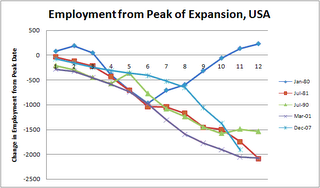
COMPARATIVE RECESSIONS. Here's a chart from Tom McMahon.


Here's another one, from King Banaian.


King has been suggesting the 1982-1983 recession (it was the second dip of a double-dip that began in 1979) is the historical example most like today's. Clearing out the excess of multiple bubbles is different, however, from clearing out the excess of monetary and fiscal stimulus rendered messier by those mid-1970s wage and price controls.
THIS SOUNDS ABOUT RIGHT. I got it from Kids Prefer Cheese, although several other sites I visited today were helping propagate it.


Pass it along.

10.12.08

QUOTE OF THE DAY. Joanne Jacobs reviews Sweating the Small Stuff: Inner-City Schools and the New Paternalism.
“Nagging is love,” I used to tell my daughter. “I am a much-loved child,” she’d reply. And so it is: if you care about a kid, you tell her what she’s doing right and what she’s doing wrong. You stick with her when she makes mistakes. You honor her successes. You nag. In Sweating the Small Stuff: Inner-City Schools and the New Paternalism, David Whitman finds that idea replicated in education. To give disadvantaged students a shot at college and mainstream success, he argues, schools must teach “not just how to think but how to act according to what are commonly termed traditional middle-class values.”
The review is in City Journal, which suggests she's preaching to the converted. All the same, instilling the Habits of Effective People is cheaper than all the other educational reforms we've been offered, something to keep in mind in straitened financial circumstances, with evidence of the failure of the more expensive therapeutic approaches all around us.
UNDOING PAST VANDALISM. The January issue of Railway brings news of a planned upgrade of London's Euston Station, including additional tracks and revised passenger flow patterns.


The redevelopment has been public knowledge since March 2007.

Network Rail said the cramped and dingy surroundings would be transformed into a light and airy thoroughfare for the 55 million passengers who use the station each year.

The unloved entrance to the station will also undergo a transformation, though it is unlikely the deal will involved resurrecting the Victorian arch that was bulldozed in the 1960s to make way for the current building.

British Land, which was selected as a preferred bidder, said the passenger improvements would be funded by unlocking the commercial development of the site.

Imagine. A railroad station in the basement of a skyscraper.


The Railway news brief describes the plan as employing "airport-style segregation for arriving and departing passengers on different levels." That description will certainly make sense to contemporary observers. The segregation of passenger traffic on different levels is a railroad invention.


The North Jersey Coast train leaves at a quarter to four. Look closely for the sign reading DOWN STAIRS FOR INCOMING TRAINS. Pennsylvania Station and Euston Station both went for 1960s redevelopments that have not aged well at all. Economic uncertainties appear to have put on hold the planned rebuilding (keep scrolling, it's down there) of Penn Station including passenger facilities in the Post Office.

9.12.08

BLAGO TO JAIL. If it's a new jail, he probably collected $200 to let the contracts.
The complaint contends Blagojevich, a Democrat, threatened to withhold substantial state assistance to the Tribune Co. in connection with the sale of Wrigley to induce the firing of Chicago Tribune editorial board members critical of Blagojevich.

The governor is also accused of obtaining campaign contributions in exchange for official actions — in the past and recently in a push before a new state ethics law takes effect Jan. 1.
Transversality conditions. Not just for qualifying exams anymore.

The transcript of the evidence makes me nostalgic for the days of [expletive deleted]. The President of the United States, and the Chicago Cubs, are two more supplicants to be reminded who is boss.

The editorial board of the Chicago Sun-Times calls for the governor's speedy departure from office.
In Blagojevich’s case, federal agents have been swarming over every part of the governor’s life for years. His friend and fund-raiser Tony Rezko has been convicted for political corruption in Blagojevich’s administration.

So what kind of man — knowing all this — continues to shake down businesses and puts a Senate seat up for sale? What combination of hubris, stupidity and greed is at work here?
That Rezko reference stirs the right. Michelle Malkin has a caption contest.


Gateway Pundit is in full cry. Wizbang's Michael Laprairie wonders if we're going to have a replay of the Clinton years.

During the 2008 Presidential campaign, it was well known that Barack Obama had a number of embarrassing skeletons in his closet, particularly the close rapport between Obama and crooked Chicago slumlord Tony Rezko, and Obama's cozy relationship with the Chicago Democratic Party political machine, perhaps the most corrupt organization in America, with only the possible exception of the Louisiana Democratic Party political machine.

The mainstream press published several interesting investigative pieces a year or so before Obama became the Democratic party nominee, but saw no need to keep that information above the page fold during the final months of the campaign. Instead, they chose to destroy Sarah Palin. And Obama's minions actively fought to silence anyone who sought to publish information about the connections between Obama and Bill Ayres.

Now, the Chicago Political Machine appears to be imploding. And there's also that pesky problem of campaign donation fraud that the mainstream press had previously found totally uninteresting.

Will Barack Obama, like Bill Clinton, be forced to endure four or eight years of embarrassing criminal investigations because the press failed to do their job and fully delve into his past

Right now, it doesn't look good for Obama. Lord, forgive our press, for they did not tell us what they knew.

Jake Tapper of ABC asks readers to consider his confession.

I hope that we will not hear the Democrats and their legacy media sycophants asking everybody to cut the new President some slack in recognition of the seriousness of the national security and economic situations. We have observed a massive expansion of government activity in the past eight years, with no little thanks to the national greatness conservative crowd. A government that is large enough to manage every aspect of our lives is a government that is attractive to influence seekers, and to the politicians willing to engage in pay-for-play. When that government is in the hands of people predisposed to use its powers expansively, the opportunities for the corrupt and the corruptible expand. Perhaps the reintroduction of Clinton-era establishment figures, susceptible to only Arkansas-level corruption, ought reassure.

There is one cheerful side to this story. The University Ethics Act is a creature of the Blagojevich administration, with the sponsorship of one Barack Obama in the state senate. The training university employees must undergo each year fosters great cynicism (Scrolling, scrolling, eyes a-rolling). It did, however, provide us with great amusement today when we could all crack wise about how we all face threats if we don't do our training, and some of us have been given do-overs because we did it too fast in the judgement of some anonymous time monitor, and our governor decided that the Gift Ban and Conflict of Interest didn't have to apply to him until it did. In conversations I have learned of other malfeasance attributable to Rod the Indicted, which I will document and report on once I get out of grading jail.

Our friendly connection at University Diaries, a source of great scorn for mandatory faculty training of all kinds, is also enjoying the moment.
DIFFUSION. New Census figures suggest a population migration that reflects both the effect of and the slow disappearance of Sundown Towns (review here.)
For the first time, Hispanic, black, Asian and other nonwhite residents account for half the population of the nation’s largest cities, according to new census figures.

Further, the data document a rapidly growing ethnic diversity in small-town America as well.
In the absence of barriers to migration, diffusion patterns converge.
“Not only are new immigrant minorities spreading away from metropolitan areas, but they are now moving to small places, both within, outside and far beyond traditional settlements,” said William H. Frey, a Brookings Institution demographer.

Dr. Frey said the shifts so far this decade “reflect economic forces that have driven middle-income whites and some blacks to smaller places, thus creating jobs in construction and other low-skilled industries for immigrant minorities in small suburbs and exurbs across the country.”
Future historians might identify as the most significant consequence of civil rights legislation the message it sent to potential immigrants of other than Northern European extraction that the United States are serious about equal treatment under the law.
OF MORE THAN THEORETICAL INTEREST. Today's Breaking Views in the New York Times suggests the tax code keeps liquidity tied up overseas.

On its own, an international tax amnesty won’t resolve the credit crisis or repair the economy. But given the limited effectiveness of some of the more expensive government programs, it’s hard to see how it would hurt.

The basic idea would be for Congress to legislate a window through which American companies could bring home dollars held abroad without paying corporate taxes of some 35 percent.

This would provide a fillip of liquidity to businesses, especially as even some of the most stable and solvent companies have been forced to pay huge premiums to obtain financing. Combined with the tax savings an amnesty would generate, companies would have greater resources to invest in research, development, capital spending and jobs.

That sounds a little like the Talmudic theft amnesty and the offering of a reward for the return of stolen goods, and a little like an immigration amnesty, which regular readers have encountered before.

Referees raise the objection that an amnesty is the source of a time-inconsistency problem, in that the granter of the amnesty is creating an incentive for people to misbehave (library fines and parking tickets come to mind) in anticipation of a future amnesty.

So too, with the tax amnesty.
There’s also the message another tax break would send. If companies believe that American authorities will grant them similar forbearance every few years, they wouldn’t bring money back home during good times. That would not just deprive the government of tax revenues, it would distort corporate behavior.
Distortion is a loaded term. Price signals distort business behavior all the time. But we call it allocative efficiency under some conditions, and in other conditions we evaluate the tradeoffs.
Still, finding a fair and efficient way to repatriate cash during a crisis could foster an economic recovery at relatively low cost to American taxpayers. One compromise might be to offer companies an amnesty if they agree to maintain certain employment levels for a set period of time.
That policy generates a different sort of social waste. But failed companies generate little in the way of jobs or of taxable income for owners and workers.

8.12.08

I KNOW I'VE MADE SOME VERY POOR DECISIONS.

Dave. Stop, Dave.


Word reaches Cold Spring Shops that General Motors can assure us now, very confidently, that they feel much better.
General Motors today unveiled an unusually frank advertisement acknowledging it had "disappointed" and sometimes even "betrayed" American consumers as it lobbies to clinch the federal aid it needs to stay afloat into next month.
I know everything hasn't been right with me, Dave.
The print advertisement marked a sharp break from GM's public stance of just several weeks ago when it sought to justify its bid for a U.S. government on the grounds that the credit crisis had undermined its business in ways executives could never have foreseen.
The tape that plays after the last notes of "Bicycle Built For Two", however, does not refer to something extraordinary dug up on the Moon.

What's a little more unusual is a company coming out and apologizing for just being generally lousy over the past couple of decades. But that is essentially what GM is doing now, with a curious campaign touting its journey on "the road to redemption." GM has run big two-page ads in major newspapers and also spins its tale on the Web.

Like all ad campaigns, the bottom line is that GM, right now, is a fine, high-quality company, whose products you should buy immediately. It's the journey to this obvious destination that's interesting. "Thirty years ago, GM quality was the best in the world," the print ad starts. "Twenty years ago, it wasn't."

And apparently the company muddled along in a sub-par manner for 10 years before deciding to change. "The hard part [was] breaking out of our own bureaucratic gridlock," the ad copy continues, and "learning some humbling lessons from our competitors." After a "painful" decade of effort, they're now back up to snuff, putting out great cars, etc., etc. The ad cites positive consumer-satisfaction research and recent automotive awards, presumably the hook for the campaign. "The road to redemption has no finish line," the copy concludes. "But it does have a corner. And it's fair to say we've turned it."

GM says that campaign is aimed at the apparently large segment of the car-buying public that simply won't consider its models. The company's North American president calls it "a unique effort to reach those consumers whose perceptions of GM are out of step with today's reality." I suppose that's reasonable, but let's say you're one of the thousands who did buy a GM car in the 1980s and 1990s. You, apparently, were a sucker. Your vehicle was not put together by a company with "a true culture of quality in every division." That's not what I'm saying—it's what GM is saying.

The code was placed in the computer's memory banks when Discovery left Earth orbit in 2003.
General Motors is running a new ad campaign in which they effectively admit they built lousy cars from the mid-seventies to the turn of the millenium. But their new stuff is really great, it really is! We appreciate your honesty, guys, but it can't erase bad memories of the '78 Malibu we owned for 6 months.
A restructuring or a managed liquidation is a bad thing?
I'M SATISFIED. Three weeks ago:
I won't be satisfied unless Badgers and Huskies both get bids.
Badgers got theirs.

University of Wisconsin coach Bret Bielema, with a 28-10 record in three seasons, and Florida State coach Bobby Bowden, with a 381-123-4 record in 43 seasons, are at opposite ends of the coaching spectrum.

It's no surprise they have different views of their upcoming meeting in the 2008 Champs Sports Bowl.

"This is how it has changed," Bowden, in his 33rd season at Florida State, said during a teleconference Sunday night. "If you're not playing for the national championship . . . who cares?

Given the expectations in Tallahassee and in Madison at the beginning of the season, that's logical. (In 2000, Wisconsin was returning much of its team after two straight Rose Bowl wins, but after a season that included a shoe scandal, they earned a rematch with a similarly chastened UCLA (motto: On! Wisconsin!) in one of the late-December games.)

Huskies got theirs.

It was announced Sunday night that the Huskies would play in the Independence Bowl in Shreveport, La. Dec. 28 at 7 p.m. The game can be seen on ESPN.

“We felt like we had a chance [of going to a bowl game], we really did,” [first-year coach Jerry] Kill said. “It’s certainly exciting to know we’re going now, there’s no question about that.”

The Huskies will take on Louisiana Tech (7-5) of the Western Athletic Conference. Louisiana Tech’s campus in Ruston, La. is roughly an hour from Shreveport, giving the Bulldogs a virtual home game.

The weather here is not conducive to outdoor practice. On the other hand, the strange patterns that sometimes arise in late December or early January can make DeKalb positively balmy. That Silicon Valley Classic had worse playing conditions than would have prevailed in DeKalb.

Northern Illinois was once a member of the same conference as Louisiana Tech for football. I forget the name of that conference, although it wouldn't be far off to call it the Harriman Lines Conference, with teams in Illinois and Louisiana and Nevada and California.
ABUSING ACCESS. Our new all-online grade reporting system requires a date of last attendance to be provided for any student who earns a failing grade. A message from headquarters tells us why.

After the Senate meeting on Thursday, we sought direction from Vice Provost Gip Seaver on the new policy of assigning a date of last attendance for students who earn an F or U grade.

Dr. Seaver explained that this new method of determining last date of attendance was adopted as a way to deal with our having been cited more than once by federal auditors for not providing timely information in cases of student "abandonment" of course work. That concept refers to students enrolling to receive financial aid, sometimes at more than one institution, and then "voluntarily withdrawing" (leaving, abandoning) their course work. This is viewed as fraud, as such students are receiving a financial aid award under false pretenses. The university has an obligation to report to the federal government those students who receive federal financial aid, then abandon all of their courses.

Dr. Seaver said: "We are under a time deadline to respond to the Feds and typically have difficulty meeting that deadline, thereby placing us in violation of Federal law. . . . [In new system,] upon receiving all of the grades, we can follow up on those students who received financial aid and appeared to leave the institution having earned no credit. Therefore we can comply with the law and resolve our continuing problem with the external auditors (they did not like our procedure and have been consistent in noting that we are not meeting the specified time deadline)."

Student loan welfare scams, imagine that. Headquarters doesn't see it quite that way.
The date of last attendance is only germane for those students who "abandon" all course work in a term. If multiple faculty provide differing dates, the university will report the one most advantageous to the student. In such cases, students are invited to submit their own independent evidence if they can document their participation in the semester past the date assigned by the faculty member. As long as faculty use their best professional judgment to determine, based on all available information, a date of last participation in the course, the university will defend faculty if any disputes that arise from students contesting the assigned date.
What's a little welfare fraud, if it fosters access?
Highlighting another aspect of the affordability crisis, the study notes that financial aid granted by colleges and universities tends to go to those who can already afford an education. The educational institutions use their financial aid funds largely to attract the most qualified students to improve their rankings, rather than to help those most in need of financial assistance.
Those few institutions that game the rankings are doing so in response to a perceived flight to quality, not because of animus against poor but striving students.
AUCUNE. The Packer defense continues its impression of the French Army.

Prussia, 1871.
In some ways, Houston still resembles an expansion team, still seeking a winning season in its seventh year of existence. Their exuberance in victory offered a telling counterpoint to the Packers' grimness in defeat.
Third Reich, 1940.
New Orleans put up 51 points on the Packers two weeks ago but the Saints' output of 416 yards wasn't an avalanche. On the other hand, Houston's 549 yards were the most against Green Bay since the Washington Redskins gained 552 on Oct. 17, 1983, in what remains the highest-scoring Monday night game, a 48-47 Packers victory.
Norway, 1050 is left to the reader as an exercise.

7.12.08

EMERGENCE CAN NOT BE MANAGED. Thomas Friedman's Hot, Flat, and Crowded is his latest attempt to peddle policy nostrums in sound-bite form. It's not filling Book Review No. 46 with spoilers to note that he's reacting to anthropogenic global warming, instant connectivity among the world's elite (perhaps aided by just-in-time logistics), and expanding population (much in the poorer corners of the world and increasingly aware of the prosperity elsewhere). Mr Friedman suggests these three phenomena interact in ways that have the potential to end badly. The book would be more believable if the author had stuck to the logic and the content. Mr Friedman's metaphor-chopping is a source of amusement among serious writers, and his attempts to improve on simple formulations annoy. Consider the efforts by some scientists to develop renewable energy cheaper than coal. Because somebody summed the formula in the equation "RE less than C" Mr Friedman decided that some longer, convoluted formula would be better, despite it being so long that he had to explain it again each time he used it. It is asking too much of the author to deal with the effects of the Hotelling principle for exhaustible resources. The principle suggests that renewable energy is not likely to be cheaper than coal (because the backstop technology puts an upper bound on price appreciation) but that does not preclude creativity in developing such things.

The greater error, however, is in Mr Friedman's confidence in expertise as the precondition for greener technologies, summarized at page 336.
As far as I am concerned, China's system of government is inferior to ours in every respect - except one. That is the ability of China's current generation of leaders - if they want - to cut through all their legacy industries, all the pleading special interests, all the bureaucratic obstacles, all the worries of a voter backlash, and simply order top-down the sweeping changes in prices, regulations, standards, education, and infrastructure that reflect China's long-term strategic national interests - changes that would normally take Western democracies years or decades to debate and implement. That is such an asset when it comes to trying to engineer a sweeping change, like the green revolution, where you are competing against deeply embedded, well-funded, entrenched interests, and where you have to motivate the public to accept certain short-term sacrifices, including higher energy prices, for long-term gains. For Washington to be able to order all the right changes and set up the ideal market conditions for innovation, and then get out of the way and let the natural energy of the American capitalist system work - that would be a dream.
And yes, I'm grumpy at having to work through the entire collection to get to that. Elsewhere in the book, Mr Friedman notes the fluctuations in fossil fuel prices that dampen incentives to develop renewable energy sources and wind and solar infrastructure and suggests the merits of a carbon tax as a simpler spur to such development.

Perhaps the troubles of the hot, flat, crowded world involve excess reliance on experts and planners and pundits.

(Cross-posted to 50 Book Challenge.)
ADMINISTRATIVE INCOMPETENCE. The University of Oregon, a source of great amusement a few years ago, is the gift that keeps on giving. Repeat with me: the track and field championships are amateur sports. It has nothing to do with money. Nike is an Oregon company. That's coincidence.

A DEFICIENT BUSINESS CASE.

The behavior of senior management of the legacy car companies reminded me of the special pleading of mediocre students. Others have come to the same conclusion, taking a bit more time with the analysis. The Corner presents a lengthy (for its format) essay by Jim Manzi with the title GM's Magical Thinking.
The point of this document was supposed to be the presentation of the plan to achieve these operational improvements. But there’s no there there. I guess somebody who’s never read a real business plan might mistake this document for one, but it’s a joke. It’s basically a list of assertions of amazing improvements, entirely discontinuous with actual performance to date, that they will achieve. What's missing is any real indication of how they will go about accomplishing this.
(Citation via Sykes Writes) The evaluation offers a policy implication.
[The proposal] exists to provide political cover to members of Congress. But if that’s the case, it’s an unintentionally beautiful illustration of why industrial policy fails. It’s both economically crucial and very hard to allocate capital well; that’s why people who are good at it make so much money. Businesses struggle to do this well, and they’re really trying. What do you think the odds are that this is a wise use of money, when the people involved are barely pretending to try?
So far I haven't seen anyone suggest we owe Saddam Hussein's heirs an apology, for rejecting his report to the U.N., which had some details right.
GETTING THE INCENTIVES RIGHT. A Minneapolis Star-Tribune editorial, suggesting enhanced state support for higher education, inadvertently on purpose establishes that the source of poverty and inequality is not college.
Growth & Justice researchers calculate that each year’s “class” of about 10,000 Minnesota high school dropouts will deprive the state of $10.6 billion over their lifetimes, in lower tax revenues and higher outlays for things like food stamps, Medicaid, housing subsidies and criminal justice services.
A commenter recognizes the error in logic.
The problem is the awful education our children are receiving in K-12. How can you increase the number of college graduates when a majority of students who graduate from high school are woefully unprepared for college?
The comment concludes,
Our economy must depend on the elite to produce enough to trickle down.
The prosperity does trickle down, in that the high achievers are doing the work the under- and never-achievers don't. but the income inequality is a consequence of higher returns to skill in the presence of diminished supply of skill.

5.12.08

THE GLORY OF FERROEQUINOLOGY. This pacing sequence, from west of Wisconsin Dells, features Milwaukee 4-8-4 261 returning from New Lisbon.

The train is going only a little faster than the Estonian steam train we noted last week. The location, however, is historically significant: this is the Sand Country east of New Lisbon through Mauston and Lyndon Station over which the world's fastest scheduled steam trains rolled. Imagine a streamlined, 300 psi 4-6-4 with eleven on at double 261's speed, or possibly, just possibly, touching 125 or 126 before the engineer has to check for the curves and the bridge at the Dells, just another day at work.