7.10.26

WILLIAM BLACKSTONE'S LOSS FUNCTION.

In statistical inference, the loss function is, loosely, a way of quantifying the consequences of a deviation of your estimate from reality.  I was looking for something precise and intuitive with the help of a search engine, and down the rabbit hole that quickly goes as apparently the people writing artificial intelligence algorithms make all sorts of use of loss functions, and whether they put more weight on positive or negative deviations of algorithm from reality might be an art form.  Ah, the joys of being pensioned off.  Here's my fortysomething self.
In statistical inference, there are two serious mistakes a researcher can make. The first type, which practitioners call Type I error, involves the rejection of a true null hypothesis. In many circumstances, people will describe such a case as a "false positive," because the null hypothesis is commonly absence of something (a disease, a price effect) and its rejection involves a mistaken diagnosis or a "statistically significant" coefficient (particularly troublesome if said coefficient also has the "wrong sign.")

The second type, per corollary a Type II error involves the failure to reject a false null hypothesis. Here, a sick person tests as healthy, or a coefficient that ought to differ from zero prints out as "statistically insignificant."
Sometimes, a researcher will speak of the power of a hypothesis test against Type I (or Type II) error, something that might be of great value if you don't want sick people tested as healthy, or as innocent people tested as guilty.
In a hypothesis test, the alternative hypothesis is the statement that the null hypothesis is false. If the alternative hypothesis is actually true, the power is the probability that one will correctly reject the null hypothesis. The most meaningful application of statistical power is to decide before initiation of a clinical study whether it is worth doing, given the needed effort, cost, and in the case of clinical experiments, patient involvement. A hypothesis test with little power will likely yield large p values and large confidence intervals. Thus when the power of a proposed study is low, even when there are real differences between treatments under investigation, the most likely result of the study will be that there is not enough evidence to reject the H0and meaningful clinical differences will remain in question. In that situation a reasonable question to ask would be, was the study worth the needed time and effort to get so little additional information.

The usual question asked involving statistical power is: what sample size will result in a reasonable power (however defined) for the primary hypothesis being investigated. In many cases however, a more realistic question would be: what will the statistical power be for the important hypothesis tests, given the most likely sample size that can be obtained during the duration of the proposed study?
In statistical inference, "significance" and "confidence intervals" are artifacts of sample size, and generally loss functions and calculations of power are symmetric with respect to the divergence of estimator from reality.  Thus, for example, "least squares" regression, minimizing the sum of the squared residuals (a fancy way of saying estimator differing from reality) more harshly penalizes larger errors compared with smaller.

DOING EVERYTHING BUT SOLVING THE PROBLEM.

Today's levity from Common Dreams is Michael Waldman's "The One Issue the Midterm Victors Must Solve? Corruption."  The secondary headline continues, "If they do not, we will be sentenced to one election after another where parties club each other with populist anger, alternating in power with little changing."  That might be an opportunity to caution partisans not to treat their temporary majority as a mandate to implement their full wish list, the way things have gone throughout this century in these United States.
I suspect both major parties are more interested in playing to the hopes of their bases than in coming up with policy tweaks that would attract some voters who are choosing the least unappetizing prix-fixe dinner being doled out.  What the voters seem to be doing is gridlocking the national government to gum up the swill-cooking, and relocating to more convivial states or localities within states.  But the communist coalition within the Democrat caucus still hasn't gotten the memo.  "If that means the national Democrats pay more attention to the interior of the country and less to the aesthetic preferences of Hollywood, Silicon Valley, and the Northeast Corridor, that might be for the good."

But after Donald Trump handed the Democrats a gift in those Georgia runoff elections, the Democrats thought they had an opportunity for Christmas by July.  "A common observation this week is that Joe Biden cannot pass Franklin Roosevelt- or Lyndon Johnson-scale legislation without first having Franklin Roosevelt- or Lyndon Johnson-scale Congressional majorities."  Which they don't have, and whatever schmoozing skills the president might have once had don't work so well.
Mr Waldman recognises that changes in the control of a Congress, and sometimes of the party holding the White House, is the only tool the voters have to stop the current government from implementing their wish list in full.  "Political scientists call this a thermostatic election. Voters adjust the temperature by turning the dial away from perceived overreaches."  He could, at that point, have suggested a change in the apportionment of Congress in order to provide a policy bundle less unpleasant to median voters.  There are serious suggestions circulating in formal and informal ways.  That's not where he wants to go.  "But at times candidates have an agenda, detailed or implicit. Those are the years that produce the biggest change."  Yes, the Silent Generation's Watergate Caucus, the Boomers' Contract with America, and what he interprets as the early Millennials' social-democratic-populism.  But, it being a Common Dreams column, it has to be about "But Trump" rather than about working the perceived discontent voters have with corruption.  In so doing, he misses the opportunity to work the problem.
A survey by the Brennan Center earlier this year found an unusual and wide revulsion against corruption. It also found that voters blame Democrats as well as Republicans.
As they should.  Corruption is the natural outcome of bipartisan consensus and compromise, which sounds nice as it generates rents for the political class to share.  Suggest that a massive rollback of federal powers, say to the enumerated and limited powers the Federal Constitution spells out, though, and you probably don't get published on Common Dreams any more.

6.10.26

BEYOND SLAPSTICK AND TIN PAN ALLEY.

The Avalon Quartet, now entering their twentieth year in residence at Northern Illinois University, opened the 2026-2027 recital season with a screening of Ménilmontant, a 1926 production, with musical accompaniment composed by a member of the ensemble.

LET THE THING BE PRESSED.

At CNN, David Goldman argues, "Trump backed Iran into a corner. The regime isn’t blinking."  That might be for the benefit of the Never Trumpers and the remaining sane Democrats.
The US-led blockade and sanctions against Iran are working. Their success could determine the next phase of the war.

Iran's remaining oil for sale is nearly exhausted. Its crude production has been cut in half. The regime's primary source of revenue is drying up. Hyperinflation has left the economy in ruins.

Meanwhile, the flow of oil from other Gulf nations through the Strait of Hormuz, over which Iran had once wielded considerable influence, has effectively returned to normal.

But Iran shows no signs of folding yet. The regime isn't willing to give any concessions on its nuclear program, and negotiations on freedom of transit through the Strait of Hormuz have repeatedly stalled.

Why, when Iran's government acknowledges its economy faces a historic catastrophe, is the regime refusing to give in?

Iran has been here before. Five decades of operating successfully through punishing sanctions have taught the Iranian regime a thing or two about how to cope. Its brutal and ongoing crackdown on protests has quelled a public revolt. And the high cost of America's ongoing operation has made the status quo politically toxic for Iran's enemy.

That's why the regime may be in a far better position than it seems.
It's the Middle East, and people playing double games means it must be Tuesday.
Iran's lack of willingness to bend suggests sanctions evasion is still taking place, said Michelle Brouhard, head of policy and geopolitical risk at Kpler.

"The Iranian regime is really good at managing their country without resources," she said. "I don't think Iran is at a tipping point. So they must be receiving funds from somewhere."

Where there's smoke, there may be fire, but detecting sanctions evasion is tricky.

Iran may be transporting oil over land to Khazakstan and Russia, or by water via the Caspian Sea, suggested Brown, who noted Iran has routinely disguised its exported oil as Iraqi, and it has transferred oil to other nations' ships to get crude out of the strait. And the regime has trustees in many surrounding nations who secretively conduct transactions for the regime in the form of US dollars, cryptocurrency or other means to avoid detection, according to Brown.

Among the most intriguing possibilities, Brouhard said, is that Gulf nations exporting oil are surreptitiously paying Iran fees in exchange for safe transit through the Strait of Hormuz – even as they're secured by US military escorts. No hard evidence of such an arrangement exists, but Mazarei and Brown also said they heard rumblings that oil producers were delivering Iran a security toll to ensure safe passage.

Iran has continued to attack some tankers shuttling oil through the strait – but those could be ships that refused to pay a toll, Brouhard suggested.
News accounts suggest eleven ships hit by something explosive over the weekend.  There are no news accounts of the Iranians losing 33 ships as Our President has threatened.  It could be the mullahs and their True Believer enforcers are waiting past the Israeli and United States elections.  "That unsustainable status quo could be why Iran has been patiently waiting out the Trump administration. It may have lost its leverage in the oil market, and its economy has been battered, but Iran may be able to outlast the United States' willingness to stay the (expensive) course."  Or it might be True Believers with matchbooks and sections of gas main to play with.  Perhaps clarity will soon come, or perhaps Israeli and United States intelligence analysts are counselling forbearance, refraining from bombing that might make Iranian civilians less unfavorably disposed toward their facsimile of a government.

That's one way for the thing to be pressed.

5.10.26

JUST A LITTLE BIT OUTSIDE.

The Milwaukee Brewers hosted the first two divisional round playoff games Saturday and Sunday.  Milwaukee's Oktoberfest was also in progress, with the Hoan Bridge illuminated in Brewer colors.


A fireworks display launched from the breakwater went into its Grand Finale at almost exactly the moment that Brewer catcher William Contreras hit a go-ahead home run.  Nobody at the stadium saw it, though, as the roof and side panels were closed.  Something about not making adjustments to the playing conditions during a playoff game.

THANKS, FEMINISTS.

"A Hypothesis Becomes Harder to Reject" concludes,
Fifty to sixty years ago the second-wave feminists, seeing only the upside potential of the Pill with abortion-on-demand as the backstop plan were all about those "casual sexual encounters," with or without "an ethic of care," and the "alternative lifestyles" fetish offers quite the diversity of sexual encounters.  And cracking down on the Greek letter organizations?  Sometimes that's all the rage, sometimes it's not.

Because culture is a type of shared consciousness, it is an emergent phenomenon, and it might be simpler to bet on emergence, and let the evolutionary dead-ends, whether of the rabbit culture or the Consciousness Revolution or of privilege-shaming, collapse of their own inconsistencies.
Nothing has changed in the eighteen months since that post, or in my evaluation of those fifty to sixty years of allegedly progressive social change.  The inconsistencies go on and on and on.  Combine an alternative lifestyle version of a casual sexual encounter in a Cornell fraternity house, and when the election cycle demands a new outrage to rile up the women of the fevered brow, the rage resumes.
You can be certain that nobody involved in the Cornell U fraternity gang-bang circus is going to come out looking good, not the frat boys, not the girl, not the county DA, not New York AG Letitia James, and not NY Governor Kathy Hochul. The latter two have decided to showboat what has become a rape case in an election year when both are up for another four-year term.

First, the incident itself: October 19, 2024, a Saturday night when upstate New York is at its fall color peak and the campus is jumpin’, 20-year-old “Jane Doe” starts drinking at her sorority, Delta Delta Delta (Δ Δ Δ, “Tri-Delt”) whose motto is Let Us Steadfastly Love One Another. Around eleven o’clock Jane goes into downtown Ithaca to do more drinking at a bar. She’s legally underage, but manages to get served.

Meanwhile, messages are zinging around on social media, Snapchat, etc. There’s a party going on at the Chi Phi fraternity (ΧΦ). Jane communicates with one of the members there. He cordially invites her over for “a threesome.” Jane apparently has a reputation as a lively girl around campus. She accepts and heads over to Chi Phi with a load on, “five out of ten” on the intoxication scale, she later writes in a nine-page statement she gave to campus police.

She arrives at Chi Phi around midnight. More drinks. Pretty soon she’s in that threesome in a bedroom. The frat boys are also pretty hammered. Things get even wilder. Four other frat boys enter the picture. On top of the alcohol, they start doing ketamine, known to produce a dissociative “floaty, out-of-the-body feeling.” One’s judgment is not too good on it, even worse when mixed with booze. The scene at Chi Phi is Animal House plus. Various shenanigans ensue. Eventually, Jane Doe gets home.
The story, sans the obligatory home videos you know 'phone owners are recording, and the ketamine, is one of long pedigree.  The cause years ago was "date rape," perhaps modified to "acquaintance rape" in order to portray the woman involved as being deprived of her agency, whether it was assisted by beer or booze or enhanced by other stimulants or perhaps sedatives, and thus a victim of circumstances.  Never mind that, as appears to be the case in this Cornell story, the lady had her evening of what she thought was fun, then, a day or so later thinks, ewwww, I shouldn't have done that.  Now there's a whole therapeutic bureaucracy for her to lay out her victimization case.  A colleague correctly described that situation as the complainant simply lacking any character: she could have dialed back the pregaming, turned down the invitation, or excused herself when the drinks and the pharmacopeia started to circulate at Chi Phi.

2.10.26

YOU SHOULD HAVE SEEN THE ONE THAT GOT AWAY.

Others might have their Florida Man Friday.  A Florida fish story will have to do here.
An ocean fishing charter off the Florida Coast near Eglin Air Force Base had an unusually large, scaleless catch. The large gray behemoth in question was a U.S. military LUCAS drone, a one-way attack aircraft derived from a design modeled after Iran’s Shahed-136.

Base officials confirmed to Task & Purpose that the drone went down Sept. 17 during routine testing on the base’s range, two days before fishermen found it floating in the Gulf.
Before you let the authorities know you've found something they might be interested in, you make use of what the fish make use of a large floating object.


Daniel Arsenault photograph retrieved from Task and Purpose.

Subway cars get splashed as artificial reefs, so why not a floating drone?  "Arsenault said they cast around the waterlogged drone, which had attracted smaller fish seeking cover in the open water, and caught mahi-mahi and tripletail before hauling it aboard."  It's among the "five most unusual things" he's snagged whilst fishing.

A CHILLY CAMPUS CLIMATE IN ILLINOIS.

The Foundation for Individual Rights and Expression continues to release collegiate free speech ratings, mostly documenting the lack thereof.  "Overall, the findings suggest some improvement in campus free speech climates, while also showing that many students still report difficulty discussing controversial topics and remain skeptical of allowing controversial speakers on campus."  That improvement is from on average, failing to provide a setting for the free exchange of ideas, at least as understood by the organization's compilers, to doing a poor to fair job.  (See John Warner, "The Limitations of FIRE’s Database," for the contested nature of that understanding.)

In Illinois, the organization evaluates twelve colleges and universities.  At the top of the list is the University of Chicago, which ranked first nationwide, albeit earning a B- at 81 points.  Generous grading curve.  Next, Northeastern Illinois, with a solid D at 64 points, but showing improvement.  Going on down, Northwestern, several of the state universities including both Southern Illinois campuses, Ronald Reagan's old Knox, and the two Chicago basketball schools come in with failing scores.  Loyola was edged out by DePaul, 53 to 51.

NUTS!

"Iran indicates it's received an official US response to its latest offer on ending the war."  That response might have been framed more politely.
Iranian officials indicated Wednesday they have received an official U.S. response to Tehran's latest proposal to end the seven-month war, which U.S. President Donald Trump had publicly rejected just days earlier.

The officials did not say what the response contained and whether it was a rejection.

Iranian Foreign Minister Abbas Araghchi presented the U.S. response to President Masoud Pezeshkian at a Cabinet meeting, government spokesperson Fatemeh Mohajerani told the state-run IRNA news agency.

"We will make every effort to bring the agreement to fruition and will firmly stand up for the rights of the Iranian people," Pezeshkian said. "The agreement must now be based on a win-win strategy."
Not that it matters in any case, as Messrs Araghchi and Pezeshkian are figureheads.  Once their diplomatic courtesy visit to New York for the opening of the United Nations fall session timed out, Secretary of State Rubio asked them to leave.
There is literally no reason to allow these people to remain in the United States. The regime, no matter who it sends to any meeting, is not, will not, and never has negotiated in good faith. They will not keep any agreement struck. They will lie to the American negotiators and they will lie to their own people. It is becoming increasingly apparent that the only way out is through; that the only way we will see a real end to this problem is with the final ending of the Islamic Republic.
In the waiting game, the United States Navy escorting shuttle tankers through the Strait of Hormuz is preventing crude oil prices from rising to levels the doomsayers were anticipating last spring.  But refining capacity outside the Gulf is under strain, and ferrying refined product, even heavy distillates, rather than crude, is asking for trouble as long as there are True Believers with sections of gas main and a box of matches.
The war has become an economic endurance test. Iran has tried to push world energy prices higher with attacks on the region's oil shipping routes; the United States, in turn, has aimed to wreck Iran's economy by blockading its ports since June and slapping it with increasingly tough sanctions.
As election seasons in Israel and the United States come to their end, perhaps will come clarity.

1.10.26

KEEP MY REFRIGERATOR SIMPLE.

As information technologies improved, and my academic career wound down, I would caution students that perhaps the full-information economy we so blithely assumed in order to make the blackboard equilibrium equilibrate might not be such a good thing to live in.  If it's connected to the internet of things, there's the risk of somebody hacking it, or your private life revealed even if you never take your illicit date to a sporting event.  (That refrigerator is cycling an awful lot for a kitchen supposedly supplying one, isn't it?)  There's another, mundane dimension to that argument.
Simple: the more electronic components there are, the more ways there are for stuff to go wrong. An appliance repairman recently suggested I stick with my old school appliances (circa 2007 is old school these days) for as long as they last, as the new ones have a mean time to some sort of failure of less than a year. Most of his service calls these days are for the new ones, and one of the advanced features tends to be what fails.
So too let it be with owners of the latest smart refrigerators.  "Owners mourn spoiled food after firmware update bricks Samsung smart fridges."  Absurd, embarrassing, and totally unnecessary.
Affected fridges “suddenly lost power and stopped functioning immediately after” trying to issue a firmware update through SmartThings, Samsung’s smart home platform, per Star News Korea. The SmartThings app then showed the devices as offline. Some users said that their fridge’s internal display was stuck showing the message “Checking SmartThings app during update.”

There are numerous reports on Samsung’s Korean community forum detailing the problem. Some users claim that they have owned their affected fridge for just a year or less.

“[T]he refrigeration and refrigeration functions themselves did not work normally, so all the food in the refrigerator had to be disposed of,” one user wrote, per a translation.
Hard pass.  All I want my refrigerator to connect to is a power grid, and all I want to start my car is an ignition key.  Other internet-connected home appliances?  No thanks.
The obvious alternative, of course, is to avoid fridges that get updates altogether. Dumb fridges can suddenly break too, but that usually doesn’t happen if that fridge’s hardware components are all working properly and if it’s just a year or two old.

While most of the complaints this week center on rotten food, an abruptly broken fridge can cause other serious problems, like ruining medication. As other poorly issued smart home gadget updates have proven, extraneous technology can spoil a simple product.
I'm willing to use electric or gas appliances connected to the respective mains.  Adding internet connectivity brings avoidable first world problems that might not be worth the convenience of having the roast defrosting or the wine chilling or the oven preheating or food in the doggie dish (don't you have to activate the robot to get that out of the 'fridge?) before the owner gets home.

A PRODUCTIVE PERSON'S FAIR SHARE OF TAXES IS NEVER ENOUGH.

The sort of achievement-resenting egalitarian who complains about wealthy people being "undertaxed" is often an innumerate who cannot distinguish stocks from flows.  It's one of my pet peeves.  "Tax incidence is messy, and distinguishing stocks from flows is hard, but never let that get in the way of The Narrative."

Meet the latest innumerate achievement-resenting egalitarian, Chuck Collins representing a nest of whiners calling themselves "Inequality."  It's the predictable rile-up-the-losers Common Dreams stuff.  "These 22 California Billionaires Don’t Want to Pay Their Fair Share."

EVERYTHING ELSE IS ELABORATION.

Jonathan Turley concludes his "Why We Shouldn’t Cancel the Supreme Court" with "In revolution after revolution, newly-established courts carried out the purported will of the people with terrible consequences. In an age of rage, it is too often reason itself that is canceled."


His essay, as befits a student of constitutional law, focuses on the role of the United States Supreme Court.  In the course of establishing his argument, he makes the following points about the American Founding.
Today’s attacks on the American judiciary do indeed harken back to the rhetoric that raged before the advent of “The Terror” in revolutionary France—the rhetoric that gave rise to the kind of “mobocracy” that the Founders sought to avoid by designing our constitutional order as they did.

To help understand this, it is useful to recall the fundamental differences between the American Revolution, which led to the world’s oldest and most prosperous republic, and the French Revolution, which led to a short-lived, blood-soaked tyranny. Both revolutions were based on Enlightenment ideas. But America’s revolution was closely tied to the political philosophy of John Locke, who held that our rights come not from the government, but from God. The institutional arrangements of the Constitution, including the independent court system, were designed to protect these God-given individual rights.

Conversely, the French Revolution was inspired in the end not by Lockean principles but by the political philosophy of Jean-Jacques Rousseau, which extolled the “general will” of the people and opposed institutions (including courts) that interfered with that will. This concept of a general or popular will served as a license for French revolutionaries like Robespierre—who declared that “Terror is only justice: prompt, severe and inflexible . . . a natural consequence of the general principle of democracy”—to unleash a torrent of executions that would eventually come to turn on the revolutionaries themselves.

There is a radical movement rising in the U.S. with chilling parallels to the French Revolution. Demands for the elimination or packing of the Supreme Court and other measures are ripped from the French revolutionary handbook.
My stance, more as citizen with some knowledge of political economy than as constitutional or legal scholar, is that perhaps in a quarter millennium we got a few things right, as witness the Declaration and Constitution still governing, while France has had Bonapartism and four or five republics over the same time horizon.  Steven Hayward introduces the likely instabilities of any such reforms more directly.  "Progressive reforms would likely cause greater instability in our already unstable politics."  Why?  "If you think government is slow and ineffective now, that Americans are dangerously polarized, and that policy instability is a drag on the public interest, just wait till the Progressives get their way, and then demand another round of constitutional 'reform' when it doesn’t work out the way they hope."  Indeed, or perhaps mais oui!

30.9.26

MORE STEAM TRAINS TO CONNECT PEOPLE.

The cheerful ferroequinology story of the summer was Big Boy venturing off Union Pacific metals to participate in a semiquincentennial event in Philadelphia, with echoes of a Reading Iron Horse Ramble along the way.


Steve Smedley photograph retrieved from Trains Magazine.

Big Boy is back in Wyoming, and as far as I know 2102 has not serenaded Mrs Travis Kelce outside Reading.

The return of big steam to excursion service continues.


New Mexico Heritage Rail photograph retrieved from Trains Magazine.

Santa Fe 2926 has operated previously in the modern era.  She's steamed up as part of expanded operation on New Mexico Heritage Rail trackage, along historic Route 66.  The trackage carries the New Mexico Rail Runner commuter trains.  Don't take a wrong turn at Albuquerque!

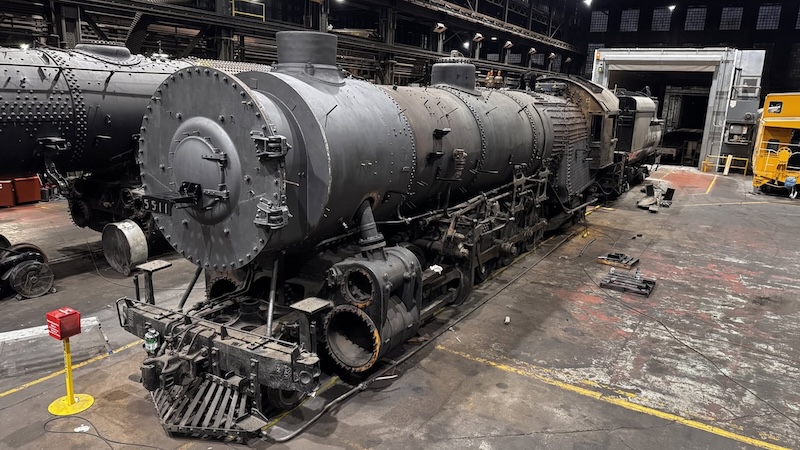
Closer to Cold Spring Shops headquarters, Railroading Heritage of Midwest America, working out of the onetime Rock Island Lines shop complex at Silvis, has performed a hydrostatic test on Union Pacific TTT-6 freight mauler 5511, the next step toward operating it.


Railroading Heritage photo retrieved from Railfan and Railroad.

The locomotive last operated in Union Pacific service in 1956, and remained in Union Pacific storage at Green River and Cheyenne, ultimately being donated, along with other steamers, including Challenger 3985, to Railroading Heritage.  That might be one of the other steamers disassembled in the background.

The TTT is a somewhat more powerful mudsucker than the Chinese QJ steamers on Iowa Interstate's inactive roster.

THE SECRET IS OUT.

Advice to beginning faculty members: deans might not read, but they can count.  "Does it come as a surprise that much of the research enterprise turns into a quest for the minimal publishable unit?  Or that average people cut corners?"  Now comes frequent Instapundit source, Wisconsin Law's Ann Althouse, with confirmation from within the enterprise, in the form of Fields Medalists objecting to people, not necessarily academic mathematicians, using algorithms to solve the famous open problems in mathematics.
The goals of the AI companies and the goals of the mathematical community are severely misaligned. We see these as part of broader alignment issues impacting other scientific and creative professions, as well as the whole of society.

Research mathematics deals with understanding basic structures of shapes, numbers, and natural phenomena. Over the course of generations, it has built a large corpus of sophisticated ideas, methods, abstractions, and other tools to comprehend the mathematical landscape. In turn, modern technologies and sciences are based on mathematical tools.
A retired mathematician's comment suggests the use of algorithms might not affect the academic enterprise much in any event.
I have literally never used AI in any of my research. My area is obscure enough that I doubt AI would have much interest any time soon in the research I do. Slightly more broadly, the big unsolved problems in my field (e.g. the Alperin weight conjecture) could maybe be finished by AI, but (best case scenario for AI) it would be pretty transparent that it was putting the finishing touches on a project that humans had been building up for decades (for instance, the McKay conjecture and the Height Zero conjecture were around in my field for decades, and have recently been solved by humans - humans who spent years putting the finishing touches on work that others had spent decades building up).
His concluding remark, however, motivated my thesis. "And a person reading about the proof of Fermat's Last Theorem might be inspired to sharpen their analytical skills, learn some math, and that could develop into something useful.  Like developing AI, oddly enough."

HOW'S THAT CONFERENCE REALIGNMENT GOING?

Last fall, ESPN's Ryan McGee's version of the Bottom Ten included Northern Ill-ugh-noise.  It's another year, another conference, and leading the list is Northern Ill-ugh-noise.
The Other Huskies were bitten by the Georgia State Not Southern Panthers 35-14 last week. Props to NIU for equally distributing its losses, with one each to teams in the Big Ten, Missouri Valley, Big 12 and Sun Belt. That is, as we say on "Marty & McGee" "apro-pro" because I can never remember which conference NIU is now in.
Not that it matters this Saturday, as they have the Flying Byes of Open Date U., to use Mr McGee's terminology, followed by an evening homecoming game with the Flying Falcons of Air Force, which also play in the Mountain West.  Off we go, into the bowl chase yonder.  Both the university's orchestra and the community symphony orchestra have performances scheduled for that Friday and Saturday.

29.9.26

THE RACE TO ELEVEN WINS.

David Manney's "From Uecker on the Radio to 103 Wins: What a Season" celebrates the Milwaukee Brewers path to the playoffs.
Some of my favorite Brewers memories don't begin at a ballpark.

They begin on a hot Wisconsin summer night with my dad, my brother, and me fishing on Half Moon Lake in Carson Park while Bob Uecker called the game on the radio. You could hear the water, the insects, maybe somebody fumbling with tackle, and Ueck describing baseball as only he could.

Those nights became part of what the Brewers mean to me.

There were ballpark memories, too. I remember going to the Met in Minneapolis and watching Larry Hisle hit two home runs against the Twinkies, including one off the fair pole.

Years later, sitting in the left-center field bleachers at the Metrodome, I had binoculars on home plate while Paul Molitor stole home while Robin Yount stood at the plate. It remains one of the greatest baseball moments I've ever seen in person.

And I know what some of you are thinking: the MLB lost some of you as a fan. I respect that. For me, however, baseball is part of me.

Growing up in Eau Claire, Wis., it meant it was easier to see the Brewers play the Twins than to drive three hours to Milwaukee County Stadium.
Until 1971, I was able to listen to, and suffer through, Brewer games on WTMJ, with Merle Harmon, and later Bob Uecker, on the play-by play; for the last forty years I've been able to enjoy the day games, but must make do with, or without, a scratchy radio broadcast of the night games, including much of that season-ending series win in Philadelphia and the sweep of the Cardinals.

THE BITTER FRUITS OF ADULTISM.

Deconstruct "I'm the boss, you're the kid," and bear what follows.
I’ve never considered taking a drink into an interview. I’m not even comfortable taking one if offered. I don’t do it because it’s generally a short enough process that it’s unnecessary.

And frankly, saying you need to stay caffeinated to talk to a potential boss sends signals I don’t know that I’d have been a fan of.

The problem here is that people are opining on this sort of thing often without asking a question of why we tended not to bring beverages to interviews in the first place. It’s one of a thousand examples of people seeking to upset the status quo without understanding why the status quo exists.

On the flip side, many of those who are upset over it may not even know why they’re upset over it. I doubt anyone came right out and said, “You guys tend to be so boring that I need as much caffeine as possible to stay awake to talk to you.” They just got bent out of shape from the start.

These little rules are common, but they generally all start from somewhere, and like Chesterton’s Fence, we need to understand them and why they exist before we set about dismantling them.
That's Tom Knighton, reacting, correctly, to the most recent first world problem: should a job-seeker bring an iced coffee to a job interview.  His conclusion?
Perhaps more importantly, why do you think you need it inside with you for a 20-minute interview? Or do you just need to knock down doors for the sake of knocking them down?

If so, be careful, because you might be on the other side of that desk and have to deal with someone just like you, only worse, and have no recourse left because of what you did at the time.
Call me old school, bringing your own drink, hot or iced, into an interview, let alone food, signals a lack of seriousness.  If the interviewer offers you coffee, tea, or water, politely accept or decline: the prudent thing might be to decline, the offer might be to put you at ease or perhaps as a test of your impulse control.

The economics job meetings offered a different sort of hazard: there were departments that conducted interviews with bottles of the adult beverages in plain view.  Always politely decline an offer of one!

COMPLEX ADAPTIVE SYSTEMS, DOING WHAT THEY D**N WELL PLEASE.

In mid-August, "If you don't like the weather, wait" proved to be logical advice.  "The Old Farmer's Almanac forecast is out, and the Great Lakes summary might be 'expect anything."  "The almanac forecast predicts the northern Plains and Upper Midwest could be drier at times, 'especially when the southern storm track becomes dominant.' Still, intense cold, wind and snow are possible, with clippers, sudden cold snaps and snowy periods likely.'"  So, too, with the northern hemisphere's hurricane season, which is defying all the expectations.

Saith the reporters, "Hurricane season is broken. Two oceans are historically out of whack."  How so?
The 2026 hurricane season has been remarkable, from the potentially record-breaking calm in the Atlantic Ocean to the hyperactive eastern and central Pacific Ocean.

Only seven tropical storms have formed in the Atlantic, while 18 tropical storms and hurricanes have formed in the Pacific. In a normal year, the Atlantic and the eastern Pacific hurricane basins see similar activity, with 14 to 15 named storms, including seven to eight hurricanes by the time the season ends on Nov. 30. This year, the Atlantic hasn't yet produced a single hurricane, while the eastern Pacific has already produced eight.

What's interesting about this season is that a few of the storms that have occurred in the two basins originated in Africa and were influenced by the same powerful climate phenomenon, El Niño. But the results have been very different, with fierce hurricanes in the Pacific and unremarkable tropical storms in the Atlantic.
Maybe it's time to look more carefully at the observations and recalibrate those extrapolation models, which are excessively sparse anyway.

28.9.26

THE LIMITS TO THERAPEUTIC CULTURE.

Earlier this month, we noted Sally Satel, a skeptic of much of therapeutic culture, nonetheless suggesting that despite its overuse, sometimes a psychotic is a psychotic.  That post concluded, "And so the research enterprise, the patient beavering away at ever more challenging anomalies not easily covered under a bright line rule, goes on."

Today's example: Jessi Gold's "Sometimes Stress Is Just Stress" in Inside Higher Ed.  Her warning: students might be quick to use the language of therapeutic culture, without the supporting therapy.
As a psychiatrist and a faculty member, I have noticed a growing trend among students: Everyday emotions are increasingly described as psychiatric diagnoses. Students are no longer simply sad—they are depressed. They aren’t just stressed—they are anxious. With this lens, normal developmental challenges like academic pressure, relationship struggles and social adjustment are now filtered through the language of mental illness.

While casual use of mental health terminology and self-diagnosis isn’t new, social media has dramatically expanded its reach.
It's likely that anyone in medicine has ample horror stories of people who come in with all sorts of fearful questions, that is, if they don't question what the practitioner is spelling out.

I'M DONALD TRUMP AND I APPROVE THIS MESSAGE.

Troll level: way beyond Dick Tuck.
The National Republican Senatorial Committee (NRSC) is apparently seeking regulatory guidance on a very serious campaign-finance matter: how exactly should it report Hasan Piker’s generous contributions to the Republican Party?

In a letter to the Federal Election Commission, the NRSC asked how it should quantify the value of Piker’s commentary, which reaches millions across Twitch and other digital platforms. After all, when a prominent left-wing streamer repeatedly says things so inflammatory, divisive, and politically self-defeating that they may as well be GOP advertising, surely someone has assigned a dollar value to the service.
I wonder what rights a political influencer has to his social media clips that get quoted, either in full (the most effective way to attack a person is to show him unedited) or in part (which also puts the person on the back foot, spending time showing how he's taken out of context).  Those social media clips will be dropping, what with Election Day about five weeks away.