
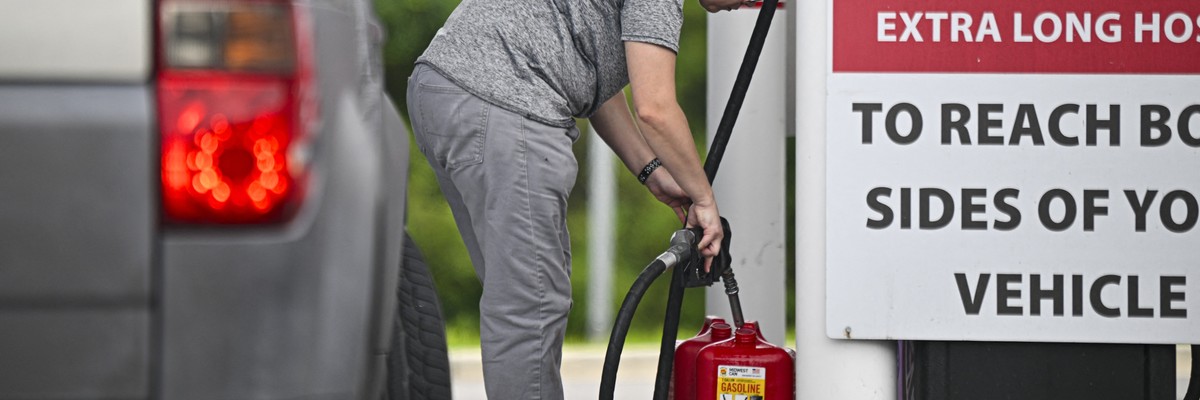
People fill up gas containers at a station in Lakeland, Florida on October 8, 2024
ahead of Hurricane Milton's expected landfall.
(Photo: Miguel Rodriguez Carrillo/AFP via Getty Images retrieved from Common Dreams)
ahead of Hurricane Milton's expected landfall.
(Photo: Miguel Rodriguez Carrillo/AFP via Getty Images retrieved from Common Dreams)
Lakeland is about as far inland as one can get in Florida, and the news reports out of Tampa suggest the gas stations there have run out, and with the inbound highways unavailable, the replenishment tank trucks are unlikely to get through. "About 17.4% of 7,912 gasoline stations in Florida had run out of fuel. ... A growing number of gas stations were flashing empty signs on Tuesday as panic-buying gripped Florida."
"Panic buying" looks like what you see in Lakeland: the tank is full, the gas cans that would otherwise be for the motorboat or the lawnmower are full, and the lines at the gas stations move more slowly as the hoarding progresses.
There's nobody with the authority to cajole or shame people to buy enough to get clear of the cone and top off further north.

It's so much easier to shame the corporations.
The head of the Congressional Progressive Caucus and a group of Florida representatives said late Tuesday that the federal government must do more to crack down on airlines, hotels, and other companies taking advantage of emergency conditions brought by Hurricanes Helene and Milton to jack up prices and pad their bottom lines.I'm not sure what's lower, exploiting vulnerable people for political gain, or using politics to allocate resources that just aren't there.
"Instead of making it easier for people to evacuate, airlines and hotels are exploiting a horrific situation to charge astronomical fares only the rich can afford—from over $600 for a single night in a Hampton Inn to over $1,000 for flights that usually cost around $100," Rep. Pramila Jayapal (D-Wash.), the chair of the CPC, said in a joint statement with Reps. Maxwell Frost (D-Fla.), Sheila Cherfilus-McCormick (D-Fla.), Darren Soto (D-Fla.), and Frederica Wilson (D-Fla.).
"Exploiting vulnerable people fleeing a deadly storm for higher profits is a new low," said the CPC members as Hurricane Milton barreled toward Florida as a monstrous Category 5 storm, fueled by record-high ocean temperatures made far more likely by the climate crisis. The hurricane is expected to make landfall in the Tampa area on Wednesday night.
The federal lawmakers' statement came amid a flood of price-gouging reports from Florida residents seeking to escape Milton's path. A spokesperson for Florida's attorney general said earlier this week that the office had received hundreds of complaints about price gouging, particularly for fuel and water.
"There were also scattered instances involving overnight accommodations, including one Airbnb listing of a 'room in Tallahassee' for nearly $6,000 a night," The Tallahassee Democrat reported Tuesday. The outlet noted that "during a storm-related state of emergency, state law prohibits price gouging for equipment, food, gasoline, hotel rooms, ice, lumber, and water needed as a direct result of the event."
The Biden Transportation Department, meanwhile, said it has "been in touch with airlines to get more information about the capacity and affordability of flights in the affected areas" amid reports of sky-high ticket prices. President Joe Biden said Tuesday that he is "calling on the airlines and other companies to provide as much service as possible to accommodate evacuations and not to engage in price gouging, to just do it on the level."
I therefore shy away from saying anything about "panic buying." A higher price closer to the expected location of landfall might provide people with reason to leave some for the next guy and top off at a distance, and buy a six-pack of bottled water rather than a palled. But if you're the Congressional Progressive Caucus, expanding your power is the categorical imperative.
In their statement Tuesday, Jayapal and the Florida lawmakers noted that "in North Carolina and Georgia, while families try to recover and rebuild from the devastating impacts of Helene, there have been hundreds of similar incidents of bad actors price gouging residents on everything from groceries to gas to hotel rooms."That demagoguery will do nothing to provide an additional gallon of gasoline, bottle of water, sheet of plywood, or seat on an airplane to people getting out of the storm's way.
"This egregious price gouging hampers evacuations and undermines recovery efforts, while putting vulnerable residents in serious jeopardy," they said.
While welcoming the Transportation Department's efforts to monitor and prevent airline price gouging, the progressive lawmakers said that "we will need a whole-of-government focus" in the coming days and weeks "on protecting the people impacted by these disasters from predatory price gouging."
"Further action is still needed from the federal government to stop the corporate exploitation that impacts all areas of American life, whether at the grocery store or gas station," the lawmakers said. "We need a federal ban on price gouging, more stringent antitrust laws and enforcement, and for Congress to reassert its role and governing power in this space—something CPC is deeply committed to and actively engaged in."
I'll let Reason's Jack NiCastro take it from there.
It's understandable to call for government assistance when faced with the havoc wreaked by natural disasters. But the government is just one kind of human institution—one that often lacks sufficient information to help people. To deliver disaster victims the goods and services they desperately need, it's better to rely on market mechanisms.Well, a state actor could avoid rationing the gasoline and water by price, by using politics or force to ration it. But if emergency managers in Florida issue hurricane season ration coupons, to be used only when the government declares an emergency, the price gouging goes on at one remove (I figure out how much of my allotment will get me out of the affected area, sell the rest of the allotment, and top off outside the affected area) or the authorities have to station jackbooted enforcers to put an end to the "panic buying." I suggest brown uniforms with Sam Browne belts. Maybe, Mr NiCastro suggests, there is an easier way. "The government should avoid scrambling the very signals that allow consumers and producers to recover from devastation."
In the early and mid-20th century, so-called market socialists Oskar Lange and Abba Lerner argued that centrally planned economies are theoretically more efficient than capitalism. But Ludwig von Mises and Friedrich Hayek disabused technocrats of such fatal conceits, winning the calculation debate and elucidating the knowledge problem. The historical record has empirically substantiated the superiority of markets to create, allocate, and innovate.
"But," the stubborn statist objects, "markets only work under normal conditions; in emergency situations we need the government to resolve the crisis." While such arguments are politically popular, they are economically vacuous.
The state does not become omniscient during times of crisis and the price system that conveys information about local circumstances is especially useful during such times. Recognizing their lack of knowledge, governments should adopt the following laissez faire policies to allow those with the know-how to recover from disaster.




No comments:
Post a Comment