
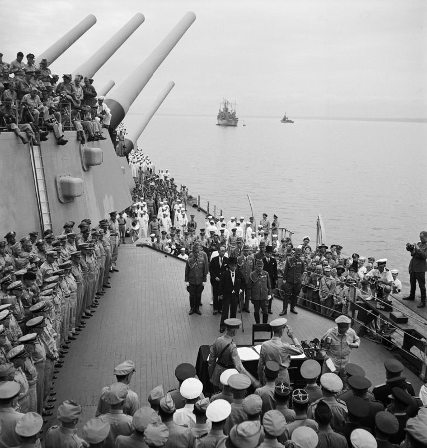
USS Missouri in Tokyo Bay.
Unattributed photograph retrieved from Ace of Spades.
Unattributed photograph retrieved from Ace of Spades.
The way the surrender came to pass continues to provoke people. There's a provocative hypothesis nailed to Newmark's Door: "Did the Nagasaki bomber ‘miss’ on purpose to save lives?"
Interesting, if true.
Few people have heard of Captain Kermit Beahan.Make what you will of the story that follows.
Beahan was the bomb-aimer on the B29 that dropped the plutonium bomb, known as Fat Man, on Nagasaki on August 9, 1945, an act that ended possibly the cruellest war in history.
Except that he didn’t drop Fat Man on Nagasaki: He dropped it to the north, 2.18 miles short of the city –— on tennis courts belonging to the managing director of Mitsubishi, next to what had been the largest Roman Catholic cathedral in Japan, in the hilly suburb of Urakami.
Because of Beahan’s “near miss”, much of the blast went over the city or was absorbed by the hills, thereby preventing a much larger loss of life. Indeed, a centre-of-Nagasaki “bulls-eye” would have killed a hundred thousand — but the final count, six months later, was thirty-eight thousand.
That is still a horrendously large number of deaths, but the story behind Beahan’s near-miss may be one of the most humane acts in the long history of warfare.
It was never intended to bomb Nagasaki — it was the secondary target. The primary target was a factory in the city of Kokura, then surrounded by the highly populated industrial cities of Yawata and Tobata. Had Beahan dropped the bomb there, as planned, there would have been an estimated 300,000 casualties.
President Truman had ordered that the bomb could only be dropped visually — Beahan had to be able to see the target. The army air force had two weather aircraft over Kokura, and both reported a tenth of cloud — essentially a sunny sky, so there should have been no impediment to a visual drop. But that’s not what happened.
Did a single bombardier, Captain Kermit Beahan, having seen the carnage of Hiroshima a few days earlier on August 6, decide himself to drop the fantastically destructive bomb to the side of the secondary target? Or, did someone very senior order him to?As the Manhattan Project came close to delivering the Bomb, some of the boffins, fretful about the power of the weapon they had developed, suggested that the first one be dropped somewhere near Japan to let the imperial warlords know what they were facing. That didn't happen, in part because some of the boffins were also worrying about their device not working. What effect would a big splash and no boom in the sea have? They also worried about their device not working when it was used in anger, as a reasonably competent Japanese physicist could figure out what they were up to. For better or worse, both bombs worked as designed.
But might President Truman, troubled by the bomb damage assessments out of Hiroshima, have ordered something similar in order to make good on his threat of "a rain of ruin?"
While it was possible to discern a half-hearted postwar cover up, none of the suggestions of cloud cover or smoke blowing over the target were at all convincing. Beahan’s actions were either self-determined or ordered. In other words, there was no cloud cover that day at Kokura.What we do know is the second guessing of the second Bomb run, whether disrupted by weather or by a back channel communication from National Command Authority goes on and on. Too often, notes Nathan J. Robinson in National Affairs, it degenerates into a version of the trolley problem with people offering their justification for running over this person or these five people.
Truman was deeply appalled at the huge loss of life at Hiroshima. Possibly he used one of several back channels to bypass LeMay, and communicated directly with General Farrell, the chief of field operations, on the island of Tinian before the B29 took off. But as with so many conundrums of history we will probably never know.
All kinds of hideous acts are justified every day for one reason or another, and, there is nothing truly remarkable about the fact that people continue to defend the annihilation of 125,000 human beings at Hiroshima and Nagasaki. But there is something curious about these inevitable outpourings of excuses for America’s conduct. It’s not the argument itself, but the intensity of the sheer certitude with which the acts are justified. Seventy years on, [the linked article dates to 2016] not only do media experts rush to excuse the bombings, but they rush to excuse them with a certitude that one usually sees reserve for the most elementary scientific truths. To these writers, that Hiroshima and Nagasaki were justified is as obvious as the law of gravity. Argue with a defender of the bombings, attempt to inject the smallest portion of doubt into the consensus, and one will be accused of pacifism and the revisionist conception of history.I suppose in polite society, it is better to make some sort of nuanced utilitarian argument rather than to come out and say "Screw around with the bull and get the horns." And thus you get Josh Hammer, probably demonstrating the sort of certitude Mr Robinson dislikes, throwing the switch to divert the trolley in a way that loses fewer Allied lives.
Commentary defending the attacks consistently exudes this hyper-confidence in their correctness.
More than 100,000 Americans had already been killed in the Pacific theater, and those who had survived were overjoyed by Truman's decision: They knew they would live and return home to their wives and children.One of the passengers on the trolley was Paul Fussell, later a professor at the University of Pennsylvania.
Truman's decision also affirmed a deeper American nationalistic sentiment: that from an American perspective, the safety and security of American lives must necessarily be prioritized over foreign lives. Truman did not see any moral virtue in sacrificing our soldiers on the altar of an abstract globalism or a relativistic humanitarianism. His first obligation as commander in chief was to protect American lives by securing a final, unconditional end to the war. In this, he succeeded — resoundingly.
Critics often claim Japan was already on the brink of surrender. They point to back-channel diplomacy and note the Soviet declaration of war the day prior to the bombing of Nagasaki. But Truman didn't have the benefit of postwar memoirs or archival research. He had bloodied maps, hundreds of thousands of dead soldiers, grieving families, and military intelligence suggesting the Japanese military would never accept unconditional surrender without a shock so great it shattered their will to fight.
This, too, reflects a clarity that modern Western leaders often lack: the resolve to act decisively, to bear the weight of terrible decisions in pursuit of peace and justice. Truman's choice was not only militarily sound but morally defensible. The bombings were not, as many armchair critics have argued over the decades, a cheap form of ethical utilitarianism; Truman's decision to bomb was simply reflective of how real war-and-peace decisions must be made in the heat of the moment, when the stakes are the highest.
It is fashionable now to question the morality of Truman's decision from the safety of the present. But it is an act of historical myopia to pretend that the atomic bombings were gratuitous or overly callous. They were not. They were the tragic price of a brutal victory and the necessary cost of hard-fought peace.
War, we know, is hell. Indeed, that is a very good reason to avoid starting wars in the first place. But once upon a time, Western societies understood that once a horrific war has been initiated, there can be no substitute for absolute victory. That lesson has long been forgotten. It is past time to learn it once again.
Fussell, died aged 88 in 2012, was a very deliberate and conscious iconoclast. In Doing Battle, Fussell admits that in writing his essay “Thank God for the Atomic Bomb,” published in The New Republic in 1981, he was “not innocent of a desire to make trouble.” There, defending the August 1945 bombing of Hiroshima and Nagasaki, he had riled many of his professorial colleagues. He had argued that “to the [American] ground troops about to invade Japan, the atom bombing of Hiroshima and Nagasaki was hardly an occasion for guilt. Just the opposite – [it was the occasion] of rejoicing and relief so overwhelming that it was hard to hold back tears, and gratitude so genuine that even those [like himself] who had spent the preceding months violating many of the Commandments, especially ‘Thou shalt not kill,’ assumed that their standing with the Almighty was still so unimpaired that they could without anomaly thank Him most fervently.” Of course, all or almost all, of Fussell’s academic critics had never seen combat.There's plenty of that "hyper-confidence in their correctness" in that excerpt, probably to the annoyance of Mr Robinson. It might make for click-baity commentaries the first week or so of each August, but does it advance an intellectual argument?
Yes, Fussell knew that while “gratifying to the aging ex-infantrymen [who in summer 1945 were about to be disgorged on the beaches of Honshu and were likely to die or be maimed in great numbers by Japanese heishi],” his essay would “annoy pacifists, certain social scientists, international reformers, and others ignorant of the ugly physical and psychological details of the war they had little intimate knowledge of.” Some 210,000 Japanese died in the nuclear-bombed cities. Fussell did not argue, as he could have, that many, many more Japanese would surely have died had the American army been forced to invade Japan and had the American air force blanket- and fire-bombed all of Japan’s cities, until victory was achieved - had not the war been abruptly, “prematurely,” halted by the atomic-bombing of the two cities. After the publication of Fussell’s article, The New Republic was flooded with letters of outrage and rebuke, “virtually all from obvious noncombatants.”
Those who are horrified by the casualties of Hiroshima and Nagasaki are therefore putting unreasoning sentiment above practical necessity. The only moral choice was to drop the bombs, since they ultimately saved lives.Early on in the evolution of Cold Spring Shops, I noted, I lack the expertise to sort the counterfactuals out. The rain of ruin achieved the surrender we note today. Was it a victory we could live with? That we're still debating it suggests people still have reservations. Was the alternative an invasion of the Japanese Home Islands? That's what all those GIs bobbing around on ships in the Pacific or being returned from Europe to be sent into action in OLYMPIC were bracing themselves for. Might a tight blockade of the Home Islands, starving the True Believers and His Majesty's cowed subjects alight, have done the job instead? Under that counterfactual, would the victors then have to live with the recollections of children slowly starving, and what sort of utilitarian trolley switching would its Deep Thinkers engage in then?
This argument is the one put forward in 1945, and the historical debate has not reached a clear resolution. Opponents of the bombings insist that the decision had little to do with the surrender; the Japanese were on the verge of surrendering anyway, and the bomb was intended to intimidate the Soviets rather than the Japanese.
If discussions of Hiroshima and Nagasaki occur on these terms, however, they are destined to be forever irresolvable and polarizing. First, running a historical counterfactual and determining what “would” have happened if the bombs had not been dropped is an impossibility. Second, people’s underlying position on the question of whether nuclear weapons are acceptable is destined to influence their interpretation of the historical evidence. The more horrified one is by nuclear weapons, the more one is likely to want to believe that the Japanese were on the verge of surrender. The more one believes that American foreign policy is a force for good, the more one is likely to believe that the bombings were a well-intentioned effort to help people by a president concerned with minimizing casualties. Pre-existing political tendencies will inevitably color the interpretation of murky historical evidence.
But if the evidence is debatable, then the extreme confidence of the bombings’ defenders is both unwarranted and disturbing. Even if we just have an open question as to whether the slaughter of over one hundred thousand civilians was a necessity or totally pointless, the stakes of the issue seem high enough that conservatives ought to be hesitant before issuing bluster in defense of mass death. With an impossible counterfactual to contend with, a hot dispute among scholars, and a brutal event under discussion, pejoratively writing off disagreement as “illiterate” and “wailing” somewhat undermines one’s confidence in the writers’ capacity for fair assessment.
Indeed, it is the sheer glibness of so much of the disdain that is worrying, that makes one question whether they are even concerned about the moral questions at all.
Let me close with a somber thought. There are almost no humans on Earth with a living memory of a nuclear weapon being used. It's when the people with living memories of things good or ill, more generally of things ill, pass from the scene, that those ill things return. We've had the echo of the 1917 influenza. What's next to bob up from the storage units of Things Long Gone? "China still resents, quite deeply, the 1937 Rape of Nanking by the Imperial Japanese Army. Tokyo Bay's peace treaty didn't settle that."




No comments:
Post a Comment