Wisconsin athletics director Barry Alvarez asked lawmakers Wednesday to help his department avoid a potentially huge tax liability.Bingo. "Required donations are not donations."
The [Wisconsin] Department of Revenue is threatening to start collecting the sales tax on donations made to Badgers’ athletics by people trying to qualify for season tickets, Alvarez said. His department would owe $400,000 in the first year and up to $2 million if the tax is collected retroactively to 2001, he said.
The Badgers’ legendary former coach testified in favor of a bill that would specifically exempt such donations from the sales tax. Fans would still pay the sales tax on the face value of the tickets.
“The failure to enact (the bill) would have an immediate negative financial impact on the Athletic Department,” Alvarez said.
An Assembly committee voted 11-0 for the bill after a 45-minute hearing. A similar plan failed to pass the full Legislature last session.
The department started requiring donations for preferential seating at football, men’s and women’s basketball and hockey games several years ago as part of a plan to get its “financial house in order,” Alvarez said.
The school charges up to $250 for Wisconsin football season ticket holders and smaller premiums for other sports. The payments are required for 38,000 seats at Camp Randall and 6,500 at the Kohl Center, Alvarez said.
18.11.07
SALES TAX MEANS SALES TAX. That goes for the Wisconsin football program, too.


IT'S HARD TO WIN A HAND OF LEASTER. Northern Illinois moves from #4 in the Bottom Ten to beyond the waiting list.
17.11.07
OUR NEIGHBORS AT WAR. Remembering Specialist Ashley Sietsema, Illinois National Guard and Northern Illinois University.
QUOTE OF THE DAY. Life choices are not interchangeable.
"This is the dark underbelly of cohabitation," said Brad Wilcox, a sociology professor at the University of Virginia. "Cohabitation has become quite common, and most people think, 'What's the harm?' The harm is we're increasing a pattern of relationships that's not good for children."The article goes on to note that Professor Wilcox's observation is not yet consensus among practitioners.
14.11.07
PAGING LOTKE AND VOLTERRA. Predator cycles are part of the balance of nature.
I also found this predator cycle simulation that appears to provide an online interactive application.
It is a desperate - and likely endless - fight to protect the delicate ecology of the world's first national park, home to a rogue colony of Lake Michigan lake trout that biologists believe was illegally planted in Yellowstone Lake by self-serving anglers hungry for bigger trout to fry.That is, until the bigger trout population falls into a Malthusian trap.
A model of biological evolution is considered, based on Lotke-Volterra population models (ecological interaction), with mutation being modelled by introducing new species with random ecological connections. It is found that the system evolves away from the ecological equilibrium point to a sort of steady-state balancing extinction with speciation.That's the scientific version. The popular version goes like this.
Read the rest of the story. It's depressing.Lake trout belong in Lake Michigan. The big lake gets out of whack without a top predator to cull its schools of smaller prey fish, including pesky alewives. But overfishing, pollution and an onslaught of invasive species combined to wipe out the king of the Lake Michigan food chain about 50 years ago.
Today, Lake Michigan lake trout are hatchery-raised and, like a dose of antibiotics, dispensed annually to help keep swarms of prey fish in check.
But in an absurd twist of ecological irony, it's a different story in Yellowstone.
In Yellowstone, Lake Michigan lake trout are the disease.
I also found this predator cycle simulation that appears to provide an online interactive application.
THERE WERE HIAWATHA PARADE FLOATS. The Hiawatha Room posts this picture of one built for the 1941 American Legion convention in Milwaukee. It appears to be parked between two of the support buildings at West Milwaukee Shops.

There are some differences between it and the mystery relic, but there are similarities.
In other Hiawatha nostalgia, consider the in-progress restorations of Coffee Creek and a 1948 leg-rest coach.

There are some differences between it and the mystery relic, but there are similarities.
In other Hiawatha nostalgia, consider the in-progress restorations of Coffee Creek and a 1948 leg-rest coach.
13.11.07

REVEALED PREFERENCES. An anonymous professor at an ambitious Southern flagship university raises a familiar gripe.
Lost in the shadows of the administration's grandiose vision are the basic necessities of professional life. The real work of the university takes place on the ground -- in the classroom, the library, and the faculty office. And those of us on the ground doing the work should be equipped with the shovels and boots our dusty work requires.Sometimes the working conditions are no better elsewhere. Everything this columnist notes is also daily reality in at least one enrollment-impacted department in a mid-major.
But who wouldn't want to achieve greatness, or the illusion thereof, on the cheap?And there you have it, the list of vague values that propel this institution forward, punctuated with the ubiquitous exclamation point that is the hallmark of [Big Southern's] proclamations: Diversity, Excellence, Rankings.
What do any of those labels really measure? And what do they really mean? How do they translate into the material conditions of my professional existence? The buzzwords stubbornly resist embodiment in mundane -- yet crucial -- items like adequate supplies of departmental letterhead, functional furniture, clean corridors, reliable e-mail systems, and, yes, soap in the bathrooms.
When my classes are at full enrollment, there are so many students and so many desks that my instructional space at the front of the room is reduced to a rectangle -- no more than a foot in width and 3 feet in length -- in which I pace like a caged animal back and forth before my students. I could gain another foot of space by moving the overhead projector, but that easy solution evades me as the projector is literally chained to the front wall.
I note this column in light of the Northern Illinois strategic plan, of which more perhaps next week.The biggest obstacle -- not only for myself but for the realization of the university's ambitions -- is the great disparity between its abstract mission statement and the material requirements of the teachers and scholars for whom the mission is a mandate.
The administration wants BSU to become one of the "top" institutions in the country, and to achieve that goal with facilities that are outdated, overcrowded, and ill-maintained, and with technologies that are unreliable, obsolete, and often unavailable.
MAKING THE CASE FOR A CORRIDOR. The editors of the Milwaukee Journal-Sentinel hope to harvest a few spillover benefits, no doubt at somebody else's expense, from a Chicago Olympiad.
Let me take this occasion to remind readers, and Journal-Sentinel editorialists, what speeds used to be routine on that railroad.
That is, if the International Olympic Committee awards the 2016 summer games to Chicago. Whether that happens or not, there are developments on the Hiawatha corridor. The aesthetes at the paper have been down on the 1960s design of the Milwaukee station for some time. That station has received a makeover, and architecture critic Whitney Gould suggests there can never be enough of that Penn Station-style open space in a railroad station.In addition, the Olympics bid could finally jump-start long-overdue improvements in rail transportation, including the possibility of a high-speed rail link between the two cities.
On that score and others, Chicago Mayor Richard Daley, Milwaukee Mayor Tom Barrett, Milwaukee County Executive Scott Walker and the congressional delegations need to read from the same playbook. A seamless and reliable transportation system is key.
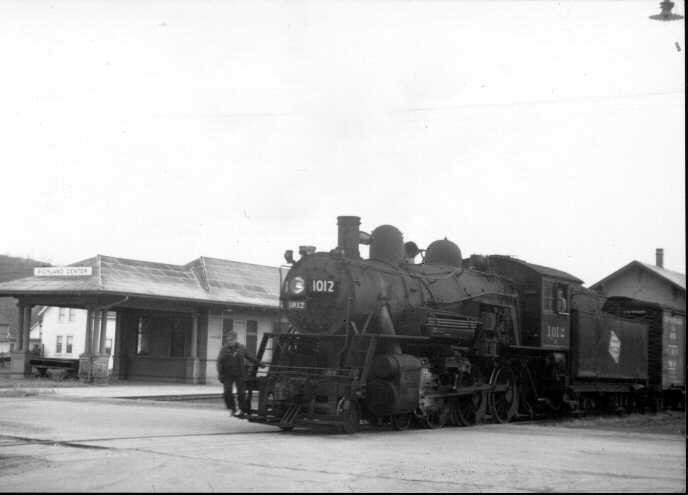
Those arches ("modern renaissance" on the outside, echoed over the ticket windows inside) were state of the art in 1965, and that "silly bell tower" was characterized by Trains as "a nod to its 1886 predecessor" which had a full clock tower. The porte-cochere came in handy for transferring to taxis on a rainy day, as well as honoring a Milwaukee Road tradition (see the new and old Sturtevant stations, as well as Milton, or Richland Center with its canonical porte-cochere.) All the same, the station upgrade is good to see.Gone are those elongated, cartoonish arches and that overbearing porte-cochère. Gone is the silly bell tower. No more broken doors and stick-on bathroom tile.
In their place is a luminous atrium that extends the building 30 feet north to the street, adding 7,500 square feet of space to the waiting area. Architect Greg Uhen has created a soaring, 50-foot-high room whose lively structural elements - crisscrossing white beams - express the sense of movement and connection embodied in a terminal for trains, buses and, perhaps someday, commuter and light rail (a prospect that seems less far-fetched as oil prices edge toward $100 a barrel).
Let me take this occasion to remind readers, and Journal-Sentinel editorialists, what speeds used to be routine on that railroad.
12.11.07
THAT MERIT TRAP, AGAIN. An essay in Chronicle Careers addresses some of the same issues as a post I noted here, a bit more coherently but no more persuasively.
The essay doesn't spell out which state schools. Is he referring to a flagship campus, a comprehensive, or a Division III party school? I keep claiming there is excess capacity in the institutions last named. Evidence to the contrary might prompt me to tone it down.Many of my childhood friends have struggled to find stable, full-time work. The police and fire departments aren't hiring; nursing and education have shifted to part-time, no-benefits operations; manufacturing is long gone; and the union jobs that lifted many of their fathers into the lower-middle class have disappeared.
So, in the place where I grew up, there are men and women in their 30's who live with their parents and can't start families because there are so few real jobs, even for the ones who put in a couple years at community college, transferred to a state school, and were the first in their families to get degrees that were sold as certain tickets to the middle class.
A lot of those people end up delivering pizzas, mowing lawns, waiting tables, or working the checkout lane at Wal-Mart for $7.15 an hour, and the message spreads that education doesn't matter.College Lite? No. Warmed-over high school? Surely not.
But that is old knowledge in a lot of subcultures -- the world of their great-grandparents -- and it is being relearned in our new Gilded Age. As Anya Kamenetz has observed in her book, Generation Debt (2006), education is, more and more, not a ticket to anything but financial ruin. You have to know somebody who knows how the system works, who will help you. Or you have to start your own business, if you can get some money. But you probably can't. For some, mostly the men, the military seems like the only reliable way out. It's no accident that military advertising emphasizes earning marketable skills; you'll see the world, and you'll come back able to look your dad in the eye.That is, as Veterans Day observances remind, if you do come back, and as speakers at the observances remind, if you come back whole. (And even people who come back unhurt physically do come back changed intellectually.) But let's back up ... there's this reference to a "system" to which some people seem to hold mysterious keys.
To a great extent, my life's course was set by the determination of my parents to give me chances that they never had and to foster a conviction that I would not live as they did: to have only one child, to send that child to parochial schools, to emphasize study, and to enforce strict rules.No mystery there: that's the Habits of Highly Effective People. The mystery, and there are still plenty of social science books to write on aspects of it, is why that determination hasn't yet emerged as an evolutionarily stable strategy, and why one can observe variations in its observance among siblings raised according to the same rules.
But, even as a child, I can remember feeling that school was training me to be a subordinate in a culture -- nearly a caste system -- where the people who have money and power were different from us in personal style, language, and values. The suited professionals in their BMWs looked like members of some kind of alien occupation army; there was no possibility of communicating with them on equal terms. And they seemed to wield almost absolute power -- over rent, jobs, health care, schools, prices -- from inaccessible conference rooms in downtown office buildings. We never met their children because they lived in faraway suburbs.Some vast conspiracy that. I'll concede that there's more to joining those ranks than buying the right suit and driving the right car, all the John T. Molloy self-help advice notwithstanding. That's not the source of the problem, as the essayist goes on to note.
In the context of working-class schools, I saw that a few students -- compliant, ambitious, individualistic, and possessing an aptitude for mimicry -- were eventually singled out for advancement. They passed by using test scores, recommendations, and loyalty oaths in the form of application essays. And if one of those students succeeded in a decade -- usually by joining the lower class of suit-wearers -- they were brought back to reinforce the myth of unfettered meritocracy: "See kids, you just have to work hard."Let's pause for a moment and reflect on the implicit inequality of outcome in that "lower class of suit-wearers" and "myth of unfettered meritocracy." Grant for the sake of discussion that the highest-paying jobs earn larger salaries compared to the mean and to the lower-paying jobs today than they did 20 or 50 years ago. That suggests the value of the marginal product of those higher-paying jobs is rising proportionately faster than the supply. If there is in fact some conspiracy among those BMW-driving bespoke-suit wearing elites to keep the individualistic mimics (really?) down, there is also a powerful incentive for some conspirator to defect (hire the mimic for half the price of the holder of the prestige degree, get more than half the effort for it.)
I was a believer, but most working-class kids only half-trust what they are told. They see what happens to their parents and older siblings. And they know that trying too hard at school will cost them friends and make them targets for violence, particularly in the earlier phases of education, before the weeding process and tracking systems produce cohorts who cling to a sense of being exceptional and deserving, unlike their lesser peers. And they pay a price for spending time studying instead of building alliances in the neighborhood.There's a rather blunt book, Resentment Against Achievement, that calls for more careful work on why the greatest resistance against individual effort comes from the very communities that would appear to benefit most by a greater exertion of such efforts. Rather than engage those ideas, the essayist chooses to throw a pity-party.
Some students, like me, can rise into the middle class that way, putting the dangers of the early grades farther into the past, but, at some point -- maybe decades later -- the ability to mimic elites must become so refined, so subtle and nuanced, that one cannot succeed anymore. There are five forks, and you don't know what to do with three of them. You've never been to Martha's Vineyard. You are reluctant to speak anyway because you can't remember the rules for "who" and "whom." People are laughing, and you don't know why. You feel like a lead pipe on a lace napkin. You have risen to your level of incompetence, and what is there to do but admit you don't belong and rely on the charity of your hosts?Please. That social capital is relatively easily acquired. I also suspect that the circles of high achievers would welcome genuinely productive additions to their ranks: it's no accident that "income inequality" and "time crunch" coexist in the Popular Perspective. The author's closing remarks raise the possibility that the people remaining in the old neighborhood might have problems themselves with their neighborhood's verities.
I don't belong in the old neighborhood either. I made my choices long ago; or perhaps others made them for me. No one is awaiting my return. I think I can hear what they'd say: "You seem to like playing the working-class hero for rich people. Whatever. Do it if it works for you. You never belonged here anyway, even when you were a kid. If I could get out of here, I would. So get on with your life. We'll be fine without you."What that imaginary friend is suggesting is "Are we making our own lives more miserable by making the lives of our ambitious acquaintances miserable?" So, again, why the persistence of resentment of the strivers by the non-strivers?
FASTER THAN THE LIMITEDS. Destination: Freedom notes China Rail's purchase of latter-day trolley sleepers.
There might be some quibbles from friends of the Interstate Public Service and Illinois Terminal about that "first EMU sleeping cars" although the absence of controllers is probably dispositive of any such quibble. The Chinese, however, are in a position to go the Chicago-New York Electric Air Line (scroll down to Faster than the Limiteds entry) a few times better by actually building and running the service. Well done, China Rail.The world’s first EMU sleeper cars are included in a $1.5 billion order for 40, 16-car EMU trains (640 cars) that the Chinese Ministry of Railways has awarded to the joint venture of Bombardier Sifang Power (Qingdao) Transportation Ltd. (BSP).
The joint venture members are: Bombardier Transportation, whose share of the contract is valued at $596 million; Power Corp. of Canada; and China South Locomotive and Rolling Stock Industry Corp. It’s the largest single order for rail passenger cars ever placed at one time in China.
Twenty of the trains will be designed for 155-mph-overnight sleeper service.
THUS ENDETH THE VERTICAL ZOO. The Milwaukee Journal-Sentinel notes the passing of Ogg Hall with a story headlined Raucous UW dorm goes upscale.
Ogg has fallen. Ogg will rise again.
There is, of course, an Ogg Blogg for the nostalgic.
When Mark Werth moved into the University of Wisconsin-Madison's Ogg Hall dormitory as a freshman in 1965, everything was new: the beds, the closets, the fluorescent lighting and the rotary phone in each room.Note: that was pretty upscale for those days, if the stories of the pay-phone at the end of the hall are more than hazy memories.
We referred to it as the vertical zoo. It was tear-gassed more than once during the waning years of Vietnam protests, and if any of my readers remember the Fish House swimming pool, check in and say hi.Werth helped build Ogg's raucous reputation from scratch, pulling fire alarms and lobbing water balloons.
"We were sort of pioneers for the newest residence hall on campus," said Werth, now 60. "When you told people you lived in Ogg, people said, 'Oh, the new one.' We got some cachet out of that."
By 1999, when Andy Masur moved to Ogg, kids still pulled its fire alarms. But the dorm had the smallest rooms on campus. With its 13-story towers, cinder block construction and 1960s look, Ogg earned a reputation as a bit of a dump.
Ogg has fallen. Ogg will rise again.
I wonder, though, whether there's still more interest in living in the two faux-Oxford quad buildings, Adams and Tripp. Years ago, the rooms there still had government issued gooseneck desk lamps and two or three rooms shared an electrical circuit. Now two or three rooms will share a toilet. (What, no communal shower to turn into a pool?)Demolition crews started last week to rip down the old Ogg Hall, where four decades of students spent their first nights away at college.
Across the street stands the new Ogg, a gleaming construction of sand-colored stone and reflective glass that opened this fall. It boasts larger, air-conditioned rooms, a kitchenette on every floor and a price tag that's nearly $800 a year higher than what students pay to live elsewhere on campus.
The new Ogg represents the new Wisconsin student. Many have never shared a bathroom, let alone a bedroom. They pay $7,000 for in-state annual tuition and fees.The article suggests that they're also going to be deprived of good stories to tell. Read it for the details. It also suggests that ETTS generalizes from the decline and fall of the great passenger trains to the collegiate experience.
The next generation of Badgers will, however, be able to truthfully say that they had to go to class against the wind and uphill both ways. (Everybody familiar with Madison's geography will grasp that truth in an instant.)Rooms in old Ogg were laid out in a circle around the elevators, while rooms in the new dorm are arranged in clusters of four, where eight residents share a bathroom. Other perks: each floor has a kitchenette with pots and pans and a study lounge with comfortable chairs.
"My friends are like, 'This is like a hotel,' " said sophomore resident Val Maharaj.
Yet some students say they miss the noise and interruptions of the old Ogg.
"You don't get to know as many people on your floor," said Megan Groves, who lived in the old dorm last year. "You have to make more of an effort to meet the rest of the floor."
And not everyone has been enthusiastic about the new campus digs.
In 2004, when the university won approval to build the dorm, some legislators from both parties bristled at its fanciness and price tag.
Masur said future Wisconsin students will miss out on the austerity of the college experience.
"There's so much money flowing into UW, with these fantastic dorms where kids have the greatest luxuries," he said. "As good as that is . . . it is losing something of the grittiness that we experienced."
There is, of course, an Ogg Blogg for the nostalgic.
11.11.07
AN ADJECTIVE, NOT A POSSESSIVE. That's Veterans Day. (Via University Diaries.) There's a meditation at Right Wing Nut House while Blackfive thanks Google for remembering.
SUMMONING THE ECHOES. In 1962, Vince Lombardi's Packers gave a new team called the Minnesota Vikings a 34-7 initiation to the National Football League. The teams have played each other approximately even in the wins-and-losses since then, with both the Vikings and the Packers going to four Super Bowls. This afternoon, however, the Packers went Lombardi and Phil Bengtson (who had the Bud Grant Vikings to deal with) and Dan Devine and Bart Starr and Forrest Gregg and Lindy Infante and Mike Holmgren and Ray Rhodes and Mike Sherman seven better. Packers 34, Vikings 0.
10.11.07
THE GALES OF NOVEMBER, REMEMBERED.

The full Edmund Fitzgerald tribute information is here, and I offer reviews of Mighty Fitz and The Wreck of the Edmund Fitzgerald, and the truth about that "S. S. Edmund Fitzgerald" lifering that washed ashore in Lake Superior last summer.

Paul Michaels photograph
The full Edmund Fitzgerald tribute information is here, and I offer reviews of Mighty Fitz and The Wreck of the Edmund Fitzgerald, and the truth about that "S. S. Edmund Fitzgerald" lifering that washed ashore in Lake Superior last summer.
UNINTENDED CONSEQUENCES. I've had an opportunity to follow up on a post from April and read Philip Orbanes's Monopoly: The World's Most Famous Game & How It Got That Way, which is a relatively easy way to produce Book Review No. 32. That earlier post developed most of the themes the book explores in greater length: apparently the earliest antecedents of Monopoly(TM) were the work of Henry George's disciples and other critics of capitalism, bent on demonstrating the evils of earning income from land ownership. (A game to illustrate the blessings of a socialist alternative strikes me as a more valuable propaganda tool as well as of greater intellectual interest. Sorry ... no "that's Candy Land" comments, please.) Eventual Attorney General (and trustbuster extraordinaire) Rexford Tugwell made an attempt at producing a real estate game as a collegiate teaching tool, and some of his economics students attempted further refinements. (But none of them achieved trembling-hand perfection, alas.)
Later, there was a great deal of maneuvering by Parker Brothers to secure the rights to Monopoly(TM) and to competing games including Finance, which always struck me as a cheap imitation of the real thing with somewhat more contrived property names, and now I know why. More than a few of the home-made board games included didactic spaces such as "New York, New Haven, and Death Railroad" (long before Patrick McGinnis), "Goat Alley," "Rickety Row," and the intriguing "Hulett's Landing." Rich Uncle Pennybags turns out to be a somewhat less menacing avatar of J. Pierpont Morgan Himself.
The book does not touch on the feature of the game that strikes me as most paradoxical: it often plays much like competitive capitalism, wherein there are sufficient budget and capacity constraints that no player is able to dominate the board. (I have never encountered a Monopoly(TM) player, either enthusiastic or reluctant, who hasn't noted the inordinate length of most games.) There is one trick I wasn't aware of that does sound like a classic profit-maximizing monopoly. Buy three houses. The incremental rent is highest at the third house (I'd never analyzed the deeds that closely, but check it out) and the rules of the game do not allow the Bank to hire a builder, so if all 32 houses are on the board, nobody is able to build additional houses. Restrict output and raise price, forsooth, and preempt your rivals' building plans to boot!
SAVOR THE DAY. Wisconsin 37, No. 13 Michigan 21. The University of Michigan band knows only one tune, and they didn't have much chance to play it today. I'll provide readers On! Wisconsin! and Varsity.
9.11.07
THE MARKET IS EFFECTIVELY COMPETITIVE. George Leef of Phi Beta Cons comments on an affirmative action debate at UCLA (motto: On! Wisconsin!)
I submit that the California State educational experience is probably not that much different from the experience offered at one of the flagship campuses, unless the California State curricula have become cesses of access-assessment-remediation-retention. I suspect, however, that there will be faculty resistance to that model of higher education, resistance that requires encouragement. Toward that end, I offer an observation from Rate Your Students.
Look no further than the price policies of the leading universities. Northwestern's Burton Weisbrod presented some of his recent work on nonprofits in our departmental workshop series. Among the slides is this information (go to image 10) which I have modified ever so slightly. The entries refer to listed tuitions among universities in 2004, with out-of-state tuitions for the state universities ranked among the top 100 "best national universities" included in the calculations. Note that the net price is lowest among the top 10 (perhaps there is some discounting going on to obtain more low-income students, but there's almost no difference in net price among the 11-50 set, with somewhat lower but still comparable net prices for everybody else. The price differentials suggest somewhat strongly that both students and universities view their offerings as substitutable (otherwise, the top 10 would be able to get away with much higher net prices than their less-reputable rivals, with the net price decreasing in distance from number 1.)What's fascinating about the story is the protest against the speakers. One Adam Lerman said "Young people in this city are not going to accept being relegated to second class universities."
Pretty silly. Unless UCLA were to expand many times over, it's inevitable that most students in Los Angeles will have to be "relegated to second class universities." Moreover, there is no reason to treat UCLA as if it's Shangri-La and everything else as garbage. The courses at UCLA aren't taught any better than at the less prestigious schools. A UCLA degree is not a guarantee of success in life and a degree from, oh, Cal State Northridge isn't a badge of shame. Like so many others, this Lerman fellow has fallen for the notion that your life will be one of Hobbesian misery unless you get into a prestige university.
| Ranking | Average listed tuition | Average Institutional Grants | Net price |
|---|---|---|---|
| 1-10 | $29,176 | $15,919 | $13,257 |
| 11-25 | $28,820 | $11,440 | $17,380 |
| 26-50 | $27,713 | $10,645 | $17,068 |
| 51-100 | $23,344 | $8,355 | $14,989 |
| >100 | $17,101 | $1,607 | $15,594 |
I submit that the California State educational experience is probably not that much different from the experience offered at one of the flagship campuses, unless the California State curricula have become cesses of access-assessment-remediation-retention. I suspect, however, that there will be faculty resistance to that model of higher education, resistance that requires encouragement. Toward that end, I offer an observation from Rate Your Students.
The short form of the paragraph that follows: Grow. A. Pair.Every week a student asks me for (a) lecture notes (b) a "retake" on a quiz or test (c) whether I "drop" low quiz/test grades and (d) whether he can take a quiz/test at his convenience because he has an ingrown toenail (an actual excuse).
I could blame the students for their wheedling and whimpering, but I blame other faculty. Where are students getting the idea that faculty hand out lecture notes so the little cherubs don't have to tire themselves by taking notes or attending class? They get these ideas from other faculty. Who is giving them lecture notes? Other faculty. Who is letting them retake quizzes, drop tests, and reschedule at their convenience? Other faculty. Some "teaching excellence" or "academic support" person will answer that these dumbing-down techniques improve student learning. They clearly don't. Have we seen any improvement in learning since faculty began handing out notes, powerpoints, and "retakes"? No.
I have a proposal. Faculty should hang together. Don't give lecture notes, and don't post lecture notes. The cherubs will learn that faculty expect them to attend class and take notes. Don't give retakes. The cherubs will learn that the first test or quiz is real and they have one shot at it. Don't give make-ups. Don't drop grades. Don't come in on Saturdays. If they miss class for Uncle Ernie's birthday party, then let them take the consequences. Don't IM with students. If the cherubs have something important to address, then they can address it like adults. Act like the bosses they will soon have. Stop making it harder on the rest of us.Indeed.
OF WIENERMOBILES AND SKYTOP LOUNGES. The Brooks Stevens design firm recently became property of Ingenium.
As part of the Brooks Stevens story, the Journal-Sentinel once published a Hiawatha tribute. What the story doesn't tell is that the Milwaukee prepared plans for a transcontinental Hiawatha in the early 1940s. The tail car was a modified Beaver Tail parlor configured as a sleeping car with some roof windows in the rear lounge section. The Skytop lounges look like a radical departure from the prewar Beaver Tails; they are, however, an incremental change from the 1940 plans, which are themselves an incremental change from the 1938 Beaver Tails, fitted with Buck Rogers-esque tail fins and large rear-facing windows.
And yes, there really was a Brooks Stevens
Even "planned obsolescence," a marketing ploy that made him, in [art curator Glenn] Adamson's words, "the Antichrist" to the doctrinaire left, had about it an engagingly populist aura.In that passage, there are multiple ideas that merit further reflection. Take first Mr Stevens's observation that dated models cascade from original owners to new owners. I recall a Newsweek economics column (sorry, can't give you the author or the exact year) from the mid-1970s suggesting that the used car market was one of the great engines of wealth redistribution (where else could one buy $2500 of car services for $500)? I believe that column preceded widespread knowledge of the Akerlof lemons principle. The vulgar understanding of "planned obsolescence" gave rise to popular criticisms of excessively materialistic consumer behavior, most notably Vance Packard's The Waste Makers. Mr. Stevens would suggest that the annual automotive model change actually reduced waste: consider this passage from page 130 of Mr Adamson's Industrial Strength Design, the catalog of exhibits at a Stevens retrospective in Milwaukee a few years ago."If companies did not bring out a new and better product each fall, volume would fall off, unit costs would increase, and employment would be reduced." Mr Adamson characterizes the observation as "Machiavellian" but "persuasive." A more accurate characterization might be "wrong." Perhaps the model change attracts buyers who would otherwise keep the existing model running for another year, but those are incremental buyers for whom the company has made an investment in tooling for the new design that it could avoid by continuing production of the existing model. Furthermore, continued production of the same model means a larger volume for that model, with perhaps economies obtained by learning by doing. At the time Mr Stevens made his observation, however, Armen Alchian's instructive "Costs and Outputs" might have still been a working draft for the Rand Corporation. Finally, the assertion that "employment would be reduced" is the lump of labor fallacy. Fewer people might have been tempted to drop out of high school to hire out with the Big Three and the Little Two at union wages, and perhaps some of the adjustment costs those people had to bear in midlife when the automobile manufacturers emphasis on style over substance encountered the realities of higher fuel prices and more dependable cars made elsewhere.
From Stevens' perspective, planned obsolescence was the consumer's desire "to own something a little newer, a little better and a little sooner than necessary."
Manufactured objects traded in for the newest thing weren't necessarily scrapped, he emphasized. They simply went on the resale market, becoming available to another level of purchaser who might not be able to afford the very latest sensation.
8.11.07

LET THEM GET A LIFE. From time to time, I've mused on the popularity of beanbag (or "bags") among the collegiate set as evidence of an overscheduled childhood. Perhaps that's not the only evidence. Consider the recently-rebuilt tot-lots at our Child Development Center.
The continued fallout from the withdrawn (pending redesign?) Delaware consciousness-raising treatments suggests that the overscheduled childhood becomes an overscheduled freshman experience.
There are always a few things the residence hall advisors ought to make clear. I still remember the warning about having a high school guest in the room with her shoes off ... On the other hand, perhaps the best way to learn about your neighbors' talents is to, well, get to know them as people. Be nice to that dork, he can write code like nobody's business.
One year has passed since two sad occasions when unknown vandals caused nearly $2,500 of damage to the old playground equipment, which included a “Discovery Tot Tree,” a “Country Cottage House” and an “Easy Stove Table.” The top of the plastic treehouse was ripped from the bottom, hoisted over the 4-foot fence and later found adrift in the river. The house and the table were torn apart.There is now an eight-foot fence around the tot-lots. I asked a colleague if that was required by some safety regulation and the colleague indicated that from time to time they'd have the apparatus damaged by collegians who got over the old four-foot fence to play on it. Although some of the new features can handle the live load of an adult, this stuff is engineered for toddlers. But again, as with the beanbag, does the propensity of collegians to use the tot-lot indicate insufficient opportunities for spontaneous play with other youngsters?
The continued fallout from the withdrawn (pending redesign?) Delaware consciousness-raising treatments suggests that the overscheduled childhood becomes an overscheduled freshman experience.
The direction Residence Life has taken with its meetings and programs is also unsettling. In previous years, floor meetings and programs were focused on social icebreakers and interacting with new members of the residence hall community. Testimonials from both sides show that many of these meetings have been redirected to focus on tolerance and diversity issues.(Via The Torch.)
There are always a few things the residence hall advisors ought to make clear. I still remember the warning about having a high school guest in the room with her shoes off ... On the other hand, perhaps the best way to learn about your neighbors' talents is to, well, get to know them as people. Be nice to that dork, he can write code like nobody's business.
NOW WE KNOW. A year ago, there was great joy among the numerous wannabe-court-intellectuals shilling for the Democrats.
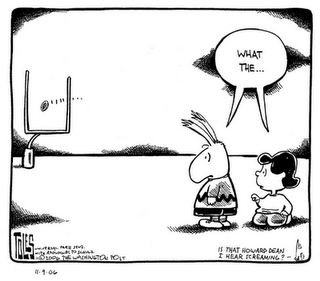
Today, it appears as if Lucy has the last laugh after all.
Today, it appears as if Lucy has the last laugh after all.
The exquisite irony of watching Democrats fall all over themselves trying to kill impeachment after spending most of the last 7 years accusing Bush/Cheney of the most dire impeachable offenses was almost too delicious to watch. It showed the Democrats to be shallow political hacks, eager and capable of using rhetoric to undermine the presidency during a time of war but without the balls to match their actions to their words.Representative Kucinich: merry prankster, certifiable loon, but please don't call him a leftist.
6.11.07
TRYING TO PUSH THE FOURTH TURNING? In the logic of generational cycles, there are hero cohorts (most recently, the GIs who came of age during World War II), artist cohorts (who come of age during the post-crisis consolidation and, like the Silent Generation I frequently revile in these pages, worship process over outcome), prophet cohorts (who come of age by challenging the order consolidated, often misperceived as limited to the Sixties hippies), and Nomad cohorts (who come of age somewhat neglected and who their elders see, often correctly, as crude.) In that logic, the cycles are rhythms of history, but they are supposed to be emergent phenomena, which can go badly wrong should a cohort attempt to push the cycle before its time. (Any such cycle ought to be arbitraged away by sufficiently forward-looking independent agents, but I digress.)
Now comes Christopher Hayes, perhaps unwittingly applying the cohort designations to a baby boomer not likely to be mistaken for a hippie.
The essay raises a theme that dominates generational thinking. In that model, a secular crisis becomes an all-consuming event in which a new social order emerges. (I suspect some people would use the locution "is constructed." That strikes me as too orderly.) Mr Hayes offers a warning to symbolic analysts, should that indeed be the social dynamic.
Now comes Christopher Hayes, perhaps unwittingly applying the cohort designations to a baby boomer not likely to be mistaken for a hippie.
[President] Bush, then, emerged as a kind of prophet. Because his image-makers had already portrayed him as having abandoned Boomer frivolity for Greatest Generation discipline, he seemed the natural choice to lead the country through its trials. In 2002, after congressional Democrats suffered losses in the mid-terms despite heavy campaigning from Bill Clinton, Time's Margaret Carlson concluded this was due to a post 9/11 "shift in the culture," in which "Clinton-era values are no longer America's."Although it's true that the aftermath of September 11 gave the national-greatness conservatives opportunities to influence the President in ways that the business and libertarian factions of the Republican coalition would have rejected if Third World grievances had remained in culture-studies departments and Southwest Asian mosques, it's also true that the Clintons fancied themselves prophets, with she often asking herself what Eleanor Roosevelt (from an earlier Prophet cohort) would have done, and he expressing some regret that no great challenge came up on his watch. (Signing the Iraq Liberation Act is one thing, having the opportunity to enforce it another.)
The essay raises a theme that dominates generational thinking. In that model, a secular crisis becomes an all-consuming event in which a new social order emerges. (I suspect some people would use the locution "is constructed." That strikes me as too orderly.) Mr Hayes offers a warning to symbolic analysts, should that indeed be the social dynamic.
I missed that detail the first two times I watched the movie. The DVD is on hand, should I get some breathing time. The metaphor, however, might refer to the process-worshippers more generally, not necessarily to the truest believers among the Prophets.But [Saving Private Ryan]'s real message revolves not around Ryan, but Cpl. Timothy Upham. We first meet Upham when Miller goes to fetch him from his desk where he is poring over maps and translating communiqués from French and German.
Young and wispy, with hair brushing his upper lip, Upham is a translator, not a fighter: He hasn't fired a gun since basic training and wants to take his typewriter with him. He quickly earns the unit's ire by annoyingly chatting everyone up and quoting books and poetry. At one point, after engaging a German tank that manages to kill one of their own men, the American soldiers capture the lone surviving German and force him to dig his own grave before they execute him. As the German pathetically mutters nonsensical English phrases, Upham objects to Miller. "Captain, this isn't right," he says, "You know this. He's a prisoner, he surrendered. He surrendered, sir." Miller is skeptical, but ultimately swayed. He blindfolds the German and tells him to walk 1,000 paces and then turn himself in to the first American soldiers he sees. The other men grumble.
It's not the last we see of the German. In the film's climatic battle, as the Americans try to hold a bridge under a heavy German attack, this same former prisoner returns to shoot and kill Captain Miller. Meanwhile, during the battle, Upham is paralyzed by a fear so total that, as his Jewish comrade wrestles hand-to-hand with a menacing Nazi, he can only cower in the stairwell below, crying as the Nazi plunges a knife in the Jewish soldier's chest.
The message is clear. In the great struggle for the future of the free world, the intellectual cannot be trusted. His concern for the laws of war means he is weak and cowardly, and will contribute to defeat. Only the true soldier can win the war. This is the ethos of the Cult of the Soldier, which would come to entirely dominate our politics in the years to follow.
SAYING NO TO THE VANGUARDISTS. Via Liberty and Power, a Sean Collins review of Until Proven Innocent, a chronicle of the Diversity Boondoggle's rush to judgement at Duke.
Apparently, so do strategic reserves.
Radical faculty members did not hesitate to presume guilt, and emerged to denounce the players. Houston A Baker Jr, a professor of English and of African and Afro-American Studies, was particularly prominent in the media. In a public letter to the administration, Baker wrote that the team embodied ‘abhorrent sexual assault, verbal racial violence and drunken white, male privilege loosed amongst us’. And in an email to the mother of a lacrosse player, Baker called her son and his teammates ‘farm animals’. A ‘Group of 88’ faculty signed a full-page advertisement in the campus paper that described Duke as a ‘social disaster’ for students who are ‘objects of racism and sexism’ and ‘see illuminated in this moment’s extraordinary spotlight what they live with everyday’. The signers asserted without qualification that something ‘happened to this young woman [Mangum]’, and thanked protesters ‘for not waiting and for making yourselves heard’.All wrong, as we now know. But there's nothing quite like a Tight Prior. That's Bayesian-speak for "narrative that confirms our prejudices."
The toughest question for any empirical researcher to answer is "What evidence would persuade you to reject your hypothesis?" It may not be wise to couch that answer in terms of statistical significance. I suppose, though, that if you've argued yourself into a position that denies the possibility of any objective reality, it's easier to fall back on that position rather than cope with the cognitive dissonance.In its details, news coverage generally followed DA Nifong’s statements uncritically. But most of the national media bathed the Duke affair in the light of a modern-day PC morality tale. On one side were white, privileged, racist, drunken, arrogant jocks at the ‘Harvard of the South’; lacrosse players in particular were from the upper classes and violent in nature (not unlike their description in Tom Wolfe’s novel I Am Charlotte Simmons – set at ‘Dupont University’, which is a thinly-veiled disguise for Duke). On the other side was a poor African-American single mother working hard to advance through a local community college. The case was presented as personifying broader social problems of sex and race in the United States.
This set-piece outrage made for a compelling story. There was only one problem: it wasn’t true.
At Duke, university president Broadhead changed his tune over time, and eventually (in September 2007) apologised to the lacrosse players for not supporting them. But the radical professors were not in the least bit embarrassed. A group of them issued a ‘clarification’ letter to their original advert, rejecting all ‘public calls to the authors to retract the ad or apologise for it’ and claiming they were misinterpreted. The letter-writers implicitly blamed the Duke student body for an ‘atmosphere that allows sexism, racism and sexual violence to be so prevalent on campus’. The faculty were the real ‘victims’ – victims of ‘intimidation’ for their views.In the same way, I suppose, that anonymous academic webloggers whinge when somebody questions their logic, or lack thereof. But academic tenure, for all its advantages in protecting the audacious for challenging entrenched orthodoxies, is also a rampart for milquetoasts. Incentives matter.
Apparently, so do strategic reserves.
However, the New York Times held on to its pro-Nifong stance until the bitter end. Even as late as August 2006, when much of the case had fallen apart, the Times continued to bang on about the ‘tangled American opera of race, sex and privilege’ and tried to resurrect the case by taking as good coin a police sergeant’s notes cobbled together after the fact. Like the Duke faculty, the Times remained unapologetic: after the defendants were declared innocent, the paper’s ‘public editor’ concluded that its coverage was balanced, and any flaws were not the result of ideological bias.Perhaps that paper exists, much like Pravda and Izvestia did until 1991, to make true believers comfortable with their prejudices. Duke's students appear to be made of sterner stuff.
If there is a redeeming feature of the Duke story, Taylor and Johnson find it in the response of the Duke students. Although some were against the players early on, many reserved judgment, and, as the facts emerged, campaigned for the accused students. Abandoned by adults in the administration and faculty, perhaps the students at Duke (and elsewhere) have learned that it is now up to them to get American society back on track.Yes, if anyone can agree on what that "track" is. (The review notes that the diversity hustlers find unlikely allies in Christian temperance types who would just as soon cast the demon rum out and in law-n-order politicians wedded to zero-tolerance policies.)
NINETY YEARS AGO. Aleksandrov and Eisenstein would have you believe that the Bolsheviks came through this Petrograd arch and started the ten days that shook the world.

When I took this picture, ten summers ago, Leningrad was St. Petersburg again, and the masses in the courtyard were more likely to be there before or after enjoying the Impressionist collection that Iosif Vissarionovich and Nikita Sergeyevich would have you believe were degenerate art.
Thank you, Friedrich Hayek, for demonstrating the folly of "scientific management" of a complex adaptive system (a lesson that the "synergy" chasers of the 1960s conglomerates had to learn the hard way).
Thank you, Aleksandr Solzhenitsyn, for documenting the evil that ensues when true believers in a better world pursue their vision to the exclusion of any objection, no matter how trivial.
Thank you, Ronald Reagan, for correctly identifying both the folly and the evil, despite the sneering from supposedly more sophisticated quarters.
5.11.07
INSUFFICIENT OPTIONS. Destination: Freedom welcomes coverage in the Sunday supplements.
Railway Age Illustrated Trains, where he has been writing, repeatedly, about the coming strangulation of the transportation network.
Now Parade picks up the story.
That reference to "specialty periodicals" includes Don Phillips's columns inWith the exception of The New York Times’ editorial pages, the news columns of The Wall Street Journal, and until recently only a handful of other general news circulation papers, few news outlets, print or otherwise, have understood or written about in depth the transportation crisis we have created, or successfully explained it.
The article, by author Peter Richmond, is one of the most important to appear in more than a generation of generally spotty or shallow news coverage of the American transportation crisis, outside of specialty or academic periodicals, in large part because of its broad reach. Until recent congestion became “gridlock”, general assignment reporters were usually only able to spend a small amount of time on any given subject, and could not become instant experts at everything they covered.
Now Parade picks up the story.
Americans spent about 3.7 billion hours stuck in traffic last year, burning gasoline whose price had soared by 60%. At the airports, security lines snake endlessly, runways are choked, and delays are common. One recent study found that, between January and August 2007, one in four flights arrived late; 159 flights were kept on the tarmac for more than three hours in August. As a result, more than half of U.S. businesses augment commercial air travel with expensive corporate jets and charters. Isn’t there a better way?Policy problems. Looking for a term paper topic?
- How much of that congestion is caused by government failures elsewhere, including the insistence on rebuilding existing highways under traffic and failure to do relatively cheap things such as synchronize traffic lights?
- What is the incidence of corporate welfare in the form of trucks on the highways and corporate jets in the airways using the road and air networks without bearing the opportunity costs.
Many transportation experts insist that the best answer to transportation gridlock is efficient intercity rail travel. Trains use one-fifth less energy than cars or planes. They run in bad weather. They’re business-efficient and tourist-friendly. Yet, since the early 1960's—with the exception of the Northeast Corridor, from Boston to Washington, D.C.—railroad transportation in the U.S. has become largely irrelevant. For most Americans, train travel from city to city remains an afterthought. And for good reason: Our national rail system is inadequate, relying on aging equipment and a shrinking route-map. The system sorely lacks both financial resources and government support.I suspect that some Southern Californians might bridle at that "irrelevant," and the emerging corridors outside Chicago, including but not limited to the Hiawatha, continue to attract new riders without alienating too many existing riders. The ultra-fast electrified corridors, or the InterCity 110s that I keep advocating, are only part of the story.
(The nice thing about cut-and-paste is that I can lift chunks out of a column in a different order than the author put them in, in order to maintain the flow of my argument.) Note that the Springfield line might be good for 110 once all the advanced signalling and four-point grade crossing protection is in place. Excessive caution, I say. That expanded Springfield service uses Illinois money, which might reduce the public-choice dynamics (Turbotrains to Parkersburg, West Virginia?) inherent in Federal funding of the rail network.As our airways and highways have slowed down, demand for train travel has been increasing. In fact, Amtrak ridership was up for the fifth year in a row, reaching record levels—despite the fact that a third of trains arrived late last year. In the Northeast, since Amtrak introduced higher-speed Acela trains in 2000, the railroad’s share of 10,000 daily commuters between Washington, D.C., and New York City increased from 45% to 54%.
“Train travel is the thing for a one-day business trip,” says Malcolm Edgerton, a Chicago architect who travels often from Chicago to Springfield on Amtrak for work. A recent trip, he said, “would have meant seven hours of driving, and I would have been exhausted. Instead, I left in the morning, did work on the train, got there at noon, did my thing, even had time to visit a museum. Then, on the way back, I drank Scotch in the bar car and traded stories with a salesman and another architect. The round trip was $40.”
I'm not sure why the Shinkansen envy. The article misses a lot of the more prosaic action, including the six-car off-peak rakes on Metra, the San Francisco commute expresses to Silicon Valley, and the Lackawanna Electric into Penn Station. And although the Europeans might be investing heavily in upgrading their intercity lines, it's no accident that state-of-the-art electric and diesel multiple unit technology tends to be European: there's a lot of that Vienna to Wiener Neustadt or London to Oxford business to accommodate, and a lot of upside potential for that traffic in the States.The key to improvements may be federal incentives for state investment, say train watchers of all stripes. They point to two successful projects that relied heavily on state funding. Amtrak recently expanded service from Chicago to downstate Illinois and St. Louis, where ridership is up about 50%, and major improvements were made to the Philadelphia-Harrisburg line.
In light of those successes, the newly Democratic-controlled House approved $50 million in matching funds for state Amtrak projects, and the Senate approved a similar program for $100 million. “We are on the edge of a revolution in thinking and the thinking of policy-makers of the future of transportation,” says Rep. James Oberstar (D., Minn.), who heads the House transportation and infrastructure committee. “And that future is filled with high-speed, reliable rail service.”
4.11.07
TURN IN THOSE WRECKERS, RIGHT-DEVIATIONISTS, AND SUBVERSIVES.

Article 58 mandates it.

Article 58 mandates it.
Residence Life is not taking kindly to having their program immediately and completely shut down. Faculty and RAs who stand up against the program have been feeling the heat.Developing.
IT WORKED. Thus did Brett Favre explain the latest long pass to Greg Jennings putting the Packers ahead of Kansas City to stay.
Announcer Wayne Larrivee made his "dagger" call in the wake of a subsequent interception return for a touchdown by Charles Woodson.Favre rallied Green Bay past Kansas City 33-22 and joined Tom Brady and Peyton Manning as quarterbacks who've beaten all 31 other teams in the NFL.
In an odd confluence of timing among three of the game's greats, Manning and Brady both achieved the career milestone only one week ahead of Favre, who had been 0-3 against the Chiefs and was probably seeing them for the last time.
Mason Crosby added a fourth field goal, from 45 yards, and with 59 seconds to go Charles Woodson intercepted Huard's pass and went 46 yards for a touchdown that made the game look much more lopsided than it actually was. The Packers scored 17 points in the final 3:05 on a defense that hadn't given up more than 20 all year.
FRUSTRATION. Years ago, it was Neenah's Red Rockets going to the state basketball tournament only to lose the final game (including, memorably, once to Milwaukee Hamilton). Now it's Neenah's turn to deliver the frustration, only to Marquette in soccer.
The coexistence of independent and common schools in the same tournament takes some getting used to. There used to be parallel tournaments, and one of the gripes those in charge of the common schools had, particularly when playing games with the independent (in Wisconsin, read "Catholic" or "Lutheran" for the most part) schools was that the indies could offer something resembling athletic scholarships, while the common schools had to build teams out of residents of the district. That, too, has changed.
The coexistence of independent and common schools in the same tournament takes some getting used to. There used to be parallel tournaments, and one of the gripes those in charge of the common schools had, particularly when playing games with the independent (in Wisconsin, read "Catholic" or "Lutheran" for the most part) schools was that the indies could offer something resembling athletic scholarships, while the common schools had to build teams out of residents of the district. That, too, has changed.

3.11.07
WHY IT MATTERS.
Two items that generated many a post on the academic weblogs this week highlight a central theme of these pages, namely that higher education ought to be higher education. Start with the commotion about junior faculty looking for new jobs. Let's break this down. As long as departmental hiring committees have the responsibility for identifying people to hire, and as long as departmental promotion committees do the initial recommendations for tenure or promotion, junior faculty recognize that their primary responsibility is to be competitive in the discipline. That means establishing a reputation as a scholar.
Perhaps the people who manage higher education might want to re-examine whether the German model or the land-grant model of scholarship is the best one to apply to higher education, but as long as the reward structure is as it is, it ought not come as any surprise that faculty members respond to the incentives it provides.
Why, then, might faculty members wish to leave? I'll concede that securing a more visible position in the academic food chain is part of it. I'll note, however, that the food chain is probably more skewed than it ought to be, and some of the responsibility for that skewedness rests with senior faculty who are indifferent or hostile to their colleagues' ambitions. There is no shame in making a promising colleague look good enough to be raided away by some other program. There is nothing but shame in thinking that the success of a colleague somehow diminishes your own work.
Some responsibility for that skewedness must rest with administrators whose mindset is "We'll never be as good as College X and there's no point in even trying," particularly when that mindset mutates into the more virulent forms of access-assessment-remediation-retention and the lowered expectations that come in train. There is nothing quite like the intellectual challenge of keeping one's mind sufficiently sharp and focused to produce the kind of research that will be rewarded in the discipline after one has spent some time attempting to reason with Rate Your Students fodder. Does it come as any surprise that the sites run by the anonymous jobseekers that set off the conversation also have a goodly number of gripes about unprepared or unmotivated students? Improve the working conditions and people will be less disposed to want to publish their way out.
And that leads to the now-suspended Delaware reeducation camps. As I noted in that post, using freshman orientation to inculcate some humility and to make the point that the privilege of a university education brings responsibilities with it is an honorable tradition. Somehow, in the Delaware materials, that mission mutated into consciousness-raising about how American society is a machine for the replication of the existing system of social stratification. I'm not persuaded of that: there is the Spielberg effect at work.
I wonder whether that consciousness-raising doesn't turn a bad theory into something like a self-fulfilling prophecy (I'm at Delaware while my richer neighbors are at Swarthmore or Princeton: what point effort?) Such thinking is, again, likely to further skew the academic food chain, and contribute to the excess demand for the places that show up at the top of the U.S. News (what happened to the World Report?) rankings. It's also likely to raise the resentments against affirmative action that much of the Delaware material addresses. (Sure, it's a thoughtcrime to mention that, but you can't speak of a machinery for replicating social stratification and at the same time expect people whose test scores are higher but who were not admitted to a better part of the machine to like it.)
Doesn't it make more sense for all concerned to recognize the excess demand and provide working conditions for the faculty and classroom conditions for the students under which all are challenged to excel rather than led to believe that their status is somehow second- or third- class? I'd expect that there'd be less job-hopping for a better fit (read research prestige and intellectually stimulating students) under those circumstances.
2.11.07
TONIGHT'S RAILROAD READING. Ezra Klein commends Congress for funding Amtrak.
The reader comments are instructive (there are no comment links, just scroll. Hand-fired commentary, forsooth.)
It's true that America doesn't have the density to support a train infrastructure like that of Europe's, but parts of America certainly do, and in those areas, Amtrak just isn't funded well enough to be a competitive option. This, of course, creates a rough cycle in which a poor reputation drives away customers, which in turn increases fares and lowers service quality, which in turn harms the reputation, which in turn drives away customers, which...Much of the United States east of the Mississippi River has a population density comparable to France, and there are a number of corridors which could be brought up to a respectable 110 mph service at a relatively low cost, particularly if policymakers drop those cartel-era speed limits compelling trains to plod along at 60-80 mph. Increased frequencies, even on passenger-unfriendly Guilford (or is it Pan Am Rail) and on the inefficiently-downsized Main Line of Mid America, not to mention on the Hiawatha service, which in my view is capable of setting the pace for economical upgrades of corridors without the folly of electrification and 180 mph running, have been bringing in the riders. More reliable timekeeping would help.
The reader comments are instructive (there are no comment links, just scroll. Hand-fired commentary, forsooth.)
It would help Amtrack [c.q] a lot if the railsystem would become independent from the company owning the rolling stock and providing the actual service. Decades of neglect have turned the rails into a state beyond repair, and its [c.q] totally illusionary to run something like a modern rail service on them. In Europe, railway compaqnies [c.q] had to rebuilt most of the tracks connecting cities from scratch, too. This is a multi-billion-dollar endeavor, but it will be an attractive alternative for flying,if finished. It's quite an ironic fact that Amtrack's [c.q.] engines are dewsigned [c.q.] for speeds of 150 mph and more, but that it's impossible to actually drive that fast most of the time. The explanation is, of course, that politicians wanted Amtrack [c.q.] trains to look like TGVs or ICEs, but shied away from the costs that it would have taken to really bring the system up to that standard. Let's hope this scrooge attitude will change soon.Demsetz auctions for train operating franchises, British-style? The British are still learning some of the difficulties with the approach. Designed for speeds of 150 mph? True of the latest power on the Northeast Corridor, but neither the New Haven nor the Pennsy really have the speed potential of the Great Western or the Milwaukee Road or the old Big Four lines from Chicago to Cincinnati or Cleveland to Cincinnati (to consider a couple of neglected corridors).
The problem, dear reader, is that freight and passenger rail are really two different technologies. The day will come when the BNSF will do all in its power to keep the intermodals on the Transcontinental and the coal on the Burlington Route. But to argue that the freight infrastructure is deficient is to have missed the Track Renewal Train in action or news of that 70 mph bridge across the Des Moines River.We should build out the infrastructure for rails for both freight and passenger services. These need to designed to allow each type of service to operate well.
Then we can let various operators compete to run on the rails. This is somewhat like trucking which uses the highways.
We know that freight hauling by rail is competitive and if subsidized as the roads are would be huge. We can see this becuase [c.q.] trucking is forced to build trains on the roads with triple trailer trucks. This system is silly.
I would agree that a clear transportation road map and investment to build strong long haul freight rail and local region rail passenger service infrastructure is long over due.
PHOTOPHOBIC? The University of Delaware administration has pulled its residential reeducation treatments pending a review.
That said, University Diaries located press coverage from the GG-1s' Nest that suggests the residential orientation program is a distortion of a laudable goal.
At Delaware, however, the recommended treatment appears not to include the Approved University Answer ("It depends...") among the options offered either to trainers or students.
A commenter at SCSU Scholars catches an irony in the program objectives.While I believe that recent press accounts misrepresent the purpose of the residential life program at the University of Delaware, there are questions about its practices that must be addressed and there are reasons for concern that the actual purpose is not being fulfilled. It is not feasible to evaluate these issues without a full and broad-based review.
Upon the recommendation of Vice President for Student Life Michael Gilbert and Director of Residence Life Kathleen Kerr, I have directed that the program be stopped immediately. No further activities under the current framework will be conducted.
Vice President Gilbert will work with the University Faculty Senate and others to determine the proper means by which residence life programs may support the intellectual, cultural and ethical development of our students.
At least one Delaware graduate is reviewing his donation practices.“Students will recognize the benefits of dismantling systems of oppression”
One oppressive system down, how many more to go?
If this indoctrination is typical of what current UD students are now routinely exposed to as official University policy, then there would be no useful purpose served by sending the school any of my money.Thus have I been informing the fundraisers at the University of Wisconsin since early in the Donna Shalala years.
That said, University Diaries located press coverage from the GG-1s' Nest that suggests the residential orientation program is a distortion of a laudable goal.
The training is important to help students understand those who are different from them, said Justin Blair, an 18-year-old sophomore from New Castle.Freshman orientation has included such an objective for years. A religious college might want to make its students aware of Matt. 25:40, and the more selective colleges of the early 20th century urged their students not to get too full of themselves simply for having been admitted. In those days, faculty and students alike were more likely to view college as a privilege, not an entitlement, and with that privilege came responsibilities. In one of Tom Clancy's early novels (I want to say it's Patriot Games, but the Clancy collection is still in storage) there's a passing reference to a senior gunnery sergeant on the Annapolis staff whose presence is a reminder to cadets: You must be worthy of commanding men such as this. A little empathy for people less favored than you is not a bad thing. (Part of the success of The Phantom Professor site is the author's keen eye for what happens when trustafarians have not been cautioned against getting too full of themselves.)
At Delaware, however, the recommended treatment appears not to include the Approved University Answer ("It depends...") among the options offered either to trainers or students.
It appears as if the default position is "The existing social order is oppressive." Or: "You may not question affirmative action." I read some of the Delaware materials (some memory holes are less thorough than others) and much of the training material takes as beyond debate that concepts such as merit or dependability are arbitrary with far more potential to destroy than to shape. Fine. Show me the evidence that what I refer to as the Habits of Highly Effective People have blighted more lives than some alternative regime, including but not limited to the Experimental Prefigurative Communities of Transformation that the Diversity Boondoggle would like to make of higher education.[Delaware freshman Brooke] Aldrich said other exercises made many students feel uncomfortable. In one, she said, students were asked if they approved of such things as affirmative action or gay marriage. If they did, they would join students on one side of the room. If they didn't, they would join students on the other side of the room. They were not permitted to explain their reasons or to answer "I don't know," she said.
"We had a strong urge to debate back and forth, tell each other why we chose this and sort out each other's views," she said. "But at the end, we were told the exercise was designed so that we could not have debate, that a lot of times in life you don't have the opportunity to express your opinion. There was a lot of pent-up tension from that."
1.11.07
INCOME = WAGES + INTEREST + RENT + PROFIT.
I suspect, however, that widespread understanding of this law of conservation would deprive many a pundit of something to fret over. Herewith yet another meditation on family wages.
Left unsaid, however, is whether that division of labor (dad compensated in cash, mom compensated in kind) was one that everybody accepted. Also left unsaid is whether that division of labor was superior to the one preceding it, in which mom, dad, and the surviving kids all participated in a lot of subsistence work.
Catch also that Westchester County reference. Next we can probably look forward to another round of fretting about assortative mating. Here's a corrective.
Or, perhaps, to get somebody else to pay for the consequences?
Lisa suggests that it is unworkable because contrary to the principle that the free market should set wages. But if I'm not mistaken, we had the family wage here in America for decades, at least unofficially, and it was the reason that many who grew up in working class families years ago had the same kind of family arrangement as higher-income people, built around a breadwinning father and a homemaking mother. No one in those days decried it as being against the free market, as far as I know, because it was something that placed a priority on care of children and mothers being able to stay at home and fathers as heads of families. Market principles are only one of the ways by which a society allows itself to be guided.Market prices can only reflect the willingness to offer and the willingness to buy resources traded on those markets. There's a more complete illustrated explanation here.
Left unsaid, however, is whether that division of labor (dad compensated in cash, mom compensated in kind) was one that everybody accepted. Also left unsaid is whether that division of labor was superior to the one preceding it, in which mom, dad, and the surviving kids all participated in a lot of subsistence work.
The idea of the family wage also produced a more egalitarian society in a good way, with less polarization between rich and poor and more of a common experience for all, and it did this not through redistribution but by emphasizing work and the importance of fathers. (Don't worry — the rich still had plenty, although that was perhaps less conspicuous than it is today.)Would that it were that simple. The technology of the day was more likely to augment the brawn of the men rather than the brains of the men and the women. Compare a hand-fired steam locomotive or a horse-drawn plow with a Dash-8 or a tractor with air-conditioned cab.
Also, as soon as mothers began to work in large numbers, the prices of everything went up, as a real estate agent in Westchester County explained to me, making it more necessary for a family to have two incomes to afford what one income once bought.See the title of this post.
Catch also that Westchester County reference. Next we can probably look forward to another round of fretting about assortative mating. Here's a corrective.
When one faces choices, with good points and bad points to each, one must make trade-offs.As bright and intelligent women go and get those careers that they wish to have (as is of course their right to pursue) we find that they tend to marry those bright and intelligent men who also pursue similar types of careers. We thus have a group of families with two high incomes, increasing the income gap.
What a difficult problem for someone who is both feminist and egalitarian. Which is to be decried, if either? That women now have the same freedoms in work and selection of a partner that men have historically had? Or the effects of this upon the income distribution?
Or, perhaps, to get somebody else to pay for the consequences?
So, if two incomes are mandatory for the basics of middle class life -- home, car, kids, dog, then childcare is now a necessity for most families. Those babies don't raise themselves. Yet, where is the child-care discussion in this presidential debate?
MORE ON FINLANDER PURPLE. That's a pejorative illustrating the potential for marginalizing the Other (hey, I could retrain to do cultural studies, but that would involve a pay cut) in a relatively homogeneous community. (One of the things one learns in building a house is the 2n-1, for n -> infinity names the paint companies have come up with for beige. No doubt it preserves the illusion of having choice where the Guardians of Public Aesthetics would prefer there be none.)
Now introduce a more exotic Other.
Via Virginia Postrel, who we wish well during her cancer treatments.
Now introduce a more exotic Other.
Uh huh.Elizabeth Villafranca perceived it as another jab at Hispanics in a city that has targeted illegal immigration.
"We know who has the bright colors," she said after the council meeting. "Latin Americans."
The author Sandra Cisneros, for example, famously painted her historical home in San Antonio periwinkle purple.
But the residents pushing the Farmers Branch paint initiative say their concern is home values and neighborhoods, not ethnicity.
Via Virginia Postrel, who we wish well during her cancer treatments.
QUOTE OF THE DAY. The dean at Anonymous Community and I clash over some things, but on this we agree.
For next week: discuss how "overreach" applies to the efforts at Delaware and elsewhere.
Amen.For all their foibles, which I've noted from time to time, tenured faculty are -- on the whole -- intelligent, independent-minded sorts. That comes with costs -- God knows, that comes with costs -- but it's also essential to what they do. As much as I resent the sense of entitlement that some of them display about the most ridiculous things, like actually being asked for receipts for travel reimbursement, I also don't want to staff classes with cubicle drones. As scary as self-styled 'free agents' are, the ones who actually drink the Kool-Aid are that much scarier.
Dr. Crazy recently started a blogfire with a post about looking for another job when you already have one. Some trolls took offense, claiming that in a tight job market, it's selfish for the 'haves' not to content themselves with their lot. But she was right, and I'd be afraid of anyone who didn't understand why. These are jobs. That's all they are. They involve 'doing work' in exchange for 'pay and benefits.' (And yes, I get hostile at the ones who take the pay and benefits, but don't do the work.) They do not involve pledging your immortal soul, or suspending your better judgment, or altering your personality according to what some motivational speaker with Dynamic People Skills says. That's overreaching, and it's insulting.
For next week: discuss how "overreach" applies to the efforts at Delaware and elsewhere.
LIVING AT THE EXPENSE OF OTHERS. Never mind that it's a regressive transfer. MINITRUTH Delaware's Student Affairs office?
Modernization is needed for a system that is being inexorably strangled by increased traffic.Catch the Divine Passive? This modernization is going to be provided by whom? The nameless ciphers at
Particularly if they don't have to pay for it, which is what the Journal-Sentinel editorialists are advocating.The White House needs to get strongly behind the Lott-Rockefeller measure, and the House needs to reconsider what it has done. The extension gives Congress another 90 days to act, but if NextGen and a reformed financing system aren't approved by the end of the year, there's a good chance the issue will get lost in next year's elections.
Air passengers and shippers deserve better.
DOWN THE MEMORY HOLE. Delaware Starts Removing Materials from Web Site.
Some specifics:
SECOND SECTION: Apparently the memory hole did a lot of work in a short time.
Some specifics:
The University of Delaware has removed its “Whole New World” training materials from its website—the materials that included the teachings about racism which we mentioned in our letter and press release about the case, and which have been roundly criticized by multiple bloggers (here’s one among many). The materials used to be here.The post ends with a good question.
If there’s nothing wrong with these materials, why were they removed?Removed? They never existed. You're referring to an imaginary number on a list that was allegedly misplaced.
SECOND SECTION: Apparently the memory hole did a lot of work in a short time.
Subscribe to:
Posts (Atom)