19.8.08

CAN'T CARRY WATER FOR A PATTERNMAKER. No matter how many times I explain this, somebody screws it up.
Businesses and unions face the challenge of "overcoming the perception that blue-collar trades offer less status, money and chance for advancement than white-collar jobs, and that college is the best investment for everyone."

Showing its business aspect, an IBEW local has produced a YouTube video that encourages young people to consider electrical apprenticeship rather than college. Pretty good advice.
Let's take a closer look at the source.
Since January, the U.S. has lost 463,000 jobs. Residential construction and manufacturers that rely primarily on the U.S. market have been hit especially hard.

But the energy industry is hard up for workers who, among other things, can make precision welds, fit pipes for pipelines and oil refineries, and understand the complex electrical wiring in modern power plants. Though the weak housing market has idled many workers who did similar jobs for home builders, their skills often aren't sharp enough to make the cut.
Something tells me the corner-cutters and excuse-mongers that provide Rate Your Students material will be dangerous to themselves and anyone else nearby in any work that involves power tools or electricity or large engines. Heck, a lot of honor students and professors are dangerous to themselves in such situations.
OBSERVATION OF THE DAY. University Diaries.
“You have a much more serious deer problem there than we do here, because you don’t allow hunting.”
"There" refers to the oh-so-gun-free Bethesda, Maryland, and "here" refers to the Adirondacks.
KISHWAUKEE RIVER CLEARED OF ALLIGATORS. The hunter prefers not to be identified.
The small alligator that has been evading DeKalb County Animal Control officers for weeks was caught Tuesday afternoon by an area resident, animal control warden Dan Berres said.

The animal, which had been described as a young alligator about 3 feet long, was caught near where the Northern Illinois University lagoon empties into the Kishwaukee River about 1 p.m. Tuesday. It was first sighted about three weeks ago in the same area, and subsequent sightings were also in that part of the river, Berres said.

“Someone had some sort of weighted net and decided to go out looking for it,” Berres said. “He went out and tossed it and got lucky, then he called us and said he’d caught the alligator.”

18.8.08

IN A LAND THAT'S KNOWN AS FREEDOM, HOW CAN SUCH A THING BE FAIR? Won't you please write to Chicago for the help that you can bring.
Please consider contacting the president of the University of Illinois system, B. Joseph White, to ask him to take immediate public steps to insure the safety of the Chicago Annenberg Challenge records, to release the identity of the collection’s donor, and above all to swiftly make the collection available.
That's the president of the University of Illinois system,

If you ask his staff to help you, will they turn the other ear?

More details of the library's unwillingness to share are here. The archive is bound and gagged.
The Special Collections section of the Richard J. Daley Library agreed to let me read them, but just before I boarded my flight to Chicago, the top library officials mysteriously intervened to bar access. Circumstances strongly suggest the likelihood that Bill Ayers himself may have played a pivotal role in this denial. Ayers has long taught at UIC, where the Chicago Annenberg Challenge offices were housed, rent-free. Ayers likely arranged for the files of the Chicago Annenberg Challenge to be housed in the UIC library, and may well have been consulted during my unsuccessful struggle to gain access to the documents.
Open up the door!

(And yes, I take pleasure in using Graham Nash's lyrics to structure my post.)
IS BERTRAND COMPETITION FOR MEN EVOLUTIONARILY STABLE? That question goes unanswered in Tim Harford's The Logic of Life, reviewed here. Now comes Dr. Helen, the beneficiary of a nepotistic instalanche, proposing a more colorful version of the Bertrand competition. There are dissenting perspectives in the ensuing bull session. There's something missing in a mating model in which the sole criterion for a match is the willingness of the providers in excess supply to put out, to put it bluntly. Shouldn't an excess supply of women at colleges be an incentive for intellectually active women, or women of high integrity, to signal those characteristics as well?

15.8.08

SING, SING, SING. I'm sure most of my readers could identify the Benny Goodman piece that's still popular with collegiate pep bands (and I've heard a steel band arrangement of it on campus.) For your listening pleasure, here's the original.
LESSONS APPLIED. Book Review No. 34 is Jeff Shaara's The Steel Wave, the second of a planned three novels of World War II. His previous The Rising Tide, reviewed here, follows some real and some fictional characters from North Africa into Italy. Many of the principal characters are now preparing for the cross-Channel invasion, which will come. The story begins with an intelligence-gathering raid on the Normandy coast and it ends with Field Marshal Erwin Rommel's suicide. Some of the principal characters, historical and imagined, are dead, and some are preparing for the next set of battles. As several of the main characters are paratroopers, the third book, if there is to be one, will likely make readers aware of the bridge too far and of Bastogne.

(Cross-posted to 50 Book Challenge).
I HEAR YOU WENT UP TO SARATOGA. The Boston connection to the Lake Shore had an extra car, the former Port of Vancouver, a Great Northern Railway parlor-observation once used on the Seattle - Vancouver Internationals, now running as City of Spokane, on the hind end on July 29. (The Boston extension of the Lake Shore also had this car on July 22, although conditions were not conducive to photography that day).


The car was still sitting in the Albany yard when 49 departed, on time, for Chicago. Sleeper passengers are served dinner at Albany. My tablemates were speculating on whether the car was carrying passengers for the races. Possible, but unlikely. The Boston train arrives in Albany just before the evening Rutland train, which would go to Saratoga, although that train arrived and left with no effort of a switcher to cut the car off 449 and add it to that train. The Montreal to New York train and an Empire Service train also showed up at Albany, and, once again, the limitations of the new Albany station were evident. If somebody at Amtrak or the New York Department of Transportation ever got serious about tightening the schedules and providing connections, there wouldn't be space in the station for the trains or for the passengers.

The potential is there. The Boston train arrives in time for a passenger to ride Springfield to Saratoga or Pittsfield to Rutland, if the passenger is patient (drive time, even with a refreshment stop someplace, is faster even though those journeys are the long way around on the interstates). The reverse connection is available, although with a LOOOOONG layover in Rensselaer (the downside of Albany-Rensselaer is it's distance from urban amenities, perhaps what Penn Central had in mind when it moved out of the Albany station). A passenger intending to ride the rails from Montreal to Chicago and points west also has the option (there no longer being any kind of cross-border connection Detroit - Windsor or Port Huron - Sarnia) of connecting in Albany, but the reverse connection is not available (the best one can do is to transfer to the Maple Leaf in Buffalo and spend the night in Toronto as the overnight Cavalier is long gone from the timetable). If I had the power to send Amtrak administrators to detention, I'd make the miscreants write "The value of a passenger service is in the intermediate community pairs that can be served directly or with reliable and rapid connections by multiple trains" a hundred times or so.

So to the trip: there wasn't a lot of time to write down car numbers and I opted to turn in early, although the planking at level crossings and the alignment of the switch frogs (oddly, in the straight direction) contributed to a restless night. Schenectady 7.25.16 - 7.31.03 (check the tickets ON the train!), Utica 8.45.27 - 8.48.03, Syracuse 9.38.23 - 9.46.30, on 30 July and on Norfolk Southern it's slow orders across western Ohio; Bryan 7.48.28 - 7.51.20, Waterloo 8.13.06 - 8.14.45, Elkhart 9.05.21 - 9.06.45 (if there's no longer a crew change here, why not consolidate the stations at the still-standing downtown South Bend station?), South Bend 9.39.45 - 9.42.18, more slow running, arrive Chicago 10.30.23 Central.

I've turned up a few other weblog train reports. Here's a recent ride from Detroit to Chicago with the tease of a continuation to St. Louis ("The value of a passenger service ...") and an installment of a ride on the California Zephyr.

DEJA VU. During last night's all-around gymnastics event, where the gold and silver medals went to U.S. competitors after a closely contested event, the commentators were griping about the judging, Nellie Kim (in some kind of official capacity) was offering technical advice to the judges, and a strong Russian performance led one of the commentators to observe that the Russian program had regained some of its swagger.

In the same week that the Prison House of Nations seeks a restoration of its suzerainty in the khanates, that, dear reader, may be no accident.
WE CAN'T BLAME THIS ON GLOBAL WARMING? There's an alligator in the Kishwaukee River.

Forget the urban legend about alligators in the sewer. There's a real crocodilian swimming in the Kishwaukee River.

“It's true. We've seen it,” said Bob Drake, director of environmental health at the DeKalb County Health Department. “It's just a little bitty thing, only about 3 feet long, that somebody let go.”

Although exotic pets (whatever that means) are illegal, that doesn't stop people from buying them (and sometimes getting more than they bargain for).

We have yet to record a 90 degree day this summer. Animal control officers hope to bring the 'gator in before the Gales of November do their work.
PHOTO FINISH. In tonight's Olympic swimming, Michael Phelps overtook Milorad Cavic at the wall. The 0.01 second margin of victory represents the tolerance of the equipment. It was really close, and the outcome called forth a protest from the Serbian coach. There apparently was conclusive visual evidence to uphold the victory. Mr Cavic apparently counted on enough momentum to win, while Mr Phelps took what the announcers called a "half stroke." The 'fly doesn't look conducive to quick alterations in one's motion, undoubtedly the swimmers do work on such things.

Also at the pool, Cesar Cielo Filho's free-throw-shooter ritual worked well enough for him to win again.

14.8.08

GOD HELPS THOSE WHO HELP THEMSELVES. Postings are slow tonight as I'm switching attention between the Olympics (one might as well kick back a bit the night before contracts start) and the internet. In one of the swimming sprints, Brazilian Cesar Cielo Filho crossed himself a couple of times before racing (he won that heat). I remember when that was a habit of more than a few high school basketball players at the free throw line.
POLITICAL ECONOMY STILL MATTERS. Hunter Lewis's Are the Rich Necessary? Great Economic Arguments and How They Reflect Our Personal Values offers a partial case. This Book Review No. 33 is less-than-impressed as the treatment is uneven and the organization is backwards. Toward the end, the author offers a cursory survey of what he terms "competing economic value systems" he classifies as "equalitarianism, fraternalism, reciprocalism, philanthropism." The classification draws contrasts too strong, as any system of economic organization includes elements of all four. The four concepts themselves have fuzzy boundaries and they cannot be treated as disjoint. They might have worked more effectively toward the beginning, as a way of structuring the contested areas, which are poverty, inequality, the profit motive, and government (with both fiscal and monetary dimensions). The point-counterpoint approach is instructive as a first approximation, although some arguments receive more careful structuring than others, something that might not be immediately obvious to an inexperienced reader. It's thus not useful as an introductory reader, although some of the material will be useful to experienced lecturers or to advanced students.

(Cross-posted to 50 Book Challenge).
BREAKING IN. The Chronicle of Higher Education invited three colleagues from Teaching and Learning (is that formulation inspired by Supply and Demand or by Reserves and Redundancy?) who have thus far written about breaking in, a task made more difficult in February, after which they commented on the challenges of balancing work and daily life (this article says little about the focus required to become truly proficient as a scholar), the reality checks, and most recently a stock-taking.

(Via Newmark's Door, where the reaction is scathing.)
PATH DEPENDENCE. Although Milwaukee's Irish Fest is under way this weekend, and there is a St. Patrick's Day parade on Wisconsin Avenue, one doesn't often think "Milwaukee" and "Irish" in the same sentence. The Lady Elgin sinking took much of Milwaukee's early Irish community to the bottom of Lake Michigan.

Though it sank more than half a century before the Titanic, the Lady Elgin has been linked with the more famous ship because it, too, suffered a tremendous loss of life. There was no passenger manifest, so the exact number of victims is not known, though contemporary accounts estimate the number on board at 600 to 700. A mass grave in Winnetka became the resting place for 80 unclaimed victims.

Many on board were Milwaukeeans, mostly from the city’s Third Ward Irish community. They had chartered the vessel for the trip to Chicago on Sept. 7, 1860, to see presidential candidate Stephen Douglas just two months before he would lose to Abraham Lincoln.

The Lady Elgin will be featured in an exhibit of Titanic artifacts at the Milwaukee Public Museum. The Titanic show, one of six touring exhibits of artifacts retrieved from the doomed passenger liner, is scheduled to be on display at the Milwaukee museum Oct. 10 through May 25, 2009.

THE INEFFICIENCY OF A 100% RESERVE. Earlier this week, the last of the Lake Michigan train ferries, S.S. Badger, was taken out of service account a bearing failure.

Officials with the company that operates the 55-year-old vessel said they hoped the steamship that crosses from Manitowoc to Ludington, Mich., would be fixed by the end of the week.

The 410-foot ship, which can carry 620 passengers and 180 vehicles, had not diverted from its normal service for repairs since 1994. A repair crew discovered the damage Saturday.

The company that operates the ferry, Lake Michigan Carferry, has had to borrow school buses to transport passengers who would normally be making the four-hour lake crossing. Officials have also offered refunds and discounts on future trips for people who had made reservations.

Badger (PM 43) has a twin, Spartan (PM 42), that has been laid up unserviceable in Ludington, Michigan, for some time. The bearing failure marks the first time Badger's operator has had to cancel sailings, which is pretty strong confirmation that keeping a boat in reserve might be excessive.
WAITING FOR WIND. As of Wednesday, Team Seven Sailing held third place in the Yngling regatta.
Sally Barkow (Nashotah) and teammates Carrie Howe and Debbie Capozzi moved into third place overall after seven of 11 races in the Yngling class in Qingdao. The U.S. team finished first, ahead of overall leader Great Britain, in the single race on Wednesday.
The Inland Lake Yachting Association reports that Thursday's racing was called account no winds.
After losing one race to yesterday's two-hour postponements and losing two more races today, the Olympic Sailing Regatta is running nineteen races behind schedule and does not have the capacity to make up all those races tomorrow at the same time. Six courses would be needed to do so, and there are only five available for the event. The Race Committee has decided to start the Laser, Laser Radial, Finns, Yngling classes one hour early at noon, and to push for three races instead of the originally scheduled two.
That's common enough for the Inland in August (I've sweated out the delays as race officer and as competitor), where thunderstorms wiped out today's scow racing at Okoboji.

11.8.08

BEATING THEIR FIRST STRING. The alliance between Britain and the United States to win World War II was successful although subject to stresses. The decision where to hit the Germans first provided some of the greatest stress, with the U.S. disposed to smash directly into Europe and the British preferring to secure the Mediterranean first, perhaps with the hopes of flipping Vichy France and Italy. Thus, a year after the declaration of war, the alliance lands at several places in Morocco and Algeria. Rick Atkinson's An Army at Dawn: The War in North Africa, 1942-1943 is the first in a planned Liberation Trilogy (the second, on the Italian campaign, is in the stack of items to be read; the third has not been released.) Because history is available to those who would investigate it, Book Review No. 32 cannot contain spoilers. The French resisted, some more willingly than others, but ultimately many French forces cooperated with the alliance. The Germans fought hard, but their logistical support was inadequate, and their leaders placed excess trust in air power or sheer will power rather than in the big battalions. The alliance's superior numbers ultimately told, although the U.S. troops had to learn how to win.

The book offers useful reinforcements to Jeff Shaara's The Rising Tide, reviewed here, as well as to Patton on film. Apparently the "let nobody come back alive" that George C. Scott's character gives during the push to Bastogne really happened in Africa. Many of the movie's African vingettes, including the death of the general's orderly, are accurate.

The behavior of alliance troops toward indigenous populations was often improper.

(Cross-posted to 50 Book Challenge).
ELECTRO LUXE. Could we speak of the coastal regions of the Scandinavian countries as a North Shore? Destination: Freedom has a report on a new electric car.
Research and development of the “Green Train” started in 2005 and is expected to continue until 2010/2011. Using the Bombardier Regina train for the demonstration, Bombardier and partners are developing a new generation of high-speed trains that meet the special technical and traffic requirements in the Nordic Countries. It is also part of Bombaradier’s ECO4 technology work to develop energy efficient trains.
The article reports the train set a Swedish speed record of 295 km/h, presumably with the field tap equipment working.


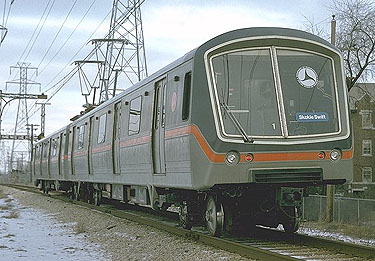
There's something compelling about the design. My first reaction was that the Electroliner design is classic.


Electroliner, September 1, 2007.

The design also evokes the Department of Transportation's State of the Art rapid transit car.


Photograph courtesy Chicago L from the Joe Testagrose collection.

10.8.08

PRE-OLYMPIC GOLD. Might there be some future Huskies on the U18 National Team, back from an undefeated trip to Argentina?
NON-ABELIAN TALK. I had some time between trains in Chicago and picked up George Lakoff's The Political Mind: Why You Can't Understand 21st-Century American Politics with an 18th-Century Brain. (Yes, as if I didn't have enough stuff to read on the train already, that, plus it's all got to be schlepped). I did finish the book, somewhere in western New York, and it gets a quick Book Review No. 31. Professor Lakoff continues to peddle his advice to Democrats (he prefers the "progressive" conceit, but we all know who the audience is) to "frame" policy issues in such a way as to appeal to peoples' methods of thinking in ways that can counteract Republican frames. I have never been impressed with the approach, and one reason the book was a quick read was that it revisits familiar ground. The professor is still using his "tax relief" argument (the cleanest "frame", which he doesn't develop well, might be "membership dues", but that, too, is incomplete as it neglects all sorts of principal-agent and public choice problems that might make a voter receptive to limiting the government's tax take, and sympathetic to reducing its power.) His japes at the surge are dated.

The few parts I found much more compelling were the references to the technical work in linguistics and in mathematics. Hence the group theoretic title. Consider one of Professor Lakoff's examples: affection being measured by temperature (cool to the advances of another, warms up over time, whether plied with good conversation or with strong drinks goes beyond the model.) But the reverse mapping (temperatures being described as more or less affectionate) does not exist. I'm looking for an accessible treatment of the intellectual cross-fertilization between linguists and mathematics, as the logical puzzles strike me as fun. The public policy analysis fails to convince and the professor appears to know just enough about game theory to be dangerous.

(Cross-posted to 50 Book Challenge).
ANALOGIES. Aaron Rodgers :: Brett Favre as (a) Bart Starr :: Lamar McHan (b) Don Horn :: Bart Starr.

Discuss.
FORTY YEARS AGO. British Railways ended routine steam operation on 11 August 1968. Some observers questioned the decision to run a trade deficit to import oil to power diesels of uneven capabilities.

Because the country was relatively prosperous at the time of conversion, many of the steamers made their way into preservation. The North Sea oilfield took care of the oil imports, at least for the time being, although British Rail and successor operators saw the wisdom of importing SD-40 and SD-70 platforms adopted to the British loading gauge.


Waterloo Station, near the end.
David Sallery photograph.

David Sallery's site depicts steam operation in the last few places where the steamers were allocated.

6.8.08

THE HIGHEST GREEN.

In High Green and the Bark Peelers, author R. M. Neal intended that as a tribute to the gentlemen who were his host on Boston and Maine's 10 am nonstopper, the Kennebec Limited, which reached Portland in two hours. By 1965, Patrick McGinnis's asset strippers had ripped out most of the second track on the Portland Division and ended the passenger trains. Guilford Transportation managed to reunite the Boston and Maine with the Maine Central, and they operated a freight railroad after a fashion, although they put many an obstruction in the way of a revived passenger train service between Boston and Portland. Despite Guilford's continued non-cooperation, the service has been expanded, ridership is up (National Corridors link expired) and passenger-train advocates are making the case for more trains as well as a possible extension of the service to Freeport or to Augusta or to Bangor. (It may be a bit much to ask for all-sleeper Bar Harbor Expresses from Philadelphia by way of Worcester, at least of a government agency).

During last month's excursion east, I took a day to sample the line. Again, thanks to a long-ago excursion, collecting all the mileage did not have to be the primary objective. Where, then, to turn back? Several people told me the Portland station was somewhat removed from the commercial parts of Portland, which made a turnback prior to Portland more attractive.
SEPARATING EQUILIBRIUM. A graduate student describes the realities of the academic food chain.

Audrey Jaeger, an assistant professor of higher education at North Carolina State University and M. Kevin Eagan Jr., a graduate student at UCLA, conducted their research at four public universities in North Carolina. They found that college students who take their introductory courses from adjuncts are more likely to change majors, enroll in a different university, or drop out of school entirely.

The problem, the authors say, is not that part-timers necessarily teach poorly but that they don’t have the necessary campus ties to actively “connect” with students. Jaeger and Eagan believe that this is because part-time faculty have fewer out-of-class interactions – holding office hours and meeting with students – of the sort that create a "connection” between students and faculty.

The columnist's reaction reveals great social science potential.

The first serious problem is that Jaeger and Eagan fail to consider that adjunct professors often don’t get the same quality of student that regular faculty do. Part-time faculty, Jaeger and Eagan acknowledge, tend to teach courses at less-attractive times because regular faculty get first choice. But they don’t carry this point to its logical conclusion. Those sections are frequently filled with students who have waited until the last minute to enroll, have given relatively little thought to their courses, and don’t really want to be there. Students in my Thursday evening recitations, a time when most would rather be partying, were often ill-prepared, weak students, or absent altogether.

Therefore, through no fault of their own, the adjuncts are likely to have a higher percentage of weak students. It is unwarranted to conclude that adjuncts are necessarily responsible for the higher rate of dropping out among their students.

Omitted variables? Check. Selectivity biases? Check.
Secondly, in their study, Jaeger and Eagan did not include years of teaching experience or whether a lecturer has a Ph.D. or other advanced degree. Part-time faculty members range from doctoral dropouts to semi-retired professors who have spent entire careers in the field. The latter can be at least as good at teaching their courses as full-time professors. For example, professor Michael Sanera teaches one Introduction to American Politics course at N.C. State University each semester as an adjunct professor. Before moving to North Carolina, he spent 20 years teaching full-time, the last fourteen as a tenured professor at Northern Arizona University. Other than his not having his own office, he says that he is teaching his part-time course no differently than the way he courses during his full-time career.
Adjustment for the quality of human capital? Check.

More telling, however, might be the enrollment-driven mentality (it matters not whether that's a business obsession with market share or an equalitarian obsession with access) that requires adjustment for the quality of the clientele.

As a TA, I noticed that weaker and more vulnerable students seldom sought out-of-class interactions me, regardless of my own availability.

Karen Palasek, a part-time professor with 24 years’ teaching experience says that current requirements at most schools where she has taught (including Peace College, N.C. State, and Campbell University) allow adjuncts to be as dedicated or lackadaisical as they choose. “It’s possible to do very little work and still fulfill your contract,” she explained.

Professor Palasek makes the effort. Whether her students do or not is not revealed.
EXCESS CAPACITY IN AIRPORTS. Earlier in the week, I had some fears for continued air service to South Bend.
But whether a cash-strapped Delta operating out of a congested Atlanta will continue to allocate expensive fuel and scarce landing slots to puddle-jumpers to Studebaker country remains to be seen.
I should have looked closer to home, where an often-lonely Rockford airport will be lonelier still.
The Chicago Rockford International Airport (RFD) announced today that Southern Skyways will discontinue their Denver service. The last flight will be on Monday, August 18, 2008. All customers currently booked on Southern Skyway flights associated with RFD scheduled for departure after August 18th will receive a cancellation notice from the airline along with a full refund for any and all unused tickets booked. Every flight between today's notice, including the August 18th flight and all "Day Trips," will be flown as scheduled.
Rockford officialdom continues to deny the obvious.

RFD Board Chairman Mike Dunn said that the Airport Authority firmly believes that RFD is an economic engine and instrument towards enhancing the quality of life for Winnebago County residents. “Along the way, we collectively discovered a niche market opportunity called "Day Tripping," whereby 131 people could fly non-stop, hassle-free to highly-desired destinations such as: Niagara Falls, Mackinac Island, and NASCAR races like the Brickyard 400 for a fun filled, full day of activities, said Dunn.

“This is not the end, as some might speculate”, said [executive director Mike] O’Brien. “The airline industry is undergoing a paradigm shift and it must. Business as usual isn't an acceptable solution to $5.00 per gallon jet fuel. Instead, this is a time out - at worse - all very necessary for purposes of assessing how best to advance the RFD cause going forward,” he continued.

I must do some history, for instance, whether the property taxes on the Illinois Central and Burlington passenger stations added up to the operating deficits of the Rockford airport during the 1960s, a formula that I know is accurate for some Great Northern stations in North Dakota. The conceit that every mid-sized city must have regular air service, let alone an "international" airport, never made much sense. That the Winnipeg Limited and the Land O' Corn and the Capital 400 had to be sacrificed to that conceit might not have made any sense either.
TRANSCENDING POLITICS. It's been picked up by Paul Soglin and Charlie Sykes and Laura McKenna (is that the first time those three merit mention in the same post?)


See more funny videos at Funny or Die

In the clip, Ms Hilton offers the substantive suggestion that additional oil development in the United States, along with continued research and development in solar and wind power, will produce "energy independence." Probably not, but independence (whether from imported energy or from imported bananas, to use an old metaphor) is not the main goal. Getting the incentives right in the face of exhaustible resources is. In that vein, let me address this Ramirez cartoon from Investor's Business Daily, which was posted without elaboration at Marquette Warrior.


The cartoon is supposed to suggest that development of wind and solar power is a step backwards. So it might be, if the incentives are wrong. There are, however, incentives, quite evident in the maritime record, to make more effective use of wind power.

It is true that in the Age of Sail, becalmed ships (which would have the mizzen, mizzen-top, and spanker set before going to oars) would sometimes be towed by crews rowing the ship's boats, or by kedging, if the water is shallow enough. It's also true that the galleon evolved from the galley, lending some versimilitude to the cartoon image (although a proper galleon would have a forecastle). But the galleon is not the last word in sail technology. In commerce, the Yankee Clipper halved the crossing times (there is a famous painting of Cutty Sark, a British Yankee Clipper, overtaking an early steamship) and for fun there is nothing more thrilling than a Laser or a racing scow. There was, also, an incentive to develop other forms of propulsion for ships (even the Yankee Clipper might be subject to the doldrums or unable to evade a typhoon and the Lasers and scow sailors prudently repair to the clubroom when there's a derecho on the radar screen) which, when acted on, checked further development of sailing technology. That does not, however, rule out further improvements in sailing technology. Such improvements, unfortunately, are unlikely to be commercially feasible except at permanently higher prices for current fuels, prices at which the development of harder-to-get-to sources will be commercially feasible.

Other technologies also have the potential for evolution. I'll probably have more to say about railroad electrification in the near future, but since we're focusing on retro technologies, consider this advanced technology steam locomotive (which was a serious proposal during one of the earlier periods of expensive oil).

ENOUGH TO STOP THE CUBS. Tornado alerts are not unknown in Chicago.
Yowza ... we had massive thunderstorms here last night, with the tornado sirens going for the first time I've ever heard them in Chicago. We actually grabbed the cat and the laptops and the firebox with the valuables and headed for the basement, where we poured pitchers of water and waited. Thankfully it all came to naught and was over quickly; within half an hour we were back upstairs watching the Weather Channel.
To the west, it looked like a replay of last month's derecho, this time with radar echoes that suggested a tornado heading east along the Milwaukee Road's Illinois Division from Stillman Valley to Elgin. Today's commentary from the university meteorologist included links to archived radar animations from Davenport and Romeoville (these are animated .gif files that load slowly -- open the links in new windows) and this observation.
Notice the "comma head" self-developing low pressure over northern DeKalb county with the system as it passed through our area. I'm still surprised there wasn't a confirmed tornado along route 72 or just south of there here in the county...
The forecast discussion included recognition of the hazards of long-term predictions.
The 16 day model forecasts (I know, take this with a grain of salt) at least show a jet stream pattern NOT conducive to any major heat through the third week of August, and that takes out what is climatologically the warmest part of the year. With only several 90 degree highs under our belt so far, and with 21 days of 90 degree highs or higher for the year being average, it's becoming safe to say that our somewhat above average summer temperature forecast will go down in flames.
Set aside the mixed metaphor (daytime highs in the 70s send the forecast "down in flames") and contemplate the difficulties of separating climate change signal from seasonal weather noise.

5.8.08

TEN PERCENT OF AN ELEPHANT OUTWEIGHS THIRTEEN PERCENT OF A COLLIE. That comparison is not terribly useful. On the other hand, a ten percent return on a $400 billion venture, while it looks big, would be reason to shift resources to a venture that offered a thirteen percent return on a $9 billion venture. Somehow, though, $40 billion in oil-company profits causes editorialists to lose their perspective. Vermont Tiger's Art Woolf calls the editorialists out.
WAS THIS WAR NECESSARY? Ian Kershaw's Fateful Choices: Ten Decisions that Changed the World, 1940-1941 places the reader in London (once), Berlin (thrice), Tokyo (twice), Rome (once), Washington, D.C. (twice), and Moscow (once) to provide readers with some understanding of how, given the British Empire's decision to go to war over Poland, a replay of The Great War turned into a global war of annihilation, particularly of Slavs and Jews. Book Review No. 30 is more on-train production. Professor Kershaw suggests that some of the decisions were optional while others were foreordained. Stalin's unwillingness to consider any evidence of hostile German intentions from the suspension of Sea Lion to the occupation of Minsk is clearly the former; Roosevelt's tilt toward Britain comes close to the latter. I wonder, after having read the book, whether the Germans really grasped what they were getting into. Although Britain's decision to fight on, alone, was a closely argued thing, the ability of an insular naval power to stalemate a putatively superior superior power (to a chess player, that is stalemate, an outcome different from a draw due to exhaustion of forces) is formidable, and the Royal Navy did take out the French and Italian fleets and counter the German surface ships. They did not quite have the counter to the German submarines, which provides reason for the U.S. to "lend a garden hose" to the neighbour with the burning house.

The book suggests that international conflict might have been a consequence of faulty economics. Professor Kershaw focuses on the ability of dictators to commit their countries to bad courses of action, something that Hitler and Mussolini and Stalin and Tojo did repeatedly, but their actions were inspired by a desire to catch up with the richer countries. The British Commonwealth and the United States were rich, and the international institutions of the day appeared to be set up in such a way as to keep them that way (a vulgar Marxist would substitute "were" for that "appeared to be" but post-minor-post-Ricardians have their obscurity for a reason) and thus Germany and Italy and Japan had to act on their particular manifest destiny in such a way as to secure sufficient resources to become first-rank powers themselves. Professor Kershaw notes, briefly, that Japan did in fact achieve such a position only after having been militarily defeated, nuked, and occupied. Perhaps politicians, and their court intellectuals, ought have a better understanding of the ways by which people (and the nations they live in, as a side-effect) become wealthy. There are some instructive maps here that illustrate the diffusion of prosperity: whether that is the result of colonisation or of proper rules of trading remains a live research question.

(Cross-posted to 50 Book Challenge).
THE VALUE OF ARTICULATION. Washington Post columnist Jay Mathews discovers the credits-don't-transfer scam, building on the work of Louisville Courier-Journal reporter Nancy Rodriguez.
"Universities are just expert in playing this game that says, 'Well, sure, you completed English composition, but you didn't take my class,' and sort of cheating students out of transfer credits by insisting that they retake essentially the same classes," said Kay McClenney, a professor at the Community College Leadership Program at the University of Texas at Austin.
By contrast, the Illinois Articulation Initiative becomes a point of pride for the Northern Illinois University Alumni Association, with a lengthy article on the method and the success stories in the spring alumni magazine.
NIU offers a large number of scholarships, several of which are awarded exclusively to transfer students. For information on NIU scholarships, visit www.scholarships.niu.edu.
The sidebar also invites alumni to create scholarship opportunities.
GET THE INCENTIVES RIGHT. The editorial board of the Milwaukee Journal-Sentinel see gains from trade in selling Lake Michigan water.

Growth in southeastern Wisconsin comes from a variety of sources and, in general, is good for the region, especially if it provides family-supporting jobs. Trying to stop that growth would put a severe drag on the region's economy. Waukesha County is not the enemy. The same applies to Washington, Ozaukee, Racine, Kenosha and Walworth counties.

The communities of southeastern Wisconsin can grow together, as the Milwaukee 7 economic development group has ably argued.

None of this means that Milwaukee shouldn't expect some reciprocity, such as support from the suburbs for more mass transit and even rail transit. Getting workers to jobs is as critical an issue as clean water.

The revised Great Lakes compact has been approved by inter alia the Wisconsin and Illinois legislatures and Congress and Parliament are at work on it. Milwaukee and New Berlin have reached one such sale agreement. Political Environment notes early reactions to the deal.
THERE GOES THE NEIGBORHOOD. A Milwaukee man neglects a $50 fine for illegally parking an unregistered van in his own driveway and the city forecloses on his house.

"They're trying to take my house away for a parking violation," [Peter] Tubic said. "I know it was my own fault for letting it drag on, I've been under mental duress. I haven't been able to handle this."

Janine Geske, a former Wisconsin Supreme Court justice and law professor at Marquette University, called the case a human tragedy and an example of how people can fall through the cracks in the system.

"It seems like a drastic remedy," Geske said of the city's foreclosure. "But on the other hand the city has to enforce its zoning laws. I don't fault the city for that.

"It's a shame someone didn't intervene to help him. . . . It would be nice if someone who worked for government would take the time and say 'let's look at this and see if we're doing the right thing.' . . . It would be nice if they would remember the human factor here."

Tubic first got the fine for parking his Ford E150 with no license plates in the driveway of the home, which belonged to his parents at the time . The radiator had broken and Tubic couldn't get his plates renewed unless the van passed an emissions test. He didn't have the money to make the repair and had more pressing worries, he said.

Mr Tubic committed this non-moving violation somewhere on West Verona Court. The article doesn't say which block of Verona Court, which is one of the piecewise-continuous streets between the half-mile roads (Oklahoma Avenue and Morgan Avenue in this case) the city built to introduce some variety into what would otherwise be the traditional urban grid pattern. The design is one in which the city might be more alert to moving violations, for instance, if an aggressive adolescent driver on the southwest side used Verona to check the performance of a Barracuda made an error in judgement, my sister would have had unexpected company in her room.

I've found no Wisconsin reaction to this story yet, although Misha gives Milwaukee officials their daily ration. Given the quagmire that much of Milwaukee has become, the use of law enforcement resources to clean up a short section of a side street strikes me as suboptimal.

3.8.08

BARRIERS TO MOVEMENT. Last month, I noted, "Higher transportation costs have the same effect as tariffs." The self-styled newspaper of record just figured it out.
Cheap oil, the lubricant of quick, inexpensive transportation links across the world, may not return anytime soon, upsetting the logic of diffuse global supply chains that treat geography as a footnote in the pursuit of lower wages. Rising concern about global warming, the reaction against lost jobs in rich countries, worries about food safety and security, and the collapse of world trade talks in Geneva last week also signal that political and environmental concerns may make the calculus of globalization far more complex.
Trade-offs everywhere. On the one hand, more costly transportation means more local production, which the article would have readers believe would restore the "broadly shared prosperity" of the 1950s. On the other hand, more costly transportation means only local consumption, which is a hard constraint on consumers.
[A] study, published in May by the Canadian investment bank CIBC World Markets, calculates that the recent surge in shipping costs is on average the equivalent of a 9 percent tariff on trade. “The cost of moving goods, not the cost of tariffs, is the largest barrier to global trade today,” the report concluded, and as a result “has effectively offset all the trade liberalization efforts of the last three decades.”
Higher energy prices are incentives to use less energy, and that is likely to check the ambitions of some of the newly industrialized countries.

The spike in shipping costs comes at a moment when concern about the environmental impact of globalization is also growing. Many companies have in recent years shifted production from countries with greater energy efficiency and more rigorous standards on carbon emissions, especially in Europe, to those that are more lax, like China and India.

But if the international community fulfills its pledge to negotiate a successor to the Kyoto Protocol to combat climate change, even China and India would have to reduce the growth of their emissions, and the relative costs of production in countries that use energy inefficiently could grow.

It's also likely to redefine "upscale".

What may be coming to an end are price-driven oddities like chicken and fish crossing the ocean from the Western Hemisphere to be filleted and packaged in Asia not to be consumed there, but to be shipped back across the Pacific again. “Because of low costs, people were profligate,” said Nayan Chanda, author of “Bound Together,” a history of globalization.

The industries most likely to be affected by the sharp rise in transportation costs are those producing heavy or bulky goods that are particularly expensive to ship relative to their sale price. Steel is an example. China’s steel exports to the United States are now tumbling by more than 20 percent on a year-over-year basis, their worst performance in a decade, while American steel production has been rising after years of decline. Motors and machinery of all types, car parts, industrial presses, refrigerators, television sets and other home appliances could also be affected.

That is, if the knowledge to produce these things hasn't all been pensioned off. Then there's food.

Higher shipping rates could eventually transform some items now found in the typical middle-class pantry into luxuries and further promote the so-called local food movement popular in many American and European cities.

“This is not just about steel, but also maple syrup and avocados and blueberries at the grocery store,” shipped from places like Chile and South Africa, said Jeff Rubin, chief economist at CIBC World Markets and co-author of its recent study on transport costs and globalization. “Avocado salad in Minneapolis in January is just not going to work in this new world, because flying it in is going to make it cost as much as a rib eye.”

Next, some relative price movements. If storage is expensive relative to local labor or to transportation, business logistics take a very different form than they do if storage is relatively cheap.

In addition, the sharp increase in transportation costs has implications for the “just-in-time” system pioneered in Japan and later adopted the world over. It is a highly profitable business strategy aimed at reducing warehousing and inventory costs by arranging for raw materials and other supplies to arrive only when needed, and not before.

Jeffrey E. Garten, the author of “World View: Global Strategies for the New Economy” and a former dean of the Yale School of Management, said that companies “cannot take a risk that the just-in-time system won’t function, because the whole global trading system is based on that notion.” As a result, he said, “they are going to have to have redundancies in the supply chain, like more warehousing and multiple sources of supply and even production.”

Ultimately, the results will leave everybody poorer.
“Despite everything, the American economy is still the biggest Rottweiler on the block,” said Jagdish N. Bhagwati, the author of “In Defense of Globalization” and a professor of economics at Columbia. “But if it’s expensive to get products from there to here, it’s also expensive to get them from here to there.”
We make economics majors sweat out isoquant maps and reciprocity conditions of dual cost functions precisely so that they understand how inescapable Professor Bhagwati's logic is.
OLIVE SHORTAGE IN TUONELA. Serve it up cold.
Al-Qaida confirmed Sunday the death of a top commander accused of training the suicide bombers who killed 17 American sailors on the USS Cole eight years ago.

Abu Khabab al-Masri, who had a $5 million bounty on his head from the United States, is believed to have been killed in an airstrike apparently launched by the U.S. in Pakistan last week.

An al-Qaida statement posted on the Internet said al-Masri and three other top figures were killed and warned of vengeance for their deaths.
Good intelligence and policing has to be backed up by good shooting. Well done.
TOO TACKY FOR WORDS. One hopes the girls (not women, definitely not ladies) who organize used-boyfriend parties will be happy with their cats.
I've never attended a used-date party, where women [c.q.] bring an ex-boyfriend to swap. At these parties, reassurance is the name of the game: The men are all eligible, and each is vouched for by at least one woman [c.q.] in attendance. Essentially, one woman's [c.q.] trash is another woman's [c.q.] treasure.
Bleah. Gentlemen, find a better strategy.
AVOID THE STRAIN. The unpleasantness that is Chicago O'Hare (Midway Airport, although listed in the same class, merits no other discussion) leads a Chicago Tribune reporter to consider other options.
Three days a week, things get hectic at Rockford's airport. A whopping three commercial passenger flights depart. But those flights go to Las Vegas, Denver and one of two Florida cities—popular enough destinations to keep the gates busy at Chicago Rockford International—yes, international—Airport. Or as busy as one baggage carousel, two escalators and one ATM can get. Just 70 miles from O'Hare International, Rockford's airport has seen its fortunes rise during the last five years by trying to be everything its hulking big brother is not. Parking, mere feet from the terminal, is free. Hot dogs cost $1. And the long lines, gruff attitudes and O'Hare's terminally stale smell? None of it.
We're not quite in the "Major Strasser's been shot! Round up the usual suspects" mode but if you're not off to a tourist destination or holding a transit visa for Lisbon, you might want to consider other options.
Reasonable flights also can be found at South Bend Regional Airport, which is accessible from downtown Chicago by the South Shore railroad, but rates aren't so cheap as to make the trek worthwhile for anyone west of, say, Gary.
I don't follow the "rates aren't so cheap" argument? Train fare? Is the author treating driving time (and the wear and tear on car and driver) as a freebie? The South Bend airport is pleasant enough, and management respects the tradition that an observation deck isn't de facto for terrorist intelligence-gathering. But whether a cash-strapped Delta operating out of a congested Atlanta will continue to allocate expensive fuel and scarce landing slots to puddle-jumpers to Studebaker country remains to be seen. That brings the reporter to the case for Milwaukee, which regular readers already know.
Similar to Midway in size and feel, Mitchell offers a manageable experience, with one main terminal—clean, carpeted and comfortable—that has three concourses, inexplicably named C, D and E (the absence of A and B is an old mystery but probably rooted in an expansion that never happened, airport officials say).

The terminal houses several impressive shopping opportunities, which, depending on your taste, may or may not include the $30 foam cheese wedge hats favored by Green Bay Packers fans. There is a Brooks Brothers for the business crowd, a PGA shop for the polo shirt crowd and a Harley-Davidson store for the wings and/or flames crowd.

Best is Renaissance Book Shop, a part of the airport landscape for nearly 30 years. With stained wood floors and shelves, it looks like a real book store, not an airport gift shop and certainly not one of those soulless chains.

Look around and you'll find all sorts of unlikely airport bounty: a $900 set of complete O. Henry works, a $200 first edition of "Harry Potter and the Chamber of Secrets" and, for $60, a rare hard-bound version of J.D. Salinger's "Nine Stories." Don't worry, there is also plenty of the standard romantic and detective trash-fluff.
That last paragraph says more about the reporter than it does about the bookstore, which is splendid. (I have purchased more than one on-train read on mental health excursions to Lake, er, Milwaukee Airport.) The reporter also doesn't quite get the train.
And that is what most makes Milwaukee a viable option to Chicagoans: Amtrak. A train leaving Chicago's Union Station seven times daily (except Sunday) costs $22 each way and will get you almost to the airport's door (if leaving from Glenview, the cost is $20). A short, free shuttle ride finishes the job.
How that leads the reporter to conclude "As for Milwaukee, people who live in Chicago and don't want to drive might need an astounding price difference (at least $150) to bother with the hassle of a train ride" escapes me. Nominal Hiawatha performance is 55 minutes Glenview-Airport, 75 minutes Chicago-Airport, and a trolley service of beverages and bag snacks is available on some trains. The problem, however, is that Midwest has been reducing its services and Northwest is a major carrier out of Milwaukee, meaning changes at Detroit or the Cities. Proper passenger trains on the Michigan Central and Milwaukee Road have the potential to put paid to that service.
IT GOES ON YOUR PERMANENT RECORD. When debt-settlement companies advertise something that sounds too good to be true, often it is. With compound interest.
Once consumers sign with a debt settlement company they are usually advised to stop paying bills and instead save cash or put it in an escrow fund. In return, the firm promises to negotiate settlement payments to reduce or wipe out the debt over time. The contract Julie Fitzpatrick signed, for example, claimed she would be "debt free" in three years.

The flaw with the concept is that once consumers stop paying their bills, interest rates on their credit cards go up and so do penalties, consumer advocates and law enforcement officials say. Also, consumers' credit ratings are likely to suffer, and creditors' lawsuits can tack on payments and court costs.
The article notes that the debt-settlement companies and credit counselors would like to have some regulation. Greater financial savvy on the part of the people who become their clients would also help. (Note, with the coming of the school year, the shameless plug for Financial Fitness in the schools.)
THE HABITS OF EFFECTIVE PEOPLE. A professor offers suggestions to an elementary school principal.
What should students learn in elementary school to help them succeed later in high school and in college? It was a good question and I'm still thinking about it. I said writing skills. The students who come to college able to write effortlessly have a huge advantage. But now I'm thinking on a different line. Perhaps a good work ethic, good study skills, and ambition are the most important skills that determine success later in school and in life. I'm not sure how a school could teach those qualities though.
The bull session begins to address the "how".
THE LAST CLANG OF THE RAIL. Ronald Reagan correctly called the Soviet Union an evil empire. Alexander Solzhenitsyn documented the evil. Do svidanya.

SECOND SECTION. University Diaries quotes Mr Solzhenitsyn's speeches.

THIRD SECTION. Marginal Revolution, with economics.

2.8.08

DISARMAMENT PACT? I've long maintained that the positional arms race to get into the hundred universities claiming to be among the top 40 is a flight from access-assessment-remediation-retention. I've also long maintained that the prestige hierarchy is over-rated, with motivated professors and motivated students being able to interact well and stretch their brains no matter where they are. Now comes Tom Wolfe's I am Charlotte Simmons, which reinforces the point in an indirect way. Yes, the book has been out for a long time, and this Book Review No. 29 may be so 2004. I brought a few things to read on the train, and yes, I read them all. Because so many people are familiar with the plot, the review will be relatively brief. Gifted and principled girl from poor and religious family gets scholarship to highly-rated private university chock full of trustafarians, obsessed with excellence in (too many to be prototypic) sports, gets overwhelmed with how very different the lives of the rich and dissolute are from her own. Bad stuff happens. There's a quip about Shostakovich's Leningrad Symphony (seventieth degree of latitude and last degree of platitude) that summarizes more than a few of the Amazon consumer reviews, and perhaps those gripes are on point. It is possible for a professor to do his work without learning much about the behavior of his charges, whether that behavior is dissolute or not, and I can therefore not call Mr Wolfe out for overgeneralizing from a small sample. Longitudes and platitudes, or perhaps caricature? If true, perhaps the ability of the rich to buy position for their offspring is restricted by their offsprings' dissolution.

There are, however, deeper questions that the book provokes. Why, despite the efforts of administrators, abetted by the Radical Students and with the passive acceptance of the Careerists or the Apathetic or some of the Nontraditionals, to exorcise the Greek Demons, does the Greek system persist and thrive? Perhaps there is something evolutionarily stable about the scamming and status-seeking and fake politeness (the levels of Sarc instruct and amuse) that provide the book's plot twists. Perhaps there is something else, possibly augmenting human capital in finance, insurance, real estate, or sales, that the sometimes superficial and sometimes destructive party scene provides. (That scene is not for university only.) And why, despite the understanding of Everyone In Authority that the athletic programs are money sinks that all too often reflect badly on the universities, do they persist? Possible dissertation topics or future posts a-plenty, without 500 pages of development?

The Spring 2008 Academic Questions included a Carol Iannone interview of Mr Wolfe. Charlotte Simmons came up. Mr Wolfe described his ending as the "most tragic" of three he was considering. His forgone alternatives were Charlotte "totally ruined" or instigating a "moral rearmament movement." I disagree with his characterization. She's dating a basketball player, although he has to "win her affections." It's March. Whether he has the opportunity to go pro remains to be determined. The Basketball Annies are still about. She's a second-semester freshman. The ambiguity is perfect.

(Cross-posted to 50 Book Challenge).

THE CASE FOR A RAIL PASS.

The O Scale Convention in Worcester referred attendees to several hotels within walking distance of the show hall and of Union Station (provided one was not too burdened with purchases or kit). The Union Station reference is both historic (Boston and Maine, Boston and Albany, and New Haven) and accurate today (the one overworked Amtrak train, and a few MBTA commuter trains). A rail pass good on Amtrak and on the commuter rail systems would offer travelers additional convenience. The idea sounds administratively unwieldy where revenue division is concerned. There still are British rail passes, although with that country's idiosyncratic methods of checking tickets, the operating companies probably make educated guesses of their shares in the revenue (consider my peregrinations in the West Country last year). That the British passes are still on offer suggests it's doable, and less complicated connections between Amtrak and the various commuter train operators enhances the value of the network. Consider Arlington Park or the historic trolleys of Kenosha or the Hamptons or Cape May, all accessible by rail but none of them on Amtrak. So, too, with some Boston area destinations. During the convention, there were a few modellers exploring the system, although the main business is work trips or perhaps a Red Sox game. Selected Worcester line trains call at Yawkey, the Fenway Park station (and a logical candidate for naming rights: the Miller-Coors Station at Fenway).


Trains of the Boston and Albany and New Haven lines call at South Station. I suppose, as is the case in London and Chicago, interconnectivity of suburban lines to permit cross-regional trips is relatively unimportant in the greater scheme of getting the regular riders to work on time. As is not the case in London and Chicago, track assignments are improvised each day with tracks posted for boarding only shortly before departure.


There are regional differences in railroading vocabulary, too. Nobody on the Boston commuter rail system understood "stopover." (They are available on Metra, ask the agent and inform the conductor, and I have some old Boston and Maine timetables that indicated stopovers were available on some classes of tickets). To do some work in Salem and Beverly and then return directly to Boston involves purchasing a separate ticket for each leg of the trip.


This tunnel runs under Salem's Washington Street. It's a made-to-order scene divider for a model railroad. The other end of the tunnel used to lead into a reservation in the middle of Washington Street and thence into a station built in the style of a Norman fortress that straddled the tracks. That end is changed utterly, but I have photographs and plans to work from.


At Beverly, the station remains in use, as a mid- to up-scale restaurant with a penchant for Cajun cooking and extensive wine and beer offerings.

Two suburban lines divide at Beverly. One continues north to Newburyport, and if Massachusetts and New Hampshire can come to some kind of agreement, there might again be passenger trains to Portsmouth. The schedules are set up to provide more frequent service Bostonside of Beverly, without the foolishness of a cluster of trains in fifteen minutes followed by nearly an hour of dead time that reduces the value of the Metra Electric. There's no conscious effort to provide in-to-out connections at Beverly, something that might benefit travelers. The North Atlantic Ocean precludes a Gloucester to Ipswich shortcut on the roads.

The Rockport line, which is more properly called the Gloucester Branch, is eminently modelable as it permits a modeler to build the end of the line into a corner and leave all the staging facilities in plain sight.

This Boston and Maine freight house, along with a funky pillar crane, avoided the attention of Patrick McGinniss's asset strippers, and both will be preserved (if perhaps relocated) in a pending upgrade of the station facilities for commuter rail. And sometimes the choice of exterior colors for a house is easy.


If one is going to build the end-of-the-line facilities into a corner alongside a wall, it's convenient to have a prototype wall to use as background. Rockport's Evans Field is home to Rockport's entry in the Intertown Twilight League and to a Little League program. I may take some modellers license and move that grandstand from the first-base to the third-base line, along the tracks (and, of course, have some spectators looking away from the ball game and at the trains!) Dang, an ETTS moment! I just thought about the view of the Milwaukee Road from the upper-deck, first-base side at County Stadium. Miller Park offers no such views.


The end-of-line destinations (until the early 1950s, there was a Friday-out, Sunday-in sleeping car from New York set out by the State of Maine Express and hauled the long way around from Lowell Junction; in the model railroad world this evolution will be much simpler) are a short walk from the station.


Perhaps we're looking at some future America's Cup or Olympic sailors using the Sandy Bay Yacht Club's Optis. (Their chances will be better if they come to the Lake District of southern Wisconsin and mess about with scows.)

That's play, there's also work. Did Patrick McGinnis inspire the painting of these lobster trap markers?


There's also a retail source of lobsters: buy 'em live and take 'em home, or this store will cook one and crack the shell and let you eat it out back and watch the tide go in.


There were more than a few shore birds making their day trips to Rockport on the trains. It is no accident that the Rockport entry in the Intertown Twilight League is the Townies. There's also a Topsfield Tories. No Danvers Witch-hunters, apparently.
TWO SCOOPS. In baseball, I root for the Brewers and whoever is playing the Braves.

1.8.08

THE FRUITS OF ACCESS. I hesitate to claim "logical conclusion" although this does not surprise.
Bellevue [Community College] has never claimed that its “Venture Program” is for everyone. Accredited in 2006, the first-of-its-kind associate degree program targets “high functioning” developmentally disabled students who can work at a minimum of the fourth-grade level in academic courses. According to the college’s Web site, students also “typically” have an IQ of 70 or above — a criterion that would exclude a significant swath of the cognitively disabled population.
Although college isn't for everyone, college officials would like to have something that is.

The college wants to maintain an accredited associate degree program, which by definition will mean that not everyone can succeed. But administrators are now discussing the possibility of offering an additional program, where students who aren’t ready for the rigors of the degree program could still get a certificate or some other validation of their efforts. Similar programs are already offered at several colleges.

“Not every student can earn that [associate] credential, and if that’s the case we need to find a way to help that [other] student progress,” Adams said.

I think I've discovered the academy's equivalent of the 25 mph train schedule on 110 mph track.
COVERED CALLS. A Chicago Cub season ticket holder can hedge against the usual September disappointment by selling an option on his or her tickets.
Think of the service this way: You are buying dibs on tickets, getting in line to buy them at current rates, which experience has shown will rise dramatically should the Cubs still be playing in October. The risk? If the Cubs don't make the playoffs, you'll lose whatever you paid get in the front of that line. In [one fan's] case, that's about $350.
That's called "the option expires out of the money" and yes, dear beer-swilling widebodies, that does happen. The company that is making these options appears to understand something about derivative securities. Read the language. "Sale of forward rights (DIBZ)." Beautiful.
Daniel Lotzof, president of FirstDibz, said that the company tries to keep professional brokers at bay by "setting limits on what one can purchase in a specific market. There are also restrictions on how many a household can buy, or how much can be put on a credit card."
There are strict delivery requirements.

Should the seller fail to deliver, FirstDibz will make good with similar tickets for the buyer while charging "market value"—likely the huge markups the buyer is avoiding by buying early—to the seller's credit card.

Buyers also can sell their tickets auction-style. As of Friday, rights to Cubs tickets were available for the National League Division Series from as low as $147 above face value in the upper-deck 500 section to as high as $495 down the left-field line in Section 102. For Game 3 of the World Series, the first home game for the National League champion, rights to buy ticket in Section 102 were being offered for $715.

So why would sellers let go of tickets now that could be worth hundreds or thousands more in October? Sellers might be out of town for at least part of the playoffs or might not be able to go to every game.

And if there is no game, the seller of the option has transferred that risk to somebody else. A season ticket is a call option on playoff tickets that may or may not materialize. It has value, but without a market to determine that value, the value is hypothetical. The option market determines that value, as one Tribune letter-writer notes.

There are probably other derivative securities one could invent for sports tickets. A time-series of the option price could prove instructive. Was it only Saturday that the Cubs were at risk of falling out of first place? How quickly things change.