31.3.06


ERICSSON GOULASH. More information about the Austro-Hungarian monitors.
The k.k. Naval Architect-Inspector Josef von Romako, brother of the famous Biedermeier painter, received orders to design a modern warship for the Danube. He resolved this task brilliantly by orienting himself along the Monitor design but opening new venues in regard to technical equipment. Two years after founding the I. Ungarische Pest-Fiumaner Schiffbau A.G. (Elsö Magyar Pest-Fiumei Hajógyár R.T.), in 1870/71, the Austrian Navy's first two-screw Danube monitors Maros and Leitha were built there. For the first time an Austrian warship was propelled by two fast running, vertically standing, high pressure engines. One has to know, that in those days common steam-engines were slow-turning low-pressure engines with huge horizontally arranged cylinders. Only after introducing fast running engines and having two engines for propulsion, it became possible to get along with small propellers, imperative, since it was impossible to accommodate bigger screws due to the ships' low draft. For the first time Bessemer steel plates were used for the belt armor, Leitha also got an armored deck--the k.k. Navy's first ships with steel protection. Another new introduction was the arrangement of both guns placed in a revolving deck turret. Advantages of turrets vis-à-vis casemates were lower weight of armor, wider firing angles, and full protection of its gun crew. Two rifled 6in (15)-cm breech loaders, System Wahrendorf, were mounted on fixed sledges. Crude lateral direction was obtained by manually turning the turret, fine tuning was arranged by the ship's maneuvering. It became a tradition from the beginning, that all monitors were named after tributaries of the Danube.That's thinner but tougher plate than Monitor's iron, and twin screws to Monitor's one. On the other hand, Monitor mounted 15 inch muzzle-loading Dahlgren guns. Ericsson intended breech-loading guns, but the Navy would have none of those, in part because of a fatal accident in which an Ericsson breech-loader exploded, perhaps owing to mishandling by a traditional Navy artillerist. Fire control by aiming the ship was common in the U.S. Navy at the time.
REMIND ME WHY HIGH-STAKES TESTING IS A GOOD IDEA. One of the fringe benefits of being on the "why am I here?" committee is that I receive the weekly missive from the State Superintendent of Education. The missive just before spring break was not pleasant.
To follow up my recent skepticism about standardized tests for colleges ... let's not talk about any market tests for high-stakes testing until the testing companies working with the common schools start passing their market tests. Alternatively, if you're going to introduce standardized tests in some colleges, I volunteer for the control group.
State Superintendent of Education Randy Dunn today announced that Harcourt Assessment, a company that had contracted with the Illinois State Board of Education to deliver Illinois Standards Achievement Test materials to Illinois school districts, has failed to meet its contractual obligation with the state.Harcourt isn't playing well in Peoria.
House Republicans want state school Superintendent Randy Dunn to appear at a legislative hearing and answer questions about a testing company's blunders in delivering materials that students need for the Illinois Standards Achievement Tests.They're not making many friends in the land of the Burlingtons.
There's trouble in River City. (It starts with a T which rhymes with T and it stands for "Tests.")School administrators across Illinois, including in Riverside, Brookfield and North Riverside, hit the panic button last week when materials for the Illinois Standards Achievement Test (ISAT) were late.
Most schools began testing Monday in grades three through eight, but by Thursday many school districts hadn’t yet received their test booklets and other materials students needed to complete the tests.
By Monday, districts in the Landmark coverage area had, indeed, begun testing for all students, but there were plenty of tense moments, even into Monday morning.
Reports of Illinois's troubles show them in Missouri.The most important standardized test that Illinois students take each year is arriving late or with incomplete or incorrect information to several school districts, prompting not only significant stress for educators, but also questions about whether the tests will be valid.
The Illinois Standards Achievement Test, which determines whether a school is on the federal No Child Left Behind watch list, is causing problems specifically for administrators and teachers in Rock Island and East Moline.
State testing in Illinois got off to a rocky start last week after school districts across the state discovered missing and flawed tests.Teachers were angry. Administrators were frustrated. In districts that were forced to postpone the tests, students, who had spent months preparing, felt let down. Illinois officials questioned whether they should fire Texas-based Harcourt Assessment Inc., the company hired to administer thePerhaps Illinois officials ought to read some weblogs. A search of the archives at testing guru Number 2 Pencil reveals several stories about Harcourt's troubles as long as four years ago.
tests.
To follow up my recent skepticism about standardized tests for colleges ... let's not talk about any market tests for high-stakes testing until the testing companies working with the common schools start passing their market tests. Alternatively, if you're going to introduce standardized tests in some colleges, I volunteer for the control group.
HERE THEY GO AGAIN. Summer is construction season, whether it's a highway, a railroad, or a university.
A thought about construction season. Sure, some people view the summer scale-back of school and college efforts as wasteful. But it does offer opportunities for refit and renovation with less disruption of operations, if they're properly managed. Compare that with summer vacation on the roads. Chicago is about to rebuild the Dan Ryan Expressway under traffic. (Years ago, when the Interstates were being built from scratch, the only traffic disruption was coming to the end of the finished stretches and back onto the existing roads.) Railroads do track work as well, and detouring trains is a bit more of a challenge than detouring vehicles that have steering wheels.
The replacement of 1,472 windows and outside doors in Reavis, Watson and Zulauf halls will take place this summer, costing about $3,150,000 according to Bob Albanese, associate vice president of Finance and Facilities.There might be reason to recover the cost with ten years' reduction in heating bills. But I'm looking at the current windows and blinds and expecting the missive (clean up your desks and such lest stuff get trampled or sucked out) implying more disruption of work.
Replacement will begin in May and end in October, but the bulk of the work will be done by August. However, the 1,047 summer courses, according to Registration and Records, offered in various campus buildings will not be affected.We'll see about that. The space grab the deans started about this time last year is still not finished. A number of offices are still awaiting number plates, and the directory downstairs still shows the deans and assorted functionaries in a number of locations. Perhaps our current acting dean was being honest about being short-staffed, lacking the resources to plan the move properly as well as lacking the resources to measure his departments' efforts properly.
A thought about construction season. Sure, some people view the summer scale-back of school and college efforts as wasteful. But it does offer opportunities for refit and renovation with less disruption of operations, if they're properly managed. Compare that with summer vacation on the roads. Chicago is about to rebuild the Dan Ryan Expressway under traffic. (Years ago, when the Interstates were being built from scratch, the only traffic disruption was coming to the end of the finished stretches and back onto the existing roads.) Railroads do track work as well, and detouring trains is a bit more of a challenge than detouring vehicles that have steering wheels.
LEARNING CURVES. The hall light at the top of the stairs at Cold Spring Shops headquarters shows signs of impending failure. Remove housing. Unscrew light. Remember those original compact fluorescent lamps that resemble the burrito as big as your head? Yup ... that was what came out. It must have gone in there sometime in the last century. Original cost about $12. The replacement ... a 75 watt equivalent that will fit any space your standard Edison bulb will go, for under five bucks. We'll see how long it lasts.
30.3.06
A CHEESEBOX UNDER THE DOUBLE EAGLE. In the course of researching the Confederate commerce raiders, I learned of a noteworthy preservation effort on the banks of the Donau.
The Dual Monarchy commissioned some river monitors in the 1870s, and the hull of one, Leitha, is the focus of a preservation effort in Budapest. (There is at least one of the Hungarian railroad system's streamlined Suburban Tanks in preservation ... must consider another trip that way.)
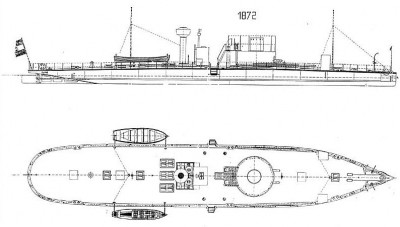
The preservation effort envisions restoring it as an Ericsson Battery, with a little help from its friends. (There appears to be a way to send Yankee greenbacks.)
The Dual Monarchy commissioned some river monitors in the 1870s, and the hull of one, Leitha, is the focus of a preservation effort in Budapest. (There is at least one of the Hungarian railroad system's streamlined Suburban Tanks in preservation ... must consider another trip that way.)

The preservation effort envisions restoring it as an Ericsson Battery, with a little help from its friends. (There appears to be a way to send Yankee greenbacks.)
TO CATCH A PIRATE, THINK LIKE A PIRATE. I mentioned Tom Chaffin's Sea of Gray, which I recently had time to finish, and herewith Book Review No. 8. This is a great yarn about the efforts of the Confederate consul in Liverpool, one James Dunwoody Bulloch, a.k.a. "Uncle Jimmy" to Theodore Roosevelt, to procure merchantmen for the Confederacy to convert into commerce raiders and the efforts of Union consul Thomas H. Dudley to ferret the efforts out and encourage H.M. Government to live up to its obligations as a neutral. Re-flagging and doctored bills of sale were common, for Yankee merchant ships and Rebel privateers alike.
Once the raider puts to sea, the story becomes more compelling. The last Rebel ship afloat (as events transpired), C.S.S. Shenandoah, was advanced for her time, with a stowable screw propellor to reduce drag when she was under full sail, although that wasn't very often as her captain feared being able to jury-rig repairs with a jury-rigged crew. (Sometimes the crew was less makeshift. The Rebels were somewhat clever at re-crewing on the fly.) Her mission was to disrupt the whaling fleets operating near the poles. Along the way, the captain concludes a treaty with a Micronesian king (on an island referred to at the time as "Ascension," not to be confused with the South Atlantic neighbor of St. Helena, under British administration) whose island hosts the thirteenth-century works of Nan Madol. (That sentence notes several things I learned from reading the book and researching the review.) He later tells a Yankee whaler that the Confederacy had formed a mutual defense pact with the whales. Along the way, his Southern officers learn some hard lessons about the effects of snow and ice on running rigging, as well as the traditional sailor's lesson that there are many days best described as "yesterday, today, and tomorrow," in which nothing of note happens. Those days take on particular importance after Shenandoah speaks a British merchantman out of San Francisco that finally persuades her captain that the Confederacy is in fact lost, and the privateer -- whose status would have been even more dubious had the United States signed on to an agreement among the European powers to abolish the practice -- was in the eyes of the European powers now a pirate ship. But not so much a pirate ship not to be celebrated by Liverpudlians upon her return there, after which several of the officers went into exile in Argentina.
The memoirs of several of the ships crew show some familiarity with Jules Verne's later Around the World in Eighty Days (1872), particularly where the International Date Line divides the whaling grounds, and Twenty Thousand Leagues under the Sea (1873), where the ruins at Nan Madol are concerned. (Verne also wrote a less-well-known work, The Blockade Runners, about the more glamorous but less effective Rebel efforts on the high seas.)
There's more, much more, to this story. Shenandoah made her way safely to Liverpool, and the officers ultimately benefitted from "with malice toward none, with charity toward all." But you'll have to read the book to understand my choice of a title for this post.
Once the raider puts to sea, the story becomes more compelling. The last Rebel ship afloat (as events transpired), C.S.S. Shenandoah, was advanced for her time, with a stowable screw propellor to reduce drag when she was under full sail, although that wasn't very often as her captain feared being able to jury-rig repairs with a jury-rigged crew. (Sometimes the crew was less makeshift. The Rebels were somewhat clever at re-crewing on the fly.) Her mission was to disrupt the whaling fleets operating near the poles. Along the way, the captain concludes a treaty with a Micronesian king (on an island referred to at the time as "Ascension," not to be confused with the South Atlantic neighbor of St. Helena, under British administration) whose island hosts the thirteenth-century works of Nan Madol. (That sentence notes several things I learned from reading the book and researching the review.) He later tells a Yankee whaler that the Confederacy had formed a mutual defense pact with the whales. Along the way, his Southern officers learn some hard lessons about the effects of snow and ice on running rigging, as well as the traditional sailor's lesson that there are many days best described as "yesterday, today, and tomorrow," in which nothing of note happens. Those days take on particular importance after Shenandoah speaks a British merchantman out of San Francisco that finally persuades her captain that the Confederacy is in fact lost, and the privateer -- whose status would have been even more dubious had the United States signed on to an agreement among the European powers to abolish the practice -- was in the eyes of the European powers now a pirate ship. But not so much a pirate ship not to be celebrated by Liverpudlians upon her return there, after which several of the officers went into exile in Argentina.
The memoirs of several of the ships crew show some familiarity with Jules Verne's later Around the World in Eighty Days (1872), particularly where the International Date Line divides the whaling grounds, and Twenty Thousand Leagues under the Sea (1873), where the ruins at Nan Madol are concerned. (Verne also wrote a less-well-known work, The Blockade Runners, about the more glamorous but less effective Rebel efforts on the high seas.)
There's more, much more, to this story. Shenandoah made her way safely to Liverpool, and the officers ultimately benefitted from "with malice toward none, with charity toward all." But you'll have to read the book to understand my choice of a title for this post.
A BAD PARODY OF ISO 9001. That has been my characterization of the teacher-education accreditation exercise we're going through, and it now turns up in comments to Jim at SCSU Scholars, similarly frustrated with accreditors of the business program.
WHAT IS SEEN AND WHAT IS UNSEEN. Inside Higher Education runs yet another "take this job and shove it" column.
New readers: stick around. I found another column at Inside that provides more grist for the regular mill. But not tonight. First some rest so as to be fresh for the students; then some after-hours therapy shuffling boxcars. See you in the evening.
There are an awful lot of people out there who live their lives in a constant state of low-level despondence: They have too many papers to grade, their colleagues are not interested in their work, their colleges are in constant crisis, they didn’t get promoted, they live in the middle of nowhere, they can’t find a date in the middle of nowhere, their partners live hundreds of miles away.With the usual incomplete list of reasons for the unhappiness.
Some of this unhappiness, I would suggest, is endemic — those repressed details — and some is particular to the conditions of academe at this moment in time — the job market, the decline in education funding, the increasingly corporate university.Regular readers of Cold Spring Shops ought to be able to identify the omitted important influence behind the "constant crisis" and the "decline in funding."
New readers: stick around. I found another column at Inside that provides more grist for the regular mill. But not tonight. First some rest so as to be fresh for the students; then some after-hours therapy shuffling boxcars. See you in the evening.
29.3.06
THE FOUNDATIONS OF PROSPERITY.
I have on occasion suggested that the role of the G.I. Bill college benefits in the emergence of a large, comfortable middle class in the U.S. has been overstated. My interpretation comes in part from reading the history of the large business enterprises and the promoters who created them. These subjects never lack for controversy. The latest reading, Book Review No. 7, is Charles R. Morris, The Tycoons, which credits Andrew Carnegie, John D. Rockefeller, Jay Gould, and J. P. Morgan with "inventing the American supereconomy." Author Morris attempts to position his book differently from Alfred D. Chandler's The Visible Hand and Scale and Scope, both of which provide excellent background on the strengths (abundant products made cheaply by a few firms) and weaknesses (abundant products made cheaply by a few firms) of industrialization. He also takes a somewhat different tack than many writers, portraying Andrew Carnegie, endower of libraries, somewhat less favorably (he comes off as indecisive and easily swayed, and his obsession with productivity -- hard-driving the steel furnaces -- as the solution to any and all ills almost wrecks his properties), and Jay Gould, issuer of watered stock and hirer of private armies, somewhat more favorably (he understood the advantages of friendly railroad connections coast-to-coast rather than community of interest pools, even if he didn't understand that railroads required proper grading and maintenance.) The central story in the book is the transition of the U.S. economy from Jefferson's yeoman farmers and Lincoln's skilled artisans to a factory system in which the machinery augments the productivity of the man in such a way that a man of even modest talents could make a valuable contribution to the assembly of a high-value product. Toward the end, Mr Morris is scornful of business theorists who would honor time-and-motion expert Frederick W. Taylor, timing to the split second the swinging of a hand-shovel, over tinkerer Alexander Holley, inventing a machine to augment the man's hands. It is in that invention of such machinery that the objective conditions favoring a broad middle class emerge. That the contemporary equivalent of such machinery makes more highly-educated people more productive gives rise to the college premium. (Thus a mass entitlement of higher education does more than slow the re-entry of demobilized soldiers to the labor force; without the objective conditions that is all the entitlement would achieve.)
Although the tycoons did engage in conduct that both inspired enactment of and later required enforcement of the antitrust laws, Mr Morris suggests that their legacy included those objective conditions for prosperity, persisting despite policymakers and management consultants alike putting too much faith in Mr Taylor's "scientific management" rather than Mr Holley's induced innovation.
The appendix inadvertently pays tribute to yet another wrong lesson. Consider this passage.
Although the tycoons did engage in conduct that both inspired enactment of and later required enforcement of the antitrust laws, Mr Morris suggests that their legacy included those objective conditions for prosperity, persisting despite policymakers and management consultants alike putting too much faith in Mr Taylor's "scientific management" rather than Mr Holley's induced innovation.
The appendix inadvertently pays tribute to yet another wrong lesson. Consider this passage.
The Carnegie Co. was a holding company formed in April 1900, comprising:Tyranny of the four-bullet slide, forsooth. As an exercise, rewrite that as a single paragraph without colons, maintaining proper sentence structure.
- The Carnegie Steel Co., its dominant property, plus other holdings previously held on the books of the Steel Co., including
- The Frick Coke Co. The Steel Co. previously held a 29.55% interest in the Coke Co., but the Carnegie Co. bought out the other shareholders shortly after it was organized, so its interest increased to 100%.
- A five-sixths interest in the Oliver Mining Co., which held large ore leases in the Mesabi ore range.
- A variety of railroads, steamship lines, and Great Lakes docks, many of them newly developed and used primarily by the Carnegie subsidiaries.
MORE STUFF TO READ. This evenings guests on Milt Rosenberg's show were John Franch, author of Robber Baron: The Life of Charles Tyson Yerkes, and John Wasik, author of The Merchant of Power: Sam Insull, Thomas Edison, and the Creation of the Modern Metropolis. These tycoons are respectively the creator of the Union Loop, financier of the London Underground, and donator of the Yerkes Observatory; and the organizer of Chicago's power network and electric suburban railroads, and donator of the CIVIC OPERA HOVSE. They both had brushes with the law and led tormented and sometimes isolated personal lives. One of the authors noted that although Citizen Kane might be about newspaper tycoon William Randolph Hearst, star Orson Welles groomed himself like Samuel Insull, and some of the scenes in the movie are out of Insull's life. I will likely acquire these biographies and get around to reviews in due course.
PROMISES, PROMISES. Democrats Pledge to 'Eliminate' Osama.
In the position paper to be announced Wednesday, Democrats say they will double the number of special forces and add more spies, which they suggest will increase the chances of finding al-Qaida's elusive leader. They do not set a deadline for when all of the 132,000 American troops now in Iraq should be withdrawn.I don't recall a Democratic deadline for eliminating poverty. Perhaps some policy goals are beyond anybody's ability to foresee meeting them, desirability notwithstanding.
WASN'T THIS THE TROUBLE WITH TRIBBLES? Surgeons Remove Two Fetuses From Infant. It really isn't funny.
It's a rare event, occurring about once in 500,000 births.Surgeons operated on a 2-month-old Pakistani girl Tuesday to remove two fetuses that had grown inside her while she was still in her mother's womb, a doctor said.
The infant, who was identified only as Nazia, was in critical condition following the two-hour operation at The Children's Hospital at Pakistan Institute of Medical Science in the capital, Islamabad, said Zaheer Abbasi, head of pediatric surgery at the hospital.
Abbasi, the chief doctor who led the operation, said the case was the first he was aware of in Pakistan of fetus-in-fetu, where a fetus has grown inside another in the womb.
"It is extremely rare to have two fetuses being discovered inside another," Abbasi told The Associated Press, adding that he did not know what caused the medical abnormality. "Basically, it's a case of triplets, but two of the siblings grew in the other."
28.3.06
OF HILLTOPPERS AND WILDCATS. Cold Spring Shops, your one-stop first stop for obscure sports news. Tonight ... the women's National Invitational Tournament, which takes place at the home courts of participating teams. Funnily, two teams with the home court are the finalists. Former North Star Conference member Marquette, now of the Big East, won the Big East consolation game, defeating Pitt. The location of the home court for the final game is now known, with Kansas State, coached by onetime drinking buddy Deb Patterson, defeating Western Kentucky by one in overtime. (No, they did not go scoreless in regulation.) The tournament final is this Friday at 7 pm, in Manhattan.
PLOTS WITHIN PLOTS. Greater DeKalb resident Rick at Right Wing Nut House has the latest "24" summary up. The show gets weirder and weirder. Apparently a precondition for a security clearance at the Counter-Terrorism Unit, let alone at the LaSalle and Bureau County Railway (or whoever is stealing the unit one boxcar at a time) is you have to be some kind of a fruit loop. But leave that aside. Focus on the latest postponed terrorist attack. I know just enough about gas works to be dangerous, and the act of going into a locked room with containers of nerve gas, that, once opened, mix with lower-pressure natural gas that goes through that room, then out a not-well-marked gas main bothers me ... those bad guys should either have suffocated or triggered an explosion starting the timers on those less convincing canisters.
Never mind, it's fiction.
Now consider Mr Moran's prediction.
Never mind, it's fiction.
Now consider Mr Moran's prediction.
It’s Henderson vs. Jack with the future freedom of the United States hanging in the balance. The Greeks would kill them both off at the end. Let’s see what Fox comes up with.They won't come up with it early in next week's show. At the end of the just-ended hour, protagonist Jack Bauer has terrorist squad leader Bierko (who reports to a renegade former Penn Central, er, Counter Terrorism Unit, official) in a submission hold just as the gasworks goes boom right on top of them. The upcoming hour starts opposite the tip-off of the men's collegiate finals. Expect Jack, or a corpse, or the ghost of Robert R. Young, to appear at the end of the hour.
MARKET TESTS TAKE MANY FORMS. Economist John S. McGee once described markets as "environments in which powerful and appraising evolutionary forces are at work." Keep that in mind, then read this Philadelphia Inquirer report on pressure to introduce standardized tests into universities, and University Diaries' comments thereon. (Take the time to visit the sandhouse.)
One paragraph stands out.
One paragraph stands out.
[Former Texas system regent Charles] Miller dismissed the comparison [to No Child Left Behind, crowding out learning every day]. The states, not Washington, should take the lead on collegiate testing by requiring it at public universities, he said. Once the big state systems prove its value, he predicted, testing will be swept by market demand into private schools.Market tests can also provide proofs of something's uselessness. Consider "New Coke" and football in a cage. And therein lies the real test for higher education. What happens when a major employer says "enough" to decoding inflated grades at the job fair and recruits out of high school? Neither the internal assessments the defenders of the status quo nor the taught-to standardized tests will be of any use.
THINGS THAT CHANGE, THINGS THAT STAY THE SAME. I recently finished David Riesman's Academic Values and Mass Education, a 1970 study of the evolution and travails of Oakland University and Monteith College at Wayne State University. A book is not old if it hasn't been read, and herewith Book Review No. 6.
Oakland University came into being as a Michigan State University project to create a high-powered undergraduate college serving a commuting population. In the Sputnik era, public recognition of a knowledge gap between U.S. youngsters and their overseas contemporaries (sound familiar?) led to public commitment of resources to develop more scientists and technocrats (before the cost-benefit ratios were known.) But rather than set up yet another Albion or Oberlin, let alone another land-grant university, Oakland's founders envisioned something at once elitist and accessible. For a number of reasons (Oakland admitted a local valedictorian whose college boards placed her in the third percentile nationwide being symptomatic of one, the temptations of suburban life providing another) the original experiment did not work well, and Oakland added dorms and athletic teams (their women's basketball team received the Mid-Continent Conference automatic bid Northern Illinois once earned during the time Northern Illinois reconsidered its ambitions to be a major independent) to become yet another suburban-specific public college.
Monteith College at Wayne was an application of the ideas of integrated liberal studies within an urban comprehensive university. Professor Riesman characterized the mindset of Monteith's creators and faculty as "anti-departmentalism." The idea continues to appeal ("The world has problems. The university offers departments.") The execution is another matter. Integrated liberal studies proved popular in the heady 1960s, when the reward to a college degree during the Great Society inflation was high, tenure was a matter of course, and anything-goes criticism of The System was in flower. By the time I arrived at Wayne in 1979, Monteith was being phased out as a college. In some ways the fate of Wayne since then has been a foreshadowing of the academy's fate elsewhere. My position as a specialist in public utilities and industrial economics followed Leonard W. Weiss and C. Emery Troxel. I may not have performed up to the standards they set. On the other hand, my colleagues made me look so good that Northern Illinois made me an offer I couldn't turn down, and in those days Northern Illinois had academic ambitions commensurate with their athletic ambitions. How quickly things change.
But what doesn't change is the questing for a mission for higher education. In 1970, Professor Riesman could still speculate on the end of the Vietnam War changing the educational treadmill, such that ambitious people with a blue-collar bent could prosper without spending the money or the time in college. He could cite legislators pressing for higher teaching loads to preclude professors from using their research time to foment revolution, and revolutionaries pressing for higher teaching loads to preclude professors from using their research time to support the military-industrial complex. Conflicts over curriculum and standards are nothing new, and the 1970 arguments are very much like today's. I found this passage depressing and illuminating.
Some passages in the book tell me more about Professor Riesman than they do about the travails of the experimental colleges. The Monteith faculty were able to obtain cooperation more readily from social scientists other than the economists, although he notes that development economics offered a more congenial set of questions for the other social scientists to engage. The development economics of those days was a curious blend of technocratic statism that failed to deliver lasting prosperity anywhere it was tried, although it made wanna-be technocratic statists in other disciplines comfortable with their prejudices. (Other versions of technocratic statism, such as Russia's instant privatizations and Britain's fragmentation of the railroads failed to perform much better.) Elsewhere, he offers one interpretation of a set of facts that well might be interpreted differently. But overall, he leaves the impression that the current tussle over the role of higher education and the proper balance between teaching and scholarship, let alone access and excellence, is neither new nor likely to go away soon.
Oakland University came into being as a Michigan State University project to create a high-powered undergraduate college serving a commuting population. In the Sputnik era, public recognition of a knowledge gap between U.S. youngsters and their overseas contemporaries (sound familiar?) led to public commitment of resources to develop more scientists and technocrats (before the cost-benefit ratios were known.) But rather than set up yet another Albion or Oberlin, let alone another land-grant university, Oakland's founders envisioned something at once elitist and accessible. For a number of reasons (Oakland admitted a local valedictorian whose college boards placed her in the third percentile nationwide being symptomatic of one, the temptations of suburban life providing another) the original experiment did not work well, and Oakland added dorms and athletic teams (their women's basketball team received the Mid-Continent Conference automatic bid Northern Illinois once earned during the time Northern Illinois reconsidered its ambitions to be a major independent) to become yet another suburban-specific public college.
Monteith College at Wayne was an application of the ideas of integrated liberal studies within an urban comprehensive university. Professor Riesman characterized the mindset of Monteith's creators and faculty as "anti-departmentalism." The idea continues to appeal ("The world has problems. The university offers departments.") The execution is another matter. Integrated liberal studies proved popular in the heady 1960s, when the reward to a college degree during the Great Society inflation was high, tenure was a matter of course, and anything-goes criticism of The System was in flower. By the time I arrived at Wayne in 1979, Monteith was being phased out as a college. In some ways the fate of Wayne since then has been a foreshadowing of the academy's fate elsewhere. My position as a specialist in public utilities and industrial economics followed Leonard W. Weiss and C. Emery Troxel. I may not have performed up to the standards they set. On the other hand, my colleagues made me look so good that Northern Illinois made me an offer I couldn't turn down, and in those days Northern Illinois had academic ambitions commensurate with their athletic ambitions. How quickly things change.
But what doesn't change is the questing for a mission for higher education. In 1970, Professor Riesman could still speculate on the end of the Vietnam War changing the educational treadmill, such that ambitious people with a blue-collar bent could prosper without spending the money or the time in college. He could cite legislators pressing for higher teaching loads to preclude professors from using their research time to foment revolution, and revolutionaries pressing for higher teaching loads to preclude professors from using their research time to support the military-industrial complex. Conflicts over curriculum and standards are nothing new, and the 1970 arguments are very much like today's. I found this passage depressing and illuminating.
Whew. Summarize in one paragraph several Cold Spring Shops themes. On one hand, here appears to be a track to what Duke calls "Professor of the Practice of ..." On the other hand, here comes the College of Education bringing its untested notions of pedagogic cosmic justice into the practice of economics.Deans and presidents of primarily undergraduate institutions are constantly complaining that they have to hire Ph.D.s who have little experience of teaching and little interest in it. In the large universities that emphasize graduate training to do research, T.A.s are thrown into the (usually lower-division) classroom with little grounding in their subject matter and even less development of self-awareness as college teachers.
Currently, much propaganda and a few new structures are being devoted to the efforts to develop a greater interest in teaching on the part of prospective college teachers. One proposal is to create a new degree, the Doctor of Arts, which would be a teaching degree, as against the Ph.D., seen as a research degree. Conceivably, as its proponents hope, the Doctor of Arts degree would not be a second-class degree for those cooled out from Ph.D. programs, but a first-choice degree for those whose commitment would be to college teaching and whose doctoral program would be as demanding as but different from a more research-oriented one. It would include consideration of problems of teaching and learning, practice teaching, and work outside one's immediate field of specialization. Yet, unless major universities hire men, including their own graduates, with Doctor of Arts degrees, it is likely that in fact it will be a less valued degree, somewhat limiting the opportunities of its possessors. Moreover, while deans and presidents of colleges want to hire teaching-oriented faculty, a department chairman may be more ambitious for national visibility -- or vice versa. But beyond such considerations, we think that the emphasis on the purity and virtue of the college teacher who does no research can be overdone.
Some passages in the book tell me more about Professor Riesman than they do about the travails of the experimental colleges. The Monteith faculty were able to obtain cooperation more readily from social scientists other than the economists, although he notes that development economics offered a more congenial set of questions for the other social scientists to engage. The development economics of those days was a curious blend of technocratic statism that failed to deliver lasting prosperity anywhere it was tried, although it made wanna-be technocratic statists in other disciplines comfortable with their prejudices. (Other versions of technocratic statism, such as Russia's instant privatizations and Britain's fragmentation of the railroads failed to perform much better.) Elsewhere, he offers one interpretation of a set of facts that well might be interpreted differently. But overall, he leaves the impression that the current tussle over the role of higher education and the proper balance between teaching and scholarship, let alone access and excellence, is neither new nor likely to go away soon.
27.3.06
A CORRIDOR WORKS BETTER WITH GREATER FREQUENCY. Destination: Freedom notes Illinois legislators planning to spend more money to run more trains.
Transportation bills do require the governor's signature.
More trains to Southern and to Western and additional calls at Illinois State, even as tuitions rise and the research missions shrink ...In the past some Amtrak routes between Chicago and downstate cities have been threatened, but this year legislators want Amtrak to operate two additional round-trips between Chicago and St. Louis.
They are willing to triple what the state pays Amtrak in order to do that.
The proposed increase also would fund one extra round-trip along the Chicago-to-Carbondale route and another round-trip between Chicago and Quincy.
This fiscal year, the state is paying Amtrak $12.1 million. Identical bills in the Illinois House and Senate would increase that annual support to $35 million.
“This proposal is building up a head of steam, and it will likely be altered in the coming weeks to reflect the financial capabilities of both the state and federal government,” said state Sen. Jeffrey Schoenberg, D-Evanston, a bill sponsor.
The extra money would be needed to employ additional crew members, print new schedules and add rail cars.
Transportation bills do require the governor's signature.
A spokeswoman for Gov. Rod Blagojevich said he has not yet decided whether to support the legislation.The governor has taken some stick for maintaining his household in Chicago and maintaining an office there. He might have to extract a pledge that critics not call attention to additional morning and evening trips into Springfield that would allow him to put in a full day there.
CONTEMPLATING THE TRADEOFFS. Immigrant-rights protests continue as Congress debates competing proposals.
Fine. Consensus is for easy problems.The Senate is set to begin debate Tuesday on the first comprehensive rewrite of U.S. immigration laws in a decade.
“We're facing a difficult situation, because we have approximately 11 million undocumented aliens here and we've got to find some way to deal with them,” Senate Judiciary Committee Chairman Arlen Specter, R-Pa., said Sunday on ABC's This Week.
Tackling that problem has been one of Bush's priorities since his first term, but it poses a political challenge or him: He must balance the demands of conservative Republicans who want a crackdown on illegal immigration, business leaders who say the nation needs more immigrant workers and Republican Party operatives, such as national Chairman Ken Mehlman, who have been wooing the Hispanic vote.
The president expressed concern last week about the political fallout. “This could be a fractious debate.”
RESPECT THE BOX.
A soon-to-be released (to journeyman economists like me; the Recognized Pundits rate advance copies) book titled The Box : How the Shipping Container Made the World Smaller and the World Economy Bigger draws a great deal of attention.
I read a review in The Economist.
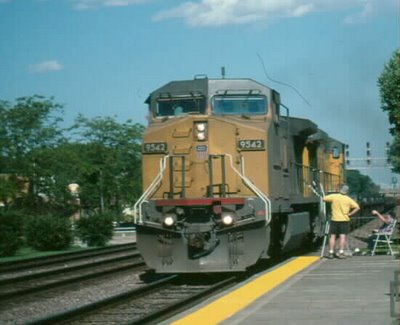
The train-spotters are awaiting the arrival of a steam locomotive, No. 3985, which, as is often the case with special events, arrived just as a rain shower ruined the exposures. The train is a bare-table move (empty well cars) reflecting the loads east, empties west (it's sometimes cheaper to sell the container to a scrap metal merchant than to find a westbound load for it) traffic the articles reference. In Chicago,
I read a review in The Economist.
WHEN the MSC Pamela sailed into Felixstowe, Britain's biggest container terminal, on her maiden voyage last year, Hutchison Whampoa, the port's Hong Kong owners, took a deep breath and renewed their efforts to build more deep-water berths. They were looking to the future. At 1,053 feet (321 metres), and able to carry the equivalent of more than 9,000 containers, Pamela is the world's largest container ship. But not for long: leviathans with twice that capacity are on their way.The point of all the media tributes is the ostensible 50th anniversary of the international shipping container, which offers two advantages, reduced handling and reduced pilferage, over traditional transloading methods.
Consider the economics. Loading loose cargo, a back-breaking, laborious business, onto a medium-sized ship cost $5.83 a ton in 1956. McLean calculated that loading the Ideal-X cost less than $0.16 a ton. All of a sudden, the cost of shipping products to another destination was no longer prohibitively expensive.An article I recall contrasted traditional shipping with containerization by using the example of a cask of olives. At each transload, a few got crushed and a few got eaten. Normal costs of business and all that. Virginia Postrel's farewell column at the New York Times (her new print medium port will be The Atlantic) notes the change.
This opened up all sorts of possibilities. Instead of manufacturing goods locally, a company could afford to replace its overcrowded multi-storey factory in Brooklyn with one in Pennsylvania, where taxes, electricity and other costs were lower, and then ship its goods to New York in a container. Later the factory might move to Mexico; it is now probably in China.
Just as the computer revolutionized the flow of information, the shipping container revolutionized the flow of goods. As generic as the 1's and 0's of computer code, a container can hold just about anything, from coffee beans to cellphone components. By sharply cutting costs and enhancing reliability, container-based shipping enormously increased the volume of international trade and made complex supply chains possible.She links to a Spiegel article that observes the half-century with musings about the latest generation of ships to round the Horn.
Vessels that accommodate 6,000 to 7,000 standard containers -- or TEUs ("twenty-foot equivalent unit") as they are known in the industry -- are becoming a common sight on the high seas. And designers have already dreamed up huge freighters capable of accommodating 13,000 TEUs.These ships are too big for the Panama and Suez canals, let alone the St. Lawrence Seaway. What happens when they hit land? Back to The Economist, with more on the challenges facing port authorities (the government agencies that own the port facilities and have the responsibility for providing the infrastructure that companies in Dubai and elsewhere manage.)
According to one rule of thumb, a single medium- sized ship can move as many containers as are transported on a typical German autobahn during a whole day. When goods are shipped in such vast quantities, the transport costs become negligible.
As to the future, the author looks to ships that will approach the “Malacca-Max”, the maximum size of a vessel passing through the Strait of Malacca, the shipping lane between Malaysia and Indonesia. Some container ships are already too big to get through the locks in the Panama Canal. The future giants will be a quarter of a mile long, 190-feet wide with their bottoms 65-feet below the waterline. They will be able to carry enough containers to fill a line of trucks 68 miles long. Hutchison needs to get digging.A quick calculation: 13,000 TEUs = 6,500 40 footers = 3,250 standard well cars = 26 standard stack trains. It's more manageable that way. But The Superintendent's favorite expert on Pacific port operations notes that there is currently no direct rail access to quayside at Los Angeles or Long Beach: anything headed east is rubbered to the railhead. And when those 26 extra stack trains converge on Greater Chicago (which includes the Union Pacific yard at Rochelle -- there are a lot of short cuts of well cars, bare-table moves, and light engine movements through DeKalb now) they're adding to growing congestion on the rails.

Elmhurst, Illinois, 16 June 2002.
The train-spotters are awaiting the arrival of a steam locomotive, No. 3985, which, as is often the case with special events, arrived just as a rain shower ruined the exposures. The train is a bare-table move (empty well cars) reflecting the loads east, empties west (it's sometimes cheaper to sell the container to a scrap metal merchant than to find a westbound load for it) traffic the articles reference. In Chicago,
Union Pacific's western competitor, BNSF, expects a near-quadrupling of container traffic from 2004 to 2007.After 90 years, the railroads finally have run out of excess capacity. That in turn has restored their ability to raise rates, according to James Valentine, a research analyst for Wall Street giant Morgan Stanley.
"These positive trends in pricing and better returns are likely to continue for years, maybe decades," Valentine said.Because "all roads lead to Chicago," he added, the region will get a generous slice. "It should receive a disproportionate benefit from the railroads' resurgence."
AUTHENTICITY, OR SELLING OUT? Chicago Tribune columnist Dawn Turner Trice calls readers attention to an academic conference.
Apparently the tension is present in African-American music as well.
Performance can be a way of making a statement. Performance can be a way of making a living. Hence the tension."That's just what we need, more mainstreaming of the pimp-gangsta-thug lifestyle."
What irks me so much about this type of rap music isn't that it's so negative and denigrating and, well, vile--but that there just isn't enough positive stuff to serve as a counterweight.That lack of balance with rap music is just one of the topics V.P. Franklin, Ortique professor of politics and history at Dillard University in New Orleans, will be discussing on Wednesday when he provides the opening address for a four-day conference at the University of Illinois at Urbana-Champaign.
"Race, Roots and Resistance: Revisiting the Legacies of Black Power" will commemorate the 40th anniversary of the black power movement. (The conference is free. For more information, call 217-333-7781.)
But those of us who came of age in that era recall that "sell-out" was an insult. Among white kids, the sell-out would imply acceptance of corporate America. Hence yuppies.My focus here is the arts segment of the movement because I look at what's happening today with rap music and I worry that its power--its profound reach and influence--is far more destructive than constructive.
Many of the artists who aligned themselves with black power saw a connection between the arts and the other struggles of the day."The art would serve the larger cause of black liberation," Franklin told me. "The paintings, the poetry, the dance, the song lyrics would raise the consciousness of people of African descent and show them what they could accomplish in solidarity."
Apparently the tension is present in African-American music as well.
But is entertainment -- whether it be music or painting or sport -- the sole instrument of validation for anybody?"Now [rap music] is much more individualistic," Franklin said. "Once hip-hop became commercial, then the artists felt they had a broader audience. And, in order to please that audience, they had to do certain things that didn't necessarily uplift the black community.
"Three decades later, rap artists use their voice, their power, most often to attain the "bling" rather than to further some cause.
Franklin believes the new artists undermine artists committed to creating more positive work and images that benefit the collective.
But does art or music have to benefit a collective? Why can't rap artists sing what they want and present the images of their choosing?
"The problem is we no longer have any control over the images or the styles," Franklin said. "A lot of young people don't see the alternatives. There's just one way of dressing, of speaking, of behaving--the negatives are being validated on so many different levels."
26.3.06
WE. WANT. MORE. In three overtimes, Wisconsin 1, Cornell 0. Do you remember the spring of 1973? After two periods of a national semifinal game, it's Cornell 4, Wisconsin 0. With 18 seconds to go, Dean Talafous ties the game at five ...
I like the tournament field.
SIEVE!
Badgers are also effective Gopher hunters. The women's team denied Minnesota a three-peat, with a 3-0 win in the Cities.
SIEVE! SIEVE! SIEVE!
I like the tournament field.
Wisconsin takes on Maine in an NCAA semifinal April 6 at the Bradley Center in Milwaukee. Boston College and North Dakota will meet in the other semifinal.At one time, there was an alliance between the Western Collegiate Hockey Association and Hockey East. All four of the teams playing in Milwaukee ... hey, another Hiawatha ride? ... are members of that alliance.
SIEVE!
Badgers are also effective Gopher hunters. The women's team denied Minnesota a three-peat, with a 3-0 win in the Cities.
SIEVE! SIEVE! SIEVE!
ILLEGAL IMMIGRATION, PRO AND CON. Virginia Postrel expresses a preference for an immigration policy that can separate the dishwashers from the terrorists. I doubt that anyone would gainsay that. But designing such a policy is harder ... does anyone even have a guess how many terrorists might be masquerading as dishwashers? She links to a Dallas Morning News editorial (I'm going to quote freely before this goes behind the firewall) that pursues multiple goals.
There's also a resource allocation problem.
In related commentary, InstaPundit received a favorable report on Chicago's illegal immigrants' rally and links to a local source that had a less favorable impression.
Operationally, it is an amnesty. Irregular workers become regular workers and pay taxes. Citizenship and voting rights are for another paper. Here's a harder problem.The Judiciary bill would offer the 11 million to 12 million illegal immigrants in the U.S. a chance to earn citizenship. They would have to show they have a job, pay a fine, pass a background check, get their taxes in order and go to the back of the line to apply for citizenship.
Let us repeat that last part, because it often gets misread as amnesty. Illegal immigrants who do the above would not cut in front of anyone else applying for citizenship. They'd have to line up behind everyone else seeking the same citizenship that many legal Americans' own immigrant ancestors sought.
The nation's security is far stronger if we know who's here to frame houses, change linens, bus tables and build microchips – and who shouldn't be here to profit from true criminal activity or worse.Although now you have a Bayesian inference problem. Does anyone have a subjective probability that a putative dishwasher is a sleeper agent?
There's also a resource allocation problem.
What are the opportunity costs?A citizenship plan also makes sense because we simply can't enforce existing laws and send the illegals back where they came from.
That refrain, a staple among some readers and on talk shows, would require rounding up a population the size of Ohio. We don't have enough border agents, police officers, holding cells, judges, courtrooms or buses to make that happen.
Paying several billion dollars to do something of that scale would be fiscally imprudent.
Is there such a thing as a forge-proof identity card? On the other hand, if the authorities knew who was here legally, wouldn't it be straightforward enough to deport the equivalent of the population of Ohio?The committee would be best served to go with the idea presented by Sens. John McCain and Ted Kennedy, who would allow as many as 400,000 foreign workers each year to receive three-year work visas. They could earn two three-year visas before returning home or earning U.S. citizenship.
That number matches the estimated annual flow of illegal immigrants. If we take those workers and give them forge-proof, biometric ID cards, we ease the burden on law enforcement agents. They will know immediately who's here legally and who's not.
Um, how big is the job churn in a "nearly full employment economy" and how does one send Vermont's cows or Las Vegas's hotel rooms to India?Illegal immigrants make up about 5 percent of our workforce. Yank all of them out of the economy, and we have a serious financial problem. You can't punch that big a hole in the workforce without upending industries, farms, manufacturers and the hospitality industry – not in today's nearly full employment economy.
Yes, fewer American high school dropouts have jobs today, but even the authors of a recent study about this admit there is no evidence that illegal immigrants have their jobs. It's more likely that many jobs would go overseas or disappear altogether if immigrants didn't do them.
In related commentary, InstaPundit received a favorable report on Chicago's illegal immigrants' rally and links to a local source that had a less favorable impression.
25.3.06
ENOUGH IS ENOUGH. Indiana's William Becker delivered the Presidential Lecture at the Midwest Economics Association. His message: teach the controversies. He's not happy about the attempts of legislators and administrators to introduce K-12 thinking into higher educations.
Doing in universities what is arguably legitimate for high schools is remedial education and not higher education.Amen.
MASSACHUSETTS LIBERALS USED TO BE MORE RESOLUTE. I've taken delivery of Sea of Gray, a story about Confederate commerce raider Shenandoah, a fairly advanced merchantman purchased from the British to be used as a privateer against the whaling fleets, to persuade Yankee abolitionists to contemplate the price of their principle (sound familiar?) The ship remained at sea after April 1865, continuing to prey on Yankee whalers, despite the protestations of captains that the Southern Rebellion was over. It has been some time since I last provided a book review. This will be among the next few releases. The politics I started with aren't interesting. The adventures are. In keeping with good sea stories, you could start this one with "no s***, this really happened."
I'LL NEVER LACK FOR WORK. The editorial board at the Milwaukee Journal-Sentinel weighs in on illegal immigration.
What contradictions? The policies are completely coherent. In the face of a pool of uncredentialed and low-skilled individuals willing to provide a cheap labor subsidy and able to cross the border in both directions (I told you that Midwest Economics Association conference was productive) the occasional regularization, or periodic offering of in-state tuition for college-age kids, or amnesty by some other name, is optimal.In proposing tougher enforcement standards and a guest worker program, the president simply got the facts right.
Borders must be secure, employers should have the means to discern legal residency and much of the economy would have some difficulty surviving without immigrant workers. But he seemingly recognized also that those already here have been doing yeoman-like labor to keep the economy humming, and he saw also the basic injustice in the country both demanding these workers' presence and condemning it. This speaks to the need to give guest workers a shot at permanent legal residency.
The president must foster compromise and break the congressional logjam. A country that speaks proudly of its immigrant past needs to act to remove the contradictions and injustice existing in its immigrant present.
WE WANT MORE. Wisconsin 4, Bemidji 0 in Green Bay. Cornell is a worthy second opponent. For a different perspective on Wisconsin hockey, go here.
There is no joy in Dinkytown, as Holy Cross eliminated Minnesota in overtime. A few years ago, I remember a Minnesota team that was much stronger on paper being taken to overtime by Harvard in the finals, and Harvard got a lucky bounce in the second overtime.
SIEVE! SIEVE! SIEVE! SIEVE!
Gotta give this one to Wisconsin. Plus it's in Wisconsin....well, not that that matters for Wisconsin fans.Indeed not. The legend lives on from Beantown on down of Elroy Hirsch buying for all the Badger fans in Providence. It really happened. I was there. Wisconsin had just lost the 1978 consolation game to Bowling Green (yeah, Northern Illinois nemesis Bowling Green. Midwestern Axis of Evil Bowling Green.) Mr Hirsch plunked $500 on the bar and said "Serve anybody wearing red."
There is no joy in Dinkytown, as Holy Cross eliminated Minnesota in overtime. A few years ago, I remember a Minnesota team that was much stronger on paper being taken to overtime by Harvard in the finals, and Harvard got a lucky bounce in the second overtime.
SIEVE! SIEVE! SIEVE! SIEVE!
THE NEW, THE OLD, AND THE SAFE COURSE. Although I have reported on the Elburn extension previously, here are the first pictures. These date from my Milwaukee trip at the beginning of Spring Break. Very little had changed today, when I made a trip to Chicago for the Midwest Economics Association.
The Elburn coach yard is now the terminal for all trains, including a few weekday trips that load their first passengers at West Chicago. (There are no interlockings between West Chicago and Elmhurst, precluding the onslaught of zonal expresses the Burlington unleashes.)
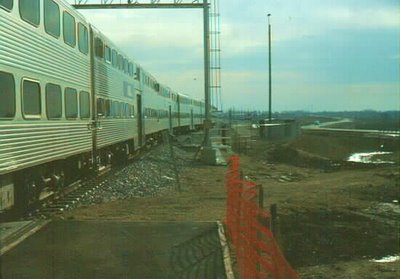
The Elburn station has only one platform, on the south side of the tracks. Here is the empty stock for the 8.25 Saturday departure backing into the station.
The Union Pacific Metra operation won a safety award. This polished locomotive bell is on display in front of the station master's office at North Western Station.
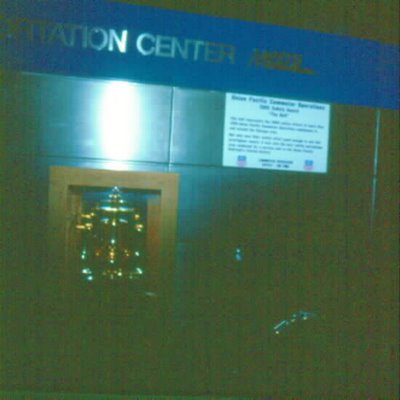
The sign reads
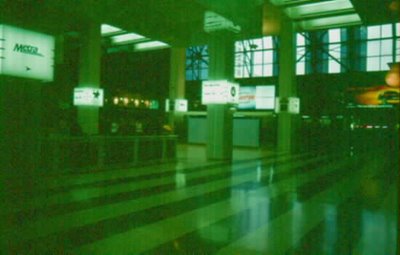
Get off the trains on the second floor, ride one of two escalator sets to street level, or spend your money in the various clothing stores on the first two levels first, or eat at the food court. (The food court is out of the line of traffic. Eating without getting trampled, what a concept.) It doesn't look much like a train hall, but there's more light coming in than is the case at Union Station just to the south.
Commuters can avoid some climbing by passing through the riverside entrance of the old Chicago Daily News building, walking up a ramp past some coffee shops, and emerging at track level. The passageway from the Daily News to North Western Station crosses Clinton Street, and the current owners of the building have thoughtfully left this link to the past in place.
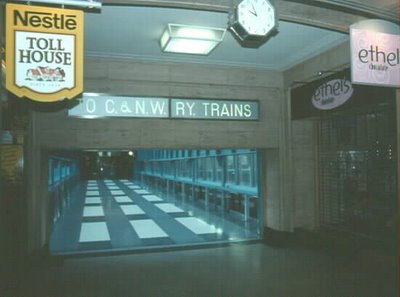
The North Western stopped being the operator of record in the early 1980s and merged into Union Pacific in mid-1995. Look for this sign in a museum eventually.
That's the end of the train riding for conferences for a while. (But I do have a weekend pass and my mental health could use a boost ...) The conference proved to be a productive one. There's an open bottle of Sprecher Winter Brew receiving the Wisconsin treatment as a reward.
The Elburn coach yard is now the terminal for all trains, including a few weekday trips that load their first passengers at West Chicago. (There are no interlockings between West Chicago and Elmhurst, precluding the onslaught of zonal expresses the Burlington unleashes.)

The Elburn station has only one platform, on the south side of the tracks. Here is the empty stock for the 8.25 Saturday departure backing into the station.
The Union Pacific Metra operation won a safety award. This polished locomotive bell is on display in front of the station master's office at North Western Station.
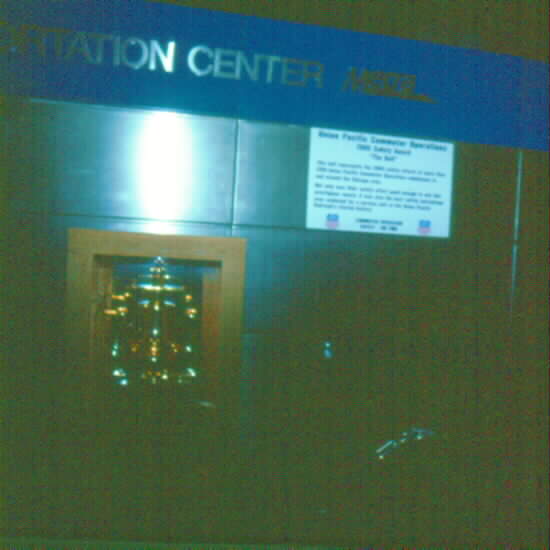
The sign reads
This bell represents the 2005 safety efforts of more than 1200 Union Pacific Commuter Operations employees in and around the Chicago area.The North Western Station is now the atrium of an office tower. I believe Chase (the old Chase Manhattan combined with a Chicago banking house) now owns the upstairs. CORRECTED 26 MARCH ... The building is now the CITICORP CENTER.
Not only was their safety effort good enough to win this prestigious award, it was also the best safety percentage ever achieved for a service unit in the Union Pacific Railroad's storied history.
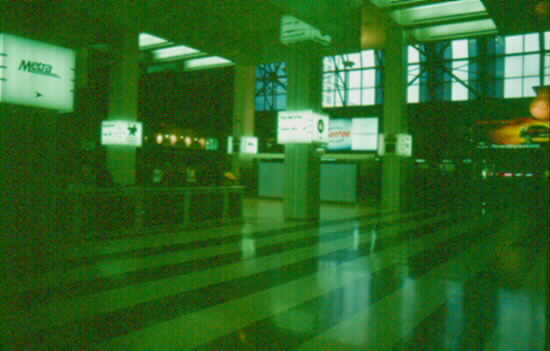
Get off the trains on the second floor, ride one of two escalator sets to street level, or spend your money in the various clothing stores on the first two levels first, or eat at the food court. (The food court is out of the line of traffic. Eating without getting trampled, what a concept.) It doesn't look much like a train hall, but there's more light coming in than is the case at Union Station just to the south.
Commuters can avoid some climbing by passing through the riverside entrance of the old Chicago Daily News building, walking up a ramp past some coffee shops, and emerging at track level. The passageway from the Daily News to North Western Station crosses Clinton Street, and the current owners of the building have thoughtfully left this link to the past in place.

The North Western stopped being the operator of record in the early 1980s and merged into Union Pacific in mid-1995. Look for this sign in a museum eventually.
That's the end of the train riding for conferences for a while. (But I do have a weekend pass and my mental health could use a boost ...) The conference proved to be a productive one. There's an open bottle of Sprecher Winter Brew receiving the Wisconsin treatment as a reward.
FRIDAY'S MODELS ON SATURDAY. Once the conference crush is over, I'll get back to this project. I have to work out the bracing for the cab floor in order to secure the rear of the cab to the tailbeam.

The cab sides have the numbers and Soviet railway emblem attached, and some detail parts that the kit designer left out are being snipped out of brass pieces elsewhere.

Taken together, it looks something like this.
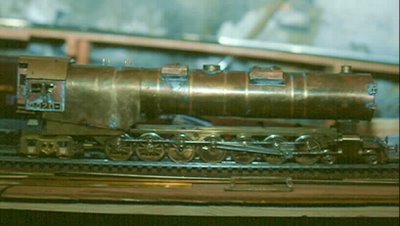
Friday morning, at the conference, the topic of economists indulging in excess rigor accompanied by oversimplification came up again. The point of modeling is to come up with a believable representation that captures the essential elements. I'm thinking of a non-cumbersome way to suggest that such criticisms are tantamount to replicating the real thing, rather than this brass miniature.
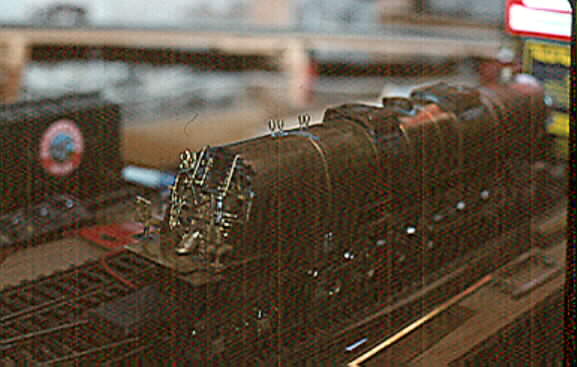
The cab sides have the numbers and Soviet railway emblem attached, and some detail parts that the kit designer left out are being snipped out of brass pieces elsewhere.
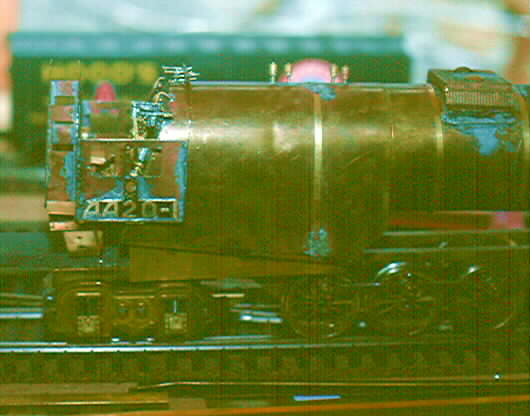
Taken together, it looks something like this.

Friday morning, at the conference, the topic of economists indulging in excess rigor accompanied by oversimplification came up again. The point of modeling is to come up with a believable representation that captures the essential elements. I'm thinking of a non-cumbersome way to suggest that such criticisms are tantamount to replicating the real thing, rather than this brass miniature.
SHE'LL LOOK BETTER IN RED. The Chicago Sun-Times discovers that getting into the University of Illinois is not easy.
The young lady features in a sidebar about the calls the admissions committee at the College of Business made.

Shed no tears.
Stacey Kostell, director of undergraduate admissions, acknowledged the school had gotten more competitive this year but said admission criteria haven't changed and that she still expects to accept close to two-thirds of students who apply. She said last year, the school saw an uncharacteristic decrease in applications; this year was closer to levels in the recent past.Illinois admits applicants by college. A high school senior who declares an interest in the business college competes in a different pool of applicants from one who declares an interest in engineering who competes in ... I'm not sure I like that idea. Sorry for going Joshua Lawrence Chamberlain again, but one reason to attend college and deal with gen-eds is to get some sense of your strengths and weaknesses, which is why junior year is for declaring majors.
"Students who had traditionally been admitted didn't always get admitted this year, not because they weren't good students, but because we had this very large increase without additional space, especially in the business program," said Kostell.
And although the school does plan to increase its nonresident enrollment in the future, she said that wasn't a factor in more residents getting denied. "We've had just as many upset out-of-state students call," she said.
The young lady features in a sidebar about the calls the admissions committee at the College of Business made.
Allison Seymour and Brad Terry seem like students any college would want.
Seymour, 18, of Lincolnshire, had a 3.74 grade point average on a scale of 4.0, scored a 31 on her ACT college admission test, including a perfect math score, took six advanced placement courses, and played volleyball and ran track for four years. Terry, 17, of Buffalo Grove, had a 33 on the ACT and played varsity baseball. Both were student council members.
But both also were rejected by the University of Illinois College of Business this year.

Shed no tears.
Terry, who said U. of I. was supposed to be a backup, said he is leaning toward attending the University of Michigan. Seymour, who got scholarship offers from the University of Iowa and Indiana University, says she plans to attend the University of Wisconsin.SIEVE!
24.3.06
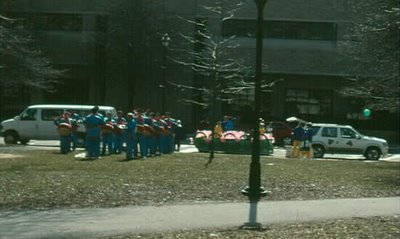
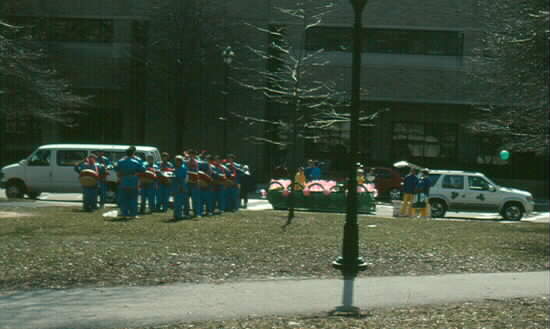
DOING IRISH MILWAUKEE STYLE. Kodachrome provides sharper pictures but there's still that matter of sending them to the lab and waiting for them to come back. Here is the visual accompaniment to this post about the Milwaukee St. Patrick's week and selection show parade. First, a bit of a contrast. Yes, that is a Chinese band practicing. The local supporters of Falun Gong received permission to follow the parade as an unofficial extra unit, trailing a local step dance group that earned some sort of national honor.
In the background is the Wisconsin Electric Power office building that occupies the site of the 1886 Milwaukee Road station. Question for my Milwaukee area readers: is the Wisconsin Avenue facade of the Midwest Express Center inspired by the roofline of that station?
I don't recall what was once at the corner of Plankinton and Wisconsin. Mo's Irish Pub is a recent addition. The banner is counting down ... six days to St. Patrick's day (by which time all but one of the Wisconsin-based basketball teams that were celebrating on Selection Sunday were free to drink the green beer.)
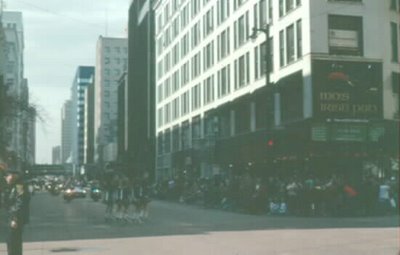
Along both sides of the street are the replica harp-case streetlights the city has been installing. Milwaukee, you're overdoing it with those streetlights. The originals were on side streets and somewhat further apart than these replicas. The tall pole with a single streetlight is correct for Wisconsin Avenue. The lamp housing is the same design as the one for the harp-case lights, but the more austere bracket was the design of choice on the main streets.
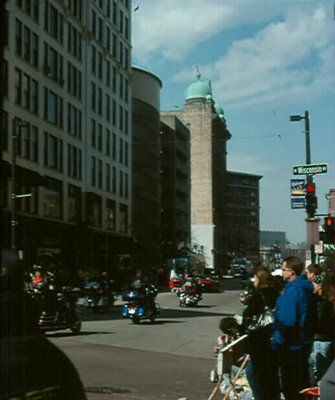
Milwaukee is the home of Harley-Davidson, and no Milwaukee parade is without an escort of Harleys. The Prussian helmets are on the Germania building that was built as the Germania building and renamed the Brumder building in the Great War era. I didn't see any bikers wearing Prussian helmets. But I did see a trolley that never got anywhere near the original Cold Spring Shops.
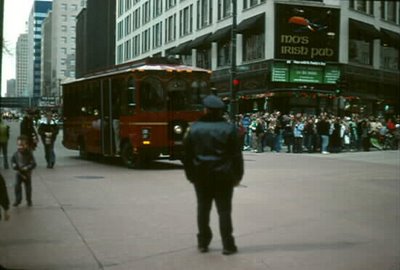
Parade participants were tossing candy to the kids, providing the policeman with opportunities to engage in patient crowd control. And yes, the weather was changeable, with occasional raw sou'easters and rain squalls off the lake, and sunny and fine by day's end.
In the background is the Wisconsin Electric Power office building that occupies the site of the 1886 Milwaukee Road station. Question for my Milwaukee area readers: is the Wisconsin Avenue facade of the Midwest Express Center inspired by the roofline of that station?
I don't recall what was once at the corner of Plankinton and Wisconsin. Mo's Irish Pub is a recent addition. The banner is counting down ... six days to St. Patrick's day (by which time all but one of the Wisconsin-based basketball teams that were celebrating on Selection Sunday were free to drink the green beer.)

Along both sides of the street are the replica harp-case streetlights the city has been installing. Milwaukee, you're overdoing it with those streetlights. The originals were on side streets and somewhat further apart than these replicas. The tall pole with a single streetlight is correct for Wisconsin Avenue. The lamp housing is the same design as the one for the harp-case lights, but the more austere bracket was the design of choice on the main streets.
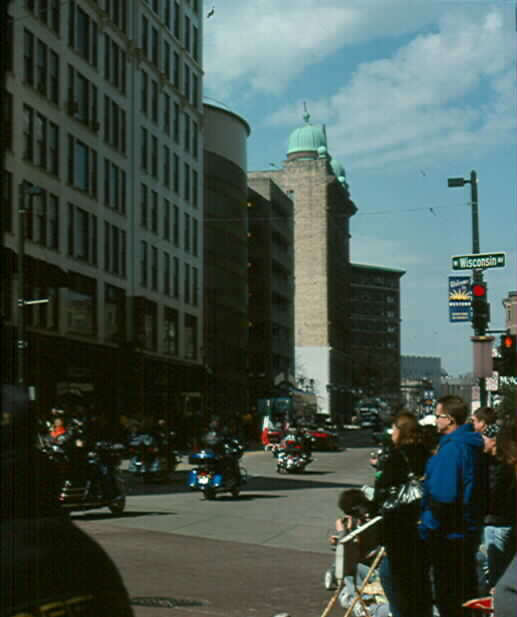
Milwaukee is the home of Harley-Davidson, and no Milwaukee parade is without an escort of Harleys. The Prussian helmets are on the Germania building that was built as the Germania building and renamed the Brumder building in the Great War era. I didn't see any bikers wearing Prussian helmets. But I did see a trolley that never got anywhere near the original Cold Spring Shops.

Parade participants were tossing candy to the kids, providing the policeman with opportunities to engage in patient crowd control. And yes, the weather was changeable, with occasional raw sou'easters and rain squalls off the lake, and sunny and fine by day's end.
THE MIDWESTS ARE IN THE CITIES NEXT YEAR. This year, a hockey tournament is there. The Lady Badgers defeated St. Lawrence 1-0 and will face off against Minnesota for the national hockey championship on Sunday. SIEVE!
MOVING THE MASSES. This morning, I presented a paper at the Midwest Economics Association conference in Chicago. Session starts at 8.15 am. Path of least resistance: the 6.07 Naperville Zephyr.
The morning rush hour on the Burlington involves loading long trains at four or five outlying stations and running them non-stop into the city. Here is the situation at 6.20.

I have shown the path of my train, which will load at Naperville and leave at 6.25. Ahead is No. 1214, which might have crossed over at West Lisle to leave Lisle at 6.26 and follow my train from Downer's Grove Main. No. 1218 has run empty stock from Aurora to Fairvew Avenue to make all stops between Fairview and Hinsdale. Off screen, No. 1216 will begin accepting passengers at Highlands. These four trains will reach Union Station between 6.58 and 7.12, and the next arrival will be the next Naperville Zephyr at 7.18 participating in a similar cycle. It's quite the kick to watch all this when it's working properly.
The morning rush hour on the Burlington involves loading long trains at four or five outlying stations and running them non-stop into the city. Here is the situation at 6.20.
I have shown the path of my train, which will load at Naperville and leave at 6.25. Ahead is No. 1214, which might have crossed over at West Lisle to leave Lisle at 6.26 and follow my train from Downer's Grove Main. No. 1218 has run empty stock from Aurora to Fairvew Avenue to make all stops between Fairview and Hinsdale. Off screen, No. 1216 will begin accepting passengers at Highlands. These four trains will reach Union Station between 6.58 and 7.12, and the next arrival will be the next Naperville Zephyr at 7.18 participating in a similar cycle. It's quite the kick to watch all this when it's working properly.
Y'ALL COME BACK NOW, HEAR? I go away for a conference and it's hit after hit after hit ... Max Speak looking for a new Washington Post columnist who is honest and readable but not "too wonky." That's how I earn my modest living, being wonky. University Diaries looking for a quotable quote. (Quotable wonk? Max, you wanna reconsider?) The dean at Anonymous Community suggests there is a downside to faculty governance out of the Joshua Lawrence Chamberlain era. Perhaps so, but the past 30 years of administrative usurpation of faculty discretion has not brought forth a flowering of great scholarship and innovative teaching. Our president, John Peters, is a fine man. But I'd really rather hear Col. Chamberlain assuring me, "Got your back, Steve."
(Here's a history quiz. Category: Incompetent Mississippi leaders. Assignment: Compare and contrast P. G. T. Beauregard with Shelby Thames.)
Thanks, all, for looking in. To quote from Rip Track, "Check it out, and see if your brain benefits from an overhaul in the Cold Spring Shops." Come on back. Post a comment. The virtual Sprecher is flowing.
(Here's a history quiz. Category: Incompetent Mississippi leaders. Assignment: Compare and contrast P. G. T. Beauregard with Shelby Thames.)
Thanks, all, for looking in. To quote from Rip Track, "Check it out, and see if your brain benefits from an overhaul in the Cold Spring Shops." Come on back. Post a comment. The virtual Sprecher is flowing.
23.3.06
EATING THE SEED CORN? Craig at Division of Labour links to a University of Pennsylvania self-study that reports the modal undergraduate lecture or seminar is taught by a tenured or tenure-track faculty member, although the majority of such courses have a lecturer, graduate assistant, or other staff responsible. His observation.
With more press like this, we will all be on four-four teaching loads sooner than later.Chris at Signifying Nothing links and notes,
Confidential to parents: drop the 40 large per annum on a liberal arts college education for your kids instead.Or check out a mid-major. The money outlay is smaller and the faculty participation in the undergraduate program greater.
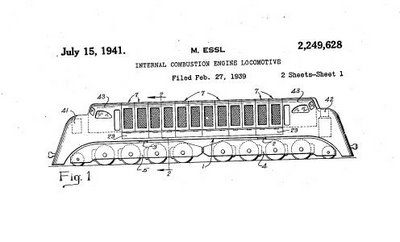
THE GENESIS OF THE GENSET. The first of Max Essl's patents for a diesel locomotive with modular power units is No. 2,249,628, granted July 15, 1941. The narrative to the patent asserts an improvement in the prior art in being able to quickly remove and replace a small power unit for repair at a workbench, rather than have the locomotive out of service while one large prime mover is being repaired or replaced.
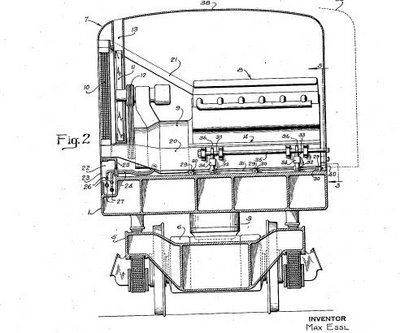
The elements of the genset are in this figure.
Subsequent patents No. 2,299,420 describe improvements in the modules to permit some servicing to be done by a maintainer while the locomotive is in use (Mr Essl would probably not appreciate me joking about the real Centipedes requiring an "oiler" and a "wiper" in the nautical mode), and No. 2,317,849 is recognizably a Centipede, with further improvements in cooling systems, ventilation, and balance.

The elements of the genset are in this figure.

Subsequent patents No. 2,299,420 describe improvements in the modules to permit some servicing to be done by a maintainer while the locomotive is in use (Mr Essl would probably not appreciate me joking about the real Centipedes requiring an "oiler" and a "wiper" in the nautical mode), and No. 2,317,849 is recognizably a Centipede, with further improvements in cooling systems, ventilation, and balance.
22.3.06
VOTES OF NO CONFIDENCE. According to USA Today,
Harvard's departed president Larry Summers is mentioned in the article, but he declined the invitation to comment. Kentucky's president Lee Todd, recruited out of IBM, [is that like hiring an AT&T guy to run Penn Central? Behave yourself.] is more talkative.
The other theme is the mission of Mr Todd and other recently hired university presidents with business backgrounds. The article mentions research emphases and economic development. The subtlety ... which a newspaper reporter can be forgiven for missing ... is in the nature of that research. We're no longer talking about disinterested inquiry into whatever seems interesting whether the outcome will have any lasting effect or not. We are talking about inquiry into projects that have a commercial payoff. The compromise that might be emerging is one in which legislatures might provide additional real resources while changing the roles of their state schools. Thus Mr Todd might receive some help for technology commercialization at Kentucky, but departments at Kentucky that don't do that kind of research, and entire campuses elsewhere in the state, might receive more explicit orders to phase out the research programs. (A similar dynamic might be at work in Illinois, but neither the legislature nor the administration of any comprehensive university has come out and said so. Legislators have conflicting visions. Presidents and provosts are reluctant to voluntarily reduce the scope of their universities.) That might entail what the dean at Anonymous Community describes as "retire the euphemisms and face reality," as well as moving toward his Easter Bunny treat, "So Flagship U could keep its doctoral programs, but Eastern Teachers State U couldn’t. Faculty at Eastern Teachers State U would actually have to teach undergraduates. Graduates of Flagship U would eventually actually have chances to get jobs."
That compromise might be honest, but it might also be unsustainable, for a different reason. Here is the current Faustian bargain at the Upwardly Mobiles, again, from the Easter Bunny post.
OK, tell the truth instead. Drop the pretense of "competing in the profession." Hold-up the existing tenured faculty to teach more classes if their scholarly work is not commercializable. But do so quickly, so as not to recruit any more ambitious Ph.D.s under what is now clearly a false pretense.
Now for the reality check. People who have a vocation for teaching and more modest research aspirations have avoided the Upwardly Mobiles for years. Does Newly Honest Safety School (properly, a four year community college with a climbing wall and good parties?) improve its chances of competing for those people? It is likely to be more difficult to give away economics Ph.D.s under those circumstances. Perhaps a university can deal with its enrollment-impacted departments in the short term by holding-up the existing tenured faculty. Replacing those people in the long term might not be as easy as "Graduates of Flagship U would eventually actually have chances to get jobs," because fewer people will attend Flagship U. with the circumscribed prospects the end of the Faustian bargain implies.
Might there be reason to develop an alternative to the Ph.D. as a credential for college teaching? That's an old idea, one that I wish to address in the future. I would be reluctant to encourage anybody with an academic vocation to act on it in the face of a market for ... state subsidized summer camps where little learning takes place?
Universities are in a tug of war pitting traditionally powerful professors against a new generation of business-savvy presidents hired to control costs, boost research and make classes more relevant in a global economy.There are two themes to the article. One is the conflict between what trustees see as businesslike methods, with a president as primary decision maker; and traditional faculty governance, with a president in the Joshua Lawrence Chamberlain mode.
Harvard's departed president Larry Summers is mentioned in the article, but he declined the invitation to comment. Kentucky's president Lee Todd, recruited out of IBM, [is that like hiring an AT&T guy to run Penn Central? Behave yourself.] is more talkative.
Professors felt Todd had not been deferential enough and failed to communicate well with them, says faculty [senate] chairman [Ernie] Yanarella.Easily Distracted has been thinking about whether a more clearly defined hierarchy is superior to shared governance. There are several different themes there. I'll limit discussion to this.
There have been times where I would have preferred centralized control or at least a greater weighting on centralized authority in various decisions at Swarthmore. That has something to do with a perception on my part that I would have agreed with what I took to be the preferences of various leadership figures. That, of course, is the first simple problem with centralized leadership in any institution. It’s fine as long as you’re happy with the leaders, not so fine when you’re not. If a more decentralized model tends towards collective outcomes that don’t suit you, at least you can usually opt out or evade those outcomes in your own autonomous domains. Not so with strong centralization.That dynamic is where many of the academy's troubles began. Drop consistent standards in the service of some notion of justice or compensation without much in the way of debate and as long as no Ward Churchill shows up, you're fine. But I have to wonder whether Professor Yanarella's colleagues on the faculty senate might not have acquiesced in many an administrative usurpation as long as it was a usurpation on the side of the senate's angels only to discover that their moral and procedural authority (they are different) had been surrendered by default?
The other theme is the mission of Mr Todd and other recently hired university presidents with business backgrounds. The article mentions research emphases and economic development. The subtlety ... which a newspaper reporter can be forgiven for missing ... is in the nature of that research. We're no longer talking about disinterested inquiry into whatever seems interesting whether the outcome will have any lasting effect or not. We are talking about inquiry into projects that have a commercial payoff. The compromise that might be emerging is one in which legislatures might provide additional real resources while changing the roles of their state schools. Thus Mr Todd might receive some help for technology commercialization at Kentucky, but departments at Kentucky that don't do that kind of research, and entire campuses elsewhere in the state, might receive more explicit orders to phase out the research programs. (A similar dynamic might be at work in Illinois, but neither the legislature nor the administration of any comprehensive university has come out and said so. Legislators have conflicting visions. Presidents and provosts are reluctant to voluntarily reduce the scope of their universities.) That might entail what the dean at Anonymous Community describes as "retire the euphemisms and face reality," as well as moving toward his Easter Bunny treat, "So Flagship U could keep its doctoral programs, but Eastern Teachers State U couldn’t. Faculty at Eastern Teachers State U would actually have to teach undergraduates. Graduates of Flagship U would eventually actually have chances to get jobs."
That compromise might be honest, but it might also be unsustainable, for a different reason. Here is the current Faustian bargain at the Upwardly Mobiles, again, from the Easter Bunny post.
Let me rephrase that slightly. The Upwardly Mobile recruits ambitious Ph.D.s who might not be doing the currently most fashionable or currently most difficult or currently most fundable work. "Help us establish our visibility. Compete in the profession. Publish your way out if you can, we understand." That might be sufficient compensation for teaching the service courses to individuals who think of Upwardly Mobile as a safety school, or as something that was there when the mugging by reality happened, or as a great place for underage drinking. And thus the cynicism.There are very, very powerful incentives for individual institutions and departments to “raise their academic profile.” A department that ‘moves up’ gets lighter teaching loads for incumbent faculty, more graduate student labor to do the scut work (freshman composition, survey courses, lab work, etc.), more prestige, and more money. Faculty in that area are freed from tedious undergrad courses, and allowed to teach graduate ‘seminars’ in which they essentially have talented, eager-to-please apprentices to help them do their research. What’s not to like?
Institutions that move up gain prestige (which pays off in a higher caliber of undergraduate, which leads to higher retention rates, which leads to higher tuition revenue…). They also gain research funding, but most importantly, they gain cheap labor. The big state universities couldn’t survive if they paid full-time salaries to everybody who teaches freshman comp.
OK, tell the truth instead. Drop the pretense of "competing in the profession." Hold-up the existing tenured faculty to teach more classes if their scholarly work is not commercializable. But do so quickly, so as not to recruit any more ambitious Ph.D.s under what is now clearly a false pretense.
Now for the reality check. People who have a vocation for teaching and more modest research aspirations have avoided the Upwardly Mobiles for years. Does Newly Honest Safety School (properly, a four year community college with a climbing wall and good parties?) improve its chances of competing for those people? It is likely to be more difficult to give away economics Ph.D.s under those circumstances. Perhaps a university can deal with its enrollment-impacted departments in the short term by holding-up the existing tenured faculty. Replacing those people in the long term might not be as easy as "Graduates of Flagship U would eventually actually have chances to get jobs," because fewer people will attend Flagship U. with the circumscribed prospects the end of the Faustian bargain implies.
Might there be reason to develop an alternative to the Ph.D. as a credential for college teaching? That's an old idea, one that I wish to address in the future. I would be reluctant to encourage anybody with an academic vocation to act on it in the face of a market for ... state subsidized summer camps where little learning takes place?
A COMMUTER RAILROAD THAT DOES THINGS RIGHT. Greater DeKalb expat Passenger Rail praises Metra.
Another routine performance this morning. I had to judge the Fed Challenge, at, no surprise, the Fed. Two more punches on the ten-ride, with a fast ride in on the 7.07 Naperville Zephyr and out on the 4.28 Nai-Mev-Org Zephyr.
Another routine performance this morning. I had to judge the Fed Challenge, at, no surprise, the Fed. Two more punches on the ten-ride, with a fast ride in on the 7.07 Naperville Zephyr and out on the 4.28 Nai-Mev-Org Zephyr.
THE EVOLUTION OF THE SYLLABUM OMNIUM. It's probably over the top to mention the "Ashley rule" or the "Justin clause."
The students, however, see the benefit of the rules."I began teaching at NIU in 1991 and my syllabus contained few, if any, rules," said Scott Short, a mechanical engineering professor. "Since then my syllabus, unfortunately, now contains a long list of rules."
Those rules, however, usually are the result of an individual student's behavior, Short said.
"Most of the rules were 'named' for a particular student who tried some funny business," he said.
"As far as the whole cell phone thing goes, I think it's really annoying when a cell phone rings during class," said ... a freshman undecided major. "Once in speech class, a cell phone went off during someone's speech and it completely threw the guy off."Yup. Sometimes there are side benefits to active learning projects. I helped a colleague with a math education class project and the day's presenters were a bit miffed that some of their classmates took advantage of their presentation to take a nap. They may encounter worse in the common schools.
CARTELS IN THEORY AND PRACTICE. Northern Star columnist Jessica King discovers that the city council has been restricting output.
Yes, I have been following this liquor cartel kerfuffle (Kartuffle??) for years, and it never ceases to offer material for public policy classes.
The column quotes the mayor, a retired economics professor, advancing a public interest argument for limiting the number of bars. Presumably there is also a public interest argument for limiting the number of outdoor events at bars to not exceeding one per day. I leave that to the reader as an exercise.
Oh, but there is a good cause.The DeKalb City Council has repeatedly voted to keep the number of Class A liquor licenses at 16, despite the growth of the city. This trend is a long one. In fact, according the original DeKalb liquor policy from more than thirty years ago, there should be two more Class A licenses in town.
The DeKalb City Council raised the minimum population needed for another liquor license twice, without a good cause.
In addition, there is no reason why current bar owners should receive special protection from competition. They should have to feel the pressures of the market, just as the owner of a candy store or clothing store should. If new bars close down because they can't attract customers, then so be it. If old bars have to close because the newer bars have better prices or pool tables, so be it.Reason, meet cause.
Yes, I have been following this liquor cartel kerfuffle (Kartuffle??) for years, and it never ceases to offer material for public policy classes.
The column quotes the mayor, a retired economics professor, advancing a public interest argument for limiting the number of bars. Presumably there is also a public interest argument for limiting the number of outdoor events at bars to not exceeding one per day. I leave that to the reader as an exercise.
21.3.06
WHY GENERATIONAL MORPHOLOGY MISLEADS. The local coffee house has been helping a used-book seller liquidate his inventory. One of the titles on the rack is part one of William L. Shirer's 20th Century Journey. I flipped through it. Let me quote from the opening chapter, for the further edification of those who might think the world-view of the parents might shape the world-view of the children.
Paris loomed as paradise, the City of Light and Enlightenment, the Center of Civilization, after our growing up in the American wasteland. We wanted to get away from Prohibition, fundamentalism, puritanism, Coolidgeism, Babbittry, ballyhoo, the booster antics of Rotary and the Chamber of Commerce -- all the cant of the bourgeois who dominated our land and made it, we thought, such a mindless, shoddy place to live in.Leave aside for the moment that a septuagenarian Mr Shirer would describe the era in those terms. Abstract from the contemporary Culture Wars division in which the puritan norms might be the sexual strictures of the Christian Right or the pleasure strictures of the Environmental Left. And don't dwell on Mencken's subsequent adoption by the libertarians. Consider instead the strength of self-reinforcing structures of conformity in a pre-television, pre-Internet, pre-Civil Rights, pre-Super Power United States. If ever the correlation of forces would have favored the parents replicating their own norms, one would expect them to have been at work in the early 1920s. All the same, the worldview of Mr Shirer and his co-cosmopolitans had a non-trivial effect on the culture to come.
We had grown up in our college years, despite the efforts of our teachers to keep our minds off current literature, on the novels of Sinclair Lewis, Main Street and Babbitt, and the thunderings of H. L. Mencken in The American Mercury against the homo boobiens of the American hinterland. They had rubbed in what we knew all too well from our young lives: the cultural poverty of the Midwest small town; the tyrannical pressures to conform to a narrow, conservative puritan norm; the hollowness of the small-town booster Babbitt businessman; the worship of business and profits and financial success by our sanctimonious and churchy Christians.
PLAYER WITH RAILROADS, AND STACKER OF DERIVATIVES. The Economist offers a favorable survey of Chicago. The full text is behind a firewall. I purchased a copy the old-fashioned way. Dan Drezner has observations and some recommended reading. Let me focus on the rail content.
Thus, a location somewhere near the Great Lakes is the best location for a connection between the farm belt railroads and the eastern trunk lines. Had that connection been established near Hammond, Indiana, or Hegewisch, Illinois, the traffic might have avoided a thirty-mile jog around the foot of Lake Michigan. A thirty-mile mistake using the information available to railroad promoters in 1857 isn't much of a mistake.
St. Louis as the gateway instead? The Nickel Plate and Wabash attempted to combine agricultural and long-haul traffic out of St. Louis with varying degrees of success, but the Baltimore and Ohio, New York Central, and Pennsylvania lines to St. Louis via Terre Haute and points south were at least two lines too many.
A town of 20,000 souls with not a mile of railway in 1847 had ten years later become the centre of the country's entire rail system.Yes, and the first miles of railway (the Galena and Chicago Union) were laid from Chicago west with the expectation of moving minerals and the reality of moving agricultural products to the Lakes. The eastern trunk lines that became the Baltimore and Ohio, Erie, New York Central, and Pennsylvania reached the Lakes in the late 1850s to connect with an existing railroad network that was the beginnings of the Chicago and North Western, Chicago Burlington and Quincy, Chicago Rock Island and Pacific and the Wabash. (The Illinois Central was projected as a Freeport to the Ohio River and ultimately New Orleans -- those minerals again -- with the Mattoon to Chicago segment an afterthought.) And thus The Economist's interpretation of history misleads.
The antitrust laws that stopped any one railroad from carrying goods from coast to coast ensure that Chicago is still the place where freight is transferred to other carriers. Logically, St. Louis would have made a better transfer point, but the people there were loth to pay for railway bridges across the Mississippi, so Chicago grabbed its chance and became the nation's entrepot.Bad history. Rate regulation became national policy in 1887, with the Sherman Antitrust Act signed by President Cleveland three years later. The reluctance of St. Louis to permit bridges is a matter of record, but the bigger problem confronting the eastern trunk lines was that an alliance, say, of the New York Central with the North Western would subject the Central to the vagaries of the harvest in northwest Illinois and Wisconsin as well as putting the Central at a disadvantage soliciting traffic off the Burlington or the later-developing Milwaukee. The eastern trunk lines preferred to compete for the long-haul traffic out of Chicago and leave the hard work of soliciting the agricultural traffic to the existing railroads running west. That choice was not without consequence; for many years the nation's "railroad problem" was the weakness of the farm-belt railroads, with the Burlington, North Western, Milwaukee, Illinois Central, Wabash, Chicago Great Western, and Rock Island all offering occasionally tenuous connections between the Union Pacific at Omaha and the eastern trunk lines around Chicago.
Thus, a location somewhere near the Great Lakes is the best location for a connection between the farm belt railroads and the eastern trunk lines. Had that connection been established near Hammond, Indiana, or Hegewisch, Illinois, the traffic might have avoided a thirty-mile jog around the foot of Lake Michigan. A thirty-mile mistake using the information available to railroad promoters in 1857 isn't much of a mistake.
St. Louis as the gateway instead? The Nickel Plate and Wabash attempted to combine agricultural and long-haul traffic out of St. Louis with varying degrees of success, but the Baltimore and Ohio, New York Central, and Pennsylvania lines to St. Louis via Terre Haute and points south were at least two lines too many.
Subscribe to:
Posts (Atom)



