26.9.12

THE SUPPLY CURVE IS INELASTIC.

This is what indisputable evidence of a split decision looks like.


Why official 84 concurred with the official to the right without a conference is now a moot point.  The best comment I've seen on the ruling is that if the offensive player comes down with the defensive player who is holding the ball, it is a catch.

There is an economics lesson in professional football's lowering of standards to hire replacement officials, one made by former basketball referee Barry Mano.
"In fairness, I look at the replacements as a group of well-paid volunteers in a failing experiment," Mano said. "What is missing here is the extraordinary value that the regular officials bring to the game from the standpoint of their presence, their management skills and their ability to control the flow of the game. This is all on top of knowing a very complex rule book and knowing all the enforcements.

"A whole bunch of decisions had to be made to set the table as it has been set," Mano said. "You put these replacements in very deep water. I mean very deep water. I was a basketball referee for 25 years. I was used think, heck I could go out and work an NBA game. We all sort of think that way. But you know what? It turns out that when you decide to have a cup of coffee in the NFL, that decision can have very serious consequences. I think the replacements are finding that out."

Mano does not see the quality of the officiating improving as the season unfolds with replacements.
The league had to dip well into the pool of extramarginal providers, as the major college conferences advised their officials that job-hopping would not be looked upon favorably.  Thus, the replacement officials include individuals discharged by the Lingerie Football League, a business that wants to signal that its product is Serious Entertainment.

Packer quarterback Aaron Rodgers offered fans the apology the league would not make.
"Some stuff just needs to be said," Rodgers, who was more diplomatic during his postgame press conference, told [his WAUK Radio] host, Jason Wilde. "First of all, I've got to do something that the NFL is not going to do: I have to apologize to the fans. Our sport is a multi-billion dollar machine, generated by people who pay good money to come watch us play. The product on the field is not being complemented by an appropriate set of officials. The games are getting out of control."

He continued: "My thing is I just feel bad for the fans. They pay good money to watch this. The game is being tarnished by an NFL that obviously cares more about saving some money than having the integrity of the game diminished a little bit."
Integrity "diminished a little bit" is an accurate understatement, contrasted with Our President's characterization of the deaths of four U.S. citizens as a "bump in the road".  That's clearly a greater manifestation of incompetence, and I'm sure there's some lesson to be learned in the attention a blown call in a football game is getting.  But some casinos are refunding bets on the Touchception game.

And all for the want of officials who have the sense to confer before making a ruling on the field.

FAMOUS MISSING PERSONS.

This past summer, there was another quest for Amelia Earhart's plane.

This fall, there's another quest for Jimmy Hoffa.

TOTAL RECALL ON THE RACETRACK.

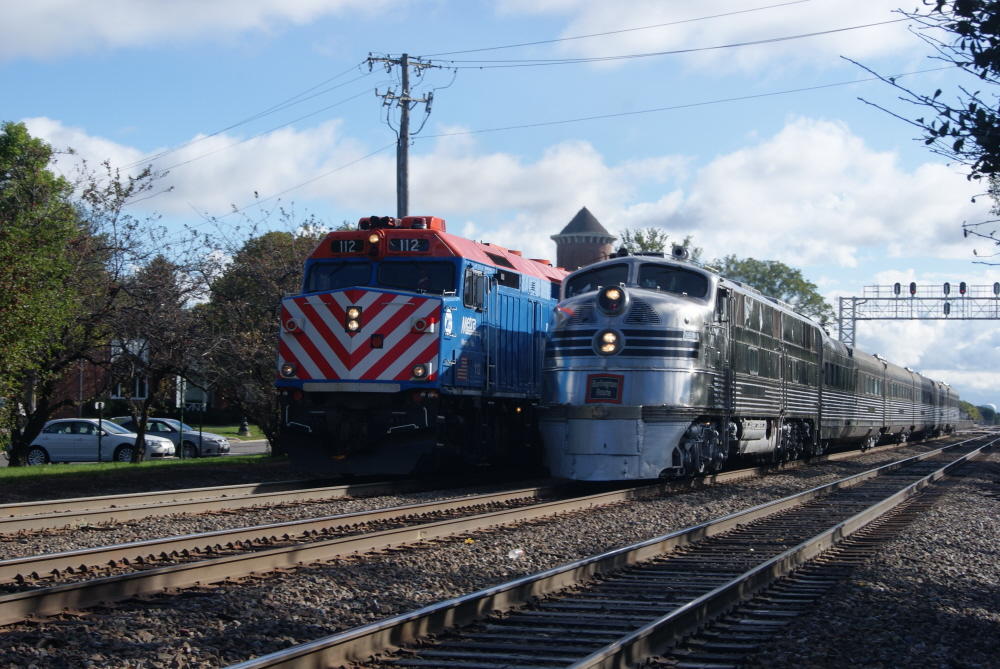
Last weekend featured excellent conditions for photography of the Nebraska Zephyr excursion.

Rusty Traque was at Western Springs on Saturday, in just the right place to see the Zephyr, which left Chicago at 9 am, overtake the regular commuter train out of Union Station at 8.30.


Joe Balynas was down the line at Highlands, with a great shot from the soon-to-be-replaced classic Burlington wooden bridge.  This picture is from Sunday, when the commuter train schedule is different.


I'm still looking for video of the Zephyr rolling through Macomb at 79 mph.  There's a signboard for engineers reading Macomb: 14 crossings, meaning a lot of horn accompaniment.

23.9.12

WHAT A FAST TRAIN LOOKS LIKE.

Amtrak, the BNSF Railway, and the Illinois Railway Museum collaborated to return Silver Pilot and The Nebraska Zephyr to its historic racetrack for two weekend trips Chicago Union Station to West Quincy and return.  I did not promise to file a trip report at the time of the trip's announcement, as I had tentative plans for other activities that weekend.  Tentative plans sometimes change, and seats on the train were still available a week ago Sunday.

20.9.12

THE STRONGEST STUDENTS ARE FORGOTTEN.

The dean at Anonymous Community confirms that under the rubric of No Child Left Behind, No Child Gets Ahead.
The folks who teach in the Honors and [learning community] programs here have favorite stories of students who didn’t know how smart they actually were until they were seriously challenged.  Take away those serious challenges -- sacrificed to yet another year of flat budgets -- and we won’t see as many of those breakthroughs.  We might not even notice, focused as we are on raising the floor.
Indeed. The comments also note that it is precisely in the allegedly less selective, and realistically, less recognised, colleges and universities that produce most of the degrees, that giving students the opportunity to face and manage challenges has the greatest effect. The self-selected hotshots at the more famous institutions can learn from each other. Too much talent is being wasted under the patronising rubric of first-generation, non-traditional, disadvantaged, what have you is equivalent to being not up to developing a first-rate mind.

IF IT FEELS GOOD, DO IT.

The consequences come later.  Ask Monica Lewinsky.
'Monica has tried to move forward, but the nightmare of her affair with Bill still haunts her,' a friend told the [National] Enquirer. 'She’s facing 40 without a man in her life, and seething about the way her reputation was destroyed as the whole world watched.'
It all seemed so much easier in that Barbara Walters interview, where they could share a giggle about how she was telling the president he had competition.
As well as the heartbreak she suffered after her relationship with Clinton, Lewinsky also plans to detail the pain of ending a pregnancy at the height of her liaison with the president, the source said.

She was carrying a child fathered by a Pentagon employee called 'Thomas', she revealed in an earlier biography written by Andrew Morton. 'That void has never been filled,' said the friend.

She decided to develop the memoir after her sullied reputation meant she struggled to find work but realised she would get a generous offer for the book.
The article notes that Ms Lewinsky did earn a master's degree in the UK and had a stint as a news reporter there. It also notes that protesters in the Middle East have other ways of taunting the current administration. "[I]n July, during a visit to Egypt as U.S. Secretary of State, Hillary Clinton was taunted by her husband's affair by protesters as they chanted 'Monica, Monica!'"  It's a hard way to learn that getting a reputation, in the high school locker room sense of the word, still has enduring consequences.

19.9.12

MISSING THE REAL PROBLEM.

A Ruth Conniff essay on the Chicago teacher strike fails to ask the right question.
A funny thing happened by the end of Brill's book, though. The young teachers he so admired, deeming them "the best and the brightest," burned out and quit. By the last chapter he was admitting that unions--along with the decent pay and benefits they bargain for--might be essential after all.
There's more wrong with Chicago's public schools than union scale salaries.  Until the schools help those parents who aspire to develop responsible habits in their children, rather than enabling dysfunction and calling it inclusiveness, it doesn't matter who -- socially conscious Ivy Leaguers or union activists or Sister Mary Elephant -- is in front of the classroom.

LOWERING OUR SIGHTS.

Maybe it's time to take a blogging sabbatical, at lease where higher education is concerned. I can't add anything to this.
The happiness and social duties of a rising generation encompass a far broader ideal than the job security of the state’s degree-holders.

The university’s founders aimed to create free citizens, to share civilization’s best knowledge with those who would build a new and vibrant commonwealth. Our current leaders seem content to optimize a work force. This kind of thinking is both uninspired and ineffective, and it leads to poor public policy.
The point of the higher learning is to be able to reconstruct, if required, the civilization that made the higher learning available.  That's not in the job description for the optimized work force.

HUMOR AMONG THE ECON.

Ally Bank has a commercial in which Thomas Sargent demonstrates the limitations of rational expectations.


The Grumpy Economist has some workshop questions, or perhaps these are pitcher-of-beer questions.
I might ask, "Tom, the Ally Bank CD allows you the option of raising your CD rate once over its two-year life. Can you explain when to optimally exercise that option?'' Or (second beer), "Tom, to what portfolio optimization question is the answer, combine a two-year CD with an American option to raise the rate once? You must have some great robust-control result here about parameter uncertainty in dynamic interest-rate models."
The calculus is in the comments.

18.9.12

WITHOUT IRONY.

With all the ills the university is subject to, a local professor of English sounds the alarm about ... The Gideons.
In other words, neither women nor the unemployed are eligible to join this Christian group. As one of the men giving out Bibles was quick to point out, the organization has a women’s auxiliary, but it remains segregated from the main association.

For some students and employees, the annual visit by the Gideons creates a cordon of privilege and discrimination around a university that strives to be egalitarian.
I suppose an Older Men's Christian Association might appear discriminatory. But on the same day this letter appeared in the university newspaper, headquarters bragged on Northern Illinois University movin' on up in the U.S. News rankings, which, to university administrators, don't matter except when they do.
Northern Illinois University offers 63 undergraduate, 78 graduate and 20 Ph.D. programs in seven colleges. NIU’s academic experience is enriched by opportunities for research, themed learning communities, internships and on-campus programs and activities that include Greek life and the University Honors Program.
Greek life ... Honors Program ... the parking stickers promote the football program ... no cordons to see here.

PARTIAL AND GENERAL EQUILIBRIUM.

A recent report from the Robert Wood Johnson Foundation estimates the medical cost savings from reductions in obesity rates.  Here's how a Milwaukee Journal-Sentinel article identifies the benefits to Wisconsin.
Every little bit counts, whether it's increasing physical activity in schools and workplaces, making fresh fruits and vegetables more affordable, or losing 10 pounds through exercise and better eating.

The ultimate payoff for Wisconsin could add up to $11.96 billion in health care savings if the average resident trimmed just 5% from his or her body mass index by 2030
Healthier eating is probably a Good Thing. It probably doesn't prolong life, although those last years will be less miserable. But a full analysis of the consequences of cheaper food ought consider the benefits, either private or public, of people no longer dying of starvation or malnutrition.

On a more micro level, there's probably room for further analysis of the allocation of space in convenience store refrigerators.
The Lindsay Heights [in Milwaukee] Healthy Corner Store Initiative is working with three neighborhood corner stores. The effort is in its early stages and the amount of available produce in the three stores currently is limited.

Refrigeration space is an issue, as corner stores typically stock snack foods and grocery staples, and don't have much refrigerated shelf space.
The refrigerated space that is there often chills pop and beer. Discuss.

AT ANY TIME, ON ANY TRACK, IN EITHER DIRECTION.

The General Rules of any railroad company expects employees to understand that trains run on those tracks.

Cell-phone yakking trespassers sometimes learn that the hard way.
According to the train conductor, the southbound train was traveling at about 40 mph around 5:15 p.m. as it approached the Amtrak station near the Ventura County Fairgrounds on Harbor Boulevard, when the victim was seen walking on the tracks.

The conductor began sounding the warning horn, but the victim appeared to be looking down at a cellphone and did not make any attempts to get off of the tracks, police said. The conductor said he tried to make an emergency stop, but could not get the train to stop in time.

The train was delayed at the scene for about two hours while the investigation was conducted.
The reporter has apparently confused the engineer, who applies the brakes and sounds the horn, with the conductor, who has the responsibility for filing the accident report. There has to be a better way of conducting investigations than to lay out the entire train for two hours, although in the Chicago area, the delay is often three hours.

This sad news brought to our attention by The Right Coast and we remind all neighbors of the railroads of Operation Lifesaver's safety tips.

16.9.12

A GREAT SENSE OF IRONY.

University of Pennsylvania professor of religious studies Anthea Butler suggests that the producer of a video that supposedly inspired al-Qaeda facilitated attacks on several embassies deserves to be arrested. The gravamen of her argument is the usual defense of speech codes and progressive intolerance.
Clearly, the military considers the film a serious threat to national security. If the military takes it seriously, there should be consequences for putting American lives at risk.

While the First Amendment right to free expression is important, it is also important to remember that other countries and cultures do not have to understand or respect our right.
That observation comes a few sentences after "If there is anyone who values free speech, it is a tenured professor!"  Time for a history lesson.  In the Sheldon Hackney days, the University of Pennsylvania was anything but an institution that valued free speech, particularly for students.  The good news is that Penn currently has a green speech code rating.  Robert Shibley, at College Insurrection, argues that Professor Butler has likely endorsed the heckler's veto.  Follow the links there to some deeper legal arguments.  Ken at Popehat, however, gets to the heart of the matter. "American universities are at the forefront of stupid, stupid forms of censorship, as we frequently discuss here."  Yes, and if the boutique multiculturalists can make common cause with the national security obsessives, and the faculty goes along with it, it won't matter how much the high schools place lacrosse and hockey ahead of academics.

BETTER WORKING CONDITIONS AND BETTER PAY

Chicago teachers remain on strike as a new school week begins.  Via Media offered a roundup of news and commentary from last week, with the suggestion that the strike means a fracture in the blue social model that Democrats pin their election hopes on.  It's true, as this Reason commentary suggests, that the troubles of the Chicago Public Schools, and struggling big-city schools generally, will not be cured by a new labor contract, or more testing, or a visit from a unicorn jumping over a rainbow, until the schools have an easier time inculcating middle-class habits in their students because the parents reinforce the code of the schools, rather than the code of the street.

14.9.12

WHAT IT TAKES TO WIN.

Northern Illinois University is close enough to the Cheddar Curtain that you'll see a fair number of Packer jerseys on game day, even if it's Bears Week.  Packer Nation Huskies didn't have a Thursday night Mid-American game competing for their attention, and it's early enough in the semester that the mad panic to finish research papers and group projects hasn't begun.

The weather in DeKalb and Chicago was dreadful at game time, but the game was on the north side of the front, at the not-yet-frozen tundra.

The outcome of the game was one to please Packer loyalists.  The Packer offense sputtered, but the special teams managed to exorcise the demons of fourth-and-26 in Philadelphia with a little fourth-and-26 trickery of their own.  More that a few casual observers might have been wondering about that touchdown pass from Tim Masthay.  He went into the locker room with a passer rating of 158.3.  Bear quarterback Jay Cutler was at 8.6 at the time.  Despite being sacked seven times, he finished the game with a 28.2 passer rating.  But his sideline deportment is again being called out by Chicago fans.

Donald Driver got to do some boot-scooting before his Lambeau Leap.  Life is good.

Time to find a bottle of Sprecher and savor the weekend.

THE POINT OF TRAFFIC TAMING IS TO LESSEN COMPLEXITY.

The temptation of traffic engineers, however, is to provide complexity and call it intelligent design.

Consider a relatively simple concept, the rotary.  In Britain, it can be designated by a dot in the centre of the intersection, and a British observer of what Midwestern traffic engineers do by way of excessive signage is less than impressed.  In the Land of Lincoln, though, drivers do not like rotaries, apparently preferring the existing systems of traffic control, in which the cycle of left arrows and straight greens lasts longer than the Gettysburg Address.  The post last cited suggested that the new rotaries, or, as they call them in America's Dairyland, roundabouts, incorporated the worst features of traffic control, with multiple lanes into the circle, and gantries with lane designators over those lanes.  Not surprisingly, some southeastern Wisconsin politicians are on record against construction of new ones, and an existing one has become an obstacle to navigation.
The roundabout at the intersection of state Highways 59 and 83 in Genesee, southwest of Waukesha, was first completed last fall. When the roundabout was designed years earlier, neither of the roads was designated high traffic. But while the work was wrapping up, Highway 59 became designated for overweight, oversize trucks, said Michael Pyritz, a spokesman for the Wisconsin Department of Transportation.

He said engineers assumed at the time, based on two-dimensional models, that trucks would be able to swing and navigate the roundabout just fine. However, he said, engineers did not have three-dimensional modeling, which would have allowed them to check for potential problems with the height of the 6-inch curb.

"The way the roundabout was built, they did not foresee, because the modeling did not exist at the time, that there'd be a problem," Pyritz said.

Soon after the roundabout opened on Oct. 7, 2011, law enforcement started getting calls about lowboy trailers getting stuck on the curb of the roundabout, which blocked the road. Lowboys are semi trucks with extremely low decks that are used to haul tall and heavy equipment, such as bulldozers and other industrial items.
The state highways so named are, in that part of the Kettle Moraine, laid out on the rights-of-way of ancient Indian trails.  The Great Spirit never envisioned 53 foot low-boys, let alone double-bottoms, on those roads.  But apparently, rather than pushing back at the abuse of truck-drivers, not to mention nearby passenger vehicles, that the presence of those elephants represents, the roads, and eventually the commercial districts of towns along the way, must be rebuilt to accommodate the elephants.

CHILDREN USED TO BE RESILIENT.

Reason's A. Barton Hinkle suggests that's because parents used to let children toughen up.
A gaggle of parents swirled around elementary-school children, taking photos to forever immortalize the First Day of School. When the bus came, the tots dutifully hauled themselves aboard and sorted themselves into the seats. The parents, meanwhile, began to wave wildly. You would have thought they were bidding bon voyage to an ocean liner, not saying sayonara to someone they would be seeing again in seven hours.
School buses apparently have sailings, now.
Going to the bus stop used to be a stoic ordeal, not a festive occasion. Your folks might march you to the proper spot, if it was your first time, but after that you were on your own. Nobody took pictures. Nobody was waiting at the bus stop when you came back, either. Now parents not only wait – they bring the car in case of inclement weather.
Once the kids get to school, the hazards have been taken out of recess, that is, if the kids even GET a recess.
The equipment on today’s playground, you might have noticed, is sheathed in rubber (fewer bruises) with few if any moving parts (no pinched fingers). To increase safety further, some schools have banned games such as dodgeball, touch football, soccer, and even tag. The playground itself might be surfaced with shredded tires. Shredded tires are not only environmentally correct, they also guarantee that any child unlucky enough to fall will bounce.

When those of us of a certain age were growing up, playgrounds were surfaced with gravel. Sometimes even scrap metal and broken glass. It hurt like heck, but it made a man out of you.
Recess is less important than high-stakes testing, at least in the mind of school administrators.

Does it come as any surprise, then, that when the products of common schools purged of any challenge arrive at university, the idea of "it depends" as an answer comes as a shock to some?  And that people deprived of the chance to toss bean-bags as eight-year-olds turn bean-bag into a drinking game?

PAY ATTENTION IN ECONOMETRICS CLASS

Time-series analysis is applicable to greenhouse gas formation and climate change.
I have a great deal of familiarity with the techniques being used; the usual list of statistical mistakes common in environmental research doesn’t seem to be made here.

What they have done is construct a 3 variable VAR with non-stationary data, and bootstrapped the distributions of causality tests. In short, they’ve done relatively standard analysis that a macroeconomist would be comfortable with. I’ve only spent about 10 minutes with the paper, but I’m OK with what I see so far.

And they conclude that global temperatures decoupled from solar radiation over the last 50 years, but did not decouple from greenhouse gases.
The full article is in Environmental Research Letters.

11.9.12

GOING GALT?

As tough as things are, they can get worse. Historiann reflects on the follies of recruiting for a research faculty on 2s 6d.
Friends, this is what you get if you try to run a research university like it’s a community college or the University of Phoenix.  That’s right:  we’re officially a Carnegie-1 institution!  What a joke.  But at least we’re not misrepresenting ourselves to our job candidates by pretending that their lives as faculty at Baa Ram U. will be anything like working for a real research university.

Speaking of which:  maybe it’s time for a sit-down strike on the Tenure and Promotion Committee.  Why should we enforce tenure and promotion standards like an R-1 when we’re staffed and funded like a community college?
Do you want to know who is John Galt?
There have always been men of intelligence who went on strike, in protest and despair, but they did not know the meaning of their action. The man who retires from public life, to think, but not to share his thoughts-the man who chooses to spend his years in the obscurity of menial employment, keeping to himself the fire of his mind, never giving it form, expression or reality, refusing to bring it into a world he despises-the man who is defeated by revulsion, the man who renounces before he has started, the man who gives up rather than give in, the man who functions at a fraction of his capacity, disarmed by his longing for an ideal he has not found-they are on strike, on strike against unreason, on strike against your world and your values.
Withdraw your sanction. Withdraw your support.

UNIVERSITIES ARE FAILING AT THEIR MISSION.

Years ago, when I made that assertion in a university publication, it didn't make me popular. Compared, though, to James R. Otteson of the Pope Center, I'm the reasonable guy.
Ask even the serious ones what proportion of their classes they believe is actually worthwhile. Their answer: maybe 25 percent.  They are probably not far off. Many classes are a hodgepodge of quirky or arcane topics of interest to the professor, and they do not combine into any coherent or integrated whole. Almost nowhere today are there curricula in what professors judge to be the most important things all smart young people—the future guardians of civilization—should know.

What results from all this? For hundreds of thousands of students, billions of dollars and many of their most formative and some of their best productive years are spent on: sleeping in, not working on Fridays, and not dressing or speaking professionally; on learning that almost anything is good enough to get a “very good” (what a “B” is supposed to mean); on learning that there is really no such thing as a deadline, but an endless supply of second chances; on learning that “trying hard” and “being passionate” are just as good as actually accomplishing something; and on learning that attending classes on any subject is probably just as good as attending classes on anything else.

These, I am afraid, are not good moral and intellectual habits. And they are probably not what anyone—including parents, taxpayers, and employers—wants from college.

Many things have contributed to bringing us to this sorry educational state, but let me cite two factors. The first is the denial of the obvious truth that a good education is difficult. It requires long, hard work on the part of both the student and the teacher. As Aristotle rightly said, “the roots of education are bitter.” If what you are doing is easy, or involves a lot of sitting around doing nothing productive, then you are not becoming educated, regardless of what anybody tells you or what any piece of paper says.

The second factor is the denial of another hard truth: Not everyone is up to the task. Anything that is difficult—running a marathon, playing Beethoven’s Hammerklavier, mastering calculus, bench-pressing 300 pounds—will cleave the world into two groups: those few who can do it, and those many who cannot. And no one wants to hear that they do not have what it takes. This truth is especially hard to accept when the fanciful notion that “anyone can become anything they put their minds to” is so deeply engrained in our culture.

Much of higher education today founders because it denies these two truths. The reality is that good moral and intellectual habits of persistence, curiosity, judgment, discipline, and humility are often not fostered, and indeed are often discouraged.
College is hard. That's Charles Murray's premise from Real Education, and we've considered the responses to his perspective previously. Perhaps, though, business as usual in higher education ends when administrators and promoters recognise that falling enrollments are not simply demographics.

SECULAR STAGNATION.

Tom Blumer summarizes 43 Months of Depressing Misery.
President Obama’s failed stimulus program, brutally expensive and common law-shredding auto company bailouts, bankrupt “green energy” initiatives, and other exercises in “fundamentally transforming” the economy have extended a deep recession which predominantly traces its origins to decades of dangerous Democrat-driven housing policies, pervasive fraud against Wall Street and investors at Democrat crony-controlled Fannie Mae and Freddie Mac, and 2008 campaign promises by Obama and fellow Democrats which the nation’s entrepreneurs, businesspeople, and investors correctly saw as threats. The president’s and fellow party members’ bully-pulpit hostility directed at the productive (“You didn’t build that“), the regulatory regime’s unprecedented overreach, and the prospect of ObamaCare’s disruptive implementation have created an atmosphere of chilling uncertainty virtually guaranteeing that the nation’s economic malaise will continue as long as they control the levers of power.
The malaise might be longer than that, according to Mortimer Zuckerman.
The best single indicator of how confident workers are about their jobs is reflected in how they cling to them. The so-called quit rate has sagged to the lowest in years.

Older Americans can't afford to quit. Ironically, since the recession began, employment in the age group of 55 and older is up 3.9 million, even as total employment is down by five million. These citizens hope to retire with dignity, but they feel the need to bolster savings as a salve for the stomach-churning decline in their net worth, 75% of which has come from the fall in the value of their home equity.

The baby-boomer population postponing its exit from the workforce in a recession creates a huge bottleneck that blocks youth employment. Displaced young workers now face double-digit unemployment and more life at home with their parents.

Many young couples decide that they can't afford to start a family, and as a consequence the birthrate has just hit a 25-year low of 1.87%. Nor are young workers' prospects very good. Layoff announcements have risen from year-ago levels and hiring plans have dropped sharply. People are not going to swallow talk of recovery until hiring is occurring at a pace to bring at least 300,000 more hires per month than the economy has been averaging for the past two years.

Furthermore, the jobs that are available are mostly not good ones. More than 40% of the new private-sector jobs are in low-paying categories such as health care, leisure activities, bars and restaurants.
Mr Zuckerman -- for reasons different than those deployed by Paul Krugman -- also characterizes the situation as a "modern day depression", one ameliorated by the social spending that wasn't present in the 1930s.
These dependent millions are the invisible counterparts of the soup kitchens and bread lines of the 1930s, invisible because they get their checks in the mail. But it doesn't take away from the fact that millions of people who had good private-sector jobs now have to rely on welfare for life support.
He concludes with a macroeconomic policy prescription blending supply-side incentives with demand-side infrastructure spending, intriguingly, though, suggesting that the roads and bridges so built be subject to tolls.

REDISCOVERING POVERTY.

It's present even with a Democrat in the White House.  Our President is hearing about it from his left.
[Professor Cornel] West and [commentator Tavis] Smiley aren’t without their detractors, and both expressed concern that personal attacks will get in the way of the work they hope to accomplish through this tour.

“Get the focus off of us, and put the limelight on our precious fellow citizens who don’t have access to a decent job, decent housing, and decent healthcare,” said West. “I think that’s a challenge for every journalist today, because the problem right now is we live in a country where conservative discourse has made it fashionable to be indifferent or have contempt toward poor people. If you focus on the messenger then you never have to confront the suffering and the misery of the poor people that we are highlighting with our work.”

Smiley also noted the negative reactions they have received for their critique of President Obama.

“I get sick and tired of people who believe that just because you’re pushing the president, that somehow you’re hating on him, or you’re aiding and abetting the other side,” said Smiley. “How do you push a president? You can’t push him by being silent. You can’t push him by not pressuring him on the things that really matter. We are not going to stop pushing, but it doesn’t mean that we hate Barack Obama.”

“What we hate is the contempt and indifference toward poor people that is found in both Republican and Democratic parties—less so in the Democrats, but both parties suffer from it,” West added. “So this issue of class, of poverty, of economic injustice is one that we will continue to highlight in a very serious way.”
The two intend to offer a view of poverty distinct from what they describe as "the prevailing public discourse" of, effectively blaming the victim.  Whether they will push Our President to move more in the direction of spreading the wealth around, or in the direction of providing conditions conducive to broadly shared prosperity, remains to be seen.

A report from Fairness and Accuracy in Reporting, in noting the absence of reporting on poverty, proposes a perplexing hypothesis.
In the current election year, when neither the incumbent Democratic president nor any of his challengers in the GOP primary have been making poverty even a minor issue, such “rules” are relegating tens of millions of struggling citizens to virtual invisibility.
It's unlikely that Our President is going to mention poverty frequently, lest the Republicans' flacks resurrect the food-stamp president meme.  The Republican economic message has a different focus: it is the incoherent fiscal policies of the administration that keeps the poor poor, and puts more of the middle class at risk of poverty.

6.9.12

LIVING LIKE TSARIST PRINCES.

The Chicago Tribune is now following developments in the Northern Illinois University coffee fund investigation.
[The coffee fund story] comes a year after the Tribune revealed that an NIU administrator assigned students to paint her house as one of the projects during NIU Cares Day, a one-day event in which students volunteer at service organizations in the community.

"Our students deserve better. We have had way too many questions of lapses of ethical behavior here by university officials up and down the ladder," said NIU senior Austin Quick, speaker of the Student Association. "It is time for the university to wake up and start looking at their employees, especially ones in senior positions."
The director of student involvement and leadership development called her own number that time.


The current officials enlisted volunteers from among their staff, and offered them modest compensation. This being Illinois, though, one wonders if there wasn't an element of "Nice job you got.  Be a shame if anything happened to it."
One of the two employees who resigned in July was John Gordon, director of the university's 10,000-seat Convocation Center, which hosts about 200 events a year, including concerts, athletic events and meetings. Gordon allegedly had a Convocation Center custodian go at least four times in the past year to his home, where she cleaned the windows and floors, washed dishes and vacuumed, according to an interview and documents obtained by the Tribune.

The employee told the Tribune she was picked up in the morning at the loading dock outside the Convocation Center and driven to Gordon's home about two miles away. She said she was given a "tip" of $20 to $40 for the work.

Gordon, who had been the only director of the entertainment venue since it opened 10 years ago, was facing additional allegations related to using his position for personal gain when he resigned effective July 31, according to documents.

For example, he was accused of having NIU property at his house, including a snowblower and vacuum, according to the documents. NIU officials said the equipment is currently at the university.
The front page of today's Northern Star offers readers a dramatis personae.  A second story suggests that the university is conserving resources by asking the parties under investigation to step out of line and disappear.
Before resigning, Gordon’s annual salary was $132,973. He received about $33,000 and six months of health insurance as part of his resignation agreement. [Former vice president of finance and facilities Robert] Albanese’s salary was $198,553 and he was given a payout of $45,000 as part of his agreement.

Kathryn Buettner, vice president of university relations, said negotiating a payment with the employees as part of the resignation agreement gave a “quicker and likely less costly resolution” than putting them on paid leave pending further investigation and administrative hearings, according to the Tribune
There will be further developments.

PAY ATTENTION TO THE DETAILS.

In a Tuesday night interview with Greta van Susteren, former presidential economic advisor Austan Goolsbee reveals something about the slow economic recovery of the United States.
As much as we have struggled, if you look at Germany, the UK, Japan, throughout Europe, throughout the advanced world, we're getting no support from any other part of the world. So are the growth of our exports is just through the sweat of our brow. There is no obvious massive growth engine that's driving to help us.
Interesting. For the past forty years or so, the Democratic Wing of the Democratic Party has been comparing U.S. social policy unfavorably to the social policies of those other industrialized countries.  Now comes the Obama Administration, putting into place all of those European policies including greater government provision of health services, and industrial policy, and equal work for equal pay, and all the rest.

Whether slower economic growth comes as a consequence of those policies is left to the reader as an exercise.

4.9.12

TEN YEARS OF SPORADIC CONTENT.

The Cold Spring Shops opened on 5 September, 2002.  We're still on the same platform, with as much of the original stylesheet as possible, although posting frequency and content have changed over the years.

Craig Newmark got started about the same time.

LOOK FOR A SIMPLER EXPLANATION.

Historiann meditates on the sexual politics of the truck scrotum.

We've reflected on the use of these accessories before, including the legalities of displaying them, generally settling on something along the lines of "lout" or "date fail".

THE STUDENTS HAVE TAKEN UP THE CHALLENGE.

Last Friday, I anticipated the Northern Star continuing its investigation of the coffee fund.


They did not disappoint.
But the staff will continue to investigate, to look into allegations of employees selling scrap metal, to look into changes with recycling around campus, to follow our university’s sports teams and review musicians who played at the House Cafe, to take photos that showcase local life.
As the story unfolds, we'll follow it.

EXTRA-SHARP CHEDDAR.

A Wisconsin cheese dealer holds a going-out-of-business sale, and there's some unexpected gold in the inventory.
Edward Zahn, 73, was in Z's Cheese Shoppe's walk-in cooler last month, preparing to shut down his Oconto store. He pushed aside stacks of cheese to reveal several wooden boxes that had been overlooked for years.

Inside were blocks of unintentionally aged cheddar - 28, 34 and 40 years old - that, some experts say, might comprise the oldest collection of cheese ever assembled and sold to the public.

"It just got overlooked," Zahn told the Wisconsin State Journal of the 40-year-old cheese. "It looks just like the others except it's just a lot sharper. It's got character."

Ken McNulty, who owns the Wisconsin Cheese Mart in Milwaukee, bought about 20 pounds of the 40-year-old cheddar and 120 pounds of 34-year cheddar. He declined to reveal the price he paid.

Cheese is often sold by the pound, but McNulty plans to sell the oldest cheese by the ounce so more people can get a taste.
The Wisconsin Cheese Mart has already sold out the October 6 vintage cheese tasting.

DERECHO.

I may have to suspend posting in a few minutes.


WHAT IS THE SOUND OF ATLAS SHRUGGING?

The brains in Spain are jumping on the planes.
In July, Spaniards withdrew a record 75 billion euros, or $94 billion, from their banks — an amount equal to 7 percent of the country’s overall economic output — as doubts grew about the durability of Spain’s financial system.

The withdrawals accelerated a trend that began in the middle of last year, and came despite a European commitment to pump up to 100 billion euros into the Spanish banking system. Analysts will be watching to see whether the August data, when available, shows an even faster rate of capital flight.

More disturbing for Spain is that the flight is starting to include members of its educated and entrepreneurial elite who are fed up with the lack of job opportunities in a country where the unemployment rate touches 25 percent.

According to official statistics, 30,000 Spaniards registered to work in Britain in the last year, and analysts say that this figure would be many multiples higher if workers without documents were counted. That is a 25 percent increase from a year earlier.

“No doubt there is a little bit of panic,” said José García Montalvo, an economist at Pompeu Fabra University in Barcelona. “The wealthy people have already taken their money out. Now it’s the professionals and midrange people who are moving their money to Germany and London. The mood is very, very bad.”
What the Spanish Armada could not do, an ill-conceived currency union can do. The most encouraging item in the article is that Spain is not Greece, not yet.

2.9.12

SOMEBODY'S COFFEE FUND.

City Barbs has continued to cover the investigation of the Northern Illinois University coffee fund.


It exists, and administrators have found it and claimed the funds. "University officials said the private, nonuniversity bank account, which contained about $2,100, has been closed, with the money deposited into the university’s general fund."

There's still work to do.
If the account was a private, non-university account, how is it that NIU was able to determine it was NIU money, and how did NIU close it? And if NIU knows the money from the account is NIU money, why are people being put on vacations instead of being charged with crimes?

And speaking of crimes, where is our able State’s Attorney and his much-ballyhooed (well, self-ballyhooed) anti-corruption unit?
The reference to vacations comes from a university statement.
Internal records indicate that the funds were not used for personal purpose or gain but were utilized for various departmental activities such as retirement celebrations, holiday events and similar activities. The university is examining whether the use of these funds in this manner is a violation of university policy and/or state law.

While this determination is being made, necessary administrative actions have been taken to assure the continuity of operations while the investigation is completed. These actions include placing four employees within the Materials Management Department on a maximum of 30 days paid administrative leave, staff reassignments and the empaneling of a policy review committee charged with reviewing and updating all procedures related to property control, cash receipts, recycling and the disposition of surplus materials.
It's Labor Day weekend. I expect the Northern Star to follow up its coverage when classes resume Tuesday.

WE WATCHED THE AMERICA THAT WORKED IN BLACK AND WHITE.

Our President had an instructive comment about the recent Republican convention.
"It was a rerun. We’d seen it before. You might as well have watched it on a black-and-white TV," Obama said, clearly enjoying himself. "If you didn’t DVR it, let me recap it for you. Everything is bad, it’s Obama’s fault, and Gov. Romney is the only one who knows the secret to creating jobs and growing the economy."
According to Our President's economic team, there is no secret. The Best and The Brightest expected doing nothing to do better than the results we've seen.  (Source.)


The populist part of the Republican base also senses, on some level, that the era of black-and-white television had features to recommend it.
Fishtown Republicans are first-hand witnesses to the decay in the roots of America.  They want a politician who speaks not only to what transpires at the economic surface of the country, but who understands and addresses what is taking place in the moral and cultural depths.  The residents of Fishtown understand deeply and implicitly — because they see it right in front of them — that America’s economic doldrums are not merely a matter of mismanagement at the top.  They’re a matter of long-term cultural decay at the bottom.  Or to use a different metaphor, Romney promises to be a better captain of a ship whose hull is decomposing — and the sailors who work below decks know that plotting a better course of navigation will not save the ship from its ultimate fate.

It’s largely the Fishtown Republicans that have proven so uncomfortable with Romney that they’ve lurched from one non-Rom to another, because Romney has given no vision that appeals to Fishtown Republicans.  A vision of managerial brilliance, of resplendent competence across a variety of organizational spheres, does not touch Fishtown residents where they are.  Romney needs to speak to the culture of Fishtown – to its decay, its present shambles, and to a hopeful future in which that culture is restrengthened and forms the basis of a renewed American economy.

Romney needs — and quickly — to develop a coherent, full-orbed vision of American renewal, one that begins at the roots of moral and cultural regeneration and extends through political and economic transformation.  He should explain that conservatism is compassionate because conservative economic policies best serve all Americans, including the poor — but he should also speak to renewing not only the policies and regulations but also the moral musculature and the cultural values that nurtured the most extraordinary economic expansion in human history.  That would be a vision and a basis for a movement.
"Fishtown" is a reference to a metaphor Charles Murray introduced to describe what we used to understand as a blue-collar ethnic neighborhood.  There's also reason for Republicans to emphasize the traditional virtues among what we used to understand as white-collar workers, or, today, as symbolic analysts.

GETTING THE MISSION RIGHT.

The local weekly advertising supplement runs retrospectives from newspaper archives.  With the beginning of the academic year on September 2, 1987 came this.
Arguing that NIU has long been chronically underfunded by the state, university president John La Tourette announced a long-range plan to downsize Northern’s on-campus enrollment to reduce staffing and space problems.
Enrollments at the time were a few hundred more students than current enrollment -- pending release of the end of week two head count.

The College of Engineering was still using buildings in Sycamore.  Branch campuses at Hoffman Estates, Naperville, and Rockford were not even in the discussion stage.

The Economics Department had a tenure-track faculty strength of 23.  It's currently fourteen.

ISAAC IN SPITTING DISTANCE.

The remnants of former hurricane Isaac left about a one-hundredth of an inch of rain here at Cold Spring Shops headquarters.


This screen grab, from the Northern Illinois University weather page, shows a well-defined low over the center of the state, with rain bands just the other side of Interstate 80.  There's still hot humid air coming out of the top, judging from the instruments around the house.

There's a blue norther, promised for Thursday or so, and its signature could be near Lake of the Woods.

27.8.12

MORE ON THE USEFULNESS OF ALGEBRA.

A few weeks ago, we had some fun with a foolish proposal by Andrew Hacker to de-emphasize algebra in middle and high school.

While I've been running away to join the circus, and working on the railroad, Professor Newmark has done additional research.  There's a link-rich essay by self-confessed "recovering English major" Jennifer Ouellette worth your perusal, and from her summary comes this gem from P. Z. Myers.
We ought to face reality: most of these students might graduate, but they’ll never crack another book in their life, the bulk of their written communications skills require nothing more than their thumbs and a tiny screen and fleeting comments that require neither punctuation nor even lower case — Y U NO WRT ME? — let alone grammar. If they make it to their version of advanced studies — business school — the epitome of literacy will be the 5 line, six words per line bullet point slide in PowerPoint, and most of the lines will consist of stock phrases.
Wipe the coffee spray off your keyboard, and go read the article and the comments.

With the academic year about to begin, you must remember this.
Setting algebra as a minimum is actually setting a low bar. If a third of the students are failing that minimal expectation, then the solution isn’t to simply disappear the requirement, but to teach it better. Or admit that students who can’t read, who can’t write, who can’t do a simple algebraic manipulation, are not educated. Period. No excuses.
Indeed.

RETURNING TO CIVILIAN LIFE.

There's a new reality show on NBC entitled Stars Earn Stripes.  Imagine Top Shot with some additional hazards, and celebrities being assisted by Special Forces and law enforcement veterans.  There's no being voted out of the camp, but performers who are declared administratively dead participate in some target shooting to determine who goes home.  The point is to raise money for charities that assist wounded veterans.

Glen Greenwald disapproves.
I wonder how actual troops who face real danger to their lives feel about having NBC exploit The Troops and convert their combat burdens into a fun reality show with feigned “danger.” And, of course, the substantial profit NBC hopes to make from selling commercials won’t be donated to veterans groups at all but will be tallied up as corporate profits — but that’s all just totally incidental to the Honor The Troops goal motivating all of this.

The ways in which this is all so sleazy, repulsive and propagandistic are too self-evident to require much discussion. There is, though, a real value: here we have a major television network finally being relatively candid about the fact that they view war and militarism, first and foremost, as a source of entertainment and profit.
In an update, Mr Greenwald notes that nine recipients of the Nobel Peace Prize, including Archbishop Desmond Tutu, but including none former Vice President Gore, former President Carter, nor current President Obama, have called on NBC to cancel the show.

A Washington Post review is also critical, if less harsh.
Adding a celebrity quotient to the military-industrial complex is nothing new — Bob Hope taught us that — but NBC’s reality competition show, “Stars Earn Stripes,” enthusiastically melds warfare and fame into a fairly solid drill exercise in gung-ho rituals. It’s a lot of hooah with a bit of puffed-chest hooey

It also feels about five years too late, in both its reality-TV tropes and its message of pride. It harks back to the “Mission Accomplished!” era of attacks and setbacks in the Middle East.
The substance of the review, however, is in a review of a second reality show called Get to Work.
At Second Chance, strict counselors first break their adult students down emotionally, while teaching these men and women the most basic survival skills of cubicle land: eye contact, firm handshakes, clear conversations and positive attitudes. (Nothing, alas, can be done about the neck tattoos snaking up from the buttoned shirt collar.)

In each episode, “Get to Work” zeroes in on a few personal stories, as the students struggle to overcome their inhibitions and histories of failure. The first hurdle is simple timeliness, as half of them wander back late from a midmorning smoke break. Others flunk the program’s mandatory drug tests.

Even though the producers keep their sights on happy outcomes, “Get to Work” is depressing stuff, made more so by the economy that awaits these job seekers. It’s all so real it verges on the mundane, but the show is also strong and necessary medicine for these times.
Yes, the failure of the economic stimulus to stimulate any economic expansion makes the trainers' and the trainees' task harder. Left unsaid, however, is how many of the clients were rendered unemployable by the do-your-own-thing culture and the non-judgemental elementary and secondary schools.

RELIEF FOR THE DROUGHT?

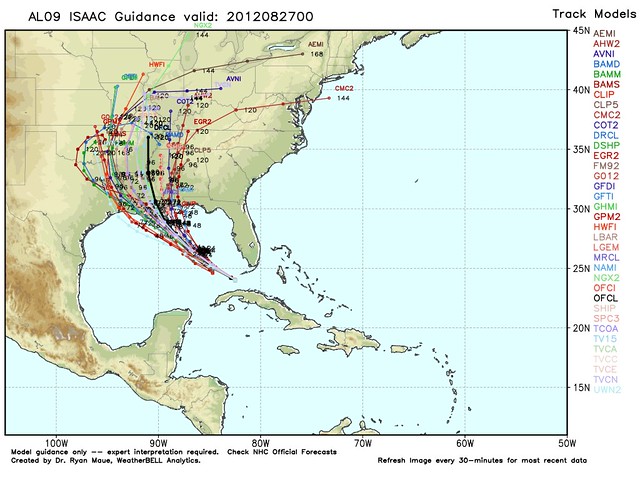
Isaac is as of this posting still a tropical storm in the Gulf of Mexico.

The forecast models have some intriguing possibilities.  From Brendan Loy comes one string diagram, with the center passing over Cold Spring Shops headquarters, and going out to sea over Sheboygan.


Compilation by Brendan Loy.

Jeff Masters of Weather Underground sends some rain bands toward Greater DeKalb.


Image from the National Oceanographic and Atmospheric Administration.

There's still a large rainfall deficit to overcome here.

26.8.12

WATCH THIS SPACE.

Last week Monday, a weather report gave an overnight low at freezing in Tomahawk, Wisconsin.

Must be model railroad season.


Spline roadbed for two tracks being glued and clamped in the foreground, the continuation being laid out in the background.  It is essential that the support structure be level in both the north-south and east-west directions lest the tracks be so uneven as to be useless.

BENDING THE COST CURVE.

We begin with a review of the inefficiency effects of a monopsony.
Monopsony power, like monopoly power, results in economic inefficiency. This is because the monopsonist avoids purchasing the last few units of a good whose value to the monopsonist is greater than their marginal cost, in order to hold down the price paid for prior units. In principle, inefficiency from monopsony can be mitigated by a well- placed legal price floor, which removes the monopsonist's power over price and eliminates its incentive to restrict the quantity it purchases. A modest price floor forces the monopsonist to take price as given and increase its purchases toward the level of competitive buyers. However, if the price floor is too high, the monopsonist will reduce its purchases -- just as competitive buyers would do in response to a price floor -- and inefficiency recurs.
With the foregoing in mind, let us consider a recent report on physician burnout.
Burnout can diminish professionalism and lessen the quality of care. At the same time, it leads doctors to reduce their hours and retire early. "We're at the cusp of reform," [the Mayo Clinic's Tait Shanafelt] said. "Precisely when we need more family and internal medicine doctors, students are more likely to enter other fields. This issue has implications for the adequacy of the physician workforce."
The way to elicit a larger supply is to increase compensation, but public policy makers and insurers have focused on reducing compensation and pushing physicians to see more patients in a day.  No doubt, somewhere there is an autistic number-cruncher spinning the increased throughput of patients as a productivity gain.
Burnout generally refers to a constellation of symptoms relating to behavior at the workplace. Symptoms include emotional fatigue, depersonalization, lost enthusiasm and a failed sense of personal accomplishment. Depersonalization -- a tendency to treat people as objects, almost as a factory worker might perceive a task to be completed - happens most commonly in individuals whose work centers on interacting with others. "We know that those professionals at highest risk include teachers, social workers, police officers, nurses and physicians,"  [Professor Shanafelt] said. Many experience feelings of burnout occasionally and to a varying degree, he said. "But when it happens a lot, there's reason for concern."
To some extent, we are observing the hell is other people phenomenon at work: it is the social service professionals who encounter people with deficient life-management skills, day after day, and that grind will tax even the most committed and idealistic among us.
When the investigators studied the results by field, they found the most symptoms in emergency room doctors, general internists, neurologists and family practitioners. "To see the family doctors and general internists with such a high level of burnout was a bit unexpected," [Prof Shanafelt] said." It's concerning, because for many folks they're the front door to the medical system."

"The prevalence of burnout is so high, there's likely a systemic cause," he suggests. "If it were just a few doctors, we might think it's just a problem with particular individuals who don't respond well to pressure or stress," he said. "But with a syndrome that's affecting nearly one out of two doctors, we need to examine the environment in which we deliver care."
Computer programmers quip, "Good. Fast. Cheap. Pick any two." The policy makers who wish to bend medicine's cost curve must contemplate the generalization.

23.8.12

DISPLAY SIGNALS AND RUN AS FIRST 381.

The Nebraska Zephyr will be returning to its raceway in September.  It's a joint venture of Amtrak, BNSF Railway, and the Illinois Railway Museum to raise money for railway preservation.
On each day, the Nebraska Zephyr will depart Chicago Union Station at 9:00AM and travel on BNSF's Mendota subdivision 162 miles to Galesburg, Illinois, arriving at 11:40AM. The Zephyr will depart Galesburg at 12:00PM for another 96 miles to Quincy, Illinois, turn on the wye at West Quincy and arrive back at Galesburg at 4:00PM. The Zephyr will then depart Galesburg at 4:20PM and arrive back at Chicago Union Station at 7:00PM, a total round trip of over 500 miles.
Note that outward timing: slightly better than a mile a minute from Chicago to Galesburg, in style.


The train has a proper parlor-observation car, and the dining car will be in operation.  The timings permit passengers along the Racetrack to catch the morning westbound Amtrak train at Naperville, Plano, Mendota or Princeton and board the special at Galesburg, or to make a round trip from Quincy or Macomb to Galesburg on the morning eastbound Amtrak train, then either do a Galesburg-Quincy round trip and return on the evening westbound train, or return to Quincy with the Macomb passengers finishing their trip on the evening eastbound train.


The Quincy trains are not as pretty, nor are the dining car and business class as elegant, but they are reliable.  The museum might have had connections with Amtrak in mind in offering the ticketing options it does.
You will be able to purchase tickets for a single segment, any combination, or all three segments. This will provide many options including taking the first and third segments and visiting the City of Galesburg for the afternoon. Also, there are options to take Amtrak service to or from Galesburg one way and ride this excursion the other way. 
I wonder, though, if any of the burghers along the way, who might not know about this special operation, might be tempted to muse, "why can't we have trains like that on Amtrak?"

MOCK THE VERITIES AT YOUR PERIL

Peter Oborne's reprimand of Prince Harry, for giving the Royal Assent to Tailhook again partying heartily, inadvertently grasps the consequences of mocking tradition and celebrating transgressiveness.
The nation accepts and admires the monarchy perhaps more today than at any time in its history. And that is because the Queen has understood the meaning of service and the personal sacrifices that involves. She has always put her country before her self-interest, never complained, always done the right thing. There has never been a breath of scandal or reproach. The values that she subscribes to are old-fashioned and easy to mock. But people respect and treasure them, perhaps far more than they understand. Without those values, the existence of a Royal family and the life of privilege its members appear to lead are without merit.
The kicker is in the next paragraph.
[The prince] is not a minor celebrity, a pop star or footballer, who has been given licence by society to behave disgracefully. He belongs to an institution that stands for certain forms of behaviour, and cannot survive if its members flout them.
There's no reason spectators have to buy tickets to watch people whose private behavior is of the kind that keeps a lot of poor people poor. Thus the bad behavior of athletes and celebrities, which might be because entertainment is the last manifestation of Thirteenth Generation crude, might soon pass, particularly if spectators stop underwriting the decadent in their decadence.

In the States, unfortunately, the British royals are simply entertainers, not heads of state, nor, despite joint training maneuvers with the U.S. military, officers and gentlemen.
Indeed, the Prince belongs to two such institutions: he is an officer in the British Army, and as such is expected to observe its own code of ethics. That this, too, was broken during this trip to Las Vegas is no coincidence. The Army is another institution that requires discipline, restraint, forbearance and sacrifice.
The prince might be third in line for the throne, but he still reports to the chain of command. Apparently in the British Army, "interview without coffee" is the equivalent of railroading's "called on the carpet".  And Mr Oborne appears to endorse the idea of a monarchy, expressing fears that Britain's republicans will have yet another disturbing Fact to be Submitted to a Candid World.
This world of celebrities is a shallow one, where nothing persists. And while the Royal family does indeed bear comparison in certain ways with the entertainment industry, as monarchists have always understood, ultimately it is based on an enduring moral, religious and social framework.

It is perhaps expecting a little too much of Prince Harry that he understand the intellectual and historical basis for the British monarchy in all its richness and wisdom. But there is nothing to stop him taking a sideways glance at his uncle. Prince Andrew, it should never be forgotten, is a war hero who risked his life flying helicopters during the Falklands War. Yet few would hold him up these days as an example of how a member of the Royal family should conduct themselves.
In making the reference to "example" Mr Oborne is endorsing the idea of standards of behavior, something that has been deconstructed so as to make possible the degraded condition in which trash entertainment makes the money and provides the content for the tabloids.

UNIVERSITIES ARE FAILING AT THEIR MISSION.

With the coming of the new academic year, it is time, once again, to contemplate the bitter fruits of universal college.
Experts say that many of the graduates lack skills such as critical thinking, foreign languages and basic office communications that businesses are looking for. Even small private enterprises that offer humble salaries find many graduates unsatisfactory. "Those small sales companies that desperately need people also reject us graduates," said Ms. Wu. "They say we don't have social resources or work experience that they need."
Those experts are not Arum and Roksa of Academically Adrift, or the commentariat at Phi Beta Cons. Ms Wu is the graduate of a Chinese university.
China has made only limited gains in remaking its economy so it relies more on services and innovation and less on construction and assembly-line manufacturing. That limits the markets for the lawyers, engineers and accountants that Chinese universities are producing.

As a result, many graduates find they can get only low-skill jobs that pay far less than they imagined they would make and see a future of limited prospects. A survey of more than 6,000 new graduates conducted last year by Tsinghua University in Beijing said that entry-level salaries of 69% of college graduates are lower than those of the migrant workers who come from the countryside to man Chinese factories, a figure that government statistics currently put at about 2,200 yuan ($345) a month.
China's economic seers anticipate better times for their graduates.  There's enough troubling news out of China that those hopes might be unrealized.

Via Angus of Kids Prefer Cheese.

OUCH.

City Barbs doesn't believe in coincidences.


Here's a reaction to the Northern Illinois University statement welcoming the State's Attorney's involvement in the coffee fund investigation.
When your PR people claim that the resignations of two of your top employees at the same time were for personal reasons and a coincidence, but later it’s found they actually resigned in the midst of investigations into “serious and substantial allegations of misconduct,” I’d say integrity is exactly the issue.
We await the first transcript with [inaudible] or [expletive deleted].

22.8.12

THE GENERAL PROBLEM?

With students returning to universities, and an election campaign in which human capital development ought to be a more important issue than the latest infelicitous remarks by a religious zealot masquerading as a senatorial candidate, a cautionary remark by Peter Wood on developing that human capital by expanding enrollment in college merits posting.
No one really wants to give up residential liberal-arts curricula taught by scholars/teachers as the primary model of college instruction. But a half century of trying to scale up that model and to make it the basis for mass higher education hasn’t worked very well. It created colleges and universities addicted to grandiose building programs, out-of-control spending, administrative bloat, grade inflation, falling academic standards, incoherent programs of study, and a larger percent of students who gain next to nothing intellectually from their time in college. That’s not a UVa problem in particular. It is the general condition of things in American higher education, and no one really has an answer to it.
The nonexistent economic recovery or not, the hundred or so claimants to be the twenty best colleges and universities in the country do not produce enough graduates to fill all the high-human-capital jobs that remain.  Thus, the actions of Virginia's governing board, in firing and un-firing a president, might not be the best case study of administrative follies or institutional mission creep.  Virginia can legitimately be a claimant or an aspirant to being well-regarded.  Institutions not so well-regarded with aspirations might be productively allocating resources.  But institutions that spend on buildings and administrators while not raising their academic profiles are asking for trouble.

YOU CAN'T GET THERE FROM HERE.

That's the punchline to jokes about New England's convoluted roads.  It may also be the reality for transit-dependent travelers headed to Scranton or the Pocono Mountains.

We're worshipping at the Church of the Lackawanna in Hoboken.  There are a lot of advertisements for Pocono Tourism.


Lackawanna Terminal, 19 July 2012.

But, thanks to Conrail tearing up the Lackawanna Cutoff (some people allege that the railroad also damaged the drains on those marvelous concrete viaducts, making service restoration more difficult) you can no longer get to the Delaware Water Gap on a train.


Lackawanna Terminal reminds me of British main stations, with a lot of pedestrian access, and minimal waiting room facilities.  With Lackawanna's long-distance passenger trains originating in New Jersey, and service beyond Buffalo interlined with the Nickel Plate, taking about six hours longer than The Pennsylvania Railroad or the New York Central system, perhaps a lounge and an oyster bar were a bit much, even if Phoebe Snow claimed the Road of Anthracite was the way to go to Buffalo.

With some recent construction at Secaucus, it's possible to take a train to Newark Airport, a new stop on the Pennsylvania.  But from Newark, you might not be able to fly to Scranton.  That's the fiscal cliff at work: with the Federal Aviation Administration having to cut its spending, controllers at some 106 regional airports face a furlough at the New Year.  But the Scranton airport, like so much else in that part of Pennsylvania, operates on a tight budget and may have to offer subsidies to regional air carriers to call there.

Putting the Lackawanna Cutoff back in place will be costly.  Competing air service, such as it is, requires public moneys as well.