13.3.13

THE SOLUTION TO A MANAGEMENT FAILURE.

Never mind the widespread malfeasance among senior administrators at Northern Illinois University.  Headquarters responds by ... adding another layer of management.
NIU’s Acting Executive Vice President of Finance & Facilities and Chief of Operations Steve Cunningham and Vice President and General Counsel Jerry D. Blakemore today announced the implementation of a planned restructuring of the university’s Office of Compliance Administration that will leverage existing personnel while adding critical specialized personnel to further enhance the university’s compliance oversight function.
I think "leverage" is the latest business euphemism for "ask each of the existing people to take on additional responsibilities", which is precisely the leverage headquarters has been giving to the faculty for the past twenty years.
“Public universities operate in a heavily regulated and increasingly complex environment. I endorsed this initiative several months ago because the compliance function must be an integral aspect of standard business practices and university operations, and increasing coordination with the Office of the General Counsel will fully establish this function as part of our central mission,” NIU President John G. Peters said.

“This reorganization allows us to structure Compliance Administration to take advantage of resources and combine expertise from across departments into one unit responsible for compliance oversight across the campus,” Cunningham said. “Adding additional personnel and resources to the existing core will be among the next steps in the process.”

Under the new organizational structure, Compliance Administration will jointly report to the vice president and general counsel and acting executive vice president of Finance & Facilities/chief of operations. The restructured Compliance Administration department will also assume responsibility for data security investigations and compliance of all electronic and print forms, including compliance with acceptable use and information security policies, breach notifications, and related e-records discovery, record preservation, and information requests. It does not include system security access and control aspects, which are integrated within the Information Technology Services (ITS) operation.
Whatever. There's unified reporting. There's also unified opportunity for covering up malfeasance.

DIDN'T MARTIN LUTHER ACHIEVE THE NECESSARY REFORM?

The white smoke has come up from the Sistine Chapel, and the longest-standing organisation in contemporary experience has a new leader.  The Roman Catholic Church has long had competitors within the Christian tradition, but apparently the presence of substitutes isn't enough for some people.
Demonstrations took place across the United States and internationally to protest the male-only conclave to elect the next pope.

Members of a church in Sarasota sent up their own smoke signals Tuesday -- not black or white, but pink.

They gathered at the St. Andrews UCC Church in Sarasota. The vigil was one of many held on Tuesday around the globe. Not all were so peaceful though: a melee ensued outside the Vatican Tuesday when two female activists who went topless were dragged away from St. Peter's Square.

The Sarasota group, though, gathered in a circle to pray, and they say their hope is for a more progressive pope.
The church in question -- itself a spin-off of the Congregationalists who spun off from the Puritans who spun off from the Anglicans -- bills itself as "open and affirming", whatever that code word means in Protestant-speak these days. Apparently there are limitations on what gets affirmed, including the right of the Roman Catholic Church to manage its affairs in the way it sees fit.  There are also limitations on their logic: presumably a pope with leanings less to the protesters' liking would serve as a recruiter for the Congregationalists.

10.3.13

UPWARD, NOT NORTHWARD, GENERALIZED.

It's always model railroad season.  Baseball season approaches.  We honor those traditions with a Fifty Book Challenge doubleheader.  Leading off, Ian Stewart's Flatterland: like flatland, only more so.  It's written in such a way as to be funny, and some of the puns are groan-inducing.  Put those reservations aside and read the book, particularly if you're curious about the higher mathematics, or perhaps about cosmology. In the years since A. Square got into trouble with Flatland's authorities, Flatland's schools have adopted the concept of "cube" as the space-time representation of a square.  I suspect some kind of obelisk might make more sense (showing the infancy, puberty, and adulthood of the square), and there are still lots of unanswered questions about the way a space-time representation is truncated at death, but I digress.

There are descendants of A. Square, including one rebellious girl, who is able to communicate with the higher dimensions, and off she goes on a tour of assorted non-flat, non-Euclidean spaces, in which the properties one takes for granted on the plane derail your train of thought off the plane.  Some of the excursions explicitly refer to deeper cosmological possibilities, others are suggestive.  Consider residents of a hyperbolic-geometry platter who perceive their local surface as flat, and who must deal with a wind that shrinks objects as those objects approach what an external observer would call the edge of the platter.  The analogy to the singularity of a black hole ought to occur to the reader.

Cleaning up is Brian Greene's The Hidden Reality: Parallel Universes and the Deep Laws of the Cosmos, which frequently suggests taking a Flatland or Flatterland view of the reality we perceive and the realities we don't see.  In some places, Hidden Reality is intuitive, in others recondite.  It's useful, for example to know the symbols in common use in quantum physics before contemplating some of the equations.  That's frustrating for an economist catching up on some recreational reading on a plane ride.  On the other hand, it's encouraging for an economist to discover that duality in physics is also about the choice of variables with which one chooses to work a problem.  At page 309, "the perturbative vice becomes a calculational virtue."  There's a lot of analysis supporting the claim, but ultimately it's about describing a challenging empirical phenomenon in a straightforward way that can then be used to retrieve something that seems difficult to retrieve in another way.

More sobering, though, are those parts of Hidden Reality that conceive of universes being sucked into one black hole to provide material for new universes .  Should parallel universes not be parallel according to some geometry ...

(Cross-posted to 50 Book Challenge.)

THE PRICE OF AMBITION.

Facebook's Sheryl Sandberg is the latest high achiever to step in the muddle that is work-life balance.
The strategies women need to embrace to solve the decades-old dilemma of the glass ceiling sound an awful lot like the ones men have used forever to get ahead—be ambitious at work and find a supportive spouse to help with the kids—and certainly they are much more retrograde than feminists might have imagined. For a movement in desperate need of a jump start, it’s a startling rallying cry.
It's all about the trade-offs in economics, and Penelope Trunk summarizes them.
Sandberg wants to be a role model for women who want big, exciting careers. But here's the problem: women don’t want to be Sandberg. It's no coincidence that the number-one woman on the list of self-made millionaires is Oprah. She has no kids and no husband. She's fascinating, nice, and smart. But few of us would really enjoy her life.

Sandberg and Oprah represent extreme choices in life. The things they give up are not things that most women would want to give up in exchange for the wild career success they could have.

Sandberg's right when she says that the thing holding women back is women's ambition. But I don't see that changing any time soon. Even after the Facebook IPO. I'm afraid that what the Facebook IPO means for women is nothing. Sandberg is not a role model. She's an aberration.

You can’t have small kids and a startup if you want to see your kids.
The men in the tech business are also asking, "where's my work-life balance?"

A related news item (via Newmark's Door) suggests that it's not just information technology that's consuming people.
Of the 266 married women who have been nominated for the Best Actress award from the beginning of the modern Oscars in 1936 to the present, 159 of them got divorced, or 60 per cent.

Winners of the gong are 1.68 times more likely to head to the divorce court than losers.
The article suggests it's status anxiety on the part of the leading men, although the simpler explanation might be the usual ambition leading to the substitution effect swamping the income effect.

GET 'EM ON AND GET 'EM OUT OF TOWN.

Changes in Federal legislation require Illinois to appropriate more money to keep the passenger trains rolling.  The Legislature has to find the money.
Gov. Pat Quinn is seeking to increase spending on Amtrak service in the state by $12 million for the fiscal year beginning July 1.

The (Bloomington) Pantagraph reported that the 46 percent increase would bring total spending to $38 million for routes from Chicago to St. Louis, Carbondale and Galesburg.

But the increase doesn’t mean Illinois will be getting extra train service. A 2008 federal law requires states to start picking up a larger part of the cost for rail service on routes shorter than 750 miles.

Other states, including New York, Michigan and California, also are facing higher tabs.

Illinois Department of Transportation spokesman Mike Claffey said the numbers are not final and the amount the state owes could be lower.

“We are in the midst of serious negotiations with Amtrak on what these increases will be, and thus have no final numbers yet,” Claffey said.

Amtrak ridership in Illinois has increased about 85 percent since 2006.
The trains are running faster on the Alton Route. We anticipate faster running times along the Way of the Zephyrs and the Main Line of Mid-America before too long.

Amtrak has borrowed one good idea from the airlines, letting frequent travelers board the Hiawathas first.
About a quarter of the trips were made by passengers using multi-ride tickets. Amtrak operates seven Hiawatha Service round trips Monday-Saturday, and six round-trips on Sundays.

Amtrak and Wisconsin Department of Transportation representatives rode last month with a group of regular Hiawatha Service passengers who requested priority boarding, among other suggestions. Amtrak operates the service under contracts with WisDOT and the Illinois Department of Transportation. WisDOT hopes to add priority boarding at the Milwaukee Station in the future.

“These are some of our best passengers and they usually need the least assistance because they ride so frequently,” said Ray Lang, Chief, State Government Relations, one of the Amtrak officials who met with an informal group of regular passengers. “In giving priority to the monthly and ten-ride passengers, our customer service representatives and conductors can give more assistance to those less-frequent customers who often need more help.”
I wonder if those "other suggestions" included a lunch-lounge car, or a Super Dome with a lounge downstairs, or a Skytop Lounge parlor car.

8.3.13

YOUR ENERGY POLICY PRIMER.

Book Review No. 3 for 2013 is Daniel Yergin's The Quest: Energy, Security, and the Remaking of the Modern World.  He begins with the opening of Desert Storm and ends with global economic development and climate change.  In between, though, are references to all sorts of developments in oil exploration, nuclear physics, the global warming hypothesis, and all manner of other stuff that is likely to appeal to energy policy wonks of various stripes.  There are distractingly many typographical errors, and the serious reader ought refer to the sources, and cross-reference the citations, favorable and unfavorable, to those sources in the academic and policy journals.  But as a way of getting started on the deeper learning, there are worse ways to start than with this book.

(Cross-posted to Fifty Book Challenge.)

DILUTION IS THE SOLUTION TO POLLUTION.

Two Nation correspondents suggest that breaking up concentrations of poverty may break up the incidence of poverty.
In her rigorous study of Montgomery County, Maryland, schools, low-income students whose subsidized housing assignments enabled them to attend very low-poverty schools closed more of the achievement gap with their high-income peers than did low-income students in higher-poverty schools who received an additional $2,000—monies which were devoted to extended learning time, smaller classes, and specialized professional development.

Effective policies exist to de-concentrate poverty and desegregate schools. Montgomery County showcases one of the smartest: laws that require developers to set aside a proportion of new housing units for subsidized housing, so that rather than creating ghettos of all-poor families (and resource-poor schools to go with them), lower-income families are able to reside in higher-income areas, and their children attend higher-income schools. Counties and cities across the country are exploring and adopting less restrictive zoning laws, since minimum-acreage lot requirements inherently lead to income segregation and force the concentration of poverty in less-restricted regions. The Century Foundation’s recent book, The Future of School Integration, advocates school “choice” focused on integrating students through voluntary inter-district transfer, and magnet schools that draw students of different ethnic, racial, and socioeconomic backgrounds without busing, by making the case to today’s parents that a twenty-first-century education requires no less.

As the United States increasingly regresses toward a Gilded Age of haves and have-nots—in terms of income, education, and opportunity—taking on concentrated poverty is critical. Indeed, Richard Rothstein and Mark Santow assert in their recent paper that, until we do so, education reform efforts are all but doomed. Continuing to consign so many children and families to communities devoid of pathways out of poverty is tantamount to throwing away our greatest resource for the twenty-first century: human potential.
The passage suggests the importance of exposing young people from less fortunate backgrounds to the life management skills of young people from more fortunate backgrounds, particularly to those life management skills that perpetuate the fortune or provide the way out of poverty.  Implicit in the passage is the presence of successful people to seek advice from, as well as sufficient support to untether from your class.  Left unstated, though, is the requirement that deconcentration of poverty must mean serious deconcentration of poverty, lest the bad habits of the chronically disadvantaged diffuse to new neighborhoods.
[University of Memphis criminologist Richard] Janikowski began working with the police department in 1997, the same year that Barnes saw the car with the bullet holes. He initially consulted on a program to reduce sexual assaults citywide and quickly made himself useful. He mapped all the incidents and noticed a pattern: many assaults happened outside convenience stores, to women using pay phones that were hidden from view. The police asked store owners to move the phones inside, and the number of assaults fell significantly.

About five years ago, Janikowski embarked on a more ambitious project. He’d built up enough trust with the police to get them to send him daily crime and arrest reports, including addresses and types of crime. He began mapping all violent and property crimes, block by block, across the city. “These cops on the streets were saying that crime patterns are changing,” he said, so he wanted to look into it.

When his map was complete, a clear if strangely shaped pattern emerged: Wait a minute, he recalled thinking. I see this bunny rabbit coming up. People are going to accuse me of being on shrooms! The inner city, where crime used to be concentrated, was now clean. But everywhere else looked much worse: arrests had skyrocketed along two corridors north and west of the central city (the bunny rabbit’s ears) and along one in the southeast (the tail). Hot spots had proliferated since the mid-1990s, and little islands of crime had sprung up where none had existed before, dotting the map all around the city.

Janikowski might not have managed to pinpoint the cause of this pattern if he hadn’t been married to Phyllis Betts, a housing expert at the University of Memphis. Betts and Janikowski have two dogs, three cats, and no kids; they both tend to bring their work home with them. Betts had been evaluating the impact of one of the city government’s most ambitious initiatives: the demolition of the city’s public-housing projects, as part of a nationwide experiment to free the poor from the destructive effects of concentrated poverty. Memphis demolished its first project in 1997. The city gave former residents federal “Section 8” rent-subsidy vouchers and encouraged them to move out to new neighborhoods. Two more waves of demolition followed over the next nine years, dispersing tens of thousands of poor people into the wider metro community.

If police departments are usually stingy with their information, housing departments are even more so. Getting addresses of Section 8 holders is difficult, because the departments want to protect the residents’ privacy. Betts, however, helps the city track where the former residents of public housing have moved. Over time, she and Janikowski realized that they were doing their fieldwork in the same neighborhoods.

About six months ago, they decided to put a hunch to the test. Janikowski merged his computer map of crime patterns with Betts’s map of Section8 rentals. Where Janikowski saw a bunny rabbit, Betts saw a sideways horseshoe (“He has a better imagination,” she said). Otherwise, the match was near-perfect. On the merged map, dense violent-crime areas are shaded dark blue, and Section8 addresses are represented by little red dots. All of the dark-blue areas are covered in little red dots, like bursts of gunfire. The rest of the city has almost no dots.

Betts remembers her discomfort as she looked at the map. The couple had been musing about the connection for months, but they were amazed—and deflated—to see how perfectly the two data sets fit together. She knew right away that this would be a “hard thing to say or write.” Nobody in the antipoverty community and nobody in city leadership was going to welcome the news that the noble experiment that they’d been engaged in for the past decade had been bringing the city down, in ways they’d never expected. But the connection was too obvious to ignore, and Betts and Janikowski figured that the same thing must be happening all around the country. Eventually, they thought, they’d find other researchers who connected the dots the way they had, and then maybe they could get city leaders, and even national leaders, to listen.
The Section 8 exports crime argument has a long pedigree, and it is often invoked locally, particularly when the police have a busy weekend on the northwest side of town.  It's also contested.  Shortly after the Atlantic article that provides the long extract was published, this site asked a number of good questions about the quality of the evidence.  A University of Minnesota study offered a qualified "it depends" to the argument that deconcentrating poverty reduces future poverty.
The potential of mixed income developments to deconcentrate poverty depends on the ability of these projects to attract middle income people to developments that are partially subsidized. This requires design features and amenities to attract moderate income and market-rate renters to neighborhoods they may not typically consider. Studies have shown that though this is difficult, it is quite possible to achieve.
There's material for further study here.

In the past few weeks, though, we've been looking at the creation of safe Congressional districts.  One wonders what a successful policy of de-concentrating poverty and inculcating bourgeois habits among the young would do to the re-election chances of Gwen or Maxine or Bobby or John.

SCHOOL FOR SCANDAL?

Wednesday's work was disrupted by the clean-up after snow, and by the presence of FBI agents searching the university police headquarters.
It is unknown what the search was related to, but NIU has faced investigations throughout the year.

In August, allegations surfaced that university employees had been selling NIU-owned scrap metal and depositing the funds into a “coffee fund.” One former and eight current NIU employees were charged with various felonies and misdemeanors in relation to the fund in October. Donald Grady, former NIU Police chief, requested FBI assistance with the coffee fund investigations, according to the Chicago Tribune.

In September, claims surfaced against John Gordon, former Convocation Center director, and Robert Albanese, former associate vice president for finance and facilities. Allegedly, Gordon had a Convocation Center custodian clean his home and Albanese used NIU property for his own purposes at his home. Gordon resigned and Albanese retired effected July 31.

In November, Clay Campbell, former county state’s attorney, formally requested that the ISP investigate the NIU Police Department and Grady, then the chief. Campbell wanted the ISP to focus on the mishandling of evidence in the case of former NIU police officer Andrew Rifkin. Judge Robbin Stuckert said the NIU police withheld information in the case. In response, NIU President John Peters requested the ISP review how the NIU police department handled the case. The charges against Rifkin were dropped, but he has since been re-indicted for criminal sexual assault. Grady was terminated in February.
A statement by retiring university president John Peters expresses surprise.
I am sure all of you were as surprised as I was to receive the news that the FBI and the State Police arrived, along with two other federal agencies, at the NIU police department Wednesday morning to serve a search warrant and remove a large number of paper and electronic police department files dating back to January 2005.

That these issues are causing the campus community distress is understandable. However, NIU must always be able to sustain external and independent review and investigation of any aspect of our operation. It is now clear that once the university comes through this trial, our university and, more specifically, our police department will be stronger, more transparent and more effective.
It's not solely about the police department.  We've been following the coffee fund investigation for some time.  Several people have been arrested.  A number of people have been placed on leave, with the local newspaper speculating that Someone Higher Up knew.


Between the start of the new semester and the immoderate weather, there has not been time to report on the firing of university police chief Donald Grady, for reasons involving the conduct of his department, and unrelated to the sale of scrap metal.  The chief is challenging his dismissal, and the editors of the local newspaper suggesting that he may have a claim in equity for being dismissed while other officials, who have been charged with crimes, remain on leave.

The most recent coverage of the FBI investigation suggests that Someone Higher Up might also be involved, in ways that are not yet clear.
“Separate from his university duties, [Vice President for Finance and Facilities Eddie] Williams has developed affordable housing resources in the DeKalb community.  Eden’s Gardens, a privately funded, two-phase project, is not affiliated in any way with Northern Illinois University, and it does not provide student housing.  Its sole purpose is to meet the housing needs of those in the community with limited financial resources.  Prospective Eden’s Gardens resident screening has been conducted for more than five years by Screening Reports Inc., a national provider of background screening service to the multi-family housing industry.

“Dr. Williams is cooperating fully with the authorities and Eden’s Gardens has provided all materials requested, but Dr. Williams has no idea why he or the project is the subject of any government interest.”
The university announced today that Mr Williams, whose branch of the organization chart includes property control, policing, and the convocation center, has also been placed on administrative leave.

President Peters likes to charge the graduating students to a life of service and social justice.  It appears, though, that the closing remarks to his tenure will be something else.
While this is a particularly uncertain time for our NIU community and one in which we must endure this external scrutiny, we will get through this and become an even better university. Trials bring strength, personal and institutional introspection and the opportunity for rebuilding.
Those trials might also offer ample opportunity for recriminations and squabbling. The FBI investigates, and the heating equipment in the Zulauf-Watson complex is broken.

7.3.13

THE UNINTENDED CONSEQUENCES OF THE VOTING RIGHTS ACT.

"Redistricting didn't win Republicans the House," offers a suitably wonky post on Wonkblog.
If we assume that nothing else affects House election outcomes but the partisanship of the districts—in other words, if we allow redistricting to have its maximum possible effect—we find that the 2011 redistricting cost Democrats 7 seats in 2012. This is not nothing, but it’s far less than what the Democrats needed to take back the House and about half what [election analyst Sam] Wang estimated.

The effect is even smaller if we incorporate other important factors. Incumbency is the most important of these: lots of Republicans who were running as challengers or in open seats in 2010—and then won—ran as incumbents for the first time in 2012. We know that incumbency is a powerful factor in House elections, bringing candidates greater visibility, adding to their campaign coffers, and deterring quality challengers from running. On average, an incumbent in 2012 ran five percentage points ahead of a non-incumbent candidate from the same party in a similar seat. Sixty-one seats were were decided by less than this margin.

More important, once we took incumbency into account, the apparent effect of gerrymandering vanished. That is, the ability of Republicans to retain the House majority may have been due to incumbency advantage, not new and more favorable districts.

We went a step further and subtracted out our estimate of the incumbency advantage to simulate what 2012 would have looked like if this advantage had not existed. In this simulation, the Democrats won 219 seats—virtually eliminating the discrepancy between votes and seats in this election.

To be sure, separating out the effects of new districts and the effects of incumbency is not easy. The new district boundaries could also have factored into incumbency advantage—deterring potential opponents by making some districts more hostile territory in ways not captured by the district’s presidential vote. So we cannot conclude from this analysis that gerrymandering had no effect whatsoever.
Read further, though, and a passage suggests that the presence of the constraint in the voting rights law that requires some fraction of the Congressional districts indeed is binding.
Democrats never quite get a consistent advantage from the 1960s through the 1980s, as the symmetry measure suggests. There has been a Republican advantage since the mid-1990s, and the change in 2011, though favoring Republicans, was modest by historical standards.

Why do Democrats have a somewhat chronic disadvantage in these graphs, especially in the last 20 years? Part of the reason is that Democratic votes are increasingly concentrated in urban areas where they are more likely to waste votes with large majorities. Jowei Chen and Jonathan Rodden have simulated thousands of redistricting plans in a handful of states and found Democrats generally do worse when districts are constrained to be compact (that is, as close to simple shapes like circles and squares as possible).
Yes, the current "partisan division" was present in the data years ago. Districts constrained to simple shapes are likely to violate the provisions of the Voting Rights Act, and Democrat politicians have prospered by appealing to constituencies allegedly protected by those provisions.

The editorial board of the Chicago Tribune erroneously blames gerrymandering but recognizes why safe districts for Members of Congress, specifically the younger Jesse Jackson, are not necessarily safe districts for constituents.
The Jacksons bought a cozy lifestyle with surplus money that, although supposedly isolated in campaign accounts, in fact was burning a hole in the congressman's pocket. The long-running and diabolical nature of their scheme suggests they felt entitled to do whatever they pleased with money that was all but unnecessary for Jackson's minimalist 2nd Congressional District campaigns.

No, gerrymandering didn't drive the ex-congressman to a life of crime. Gerrymandering did, though, enable it. With no viable opposition, he had little need to buy expensive TV time — and, to be frank, he had fewer pesky journalists going line by line through his campaign finance reports. More scrutiny might have detected questionable spending patterns.

The corrupt if legal packing of congressional (and state legislative) districts to make them safe for either major party is an Illinois problem and a national problem. The political research website Ballotpedia reports that only 14.5 percent of all U.S. House races, or 63 of 435, were decided by 10 percentage points or less in 2012: The average Democratic victory margin was 35.7 percent; the Republican average was 28.6 percent.

Think about those huge margins of insulation. Think too about how voters in only one of every seven districts got to choose their U.S. representatives in genuinely competitive races. Why? Because pols in Illinois and many other states rigged the majority of races to all but guarantee victory to one party or the other. Often the candidates don't even matter, just the D or R after their names.

And on goes the protection game. Voters in the new district drawn to insulate Jackson are less than a week from learning who likely will replace him. Whichever Democrat emerges from the Tuesday special primary is a heavy favorite to win the April 9 general election.

That Democratic victor may never have to face serious competition again — at least until the next redistricting after the 2020 federal census. He or she will live out this decade with a tremendous advantage: a district drawn by one party, to benefit one party.

Not that an incumbent blessed by gerrymandering can't find ways to squander a nearly sure thing.
There's no incentive for such an incumbent to behave differently. Without the legions of desperate constituents to hold up as continued evidence of institutionalized oppression, such incumbents have a tougher time getting re-elected. The political integration of Congressional districts might be a necessary step toward the economic integration of communities. With spring break at hand, look for more on this point.

MILLIONS FOR ADMINISTRATORS, NOT ONE CENT FOR FACULTY.

A new memo hit my paper mailbox earlier this week.
Applications are being accepted for the anticipated position of associate vice provost for academic outcomes assessment.  This position reports to the vice provost for academic planning and development.
Probably important to have such lines filled.  You can't get good interim help these days.
[Moorhead State spokesman David] Wahlberg said the university started sending out fall of 2013 acceptance letters in the fall of 2012. But the mistake wasn’t caught until last week, when the new interim admissions director and interim vice president for enrollment management were familiarizing themselves with MSUM’s policies.

“They looked at the files and it didn’t seem to make sense to them how that happened,” he said. “They looked at it further and realized that a mistake had been made.”

Wahlberg said university officials are still taking steps to correct those mistakes, and to figure out just what happened. But he said the problem boils down to the school not being uniform in applying its acceptance standards to these applicants.
But administrative expense-preference behavior can lead to  institutional dry rot.
Only 42 percent of the campus agreed that “the climate at [Appalachian State] supports and promotes academic freedom.”

Also alarming to the university is that 30 percent of tenure-track faculty revealed they are currently seeking employment at other institutions.

“Every institution would expect some movement by faculty, especially Assistant Professors, as they find the right mix of conditions to develop their careers. However, such a large number suggests widespread discontent with the institution on a broader level,” the report stated. “With 52 percent of the assistant professors in Arts and Sciences and 42 percent in the College of Education seeking other employment the ability of departments and programs to develop a stable curriculum is diminished. Such large numbers raise concerns about ASU’s future.”

Fifty-nine percent of respondents stated they did not find the resources available for supporting faculty research adequate and 60 percent of respondents expressed concern of financial support for faculty development not being adequate.

The financial concerns expand far beyond just faculty development too. Over three-quarters — 76 percent — of tenure-line respondents stated they did not feel that the salary and benefits at ASU are sufficient to attract and retain high quality employees.

“Over many years I have worked long and hard for essentially no financial reward beyond keeping my job. The University has escalated salaries and benefits for new hires so much more rapidly than it has for us old hands. Regardless of the fiscal realities of the system, none of us can continue to regard ourselves and our contributions to ASU as truly valuable if there is never any ‘reward’ for our work,” wrote one of the respondents in the open-ended questions portion of the survey.
But headquarters disregards what the hired help is saying. I'll bet the pay-raise policy is "look for a better job, we might match it."
Concern was also raised over the administration’s respect of faculty governance with 62 percent of full professors saying they did not feel the provost respects faculty governance. Fourty-four percent stated they did not feel the chancellor respected faculty governance.

“The present administration runs roughshod over faculty governance. The fact that the chancellor rules against the faculty in every single grievance proceeding tells you all you need to know,” wrote one respondent.

“To put it simply, the issues that interfere with the realization of the measures of job satisfaction tend to show up in the survey as negative influences on morale. This survey has highlighted some of those negative influences on morale in the hope that recognition is the first step toward rehabilitation,” the report stated in its conclusion. “The institution clearly has some areas where it needs to improve.”
It's a hope, but what's the over-under on Appalachian State filling an anticipated position for an associate vice provost for administrative expense preference first?

6.3.13

SNOW DAY.

The winter that began with very little snow, and the first serious snow of late January giving way to warmer temperatures in DeKalb than in Silicon Valley on at least one day.  Late February and early March brought what the weather forecasters refer to as an "active pattern."  There's plenty of drought relief piled up, and two partial snow days for the collegians.  The commuters were not pleased with headquarters deciding to call Tuesday classes off from 12.30 on.  The residential students used Facebook to organize a snowball fight.


Northern Star photo by Gavin Weaver.


NO BETTER WAY AVAILABLE.

A current CNN Money article suggests that the current sequester might become the current continuing resolution, for lack of a mutually beneficial compromise, at least until the current debt ceiling matters.
At that point, the fiscal year, which ends Sept. 30, will be almost over, and the overriding priority will be to avoid default.

So it may be that only political pressure would force a compromise on replacing the sequester, said budget expert Charles Konigsberg.

The public pitching a fit might work. So, too, might terrible economic numbers.
Meanwhile, the Washington Monument remains closed, Vice President Biden is back on the Acela Express, and Wall Street is bubbling up.  Today's CNN Money article doesn't suggest a connection between a temporary end to government expansion and animal spirits, relying on more conventional formulae.  The disciples of Leon Trotsky also rely on convention.
The latest surge in the stock market—which has soared almost without a hitch since the start of the year—is bound up with the fact that those in the know had been assured the White House and Congress would push through the sequester cuts. As a leading Bank of America executive told the New York Times this week, “The market wants more austerity.”

More broadly, since day one of the crisis the government has provided the banks with unlimited funds.
What happens if the private economy continues to recover, despite the slowed rate of increase in federal spending?

RENDERED UNEMPLOYABLE BY THE MINIMUM WAGE?

John Cochrane suggests that viewing the minimum wage as some kind of family wage is a fantasy.
What caught my eye is the "family with two kids,"  "...millions of working families." It paints a grim picture: mom, dad, two kids, trying to survive one wage earner's full-time minimum-wage job.

My thought: What planet do the president's advisers live on? Come take a look, say, at the south side of Chicago, where I grew up and live, and where President Obama spent many formative years as a community organizer and so knows it even better. Is the first-order problem of these neighborhoods that its residents live in intact families with two kids, one full-time wage earner, trying to live on the wages from a full-time minimum wage job, but  having a tough time making ends meet? Is there anyone like this?

The tragedy of the neighborhoods around where I live, and President Obama used to live, is the vast number of people with no job at all.  How does raising the minimum wage for the few who have a minimum-wage job help the vast majority who have no job at all?

Minimum wages are about teenagers and young adults, most still living at home. It's about the "dating" phase of work-force attachment, where people learn the skills and habits, and make connections by which they can move up to better jobs when they are ready to have families. 
To put the problem in the language of The Book Of Rules, "To obtain promotion, ability must be shown for greater responsibility." But how show the ability without the entry-level job?

That's an argument that higher minimum wages foreclose entry-level jobs.  That's not an argument against raising the minimum wage, as Gary Becker explains.
Even if one accepts the conclusion, as I do, that higher minimum wages lowers employment significantly of vulnerable groups like teenagers, this conclusion does not imply that minimum wages are an ineffective way to fight poverty. Higher minimum wages might still increase the overall earnings of the poor because the higher earnings of those who manage to keep their jobs dominates the negative effects on the earnings of workers who lose their jobs.

That conclusion too is not justified because minimum wages are ill suited to raise the incomes of the poor, partly because it targets individual earnings rather than family incomes. Posner gives several reasons why low earnings of individuals and low family incomes are only loosely connected.
No end to the tradeoffs, or to the bad political speeches.

4.3.13

INSUFFICIENT MARKETS?

Time's Steven Brill writes a lengthy article attempting to make sense of the high prices that accompany medical care.  A Paul Buchheit reaction to the article opens with an instructive error.
Economists have told us that the profit motive of privatization comes with an "invisible hand" that automatically corrects inequities in the market. It hasn't worked that way for health care.
No, the invisible hand corrects inefficiencies. The horror stories that Mr. Buchheit presents often bundle inequity with inefficiency. To correct the one, however, is not possible without understanding the other.

Start with another reaction to Mr Brill's article, this one from Holman Jenkins in The Wall Street Journal.
"What is so different about the medical ecosystem that causes technology advances to drive bills up instead of down?" Mr. Brill asks. But his question is rhetorical since he doesn't exhibit much urge to understand why the system behaves as it does, treating its nature as a given.

In fact, what he describes—big institutions dictating care and assigning prices in ways that make no sense to an outsider—is exactly what you get in a system that insulates consumers from the cost of their health care.

Your time might be better spent reading Duke University's Clark Havighurst in a brilliant 2002 article that describes the regulatory, legal and tax subsidies that deprive consumers of both the incentive and opportunity to demand value from medical providers. Americans end up with a "Hobson's choice: either coverage for 'Cadillac' care or no health coverage at all."

"The market failure most responsible for economic inefficiency in the health-care sector is not consumers' ignorance about the quality of care," Mr. Havighurst writes, "but rather their ignorance of the cost of care, which ensures that neither the choices they make in the marketplace nor the opinions they express in the political process reveal their true preferences."

You might turn next to an equally fabulous 2001 article by Berkeley economist James C. Robinson, who shows how the "pernicious" doctrine that health care is different—that consumers must shut up, do as they're told and be prepared to write a blank check—is used to "justify every inefficiency, idiosyncrasy, and interest-serving institution in the health care industry."

Hospitals, insurers and other institutions involved in health care may battle over available dollars, but they also share an interest in increasing the nation's resources being diverted into health care—which is exactly what happens when costs are hidden from those who pay them.
It matters not whether a government insurance agency acting as a monopsonist toward physicians, surgeons, and pharmacists, or whether the secretary of Health and Human Services seats a board of Wise Experts. Rents will exist. Rent-seekers will seek rents. Rents will be dissipated. The taxpayers will not necessarily be better served.

THE EVOLUTION OF THE VOWS.

Two posts focusing on apparently different phenomena nonetheless identify common adaptations to transaction costs.  A Via Media post on the rightness, or not, of priestly celibacy (note, this is not the chastity expected of nuns and monks) begins with the early Catholic Church.
Centuries of persecution reinforced the idea that the leaders of the Christian community, bishops and priests for whom martyrdom was in the job description, should avoid earthly entanglements. One can sympathize with their point of view. It is bad enough being fed to the lions without worrying about the hungry family you are leaving behind.
Celibacy might have expired with the Establishment of the Roman Catholic Church, but for the bequest motive.
The Church became one of the wealthiest institutions in the Empire, and its officials controlled great resources and had immense political power. That power only grew when the Empire fell and feudalism appeared. In an era of weak states and institutions, powerful families constantly sought to appropriate ‘common’ property; much like oligarchs pillaging state property after the fall of the Soviet Union, people sought to ‘privatize’ both church and state property when opportunities rose.

Without celibacy, clerical dynasties would surely have emerged, and lucrative offices would almost inevitably become hereditary. Even humble parish priests would try to ensure that their sons followed them in their calling and, in a period of weak institutions and little central authority, the positions and the possessions of the Church were all too likely to fall under private control. Celibacy ensured that priests had no children, or that, if they did (and there have never been many illusions in the Church about the weakness of the flesh and the powers of temptation), those children would at least be illegitimate and unable to claim a right of succession.
One day, there is a dissertation waiting to be written about the persistence of heirs, including, these days, the bastard heirs, of entertainers, athletes, and academicians continuing the family traditions.  And it is no accident that the canonical academic novel features a dysfunctional couple essential to a quorum of the tenure committee in the English department, and the departmental civil war begins when dysfunction manifests itself in polymorphous perversity.  But higher education's administrators see some value in solving joint-location decisions, departmental politics notwithstanding.  Or not.  At least two senior female executives in information technology businesses have implemented policies that set off the entire work-life-balance conversation all over again.  There's a well-documented round-up at 11-D.  Go there for that conversation, focus here on this observation about the academy.
A friend of mine and I were gossiping last week about fellow academics who were getting promotions and all that. The commonality? They didn't have kids. Some weren't even married. 
Perhaps we're still seeing the separating equilibrium in which the ambitious people do not begrudge their family-focused colleagues and co-workers their children, as long as those colleagues do not begrudge the ambitious their promotions.  Or perhaps, despite four years of change we can believe in, labor markets are still not tight enough for people of ability to request more favorable working conditions, despite there being good reason to do so.

DEVELOPING A GRADUATE PROGRAM.

A Peter Boettke tribute to Armen Alchian includes a tutorial on developing a graduate program.
The various micro professors I had, all stressed that we learn to reason as an economist, not just learn the formal language of economists.  And to acquire that ability, they all pointed us to Armen Alchian.  We studied his textbook, we read his articles, we listened to his former students relay stories about how he taught and what he taught.  When we were studying for our microeconomics qualifying exam, my study partners often joked that we needed to do our best to become Alchian to succeed on the exam.  And, the exam format did in large part take the form of the True, False, Uncertain questions which are in University Economics and the pass rate in those early years of GMU's PhD program did not get above 50% by design.  If we could learn to reason like Alchian in tackling questions, then we could pass the exam.  If we couldn't think like Alchian, then we would need to take the exam again.  Many of my classmates needed a second or even third try.
The George Mason Way, thus, involves competing for good professors.  In the early days of Cold Spring Shops, we noted the revealed preferences of administrators at the University of Arizona when Vernon Smith left for George Mason.  Subsequent developments at Arizona were not then, and are not now, encouraging.  The George Mason Way also requires graduate students to think like economists.  Stringing together a few symbols allegedly connected by FOC => is not enough.  And, occasionally, the candidacy examination committee, dispassionately, has to weed.

The reader is invited to contrast the George Mason approach with a graduate education model based on making noncompetitive salary offers and worrying more about retention than about the quality of the students retained.

27.2.13

SWEET LAND OF SUBSIDY.

A Wisconsin legislator discovers his state's roads are not self-sustaining.
A small gas tax increase would not likely produce severe consumer pain at the pump when you consider how every several days the price already fluctuates, sometimes by 10 cents to 15 cents a gallon. To go that route would require measures along the lines of the Governor's Transportation Commission that allocates needed money for transit and long overdue increases for local road maintenance, which both often get shoved off to the side by larger highway or new construction projects.

Another benefit of the gas tax is that a large percentage of those dollars come from non-Wisconsin taxpayers. A weight-based registration system makes sense as well. It's common sense that the larger and heavier the vehicle, whether an SUV or semitractor-trailer, there is more wear and tear on the road system - especially in cold weather with salt and ice taking their toll.
The state legislature is dealing with the opportunity costs of using fuel tax revenues as a piggy-bank for other state projects, or perhaps it's the other way around.

Is it too much to hope that Passenger Rail into Madison and Green Bay returns to the policy mix?

DEVELOP YOUR INTUITION.

David Henderson remembers Armen Alchian, starting with some recollections from heterodox economists.
[Friedrich] Hayek gave his characteristic wince, paused, and said, "There are two economists who deserve the Nobel prize because their work is important but won't get it because they didn't do a lot of work: Ronald Coase and Armen Alchian."

Sixteen years later, in 1991, Ronald Coase did win the Nobel Prize. When I got the news, I called Armen and told him the story. He got a kick out of it and seemed to have a new hope that he would win. He didn't, and now he can't. Armen Alchian died on Tuesday at the fine age of 98.
I consider myself fortunate to have learned intermediate price theory out of George Stigler's The Theory of Price and Alchian and William Allen's Exchange and Production, rather than out of the Henderson-and-Quandt-stripped-of-Lagrangians canonical texts of the day.  I'm not sure my students agree, as it is my penchant to ask questions that require them to develop their intuition in quirky ways, rather than scribble a figure or calculate an elasticity.

Somewhere in the stack of books to review is Alchian's Economic Forces at Work, and I really have to dig into it, particularly this paper.
Alchian first major article, "Uncertainty, Evolution and Economic Theory," was published in 1950. It was his response to a controversy about whether companies really do maximize profits. Alchian argued that even though all companies may not maximize profits, those that survive will be ones whose managers, by luck or design, came close to maximizing profits. Therefore, those that we observe will have maximized profits. So, for the long term at least, Alchian argued that economists don't need to show that all companies try to maximize profits in order to derive the standard conclusions from the profit-maximization assumption.
It gets hard to render that idea into mathematics: firms that are doing relatively poorly are receiving noisy signals that they've failed to reach the frontier in some way, but coming up with a compact strategy space and a dynamic that converges is messy.

I'm also intrigued by this observation from Professor Henderson.
My personal favorite of his published papers is "The Economic and Social Impact of Free Tuition" (1968). Alchian pointed out that government aid to higher education is a transfer to the relatively rich. That's because people who can make it through college, even though they may have a low current income, have a high wealth.

He compared subsidizing college to subsidizing drilling expenses for someone sitting on a large pool of oil. The untapped student's potential is the analogue of the untapped oil. Alchian argued that lack of current income might be a justification for loans to aspiring college students but not for outright subsidies. He cinched the argument with the following story:

One poor, "uneducated" resident of Watts, upon hearing Ralph Bunche [a well-known black educator and diplomat] say that he could not have had a college education unless tuition were free, opined, "Perhaps it's time to repay out of his higher income for that privilege granted him by taxes on us Negroes who never went to college."

I still make Alchian's point in my classes and, although it upsets my students, not a single one has been able to undercut the fundamental soundness of Alchian's argument.
I've been struggling for years with a pithy way to express similar sentiments.

25.2.13

THE WORK GETS DONE AT THE MID-MAJORS AND THE REGIONAL COMPREHENSIVES.

Historiann has a tough question for the faddists who hope online college can solve higher education's Wayne State problem.
[T]hey’re producing a product that’s intended for the state uni and community college crowd.  Here’s why  it’s important to talk to faculty who teach first generation students, working-class returning students, nonwhite students, and students who are financing their own educations through heavy student loan borrowing: we’re already teaching your target “customers,” and we know what they need and why online courses won’t fit the bill.
Let me refresh everybody's memory.


The first-generations and non-traditionals and commuters and anyone else who is not part of the U.S. News bubble but is in college will have no shot at competing with the better-connected or better-resourced supposed meritocrats without a faculty that recognizes the mid-majors and comprehensives are in the same business as the bubble schools, and work with their students accordingly.
[P]rofessors matter too.  We matter not just to the weaker students who appear to benefit more from f2f courses, but even to the strongest students as we have a decisive leadership role in our own classrooms as to what we talk about, how we discuss issues and problems, and in what we decide to do with “teaching moments” in f2f classes that might appear to be purely provocative and/or clueless student comments in an online discussion session.  I’m sure all of you faculty types can think back with pride on a moment in which you were challenged in class by a student, or a time when you took what seemed like a profoundly obvious comment and used it as an opportunity for deeper exploration of a subject or problem.
Indeed.

Keep in mind, also, that developing as a professor includes developing the ability to distinguish a clueless question from a badly phrased yet insightful question. Not always easy.

SEQUESTRATION.

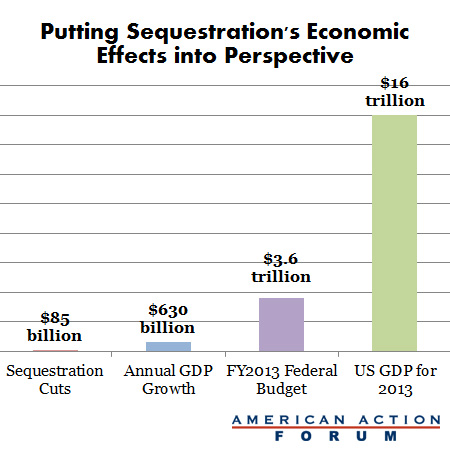
Betsy's Newmark recommends a Washington Post analysis of the scale of the sequester.  The proportion the reduction in the rate of increase of federal spending bears to total federal spending, let alone to national income puts the mouse and the elephant, or Z Scale and O Scale, in the same size class.


Washington Post graphic via Betsy's Page.

Here, quoting from an electronic mail circulated last fall to Northern Illinois faculty, is what a real sequester looks like.
Earlier this year, the State of Illinois announced a reduction in state funding to NIU of approximately $6,000,000. This budget reduction was allocated to the various units of the university, including our college, with a reduction of $1,419,000 assigned to the College of Arts & Sciences. That represents a reduction of approximately 3% of our core operating budget. To respond to this cut, [deans, administrators, and faculty collaborated] to develop a budget reduction plan. [Headquarters] had hoped that we would be able to find enough savings that would allow us to accomplish the needed reductions without any visible impact on the college’s operations. It is now clear that this will not be possible, and that more aggressive action will be needed to balance our budget.

The budget reduction is only for our General Revenues (02) funding. None of the action steps described below apply to our other fund categories such as fee accounts, local funds, grant accounts or foundation accounts. No new restrictions are being placed on those accounts.

With nearly 90% of our budget associated with personnel, it is difficult to absorb budget reductions on short notice. We are therefore approaching this as a two-step process. First, we will use a combination of reserves and short-term spending reductions to balance our FY 13 budget. At the same time, we will look more strategically at steps we can take to bring our permanent budget into balance. Those steps will include efforts to increase revenue, diversify our resources, and make targeted reductions and reallocations. The 3% reduction in our budget is a permanent reduction, and we will need to find permanent sustainable reductions in our FY 14 budget. However, there is no assumption that the permanent reductions made in FY 14 may or may not be the same as the reductions made in FY 13.

To balance the budget for FY 13 and to help prepare for the FY 14 budget, [headquarters calls] for a variety of immediate action steps. The following steps are effective immediately, and will remain in place through June 30, 2013, the end of the current fiscal year.
  •  Faculty Hiring Freeze: Most faculty hiring authorized for Fall, 2013 will be cancelled. A small number of guaranteed positions, and positions tied to strategic planning initiatives, may be authorized to proceed, but all other searches will be canceled. Chairs and directors have been notified individually on the status of their searches.
  • Staff Hiring Freeze: All vacancies in operating staff and supportive professional staff positions will be carefully evaluated, and a determination for each will be made whether to fill the position, freeze it temporarily, or cancel it permanently.
  • Instructional Staffing: In deploying and staffing the Spring 2013 schedule, we will need to be more conservative than we have been in the recent past in meeting student instructional needs.
  • Graduate Assistant Vacancies: All existing commitments to graduate assistants for FY 13 will be honored. However, if any students resign their assistantships mid-year, those funds will be recovered. The position will only be refilled if there is a specific instructional need that will be filled by the assistantship.
  • Non-Personnel Budgets: I am asking each unit to reduce its non-personnel budget by 5%. This includes operating budgets, travel budgets and equipment budgets. Each unit will determine how and where to take its reduction. Details will be forthcoming from [an individual] in the college business office.
  • College Travel Supplements: The college will honor the commitments we have already made for travel supplements. However, for faculty and staff, the college will only authorize new travel supplements for untenured faculty, and will only do so if there is a 1-1 match of unit-level funds. The college will continue to provide awards for student travel (both graduate and undergraduate students) from our Foundation accounts, as long as funds permit.
In making long-term reductions, our priorities will be to protect our core missions of teaching and research, to protect our highest quality programs, and to make the most efficient use of our resources. This will not be simple, and it will take some time to develop and announce a permanent reduction plan. [The aforementioned collaborators will work with] the College Senate [the committee of department chairmen -- ed.] to develop and implement a thoughtful, sustainable budget plan.

Once we have absorbed these reductions in FY 13 on a one-time basis in FY 13 and make them permanent in FY 14, [The author of the memo hopes], but certainly can’t promise, that we will not have to make any further reductions. With pension reform still in the wind, economic recovery still sputtering and enrollments still lagging, we have some distance to go before we can be sure that our general revenue budget will remain stable. [The author knows] that this kind of continued uncertainty is unsettling and tiring. [The author appreciates] all that you have done as we have worked through the challenges of the last few years, and, with your help, ... will do my best to address these new challenges.
The "continued uncertainty" has been going on for 20 years, with several different deans having to retrench in some way or other.  When I hired out in 1986, my department was under strength compared to economics departments in universities with comparable enrollments and responsibilities.  Administrative burdens have increased for faculty, and my department is about half the size it was in 1986, despite total enrollments being similar.  That "lagging enrollments" is relative to strategic plan targets.

Despite the retrenchments, there is still money in the budget for the women of the fevered brow to commemorate fifty years of The Feminine Mystique, complete with retro-Sixties posters all over campus to promote the schedule of events, and at the university level, there are resources for a football preview and book debut even before spring camp opens.

At the federal level, the Washington Monument has been closed for over a year.  We'll survive the sequester.  Surviving administrative preferences, locally or nationally, is another matter.

24.2.13

NOTES ON AN OLD TIMETABLE.

It has been a Cold Spring Shops tradition to agitate for faster train timings by drawing invidious comparisons of Amtrak schedules with those maintained by Depression-era steam railroads.


The publisher of Harper's is inspired, upon riding Amtrak from New York to New Haven to view some art at Yale, to make a similar comparison.
I take the chronically mediocre, supposedly high-speed Acela fairly often to Boston, Providence and Washington; no one needs to tell me how much faster and better it could be. But to refresh my knowledge, I recently made a round trip to New Haven, just to remind myself of what we’ve lost and of the potential benefits if we took trains seriously again.

New York’s acoustic-tile-ceilinged, fluorescent-lit Penn Station remains what has to be among the worst, most dispiriting major transportation terminals in the world, though my latest visit, post-rush hour on a Thursday morning two weeks ago, was relatively painless. My ticket seller was cordial and patient in explaining the differences between a $76 round trip on the Northeast Regional and a $140 round trip on the Acela. Further, I learned from my ticket folder that May 12 is National Train Day.

Waiting under the train board for the track to be announced (there’s no space for benches), I was tempted to jump on the glamorous-sounding Silver Star to Miami, scheduled to leave at 11:02, two minutes after my Northeast Regional #172, but I stuck with my plan. Whatever the ugliness of Penn Station, I was happy to be spared the airport-security drill and even happier when my train lurched into motion exactly on time. The café car was staffed by a kindly soul, and my $4.75 fruit-and-granola yogurt parfait along with my $2 coffee made for an adequate meal. As we moved east, then north through Queens, over the spectacular Hell Gate Bridge, then across Randall’s Island and past the New York Post printing plant, I started to think that maybe “regular” Amtrak wasn’t so bad, even when it bumps along at 50 to 60 mph.

On the advice of my editor, I had invented an itinerary, including a quick tour of the Yale University Art Gallery, so I began to watch the clock very closely. Only if the train were on schedule could I see some paintings and catch the returning Acela to New York to make a 4 p.m. appointment. The train arrived right on time at the hollowed-out wreck known as Bridgeport, then four minutes early, at 12:34, at New Haven (Paris by comparison to Bridgeport), whose handsome beaux-arts, Cass Gilbert-designed Union Station puts New York City’s hideous 1960s Pennsylvania Station to shame. Ten minutes later I was admiring Thomas Eakins’s “Taking the Count,” after marveling at Van Gogh’s “Café de Nuit,” Trumbull’s “Washington at Trenton” and Bonnard’s “Place Pigalle at Night.”

A great university gets the art, the romance and the train station it deserves. Why not the trains and speed to match?

Returning to Amtrak blandness on the frigid westbound platform, I was pleased to observe a crew pre-emptively de-icing the eastbound platform with liquid calcium chloride, in anticipation of the coming blizzard. Still, what’s the point of the Acela and the extra $32? It couldn’t be my $8 “Tuscan Panini,” which turned into a soggy mess after microwaving. True, I skipped Bridgeport in a bit of class-conscious scheduling. But my front-end-of-the train coach car made a squeaking sound every time that we jerked a little and at 2:10 a last call was announced in the café because of a “scheduled break,” even though we weren’t due into New York for another half hour. Shabbiness, thy name is Amtrak.

My Acela did arrive on time (one of 85.4 percent such rides in the past 12 months), but so what? While the train briefly hits 150 mph north of New York, it averages somewhere in the 70s range between Manhattan and Bos-ton because the tracks can’t handle anything faster. The telling comparison is not with the Northeast Regional but with Metro North’s New Haven Line commuter train out of gorgeous Grand Central that takes the more direct route through upper Manhattan to New Haven. The 10:03 Acela takes 1 hour 27 minutes to reach New Haven, for $70. The off-peak 10:07 Metro North takes just 33 minutes longer and costs $22. Shocked? Not enough. In 1963, when New York’s magnificent old Penn Station was demolished, the New York, New Haven and Hartford Railroad ran its fastest train from New York’s Grand Central to New Haven in 1 hour 20 minutes, seven minutes faster than the present-day Acela!
Yes, once upon a time a New Yorker could make a midday trip to New Haven and return on the Yankee Clipper, with a dining car that would put the Acela cuisine to shame.   Or one could return later in the evening on the Merchants Limited.

HITTING BOTTOM?

Three articles suggest there are limits to a business model based on cheap goods offered at low prices made possible by cheap and contingent labor.  The straight news angle is that retail stores require consumers to have disposable income out of which to consume.
American consumers might be preparing to downshift again, if only slightly, with low-income consumers hit the hardest. Sensing consumer trepidation, retailers are scrambling to adjust.

Retailers, restaurants, and consumer goods companies like Wal-Mart are lowering sales forecasts and adjusting marketing campaigns ahead of expectations that consumers will slash spending, the Wall Street Journal reports.
Peggy Noonan sees one Deeper Lesson in the aisles of Wal-Mart.
It was Sunday afternoon on a holiday weekend but even accounting for that the mood and look of the place was different from what it was two and five years ago. Then, things seemed dynamic—what buys, what an array of products, what bustle in the aisles. This time it seemed tired, frayed, with fewer families and scarcer employees. It looked like a diorama of the Great Recession.

What effect do all the successive fiscal cliffs, ceilings and sequesters, have on public confidence? On the public's spirit? They only add to the sense that Washington is dysfunctional and cannot possibly help us out of the mire.

It shows the world we lurch from crisis to crisis by habit now. This makes us look incapable and beset.
The entropy isn't in Washington, suggests James Howard Kunstler.
WalMart managed to install itself in the pantheon of American Dream icons, along with apple pie, motherhood, and Coca Cola. In most of the country there is no other place to buy goods (and no other place to get a paycheck, scant and demeaning as it may be). America made itself hostage to bargain shopping and then committed suicide. Here we find another axiom of human affairs at work: People get what they deserve, not what they expect. Life is tragic.

The older generations responsible for all that may be done for, but the momentum has now turned in the opposite direction. Though the public hasn't groked it yet, WalMart and its kindred malignant organisms have entered their own yeast-overgrowth death spiral. In a now permanently contracting economy the big box model fails spectacularly. Every element of economic reality is now poised to squash them.
The economic reality that cost-conscious managers missed is that, yes, a worker's wages are a capitalist's cost.  But there's another part of the circular-flow model that will bite the managers every time.  A capitalist's sales are a worker's purchases.

SEEKING A CATHEDRAL DOOR

Higher education requires a Reformation.  Or perhaps a Counter-Reformation, from well-meaning but misguided people who have lowered expectations, and everything else.  The National Association of Scholars polled assorted observers of the academic scene to identify One Hundred Theses, not necessarily all aligned with any one doctrine or dogma.

NEVER MIND THOSE NAMED STORMS.

Nemo, Q, Rocky, whatever.  It's half-past February.  That means Ollie's is open.
People stand in line. The 18-degree day turns their breath into fog, yet the only thing on their minds is getting a fresh scoop of frozen custard.

Ollie’s Frozen Custard, 2290 Oakland Drive in Sycamore, opened for its 2013 season on Wednesday. Ollie’s has been serving the area with its frozen treats since 1985.

Becky Duda, a 7-year-old DeKalb resident, said it is never too cold for custard. She prefers chocolate custard with M&M toppings.
Come summertime, there are additional seasonal flavors, and pumpkin custard in October.  Strawberries and Oreos on vanilla custard?  A Huskie, of course.

19.2.13

FUN WITH SEMIOTICS.

The Sports Illustrated swimsuit issue is a glossy provocation to the Perpetually Aggrieved.

What's the over-under that at least one participant in the semiotics workshop wishes she could be a swimsuit model?

YOU CAN'T GET THERE FROM HERE.

Insta Pundit is not happy about having to drive across Dixie.
I drove home from Bentonville, Arkansas in 11 hours, 15 minutes today, courtesy of Hertz and not courtesy of US Air, who not only couldn’t honor my ticket today, but who couldn’t even promise to get me home by Tuesday. I rented a Mazda 6 — nice car, surefooted and easy to drive — and it wasn’t bad. But jeez, airlines really suck today. Perks and first-class upgrades are okay, but the bottom line is, can you rely on them to get you where you’re going? Not so much. . . .
We've noted, previously, the withdrawal of the air carriers from some of the less-heavily-trafficked routs, and the occasional usefulness of the passenger train as an option, even in some surprising places.

The passenger rail network that we have today, however, still has the structure of the late-1960s network, and trains withdrawn prior to the creation of Amtrak have only rarely been added to the system.  The retrenchment began even earlier in the Southwest.  The best rail itinerary from the summer of 1954 would make the current U.S. Air offering look good.  The nearest passenger service to Bentonville is the Frisco at Rogers, Ark.  Board the Meteor at 9.23 (sections and bedrooms available). Arrive St. Louis at 7.45 the next morning.  Board Baltimore and Ohio's National Limited at 9.45, arrive Cincinnati at 5.35.  Sections might be available for day use.  Get supper in Cincinnati, then board Southern's Carolina Special 9.50, arrive Knoxville 6.50.  Sections and compartments available.  Two nights out, though.  Driving, even on pre-Interstate Highway roads, looks appealing.

On the map, a Rogers - Fort Smith (Ark.) - Little Rock - Memphis - Knoxville routing looks more direct, but the connections involve either a long wait at Memphis or a change of trains at Chattanooga.

YOUR PRIVATE DRONE.

At the July 2011 Gettysburg re-enactment, site marshals asked spectators to ground their heli-camera for fear it would spook the horses.


You'll see the camera grounded to the left of the spectator in blue shirt and tan shorts.  It looks a lot like the robot camera that turns up in football coverage.  The one in the stadium travels on some overhead wires.  This one is a remote controlled helicopter.  It's not the only incarnation of a private drone (via Drudge).
The drones sell for as little as $350, making them increasingly popular with the general public, and worrying those who believe the technology has the potential to be a peeping Tom in the sky.

Associate Professor Kevin Heller from the Melbourne Law School says the idea that private citizens can buy drones and record footage directly onto smartphones had serious privacy implications.

He said that while ''not everybody who buys these drones is a closet criminal … there are infinite mischievous possibilities''.
As cheap and light as digital cameras have become, a clever hobbyist might be able to do some kitbashing.

The same site offers another remote-controlled helicopter that raises the possibility of being able to take out a neighbor someday.

17.2.13

COOL PLACES TO CATCH A TRAIN

From The Weather Channel.  Their focus appears to be on the aesthetic: no discussion of whether there is a coffee bar with a good view of the trains.  London's Kings Cross used to have one.  I recall a good one alongside Platform 1 at London Paddington, not a bad place to observe a commuter rush that is the antithesis of the south side of Chicago Union Station.  If there's not a coffee bar, a bratwurst kiosk will do, such as the one just beyond the bunters at Frankfurt (Main) Hauptbahnhof.  Sorry, Milwaukee, those vending machines just don't cut the mustard.

RENDERED STUPID BY UNTESTED THEORIES

Peter Lawler of Berry College talks smack about people who need smack to be talked about them.
There is, in truth, little confidence in administrator-driven educational assessment. As nearly everyone knows, "assessment mania" originated in schools of education, which are not known as centers of excellence or even effectiveness.  For another, assessment rarely presents itself as aiming to remedy "grade inflation," which is so often pointed to as evidence of higher education's declining rigor or basic quality control.  Assessment is usually tied to "competencies."  To be competent in this or that skill is be "good enough."  And those in the know realize that "competency-based grading" is behind the spectacularly high grades given to students in schools of education for decades now.  "Good enough" in a variety of skills equals an A.  A focus on measuring competence might mean that we can show no student has been left behind, but it might also be at the expense of cultivating or recognizing excellence.  That, of course, is the criticism so many high-school teachers have of the whole No Child Left Behind and similar standardized assessment initiatives.
Quite.