“You have a much more serious deer problem there than we do here, because you don’t allow hunting.”"There" refers to the oh-so-gun-free Bethesda, Maryland, and "here" refers to the Adirondacks.
19.8.08


KISHWAUKEE RIVER CLEARED OF ALLIGATORS. The hunter prefers not to be identified.
The small alligator that has been evading DeKalb County Animal Control officers for weeks was caught Tuesday afternoon by an area resident, animal control warden Dan Berres said.
The animal, which had been described as a young alligator about 3 feet long, was caught near where the Northern Illinois University lagoon empties into the Kishwaukee River about 1 p.m. Tuesday. It was first sighted about three weeks ago in the same area, and subsequent sightings were also in that part of the river, Berres said.
“Someone had some sort of weighted net and decided to go out looking for it,” Berres said. “He went out and tossed it and got lucky, then he called us and said he’d caught the alligator.”
18.8.08
IN A LAND THAT'S KNOWN AS FREEDOM, HOW CAN SUCH A THING BE FAIR? Won't you please write to Chicago for the help that you can bring.
If you ask his staff to help you, will they turn the other ear?
More details of the library's unwillingness to share are here. The archive is bound and gagged.
(And yes, I take pleasure in using Graham Nash's lyrics to structure my post.)
Please consider contacting the president of the University of Illinois system, B. Joseph White, to ask him to take immediate public steps to insure the safety of the Chicago Annenberg Challenge records, to release the identity of the collection’s donor, and above all to swiftly make the collection available.That's the president of the University of Illinois system,
If you ask his staff to help you, will they turn the other ear?
More details of the library's unwillingness to share are here. The archive is bound and gagged.
The Special Collections section of the Richard J. Daley Library agreed to let me read them, but just before I boarded my flight to Chicago, the top library officials mysteriously intervened to bar access. Circumstances strongly suggest the likelihood that Bill Ayers himself may have played a pivotal role in this denial. Ayers has long taught at UIC, where the Chicago Annenberg Challenge offices were housed, rent-free. Ayers likely arranged for the files of the Chicago Annenberg Challenge to be housed in the UIC library, and may well have been consulted during my unsuccessful struggle to gain access to the documents.Open up the door!
(And yes, I take pleasure in using Graham Nash's lyrics to structure my post.)
IS BERTRAND COMPETITION FOR MEN EVOLUTIONARILY STABLE? That question goes unanswered in Tim Harford's The Logic of Life, reviewed here. Now comes Dr. Helen, the beneficiary of a nepotistic instalanche, proposing a more colorful version of the Bertrand competition. There are dissenting perspectives in the ensuing bull session. There's something missing in a mating model in which the sole criterion for a match is the willingness of the providers in excess supply to put out, to put it bluntly. Shouldn't an excess supply of women at colleges be an incentive for intellectually active women, or women of high integrity, to signal those characteristics as well?
15.8.08
SING, SING, SING. I'm sure most of my readers could identify the Benny Goodman piece that's still popular with collegiate pep bands (and I've heard a steel band arrangement of it on campus.) For your listening pleasure, here's the original.
LESSONS APPLIED. Book Review No. 34 is Jeff Shaara's The Steel Wave, the second of a planned three novels of World War II. His previous The Rising Tide, reviewed here, follows some real and some fictional characters from North Africa into Italy. Many of the principal characters are now preparing for the cross-Channel invasion, which will come. The story begins with an intelligence-gathering raid on the Normandy coast and it ends with Field Marshal Erwin Rommel's suicide. Some of the principal characters, historical and imagined, are dead, and some are preparing for the next set of battles. As several of the main characters are paratroopers, the third book, if there is to be one, will likely make readers aware of the bridge too far and of Bastogne.
(Cross-posted to 50 Book Challenge).
(Cross-posted to 50 Book Challenge).
I HEAR YOU WENT UP TO SARATOGA. The Boston connection to the Lake Shore had an extra car, the former Port of Vancouver, a Great Northern Railway parlor-observation once used on the Seattle - Vancouver Internationals, now running as City of Spokane, on the hind end on July 29. (The Boston extension of the Lake Shore also had this car on July 22, although conditions were not conducive to photography that day).

The car was still sitting in the Albany yard when 49 departed, on time, for Chicago. Sleeper passengers are served dinner at Albany. My tablemates were speculating on whether the car was carrying passengers for the races. Possible, but unlikely. The Boston train arrives in Albany just before the evening Rutland train, which would go to Saratoga, although that train arrived and left with no effort of a switcher to cut the car off 449 and add it to that train. The Montreal to New York train and an Empire Service train also showed up at Albany, and, once again, the limitations of the new Albany station were evident. If somebody at Amtrak or the New York Department of Transportation ever got serious about tightening the schedules and providing connections, there wouldn't be space in the station for the trains or for the passengers.
The potential is there. The Boston train arrives in time for a passenger to ride Springfield to Saratoga or Pittsfield to Rutland, if the passenger is patient (drive time, even with a refreshment stop someplace, is faster even though those journeys are the long way around on the interstates). The reverse connection is available, although with a LOOOOONG layover in Rensselaer (the downside of Albany-Rensselaer is it's distance from urban amenities, perhaps what Penn Central had in mind when it moved out of the Albany station). A passenger intending to ride the rails from Montreal to Chicago and points west also has the option (there no longer being any kind of cross-border connection Detroit - Windsor or Port Huron - Sarnia) of connecting in Albany, but the reverse connection is not available (the best one can do is to transfer to the Maple Leaf in Buffalo and spend the night in Toronto as the overnight Cavalier is long gone from the timetable). If I had the power to send Amtrak administrators to detention, I'd make the miscreants write "The value of a passenger service is in the intermediate community pairs that can be served directly or with reliable and rapid connections by multiple trains" a hundred times or so.
So to the trip: there wasn't a lot of time to write down car numbers and I opted to turn in early, although the planking at level crossings and the alignment of the switch frogs (oddly, in the straight direction) contributed to a restless night. Schenectady 7.25.16 - 7.31.03 (check the tickets ON the train!), Utica 8.45.27 - 8.48.03, Syracuse 9.38.23 - 9.46.30, on 30 July and on Norfolk Southern it's slow orders across western Ohio; Bryan 7.48.28 - 7.51.20, Waterloo 8.13.06 - 8.14.45, Elkhart 9.05.21 - 9.06.45 (if there's no longer a crew change here, why not consolidate the stations at the still-standing downtown South Bend station?), South Bend 9.39.45 - 9.42.18, more slow running, arrive Chicago 10.30.23 Central.
I've turned up a few other weblog train reports. Here's a recent ride from Detroit to Chicago with the tease of a continuation to St. Louis ("The value of a passenger service ...") and an installment of a ride on the California Zephyr.
DEJA VU. During last night's all-around gymnastics event, where the gold and silver medals went to U.S. competitors after a closely contested event, the commentators were griping about the judging, Nellie Kim (in some kind of official capacity) was offering technical advice to the judges, and a strong Russian performance led one of the commentators to observe that the Russian program had regained some of its swagger.
In the same week that the Prison House of Nations seeks a restoration of its suzerainty in the khanates, that, dear reader, may be no accident.
In the same week that the Prison House of Nations seeks a restoration of its suzerainty in the khanates, that, dear reader, may be no accident.
WE CAN'T BLAME THIS ON GLOBAL WARMING? There's an alligator in the Kishwaukee River.
We have yet to record a 90 degree day this summer. Animal control officers hope to bring the 'gator in before the Gales of November do their work.
Although exotic pets (whatever that means) are illegal, that doesn't stop people from buying them (and sometimes getting more than they bargain for).Forget the urban legend about alligators in the sewer. There's a real crocodilian swimming in the Kishwaukee River.
“It's true. We've seen it,” said Bob Drake, director of environmental health at the DeKalb County Health Department. “It's just a little bitty thing, only about 3 feet long, that somebody let go.”
We have yet to record a 90 degree day this summer. Animal control officers hope to bring the 'gator in before the Gales of November do their work.
PHOTO FINISH. In tonight's Olympic swimming, Michael Phelps overtook Milorad Cavic at the wall. The 0.01 second margin of victory represents the tolerance of the equipment. It was really close, and the outcome called forth a protest from the Serbian coach. There apparently was conclusive visual evidence to uphold the victory. Mr Cavic apparently counted on enough momentum to win, while Mr Phelps took what the announcers called a "half stroke." The 'fly doesn't look conducive to quick alterations in one's motion, undoubtedly the swimmers do work on such things.
Also at the pool, Cesar Cielo Filho's free-throw-shooter ritual worked well enough for him to win again.
Also at the pool, Cesar Cielo Filho's free-throw-shooter ritual worked well enough for him to win again.
14.8.08
GOD HELPS THOSE WHO HELP THEMSELVES. Postings are slow tonight as I'm switching attention between the Olympics (one might as well kick back a bit the night before contracts start) and the internet. In one of the swimming sprints, Brazilian Cesar Cielo Filho crossed himself a couple of times before racing (he won that heat). I remember when that was a habit of more than a few high school basketball players at the free throw line.
POLITICAL ECONOMY STILL MATTERS. Hunter Lewis's Are the Rich Necessary? Great Economic Arguments and How They Reflect Our Personal Values offers a partial case. This Book Review No. 33 is less-than-impressed as the treatment is uneven and the organization is backwards. Toward the end, the author offers a cursory survey of what he terms "competing economic value systems" he classifies as "equalitarianism, fraternalism, reciprocalism, philanthropism." The classification draws contrasts too strong, as any system of economic organization includes elements of all four. The four concepts themselves have fuzzy boundaries and they cannot be treated as disjoint. They might have worked more effectively toward the beginning, as a way of structuring the contested areas, which are poverty, inequality, the profit motive, and government (with both fiscal and monetary dimensions). The point-counterpoint approach is instructive as a first approximation, although some arguments receive more careful structuring than others, something that might not be immediately obvious to an inexperienced reader. It's thus not useful as an introductory reader, although some of the material will be useful to experienced lecturers or to advanced students.
(Cross-posted to 50 Book Challenge).
(Cross-posted to 50 Book Challenge).
BREAKING IN. The Chronicle of Higher Education invited three colleagues from Teaching and Learning (is that formulation inspired by Supply and Demand or by Reserves and Redundancy?) who have thus far written about breaking in, a task made more difficult in February, after which they commented on the challenges of balancing work and daily life (this article says little about the focus required to become truly proficient as a scholar), the reality checks, and most recently a stock-taking.
(Via Newmark's Door, where the reaction is scathing.)
(Via Newmark's Door, where the reaction is scathing.)
PATH DEPENDENCE. Although Milwaukee's Irish Fest is under way this weekend, and there is a St. Patrick's Day parade on Wisconsin Avenue, one doesn't often think "Milwaukee" and "Irish" in the same sentence. The Lady Elgin sinking took much of Milwaukee's early Irish community to the bottom of Lake Michigan.
Though it sank more than half a century before the Titanic, the Lady Elgin has been linked with the more famous ship because it, too, suffered a tremendous loss of life. There was no passenger manifest, so the exact number of victims is not known, though contemporary accounts estimate the number on board at 600 to 700. A mass grave in Winnetka became the resting place for 80 unclaimed victims.
Many on board were Milwaukeeans, mostly from the city’s Third Ward Irish community. They had chartered the vessel for the trip to Chicago on Sept. 7, 1860, to see presidential candidate Stephen Douglas just two months before he would lose to Abraham Lincoln.
The Lady Elgin will be featured in an exhibit of Titanic artifacts at the Milwaukee Public Museum. The Titanic show, one of six touring exhibits of artifacts retrieved from the doomed passenger liner, is scheduled to be on display at the Milwaukee museum Oct. 10 through May 25, 2009.
THE INEFFICIENCY OF A 100% RESERVE. Earlier this week, the last of the Lake Michigan train ferries, S.S. Badger, was taken out of service account a bearing failure.
Badger (PM 43) has a twin, Spartan (PM 42), that has been laid up unserviceable in Ludington, Michigan, for some time. The bearing failure marks the first time Badger's operator has had to cancel sailings, which is pretty strong confirmation that keeping a boat in reserve might be excessive.Officials with the company that operates the 55-year-old vessel said they hoped the steamship that crosses from Manitowoc to Ludington, Mich., would be fixed by the end of the week.
The 410-foot ship, which can carry 620 passengers and 180 vehicles, had not diverted from its normal service for repairs since 1994. A repair crew discovered the damage Saturday.
The company that operates the ferry, Lake Michigan Carferry, has had to borrow school buses to transport passengers who would normally be making the four-hour lake crossing. Officials have also offered refunds and discounts on future trips for people who had made reservations.
WAITING FOR WIND. As of Wednesday, Team Seven Sailing held third place in the Yngling regatta.
Sally Barkow (Nashotah) and teammates Carrie Howe and Debbie Capozzi moved into third place overall after seven of 11 races in the Yngling class in Qingdao. The U.S. team finished first, ahead of overall leader Great Britain, in the single race on Wednesday.The Inland Lake Yachting Association reports that Thursday's racing was called account no winds.
After losing one race to yesterday's two-hour postponements and losing two more races today, the Olympic Sailing Regatta is running nineteen races behind schedule and does not have the capacity to make up all those races tomorrow at the same time. Six courses would be needed to do so, and there are only five available for the event. The Race Committee has decided to start the Laser, Laser Radial, Finns, Yngling classes one hour early at noon, and to push for three races instead of the originally scheduled two.That's common enough for the Inland in August (I've sweated out the delays as race officer and as competitor), where thunderstorms wiped out today's scow racing at Okoboji.
11.8.08
BEATING THEIR FIRST STRING. The alliance between Britain and the United States to win World War II was successful although subject to stresses. The decision where to hit the Germans first provided some of the greatest stress, with the U.S. disposed to smash directly into Europe and the British preferring to secure the Mediterranean first, perhaps with the hopes of flipping Vichy France and Italy. Thus, a year after the declaration of war, the alliance lands at several places in Morocco and Algeria. Rick Atkinson's An Army at Dawn: The War in North Africa, 1942-1943 is the first in a planned Liberation Trilogy (the second, on the Italian campaign, is in the stack of items to be read; the third has not been released.) Because history is available to those who would investigate it, Book Review No. 32 cannot contain spoilers. The French resisted, some more willingly than others, but ultimately many French forces cooperated with the alliance. The Germans fought hard, but their logistical support was inadequate, and their leaders placed excess trust in air power or sheer will power rather than in the big battalions. The alliance's superior numbers ultimately told, although the U.S. troops had to learn how to win.
The book offers useful reinforcements to Jeff Shaara's The Rising Tide, reviewed here, as well as to Patton on film. Apparently the "let nobody come back alive" that George C. Scott's character gives during the push to Bastogne really happened in Africa. Many of the movie's African vingettes, including the death of the general's orderly, are accurate.
The behavior of alliance troops toward indigenous populations was often improper.
(Cross-posted to 50 Book Challenge).
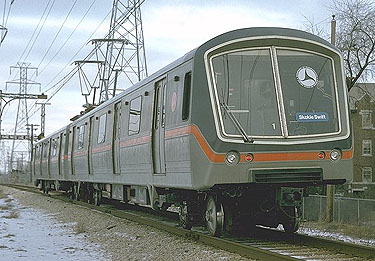
ELECTRO LUXE. Could we speak of the coastal regions of the Scandinavian countries as a North Shore? Destination: Freedom has a report on a new electric car.

There's something compelling about the design. My first reaction was that the Electroliner design is classic.

The design also evokes the Department of Transportation's State of the Art rapid transit car.

Research and development of the “Green Train” started in 2005 and is expected to continue until 2010/2011. Using the Bombardier Regina train for the demonstration, Bombardier and partners are developing a new generation of high-speed trains that meet the special technical and traffic requirements in the Nordic Countries. It is also part of Bombaradier’s ECO4 technology work to develop energy efficient trains.The article reports the train set a Swedish speed record of 295 km/h, presumably with the field tap equipment working.

There's something compelling about the design. My first reaction was that the Electroliner design is classic.

Electroliner, September 1, 2007.
The design also evokes the Department of Transportation's State of the Art rapid transit car.

Photograph courtesy Chicago L from the Joe Testagrose collection.
10.8.08
PRE-OLYMPIC GOLD. Might there be some future Huskies on the U18 National Team, back from an undefeated trip to Argentina?
NON-ABELIAN TALK. I had some time between trains in Chicago and picked up George Lakoff's The Political Mind: Why You Can't Understand 21st-Century American Politics with an 18th-Century Brain. (Yes, as if I didn't have enough stuff to read on the train already, that, plus it's all got to be schlepped). I did finish the book, somewhere in western New York, and it gets a quick Book Review No. 31. Professor Lakoff continues to peddle his advice to Democrats (he prefers the "progressive" conceit, but we all know who the audience is) to "frame" policy issues in such a way as to appeal to peoples' methods of thinking in ways that can counteract Republican frames. I have never been impressed with the approach, and one reason the book was a quick read was that it revisits familiar ground. The professor is still using his "tax relief" argument (the cleanest "frame", which he doesn't develop well, might be "membership dues", but that, too, is incomplete as it neglects all sorts of principal-agent and public choice problems that might make a voter receptive to limiting the government's tax take, and sympathetic to reducing its power.) His japes at the surge are dated.
The few parts I found much more compelling were the references to the technical work in linguistics and in mathematics. Hence the group theoretic title. Consider one of Professor Lakoff's examples: affection being measured by temperature (cool to the advances of another, warms up over time, whether plied with good conversation or with strong drinks goes beyond the model.) But the reverse mapping (temperatures being described as more or less affectionate) does not exist. I'm looking for an accessible treatment of the intellectual cross-fertilization between linguists and mathematics, as the logical puzzles strike me as fun. The public policy analysis fails to convince and the professor appears to know just enough about game theory to be dangerous.
(Cross-posted to 50 Book Challenge).
Subscribe to:
Posts (Atom)