The Excessively Complex, too, particularly if you wish to solve mysteries. First read The Sherlock Holmes Handbook: The Methods and Mysteries of the World's Greatest Detective. It's Book Review No. 14. The contents will be left to the reader as an exercise. I did like one of the Holmes quotes from the end of the work. From "The Adventure of the Copper Beeches" comes a theme for a model railroad display now a-building. "The lowest and vilest alleys in London do not present a more dreadful record of sin than does the smiling and beautiful countryside." Why else would Holmes and Watson be coming and going from Paddington Station or Victoria Station?
(Cross-posted to 50 Book Challenge.)
20.5.12


RECALLING THE ZIPPER.
The Chicago and Eastern Illinois Railroad provided a Chicago connection for Louisville and Nashville passenger trains to New Orleans, Atlanta, and Florida destinations. For a time, the carrier also offered its own passenger train between Chicago and St. Louis. This service included a day train called The Zipper (connecting downstate with a motor train called The Egyptian Zipper to Thebes) and a night train called Silent Knight. These trains all vanished with the coming of Amtrak, although Amtrak's Floridian returned to C&EI rails, missing Louisville, for a few months in 1974 and 1975.
In the 1960s, the railroad became a takeover candidate, with both Missouri Pacific and Louisville and Nashville seeking a Chicago entrance for their freight trains. The resolution involved what Trains magazine referred to as the wishbone, with Missouri Pacific taking ownership of lines south and west of Woodland, Illinois, Louisville and Nashville taking ownership of lines south and east, and the carriers jointly owning the two-track mainline north of Woodland into the Chicago area. Subsequently, Missouri Pacific became part of Union Pacific, and Louisville and Nashville part of CSX Transportation, but the joint operation remains.
Thus, when Amtrak and Union Pacific have engineering work on the Alton Route through Bloomington and Springfield, there is a detour route available for passenger trains. Typically the Texas Eagle for beyond St. Louis detours, with the St. Louis corridor trains turning at Springfield, or replaced by buses.
This spring, there have been several such detours, often announced well-in-advance, as improvements on the Alton to make possible 110 mph operation proceed. One such detour took place just after the end of the academic year, and I took advantage of the information to secure sleeper space to Longview, Texas, which seemed like a good place to spend a day and turn back.
A rider with a greater taste for adventure can attempt a turnback in Dallas, although there's not much time in town between trains, and the margin for error in case of trains running late is too small. Another possibility is to ride the detour only, with an overnight in St. Louis, or create a Chicago - St. Louis - Kansas City - Chicago circle tour out of it, with ample time for sightseeing or dining in either St. Louis or Kansas City (the trains aren't frequent enough to create blocks of time during business hours in both cities.) In October, 2010, rail enthusiasts Otto Dobnick, Dave Ingles, and Rick Moser did the St. Louis turn on a previous announced detour. Their trip log is amply illustrated.
An Amtrak detour has ample potential for adventure, simply because of the day-to-day challenges (which also affect freight trains) of getting a train from Chicago's Union Station to the operating railroad. My use of the locution "Chicago area" reflects those challenges. Amtrak dispatchers regularly use backward induction to get a train out of Chicago, first asking the CSX or CNR or Norfolk Southern dispatcher if he'll take a train; upon getting that commitment telling the dispatcher of the line connecting to CSX or CNR or NS that the train will be able to move to that line; then work backward in like manner until the line connecting to Union Station has accepted the train, and then the train moves on time. When the dispatchers haven't worked together in that manner, trains can wait, and wait, and wait, as was my experience in the summer of 2001 when a Cardinal headed for Washington, D.C. was held off the CSX line to Indianapolis until the dispatcher could find a path for it.
Amtrak 21 Texas Eagle, Chicago to Longview, Texas via C&EI detour, 16-17 May 2012: diesel 53, transition sleeper 39008, sleeper 32018, buffeteria car 37010, Sightseer Lounge 33031, coaches 31044-31010-34041. Seasonable temperatures and dry rail. Space in lower level of 32018. Go 1.45, stop at coach yard, go 1.53, easy transition from PRR to C&WI, also used by Metra's Southwest trains and Amtrak's Cardinal; stop at 80th St 2.25, freight train crossing, go again 2.30; stop 2.35 pm at 115th St.

Here's 22 with 164 and 8 cars, both trains move at 2.38, pass milepost 16 at 2.42; stop Dolton (now on ex-C&EI trackage not used by other Amtrak trains) 2.52 "awaiting a signal", go 3.10. From here our progress is mostly at 60 mph and freight trains are generally out of the way. Pass Watseka (TP&W crossing) 4.17; Woodland Junction 4.23, overtake stack train 4.50; dinner call at five; overtake mixed goods 5.22, Villa Grove 5.30, pass Tuscola (IC crossing) 5.40.
I made mention of a buffeteria car. That's a Milwaukee Road locution. Amtrak calls its reconfigured dining cars "Cross Country Cafe" cars, and one such car served as the dining car on this night's 21.

One end is set up as a self-service area and an attended buffet. The other end is set up as a diner, and there are apparently different configurations of these cars. The point of this configuration is either to offer a dining service with a smaller crew, as is being done on this run, or to offer an economy food service out of the buffeteria. Despite the economy setup, the diner offers a deluxe menu, with steaks grilled to order, or lamb shanks, or chicken, or a few other items, and apart from the vegetarian special, patrons can choose either potatoes or rice. Fewer people are served at each seating than is possible with a fully-staffed Superliner diner, although we will see the carrier introducing other economies, including seating in half the diner, in subsequent reports. Out of view to the left is the table commandeered by the crew for their mobile office. There has to be a better way of providing crews with a work space than a practice that gives lounge patrons the impression that the train exists for the benefit of the crew.
Pass Findlay (where the Egyptian Zipper used to connect with the Zipper) 6.12, pass Pana (which used to be where the C&EI used New York Central double track into St. Louis, and the crossing of the Illinois Central Charter Line) 6.34, meet eastbound stacks Hillsboro 7.03, Vierling Junction 7.50, Venice 8.10, arrive St. Louis 8.31.

The hotel and assorted other buildings block any view of the Gateway Arch. There's time for a stroll, and for smokers to smoke, and the locomotive to be fueled and the southbound passengers to board. Leave St. Louis 8.55, room made down, shower at Texarkana 6.30 on the 17th, pass Atlanta 7.10, protracted station work at Marshall hand-throwing switches, recrewing, then taking passengers, leave 8.14, arrive Longview 8.39, almost on time.

Longview is where the Amtrak passenger destined for Houston or for Shreveport changes to a bus. There's more to say about Longview, and about the value of connectivity among the long-distance Amtrak trains, to come.
In the 1960s, the railroad became a takeover candidate, with both Missouri Pacific and Louisville and Nashville seeking a Chicago entrance for their freight trains. The resolution involved what Trains magazine referred to as the wishbone, with Missouri Pacific taking ownership of lines south and west of Woodland, Illinois, Louisville and Nashville taking ownership of lines south and east, and the carriers jointly owning the two-track mainline north of Woodland into the Chicago area. Subsequently, Missouri Pacific became part of Union Pacific, and Louisville and Nashville part of CSX Transportation, but the joint operation remains.
Thus, when Amtrak and Union Pacific have engineering work on the Alton Route through Bloomington and Springfield, there is a detour route available for passenger trains. Typically the Texas Eagle for beyond St. Louis detours, with the St. Louis corridor trains turning at Springfield, or replaced by buses.
This spring, there have been several such detours, often announced well-in-advance, as improvements on the Alton to make possible 110 mph operation proceed. One such detour took place just after the end of the academic year, and I took advantage of the information to secure sleeper space to Longview, Texas, which seemed like a good place to spend a day and turn back.
A rider with a greater taste for adventure can attempt a turnback in Dallas, although there's not much time in town between trains, and the margin for error in case of trains running late is too small. Another possibility is to ride the detour only, with an overnight in St. Louis, or create a Chicago - St. Louis - Kansas City - Chicago circle tour out of it, with ample time for sightseeing or dining in either St. Louis or Kansas City (the trains aren't frequent enough to create blocks of time during business hours in both cities.) In October, 2010, rail enthusiasts Otto Dobnick, Dave Ingles, and Rick Moser did the St. Louis turn on a previous announced detour. Their trip log is amply illustrated.
An Amtrak detour has ample potential for adventure, simply because of the day-to-day challenges (which also affect freight trains) of getting a train from Chicago's Union Station to the operating railroad. My use of the locution "Chicago area" reflects those challenges. Amtrak dispatchers regularly use backward induction to get a train out of Chicago, first asking the CSX or CNR or Norfolk Southern dispatcher if he'll take a train; upon getting that commitment telling the dispatcher of the line connecting to CSX or CNR or NS that the train will be able to move to that line; then work backward in like manner until the line connecting to Union Station has accepted the train, and then the train moves on time. When the dispatchers haven't worked together in that manner, trains can wait, and wait, and wait, as was my experience in the summer of 2001 when a Cardinal headed for Washington, D.C. was held off the CSX line to Indianapolis until the dispatcher could find a path for it.
Amtrak 21 Texas Eagle, Chicago to Longview, Texas via C&EI detour, 16-17 May 2012: diesel 53, transition sleeper 39008, sleeper 32018, buffeteria car 37010, Sightseer Lounge 33031, coaches 31044-31010-34041. Seasonable temperatures and dry rail. Space in lower level of 32018. Go 1.45, stop at coach yard, go 1.53, easy transition from PRR to C&WI, also used by Metra's Southwest trains and Amtrak's Cardinal; stop at 80th St 2.25, freight train crossing, go again 2.30; stop 2.35 pm at 115th St.

Here's 22 with 164 and 8 cars, both trains move at 2.38, pass milepost 16 at 2.42; stop Dolton (now on ex-C&EI trackage not used by other Amtrak trains) 2.52 "awaiting a signal", go 3.10. From here our progress is mostly at 60 mph and freight trains are generally out of the way. Pass Watseka (TP&W crossing) 4.17; Woodland Junction 4.23, overtake stack train 4.50; dinner call at five; overtake mixed goods 5.22, Villa Grove 5.30, pass Tuscola (IC crossing) 5.40.
I made mention of a buffeteria car. That's a Milwaukee Road locution. Amtrak calls its reconfigured dining cars "Cross Country Cafe" cars, and one such car served as the dining car on this night's 21.

One end is set up as a self-service area and an attended buffet. The other end is set up as a diner, and there are apparently different configurations of these cars. The point of this configuration is either to offer a dining service with a smaller crew, as is being done on this run, or to offer an economy food service out of the buffeteria. Despite the economy setup, the diner offers a deluxe menu, with steaks grilled to order, or lamb shanks, or chicken, or a few other items, and apart from the vegetarian special, patrons can choose either potatoes or rice. Fewer people are served at each seating than is possible with a fully-staffed Superliner diner, although we will see the carrier introducing other economies, including seating in half the diner, in subsequent reports. Out of view to the left is the table commandeered by the crew for their mobile office. There has to be a better way of providing crews with a work space than a practice that gives lounge patrons the impression that the train exists for the benefit of the crew.
Pass Findlay (where the Egyptian Zipper used to connect with the Zipper) 6.12, pass Pana (which used to be where the C&EI used New York Central double track into St. Louis, and the crossing of the Illinois Central Charter Line) 6.34, meet eastbound stacks Hillsboro 7.03, Vierling Junction 7.50, Venice 8.10, arrive St. Louis 8.31.

The hotel and assorted other buildings block any view of the Gateway Arch. There's time for a stroll, and for smokers to smoke, and the locomotive to be fueled and the southbound passengers to board. Leave St. Louis 8.55, room made down, shower at Texarkana 6.30 on the 17th, pass Atlanta 7.10, protracted station work at Marshall hand-throwing switches, recrewing, then taking passengers, leave 8.14, arrive Longview 8.39, almost on time.

Longview is where the Amtrak passenger destined for Houston or for Shreveport changes to a bus. There's more to say about Longview, and about the value of connectivity among the long-distance Amtrak trains, to come.
YOU ARE PAID TO SAY NO AND UPHOLD STANDARDS.
Janice Fiamengo of Ottawa dreads encounters with incompetent grade-grubbers.
Meetings about bad grades are uncomfortable not merely because it is unpleasant to wound feelings unaccustomed to the sting. Too often, such meetings are exercises in futility. I have spent hours explaining an essay’s grammatical, stylistic, and logical weaknesses in the wearying certainty that the student was unable, both intellectually and emotionally, to comprehend what I was saying or to act on my advice. It is rare for such students to be genuinely desirous and capable of learning how to improve. Most of them simply hope that I will come around. Their belief that nothing requires improvement except the grade is one of the biggest obstacles that teachers face in the modern university. And that is perhaps the real tragedy of our education system: not only that so many students enter university lacking the basic skills and knowledge to succeed in their courses — terrible in itself — but also that they often arrive essentially unteachable, lacking the personal qualities necessary to respond to criticism.Yes, that behavior is learned, and yes, there is much to say about so-called progressive education depriving young people of the reality checks they will encounter only later, in harsher forms. And yet, it is your duty as a professor to say no and uphold standards. Catching up on technical papers or your reading, and writing your own technical papers is also part of the job, but without the saying no, tactfully, to incompetent grade-grubbers, there is no reputation for selectivity to exploit when your research competes with that of others.
THE LIMITATIONS OF GOVERNMENT.
We have from time to time observed the maturation of Tom Brokaw. In 2007 came a conjecture.
There was enough of a consensus that a midwestern graduate of a state university and a graduate of one of the Ivies could hold the same positions. In Boom, however, Mr Brokaw repeatedly (is it unwittingly?) suggests that shared consensus was one of an out-of-touch elite.By August 2011, in the middle of Our President's contrived debt-ceiling crisis, came evidence that Mr Brokaw was beginning to recognize reality mugging him. His The Time of Our Lives might have also been recognition that Reliance on Washington has reached its limits, although in that book he still keeps the notion of a Vital Progressive Center alive.
THE LIMITS OF FLY-BY-WIRE.
Designers can build safeguards into planes, but the mechanical assistants can only be designed with experience in mind. Sometimes that experience comes the hard way.
Airline pilot Denny Fitch was hitching a ride home on a DC-10 in 1989 when heard an explosion somewhere in the back of the jet. He soon made his way to the cockpit to see if the crew needed help.Mr Fitch survived that crash, and his recent obituary reminds readers that he bought himself and some of the passengers additional years of life.
Inside, he found three men desperately trying to keep the giant plane in the air after losing all hydraulic power needed to control direction and altitude. Fitch took a seat in the only space available – the floor – and helped operate some of the only equipment still working – the wing engines – to try to land the aircraft carrying nearly 300 people.
When the crippled plane crash-landed in Sioux City, Iowa, more than half of the passengers survived – one of the most admired life-saving efforts in aviation history.
After the accident, aviation experts conducted simulations in which test pilots and trainer pilots tried to land similarly stricken aircraft.
"I'm not aware of any that replicated the success these guys had," said Mike Hamilton, a United pilot who flew with Fitch. None of the simulator pilots were able to make a survivable landing.
"Most of the simulations never even made it close to the ground," Hamilton said.
And the teamwork of Fitch and the others on the flight deck is still a model for the industry.
15.5.12
SO MUCH FOR CONNECTIVITY.
As part of the security measures for the NATO Summit taking place in Chicago over the weekend, Metra is prohibiting large luggage and drinks on trains for the duration.
The last day of the conference will be Monday, May 21, and it will surely be an ugly Monday with no morning coffee on the trains. (Because of heavy passenger loadings, the bar cars have all been converted for passenger use. I wonder if the ban also applies to the one remaining subscription parlor car.)
On Saturday and Sunday, there may be Amtrak passengers connecting to and from Metra, and their luggage has to be left at Union Station, or ??? (As if the Metra or Amtrak schedules pay much attention to connectivity anyway.)
The last day of the conference will be Monday, May 21, and it will surely be an ugly Monday with no morning coffee on the trains. (Because of heavy passenger loadings, the bar cars have all been converted for passenger use. I wonder if the ban also applies to the one remaining subscription parlor car.)
On Saturday and Sunday, there may be Amtrak passengers connecting to and from Metra, and their luggage has to be left at Union Station, or ??? (As if the Metra or Amtrak schedules pay much attention to connectivity anyway.)
NO CHILD GETS AHEAD.
Ralph Nader contemplates the social waste that is the United States recruiting the best and the brightest from other countries.
Our companies need these skills. The foreigners have these skills and we want them here where they can flourish, and create profits and jobs. Never mind that our country has plenty of people waiting to have the same opportunity. By reducing tuition barriers, overcoming historic discrimination (e.g. lack of women engineers), reducing the 40 percent dropout rate from colleges, and working with youngsters on a one-on-one basis so that they are not left behind or skewered by misguided multiple-choice standardized test regimens, are all great ways to reach out to Americans.It's up to education policy makers in the United States to develop that human capital, rather than do things that impede its development, including the obsession with standard tests. At the same time, it ought to be policy, or practice, in the United States to continue to build that city on the hill, and if that city on the hill attracts talented people from other countries, so be it.
Also, what about having ready and able specialists here who may have to be paid more than their overseas counterparts? These Silicon Valley corporations are making huge profits, pay few taxes, and receive subsidies known as R & D tax credits.
Now we see the grossest of contradictions. We have an agency for International Development (USAID), economists and politicians saying that developing countries desperately need these same skills or what they call “human capital.” They need engineers for their transportation, hydraulic and soil systems, physicists for their universities and modern industries, physicians for their sick and injured, nurses for hospital care, public health specialists for eradicating systemic diseases, and entrepreneurs to jumpstart businesses that deal directly with the necessities of life. Through many columns, the globetrotting Tom Friedman has urged developing countries to retain such native talent to build their economies. Yet he has also written that students from abroad receiving U.S. PhDs in the hard sciences be given immediate permanent U.S. residence en route to citizenship. Well, you can’t have it both ways. There is not a large surplus of such talent that we can drain them from developing countries building their own societies.
LOSING THE POSITIONAL ARMS RACE.
The longer the wait from the end of the season, the more expensive it gets to keep the football team in camp.
Just under three months to the next season, which will begin in Chicago, with Iowa playing the role of the visiting team.
In 2010, Northern Illinois had to wait two weeks between its loss in the Mid-American Conference Championship game and its victory against Fresno State in the Humanitarian Bowl in Boise, Idaho.Helping kick off Mardi Gras in the cradle of Mardi Gras might have been fun, but the bowl revenues weren't that great. Selling wins to Big Ten teams with large alumni bases in Chicago isn't always lucrative enough.
This past season, the Huskies had more than a month from their MAC title win in Detroit on Dec. 2 to the GoDaddy.com Bowl victory over Arkansas State on Jan. 8 in Mobile, Ala. That also meant players had to spend more time on campus and more money on meals.
NIU received $431,680 in total revenue from the GoDaddy.com Bowl. Total expenses were $593,238, which resulted in the loss.Headquarters is of the view that the football visibility is worth it.
The internal athletic funds used to cover the loss include revenue from the Huskies’ game against Wisconsin at Soldier Field on Sept. 17, 2011.
NIU received about $850,000 in revenue from the Solider Field contest, NIU spokeswoman Donna Turner told the Daily Chronicle on Wednesday. That number falls short of expectations of $1 million. Wisconsin was paid the first $1 million in revenue, with NIU keeping whatever revenue was left, according to the game contract.
Included in the revenue figure from the GoDaddy.com Bowl was the $400,000 payout the school received from the MAC, as well as $31,680 in ticket revenue. NIU sold 738 tickets. The school distributed 1,708 tickets, which included free tickets for students and player comps.
Just under three months to the next season, which will begin in Chicago, with Iowa playing the role of the visiting team.
10.5.12
DONE.
Union Pacific celebrates its sesquicentennial. There's a steam train touring the railroad's historic territory (not including North Western and Missouri Pacific and the other lines that have subsequently become part of the system).
May 10 is significant to the carrier's history, as on that day in 1869, the last spikes were driven.
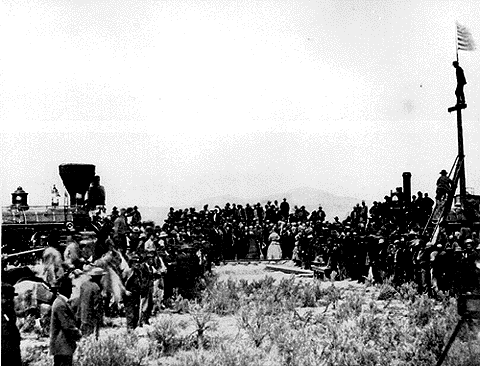
Happy 143d to the Transcon, and let the stack trains roll. (And the coal. And the corn. And the pigs. And the ethanol.)
May 10 is significant to the carrier's history, as on that day in 1869, the last spikes were driven.
Happy 143d to the Transcon, and let the stack trains roll. (And the coal. And the corn. And the pigs. And the ethanol.)
GET RID OF THE TRAFFIC LIGHTS.
The Transportationist introduces naked streets.
A related article notes that there is a right way and a wrong way to time the traffic lights, in those areas where the traffic might be heavy enough to require signalling.
Pedestrians are likely to be safer if the engineers make the effort to time the greens to encourage adherence to the speed limit, rather than putting signals in haphazardly with speeding-encouraging patterns that regular drivers discover.
In 2007, the Dutch city of Drachten did away with street lights in 20 four-way intersections, installing traffic circles instead. The shift caused a dramatic decline in the number of traffic-related deaths: one intersection went from 36 in the four years before the shift to two the year after. And vehicles now cross the junction 20 second faster.I hesitate to generalize from a small sample, but a few days ago a traffic light with a 90 second cycle was on the blink. That 90 second cycle includes the left arrow, common in Illinois. A lot of cars can back up in 90 seconds, particularly if the left arrow is in effect for the better part of a minute itself. But cars don't arrive at that corner in packs because these aren't the busiest streets in town, and because it isn't near a shopping center with its out-of-synchronization access signals that generate packs of traffic. So when the light is on the blink, drivers treat the flashing reds as a four-way stop, and with relatively infrequent arrivals of cars at the corner, wait times are a few seconds instead of up to two minutes. Something similar might be at work to the advantage of drivers arriving at those Drachten rotaries.
"The idea is to create space where there is mild anxiety among everyone so they all behave cautiously. No one thunders along at 30mph on a high street thinking that they have priority," Owen Paterson, the Dutch Transport Minister, told Jalopnik. "Instead of the State laying down the rules, we need to give responsibility back to road users."
A related article notes that there is a right way and a wrong way to time the traffic lights, in those areas where the traffic might be heavy enough to require signalling.
David Goldberg of Transportation for America says timed signals can be dangerous if they encourage drivers to speed through lights, and force pedestrians to wait too long for an opportunity to cross. He, like Flocks, is an advocate of systems like HAWK, which empower pedestrians to cross safely.Those lights that favor the speeders are probably accidentally timed, if at all. There used to be several stretches of Warren Avenue in Detroit that somebody going 40 or faster could get a green at Grand and sail all the way to Wayne State without stopping, while somebody obeying the posted 30 (never enforced, even in those days) would encounter reds at each controlled corner. I encountered a stretch of U.S. 1 from Trenton to New Brunswick where I in my rental car was behaving myself and the locals were going 65 to 70 and making all the greens while, once again ...
Flocks says timed lights can work if they're used correctly. She warns against systems that encourage drivers to speed up to get through as many lights as they can.
But some lights are designed to incentivize the opposite, she says. The key is the timing. If traffic lights are designed so that you have to speed a little to get through them all, then that's what drivers will do. But some cities have a system in place that punishes speeding drivers. Drivers going five to ten miles over the speed limit are stopped every third light. If you're going exactly the speed limit, you'll cruise down the road.
Pedestrians are likely to be safer if the engineers make the effort to time the greens to encourage adherence to the speed limit, rather than putting signals in haphazardly with speeding-encouraging patterns that regular drivers discover.
SELECTIVE OUTRAGE.
The Perpetually Aggrieved in the academy can get annoying voices silenced. It doesn't follow that the Perpetually Aggrieved refrain from stereotyping or in-group references in order to provide good examples for debating controversy.
What Riley did do was express a viewpoint on a very sensitive and controversial topic in academia, and a huge chunk of academia mobilized not simply to argue with Riley about the issue, but to ensure that she no longer had a platform upon which to express her opinions. It wasn't enough to simply convince people that they were right and the dissenter was wrong; as in so many FIRE cases, the dissenter had to be silenced in favor of those with the "right" opinions. Until our higher education culture rids itself of this compulsion, it will continue to poorly serve our students and our society at large.Liberating tolerance isn't that liberating, is it?
The petition urging The Chronicle to fire Riley ended with the words "Viva civility!" If, in America, "civility" comes to represent banishing your opponents from the field of debate rather than debating them openly and fairly, this nation is going to have a very serious problem.
INTERCOURSE BECOMES CLOTHED WITH A PUBLIC INTEREST WHEN IT AFFECTS THE PUBLIC AT LARGE.
You get headlines like that when an economist schooled in public utility economics encounters a National Review editorial calling for a restrictive view of marriage.
Put another way, the culture is doing just fine in protecting children -- in neighborhoods where the adults act responsibly, and not so well -- in neighborhoods where the adults don't. Maybe it's time for the editors at National Review to unbundle government from culture, or Caesar from Christ?
The only good reason to have marriage laws in the first place — to have the state recognize a class of relationships called “marriage” out of all the possible strong bonds that adults can form — is to link erotic desire to the upbringing of the children it can produce.A previous editorial addresses objections other commentators raised to that position. A sentence toward the end raises a critical question. "The symbolic message of inclusion for same-sex couples — in an institution that makes no sense for them — would be coupled with another message: that marriage is about the desires of adults rather than the interests of children." Implicitly, it is the state, and not the culture, that is protecting the interests of children. Doesn't that imply a competence for the state in protecting the interests of children that it has not demonstrated when it comes to providing education, or school lunches, or safe neighborhoods?
We have already gone too far, in both law and culture, in weakening the link between marriage and procreation. To break it altogether would make the institution of marriage unintelligible. What possible governmental interest is there in encouraging long-term commitments with a sexual element, just as such?
Put another way, the culture is doing just fine in protecting children -- in neighborhoods where the adults act responsibly, and not so well -- in neighborhoods where the adults don't. Maybe it's time for the editors at National Review to unbundle government from culture, or Caesar from Christ?
9.5.12
UNIVERSITIES ARE FAILING AT THEIR MISSION.
The house organ for Business as Usual in Higher Education invites journalist Naomi Schafer Riley to participate in their Brainstorm forum, and she says some unkind things about area studies dissertations, and the Perpetually Aggrieved do what they perpetually do, so the editor continues Business as Usual in the expected way. Constructive self-criticism is collegial these days.
Minding the Campus has a list of recommended readings, from a variety of perspectives, on the post and the subsequent reaction.
Peter Wood, who holds the title of Most Favorite Administrator at Cold Spring Shops, has not yet been purged from the Innovations forum, but he's clearly showing sectarian and deviationist tendencies. (Sorry, that doesn't sound so good in English. There's a reason the murderer in Crime and Punishment is named Raskolnikov.)
But the people calling for Ms Riley to be purged and exiled do a more effective job of illustrating those failings. Poet Gina Barreca, hoping not to have to provide a Creative Response to Just Criticism, offers an uncreative response whose ending disclaimer fails to impress Benjamin Plotinsky, who has a real Ph.D. from a real university.
Since Brainstorm was created five years ago, we have sought out bloggers representing a range of intellectual and political views, and we have allowed them broad freedom in topics and approach. As part of that freedom, Brainstorm writers were able to post independently; Ms. Riley’s post was not reviewed until after it was posted.Long Live Comrade Stalin.
I realize we have made mistakes. We will thoroughly review our editorial practices on Brainstorm and other blogs and strengthen our guidelines for bloggers.
Minding the Campus has a list of recommended readings, from a variety of perspectives, on the post and the subsequent reaction.
Peter Wood, who holds the title of Most Favorite Administrator at Cold Spring Shops, has not yet been purged from the Innovations forum, but he's clearly showing sectarian and deviationist tendencies. (Sorry, that doesn't sound so good in English. There's a reason the murderer in Crime and Punishment is named Raskolnikov.)
So why did Riley’s opinion arouse such fury? It fell within the category of unspeakable observations in higher education—unspeakable because to voice them is almost certain to provoke outrage. The outrage is all the hotter because many people share Riley’s view that “black studies” and its variants are intellectually shallow and academically superfluous. To criticize, let alone mock, fields like this touches on higher education’s troubled conscience.Political correctness contributing to the failure of higher education? Where did we hear that first?
And higher education’s conscience is troubled because of the history behind such fields. Their rise owes less to signal intellectual accomplishments than to university administrators seeking to appease vocal constituencies. We have a collective pretense that the fields (black studies being the preeminent example) that combine identity group solidarity, a program of social change, and a fair amount of advocacy are “real” academic disciplines. It is impolite to call such pretenses into question because doing so unsettles some of the tacit agreements that undergird identity politics in American higher education.
But the people calling for Ms Riley to be purged and exiled do a more effective job of illustrating those failings. Poet Gina Barreca, hoping not to have to provide a Creative Response to Just Criticism, offers an uncreative response whose ending disclaimer fails to impress Benjamin Plotinsky, who has a real Ph.D. from a real university.
What I can say is that, as poetry, it’s an embarrassing failure — the work of a writer who doesn’t understand the first thing about verse, comic or not. The first stanza is a badly scanning limerick. The second and third stanzas abruptly change the meter and rhyme scheme to something resembling Lewis Carroll’s The Hunting of the Snark. The final stanza shifts abruptly again: It’s a quatrain with an AABB rhyme scheme and four lines of anapestic tetrameter. The one formal characteristic that unites the poem is how badly it scans throughout; I’d call your particular attention to the lines beginning “Where no one paid her” and “Poor NSR chewed off,” both of which utterly fail to be the anapestic trimeter that they’re supposed to be.I suppose, though, that because his reaction is in National Review, it can be dismissed as so much bourgeois formalism. So too must it be with The Wall Street Journal, which has called the house organ of Business as Usual the Comical of Higher Education.
That last sentence encapsulates the intellectual corruption of academia, a profession that ought to encourage intellectual adventurousness, not pander to those who are unable to withstand the "distress" of having their ideas challenged. But we've been irremediably cynical about academia since our undergraduate days. In our own field of journalism, however, we still recoil at a display of perfidy.Subsequently,the Journal goes after The Cravenness of Higher Education.
It is sometimes a useful exercise to take the things that people say at face value, especially when that is counter to their intended construction. Let's apply that technique to McMillen's post from last night.
According to McMillen--whose bio informs us she has been with the Chronicle for over a decade and has been its top editor for nine months--she was ignorant of the publication's "basic editorial standards" until a thousands-strong mob set her straight in the course of seeking to silence one of her writers.
It is hard not to note the context in which Ms. McMillen dismissed Naomi Riley for committing speech. Now more than ever, too many college graduates discover that their expensive higher educations send them into a modern workplace with skills that few employers want or need. The graduates sit home, unemployed and unemployable. Meanwhile, back inside the school walls, the Chronicle of Higher Education stands ready to eliminate any writer who causes distress to the modern generation of scholars who teach these students.I invite the Journal's recruiting team to one of our job fairs. Perhaps they're paying too much attention to the culture wars in the Ivies, and a visit to the land-grants and the mid-majors might counteract the daily running of the Occupy gauntlet of spoiled kids that is coloring their attitudes.
A FISH WITHOUT A BICYCLE.
As long as Julia has Barack Obama, she can get by without a man.
There's a hilarious send-up of the presentation, which has been laughed unto scorn all over the internet, at Reason. Here's Jennifer Rubin, unimpressed by those fish. "I would briefly note the irony of the liberal feminists’ idealized single woman: no husband and utterly dependent on government. This is progress?" She endorses a William Bennett reaction.
There's a hilarious send-up of the presentation, which has been laughed unto scorn all over the internet, at Reason. Here's Jennifer Rubin, unimpressed by those fish. "I would briefly note the irony of the liberal feminists’ idealized single woman: no husband and utterly dependent on government. This is progress?" She endorses a William Bennett reaction.
Julia's entire life is defined by her interactions with the state. Government is everywhere and each step of her life is tied to a government program. Notably absent in her story is any relationship with a husband, family, church or community, except a "community" garden where she works post-retirement. Instead, the state has taken their place and is her primary relationship.Indeed so, but Mr Bennett notes it takes something more substantive than Not Obama to replace Our President. "Conservatives must be able to provide Julia an alternative vision for a better future. Without it, Julia might have nowhere else to turn but to the government, and that is nothing to laugh about." Puts the continuing Culture War circuses in perspective, doesn't it?
CHICAGO, WISCONSIN.
An instructive book titled How the States Got Their Shapes explains that Pennsylvania, Indiana, Illinois, and Minnesota all received special consideration by Congress in obtaining a Great Lakes coast.
In Illinois, a man named Nathaniel Pope merits mention on a historical marker, located on approximately the original Wisconsin border, Plankinton, er, Ogden Avenue.
In Illinois, a man named Nathaniel Pope merits mention on a historical marker, located on approximately the original Wisconsin border, Plankinton, er, Ogden Avenue.
Along Route 34 between Somonauk and Sandwich is the Sannauk Forest Preserve, and in the middle of that 72-acre woodlands is a state historical marker placed there in 1989. It reveals how this county and 13 others in northern Illinois almost ended up in Wisconsin. I just came across this bit of trivia last week and went to the library to learn more about Nathaniel Pope’s influence on Illinois.It's possible that Mr. Pope, and not the elder Mayor Daley, invented the Illinois tradition of keeping dead people on the voting rolls, in his case in order to have sufficient people enumerated within the borders of the proposed state to qualify as a state. But in so doing, he created a free state with a southern boundary south of Richmond, Virginia.
[Pope] wrote an article for the Western Intelligencer newspaper explaining his maneuvers in Congress. It turned out to be a brilliant plan because it gave Illinois a better foothold on the Great Lakes to help commerce, added thousands of acres of fertile farmland, and because half the population lived in this northern section, it later proved valuable in assuring the state would vote to stay in the Union and oppose slavery.Perhaps in that transaction is the beginning of the Chicago and Downstate split. South of Plankinton, er, Ogden Avenue, Illinois takes on a more southern tone, complete with loyalties to the Cardinals rather than the Cubs or White Sox. Cairo, however, had great value as a jumping-off place for Grant and Sherman.
TONIGHT'S RAILROAD READING.
Salem, Massachusetts, will be getting a new commuter train station with additional parking capacity. Site preparation for the parking deck has uncovered the foundations of the Salem roundhouse. The article helpfully explains what a roundhouse is.
It's unfortunate that relatively few turntables have made it onto preservation railroads. There's drama in bringing a steam locomotive out of its stall, balancing it on the turntable, then turning it to move to the ready track and thence to station or yard.
The archaeological report Massachusetts will receive promises to be of use here, as a model Salem engine terminal is part of the model railroad still a-building down cellar.
The roundhouse is a remnant from the steam locomotive days. It was a large brick building with a turntable in the center, surrounded by a dozen stalls where locomotives were repaired and stored at night.The noun, hostler, originally referred to the stableman who made sure that flesh-and-blood horses were not put away wet after being ridden hard. The iron horse required similar care and feeding.
The locomotives were driven onto the turntable, which would rotate, allowing the trains to pull into a stall. The building had a coaling tower and water tank. At night, workers called "hostlers" fed the boilers to keep the steam engines running.
It's unfortunate that relatively few turntables have made it onto preservation railroads. There's drama in bringing a steam locomotive out of its stall, balancing it on the turntable, then turning it to move to the ready track and thence to station or yard.
The archaeological report Massachusetts will receive promises to be of use here, as a model Salem engine terminal is part of the model railroad still a-building down cellar.
TAX INCIDENCE.
Some thoughts on taxing corporate income as personal income from Laura Tyson.
Learn Liberty contributes a video primer on tax incidence.
It's been featured by Coordination Problem and Professor Munger asks, "Are Corporations People?"
According to conventional wisdom, the corporate-tax burden is borne principally by the owners of capital in the form of lower returns. But, as capital becomes more mobile, relatively immobile workers are bearing more of the burden in the form of lower wages and fewer job opportunities. That is why countries around the world have been cutting their corporate-tax rates. The resulting “race to the bottom” reflects intensifying global competition for capital and technological knowhow to support local jobs and wages.Via Greg Mankiw. Collegiality exists among veterans of the Council of Economic Advisors.
Moreover, a high corporate-tax rate is an ineffective and costly tool for producing revenues, owing to innovative financial transactions and legal tax-avoidance mechanisms. A company’s legal residence and geographic sources of income can be and are manipulated for such purposes, and the incentives and scope for such manipulation are especially large in sectors where competitive advantage depends on intangible capital and knowledge – sectors that play a major role in the US economy’s competitiveness.
Learn Liberty contributes a video primer on tax incidence.
It's been featured by Coordination Problem and Professor Munger asks, "Are Corporations People?"
NO FISHING OFF THE COMPANY PIER.
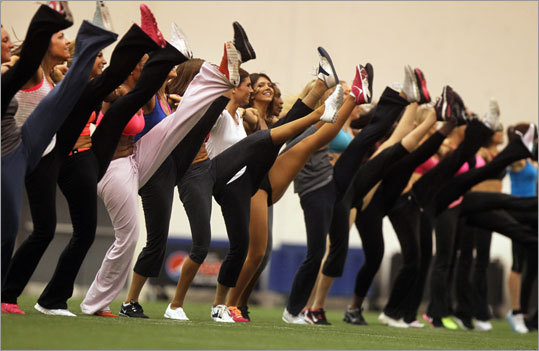
The Boston Globe sends a reporter to boot camp for Patriot cheerleaders.

Yes, go to the story for the eye-candy, but scroll through for the news. Cheerleaders serve for no more than three years, and they are not allowed to socialize with the players.

Boston Globe photograph by Stan Grossfeld.
Yes, go to the story for the eye-candy, but scroll through for the news. Cheerleaders serve for no more than three years, and they are not allowed to socialize with the players.
7.5.12
WORKING HYPOTHESES CANNOT BE AD HOC.
Cold Spring Shops posts have used the label "fourth turning" in reference to events that might lead to a major change in established institutions or the Way Things Ought Be Structured. The label is simply a label, and ought not be freighted with any inference of precision.
So, too, must it be with generational analysis generally, if recent attempts by pop culture mavens and marketers to typecast the current cohort of babies is any indicator.
Thus Generations begins with a comparison of President Kennedy's inaugural parade with that of President Bush the elder. Both Presidents served with distinction in World War II, and their inaugural parades were slices in time of the G. I. Generation in rising middle age and in elderhood. Working hypothesis: epochal events shape cohorts of individuals, in the case of the G.I.s a massive coming of age challenge combining economic distress and global war.
The complementary proposition, however, of cohorts of individuals shaping the epochal events, is less persuasive. The most destructive epochal event of the Anglo-American saeculum, namely the secession crisis and Civil War of the late 1850s and early 1860s, is an anomaly in the Generations framework, in which there is neither a four-cohort (Idealist, Reactive, Civic, Adaptive) stratification of the population nor a four-duodecade (Awakening, Inner-Driven, Crisis, Outer-Driven) divison of the lifespan. (In Fourth Turning, these terms are clarified as respectively Prophet, Nomad, Hero, Artist cohorts and Awakening, Unraveling, Crisis, High eras.)
Increased lifespans, the authors suggest, also have the potential to change the interaction of cohorts. With relatively few sixtyish or older members of the currently oldest cohort, a generation's hold on positions of elder influence attenuates quickly. The authors do not explore all the possibilities of those longer life-spans for disrupting or modifying the historical cycles, although their discussion (from the early 1990s) of the G.I. Generation (Civic or Hero, came of age during World War II) notes their long tenure in the Presidency (1961-1993, as subsequent events prove.) They project Baby Boomer presidencies commencing in 2000 until 2020, with Thirteenth Generation presidencies after 2020. In reality, two Baby Boomers, neither noted by the authors as prominent politicians (the smart money was on Albert Gore the younger and Newt Gingrich in those days) served eight year terms commencing in 1993, and Barack Obama, more like a Thirteener than a Baby Boomer, began his first term in 2009. Perhaps some future analysis will suggest the Boomers and the Thirteeners ascended to national office too soon, although what those officeholders did has to be viewed against the events they reacted to.
Those events included the hung election of 2000, the September 11 terrorist attacks, the collapse of exotic finance commencing in 2007, and the unraveling of the European monetary union. Generations anticipates a secular crisis commencing around 2010 (a little late) with a resolution in the late 2020s. The public response has been a mix of internal dissension (characteristic of the 1960s), deferral and calls for compromise (characteristic of the early 1990s), and exaggeration of the threat and calls for consensus (worked after Pearl Harbor, not at all characteristic of the early 2000s).
Whether we are looking at the first draft of a logical hypothesis, or a pop-culture distraction, will be left to the reader as an exercise.
(Cross-posted to 50 Book Challenge.)
So, too, must it be with generational analysis generally, if recent attempts by pop culture mavens and marketers to typecast the current cohort of babies is any indicator.
"No one knows who will name the next generation," says Neil Howe, who, along with his deceased co-author and business partner, William Strauss, is widely credited with naming the Millennials, a generation he figures spans from about 1982 to 2004. Millennials, he says, lived during a huge cultural change in how to nurture children. It was the era of the Baby on Board stickers. Cocooning. Over-protected kids.Millennials Rising followed The Fourth Turning, but before The Fourth Turning was Generations: The History of America's Future, 1584 to 2069, the subject of this evening's Book Review. No. 13. Generations prefigures The Fourth Turning (the churlish will note that many of the most colorful passages in Turning are lifted verbatim from Generations) but it also suggest that generation-naming, and epoch-naming, are ad hoc at best, and as a theory of social development, it might work best retrospectively.
And, arguably, he's got early dibs in to name the next generation, as well. His company sponsored a website contest in 2005, and folks voted overwhelmingly for the "Homeland Generation." That was not long after 9/11, and one fallout of the disaster was a nation that felt more safe staying home.
But he's not set on that name. "We're not totally wed to it," he says. "We've resisted the temptation to name the next generation until we think the Millennial Generation has run its course." That will be a while, he says, because the heart of the next generation is still mostly in nursery school.
Even then, he says, others are trying way too hard to slap a name on them. "Names are being invented by people who have a great press release. Everyone is looking for a hook."
He knows why. Naming the Millennial Generation back in 1989 has been a boon for his own business, though he downplays it. It's made him relatively famous. His best-selling book,Millennials Rising: The Next Great Generation, was published in 2000, and he is now a must-book speaker in demographic circles.
Thus Generations begins with a comparison of President Kennedy's inaugural parade with that of President Bush the elder. Both Presidents served with distinction in World War II, and their inaugural parades were slices in time of the G. I. Generation in rising middle age and in elderhood. Working hypothesis: epochal events shape cohorts of individuals, in the case of the G.I.s a massive coming of age challenge combining economic distress and global war.
The complementary proposition, however, of cohorts of individuals shaping the epochal events, is less persuasive. The most destructive epochal event of the Anglo-American saeculum, namely the secession crisis and Civil War of the late 1850s and early 1860s, is an anomaly in the Generations framework, in which there is neither a four-cohort (Idealist, Reactive, Civic, Adaptive) stratification of the population nor a four-duodecade (Awakening, Inner-Driven, Crisis, Outer-Driven) divison of the lifespan. (In Fourth Turning, these terms are clarified as respectively Prophet, Nomad, Hero, Artist cohorts and Awakening, Unraveling, Crisis, High eras.)
Increased lifespans, the authors suggest, also have the potential to change the interaction of cohorts. With relatively few sixtyish or older members of the currently oldest cohort, a generation's hold on positions of elder influence attenuates quickly. The authors do not explore all the possibilities of those longer life-spans for disrupting or modifying the historical cycles, although their discussion (from the early 1990s) of the G.I. Generation (Civic or Hero, came of age during World War II) notes their long tenure in the Presidency (1961-1993, as subsequent events prove.) They project Baby Boomer presidencies commencing in 2000 until 2020, with Thirteenth Generation presidencies after 2020. In reality, two Baby Boomers, neither noted by the authors as prominent politicians (the smart money was on Albert Gore the younger and Newt Gingrich in those days) served eight year terms commencing in 1993, and Barack Obama, more like a Thirteener than a Baby Boomer, began his first term in 2009. Perhaps some future analysis will suggest the Boomers and the Thirteeners ascended to national office too soon, although what those officeholders did has to be viewed against the events they reacted to.
Those events included the hung election of 2000, the September 11 terrorist attacks, the collapse of exotic finance commencing in 2007, and the unraveling of the European monetary union. Generations anticipates a secular crisis commencing around 2010 (a little late) with a resolution in the late 2020s. The public response has been a mix of internal dissension (characteristic of the 1960s), deferral and calls for compromise (characteristic of the early 1990s), and exaggeration of the threat and calls for consensus (worked after Pearl Harbor, not at all characteristic of the early 2000s).
Whether we are looking at the first draft of a logical hypothesis, or a pop-culture distraction, will be left to the reader as an exercise.
(Cross-posted to 50 Book Challenge.)
Subscribe to:
Posts (Atom)