That Elburn routing involves the Union Pacific, which shares Chicago and North Western's historic allergies to passenger trains.At a Thursday meeting of the Genoa Economic Development Committee, city administrator Joe Misurelli urged committee members to reach out to everyone they know and ask them to contact state officials to express support for the Genoa option.
A new facet to the Canadian National route is the revelation that a station would be added in South Elgin, Misurelli said, opening the rail corridor up between Rockford and western DuPage County.
“It took 30 years to get this far, so why would you not want to give it the best chance of success from the beginning?” Misurelli said. “Make it more sustainable, give it the most ridership available. Rockford and Belvidere ridership is still served with this spacing, but you add 600,000 potential riders (with the station spacing on the Genoa route.)”
State Rep. Robert Pritchard, R-Hinckley, is trying to get supporters of both routes to come together and reach a compromise, he said. IDOT has said it hopes locals can reach a consensus on the preferred route, he said.
“People feel passionate about it,” Pritchard said. “I don’t know what that compromise would look like, because they’re different routes with different benefits. But I’d like to see if we can compromise and come up with something beneficial to everyone in our area.”
Pritchard noted that a study completed by Amtrak in 2007 found the Genoa route would be the best and most direct line for the service, which is why he supports it, he said.
“This was the fastest to get up and going, had the potential to get the most riders and it’s the cheapest to do,” Pritchard said. “Those are rational concerns in this time of federal and state budget problems.”
State Sen. Brad Burzynski, R-Rochelle, however, said he has always supported the Belvidere option. He said he is looking at long-term possibilities for the region, and sees the Amtrak line as a potential precursor to commuter rail service to Rockford.
“If we’re going to be upgrading tracks, let’s do it once in one location rather than doing it twice,” Burzynski said. “It makes more sense to do that. ... If I do see commuter rail coming back to DeKalb County, I think it’s going to be through Elburn, not through Genoa.”
5.3.10


There are some who say Milwaukee Hamilton is the favorite to win the boys state basketball championship.True enough. The smart money was on Madison West in 1972.
Tom Diener, the second-year coach of the Wildcats, isn't one of them.
"No, I would never say that," Diener said. "I think most years, to be honest, there's usually around five teams I think can put it together and win six or seven in a row. Usually there are four to five teams that are capable of winning the state championship. I think it's that way again this year.
"I think we are one of the four or five teams that can do that. Having said that, there's probably 10 teams that can knock you off on your way to get there. When you look at the state championship, I don't think you can say there's a team that's favored."
NIU junior Brad Dieckhaus and sophomore Mason True are accused of assaulting University of Iowa sophomore Trent James, leaving James with a bloody nose and mouth and extreme bruising to the face. James’ father, Jeff, wrote in an e-mail to the Daily Chronicle that his son has a fractured nose.
True, 20, also was charged with public intoxication. Dieckhaus and True were scheduled to have preliminary hearings on Thursday in Johnson County Court in Iowa.
NIU wrestling coach Dave Grant released a statement on Friday, announcing the indefinite suspensions.
2.3.10
A key to fixing the problem is to identify what should be federal and what should be state and local responsibilities. In principle, only the interstate highways - our key arteries for interstate commerce - should rise to the level of the federal government. Other highways, streets, sidewalks, bike paths, local transit lines, etc., are more properly state and local concerns.Good start is not the same thing as finishing the job. Repairs to the yellow and blue highways will involve local and state taxes. Perhaps, though, hard budget constraints for state and county highway commissions will concentrate the mind. And $800 million for 150 miles of faster passenger trains rather than an additional pair of lanes for 150 miles of interstate at upwards of $2 billion might be a bargain.
Reserving the federal Highway Trust Fund just for highway improvements would mean a 25 percent boost in federal highway investment - about $11 billion per year, a good start toward repairing our aging infrastructure.
There's another source of revenue that Mr Poole overlooks.
The bottom line is that our interstate system is deteriorating, which could be devastating to our economy. Trucks haul 66 percent, by value, of all goods moved in America on these highways, and projections show that this volume will increase 2.5-fold by 2035. We can't continue to siphon money away from them.He has to evaluate that percentage by value, because by ton-miles, it's advantage freight railroads -- the trucks move the goods over relatively short distances from large warehouses or intermodal yards. That's freight railroads that have come up with more productive methods of renewing the tracks, and capacity expansions that have not involved any federal money.
Passenger and freight railroading is sufficiently different that mixing the two types of traffic hampers the performance of both. The freight pays its own way. The freight railroads understandably object to handing over control of their capacity to Amtrak or to commuter rail authorities.
The trucks Mr Poole frets about are sources of congestion as well as hazards to automobile drivers. (The automobile drivers are also hazards to truckers.) But the trucks do not bear the full cost of the roads they congest and pound to pieces. So much for siphoning money. Privatize the highways, put the right tolls on the trucks. It's the libertarian thing to do.
1.3.10
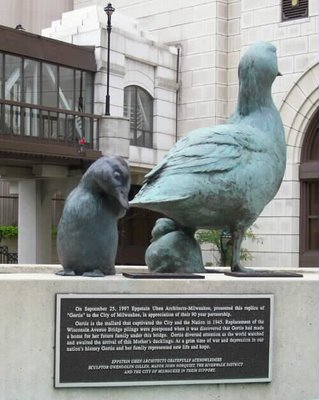
The story behind the story is worth retelling.
In the 1940s, Milwaukee native Nick Georgiady was serving with the U.S. Army Air Forces when he discovered a story from back home in Stars and Stripes.
The star of the story became known as "Gertie the Duck." In the war-weary spring of 1945, Gertie laid her eggs atop a piling on the Milwaukee River in downtown Milwaukee. She became instant news - including on the wire services and in Life magazine - attracting throngs of enchanted and sometimes worried duck-watchers.
Years later, schoolteacher Georgiady became the co-author of a bestselling "Gertie the Duck" book. He created the book with Louis Romano, a buddy from Milwaukee. Romano also served with the Army Air Forces and became a schoolteacher in the Milwaukee area.
"Anything catching the more human side of living was a nice relief," Georgiady later recalled of those war days.
Recalling the construction of the interstate highway system, Barrett said, "I'm glad that the governors in the 1950s did not say 'no' to President Eisenhower because the federal government did not pay for snowplowing."The Republican hopefuls, former Representative Mark Neumann and current Milwaukee county executive Scott Walker, don't want to spend money to run the trains, although they've not ruled out taking the $800 million to upgrade the Milwaukee to Madison segment of the future Chicago to Twin Cities fast line.
To put that $800 million in perspective, the upgrade to 110 mph running between Milwaukee and Chicago (probably K.K. Draw to Mayfair) will take $12 million. Repeal or amend some of the excessive safety regulations and that upgrade is much cheaper. On the other hand, to provide a full interchange between the Tri-State Tollway and Interstate 57 in the southern suburbs of Chicago, a subsidy to the trucking companies, will run $570 million, with relatively little increase in road speeds. The Chicago area received $300 million in stimulus money to improve a number of railroad junctions where freight trains interfere with commuter trains, an expenditure that probably has a much higher benefit-cost ratio.
A number of unexpected events at NIU during February is the reason for the delay, [spokesman Brad] Hoey said.So much for downsizing being a way to boost productivity: there comes a workload that will overburden the most dedicated corps of remaining workers.
The first was finding out the school was receiving a $7.5 million federal grant to create a Regional Extension Center to help doctors throughout the state adopt digital health information records that can be shared quickly and securely. A news conference was held Feb. 17 to announce that.
NIU staff then had to focus on another grant, as it learned last week that the county would be receiving about $13 million in state and federal funds to expand high-speed Internet access in the area to about 60 anchor institutions, including schools, hospitals, libraries, public safety entities and government agencies.
DeKalb County will administer the project, known as the DeKalb Advancement of Technology Authority, or DATA. NIU will design the infrastructure and network, and DeKalb Fiber Optics LLC will maintain the fiber cable and provide services over the infrastructure. NIU staff helped coordinate the Feb. 19 news conference at which that grant was announced.
And on the morning of Feb. 19, the campus had to respond to a shooting outside of the Stevenson North residence hall towers. NIU student Zachary Isaacman has been charged with shooting Brian Mulder, 24, of Marengo in the leg around 3:30 a.m. that morning.
“It put us a little bit behind in coordinating and getting things together so that we can get the report out,” Hoey said of those unexpected events. “It is coming, and it is coming rather quickly.”
The university still is getting the hard copy of the report together and determining a delivery mechanism, Hoey said.
The editorial board of the Northern Star, which, while engaging in Ahab-like pursuit of campus police chief Donald Grady, has done excellent work uncovering family ties in the administration and reporting on the cost of the football positional arms races, disagrees.
The editors are betting on a Friday release. They have asked for a Wednesday release. The Star's last issue before spring break will be published Thursday.Following the Northern Star’s editorial calling for Donald Grady’s removal as NIU Police Chief, the university announced that a three-person review panel would investigate the situation.
For weeks, NIU officials said the panel would conclude around Thanksgiving.
On Nov. 24, 2009 the university announced that the panel had submitted its report.
Pay attention to the date. Nov. 24 was the Tuesday before Thanksgiving.
It was not only the last day before Thanksgiving break, but it also comes at a time when the NIU community is not worried about the goings-on of the university, but how much food they will eat over the
weekend.Then, when NIU announced that Grady would be reinstated, they did so on Dec. 11: the Friday of finals week.
Clearly, NIU has an issue with timing. When it comes to good news, it has no problem telling the whole world.
But when it comes to “bad news,” like releasing important reports or raising tuition, NIU prefers to do it at a time when no one’s paying attention.
Which brings us to this week. On Dec. 11, the university announced that it would be releasing the University Police’s report on the Feb. 14 shootings at the end of February.
28.2.10
Union's shortcomings are the consequence of two decisions. The more recent decision, to provide commercial space above the passenger concourse (at the time it was cash-strapped private passenger train operators, not a cash-strapped quasi-public agency) in an era of declining intercity passenger trains, led to a design in which commuters would rush through the concourse to board their trains. That 1991 redesign provided separate passages for commuters from street level to trackside and a semblance of a waiting area for intercity passengers (although that area is inexplicably chopped up into a public seating area and some train-specific seating areas that are never used.) Those areas, however, are obstacle courses defined by the supporting columns for that commercial space.Today, [Union] station, which serves Metra commuter rail trains as well as Amtrak trains, is (or should be) a civic embarrassment. The traveling public must endure a maze of corridors, packed waiting rooms and the stench of train fumes. The grandly scaled waiting room, with its sky-lit, barrel-vaulted ceiling, is empty most of the time—an ironic state of affairs given the congestion elsewhere in the station. The room’s most effective use these days is as a movie set or a camera-ready backdrop for local politicians, who held a press conference on high-speed rail there Friday.
A 1991 renovation by Chicago architect Lucien Lagrange upgraded ticket counters, along with Amtrak waiting areas and baggage handling systems. But Amtrak, which owns the station through a subsidiary, runs far more short-haul trains now than it did then, so its facilities are overwhelmed. Even Amtrak spokesman Marc Magliari says the situation is unacceptable. And well it should be. How do you get people to take the train instead of the plane if you’re going to treat them with such disrespect?
We have a concourse area through which columns could be placed because of a previous decision, to build the station as a double-stub station, with ten tracks terminating at the north, thirteen tracks terminating at the south, and one through track on the river side of the station. Consequently, there's little capacity for running trains through Chicago, although Amtrak has on occasion offered such service (it has always come a cropper as late-arriving trains from the south disrupt the generally reliable Hiawatha service to Milwaukee.)
Helmut Jahn has offered a proposal to provide a few platforms for the faster trains, in space under the old Post Office that straddles the Eisenhower Expressway and Union Station's south platforms. In that space, there's room for a few run-through trains, and that station is on the other side of the expressway from the southwest corner of the Loop. The current concourse building, which was designed with the Chicago Mercantile Exchange, now has a health club upstairs. Perhaps now is the time to redevelop the concourse area, with the north and south tracks joined for the first time and the passenger facilities above the tracks, the way it's done at Philadelphia's Thirtieth Street Station.
IF IT DIDN'T EXIST, WE'D HAVE TO IMAGINE IT.
27.2.10
26.2.10
And that's with limited food service (a trolley service of soft drinks and bag snacks is offered on a few trains) and timings based on 79 mph train speeds. Glenview to Milwaukee Airport in 35 minutes, and a station at Gurnee with ample parking and a shuttle service to Great America and Gurnee Mills offer yet more upside potential."Nobody really wants to compete with Southwest," [AirTran CEO Bob] Fornaro says. "But the upside is they'll bring a lot of loyal Chicagoans with them. That will raise the profile of Milwaukee among Illinois residents who might not have considered the airport before."
It could also raise the profile of Milwaukee as an alternative airport for greater Chicago, much as Southwest has done for Baltimore to greater Washington, D.C., or Providence to greater Boston, says Kit Mueller, a 36-year-old technology consultant from Chicago.
Mueller, who says he travels up to 30 times a year for a combination of both work and pleasure, is a convert to Milwaukee.
Unlike the northern Illinois residents most Milwaukee airlines seek, Mueller actually lives in The Loop in central Chicago — about 90 miles from Mitchell airport. Still, he says, he prefers Mitchell over O'Hare, saying the ride to Milwaukee on Amtrak's Hiawatha line doesn't take him any longer than Chicago's Blue Line "El" train to O'Hare.
"I've been somewhat the evangelist of late," Mueller says. "Whenever we're talking travel, I'm like, 'Always check Milwaukee,' " he says, though he adds Chicago's downtown Midway is still his airport of choice.
Mueller says some people think he's crazy "at first" when he tells them he prefers Milwaukee.
"But two people have actually come with me" to Mitchell, he says, claiming they warmed to the idea after giving it a chance.
There are days, however, when 94 doesn't go that fast. I suspect, further, that AirTran and Republic (hello, Herman?) won't complain about passengers transferring from the trains. Swift of foot is Hiawatha. With each stride two miles he will measure.Having Mueller's endorsement is fine, but he isn't the target Chicago audience for Mitchell and its airlines.
"While Milwaukee is only 70 miles from O'Hare and 90 miles from downtown Chicago, those aren't the important numbers," says Mitchell director [Barry] Bateman. "For the majority of our customers who live in the high-income, frequent-traveler northern Illinois tier, Milwaukee is only a 45- to 50-minute drive on the interstate — the same amount of time it takes them to drive to O'Hare."
Students are exploring their opportunities to substitute.Student Trustee Matt Venaas spoke in support of the housing increase.
“In these troubled economic times, I am always concerned about raising student costs,” Venaas said. “However, with [Residence Hall Association] so strongly behind the move, I have to support the goal of the increase.”
Venaas added that the increase will help cover the cost of an unfunded state mandate that requires sprinklers in all residence halls by 2013.
Jonathan Kite, president of the Residence Hall Association, explained more about the increase.
“We are in direct competition with apartments,” he said. “While we may not be able to compete in price, we certainly look to offer amenities that will attract residents. Certain fees are needed to help residents live in comfortable facilities.”
Some Wisconsin friends joked about not being able to afford the dorms, some years ago. I'm not sure that was strictly true, considering transportation and food. But in those years, university housing was not obligated to be self-supporting in the same way.Megan Peterson, sophomore communicative disorders major, said a fee increase will cause her to reconsider living in a residence hall.
“I probably will not live in the dorms,” Peterson said. “It’s not cheaper to live in [the] dorms.”
Michael Stang, executive director of Housing and Dining, is worried about the impact of the fee increase.
“Housing and Dining is always concerned about the impact that fee increases have on a student’s willingness or ability to remain with us in the residence halls,” Stang said.
Stang said that Housing and Dining addresses fee increases without compromising living in the residence halls.
My post title invokes a corollary to a Vietnam-era policy: old enough for the draft, old enough for a draft. Prosit!
RUNNING EXTRA. Give Phil Miller a Molson Golden.
25.2.10
Mr Mulder continues to recover at home.Brian Mulder, freshman business administration major, said that, after a party Thursday night, he and some friends returned to his room in Stevenson by around 1 a.m.
Mulder said around 3:20 a.m., he and friend freshman Kevin Anderson stepped outside for a cigarette. At this time, the two saw a young woman walking toward Stevenson, allegedly followed by Zach Isaacman, 22, of Buffalo Grove.
“It looked like she was nervous or something,” Mulder said.
The young woman entered Stevenson and closed the door behind her, effectively locking Isaacman out.
Mulder said Isaacman approached Stevenson and motioned to be let in.
Mulder, president of the Stevenson North Hall Council, asked Isaacman if he lived in Stevenson, and Isaacman revealed he lived on Greek Row.
Mulder told Isaacman to return home, as there “was nothing there for him” at Stevenson.