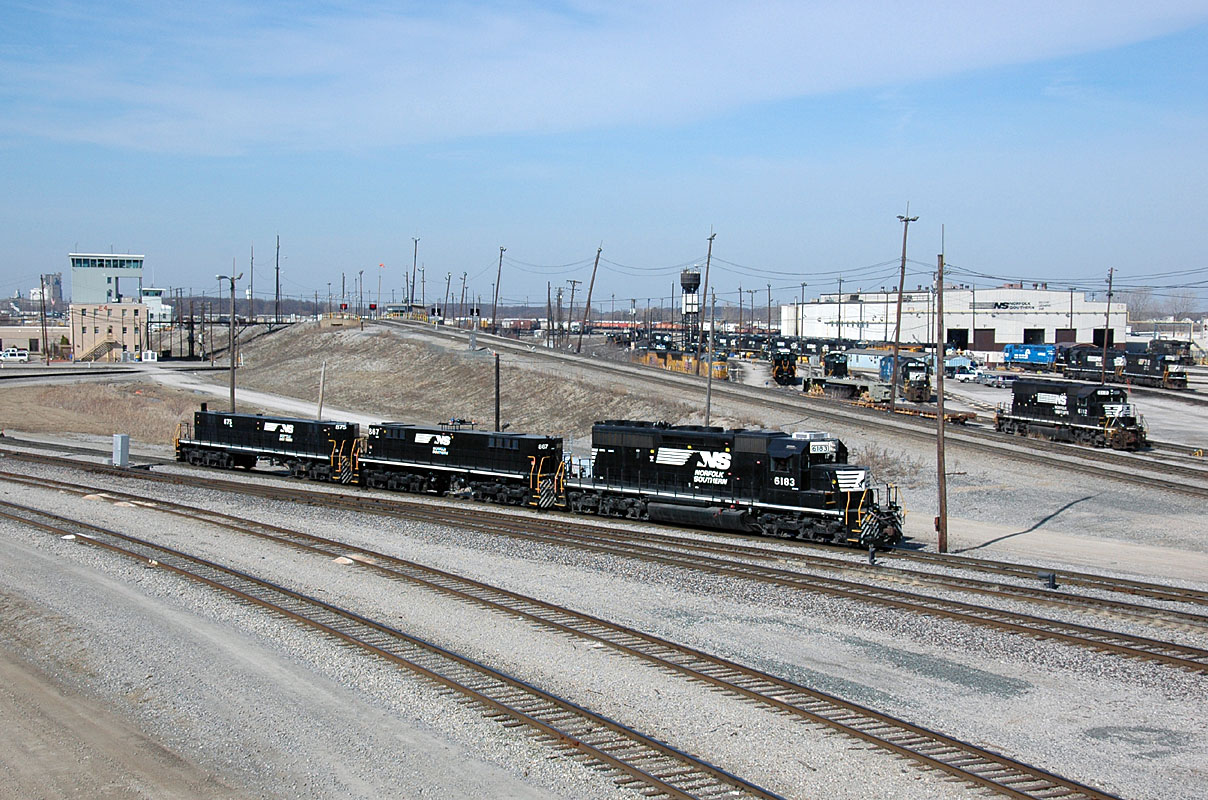
You’re at trackside, eyeing an approaching CSX train. The roar of working diesels increases, but it’s oddly distant, given that the engines are so close. The lead unit grinds by, eerily silent but for the humming of its traction motors, followed by two others making all the familiar diesel sounds. What’s going on? The first unit was not a locomotive at all, but a slug.The "cow and calf" locution originated with end-cab switchers, where, to reduce the expense of the slugs, the builder left the cab off. That configuration also offered better visibility over the hood of the calf. Some railroads with heavy yard switching duties slaved two calves to one switcher, and rural-minded rails took to referring to the combination as a "herd." Norfolk Southern use a thundering herd in Bellevue.
A slug is a vehicle used for moving trains, having traction motors and added weight (or “ballast”) but no prime mover or generator. The electric current for its motors is provided by a “mother” unit, a standard locomotive fitted with cable connections to feed current to the slug.
Without a power source of its own, a slug cannot move by itself and is not a locomotive in the strictest sense of the word.
Slugs enable a more complete use of a locomotive’s power output than would otherwise be possible. A locomotive has more power than it can use for tractive effort at low speeds — at a certain point, the application of more power only makes the wheels slip. By spreading the power over the additional wheels of a slug, greater tractive effort can be had.
Slugs are most effective at low speeds. Since their introduction in the 1940s they have found wide use in hump yards, where entire trains must be moved at a walking pace during classification.

Brian Schmidt photograph retrieved from Trains.
Locomotive manufacturers also toyed with more elegant names for the slug.
Most slugs are four-motor units, although at least three railroads have operated six-motor slugs. The additional demands of the extra two traction motors require a larger mother unit than would be needed for a four-motor slug.We could do the rural metaphors in the German style and refer to that slug as the milch cow, but that's not where we're going today.
The name “slug” is derived from the early use of such units in very slow-speed yard work. “Drone,” a Santa Fe term, also is a descriptive borrowing from the animal kingdom. The more marketable “MATE” (motors for added tractive effort) was GE’s handle for its built-new slugs of the 1970s. In the same era, “TEBU” (tractive effort booster unit) was Morrison Knudsen’s term for its slug design.
The advent of high-horsepower diesels led to the development of slugs for road use in 1970. While yard slugs are useful up to about 12 mph, road slugs cut out at 30-35 mph, when the mother units need all their power for themselves. Refinements to the basic slug concept include fuel tanks connected to the mother unit’s tank (making the slug a fuel tender), dynamic brakes, and control cabs.
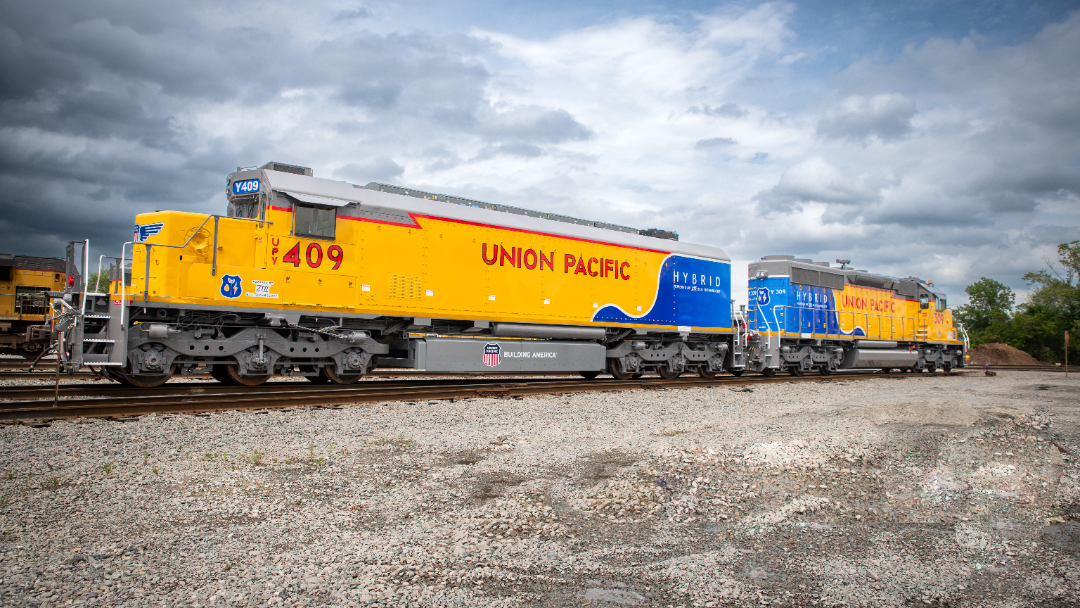
Rather, we're going to note that as the fuel tanks empty, the additional tractive effort coming from the slug is reduced (and they're excess weight along for the ride once the train gets a roll on things.) Now, if you put batteries in that slug, you could keep the motors turning as the train picks up speed, plus the dynamic braking could put juice back in the batteries. That's precisely what Union Pacific are up to. "The first of six cutting-edge hybrid battery-electric locomotives designed and built by Union Pacific Railroad and its partner ZTR, a leading rail technology company, will undergo extensive testing next month in a Union Pacific facility and rail yard."

Unattributed photograph retrieved from Union Pacific.
Union Pacific have high hopes for these locomotives, which might be able to be combined into larger herds.
The hybrid locomotives will operate as "mother-slug" units, with one locomotive running on diesel and an accessory or “slug” unit providing battery power. The batteries will have multiple charging options, including wayside charging and onboard self-charging capabilities. The engineless slug design increases the number of traction motors available, enhancing the locomotive's pulling and braking power for yard switching work, where trains are built.The one thing they haven't mentioned is being able to do that wayside charging whilst underway.
Depending on mode of operation, these hybrid switchers are expected to consume as much as 80% less fuel – reducing associated greenhouse gas and criteria pollutants. Additional benefits include reduced maintenance expense and noise compared to traditional diesel units.
Union Pacific has been exploring new technology and innovative approaches to meet its sustainability goals. These include testing and increasing the use of biofuels, using technology to enhance locomotive fuel efficiency, and working with vendors and customers to identify new sustainable synergies.




No comments:
Post a Comment