If we consider running powered dollies in trains, we might have the advantage of being able to use smaller batteries. I'm not persuaded that Parallel's dollies have this eight hundred kilometer (500 mile) range anyway. But if you're hauling them at the end of an intermodal train with diesels distributed throughout that train, you don't require that sort of range. On the other hand, you have to peddle those cars to those trackside consignees.A few years ago, U. S. freight railroads scaled back their retail intermodal and called it "productivity improvements." Despite all the efforts of the Jarrett regency to kill long-haul trucking, the railroads continue to leave that money on the table. Shippers are not happy.
Again, the interurbans were working on that long ago. Because the steam railroads wouldn't interchange with them anyway, the interurbans and rapid transit companies invented all sorts of couplers that made the electrical and brake connections at the same time they joined the cars. The Germans have been working on improving those couplers and adapting them to freight cars. At the moment, their focus is on being able to assemble cars into trains more quickly, without all the connecting of links and airhoses that the European hook couplers involve. But if you can write an algorithm to couple the cars, can it be that hard to write an algorithm to uncouple them? "With fully-automatic couplers that make or unmake brake and communication line connections concurrently with the addition or deletion of cars, wouldn't the simpler solution be to do adds and drops on the fly? On the other hand, particularly with rapid-transit equipment, a drop or add can be made in a stop of about a minute." That is, we run the intermodal train in the fashion of the British railways that "slipped" coaches off the hind end of their express trains, in order to provide country-bound Londoners access to towns such as Reading or Westbury whilst not stopping short of Exeter or Plymouth.
Then there's the challenge of getting the retail container to the consignee's siding.
More regulatory oversight is needed to keep rail volumes from shifting to trucks and limiting the railroads’ growth potential, rail customers have told the Surface Transportation Board.Read through that article, dear reader, and despair. If there is more regulation, of whom will it be, and for whose benefit? How much evidence must I offer that rent-seeking is real?
Their testimony, along with that of railroads, unions, industry consultants and others, has been filed with STB ahead of a two-day hearing at the agency next week over concerns about the railroads’ ability to continue to grow their business.
“The deteriorating rail service members have experienced for decades makes it exceedingly difficult for shippers to do business with railroads as they are at risk of losing customers if they cannot provide them with reliable shipments,” said Richard Erstad, vice president and general counsel for chemical manufacturer Hawkins Inc., in comments filed on behalf of the Alliance for Chemical Distribution. “This is even more impactful for small rail customers who can have their entire operation disrupted if just one car is severely delayed.”
Such factors, Erstad stated, contribute to “shippers being reluctant to utilize freight rail and more willing to use trucking because of its far superior reliability despite its worse safety record.”
The Private Railcar Food and Beverage Association (PRFBA), whose members include major rail shippers such as Frito-Lay, a division of PepsiCo, Kraft Heinz, and Molson Coors, contends that the Class I railroads’ use of Precision Scheduled Railroading eliminated lanes, which in turn reduced rail carriers’ available capacity (and volume along with it), while reducing service to the association’s members.
The [Association of American Railroads] also cited an uneven modal playing field within the U.S. Department of Transportation, which is looking to develop and promote automation in the trucking industry while staving off such policies in the rail sector.And a further mechanical fix, instead of battery powered dollies, why not a battery powered well car?
“Truck competition could intensify further if federal truck size and weight limits were relaxed, allowing motor carriers to increase capacity without significant additional costs,” the AAR stated. “This could make all-highway transportation relatively cheaper, potentially challenging railroads further.”
But shippers told the STB that more regulatory oversight will be needed to keep railroad market power in check, which they say will lead ultimately to more freight moving over the rails.
“We can do this through the elimination of exempt commodities and greater regulation of contract moves, and by addressing the true meaning of the railroads’ common carrier obligations,” PRFBA stated.
“If the railroads could work with shippers, by providing good service, user-friendly alternatives, and competitive pricing, this nation’s rail networks would immediately see increased volumes.”
Intramotev, the startup company that converts conventional freight cars to battery-electric, self-propelled vehicles, has debuted an autonomous double-stack car.That sure sounds like a slip coach, if without the guard working the brake. Current operating rules governing the use of braking systems and the spacing of trains under positive train control might prevent these maneuvers.
The company showed off the TugVolt well car in a video released this week. The 20-year-old former TTX car carries two 40-foot international containers as it moves independently along trackage in Intramotev’s facility. It’s also shown pulling a box car.
Intramotev currently has self-propelled hopper cars in service on a Pennsylvania mining railroad that is not connected to the national rail network, and thus is beyond the reach of Federal Railroad Administration regulations. Absent a waiver from existing regulations, the equipment cannot currently operate on the common carrier rail network. The goal of operating in revenue service on mining railroads is to prove the technology before making the leap to short lines and Class I railroads.
Intramotev’s technology is designed to be compatible with conventional rail equipment and can be applied to any type of freight car. TugVolts can operate within a conventional train. Or they can operate autonomously or by remote control.
The long-term vision: Have TugVolt well cars included in a conventional long intermodal train from, say, Los Angeles to Chicago. Upon arrival in Chicago, a block of TugVolt cars could then run independently to a common destination in a smaller market or even to an individual customer location.
The latter-day slip coach is also an idea in the works, which provoked me to observe, "With fully-automatic couplers that make or unmake brake and communication line connections concurrently with the addition or deletion of cars, wouldn't the simpler solution be to do adds and drops on the fly? On the other hand, particularly with rapid-transit equipment, a drop or add can be made in a stop of about a minute." Lo, and here it is. "American Solar Rail aims to eliminate station stops with self-propelled car that would deliver passengers to trains on the fly."
Imagine if you could launch faster passenger train service on a dedicated right of way for half the cost of traditional high speed rail — or speed up conventional service by 30% while still running at 79 mph.I can imagine the brake-inspection and signalling regulators tearing their hair out over this concept.
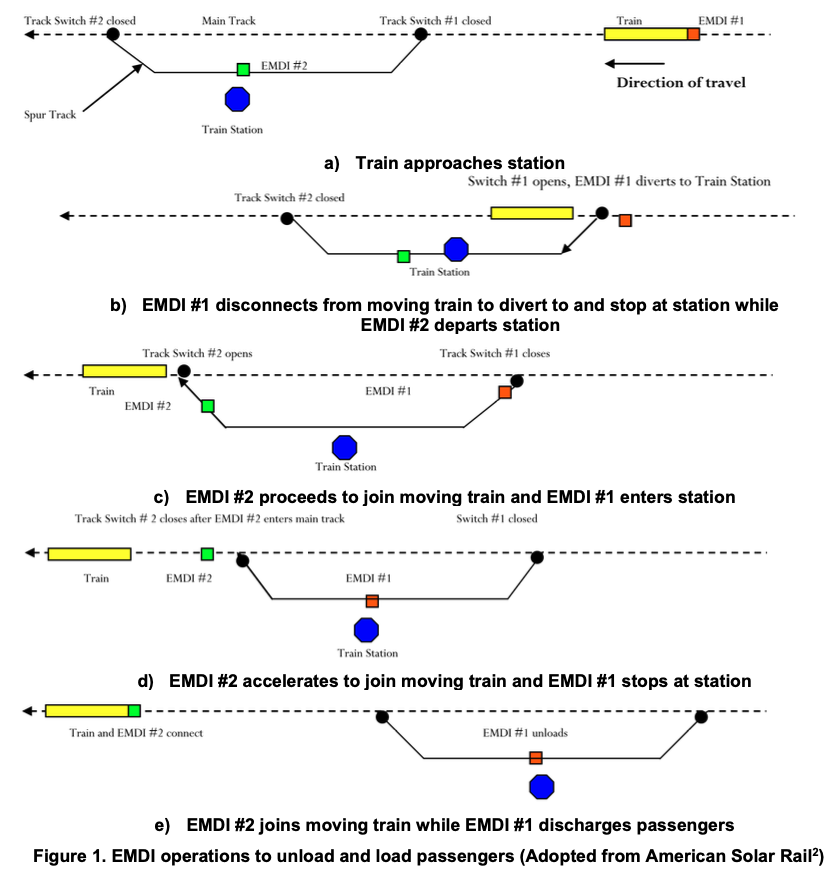
It’s possible, a startup company claims, to slash transit times by eliminating the station stops that pull down average train speeds. American Solar Rail proposes building autonomous, self-propelled, battery-electric passenger cars that would function as rolling stations.
The EMDI cars would pick up passengers at conventional stations, then deliver them to the passenger train on the fly. Passengers who want to get off at the next station would then board the EMDI, which would uncouple from the train and make the station stop, where the process would repeat itself.
A passenger route using the EMDI system and a top speed of 125 mph could achieve similar transit times as a true high speed line with maximum speeds of 180 to 220 mph, ASR founder Robert Green says.

Shuttle slip operation diagram retrieved from Trains.
Under British slip-coach procedures, the through train would slow a bit to allow slack in the coupling, then accelerate to get ahead of the slip coaches enough for the signalman to get the points and signals. To that we're adding the joining coach, which has to be away from the platform before the slipped coach arrives, far enough behind the through train for the points and signals to be properly cleared, and then it's accelerating to catch the through train, and once this steeplechase is done, passengers have to be chivvied into or out of the through cars before the evolution for the next station commences.
ASR has received a patent for the EMID and commissioned a study of the concept at MxV Rail in Pueblo, Colo. Much of the necessary technology exists in some form, MxV Rail noted, but has yet to be applied to railroads.Neither Amtrak nor the Rail Passengers Association responded to Trains's request for comments.
“The EMDI concept does not present any barrier to implementation that cannot be surmounted. There are, however, many technical and regulatory challenges associated with the EMDI concept that would have to be solved to achieve a functional system,” according to MxV Rail’s October 2023 report.
Chief among them: Safety issues related to the EMDI catching and coupling with a passenger train.
“Current train control concepts work on the principle of fail-safe train operation and train spacing, which require automatically stopping the train in the event of any train control failure. The spacing between consecutive trains is set by signal separation or the braking distance of the train. The EMDI concept shifts this paradigm,” MxV Rail notes. “The concept will need to meet the current fail-safe standards for train operations and be capable of fail-safe encroachment of the EMDI vehicle to less than braking distance from the train, particularly during coupling. This will be the key challenge regarding the fulfillment of the regulatory requirements for fail-safe train operations.”
MxV Rail recommended that ASR create a technical advisory board to address technical and regulatory issues.
Apparently British railways tried adding the slip coaches on the fly, using a propelling station pilot called on to a train running at low speed, and quickly thought better of it.
If only trains, freight or passenger, didn't have to stop so often.




2 comments:
There was an experiment in the 1990s on theTex-Mex with air hoses that would connect and disconnect themselves. While it was a success it was deemed too expensive to retrofit 500K+ freight cars so it died.
So it always goes, you either have captive cars in the fashion of rapid transit lines with those Tomlinsons or orphan cars such as the Danish Flexliners that can't run in other sorts of trains.
On the other hand, once the incentives are right, the retrofitting might follow.
Post a Comment