Simply put, the Geometry Problem is that cars are much bigger than humans. They have quite different spatial requirements, both in motion and at rest, than any other mode of transportation. This is neither good nor bad, it’s just a physical constraint.What follows is an instructive exposition of the evolution of cities.
But these physical differences mean that when we optimize places for cars, they end up not working well (or working at all) for any other mode. They become car-only places.
Like all design decisions, the decision to make car-only places has tradeoffs. The key tradeoff here is that car-only design requires a large amount of space to work well, and that conflicts with and stifles the natural economic growth of cities. Let’s unpack this.
[T]o optimize for the car, we need to spread everything out. Speaking purely in terms of transportation design, this is fine. But, unfortunately, transportation design isn’t the only thing we care about.Sometimes those near-city-center houses on small lots give way to apartment blocks. I quibble with his use of the term "efficiently" as it appears to be the restricted sense of using fewer materials, rather than the identification and harvesting of gains from trade. One could build the apartment blocks farther from the central business district, to take advantage of the bid-rent curve, but that might not be the most efficient way to trade land costs for transportation costs. Those houses on bigger lots? Back in the day, that land was less valuable for retailers or whatever industries located along the railroad tracks, which might make buying a larger parcel suitable for a house with a stable the locationally efficient use of the land. (And I haven't gotten into yet another complication, which is that there are many dimensions along which houses can vary, leading to the equilibrium householder being indifferent among the bundle of rooms, the lot size, travel time, and proximity to noxious facilities at various places in town.)
Economic activity wants to agglomerate. This is how and why cities exist - they are convergence points of economic value that attract people.
Cities naturally grow as economic activity increases. Space at the convergence points becomes more and more valuable. To keep the economy growing we use the space more and more efficiently to keep it affordable. At first this means we put buildings closer together and cover more of each lot. Then we start to build taller.
In historic small towns you can still see how this used to work. Right at the city center there are a few tall buildings. Then there’s a Main Street with small buildings side by side. Just off the Main Street you have houses on small lots. As you spread out the lots get bigger. That’s the natural economic shape of a city.
Trigger warning: this idea of space being used efficiently is called “density.” Healthy cities gradually spread out around the edges as they also gradually grow denser in the center.
We can hold all those quibbles in abeyance, and yet, there are plenty of opportunities for research.
In rural or exurban areas where space is not valuable, trading space efficiency for time efficiency is perfectly logical. In fact, it’s a great idea! Without cars it’s difficult to get economic activity going in an undifferentiated rural area, but with cars we can get agglomeration benefits over a much larger area, so car travel makes it much easier for rural areas to grow compared to the pre-car world.Put more precisely, the automobile convexifies space and time in such a way that the second-, third-, and lower-order central places are no longer tied to the waterways or the railroad lines the way those late-nineteenth-century towns were. At the same time, though, the opening up of those hinterlands affects the shape of the rent gradient, and while it is possible to build parking decks in cities, the parking decks and the expressways and arterial streets that connect them to the hinterlands clog. Need I mention that Mr Burleson has not mentioned treating the expressways and parking spaces as productive assets and pricing them accordingly? (Paul Krugman has thoughts.)
Economic growth makes space more valuable, and as space becomes more valuable it’s no longer cost effective to allocate all of it to cars. At a certain point the growth of the city makes the car system degrade. We start having traffic jams. Parking lots get crowded. Growth starts to make quality of life worse, so people naturally become skeptical of growth, and then start to oppose it entirely.
The fact that cities want to gradually densify over time becomes a big problem for a car-only transportation system.
Perhaps it is the absence of those prices, rather than the Geometry Problem, that hampers mobility.

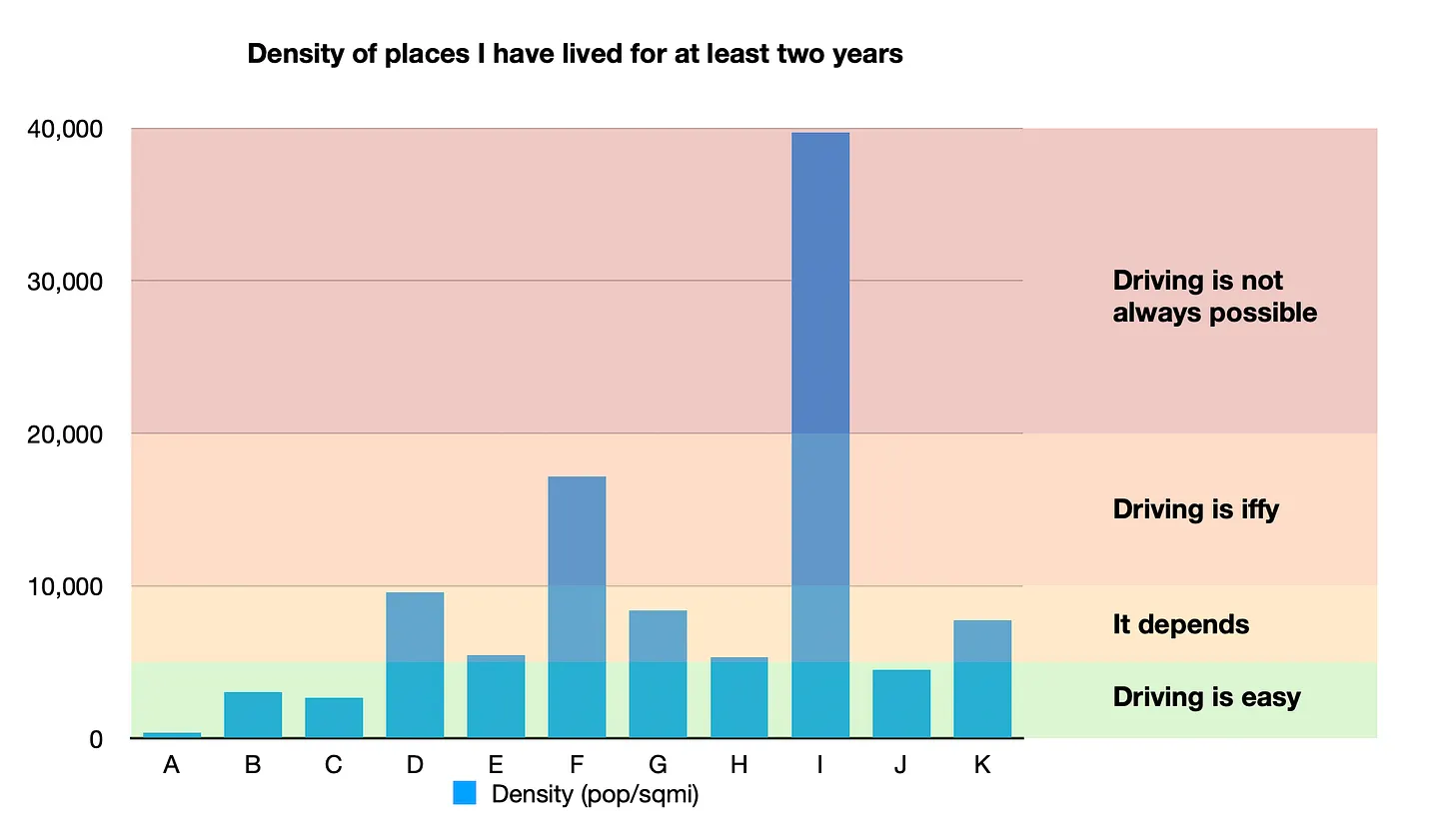
Density and driving experience, as observed by Andrew Burleson.
There's a further complication: driving is easiest in sparsely settled areas, although the convexification of space and time often means the end of the local grain elevators and feed mills and the replacement of the Main Street merchants by the Wal-Mart super center and the ancillary businesses in adjacent strip malls. Local driving is easy: getting to those commercial centers or to an employer in a central business district gets you into those "it depends" and "iffy" situations in the third- and fourth-order central places, which is to say, the towns that used to have an accommodation train or perhaps were located along an interurban.
So growth is good until a certain density, and then growth becomes more and more painful as the transportation system that got us to this point degrades in quality. To make matters worse, transportation planners generally agree that transit doesn’t work well until we get above 10k people per square mile. So there’s this gap we can’t cross, the Missing Middle of Transportation.That "middle" might be an artifact of zoning and parking mandates pretending that the roads and parking spaces are free: thus where the stroads are not too inconvenient, people will drive, but where the bus might be an option, people fret about finding parking spaces.
I submit, dear reader, that treating the roads and parking spaces as free contributes to our current pass.
We started by noticing why cars can be awesome. America saw that potential, and after WW2 went “car-only” as our transportation model, trading off spacial efficiency for time efficiency.That "Marchetti constant?" "From ancient Rome to modern Atlanta, the shape of cities has been defined by the technologies that allow commuters to get to work in about 30 minutes."
At the time this made a lot of sense. Every city had a vast area of uneconomic land around it, but this new technology greatly expanded the Marchetti constant, opening all this land for growth.
What was I saying about convexifying space and time? From downtown Waukesha to the business district of Milwaukee, a 30 minute ride on the interurban.

That's fine, if you're close to the Rapid Transit line and work near the Public Service Building. If you lived in Franklin and worked at A. C. Spark Plug or Allen-Bradley, not so much.
No wonder turning the section roads into stroads and building urban expressways appealed.
Before the Great Depression all our cities had to fit in a much smaller area (roughly that green outline), but after the war they could expand much, much further (to the black outline).I'm skeptical of that chain of causation, as it appears to conflate rent gradients and the emergence of intermediate order central places. I don't hear a lot about edge cities any more, and yet might Galveston exist as a second-order central place on the coast, while Waukesha is changing from low-order to higher-order central place outside Milwaukee. And I repeat: might those "traffic and parking problems" be road socialism presenting itself the way any other socialism does?
With that much room, the space vs time tradeoff made sense to most people.
The new suburban areas we built started out near zero people per square mile and grew from there. For a while everything was great, and then growth started making quality of life worse (ie we got traffic and parking problems), such that further growth in the neighborhood was undesirable. But that was okay, because there was still plenty of convenient, undeveloped land around to expand into.
It’s obvious in hindsight that this couldn’t go on forever, but at the same time, this pattern of suburban development held up for 50-70 years. We can understand why the mid-century planners weren’t too worried about this.
But, two generations later, most of our metro areas are straining against the Marchetti constant. Regions can partially adapt by building major new economic hubs far off from the original center, but they don’t get the full economic benefit as you can no longer practically commute across the entire region. For example, in a metro area like Houston there’s continuous development stretching 100 miles from Conroe to Galveston, but Conroe and Galveston are realistically not part of the same economy. They don’t get the full agglomeration effect.
So our most important economic centers end up walled-in by a ring of suburbs that stretches as far as people can commute and can’t easily add more people without degrading their quality of life. The result is intense political opposition to densification, which leads to excessive land rent, which manifests as prohibitively expensive housing.
Lots of potential research questions.




No comments:
Post a Comment