I WISH PEOPLE WOULD STUDY RECENT HISTORY. Former Minnesota senator, Democratic presidential aspirant, and independent presidential candidate Eugene McCarthy died today. The 7 pm radio news broadcast provided a brief biography, mentioning that Senator McCarthy's protest campaign contributed to President Lyndon Johnson opting not to stand for re-nomination or re-election, with Mr Johnson's vice-president, Hubert Humphrey, obtaining the Democratic nomination and Richard Nixon winning "handily."
Erm, handily? Look at the map here. (Note that the major parties swap colors according to some convoluted formula. The blue states went for Nixon. The red states went for Humphrey. Then look at the old Confederacy. There are some maroon states. Those went for Alabama governor George Wallace, who ran on a right-populist platform that included an appeal to Northern white ethnics whose schools were the object of bussing to end de facto segregation.)
Neither the Wikipedia entry nor this site will tell you that the major networks (the three legacies of clear channel frequency allocations in the 1920s and VHF channel allocations in the 1940s) did not call California, and the election, for Richard Nixon until breakfast time on Wednesday morning.
10.12.05


A PUBLIC SERVICE ANNOUNCEMENT. Riding Roller Coasters May Actually Be 'Death-defying' For People With Heart Disease. Those advisories at the loading platform? Respect them.
The news story ran in the DeKalb Midweek, which at the start of roller coaster season interviewed a local expert on pricing and riding. (That expert has fallen a bit short of his goal of completing the research on the problem.)
On the other hand, if you don't have a heart condition, the best thing to do is just relax.The thrill of a roller coaster ride with its climbs, loops and dives can speed up the heart, sparking off an irregular heartbeat that could put individuals with heart disease at risk of having a cardiovascular event, according to new research reported at the American Heart Association's Scientific Sessions 2005.
"Individuals who have suffered a heart attack, have heart disease or irregular heart rhythms should not ride a roller coaster," said Jurgen Kuschyk, M.D., a cardiologist at University Hospital in Mannheim, Germany. "The rising heart rate in riders with pre-existing heart disease could result in heart attack, irregular heart rhythms and possibly sudden cardiac death."
Before the study, the researchers thought the increased G-forces occurring when riders suddenly plummeted towards the ground would increase stress on the body and increase heart rate. "But the increased G-force didn't have too much of an effect on the heart rate," Kuschyk said. "The heart rate appeared to rise more from psychological stress and fear at the beginning as riders were climbing or reaching the top. This was surprising. Their heartbeat increased twice or triple the amount in the first part of the ride."I've noticed the same thing, the apprehension upon being winched up the lift worse than the experience of the ride. Best thing to do is just look around, relax, and raise your hands as the train drops off the lift hill.
The news story ran in the DeKalb Midweek, which at the start of roller coaster season interviewed a local expert on pricing and riding. (That expert has fallen a bit short of his goal of completing the research on the problem.)
THAT'S WHY WE SAY READ AND UNDERSTAND. Integrity. Most frequently looked up at Merriam-Webster's online dictionary service.
The noun, formally defined as a "firm adherence to a code" and "incorruptibility," has always been a popular one on the Springfield-based company's Web site, said Merriam-Webster president John Morse. But this year, the true meaning of integrity seemed to be of extraordinary concern. About 200,000 people sought its definition online.Get out your candles and beads.
"I think the American people have isolated a very important issue for our society to be dealing with," Morse said. "The entire list gives us an interesting window that opens up into what people are thinking about in their lives."
Ralph Whitehead, a journalism professor at the University of Massachusetts, said it may indicate the continuing discussion about American values and morality, or perhaps that integrity itself is becoming scarce so its definition is unfamiliar.
"You hope integrity is a word everyone understands," he said.
A REASON TO SAY "HUMBUG." I find Lexus's faux-lounge-Christmas-piano-music particularly annoying, and it's on at least twice an hour on any cable channel with delusions of serving an audience with disposable income. (At least I have not ... yet ... heard it on a ring tone!)
Although this comment to this post takes rather a cynical a view of the motives one might have for buying such a Christmas present, I must confess to imagining a voice-over to the commercial with the guy looking at the bling and then noticing the Lexus cute-ute outside the jewelry store. Don't know whether I want him mulling "will she forgive me for boinking the nanny?" or "this should keep her pacified if she finds out."
Although this comment to this post takes rather a cynical a view of the motives one might have for buying such a Christmas present, I must confess to imagining a voice-over to the commercial with the guy looking at the bling and then noticing the Lexus cute-ute outside the jewelry store. Don't know whether I want him mulling "will she forgive me for boinking the nanny?" or "this should keep her pacified if she finds out."
9.12.05
WE GET FAN MAIL. Grades are in, and Blackboard sure beats those pre-addressed postcards for getting the information to anxious students (although it's harder to score brownie points scribbling a little "Flight into Egypt" on the postcard for Renaissance to Modern Art this way.)
One student, wondering when I'd crawl out of my cave and post the grades, made this observation.
Course evaluations will soon be available for my inspection. We get panned too ...
One student, wondering when I'd crawl out of my cave and post the grades, made this observation.
I liked the class a lot, it was one of those rare classes that actually makes you work for your grade!My response gives thanks, and recommends the relevant advisor and department chairman be informed of that preference. Now that time permits (yeah, right) I intend to do a little survey of the academic mission, as it manifests itself in various locations. For the moment, think about "retention." At the mid-majors (Northern Illinois is a research comprehensive, and we're unlikely to hear any talk of going to Division II in football anytime soon) "retention" might involve keeping first-generation and non-traditional students focused on getting that leg up the public universities provide, or it might mean making it worthwhile for motivated students of any kind from trying their luck at Northwestern or Illinois. Those goals are NOT mutually exclusive.
Course evaluations will soon be available for my inspection. We get panned too ...
8.12.05
CARNIVAL CALL. The 54(8)th edition of Carnival of Education mimics a bull session in the common room.
IN LIEU OF MANHATTAN TRANSFER. Doctor Silence discovers there's an easier way than leaving the Pennsylvania Station at a quarter to four.
I've known for a while that there is another option. You can take the train PAST Secaucus to HOBOKEN. There is a train called the PATH train that runs from Hoboken terminal right to 14th street. It always seemed like it would be more trouble, and probably more expensive, since I have no idea how much the additional PATH ticket costs. Well, I recently learned that not only is the PATH ticket just $2... same as the subway I take down from Penn each day, but today I found out that a monthly ticket to Hoboken is FIFTY DOLLARS CHEAPER A MONTH than the ticket I've been buying to Penn Station.Congestion surcharges at Penn? The cheaper trip also has to be less burdensome, as his original routing, unless he's on one of the new Lackawanna Electric service trains going directly to Penn Station, involves a change to the Pennsy at Secaucus and another change to the subway at Penn Station. Other Lackawanna Electric trains run directly to Hoboken, where there has been a change to the Tubes for years.
COUNTING TO TEN. Just finished assigining the scores on the principles exam. The most challenging part is consistently grading the analytic problems (draw some supply and demand curves, then shift one as required by the information given) worked by people who make the most ingenious mistakes.
Make what you will of the fact that the short-answer question most frequently skipped was the one on elasticity. I'm not sure what it tells me that nobody gave the C-student answer, "it's different from the one in class where you ripped the school paper for griping about oil company profits without thinking about the elasticity being less than one ..." The brakes question came in second.
Make what you will of the fact that the short-answer question most frequently skipped was the one on elasticity. I'm not sure what it tells me that nobody gave the C-student answer, "it's different from the one in class where you ripped the school paper for griping about oil company profits without thinking about the elasticity being less than one ..." The brakes question came in second.
7.12.05
FINDING THE RIGHT MIX OF IMPROVEMENTS. I recently picked up an anthology combining Adrian Vaughan's Signalman's Morning and Signalman's Twilight, two memoirs of a career keeping the freights out of the way of the expresses on the former Great Western. No review, as I had read these separately several years ago. Some observations on a second reading come to mind. Mr Vaughan's recollections place the books solidly in the class of train-enthusiast writing that ends with some change the author perceives as "everything turned to s***." (In Midwestern train enthusiast circles, if you hear "E-T-T-S," with each letter vocalized, do not assume the speakers are collecting employee timetables. It's likely generalized carping about the passing of the pre-Amtrak, pre-merger carriers.)
In Mr Vaughan's case, ETTS follows the efforts of the Western Region to replace the steam locomotives with German-inspired diesel-hydraulics and the manual block signalling with what they call "panel signal boxes" and we understand as centralized traffic control. The Western Region had troubles with both transitions. The diesels failed with disturbing regularity, and trains sometimes covered great distances with defects.
What was missing from British Rail? General Motors and Motorola come to mind. Nobody would ever mistake a 1750 hp diesel-hydraulic "Hymek" for a GP-9, and the on-train radios permitted crews of opposing trains or observers at the remaining open offices to alert the crews to troubles directly, none of this seven-bells-to-the-next-signalman to put signals at STOP (Danger, if you will) and advising the crew to walk the train.
Today, the supervision of trains is entrusted even more to remote control. A passenger on the Hiawatha was surprised to learn from me about the talking defect detectors that advise the crew of the condition of their train, no more hoping for a sharp eye at Sturtevant!
QUOTE OF THE DAY. The dean at Anonymous Community reflects on the current business model.
I’ve long thought that the way academia treats its adjuncts is immoral. ... A structure that makes sense for dealing with the retired professional who wants to teach the occasional class as a hobby has taken over half of academia.What is going on in the other half is not always pretty, either.
CARNIVAL CALL. The Carnival of the Capitalists calls at Techronization. (Via Voluntary Xchange, who recommends some posts.)
6.12.05
YOU CAN'T FIND THOSE HIDDEN MEANINGS ON THE TRACKS OF IRON HIGHWAY. Definitely term paper season, somebody wants "analysis hiawatha song." Heh. Somebody help me out with a reference to "lazy Kwasind" that fits the meter.
TELL US WHAT YOU REALLY THINK. Via Koru's Daughter, an illustration of the Beltway maxim that a "gaffe" is someone inadvertently telling the truth?
I have a college friend with a son at Richmond, perhaps there is some inside information I can scare up. The president's site declines to comment, and a full text of the speech is not available from there.
One wonders, though, if a separating equilibrium is emerging.
Mush-heads of all countries, unite!During a "state of the university" speech in October at the private liberal arts college, [University of Richmond president] William E. Cooper discussed the school's efforts to become more academically competitive by attracting more talented students.
"The entering quality of our student body needs to be much higher if we are going to transform bright minds into great achievers instead of transforming mush into mush, and I mean it," he said.
He later apologized for his remarks and said they were misinterpreted.
I have a college friend with a son at Richmond, perhaps there is some inside information I can scare up. The president's site declines to comment, and a full text of the speech is not available from there.
One wonders, though, if a separating equilibrium is emerging.
Before coming to Richmond, Cooper was Georgetown University's executive vice president and dean of faculty at Tulane University. He started at Richmond in 1998 with a goal of boosting its national profile, and to that end Richmond has undertaken a $200 million fundraising campaign.Cooper angered some students when the university raised tuition 31 percent this fall to nearly $35,000, among the nation's highest, despite a $1.1 billion endowment.Might Richmond's strategy be to price the hoi polloi out, in order to sell the exclusive image and brand name capital of a Harvard, access be hanged?
5.12.05
PICK YOUR POISON. Suppose you encountered these five questions on an introductory price theory exam. Which one would you skip? Credit for your explanation.
- Blackberries grow alongside country roads in Iowa. Drivers stop and gather them without hindrance from the police or local residents. Are those wild blackberries free goods or scarce goods? Explain.
- An acre of land in California produces more tobacco than an acre of land in Connecticut. Tobacco production flourishes where the climate is warm, and Connecticut has a chilly climate and rocky soil poorly suited to farming. But Connecticut farmers grow tobacco, and California farmers do not. Explain why.
- "People drive faster because they have good brakes." Use economics to explain why.
- "The expression ‘to incur a cost’ is equivalent to saying that one has committed acts that sacrifice an opportunity." Do you agree? Disagree? Explain.
- Suppose the price elasticity of demand for electricity is 1.3. Will the higher electricity prices Commonwealth Edison has been asking for raise their revenues? Why or why not?
DOES ANYBODY REALLY KNOW WHAT TIME IT IS? Final examination in introductory price theory this morning. Big room, 74 students eager to give it a shot. The Standard Time Recorder analog clock (the kind we used to refer to as "slaved" to a "master") in the front of the room is telling us it's 4.27. Central Standard Time is close to 10 am at that observation.
Improvise. Set countdown timer on cheap Timex to 1:50:00 (that gives the circuitry a workout as its more common use is a six minute or ten minute countdown for Laser racing.) Show setting to several students. Announce that once all exams are distributed, clock's on. Distribute tests. Start clock. Work out a checklist of what countdown time (1:35, 1:20, 1:05, ...) corresponds to the quarter hours, and post the quarter hours on the blackboard. Must have gotten the degree of difficulty right as few people were around as the counter approached zero.
Back to the office. Notice a nice stack of clear hardwood, stained with a slightly plummy cast, to go with the Calamine lotion and spilt milk wallboard in the remodeled deans' quarters downstairs. Wonder how many clock repairs that would buy. Contemplate the slightly noisy exhaust fan in the room with the non-functioning clock that sounds a little bit like somebody is listening to rock with the headphones dialed way down, and wonder when that will either seize or be replaced. Dedicate this Chicago song, particularly the "does anybody really care?" line, to headquarters.
3.12.05
THE FREQUENT-FLYER'S LENDING LIBRARY. On last weekend's trip I discovered that the bookseller at the Milwaukee airport is part of the Paradies Shops "Read and Return" book-selling system. Buy a book, read it, hang onto the receipt, return it within six months for a 50% refund, just like your local monopoly university bookstore, at any airport in the Paradies network (alas, neither of the Chicago airports nor Boston nor San Jose.)
So here comes an unexpected Book Review No. 42, improving my chances of making the half-ton before year's end. I picked up Never Check E-Mail in the Morning, a collection of strategies for making more effective use of one's work time. The title alludes to a suggestion of blocking out an hour or two at the start of each day for thinking or intensive project time, with the e-mail alarm (the nice thing about primitive computer technology is it doesn't have one) turned off, the 'phone set to voice mail, and the door closed. That's straightforward enough for overstressed academics, as are some of the other suggestions for keeping inboxes and work space manageable. It's also straightforward enough to deal with what the author calls "nibblers," including perfectionism, procrastination, interruptions, and meetings. It gets a bit more challenging when it comes to another strategy, delegation. The book offers a number of case studies in which a worker is able to convince the management to provide additional help (sometimes that involves getting the worker to recognize that the additional help is in fact useful.) The absence of market tests for universities, however, make that selling job a bit more difficult for a department chairman seeking additional colleagues or a professor requesting more grading or research assistance. (Want an RA? Write a grant.)
The discussion of the effects of multitasking on productivity is instructive.
Ah, but toward the end of the book comes something else to think about. Some of the stressors are self-inflicted ("It's you," in the author's words.) Some stressors: workload, company culture, company changes, and compensation, are beyond your control. ("It's them.") Here, the book is less useful for stressed academics, as the market tests that might get corporate headquarters thinking about whether tired engineers crashing trains or voice-mail hell losing sales is really good for the bottom line are missing. Take workload. (Please.)
Then check out some testimony from National Association of Scholars president Steve Balch (via SCSU Scholars; I am now and have for a long time been a card-carrying member of the Association.) The testimony is in two longish .pdf files. Here is a key point.
So here comes an unexpected Book Review No. 42, improving my chances of making the half-ton before year's end. I picked up Never Check E-Mail in the Morning, a collection of strategies for making more effective use of one's work time. The title alludes to a suggestion of blocking out an hour or two at the start of each day for thinking or intensive project time, with the e-mail alarm (the nice thing about primitive computer technology is it doesn't have one) turned off, the 'phone set to voice mail, and the door closed. That's straightforward enough for overstressed academics, as are some of the other suggestions for keeping inboxes and work space manageable. It's also straightforward enough to deal with what the author calls "nibblers," including perfectionism, procrastination, interruptions, and meetings. It gets a bit more challenging when it comes to another strategy, delegation. The book offers a number of case studies in which a worker is able to convince the management to provide additional help (sometimes that involves getting the worker to recognize that the additional help is in fact useful.) The absence of market tests for universities, however, make that selling job a bit more difficult for a department chairman seeking additional colleagues or a professor requesting more grading or research assistance. (Want an RA? Write a grant.)
The discussion of the effects of multitasking on productivity is instructive.
The Journal of Experimental Psychology found that it takes your brain four times longer to recognize and process each thing you're working on when you switch back and forth among tasks. This means that if your day is a random free-for-all, in which you hop from task to task in no particular order, your work will literally take much longer because of the real time you lose switching gears.As that reference, from page 102, is not cited, I am not able to assess the validity or the generality of the finding or whether it is a cherry-picked finding with ample findings to the contrary. But it does sound descriptive of life in the mid-majors during office hours, where the inspired and the troubled are in for advice, and one must adapt to the variety of puzzles that present themselves, and then get back to the business of doing serious research that respectable journals might publish.
Ah, but toward the end of the book comes something else to think about. Some of the stressors are self-inflicted ("It's you," in the author's words.) Some stressors: workload, company culture, company changes, and compensation, are beyond your control. ("It's them.") Here, the book is less useful for stressed academics, as the market tests that might get corporate headquarters thinking about whether tired engineers crashing trains or voice-mail hell losing sales is really good for the bottom line are missing. Take workload. (Please.)
Spending the majority of your time wading through tasks that don't show off your best talents can undermine your confidence and hurt your image. If every single task on your to-do list feels like a chore instead of an invigorating challenge, it's hard to enjoy going to work every day.Let me count the ways. Assessment. Accommodation. Retention. (If I wanted to do special ed, would I have pursued an economics degree from a highly regarded department?) Fortunately, others are thinking about the corrosive nature of these things. Start with a review of Killing Thinking, another candidate for the stack of things to read, that University Diaries found.
[Author] Mary Evans hopes that this is the kind of discussion that will be sparked by the republication of her book. 'The first reaction, when it was originally published, was a lot of recognition from academics and students about what is going on in universities', she tells me. 'The second was: "Yes, it's all terrible, but what can we do?" - a terrible sense of passivity, as if academics didn't own the university, and this was just how it is. That was what I found the most depressing. I hope now that we can have a public discussion about what can be done'.Go read the whole thing. The book focuses on the British universities, which might have suffered much worse from the convex combination of "access" delusions and business envy that is wrecking particularly the state universities here. The review also offers an insight into the increased value of a degree from a famous university as a consequence. That, however, hints at a market test for the academy that the therapeutic, inclusive, and quality-minded managers will fail.
Then check out some testimony from National Association of Scholars president Steve Balch (via SCSU Scholars; I am now and have for a long time been a card-carrying member of the Association.) The testimony is in two longish .pdf files. Here is a key point.
Why, when looking at traditional cultural values and established institutional arrangements, is the attitude "critical", and, when looking at other cultures and lifestyles, is the attitude "celebratory"? Shouldn’t it be critical – not necessarily in the sense of adversarial, but in the sense of analytical – all the way round? And does not this strange dichotomy, critical on the one hand, celebratory on the other, suggest a political project within the university devoted to social change of a particular character, a project, that as I think I’ve shown, is now deeply and institutionally engrained?Can you say "undermine your confidence and hurt your image?" Fortunately, people are noticing. And that attention might bring changes in company culture and structure that Never Check doesn't recognize. The book's advice focuses on adapting your style to the changes in culture or structure, without getting into the higher-order thinking about whether the changes are good for the revenue line, something that compels the most faddish of businesses to check its premises. In the academy, the pressures to check the revenue line have been attenuated by a burst of enrollments (the Millennials maturing, lots of immigrant kids from the old Soviet Bloc and just about everywhere else, and adults whipsawed by the productivity fad) but the discontent with the capabilities of the graduates continues, and that market test has a steeper grading curve than do I.
THE IDEA FACTORY IS OPEN. It must be exam time, judging from the search strings. I wonder if somebody, somewhere, is using instant-messaging technology to cheat on an exam. Recent visits have included the search string, "essay compare and contrast on reagan and bush presidencies." The top entry for that string is priceless. "Reagen and Bush presidencies." Tee hee, you flunk. There's also a search for "explanation of the "mean value theorem" layman language." This site might be two sigmas above the mean for technical topics, but it's not a statistics site. On the other hand, this link has some cute juxtapositions.
2.12.05
INCOME AND SUBSTITUTION EFFECTS.
Atlantic Blog points to two articles that convert the battle of the sexes into an intramural struggle among the women.
One, by Professor Linda Hirshman in The American Prospect, has sparked a great deal of conversation and commentary. Go here for several link-rich posts with active comments, here for more links as well as spirited commentary and comments, and here for a somewhat differing perspective including civil disagreement.
The other offers a somewhat more measured take on the idea that high-achieving women who become stay-at-home moms are somehow traitors to The Cause. (That idea has a rather dubious pedigree. A cherry-picked sample, specifically the wedding announcements of the New York Times, cannot be the basis of any serious social science, although it might provide what we call "stylized facts," which might be a polite way of saying "gross generalization," to begin some serious investigation.) On to the substance.
And, contrary to this comment in the University Diaries bull session, it doesn't necessarily require a female CEO to make the change happen.
Marginal Utility in Madison (who sometimes does trains and planes) is thinking out loud, but read his full post, including the comments, and see some of the same thoughts emerge.
I suspect that talk of an eighty hour work week would have struck them as utopian (did that word exist in 1870?) in the extreme. Sunday might have been the Sabbath day, and the Lord might have rested, but those cows had to be milked -- by hand -- before and after church.
One, by Professor Linda Hirshman in The American Prospect, has sparked a great deal of conversation and commentary. Go here for several link-rich posts with active comments, here for more links as well as spirited commentary and comments, and here for a somewhat differing perspective including civil disagreement.
The other offers a somewhat more measured take on the idea that high-achieving women who become stay-at-home moms are somehow traitors to The Cause. (That idea has a rather dubious pedigree. A cherry-picked sample, specifically the wedding announcements of the New York Times, cannot be the basis of any serious social science, although it might provide what we call "stylized facts," which might be a polite way of saying "gross generalization," to begin some serious investigation.) On to the substance.
There is certainly more that can be done to facilitate those women who want, or need, to work and take care of children as well. There is also an onus on women in the workplace to do all they can to modify existing structures so as to facilitate those coming after them. But that is quite a leap from arguing, as Robinson does, that educated women have an obligation to disregard their own wishes in order to stay in the workplace and force these changes.I'm going to go out on a limb here and suggest that educated women (and men, I want to extend the argument) might be able to force those changes more quickly by opting out. Here I'm going to go the columnist one better.
It is bordering on fantasy to suggest that with the right legislation and the right liberal culture, trade-offs will never have to be made. Trade-offs will always have to be made. It is impossible to have a full-time, high-powered career and still be on hand whenever your children need you. If women are settling for less demanding jobs, it is because they are making choices that allow them the income and the fulfilment they need from work, as well as a reasonable amount of time with their families.I concur in part and dissent in part. Yes, as long as resources are scarce, people will have to make tradeoffs. But where is it written that a "full-time, high-powered career" equates to the notorious (or is it mythical?) 80 hour week, for woman or for man? Phantom Scribbler, writing half in jest, comes close to making my point.
Getting to the top involves a huge amount of energy and time. To make that commitment, to work late nights and weekends and travel abroad at short notice, you need either a battery of nannies or a very supportive partner.
All these NY Times brides/Ivy League graduates/fetishized elite picks o'the week who have walked away from the important business of boardrooms and corporate law offices are making it harder for ALL WOMEN. Because if there were more women willing to stick it out for the 80-hour weeks required for corporate success, that would make it more comfortable for ALL WOMEN, not just the ones who are already doing pretty well based on their status, education, family income, and all that.I'm going to be contrarian here and suggest that the hotshots who are walking away are actually going to compel those high-powered corporate and professional types to rethink their job descriptions. Why? Because the highest achievers are in the best position to negotiate more favorable terms of employment. I'm making an argument from economic theory, for which I can append anecdotal support as well as advice from a career guru. I will expand on that part in a book review post the next time diminishing returns to grading set in. For now, suppose the high achievers begin saying no to the "we will pay you lots of money but you will have no time to spend any of it" terms of employment? You suppose hiring commitees might give a little on the hours, family leave policies or no? (Yes, regular readers, I have made this argument, recently, and certainly many times before.)
And, contrary to this comment in the University Diaries bull session, it doesn't necessarily require a female CEO to make the change happen.
I think the reason women should become "masters of industry" is because that gives them the power to change industry. Want more part-time work or more flexible work arangements for women (or men)? A woman CEO can make it happen.I propose to decompose the term "trend" into two components, management fads that may not be well-thought-out, and evolutionarily stable responses to market incentives. The market incentive I'm thinking about is my old friend the backward-bending labor supply curve. Businesses that discover resistance to terms of employment that involve open-ended time commitments where the resistance increases at higher salary offers are more likely to consider other terms, particularly if they're forever attempting to replace their best people.
However, it will be difficult unless there are many women CEOs. If there is only one making changes, she is a maverick bucking the system and becames a target. Any downturn in business will be blamed on her family friendly policies. If there are many women executives making such changes, she's has some protection. She's part of a trend - and businesses love trends.
Marginal Utility in Madison (who sometimes does trains and planes) is thinking out loud, but read his full post, including the comments, and see some of the same thoughts emerge.
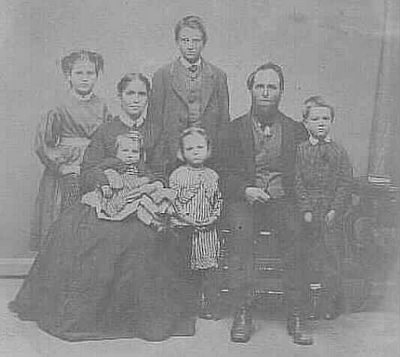
There are several angles that are worth working when considering the imperative to work as much as you can work, including the likeness of many high-hours work situations to fraternity hazing, the question of how many hours of actual productive work are actually extracted in those situations (esp. in the absence of rigorous policing of computer desktops). The celebration of workaholism for the sake of... of... well, neither PS nor I are actually able to put a handle on it, is curious.Get enough people in responsible positions thinking this way, and the 24/7 treadmill begins to crumble. And perhaps it won't take 135 years. Why 135 years? Consider this picture. We are looking at my second great-grandparents and their children. This picture dates to the early 1870s as the baby died in August 1872.

Standing in rear: Mary Esther Hopkins, Fowler James Hopkins;
Front row: Sarah Jane (Hyatt) Hopkins, Joseph Hopkins, Cora Hopkins,
Francis Hopkins, Ira Lincoln Hopkins.
Hingham, Wisconsin.
I suspect that talk of an eighty hour work week would have struck them as utopian (did that word exist in 1870?) in the extreme. Sunday might have been the Sabbath day, and the Lord might have rested, but those cows had to be milked -- by hand -- before and after church.
SERENDIPITY. The Shore Line Interurban Historical Society has its printing done by Waukegan's North Shore Printers. The founder of the printing company was inspired by screeching interurban flanges on the streets of Waukegan to name the business ... North Shore Printers.
Just arrived at the Cold Spring Shops library is the latest copy of First and Fastest ... and an unexpected bonus. In common with many other businesses, North Shore Printers do a calendar. For 2006, the current managers asked Shore Line, one of their customers, to provide some photographs. As consideration, the press run included sufficient calendars to provide one for each First and Fastest subscriber.
And here, for the record, is evidence of just who pioneered piggyback.

Norfolk and Western might have offered interchange piggyback service beginning in 1955, and the Chicago Great Western and the New Haven might have begun service confined to their lines in the 1930s, but the North Shore's ferry truck "merchandise despatch" service (which also accepted trucking company trailers) began in 1927.
LEARNING HOW TO WIN. The Northern Illinois womens' basketball team has had a tough stretch, with close losses to Wisconsin-Green Bay at home and to Illinois State, Western Illinois, and Illinois-Urbana on the road. The home game went to overtime, and the road games were close until the final few minutes. Tonight Illinois-Chicago visited DeKalb, and it was the home team's turn to score most of the points in the final three minutes, prevailing 51-40.
Yesterday marked a homecoming for the Speaker of the House, who attended the opening wrestling match against Northwestern. The article doesn't report whether Mr. Speaker was also President Peters's guest for the football game that ended after the match did.
Yesterday marked a homecoming for the Speaker of the House, who attended the opening wrestling match against Northwestern. The article doesn't report whether Mr. Speaker was also President Peters's guest for the football game that ended after the match did.
OUCH. Last evening, I was all ready to go with a cheerful post about the Northern Illinois Huskies qualifying for some Monday Night Football after recovering from some early setbacks and taking a 14 point lead over Akron into the fourth quarter. Alas, Akron managed 21 points to Northern's six in that quarter. With under two minutes to go, Northern had the ball, Akron was out of times out, one more first down would have enabled the Huskies to run out the clock, that first down was not to be had, an Akron delay-of-game penalty gave the team time to call a few plays, and with 10 seconds to go the final seven points went on the board.
The bad news is, that's a tough loss for some gritty kids. The good news is, the life of the university goes on. Exams are about to begin. Posts might be spotty the next few days; interpret those as evidence of procrastination.
The bad news is, that's a tough loss for some gritty kids. The good news is, the life of the university goes on. Exams are about to begin. Posts might be spotty the next few days; interpret those as evidence of procrastination.
THE BENEFIT PRINCIPLE STRIKES AGAIN. Harry at Crooked Timber comments on a proposal from the student government at Wisconsin-Eau Claire to introduce a student fee to raise professor salaries.
Here's how the Fourth Estate reports it.
The Crooked Timber take?
The comments at Crooked Timber are worth your perusal, and take a look at this linked post.
Here's how the Fourth Estate reports it.
Aaron Olson, the president of UW-Eau Claire's Student Senate, said the $20 annual fee was needed to draw attention to what he views as the Legislature's woeful underfunding of the UW System. He said professors and instructors are leaving the system for higher-paying jobs in other states - a common complaint among university administrators and the Board of Regents.There are tradeoffs.
I'm resisting the temptation to toss off a "why not 100%, indeed?" and leave it at that. It is encouraging, however, to see some recognition that faculty have opportunity costs, and, misplaced administrative priorities notwithstanding, some universities are raiding others. (Western Michigan a peer institution of Eau Claire??!? I'd like to place some economics PhDs at Western Michigan.)But students across the UW System have already been saddled with ever-increasing fees to help fund capital projects and academic services that once were paid for with taxpayer dollars. Critics warn of a slippery slope should students start pitching in for their instruction.
"I'm worried that the state Legislature will love the idea of having students pay more and the state pay less," said Jacob Boer, a UW-Eau Claire senior who was among eight students on the Student Senate to vote against the fee last month. Nineteen student senators voted for the fee, and one abstained. "It's just going to lead to further privatization."
Rep. Rob Kreibich (R-Eau Claire), who chairs the state Assembly committee on higher education, agreed.
"If you start down that road, I could envision students being asked to shoulder more and more faculty pay," Kreibich said. "Why not 50 percent, or eventually 100 percent?"
The Crooked Timber take?
The article is pretty good; the students who support the raise are clearly worried about their degrees being worth less as a result of the defection of professors who can get paid more elsewhere; the opponents see the move (rightly) as creeping privatization, in an environment in which there are moves among a significant group of legislators to cap both tuition and spending.But therein lurks the Benefit Principle. Public colleges are regressive transfers at work. All taxpayers kick in to subsidize the education of individuals more likely to come from richer families (this may be less true at Eau Claire than at Madison with its state-subsidized Coasties) who will on average make more money as adults. At the margin the benefits of the public university might be strictly private, and the division of those benefits between professor and student a purely private matter. (I have already set the public policy examination; it might be fun on a future problem set to turn students loose analyzing the implications of a tuition cap in the presence of a substantial rate of return to that associate or baccalaureate.)
The comments at Crooked Timber are worth your perusal, and take a look at this linked post.
In most academic fields people are asked to devote many years to learning very specialized knowledge. There is a very thin market for their services, with often only a few institutions in the world that would pay them for their specialization. It's reasonable for people to ask for job security in exchange for devoting a lot of time to learning highly specialized knowledge; otherwise they'd essentially be screwed if they lost their jobs. The alternative would be to pay people very high wages to compensate them for the risk they take in specializing so strongly. Academic institutions probably couldn't afford the wage premium. Think about the wages that would be necessary to attract people to spend five years in grad school followed by an uncertain job market if there wasn't the prize of tenure at the end.That's the argument I refer to as the "professional sports alternative" model of academic compensation. One of the hidden costs of those high salaries for players in their four peak performing years (that's the half-life of a cohort of pro players) is the unemployment or underemployment of many kids not quite good enough to become a draft pick. (But therein hides another imponderable: aren't I describing, with one or two zeroes suppressed, the career ladder in many of the PhD-jammed fields? Questions, questions.)
30.11.05
WORDS ARE PLENTIFUL, DEEDS ARE PRECIOUS. Northern Illinois University begins a national search for a new provost. President John Peters has ambitions.
Anybody in headquarters ever hear of an opportunity cost?
“Our next provost must rise to the challenge of creating a great intellectual environment, enhancing the student experience, driving an aggressive research agenda, expanding our graduate programs, creating sustainable scholarly and creative initiatives, encouraging active engagement in our region and continuing our efforts to internationalize the campus.”High sounding words, to be sure, but follow the money. First comes the new alumni relations center. Next comes the study hall and weight room upstairs from the locker room. Today comes a field trip.
Yes, you read that right. The prize for winning the Wednesday afternoon game rescheduled for TV from the Tuesday evening game is an opportunity to play in a Thursday evening game. Because Friday is the last day of classes, a Saturday game would technically be during exam week, not permitted. And there are prizes for those who stick around for those Thursday summary classes.Administrators have set up transportation to the NIU football team’s first MAC Championship game at 6:30 p.m. CDT Thursday at Ford Field in Detroit.
The first 300 students who buy a $5 ticket will receive free round-trip bus transportation, a box lunch and a T-shirt commemorating NIU’s MAC West Division title.
If the Huskies win, a post-game celebration will be held in the Holmes Student Center’s Regency Room until midnight. The event will feature a disc jockey, snacks and beverages. The first 300 students to arrive at the event will receive a free T-shirt. For more information about tickets and the postgame celebration, call the Office of Student Involvement and Leadership Development.(I wasn't aware we had such an office. Perhaps that falls under the rubric of "enhancing the student experience.")
Anybody in headquarters ever hear of an opportunity cost?
ONE OF THESE THINGS IS NOT LIKE THE OTHERS. The folks who run what we used to know as the Greater Rockford Airport would hereafter like all to refer to it as the Chicago/Rockford Airport.
(Via The American Mind.)
It became the Chicago/Rockford International Airport this month, although the airport is about 90 miles from downtown Chicago. Milwaukee and South Bend, Ind., are similar distances from the city, but neither of the public airports in those cities has seen a need to add Chicago to their name.Pedantic note: the Mitchell International Airport train station is at Milepost 78 from Union Station, and the Chicago South Shore and South Bend extends about 90 miles from underneath the Prudential Building. Therein lies a hint that the name change might not deliver the benefits the renamers anticipated. It is possible to reach O'Hare, Midway, South Bend-Niles, and Mitchell by train from the Loop and the inner suburbs of Chicago. (In the few times I've explored the Hiawatha Corridor recently, I have seen substantial Mitchell-Sturtevant or Glenview traffic on board.) Rockford, you're stuck on the Kennedy and Northwest Tollway. But what was that H. L. Mencken line about not going broke underestimating intelligence?
If.When travelers in Denver are looking at the computer screens of arrivals and departures in Denver or Detroit, they're going to see the listings for Chicago-Midway and Chicago-O'Hare, followed by Chicago-Rockford. There is a value in that association, [RFD executive director Bob O'Brien] said.
The change is unlikely to result in people getting off a plane in Rockford and wondering where the Wrigley Building and Navy Pier are. Entering the word "Chicago" at a site such as Orbitz will only bring up options for O'Hare and Midway, not Rockford.
"You wouldn't choose us unless you chose us on purpose," O'Brien said.When he hears from those angry over the airport's new name, O'Brien said he explains there was a sound financial reason for the move.
"If it creates millions of dollars in economic impact, if it creates jobs and enhances the quality of life here, what do you care what we call it for marketing purposes," he said. "You're still going to say I'm going to the Rockford airport."
(Via The American Mind.)
QUOTE OF THE DAY. Just One Bite has reservations about universal college.
Call me an elitist, but I don't think that lowering entrance standards and adding remedial classes to allow people with limited intellectual capability or a lack of motivation to attend college benefits us. I'd love to see more details about college drop-outs; how many of them had been struggling from Day One? When we make a four-year degree (what an antiquated term that is!) a goal -- nay, a necessity -- for people who want a decent standard of living, resulting in a larger percentage of mediocre students going on to college, why are we surprised when many of them fail to thrive?(Via Multiple Mentality.)
SCOOPING THE ONION. I'm not familiar with something called "The David Lawrence Show," but he's following stories involving Delta Airlines, including the rather macabre (and rail-inspired?) Onion cost-cutting story I commented on.
CARNIVAL CALL. This week's Carnival of the Capitalists cruises onto Gill Blog, and Carnival of Education No. 53(8) is open at Education Wonks.
InstaPundit's extended family have a blogospheric version of Amusement Business available as Blog Carnival Index. Virtual tack-spitters, forsooth!
InstaPundit's extended family have a blogospheric version of Amusement Business available as Blog Carnival Index. Virtual tack-spitters, forsooth!
29.11.05
"RELENTLESS COMBINATION OF MISCHIEF AND LOGIC." That might be better than "sex, death, and why the lines are longest at the roller coaster" as a way of selling economics. It's part of a Catallarchy interview of Tim Harford, The Undercover Economist (must add that to the stack), who has his own advice column.
GETTING OFF THE TREADMILL?
Russell at Cafe Hayek sees a less-Scroogelike reason to say "humbug."
Suppose every American decided that life is too fast-paced, that the pleasure we get from material things is fleeting and that we all need to spend more time with our families. Suppose every American decided to look for part-time jobs with half of the hours we currently work.That third paragraph offers a variation on a theme I've posted on here, (sorry, the search screen isn't helpful tonight) about how half of (or all of) Friday away from the office will be the reality for many people, long before some amendment to the Fair Labor Standards Act codifies it for everyone. (Is there a way of testing the hypothesis that legislation mandating changes that are already taking place encounters less resistance than legislation mandating changes that are not?)
The result would be an economy that was half as large as the current one. But that transformation would be good, not bad. Assuming that we indeed found that additional family time to be as satisfying as we had expected, then our economy would be healthier. We would be happier and better off.
The only footnote to this point is that if we all made this decision overnight, the transition to a smaller economy would be traumatic. But if it happens gradually, it would be fine. Having an economy half of the current size would be good if each of chooses to spend more time at home and less time in the commercial side of life.
Too many stories about holiday spending imply that spending has some sort of positive externality, that the benefits extend far beyond the buyer and the seller and that to stay home by the fire in the fireplace playing the guitar or reading to your children is somehow unpatriotic.
MORE HISTORY TO KNOW ABOUT. No reason to study history?
We're not very good at celebrating our military heroes. Memorial Day and Veterans Day pass with less and less public acknowledgment, beyond a general holiday feeling. Around June 6, when the president goes to France to observe the anniversary of D-Day, there will be some notice of Normandy veterans. But no one will even pause to contemplate the anniversary two days before--Midway Day, the official commemorative day of the U.S. Navy. It marks one of our nation's most dazzling feats of arms, just six months after the disastrous surprise attack on Pearl Harbor.That leads into a review of a new book about Midway, with a caution, and a recommendation.
Must consider adding this book to the stack.[Author Alvin] Kernan [who served on Enterprise] brings this maritime battle superbly to life. He explains the whole history of the U.S. carriers and their arsenal and the commanders and pilots who were trying to learn on the job. And he narrates the air assault in gripping detail. Mr. Kernan makes it clear how it came to pass that U.S. admirals sent a large group of brave but poorly equipped and undertrained men to fight with outmoded tactics. He is less clear on why. One obvious explanation: At the beginning of a war, you fight with whatever is at hand and learn from your mistakes. Adm. Nimitz would have happily accepted double the casualty rate to get what he got: four sunk Japanese carriers.
Midway was a great victory, but the Navy still had miles to go to figure out how to use and defend its carriers--as the costly mistakes in the sea battles around Guadalcanal in late 1942 proved.
THE HIGHER LEARNING. One university sees its future in vocationalism.
The university describes its mission thus.
Read and reflect. Wouldn't it be easier for those 625 to 900 people to apprentice themselves to firms rather than chase the credential?Many colleges in recent years have eliminated majors or departments in relatively obscure fields, citing the need to focus on areas with growing student interest. Few, however, have taken the step Post University plans: eliminating majors in English and history and upper-level courses in liberal arts generally.
Post, in Waterbury, Conn., was founded as a private university in 1890, and has always had a strong vocational orientation. The university has seen some radical changes in governance. In 1990, Post became one of several American colleges that affiliated with the Teikyo Group, from Japan. Post became Teikyo Post University. Last year, when Teikyo pulled out, private investors purchased Post and it traded in its nonprofit status to become a for-profit (and profitable) entity.
Now the university — with about 1,400 students — plans to stop offering liberal arts degrees and to focus on academic programs directly linked to careers. No full-time faculty members will lose their jobs. But there will be shifts in priorities for adjunct hiring — and part-time faculty members teach a major proportion of classes at Post.
Jon Jay De Temple, president of Post for the last five years, said that he believes the institution needs focus. “We’re not big enough to do everything for everybody,” he said.
De Temple said that based on that view, administrators and board members believe that majors that don’t “lead to a job” should be eliminated. He stressed that there would still be history and English instruction at the university, but said that there would not be any upper-level courses. “We’re probably not the best institution to turn out an English major,” he said.
The college hopes to shift resources to expand offerings in high-growth fields such as criminal justice, health services, and sports and entertainment. Post also wants to improve its well regarded equestrian program.
With such improvements, De Temple said that he thought Post could increase its enrollment of traditional-age college students from 625 to as many as 900.
The university describes its mission thus.
Post University is a career-oriented and student-focused university located in Waterbury, Connecticut. Post is known for its quality academic programs, small classes, national award winning student activities, and its NCAA Division II athletic programs. Our students pursue their personal and professional goals within academic programs supported by a dedicated faculty who blend both theory and practice within their classroom experiences. Become a part of the long tradition of private higher education in New England. Take the time to explore this web site and discover New England's value, Post University's career-oriented programs that focus on each student, every day.I'm not sure what to make of a university website that allows a visitor to "View Course Cart."
TONE-DEAF? There's an electronic carillon simulator in the student center that serenades the campus at noon each day. Today, with the blue norther blowing and everyone stressed with those end-of-the-semester deadlines and that final exam anxiety, the programmers decided to serenade us with Song of the Volga Boatmen.
27.11.05
NEW IDEAS, OLD IDEAS. Time's Joel Klein interviews Illinois Representative Rahm Emanuel, who offers some suggestions for his Democratic Party.
Expand support for higher education. "Make college as universal in the 21st century as high school was in the 20th"; three out of four jobs in the new, high-tech economy require two years or more of higher education.I'm skeptical. With the defect rate and the remediation efforts as high as they are, mightn't it make more sense to restore the high schools to respectability first?
Create a National Institute of Science and Engineering, like the National Institutes of Health (NIH). Funding for the nih [c.q.] has quadrupled since the 1980s, from $7 billion to $28 billion. "That's why we lead in pharmaceuticals and medical technology." Funding for science has been stagnant—about $5 billion—during that period. "I'd quadruple it and concentrate on nanotechnology, broadband and energy."Here's a proposal that might inspire some debate. To what extent are those "rising health care costs" a side-effect of that government spending? On the other hand, is it right to refer to something that absent the research wasn't available at any price as a "rising cost?" To what extent is the research corporate welfare?
Promote energy independence. Reduce foreign oil by 50% in 10 years. Create a hybrid economy. Use government contracts and tax incentives to boost solar and wind power.Does that include developing oil resources in Alaska and the Great Lakes, and the oil shales, or extracting more natural gas?
"You got a job, you got health care." Give the uninsured vouchers—"I'm not afraid of vouchers"—for use in the insurance system that covers federal employees. Basic coverage, nothing fancy.Demsetz auctions for the right to sell the insurance?
Organize a bipartisan summit on the budget. Balance it.What are you prepared to give up? I see proposals to spend money.
APPLIED HIAWATHA RESEARCH.
All this posting about Hiawatha steam speed records or not inspired me to take a mental health day riding a Hiawatha. Hey, the weekend pass is good for two days, and the stack of homeworks to be returned Monday will be the most travelled set of homeworks I've graded, with one Hiawatha, two commuter trains, three stations, a coffee house, and an airport Starbucks offering working space.
Today's connecting concourse is Chicago's Union Station.

The waiting room has thus far avoided being "redeveloped" as an office tower or an apartment complex, and it stands in all its Pennsylvania Railroad grandeur. (It also serves as a gathering area for some Amtrak passengers as we shall see.)
The conductor of the 10.20 "Morning" Hiawatha (hey, the real Morning Hiawatha used to leave at 10.30) was a bit impatient on the radio. "C'mon, 'Casey,' let's highball!" (Name changed.) So when the conductor collected my ticket, I was in the mood for some teasing. "Could 'Casey' get us from Glenview to Milwaukee Airport in 45 minutes?" (No.) But at one time, such running would be possible.
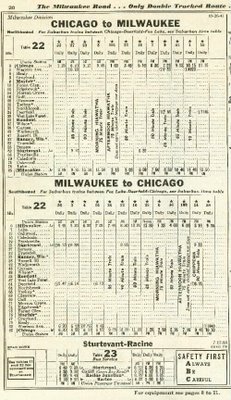
This schedule was in effect when Pearl Harbor was bombed. Trains are much faster, although today's service is better spaced throughout the day, with something resembling a memory pattern of two hour headways. Several of the services shown here continued to Green Bay, the Twin Cities, and the Pacific Coast. Note that the speed restrictions in effect today are bureaucratic constraints, not technological constraints. No automatic train stop, centralized traffic control, welded rail, or dead-man petals in 1941.
The northbound trip was fast and on time into the airport. Amtrak strengthened the formations with a business-class dinette car (hey, hire a cafe attendant and make that a regular feature.) There is work in progress at Highway 20 building what looks like a new Sturtevant-Racine station (what will happen to that funky witch's hat station at Sturtevant?) Lake Yard, and the interlocking tower that stood there until recently, are gone.
The weather isn't conducive to flying.

I'm not sure whether these posts are a security measure or simply recognition that some drivers will mistake any wide paved surface, including a sidewalk leading to a passenger platform, for a road.

Let the record show that there was at one time a closer train stop to Mitchell International.
 The line of trees marks the right-of-way of the North Shore Line, and the Milwaukee Division locals would make a flag stop at Grange Avenue, although whether any adventurous souls made an intermodal connection hiking into the airport from there may remain an eternal mystery.
Inside the airport, which offers a shuttle bus to the train station (and lots of air travelers were making connections today) this cluster of maps shows the weather and the current position of airplanes inbound to Milwaukee. The maps might have assuaged some people on this foggy day.

(Again, the cheap digital camera reveals its limitations.)
The southbound 3.0 Hiawatha was a few minutes late into Airport Station, probably delayed in Milwaukee receiving transfers from a late-running Empire Builder that blasted up Lake Hill just ahead of the corridor train. Once all the airport passengers were loaded, it was off to the races, with an on-time arrival in Chicago, and plenty of time to turn the train and get the northbound hordes away at 5.08. (That's WITH strict adherence to the 79 mph speed limit. Give them their head to 110, I say.) Other trains were also busy, with the State House and Pere Marquette strengthened but away on time, the Capitol Limited loaded and away on time, a long Illinois Zephyr into the station with little time to load and away on time (passengers requested to queue outside the departure lounge.) Only the Twilight Limited was delayed, account late arrival of the inbound equipment, and those passengers were requested to assemble in the Great Hall to be marched to their train when it was ready. But considering the crush of passengers and the limitations of the concourse, which was "redeveloped" in 1969 for commuters only, the late afternoon departures went quite smoothly. That also appeared to be the case on the suburban services, including the 6.40 to Elgin, which was also full of shoppers, holiday-makers, and a few transfers off of Amtrak.
Today's connecting concourse is Chicago's Union Station.

The waiting room has thus far avoided being "redeveloped" as an office tower or an apartment complex, and it stands in all its Pennsylvania Railroad grandeur. (It also serves as a gathering area for some Amtrak passengers as we shall see.)
The conductor of the 10.20 "Morning" Hiawatha (hey, the real Morning Hiawatha used to leave at 10.30) was a bit impatient on the radio. "C'mon, 'Casey,' let's highball!" (Name changed.) So when the conductor collected my ticket, I was in the mood for some teasing. "Could 'Casey' get us from Glenview to Milwaukee Airport in 45 minutes?" (No.) But at one time, such running would be possible.

This schedule was in effect when Pearl Harbor was bombed. Trains are much faster, although today's service is better spaced throughout the day, with something resembling a memory pattern of two hour headways. Several of the services shown here continued to Green Bay, the Twin Cities, and the Pacific Coast. Note that the speed restrictions in effect today are bureaucratic constraints, not technological constraints. No automatic train stop, centralized traffic control, welded rail, or dead-man petals in 1941.
The northbound trip was fast and on time into the airport. Amtrak strengthened the formations with a business-class dinette car (hey, hire a cafe attendant and make that a regular feature.) There is work in progress at Highway 20 building what looks like a new Sturtevant-Racine station (what will happen to that funky witch's hat station at Sturtevant?) Lake Yard, and the interlocking tower that stood there until recently, are gone.
The weather isn't conducive to flying.

I'm not sure whether these posts are a security measure or simply recognition that some drivers will mistake any wide paved surface, including a sidewalk leading to a passenger platform, for a road.

Let the record show that there was at one time a closer train stop to Mitchell International.
 The line of trees marks the right-of-way of the North Shore Line, and the Milwaukee Division locals would make a flag stop at Grange Avenue, although whether any adventurous souls made an intermodal connection hiking into the airport from there may remain an eternal mystery.
Inside the airport, which offers a shuttle bus to the train station (and lots of air travelers were making connections today) this cluster of maps shows the weather and the current position of airplanes inbound to Milwaukee. The maps might have assuaged some people on this foggy day.

(Again, the cheap digital camera reveals its limitations.)
The southbound 3.0 Hiawatha was a few minutes late into Airport Station, probably delayed in Milwaukee receiving transfers from a late-running Empire Builder that blasted up Lake Hill just ahead of the corridor train. Once all the airport passengers were loaded, it was off to the races, with an on-time arrival in Chicago, and plenty of time to turn the train and get the northbound hordes away at 5.08. (That's WITH strict adherence to the 79 mph speed limit. Give them their head to 110, I say.) Other trains were also busy, with the State House and Pere Marquette strengthened but away on time, the Capitol Limited loaded and away on time, a long Illinois Zephyr into the station with little time to load and away on time (passengers requested to queue outside the departure lounge.) Only the Twilight Limited was delayed, account late arrival of the inbound equipment, and those passengers were requested to assemble in the Great Hall to be marched to their train when it was ready. But considering the crush of passengers and the limitations of the concourse, which was "redeveloped" in 1969 for commuters only, the late afternoon departures went quite smoothly. That also appeared to be the case on the suburban services, including the 6.40 to Elgin, which was also full of shoppers, holiday-makers, and a few transfers off of Amtrak.
26.11.05
FAREBEATERS' PARADISE? The first weekend of Christmas shopping brings lots of people into Chicago. Metra sent a ten car train to protect the 10.05 Geneva-Chicago, and by the time it left Elmhurst, nearly all the seats were taken. The conductor and collectors didn't have sufficient weekend passes, although they sold one-way tickets for people who would pay more for the weekend pass than for two one-way coupons. I wonder if there's a way of auditing the one-way ticket sales from Chicago to determine how many people might have taken advantage of the situation to buy only their return ticket.
At Chicago, I bought the weekend pass and headed to Kenosha, where the heritage trolley is running. It has been tricked out for Christmas.

I brought along the Canon with the old-style film and a light meter I can manage. It was a gorgeous day for trolley pictures. This one from the cheap digital will have to serve for now. Perhaps some real pictures later.
The other Metra trains were also doing a good business hauling shoppers around. The Kenosha 400 came in a few minutes late after setting down large crowds at the North Shore stations (from which relics of the old North Shore Line can still be seen if you know where to look) and on the return trip the three open cars were pretty well filled, including shoppers making short turns from Lake Bluff or Lake Forest to Evanston or Ravenswood. If the roads are miserable enough, people will use the trains.
I used the train rides to do some reading and will soon post more book reviews. I still plan to meet the Fifty Book Challenge. Reviews 42, 43, and 44 are in preparation, and 45 is in progress.
25.11.05
IN FOR MAINTENANCE. Some of the motive power has been receiving maintenance. First, a New Haven H16-44 with the Atlas caboose a reader asked about. The cheap digital camera doesn't do a real good job with orange and red in direct light, so I've turned this into a black and white image. The diesel has received a wheel cleaning. The pilot requires a bit more adjustment so it won't short on grades.

This State of Maine Northern caboose hop has one of my Lionel GP-7 conversion projects, using a frame from Chassis System and a P&D drive (the Atlas drive originally envisioned by Chassis System isn't quite robust enough for so heavy an engine.) The engine is in for some handrail renewals.

Santa Fe never had any of these, but with careful application of un-paint followed by some Hunter Green, we will see a believable representation of a New Haven engine. This is another of my bargains, which I obtained for $100. The driveline is Central Locomotive Works's. It requires more weight over the lead truck, as the trailing truck is sufficiently massive as to induce a torque that relieves itself by wheel lift in the lead truck.

Just for fun, a Pennsylvania O1a from Locomotive Workshop, which is having its power pickup improved.

Lessons learned from that project will make completion of the other O1a easier.

I'll not be complaining of boredom once finals are in.
RULES WRITTEN IN BLOOD. Nobody died, but a few people are still in hospital, many got a scare, and many more were home late after a westbound Metra North Central train hit some cars trapped on the tracks at Elmwood Park, Wednesday night. The crossing is a scary one, with the tracks crossing the road at a very shallow angle, and big signs all over the place reading "Long Crossing. Do Not Stop on Tracks." Some people did anyway. The usual set of maltimed Illinois traffic lights contributed to the accident. There is a set just east of the tracks that is not interlocked with the railroad crossing. I thought those were supposed to be fixed after the school bus got trapped on the Northwest Line at Cary Grove in 1995. Several survivors of the crash have reported being stuck in traffic, which was very heavy that evening.
The point of traffic control signals is to control traffic, not to frustrate it. But no highway engineer has ever figured that out. I don't know how many hours are wasted in shopping districts by drivers who watch the signal at the mall entrance drop to red just as the signal at the mile road has cleared for the first time in two minutes. I also suspect that a lot of speeding is a response by local drivers who have figured out the perverse cycle of traffic lights that will stab you at each mile road if you travel the legal limit.
The point of traffic control signals is to control traffic, not to frustrate it. But no highway engineer has ever figured that out. I don't know how many hours are wasted in shopping districts by drivers who watch the signal at the mall entrance drop to red just as the signal at the mile road has cleared for the first time in two minutes. I also suspect that a lot of speeding is a response by local drivers who have figured out the perverse cycle of traffic lights that will stab you at each mile road if you travel the legal limit.
RECLAIMING THE CULTURE. From Joanne Jacobs comes news that some parents are regaining the strength to say no to coarseness.
Well, the so-called utopia is here, and older women have reason to be alarmed at the dangers young women are bringing upon themselves. These girls are treated as objects just as surely as in any earlier generation. It's pre-liberation treatment in post-liberation disguise. "Turn back before it's too late!" we want to warn them -- because what awaits them is not Prince Charming. It is more likely to be loneliness and regret.And Kimberly at Number 2 Pencil sees sense in the policies of Chicago eateries that would like the yuppie puppies to be housebroken. Inside voice, indeed.
STUDENTS TAKE NOTES, TAKE TESTS, TAKE OFF. That's life at a commuter school, but at Wisconsin-Milwaukee the emphasis is on taking off.
Some specifics.Only 40 percent of those surveyed felt that the coursework that they were given would be relevant in everyday life. This is 10 percentage points lower than the national average for schools the size of UWM.
Very few of those surveyed feel that they have learned stronger social skills or gained understanding of global and political issues since coming to UWM.
Part of the problem may be that less than half of those surveyed feel that they have adequate contact with faculty members outside of class.
Most of the students in the survey never went out of their way to contact professors, join professional clubs or participate in academically enriching programs.
The academic department may not be to blame in the long run, however, because the survey also shows that UWM students are doing little to help themselves get the most out of their college careers.
I'm sure the Wisconsin legislature is pleased to appropriate money for Club-Med-by-the-Lake.Almost half reported skipping class frequently or coming to class late.
UWM students are not engaging in their academics with their fellow students either. Of those surveyed, only 25 percent stated that they discussed coursework or engaged in intellectual conversations with their peers.
Although last year’s freshmen class rated UWM’s academics low, they were quick to point out that their overall college experience was rated very highly. Over 72 percent rated their experience at UWM to be great.
This surprising result may be attributed to the fact that UWM students are more social than most colleges across the country.
Freshman students at UWM rate slightly higher than the national averages in drinking, attending parties and getting involved with community events.
AND THERE IS YOUR DAGGER. With the third quarter winding down, Wisconsin converts an interception into a touchdown, and it's 41-17, probably ample cushion even for a suspect defense.
FREE-RIDERS. Laura at Ace of Spades discovers the British radio tax, and that where there are taxes, there is tax evasion. The television signal is costly to produce, but use of it is nonrivalrous, and exclusion of viewers, once they have bought the receiver, is costly. In short, the Beeb is a classic example of a collective consumption good with a serious free-rider problem.
In the United Kingdom and other parts of the Commonwealth, owners of radio and television receivers must pay an annual receiver tax. In the United States, we have commercials. But with recording technologies, including Tivo, watchers can avoid the commercial tax by judicious use of the pause button (legacy VCR users know that one) or by fast-forwarding. The rating services and the advertisers have exactly no authority to compel people to pay that tax.
In the United Kingdom and other parts of the Commonwealth, owners of radio and television receivers must pay an annual receiver tax. In the United States, we have commercials. But with recording technologies, including Tivo, watchers can avoid the commercial tax by judicious use of the pause button (legacy VCR users know that one) or by fast-forwarding. The rating services and the advertisers have exactly no authority to compel people to pay that tax.
WELCOME, EDUCATION WATCHERS. Education Watch liked this post so much he quoted all of it. Look around, there might be more of interest around here.
BEER AND CIRCUSES. Northern Illinois University's football team overcomes Western "We Scored First" Michigan to earn a spot in the Mid-American title game at Ford Field with an invitation to the GMAC Bowl or the Motor City Bowl at stake. First prize: a trip to Detroit. Second prize: two trips to Detroit.
Earlier that day, the university commenced construction of the Academic and Athletic Performance Center, a long-winded way of describing fancier locker and weight rooms with a study hall upstairs.
The director of athletics trots out an annoying metaphor, again.
Here's what the new front porch will look like.

Leni Riefenstahl and Albert Speer could not be reached for comments on the presentation.
Earlier that day, the university commenced construction of the Academic and Athletic Performance Center, a long-winded way of describing fancier locker and weight rooms with a study hall upstairs.
The director of athletics trots out an annoying metaphor, again.
Athletics is the front porch for the university. It's the most visible. This is a strong re-investment in the front porch. The front porch is not the most important part of a home, but it is the most visible part.I repeat: those of us who are in the kitchen, or perhaps relegated to the broom closet, have been doing our work, even when the front porch was 0-for-the-late-1990s.
Here's what the new front porch will look like.

Leni Riefenstahl and Albert Speer could not be reached for comments on the presentation.
NOTICE OF LINE RELOCATION. Bill Roggio has closed The Fourth Rail with its funky what-if-Pennsy-had-built-multiple-prototypes-of-the-S1 headers and is now posting from Iraq on Threats Watch.
GOLDEN ANNIVERSARY OF A CLASSIC. Betsy's Page finds a report that the green bean casserole invented by Campbell Soup's idea department is fifty years old, and still popular at Thanksgiving.
Herewith one, from yesterday's dinner. Yum.

Apparently the dish, which isn't everybody's favorite, is also available ready-to-run for those who aren't into kit-building. There are also scratchbuilder versions of the recipe.
Herewith one, from yesterday's dinner. Yum.

Apparently the dish, which isn't everybody's favorite, is also available ready-to-run for those who aren't into kit-building. There are also scratchbuilder versions of the recipe.
THINKING LIKE A RAILROAD. The Onion imagines a macabre cost-cutting strategy.
Not long after that, the Burlington killed the Billings-Alliance local under similar conditions, delaying a number of passengers somewhere in northwestern Nebraska until buses could be arranged. Among the passengers on that train was Representative Glenn Cunningham (once an Olympian runner) who made a federal case out of train discontinuances upon his return to Washington.
I wonder if a writer for Onion is familiar with the history of the passenger train. In the late 1960s, the Louisville and Nashville annulled the Pan-American at Montgomery, Alabama, where the train would lay over to be combined with the Crescent Limited (in those days an interline operation) to finish its run to New Orleans. Passengers were put on a bus. The annullment enabled the railroad to terminate a passenger train in the interval between expiration of a restraining order and an appeal to a higher court. The railroad could then argue that any further restraining orders were moot, as no other Pan-American was running.A 737 traveling from Cincinnati to Salt Lake City was lost with all passengers and crew Monday when cash-strapped Delta Airlines, the aircraft's operator, canceled Flight 1060 en route.
According to a statement from Delta, the midair cancellation was made as part of the company's plan to cut continental service by 25 percent and emerge from Chapter 11 bankruptcy with an economically viable business strategy."
Delta Airlines regrets any inconvenience to our valued customers," the statement read in part. "Unfortunately, in today's uncertain economy, service interruptions and cancellations are inevitable."
Not long after that, the Burlington killed the Billings-Alliance local under similar conditions, delaying a number of passengers somewhere in northwestern Nebraska until buses could be arranged. Among the passengers on that train was Representative Glenn Cunningham (once an Olympian runner) who made a federal case out of train discontinuances upon his return to Washington.
RESEARCHING THE HIAWATHA. The Milwaukee Road Historical Association maintain an archive at the Milwaukee Public Library. Enroute to Titletown, I stopped at the library and inquired about the November 1939 employee magazine with C. H. Bilty's article about the 125 mph test run of an F-7 Hiawatha that is likely the world's fastest authenticated speed obtained with a steam locomotive. The archive is not a public collection, and volunteers from the association work with the requests researchers leave. Expect a full report once I hear from the association.
The central library in Milwaukee was worth the trip, research findings or not. The inside has been extensively rearranged, with all vestiges of the old museum removed, and the central lobby backdated, with the escalators and other traces of Fifties modernization replaced by a grand staircase. Worth a look.
The central library in Milwaukee was worth the trip, research findings or not. The inside has been extensively rearranged, with all vestiges of the old museum removed, and the central lobby backdated, with the escalators and other traces of Fifties modernization replaced by a grand staircase. Worth a look.
ISN'T HIGH-TECH WONDERFUL? Wisconsin's pre-bowl bowl is a road trip to Hawaii. There's a Rainbow Warrior fan attempting to make the best of things, liveblogging the game at University of Hawaii Football.
SECOND SECTION: STOCCO TO ORR, TOUCHDOWN, WISCONSIN!
SECOND SECTION: STOCCO TO ORR, TOUCHDOWN, WISCONSIN!
CARNIVAL CALL. Carnival of Education No. 52(8) makes its pre-Thanksgiving call at The Education Wonks
22.11.05
HAPPY THANKSGIVING. That's all for this week. I give thanks for your readership and your comments.
Spare a few moments thanks for the young people in harm's way around the world, for the people in emergency services who deserve to sit down to the turkey without the alarm ringing, for the people in transportation, tourism, and entertainment passing on their family gatherings to enhance yours.
Spare a few moments thanks for the young people in harm's way around the world, for the people in emergency services who deserve to sit down to the turkey without the alarm ringing, for the people in transportation, tourism, and entertainment passing on their family gatherings to enhance yours.
BURY THE PROBLEM, APPOINT A COMMISSION? University Diaries recommends this Neal McCluskey column in National Review. Mr McCluskey is skeptical about the Spellings Commission on Higher Education doing anything substantive.
The academy is broken, and the commission ought to understand why.
The commission ought to know, for example, about universities diversifying their sources of income by rescheduling football games to suit the broadcasters at ESPN and competing for customers with climbing walls, coreless curricula, and nonexistent admission standards. A post at the American Council of Trustees and Alumni lays down a marker.
Another post links to a temporarily free Chronicle of Higher Education article on the battle between the University of Wisconsin System and the Wisconsin Legislature.
Much of the article touches on Culture Wars topics where the university appears to have made whatever effort it took to be as transgressive as possible. But focus on this:
Finally, the commission ought to know that the academy's common practice of admitting the unprepared and calling it "access" is sapping the morale of the faculty. Although each of the following sites is anonymous, allowing the poster to get away with characterizations of students that I consider impolitic, the frustration, irritation, and attempts at grim humor brought about by the antics of the unprepared, who nonetheless consider themselves entitled, are clear enough.
If the commission is going to be anything other than an exercise in public choice, it behooves interested parties to suggest courses of action and point out omissions.In September, U.S. Secretary of Education Margaret Spellings announced the formation of a commission tasked with designing a “national strategy for higher education” to prepare us for the 21st century.
The commission is composed entirely of people in academia, government or big business, all of whom benefit when taxpayer money is shoveled into higher education. Its recommendations are therefore almost a foregone conclusion: The federal government should spend more on student aid supposedly to ensure, as Spellings demands, that we have a workforce for the 21st century, and on “basic” research that businesses want done but on which they would rather not risk their own money.
Of course, with a unified national strategy two more things will come: federal control of academia and an end to the competition for students that has driven innovation in American higher education and made it the envy of the world. It’s the worst thing we could do according to a recent analysis by The Economist, which concluded that for a higher education system to succeed, it must “first: diversify [its] sources of income” and “second: let a thousand academic flowers bloom. Universities… should have to compete for customers.”
Unfortunately, we are heading in the opposite direction. Think No Child Left Behind for the Ivy League. “Many people don't realize that federal dollars… make up about one-third of our nation's total annual investment in higher education,” Secretary Spellings declared as she announced the formation of her commission. “By comparison, the federal government's investment in K-12 education represents less than 10 percent of total spending. But unlike K-12 education, we don't really ask many questions about what we're getting for our investment in higher education.”
The academy is broken, and the commission ought to understand why.
The commission ought to know, for example, about universities diversifying their sources of income by rescheduling football games to suit the broadcasters at ESPN and competing for customers with climbing walls, coreless curricula, and nonexistent admission standards. A post at the American Council of Trustees and Alumni lays down a marker.
As part of her ongoing investigation into American higher education, Margaret Spellings ought to consider the incuriousness of contemporary college students alongside the decline of liberal education and the spiralling costs of a bachelor's degree. It's a difficult, perhaps impossible, thing to quantify, but it is nonetheless a phenomenon that is every bit as current as the declining quality of higher education, and every bit as troubling. If we are to reform American higher education in a meaningful way, it will not be enough simply to reshape curriculum and costs along idealized lines. It will be necessary to envision this reshaping in the context of the modern undergraduate's intellectual sensibility. It cannot be taken for granted that this sensibility is inherently curious, inherently interested in learning, or inherently responsive either to the spirit of inquiry or to the more mundane spirit of intellectual respectability. Liberal education, in its tradition conception, is predicated on the idea that those engaged in it care deeply about questions, about exploring ideas, about discovery; it also presumes that those engaged in it want very much to acquire a breadth and depth of general knowledge that will save them from personal and professional embarrassment later on; it also assumes implicitly that a desire to avoid shame animates on some level students' quest for cultural literacy. Students must bring a certain type of determination, as well as a certain horror of ignorance, to their studies if liberal education is to be successful. In the absence of that determination, it's a real question whether liberal education may properly be said to exist.The commission ought to know that a conclusion satisfactory to everybody may not be possible. There are two posts at SCSU Scholars that bear on workforce preparation and the future of higher education. One focuses on the continuing difficulties businesses face in finding skilled workers.
Firms are spending more in making investments in their own workforce. This demand for skilled labor will quite possibly also lead to increased demand for older workers, which would soften the blow raising retirement ages or the age at which one qualifies fully for Social Security. Indeed, what sense does it make to give skilled labor an incentive to not work?What does that say about the academy's efforts at workforce development, all those business majors notwithstanding?
Another post links to a temporarily free Chronicle of Higher Education article on the battle between the University of Wisconsin System and the Wisconsin Legislature.
Along with paying a price for some political and management decisions that its own administrators concede were ill advised, the Wisconsin system appears to be feeling a backlash from broader higher-education trends. Those include rising tuition and admissions requirements, which have left many Wisconsinites feeling shut out of the system; tight state budgets and escalating costs, which have brought its expenditures under intense scrutiny; and a growing divide between the culture of colleges and the way the rest of society thinks and operates.You think?
Much of the article touches on Culture Wars topics where the university appears to have made whatever effort it took to be as transgressive as possible. But focus on this:
The system's enrollments from working-class and poor families have dropped substantially, and both Republican and Democratic lawmakers say taxpayers complain that many campuses have shut out their children by raising their tuition and admissions standards too high.Herein lies a conflict the commission ought to be aware of. To the extent that university degrees augment human capital, those degrees are private benefits, and it makes economic sense for the beneficiary to bear the burden. To the extent that more rigorous curricula augment human capital, it makes economic sense for the university to avoid enrolling "clients" whose primary interest is getting wasted. And perhaps the local common schools have failed at their job of preparing Wisconsin's children for college.
Finally, the commission ought to know that the academy's common practice of admitting the unprepared and calling it "access" is sapping the morale of the faculty. Although each of the following sites is anonymous, allowing the poster to get away with characterizations of students that I consider impolitic, the frustration, irritation, and attempts at grim humor brought about by the antics of the unprepared, who nonetheless consider themselves entitled, are clear enough.
IT PAYS TO UNDERSTAND ECONOMICS. In August, Hawaii's Public Utilities Commission issued wholesale price caps for gasoline, a development that led Coyote Blog to deem Hawaii a "peoples' republic." In the comments to that post, I noted,
Monday morning, the wake-up-radio-news included the latest retail gasoline price survey from Lundberg. Money observation.
The state's behavior makes misguided use of a basic principle of competitive supply, namely cheaper inputs translate into cheaper final product. But the way this regulation works, with the retail price of gasoline not capped and the wholesale supply limited to that which can be profitably sold at the controlled price, there will be no gas lines as a somewhat higher retail price will clear the retail market. I use a variant of this in price theory courses (at all levels) all the time.Later that day, the Coyote updated his post with a link to Jane at Asymmetrical Information, who made a similar observation.
Monday morning, the wake-up-radio-news included the latest retail gasoline price survey from Lundberg. Money observation.
Mainland prices are falling faster than Hawaii prices.As Gomer Pyle would put it, Supraahz, supraahz, supraahz.
REFLECTIONS ON THE RAILROAD LIBRARY. I took a mental health afternoon, otherwise known as visiting a few local hobby shops. I made some additions to my library, including a used copy of Some Classic Trains. But this isn't any used copy. It has a bookplate showing the Canadian National Railways Library as former owner, and it is autographed by author Arthur D. Dubin to Donald Gordon, who headed the Canadian National Railways, who as "CN" today own the Wisconsin Central and the Main Line of Mid-America.
Something to reflect on, though ... making arrangements to someday sell off the library.
Something to reflect on, though ... making arrangements to someday sell off the library.
Subscribe to:
Posts (Atom)



