Cold Spring Shops

Observations on economics, the academy, the wider world, and things that run on rails.

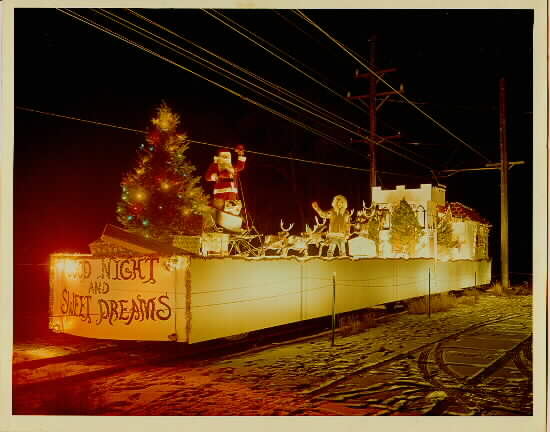
"Cold Spring Shops" was the name of the primary repair and car building facility of The Milwaukee Electric Railway and Light Company ... builders of trolley dining cars and the Christmas parade train ... perhaps I can be that creative too.


FREIE GEMEINDE


Northern Illinois University's current Speech Code Rating:

SUPERINTENDENT'S OFFICE


About Me
I Tube


Weblog Commenting and Trackback by HaloScan.com

ARCHIVES


09/01/2002 - 10/01/2002 10/01/2002 - 11/01/2002 11/01/2002 - 12/01/2002 12/01/2002 - 01/01/2003 01/01/2003 - 02/01/2003 02/01/2003 - 03/01/2003 03/01/2003 - 04/01/2003 04/01/2003 - 05/01/2003 05/01/2003 - 06/01/2003 06/01/2003 - 07/01/2003 07/01/2003 - 08/01/2003 08/01/2003 - 09/01/2003 09/01/2003 - 10/01/2003 10/01/2003 - 11/01/2003 11/01/2003 - 12/01/2003 12/01/2003 - 01/01/2004 01/01/2004 - 02/01/2004 02/01/2004 - 03/01/2004 03/01/2004 - 04/01/2004 04/01/2004 - 05/01/2004 05/01/2004 - 06/01/2004 06/01/2004 - 07/01/2004 07/01/2004 - 08/01/2004 08/01/2004 - 09/01/2004 09/01/2004 - 10/01/2004 10/01/2004 - 11/01/2004 11/01/2004 - 12/01/2004 12/01/2004 - 01/01/2005 01/01/2005 - 02/01/2005 02/01/2005 - 03/01/2005 03/01/2005 - 04/01/2005 04/01/2005 - 05/01/2005 05/01/2005 - 06/01/2005 06/01/2005 - 07/01/2005 07/01/2005 - 08/01/2005 08/01/2005 - 09/01/2005 09/01/2005 - 10/01/2005 10/01/2005 - 11/01/2005 11/01/2005 - 12/01/2005 12/01/2005 - 01/01/2006 01/01/2006 - 02/01/2006 02/01/2006 - 03/01/2006 03/01/2006 - 04/01/2006 04/01/2006 - 05/01/2006 05/01/2006 - 06/01/2006 06/01/2006 - 07/01/2006 07/01/2006 - 08/01/2006 08/01/2006 - 09/01/2006 09/01/2006 - 10/01/2006 10/01/2006 - 11/01/2006 11/01/2006 - 12/01/2006 12/01/2006 - 01/01/2007 01/01/2007 - 02/01/2007 02/01/2007 - 03/01/2007 03/01/2007 - 04/01/2007 04/01/2007 - 05/01/2007 05/01/2007 - 06/01/2007 06/01/2007 - 07/01/2007 07/01/2007 - 08/01/2007 08/01/2007 - 09/01/2007 09/01/2007 - 10/01/2007 10/01/2007 - 11/01/2007 11/01/2007 - 12/01/2007 12/01/2007 - 01/01/2008 01/01/2008 - 02/01/2008 02/01/2008 - 03/01/2008 03/01/2008 - 04/01/2008 04/01/2008 - 05/01/2008 05/01/2008 - 06/01/2008 06/01/2008 - 07/01/2008 07/01/2008 - 08/01/2008 08/01/2008 - 09/01/2008 09/01/2008 - 10/01/2008 10/01/2008 - 11/01/2008 11/01/2008 - 12/01/2008 12/01/2008 - 01/01/2009 01/01/2009 - 02/01/2009 02/01/2009 - 03/01/2009 03/01/2009 - 04/01/2009 04/01/2009 - 05/01/2009 05/01/2009 - 06/01/2009 06/01/2009 - 07/01/2009 07/01/2009 - 08/01/2009 Current Posts

AUDITORS


Hit Counter
Free Counters
Who Links Here

This page is powered by Blogger. Isn't yours?


31.12.05

THANK YOU. The "Acknowledgements" section at Fruits and Votes includes this.
I want to identify specifically two that provided me with much inspiration (in addition to PoliBlog): Stephen Karlson's Cold Spring Shops and Tom Grant's Arms and Influence. These are true model blogs.
That's very kind. The other sources do a much better job of concentrating on topics of substance than I do. Or perhaps by "model blog" he's referring to what's immediately below???

Happy New Year to all.

|

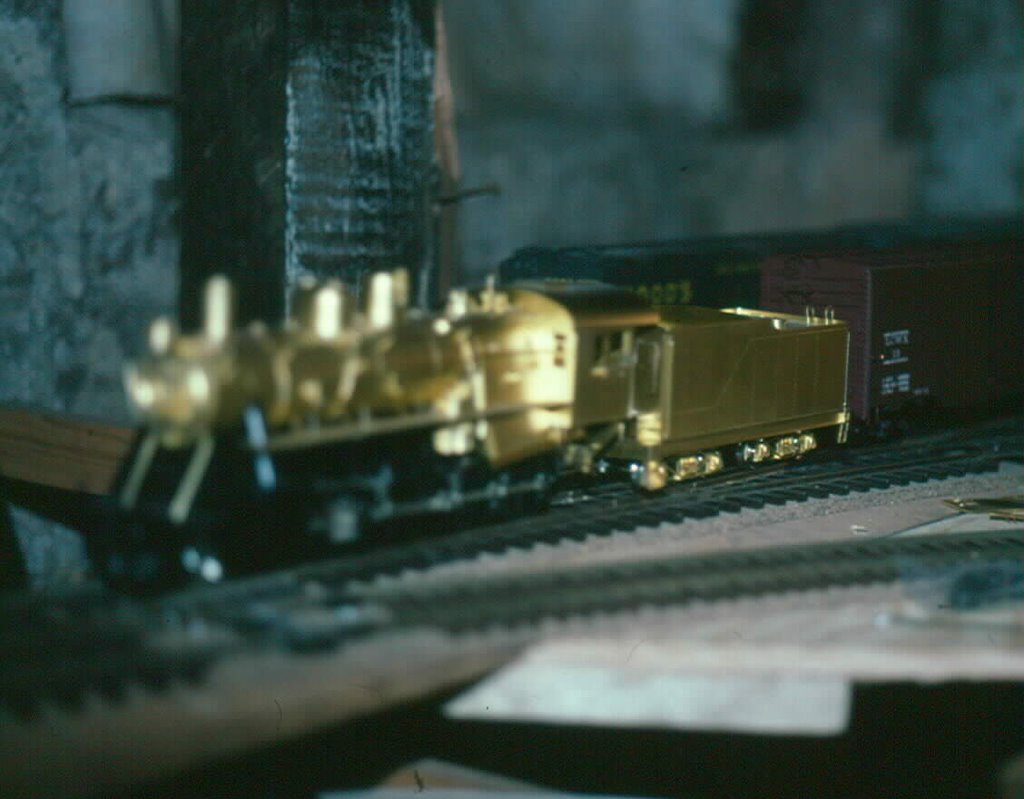
SOME MODEL BUILDING PROGRESS. This is the chassis for the Locomotive Workshop Alco-General Electric-Ingersoll Rand 300 hp boxcab diesel kit. I've been chasing most of the short circuits and other glitches, and it is beginning to run reliably well on straight track with the right additional weight added to the frame. (You'd think a thick slab of brass like that frame would be plenty of weight, but this is O scale, and I am working on some additional power pickups. At present two drivers on each truck are the entire power supply for it.) Some purists might bridle at the idea of each truck powered by a vertical can motor, but one does what one can with what one has.


The prototype looks like this, although mine will be somewhat less colorful. Ingersoll-Rand prettied this one up for the Nation's Bicentennial, and I think to draw attention to what they were part of. (As built they were generally engine black. I think Chicago and North Western painted one yellow and green later.)


Look closely at those radiator assemblies at each end of the roof. I have two brass bars and four brass half-rounds drilled with lots of holes, and lots of two lengths of pre-bent brass rod to go into those holes. I'm wondering if there's some way to apply a little bit of solder paste to each length, insert all the little rods into all the little holes, get the whole works in some kind of a jig, then hit it with the blow-torch and it's all done at once! Otherwise it's the soldering paste and the resistance soldering unit one rod at a time. Sounds tedious. On the other hand, there will soon be a stack of qualifying exams to grade. (I get paid to do that.)

|

EVER THE BOOKWORM. In grade school, one of my teachers let us keep track of our reading by adding segments to our bookworm. In those days, that meant cutting circles out of construction paper and filling in the title of the book we had finished. But we had to turn in our book reports first. Perhaps it was an early warning signal of geekiness that I took some pride in filling in more circles than anybody else. Some teachers still offer their charges opportunities to fill in the circles, although the circles are now available formatted for a color printer. (There's also, apparently, an interactive game called "Bookworm" these days.)

In lieu of the filled-in circles, here is a list of the fifty books I turned in book reports for before claiming them in the Fifty Book Challenge, as well as links to the book reports themselves.
  1. Mona Charen, Do-Gooders, 11 January 2005.
  2. Michael Crichton, State of Fear, 13 January 2005.
  3. Max Hastings, Armageddon, 21 January 2005.
  4. Mary Eberstadt, Home-Alone America, 24 January 2005.
  5. Jim Nelson Black, Freefall of the American University, 24 January 2005.
  6. Joseph Vranich, End of the Line, 24 January 2005.
  7. Thomas McInerny and Paul Vallely, Endgame: The Blueprint for Victory in the War on Terror, 6 February 2005.
  8. Richard J. Evans, The Coming of the Third Reich, 19 February 2005.
  9. Jim Dwyer and Kevin Flynn, 102 Minutes, 6 March 2005.
  10. Philip Roth, The Plot against America, 6 March 2005.
  11. Marc Frattasio, The New Haven Railroad in the McGinnis Era, 16 April 2005.
  12. Brian C. Anderson, South Park Conservatives, 18 April 2005.
  13. Steven D. Levitt and Stephen J. Dubner, Freakonomics, 17 May 2005.
  14. Dan Rockmore, Stalking the Riemann Hypothesis, 5 June 2005.
  15. Eli Maor, e: The Story of a Number, 8 June 2005.
  16. Christina Hoff Sommers and Sally Satel, One Nation Under Therapy, 15 June 2005.
  17. Stan Abbot and Alan Whitehouse, The Line that Refused to Die, 16 June 2005, book appears to be out of print.
  18. Craig Symonds, Decision at Sea: Five Naval Battles that Shaped American History, 17 July 2005.
  19. Eric Schlosser, Reefer Madness, 17 July 2005
  20. James DeKay, Monitor, and
  21. James Nelson, Reign of Iron, 25 July 2005 a battle of the books.
  22. David Laskin, The Children's Blizzard, 26 July 2005.
  23. Laurence Kotlikoff and Scott Burns, The Coming Generational Storm, 27 July 2005.
  24. John Earl Haynes and Harvey Klehr, In Denial: Historians, Communists, and Espionage, 29 July 2005.
  25. Patrick Allitt, I'm the Teacher, You're the Student, 30 July 2005.
  26. R. A. Scotti, Sudden Sea: The Great Hurricane of 1938, 31 July 2005.
  27. Hugh Bicheno, Midway, 3 August 2005.
  28. Jack Greene, The Midway Campaign, 7 August 2005.
  29. Thomas Friedman, The World is Flat, 8 August 2005.
  30. Thomas Cutler, The Battle of Leyte Gulf, 9 August 2005.
  31. Gary Nabhan, Why Some Like It Hot, 14 August 2005.
  32. Andrew Roberts, editor, What Might Have Been, 17 August 2005.
  33. Robin Neillands, The Battle of Normandy 1944, 19 August 2005.
  34. Bernard Goldberg, 100 People who are Screwing Up America, 21 August 2005.
  35. Judith S. Wallerstein, Julia M. Lewis, and Sandra Blakeslee, The Unexpected Legacy of Divorce, 21 August 2005.
  36. J. Martin Rochester, Class Warfare, 22 August 2005.
  37. Lisa Duggan, The Twilight of Equality?, 30 August 2005.
  38. Kevin John Robertson, Blue Pullman, 15 September 2005.
  39. Dennis Showalter, Patton and Rommel: Men of War in the Twentieth Century, 20 September 2005.
  40. Kenneth Sewell and Clint Richmond, Red Star Rogue, 1 October 2005.
  41. Laura Penny, Your Call is Important to Us, 3 October 2005.
  42. Julie Morgenstern, Never Check E-Mail in the Morning, 3 December 2005.
  43. Steven E. Woodworth, Nothing but Victory: The Army of the Tennessee, 1861-1865, 10 December 2005.
  44. Lynne Truss, Talk to the Hand, 11 December 2005.
  45. Charles S. Roberts, West End, 12 December 2005.
  46. John Pina Craven, The Silent War, 19 December 2005.
  47. Roy Adkins, Nelson's Trafalgar, 20 December 2005.
  48. Jared Diamond, Collapse, 23 December 2005.
  49. Leslie Savan, Slam Dunks and No-Brainers: Language in Your Life, the Media, Business, Politics, and, Like, Whatever, 29 December 2005.
  50. John R. Stilgoe, Shallow Water Dictionary, 31 December 2005.


The timing of the reviews gives some insight into the rhythms of academic life. Note in particular the absence of reviews for most of October and all of November. The fall semester is an unrelieved slog once the homework problems and examinations fall due. The spring semester is also a slog, but the spring break, like the westbound flat spot on Seventeen Mile Grade, offers an opportunity to catch one's breath.

(Also posted at the European Tribune and at the Fifty Book Challenge, where I made a bookworm for them!)

|

WHERE THE LASERS DARE NOT SAIL. Harvard's John R. Stilgoe, the Robert and Lois Orchard Professor in the History of Landscape in the Department of Visual and Environmental Studies has written Metropolitan Corridor as well as the preface to the second volume of When the Railroad Leaves Town (this volume includes Carpentersville, Lake Geneva, and Sturgeon Bay.) He's an O Scaler with more patience than I have at adapting a natural stone basement to a decent layout. You could look that up. But it's his penchant for messing about in boats that gives me Book Review No. 50, Shallow Water Dictionary. It's an exploration of the terminology of the coastal regions of southern Massachusetts, with a close reading of vintage dictionaries (some older than his basement.) The work on oars and rowing is instructive. One suspects that John would like to refer to canoes and kayaks as affectations of a certain kind of snobbery, but he doesn't quite do that. The discussion of flats and spits is Required Reading for any landlubber with a four wheel drive yuppiemobile who would like to drive out to that high spot for a picnic. (Better to row over, and mind the currents and the tides. Don't get bored.)

Some of the regionalisms are interesting. The Massachusetts dictionaries refer to a "creek" as the saltwater inlet of a small stream. In Massachusetts, the freshwater part is a "brook." That's a bit jarring to someone who grew up near the Honey Creek Parkway and learned early on about the Duck Crick River (to use the local pronunciation), both of which drain into Lake Michigan, still, despite the zebra mussels, lampreys, and gobys, freshwater. The nature of "skiff" is instructive as well. My maternal grandfather built what he called a skiff once. It was a low-freeboard, double-ended rowboat. Scale down a Monitor-style hull with whaleback decks at each end (there is no bow and stern as we usually understand it) and place oarlocks midships. At one time, the Melges Boat Works offered something they called a duck skiff which was more like what the New Englanders call a duckboat, or perhaps a punt.

There are a number of other surprises that will trap the unwary hiker who ventures too close to the ocean, if the coast is anything other than beach or sea-wall. Many of them have their own special words, and their special hazards. Read and prepare.

|

EVERYTHING WE LIKE GOES AWAY. Chris at Signifying Nothing notes that Chicago's Berghoff restaurant on Adams Street will close at the end of February. Perhaps I'd best check that Elephant and Castle on the next block lest it go away too. The fate of the Berghoff brand of Huber beer remains to be determined.

|

I HAVE PROJECTS TOO. The Russians may have some Lend-Lease Decapods that could use some work. So do I, if on a smaller scale. I offer a Locomotive Workshop kit of the 1915 version that still requires a great deal of tweaking of the transmission before I apply connecting rods and valve gear, let alone the superstructure. That crosshead guide requires a rear anchor, although the plans I've consulted are somewhat mysterious about its placement.


But (story of my life?) shortly after I purchased a couple of these kits at a clearance sale (typical frugal Yankee) Sunset came out with a built-up model of the Erie version that was comparably cheap.


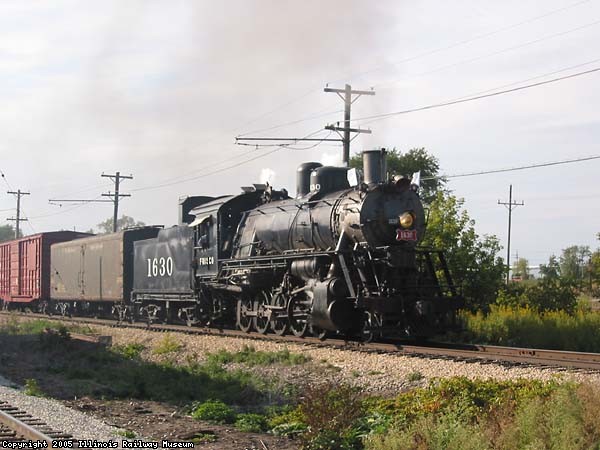
The Sunset version has a different style crosshead guide. Must look at my collection of detail shots of the Frisco 1630, which appears to have the same style.

|

30.12.05

LAWS OF CONSERVATION. Laura at 11-D has a modest proposal.
One income should support one family.
She's reacting to a New York Times article suggesting that houses are really cheaper than they were 20 years ago and a reaction by Elizabeth Warren, one author of The Two Income Trap (did I really read that two years ago???), who has a condensed version of her argument at a bankruptcy symposium.
In other words, it now takes two earners to pay a mortgage rather than one. A generation ago, a typical wage-earner could buy a typical house; today, it takes two incomes to buy an average home in fully 75 percent of America's cities. And that means housing is just as affordable as it used to be?
Ladies and Gentlemen, I give you the Say Aggregation Principle (hey, that's not a bad item to be ranked #1 in Google searches!) Economics is about tradeoffs. The economic emancipation of women is a good thing, as some people see it. Additional buying power from two-income families is a good thing, as many people see it. No-fault or unilateral divorce may be a good thing, but that's why we have Culture Wars. Culture Wars or no, it is policy. Ah, but then we get the Gary Becker question, "what is the effect of no-fault divorce on the labor force participation rates of married women?" If either partner is able at any time to end the marriage, attachment to the labor force may be cheaper insurance than salting away some of the allowance money. But with more labor force participation, our old friend Value of Output = Wages + Interest + Rent + Profit kicks in.

And alas, that is going to be as true in the heartland, where house prices are somewhat lower than they are in the hot coastal locations that Tapped's Garance Franke-Rutta and Ezra Klein seem to think are more desirable. (A hint to all you coastal denizens: there is something called interregional arbitrage. Places that rate higher according to school test scores or quality of life surveys or anything else will command a premium. Value of Output and all that again.)

As far as the houses being cheaper, it's difficult to compare. I don't recall many houses being built years ago with 3 car garages, 2 1/2 baths, and a spa in the master bedroom. Some of the upper-bracket ranch houses on offer around here have all of those. Interest rates were a lot higher in those days, as well.

|

WE GET PREDICTIONS. At Tapped, Matthew Yglesias and Ezra Klein have theirs. Guys, the New Year no longer begins on April 1!

|

A DISTINGUISHED ALUMNI AWARD IN THE MAKING? Newmark's Door picks up a Washington Monthly profile of Markos Moulitsas Zuniga, proprietor of the Daily Kos. The profile mentions that Mr Moulitsas graduated from Northern Illinois University. Mr Moulitsas corrects the profile to note that he was rather busy running "the school paper." A quick search of the Northern Star's alumni profiles confirms that Mr Moulitsas was at Northern Illinois, although it's not clear whether he graduated in 1995 or 1996. This excerpt from a faculty discussion list in late 1995 suggests he's been a controversialist in training for some time.

|

29.12.05

THE EVOLUTION OF COMMUNICATION. In November, Extension 720 offered a one hour chat with Leslie Savan, author of Slam Dunks and No-Brainers: Language in Your Life, the Media, Business, Politics, and, Like, Whatever. I had some book-club bonus points and ordered it. Here is Book Review No. 49. At the risk of sounding like one of the pop-phrases Ms Savan skewers, Stay. On. Message. Ms Savan at times attempts to bring Edwin Newman up to date, bemoaning jarring neologism that robs language of content. At other times, she's a disciple of George Lakoff (who makes a cameo appearance, although not as a repackager of Democratic talking points) eager to pin abuses of language on a Republican establishment repackaging misguided policies as good medicine through proper choice of words. Ultimately, her book fails either as curmudgeonry or as polemic. (On the stack of things to get to is Sandra Stotsky's Losing Our Language, which appears to be a somewhat more scholarly polemic.)

Pop phrases are at once content-free and precise, enabling a speaker to end a conversation in such a way as to preclude any possible refutation. That's the message of the longest chapter. (Yeah, right.) Ms Savan explores several origins of pop phrases. Many have African roots. That goes beyond the hip-hop inspired "Z" and "X" and "2" constructions; apparently "24/7" is a rap number phrase. (The linked page sheds no further light on the expression's origin.) But it strikes as a bit of a stretch to trace "bad" as "excellent" to a Mandinka phrase translating as "it is good badly," as she contends on p. 53; "I want it badly" might work as a source as well. Some phrases are -- possibly manufactured -- attempts to be the opposite of a snob. That is not to say to be nyekulturniy, an expression for which "boor" is an inadequate substitute. Some emerged from the academy or from high politics. These words and phrases are a different sort of conversation-ender, but Ms Savan treats them as words that "lend a halo effect." Examples: appropriate, agenda, celebrate, issues, offended. Many of these words function as vague space-fillers. Then come the expressions that originated with computer experts or capacity-constrained message systems. (Come to think of it, SOS and 10-4 have those properties. The technological constraints are the same. Have these phrases lost their punch, or did Ms Savan fail to research them?)

When the catalog is done, however, we have ... whatever. No call to address the consequences -- and Ms Savan identifies some -- of a less-precise, more cliched language. No suggestion that people whose vocabulary is limited to pop phrases are boring dinner companions. No rigorous investigation of the adverse consequences of either/or, select an option from the choices offered on the screen or on voice mail thinking. Neither scholarly study nor curmudgeonly complaint, Slam Dunks and No-Brainers may make some people comfortable with their prejudices, but it will not change many minds.

|

NO GUTS, NO GLORY? Cato Institute president Ed Crane concluded his final report of 2004 with this:
I was pleasantly surprised at how well the elections went in Afghanistan, but I fear that won't be the case in Iraq. I certainly hope I'm wrong. I hope I am right, however, about my prediction for 2005: we are going to capture Bin Laden and privatize Social Security.
That's why I won't make predictions.

The Anchoress has. So have several writers at National Review. I'm sure there are others. Time for a Carnival of the Predictions?

|

TONIGHT'S RAILROAD READING. There's nothing quite as refreshing as a midsummer swim in Lake Baikal. The best way to get there is a ride on the Circumbaikal Railway, a piece of which continues to operate as a tourist railroad. (The Main Line of the Trans-Siberian had to be relocated to permit construction of the Irkutsk Dam along the Angara River. The Railroad once followed the Angara valley from Port Baikal to Irkutsk.)


This picture suggests the yard at Port Baikal has become a bit of a railroad museum (note the pantograph beneath a catenaryless Siberian sky.) These kids are climbing on yet another Lend-Lease Decapod from the 1940s.


At midsummer, we're not above using the neither lent nor leased Decapods for patriotic displays.


July 3, 2004.

|

UNIVERSITIES ARE FAILING AT THEIR MISSION. The word is getting out. University Diaries points to a Christian Science Monitor editorial calling on the legislative bodies that funnel tax money to higher education to ask for more accountability.

The US system of higher education is the best in the world, and regulating it should not be done lightly, especially because the causes for these literacy declines may be quite fixable: Many public universities have lowered their standards in accepting students, and a huge influx of Latino immigrants in the 1990s led to many more nonnative English speakers in schools.

The ranking of colleges, such as those done yearly by US News and World Report, has already put a spotlight on weaknesses in higher education. (US News may now want to add literacy rates to its criteria.) But federal and state taxpayers, too, should be entitled to know which colleges efficiently and effectively use government aid to achieve the best results.

I submit that the U.S. News and similar league tables do not so much put a spotlight on weaknesses as they identify the best places for well-to-do families to buy prestige, content be hanged. I submit further that, although higher education still runs a trade surplus, that surplus is driven by graduate programs less affected by the access, assessment, and retention follies plaguing the undergraduate enterprise.

Milt's File recommends Inside Higher Education's reaction to The National Assessment of Adult Literacy. Money paragraph:
“This seems like another piece of hard evidence, a fairly clear indication, that the ‘value added’ that higher education gave to students didn’t improve, and maybe declined, over this period,” said Charles Miller, the former University of Texas regent who is heading the U.S. education secretary’s Commission on the Future of Higher Education. “You have the possibility of people going through schools, getting a piece of paper for sitting in class a certain amount, and we don’t know whether they’re getting what they need. This is a fair sign that there are some problems here.”
I'll work on a tactful way of communicating this information should anyone with a stronger command of entitlement than of economics stop by to negotiate a grade increase.

There's a good bull session on this survey, and related topics, at Joanne Jacobs's place.

|

THE OLD FAMILIAR CAROLS. Enroute to points north, I discovered a radio station that was playing nothing but Christmas carols (with the secular seasonals such as Sleigh Ride and Jingle Bells thrown in, which got me thinking about the physics of horse-drawn sleighs, but I'm still puzzling out what sort of snow would be conducive to "dashing through.") I claim no particular expertise in Christmas carols (that's William Studwell's job) but note some evolutions in the form, not all positive. The station had a limited playlist, sometimes offering more than one arrangement of a piece. O Holy Night received multiple playings, and the line "And in His Name all oppression shall cease" got me wondering how much of his Church's history Placide Clappeau knew. That he's French and the work is from the late Romantic era suggests something. The station also played something new in the mega-church style (modern harmonies, some brass, some singing kids, some contemporary phrasing) but as the entire program was pre-packaged without introductions I don't know what I heard.

I am hereby lodging a humbug against some pop arrangements of the standards. The absence of introductions hampers informed commentary. But if a fashionable young female singer is going to do Silent Night, it detracts to edit out all the difficult words and end each verse with "sleep in heavenly peace," no matter how sweet the sentiments.

Enroute south, I played the River City Ragtime Band's Christmas in Dixieland. The band's promotional material correctly notes,
Applying the Dixieland style to Christmas music is not sacrilegious. In fact, when the music was played to a minister, he suggested that the River City Ragtime Band was fulfilling the Biblical edict: "Make a Joyful Noise Until the Lord, All Ye Lands." The River City Ragtime Band interprets the word "Lands" to include "Bands."
True enough. That said, Go Tell it on the Mountain adapts to jazz combo better than, say, Good King Wenceslas.

|

23.12.05

MARKING OFF. He's making a list, checking it twice ...


Back next week. Merry Christmas and Happy Hanukah.

|

E-T-T-S, MADE RIGOROUS? Book Review No. 48 is Jared Diamond's Collapse, which I finished before I did the Christmas shopping. It's a longish book, attempting to unravel the reasons for the failure of societies ancient (Viking settlements in Iceland and points West, Easter Island and elsewhere in the Pacific) and contemporary (Rwanda, the former mining regions of Montana.)

First, a stylistic observation. What is the convention in archaeological writing about using the words of the civilization under study? We learn that the Easter Islanders called their statues moai and the platforms they stood on ahu. Is it really necessary to make further references to moai and ahu rather than write "statue" or "platform" or often, "it?" Elsewhere in the book, things that one might refer to by the indigenous word get referred to by the English word. (On the other hand, it might be amusing to read the Icelandic for "lutefisk," to round out what Professor Diamond did glean about how Vikings subsisted in Iceland and Greenland, places less hospitable to the raising of cattle and hogs, and on the latter, having competition over the fisheries and rookeries from Inuit that had a head start learning how to harvest them.)

Second, a possibly irreverent compare-and-contrast. Im many of the vanished societies, the raising of statues, temples, and other monuments to the rulers reached a peak as the society began to run into trouble. (I want to distinguish this observation from a somewhat more disturbing tic in Professor Diamond's work, that of the society "peaking" before it collapses. Elementary calculus. Can't happen any other way.) Professor Diamond interprets the arms race in ever greater monuments as last-ditch attempts by the rulers to hang onto their power and reverse the decline. (Gods displeased. Must erect more grandiose statue. Years ago, David Hapgood's The Screwing of the Average Man raised a similar gripe with elite calls for "sacrifice." Finish Pyramid before Pharaoh dies was his metaphor.) But that provokes a rather grim game. What, in 100 or 200 or 500 years, will historians view as the Easter Island statues of our time. Will it be higher education? Yes, our graduates are less and less able to handle entry-level jobs, but one more diversity program will fix that. Will it be national politics? Yes, we are borrowing more and more money, but one more tax rate cut will bring in a surplus. Will it be the cities? Yes, we've been becoming less and less livable, but one more light-rail system will reverse sprawl. Have I left out your favorite? The suggestion box is open. Or will the great failure be something we've completely overlooked.

On to the substance ... Professor Diamond has discovered some fundamentals of economics. Much of his work identifies collapses that came when the Easter Islander cut down the last tree, or the Viking butchered the last pig, or the miner cleared the last vein. He correctly invokes the tragedy as the commons as the model behind the resource depletion, and correctly identifies the establishment of property rights and rules of contract as methods to internalize the costs of depleting the resources, a development that also makes it more difficult for elites to take actions and impose costs on others.

There are other passages in the book where Professor Diamond's command of economics (he is a geographer, there is division of labor) is a bit shaky. This passage at p. 164 is particularly grating.
Socially stratified societies, including modern American and European society, consist of farmers who produce food, plus non-farmers such as bureaucrats and soldiers who do not produce food but merely consume the food grown by the farmers and are in effect parasites on the farmers. ... In the United States today, with its highly efficient agriculture, farmers make up only 2% of our population, and each farmer can feed on average 125 other people.
Let's try a substitution here.
Socially stratified societies consist of health care professionals who produce longevity, plus non-health-care-professionals who do not produce health care but merely consume the health care produced and are in effect parasites ...
The substitution works. With primitive life expectancies of 30-40 years, on average each of us who has attained middle age or greater is parasitic on the health care industry. It's called division of labor. It's structured by mutually beneficial trades. And if resources are properly priced (something that doesn't hold up in some of Professor Diamond's tragedy of the commons situations) it leaves all concerned, farmer and non-farmer, doctor and patient, poet and politician, better off.

It's a long read, instructive in places, provocative in places.

There's a good chance I'll make the fifty. The next two will be somewhat lighter fare.

|

20.12.05

COMPARE AND CONTRAST. I have located a marvelous collection of Russian train photographs. On this page, a Lend-Lease Yem 4232 at Petrovsky Zavod, near Chita, in June 2004, and in need of some attention.


Not far from home, a similar locomotive built for Russia during the First World War sometimes pulls passenger -- or historic freight -- trains at the Illinois Railway Museum.

|

COMMERCIAL FRUITS OF VICTORY. The Admiralty have a Trafalgar 200 commemorative site, complete with commemorative and souvenir items thoughtfully grouped as household gifts, or suitable for Christmas. The household items do not include a square wooden plate, just the thing for serving those square meals.

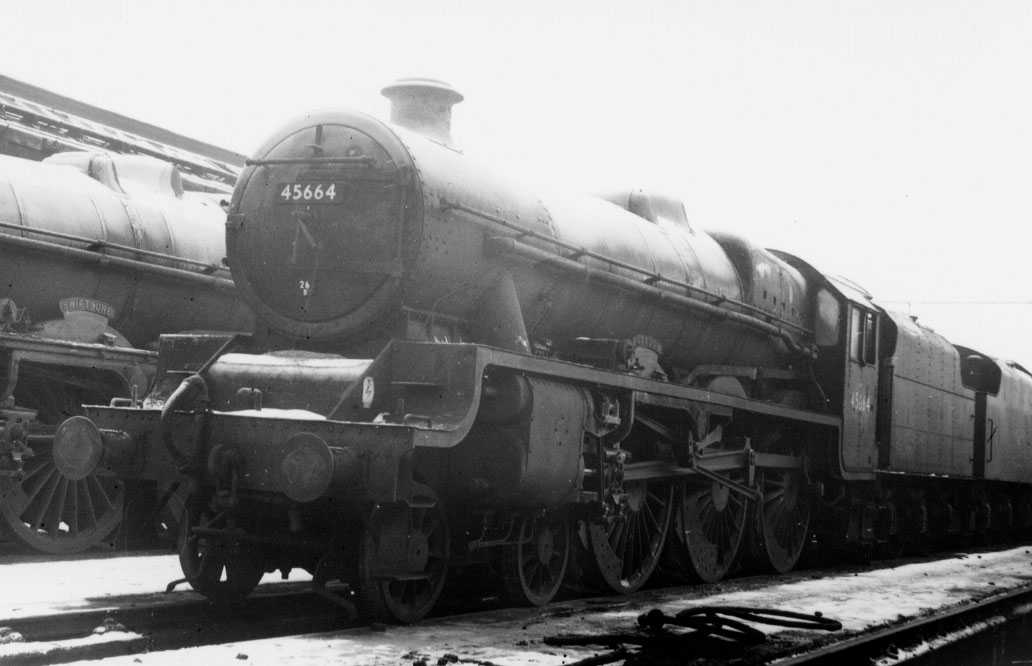
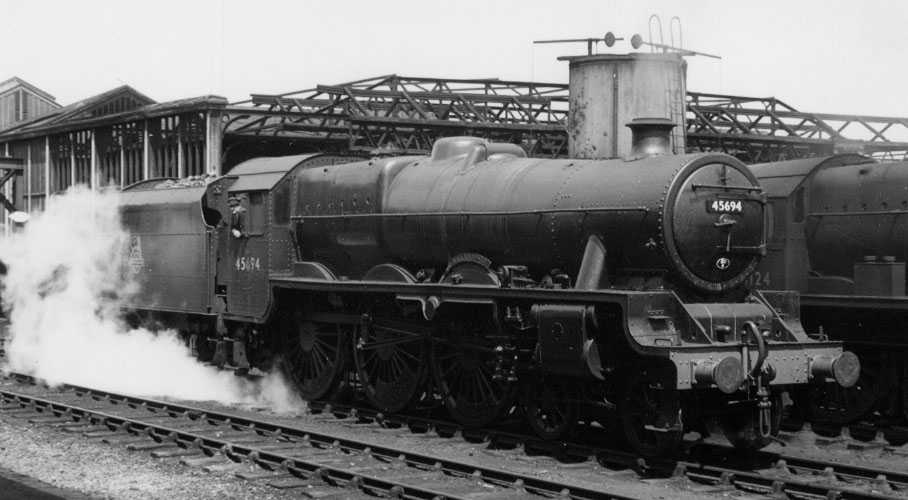
The British railway historical magazine Backtrack has been offering a Trafalgar retrospective of a different sort. A number of the London Midland and Scottish "Jubilee" class 4-6-0s were named for Admiralty figures and ships. Herewith a quick look. This site offers many more roster and action photographs of Jubilees.


Bellerophon, the shed looks like the Germans had at it.


|

LAYING YOUR SHIP ALONGSIDE THAT OF THE ENEMY. England observed the bicentennial of the Battle of Trafalgar in October. At that time, I was working through Nelson's Trafalgar, and offer a few observations as Book Review No. 47. The battle itself was fought under conditions racing sailors would describe as a "drifter," with the British to windward and blanketing, and the French and Spanish making every effort to shoot away the British ships' rigging, the better to make their escape and lift the blockade. A few days after the battle, a storm observers describe as a "hurricane" (Is that correct? The just-ended hurricane season was noteworthy for one such storm making landfall in Portugal ...) sank many of the French and Spanish ships that had surrendered to the British. It took a few days, as well, for news of the victory to reach England or the defeat to reach Napoleon. The Franco-Spanish alliance of the day was a bit shaky anyway.

The information the book provides about ordinary life on the ships (squalid) brings a few surprises. Consider "slush fund." It didn't originate with Chicago aldermen receiving kickbacks on street-salt contracts; rather, it's money the ship's cook earned by selling the fat-scum off the stew-pot to supplement his own income. Half of that scum was requisitioned by the ship to waterproof the rigging ... picture yourself going aloft in a blow gripping shrouds reeking of rancid cow fat. In order to pack space in the few cupboards in the mess, plates were square with raised edges, giving rise to the expression "a good square meal" (the author suggests this terminology is ironic; it has always been the sailor's one prerogative to gripe) as well as "on the fiddle," referring to the sailor that filled his plate to the raised edges, called "fiddles."

|

19.12.05

EXTRAPOLATION? This week's installation of DoDo's Monday Train Blogging focuses on failures that seemed logical at the time.
For example: if the steam engine could be made into a locomotive, why not put a coal-fired power plant on the rails?
Result: the Chesapeake and Ohio and Norfolk and Western turbo-electric locomotives (and a later Union Pacific attempt to use pulverized coal as the turbine fuel -- NOT as boiler fuel the way stationary power companies do.)


The post also contemplates what happens if one attempts to go beyond double-expansion compounding to triple-expansion (not pretty; the dodge works better at sea where engines are worked at a constant speed for a long time) or generalizing the idea of five coupled axes to six or seven.

But if those are failures as a consequence of unanticipated difficulties with what appears to be a straightforward extrapolation, there are other kinds of failures to contemplate. Consider this French attempt to put a coal-fired power plant on rails.


Inline steam engine turning an alternator wired to motors on the bogies. All that's missing is Hermann Lemp's control system and a Winton 201A ...

|

RULES WRITTEN IN BLOOD. Two school friends plan a train trip to do some shopping. Things go terribly wrong.

At the rail station in Elsenham, Essex, where the girls were to catch the train, they probably rushed over the level crossing to buy their tickets on the far platform. Like many village stations, Elsenham has only one ticket machine and no footbridge.

Then, when they could see passengers boarding the Cambridge train, the girls probably hurried back over the crossing where the pedestrian gates remained unlocked. But by now there was a red light and a klaxon bell warning of an express train from Birmingham to Stansted.

Did the girls imagine that these warning signals were related to the Cambridge train already in the station? Possibly. They either ignored — or failed to see — the express train, which was travelling at 80mph.

The British are far more rigorous in separating automotive and pedestrian traffic from railroad rights of way, and yet there is more the public would like the authorities to do.

|

VENTING. An Inside Higher Education columnist discovers "Oy, vey!" students, and suggests same consider how others see their requests.

Translation Guide for Students

When a student says: Will that be on the test?
The professor hears: I could care less about learning. Grades are my sole concern.

When a student says: I missed the exam because I had to go to my grandmother’s funeral.
The professor hears: I was too busy partying to study, so at the last minute I panicked and skipped the test.

When the student says: I have to miss class next week. What will be covered?
The professor hears: It’s easier to ask teachers for special treatment than to read the syllabus.

When a student says: May I have an extension?
The professor hears: That ridiculous class rule that late papers get reduced grades shouldn’t apply to me. After all,I’m the center of the solar system.

When the student says: I was sick last week. Did we cover anything important?
The professor hears: When I skipped class last week, did you cover anything I need to know for the final? It’s too much trouble to ask my nerdy classmates, and my friends don’t pay attention.

When the student says: Can I still get a B?
The professor hears: I just realized that not doing any work all semester and getting a C minus on the mid-term paper might mean a low grade.

When the student says: What are your office hours?
The professor hears: I haven’t even bothered to read your syllabus but I still want you to spoon feed me private tips that will get me a higher grade.

When a student says: There are personal reasons I haven’t been doing well in your class this semester.
The professor hears: Maybe if I concoct a dramatic sob story for this dupe, I’ll get special treatment.

When a student says: Can I do something for extra credit?
The professor hears: Even though I haven’t cracked a book all semester I still deserve special dispensation and extra effort from my professors.

When a student says: I can’t take the final exam when it is scheduled. Could I take it in January?
The professor hears: I talked my parents into leaving early for our ski trip to Aspen, and if I postpone the test until after the break, my friends will tell me what to study.

When a student says: Plagiarism? But I promise that I hadn’t even seen the Web site when I wrote my paper. It’s a totally random coincidence. I promise.
The professor hears: Busted! And I can’t believe that this dinosaur knows how to do a Google search.

When a student says: Cheat? Me? But I swear I didn’t do it. You’re not going to give me a zero are you?
The professor hears: Even when I’m busted, normal punishments should be rescinded because I’m the center of the universe. Better try to lie my way out of this one.

Despite the cynicism, the columnist concludes with a bit of solid advice.

I believe that we serve our students well when we respectfully remind them of — or teach them — manners: especially through our own actions and interactions. It is ideal, I believe, if we impart these lessons in etiquette with grace, kindness and good humor. It is not always easy to maintain composure and respond with generosity when faced with bad-mannered students — but we can try.

As authority figures, we automatically are role models — and models not just of intellectual prowess, but also of attitudes and habits. We are — like it or not — in positions of authority vis a vis our students. Given that, the stance of a benevolent dictator is a reasonable posture to assume. An “eye for an eye” is an inappropriate strategy for those who wield power.

Part of our mission, I believe, is to demonstrate maturity, respect and empathy. Hopefully, students will internalize and assume a similar mien over time. Politeness rules. Despite my sardonic translation sheet, I do believe that we teach most effectively when we are consistently considerate of our students I believe that we can profess most powerfully when we keep in mind that students may be learning far more from us than the scholarly content of our class lessons..

When we start to lose our tempers and respond snidely to Oy-vey students, perhaps this quote by Albert Schweitzer is apt: “Only those who respect others can be of real use to them.”

Let me add only this: each of the special requests deconstructed infra is a request that the professor be inconsiderate of those students who did play by the rules. There are tactful ways to remind the special pleaders that equal treatment under the rules presupposes equal performance subject to the rules.

|

CARNIVAL CALL. Carnival of the Capitalists offers a return engagement at Coyote Blog, and once again a word from the right sponsor.

|

SOMETIMES YOU CAN GO HOME AGAIN. Sean at The American Mind brings news of the return of Suburpia. I have not been able to locate any sub shop, independent or chain, with exactly that mix of flavor and texture in the lettuce ... Mine must have been a minority preference as most of my friends and acquaintances preferred Cousins.

|

HIER STEHE ICH, ICH KANN NICHT ANDERS. Degree not always guarantee of skills. (Via University Diaries.)
Many state universities, [U.S. Commissioner of Education Statistics Mark Schneider] said, now have open admissions policies that accept almost all high school graduates, including those who might not be as well prepared as their peers were decades earlier. In addition, colleges and universities are taking in a more diverse population that might have language or cultural challenges. Or, he said, colleges "may not be doing the job as effectively as they could be."
You think?

At Betsy's Page, a proposal to subject Higher Ed to the same sort of scrutiny some of the common schools have faced.
It's time to apply the same "get tough" approach to outcomes in education that we've begun to apply to secondary schools to colleges. Perhaps, if these colleges knew that future employers would know that they are graduating large numbers of students who are not proficient readers, those schools might decide to toughen up their standards. I suspect that these large numbers failing the test come from a certain tier of colleges and prospective students might like to know that information. How many of these colleges are public colleges? Are taxpayers supporting institutions that are failing to make sure that their graduates can read complex material?
What was I writing about market tests?

RUNNING EXTRA: More from University Diaries here and here. First check this symposium at Australia's The Age. Then read Harvard's Derek Bok.
Changing demands in the economy are forcing employers to pay increasing sums to remedy deficiencies in the writing and computational skills of the college graduates they hire. In addition, more and more work normally performed by college graduates is now being outsourced to other countries.
University Diaries suggests sloppiness elsewhere in the curriculum might be crowding out the learning that used to go on in college.
Yet some professors teach primitive relativism; and even if they don’t, it’s encoded in the DNA of the cultural competence and diversity training fundamental to the environment of most American universities that even elementary acts of judgment and reasoned preference are abominations. Add to these influences the gelatinous mass that makes up the curriculum of many of our colleges, and you see why the reigning moral philosophy of some of our 21-year-olds is playdoh relativism.
To go, all too often, with playdoh spelling and figuring.

|

CARNIVAL CALL. The fourth (collegiate) Teaching Carnival is with the New Kid on the Hallway. As one might imagine for this time of year, there is a lot of introspection and more than a few gripes about the students who don't measure up ...

|

"HUMANITY MAY HAVE DIFFICULTY SURVIVING ITS GENIUSES." That's one of many asides in John Pina Craven's The Silent War, which is Book Review No. 46. The book is those recollections of a scientist with extensive submarine service experience, and a security clearance that limits what he can reveal. Filter what you read accordingly. It is, that caveat aside, instructive to learn how close the Navy came to losing Nautilus, and to scrubbing the submarine-launched ballistic missile programs. I read this book to obtain more information about the rogue Soviet submarine mentioned in Red Star Rogue. Mr Craven's work confirms in part and questions in part the information Red Star Rogue offers. The confirmation is intriguing and troubling, in that both works suggest the Soviet Politburo was not in complete control of its military (Mr Craven casts himself as occasionally holding back Pentagon and Defense hotheads pending the day when renegade elements in the Soviet Union self-destruct the place by attempting a coup) and U.S. negotiators were able to exploit that.

There are lesser bits of new knowledge I gleaned as well, such as "the wedge containing the bow waves invariably makes a perfect 19 degree 28 minute angle with the path of the ship. Similarly the bow waves diverge tangent to a line that is always 35 degrees 16 minutes with the path of the ship." That holds for rowboats and aircraft carriers alike. Might be useful information for painting backdrops.

|

18.12.05

THE ALL WEATHER MODE MAKES HEAVY WEATHER. This painting greets passengers disembarking from or boarding the Hiawatha at Milwaukee's downtown station.


Last month's mental health excursions got me thinking about doing some more train riding, this time with work less time-sensitive than a stack of homework assignments. In browsing the Hiawatha schedules, it all of a sudden occurred to me ... this is an 89 minute timing end to end. In steam days, the Milwaukee bragged on its 85 Minute Train service that made one stop at Glenview. A plan forms. Board the 10.20 am off Chicago. Ride to Milwaukee. Stuff self with Real Chili. Browse some bookshops. Board the 3.00 pm return, get home at a decent hour.

The plan started to unravel at Union Station. The 8.00 Milwaukee, due in at 9.29 to turn as the 10.20, limped in at 9.59. Instead of the cleaners descending on the train to prepare it for the quick turnaround, carmen and mechanics got to work cutting out a bad-ordered coach. The station staff kept us informed of developments, but many of those weren't encouraging. "We've now broken the train apart." "We've brought the replacement coaches over." "We've put the train back together." "The lights aren't working yet." Some passengers left the boarding area, opting to drive instead. Around 11.40, the train is finally ready for boarding, with an 11.58 departure. With no further difficulties, a somewhat more rushed lunch and the original schedule is still possible. There were, however, reasons beyond troubles with the coaches delaying the inbound equipment. The signalling was not working north of the Wisconsin border, requiring the crew to make "know-nothing" stops at permissive signals, proceeding at restricted speed, as well as to dismount and inspect the points at interlockings. Plod, plod. Finally, into Milwaukee at 2 pm. The equipment on the delayed 10.20 is supposed to become the 1.00 pm return to Chicago. Amtrak annulled that train and used the equipment to protect the 3.00 pm trip. I looked at the departure board, noted that there was another departure at 5.45, and modified my plans somewhat. (After having to arrange overnight lodging in Brussels, on short notice, relying on schoolbook German, I'm not going to give up easily on an itinerary.) Walk to the chili parlor. Stuff self. Walk to the bookstore. Spend money. Window-shop the Grand Avenue. Have an E-T-T-S moment thinking about eight stories of Gimbel's where the riverside Borders now is, and eight stories of Boston Store where a much-reduced store occupies the first two floors, the upper stories are lofts, and the bargain basements are gone. I wonder if any of the owners of eighth-floor condos have memories of the toy departments that were once there ...

Back to the station. More troubling developments. The stock of the 1.00 train ordinarily turns as the 3.15 Chicago, arriving at 4.44 with an hour to turn it as the 5.45. Amtrak apparently decided to annul the 3.15, although there would be stock in Chicago for one, rather than contend with the signal troubles and more late running. Thus, the 5.45 return is also annulled, with the 7.30 train to be run, and the possibility of Chicago passengers being able to board a late-running Empire Builder expected around 6.40. I'm thinking about the 2 hour running time with the signal troubles, the prospect of equipment failure, and the risk of missing the 12.40 am scoot to Geneva if everything goes badly. Some people are pooling their money to hire a van and drive to Glenview and downtown...

The worst-case scenario doesn't materialize, fortunately. At about 6.40 there is some noise outside. Not the Builder. It's the 5.08 Chicago. Might the signal troubles be fixed? Station staff advises all passengers to plan to go on the 7.30 as the Builder is still somewhere beyond Columbus.

Board train. Horizon car with leg and foot rests??? Consider possibility of a good run. Recall lap-timer feature on watch. Recall how to start it.

Amtrak 342 Hiawatha Service, Milwaukee-Chicago: 200 - 54557 - 51503 - 54579 - 54563 - 54017 - 54525 - 39. Locomotives 200 and 39 are "Genesis" series diesels. 54-series Horizon coaches have corridor density seating, 51-series have long-distance density with leg and foot rests. 15 degrees Fahrenheit at Milwaukee, clear and dry. The service difficulties have scared away passengers at Mitchell International (four passengers on) and Sturtevant (nobody on or off). Mayfair in the 72nd minute, Pacific Junction in the 75th minute, Noble Street 80, Madison Street 85, stop 85:52.75. Give 'em free rein to 110 and let's do some serious corridor railroading.

The Builder? It pulled into Milwaukee while 342 was loading. We left on time. The Builder left a minute or two later, and passed 342 on Lake Hill as 342 was leaving Mitchell International. (Note to overseas readers: two main tracks lets you do things you can't on double track.) But the signal gremlins apparently were not exorcised by the full moon, as we passed the Builder at the new crossovers north of Caledonia (A-70?) and ran ahead of it the rest of the way into Chicago. The crossovers at Wadsworth worked properly, getting 342 out of the way of a freight train and the 8.05 Chicago. Our arrival at Union Station caused some consternation among the redcaps, who had brought all their electric baggage carts onto track 17 expecting to meet the Builder. The Builder ran through and unloaded on track 28 at 9.15.

Metra back to Geneva was routine. But that was not the end of the weekend.


Geneva, Illinois, 9 am, December 18, habitat of the American dung beetle. Metra's weekend pass makes for a great day rover. I used it to get to Kenosha for the trolleys, and I have used it to shop at bookstores in Printer's Row and Hyde Park, and if I were venturesome enough, those in Evanston as well. There's also a way to go to Blue Island on one line and return on another, and at one time there were some great Polish grocery stores in downtown Blue Island, are they still there?

But today, it's the interurban time machine.

As a matter of pride, I still aim to walk from the Burlington or Milwaukee or North Western to the South Shore in 20 minutes. Today's routing includes a stop at the Union Station bakery, after confirming an on-time departure of the 10.20 Hiawatha (but the chili parlor's Sunday hours are different ...) and a walk east on Adams Street, where, between LaSalle and Clark, I discover a pub called "Elephant and Castle," complete with the figure that later evolved into the bishop (yes, you'd think it's the rook, but the Russian notation for "bishop" begins with "C" as in "Slon," and that's Russian for "elephant," go figure) on the sign. Keep this in mind for future reference. On my first trip to London, I made a point to ride to "Elephant and Castle" because that struck me as such a fine name for a pub. Get there to find a small mall, decorated with a pink elephant, and no food court, and a rather tatty billiards club. There's no place like home, there's no place like home. There's also a rather funky old-style office tower with lots of domes on the northwest corner of Lake and Wabash. Looks like it's been there since I was riding the North Shore, but this is the first time it registered ... lighting didn't work with the cheap digital, but I had the Canon along. Picture of the building later.

The cheap digital did work well enough in "Millennium Station," the new name for the Illinois Central - South Shore Randolph St. Station in the basement of the Prudential Building.


This is looking past the passenger waiting area toward the South Shore ticket office and boarding concourse. There isn't a straight line in the place until one goes through the doors to the South Shore's platforms.

The old Gary, Indiana, New York Central and Baltimore and Ohio joint station is still standing, if somewhat trashed. The U.S. Steel Gary Works continues to smelt iron and cast steel.


But the signal gremlins were at it again ... the 11.59 am Chicago-South Bend was knocked for about 20 minutes owing to signal troubles along the East Chicago bypass and through Gary. I wasn't concerned about missing my return train from South Bend, as the outbound equipment returns as the inbound train, but the signal troubles and the prospect of heavy loads of Chicago Bear fans on the return had me wondering about cutting my connection back to the North Western a bit close.

Not to worry. Through the dunes, the signals were working. The South Shore dispensed with the traditional "cut" at Michigan City Shops, and with no passengers on or off at Hudson Lake, it's a fast ride to the South Bend airport.


In at 3.35, time to disembark and take a few pictures, passengers begin boarding.
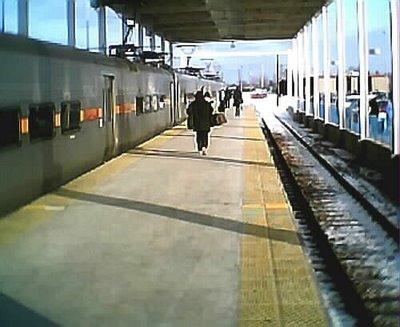

It's still possible to work a streetcar turnaround. Departure for Chicago is at 3.42. At Grandview substation, the South Shore begins to parallel the old New York Central. There was a long freight train going west as we crept around the curve onto the original mainline alignment. Off the curve, wind up the controller, overtake that freight train within two miles and leave it behind.

The "genius department" at Michigan City Shops still has its work to do.


The oldest of the South Shore's current fleet of cars are about the same age at which the South Shore rebuilt its steel "arks" as the longer, air-conditioned cars that had to be babied along into the early 1980s. Time passes...

No "add" at Michigan City either, and relatively few Bear fans boarding. The train made an additional stop at 18th Street to set down the Bear fans close to Soldier Field, and I did make the connection with time to spare.

|

16.12.05

ALLOCATING SCARCE RESOURCES AMONG COMPETING USES. The editors at the New York Times would prefer not to tell New Orleans: Drop dead.
Maybe America does not want to rebuild New Orleans. Maybe we have decided that the deficits are too large and the money too scarce, and that it is better just to look the other way until the city withers and disappears. If that is truly the case, then it is incumbent on President Bush and Congress to admit it, and organize a real plan to help the dislocated residents resettle into new homes. The communities that opened their hearts to the Katrina refugees need to know that their short-term act of charity has turned into a permanent commitment.
Their interpretation.
If the rest of the nation has decided it is too expensive to give the people of New Orleans a chance at renewal, we have to tell them so. We must tell them we spent our rainy-day fund on a costly stalemate in Iraq, that we gave it away in tax cuts for wealthy families and shareholders. We must tell them America is too broke and too weak to rebuild one of its great cities.
For another interpretation, read this.
Today, most central cities feature horrific educational deficiences, crumbling infrastructure, and stultifying regulations that drive commerce ever more into the suburban periphery. Yet most city leaders—not to mention productive citizens in the rest of the nation—avert their eyes from these problems until a trauma like Katrina forces the products of our urban maladministration into view. Rather than re-examine their bankrupt social and economic premises, urban elites prefer to channel money into sports stadia and convention centers, hip lofts and restaurants, hoping somehow this will suck talent and wealth into their cities. As if today’s urban underclass will just fade away, and leave the cool hipsters unbothered to enjoy their entertainment districts.

This collapse of responsibility and discipline goes against the entire grain of urban history. From republican Rome to the golden ages of Venice, Amsterdam, London, and New York, cities have flourished most when they have served as places of aspiration and upward mobility, of hard work and individual accountability. By becoming mass dispensers of welfare for the unskilled, playpens for the well-heeled and fashionable, easy marks for special interests, and bunglers at maintaining public safety and dispensing efficient services to residents and businesses, many cities have become useless to the middle class, and toxic for the disorganized poor. Today’s liberal urban leadership across America needs to see the New Orleans storm not as just a tragedy, but also as a dispeller of illusions, a revealer of awful truths, and a potential harbinger of things to come in their own backyards.
The common theme: corporate welfare, whether it be no-bid contracts in Iraq or entertainment-industry subsidies in the States? (At least nobody mentioned the streetcars?)

|

QUOTE OF THE DAY. A Constrained Vision, distinguishing economics from applied mathematics.

And just because you can take derivatives and integrals doesn't mean you understand economics. If you can't explain opportunity cost, consumer surplus, deadweight loss, elasticity, etc. in plain English--which is what this class is supposedly teaching you--then you're just doing math problems.

If this guy could do that before taking the intro micro class, then he may be right that the class was a waste of his time. But most people can't. In fact, since I was a TA for this class for four semesters, I can tell you that a lot people can't do that even after taking the class. To tell them to skip ahead to micro with calculus is a terrible idea that would hurt, not improve, economic education.

I would add only that, sometimes, knowledge of the calculus tricks does aid the understanding. But the math is the servant; it adds precision to stories that can be explained in other ways.

|

FINDING THOSE MARKET TESTS. The dean at Anonymous Community would like to be able to identify a good college. He's not sure whether market tests (majors go in and out of vogue) or reputational rankings really do the job.
Reputation is, at best, a trailing indicator.
Exactly. Put more precisely, a good reputation is the undepreciated accumulation of past market tests. Without more information about the source he uses to obtain a performance measure for a non-profit organization, some of what follows is speculative, but here goes.
The academic prestige hierarchy (a version of Collins’ ‘reputation’) is almost purely based on inputs, rather than outputs. Pour lots of research money and some high-SAT undergrads into a university, add a good football team, and voila! Selectivity of admissions correlates very strongly with academic prestige, regardless of what the teachers in the classrooms actually do. As a former professor of mine put it, “we don’t often turn a silk purse into a sow’s ear.” Give me a college full of valedictorians, and I’ll give you a great job placement record, even if the undergrads spend all four years majoring in beer.
That last sentence sounds almost exactly like life in the major Japanese universities, which at one time offered a four-year respite between competing to get in, and graduating to a stressed-out life sleeping in the tube-hotels as an entering salaryman. But we haven't heard much about Japanese methods in the past ten years, have we? To quote John S. McGee, "Open markets are institutions in which powerful and appraising evolutionary forces are at work." Japan, Inc. is not exempt. Neither are the name-brand universities. In previous posts, I have noted the phenomenon (Blogger tech support, please fix the new search feature or let us have the old one back, my memory is a bit overloaded at the moment) of employers, frustrated with the noisy signal a prestige university transcript laden with inflated grades sends, asking applicants to provide SAT scores. Freefall of the American University, a work I recall referring to once or twice, introduces similar anecdotes about employers giving up on the name universities and recruiting at what the dean refers to as "So-So State" instead.

There is, however, another appraising force at work. Perhaps the very obsession with "access," "diversity," "inclusion," and all the other feel-good projects university administrators unfamiliar with genuinely hard budget constraints have been peddling, to the exclusion of education, drives the valedictorians (their parents??) to pursue the prestige degrees. That appears to be the British experience; and I intend to read Killing Thinking, which appears to have discovered that the competition to enroll at Cambridge, Oxford and some of the other best-known universities has increased concurrently with the push for "access" blended with "career preparation" elsewhere, and report on what's in there, sometime in the near future. This rather whiny(*) article A Constrained Vision recommended suggests that some in the academy see things similarly.
Every professor seems to complain that most high-school graduates are not really prepared for college, either academically or emotionally. More and more, our energies are devoted to remedial teaching and therapeutic counseling. Most believe that something is wrong in public education, or the larger culture, that can only be dealt with, in part, by selective withdrawal.
That rethinking the therapeutic model might be constructive hasn't occurred?? That the therapeutic model is generating that inefficient self-segregation isn't open for discussion?

Why inefficient? Call up another theme that recurs here, often with the shorthand "Spielberg effect" header. The short form: economics research suggests students who were admitted to Prestige Ivy but enrolled at Enormous State do about as well in life as students with comparable credentials who were admitted and enrolled at Prestige Ivy. The Prestige Ivy credential, then, is an inefficient signal of ability. Apparently some savvy "Coastie" parents have figured that out. (I can give you this link because it's a relatively recent post.)

That research puts the burden on the So-So States of this world in a different way, as it suggests the (relatively recent) pecking order in which onetime finishing schools become German-style research universities and onetime normal schools become So-So States is less well-defined than U.S. News, or the folks who would like to lord it over those lower down the food chain, would have you believe. In that light, consider these observations from Kelly in Kansas.
The reputation of our particular program is well-received in the field although students toward the end of the program (as they enter more 'professional practice' related classes) complain that we are expecting way too much. Only later when they themselves graduate do they thank us for preparing them for the real world. And since those evaluations come after the university's official student measurement instrument, the numbers don't correlate with any of this.
Let me reinforce that with something I learned as part of a now-abandoned Liberal Arts initiative, set up to induce more students to take their first two years at Northern Illinois rather than at a community college, by offering an additional certificate for completing a thematic cluster in general education. That was the enrollment motive. The pedagogical motive: a liberal arts cluster that enables students to make connections develops higher-order thinking skills useful higher up the corporate (or non-profit, or government) ladder. We received several different empirical confirmations of that assertion. Is that something a university could assess, in some systematic way? Outside my pay grade. Is that a market test at work? Yup. Is it telling the So-So States and Enormous States to expect more of their charges? I suspect so.

(*)Why do I call it whiny? Two examples:
They have negative memories of their own education. Although it takes some probing, nearly every professor with home-schooled children mentions traumatic childhood experiences in school. Professors, as a group, tend to have been sensitive, intelligent children who were picked on and ostracized. They foresee the same treatment for their own children, and they want to do everything they can to prevent the children from experiencing the traumas they experienced. Professors recognize how many of our most brilliant students have been emotionally or physically terrorized for a dozen years before they arrive at college. School sometimes teaches otherwise happy and intelligent children to become sullen and secretive and contemptuous of learning.
What's that line in Emerson about society everywhere at war against the individuality of its members? Professors aren't the only nails to be hammered down.

No doubt, my spouse and I have had to forgo some career options for our present way of life. Home schooling our children means we have to live on an assistant professor's salary. It also means living in a small town in the Midwest instead of an expensive city on one of the coasts. It means living in an old farmhouse that I am, more or less, renovating by myself. It means not eating out or going on vacations very often. It means driving older American cars instead of shiny new Volvos. But the big reward is the time we get to spend with our children.

I suppose, on some level, my spouse and I are rebelling against an academic culture that tells us we should both be working at demanding professional jobs while our children are raised by someone else. But we value this time with our children more than career advancement for its own sake. We don't regard ourselves as conservatives. We feel like we're swimming against the
mainstream of a culture that has sacrificed the family for economic productivity and personal ambition.

Give. Me. A. Break. (Laura, fire away!)

|

SWITCH OUT THE SCRAP LINE. Sometimes an officially retired steam locomotive would be pressed into service for the grain rush (United States) or to cover unexpectedly many diesel failures (Western Region of British Railways). Chris at Signifying Nothing observed a fitter checking over Mungowitz Ended.

|

MEASURE INPUTS, NOT OUTPUTS. Dr. Crazy must be getting the "I was expecting a higher grade ..." messages.

1. Tracy spends a lot of time on her schoolwork and works hard at her schoolwork.

2. Tracy has a 4.0 grade point average.

3. Tracy has a 4.0 grade point average because she spends a lot of time on her schoolwork and works hard at her schoolwork.

This is what is known as a logical fallacy.

Read it all.

There are advantages to teaching economics. I use a variant on the "you're measuring inputs" or on the "let's stipulate that everybody worked hard, you recall that working smart also enters the calculation?" all the time.

|

THE OBSERVATORY HEIGHTS CONDOS? The University of Chicago has put its Yerkes Observatory, in Williams Bay, Wisconsin, up for sale.

Historic, beautiful and obsolete, the observatory sits on 77 lakeside acres in Williams Bay, Wisconsin, and is a reminder of technology's inevitable replacement. Now more recreational site than center of science, the building is up for grabs in a deal that has some worried its historic importance may be compromised by the wrong buyer.

The former powerhouse of American astronomy, finished in 1897, has fallen out of the limelight since 1960 because of atmospheric pollution and new technological devlopments. A single full-time faculty member serves at Yerkes, doing mostly educational outreach.

The commenters on this post agree that the observatory is worthy of preservation, provided somebody else pays for it.

|

RENT SEEKING? An earlier post expressed skepticism about pinning your hopes of academic visibility on your athletic program, this time at [Southwest] Missouri State and Marquette. The University Diaries post that got me started includes a rather provocative comment.
Missouri State University was, until last year, Southwest Missouri State University at Springfield. Its name-change was part of a plan--hatched in close conjunction with Missouri's Republic [c.q.]political leadership, most of which is from Springfield--to "upgrade" the institution, start doctoral and professional programs, and seize tens of millions in state funds from the state's actual land grant institution, the University of Missouri. If Missouri State wants to do all this, and replace the University of MIssouri [c.q.] as the leading public institution of higher education in the state (conveniently located in a Republican stronghold, rather than the liberal college town of Columbia, where the University of Missouri is) it will need a Division I-A football team.
Public choice at work?

I'm not able to comment on that allegation. The public record suggests [Southwest] Missouri State's administration is embarking on the course Murray Sperber characterizes as "Upwardly Mobile." Here is the university's own explanation.
Today, the institution is a multipurpose, metropolitan university providing diverse instructional, research, and service programs. On August 28, 2005, the institution's name changed to Missouri State University.
The history is a bit eerie. We have a state teachers' college that evolves into a compass-point state college and then into a compass-point state university and, on its centennial, into Missouri State. At the 1995 centennial of Northern Illinois University, some senior administrators pushed to rename our former state teachers' college the University of Northern Illinois, as if transposing a few words takes away the stigma of the compass point. So far, that hasn't happened. Judge us by what we do, not by what we are allowed to call ourselves.

[Southwest] Missouri State's athletic department has made the tough decision to free up additional resources (to strengthen its football program?)
The current intercollegiate athletics budget is approximately $11.1 million, with about $5.1 million coming as the transfer from the university’s general fund. Included in the $11.1 total is approximately $3.9 million in athletic scholarships. Nietzel says the Missouri State athletics program should not be expected to be totally self-sufficient, but he also says it needs to come closer than it is now.
Again, some eerie similarities. (I'll leave aside the problems of self-sufficiency in a multiproduct enterprise. Too much heavy economics for a Friday afternoon.) Anybody remember Cut Five, Cap Two, the Wisconsin dodge to free up more resources and get some Rose Bowl wins for the Badgers?

Unfortunately, [Southwest] Missouri's up-and-coming Division I football team, should that be part of the master plan, is likely to be a desirable "bought win" for Kansas or Northern Illinois or Penn State (they could take over for Rutgers!) Something similar appears to trouble the football staff at St. Cloud State, where the administration would like to move to Division I in football and private communications inform me the coaches are less than pleased with the possibility. Despite Northern Illinois's recent successes on the field, I am still troubled by the away games at big stadiums (season openers at Ohio State and Tennessee the next two seasons) motivated in part by the requirement for average home and away attendance to meet Division I criteria. That the season is likely to be expanded to twelve games for everybody simply enhances the chances of young men being injured with little or no compensation for it. And the evidence of football programs building enrollment or academic reputation is generally anecdotal.

Then comes the other part of Upwardly Mobile, adding new graduate programs (this at a time when in many fields there are more novices than there are convents to house them) and converting Compass Point State into the equivalent of a land grant college. Consider economics. (You really want the administration to see that you could hold a faculty meeting on a landing?) Currently, [Southwest] Missouri State offer baccalaureate degrees in economics, and the college of business no doubt requires its students to be serviced. Now you want to throw in a masters' program? A Ph.D.? I did a quick scan of the faculty web pages. I found exactly one that provided a list of refereed publications. I found no evidence of any faculty publication in the discipline's eight leading journals. That poses a number of problems for the current economics faculty, none good. First, to add a Ph.D. the search committee might have to recruit people with research talents beyond their own. Challenging, not impossible. Then the existing committee of tenured faculty must consider standards for tenuring those new hires. Do they reject those who have not managed to publish any of their research in those leading journals, or do they find reason to reject those who have?

|

CLANG, CLANG, CLANG GOES THE TROLLEY. Live from the Third Rail finds radio coverage of New Orleans testing the streetcars on the Canal and St. Charles lines, complete with the gongs and the gear noise. Service resumes this weekend, with your tax dollars paying for free rides "through March," or through Mardi Gras.

|

STUBBORN, IMPOSSIBLE PEOPLE Thus does University Diaries characterize the late Senator William Proxmire, the Senator from Wisconsin who succeeded Joseph McCarthy, a stubborn, impossible person of a different stripe.
Tenacity was a key to Proxmire's temperament. It fueled his lonely crusade to talk the Senate into approving an anti-genocide treaty - he made 3,000 speeches to the Senate over 19 years to force that vote. He went more than 20 years without missing a roll-call vote, smashing the previous record. His job was his life.
He was no doubt best known for his Golden Fleece awards, many of which fought rearguard actions against what we understand as public choice in action. Although the obituary, in an urban paper, notes critics of the senator who wish he had, just once, made some kind of deal to bring more federal funds to Wisconsin cities, notably Milwaukee, it does not note his understanding of where his bread was buttered. There is a legendary story in the Wisconsin economics department about the day an economics professor got up at one of Senator Proxmire's public sessions and asked about his vote in favor of cheese subsidies. It happened before I got there, but given the independent cast of mind of the professor in the story, I do not doubt that it happened.

|

FLASH FORWARD. Thursday night's Steve and Johnnie included an interview and performance by Corky Siegel and Jim Schwall, who reunited the Siegel-Schwall Blues Band after a 32 year hiatus. (I was not aware at the time that the Siegel-Schwall concert upstairs at Wisconsin's Carson Gulley Commons, sponsored by the Lakeshore Halls Association, was a farewell tour of sorts.) I had seen some Corky Siegel performances at Summerfest and at the Egyptian Theatre in the intervening years. The new Siegel-Schwall album provides the title for this post. There are upcoming performances in the Chicago and Madison area.

We now end this wallow in the past.

|

ON THE AIR. The Friday, December 16 Extension 720 will feature Express Messenger Milt Rosenberg interviewing Express Messenger Joanne Jacobs, who will be describing and later taking 'phone calls about Our School, her story of Downtown College Prep, a charter school in San Jose. (The show will be on air 9 pm to 11 pm Central on WGN Radio, 720 on your AM dial, clear channel Everywhere East of the Rockies, or on the WGN website.)

This review gives some sense of what the faculty was getting into.

The staff, young and largely inexperienced, was thrown into the educational equivalent of a boiling cauldron without protective gear. DCP students read far below grade level; educators hoping to teach advanced-placement math found their students didn't understand fractions. It was frustrating.

Moreover, most students didn't understand the process of education. As Jacobs awkwardly writes: "Some hadn't done homework ever."

(Awkwardly? Reads like a proper Milwaukee locution to me.)

Another review pulls no punches about what the school did differently.

"Progressive" educators should not read further unless smelling salts are at hand. Enough "protofascism" (one critic's words) exists in DCP's academic and disciplinary policies to make a touchy-feely educator faint dead away. There is no pretense of the students being at the same level of the teachers, and no condescending sugarcoating of the intensity of the work. Homework is assigned in every class, every day. Students who are still learning English aren't immune from academic probation. English students who haven't done their homework must march "the walk of shame" to update their homework charts in the front of the classrooms. No 11th-grader earns promotion to their senior year without having the GPA and test scores indicating they're eligible for Cal State (for which scholarship funds were raised).

Hoodies are confiscated; rough language is cause for a discipline referral; any student caught with drugs or alcohol is expelled (three strikes applies only in baseball - at DCP, only two referrals are necessary for a disciplinary meeting). One girl gets pregnant her first year; she is allowed to return, but is not allowed to bring the baby on campus for other girls to fuss over, and never mind free daycare. One teacher proudly displays a card, written by a student, that says, "Our teacher makes us suffer." In another classroom hangs an old WWI poster, aflame with images of crashed warplanes: "Consider the Possible Consequences If You Are Careless In Your Work."

You mean setting high expectations and holding students to them ... leads to high performance?
I hope this book's true purpose is to convince truly progressive education reformers to reject the current system and strike out with new charter schools, because that's what it's sure to cause.
Indeed.

|

HAPPY BEETHOVEN'S BIRTHDAY.


This portrait, which dates to 1806, is among this online gallery.

The Eroica Symphony in E-flat premiered in April 1805, and Beethoven is working on the Fourth Symphony and the Violin Concerto in 1806.

|

12.12.05

A LITTLE THERAPY. No exams to grade, thus a brief opportunity to treat the day job as a day job, and guiltlessly work on wiring the first O-1 so that it will run properly.


This picture dates from September, 2001. The superstructure is in essentially the same condition today.

|

THOSE MOUNTAINS ARE MADE TO BE CROSSED. Book Review No. 45 is West End (also available here), Charles S. Roberts's reminiscence, with some history, of the Baltimore and Ohio Rail Road's initial crossing of the Alleghanies.(*) This work includes sufficient research and commentary to distinguish it from the more common compendium of roster shots that passes itself as a railroad book, thus meeting the minimal standards for the book reading challenge.

This stretch of railroad properly qualifies as the world's first mountain railroad. The builder of the Semmering Pass line in Austria did extensive research on Baltimore and Ohio's efforts before deciding that a railroad could be driven from Vienna to Graz by way of Gloggnitz, Semmering, and Mürzzuschlag. The climb from Piedmont to the summit alone is longer than the Semmering Pass crossing, and there are several long, steep slogs confronting eastbound traffic out of Grafton, West Virginia. To be sure, the summit at Semmering is a bit higher than the "Summit of the Alleghanies," but the difference is not as great as that on the Pennsylvania Rail Road's Main Line, another contender for a mountain railroad antedating the Semmeringbahn. (It's also possible to imagine Brahms or Dvorak taking the air at Deer Park or the Glades and working on some music. The mind boggles at the thought of Brahms in Altoona or Gallitzin.)

West End has in common with Mr Roberts's work on the Pennsylvania an excessive reliance on private information left to the reader to take on faith. Two examples. First, the thesis of the book is that the West End is the toughest stretch of railroad anywhere (others have more traffic or tougher grades) but the author provides no empirical support for that conclusion. Yes, lugging a lot of coal over sixty miles of moutain railroad on unstable rocks in wintry conditions is challenging, but to some extent that describes the Wyoming coal line and much of the Norfolk and Western. Second, the author refers to a Westinghouse plan for electrifying the West End in the late 1920s as daunting the consulting engineers, pp. 158-159. "Westinghouse engineers were obviously taken aback by the severity of West End operating conditions and one has the feeling that they were not absolutely and completely sure that they could get the job done. Electrification for Norfolk and Western, Virginian, Great Northern and others were success stories." That "other" leaves out the Milwaukee's Pacific Coast electrification, the more challenging of the two pieces of the Puget Sound under wire, as the line was cobbled together somewhat hastily in the first place in order to have a transcontinental railroad, rather than a superbly-engineered line as far as Avery, Idaho. Are readers supposed to be so steeped in Baltimore and Ohio lore that the impossibility of wiring it is to be taken on faith, rather than after a review of the evidence, or perhaps as a consequence of the money running out in 1929?

(*)The marker at the crest of Seventeen Mile Grade reads "Summit of Alleghanies Altitude 2628 Feet." The marker at the crest of Sand Patch identifies the summit of the "Alleghenies."

|

THIS LITTLE LIGHT OF MINE. Tom McMahon reports that the ancient lightbulb in the Livermore, California firehouse still sheds light after 100 years, and it has its own webcam. I remember seeing a CBS News story on this long-burning bulb, made by the Shelby (Ohio) Electric Company (a lightbulb that refuses to abdicate keeps the spirit of The Mohawk that Refused to Abdicate alive?) sometime in 1972 ...

|

11.12.05

PLAYING FOR LEASTER? The last mistakes were Detroit's. Packers 16, Lions 13, in overtime. Now comes the dilemma: spoil the Bears' season on Christmas Day and help the Vikings back into the division title?

|

CULTURAL STUDIES DISCOVERS E-T-T-S(*)

For Book Review No. 44, a quick look at Talk to the Hand, by Lynne Truss. Buried inside yet another lament about cell-phone gabblers, voice-mail hell, corporate "service improvements" that make consumers miserable, yobbish youth, reality television, and rampant individualism is an attempt at a case for respecting the common good. What she really does, however, is make the case that understanding social institutions is a task better left to economists than to cultural-studies wordsmiths. Toward the end she quotes a passage from The Society of Individuals.
The idea that in "reality" there is no such thing as a society, only a lot of individuals, says about as much as as the statement that there is in "reality" no such thing as a house, only a lot of individual bricks, a heap of stones.
Sure, but by what principles did a builder choose to use bricks rather than sticks, and did those same principles govern the selection of land for houses rather than coffee shops, and did those same principles lead to the emergence of neighborhoods or of cities? It is through such facile analogies that lame ideas such as "social construction" propagate.

There is a better passage earlier in the book.
Politeness is a signal of readiness to meet someone half-way; the question of whether politeness makes society cohere, or keeps other people safely at arms length, is actually a false opposition. Politeness does both, and that is why it is so frightening to contemplate losing it. Suddenly, the world seems both alien and threatening -- and all because someone's mother never taught him to say, "Excuse me" or "Please". There is an old German fable about porcupines who need to huddle together for warmth, but are in danger of hurting each other with their spines. When they find the optimum distance to share each other's warmth without putting each other's eyes out, their state of contrived cooperation is called good manners.
Put precisely, institutions evolve to reduce transaction costs. Incivility raises transaction costs. Incivility is inefficient. Per corollary, voice-mail hell is inefficient.

(*)Explained here. Author Lynne Truss's predilection for four-word, four-syllable titles precludes that as her title, which is, however, a Springer show quotation.

|

CURIOUSER AND CURIOUSER. What happens when an underachieving Green Bay hosts an underachieving Detroit? It's going to be difficult to top what just happened. Green Bay stopped Detroit on a fourth-and-goal at the epsilon. On the ensuing series, Green Bay may or may not have been holding in the end zone, and a running back may or may not have intentionally grounded the ball in the end zone, either of which would have given Detroit two points and the lead. After review, the running back was outside the tackle box when he threw the ball (no in the grasp rule any more) and the holding was outside the end zone. No intentional grounding, no safety, and Detroit declined the holding penalty. Can you play football for leaster?

|

RECLAIMING AN ACADEMIC CULTURE. Start with a recollection by the dean at Anonymous Community of how a proprietary "college" handled retention problems.

At my previous employer (a for-profit college), the single aspect of the job I hated the most was on Tuesdays, when a report would show up on my desk (and the other managers’) showing the top 25 class sections that semester for student attrition. I was supposed to ‘ask’ the instructors of those sections in my departments to ‘shed light’ on the high drop rates, and to keep notes about which instructors showed up on the list most frequently. Persistently high drop rates were cause for termination, and both adjunct and full-time faculty were terminated when they couldn’t bring the rates down.

I hated that. I hated it because as a professor, I saw firsthand how much student attrition has nothing to do with the quality of teaching. (Most of it had to do with transportation, work/family hours, money, family crises, or substance abuse.) As the institution started to struggle financially, the squeeze on instructors tightened. Some, I’m told, consciously lowered their grading standards to keep themselves off the list.

(Here's where anonymity frustrates. I'd really like to know what proprietary college this is, and whether the retention efforts paid off, or if the policy led to inflated grades and employers staying away from the job fairs or requesting additional evidence of competence, such as SAT scores or military discharge papers. Focus on that "as the institution started to struggle financially." Might that be evidence that the real customer of a college degree is the employer, not the student. Inflate the grades, retain students, students don't cut it on the job market, fewer students come, inflate the grades further?)

Focus next on the sources of attrition. The retention dilemma might boil down to whether an institution interprets those sources as beyond individual students' control or as evidence of poor life management skills. (The short version is that both hypotheses receive support from economics research.) What the institution chooses to do about students' difficulties, however, becomes a major contributor to poor faculty morale, particularly when crunch time comes for the students. There's a conversation about that topic at Dr. Crazy's. The money paragraph:
If I didn't care, then I wouldn't be so pissed off when some refuse to take advantage of the opportunities I give them to succeed in my courses. What yesterday's post was about was frustration. I'm sure you all have felt it, too, regardless of whether you're a professor, a student, whatever. I find it interesting that some become so offended when people who teach actually express frustration. The fact that I do doesn't mean that I'm disrespectful to my students or that I hate my job. It means that sometimes my job is frustrating.
The comments (Blogger's internal comment feature does not yet allow links to individual comments, just go and scroll) raise some points that suggest additional thinking. Here's one:
I also teach at an institution where there is significantly more pressure on faculty to work around the off campus lives of students than there is pressure on students to accomodate their classes. At its worst, it feels like you can't expect anything of people enrolled in your courses without seeming mean, insensitive, unsupportive, discouraging, etc. It is only in the past year or so that I've become truly comfortable holding my ground on what I think are pretty basic expectations for student work. I sympathize a lot with the feeling that some students seem to expect that you should, essentially, design a whole new course just so they can tick the credits off of their list.
Again, the problems of anonymity. Do I infer that this poster's institution views the sources of attrition as beyond the students' control? Or is the institution's culture one that encourages lots of extracurricular and service activities even at the exclusion of book learning? But I repeat: there are market tests for institutional performance. Public policy for the past 20-25 years has not been biased toward more rigor and accountability in the schools because a few mean Republicans are running the government. The education system has failed to challenge its charges. Stand your ground. I'm counting on the next cohorts of professors not to give up.

Scroll further.

The problem here is (at least as I see it), is that most academics are "produced" at places at Harvard, Wisconsin, Chicago, Berkeley (these types of places produce the lion's share of PhDs...don't believe me, look it up). These are places where students (undergrads as well, for the most part) actually CARE about learning and what-have-you. Surprise, surprise, surprise when they (newly-minted PhD's) get to So-So State U. and guess what: Students don't care so much about anything except getting the ol' BA and getting out and making cash money.

So, when a students sends an annoying email about "Please give me an extension" or whatever, the instructor/professor is understandably upset..but wait: Why does the professor get upset? Because he/she has put all their ol' eggs in the same basket and is letting the student RUN THEIR LIFE. What I say, is take back the control say, "You get an F", refer them to the syllabus ...

Dig deeper. First, the Ph.D.s are a self-selected bunch likely to hang out with other similarly self-selected people. They're less likely to have seen the time-servers sharing the Harvards, Wisconsins, Chicagos, and Berkeleys with them. (You get a better class of slacker, but you're still dealing with slackers.) Thus, to gripe about how working conditions would be better higher up the food chain is likely self-defeating. Second, think about how a less-motivated culture has emerged at So-So State. (With sufficiently many Ph.D.s from strong institutions saying "Enough," it it might go away.) Did So-So State expand its faculty and take on additional responsibilities during the 1960s, often by hiring further down the food chain? Does So-So's mission statement reflect the questioning of "status hierarchies" popular in those days? Has anybody even given any thought to what So-So's mission is? In the first case, changing the institutional culture might be as simple as waiting out the mediocrities. In the second case, that's why we have market tests (is anybody really interested in "alternative" degree programs any more?) In the third, the simplest thing to do might be to hold the line and take the control back.

Another remark:
As Dr. Crazy points out, anyone who is a professor and does NOT get riled up over rude/slacker/apathetic students is not teaching because they love it. To push down the emotions of frustration is to give up caring, and as soon as you give up caring, you stop being nearly as effective.
Yes, but part of being effective is to set those boundaries and stick by them. What does it say about the times we live in that some people describe such standards as "tough love?"

|

QUOTE OF THE DAY. InstaPundit doesn't offer commentary frequently, but this is a goodie.
Too many people in academia don't seem to realize that the money has to come from somewhere. And you hear people talk about how academia needs to adopt an "adversarial stance" toward the larger culture, without thinking much about why the larger culture would want to pay for that.
That comes bundled with a George Will column.
A striking alteration of America's political landscape since 1960 has been the marginalization -- actually, the self-marginalization -- of the professoriate.
Don't discount it as the dyspeptic response of a lifetime Cubs (and American Flyer) fan to a Sox win. Read the rest.

|

NO DUMB IDEA EVER GOES AWAY. University Diaries has been following the corrosive effect of big time football on the academy for some time. Most recently, she's turned up what we refer to as an opportunity cost, here at [Southwest] Missouri State and at Colorado. Start at [Southwest] Missouri State, where one observer sees the folly of dropping some non-revenue sports in preference to football.
One of the main reasons given for not cutting the football program by university officials has been that in doing so, the university would lose face recognition amongst the community and prospective students. Somehow, students make their decision to attend Missouri State based on the fact that MSU has a mediocre football program in place.
Doubtful. A recommendation to new readers: pick up Murray Sperber's Beer and Circus (my regular readers are about to get a review session) and read about the potential reverse effect. Quoth Publishers Weekly,
Sperber argues that an ever-growing number of state universities lure undergraduates to their schools with halcyon images of booze-filled parties and prominent sports programs while abandoning their commitment to the students' education. Administrators use the students' sorely needed tuition dollars to fund sports, build research facilities and hire world-class faculty members, who give the school prestige but scarcely give their legions of undergraduate charges the time of day. With an eye fastened on the dangerous phenomenon of binge drinking, Sperber (College Sports Inc.) backs his assertions with responses to a questionnaire he circulated to students across the country, interviews with professors and administrators and frequent citations from sociological studies. Sperber methodically attempts to persuade readers that at the largest universities, where the majority of young Americans attain their undergraduate degrees, "the party scene connected to big-time sports events replaces meaningful undergraduate education." Though he admits his work deals mainly with anecdotal rather than scientific proof, the wealth of evidence Sperber amasses to support his convictions makes for a striking, sobering read.
Professor Sperber offered a case study of the attempt of the powers of the [State] University of [New York at] Buffalo to reposition their respectable, if sports-invisible university as a joke member of the Mid-American, to the detriment of all concerned. I don't know of any noteworthy academic programs at [Southwest] Missouri State (Golden Bear fans, enlighten me), but I do know they have a solid womens' basketball team, their coach's trailer-park hairdo notwithstanding.

Then head over to Colorado, where embattled party director football coach Gary Barnett has stepped down. Read a Denver columnist's version of Imagine.
"I want it to be clear that I'm going to bring a great football coach to this university," University of Colorado-Boulder athletic director Mike Bohn said last week.
It won't be Don Morton.
Tulsa football coach Steve Kragthorpe does not want to replace Gary Barnett as coach at Colorado.
Sorry, I'm being mean.

But read the entire Denver Post column.

"Ironically, at a time when higher education has never been more important to our nation ... confidence in the university has been badly damaged by the corruption of big-time college sports," [former University of Michigan president James] Duderstadt said. Until universities confront this pig in the parlor, "they will be unable to earn the public trust."

Forget the myth that football pumps millions into university budgets every year. Even if it were true, it wouldn't matter. As the tattered reputation of CU demonstrates, football - and our obsession with it - has cost us dearly.

And it deludes others.

During their time at Marquette, every student inevitably discusses our lack of a football team.

Most students want a football team because it would be fun or cool. While it would be fun, a football team could propel Marquette into the upper echelon of universities.

After Marquette’s Final Four appearance in 2003, the group of student applicants for the following year was the largest ever. This result of larger applicant pools has changed Marquette’s reputation and has allowed the school to be more selective.

Many gifted students disregard Marquette because we lack a football team. While this may be shortsighted on their part, it does refl ect the general sentiment surrounding our school.

I bet Marquette’s strong alumni base feels the same way. Ask any alumnus what they missed out on during their Marquette experience and a majority will say football. In a time when many Marquette alumni feel isolated from the school after last year’s nickname controversy, the best way for Marquette to reach out to students and alumni would be to reinstitute a once-proud program: Marquette Football.

With a football team, Marquette would attract better students. A proud tradition would be restored and alumni interest would grow. Alumni donations would increase providing additional funding for student projects. In turn, this would attract even stronger students and professors. This cycle would propel Marquette into the highest tier of universities.

Right. (Not to generalize from my own experience, but the high price and skimpy academic reputation of Marquette more than offset whatever drawing power Al McGuire had. Milwaukee, which was off the sports radar screen completely, and Madison, where there was a strong hockey team exactly one member of my graduating class knew about, drew for the academics. The social set weighed the relative merits of Oshkosh and Whitewater. Revenge of the nerds, forsooth!) As far as football, anybody remember George Andrie? (He'll sell you logo-wear if you're interested.)

Again, not to generalize from my own experience, but the recent successes of Northern Illinois football have not been without consequences: classes disrupted on Tuesday, Wednesday, or Thursday evenings, longer police blotters on home-game weekends, and resources openly reallocated away from the academic departments. Is that really where Marquette and [Southwest] Missouri State want to go?

|

I WANT TO HEAR A GOOD SIEVE CHANT. Wisconsin 7, Michigan Tech 0.

|

ANGELS WE HAVE HEARD ON HIGH TELL US TO GO OUT AND BUY. That's from Tom Lehrer's Christmas Carol, and it's as good a way as any to introduce No Credentials' anthology of karaoke for RINOs.

|

IMPOSING A POOLING EQUILIBRIUM. Illini or Huskie does not like Chicago's imposition of a smoking ban in all taverns and eateries.

I'm confused about the necessity to make things mandatory instead of voluntary. As a Virginian, I'm aware of the initiative happening up there in Alexandria to ask businesses to voluntarily ban smoking on their premises. 60 businesses voluntarily took up the ban on smoking. (I can't seem to remember where I read that, but you'll have a source for it as soon as I find one)

and what about the poor employees trapped in those smoke-filled taverns slowly marching towards a lifetime of being hooked up to an oxygen tank?

I feel the spirit of Adam Smith within me, "the agreeableness or disagreeableness of the employment themselves... make up for a small pecuniary gain in some employments"

If you're a business owner who wants a clear conscious, but no loss of business from the absence of smoking customers... just pay bartenders a compensating wage differential for all of the additional second hand smoke they're inhaling...I betcha people still take those jobs.

It'll even serve as a pretty good line to use on the ladies, "my job is so dangerous that they pay me a compensating wage differential....oh yeah, everyday I go in there, knowing that I could die....but it's an easy choice to make when you know your purpose on this earth is to serve the people."

You have started well, entered apprentice. Here in DeKalb, one of the east side bars has posted a big sign, "Support Hospitality Business. Oppose Smoking Ban," complete with contact information for the mayor and common council members. DeKalb, also, would like to go the Chicago route, despite the potential inefficiency.

Here's the economic theory. Separating equilibria can more efficiently serve populations with different attitudes toward risk, provided the separation can be achieved more cheaply than a common policy can be provided. (That's the short form. One can devote a month or two of an advanced microeconomics class to the details.) We already have a number of separating equilibria in taverns: gay bars, frat bars, sports bars, jaded-old-man bars, biker bars. Most of these have the property of evolving without any special legislation. Taverns are generally obligated to serve any patron of legal drinking age who does not exhibit signs of incapacitation, but clientele are able to self-select. The dynamics of that self-selection are a bit tricky to model with more than two types of client.

In Alexandria, participating bars put up a special "smoke free" sign (try that with "gay free" or "yuppie free" or "frat free") and those that allow smoking weigh the loss of business from smokers differently.

|

I'LL NEVER LACK FOR WORK. The grades may be done but there are some things to tidy up at the office. Enroute, I heard a radio commercial objecting to pay radio (this article might provide some context.) Tag line: This message brought to you by America's 13,000 radio stations that believe some things should be free.

I'm not making this up.

|

MAYBE I SHOULD CALL THE ROLL? Wanted: Skilled workers; Businesses boosting pay, retraining employees in a struggle to fill openings. Read on:

"If you want people who are pretty smart and self-driven, you are not going to hire them for $8 an hour. I think that a lot of manufacturers are asking too much for too little pay."

Pay may be part of the issue. But global competition is changing the skill levels many manufacturers are seeking in their employees. And a new report shows a widening gap between employers' needs and workers' abilities.

The report released Nov. 22 by the National Association of Manufacturers cites the "human capital performance gap" as a threat to America's competitiveness and "our nation's most critical business issue."

Based on a Deloitte Consulting survey of more than 800 manufacturers, the study reports that three-fourths of the respondents said a "high performance work force" is key to success in business, and nearly half said their current employees lacked even basic skills such as attendance, timeliness and work ethic.

We're talking about manufacturing and the skilled trades here, not the (I fear increasingly suspect) college premium. And sometimes the reasoning of the people in higher education is suspect.

The key for manufacturing survival in a global market is figuring out how to produce more and better with fewer workers, said John Stilp, dean of technology and applied sciences at Milwaukee Area Technical College.

"What we want in our economy is the entry level worker with the highest possible skills," Stilp said. Toward that end, MATC has used a federal grant to pilot an assessment of manufacturing skills, which led to the launch Nov. 16 of a national certification system through the Manufacturing Skill Standards Council.

There are limits to what one can extract from a person. Perhaps the secret is to expand the output of people while enabling them to go home sooner?

At Exacto Spring Corp. in Grafton, it takes three years of training to get employees fully up to speed on their jobs. "During that time, there are ups and downs before you see a payback," said Greg Heitz, company president.

Exacto focuses on the work environment along with wages.

"If someone doesn't want to get up in the morning and go to work, the pay won't be enough," Heitz said.

The company wants employees who can work with machinery, tools and blueprints. "If you lack reading and math skills, we can't hire you," Heitz said.

Exacto has done well with more mature workers, who are about 35 and older.

"These are guys who really care about their jobs, once they get a family and start worrying about things like insurance and benefits," Heitz said. "You see a lot of younger people who will go through six or seven jobs. Why waste your time with them?"

There's more. Some of it is frustration with what the schools produce. Some of it is frustration with the nature of office work.

|

10.12.05

THEY DROVE OLD DIXIE DOWN. It took more than a night, but the Army of the Tennessee, under Genls. Grant and Sherman, enjoyed Nothing but Victory, our Book Review No. 43. The Amazon site includes at least one reviewer who discovered that the Army of the Tennessee is The Neglected Actor in winning the War of the Southern Rebellion. I have long intuited that. Perhaps it comes from having walked most of the Shiloh Battlefield and later discovering collateral grand-uncles in the 31st and 34th Wisconsin. (And I must confess upon paying my respects at Little Round Top to thanking the 20th Maine for buying enough time for the Midwestern -- at the time of the Rebellion, Northwestern -- units to finish the job in the West and make it possible for President Lincoln to pension off his political generals and get the job done in the East.)

The book will frustrate the military enthusiast who is looking for campaign maps and tactical analysis. On the other hand, it provides a great deal of insight into the thinking of commanders and corporals as well as some contemporary lessons. It provided me with some new information.

Consider, for example, the blunder that might have lost the Rebellion for the Confederacy. (One of the guests on the recent
Extension 720 Civil War evening offered that assertion.) Some years ago, I visited the so-called "Gibraltar of the West," a fort overlooking the Mississippi River at Columbus, Kentucky. I was not aware then that this fort, established by Bishop Leonidas Polk, a Confederate general, was the consequence of a Rebel invasion of a neutral state. President Lincoln and his advisors were wise enough to restrain impetuous Union commanders, who saw the strategic value of Columbus, from occupying it and giving secessionist legislators in Kentucky reason to claim the Yankees had invaded. But with Rebel units in Columbus, the Union commanders could petition the Kentucky legislature for permission to eject the Rebel invaders from Kentucky. Although Kentucky remained a battleground for the duration, the clearance of Columbus was ultimately obtained by passing through Kentucky to obtain control of the Tennessee and Cumberland rivers, thus getting in the rear of a Rebel army now stuck on the Kentucky bluffs.

(I'll leave the politics of the Confederacy to others. Commanders enjoyed greater freedom of action than their Union counterparts, often to the despair of president Jefferson Davis, and brain-cramps such as Bishop Polk's were less likely to be punished with a demotion. And many of the Rebel soldiers were fighting for principles of individual autonomy. But it's a bit of a paradox to invoke libertarian-sounding principles such as local control and states' rights in defense of the right to own another human being, the "property gained by honest toil" in Bonnie Blue Flag.)

A careful reader will also discover the origin of Genl. Grant's fighting style. At the Battle of the Wilderness, he dressed down the querulous Army of the Potomac staff, "Oh, I am heartily tired of hearing about what Lee is about to do. Some of you seem to think he is suddenly going to turn a double somersault, and land in our rear and on both of our flanks at the same time. Go back to your command, and try to think what we are going to do ourselves, instead of what Lee is going to do."(*) That thinking was in place as early as the
battle for Fort Donelson. I was not aware until reading this book that the Rebels attempted to break out from the fort, and nearly defeated the Union army in the process. The story credits Genl. Grant with intuiting that the Rebel army was probably as tired as his own, and the army that made the next aggressive move would prevail. (And I can imagine, can't I, that somebody might have attributed the phrase "fatigue makes cowards of us all" to the General, and that became part of West Point lore, and Vince Lombardi learned it assisting Red Blaik at Army?) We see the same pattern at Shiloh. Rather than retreat across the Tennessee River and fort up with the reserve, the usual Eastern pattern in those days, Genls. Grant and Sherman organized a defensive line along the river and brought the reserves across. The story at Vicksburg is even more interesting. I'm not an expert in getting into the enemy's O-O-D-A loop, but that sure sounds like what happened. The Army of Northern Virginia was not used to being treated that way.

I'm also given to wonder what former Army of the Potomac commander Joseph Hooker, whose units acquitted themselves well at
Missionary Ridge and Lookout Mountain, might have thought after observing the western fighting style. "Dang ... Jackson's corps had to have been worn out after marching all day ... if only we'd hit back immediately..."

But in some ways the lessons one might draw from the Army of the Tennessee for today's troubles are the most instructive. Consider a recent New Republic essay by
William Stuntz, which addresses the thesis that longer, more difficult wars lead to more careful thinking about the war's objectives and the permanence of the results. Here's his opening.

Abraham Lincoln led what was left of his country to war to restore "the Union as it was," to use the popular phrase of the time. Free navigation of the Mississippi River, the right to collect customs duties in Southern ports, the status of a pair of coastal forts in South Carolina and Florida--these were the issues over which young American men got down to the business of killing one another that sad summer.

It was all a pipe dream. "The Union as it was" was gone, forever. Events proved William Tecumseh Sherman--the prophet of that war--right, and everyone else wrong: An ocean of blood would be required to reunite the United States, and once that blood was spilled, the country over which James Buchanan had presided was as dead as the soldiers whose corpses littered the battlefields of Shiloh and Gettysburg, Antietam and Cold Harbor.

But here is where we part company. (I'm going to leave aside the absence of a loss function with more power against a false positive where the false positive is nuclear weapons in the contemporary part of Mr Stuntz's thesis.) Mr Stuntz suggests the Union war aims had changed by 1864.

Similarly, control over the Mississippi wasn't worth the bloodletting across the length of the Confederacy's border that took place in Lincoln's first term. Thankfully, Lincoln saw to it that the war's purpose changed.
No. President Lincoln earned a second term because the first war aim, reopening the Mississippi, was achieved, and Atlanta occupied. What went on across the Virginia border was in some ways an expensive sideshow. General Lee could have occupied Washington but without the Mississippi and the northern Atlantic ports, what good would it have done? (One of the four battles named in the quote is not like the others. If you've been paying attention, you know which one, and why.) The purpose remained the same. President Lincoln had the political capital to replace some of his political Eastern generals with real commanders, who, well, one of the four battles is not like the others, get the picture?

Then, if you think national politics are fractious today, let me give you some perspective from 1864. (Scroll down for some perspective from 1968.) Open Nothing but Victory to p. 296. Read about the "
copperheads (peace Democrats)" who visited Army camps encouraging soldiers to desert. Then flip to p. 454. Vicksburg surrenders.

That afternoon, crowds of boys stood around shouting and ringing cowbells outside the houses of [Mt. Pleasant, Iowa's] three antiwar residents, and the local menfolk made the three Copperheads display the Stars and Stripes.
Or consider how the Army of the Tennessee cleared improvised explosive devices, which is what the land mines of the day were. See page 602.
The use of land mines was still quite new, and it was considered to be outside the bounds of civilized warfare unless they were planted directly in front of a fort, within the range of its guns. Then they were allowable as part of the fort's defenses. But, as Henry Hitchcock of Sherman's staff wrote, to "leave hidden in an open public road, without warning or chance of defense, these murderous instruments of assassination" was "contrary to every rule of civilized warfare.(+)" [Brig. Genl. Frank] Blair dealt with the matter by having Rebel prisoners brought up and ordered to clear the road of mines. Just as they were being assigned their task, Sherman and his staff rode up. Some of the prisoners "begged" Sherman very hard to be left off, but" as Hitchcock noted, "of course to no purpose." Sherman told the prisoners that "their people had put these things there to assassinate our men instead of fighting them fair, and they must remove them; and if they got blown up he didn't care." The prisoners went to work "very carefully" and successfully
cleared the minefield without further incident.
Nothing quite like a spat among neighbors to bring out the worst. I haven't mentioned the foraging. That sub-story is almost worth another column. Just read the book.

(*)Rhea, The Battle of the Wilderness (Baton Rouge: Louisiana State University Press 1994, 421-22)

(+)Isn't "civilized warfare" an oxymoron?

|

A REWARD FOR FINISHING THE GRADING. I was clearing the snow left over from Thursday's storm in order to make Sunday's cleanup of the snow currently falling when the letter carrier turned up. "Oh, you're here. Could you sign this? I'll get the package from my truck." It's a delivery confirmation slip for a shipment of Great Western Collett "Excursion coaches" available ready-to-run from Tower Models. (It's getting harder and harder to be a scratchbuilder either in North American or British image with so much ready to run stock on offer.) The cars come with working link couplers, and it made sense to unpack them and run an some acceptance trial. You're looking at the D127 Brake Corridor Third and the C77 Full Corridor Third. I figured these would be enough of a test for today. There is also an E162 Corridor Composite for this set.


If the boys at 11-D read this, they'll discover that some adults also appreciate that "there's the Great Western Way, and then there's the Wrong Way." The Great Western Way would be to assign a "Small Prairie Tank" to a job a bit more demanding than Oliver or Duck could handle, such as getting up the (totally unprototypic but required by the constraints of the basement) Gloucester Hill. The train is passing the West Gloucester lighthouse. I'm running it in the English fashion, on the left-hand, inward track, as there is an outward home road train occupying the outward main through Gloucester.


Here, we have to allow for some artistic license running a train into a station without floor-level platforms. The motive power is heading into the release road, which, at Rockport, Massachusetts, would let a locomotive escape from a train arriving on one of the right-hand tracks.


The prototype cars are 61 feet long, which works out to about 67 feet for a North American O Scale layout. They will require a bit of tweaking of the couplers and the buffers to avoid buffer lock and string-lining on a 52" radius curve ample for my 85 foot U.S. design Pullman-Bradley coaches. Pretty cars. Must get the full Great Western and British Rail rake together and show off "The Mayflower" for you.

|

STREAKS END. Wisconsin's volleyball team, coached by Northern Illinois expatriate Pete Waite, bowed out of the NCAA Tournament in the regional finals, and Wisconsin's hockey team, which has restored the November magic of years past, allowed Michigan Tech to be effective on both sides of the power play, ending an unbeaten string at 14 games.

With exams done, Northern Illinois basketball teams resume play.

|

I WISH PEOPLE WOULD STUDY RECENT HISTORY. Former Minnesota senator, Democratic presidential aspirant, and independent presidential candidate Eugene McCarthy died today. The 7 pm radio news broadcast provided a brief biography, mentioning that Senator McCarthy's protest campaign contributed to President Lyndon Johnson opting not to stand for re-nomination or re-election, with Mr Johnson's vice-president, Hubert Humphrey, obtaining the Democratic nomination and Richard Nixon winning "handily."

Erm, handily? Look at the map here. (Note that the major parties swap colors according to some convoluted formula. The blue states went for Nixon. The red states went for Humphrey. Then look at the old Confederacy. There are some maroon states. Those went for Alabama governor George Wallace, who ran on a right-populist platform that included an appeal to Northern white ethnics whose schools were the object of bussing to end de facto segregation.)

Neither the Wikipedia entry nor this site will tell you that the major networks (the three legacies of clear channel frequency allocations in the 1920s and VHF channel allocations in the 1940s) did not call California, and the election, for Richard Nixon until breakfast time on Wednesday morning.

|

A PUBLIC SERVICE ANNOUNCEMENT. Riding Roller Coasters May Actually Be 'Death-defying' For People With Heart Disease. Those advisories at the loading platform? Respect them.

The thrill of a roller coaster ride with its climbs, loops and dives can speed up the heart, sparking off an irregular heartbeat that could put individuals with heart disease at risk of having a cardiovascular event, according to new research reported at the American Heart Association's Scientific Sessions 2005.

"Individuals who have suffered a heart attack, have heart disease or irregular heart rhythms should not ride a roller coaster," said Jurgen Kuschyk, M.D., a cardiologist at University Hospital in Mannheim, Germany. "The rising heart rate in riders with pre-existing heart disease could result in heart attack, irregular heart rhythms and possibly sudden cardiac death."

On the other hand, if you don't have a heart condition, the best thing to do is just relax.
Before the study, the researchers thought the increased G-forces occurring when riders suddenly plummeted towards the ground would increase stress on the body and increase heart rate. "But the increased G-force didn't have too much of an effect on the heart rate," Kuschyk said. "The heart rate appeared to rise more from psychological stress and fear at the beginning as riders were climbing or reaching the top. This was surprising. Their heartbeat increased twice or triple the amount in the first part of the ride."
I've noticed the same thing, the apprehension upon being winched up the lift worse than the experience of the ride. Best thing to do is just look around, relax, and raise your hands as the train drops off the lift hill.

The news story ran in the DeKalb Midweek, which at the start of roller coaster season interviewed a local expert on pricing and riding. (That expert has fallen a bit short of his goal of completing the research on the problem.)

|

THAT'S WHY WE SAY READ AND UNDERSTAND. Integrity. Most frequently looked up at Merriam-Webster's online dictionary service.
The noun, formally defined as a "firm adherence to a code" and "incorruptibility," has always been a popular one on the Springfield-based company's Web site, said Merriam-Webster president John Morse. But this year, the true meaning of integrity seemed to be of extraordinary concern. About 200,000 people sought its definition online.

"I think the American people have isolated a very important issue for our society to be dealing with," Morse said. "The entire list gives us an interesting window that opens up into what people are thinking about in their lives."

Ralph Whitehead, a journalism professor at the University of Massachusetts, said it may indicate the continuing discussion about American values and morality, or perhaps that integrity itself is becoming scarce so its definition is unfamiliar.

"You hope integrity is a word everyone understands," he said.
Get out your candles and beads.

|

A REASON TO SAY "HUMBUG." I find Lexus's faux-lounge-Christmas-piano-music particularly annoying, and it's on at least twice an hour on any cable channel with delusions of serving an audience with disposable income. (At least I have not ... yet ... heard it on a ring tone!)

Although this comment to this post takes rather a cynical a view of the motives one might have for buying such a Christmas present, I must confess to imagining a voice-over to the commercial with the guy looking at the bling and then noticing the Lexus cute-ute outside the jewelry store. Don't know whether I want him mulling "will she forgive me for boinking the nanny?" or "this should keep her pacified if she finds out."

|

9.12.05

WE GET FAN MAIL. Grades are in, and Blackboard sure beats those pre-addressed postcards for getting the information to anxious students (although it's harder to score brownie points scribbling a little "Flight into Egypt" on the postcard for Renaissance to Modern Art this way.)

One student, wondering when I'd crawl out of my cave and post the grades, made this observation.
I liked the class a lot, it was one of those rare classes that actually makes you work for your grade!
My response gives thanks, and recommends the relevant advisor and department chairman be informed of that preference. Now that time permits (yeah, right) I intend to do a little survey of the academic mission, as it manifests itself in various locations. For the moment, think about "retention." At the mid-majors (Northern Illinois is a research comprehensive, and we're unlikely to hear any talk of going to Division II in football anytime soon) "retention" might involve keeping first-generation and non-traditional students focused on getting that leg up the public universities provide, or it might mean making it worthwhile for motivated students of any kind from trying their luck at Northwestern or Illinois. Those goals are NOT mutually exclusive.

Course evaluations will soon be available for my inspection. We get panned too ...

|

8.12.05

THE FRUSTRATION BUILDS. But sometimes vengeance is the professor's prerogative.

|

THE VIRTUAL ECONOMICS ASSOCIATION. Check out Economics Roundtable.

|

CARNIVAL CALL. The 54(8)th edition of Carnival of Education mimics a bull session in the common room.

|

IN LIEU OF MANHATTAN TRANSFER. Doctor Silence discovers there's an easier way than leaving the Pennsylvania Station at a quarter to four.
I've known for a while that there is another option. You can take the train PAST Secaucus to HOBOKEN. There is a train called the PATH train that runs from Hoboken terminal right to 14th street. It always seemed like it would be more trouble, and probably more expensive, since I have no idea how much the additional PATH ticket costs. Well, I recently learned that not only is the PATH ticket just $2... same as the subway I take down from Penn each day, but today I found out that a monthly ticket to Hoboken is FIFTY DOLLARS CHEAPER A MONTH than the ticket I've been buying to Penn Station.
Congestion surcharges at Penn? The cheaper trip also has to be less burdensome, as his original routing, unless he's on one of the new Lackawanna Electric service trains going directly to Penn Station, involves a change to the Pennsy at Secaucus and another change to the subway at Penn Station. Other Lackawanna Electric trains run directly to Hoboken, where there has been a change to the Tubes for years.

|

COUNTING TO TEN. Just finished assigining the scores on the principles exam. The most challenging part is consistently grading the analytic problems (draw some supply and demand curves, then shift one as required by the information given) worked by people who make the most ingenious mistakes.

Make what you will of the fact that the short-answer question most frequently skipped was the one on elasticity. I'm not sure what it tells me that nobody gave the C-student answer, "it's different from the one in class where you ripped the school paper for griping about oil company profits without thinking about the elasticity being less than one ..." The brakes question came in second.

|

7.12.05

INFAMY. December 7, 1941. (Via Bardiac.)

SECOND SECTION. Winds of Change calls the roll.

|

FINDING THE RIGHT MIX OF IMPROVEMENTS. I recently picked up an anthology combining Adrian Vaughan's Signalman's Morning and Signalman's Twilight, two memoirs of a career keeping the freights out of the way of the expresses on the former Great Western. No review, as I had read these separately several years ago. Some observations on a second reading come to mind. Mr Vaughan's recollections place the books solidly in the class of train-enthusiast writing that ends with some change the author perceives as "everything turned to s***." (In Midwestern train enthusiast circles, if you hear "E-T-T-S," with each letter vocalized, do not assume the speakers are collecting employee timetables. It's likely generalized carping about the passing of the pre-Amtrak, pre-merger carriers.)

In Mr Vaughan's case, ETTS follows the efforts of the Western Region to replace the steam locomotives with German-inspired diesel-hydraulics and the manual block signalling with what they call "panel signal boxes" and we understand as centralized traffic control. The Western Region had troubles with both transitions. The diesels failed with disturbing regularity, and trains sometimes covered great distances with defects.

What was missing from British Rail? General Motors and Motorola come to mind. Nobody would ever mistake a 1750 hp diesel-hydraulic "Hymek" for a GP-9, and the on-train radios permitted crews of opposing trains or observers at the remaining open offices to alert the crews to troubles directly, none of this seven-bells-to-the-next-signalman to put signals at STOP (Danger, if you will) and advising the crew to walk the train.

Today, the supervision of trains is entrusted even more to remote control. A passenger on the Hiawatha was surprised to learn from me about the talking defect detectors that advise the crew of the condition of their train, no more hoping for a sharp eye at Sturtevant!

|

QUOTE OF THE DAY. The dean at Anonymous Community reflects on the current business model.
I’ve long thought that the way academia treats its adjuncts is immoral. ... A structure that makes sense for dealing with the retired professional who wants to teach the occasional class as a hobby has taken over half of academia.
What is going on in the other half is not always pretty, either.

|

CARNIVAL CALL. The Carnival of the Capitalists calls at Techronization. (Via Voluntary Xchange, who recommends some posts.)

|

6.12.05

YOU CAN'T FIND THOSE HIDDEN MEANINGS ON THE TRACKS OF IRON HIGHWAY. Definitely term paper season, somebody wants "analysis hiawatha song." Heh. Somebody help me out with a reference to "lazy Kwasind" that fits the meter.

|

TELL US WHAT YOU REALLY THINK. Via Koru's Daughter, an illustration of the Beltway maxim that a "gaffe" is someone inadvertently telling the truth?

During a "state of the university" speech in October at the private liberal arts college, [University of Richmond president] William E. Cooper discussed the school's efforts to become more academically competitive by attracting more talented students.

"The entering quality of our student body needs to be much higher if we are going to transform bright minds into great achievers instead of transforming mush into mush, and I mean it," he said.

He later apologized for his remarks and said they were misinterpreted.

Mush-heads of all countries, unite!

I have a college friend with a son at Richmond, perhaps there is some inside information I can scare up. The president's site declines to comment, and a full text of the speech is not available from there.

One wonders, though, if a separating equilibrium is emerging.
Before coming to Richmond, Cooper was Georgetown University's executive vice president and dean of faculty at Tulane University. He started at Richmond in 1998 with a goal of boosting its national profile, and to that end Richmond has undertaken a $200 million fundraising campaign.Cooper angered some students when the university raised tuition 31 percent this fall to nearly $35,000, among the nation's highest, despite a $1.1 billion endowment.
Might Richmond's strategy be to price the hoi polloi out, in order to sell the exclusive image and brand name capital of a Harvard, access be hanged?

|

5.12.05

PICK YOUR POISON. Suppose you encountered these five questions on an introductory price theory exam. Which one would you skip? Credit for your explanation.
  1. Blackberries grow alongside country roads in Iowa. Drivers stop and gather them without hindrance from the police or local residents. Are those wild blackberries free goods or scarce goods? Explain.

  2. An acre of land in California produces more tobacco than an acre of land in Connecticut. Tobacco production flourishes where the climate is warm, and Connecticut has a chilly climate and rocky soil poorly suited to farming. But Connecticut farmers grow tobacco, and California farmers do not. Explain why.

  3. "People drive faster because they have good brakes." Use economics to explain why.

  4. "The expression ‘to incur a cost’ is equivalent to saying that one has committed acts that sacrifice an opportunity." Do you agree? Disagree? Explain.

  5. Suppose the price elasticity of demand for electricity is 1.3. Will the higher electricity prices Commonwealth Edison has been asking for raise their revenues? Why or why not?
Must grade the exams first, but notice how I've set up a procrastination post for later in the week. Feel free to use these questions on your exams, or to suggest pitfalls in using them.

|

DOES ANYBODY REALLY KNOW WHAT TIME IT IS? Final examination in introductory price theory this morning. Big room, 74 students eager to give it a shot. The Standard Time Recorder analog clock (the kind we used to refer to as "slaved" to a "master") in the front of the room is telling us it's 4.27. Central Standard Time is close to 10 am at that observation.

Improvise. Set countdown timer on cheap Timex to 1:50:00 (that gives the circuitry a workout as its more common use is a six minute or ten minute countdown for Laser racing.) Show setting to several students. Announce that once all exams are distributed, clock's on. Distribute tests. Start clock. Work out a checklist of what countdown time (1:35, 1:20, 1:05, ...) corresponds to the quarter hours, and post the quarter hours on the blackboard. Must have gotten the degree of difficulty right as few people were around as the counter approached zero.

Back to the office. Notice a nice stack of clear hardwood, stained with a slightly plummy cast, to go with the Calamine lotion and spilt milk wallboard in the remodeled deans' quarters downstairs. Wonder how many clock repairs that would buy. Contemplate the slightly noisy exhaust fan in the room with the non-functioning clock that sounds a little bit like somebody is listening to rock with the headphones dialed way down, and wonder when that will either seize or be replaced. Dedicate this Chicago song, particularly the "does anybody really care?" line, to headquarters.

|

3.12.05

THE FREQUENT-FLYER'S LENDING LIBRARY. On last weekend's trip I discovered that the bookseller at the Milwaukee airport is part of the Paradies Shops "Read and Return" book-selling system. Buy a book, read it, hang onto the receipt, return it within six months for a 50% refund, just like your local monopoly university bookstore, at any airport in the Paradies network (alas, neither of the Chicago airports nor Boston nor San Jose.)

So here comes an unexpected Book Review No. 42, improving my chances of making the half-ton before year's end. I picked up Never Check E-Mail in the Morning, a collection of strategies for making more effective use of one's work time. The title alludes to a suggestion of blocking out an hour or two at the start of each day for thinking or intensive project time, with the e-mail alarm (the nice thing about primitive computer technology is it doesn't have one) turned off, the 'phone set to voice mail, and the door closed. That's straightforward enough for overstressed academics, as are some of the other suggestions for keeping inboxes and work space manageable. It's also straightforward enough to deal with what the author calls "nibblers," including perfectionism, procrastination, interruptions, and meetings. It gets a bit more challenging when it comes to another strategy, delegation. The book offers a number of case studies in which a worker is able to convince the management to provide additional help (sometimes that involves getting the worker to recognize that the additional help is in fact useful.) The absence of market tests for universities, however, make that selling job a bit more difficult for a department chairman seeking additional colleagues or a professor requesting more grading or research assistance. (Want an RA? Write a grant.)

The discussion of the effects of multitasking on productivity is instructive.
The Journal of Experimental Psychology found that it takes your brain four times longer to recognize and process each thing you're working on when you switch back and forth among tasks. This means that if your day is a random free-for-all, in which you hop from task to task in no particular order, your work will literally take much longer because of the real time you lose switching gears.
As that reference, from page 102, is not cited, I am not able to assess the validity or the generality of the finding or whether it is a cherry-picked finding with ample findings to the contrary. But it does sound descriptive of life in the mid-majors during office hours, where the inspired and the troubled are in for advice, and one must adapt to the variety of puzzles that present themselves, and then get back to the business of doing serious research that respectable journals might publish.

Ah, but toward the end of the book comes something else to think about. Some of the stressors are self-inflicted ("It's you," in the author's words.) Some stressors: workload, company culture, company changes, and compensation, are beyond your control. ("It's them.") Here, the book is less useful for stressed academics, as the market tests that might get corporate headquarters thinking about whether tired engineers crashing trains or voice-mail hell losing sales is really good for the bottom line are missing. Take workload. (Please.)
Spending the majority of your time wading through tasks that don't show off your best talents can undermine your confidence and hurt your image. If every single task on your to-do list feels like a chore instead of an invigorating challenge, it's hard to enjoy going to work every day.
Let me count the ways. Assessment. Accommodation. Retention. (If I wanted to do special ed, would I have pursued an economics degree from a highly regarded department?) Fortunately, others are thinking about the corrosive nature of these things. Start with a review of Killing Thinking, another candidate for the stack of things to read, that University Diaries found.
[Author] Mary Evans hopes that this is the kind of discussion that will be sparked by the republication of her book. 'The first reaction, when it was originally published, was a lot of recognition from academics and students about what is going on in universities', she tells me. 'The second was: "Yes, it's all terrible, but what can we do?" - a terrible sense of passivity, as if academics didn't own the university, and this was just how it is. That was what I found the most depressing. I hope now that we can have a public discussion about what can be done'.
Go read the whole thing. The book focuses on the British universities, which might have suffered much worse from the convex combination of "access" delusions and business envy that is wrecking particularly the state universities here. The review also offers an insight into the increased value of a degree from a famous university as a consequence. That, however, hints at a market test for the academy that the therapeutic, inclusive, and quality-minded managers will fail.

Then check out some testimony from National Association of Scholars president Steve Balch (via SCSU Scholars; I am now and have for a long time been a card-carrying member of the Association.) The testimony is in two longish .pdf files. Here is a key point.
Why, when looking at traditional cultural values and established institutional arrangements, is the attitude "critical", and, when looking at other cultures and lifestyles, is the attitude "celebratory"? Shouldn’t it be critical – not necessarily in the sense of adversarial, but in the sense of analytical – all the way round? And does not this strange dichotomy, critical on the one hand, celebratory on the other, suggest a political project within the university devoted to social change of a particular character, a project, that as I think I’ve shown, is now deeply and institutionally engrained?
Can you say "undermine your confidence and hurt your image?" Fortunately, people are noticing. And that attention might bring changes in company culture and structure that Never Check doesn't recognize. The book's advice focuses on adapting your style to the changes in culture or structure, without getting into the higher-order thinking about whether the changes are good for the revenue line, something that compels the most faddish of businesses to check its premises. In the academy, the pressures to check the revenue line have been attenuated by a burst of enrollments (the Millennials maturing, lots of immigrant kids from the old Soviet Bloc and just about everywhere else, and adults whipsawed by the productivity fad) but the discontent with the capabilities of the graduates continues, and that market test has a steeper grading curve than do I.

|

THE IDEA FACTORY IS OPEN. It must be exam time, judging from the search strings. I wonder if somebody, somewhere, is using instant-messaging technology to cheat on an exam. Recent visits have included the search string, "essay compare and contrast on reagan and bush presidencies." The top entry for that string is priceless. "Reagen and Bush presidencies." Tee hee, you flunk. There's also a search for "explanation of the "mean value theorem" layman language." This site might be two sigmas above the mean for technical topics, but it's not a statistics site. On the other hand, this link has some cute juxtapositions.

|

2.12.05

INCOME AND SUBSTITUTION EFFECTS. Atlantic Blog points to two articles that convert the battle of the sexes into an intramural struggle among the women.

One, by Professor Linda Hirshman in The American Prospect, has sparked a great deal of conversation and commentary. Go here for several link-rich posts with active comments, here for more links as well as spirited commentary and comments, and here for a somewhat differing perspective including civil disagreement.

The other offers a somewhat more measured take on the idea that high-achieving women who become stay-at-home moms are somehow traitors to The Cause. (That idea has a rather dubious pedigree. A cherry-picked sample, specifically the wedding announcements of the New York Times, cannot be the basis of any serious social science, although it might provide what we call "stylized facts," which might be a polite way of saying "gross generalization," to begin some serious investigation.) On to the substance.
There is certainly more that can be done to facilitate those women who want, or need, to work and take care of children as well. There is also an onus on women in the workplace to do all they can to modify existing structures so as to facilitate those coming after them. But that is quite a leap from arguing, as Robinson does, that educated women have an obligation to disregard their own wishes in order to stay in the workplace and force these changes.
I'm going to go out on a limb here and suggest that educated women (and men, I want to extend the argument) might be able to force those changes more quickly by opting out. Here I'm going to go the columnist one better.
It is bordering on fantasy to suggest that with the right legislation and the right liberal culture, trade-offs will never have to be made. Trade-offs will always have to be made. It is impossible to have a full-time, high-powered career and still be on hand whenever your children need you. If women are settling for less demanding jobs, it is because they are making choices that allow them the income and the fulfilment they need from work, as well as a reasonable amount of time with their families.

Getting to the top involves a huge amount of energy and time. To make that commitment, to work late nights and weekends and travel abroad at short notice, you need either a battery of nannies or a very supportive partner.
I concur in part and dissent in part. Yes, as long as resources are scarce, people will have to make tradeoffs. But where is it written that a "full-time, high-powered career" equates to the notorious (or is it mythical?) 80 hour week, for woman or for man? Phantom Scribbler, writing half in jest, comes close to making my point.
All these NY Times brides/Ivy League graduates/fetishized elite picks o'the week who have walked away from the important business of boardrooms and corporate law offices are making it harder for ALL WOMEN. Because if there were more women willing to stick it out for the 80-hour weeks required for corporate success, that would make it more comfortable for ALL WOMEN, not just the ones who are already doing pretty well based on their status, education, family income, and all that.
I'm going to be contrarian here and suggest that the hotshots who are walking away are actually going to compel those high-powered corporate and professional types to rethink their job descriptions. Why? Because the highest achievers are in the best position to negotiate more favorable terms of employment. I'm making an argument from economic theory, for which I can append anecdotal support as well as advice from a career guru. I will expand on that part in a book review post the next time diminishing returns to grading set in. For now, suppose the high achievers begin saying no to the "we will pay you lots of money but you will have no time to spend any of it" terms of employment? You suppose hiring commitees might give a little on the hours, family leave policies or no? (Yes, regular readers, I have made this argument, recently, and certainly many times before.)

And, contrary to this comment in the University Diaries bull session, it doesn't necessarily require a female CEO to make the change happen.
I think the reason women should become "masters of industry" is because that gives them the power to change industry. Want more part-time work or more flexible work arangements for women (or men)? A woman CEO can make it happen.

However, it will be difficult unless there are many women CEOs. If there is only one making changes, she is a maverick bucking the system and becames a target. Any downturn in business will be blamed on her family friendly policies. If there are many women executives making such changes, she's has some protection. She's part of a trend - and businesses love trends.
I propose to decompose the term "trend" into two components, management fads that may not be well-thought-out, and evolutionarily stable responses to market incentives. The market incentive I'm thinking about is my old friend the backward-bending labor supply curve. Businesses that discover resistance to terms of employment that involve open-ended time commitments where the resistance increases at higher salary offers are more likely to consider other terms, particularly if they're forever attempting to replace their best people.

Marginal Utility in Madison (who sometimes does trains and planes) is thinking out loud, but read his full post, including the comments, and see some of the same thoughts emerge.
There are several angles that are worth working when considering the imperative to work as much as you can work, including the likeness of many high-hours work situations to fraternity hazing, the question of how many hours of actual productive work are actually extracted in those situations (esp. in the absence of rigorous policing of computer desktops). The celebration of workaholism for the sake of... of... well, neither PS nor I are actually able to put a handle on it, is curious.
Get enough people in responsible positions thinking this way, and the 24/7 treadmill begins to crumble. And perhaps it won't take 135 years. Why 135 years? Consider this picture. We are looking at my second great-grandparents and their children. This picture dates to the early 1870s as the baby died in August 1872.

Standing in rear: Mary Esther Hopkins, Fowler James Hopkins;
Front row: Sarah Jane (Hyatt) Hopkins, Joseph Hopkins, Cora Hopkins,
Francis Hopkins, Ira Lincoln Hopkins.
Hingham, Wisconsin.

I suspect that talk of an eighty hour work week would have struck them as utopian (did that word exist in 1870?) in the extreme. Sunday might have been the Sabbath day, and the Lord might have rested, but those cows had to be milked -- by hand -- before and after church.

|

SERENDIPITY. The Shore Line Interurban Historical Society has its printing done by Waukegan's North Shore Printers. The founder of the printing company was inspired by screeching interurban flanges on the streets of Waukegan to name the business ... North Shore Printers.

Just arrived at the Cold Spring Shops library is the latest copy of First and Fastest ... and an unexpected bonus. In common with many other businesses, North Shore Printers do a calendar. For 2006, the current managers asked Shore Line, one of their customers, to provide some photographs. As consideration, the press run included sufficient calendars to provide one for each First and Fastest subscriber.

And here, for the record, is evidence of just who pioneered piggyback.


Norfolk and Western might have offered interchange piggyback service beginning in 1955, and the Chicago Great Western and the New Haven might have begun service confined to their lines in the 1930s, but the North Shore's ferry truck "merchandise despatch" service (which also accepted trucking company trailers) began in 1927.

|

LEARNING HOW TO WIN. The Northern Illinois womens' basketball team has had a tough stretch, with close losses to Wisconsin-Green Bay at home and to Illinois State, Western Illinois, and Illinois-Urbana on the road. The home game went to overtime, and the road games were close until the final few minutes. Tonight Illinois-Chicago visited DeKalb, and it was the home team's turn to score most of the points in the final three minutes, prevailing 51-40.

Yesterday marked a homecoming for the Speaker of the House, who attended the opening wrestling match against Northwestern. The article doesn't report whether Mr. Speaker was also President Peters's guest for the football game that ended after the match did.

|

OUCH. Last evening, I was all ready to go with a cheerful post about the Northern Illinois Huskies qualifying for some Monday Night Football after recovering from some early setbacks and taking a 14 point lead over Akron into the fourth quarter. Alas, Akron managed 21 points to Northern's six in that quarter. With under two minutes to go, Northern had the ball, Akron was out of times out, one more first down would have enabled the Huskies to run out the clock, that first down was not to be had, an Akron delay-of-game penalty gave the team time to call a few plays, and with 10 seconds to go the final seven points went on the board.

The bad news is, that's a tough loss for some gritty kids. The good news is, the life of the university goes on. Exams are about to begin. Posts might be spotty the next few days; interpret those as evidence of procrastination.

|

THE BENEFIT PRINCIPLE STRIKES AGAIN. Harry at Crooked Timber comments on a proposal from the student government at Wisconsin-Eau Claire to introduce a student fee to raise professor salaries.

Here's how the Fourth Estate reports it.
Aaron Olson, the president of UW-Eau Claire's Student Senate, said the $20 annual fee was needed to draw attention to what he views as the Legislature's woeful underfunding of the UW System. He said professors and instructors are leaving the system for higher-paying jobs in other states - a common complaint among university administrators and the Board of Regents.
There are tradeoffs.

But students across the UW System have already been saddled with ever-increasing fees to help fund capital projects and academic services that once were paid for with taxpayer dollars. Critics warn of a slippery slope should students start pitching in for their instruction.

"I'm worried that the state Legislature will love the idea of having students pay more and the state pay less," said Jacob Boer, a UW-Eau Claire senior who was among eight students on the Student Senate to vote against the fee last month. Nineteen student senators voted for the fee, and one abstained. "It's just going to lead to further privatization."

Rep. Rob Kreibich (R-Eau Claire), who chairs the state Assembly committee on higher education, agreed.

"If you start down that road, I could envision students being asked to shoulder more and more faculty pay," Kreibich said. "Why not 50 percent, or eventually 100 percent?"

I'm resisting the temptation to toss off a "why not 100%, indeed?" and leave it at that. It is encouraging, however, to see some recognition that faculty have opportunity costs, and, misplaced administrative priorities notwithstanding, some universities are raiding others. (Western Michigan a peer institution of Eau Claire??!? I'd like to place some economics PhDs at Western Michigan.)

The Crooked Timber take?
The article is pretty good; the students who support the raise are clearly worried about their degrees being worth less as a result of the defection of professors who can get paid more elsewhere; the opponents see the move (rightly) as creeping privatization, in an environment in which there are moves among a significant group of legislators to cap both tuition and spending.
But therein lurks the Benefit Principle. Public colleges are regressive transfers at work. All taxpayers kick in to subsidize the education of individuals more likely to come from richer families (this may be less true at Eau Claire than at Madison with its state-subsidized Coasties) who will on average make more money as adults. At the margin the benefits of the public university might be strictly private, and the division of those benefits between professor and student a purely private matter. (I have already set the public policy examination; it might be fun on a future problem set to turn students loose analyzing the implications of a tuition cap in the presence of a substantial rate of return to that associate or baccalaureate.)

The comments at Crooked Timber are worth your perusal, and take a look at this linked post.
In most academic fields people are asked to devote many years to learning very specialized knowledge. There is a very thin market for their services, with often only a few institutions in the world that would pay them for their specialization. It's reasonable for people to ask for job security in exchange for devoting a lot of time to learning highly specialized knowledge; otherwise they'd essentially be screwed if they lost their jobs. The alternative would be to pay people very high wages to compensate them for the risk they take in specializing so strongly. Academic institutions probably couldn't afford the wage premium. Think about the wages that would be necessary to attract people to spend five years in grad school followed by an uncertain job market if there wasn't the prize of tenure at the end.
That's the argument I refer to as the "professional sports alternative" model of academic compensation. One of the hidden costs of those high salaries for players in their four peak performing years (that's the half-life of a cohort of pro players) is the unemployment or underemployment of many kids not quite good enough to become a draft pick. (But therein hides another imponderable: aren't I describing, with one or two zeroes suppressed, the career ladder in many of the PhD-jammed fields? Questions, questions.)

|