10.6.13

PLATO, ARISTOTLE, LOMBARDI.

The Milwaukee Journal-Sentinel interviews Packer alumni, about whether Vince Lombardi's methods would still work, 100 years from the date of his birth. "Lombardi would be successful today, his players maintain, because his coaching foundation was built on fundamentals, hard work, discipline, execution and the pursuit of perfection — building blocks that never go out of style."  It's about saying no and upholding standards.
There is no denying Lombardi was a task-master, a stern man who relentlessly demanded more from his players than they thought they could give. At times, they hated him for it.

But with few exceptions, they put up with it because the payoff — victories and titles and glory — far outweighed the pain of grass drills and the humiliation of Lombardi's stinging rebukes.
Retrospectively, though, too many Lombardi "imitators" make too much of his one-liners, and too little about his efforts to get to know the motive powers of his players. "A master psychologist, he knew instinctively when to get in a player's face and when to pat him on the fanny or tousle his hair." The real nasty people were elsewhere in professional football, and those nasty people don't have the Super Bowl trophy named for them, let alone many Lombardi Trophies in their teams' offices.
Lombardi's teams were superior, quite simply, because they blocked and tackled better than did the other teams. He drilled his players, over and over, until execution became second nature and mental mistakes were all but eliminated.

"He would be successful in any era," said UW-Milwaukee basketball coach Rob Jeter, whose father, Bob, played cornerback for Lombardi. "The fundamentals are constant over time. Being a professional, how you handle yourself, those messages are all still good."

Furthermore, whatever Lombardi demanded of his players, he demanded of himself. He was in the trenches with them, exhorting and imploring and teaching.

[Safety Tom] Brown said Lombardi had an astonishing grasp of his offense and knew every assignment for every play for every position. He took no shortcuts as a coach.

"I think the first thing everybody noticed was what a hard worker he was," [offensive tackle Bob] Skoronski said. "When we got ready to open the season, we were going to be working on the power sweep for hours, not for minutes. He was 100% committed on his part with time and energy.

"I can't imagine that part of it is any different in today's game."
I once had a student inquire whether we would ever stop thinking about comparative advantage. Nope: if you get opportunity cost, specialization, substitution, and arbitrage you will get economics.

Where do you suppose I got that from?

7.6.13

FOR A BRIGHT SMILE, SAY CHEESE!

Seriously.
Researchers found that the fermented dairy product made the mouth more alkaline, which in turn reduced the need for dental treatment.

They also discovered that cheese created a protective film around teeth.
Make mine aged Wisconsin cheddar.

OBAMASCLEROSIS.

The latest labor market report looks like "slow but steady" economic growth.  But manufacturing growth is lagging.  And Professor Newmark's mentor, Edward Leamer, says, "It's not a recovery. It's not even normal growth. It's bad."

VISIT THE COLD SPRING SHOPS.

Not mine.  The ones in Cold Spring, New York.  I Ride The Harlem Line strayed to the Hudson Line for a photo essay.  A New Yorker took a getaway day there, by train from Grand Central.  On one perusal of the business directory, I found several outlets selling those wooden children's train sets.

IT'S NOT WHAT YOU SAY, IT'S WHO YOU SAY IT TO.

Lynne Kiesling's "America's surveillance state: Can you hear me now?" links to several instructive sources on what metadata surveillance is all about.  Reason's Nick Gillespie offers responses to several simple arguments defenders of Our President, or of National Security, might offer.

I commend a point-counterpoint on surveillance activities by business of its consumers.  Slate's Amy Webb notes we consent to it all the time.  Reason's Declan McCullach suggests it's for the good.

There's a small part of both essays I'd like to expand upon.  Think about the canonical price-takers' market, which operates under conditions that can be as stringent as complete and perfect information.  Actually existing markets operate far from those conditions, although contemporary databases move them closer.  Here's Ms Webb, contemplating getting delayed with only rain clouds overhead. "I’d have been soaking wet, lost, and clutching a piece of notebook paper covered in illegible shopping lists and reminders."  Mr McCullach has a longer elaboration.
It's easy to complain about a subjective loss of privacy. It's more difficult to appreciate how information swapping accelerates economic activity. Like many other aspects of modern society, benefits are dispersed, amounting to a penny saved here or a dollar discounted there. But those sums add up quickly.

Markets function more efficiently when it costs little to identify and deliver the right product to the right consumer at the right time. Data collection and information sharing emerged not through chance but because they bring lower prices and more choices for consumers. The ability to identify customers who are not likely to pay their bills lets stores offer better deals to those people who will.
Tradeoffs, everywhere.

All the same, perhaps increased public awareness of governmental snooping will raise consciousness about corporate snooping.  Take those rewards cards.  Please.  A shopper who wishes to take advantage of all the offers all the stores offer has to schlep around a little card for each store and remember to scan it.  And it's annoying to have to play Twenty Questions at the checkout counter in order to make a small purchase.  It used to be that the weight of the currency and coin exceeded the weight of the Green Stamps.  Now the weight of the rewards cards exceeds the weight of the one debit card (which itself is probably supplying purchase tracking information to somebody.)

THINK OF THE STARVING ARMENIANS.

Or the Indians, or the Africans, or the Hungarians.  Thus did generations of parents guilt-trip generations of children into cleaning their plates.  Now comes Pope Francis, calling attention to the sin of wastefulness.
“This culture of waste has made us insensitive even to the waste and disposal of food, which is even more despicable when all over the world, unfortunately, many individuals and families are suffering from hunger and malnutrition,” the Pope said.

“Once our grandparents were very careful not to throw away any leftover food. Consumerism has led us to become used to an excess and daily waste of food, to which, at times we are no longer able to give a just value.

“Throwing away food is like stealing from the table of the poor and the hungry,” he said.

Since taking office in March, Pope Francis has called for the world’s 1.2 billion Catholics to do more to defend the poor and to practise greater austerity itself.
The most logical austerity for well-off parents and well-off eaters might be to put less stuff on their plates. A great deal of restaurant food gets thrown away because the portions exceed the capacity of all but the most ravenous stomachs. Smaller portions might also help at home.  (And what good does it do a hungry Armenian for a prosperous American to clean his plate?)

How much obesity started with children guilt-tripped into cleaning their plates?  Less stuff on a plate, less struggle to finish it.  Perhaps leaving the table neither hungry nor full is the best strategy.

MISPLACED CREATIVITY.

Summertime, when construction delays make your journey even longer in order to give you the same travel time you had before the construction started.


David Levinson found this gem on xkcd three construction seasons ago, along with a short Slashdot feature on the merits of traffic-light timing.

6.6.13

PUSHING ON A STRING.

In introductory macroeconomics, forty years ago, the received wisdom about fiscal and monetary policy had fiscal policy as the throttle, and monetary policy as the brake.

Perhaps that simplification is still valid.  Consider Edward Lazear's latest analysis of the unemployment numbers.
The Fed may draw two inferences from the experience of the past few years. The first is that it may be a very long time before the labor market strengthens enough to declare that the slump is over. The lackluster job creation and hiring that is reflected in the low employment-to-population ratio has persisted for three years and shows no clear signs of improving.

The second is that the various programs of quantitative easing (and other fiscal and monetary policies) have not been particularly effective at stimulating job growth. Consequently, the Fed may want to reconsider its decision to maintain a loose-money policy until the unemployment rate dips to 6.5%.
There are other influences at work, including unemployment and disability benefits, to depress labor-force participation. Perhaps, though, the traditional Keynesian argument in favor of borrowing cheaply to build capital assets has bite.

NO TARGET IDENTIFICATION IN CHICAGO.

A nine-year-old boy is among the casualties from another night in Chicago.
The boy shouted from the backseat, "Mommy, I'm shot," and his mother drove him to Comer Children's Hospital, about a mile and a half away. He underwent surgery overnight for a gunshot wound to the chest and police said he was expected to survive.

Other children were in the car but they were not hit, police said.

The boy's mother told police she was driving near East 67th Street and South Evans Avenue around 5:30 p.m. Wednesday when she heard as many as five gunshots.

Police said someone on the street had either spotted the boyfriend in the front seat or recognized the red Aveo and opened fire, hitting the boy. The boyfriend fled the car as the mother drove to the hospital, police said.
Wednesday: eleven people shot, two fatally. In the fall, NBC will be releasing a Chicago P.D. drama to accompany Chicago Fire. Mayor Emanuel made a cameo appearance in Chicago Fire. How much government failure will the new show have to conceal in order to get another cameo from the mayor?

IT'S WRIGLEYVILLE ON RAILS.

Britain's Trans-Pennine line from Manchester to Leeds via Huddersfield puts me in mind of what a ride on the Lehigh Valley might be if somebody saw fit to run Budd cars from Allentown to Ithaca.  There's a lot of old, idled factories, and abandoned railroad grades to speculate on, as well as enough hills and grades to slow the pace of the trains.

There are also a lot of modern-day brew-pubs up in those hills, and letting the West Yorkshire Passenger Transport Authority do the driving doesn't sit well with the locals.
The rail ale trail runs over the Diggle route from Dewsbury to Stalybridge and encouraged real ale drinkers to take the train to sample the various brews on offer at pubs along the Pennine route. The popularity of the trail increased after it was featured in a TV programme fronted by James May and Oz Clarke.

However, the trail has been hijacked by hen and stag parties or other all male or female groups, often wearing fancy dress, homing in on Marsden or Slaithwaite, and has led to drunkenness, abuse of residents, urinating and vomiting in the streets, and trespass on the railway line, causing delays to other services.

Now a number of pubs have said they will not be serving lager, shots, double or triple measures of spirits to deter binge drinkers. Fancy dress is also banned.
I wonder what qualifies as "fancy dress" in Yob Nation.  In Wrigleyville, or on the Jersey Shore, it's a clean t-shirt.

QUESTIONING THE CULT OF THE PRESIDENCY.

It's some cat-fight on the left, but there might be something more substantive at work.
[Jessica] Valenti now views the feminist situation is so dismal that the likeliest available consolation is the symbolic victory of electing a moderate Democratic female president.

After resisting the siren song of identity politics for one entire election cycle, namely 2008, where Valenti rejected the “vagina litmus test” when choosing Barack Obama over Hillary Clinton, Valenti is prepared to vote for a woman “not because I believe the female Democratic candidate…is guaranteed to be the most feminist, but because I’m just too fed up to do anything else.”

The trap of valorizing any woman, and particularly Clinton, as an icon and losing sight of her as a politician was foreshadowed by the “Texts from Hillary” phenomenon and her social media renaissance, as I noted in The Nation last year. There are arguments to be made for and against Clinton as a candidate, but the problem is less about her than about a voter’s self-indulgent investiture of the nation’s highest office with redemptive powers.
That's a lesson for voters, no matter what their political leaning.  The presidency is a job.  It is a mistake to attribute redemptive powers to the office, let alone to the individual holding the office, or to suggest (as Hillary! herself did) that conditions in the Republic would be improved by the election of Barack Obama.  Her concession-cum-endorsement had some litany of the Good Things that would follow, and no doubt, more than a few of the women of the fevered brow went right along with it.

As the essay concludes, better not to "go for a feel-good fix -- especially one that may be no fix at all".

NO PLANS TO CHANGE THE WORD-MARK OR THE TAG-LINE?

And yet Harvard sets the pace for higher education, adding people to its public affairs office.
Obviously Harvard has good reason to “advance its interests.” As the article explains, however, most colleges of similar size employ only 20 or 30 people. In the last five years HPAC has more than doubled.

The institution’s communications department now appears to be about the same size as its physics department.
Harvard Crimson offers the full story.

Juliana DeVries at The Torch suggests that the offices full of spinners might have the kind of thinking time the faculty is supposed to have, although in the case of administrators in public affairs and student affairs, that thinking often turns to some new contrivance to suppress free thought.


Unattributed photograph from The Fire.

Well, maybe somebody in communications has to re-examine the branding.  That building, decked out as it is, makes a great background for the Leibstandarte Musikkorps.


5.6.13

NOTHING MORE TO ADD.

University Diaries, on the fruits of beer-'n-circus.
If any particular enterprise with university in its name loses its seriousness, as expressed in a scholarly atmosphere, a liberal arts curriculum, and the training of students for higher study and for jobs, state legislatures and citizens will begin to question the special forms of financial support (there are many besides tax exemption, of course tax exemption is shorthand for them all) they are providing. Politicians will appropriate less and less money; alumni will offer fewer and fewer donations. Eventually, for the worst among our universities, students will stop applying.
Her focus is on the sports enterprise consuming the university president's job. Go, read, understand, and contemplate the generalization to the other ways in which higher education abdicates its seriousness.

THE SPILLOVER BENEFIT OF LIMITED TRAINS.

I'm reverting to ancient interurban terminology in the title.  A "local" car will stop on signal anywhere (street corner, road crossing, possibly in front of your house) upon the proper signal to the motorman.  An "express" car stops only at designated stations (possibly including some of the corners and crossings, perhaps designated by the notation f -- stops on signal, use light at night.)  A "limited" car has no conditional stops, and may be scheduled to stop only at a limited number of the designated stations.

In contemporary parlance, high-speed rail may be serving the function of the limited trains, without the necessity of trundling through city streets or sharing the elevated with rapid transit cars, generating traffic and enhancing property values to boot.
“The bullet train offers the possibility,” [UCLA economist Matthew] Kahn said, “that they effectively become suburbs of those communities. And become desirable to a subset of people who live there.”

Small cities need to be too far to drive to but too close to fly to the nearest “megacity.” Kahn used Philadelphia as an example. Right now, he said, a trip to New York City takes 80 minutes by high-speed Amtrak, which averages 150 miles per hour.

“If that became a half hour away because of the high-speed rail, I think Philadelphia home prices would jump sharply,” Kahn said. “There’d be much more demand to live there.”

Kahn and his co-author Siqi Zheng found bullet trains unintentionally created new suburbs called “sweet spots” about 60 to 470 miles from mega cities. Bullet trains provide big-city benefits despite the distance without “downsides like high housing costs, overcrowding, or air and water pollution,” Kahn said.

“It really comes down to," Kahn said, "is there a train that moves at 150 miles per hour" and are there good local connections to it? "Then there's certainly some potential there."

For instance, he added, “if the train moved fast enough between Cleveland and Chicago, I think there’d be similar gentrification in Cleveland.”
Not to count rivets, but Amtrak's trains don't average 150 mph on The Broad Way.  There are enough Clockers and Acela Expresses running between New York and Philadelphia to make possible a day of business in one city by a resident of another city.  There's also enough Hiawatha service to turn Milwaukee into a suburb of Chicago, even without the 100 mph speeds and 75 minute timings of the 1930s, and some of the wealthier banlieus of Chicago have non-stop service to and from the Loop (Naperville Zephyrs every 20 minutes for two hours each weekday morning, most notably, and the down Elburn 400 just after 5 pm.)  In New Jersey, Trenton, Princeton Junction, New Brunswick, and Metuchen enjoy enhanced property values from the presence of New Jersey Transit and its limiteds capable of speeds that don't delay the Acelas and Clockers.  Faster service between Cleveland and Chicago: possibly beneficial to property owners in Cleveland, but look for enhanced property values in Toledo or Elkhart and South Bend.

PORTE DES MORTS.

Wisconsin's Door County exists today as a place for Illinoisans to sink their money, although it got its name for Lake Michigan's propensity to sink ships.  The first European ship to sink, Rene-Robert Sieur de La Salle's Griffon, may have foundered near modern-day Charlevoix, Michigan.  (Wisconsin legend has her foundering off Washington Island, perhaps aided by Thor claiming Sister Bay for the Swedes.)  After protracted negotiations, a research team has permission to explore a wreck that may be Griffon.

WHEN JUPITER ALIGNS WITH VENUS.

All of this spring's rains have been good for the garden and the lawn, both of which were stressed most of last summer.  The timing of the overcast and the rain could have been better, though, as the triple conjunction of Mercury, Venus, and Jupiter took place above the clouds all of last week.


Mont-St.-Michel, France, 26 May 2013.  Thierry Legault photograph.

Jenny Williams of Geek Dad had clear viewing conditions from Arizona.

I'm pleased to report that Mercury hung around high enough until Monday, the 3rd, in order to show up about 45 minutes after sunset, and a few degrees higher than Venus, which came out nice and clear immediately after sunset.  Jupiter had already set, though.

The grass and vegetables are doing just fine, though.

4.6.13

WHEN YOU HAVE ELIMINATED THE IMPOSSIBLE.

Neurosurgeon Eben Alexander had all the scientific reasons to be skeptical of other peoples' near-death experiences.  Then he had a particularly bad case of meningitis, in the middle of which he might have had such an experience himself.  His after-recovery report appears in Proof of Heaven: A Neurosurgeon's Journey into the Afterlife, today's Book Review No. 9.  Dr Alexander makes every effort to interpret his recollections in light of medical science's working hypotheses.  In his view, those explanations come up wanting.  Whether he has proof of heaven, or whether we're all still in the position of the New England agnostic who had "Gone to find out for myself" carved on his tombstone, is left to the reader as an exercise, or possibly as the Final Examination.

(Cross-posted to 50 Book Challenge.)

THE CASE FOR EMERGENT ORDER.

Don Boudreaux doesn't quite call the good-government types mystics of muscle.
Uncivilized people, children, violent criminals – these are people whose first instinct is to demand the seemingly simple solution of brute force to all problems, real and unreal.  But there’s surprisingly little difference between the base, instinctive attraction to force of such people and the base, instinctive attraction to force of academics, “activists,” pundits, and politicians who, dissatisfied with some aspect of the world, immediately propose to use force to remedy the problem.  Awareness of the great potential for society to progress undesigned, organically, bottom-up, spontaneously, piecemeal through a marvelously complex process of multitudinous tiny mutual adjustments – that is, awareness of the only process by which society has in fact progressed from subsistence and incivility to prosperity and civilization – is lost on the advocates of force, the most intellectually celebrated of whom call themselves (irony of irony) “Progressives.”
It's interesting how, in the comments, the dissenters focus on the necessity of someone to use force against violent criminals. As if that is reason to expand the ability of that someone to use force against anybody who makes a bad decision.

TO BE A UNIVERSITY, CONCENTRATE ON BEING A UNIVERSITY.

The University of Montana at Missoula makes repeated appearances at University Diaries as a case study of football players behaving badly.  The good news is that several faculty members have submitted a column to the local newspaper calling out their administrators for misguided expense-preference behavior.
The problem of low enrollment and the need for budget cuts stems not from bad luck or unfortunate circumstances, but rather from mismanaged budgetary calculations. In the interest of maintaining a quality curriculum that can attract students, the UM administration must assume responsibility for its poor decisions and balance the university budget by cutting its own administrative expenditures.

This effort can begin in several ways: UM should impose an immediate freeze on all bureaucratic searches, hires and salary increases. It should also cut all expensive and frivolous travel, receptions, as well as unnecessary administrative positions.

An example of the latter is the university's recently hiring of a vice president for integrated communications at an annual salary of $147,000 to "manage" news and information. In the wake of a budget slashed by millions, is it not reasonable to expect that the UM president – who at an annual salary of $289,466 is the highest-paid public official in Montana – speak on behalf of the university he was hired to lead and not rely on another individual to speak on his behalf? And is it not sensible and ethical for the UM administration to use this $147,000 to save faculty positions and the classes that have been eliminated?

Another example is the costly "rebranding" of the university and its subsequent adoption of the motto "thrive." First, there is no objective evidence to indicate that a new brand will attract more students to UM. Second, studies have repeatedly shown that students choose a university because it provides a rich, diverse and robust curriculum, and a productive and nationally recognized faculty. Instead of wasting money on superficial concerns, such as a new brand, the university administration should focus its efforts on improving the substance of the university, maintaining a strong curriculum, and keeping talented and hardworking professors in the classroom.

The recent instructional cuts were determined and implemented during the spring break while students and faculty were away from campus. Only after numerous letters, complaints and a rally did the UM administration scramble to assure the university community that it would organize task forces to discuss the budget in a more open and transparent fashion. This apparent change of heart came during the last week of the academic calendar when faculty and students were preoccupied with their final examinations, thus making their active participation nearly impossible.
It's the usual administrative abuses and usurpations.  I'm incapable of thinking like an administrator, and thus not able to explain why spending money to redesign the trademark or come up with a new (or borrow an existing) tagline is more important than, oh, fixing the roof in a building used for classrooms, or staffing the academic departments in line with the enrollments they currently are attempting to serve.

And people keep asking me if I intend to teach any courses or share office space after I've retired. What for, it only encourages the REMFs to think they can get good help for free?  There's been enough of that under the rubric of "downsizing" or "productivity" or "service" already.

PUT ASIDE THE FALSE GODS.

I'd collected a few observations from last fall, as the presidential election approached.  In light of the accumulating evidence that Our President is more interested in campaigning than in governing, and in the face of the rent-seekers crowding out the idealists, and the idealists becoming dizzy with success, it's useful to return to those observations.

Start with Sarah Hoyt, counseling possible Romney voters to beware the presidential cult.
None of us was born when this nonsense started. In a way it is a twentieth century brand of nonsense, at least for the United States, the idea that a superior man will be found who will embody the virtues of the republic and flawlessly lead the people. Let’s face it, until World War Two showed us the horrors behind the curtain, Western Civ had got all jiggy with genetic superiority and the idea of the great man. And even World War Two didn’t wipe it out completely. FDR was to an extent our Caesar, the man who was perfect to take the ship of state and sail it to a “progressive” future where only the enlightened would make decisions and all would be as it should be.
In light of recent developments, a subsequent passage is on point.
Obama is no Carter. And our situation is in many ways far worse than it was.

But it is good, most of all, because Obama was bad enough that he woke the force that protects this country. It had been asleep for seventy years, sleeping beneath the dark hill of statism. It is now up, and roused and active. It is moving. The tea parties are proof of that, as is the massive swatting the Lords of Political Correctness got over the Chick-fil-A business.
President Obama and his willing accomplices in the legacy press weren't enough to awaken an electoral majority. It's going to take hard work to keep awake people upon whom it is dawning that the President's willing accomplices in the Internal Revenue Service investigating ordinary people extends the threat of Overweening Government to everybody.

Whether it's enough to produce the outcome George Will desires also remains to be seen.
Someday, someone is going to seek the presidency by demystifying it. Many voters will be astonished by, and even be grateful for, the novelty of being addressed as adults.
There's an intriguing observation at Mahablog about the propensity of self-styled progressives to seek the Savior President.
What [Erik] Loomis is calling “Green Lantern presidencies” I’ve called the “magic candidate,” which is the syndrome that makes people believe all we have to do to counteract 50 years of relentless wingnut organizing is elect the right guy to be president.
Perhaps, if politically active people of all stripes abandon their presidential cargo cult, they might find a way to resolve some of the tussles that seem so intractable.

DUMBING DOWN, BEGINNING WITH HARVARD.

I was under the impression that lawyers had to be particularly quick and improvisational speakers, whether cross-examining the other side's witness, or conducting a congressional hearing, or defending a malefactor at a congressional hearing.  In the name of inclusion, though, a useful mind-training tool comes in for criticism, despite the fact that law students have traditionally feared being called upon.
For many in the Law School, the Socratic method is an outdated teaching style that reinforces gender imbalances in academia.

“Women take longer to process thoughts before they feel comfortable to say them out loud than men do,” [law student Jessica] Jensen said, adding that men feel more natural in that kind of classroom atmosphere.
Not in my experience, and I suspect the man-o-sphere could produce all sorts of horror stories about nagging ex-wives or chatterbox ex-girlfriends, whether in the law or not.

I'm intrigued that, even among the self-selected overachievers that make up a Harvard Law class, there's still some sort of peer pressure not to engage with the course.
Others suggested that the pressures of the classroom environment contribute to women not raising their hands as often as men. “Women are more likely to be called ‘gunners’ or ‘teacher’s pets’ if they participate in class,” said Jean N. Ripley, second-year Law School student and co-chair of the Shatter coalition.

In his study, [law graduate Adam] Neufeld, who said he supports the Socratic method, found that women assessed themselves significantly lower than men did, suggesting that different confidence levels may account for the disparity in classroom participation.

“Volunteering is a fairly socially aggressive act,” he said. “You are making all the other students listen to your comment, you think it is unbelievably important and something that no one else has thought of.”
Sometimes it is. Sometimes it isn't. If you're at Harvard Law, and fearful of saying something for fear of being thought a pudd'nhead, perhaps you have no business at Harvard Law.
“It’s an extreme form of sexism to say that essentially women in general aren’t capable of dealing with the demands of the Socratic method,” said Harvard Law professor Alan M. Dershowitz.

Dershowitz noted that some of the best Socratic students in his classes have been women. “You cannot generalize about men and women when it comes to their ability to be law students or practice law,” he said. “We have to keep inquiring as to why this disparity exists but we have to do it without divulging into stereotypes.”

Dean of the Law School Martha L. Minow pointed to an ongoing debate over the possibility of gendered dimensions of certain forms of argument and reasoning, saying that it “can’t be the case” that “certain types of reasoning are beyond the reach of a group of students.”

And many professors, including Dershowitz, defend the Socratic method as a critical component of the Harvard Law School education.

“The whole practice of law is Socratic,” he said. “You can’t be an effective advocate without mastering the Socratic method.”
Apparently, there are advocates who think differently. In an era of expanding reserve armies of unemployed lawyers, perhaps there's an opportunity for Harvard, or other law schools that aspire to high standing, to hold the line on standards.

3.6.13

PUBLIUS VERGILIUS MALTHUS.

There's a large stack of books finished, awaiting a review to be posted.  The logical thing to do, thus, is to get back to work by making Book Review No. 8 the recently-released Inferno by Dan Brown.

STOP ENABLING IGNORANCE. THE CARPENTERS WILL THANK YOU.

During the recent circus modelers showing in Baraboo, I participated in a conversation with some of the modelers whose day job is in the building trades.  Let's say that these men were less than happy with the preparation of aspiring laborers, helpers, and apprentices to do simple tasks like reading a tape measure or scaling up a dimension.  To make good use of a roofer's square, after all, requires a working knowledge of similar triangles.

One of them asked me if conditions were similar in higher education.  I noted that the most commonly offered course in the mathematics department was often junior high or high school algebra.

Whether I've brought the Carpenters and Joiners on board with sending high schools the bill for doing their work, or expanded the set of employers who require an associate's degree where previously a high school diploma suffices remains to be seen.

29.5.13

RUNNING AWAY WITH THE CIRCUS.

Thanks for looking in.


The Karlson Brothers Circus begins its second season on tour.

THE REAL RADICAL APPROACH.

In a commentary on the corrosive role of money in politics, former Texas Railroad Commissioner turned radio talker Jim Hightower has it half right.
Far from earning trust, [business interests have] already wrecked our economy and betrayed our nation's egalitarian ideals — while feathering their own plutocratic nests. Now they want free rein to pervert America's democratic process with clandestine election campaigns secretly financed with other people's money.

NO! These kleptocrats are the real radicals. It's time to stop them, not only by disclosing their thievery, but ultimately by outlawing it — and retuning elections to the people.
The best way to outlaw rent-seeking behavior (possibly, more accurately, privilege-seeking behavior) is to limit the powers of the regulatory state.  As long as there are extensive powers to create, destroy, or reallocate wealth, there will be attempts to capture those powers.

A TACTIC TO RAISE FACULTY SALARIES?

Shortly after the Boston Marathon bombing, Bill O'Reilly hosted Bob Beckel and Kirsten Powers to hash out a surprising proposal by Mr Beckel that the United States place a moratorium on admitting students from Moslem countries.  And from China, which in his view is sending computer science majors to graduate school to learn hacking techniques.

Mr O'Reilly doesn't post all of his transcripts, and I'm running on my aging memory here.  Mr Beckel made a similar proposal on The Five, and the Huffington Post picked up his elaboration on Chinese hackers.

Serious implementation of such a policy would, ceteris paribus, adversely affect enrollments at many a graduate program.  Whether graduate programs serve as gateways to refugees, or as symptoms of the poor technical preparation of U.S.-born and U.S.-schooled students, or as a way to allow university administrators a source of cheap immigrant labor for faculty positions is beyond the scope of today's post.

In a world where you'd understand if the American Economic Association job meetings offered a dim sum bar at the opening reception, though, a government crackdown on graduate student visas will change the dynamics of those meetings.

28.5.13

ANTICIPATING PANAMAX?

Container traffic can go east or west, and Europe to Japan can use the Suez Canal, or the Panama Canal, or let one of the North American transcontinentals use the land bridge.

The Russian rail system is also competing.
The express container train from Nakhodka-Vostochnaya takes just 7 days to reach Moscow and travels non-stop, bypassing the sorting stations en route, thus greatly improving container delivery times from the Far East to Moscow.

The current fast container service takes 11-14 days to reach Moscow, while shipping containers on the Trans-Siberian takes up to 20 days under normal conditions. Sea freight from Asia to Europe via the Suez Canal can take as little 16 days and as much as 28 days depending on which ports are used and which routes are sailed.

Russia and [Russian Railroad] are facing potential new competition for Asia – Europe rail freight in the form a new “Silk Road” rail corridor coming together as a joint effort between several former Soviet Union republics in central Asia such as Kazakhstan, Uzbekistan, Azerbaijan plus Iran, Turkey and perhaps even Afghanistan and western provinces in the Peoples Republic of China.
The Russian railroaders show great resourcefulness, using surplus gondolas as intermodal platforms.


Chita city administration photograph courtesy Destination: Freedom.

A math problem:  The Trans-Siberian is electrified from Moscow to the Pacific Coast.  Suppose the railroad's managers decide to raise the catenary (let's say, by three meters) in order to provide clearance for double-stack cars the length of the route.  Would you rather provide the catenary poles for the project, or the conductor wire?

THE QUICK-GROWING EUCALYPTUS TREE.

Last December, we noted the oddity of paper milled in China being exported to Wisconsin (and, for all I know, Millinocket, Maine?)

The followup articles in the Milwaukee Journal-Sentinel noted that something more than productivity-obsessed clear-cutting was at work.
Wending Huang, Asia Pulp & Paper Co.'s chief forester in China, calls them his "Yao Mings" - after the towering Chinese basketball star. The tiny green tissue samples, methodically implanted in Petri jars, will become hardwood eucalyptus trees that need only four to six years to reach full height, up to 90 feet or more.

"And then we harvest," said Huang.
It's difficult for naturally-grown pulpwood trees that require four to six decades to reach harvestable size to keep up.  It's in the growing of trees by that method, however, that the paper business and the friends of nature find common cause.
As Wisconsin showed decades ago, the environmental and economic benefits of trees intersect.

Trees, of course, provide a refuge for wildlife and serve as giant carbon sponges. Replacing trees that are thinned by logging can keep a forest young and healthy, less susceptible to forest fires. The logging, in turn, gives the owner an incentive to keep the land undeveloped.

"If you lose that economic value, there's less incentive to keep those lands forested," said Paul Delong, chief forester for the Wisconsin Department of Natural Resources. "Suddenly, the incentive to keep that habitat healthy goes down."
What intrigues about the combined stories, though, is that the Chinese eucalyptus farms also appear to be taking advantage of what would otherwise be scrub land.
The plantations are at least two hours from the nearest city, by way of dusty roads populated with water buffalo, wild pigs, goats and clattering motorbikes. The labs, in the shadow of a faded water tower, are not fancy. Women from nearby villages have been trained to clone the trees and prune and tend to the precious cutlings, wearing straw hats to guard against the hot sun.

Wisconsin's mills long competed with those in other states and Europe that had a similar northern climate. In time, countries such as Brazil and Australia turned to eucalyptus plantations, but not with the assembly-line intensity of China.

The APP plantation land was once considered "degraded" - all sandy soil with scrub vegetation.

Now eucalyptus trees stand straight as matchsticks, with no branches apart from a tuft of leaves at the top, meaning less waste and more pulp.
Trees growing that fast have to capture a lot of carbon to produce the wood. The mathematics of replanting are the same whether a tree reaches full height in four years, or forty.

FOR NONCONFORMITY THE WORLD WHIPS YOU WITH ITS DISPLEASURE

When a disaffected person shoots up a school or a movie theater, or plants a bomb at a sporting event, as sure as dandelions follow the rain, will come the attempts to identify some greater flaw in Society that led the disaffected person to behave badly.

WHEN YOU HAVE ELIMINATED THE IMPOSSIBLE?

Perhaps the case for taking seriously the notion of enumerated and limited government powers is that somewhere, there exists an unmanageable expansion of powers.
Among the core problems that skeptics of big government have long highlighted is precisely the inability of even the best-intentioned government leaders to successfully supervise and keep honest the legions of bureaucrats employed to carry out all the tasks that “progressives” assign to government. So one cannot legitimately, when seeking to expand state power, assure us that such power will be exercised with sufficient attentiveness to avoid abuse, but then — when reality exposes those assurances as fanciful — plead innocent by noting that the degree of attentiveness necessary to prevent abuse is humanly impossible.

The fundamental question raised by the IRS scandal isn't whether Obama ordered, or even knew of, the apparent misuse of the taxing power to punish political opponents. Rather, the fundamental question asks about the wisdom of creating in the first place government agencies that can so easily abuse their power in order to play political favorites.

In the private sector, we rely upon two core features of markets to protect against such abuse. First, each person is free not to patronize firms that fail to deliver sufficient value. Second, firms prosper only by — and only so long as they continue — competing successfully for consumers' dollars. But because government agencies are funded with taxes — and because those agencies face no competition — greater reliance than is necessary in the private sector must be put on the integrity, altruism and diligence of elected officials to oversee government agencies in ways that ensure that those agencies don't abuse their awesome powers.
Note, in the third paragraph, the implicit case for limiting the power of corporations to use the police power of the state to build storm shelters.  Perhaps in that recognition is the beginning of wisdom among people who see Governance as a Force for Good, that the force remains when the idealists retire, and then the rent-seekers take over.

27.5.13

TO REMEMBER.

Our President seeks to conclude the various wars to contain terrorism this Memorial Day.

The Military Times present a roll call of those we have lost since 2001.

The Los Angeles Times have a memorial gallery, with tributes from families and friends.


In DeKalb, there are new portraits of Illinoisans who fell in service.

LEARNING TO LIVE FREE.

Victory Day is a national holiday in Russia.  The casual observer of the news might be forgiven for thinking that the traditional May Day rollout of heavy weapons on Red Square has simply been moved to V-E Day.


Associated Press photograph by Ivan Sekretarev from Sacramento Bee.

There's even a former General Secretary of the Communist Party on hand for the occasion.


Associated Press photograph by Alexander Zemlianichenko from Sacramento Bee. 

Official parades take place in most of the big cities of Russia, although in Novosibirsk it appears as though the brass have to inspect the troops from Ford Falcon convertibles.


English Russia image.  No photographer credit provided.

The English Russia coverage from Novosibirsk includes a time-lapse photograph of the day's festivities.

Near Novosibirsk is Akademgorodok, where the local parade takes a form that would be more familiar to Middle America.  The video is in the style of a home movie, complete with a trip to the beach later in the day.


It's not clear when the official parade begins.  In the video, we see a Siberian version of Rolling Thunder, kids on go-karts, marching school groups, and veterans with their friends and relatives, as well as a group of friends and relatives of the war dead carrying portraits.  No scouts tossing candy to the spectators, although some adults appear to be issuing balloons to children along the route of march.

In Moscow, there are still a few veterans of 1941-1945 on hand to enjoy the day.


Associated Press photograph by Ivan Sekretarev from Sacramento Bee.


26.5.13

THE PRICE OF SUCCESS.

A Michigan expatriate reflects on the inevitability of his state's most promising young people working in Chicago.
The North Side of Chicago is such a refuge for young economic migrants from my home state that its nickname is “Michago.” In 2000, a quarter of Michigan State University graduates left the state. By 2010, half were leaving, and the city with the most recent graduates was not East Lansing or Detroit but Chicago. Michigan’s universities once educated auto executives, engineers, and governors. Now their main purpose is giving Michigan’s brightest young people the credentials they need to get the hell out of the state.

In the 2000s, Michigan dropped from 30th to 35th in percentage of college graduates. Chicago is the drain into which the brains of the Middle West disappear. Moving there is not even an aspiration for ambitious Michiganders. It’s the accepted endpoint of one’s educational progression: grade school, middle school, high school, college, Chicago. Once, in a Lansing bookstore, I heard a clerk say with a sigh, “We’re all going to end up in Chicago.” An Iowa governor once traveled to Chicago just to beg his state’s young people to come home.
We've looked at this phenomenon before.  The export of human capital is not necessarily a bad thing.  One passage in the article, though, suggests something about the human cost of the traditional corporate contract.
As [the notorious high-rise public housing at] Cabrini-Green was dismantled to make way for the outriders of the bourgeois white invasion, an old black man made an astute observation on how his new neighbors’ pursuit of professional achievement had isolated them personally. “I’ve never seen so many dogs,” he said.
More stressed, and the presence of a Michigan State themed bar in the shadow of DePaul, or the chance to watch Iowa or Nebraska or Wisconsin at Soldier Field at what is notionally a Northern Illinois home game may be scant compensation.

THE VALUE OF TENURE.

Prime numbers greater than 2 cannot be even, and larger prime numbers cannot be divisible by ever-larger lists of candidate prime factors.  Intuitively, it would seem as though prime number twins, such as 3,5; 5,7; 11,13; 17,19; 29,31; 41,43 ought to become fewer, farther between, and perhaps beyond some value, nonexistent.  Not so fast.
Last week, Yitang “Tom” Zhang, a popular math professor at the University of New Hampshire, stunned the world of pure mathematics when he announced that he had proven the “bounded gaps” conjecture about the distribution of prime numbers—a crucial milestone on the way to the even more elusive twin primes conjecture, and a major achievement in itself.

The stereotype, outmoded though it is, is that new mathematical discoveries emerge from the minds of dewy young geniuses. But Zhang is over 50. What’s more, he hasn’t published a paper since 2001. Some of the world’s most prominent number theorists have been hammering on the bounded gaps problem for decades now, so the sudden resolution of the problem by a seemingly inactive mathematician far from the action at Harvard, Princeton, and Stanford came as a tremendous surprise.
Sometimes, being able to reflect on a problem without feeling the obligation to deliver a workshop or write a grant or race another colleague into print can be a blessing.  Too much academic effort goes into producing minimal publishable units.

The proof has an intuitive explanation.
You might think that, because prime numbers get rarer and rarer as numbers get bigger, that they also get farther and farther apart. On average, that’s indeed the case. But what Yitang Zhang just proved is that there are infinitely many pairs of primes that differ by at most 70,000,000. In other words, that the gap between one prime and the next is bounded by 70,000,000 infinitely often—thus, the “bounded gaps” conjecture.

On first glance, this might seem a miraculous phenomenon. If the primes are tending to be farther and farther apart, what’s causing there to be so many pairs that are close together? Is it some kind of prime gravity?

Nothing of the kind. If you strew numbers at random, it’s very likely that some pairs will, by chance, land very close together.
I'm struck with the frequency with which winning Power Ball tickets, including the big jackpot ones that are rational for even modest risk-averters to play, have a pair of adjacent numbers in them. (It's crazy, though, to guess which pair. Might be simpler, if you want to roll your own, to have a random number generator give you four numbers, then construct a set of tickets by pairing up one number at a time, above and below.)  The theorem, which establishes that the set of primes that differ by at most 70m is countable, asserts the existence of prime twins anywhere along the natural number line, but finding them is harder than finding winning Power Ball tickets.

Via 11-D.  The article has a number of references for the reader who would like to study further.  The Simons Foundation release includes a reference to a proof of the ternary Goldbach conjecture.

CONFUSING STOCKS WITH FLOWS.

The heirs to Leon Trotsky comment on the failure of the Skagit River bridge.
Interstate 5 runs from Canada, through or near most major west coast US cities, and south into Mexico. It serves as a major thoroughfare for travelers and trucking. As Skagit River Bridge acts as a major link between Canada and the US, and as a much-used route for commuters in the area—where Boeing has major operations—repairs are expected to take less time than the thirteen months of the collapsed Interstate 35W highway bridge in Minnesota. In the mean time, traffic is being thrown onto alternate routes, with local commutes that once averaged half an hour now hitting 70 minutes.

The area’s roads apart from the highway are not designed for such heavy traffic, to say nothing of major truck commerce, and the smaller bridges over the Skagit River will undergo additional strain. One of the alternate routes recommended by Washington State Department of Transportation (crossing the north fork of the Skagit River on Best Road) includes a bridge already noted as “structurally deficient,” with its last inspection being in August of 2010 when its substructure was given a rating of 4. The [state department of transportation] recommended alternate route to Canada, or for those who can bypass Mount Vernon along SR 9, likewise crosses a “structurally deficient” bridge with a substructure rating of 4.
Nowhere in the article is there any analysis of whether the deficiencies in the other highways are evidence either of insufficient influence exerted by the trucking companies in getting sturdier bridges built, or whether even the existing bridges are a form of corporate welfare.  It's apparently simpler to look at the large houses of a few wealthy people to stir up the peons.
Washington is home to eight of the Forbes 400 Richest people in the world, including Bill Gates (#1), and Steve Ballmer (#19) of Microsoft, Howard Schultz (#311) of Starbucks, and Jeff Bezos (#11) of Amazon.com. Together, just these four individuals hold US$106.6 billion—more than two and a half times that earmarked for infrastructure in the Fiscal Year 2014 national budget proposal by Obama.
That some of those people might have gotten rich by making it possible for people to engage in commerce without necessarily having to be in office buildings, or even in the same city, doesn't occur to the writer. That those capitalists might owe some of their large fortunes to people who opt out of commuting in cars doesn't occur to the writer.  That accumulated net worth is a stock, and road repair is a flow, is too sophisticated a concept for the heirs to Comrade Trotsky.

THE QUINTESSENTIAL KNOWLEDGE PROBLEM.

Executive over-reach, as manifested in the Internal Revenue Service, the surveillance of subversives at Associated Press, and the emerging unintended consequences of the so-called Affordable Care Act, ultimately illustrates the folly of concentrating more powers in the executive. Here's Gordon Crovitz at Wall Street Journal getting to the heart of the matter.
President Obama is accountable for the IRS, State Department and Justice Department. His longtime adviser David Axelrod last week blamed a too-big government for the scandals: "Part of being president is that there's so much beneath you that you can't know because the government is so vast."

Messrs. Obama and Axelrod helped create that problem, but the argument against big government rings especially true in an era when not even the government can control information.
Why the commentariat is discovering this phenomenon only now comes as a bit of a surprise. Readers with long memories might remember the conglomerate firms of the mid-to-late 1960s. The conceit in those years was that Scientific Management with Harvard Business School degrees could create additional value in stodgy companies. It didn't matter much what those companies did, because Management by Objectives or whatever the business fad of the era was would enhance productivity.

The buzzwords stay the same, although the failure of conglomeration could not be laid off on the absence of presentation software, smart 'phones, or the Black-Scholes formula. Our political masters in Washington have all those things, and they're coming undone. Here's Daniel Henninger, also in Wall Street Journal, extending Mr. Crovitz:
[B]ack to David Axelrod. It behooves us to focus on the implication in his assertion that the government has become too vast for a mere U.S. president to bear responsibility. This may be the most significant Freudian slip in 50 years.

Barack Obama was the president who on entering the White House promised an era of "smart government." It was Barack Obama who told graduates at Ohio State that the government is good. In that light, the Axelrod admission is historic. Historic because it was during Franklin Roosevelt's presidency that liberal policy makers and intellectuals promised good government forever via something called the administrative state—in which dedicated bureaucrats would carry out benevolent public policies designed by smart social scientists.
Yes, imagine Penn Central's Stuart Saunders or LTV's James Ling or Litton's Charles Litton conceding that the expertise involved in running a railroad or a control systems company didn't generalize to charter aircraft leasing or a shipyard or an office equipment factory. (Among my examples there are railroads getting into electronics, electronics getting into railroads, and promoters getting into trouble.)

If there are limits to the administrative state, if even High Government Officials have to think through the implications of spans of control, that must be to the good. It's particularly newsworthy when Georgetown's Jonathan Turley, more frequently heard supporting the Eastern Establishment on MSNBC, sees administrative bloat. "Our carefully constructed system of checks and balances is being negated by the rise of a fourth branch, an administrative state of sprawling departments and agencies that govern with increasing autonomy and decreasing transparency." His elaboration notes that expense-preference behavior isn't just for university athletics departments and executive vice-presidents any more.
The rise of the fourth branch has occurred alongside an unprecedented increase in presidential powers — from the power to determine when to go to war to the power to decide when it’s reasonable to vaporize a U.S. citizen in a drone strike. In this new order, information is jealously guarded and transparency has declined sharply. That trend, in turn, has given the fourth branch even greater insularity and independence. When Congress tries to respond to cases of agency abuse, it often finds officials walled off by claims of expanding executive privilege.
Perhaps, though, Professor Turley pulls his punches for fear of losing his MSNBC gigs by drawing a stronger conclusion. "We cannot long protect liberty if our leaders continue to act like mere bystanders to the work of government."

He is, however, making a case for taking seriously the notion of enumerated and limited powers for government.  The commentariat might be able to marginalize invocations of British Regulars invading houses, imposing arbitrary taxes, and confiscating weapons.  It's going to be less easy for those court intellectuals to marginalize invocations of self-serving government officials acting in something other than The Public Interest.

25.5.13

NO CLEAR RESPONSIBILITY FOR CHECKING CLEARANCES.

An out-of-diagram truck hits a bridge beam, and the Interstate 5 bridge over the Skagit River in northwestern Washington falls down.  The usual political posturing is well under way.  The reality is probably more prosaic.
An official with Canada-based Mullen Trucking, which employed the truck driver, said state transportation officials had given clearance to take the oversize load across the bridge.

"Hopefully we will get some answers," said Ed Scherbinski, vice president of operations for Mullen Trucking, adding that the company was sending its own investigative team to the scene.

Scherbinski declined to immediately provide the height of the oversize load the trucker was hauling. The truck had been bound for Vancouver, Washington, he said.
Nobody knows, nobody has the primary authority, everybody has the opportunity to blame somebody else for not paying attention. It's enough to make Ayn Rand giggle.

Meanwhile, with this bridge out, and no other public roads capable of handling heavy trucks and oversize loads between Seattle and Vancouver, B.C., expect the special pleading to get very loud.

It's unlikely, though, that anyone will suggest that if the trucking companies are to receive the benefit of sturdier bridges, they ought to bear the burden of building them, and perhaps hire the managers responsible for checking clearances.  That's loosely what the Roadmaster does on the railroad.

TO REMEMBER.

Flynn Robinson, first all-star for the Milwaukee Bucks.

YOU ARE DUMBER. YOU ARE MORE STRESSED.

Just because you have the capability to reach others or be reached by others doesn't mean you should.
"It's like an arms race … everything is an emergency," said Tanya Schevitz, spokeswoman for Reboot, an organization trying help people unplug more often. "We have created an expectation in society that people will respond immediately to everything with no delay. It's unhealthy, and it's unproductive, and we can't keep going on like this."
The good news is that some productive people, or, more importantly, some people in authority, get it.
Laura Vanderkam, who recently published the eBook, "What the Most Successful People Do on the Weekends," says that many executives she's worked with have learned they can unplug for a weekend without dire consequences.

"Many of us have an exaggerated sense of our own importance," she said, speaking on the eve Memorial Day weekend. "I can tell you that come Tuesday morning, the Earth will still be revolving, whether you have checked your email or not."

Besides driving each other crazy, we are also robbing our brains of critical downtime that encourages creative thinking when we skip weekends and vacations. At extreme levels of exhaustion, rest-deprived brains experience memory loss and hallucinations. But without regular rest, brains fail at more basic tasks. A study at the University of California, San Francisco, found that new experiences fail to become long-term memories unless brains have downtime for review.

Vanderkam also argues that taking breaks makes you more focused when you work. People who work 50 or 60 hours rarely get more done than people who work 40 hours, she argues.
Editor's note. Yes, this post is going up on Saturday. But Cold Spring Shops was idle from Monday through late Friday, and if there's anything in my university electronic mail, none of it must have been so urgent as to drive somebody to leave a message at my home 'phone.  Tonight, the cyber-space gets turned off in favor of sports on the radio, and modelling supplies down cellar.

BRING BACK STAGNATION.

Russia Today reports on a poll to identify the best former Russian or Soviet supremos.
Over half of Russians believe Soviet leader Leonid Brezhnev was the best head of state in the past century, followed by Bolshevik Revolution mastermind Vladimir Lenin and dictator Joseph Stalin, a poll by Levada Center has revealed.
One of the authors of the poll summarizes Russian social attitudes.
Gorbachev and Yeltsin’s time brought “only defeats” and no material prosperity, political analyst Sergey Chernyakhovsky explained.

“Gorbachev’s rule ended up with the dissolution of the USSR, which is still considered by Russians as the 20th-century catastrophe,” said Aleksey Grazhdankin, deputy head of the Levada Center. Attitudes towards Yeltsin worsened following his 1992 reforms, which lead to inflation and the closure of many businesses, he added.

Harsh politicians are always perceived better than liberal ones, Grazhdankin said: “Freedom brings uncertainty, while people prefer certainty and clear perspectives… Rights and freedoms are too abstract, and the majority of people don’t need them. First of all, people appreciate the right to social guarantees and labor.”
Before you get too smug about something in the Russian character loves a tyrant, make sure you understand the symbiosis between desperate people and the politicians who exploit that desperation without ameliorating it.

INTRODUCING THE CORN KING ZEPHYR.

Illinois legislators are contemplating a cross-state train.
The route would run from the Quad Cities to Danville through Galesburg, Peoria, Bloomington-Normal, and Champaign-Urbana and would have connections with existing state-supported rail passenger corridors.

The bill is sponsored in the state house of representatives by Rep. Don Moffitt, who says the route could start as state-supported bus service and eventually transition to rail passenger service. “This doesn’t compete with the other corridors,” Moffitt tells the paper. “It enhances because it gives you more options for connecting and going different places.”

Supporters note the new route would be a boon to college students as it would connect 14 college and universities across the state.
Such a bus service already exists, it's Amtrak Thruway runs 8890 and 8892 toward Indianapolis, and 8893 and 8895 toward Galesburg or Davenport.

As a through Passenger Rail service, it might never have been offered previously.  The named train I refer to is a service from the Quad Cities to Indianapolis jointly operated by the Burlington Route and the Illinois and St. Louis Railroad.  It exists as an HO Scale service only.  Seeing it on the 12" to the foot rails would be pretty neat.

19.5.13

MARKING OFF.

Grades in, garden in, electronic mail autoresponse set to "Leave me alone", time to go off the grid for a few days.  Thanks for looking in.

TODAY'S COMMENCEMENT ADVICE.

First Lady Michelle Obama delivered the commencement address at Bowie State University.
For generations, in many parts of this country, it was illegal for black people to get an education.  Slaves caught reading or writing could be beaten to within an inch of their lives.  Anyone -- black or white -- who dared to teach them could be fined or thrown into jail.  And yet, just two years after the Emancipation Proclamation was signed, this school was founded not just to educate African Americans, but to teach them how to educate others.  It was in many ways an act of defiance, an eloquent rebuttal to the idea that black people couldn’t or shouldn’t be educated. 
She juxtaposes this history with a contemporary idea that strongly requires rebutting.
Take a stand against the media that elevates today’s celebrity gossip instead of the serious issues of our time.  Take a stand against the culture that glorifies instant gratification instead of hard work and lasting success.

And as my husband has said often, please stand up and reject the slander that says a black child with a book is trying to act white.  Reject that.
Indeed.

I recall first encountering that slander during my final year in Detroit, and being dismayed by the rejection of all that was proper in the civil rights struggles that it entailed.

Thank you, Mrs Obama, for being a more effective messenger than I could ever hope to be.

INDEED.

With commencement season wrapping up, an encouraging story of a recent graduate who found something she enjoyed doing.
A transfer student from Highland Community College in Freeport, Ill., [Heather] Jurs said the decisions to major in geography and to transfer to NIU were clear choices.

“I had always loved geography, but I selected it as my major because I had two great teachers in my high school and community college that opened my eyes to the world around me. I chose NIU because of its great geography and teaching programs,” she says. “The transition from Highland to NIU was really smooth. All of my classes transferred easily, I was able to begin my major and teaching classes as soon as I transferred, and I was able to complete my degree in the same number of years it would have been if I had started as a freshman at NIU.”
There tend to be opportunities, even in difficult times, for determined people.  Our graduate has this concluding comment. “Pick your major based on what you love doing and don’t worry about what others think. I can’t tell you how many times I had to answer the question, ‘What are you going to do with a geography major?’”I propose that practical-minded people invert that question. It usually doesn't come up with business or engineering or programming majors, but perhaps it is those majors who should have to explain what they propose to do with that degree. "Be miserable, if well-paid, for the next 40 years" doesn't cut it.

GOVERNMENT FAILURE

Despite the best efforts of various Daleys, current mayor Rahm Emanuel, and the Illinois Democratic Party, Chicago is the kind of place that people decide it is good to be from, and there are fewer young people enrolling in the common schools. The logical thing for a school board to do is to consolidate and close a few schools, but to do so allows the Perpetually Aggrieved to express a multiplicity of grievances
Chicago Teachers Union President Karen Lewis, who is [as is Chicago Public Schools superintendent Barbara Byrd-Bennett] African American, has called the planned closures “racist” and “classist.”

“What I cannot understand and what I will not accept is that the proposals I am offering are racist,” Byrd-Bennett said, prompting shouts of “They are!” from the often-raucous crowd.

“To refuse to challenge the status quo that is failing thousands of African American students, that’s what I call racist.”

Addressing safety concerns about children crossing gang lines to get to new schools, Byrd-Bennett said she has no patience for adults who use the “excuse of gangs to leave children trapped in failing schools.”

However, CPS itself considered the gang factor when it agreed with a school closings commission’s recommendation to keep high schools off the closing list out of concern for teens’ safety if gang territories were disrupted.
The government is that institution within a society that holds a monopoly on violence. Apparently the same government that can persuade the owner of a baseball team to back off on questioning Our President cannot maintain order in the bad neighborhoods, and the people within those neighborhoods have developed survival strategies to use in the absence of government control of the streets.
Most of the schools on the “hit” list are located in socio-economically depressed areas of our city. That is the root problem that needs to be addressed. WBEZ’s recent program on Harper High School recounts in stark terms how our children are suffering. For example, here’s a list of rules that the students recounted for how to survive in their neighborhoods located in gang territory:
  1. Know your geography – you must always be aware of where you are and what gang controls that specific territory.
  2. If you must go out, never walk alone because it makes you the target of a gang member; never walk with someone else either because that makes you appear to be a gang member. Walk with someone but separately so that you have each other’s back.
  3. Don’t use the sidewalk, walk in the street to feel safer.
  4. If you hear shots, don’t run, fall to the ground.
  5. Watch what you say and do.  You can be shot for big and small reasons (boyfriend-girlfriend stuff, money owed, petty stuff, he said-she said, retaliation, off your block).
  6. Never go outside if you don’t have to.
  7. Stay at school as long as possible.
These students recognize their school as a safe haven.  We should celebrate and nurture that within our communities, not destroy it.  I would ask that you consider delaying the decision until you have had time to explore other solutions that affirm our city’s commitment to the poorest communities, support their schools and support them in their struggles for a better life.
(Emphasis in the original).  Apparently, walking in the street, risking being hit by a car, is safer than walking in the sidewalks.  Does it come as any surprise that people might be fleeing schools in such neighborhoods?

KOCH'S COKE.

The New York Times publishes what may be an environmental report, although it appears to be more of an attempt to shore up its base.  Apparently river-front property in Detroit is so devoid of other commercial prospects that it becomes a cheap place to pile up petroleum coke for trans-shipment.
Detroit’s ever-growing black mountain is the unloved, unwanted and long overlooked byproduct of Canada’s oil sands boom.

And no one knows quite what to do about it, except Koch Carbon, which owns it.

The company is controlled by Charles and David Koch, wealthy industrialists who back a number of conservative and libertarian causes including activist groups that challenge the science behind climate change. The company sells the high-sulfur, high-carbon waste, usually overseas, where it is burned as fuel.

The coke comes from a refinery alongside the river owned by Marathon Petroleum, which has been there since 1930. But it began refining exports from the Canadian oil sands — and producing the waste that is sold to Koch — only in November.
This coke doesn't have the strength to serve as reducing agent in a blast furnace, although it apparently can be used as fuel in Chinese and Mexican power plants.  Whether shipping the stuff to China rather than shipping Powder River or Crowsnest coal is on balance environmentally more friendly the story doesn't say.

The story, curiously, doesn't have as much to say about the third Koch brother.
One of the world’s largest dealers of petroleum coke is the Oxbow Corporation, which sells about 11 million tons of fuel-grade coke a year. It is owned by William I. Koch, a brother of David and Charles.
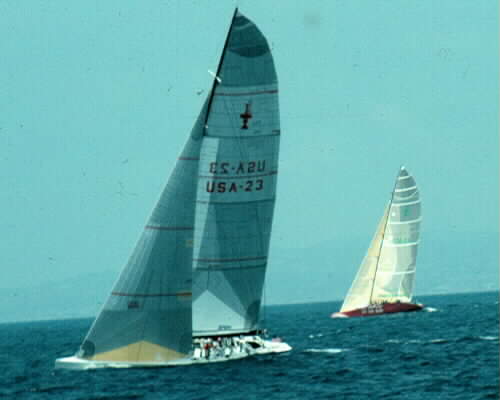
You'd think Times readers (the paper, after all, runs wedding announcements that David Brooks famously characterized as more like merger announcements or alliances among the 1% royalty) might want to be reminded that Bill, along with Buddy Melges, once defended an America's Cup.


Race 5, May 16, 1992.

(Was that really 21 years ago???)

But, once the reminder that nasty limited-government types might be engaging in rent seeking in the energy sector is out there, the paper's mission is accomplished.  You probably wouldn't use an America's Cup-class sloop to fish for Midgaardsormen.

MISCHARACTERIZING DEMOCRACY.

Milwaukee's Palermo's Pizza (disclaimer: frequently purchased frozen at Jewel for the Cold Spring Shops commissary) have been involved in some sort of labor dispute.  Although the legalities are mostly behind us, the Perpetually Aggrieved never miss an opportunity to be aggrieved, here holding a stand-in at one of the Palermo pizza stands on the Wisconsin-Milwaukee campus, and engaging in the usual semi-literate chanting.  Democracy looks like unwashed people desiring food not to be sold, apparently.  The stand-in gave some diversity hustler in the UWM administration a chance to show his solidarity with Occupy types by ordering the stand be closed, leading a Milwaukee observer to quip, "UWM will serve jello instead of Palermo's."  Or both.
Now, UWM officials are saying the school continues to offer Palermo’s Pizza products for sale on campus.

UWM officials said in a statement released Thursday: “What has changed in the past two days is the availability of the pizza in the Student Union food court where a long planned renovation project got underway this week.”

UWM officials say the school did not intend on closing the pizza stand on Tuesday — “but because of the presence of protesters in the kitchen preparation area, it was determined that the food in the stand would need to be discarded because it had potentially been contaminated.  As a result, UWM administrators and police announced the stand was being closed.”

Because the pizza stand had been scheduled to close for the summer at the end of business on May 8th due to the renovation project, UWM administrators made the decision not to open the stand for one additional day — and closed it on Tuesday.
Playing in the middle of the road is a good way to be hit by traffic going both ways. With final exams approaching, perhaps the Perpetually Aggrieved will take their victory, such as it is.  But with the job market for college graduates being what it is, we've probably not seen the last of the Palermo shuffle in Wisconsin.

The Madison campus continues to serve Palermo pizza, although with Paisan's available not far from campus, why would anyone bother?