30.3.14

RUN THE FOOTBALL TEAM LIKE A BUSINESS.

The players at occasional football power Northwestern have obtained National Labor Relations Board concurrence with their request to be regarded as employees, and represented by the Steelworkers.

Writing for The Nation, Dave Zirin suggests that Northwestern's administration fears the countervailing power of unions where paying market wages to support staff is concerned, while conference and National Collegiate Athletic Association pooh-bahs fear the countervailing power of market options to the one-size-fits-all indenture athletic scholarship that binds players to a university for four years (one year in the case of some basketball programs).

The teachable moment: market forces are not always friendly to capitalists or entrenched interests.  Academics on the left ought to be alert to the potentially liberating features of neoliberal economics.

At Minding the Campus, James Piereson notes that running a business implies paying attention to hard budget constraints.
If it is upheld, the ruling threatens to obliterate the major assumptions governing college sports and could even bring about the end of big time college athletics altogether.  Given the expense and liability of maintaining athletic programs on a semi-professional basis, many institutions will fold them up altogether and proceed with on-campus athletics on a club or recreational basis.
So far, nobody has contemplated the tax considerations.  Perhaps institutions of higher education could run sports programs according to a business model, in such a way as to be able to pay their employees, in the same way that non-profit hospitals can conduct charity drives while competing in the relevant markets for neurosurgeons and radiologists.

Otherwise, raising money for the positional arms race in football becomes harder.


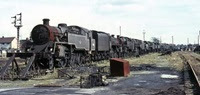
This is the Chessick Practice Center at Northern Illinois University, the result of a successful fund-raising campaign.  That it looks like a suitable structure for holding a continuous casting machine or a pickling line is serendipitous.  But running a spur from Union Pacific across the Lincoln Highway into a steel mill would not be cheap.

Instead of a plant gate, though, there's a ceremonial plaza.


Donated artwork, and additional naming rights.  That works for a university, it works for a hospital, and it works for an art gallery.

But then there are the tax benefits to buying seat licenses.  Not even at occasional BCS intruding Northern Illinois can you drive to the neighborhood of Huskie Stadium on game day and park wherever you want.  Season ticket holders must make an additional "donation" to Intercollegiate Athletics in order to secure the most convenient parking spots or tailgating locations.  (If you have a blue faculty and staff permit, there are a couple of ways to beat the system, which for a cup of coffee -- this being Illinois -- I will show you.)  How long will the tax-deductibility of these mandatory contributions last, if college football and basketball become more explicitly businesses?

TSAR ALEXANDER III UPDATE

Via Insta Pundit, the latest flutters of the Double Eagle.
Andrej Illiaronov, Putin's economic adviser between 2000 and 2005 and now senior member of the Cato Institute think tank, said that "parts of Georgia, Ukraine, Belarus, the Baltic States and Finland are states where Putin claims to have ownership."

"Putin's view is that he protects what belongs to him and his predecessors," he said.

When asked if Putin wishes to return to the Russia of the last tsar, Nicholas II, Illiaronov said: "Yes, if it becomes possible."

Illiaronov admits that Finland is not Putin's primary concern at present but, if not stopped in other areas of Eastern Europe, the issue will one day arise. Russian troops are currently massing on the eastern border of Ukraine, following Russia's recent annexation of Crimea.
That's the 1913 Tsar Nicholas, commemorating the tri-centennial of the Romanoff dynasty, which Alexander III did not live to see.

Perhaps it takes rough times to bring forth a new Sibelius to write suitably stirring music for the Finns.

HIGHER EDUCATION LOWERS ITSELF.

A tenure-track professor at Chicago State comes to grips with messy reality.
Now that I've been here for a couple semesters, I have seen the general lack of facilities upkeep and maintenance. There is intermittent wi-fi, electrical outages and surges that have damaged expensive research equipment, floods from burst pipes, potholed and cracked walkways, muddy ruts and pooling water over sidewalks, and don't even get me started about the lack of childcare on campus when half of our students are women with children! I also get the feeling when attending university and departmental meetings that a lot of committee work feels like a waste of time because recommendations and decisions get reversed or altered by the time they are finalized.
The professor's error, dear reader, is in thinking his paychecks come from an institution of higher learning.
When I go back and review that list, it sounds like I'm working in a poor, developing, corrupt country - but I take the Red Line home each day and remember that we live in a vibrant, modern American city that should be providing a quality education and experience for our students who work so hard to attend. We should be an example of progress and upward mobility for the community that we serve, not an embarrassment that continues to fulfill stereotypes and further marginalizes our students.
A university that educated its oppressed and marginalized students would be a university that got rid of remediation and the therapeutic bureaucracy that enables underachievement.  It might insist that the high schools do their job properly so college faculty wouldn't have to teach junior high math.  That would be the end of the first-generation-nontraditional scam that turns many a public university into an expense-preference playground for diversity hustlers.  Not only that, successful students would no longer be constituents rendered helpless by years of Democrat policies.  Democrat ward-heeler politicians and diversity hustlers at nonselective universities owe their continued existence to the continued misery of the poor.  The only option for an individual coming to grips with the understanding that he is not working for an institution of higher education is to exit.
I was very happy to accept this position and was hoping to stay for at least a few years until I was (hopefully) granted tenure, and I have really loved teaching and interacting with our CSU students and the other faculty. However, the upper administration's actions make me very worried for the integrity of CSU, and, therefore my professional reputation. I have been starting to look for other positions already this next academic cycle, and the thought of going through that again churns my stomach.
Idealism (doing the poor a service) crashes with reality (the continued existence of the poor keeps the diversity hustlers employed).  Yes, the academic job market is scary this year.  Scarier, too, is the likelihood that other institutions of higher education are advertising for professors, yet perpetuating the same access-assessment-remediation-retention scam that culminates in a Chicago State style dropout factory.

29.3.14

WORKING ON THE RAILROAD.

Hand-spiking turnout assemblies to cross-ties is slow going.  Gluing three foot sections of prefabricated flex-track goes faster.


There is substantial progress on ten days ago.

I'm also learning about ways to adapt helicopter model controllers to model trains.  If that project works out, I don't have to bother with route selection at frogs, or with reversing sections.  Might even dispense with the time-sharing problems that arise on layouts with multiple command control throttles in use at the same time.

UPSCALE OBNOXIOUS MUST SELL.

Nailed to Newmark's Door is the Index of Obnoxious Luxury Car Ads.

At Number Ten, "Nothing says 'I'm sorry for shtupping the au pair' like buying your spouse a Lexus with a bow on it."

Advantage, Cold Spring Shops, eight Christmases ago. "Don't know whether I want him mulling 'will she forgive me for boinking the nanny?' or 'this should keep her pacified if she finds out.'"

Not that BMW or Acura or Cadillac or Mercedes-Benz think of the carriage trade as refined, either.

HIGHER EDUCATION LOWERS ITSELF.

I can fight it out on this line if it takes all summer.  Here's Voluntary Xchange.  "I’m only half way through a career in an industry that’s being deconstructed out from under me." Perhaps the administrator is using the infelicitous "K-16" locution to suggest that the high schools, well, prepare their graduates for college work.  Yes, and there will be a Cinderella in this year's final four.

28.3.14

THE LEGISLATURE DOES NOT ADEQUATELY FUND THE EXISTING UNIVERSITIES.

Yet it occurs to two legislators to establish another Big Ten university in Illinois.
They say it will keep tuition low and retain home-grown talent in Illinois.

According to a press release, state Sens. Matt Murphy (R-Palatine) and Michael Connelly (R-Naperville) say the idea developed after learning more and more suburban students leave Illinois to attend other, high-priced Big Ten institutions out-of-state.

The measure, Senate Bill 3526, would create a study commission to explore the possibility of establishing an existing Illinois public university as another Big Ten university. The bill passed the Senate Higher Education Committee on March 19. It is expected to be called for a Senate vote soon.

Sen. Murphy says since Illinois is the fifth largest state in the country, that creates a competitive admission process at the state's only flagship university.

"We should make it easier for these students to stay in Illinois, not look for greener pastures across state lines," Sen. Murphy said.Sen. Connelly notes other surrounding, smaller states have multiple Big Ten schools, such as Michigan and Indiana.
We've been following the competition of the Midwestern state universities for out-of-state students that pay full freight for years, noting a few Urbana hopefuls that got away, while north of the Cheddar Curtain, Madison's quest for out-of-state students chases high-potential Wisconsin residents elsewhere (including to Illinois?) or has Milwaukee enrolling more in-state students than Madison, unfortunately bringing in their train the collegiate party culture rather than a quest for intellectual challenges.

In Illinois, Senators Murphy and Connelly hope to perform the upgrade on the cheap.
Requires the Board of Higher Education to establish a Big Ten Feasibility Study Commission to deliberate and determine the feasibility of having another public university in this State become a part of the Big Ten Conference and how this might be accomplished, while remaining revenue neutral to this State. Sets forth the membership of the Commission, and provides that members shall serve without compensation and without reimbursement for their expenses.
(The full text of SB 3526 is, mercifully, short.)

I imagine the fantasies that are forming in the minds of our athletics administrators.


And yes, I've long endorsed efforts by our senior administrators to raise the university's academic profile.

But then, there's that revenue neutrality.  Eight years ago, or, within the time frame of this cross-border competition for high-achieving students that will pay full freight, conditions at Urbana were so tight that faculty who could get better offers elsewhere were doing so.  Not much has changed since then.  The legislature's decision to deal with university pension liabilities by simply abolishing a number of benefits after July 1 of this year, rather than phasing the benefits out over time, has simply induced large numbers of senior faculty and staff to take their pensions.  More than a few of those people might have been willing to work for a few more years.

Yes, Illinois can keep more native students in its state universities by raising the academic profile of its state universities.  On the cheap, though?  Doubtful.

PIGOU NO GO?

At The Washington Examiner, Philip Klein proposes to abolish the mortgage interest deduction, arguing from what seems like a sound first principle. "The purpose of taxes is to raise money to finance government services, not to manipulate human behavior or economic activity." Here's where understanding a little economics is useful.  Attractive though it might be to invoke a philosophical principle, such as "humans are not gerbils running a maze for rewards," or "simpler is better," a tax, like any other price, functions to allocate resources.  Thus taxes can be changed in such a way as to allocate resources with the least loss of efficiency, or not.

SOMETIMES THE ENEMIES ARE ON THE LEFT.

Amy Goodman identifies The Least Transparent President in History.
In 2008, when campaigning, Barack Obama was often touted as a constitutional-law professor. As such, we can assume he studied writings of one of that document’s authors, James Madison, the fourth president of the U.S., considered the “Father of the Bill of Rights.” Madison wrote, in 1822, “A popular Government, without popular information, or the means of acquiring it, is but a Prologue to a Farce or a Tragedy; or, perhaps both.” With Edward Snowden’s revelations of massive NSA spying and surveillance, and the administration’s abysmal record on transparency, President Obama has tragically moved well beyond farce.
Such perspectives are de rigueur at Pajamas Media sites, or National Review. It's instructive to observe the discontent among self-styled progressives.

24.3.14

WORKING ON THE RAILROAD.

Another week, more progress.


Looking south into the main staging area.  Closest turnouts came prefabricated, with wood ties.  In the distance, turnout assemblies, with wood ties cut and counted, awaiting staining and installation.

DOUBLE THE FREQUENCY, TRIPLE THE RIDERSHIP.

Travel and Trains takes up the cause of additional passenger trains on The Water Level Route.  The Midwest High Speed Rail Association submits a detailed wish list, complete with a suggested timetable that among other things, deals with the inconveniences suffered by residents of Erie, Pennsylvania, just a little too far from the major airports to have air service, and smack in the middle of the night on the Lake Shore's schedule, if the Lake Shore is ever on schedule.  There's a lot of optimism in the proposed schedule, including improved tracks to permit 90 mph running, and station platforms on both sides of the track, which will end the nightly tangle the existing Amtrak service contributes to, as two trains in each direction must be on the north track at Sandusky and on the south track at Lorain, because that's where the sole passenger platforms are.  It doesn't help timekeeping, or the dispatcher's equanimity, that the intermodal trains and automobile shipments are also heavy that time of night.

The revised schedule, though, continues to treat the service west of Buffalo entirely as offered by through trains.
Had Penn Central implemented the same sort of corridor concept from Buffalo to Cleveland and Toledo that it was implementing east of Buffalo, residents of Erie might already have more trains. As it is, people in Mendota, Illinois, Lynchburg, Virginia, or Sturtevant, Wisconsin, enjoy more frequency and connectivity than do residents of Erie, or, for that matter, Cleveland.
Hub-and-spoke air networks have eroded passenger resistance to changing planes.  Cross-platform transfers to dependably scheduled trains are easier.  Many British stations have food service and news stands at trackside, to cater to the through traveller changing trains at Reading or Crewe or Birmingham.  A feeder network of Pittsburgh - Youngstown - Cleveland and Cleveland - Columbus - Cincinnati day trains has potential, although the political resistance to Passenger Rail in Ohio is likely to be stiff.

WORK-LIFE BALANCE IS FOR MEN, TOO.

Republican Senate hopeful Dave Oberweis took a trip to Florida just before the March 18 primary, the better to maintain domestic tranquility.
Oberweis said that one of the problems that ended his first marriage to Elaine Pearson was that she thought he worked too much. He said he didn't want to make that mistake again.

“This is something that I have been reluctant to discuss,” he said. “It's very personal. … I was married to my first wife for 35 years, have five kids, and as far as I was concerned, it was a very happy marriage, I was very pleased, and I was stunned about — I don't know — 10-11 years ago when one day she left. My children were equally stunned. I couldn't sleep, I couldn't eat for months. I lost 60 pounds. It was by far the worst thing that has ever happened to me in my life, and I don't want to repeat it.

“Julie and I have been married now about six and a half years, almost seven years, and if I made a mistake — my first wife indicated that one of the things that concerned her was that I worked too much, that I got focused on something and poured all of my time and energy into it and there wasn't enough for her.”
There's something incomplete in his story.  No warning signs in those 35 years?  Or were the emoluments of living the life of a corporate spouse inadequate compensation when what would normally be the beginning of a comfortable retirement turned into the beginnings of a second act, as a political spouse?

It's encouraging, though, to consider even older people questioning the Industrial Age dispensation in which it was permissible for fathers to be absent as long as the big paychecks kept coming in.  Perhaps younger people of both sexes will be more aggressive in seeking a different bundle of labor and leisure from prospective employers.  Or perhaps mechanization will offer a way out of the forty hour work week trap.

As far as the primary went, Mr Oberweis will represent the Pachs against Senator Durbin.

COUNTRIES HAVE PERMANENT INTERESTS.

Taiwan is working on a fleet of missile corvettes capable of attacking aircraft carriers.  Via Media notes that the western Pacific is filling with ships.  Although China continues to view Taiwan as a renegade province, and the People's Liberation Army Navy will soon have an aircraft carrier, Japan also have a large destroyer with a flight deck, and a history of occupying Taiwan.


And people have long memories.

MAKE TIME TO THINK.

Higher education used to be an environment in which scholars would work long hours on problems that interested only about six other people, because that's what they wanted to do, because that's what they got respect for doing, and because there wasn't a lot of administrative scut-work cutting into thinking time.

I say used to be deliberately, because I've seen the administrative abuses and usurpations metastasize over the past thirty years, and have been passively fighting back by ignoring them whenever possible for the past ten.

The good news is, the push-back is beginning.  Let's start with "In Search of Lost Time," by Philip Nel in Inside Higher Education.  I borrowed one of his closing lines for the title of the post.

Professor Nel notes first that it's habit to work hard.  There's nothing that concentrates the mind quite like an unfinished research project, and if it's a project properly chosen and properly specified, the time spent on that task is rewarding time.  The problem arises, though, when the academy begins to punish cooperative colleagues for being cooperative.  "When we’re just starting out, we learn to say 'yes' to everything." The novice has to learn to say no to committee assignments and interdisciplinary task forces.  A proper department will protect probationary faculty from such morale-sucks, although those become ways in which the tenured faculty are subject to hold-up.  And, in the absence of much merit money, let alone keeping up with the cost of living, the hold-ups proliferate, as do the requests for favors that might be currency in trading on one's reputation.

YOU GOT A VOT VERE?

North Shore Line Memories includes the tale of a crew at Pettibone Yard that made too aggressive a shove, winding up with a boxcar past the end of track and up a tree.

The yardmaster called master mechanic Henry Cordell to have two men sent over to assist in retrieving the car.  The post title quotes a question Mr Cordell asked.

What would Mr Cordell have made of a motor car up an escalator?


Chicago Tribune picture courtesy Milka Overton

Today's incident may raise questions about crews on short rest.
The [motorman] has been employed with CTA for about a year, Kelly said. She “works a lot of overtime,” [union president Robert] Kelly said, but she had been off for about 17 hours before starting her overnight shift, which began at 8 p.m. on Sunday.

“So she had an ample amount of time to be off that day,” Kelly said. “I do know she works a lot, as a lot of our members do.”
In the case of the errant boxcar, the North Shore Line crew was able to roll the boxcar back onto the rails, using the grooves the wheels had cut in the ground and the tree on the way up.  This errant multiple unit car will be disassembled, then removed.

"WE'RE AFRAID OF SOUNDING AS IF WE AGREE WITH MILTON FRIEDMAN."

Go.  Read and understand.

Ask yourself whether academic freedom and tenure are for Lernfreiheit, or for craven cowardice.

23.3.14

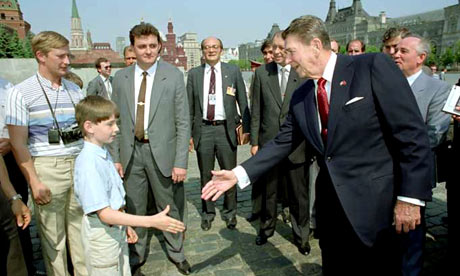
VLADIMIR PUTIN TOOK MEASURE OF RONALD REAGAN.

Or not.  I like to think that he did.


Pete Souza photograph for Radio Free Europe, retrieved from The Guardian.

Tsar Vladimir the Occupier is clearly behaving as if Barack Husseinovich is no Ronald Reagan.
Europe’s interests will be best served by fostering good relations with all of its international partners. At the same time, we are rightly committed to pursuing a foreign policy based on values. And no other international relationship embodies these values more fully than Europe’s relationship with America.

The transatlantic relationship is based on a shared commitment to parliamentary democracy, the market economy, the rule of law, freedom of speech and respect for human and citizens’ rights.
But where Our President engages in Alinsky-style mocking and personalizing opposition, with the connivance of the MSNBC kiddie korps, it makes Vladimir the Occupier's task of mocking Western values easier.

COLLEGE TEACHING IS IMPROVISATIONAL ACTING.

I stated the short form two weeks ago.   Here's the elaboration.
About six months ago, a group of physicists in the U.S. working on the Large Hadron Collider addressed a problem they've been having for a while: Whenever they had meetings, everyone stuck to the prepared slides and couldn't really answer questions that weren't immediately relevant to what was on the screen.
The point of a research workshop is to deal with the side issues, which might sometimes be deep trivialities.

The point of a class is to encourage thinking.  The ill-posed and possibly irrelevant question is often the greatest opportunity to get a teaching point across.

Business television precludes both.

A GOOD WEEKEND TO BE A BADGER FAN.

The men's hockey team won the inaugural Big Ten tournament.  Next up, a tilt with North Dakota (how things have changed, that used to be a title game) in the national tournament.


In the basketball tournament, and, the past fifteen years notwithstanding, success and Wisconsin basketball in the same sentence still takes some getting used to, the better team won.
Oregon's lineup built a 14-point first-half lead draining threes and slashing to the basket, Wisconsin unwound the lead like it was a tangled yo-yo with a group of less-skilled but veteran players who have been groomed in the same system, together for 2-3 seasons. That group finished together on the floor as a team.
Yes.  You can see a lot of individual flash at an all-star game, or in the alley behind Cabrini Green.  The columnist I'm quoting, John Canzano, correctly noted that Oregon was beaten by a better [athletic] culture.  How often does the amateur establish a strong position against grandmaster, only for grandmaster to go on to win?

18.3.14

IMPROVING ON HAMURABI?

A forthcoming Ecological Economics paper, "A Minimal Model for Human and Nature Interaction," by Motesharrei, Rivas, and Kalnay, has been receiving attention outside of the customary circle of academic readers, perhaps because its conclusions make one set of policy advocates comfortable with their prejudices.
The model has just four equations that describe the evolution of the populations of Elites and Commoners, Nature, and accumulated Wealth. Mechanisms leading to collapse are discussed and the measure "Carrying Capacity" is developed and defined, The model suggests that the estimation of Carrying Capacity is a practical means for early detection of a collapse. Collapse can be avoided, and population can reach a steady state at the maximum carrying capacity, if the rate of depletion of nature is reduced to a sustainable level, and if resources are distributed equally.
The problem, dear reader, is that the model builds on the simple Lotke-Volterra predator-prey equations. I couldn't copy and paste them from the .pdf of the paper, so, with some abuse of notation, here goes.  Let W be the population of Workers, B the population of Bosses, X the stock of natural resources, and Y the accumulated wealth.

The four equations of motion of the model are

(1)   dW/dt = (b - a)W, where b is the birth rate and a the death rate;

(2)   dB/dt = (c - d)B, where c is the birth rate and d the death rate;

(3)   dX/dt = gX(L - X) - uWX, where L is the exogenous carrying capacity of the environment, g a regeneration factor, u is the constant marginal product of workers, whose productive activities deplete Nature;

(4)   dY/dt = uWX - S - A, where S is the consumption of Workers, assumed to be at a subsistence level, and A the consumption of Bosses, who extract surplus value.

The dynamics of this relatively simple model are not radically improved on those of Hamurabi, an ancient computer game I probably wasted too much time on years ago, and which you can play online at your leisure.
HAMURABI: I BEG TO REPORT TO YOU,
IN YEAR 1, 0 PEOPLE STARVED, 5 CAME TO THE CITY,
POPULATION IS NOW 100
THE CITY NOW OWNS 1000 ACRES.
YOU HARVESTED 3 BUSHELS PER ACRE.
RATS ATE 200 BUSHELS.
The simulator gives you some information, and you try to keep your subjects alive for ten years.

In the working paper, the structure of production has a Marxian feel to it, with the Bosses appropriating some of the production for themselves without depleting Nature, and the Workers getting only subsistence pay.  Not surprisingly, a gripe session about the modelling, and the folly of using NASA money to fund the research, ensues at Insta Pundit.

But there are opportunities for further research, some of which have been anticipated by the authors (See Motesharrei, Rivas, and Kalnay p. 7.)

[The initial model] models the Depletion side of the equation as if it includes the reduction in Nature due to Pollution.  Future versions will differentiate Depletion from Pollution.  The depletion term includes a rate of depletion per worker, [u], and is proportional to both Nature and the number of workers.  However, the economic activity of [Bosses] is modeled to represent executive, management, and supervisory functions, but not engagement in the direct extraction of resources, which is done by [Workers].  Thus, only [Workers] produce.

Technological change can raise the efficiency of resource use, but it also tends to raise both per capita resource consumption and the scale of resource of [c.q.] extraction, such that, absent policy effects, the increases in consumption often compensate for the increased efficiency of resource use. ... The extent of these effects varies, but in this initial model, we assume that the effects of these trends tend to cancel each other out.  In future versions, the rates of these trends could be adjusted in either direction.
The paper notes that the source code for the model is available online at http://www.atmos.umd.edu/~ekalnay/handy-ver1.mdi, on the Maryland site of Professor Kalnay.  I received a 404 error checking that link earlier this evening.  My hope is that we're dealing with a temporary server hiccup, perhaps account high casual interest coming in from the public intellectuals.

One of my early interests in economics was playing around with simple Keynesian Cross models, with the help of a Commodore calculator and pencil and paper.  There are a number of tweaks that occur to me in the simple model, including making L endogenous, having improvements to u arrive randomly, having depletion or pollution surprises arrive randomly (the Newcomen engine improves u, depletion of England's coal begins immediately, and carbon concentrations in the atmosphere increase).  As a further complication, I want to have u affect the compensation of both Bosses and Workers.  Perhaps u attaches to a Worker who then contracts with other Workers to implement the idea, raising the living standard of what becomes a Boss and his spawn, as well as the living standards of some Workers.

Yes, that begins to get messy, but in my second childhood, I hope to have some thinking time.

17.3.14

MARCH IS FOR MODEL RAILROADING.

Posting is likely to continue to be sporadic.  With winter reluctant to relinquish its grip, there's nothing as comfortable as a warm basement and trains to run.


Closest to the camera, a Baldwin Double Ender on the first stretch of main line out of staging.  At right, a string of hopper cars headed for hidden staging track for the Boston and Albany.  Yes, that's a Boston and Maine diesel, with a string of New England Coal and Coke hoppers.

WHEN YOU HAVE ELIMINATED THE IMPOSSIBLE.

Might Malaysian Air 370 have been running on the yellows of Singapore 68?
Remember the one challenge that is currently making everyone doubt that MH370 actually flew to Turkmenistan, Iran, China, or Kyrgyzstan?  That challenge is the thought that MH370 couldn’t make it through several key airspaces such as India or Afghanistan without being detected by the military.

It is my belief that MH370 likely flew in the shadow of SIA68 through India and Afghanistan airspace.  As MH370 was flying “dark” without transponder / ADS-B output, SIA68 would have had no knowledge that MH370 was anywhere around and as it entered Indian airspace, it would have shown up as one single blip on the radar with only the transponder information of SIA68 lighting up ATC and military radar screens.
It's an old trick for attempting to fool an air defense system. Tom Clancy used it several times.

Or might the crew have placed too much faith in the onboard computers?
In commercial aviation, the smart automated systems are also stupid. I’ve studied several incidents in aviation where the lack of communication to the pilot was deadly. Literally. Something goes wrong with the airplane, but the intelligent, automatic systems compensate. No need to bother the pilots. But the wrong thing gets worse and worse until the automation reaches the limit of its compensatory abilities. “OK, I give up,” it says, and lets the plane start to crash.

“Huh” say the pilots, scrambling to figure out what happened and what they should do about it. (Usually they succeed because when a plane is 30-40,000 feet up in the air (9-12 KM), there is quite a bit of time – minutes. Moreover, commercial airline pilots are extremely well-trained.
Smart devices, stupidly done?

IDEOLOGICAL AGITPROP CROWDS OUT LEARNING.

Bernie Reeves of Phi Beta Cons suggests a "Heart of the Matter" task force to boost student interest in the humanities will only continue the self-marginalization of the Perpetually Aggrieved.
Of course, the humanities and the traditional liberal arts are essential elements of a proper college education. But the Heart of the Matter committee did not confront the real problem: Even if a magic wand were waved, and all undergraduates were forced to take required courses in the liberal arts, their content would not be recognizable to those who passed through the curriculum 40 years ago.

In their successful campaign to discredit Western values and achievements — deemed to have succeeded via racism, chauvinism, imperialism and exploitation of the environment — out went the traditional liberal arts core curriculum, and in came a myriad of faux courses predicated on elevating the identity of the allegedly exploited, including Women’s, Black, Gay, Transsexual and Environmental Studies and their kin. The disguise for this subornation of an entire culture is Multiculturalism, one of those weasel words that cloaks the goal of undermining western culture with the inarguable position that students must study many other societies before learning about their own.
The good news is that the Perpetually Aggrieved are facing reality. I'll offer evidence, with any luck, later this week.

KUDOS.

Jane Albright, currently at Nevada by way of Northern Illinois and Wisconsin, 2014 Carol Eckman honoree.

THERE'S MONEY IN POVERTY.

George Will summarizes in one paragraph the secret of urban Democrat electoral success.
We spend $1 trillion annually on federal welfare programs, decades after Daniel Patrick Moynihan said that if one-third of the money for poverty programs was given directly to the poor, there would be no poor. But there also would be no unionized poverty bureaucrats prospering and paying dues that fund the campaigns of Democratic politicians theatrically heartsick about inequality.
Yeah.

He also points out a possible tension between the expansionary monetary policy and a fiscal policy rendered less expansionary in pursuit of inordinately many targets.
Richard Fisher, president of the Federal Reserve Bank of Dallas, says the total reserves of depository institutions “have ballooned from a pre-crisis level of $43 billion to $2.5  trillion.”

And? “The store of bank reserves awaiting discharge into the economy through our banking system is vast, yet it lies fallow.” The result is a scandal of squandered potential:

“In fourth quarter 2007, the nation’s gross domestic product (GDP) was $14.7 trillion; at year-end 2013 it was estimated to be $17.1 trillion. Had we continued on the path we were on before the crisis, real GDP would currently be roughly $20 trillion in size. That’s a third larger than it was in 2007. Yet the amount of money lying fallow in the banking system is 60 times greater now than it was at year-end 2007.”

The monetary base having expanded 340 percent in six years, there is abundant money for businesses. But, says Fisher, the federal government’s fiscal and regulatory policies discourage businesses from growing [c.q.] the economy with the mountain of money the Fed has created. This is why “the most vital organ of our nation’s economy — the middle-income worker — is being eviscerated.” And why the loudest complaints about inequality are coming from those whose policies worsen it.
Capital has gone on strike.

There's a further complication, in that the magnitude of capital created by the repo market prior to 2008 might be far greater than that of the idle official money rendered impotent by hope and change.

16.3.14

JUST IN TIME FOR MARCH MADNESS.

A reality check on the economic consequences of the Super Bowl.
As Holy Cross professor Victor Matheson, another economist who's studied Super Bowl impact, puts it, "Imagine an airplane landing at an airport and everyone gets out and gives each other a million bucks, then gets back on the plane. That's $200 million in economic activity, but it's not any benefit to the local economy."
It's true that the airport gets to collect some landing fees, and the airport concessions might sell a few martinis to lubricate the deals, but the presence of an airport suggests that if that plane doesn't land, some other plane might.  The reverse proposition is also valid.
Then there's the issue of displacement. When hordes of Super Bowl visitors descend on a city's hotel rooms, that fills up all the hotel rooms, which means -- wait for it -- no more hotel rooms for anyone else. So people who might have visited New Orleans otherwise are forced to steer clear. (The NFL study tried to account for this by subtracting out New Orleans' lost convention business, but as you may be aware, there are other reasons to visit New Orleans in the winter other than for a convention.) In fact, because Super Bowl rooms are often required to be rented by the week but many visitors only show up for the game weekend, some economists have suggested that all those incoming NFL fans only end up displacing people who would have spent more, on average, during their time in town.
So let it be with the basketball tournament.  I wonder if this year's tournament, which is scheduling games closer to the campuses of higher-seeded teams, is catching on.

WHAT'S WRONG WITH THIS LOGIC?

Robert Reich is the latest aging hippie to lament the monuments his generation destroyed.
Do you recall a time in America when the income of a single school teacher or baker or salesman or mechanic was enough to buy a home, have two cars, and raise a family?
The second car might not have been necessary, because the household in question likely had Dad off to work first thing in the morning, Mom at home minding the kids, and the kids could walk to a neighborhood school, and play tag or sandlot baseball or fly kites or roller skate with their neighbors until the streetlights came on.
We weren’t rich but never felt poor, and our standard of living rose steadily through the 1950s and 1960s.

That used to be the norm. For three decades after World War II, America created the largest middle class the world had ever seen. During those years the earnings of the typical American worker doubled, just as the size of the American economy doubled. (Over the last thirty years, by contrast, the size of the economy doubled again but the earnings of the typical American went nowhere.)
No mention of second-wave feminism, of leaning in, of the substantial increases in labor force participation by women, including married women who saw that time in America as institutionalized oppression.  Thus de facto segregation's bastard cousin, sexism.  Income = Wages + Interest + Rent + Profit.  Change the number of wage-earners and do the math.
In those decades, tax revenues from the wealthy and the growing middle class were used to build the largest infrastructure project in our history, the Interstate Highway system. And to build the world’s largest and best system of free public education, and dramatically expand public higher education. (Since then, our infrastructure has been collapsing from deferred maintenance, our public schools have deteriorated, and higher education has become unaffordable to many.)
Mr Reich has no sense of irony. Here are the paragraphs that follow.
We didn’t stop there. We enacted the Civil Rights Act and Voting Rights Act to extend prosperity and participation to African-Americans; Medicare and Medicaid to provide health care to the poor and reduce poverty among America’s seniors; and the Environmental Protection Act to help save our planet.

And we made sure banking was boring.

It was a virtuous cycle. As the economy grew, we prospered together. And that broad-based prosperity enabled us to invest in our future, creating more and better jobs and a higher standard of living.

Then came the great U-turn, and for the last thirty years we’ve been heading in the opposite direction.
That's the Canon as prophesied by Herbert Croly, legislated by Franklin Roosevelt, and perverted by Lyndon Johnson. And if you've just had some kind of mushroom, the role of the hippies in wrecking the virtuous cycle gets very small.
The collective erasure of the memory of that prior system of broad-based prosperity is due partly to the failure of my generation to retain and pass on the values on which that system was based. It can also be understood as the greatest propaganda victory radical conservatism ever won.

We must restore our recollection. In seeking to repair what is broken, we don’t have to emulate another nation. We have only to emulate what we once had.
"Radical conservatism" had little trouble facing down both the Evil Empire of Brezhnev and Andropov  and "got a problem, get a program" technocracy because the former was so laughably clumsy and the latter so demonstrably enabling failure and undermining the foundations of prosperity and strength.

Perhaps in his concluding "America’s great U-turn can be reversed. It is worth the fight" is an offer from Secretary Reich to work with traditional conservatives, and the remaining Scoop Jackson Democrats, in undoing the worst effects of Sixties do-your-own-thing libertinism, particularly on the most vulnerable members of the public.

9.3.14

HOPE SPRINGS ETERNAL.

When it comes to basketball, March Madness is elsewhere.  At Northern Illinois, it's generally March Sadness, and that has been the case for the better part of twenty years.

A few little kids still turn out for the women's games.  The more successful the team, the more little kids you'll see.


Yesterday, at least, there was reason to believe.


Not as easy as it looks, rallying from ten down midway in the first half to down four at intermission, only to snag a lead coming out of the break and stretching that to as many as twelve.

It has to be more fun signing autographs for the youngsters after a win.


RECLAIMING HIGHER EDUCATION.

Peter Salins offers an excerpt from his new book to start the conversation.
There are four generic problems facing the preponderance of American colleges and universities, most of them festering for decades, but getting worse as college enrollment has expanded and student selectivity declined: they admit too many unprepared students, they invest too little in undergraduate instruction, they are too cavalier about graduation rates, and their financing is so erratic that millions of qualified high school graduates don't even go to college, and those that do are overly burdened with debt.
Start by saying NO to the Distressed Material calling itself high school graduates.
Among these, perhaps the most easily corrected by unilateral college actions is the misalignment between the academic preparation needed to succeed in college - even in narrow technical and professional programs (like computer science or nursing) - and the instructional standards of American high schools.  This is not just a problem for graduates of struggling inner city high schools, but also for a majority of those coming out of schools in middle income suburbs.  Practically the only actions taken by all but the most elite American colleges to deal with this problem is to invest heavily in "remedial" courses, under the hopeful assumption that one or two semesters of catch-up English and math courses can compensate for four years of high school failure.  Not surprisingly, the hope is unjustified, and fewer than a quarter of all students taking such courses ever make it out of the remedial purgatory ready to continue successfully in the regular curriculum.  We now have over four decades of failed experience with the remediation paradigm, yet, in the name of broadened college "access," we continue to waste vast resources - institutional, public and personal - on this flawed concept.

What should be done instead is to more thoroughly align high school curricula and instruction with college expectations.  Despite voluminous lip service paid to this objective, it is rarely achieved in practice.  There is reason for optimism on this score, however, in a new nationwide effort to upgrade K-12 curricular content, the Common Core State Standards Initiative, currently subscribed to by 45 states.  Given its potential for raising the level of college preparedness across the board, the American collegiate establishment, represented by eight key organizations, should now weigh in on this project to make sure that the standards are adequate and that they are actually being implemented.

The other effective action that colleges could take is to not admit students that graduate from high school without a proven "college-ready" academic diploma.  Even though a majority of American high school graduates are taking high school exit exams today, few of these really screen out the unprepared.  Ideally, all states should make sure their exit exams are truly rigorous, and give academic diplomas only to those sufficiently prepared for college.  Until this happens, the best course would be for colleges to rely on the national SAT or ACT entrance exams, and not admit any students falling below the college-ready threshold (about 1575 on the combined SAT and on the ACT 18 in English and 22 in math).
Expect some controversy, as there's evidence that high school grades are a more dependable signal of college success than test scores are.  But admissions boards could be more explicit about favoring transcripts heavy on English, Mathematics through calculus or pre-calculus, laboratory science, and foreign languages with high marks.  Mr Salins continues, though, noting that the absence of the equivalent of senior non-coms in introductory classes is a false economy.
The first two years of undergraduate coursework are short-changed more fundamentally by the paucity of instructional resources devoted to them.  Well-endowed private universities and the best of the public ones divert resources away from early undergraduate instruction to allow their senior faculty to engage in serious research (on which both the faculty's and the institution's reputation depends), and to pay for it.  Less research-driven baccalaureate colleges and community colleges skimp on lower level instruction because they need to conserve their resources to pay for the more expensive upper level and professional coursework on which their reputation rests.  The way in which in almost all American colleges and universities square this resource circle is to cheat their freshmen and sophomores by placing them in oversized course sections and assigning poorly paid "adjunct" faculty and graduate students to teach them.  Given how important the first two years of college are, this state of affairs is scandalous.
Even so, the presence of Distressed Material contributes to the rot, perhaps more than the careerism of matriculants treating their core courses as an obstacle, or the rent-seeking of faculty wanting a counter at the distribution requirements food court.
Having chosen to be less selective in admissions, most baccalaureate colleges anticipate a less than complete graduation rate, and congratulate themselves when they exceed their mathematically calculated "expected graduation rate."  Given their open-admissions mission, almost all community colleges have very low graduation rate expectations to begin with and adamantly reject this as a qualitative criterion.  To be fair, some colleges and statewide higher education systems take pains to preemptively advise their students online as to necessary course-taking and try to assure that all courses necessary for graduation are being offered.  But outside the insular world of institutional graduation rate fatalism and excuse-making, parents, politicians and thoughtful higher education leaders are rightly concerned.
When it comes to "what is to be done," though,  Mr Salins is partly right and partly wrong.
One of the most unquestioned assumptions surrounding the college affordability issue is that it is the inevitable result of the way in which a college education is being delivered today: courses (many of them with small enrollments) set in physical classrooms, taught by well-paid faculty, on leafy campuses with myriad desirable but not necessarily essential ancillary facilities like student unions, fitness centers, museums and stadiums.  This entire arrangement, it is widely believed, is anachronistic and must unavoidably result in a high outlay per student, to be borne at private schools by students' families and at public ones by the states.  Given this diagnosis, the fashionable remedy is to a) sever the link between college instruction and the college environment and b) deliver much or all instruction online.

Many Americans, especially those who are working, raising families, or otherwise strapped for time, might benefit from a non-campus based college experience, but there is a lot more to college than classroom instruction which is why we will still want as many students as possible getting their education in a campus setting.  And as to online instruction, there is a place for it in a college education, but in terms of educational benefit, it can never entirely replace taking courses with a live instructor, surrounded by live classmates, in a traditional physical classroom.

Just as almost no one tilling the vast K-12 education reform garden suggests doing away with our traditional elementary and secondary school facilities, there is no need today to do away with our traditional college campuses.  In fact, these places are in many ways among the most glorious of American institutions, and the envy of the rest of the world.  Nevertheless we need to definitely rethink what goes on in them, and how they are financed.
I'm going to have to keep on pushing the excess demand for perceived quality argument, apparently.  In Forbes, George Leef looks at the unsustainability of the summer camp model.
The West Virginia campus is so dominated by the party culture that students who are not partiers are “marginalized.” But when the detrimental effects of party behavior on them are brought up (including the way the university’s reputation is damaged by the partiers), the partiers turn the blame around and say that the non-partiers should have gone to some other school.

One aspect of the party culture that [Party School author Karen] Weiss might have explored further is the academic work that the heavy and extreme partiers do (or mostly don’t do). She informs us that very few of them major in demanding fields such as engineering or health sciences. Most major in a social science field or something else. I wish she had gone further into the questions raised by the intersection of a university’s academic requirements and the party culture.

How do students who get intoxicated several times a week cope with even the lightest of academic demands?  Do they search for courses that are known for easy grading no matter how little work they do and how poorly they perform? Are they prone to submitting papers that were written by others, including ones they bought from essay mills?
Going forward, the most egregious sub-prime party schools may find themselves failing a market test. And market tests have steeper grading curves than even those employed by cranky old academic ninja economics professors.
Partying has long been a feature of American college life, so it’s unrealistic to think about putting an end to it. What probably will minimize it, however, is the economics of the college experience. Partiers are spending quite a lot of money (some from their families; some from taxpayers) in exchange for a lot of immediate gratification but little or no lasting benefit. It used to be the case that merely getting a degree was worthwhile due to our mania for credentials—that is, college degrees used as a way of screening out probably unqualified, untrainable individuals.

That mania seems to be abating, however. Employers have found out that college degrees do not necessarily betoken much knowledge or reliability. They are starting to look for better indicators (such as e-portfolios with badges, certifications, and other demonstrations of competence) that don’t require graduation from college. As that movement continues, before long the mere possession of a generic degree from any school, and especially a “party school” will be unavailing.
In turn, those market tests are likely to heighten the contradictions among campuses of state university systems that currently combine flagship and party barge institutions.
Public research universities have been an essential component in the success of American higher education. During the past two decades, however, they have faced unprecedented challenges – growing enrollments, declining state funds, faculty salaries lagging far behind their private competitors.

While no one wants to see an unconstrained conflict among institutions within the states or to have the flagships beggar their neighbors, the future success of public research universities is essential to the well-being of the nation. It is time to ask whether their excellence can be maintained if they remain coupled to systems of governance created in a different time, within a different context, for different purposes.
So simplify. Whitewater and Eau Claire and Oshkosh and LaCrosse are in the same business as Milwaukee or Madison, and a state policy that reserves a slot somewhere in the state system for any graduate in the top half of any high school in the state implicitly reserves a lessened opportunity to a graduate that doesn't make the cut at Madison as long as Whitewater is getting by.  Either clean all the windows or pull the shade.  And yes, faculty, maintain social distance.
I’ve always been of the view that I don’t want to undermine my own authority in the classroom by dressing like the students, inviting them to use my first name, or making any other gestures towards “being down with the kids.” I find many other female academics also take this approach.

To add to the confusion, in most departments there is the species of (white) male professor, who wants to be seen as “cool” (you know the one, who shows up dressed like he’s come to mow the lawn), who invites all the youngsters to “call me Dave,” resting safely in the comfort of assumed male authority. If you’re one of these guys: you are not helping the rest of us.
Male or female, in Australia or Illinois, THIS MEANS YOU.

And master the art of the prolonged silence.  Somebody walks into your office with a dumb request, just do your best Vladimir Putin stare and say ... nothing.

THE CYNICS CALLED URBAN RENEWAL "NEGRO REMOVAL."

Cleaning up the neighborhood for the Olympics is much the same.
Countries that host Olympic games are always eager to show the world their best sides and in the case of the residents of Sochi that meant a number of people living in towns near Olympic facilities contributed to the redevelopment of Sochi in order to help it become the magnificent venue it was.
Take Vesyoloye. Please.
On Akatsiy street, for example, the residents have for years had neither running water nor a sewage system. The communal outhouse that the residents enjoyed using was ordered to be torn down by a judge because authorities said it was an eyesore, being adjacent to the new super highway being built. (The judge ordering its destruction told the residents to get an eco toilet. Some residents told reporters they were using buckets instead.) The $635 million highway that was built to get people in and out of Sochi cut many of Vesyoloye’s residents off from the city center. One resident on that street told a reporter: “Everyone was looking forward to the Olympics. We just never thought they would leave us bang in the middle of a federal highway!” Thousands of people in Sochi were dislocated and promised new homes that three weeks before the beginning of the games had not been provided. Some Sochi residents who had not been displaced had a new neighbor in the form of a dump that was created to contain Olympic construction waste. Construction waste has polluted rivers and streams. Although the affected residents contributed to the success of the Olympics in their modest ways, none of them was given tickets to any of the events. It should not be hard to organize a group to visit Rio in order to tell its citizens what to anticipate. They may be too late.
So far, of the BRIC emerging countries, only India has opted out of the Olympic hosting derbies. That Chicago lost out to Rio led to more than a few sighs of relief in Illinois. The plans for additional facilities did involve planned slum-clearing, if not on the Brazilian scale.
In some areas where the government has made efforts to relocate residents so the slums can be redeveloped in preparation for the World Soccer Cup and the Olympic games, residents have resisted. Commenting on events, Christopher Gaffney, a professor at Rio’s Fluminense Federal University said: “These events were supposed to celebrate Brazil’s accomplishments, but the opposite is happening. We’re seeing an insidious pattern of trampling on the rights of the poor and cost overruns that are a nightmare.” Evictions are taking place in slums all over the city. In some places those who refused to move continue to live in the rubble left when their slum dwellings were destroyed. The owner of one slum dwelling that was razed to make way for an express way was told by the government she could accept $2,300 for her house when adjacent residences were selling for $50,000, accept an apartment in a distant housing project or take nothing. The replacement apartment she was given is 35 miles from the center of Rio.
Urban renewal, Model Cities, hero projects, public-private back-scratching partnerships.  Unfortunately, there's no expression in Portuguese or Russian for Takings Clause.

THE EXAMINED LIFE IS THE MORE CHALLENGING LIFE.

Existential Depression in Gifted Children.
Existential depression is a depression that arises when an individual confronts certain basic issues of existence. Yalom (1980) describes four such issues (or “ultimate concerns”)–death, freedom, isolation and meaninglessness. Death is an inevitable occurrence. Freedom, in an existential sense, refers to the absence of external structure. That is, humans do not enter a world which is inherently structured. We must give the world a structure which we ourselves create. Isolation recognizes that no matter how close we become to another person, a gap always remains, and we are nonetheless alone. Meaninglessness stems from the first three. If we must die, if we construct our own world, and if each of us is ultimately alone, then what meaning does life have?
It's what you do along the way. And the absence of external structure implies the freedom to not associate with people who are a drain on your spirit or your time.  The challenge, though, is in interacting with people who don't get it, who won't get it, or (channelling Veblen) whose sense of self requires them not to get it.
Why should such existential concerns occur disproportionately among gifted persons? Partially, it is because substantial thought and reflection must occur to even consider such notions, rather than simply focusing on superficial day-to-day aspects of life. Other more specific characteristics of gifted children are important predisposers as well.

Because gifted children are able to consider the possibilities of how things might be, they tend to be idealists. However, they are simultaneously able to see that the world is falling short of how it might be. Because they are intense, gifted children feel keenly the disappointment and frustration which occurs when ideals are not reached. Similarly, these youngsters quickly spot the inconsistencies, arbitrariness and absurdities in society and in the behaviors of those around them. Traditions are questioned or challenged. For example, why do we put such tight sex-role or age-role restrictions on people? Why do people engage in hypocritical behaviors in which they say one thing and then do another? Why do people say things they really do not mean at all? Why are so many people so unthinking and uncaring in their dealings with others? How much difference in the world can one person’s life make?
Sometimes, hell is other people. Sometimes, evolved conventions provide a modicum of structure.  But "evolutionarily stable strategy" is a hard concept to explain to a bright ten-year-old, no matter how musically or mathematically virtuosoistic he is.
When gifted children try to share these concerns with others, they are usually met with reactions ranging from puzzlement to hostility. They discover that others, particularly of their age, clearly do not share these concerns, but instead are focused on more concrete issues and on fitting in with others’ expectations. Often by even first grade, these youngsters, particularly the more highly gifted ones, feel isolated from their peers and perhaps from their families as they find that others are not prepared to discuss such weighty concerns.

When their intensity is combined with multi-potentiality, these youngsters become particularly frustrated with the existential limitations of space and time. There simply aren’t enough hours in the day to develop all of the talents that many of these children have. Making choices among the possibilities is indeed arbitrary; there is no “ultimately right” choice. Even choosing a vocation can be difficult if one is trying to make a career decision between essentially equal passion, talents and potential in violin, neurology, theoretical mathematics and international relations.
That's not a bad problem to have. In part, pay packets differ because of the decisions individuals acting on their passions made.  Talent properly nourished is likely to serve the less-talented (by inclination or by choice) better than talent stifled, hampered, or exposed on a regular basis to resentment against achievement.

LET FACTS BE SUBMITTED TO A CANDID WORLD.

The faculty are stewards of the university.  Presidents, provosts, deans, and retention counselors serve at the pleasure of the faculty.  I've deliberately borrowed wording from The unanimous Declaration of the thirteen united States of America to introduce a CSU Faculty Voice recitation of the ways in which current president Wayne Watson has failed the faculty, the students, and the taxpayers.
To those of you who support Wayne Watson, I assume you are not willing to accept a miserable administrative performance, do not condone academic fraud and basic dishonesty, do not favor attacks on free expression, do not stand for cronyism, do not support cowardly retaliation as a management tool and do not wish to see the university destroyed. Do you really think the faculty is to blame? If there are achievements by this administration that offset the multiple failures listed above, I have missed them. I would be delighted to know what they are.
Go. Read and understand.

8.3.14

COLLEGE TEACHING IS MOSTLY ACTING.

It's probably more accurate to think of a classroom performance as improvisation.  Yes, dear reader, you must have a script, but yes, dear reader, you must have the good judgement to deviate from the script when a useful question comes up, or when an ad-lib might help make the point.

A good actor, however, does not read his script aloud while the audience reads it silently.


Indeed.

I get dissatisfied course evaluations, mostly for offering open-ended questions on assignments and examinations, or for grading harshly.

I do not recall an evaluation suggesting that I convert everything to a slide show and make the slides available on line.

Go to slide 4, read and understand.

The most important part of a presentation is ...
what is not committed to pixels.

4.3.14

FASCHING IST.

DIVISION OF LABOR STILL MATTERS.

In a recent post, I suggested that climate simulation models were only as good as the boundary conditions and the equations of motion.  I didn't know the half of it.
[C]limate scientists tend to show averages of many simulations, which smooths out any temporary changes in trend. Here is a figure that shows some individual simulations and how each one can have slowdowns at different times:

Figure 1a from Hawkins, et. al. (2014) Nature Climate Change, 
retrieved from Edwards, "Pause for Thought".

The gray band is the average of a number of temperature forecasts, a few of which are plotted.  The colored lines are observations.
We believe the complexity of the science and the public interest in the pause are not ‘difficulties’ to be avoided or glossed over but instead provide a fantastic opportunity to dig into the details of the science.
Wherein simulation scientists and policy advocates each have roles to play, and each role is different.
At the heart of this miscommunication lies a desire by scientists to simplify a complicated phenomenon. But whether this is done out of a desire to make a better case for policymakers to push through green schemes, or just to spread knowledge to the layman, the dumbing down of climate science has come at the expense of the facts.

Greens, in their quest to paint the darkest possible picture of our future, have been all too keen to seize on such oversimplifications, but in doing so they have given fodder to their dreaded enemies, the climate deniers. The greenhouse effect is fairly easy to understand, but the fiddly bits are decidedly less so. Ignoring them in favor of a cleaner narrative does the green movement more harm than good.
I'm extracting what appear to be the salient parts of both essays; both, and their comment sections, will reward careful study.

BULLYING INEPTITUDE.

Peggy Noonan.
We are suffering in great part from the politicization of everything and the spread of government not in a useful way but a destructive one. Everyone wants to help the poor, the old and the sick; the safety net exists because we want it. But voters and taxpayers feel bullied, burdened and jerked around, which again is not new but feels more intense every day. Common sense and native wit tell them America is losing the most vital part of itself in the continuing shift of power from private to public. Rules, regulations, many of them stupid, from all the agencies—local, state, federal—on the building of a house, or the starting of a business.
And yet: "Offer public affairs programming that takes seriously the idea that Government is Big because Government Generates Rents and Rent-Seeking Creates Gridlock and the whole Pundit Industry will collapse."

A CALL FOR REALISM.

The governing hallucination strategic plan for Northern Illinois University, yet another Vision 2020, proposed an enrollment of 30,000 students.  At the rollout of the plan, I was skeptical.
The projection (a visual in the speech, not provided in the transcript, possibly available in the webcast, and as far as I know not adjusted for the effect of the Ryan, Blagojevich, and Quinn administrations' policies driving people out of the state) provides for more graduates than were present in the early 1990s, and about the same number as were present in the middle 1990s. A special task force on right-sizing (Nineties-speak for strategic planning) determined that our enrollment target was around 19,000 students. (When I started in 1986, our enrollments were around 24,000, and there were 23 tenure-track faculty in economics. That task force determined our faculty size to be 15 for that 19,000. We are currently nine for the 25,400.)
And yes, I repeated myself.  And again.  To no effect.  So I tendered my resignation.

Perhaps headquarters will pay attention to the students, specifically, to the editorial board at the Northern Star.
Vision 2020, which calls for enrollment of 30,000 students by 2020, has always seemed unattainable to the Editorial Board.

In September 2010, just days after the plan was announced, the Editorial Board wrote, “But nothing good will come from everyone drinking the same Kool-Aid; NIU needs to adapt if it turns out that a particular goal is either immeasurable or impossible.”

That advice hasn’t been taken and Vision 2020’s goals have not been reevaluated, even though enrollment continues to plummet — including a 3.3 percent drop to 21,138 from fall 2012 to fall 2013.
Their advice:
NIU must focus on retention and bringing in transfers, since fewer freshmen are going to universities across the state.

NIU should have an enrollment of 25,000 by 2020 — that reflects statewide falling enrollment while giving us something to work for.

How will we reach that goal? The university should provide more scholarships to upperclassmen, transfers and non-traditional students, make it easier for credits to transfer over and introduce transfers to NIU in the same way we do freshmen instead of treating them like seasoned Huskies.

Again we’ll warn: NIU must stop sipping the Vision 2020 Kool-Aid and create a plan with realistic goals and detailed steps for hitting those marks.
I'll gripe about the retention follies another day. It occurs to me, though, that having the departments properly staffed so that students are able to complete their schedules without having to deal with irregular offerings either of foundational courses or key electives, might pay off in retention and completion to orders of magnitude greater than more money in student affairs.

1.3.14

VLADIMIR PUTIN CHANNELS TSAR ALEXANDER III.

The musical selections for the opening and closing ceremonies at the Sucky, er, Sochi Olympics, provide a better look into his soul than President Bush gazing into his eyes.

Consider the way in which the opening ceremony depicts Peter the Great creating St. Petersburg.  For the music, the Petersburger March.


Written by a Finnish subject of Alexander I, who dedicated it to his brother-in-law Friedrich Wilhelm III, King of Prussia.  At the Olympic opening, the mime troupe introduced the march with a very Prussian Lockpfeife fanfare, then presented a very Prussian Stechschritt during the march.  No Euler and his infinite series, no Mendeleyev and his elements, no John Paul Jones turning muzhikii into seamen.

At the closing, the athletes brought in the Russian tricolor to Tchaikovsky's Festival Coronation March.

MARCH IS (LEFTIST) WOMEN'S (SELECTIVE) HISTORY MONTH.

There's no money for staffing the academic departments or for replacing the dry-erase markers in classrooms.  Posters for the latest Identity Politics Flavor of the Month, yes.

At Northern Illinois University, the event begins with a promotional campaign.  Tuesday will be "This is what a feminist looks like" sticker day.  "We hope to break harmful stereotypes that cast all feminists as white, female, middle-class, or politically radical, and to open up the definitions of 'feminist' to more complicated meanings." Mostly, the Uncle Tims peacock that day.  The theme for the month, though, is the fiftieth anniversary of the Civil Rights Act.  Complete with all the usual suspects, and the usual abuse of the English language.  There's a special circle in Hell for marketing types that salt compound words with capital letters where they don't belong, e.g. TrucTrain, PowerPoint, or PeopleSoft, and for academic types that attempt to redefine words by inserting parentheticals, e.g. Terr(or)toriality or, from this year's collection of politically radical events -- note the inclusive or above --, "Shifting Fault(lines)."

The poster itself?  The portraits from the poster border are at the header of the event announcement.  No rebuttal to Undeniable Truth 24 here.