Showing posts sorted by relevance for query soccer girls third world. Sort by date Show all posts

23.8.16

REVEALED PREFERENCES.

Footie is popular with eight-year-old girls in the United States, and adolescent males all over the Third World.  Perhaps U.S. policy contributes to its omnipresence.  In Brazil, by contrast, the resources tend to go to the adolescent males.
“This is a macho country,” [former captain Aline] Pellegrino says. “And soccer is seen as a male sport. Whoever plays soccer is a strong man, that is the image, so having a woman play soccer does not match that. They want women in the kitchen, all beautiful and sexy. Not in a soccer jersey kicking a ball around.” Brazil’s affinity for soccer is unmatched anywhere in the world.

While the rules of the modern game were drawn up in England, Brazil can claim to be its spiritual home, a place where the game and life intertwine effortlessly.

The 2014 World Cup, despite Brazil’s crushing 7-1 defeat to Germany in the semifinal, gave the world a glimpse of how the vibrant national personality draws inspiration from the planet’s most popular sport.

Women, however, have been lost somewhere on the periphery of that idyllic scene.

Even with the women’s game enjoying more global popularity than ever, Brazil has not caught up. The Brazilian women’s team is one of the favorites for gold in Rio, but the treatment of girls who want to play at the grass-roots level is disturbing, to say the least.
Old-style sex roles apparently hamper the development of youth footie for the girls.  Perhaps, too, there aren't enough minivans yet.

For all of the attention Brazil and the States pay to footie, and to beach volleyball, the winners in the Olympic women's footie tournament and on the beach were ... the Germans.  Deutsche Frauen, Deutsche Treue, Deutscher Wein und Deutscher Sang.

In the men's tournament, it was Brazil beating Germany.  By penalty kicks.

Doesn't that say something is wrong with an activity more suitable for kids running around a field with rudimentary equipment than as a worldwide sport?  You run around for ninety minutes, plus some unspecified extra time incurred because there are stoppages of play and out of bounds set plays and somebody who never went to clown college doing a bad parody of a pratfall, and after that, there is no score (nil-nil, for the purists) or it's tied (sometimes in the extra time) and then you go to a bad parody of overtime in college football?

And people say watching yacht racing is boring?

Why not try something else?  Emulate hockey's regular-season rules, in which each side plays with fewer skaters (yes, this too, goes to penalty shots, but the point of fewer skaters is to provide more room to shoot).  Because it's for a title, allow rotations in order that the side on the field at the start will each get a blow should the running around go on for ninety minutes or longer (as Chicago Black Hawk fans have experienced in the past few seasons).  Perhaps to expedite matters, go to the reduced sides at the beginning of extra time, but play it out as it's currently done; then it's sudden victory.

3.8.21

SCHADENFREUDELICIOUS!

I really, really, shouldn't pay any attention to the Olympics, or to Victory Girl Toni Williams scorning the women's footie squad.  "Women’s Soccer Team Loses; Patriots Cheer."  That's what happens when sports competitors inject themselves into the culture wars in such a way as to antagonize potential fans.  "So, you lost to Sweden and to Canada. Boo freaking hoo. I am cheering. Not that I care, but remember that time the boys FC Dallas under 15 boys beat the women’s soccer team. Yes, that was you too."

That might not be the fairest story to tell, soccer being a sport popular with American eight year old girls, and adolescent and older males throughout the third world, some of whose families might have sought a better life in Dallas.  But yeah, deplorable-shaming potential fans is stupid.  That might include Power Line's Paul Mirengoff.
I’ll never root against the U.S. or take pleasure from Americans losing. However, I’ll shed no tears over the U.S. women falling short at the Olympics.

This is one of the most obnoxious, arrogant, and whiny sports teams I’ve observed in more than sixty years of fandom. And, although there’s likely some diversity in the political views of team members, the face of the squad, Megan Rapinoe, is an abrasive far-leftist — and a world class narcissist.

The Olympics may be the end of the line, or close to it, for Rapinoe and other team veterans. Their accomplishments are impressive, even taking into account the relatively small number of nations that take women’s soccer seriously enough to provide worthy competition.

I’m hoping that the next generation of U.S. women’s team members will be less entitled and a bit more humble than the generation that soon will be moving on.
There might be people who see in that "obnoxious" or "entitled" behavior a manifestation of authenticity. Sister Toldjah is having none of it.  Ultimately, it's about the value proposition.  "In other words, generate the necessary revenue that would justify getting paid on par with the guys and then we can revisit the 'equal pay' issue again to see if Rapinoe, who make hundreds of thousands if not millions in endorsement deals alone, has any further questions."  Find the way to bring in new fans without seeming to sell out the true believers, and see what happens.

19.6.26

LIBERAL WEENIES COME FOR FOOTIE.

Seriously, Adam Kadlac?  "Should you feel guilty about rooting against the US in the World Cup?"

Every four years polite Americans pretend to be interested in men's footie.  Cold Spring Shops, not so much, with only 42 posts getting a "footie" label in going on two dozen years, and most of those professing benign neglect with a little snarking, e.g. "Ordinarily, that would be reason enough for Cold Spring Shops to continue its policy of benign neglect of the game popular with adolescent males in the third world and eight year old girls here."

The liberal weenies, though, make themselves figures of fun, starting with calls for a boycott of the Stateside games that prompted my "I have no plans to attend or to watch any World Cup games. Where can I sell carbon offsets?"

9.7.19

GIRLS GONE WILD?

The Babylon Bee has some fun with the ladies' World Cup.  "Soccer is a game played by children and Europeans that involves moving a ball around without using one’s hands -- the feature that distinguishes man from lesser animals. It is unclear how such an activity could generate money."  There's some serious political economy to take up, involving pay for play, but not today.  "Footie is popular with eight-year-old girls in the United States, and adolescent males all over the Third World."

The Bee's writers are speaking my language.  "Whatever the explanation, time is ticking down to figure it out -- or ticking up since we’re talking about soccer where they don’t even know how to use a clock."  Well, they at least know how to use a stopwatch, or perhaps an egg timer.  "You run around for ninety minutes, plus some unspecified extra time incurred because there are stoppages of play and out of bounds set plays and somebody who never went to clown college doing a bad parody of a pratfall, and after that, there is no score (nil-nil, for the purists) or it's tied (sometimes in the extra time) and then you go to a bad parody of overtime in college football?"

26.7.07

ARE THERE TRAILER PARKS IN BRITAIN?

Schoolteacher Francis Gilbert takes a cut at a larger social phenomenon, attempting in Yob Nation to offer a prima facie case that the bad habits of the hustler and the slacker have become the norm in British culture. I don't know enough of the country's history to evaluate all of the claims in the work, which appears to find yobbery everywhere. (Did you know that John Bull is the Father of All Yobs?) This Book Review No. 26 suggests that Thirteenth Generation crudity has made its way to Britain. Mr Gilbert attempts to make the case that the well-to-do have aped some of the self-destructive behaviors that used to be confined to the poorer quarters, although his evidence is of the anecdotal and unsystematic type. Thus, for example, the aggressive, sometimes drug-charged style of the securities trader and the initiation rituals of the officer corps become of a piece with the brawling of Geordies with Scousers in the terraces. (Ah, soccer, the sport of choice of eight year old U.S. girls, and of Third World males.) Recently retired Prime Minister Tony Blair rates a yob tag, with Mr Gilbert suggesting his relationship with "consigliere" Alastair Campbell sharing an inner outlook in common. Binge drinking and the rabbit culture become, in Mr Gilbert's estimation, the norm for social life among collegians and young professionals. Bristol's gentrified riverfront, with numerous nightspots, takes on a "bleak, sour mood" at bar time. (I did spend a Saturday evening in a hotel near that riverfront, and although it sounded like quite the party, it didn't sound that unpleasant, although I was still a bit out of phase with the clock and opted to turn in early.) The impression the bar staff has of the collegians brings to mind the Rate Your Students fodder who will not do a lick of work but will push every button to wheedle a higher grade. "You find yourself engaged in an argument with one of them for 15 minutes to half an hour, if you won't let one of them in." So just say no and summon the bouncer faster. (I did notice a lot of "staff wanted" posters in windows of waterfront establishments. Perhaps there is a mismatch between pay and working conditions.) Ayia Napa, in Cyprus (where the Greeks and Turks continued World War I by proxy) appears to be a British version of Panama City or South Padre, complete with "Girls Gone Wild" material. Mr Gilbert does not draw the plausible connection between welfare entitlements and the yob life, although one of his sources laments that more of Britain's skilled trades are being done by immigrants, legal and illegal, from the former Soviet bloc. But, to repeat myself, the steering of young men who exhibit yobbish tendencies to trade school ought not be the default policy prescription.

Mr Gilbert's policy prescriptions, although incompletely supported by the stories he puts together, strike me as sensible. First, he suggests that the destructive lifestyles of the rich and famous (are you listening, Michael Vick, Lindsay Lohan, Newt Gingrich, Barry Bonds, Britney Spears, Paris Hilton?) ought not receive the affirmation they often do. Here, the book might have been strengthened by appeals to more rigorous social science, should such work exist, on the casual causal relationship between the antics of famous people and the mores of the hippie commune and the trailer park. Second, he suggests that the schools more aggressively inculcate the habits of the middle class (to put it in the North American locution I regularly use.) Again, although he draws on reports of classroom management difficulties colleagues have encountered, and some of his other books suggest a discontent with the teacher's lot, Mr Gilbert puts together an incomplete case. Finally, he suggests a tougher criminal justice system, with greater reliance on anti-social behavior orders (usually involving a more rigorous house arrest than Paris Hilton almost got away with.) There has to be a great deal of social science addressing the effectiveness of that regimen.

I must add an anecdotal note of my own. Often, the markers of a "yob" appear to be sneakers, which the British call "trainers," hooded sweatshirts, and ballcaps, often with the bill askew. That description would fit more than a few good and decent U.S. collegians, and some of Mr Gilbert's problem might rest in decoding the cross-cultural messages. On my visits to Britain, the attempts of the young to ape North American dress and speech amuse. All too often, the youngsters know some of the words, but they don't get the music. But frequent use of the less imaginative four-letter words is a sign of social deficiency, there as well as here.

23.2.26

DISPATCHES FROM THE NEW COLD WAR.

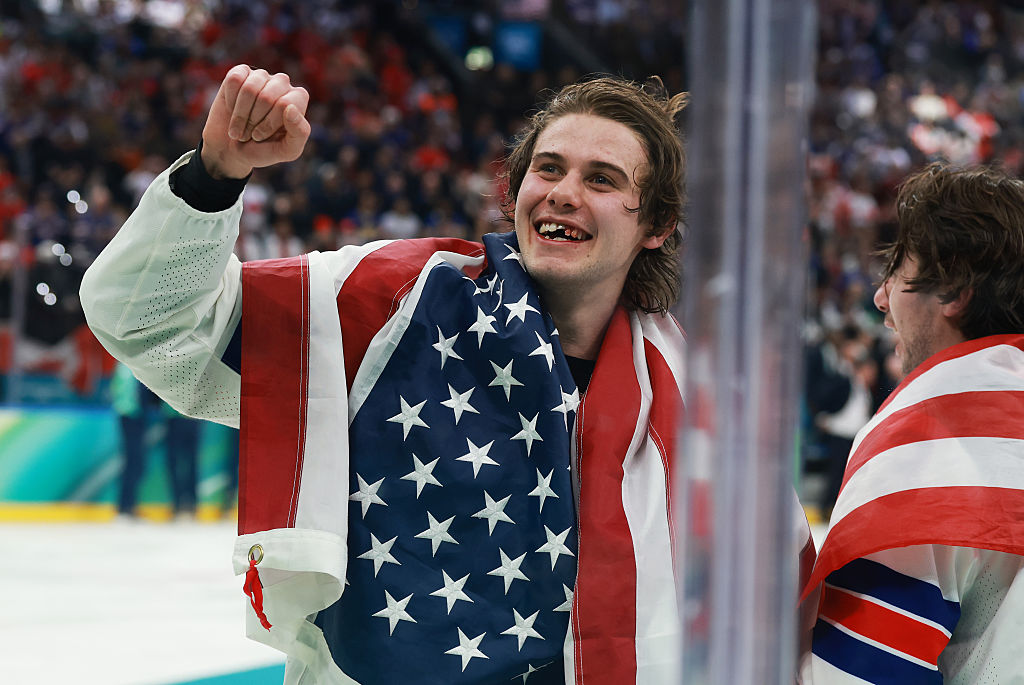
The Games of the XXV Winter Olympics, to use the full and pretentious title (cue the bugles) wrapped up over the weekend.  Both men's and women's hockey tournaments concluded with Team Canada playing Team U.S.A.  For the first time in any Olympiad, Team U.S.A. won both games, which has not been the case for either squad of late.


Photo by Elsa for Getty Images retrieved from Washington Free Beacon.

Both games ended 2-1 in overtime.  The women played on Thursday.  During pool play, they beat Canada 5-0 (which was a common margin of victory all the way to the gold medal game).  Years ago, Wisconsin's men's team won the Western Collegiate Hockey Association tournament final, putting up ten on North Dakota.  Sure enough, North Dakota got another shot at Wisconsin for the national title, and won that game.

The men played on Sunday.  Both teams arrived at the gold medal game undefeated.  On paper, Team Canada looked like the better squad, and during much of the game all the play was in the United States' zone.  But after Canada got the equalizer in the second period, no team scored in regulation, that despite Team U.S.A. having a four minute power play after Jack Hughes, pictured above, had a close encounter with a high stick.  During that power play, a United States player committed a penalty, and Canada, rather than go on the attack with five skaters and an empty net, went with five skaters, one of whom did his best Bobby Orr impression skating circles in his own zone to facilitate a longer power play for their side.  Nobody scored.  Nor did Canada score on a subsequent five-on-three power play.  Thus it went to overtime, and on occasion the team that looks to be exerting the most pressure comes up short in overtime.  Ask the Minnesota men how their title games against Harvard, Union, and Quinnipiac turned out.  Jack Hughes got the winning goal, hustling into position to convert a two-on-one goal rush into a three-on-one.

23.7.26

HILLBILLY HONOR CULTURE?

Basketball pundit Hallie Grossman profiles Sophie Cunningham.  "Love her or hate her, Sophie Cunningham won't be ignored."  Ms Cunningham professes not to be interested in the culture wars, although the culture wars have caught up with her.
These late-game theatrics -- the pro-wrestling bluster disguised as flagrant foul, her ejection, the scrum that breaks out after the takedown -- are not, it turns out, the end of anything. They're the beginning of everything.

In the year to come, Cunningham will have a billboard outside Madison Square Garden, star in the Sports Illustrated Swimsuit Issue, moonlight as a ring girl at UFC 329, receive her own colorway on an Adidas shoe, be floated as a future vice presidential candidate and, of course, unleash the finger point that launches a thousand memes. You've seen it. The White House has seen it. We've all seen it.

Cunningham, like the WNBA, has become a cultural flashpoint. The league's footprint has never been bigger and the chorus of voices around it has never been louder. All-Star voting and sponsorship opportunities, whistles and non-whistles, who and who does not get to capture this attention economy -- all have become proxies for debates about race and gender, identity and politics. Squarely in this morass sits Cunningham, a white, conventionally attractive, attention-grabbing reserve player who is not one of the league's All-Stars but is one of its most magnetic stars.
We'll deal with the gender studies throat clearing that concludes that quote in due time.