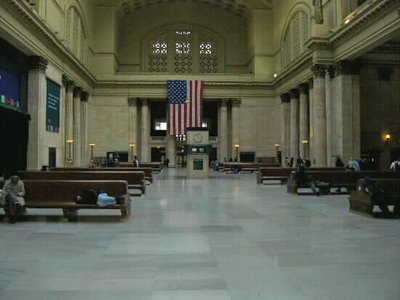
On occasion, I've alluded to the Academic Gothic style as contributing to the image of a university, whether it be ivy-covered and old or relatively new and a converted normal school.

It would be easy enough for me to pivot and point my camera at an undistinguished administration building or a Brutalist (not "riot renaissance") art and music complex but that would spoil the mood, wouldn't it?
Now comes perhaps the most unlikely advocate for Institutional Solidity, and he has a pen and a 'phone.
The squeals of outrage by the architectural profession at President Trump’s proposed executive order, Making Federal Buildings Beautiful Again, were entirely predictable. The order—if promulgated—makes the classical style the default for new federal buildings in Washington, together with a preference for classical and other traditional styles elsewhere.Sound the alarm! Albert Speer is on the loose, and Independence Avenue is going to look like the Alexanderplatz! Rod Dreher provides an excellent roundup, with rebuttals, of the hysteria.
That’s an actual Yale University historian claiming that the White House’s desire that future federal buildings be constructed according to the Classical (Greco-Roman) style which is already standard in historic Washington buildings is a sign of the coming Nazification of America. (Note well: actual Hitler, and actual Mussolini, built horrible Modernist buildings as their signature styles.) If you don’t build this ugly-ass modern crap that nobody but professors and architecture critics like, you’re a Nazi!I'll limit my observations to two: those monotonous look-alike buildings housing Mr Roosevelt's alphabet agencies date to the same era as the fascists, and Milwaukee's Acropolis, which is to say, the columned courthouse atop the hill that was laid down by the glacier forming Lake Michigan, is a "Rooseveltian pile." (I forget where I saw that expression, but I like it. And the solidity of the courthouse.) Here's Strong Towns's Charles Marohn on the symbolic value of solidity.
There is something subtly innate expressed in classical architecture. Over a decade ago, my oldest daughter and I were driving through downtown. She pointed at the historical county courthouse and asked me, “Daddy, what is that building?” Being a dad, I asked her what she thought it was. “I don’t know. A church?” I then circled around the block and pointed to the new county courthouse. “What do you think that building is?” Neurons were being rewired. She said, “A target?”The new Brainerd courthouse is a low building with a parking crater, it sure looks like a big box store.
In her four-year-old mind, she associated the classical architecture of the old courthouse with a community building of significance, something she could pull out of her limited catalog of such places. She also associated the new courthouse with simple utilitarian function. She might be brilliant (I certainly think so), but she was still a child with a child’s mind. No matter; she was right.
Elsewhere in that essay, he invokes that Grand Roman Quality, and the jarring position he's been trolled into.
Yes, the Nazis liked classical architecture. So do the millions of non-Nazis who have walked up the steps to the Lincoln Memorial, stopping at the place where Martin Luther King gave his I Have a Dream speech, before proceeding to a reading of the Gettysburg Address, all while pondering in reverent silence the humble sacrifices and many implications for humanity.On the other hand, perhaps it takes the bully pulpit of a president to call attention to the clique of prestige architects who would rather assault the eye than oh, provide a proper setting for a trial, or a workshop, or a serious game of chess, or boarding a train.
Let me put forth a supposition: Very few lovers of classical architecture want their brand spokesman to be President Donald Trump. That’s not a partisan comment; you can support or oppose the president and still reach that conclusion. It’s more an observation that, if I were picking a celebrity spokesman for a brand I loved, I would want someone non-controversial, widely embraced, and easy to admire. In general, politicians make terrible brand representatives. This is especially true in a time of extreme political polarization.
Here's Mr Marohn again. There's a lot more in his post, including links, that will reward careful study. I'm attempting to stay on one point here.
Indeed, one of the most controversial aspects of the executive order among vocal architects, their organizations, and their supporters isn’t the banning of Brutalist of Deconstructivist styles but the notion that when the U.S. General Service Administration holds a design competition for a new building, the panelists providing feedback on the designs would not come from this exclusive clique. They would represent, in effect, the general public (those who are actually commissioning the building)."Exclusive clique" is not exaggeration. Here's Theodore Dalrymple.
The totalitarian sensibility of much modernist architecture is to me so obvious that I fail to understand how anyone could miss it. For lack of any other means to achieve grandeur, it deliberately employs sheer size and inhuman coldness of materials to achieve prepotency, in the process reducing the individual to insignificance, as mere intruders or bacteria in a Petri dish.Yes, and like tenure music, it exists in order that insiders can validate other insiders with their awards and prestige contracts.
The order will give renewed courage to patrons of architecture, who for a long time have been cowed by the architects’ mastery of high-sounding verbiage and gobbledygook to promote their inhuman work, so much of which these days looks like a snapshot taken of a huge shack in mid-collapse during an earthquake. Patrons, like the courtiers of the Emperor with no clothes, have hitherto been afraid to confront architects for fear of appearing ignorant and unsophisticated, but will no longer have to accept the dictation of architects. Examples will show that things can be done differently, that patrons do not have to accept what Thom Mayne, the architect responsible for some of the worst of recent buildings, called “demanding art-for-art’s-sake architecture that only other architects can appreciate.”Everybody else scuttles in like a rat. Here's more from Rod Dreher.
The order will also free architects and teachers of architecture from the groupthink which undoubtedly afflicts the profession, not only in America but in Europe and elsewhere. It will serve to increase, not reduce, choice, and with luck will restore public confidence in its own taste and right to pronounce on architectural matters, as well as its influence over what is built in its name. After all, it is the public that has to live with architecture. Architecture should not be a secret garden into the beauties of which only architects may enter.
Nothing, and I mean nothing, makes me more likely to sympathize with Trump than his enemies. Donald Trump, the building of Trump Tower and various casinos, is nobody’s idea of an architectural good-taste-haver, but good grief, when the academic and cultural elites accuse him of being a fascist simply for questioning the horrible buildings they uglify the public space with, using taxpayer money, then I’m all for him. Note well: if Trump wanted to build federal buildings in the style of condo towers or casinos, I’d be all against him. He’s talking about making federal buildings look like the classical style that most everybody loves and associates with the federal government.The newer buildings, however, might provide a better visual picture of Big Government.
The post-1950 buildings in Washington are almost uniformly hideous. They make you want to hate the government. When I first moved to DC, I would look at the old Classical buildings, and feel a sense of civic pride, of elevation. Then I would look at the more recent federal buildings, and feel that the state was nothing but a faceless hulk that wanted to crush people.Truth in packaging? "I'm from the government, and I'm here to help you."
The current dispensation? Shorter Catesby Leigh in City Journal: the trendy stuff sucks.
Small wonder that historic preservation got national traction after the modernist takeover of the architectural profession. Alas, modernist dominance of our cultural institutions has reached the point where the National Trust for Historic Preservation has itself come out against the proposed executive order.It came to this when we lost this.

The good news is there's an insurgency under way.
A classically oriented architectural counterculture emerged in the U.S. several decades ago. Impressive institutional work is now being done in demanding traditional modes, including Collegiate Gothic. Over the last two decades, Alabama has seen the erection of three classical or Art Deco U.S. courthouses that, while not brilliant achievements, are vastly superior to their modernist counterparts. The nation would benefit handsomely if the federal government made it a policy to offer humanistic alternatives to the dehumanized anomie afflicting our contemporary architecture.Put another way, there are limits to how much citizens are willing to pay to have Distinguished Experts assault their eyes or their ears.




No comments:
Post a Comment