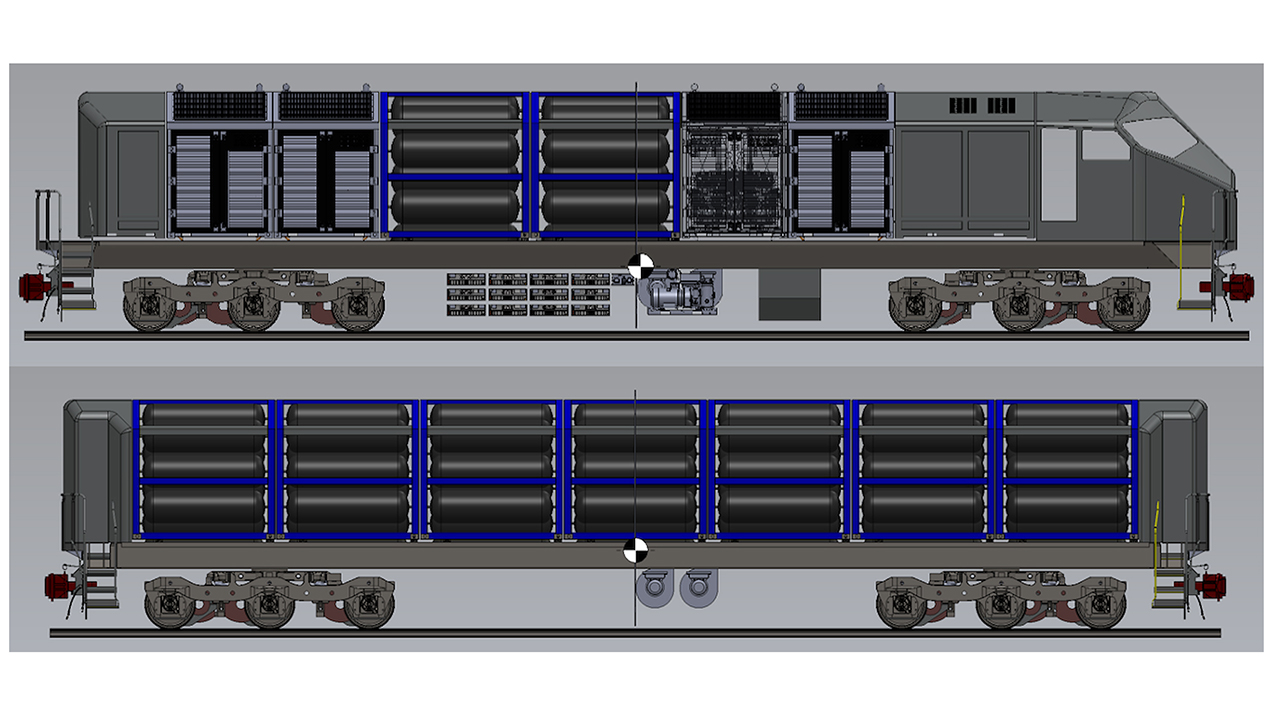
Several alternative fuels are currently being evaluated to replace diesel, each with the advantage of lower or zero emissions. However, they also have important characteristics that must be addressed. Liquefied Natural Gas (LNG) is one of the first alternative fuels considered by the rail industry. Natural gas burns significantly cleaner and produces lower emissions of sulfur, nitrogen, and carbon dioxide into the atmosphere as compared to diesel.The article includes an illustration of a latter-day tender car, that looks like a repurposed E unit.
The volume energy density of LNG is 40% of diesel and therefore requires an LNG tender for the same train range. Moreover, LNG needs to be stored in cryogenic tanks. To avoid the cryogenic storage challenges, Compressed Natural Gas (CNG) is also considered. The volume energy density of CNG is lower than diesel, which requires the use of fuel tenders for long-haul operations. RNG is biogas that is manufactured to have similar performance to fossil natural gas but has further lowered emissions.
A very promising alternative fuel considered is hydrogen, which can be produced in the electrolysis from water and turned back into water in fuel cells to produce electricity. This makes hydrogen powered rail vehicles virtually emission-free if the hydrogen is produced using renewable energy sources, such as photovoltaic or wind power plants. Like natural gas, the volume energy density of cryogenic liquid and compressed gas hydrogen is lower than diesel, which requires the use of fuel tenders for long-haul operations.
Another solution to propel the trains is BESS (Battery Energy Storage System), which typically uses lithium-based battery packs. The benefit of the BESS is that there are no emissions from the vehicles. The disadvantage is the limited range and time necessary to charge the batteries. However, it is a valuable alternative that could be advantageous in certain applications.

Unattributed and uncaptioned. Retrieved from Railway Age.
There's something familiar about that battery car.

It's been put into use, and I should make time to complete the A-B-A set I'm working on. The A-B set is in operation, most recently testing tracks that have not yet been wired for command control.




No comments:
Post a Comment