17.1.06
SCRATCH SOME BAD GUYS? This service normally leaves war coverage to others. Do note this Hit and Run post (via American Thinker) on the one-time newspaper of record publishing a photograph offering a shell fragment as a piece of a missile. Note also that Pakistani provincial officials are now reporting the deaths of four or five "foreign terrorists" in that controversial air strike on some houses near the Afghan-Pakistan border. (Power Line linked to a New York Post story earlier today. To the best of my knowledge the Associated Press and the Milwaukee Journal-Sentinel are not members of the Vast Right Wing Chickenhawk Conspiracy.)


ADMIRAL ZHENG'S LOBSTER? Best of the Web makes fun of this story, but perhaps there's something to follow up on.
I have glanced at the book which offers some speculation about the Chinese origins of the Newport Tower, which has been offered as evidence of all sorts of settlements, although so far nobody has commented on similarities between its base and the base of New Haven Railroad interlocking towers. Perhaps some fieldwork for this summer?
And now for some speculation ... (why should this night be different from any other night?) The North America chapters of 1421 suggest Chinese intercourse with and Chinese influence on the Native peoples of Rhode Island and southeastern Massachusetts. Was memory of the civilized interaction between Chinese and North Americans one cause of the initial good relations between Puritans and North Americans two centuries later. Must read more and report.
That map is mentioned in the opening sentences of 1421: The Year China Discovered America, which is on my stack of books to review. (Perhaps soon. Nephew has birthday pizza party not far from the Mitchell International station. Train trip less stressful than driving ...)Columbus reputedly discovered the New World in 1492 but Admiral Zheng He may have got there 70 years earlier.
A copy of his map of the world, dated 1418, is about to be unveiled to the public in Beijing and at Greenwich's National Maritime Museum.
I have glanced at the book which offers some speculation about the Chinese origins of the Newport Tower, which has been offered as evidence of all sorts of settlements, although so far nobody has commented on similarities between its base and the base of New Haven Railroad interlocking towers. Perhaps some fieldwork for this summer?
And now for some speculation ... (why should this night be different from any other night?) The North America chapters of 1421 suggest Chinese intercourse with and Chinese influence on the Native peoples of Rhode Island and southeastern Massachusetts. Was memory of the civilized interaction between Chinese and North Americans one cause of the initial good relations between Puritans and North Americans two centuries later. Must read more and report.
PLOTS WITHIN PLOTS. Rick at Right Wing Nut House resumes his spring service of "24" plot summaries. These summaries are useful to casual watchers of the series as they include reference to past seasons. The current day's action features a promoted Vice President (whether the President who was shot down on Air Force 1 eighteen virtual months ago is still alive but incapacitated has not been clarified) with Nixonian mannerisms and a Clintonian obsession with a legacy and a First Lady who appears to be based on Martha Mitchell of Watergate plot notoriety who must take time out from a summit to deal with a hostage situation. Or something. There is a double agent on the President's detail who is communicating with some shadowy figure who is communicating with the hostage-holding terrorist leader who may or may not be running cover for some other plot involving poison gas.
Got all that? The September 11 operation was sparse but effective. Somehow the script writers at Fox have to put the equivalent of three centuries of Byzantine intrigue into three months.
Got all that? The September 11 operation was sparse but effective. Somehow the script writers at Fox have to put the equivalent of three centuries of Byzantine intrigue into three months.
16.1.06
SLOUCHING INTO THE NEW SEMESTER. Some institutions of higher learning have a policy in which students who do not show up for the first week of classes are removed from the class rolls. Playing School, Irreverently, discovers that some such individuals give new richness to the notion of chutzpah.
In many cases, I wonder if such students are even aware they have a university account? Probably over half of my correspondence comes from hotmail or aol accounts with handles that tell me more than I really want to know about my correspondents.
Well, apparently (or so I've just learned) students expect us to email them if we see them on the roster and they don't show up. For a moment I thought "Yeah, I know, I'm such a slacker though ..." and then I thought the better of that. This is insane. Pre-email, or actually more recently (pre-university system that assigned email to students that they may or may not use) I'd have had no way of contacting a no-show. Sorry kids, I really don't think this one is my responsibility. What, am I supposed to email you to remind you that you registered for my course? To tell you that your evil twin registered you? To find out where to send the engraved invitation for you to come to class? To tell you I actually do abide by the university rules?Hear! Hear!
In many cases, I wonder if such students are even aware they have a university account? Probably over half of my correspondence comes from hotmail or aol accounts with handles that tell me more than I really want to know about my correspondents.
I COULDN'T WAIT UNTIL APRIL 1. Last night I was doing some more research on the Andreyev and I came across the Berlinerwerke Apocrypha, evidently the work of someone with a bit more skill with a Dremel (scroll around and see what one can do with cheap HO plastic diesels) and Photoshop as well as a bit more imagination than I.
The author was laboring under the impression that the Septipede was a railroading urban legend when he reported the discovery of the 4-14-2 Pennsylvania V1 "Rocky."

In subsequent research, the author discovered that there was indeed a seven-coupled Soviet locomotive, comrades. His explanation is in the spirit if not quite up to the standard of proper socialist self-criticism.
Chesapeake and Ohio were also working on seven-coupled power.

The Pennsylvania, not to be outdone, took a different C&O design with dual cylinders and modified it.
 (Some quibbles: C&O would have provided more sand delivery pipes, and that crosshead and valve motion configuration would have snapped under a heavy load. To have expected a single crosshead to handle the reciprocating mass of two pistons boggles the mind. Look carefully at the diagrams for the Andreyev, which include tandem crossheads, an extra connector between the eccentric and the reverse lever and articulated connecting rods. The forward crosshead guide hanger and valve stem guide are similar to those on the front engine of a Challenger or Big Boy. Whew, one less applied engineering problem.)
15.1.06
TROUBLED BY MOBILE PHONE USE IN CLASS. Local high schools prohibit their use with varying degrees of stringency. "That's so high school" is not a counter-argument to prohibiting their use during class at the university.
Students are always becoming more technologically savvy and could be using text messages to cheat on tests.Indeed, and in coming up with methods of concealing same.
NOBODY AMONG US KNOWS HOW TO POPULARIZE ECONOMICS. And yet people write such books, just as Paris gets fed and pencils get produced. The most recent entry in the derby is Tim Harford's The Undercover Economist, which is closer in style and topics to Steven Landsburg's Armchair Economist, which I use to complement a microeconomic principles text, than it is to Steven D. Levitt and Stephen J. Dubner's Freakonomics, which I reviewed last year. On, then, to Book Review No. 4 for 2006.
Undercover Economist addresses fewer topics than Armchair Economist, with, however, less of the Chicago-tight-prior theorizing that reviewers of Armchair have interpreted varyingly as "arrogance" or right-wing preaching. Undercover sheds light on more difficult topics such as adverse selection, signalling, game theory, and externality. I can see using this as a complement to an intermediate price theory text, particularly if I had four credits to work with.
An academic economist must always keep in mind the intended audience of a book, particularly if the intended audience is a class confronting a required book. I have the disadvantage of having observed, as a graduate student, the development of the Rothschild-Stiglitz insurance market model and the Wilson extension of the lemons principle. It is helpful to a student who does not have a complete set of class and seminar notes to see the intuition, which has been further developed and codified over the years.
PUTTING THE QUESTION. The University of Toledo's women's basketball team paid Northern Illinois a visit yesterday. The home team prevailed.
"I was very impressed with our defense against a very good team and for only the second time this year, we had a positive assist to turnover ratio," first-year NIU head coach Carol Owens noted. "We continue to improve and that's the key. We established both an inside and an outside game which is always a key."How encouraging the contrast with last year.
"Our team chemistry has really come along. We have bonded so well as a team on the court. Defensively, we are playing together so much better," Owens insisted. "Bishop and Zeller really hurt us in the first half scoring nine and 12, so defense was something we discussed at half. Mary Basic (Lemont / Chicago Heights Marian Catholic) has become our utility player. A lot of what she does doesn't always show up in the box score, but her contributions are always a key. Today it was rebounds and I was really pleased with her defense on Bishop, particularly in the second half."Compare and contrast.
ST. VINCENT INTERVENES? No professional football team has yet won more than two consecutive Super Bowls, and the Packers remain the last professional football team to have won three consecutive National Football League titles. The Patriots' loss last night means the Packer string of five titles in seven years is also safe for now.
BE CAREFUL WHAT YOU ASK FOR. Via University Diaries, a parody site suggesting Oklahoma State University recognize a generous benefactor by renaming itself Boone State in recognition of a generous donation to the sports programs by alum and oilman T. Boone Pickens.
There are precedents. Ball State University is not paying tribute to its role as a training ground for the Big Ten. The five sons of canning jar magnate Lucius Styles Ball, including interurban promoter George A., purchased a private normal school that opened in 1899 and deeded it to the state of Indiana as a teachers' college in 1918. That normal school became a state university in 1965.
I know of a slightly older state teachers' college that became a state university in 1957. Telecommunications magnate John Barsema has been very generous to the building fund, as has banker John Castle. (Economics, by the way, suggests that the name "Castle Bank" might be more suggestive of permanence and stability than, say, "Fifth Third Bank," which sounds like music theory, or "Old Second Bank," redolent of a hymnal.) To my knowledge, there are no plans to sell the naming rights to the University.
14.1.06
FINDING THOSE MISSING MEN. Steel City Cowboy suggests a simpler explanation for young men's diminished share of the freshman class. It's pragmatism rather than a feminist plot at work.
Yes, higher education might have a problem if some men's cost-benefit calculations work out against enrolling, but one solution to that problem is to focus on the higher-order skills rather than the (quickly overtaken by technical change anyway) entry-level job preparation.
A 2002 breakdown by the U.S. Census Bureau indicates that while 74 percent of males over age 16 were in the labor force, only 60 percent of females were in the same group. In addition to that, a significantly larger proportion of the employed women worked in traditionally female jobs such as clerical and administrative positions. Although the current number and married men and women are basically equal (duh!), the number of men who have never been married is almost thirty percent higher than the number of women who have never been married.Therefore,
I have my doubts about the "affordable luxury" hypothesis. Per corollary to the learning-by-entrepreneuring, why spend all the money on tuitions and sorority functions rather than joining the Junior League right out of high school? I also have doubts about the job-preparation hypothesis. With the exception of some business or service-sector curricula, higher education is not training for an entry level job. (When the resources and institutional commitment are there, and the moon is in the seventh house, and the smelt are running, the College of Liberal Arts argues, based on survey data, that a liberal arts degree better equips its holder with the ability to connect seemingly unrelated ideas, and other higher-order skills, valued in the executive suite.)[I]f the value of college education is declining, it would be men who would begin to jump ship first. People who expect an economic buffer, or who will be competing in a market in which an advanced skill set is not required, can afford to be more frivolous in the educational decisions. College to them would be an affordable luxury. To men, though, the cold grip of economic reality is felt sooner, and more surely.
But how would young men know ahead of time that the value of a college diploma is falling? By talking to their older brothers, their neighbors and friends, who are ten years ahead of them on the employment curve. Ask those people "Did college prepare you for the working world?" and they will most likely laugh first, then reply "Not at all. I learned more in my first month on the job than I did in four years at college. I probably should have saved the $100,000 it cost and started a shoe store."
Yes, higher education might have a problem if some men's cost-benefit calculations work out against enrolling, but one solution to that problem is to focus on the higher-order skills rather than the (quickly overtaken by technical change anyway) entry-level job preparation.
THE IRON OCEAN. Britain has embarked on, and then backed away from, an extreme experiment in selling a government-owned railroad. The idea of separating ownership of the train service from ownership of the rights-of-way is not new. In March 1967, an aviator named R. Jay wrote an article in Trains proposing that the terminals and stations be owned by local and state governments, and the rights-of-way, signalling and dispatching, and associated maintenance and staff be owned by the national government, with private business owning the rolling stock and associated maintenance and hiring the train crews. He argued that to do so would put the railroads in a similar position with respect to their air and bus competitors for the passenger trade (at this date the notion of a commuter rail authority was still rather daring, and Amtrak some years off) and with respect to their truck and barge competitors for the freight traffic. His article offers an interesting twist on the ad popularum fallacy.
The British took the argument one step further, unbundling the operating companies from the rights of way, but at the same time selling the rights of way. What came afterward was not very pleasant. Christian Wolmar documents and interprets the results in On the Wrong Line: How Ideology and Incompetence Wrecked Britain's Railways, which will be this year's Book Review No. 3.
Mr Wolmar, who works with former Western Region signalman Adrian Vaughan on this book, is very open about his preference for an integrated nationalized rail system, arguing that a railway network is best planned and managed at the national level. The failures of state-supported railroad investments in Europe that I learned about at the Semmering Pass conference suggested that such planning and managing might have fewer opportunities to make mistakes, but the mistakes would be more damaging.
But that the British introduced competition in the most extreme way is beyond debate. Rather than have suburban train authorities pay for the use of tracks with the track-owning railroad's train crews and dispatchers shepherding the trains, or allowing trackage and haulage rights or setting up terminal districts, the British separated track ownership from rolling stock ownership from responsibility for meeting the schedules. The intent was to allow for all sorts of creative destruction. The effect was confusion, in that a passenger with a ticket for an 8 am service from one carrier might discover that the 9 am service to the same destination was operated by another carrier that did not honor the ticket. (Here, Mr Jay's analogy to the air carriers breaks down. Airplane boarding is primitive compared to loading trains, but that very primitiveness means there is no chance of a passenger holding an American Airlines ticket to Boston getting anywhere near the United Airlines service. A train passenger expects to wait at trackside, climb aboard, and go.) The confusion was further confounded as the owner of the tracks had to work with other subcontractors to maintain the tracks, and any decision to take a track out of service for work would inconvenience some operating companies more than others. That problem might not be something laid at privatization per se, but a vertically integrated railroad has an easier time identifying the opportunity cost of a track closure. (If the British had our Form B protection of track crews and reverse-signalling, some of the difficulties Mr Wolmar details might have been less severe.)
The operating companies were supposed to be given greater freedom to compete, as well as a greater threat of having a franchise put up for bid, by not being tied to the ownership of particular rolling stock. The privatization set up a number of companies that owned rolling stock and leased it, often after a repaint, to the operating company of the month. The book is a bit skimpy on why that approach was the choice. In the United States, much rolling stock is leased. Even during the worst days of the 1960s and 1970s, weak railroads were able to obtain reliable diesels, as banks, insurance companies, and other conservative investors understood that locomotives and freight cars could be repainted and leased to other railroads, including the stronger lines that would sometimes have to upgrade their fleets. There were specialist leasing companies to be sure, but there was an active market in locomotive trust certificates. Why did the British limit the rolling stock market to a few specialist firms whose primary function was to put yet another coat of paint on an overpriced nodding donkey?
The great difference between the British railway system and the railroads of North America is in the nature of the service. Visualize the commuter rail authorities along Amtrak's Northeast Corridor as the dominant service country-wide. As is the case in North America, these passenger services receive subsidies. There is a freight service, including dedicated intermodal and unit coal trains, although not on the same scale. Mr Wolmar's thesis is that this service is best offered as a nationalized network with one carrier. He does not contemplate the possibility of an integrated privatization, say, by setting up a Norfolk Southern in place of the North Eastern and Southern region, a Great Western, a London and North Western competing with a Great Northern, with what we would understand as a regional short line for Scotland, and the passenger transport executives cooperating with an inter-city passenger authority and the private railroad to share the tracks among the subsidized passenger trains and the owning railroad's freight trains. There are certainly people with the CNR (successor to Wisconsin Central) with some understanding of that cooperation.
If we the electorate are perfectly happy to fly, float, and roll our persons and commerce in corporate vehicles on Government rights of way, why not allow railroads to run trains on Government tracks?Forty years later we have a slightly different twist on this. Freight railroads are able to pass market tests. The air carriers, barge lines, and truckers get at best an Incomplete.
The British took the argument one step further, unbundling the operating companies from the rights of way, but at the same time selling the rights of way. What came afterward was not very pleasant. Christian Wolmar documents and interprets the results in On the Wrong Line: How Ideology and Incompetence Wrecked Britain's Railways, which will be this year's Book Review No. 3.
Mr Wolmar, who works with former Western Region signalman Adrian Vaughan on this book, is very open about his preference for an integrated nationalized rail system, arguing that a railway network is best planned and managed at the national level. The failures of state-supported railroad investments in Europe that I learned about at the Semmering Pass conference suggested that such planning and managing might have fewer opportunities to make mistakes, but the mistakes would be more damaging.
But that the British introduced competition in the most extreme way is beyond debate. Rather than have suburban train authorities pay for the use of tracks with the track-owning railroad's train crews and dispatchers shepherding the trains, or allowing trackage and haulage rights or setting up terminal districts, the British separated track ownership from rolling stock ownership from responsibility for meeting the schedules. The intent was to allow for all sorts of creative destruction. The effect was confusion, in that a passenger with a ticket for an 8 am service from one carrier might discover that the 9 am service to the same destination was operated by another carrier that did not honor the ticket. (Here, Mr Jay's analogy to the air carriers breaks down. Airplane boarding is primitive compared to loading trains, but that very primitiveness means there is no chance of a passenger holding an American Airlines ticket to Boston getting anywhere near the United Airlines service. A train passenger expects to wait at trackside, climb aboard, and go.) The confusion was further confounded as the owner of the tracks had to work with other subcontractors to maintain the tracks, and any decision to take a track out of service for work would inconvenience some operating companies more than others. That problem might not be something laid at privatization per se, but a vertically integrated railroad has an easier time identifying the opportunity cost of a track closure. (If the British had our Form B protection of track crews and reverse-signalling, some of the difficulties Mr Wolmar details might have been less severe.)
The operating companies were supposed to be given greater freedom to compete, as well as a greater threat of having a franchise put up for bid, by not being tied to the ownership of particular rolling stock. The privatization set up a number of companies that owned rolling stock and leased it, often after a repaint, to the operating company of the month. The book is a bit skimpy on why that approach was the choice. In the United States, much rolling stock is leased. Even during the worst days of the 1960s and 1970s, weak railroads were able to obtain reliable diesels, as banks, insurance companies, and other conservative investors understood that locomotives and freight cars could be repainted and leased to other railroads, including the stronger lines that would sometimes have to upgrade their fleets. There were specialist leasing companies to be sure, but there was an active market in locomotive trust certificates. Why did the British limit the rolling stock market to a few specialist firms whose primary function was to put yet another coat of paint on an overpriced nodding donkey?
The great difference between the British railway system and the railroads of North America is in the nature of the service. Visualize the commuter rail authorities along Amtrak's Northeast Corridor as the dominant service country-wide. As is the case in North America, these passenger services receive subsidies. There is a freight service, including dedicated intermodal and unit coal trains, although not on the same scale. Mr Wolmar's thesis is that this service is best offered as a nationalized network with one carrier. He does not contemplate the possibility of an integrated privatization, say, by setting up a Norfolk Southern in place of the North Eastern and Southern region, a Great Western, a London and North Western competing with a Great Northern, with what we would understand as a regional short line for Scotland, and the passenger transport executives cooperating with an inter-city passenger authority and the private railroad to share the tracks among the subsidized passenger trains and the owning railroad's freight trains. There are certainly people with the CNR (successor to Wisconsin Central) with some understanding of that cooperation.
13.1.06
PERFECT PRICE DISCRIMINATION? Several posts consider the future of state subsidized universities. At Inside Higher Ed, Wick Sloane wonders when the legislatures broke the old social contract under which taxpayers picked up much of the tab for in-state students. But dig deeper. Why ought there be a public subsidy for purely private benefits? Particularly when the beneficiaries are either currently well off or likely to be well off in the near future?
But all of those are different from workforce development, which is properly a private function. There is nobody in the academy or in government clever enough to anticipate the skill requirements of the U.S. or the world economy in five years, let alone fifty. The best we can do in the university is equip our charges with the ability to think for themselves and adopt on the fly. But those are purely private benefits, to be appropriated by graduates as employees and by their employers, and the academy ought properly harvest its share of gains from trade.
Mr Sloane's focus is on the consequence of policies that, in his view, shut out determined but poor students. Perhaps his point is that financial aid policies, including state-specific tuition subsidies, limit access to strivers. Something similar seems to be motivating James C. Garland of Miami of Ohio (that's the mid-major, not the street gang), who notes,
What would Mr Garland have the legislators do?
Perhaps, but not the way Mr Garland envisions it. First, colleges and universities have to generate the funds in the first place. State-supported universities will have to replace the subsidies, either by landing more voucher students or by raising their visibility, or drop some programs, or close. It is thus doubtful that the proposal would have the anticipated effect on competition. Furthermore, whether you want to call the third-party payment a voucher or a guaranteed loan or a subsidy, it is still a third-party payment. Students will have less incentive to shop around and administrators less incentive to cut out the expense-preference behavior. To obtain lower tuitions and greater enrollment requires both shopping around and an end to that behavior.
Reason's Neal McCluskey gets it.
Our national policy is that we can’t find more money for student aid. Yet billions appear for Katrina overnight. This may be deficit spending and raises all sorts of questions to debate. It is our policy that Katrina is more important than creating a work force to sustain the nation.This was a chief financial officer of a major university?? And he doesn't grasp fiscal stimulus? There is a more challenging point, namely, ought the national government be the insurer of last resort against acts of nature. Or, one might view the government spending as isomorphic to a liability settlement. It was, after all, the government's flood walls that gave way.
But all of those are different from workforce development, which is properly a private function. There is nobody in the academy or in government clever enough to anticipate the skill requirements of the U.S. or the world economy in five years, let alone fifty. The best we can do in the university is equip our charges with the ability to think for themselves and adopt on the fly. But those are purely private benefits, to be appropriated by graduates as employees and by their employers, and the academy ought properly harvest its share of gains from trade.
Mr Sloane's focus is on the consequence of policies that, in his view, shut out determined but poor students. Perhaps his point is that financial aid policies, including state-specific tuition subsidies, limit access to strivers. Something similar seems to be motivating James C. Garland of Miami of Ohio (that's the mid-major, not the street gang), who notes,
When states pay their universities to hold down tuition charges, they are indirectly subsidizing wealthy and poor students alike.Regular readers of these pages know this. Higher education offers many possibilities for identifying reservation prices and selling to marginal buyers at cost, or below cost. That universities have the ability to sell at or below costs to low-income strivers but increasingly reveal a preference to offer those benefits to high-achievers irrespective of ability to pay might suggest that there are relatively few low-income strivers. So-called "need based" financial aid might be attracting students of little ability and life-management skills to match.
What would Mr Garland have the legislators do?
I wonder if Mr Garland favors vouchers for primary school, as this is essentially what's proposed here, along with elements of industrial policy. Math teacher scholarships? What good will these be without better working conditions for math teachers? Will financial aid offices still be able to practice yield management? Given the college degree premium particularly in technical fields, there is likely to be some upside potential in tuitions. That makes the gushing praise the American Council of Trustees and Alumni weblog offers Mr Garland look less good.Finally, reallocate the freed-up subsidy dollars to scholarships for new undergraduate and graduate students. The scholarships, valid at any accredited four-year college in the state, would go primarily to middle- and low-income students, with some reserved for engineering majors, math teachers and other groups that meet state needs.
Consider the consequences of this change:
Middle- and low-income students' degree costs would significantly decrease; others would pay a larger share of their college costs.
Universities and colleges would scramble to attract scholarship-holding students. Students would choose schools that offered them the highest-quality programs, the most value and a competitive tuition. Colleges that lost market share would either improve their offerings, lower their prices or risk going out of business.
Lacking an automatic pricing advantage, formerly public colleges would raise tuition to make up their revenue shortfall, but no more than the market would allow.
Garland's is a neatly libertarian model of how to use market forces both to liberate public institutions and to regulate them. By freeing themselves of dependency on subsidies that are at once grudgingly given and never enough, colleges and universities recover the freedom to use the funds they generate as they see fit. And, by competing openly with one another in the marketplace, colleges and universities will be forced to ensure that they spend their money well and that they offer a reasonably priced product. Meanwhile, privatization becomes, ironically, the means of restoring financial accessibility to a higher education system whose skyrocketing price tags have made it increasingly exclusive and anti-democratic.Um, if enterprises that rely on subsidies are to lose their subsidies, won't there be fewer such enterprises? If that's the case, won't the supply curve shift to the left and the equilibrium price tend to rise? Somehow, we're going to get a leftward shift in supply and sufficient fat squeezed out that on net the equilibrium price will be lower?
Perhaps, but not the way Mr Garland envisions it. First, colleges and universities have to generate the funds in the first place. State-supported universities will have to replace the subsidies, either by landing more voucher students or by raising their visibility, or drop some programs, or close. It is thus doubtful that the proposal would have the anticipated effect on competition. Furthermore, whether you want to call the third-party payment a voucher or a guaranteed loan or a subsidy, it is still a third-party payment. Students will have less incentive to shop around and administrators less incentive to cut out the expense-preference behavior. To obtain lower tuitions and greater enrollment requires both shopping around and an end to that behavior.
Reason's Neal McCluskey gets it.
In those sums, plenty of money for climbing walls and dorm suites with floors reinforced for big-screen entertainment centers.Student aid, for one thing, has been plentiful for years, and has been growing faster than college costs. According to data from the College Board, while over the last decade the average, inflation-adjusted, per-pupil cost of tuition, fees, room, and board grew 32 percent at private four-year institutions, and 42 percent at public four-year schools, aid per full-time equivalent student ballooned 62 percent. Moreover, despite what student advocates try to tell us, the increase in assistance hasn't come primarily through loans. Inflation-adjusted grant aid per full-time equivalent student, which recipients never have to pay back, grew 51 percent between 1994–95 and 2004–05, from $2,965 to $4,479.
Of course, someone has had to pay for all this unappreciated generosity, and as is so often the case that someone is you, the taxpayer. Between 1994–95 and 2004–05, total inflation-adjusted student aid provided through state and federal grants and subsidized loans ballooned from $37 billion to almost $69 billion.
ON MY WORKBENCH. The backhead of the Andreyev is about done. I've installed dual gauge glasses and water columns as well as stoker controls and a few valves. Don't want to overdo it on the valves.
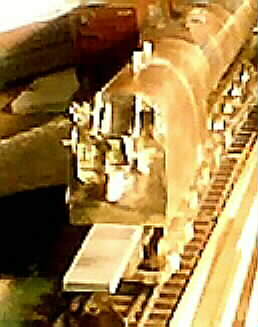
Next up: a few more valves, also the floor with two seats, the brake stand (again, it is convenient that Russian practice is similar to North American) and reverse lever.
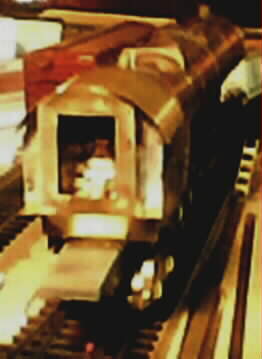
As far as I know, the Communists found a portrait of Lenin somewhere in the cab to be a bit much!

Next up: a few more valves, also the floor with two seats, the brake stand (again, it is convenient that Russian practice is similar to North American) and reverse lever.

As far as I know, the Communists found a portrait of Lenin somewhere in the cab to be a bit much!
NO TRISKADEKAPHOBIA HERE. Matt at Hit and Run has the obligatory Friday the 13th link to "why people fear Friday the 13th." Writing as someone who entered this life on a Friday the 13th, under a full moon no less, I find this fear somewhat amusing. On the other hand, the power was out for the better part of the early evening around here tonight ... could it have been Hod's mistletoe gone awry again?
DEPRESSING. John Stossel's Stupid in America on ABS's 20/20 has just ended. He's written a brief synopsis for Reason. That synopsis mentions New York's "rubber rooms," a facility for teachers insufficiently competent to teach but insufficiently incompetent to fire. Mr Stossel shows a rather complicated flowchart a principal must work through to justify firing a teacher. It's probably easier to canonize a saint. But one wonders about the emptiness of some peoples' lives ... evidently the teachers exiled to the rubber rooms are content to play cards or just hang out all day rather than find something more productive to do. The show also revealed something I was not aware of ... school choice in Belgium, complete with vouchers good in parochial schools. A market in elementary education services, hard by the headquarters of the European Union, forsooth! Mr Stossel could have done more about the manifestation of choice in the United States, namely the test-score premium that explains much of the variation in otherwise identical houses in various parts of the country.
RUNNING EXTRA. Company Mail source Blogs for Industry reviews the broadcast.
RUNNING EXTRA. Company Mail source Blogs for Industry reviews the broadcast.
11.1.06
THE VALUE OF CARTELS? The economic theme for today appears to be insecurity. Two posts, from differing perspectives, appear slightly nostalgic for the days of monopoly capitalism and regulated cartels.
First, Elizabeth Warren sees "The Middle Class on the Precipice."
But it's not simply Professor Warren, who I have beaten up, repeatedly, for failure to grasp the Say Aggregation Principle, that is nostalgic for the concentrated industries of years ago. Harold Meyerson (!) quotes a scholar who appears positively nostalgic for "A Gentler Capitalism."
First, Elizabeth Warren sees "The Middle Class on the Precipice."
How many times do people have to be mugged by reality before they grasp the idea that choices have consequences? (Let's leave aside the dubious statistical inference that three different sources of uncertainty treble the odds, and two participants in the workforce doubles the risk of a spell of unemployment. I want to finish this post before supper.) Among my early reactions to The Two Income Trap, which gives Professor Warren and her daughter material for this continuing policy show is this.The only real increase in wages for a family has come from the second paycheck earned by a working mother. With both adults in the workforce full-time, the family’s combined income is $73,770—a whopping 75 percent higher than the median household income in the early 1970s. But the gain in income has an overlooked side effect: family risk has risen as well. Today’s families have budgeted to the limits of their new two-paycheck status. As a result, they have lost the parachute they once had in times of financial setback—a back-up earner (usually Mom) who could go into the workforce if the primary earner got laid off or fell sick. This “added-worker effect” could buttress the safety net offered by unemployment insurance or disability insurance to help families weather bad times. But today, a disruption to family fortunes can no longer be made up with extra income from an otherwise-stay-at-home partner.
Income risk has shifted in other ways as well. Incomes are less dependable today. Layoffs, outsourcing, and other workplace changes have trebled the odds of a significant interruption in a single generation. The shift from one income to two doubled the risks again, as both Mom and Dad face the possibility of unemployment. Of course, with two people in the workforce, the odds of income dropping to zero are lessened. But for families where every penny of both paychecks is already fully committed to mortgage, health insurance, and other payments, the loss of either paycheck can unleash a financial tailspin.
There are also coping strategies available to families. Don't buy the McMansion in the first place. Ditto the SUV that looks like a Kenworth bobtail. Homeschool. Ditch the organized sports and let the kids organize their own recreation. Encourage the kids to work their way through college. Cut up the credit cards. Start a victory garden.Joanne Jacobs has a similar reaction today.
We live in bigger houses, have available better treatment for more ailments, watch bigger, better TVs, listen to smaller, better iPods and drive mammoth SUVs.But it's not those choices (conveniences becoming necessities?) that concern me today. Back to Professor Warren.
Steelworkers, airline employees, and now those in the auto industry are joining millions of families who must worry about interest rates, stock market volatility, and the harsh reality that they may outlive their retirement money.Years ago, economic policy courses would likely have a unit on barometric price leadership. The short version of the model is an industry that prices like a monopoly without there actually being a monopoly, or, more distressingly, an illegal conspiracy (with great anecdotes about electrical equipment executives hiding out at Dirty Helen's in Milwaukee's red light district) to fix prices. In those days, the existence of such non-conspiratorial collusion provided reason to propose antitrust improvements, such as mandatory restructuring of competitive industries, or less rigorous standards of evidence that a conspiracy existed. And what industries provided canonical examples of antitrust-immune price leadership (sometimes referred to as "consciously parallel"; today "rational cooperation" is a subgame-perfect version of that story)? Everybody get steel, motor vehicles, and tobacco? The airlines in those days were regulated "in the public interest," but that "public interest" required that the public be protected from "ruinous and destructive" price competition, and Walter Folger Brown forbid that coach passengers be served a decent sandwich at lunch!
But it's not simply Professor Warren, who I have beaten up, repeatedly, for failure to grasp the Say Aggregation Principle, that is nostalgic for the concentrated industries of years ago. Harold Meyerson (!) quotes a scholar who appears positively nostalgic for "A Gentler Capitalism."
For the pervasive insecurity that is inextricably part of today's capitalism has become the dominant fact of modern life. "The fragmenting of big institutions has left many people's lives in a fragmented state: the places they work more resembling train stations than villages," writes sociologist Richard Sennett in "The Culture of the New Capitalism," a newly published collection of lectures he gave at Yale University in 2004. Throughout most of the 20th century, the insecurity endemic to capitalism was mitigated by business institutions organized, as Sennett's great predecessor Max Weber first noted, along military lines. The corporation gave the employee a place and a ladder, and in such a lifelong institution, Sennett notes, "it became possible to define what the stages of a career ought to be like, to correlate longtime service in a firm to specific steps of increased wealth."Those big institutions are, presumably, the giant corporations capable of practicing barometric price leadership right up to the day that some upstart displaces them. (And it is certainly the case that the automakers and Big Steel have objected, loudly, to foreign competition, and legacy air carriers have sought subsidy, and former retailing giants such as Sears and Penney have had to surrender to Wal-Mart or make common cause with Lands' End.) I think that's called creative destruction, and Russell at Cafe Hayek suggests as much. In a follow-up post, he notes that there are market tests for businesses that render their institutional memory redundant.
Sennett is no apologist for the old corporate order, but it did impart a structure to people's work lives and a place to hone their crafts. The new workplace, by contrast, is a brave new world of short-term employment and relationships, where experience is not necessarily a virtue and institutional memory is sketchy at best. It may be a fine place for young workers, but "as middle age looms and children, mortgages and school fees appear, the need for structure and predictability in work grows greater." The frequent migration of executives from one firm to another, Sennett adds, imposes further costs on employees: "This managerial revolving door has meant that the steady, self-disciplined worker has lost his audience."
Imagine that—the most productive companies treat their workers well. It's unfortunate that we live in a time where that is considered surprising.Next week, I greet the registrants in a public policy course that has a substantial competition policy component, as well as an antitrust economics course. I'm working on incorporating the tension between the security of monopoly (if in fact there is such security) and the inefficiency of monopoly into both.
I FEEL YOUR PAIN. Financial Rounds:
No doubt, though, that the people who exist to measure the work rather than do the work will be able to report, to whoever cares, that the administrative fads of the moment have been communicated to all the faculty.Classes don't start for another two weeks. But, my university makes all faculty get together for a two-day series of meetings before each semester (it's today and tomorrow).
What a massive waste of time! It's supposed to be a means of passing on and/or maintaining our school's unique culture. It actually accomplishes this end, since part of our culture seems to involve wasting time in boring, unproductive meetings.
RULES WRITTEN IN BLOOD. John at EclectEcon suggests greater reliance on nuclear steam electricity as a way of sparing miners' lives (as well as reducing greenhouse gas and acid rain combustion byproducts?) There are several links to others thinking about the same thing.
Two observations: First, many of the electricity generating plants now use natural gas rather than coal (for those environmental reasons.) That situation came to light first in early 2001, when a severe winter in the east coincided with the teething troubles in the California power-deregulation plans. Second, many of the coal-fired plants use strip-mined coal from the Powder River basin. It has a lower heat content but less sulfur than the eastern coals. (One of these days I have to figure out EDGX and AERX and some of the other odd reporting marks on the Powder River trains rolling through DeKalb. I know who WEPX and WPSX and NORX and CEEX are. Some of these other trains are headed east of the Appalachians.) That leaves open the possibility that the deep miners of West Virginia are bringing up metallurgical coals. (What other uses are there for coal these days?)
Two observations: First, many of the electricity generating plants now use natural gas rather than coal (for those environmental reasons.) That situation came to light first in early 2001, when a severe winter in the east coincided with the teething troubles in the California power-deregulation plans. Second, many of the coal-fired plants use strip-mined coal from the Powder River basin. It has a lower heat content but less sulfur than the eastern coals. (One of these days I have to figure out EDGX and AERX and some of the other odd reporting marks on the Powder River trains rolling through DeKalb. I know who WEPX and WPSX and NORX and CEEX are. Some of these other trains are headed east of the Appalachians.) That leaves open the possibility that the deep miners of West Virginia are bringing up metallurgical coals. (What other uses are there for coal these days?)
TOPPING YET ANOTHER SEARCH STRING. This time, "Wisconsin chili recipe." I must caution readers that my recipe is of the same class of hotness as Real Chili's "Hot with beans" or Chili John's hot. Most of the recipes on the first page of links are what I understand to be close to what I call "camp chili." The basic ingredients for most Midwestern chili, spaghetti, and goulash start with 1.5 pounds of ground beef, onions, green peppers, and something with tomato. The spices and the choice of starch determine the ethnicity of the dish. (In Iowa and Minnesota, it's the choice of starch. Leave out any spice more daring than salt and a quarter-teaspoon of ordinary black pepper.)
10.1.06
THE DIFFICULTY OF FRAMING A POLICY STATEMENT. Steven Horwitz at Liberty and Power links to a recently released statement by the Board of Directors of the American Association of Colleges and Universities on "Academic Freedom and Educational Responsibility" The statement gets into a difficult position early.
Professor Horwitz notes that hiring committees are self-referential. The possibility of a department or a discipline being captured by a faction that honors content-free research is real enough. Economics is not immune from that. As he notes,
Perhaps that opening paragraph is boilerplate. Perhaps the entire statement is spin. But it is not without consequence. Consider
The statement is unlikely to mollify critics of the academy who see group think and phony diversity. Neither does it address the very real diversion of resources in the academy to non-academic purposes and emoluments for administrators.
Academic responsibility requires professors to submit their knowledge and claims to rigorous and public review by peers who are experts in the subject matter under consideration; to ground their arguments in the best available evidence; and to work together to foster the education of students.That sounds straightforward enough, but "best available evidence" might rule out any work in literary criticism, and it certainly raises questions about what passes for "theory" in those quarters as something that merits peer review. (There is a much longer passage, under the heading "Academic Freedom and Scholarly Community," where the authors address that objection, although in such a way as to leave open the possibility of self-referential disciplines emerging. Market tests are Neglected Actors throughout that section.)
Professor Horwitz notes that hiring committees are self-referential. The possibility of a department or a discipline being captured by a faction that honors content-free research is real enough. Economics is not immune from that. As he notes,
After all, how well can an Economics department full of neoclassical economists really teach other perspectives (e.g. Austrian or Institutionalist, much less, say, Marxist)?Marx is a minor post-Ricardian. Ronald Coase, Douglass North, and Oliver Williamson have much to say about the evolution of institutions. Hard-core Austrians who reject mathematical modelling and econometrics? That "best available evidence" line might suffice to ignore applications from such people.
Perhaps that opening paragraph is boilerplate. Perhaps the entire statement is spin. But it is not without consequence. Consider
Is the notion of a "common good" indoctrination? Propaganda? Emotional appeal? Is that inevitably something different from pursuing a career and relating to others? What conceits are at work in that "imagine alternative futures?"Beyond fostering intellectual and personal development, a liberal education also enables students to develop meaning and commitments in their lives. In college they can explore different ways to relate to others, imagine alternative futures, decide on their intended careers, and consider their larger life’s work of contributing to the common good.
Building such intellectual and personal capacities is the right way to warn students of the inappropriateness and dangers of indoctrination, help them see through the distortions of propaganda, and enable them to assess judiciously the persuasiveness of powerful emotional appeals.
The statement is unlikely to mollify critics of the academy who see group think and phony diversity. Neither does it address the very real diversion of resources in the academy to non-academic purposes and emoluments for administrators.
THE ART OF RAILROADING. This week's feature at DoDo's Train Blogging notes that the Impressionists loved trains. Several of the paintings commenters have submitted hang, fittingly, in the Art Institute of Chicago.
The image is a different twist on art and railroading. Edward Hopper's "Nighthawks," which hangs in the same gallery as "American Gothic" (when the latter is not on tour), provided the interior arrangements for this all-night counter near the station.
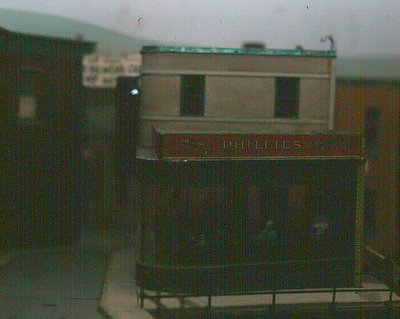
The location is on the late John Armstrong's Canandaigua Southern in suburban Washington, D.C.
The image is a different twist on art and railroading. Edward Hopper's "Nighthawks," which hangs in the same gallery as "American Gothic" (when the latter is not on tour), provided the interior arrangements for this all-night counter near the station.

The location is on the late John Armstrong's Canandaigua Southern in suburban Washington, D.C.
WHY PUBLIC CHOICE THEORY WILL NOT GO AWAY. George Will:
John Fund:
Read and understand all. There may be a quiz later.
The national pastime is no longer baseball, it is rent-seeking -- bending public power for private advantage.(Via InstaPundit.)
John Fund:
Many Republicans have forgotten that as government grows, its increased power to grant favors or inflict pain attracts more people who would abuse the system.(Via Betsy's Page. See supra.)
Read and understand all. There may be a quiz later.
9.1.06
VERY JUNIOR HIGH. Journalist Alexandra Robbins attempted to do some ethnography among the sororities. The result is Pledged, an impromptu Book Review No. 2 using the time between clearing security in Boston and landing in Chicago to do the reading. (I was in the usual end-of-convention convex combination of juiced on caffeine and overtired that precluded either sleeping the trip away or doing some more serious work.) As is often the case in a popular investigation (and still too often in a scholarly investigation), a small sample of anecdotes (possibly combed for the most titillating outliers) do not make for robust research. Ms Robbins did have the problems of having to pretend to be younger and working around an official proscription by the Greek organizations, which she characterized as fearful of hatchet-job journalism. Given what she reported, those organizations do indeed have much to be fearful of.
I'll start with some general observations Ms Robbins makes about the ambiguous role the Greek system plays in university life.
The bonding and exclusion is apparently important. Pledged opens and closes with Southern Methodist's Bid Day, which gives the impression of medicine's Match Day without the gravitas, although to receive a bid from an unanticipated house, or from no house at all, is The. End. Of. The. World. to some so treated, as well as to their parents. (Southern Methodist's erstwhile Phantom Professor had several books, including Pledged, on her Summer Stack. Reviews and impressions, please.) More seriously, the exclusion continues to manifest itself as racial segregation along Southern Greek Rows where such affiliations are evidently more important to students and historically white houses serve the same function the all-Pullman Panama Limited allegedly did for the Illinois Central Railroad, of enabling the universities to comply with civil rights laws while circumventing them. (The City of New Orleans of the era was a fast all-coach train that would connect Chicago to New Orleans in 19 mostly daylight hours. Theodore White's Making of the President 1960 notes its role in the black migration to Chicago.)
The use of the term "nonoverlapping" in the same sentence with the category "promiscuous" misleads. That's the central focus of Pledged. I've sometimes suspected that Thomas Frank wrote What's the Matter with Kansas, which I've remarked on more substantively here, here, and here, in part as payback to people he thought were friends who excluded him from the Greek-system sexual cartel that dominated social life in Lawrence. Better to opt out of that cartel. If the anecdotes of Pledged are representative (small samples generally aren't) the neuroses and follies of Sex and the City and Desperate Housewives are simply party life in the rabbit culture relocated to upscale quarters. At gatherings of the national Greek organizations, speakers seek to dispel the image of the ladies as on the one hand "sorostitutes and fraterniture" and on the other hand "dramatic" and "high maintenance" but on the other hand the guys are quite happy to ply the gals with their liquor and the gals quite happy to drink it, even if it is on occasion a Mickey Finn (to use the language of a more hard-boiled era.) But the right house has to be providing the drinks and the companionship. And yes, people get hurt. Often.
Pledged tells us very little about what goes on in class (other than many are missed for house events; no doubt some are cut for hangovers.) One of the students has a fling with a professor in a course she is finishing. Apart from that, Ms Robbins misses an opportunity to rebut some spin from the national organizations about members of Greek-letter organizations having higher graduation rates. (That's easy. Even a Yale soccer player should be able to follow this, although people who should know better don't. Fraternity and sorority membership is a proxy for higher family income. Students with more family resources are more likely to finish. Well-known state universities reserve residence hall space for state residents. Well-to do parents that take advantage of lower out-of-state tuitions than prevail at the most famous private universities, such as the parents of Coasties, provide a population with lots of resources to keep those houses solvent, as well as to buy the PradaGucciChanel with designer sunglasses and Uggs the membership committee expects the newest litter of rabbits to wear.)
How are things different here? Northern Illinois does not cater to as rich a population. Although many people perceive the social life as dominated by the Greek system, our fraternity and sorority membership as a share of the student body looks more like Chicago's than like Northwestern's or Illinois-Urbana's. We also have rules. (I recognize the name of one of the student authors of this document and will vouch for that person's character.)
I'll start with some general observations Ms Robbins makes about the ambiguous role the Greek system plays in university life.
That this kind of exclusivity is collegiately condoned makes the situation all the more intriguing: sororities themselves are cliques. Envision taking the group of girls in high school who bond and exclude and formally recognizing their belonging to one group and not to another by assigning them letters, colors, and mascots. The blondes, the super-thin, the rich, the promiscuous, and the girls who smoke marijuana are separated and recognized as distinctive, nonoverlapping groups. Once a girl is accepted into one of the groups, she can never affiliate with another. Each group is allotted [space] (decorated in their colors) from which they can observe the other groups. They are given secret rituals and an oath swearing allegiance to one another.Such validation by the university might contribute to the "cooperation in the prolonged immaturity of our students" Mark Bauerlein of Emory deplores, as well as to the proliferation of "well-dressed dodos" Kimberly of Number 2 Pencil anticipates. That's not, however, where Ms Robbins is taking us. We will learn a little bit about the secret rituals. Many of these involve the recruiting and pledging of members and the subsequent pair-bonding of members. Much of what Ms Robbins reports gives the impression of Freemasonry without the gravitas. She makes several references to a publication called the Norman Shield of Kappa Delta (there's what the organization calls a "Norman Cross" on its arms; the elegance of the Square and Compass it hasn't) as well as to the initiation rituals of this organization, which allow members to pass through degrees. (To be fair, some critics of the Freemasons have suggested that the proliferation of degrees are a way for local lodges to make money. Keeping the house solvent matters to the young ladies Ms Robbins visits.)
The bonding and exclusion is apparently important. Pledged opens and closes with Southern Methodist's Bid Day, which gives the impression of medicine's Match Day without the gravitas, although to receive a bid from an unanticipated house, or from no house at all, is The. End. Of. The. World. to some so treated, as well as to their parents. (Southern Methodist's erstwhile Phantom Professor had several books, including Pledged, on her Summer Stack. Reviews and impressions, please.) More seriously, the exclusion continues to manifest itself as racial segregation along Southern Greek Rows where such affiliations are evidently more important to students and historically white houses serve the same function the all-Pullman Panama Limited allegedly did for the Illinois Central Railroad, of enabling the universities to comply with civil rights laws while circumventing them. (The City of New Orleans of the era was a fast all-coach train that would connect Chicago to New Orleans in 19 mostly daylight hours. Theodore White's Making of the President 1960 notes its role in the black migration to Chicago.)
The use of the term "nonoverlapping" in the same sentence with the category "promiscuous" misleads. That's the central focus of Pledged. I've sometimes suspected that Thomas Frank wrote What's the Matter with Kansas, which I've remarked on more substantively here, here, and here, in part as payback to people he thought were friends who excluded him from the Greek-system sexual cartel that dominated social life in Lawrence. Better to opt out of that cartel. If the anecdotes of Pledged are representative (small samples generally aren't) the neuroses and follies of Sex and the City and Desperate Housewives are simply party life in the rabbit culture relocated to upscale quarters. At gatherings of the national Greek organizations, speakers seek to dispel the image of the ladies as on the one hand "sorostitutes and fraterniture" and on the other hand "dramatic" and "high maintenance" but on the other hand the guys are quite happy to ply the gals with their liquor and the gals quite happy to drink it, even if it is on occasion a Mickey Finn (to use the language of a more hard-boiled era.) But the right house has to be providing the drinks and the companionship. And yes, people get hurt. Often.
Pledged tells us very little about what goes on in class (other than many are missed for house events; no doubt some are cut for hangovers.) One of the students has a fling with a professor in a course she is finishing. Apart from that, Ms Robbins misses an opportunity to rebut some spin from the national organizations about members of Greek-letter organizations having higher graduation rates. (That's easy. Even a Yale soccer player should be able to follow this, although people who should know better don't. Fraternity and sorority membership is a proxy for higher family income. Students with more family resources are more likely to finish. Well-known state universities reserve residence hall space for state residents. Well-to do parents that take advantage of lower out-of-state tuitions than prevail at the most famous private universities, such as the parents of Coasties, provide a population with lots of resources to keep those houses solvent, as well as to buy the PradaGucciChanel with designer sunglasses and Uggs the membership committee expects the newest litter of rabbits to wear.)
How are things different here? Northern Illinois does not cater to as rich a population. Although many people perceive the social life as dominated by the Greek system, our fraternity and sorority membership as a share of the student body looks more like Chicago's than like Northwestern's or Illinois-Urbana's. We also have rules. (I recognize the name of one of the student authors of this document and will vouch for that person's character.)
NEVER CLEAN OUT YOUR RESEARCH FILES COMPLETELY. Rip Track complains about railroad fuel surcharges on freight rates.
Rip Track has a request to the railroads.
On the other hand, don't do that. Leave these escalator clauses in place as they are for about five years. I know exactly how to identify the deadweight losses that would result. All I have to do is cultivate some shippers who will provide me with the text of the surcharge clauses.
Years ago, I participated in some research on automatic fuel cost adjustments to electricity rates. (Was it really thirty years ago this month I started working on it?) The purpose of those adjustments was to spare the utility regulators the difficulty of holding a full-blown rate hearing each time the utility's fuel bill changed. The point of the research was to identify the extent to which power companies used relatively more fuel-intensive technologies so as to be able to recover more of a cost change more rapidly. (They did, to the extent of several millions of 1972 dollars in additional costs to consumers. The inefficiencies haven't gone away. More recent researchers have proposed transferring the fuel price risk to the futures market as an alternative way of reducing the inefficiency.) But those adjustment clauses (I read them. All of them. For several different volumes of the long-lost National Electric Rate Book) required rate reductions if the utility's delivered costs of fuel fell below some baseline. Did Burlington leave something out of its tariffs that shippers completely missed?Anyone who ships by rail today is aware of the "Fuel Surcharge", a tariff that is added to all published freight rates. Several months ago when the surcharge was initiated, rates would fluctuate somewhere between 2% and 4.5% to 5%. Then everything changed. As Autumn '05 approached, the surcharge ballooned to 10%, 11%, and 12%, finally resting at an unbelievable 18.5% for BNSF Shippers for December 2005!
One problem is obvious for Rail Shippers. If you work up a competitive quotation, and base your freight component on a lower surcharge, the increases which we have recently seen blow your bid out of the water. The difference between a 4% fuel surcharge and a 12% fuel surcharge will ultimately mean a financial loss for such a project as bid. And guess what? No owner who awards a contract based on your bid will cut much slack here. All things equal, you lose!
Another problem: The 18.5% Fuel Surcharge for the BSNF was announced to shippers on the first day of November. At that time, is was an accurate reflection of fuel prices. Guess what happened? If you recall, fuel went down in price. But the BNSF, in this case, did not lower their surcharge, it remained in place.
Rip Track has a request to the railroads.
Please, Class Ones, do this. If you are a high-powered exec, you can even take credit for thinking it up. The solution? Admit that fuel prices are not going back to the levels of late 2004. Simply raise your published tariffs so that the fuel surcharge can be lowered to a much smaller and more controllable percentage.In the regulated utilities, this arrangement would involve a partial or full hearing to change the base delivered price of fuel above or below which the fuel adjustment would take effect. For completeness, a shipper who has the opportunity to shift sufficient traffic to Union Pacific or CN to matter ought inform Burlington that an escalator clause without a base delivered price for fuel and the possibility of lower tariffs in the event of fuel prices below that base.
On the other hand, don't do that. Leave these escalator clauses in place as they are for about five years. I know exactly how to identify the deadweight losses that would result. All I have to do is cultivate some shippers who will provide me with the text of the surcharge clauses.
THAT'S NEWS TO ME. Destination: Freedom notes that there is no such thing as "free parking." No news there. The opportunity cost, however, is news.
The total subsidy for off-street parking in 2002, [UCLA professor Donald] Shoup estimated, was between $127 billion and $374 billion—somewhere between the costs of Medicare ($231 billion) and national defense ($349 billion). And research conducted under the CTS Transportation and Regional Growth Study estimated the total cost of off-street parking in the Twin Cities is 50 percent more than the cost of streets and highways.That sounds large. Professor Shoup (more here) has a book titled The High Cost of Free Parking that might provide the support for those estimates. There are, however, complications.
Shoup envisions communities that charge market-rate prices for curb parking, use the revenue to improve neighborhoods, and remove off-street parking requirements. The cost of parking becomes unbundled from other transactions, so driving and oil consumption drop and our air is cleaner. “We pay less for the price of everything except parking,” he summarized.Bundling and unbundling, however, have complexities. I remember inner-city department stores with proprietary parking lots. Consumers could use these at no additional charge, although drivers would have to wait for directions from a traffic controller with a high-level view of the lot. That had to be one of the more trying jobs in the store on those sub-zero days around Christmas. But the controller earned his pay those days, as those lots definitely were not engineered for peak loads, contrary to assertions elsewhere in the article and in this summary from the UCLA Institute of Transportation Studies of High Cost. Other inner-city department stores would have parking validation agreements with nearby paid lots that might be operated as a business or as a city utility. These arrangements had to emerge for a reason. What competitive advantage did stores discover in providing parking as an additional service to shoppers (one that would be easier to unbundle than, say, fitting rooms or warranties?) Why did that competitive advantage morph into the shopping centers, enclosed shopping malls, and complexes of free-standing big box stores, surrounded by ample parking we see today, to the dismay of the urban lobby? On the other hand, why have land-use planners adopted the practices of stores with ample unpaid parking as recommended practices, something that Professor Shoup criticizes?
Even though parking costs are hidden, Shoup declared, we all bear the cost of this “great planning disaster.” Parking requirements skew travel choices, distort urban form, degrade urban design, raise housing costs, impede reuse of older buildings, limit homeownership, damage the urban economy, and harm the environment.On the other hand, couldn't the same thing be said about any other kind of requirement? Simply because free-standing shopping centers appear to be a good idea given the incentives in place after World War II does not mean such complexes will never become obsolete, exactly as many central cities have. Land-use planning that mandates perpetuation of the 1850-1950 urban forms is not per se a distortion?
SIXTY YEARS AGO. Sgt. Karlson receives an honorable discharge at Fort Meade in Maryland.

Battles: Ardennes, Rhineland, Central Europe.
Recognition: Good Conduct Medal, American Theater Ribbon, Meritorious Unit Award, Victory Ribbon, European-African-Middle Eastern Theater Ribbon.

Battles: Ardennes, Rhineland, Central Europe.
Recognition: Good Conduct Medal, American Theater Ribbon, Meritorious Unit Award, Victory Ribbon, European-African-Middle Eastern Theater Ribbon.
8.1.06
WAS THERE A MAN DISMAYED? The Live Journal 50 Book Challenge remains an active community this year. As the community organizer offers the fifty as a goal, rather than a competition, this year's efforts may or may not attain fifty by year's end. But Review No. 1 is ready, and with a Border's in the Boston airport and airport delays (in the time it takes to load a 737, a Hiawatha can get from either Chicago or Milwaukee to the State Line) a Review No. 2 is close to hand.
For the first review, H.P. Willmott's The Battle of Leyte Gulf: The Last Fleet Action. I suppose a dust jacket that refers to the work as a "careful interrogation"and an opening sentence that asserts "One is tempted to suggest that there are only two problems in the study of naval history: naval historians and naval officers" ought offer sufficient warning that academic posturing (demonstrating some other historian or some other school of thought to be inadequate) rather than analysis of the record is the author's objective. And, indeed, Mr Willmott's perspective is one of emphasizing social organization and ideas, rather than Thomas Carlyle's notion of influential individuals, as the prime mover of historical events. (He asserts, although it is beyond the scope of his book to demonstrate, that the pre-Pearl Harbor Japanese Navy exhausted itself exhausting the pre-Pearl Harbor U.S. Navy, with the new U.S. Navy launched after Pearl Harbor overwhelming what remained of that Japanese Navy, with the outcome of Leyte Gulf essentially irrelevant to the outcome of the Pacific War. Put simply, the U.S. Navy would have been able to make good any losses the Japanese might have inflicted. Had the Japanese not suffered the losses they did, their fleets would have been stranded for lack of fuel.)
The analysis of the battle itself offers little that is new, Mr Willmott's investigation of Japanese sources notwithstanding. My review of Thomas Cutler's The Battle of Leyte Gulf complained that a fictional character, rather than a Navy veteran, summarized the attitude in Task Force 38 to Admiral Halsey's handling of the fast battleships. But Mr Willmott's evaluation of the behavior of Japanese Admiral Kurita Takeo, the one striking force commander with the chance of achieving a local victory, might as well have been given by Robert Mitchum. More precisely, the naval officer, Victor Henry, played by Robert Mitchum in the television version of War and Remembrance translates and comments on a book by a fictional German general as a way of putting the fictional events in some context. The general comments on Admiral Kurita's errors in commencing to attack, then breaking off, with the opportunity to destroy some light carrier formations and menace the U.S. beachhead on Luzon. Robert Mitchum's character comments,
It took Kurita over three hours to round up his force. Air attacks slowed the process, and the buzzing planes and bursting bombs must have been driving him cuckoo. By the time he was ready to head into the gulf, it was getting on to one o'clock. His surprise was blown. He surmised -- quite correctly -- that wherever Halsey was, he was coming on fast. Ozawa was silent, and the southern force had evidently never made it into the gulf. To Kurita, the gulf had become a death trap, a hornet's nest of land-based and carrier planes, where his whole force would be sunk in the remaining daylight hours without laying a glove on MacArthur.Mr Willmott uses more words to reach effectively the same conclusion. He does note that the combined air power of the escort carrier air wings equated to the strength of two fleet carriers, and, with U.S. bases established ashore, the planes were able to conduct shuttle bombing runs from the more distant escort carriers to the land bases and back. He also suggests that, even had the ships of the line destroyed the escort carrier forces and taken positions off the landing beaches, they would be isolated, short on fuel, and ultimately overwhelmed by the U.S. Navy units closing from points east. Unlike Admiral Halsey's theoretical fear of shuttle bombing by carrier planes staging to Japanese bases on Formosa or elsewhere on the Philippine Islands, Admiral Ozawa confronted the reality of shuttle bombing without an air umbrella.
ARLINGTON, BERKELEY, CLARENDON. Should I ever have occasion to write a manual for operating and signalling a model railroad, I might use Boston's "alphabet streets" as hypothetical station names for the dispatching examples. Quick quiz: "Number 2 has right over Number 1 Gloucester to Exeter." What's wrong?
The economics convention has concluded and I am safely home. Like King, it strikes me that the bargaining balance will favor the buyers this year, particularly for entry-level positions. (We, too, chatted with people that are likely to find work elsewhere. With the internet and Google Scholar, our chances of locating their research in the working paper or pre-publication stage is a lot easier than in the days when we had to maintain reciprocal working paper exchanges. There are a few people whose work I am going to follow up on from the office.) Unlike Phil, I am not dismayed that next year's convention will be in Chicago. (The timing, early in January, is inconvenient but understandable. Something like half the working economists live in the Northeast Corridor. At one time, there was a referendum in the American Economic Association to hold every other convention either in New York or somewhere in the Northeast Corridor, meaning Boston, New York, Philadelphia, the District, or possibly Baltimore. The actual scheduling of conventions is a bit more geographically dispersed than that.)
I did have a bit of an opportunity to explore Boston before the heavy interviewing began. The Massachusetts Bay Transportation Authority still operates the funkiest heavy-rail transit system in the world. (Moscow's is most elegant, New York's most muscular, and Chicago's most authentic.) The Authority has recently introduced farecards, which it calls "Charlie cards," to remember the legendary song, made famous by the Kingston Trio, about the man who didn't have the nickel to pay on departing outside the single fare area. (As recently as 1988, the left-side loading trackless trolleys that looped through Harvard Square were pay-to-exit outbound, pay-to-enter inbound with direct access to the paid-fare area of the Harvard heavy rail station.) I was able to sample all four heavy rail lines, and grabbed a late lunch in the South Station food court. Boston's commuter rail operation is a bit less intense than Chicago's. I'm not sure that food court, or the practice of posting different tracks for some of the suburban trains each day in the English fashion, would last long with the thundering herds of Burlington commuters headed to Clarendon Hills or Downer's Grove.
The alphabet streets are a bit of urban-grid logic amid the cattle-trail randomness of Boston's streets. As I understand it, they are built on reclaimed land where the Boston Neck was filled in. The area is easily walkable, with lots of historic churches and other sites worth a longer look. I was able to check for some records at the New England Historic Genealogical Society and stroll from my hotel to the original Cheers, properly the Bull and Finch (a play on the Capitol architect?) pub. There was a Patriots game on television, and, with the interviewing done, the Guinness tasted good with a cheeseburger and chowder.
4.1.06
MARKING OFF. I did mention that the Economics convention is coming up. Like Phil at Market Power, I have been entrusted with recruiting. Unlike the Modern Language types, I will not be live-blogging the conference.
TWELVE OUT. The Country Pundit gets the words right.
SECOND SECTION. This morning's news is very different. The families of the twelve dead miners had their hopes raised, then dashed, on an erroneous early report.
Any man willing to go into the bowels of the earth in search of black diamonds gets my hat tipped to him. Prayers have been answered, and thanks will be offered. I hope that the family of the deceased supervisor will be able to pull through this obviously very difficult time.Amen.
SECOND SECTION. This morning's news is very different. The families of the twelve dead miners had their hopes raised, then dashed, on an erroneous early report.
QUOTE OF THE DAY. Steven D. Krause is not happy with the timing or the purpose of the Modern Language Association convention.
The Modern Language Association is done for this year, and the news reports are trickling in. Professor Krause has a survey. Milt's File hopes the Association will get out of the "'theory' morass in which they have floundered" and recommends a Nick Gillespie three-parter at Tech Central Station. The Valve has a post roundup, a reaction to Mr Gillespie, an individual report, another individual report, and a link-fest for one individual who filed multiple reports.
Ah, the annual Modern Language Association convention, the meat market of English studies, and, IMO, ample evidence for the contempt that the field and profession has for family, impoverished graduate students, and “lives” in general.This convention continues to use the week between Christmas and New Year's Day. Economics used to do that (because the hotels could be had cheaply?) but it now meets the first weekend after New Year's Day. That's not quite as bad, as that week is usually registration or set aside for faculty meetings. (The escort services in the convention city get to stand down when the economists hit town, from what I've been told.)
The Modern Language Association is done for this year, and the news reports are trickling in. Professor Krause has a survey. Milt's File hopes the Association will get out of the "'theory' morass in which they have floundered" and recommends a Nick Gillespie three-parter at Tech Central Station. The Valve has a post roundup, a reaction to Mr Gillespie, an individual report, another individual report, and a link-fest for one individual who filed multiple reports.
ON MY WORKBENCH. The Andreyev has a rather large expanse of backhead and a sufficiently well-illuminated cab that some superdetailing is in order. First, the stoker housing and controls.

The prototype had TWO stokers. In the absence of any solid information about how those were laid out, I provided a single stoker housing and firedoor in the North American style.
I also didn't know exactly what the throttle configuration was, but, with my understanding of Soviet standardization, figured the overhead throttle lever employed on the P36 would be good enough, particularly with the throttle linkage running outside the boiler to a control box at the smokebox.

I've had no end of trouble with the placement of the throttle hanger and the lever, but you'll see the hanger at the right side of the backhead. Once that's in place, in go the gauge glasses and a few valves. There will be seats and a brake stand. Must lay out that cab floor and rear mount first.
And no, the engine will NOT negotiate the curve in front of it.
NOTICE OF LINE RELOCATION. The site formerly known as Eclectic Econoclast is now posting as EclectEcon.
2.1.06
THE QUOTE MEME. I did promise to respond to a request from Voluntary Xchange.
I have others. Maybe on slow days ...
You know you've got them somewhere. Wonderful quotes that you kept for posterity and which have yet to see the light of day. Set them free and let the rest of us read them!Yes, I do that. Here's a short one from C.S. Lewis, "The Abolition of Man."
We make men without chests and expect of them virtue and enterprise. We laugh at honour and are shocked to find traitors in our midst. We castrate and bid the geldings be fruitful.The essay predates the therapeutic infection of our education enterprise. Read the rest of it.
I have others. Maybe on slow days ...
WHY THE LOSS FUNCTION MATTERS. Mitch at Shot in the Dark finds a Chicago Tribune appraisal of nine arguments for liberating Iraq. The Tribune's writers conclude,
The article is worth your time reading it. What it ... and many other arguments, both in favor and in opposition to liberating Iraq (or toppling Saddam, or stealing the oil, as you wish) ... neglects to do is carefully spell out what would be better or worse about the status quo ante bellum.Seventeen days before the war, this page reluctantly urged the president to launch it. We said that every earnest tool of diplomacy with Iraq had failed to improve the world's security, stop the butchery--or rationalize years of UN inaction. We contended that Saddam Hussein, not George W. Bush, had demanded this conflict.
Many people of patriotism and integrity disagreed with us and still do. But the totality of what we know now--what this matrix chronicles-- affirms for us our verdict of March 2, 2003. We hope these editorials help Tribune readers assess theirs.
REVEALING YOUR RESERVATION PRICES. In October, I had to do some quick research on reverse auctions in order to help the university radio station with a story. At that time, I had some reservations about coming up with a uniform price for each slice of a power company's load, suggesting that some base load producers would be making a lot of money. The metaphor I used was that the base load producers would be paid as if they were making a combination pizza with pineapples, Canadian bacon, and mushrooms when they were simply making cheese pizzas.
The reality might be worse than that. Lynne at Knowledge Problem reads Arthur Laffer and Patrick Giordano, who are thinking along similar lines.
While I'm on this subject, a quibble. Messrs. Laffer and Giordano raise this objection, which I have heard raised locally, to the entire reverse-auction power market.
The reality might be worse than that. Lynne at Knowledge Problem reads Arthur Laffer and Patrick Giordano, who are thinking along similar lines.
In ComEd's proposal the auction is halted at the so-called market-clearing price and all sellers receive that same uniform price--even those suppliers, like Exelon Generation, that might have been willing to sell at lower prices because their generation costs are very low.But the experimental research she has done with alternatives to uniform-price auctions introduces a different set of problems.
But we have decades of field and experimental data to show that pay-as-bid/pay-as-offer auctions induce participants to misrepresent their true values. Think about it: if you know that you are going to receive exactly what you offer, are you going to offer at your marginal cost? Heck no! You are going to shade your offer upward. In experiments ranging from Treasury bond auctions to wholesale power markets, there's a four-decade-long experimental literature exploring the intricacies of uniform vs. pay-as-bid auctions, and in general uniform price auctions are more efficient, although whether the buyers or the sellers benefit more depends on the application.In the wholesale power market, however, there might be ways of holding more than one uniform price auction (for example, some number of megawatts to be delivered continuously over the duration of the contract, some number of megawatts to be delivered from an hour before sunrise to an hour after sunset in the summer, some megawatts to be made available as a reserve.) That strikes me as a more logical way to preclude Edison from funneling money to its parent company, Exelon.
While I'm on this subject, a quibble. Messrs. Laffer and Giordano raise this objection, which I have heard raised locally, to the entire reverse-auction power market.
ComEd's proposal is particularly objectionable in Illinois because utility consumers long ago paid to build the nuclear plants now owned by Exelon Generation.What ever happened to the sunk cost fallacy? The efficient price for, to use my illustration, continuous delivery of electricity from continuously-turning power plants, whether nuclear or other, is a price at which an investor will replace existing capacity as it wears out. Whether Edison has or has not retired the bonds to pay for the existing nuclear plants (or, for that matter, the Insull-era coal plants) is irrelevant. Whether Exelon, or somebody else, can replace that base capacity as it wears out is most relevant.
IF YOU WANT TO BE A BADGER. Wisconsin football coach Barry Alvarez finished his coaching stint at Wisconsin (he stays on as director of athletics) with a 24-10 win over Auburn in the Capital One Bowl. (Not Capital One "Wallet" Bowl?) Although the touchdown drive that Wisconsin answered Auburn's touchdown at the beginning of the fourth quarter might have been the defining moment of the game, the drive that best exemplifies the Alvarez era is the one that finished the game. Auburn's special teams downed a punt inside the Wisconsin 1. (Yes, some replays showed that ball in the end zone, but I'm persuaded that instant replay is leading to sloppy refereeing, as the on-field guys are counting on the upstairs guys to bail them out. That's for another season.)
No doubt the Auburn fans were still hanging onto some hope at this time. Despite Wisconsin's two-touchdown lead, there were still six minutes or so to play, with the SEC's best defense and a potent offense waiting for some more snaps. And that defense came within a second of sacking quarterback John Stocco for a safety, but Stocco completed the pass for a first down. A few more runs, a few more pass plays, a few more first downs, and now it's first and goal with under two minutes to play. Auburn's coaching staff didn't prolong the obvious with spite times-out (one wishes there was some equivalent to tipping over the King in football and basketball games with the result decided), and two more running plays and a game-ending take-a-knee ends it.
Those long drives that kept the ball out of the hands of the other team's offense and ran out the clock were a key feature of the Rose Bowl seasons. It is difficult to conceive of a more fitting end to the Alvarez era at Wisconsin.
On ice, the natural order of things is being restored. Wisconsin won the Badger Hockey Showdown, defeating Western Michigan and then Northern Michigan. The other participant was Wayne State. (Did Wayne State make skimpy counter-offers to faculty to pay for this hockey team? And what's up with the Wayne "Warriors?" When I was there it was the Wayne State "Tartars.") And what's this I see, Wisconsin 4 at Minnesota 3, then Wisconsin 4 at Minnesota 0! SIEVE!
How things change ... the last time a Wisconsin team won the NCAA tournament, they were playing New Year's Eve games against teams with CCCP on their jerseys. Will the hockey gods grant Wisconsin an NCAA title and let Michigan be the evil empire?
RUNNING EXTRA. Four Block World summarizes.

SWITCHING OUT THE SCRAP LINE. Mungowit's End has returned to active service, after inspecting the staybolts and filling the lubricators.
ORDER, COUNTER-ORDER, DISORDER? A year ago, these pages were following the regime change in Green Bay, and suggesting that more recriminations were in order. Packer management brought in Ted Thompson as general manager, redefining then head coach and general manager Mike Sherman's portfolio as head coach and vice-president. Mr Thompson subsequently hired Miami's defensive coordinator Jim Bates as defensive coordinator. For all the troubles the Packers had this year, in many losses the margin of defeat was an interception return for a touchdown or a missed field goal. Some of the other troubles were recurrences of troubles in the 2004 season. At that time, a sportswriter asserted,
Today, Mr Sherman's portfolio has been further redefined by the Packers as job-seeker.
During the 132 years that the New York Yacht Club held the America's Cup, legend had it that the display case that housed the Cup would be used to house the head of the skipper who lost it. Dennis Conner managed to keep his head, despite losing the Cup. The way coaches turn over, Mike Sherman might yet land on his feet. (Minnesota and Detroit are looking ...)
Coach Mike Sherman has won a ton of regular-season games but hasn’t even reached the NFC Championship Game in five years. His team failed even to compete Sunday, just as it didn’t against St. Louis in 2001 and against Atlanta in 2002. Last year, Sherman blew it himself in Philadelphia by not going for it on a fateful late fourth and 1.(This column came in the aftermath of a blowout playoff loss, at home to Minnesota. For the second straight year, Minnesota put more than thirty points up on the Central Division champion, but that didn't save their coach.)
Today, Mr Sherman's portfolio has been further redefined by the Packers as job-seeker.
Sherman's winning percentage is the fourth best all-time among Packers coaches, behind Vince Lombardi (.746), Mike Holmgren (.670) and Curly Lambeau (.657).Unfortunately, on Mr Sherman's tenure, the Packers underachieved in the playoffs, losing at home twice, something that hadn't happened in 70 or 80 years of title games and the later divisional playoffs.
During the 132 years that the New York Yacht Club held the America's Cup, legend had it that the display case that housed the Cup would be used to house the head of the skipper who lost it. Dennis Conner managed to keep his head, despite losing the Cup. The way coaches turn over, Mike Sherman might yet land on his feet. (Minnesota and Detroit are looking ...)
RINGING IN THE NEW. A Constrained Vision brags on the Raleigh acorn and assorted other objects (a giant bologna???) people lower to count down to the New Year. Happy New Year, no matter how you choose to introduce it.
But let me offer a different candidate for Best Urban Celebration. Chicago featured fireworks from the Buckingham Fountain and from Navy Pier. Perhaps one of these years I'll have reason to observe it in person, if at all possible from a boat, if the harbor is open. The Chicago skyline, viewed from the lake side, is the equal of any other coastal city of size.
But let me offer a different candidate for Best Urban Celebration. Chicago featured fireworks from the Buckingham Fountain and from Navy Pier. Perhaps one of these years I'll have reason to observe it in person, if at all possible from a boat, if the harbor is open. The Chicago skyline, viewed from the lake side, is the equal of any other coastal city of size.
Subscribe to:
Posts (Atom)