Cold Spring Shops

Observations on economics, the academy, the wider world, and things that run on rails.

"Cold Spring Shops" was the name of the primary repair and car building facility of The Milwaukee Electric Railway and Light Company ... builders of trolley dining cars and the Christmas parade train ... perhaps I can be that creative too.


FREIE GEMEINDE


Northern Illinois University's current Speech Code Rating:

SUPERINTENDENT'S OFFICE


About Me
I Tube


Weblog Commenting and Trackback by HaloScan.com

ARCHIVES


09/01/2002 - 10/01/2002 10/01/2002 - 11/01/2002 11/01/2002 - 12/01/2002 12/01/2002 - 01/01/2003 01/01/2003 - 02/01/2003 02/01/2003 - 03/01/2003 03/01/2003 - 04/01/2003 04/01/2003 - 05/01/2003 05/01/2003 - 06/01/2003 06/01/2003 - 07/01/2003 07/01/2003 - 08/01/2003 08/01/2003 - 09/01/2003 09/01/2003 - 10/01/2003 10/01/2003 - 11/01/2003 11/01/2003 - 12/01/2003 12/01/2003 - 01/01/2004 01/01/2004 - 02/01/2004 02/01/2004 - 03/01/2004 03/01/2004 - 04/01/2004 04/01/2004 - 05/01/2004 05/01/2004 - 06/01/2004 06/01/2004 - 07/01/2004 07/01/2004 - 08/01/2004 08/01/2004 - 09/01/2004 09/01/2004 - 10/01/2004 10/01/2004 - 11/01/2004 11/01/2004 - 12/01/2004 12/01/2004 - 01/01/2005 01/01/2005 - 02/01/2005 02/01/2005 - 03/01/2005 03/01/2005 - 04/01/2005 04/01/2005 - 05/01/2005 05/01/2005 - 06/01/2005 06/01/2005 - 07/01/2005 07/01/2005 - 08/01/2005 08/01/2005 - 09/01/2005 09/01/2005 - 10/01/2005 10/01/2005 - 11/01/2005 11/01/2005 - 12/01/2005 12/01/2005 - 01/01/2006 01/01/2006 - 02/01/2006 02/01/2006 - 03/01/2006 03/01/2006 - 04/01/2006 04/01/2006 - 05/01/2006 05/01/2006 - 06/01/2006 06/01/2006 - 07/01/2006 07/01/2006 - 08/01/2006 08/01/2006 - 09/01/2006 09/01/2006 - 10/01/2006 10/01/2006 - 11/01/2006 11/01/2006 - 12/01/2006 12/01/2006 - 01/01/2007 01/01/2007 - 02/01/2007 02/01/2007 - 03/01/2007 03/01/2007 - 04/01/2007 04/01/2007 - 05/01/2007 05/01/2007 - 06/01/2007 06/01/2007 - 07/01/2007 07/01/2007 - 08/01/2007 08/01/2007 - 09/01/2007 09/01/2007 - 10/01/2007 10/01/2007 - 11/01/2007 11/01/2007 - 12/01/2007 12/01/2007 - 01/01/2008 01/01/2008 - 02/01/2008 02/01/2008 - 03/01/2008 03/01/2008 - 04/01/2008 04/01/2008 - 05/01/2008 05/01/2008 - 06/01/2008 06/01/2008 - 07/01/2008 07/01/2008 - 08/01/2008 08/01/2008 - 09/01/2008 09/01/2008 - 10/01/2008 10/01/2008 - 11/01/2008 11/01/2008 - 12/01/2008 12/01/2008 - 01/01/2009 01/01/2009 - 02/01/2009 02/01/2009 - 03/01/2009 03/01/2009 - 04/01/2009 04/01/2009 - 05/01/2009 05/01/2009 - 06/01/2009 06/01/2009 - 07/01/2009 07/01/2009 - 08/01/2009 Current Posts

AUDITORS


Hit Counter
Free Counters
Who Links Here

This page is powered by Blogger. Isn't yours?


30.11.04

CLANG, CLANG, CLANG GOES THE TROLLEY? Professor Althouse is not pleased with Madison, Wisconsin's plans to provide light rail and commuter train service to 52 Square Miles Surrounded By Reality.

One of her readers asks what seems like an obvious question.
I am fascinated that no one brings up the fact that the cities that our city fathers & mothers are emulating all have much larger populations, very different demographics, and much longer commute times than Madison. And it is population, demographics and commute times which determine the market for light rail or trolleys. If someone can show me a similarly sized city to Madison that has a successful light rail/trolley system I might be convinced; but to the best of my research there is none. Chicago has about 3 million people. Portland has 1.7 million people. San Diego has 1.25 million. And, having lived in both areas, I can tell you that the commute from Middleton to downtown Madison IS NOTHING like the commute from San Ysidro to downtown San Diego.
The problem, dear reader, is that Madison has a bad case of Kenosha envy.


It is sheer serendipity that the State Line got snow today.

The Kenosha trolley service is a downtown circulator, with several cars operating around a loop serving the Metra train station on the west and some museums and parks at the lake shore.

Furthermore, Kenosha's northern neighbor Racine is also considering trolleys.The Madison plan, however, does not sound like an operation intended to serve tourists, which later can be expanded, a la Memphis and possibly Kenosha, to serve shoppers and commuters. (Oh, and I wish newsies would learn something about railroads. What on earth is a diesel-electric hybrid train? Are we talking about your basic internal combustion engine spinning a generator that provides current to motors geared to the wheels, the way Hermann Lemp and Harold Hamilton envisioned it around 1920? Is it a train that draws power from trolley wires on city streets and then operates on the diesel-electric principle away from the trolley wire, also an old idea? Or is there some drive system in the manner of a Toyota Prius that I don't know about?)

Trolleys, however, are going to make a comeback where there is utility for them. If Indiana runs a service Hammond-Munster-Valparaiso-Lowell, it is replicating and then extending a Gary Railways service from before the Depression.

I will not be so bold as to suggest that residents of the new subdivisions of East Troy and Mukwonago become advocates for an extended interurban service.

|

IT'S OVER. At the beginning of today's Jeopardy, host Alex Trebek asked record money-winner Ken Jennings if he had quit his day job yet. His response: "No, but I might work less hours." Time for those scaled back hours to begin. The buzz in the entertainment business, for the past week, was that his streak would end at the end of November. It did. Sean at The American Mind has coverage and linkage. I sneaked away from the numerical analysis and watched the show. How could one first mistake Bastogne for Verdun (relieved by General Patton on December 26, Germans finally ejected in January) and then be so unaware of the 1920s as to not get the brimless hat that resembles a bell, which is the French translation of its name? Cloche, darn it. Theda Bara and all that. Apparently ABC's Nightline is in the loop, Mr. Jennings will be the story this evening.

Today's winner's strategy was interesting. She wagered enough to get a $1 lead in case Mr Jennings made a mistake, then correctly asked which company employs most of its white collar workers for four months. Hint: taxes are due April 15. And yes, H&R Block has offered to do Mr Jennings's taxes.

|

GET A GRIP. Pejman Yousefzadeh:
Let's put a silly myth to bed, shall we? Contrary to what some believe, American politics is not devolving into a state of fascism.
He continues,
None of this is to say that when it comes to fascism, "It Can't Happen Here." But those who make the claim that America is becoming a fascist state have an obligation to be responsible with the facts, lest others stop taking them seriously. Ironically enough, fascism has its best chance when those who line up to denounce it discredit themselves with one too many false alarms. The next time they sound the alarm, they may have reason to. But few people will be inclined to listen if those who make the claims have proven themselves to be untrustworthy demagogues in the past.
Quite so. John Podhoretz suggests that listeners consider the source, which is wrong on other things as well.
For you see, having passionately opposed the war like so many on the Left, Ackerman has a weirdly vested interest in the failure of American efforts to ensure that the future will be better than the past.

Otherwise, he and his willfully blind brethren will be proven history's fools — which has been the unhappy fate of many on Left who have spent their intellectual capital placing bets against the American creed.
It's a dig at a specific columnist, but the columnist is representative of the school of thought Mr Yousefzadeh is calling to account.

|

IS THIS REALLY THE HILL YOU WANT TO DIE ON? Lionel Shriver evaluates the British foxhunting ban, finds it wanting.
Self-evidently, class antagonism plays a part. Decrying fox hunting as a decadent diversion of the aristocracy, Labour is now in the saddle, and will hound the toffs in their poncy red outfits. The fact that latterly fox hunting bridges class barriers, bringing rural communities of varying incomes together, has failed to diminish this class bloodlust, since most ban advocates are proudly ignorant about the sport they would abolish, and have never been on a fox hunt.

Yet the deeper modern rift between the urban elite and the disempowered countryside is more salient. The urban professionals backing the ban have ideas about themselves, very precious ideas. They are civilized. They recycle. They believe that meat grows in cellophane packets. They abhor genetically modified foods and animal testing. They are good. Britain's country dwellers, who actually make things, grow things, raise things and, yes, kill things, are too busy to worry about being good.

Fox hunting turned an unpleasant necessity, the eradication of livestock predators, into a ritual--an excuse for a frolic on horseback, fresh air, fellowship and a warming drink. And therein lies the nugget. For the virtuous, killing animals grimly is OK, but killing animals and enjoying it amounts to sadism and is therefore unacceptable. What was legislated was not so much what rural sportsmen are allowed to do as what they are allowed to feel.

Alas, Europe in general is suffering under the tyranny of Goodness. The same impulse to legislate virtue drives the antismoking lobby. Hate-crime legislation levies additional jail time on criminals not for what they did, but why. And recycling is embraced as an intrinsically virtuous idea, whether or not its economics or even its environmental merits add up. Thus Goodness is not about doing good but affecting it, and about telling moral inferiors what they may or may not enjoy. In sum, the hunting ban is about vanity.
Amen.

|

FOURTH TURNING ALERT. The Armed Liberal thinks Michael Kinsley doth protest too much. Here is Mr. Kinsley sounding like a technocrat.
Especially humiliating are efforts by liberals to reposition the issues they care about as conservative and therefore, we hope, transform them into values. Welfare? It (like nearly everything else) is about families, of course. And affirmative action is about work and opportunity. Liberals' actual motivation — the instinct that a prosperous society ought to mitigate the unfairness of life to some reasonable extent — isn't considered a value. So let's keep that one among ourselves.

Why should anyone care, or care so much, whether the people running the government have good values? Shouldn't we prefer a bit of competence, if forced to choose? For example, suppose we had a government that was capable of assuring enough flu vaccine to go around, like the governments of every other developed country in the world. Wouldn't that be nice? And if we could have that kind of government, would anyone really mind if a few more of its leaders secretly enjoyed Janet Jackson's halftime show at the Super Bowl?
Does it have to be either-or? The first paragraph brings to mind "What you have done to the least among yourselves, you have done to Me." In Mr Kinsley's world, that is not a value. Strange times we live in. Armed Liberal is unimpressed.
Looking at America in the late 1950's and early 1960's it was fairly obvious that the gross injustices faced by African-Americans fell outside the boundaries of the 'norm' of American values as they had come to exist at that point in history.

Today, the left can't talk in terms of American values, because to significantly large portions of the left, those values are what must be rejected - wholesale - in order to establish a desirable society.

That's the deliberate result of a long effort to cut ourselves adrift from our own American history - re-imagined by those who are doing the cutting loose as an endlessly sordid, corrupt, and brutal chain of exploitation, misery, and waste.

I detest those who make the political into the psychological. But somehow I find myself unavoidably drawn to this rejection of our heritage as a political version of the adolescent's rejection of their parents. They are tragically uncool, embarrassing in almost every way, and - other than enjoying the material benefits of our relation to them - we didn't possibly see what we might get from them.
Indeed. "Hope to die before I get old." Be careful what you wish for, perpetually aggrieved oldsters.

But there is more to the argument than delivering us from evil. To be sure, there are at least two systems of belief at work. Former Governor Pete DuPont has a good summary.
What was determinative is that the two political parties view the American people very differently. The Republican Party has become the party of individualism, believing that free enterprise, market economies, and individual choices give people the best chance of a good life; that if ordinary Americans are left alone to make their own decisions, they will generally be good decisions, so they--not the government--should have the power to make them.

Conversely, the Democratic Party is the party of centralization, believing that a wise and benevolent, best-and-brightest, urban blue-county government can make better choices than those of rural, red-county Americans. This is not a new belief; it is the legacy of the 1930s (the New Deal) and the '60s (the Great Society). It was fully reflected in John Kerry's campaign: Taxes must rise and government must grow; trade must be regulated and limited; the 1935 Social Security system is perfect and nothing about it may be changed.

But America today is very different than in the '30s and '60s. Socialism is dying; collectivism is vanishing. Market economies have overtaken government-run ones around the globe. Life expectancy is increasing; inflation-adjusted median family income is up 24% in 20 years; 69% of American families own their own homes, and 52% own stocks, bonds or other financial instruments. Americans have expanded their vision and abilities and prospered; we have become an opportunity society where individualism is far more important than centralization. People want to be a part of that progress, to participate in the pursuit of happiness.
Furthermore, results count at least as much as intentions. Opinion Journal's Dan Henninger makes that point.
This country's social fabric might have been better integrated than it is today if more of the war on poverty had been left to voluntary associations, such as the Salvation Army, the bright beacon of the holiday season. Public politics is a necessity, but it's also a killer. Fought for 30 years, the war on poverty stalled, failed and forced passage of welfare reform to clean up the mess. President Bush's faith-based initiatives is an admirable recognition of voluntary power, but one wonders if it too will break under the weight of federal appropriations.

The Iraq war itself hasn't been immune. Many of its manifest problems are due to the complex bureaucracies (like the ones that were in charge of prewar intelligence) that created chokepoints rather than pathways to good decision-making in Iraq after we arrived there in March 2003.

This isn't intended as a simple rant against our fatso government, though we do damage to the targets of our good intentions if we refuse to recognize government's lumbering ineffectualities. The government can organize men and women to fight well, but it appears no longer able to organize the American people to support the fighters. Now we have this largely private support network that is reaching critical mass on the Web--without fanfare, with little official support. Sounds like a coalition of the willing.
Intentions are easier to evaluate than results. Consider this dig at an unenlightened Republican voter. Ken at Chicago Boyz offers a dissenting point of view.

|

RANDOM ACTS OF KINDNESS. Harvard Law's William Stuntz attends an evangelical church. He suggests that the churches and the universities continue (let us not forget that universities evolved from seminaries) to have much in common, and both are somewhat different from the rest of the world.
Churches and universities are the two twenty-first century American enterprises that care most about ideas, about language, and about understanding the world we live in, with all its beauty and ugliness. Nearly all older universities were founded as schools of theology: a telling fact. Another one is this: A large part of what goes on in those church buildings that dot the countryside is education -- people reading hard texts, and trying to sort out what they mean.

Another similarity is less obvious but no less important. Ours is an individualist culture; people rarely put their community's welfare ahead of their own. It isn't so rare in churches and universities. Churches are mostly run by volunteer labor (not to mention volunteered money): those who tend nurseries and teach Sunday School classes get nothing but a pat on the back for their labor. Not unlike the professors who staff important faculty committees. An economist friend once told me that economics departments are ungovernable, because economists understand the reward structure that drives universities: professors who do thankless institutional tasks competently must do more such tasks. Yet the trains run more or less on time -- maybe historians are running the economics departments -- because enough faculty attach enough importance to the welfare of their colleagues and students. Selfishness and exploitation are of course common too, in universities and churches as everywhere else. But one sees a good deal of day-to-day altruism, which is not common everywhere else.

And each side of this divide has something to teach the other. Evangelicals would benefit greatly from the love of argument that pervades universities. The "scandal of the evangelical mind" -- the title of a wonderful book by evangelical author and professor Mark Noll -- isn't that evangelicals aren't smart or don't love ideas. They are, and they do. No, the real scandal is the lack of tough, hard questioning to test those ideas. Christians believe in a God-Man who called himself (among other things) "the Truth." Truth-seeking, testing beliefs with tough-minded questions and arguments, is a deeply Christian enterprise. Evangelical churches should be swimming in it. Too few are.

For their part, universities would be better, richer places if they had an infusion of the humility that one finds in those churches. Too often, the world of top universities is defined by its arrogance: the style of argument is more "it's plainly true that" than "I wonder whether." We like to test our ideas, but once they've passed the relevant academic hurdles (the bar is lower than we like to think), we talk and act as though those ideas are not just right but obviously right -- only a fool or a bigot could think otherwise.
I think I see an internal contradiction here. Does a congregant come to Jesus by faith? How many court intellectuals come to the Welfare Economics Paradigm by the same route -- particularly specialists in disciplines who find the Croly Ghost conforms to their prejudices but whose secular rewards do not depend on testing those commonplaces.

The first paragraph also sheds light on a phenomenon Henry at Crooked Timber observes, namely a relative paucity of economics weblogs.
I suspect that one of the important causal factors is legitimation. Junior academics may be unwilling to get involved in blogging. Not only is it a time-suck, but it may seem faintly disreputable - senior scholars in many fields of the social sciences take a dim view of ‘popularizing.’ However if there is a well known senior scholar in a discipline who blogs, it’s much easier for junior people in that discipline to dip their toes in the water without worrying that it’ll hurt their tenure chances.
To some extent that's true, although to the extent that economists recognize scant incentives to write weblogs, they will continue to be "underrepresented" on line.

Tyler at Marginal Revolution has some thoughts on possible motives for Professor Becker and Judge Posner.

|

CELEBRATING BRETT FAVRE DAY. Star Ram receiver Isaac Bruce twice leaves the ball on the ground for a Packer defender to run in for a touchdown. Quarterback Favre throws three touchdown passes (38 straight games with a touchdown pass, a longer streak than Bart Starr.) Late in the game, the Packers lined up in the U-71 formation with the purpose of converting a fourth down and running out the clock. The blocking worked so well that Najeh Davenport stopped running with a Lambeau Leap. Packers win 45--17.

|

BEGGAR THY NEIGHBOR. The Canadian government is considering prohibitive tariffs on a number of goods, including a 100% tariff on the declared value of recreational boats. If memory serves, the largest M Scow fleet in the world is in Canada. But new M Scows come from Zenda, Wisconsin.

|

SO MUCH FOR PLAYING THAT RACE CARD. Charges say 4 were shot in back.
The criminal complaint charging Chia Soua Vang with six counts of first-degree intentional homicide asserts that he shot four victims in the back and all but one were unarmed during the slaughter on the gun deer season's second day.

Those facts and other evidence cited in the complaint filed late Monday conflict with Vang's statements that he began firing upon the hunting party in self-defense, after being told to leave their property near Exeland in Sawyer County.
It will be difficult for the Minneapolis latte liberal establishment to explain this away.

|

CARNIVAL CALL. This week's Carnival of the Capitalists visits Lachlan Gemmell.

|

TODAY'S RECOMMENDED READING. Milton Rosenberg is a much more active reader of the think-sites than I. His Monday links are particularly rich. Go and educate thyself.

|

29.11.04

SIXTY YEARS AGO. Sgt. Karlson reported boarding a LST on November 28, 1944, enroute LeHavre, then up the Seine to Rouen.
Immediately off to Saint-Saens to camp in cold muddy field for several days. Shared two man pup tent with Charlie Yesline.

|

KUDOS. Good going, guys.
For the first time in modern history, Northern Illinois University’s football team has four candidates on the national College Sports Information Directors of America Academic All-America ballot.

The quartet of Huskie student-athletes---senior quarterback Josh Haldi, senior cornerback Rob Lee, senior wide receiver Dan Sheldon, and senior offensive tackle Jake VerStraete---were named to the 2004 CoSIDA University Division District Five All-Academic football squad, regional coordinator Tom Lamonica of Illinois State University announced Thursday (November 11).
In other good news, some of the BCS conferences that had commitments in principle for their lower-division teams that somehow scraped together six wins have failed to deliver those teams.
The ACC, Big Ten, Big 12 and SEC did not produce enough qualified teams to fill out their preseason bowl tie-ins, freeing up those games for other eligible teams.

NIU (8-3) is one of six bowl-eligible MAC teams.

All four ESPN.com experts predict NIU will play in its first bowl since 1983. Ivan Maisel and Rece Davis both have the Huskies playing in the Silicon Valley Football Classic against Fresno St., while Pat Forde and Dave Revsine predict the Huskies will play Minnesota in the Motor City Bowl.
Road trip?

|

GETTING THERE WAS NOT HALF THE FUN. That's the message from Live from the Third Rail, riding the Northeast Corridor on the day before Thanksgiving. Getting back was not fun either.
1. The train back to D.C. was a "Holiday Special" from New Jersey Transit and thus went at a top speed of 79 mph as opposed to the 125 of which Amtrak trains are capable. This alone added 45 minutes to the three-hour trip, but that was scheduled.

2. The Metroliner ahead of us, already 20 minutes behind on departure from New York, broke down in Jersey but managed to pull into Newark Airport station, where everybody left. We took on all of their passengers, most of whom ended up standing. There was a Metroliner a few minutes behind us, but they didn't split up the train, leaving our creaky commuter train to take the entire burden.

3. No new passengers at Metropark or Trenton, whether they had tickets or not. Of course, the announcement came after some people had already boarded the train. We had to wait for them to get off.
In some ways this reminds me of The Pennsylvania Railroad's "Big Red Subway." During the Second World War, passengers on the Corridor might have to ride in a converted boxcar, and they might have to stand, but they got there.

|

TODAY'S IMMIGRATION PUZZLE. Can you be outrageous to make a point? Don at Cafe Hayek is.
According to the theory of many of those who fear immigration and population growth reduce wages, wages in Zimbabwe should rise, as should its people’s standard of living. According to those who fear that immigration and population growth damage the environment, the environment in Zimbabwe should become cleaner, safer, more sustainable, and more beautiful. According to those who fear that immigration and population growth put a too-heavy burden on government schools, roads, and other public goods, public goods in Zimbabwe should become models of efficient and uncongested use.
Erm, there still are laws of conservation in economics, and the factor price equalization theorem still holds. A counterexample can be a disproof, but as my dad asked, "Why compare yourself with the worst?"

|

IN QUEST OF VIEWPOINT DIVERSITY. Robert at Signifying Nothing links to a George Will column raising the by-now-standard recognition of leftist bias in the academy. Herewith America's most erudite Cub fan, who is also a defender of American Flyer against Lionel. (Yes, I can document these things but look it up yourself.)
Many campuses are intellectual versions of one-party nations -- except such nations usually have the merit, such as it is, of candor about their ideological monopolies. In contrast, American campuses have more insistently proclaimed their commitment to diversity as they have become more intellectually monochrome.
Mr Prather wonders if the biases of the academy had something to do with the rise of the conservative think-tanks that provide intellectual ammunition for the vast right wing conspiracy. Let me return to this.
Right Nation [details or compare prices] also offers a better treatment of the vast right wing conspiracy financed by five families than [What's the Matter With] Kansas [details or compare prices]. The money from the Kochs, Bradleys, Scaife, and the like has been helpful, but without ideas and resonance among the voters the return on that investment would be small indeed.
The "best and the brightest" had to be revealed for the poseurs they were, and it is true that some of the new commonplaces were reviled in the common rooms. On the other hand, that the universities lacked receptivity to such ideas is also true (I recall some hostility to Milton Friedman's approach to economics at Wisconsin, although that was not shared by all faculty or all graduate students.) Right Nation (pp. 72-73) presents another element: the mistreatment by the "best and the brightest" of some of their own.
The neocons hated what was happening to America's universities, the institutions that had lifted them out of the ghetto. How could the high priests of America's temples of reason stand idly by while students trashed university property? How could people who were supposed to care about intellectual standards agree to the [re -- ed.] introduction of quotas? Criticizing the war in Vietnam was all very well, but how could these overprivileged brats burn the American flag? How could they argue that America was always wrong and its critics always right?
Why only a partial reality check for the academy? Some disciplines are more grounded in reality than others. Physicists can pursue unified field theories without regard for laws of conservation in economics. Political scientists, economists, and sociologists cannot; and those disciplines are far less p.c.-positive than physics, let alone history, English, or the assorted area studies disciplines (want fries with that?)

(I really have to locate and post that "Costs of Correctness" essay. Here I go repeating points from it ... Stick around, Christmas is coming.)

The good news is that some of the less transgressive remnant in English recognizes that they have a problem. Critical Mass comments,
When the academic humanities are finally, definitively destroyed by the studied, self-important irrelevance of theorists' dogmatically inaccessible progressivist stance, no one will be able to complain that there were not cogent warnings of what was to come.
Excellent. Perhaps one of these days the Economics faculty will receive capstone paper drafts that look like proper papers.

SECOND SECTION. Evidently the universities have not suffered enough. Captain Ed notes that the expense-preference behavior goes on. At the Washington Post, the big problem is a lack of ... minority enrollment at the name colleges.
Post staff writer Michael Dobbs reports that numerous other large universities are reporting declining black enrollments; these include many campuses in the University of California system, the University of North Carolina at Chapel Hill and the private University of Pennsylvania. The University of Georgia experienced a 26 percent drop in African American freshmen this year, Ohio State University a 29 percent drop and the Urbana-Champaign campus of the University of Illinois a 32 percent drop.
And the solution: more of the same.
The key to increasing minority enrollment lies partly in intelligent affirmative action programs; partly in awarding tuition aid on need, not merit; and ultimately in increasing the number of students ready and able to apply. No matter how committed to diversity or recruiting of minority students universities may be, they can compensate only so much for the profound failures of the primary and secondary educational systems that generate their applicant pools.
Let the reality check begin. The Captain adds,
The true cause of falling enrollments is a public-school system that locks children into failing institutions with no hope of upward or outward mobility. Middle-class parents of all ethnicities can move to the suburbs or exurbs, where fewer students and greater resources create a better environment for their children. Upper-class parents can afford to send their children to private schools, where teachers have to produce to remain employed. Other parents remain locked into urban school districts that attract few talented teachers and, because of idiotic state laws, cannot expel troublemakers except under the most critical of circumstances, forcing them to spend money on security that would be better spent on education. And without economic mobility, the children must go to these schools, whether they teach well or not.
That's part of the solution, but it also behooves the "best and the brightest" to consider Michael at 2 Blowhards's suggestion (via Spitbull) intended for the Angry Left, but apt advice to the academy in particular.
Perhaps what many Bush voters were doing instead was voting against Kerry's backers, many of whom have been fantastically abusive and snide towards Red America. As far as I can tell, it almost never occurs to the left that the other half of America might not like being ridiculed, being called stupid, and being put down for what they believe in. Yet as dumb -- or at least clueless -- as this demonstrates them to be, these same lefties persist in thinking that their only problem (and the only reason they lost) is that they're too smart for the rest of us. Good lord, what to make of this?

And, hey, has anyone else been as struck as I have by the way lefties -- so quick to ask "what have we done to make them hate us?" when we're attacked by foreign nuts -- never think to ask the same question about why so many of the people they share their own country with dislike (or at least mistrust) them?
Substitute "academic administrators" for "lefties" in the above. It scans.

Oh, and it's time for a reality check for the students. The extended Thanksgiving recess has ended at Northern Illinois, and the Northern Star is following up on the National Study of Student Engagement. (No, this has nothing to do with granting M.R.S. degrees.)
Stephanie Guido, a freshman pre-physical therapy major, said studying more than 25 hours a week is just too much to ask.

“Nobody wants to study for 25 hours a week, that’s too boring,” Guido said. “I only study 15 hours a week.”

Although this year’s study found the typical student isn’t putting in the “appropriate” 25 hours or more to achieve his or her grades, 40 percent said they earn mostly As, while 41 percent said they earn mostly Bs.

“You can get As and Bs without studying that amount,” said Brian Murphy, a sophomore physical education major. “If they are classes within your major, they are naturally going to come easier to you, I would think.”

Other NIU students said the study fails to acknowledge other aspects of college life.

“College is not about academics all the time,” said Vince DaCosta, a sophomore business administration major.

Other important aspects include going out and meeting and connecting with other people, DaCosta said.
Prepare yourselves! The Academic Ninja (TM) returns in January.

|

QUESTION OF THE DAY. Courtesy of Econ Log.
Why do people prefer that "social justice" be carried out with other people's money via taxes than with their own money via charitable contributions?
Interesting statement of the question, as it presupposes that there is something called "social justice" that can by achieved by spending money, with the debate limited to the means by which the money is raised and spent. I suppose it's too curmudgeonly to ask whether there is any kind of justice that isn't social.

Secondary nitpick: does the tax code provide for deductions for charitable contributions?

|

INSTITUTIONALIZED PUSILLANIMITY? What happens when indecisive adults whose childhood was marred by depression and war gain control of the institutions? Richard Bailey doesn't like the outcome.
For fear of possible dangers from an unpredictable and hostile world, parents restrict their children's freedom to be outdoors, to play without adult supervision, and to do the sorts of things that many of us took for granted as we were growing up. A report published by the Children's Play Council claimed that children had become virtual prisoners in their own homes.
He's reporting from the U.K., where pedestrian-unfriendly subdivisions and distant schools are not the norm. Nonetheless,
There is mounting evidence that increasing numbers of children are being denied the freedom to move around their local environment. For example, 30 years ago, almost all schoolchildren were free to walk to school unaccompanied; now, most are not. There has also been a reduction in the proportion of children of all ages allowed by their parents to cross roads, cycle, go out after dark, and access leisure facilities by themselves. Even in the years between 1990 and 1998, there has been a significant reduction in 10- and 11-year olds who walk to school, and an increase in those who are driven (despite the fact that these are primary school pupils who usually live close to their school).
Joanne Jacobs, who located the story, notes,
The British have been more likely than Americans to send students on adventure trips -- until recently, when "safety first" has made school a lot duller.
I note the following: such kids, as young adults, develop the habits of using their cars to drop off their friends at college, and find the initiative to whinge about a lack of parking, or perhaps a lack of middle-school type turnarounds, but lack the initiative to write a proper research paper. It's stuff like that that makes academic ninjas.

|

TODAY'S VISION OF THE ANOINTED comes from The Econoclast. The aesthetic imperative: banning drive-throughs at the Bun and Run.
I expect that some people favour the ban on drive-throughs because they don't want the extra traffic in their residential neighbourhood. Others, however, see drive-throughs as a hated symbol of our North American consumerism. This nefarious group happily asserts that drive-throughs contribute to air pollution, even though the evidence is that using drive-throughs reduces pollution! What a bunch of feel-good anti-intellectuals.
Exactly. But try banning tattoo parlors, piercing shops, check cashing services, or tanning and nail salons.

|

SHCHE NE VMERLA UKRAINA. King at SCSU Scholars continues to cover the Ukrainian election and recommends that people wear orange today to show support for wronged opposition candidate Yushchenko.

There is one potential identification problem. A number of Wisconsin deer hunters have suggested that Packer fans wear orange tonight in order to provide national television with a tribute to the Rice Lake hunters.

SECOND SECTION: Solidarity with Ukraine Day is also Brett Favre Day, reports Sean at The American Mind.

|

I RESEMBLE THAT REMARK. Remember this?
"This man is an academic ninja, who kicks our butts and has little to no remorse."
Something similar has made the Hall of Fame. (Hat tip: Newmark's Door.)

|

GET INVOLVED. Jeff at J.V.C. Comments links to my "Thanksgriper" post, and offers some suggestions for the holiday-challenged.

But verily, I say unto you: If, by some dolorous chance, the only people in your life are empty-hearted shopping addicts, and if you expect to witness not a single act of generosity or selflessness between now and December 25, then you know what? You need new friends. You need a new family. You need a new life. At the very least, you need to look a little harder at your town or city or neighborhood without seeing past signs of decency that in your bitterness you've chosen--yes, chosen--to overlook.

Or maybe you need to do something unselfish yourself. By that I don't mean thinking nice thoughts about idealized poor people and complementarily mean thoughts about suburbanites and Wal-Mart. That's effing useless. Get out your checkbook, get out into your community, get off your ass, and do something. Find a hard-up family whose kids need a Christmas. Find a group home that could use the old beds or dressers hiding under that shroud of dust in your basement. Find a soldier who will dance for joy over a package containing books and Slim Jims and clean underwear. Find his family; they need you too.

At Winds of Change, Joe has an extensive list of suport organizations for service personnel, from the United States and from numerous Coalition allies. Jeff is correct. Be helpful, but don't brag about it on your weblog.

|

A DISTRESSING WAY TO START THE WEEK. Kerry reports that The House will close at week's end.
I'm really at a loss here...what am I supposed to do for finals week!? Any DeKalbians out there who can suggest something besides Caribou or Holmes for a place to get some iced mocha?
The choices she lists leave much to be desired. Holmes is the student center. Imagine a Starbucks counter in the corner of a bus station. Lovely. Caribou is good, but located in a strip mall. Why does the prosperous commercial part of DeKalb have to look like Scumburg? There may still be a Coffee Gourmet in Sycamore, but one might as well plan a road trip to Geneva. Borders have a coffee shop, but again, it's in Scumburg. And none of these offer a view of the tracks.

|

27.11.04

HIGHWAY PRIVATIZATION. Coming north of the Cheddar Curtain?

Gov. Jim Doyle has vowed Wisconsin will never have toll roads as long as he is in office, and a recent poll conducted for the state Department of Transportation showed only about one-third of the population would back them.

But that hasn't stopped former legislator Kevin Soucie from pushing the idea. Some business leaders and lawmakers have said the state shouldn't rule out tolls to avoid raising gas taxes or license fees to pay for rebuild the area's aging freeways, potentially a $6.2 billion job that started with the $810 million reconstruction of the Marquette Interchange downtown.

(I've added the links.) I suppose we should be grateful for this:
[Chicago] also retained naming rights, just in case someone offers a few million bucks to turn the Skyway into the Taco Bell Turnpike or the Wal-Mart Parkway.

|

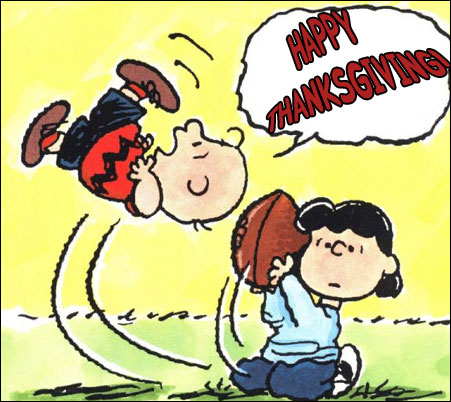
A SMALL VICTORY FOR LUCY. Michele at A Small Victory sees it as an image for the Thanksgiving season.


It's true that the gag appears at the beginning of "Charlie Brown Thanksgiving," but the annual football pull generally appeared on an October Sunday.

|

LINKING THIRTEEN GREAT STATES TO THE NATION. Opinion Journal's Russ Smith pens a tribute to the recently-reopened Baltimore and Ohio Railroad Museum at Mount Clare Shops in Baltimore. He also notes what we've lost.
One exhibit that caught my eye upon the museum's reopening was devoted to the dining service of the old B&O, when passengers relaxed in club cars and had waiters carve turkey tableside. There's a snack menu from the 1960 Capital Limited, which traveled from Washington to Chicago; it offered a plate of either olives or pickle chips for 30 cents, Cokes at 20 cents, tuna sandwiches for 80 cents and a crab cocktail for a dime short of a dollar. Think about that the next time you purchase a cardboard, microwaved pizza on an Amtrak Acela or Metroliner train.
I will skip the obligatory conversion to current dollars. Economy measures in food service might be self-defeating. Right up to the end of service, the dining service on the Electroliner reported a profit.

|

FACTOR PRICE EQUALIZATION DOES NOT EQUAL A RACE TO THE BOTTOM. Captain Ed headlines a post "Era Of Cheap Chinese Labor Coming To A Close." It links to a Washington Post story (registration required) about the old class struggle.

Stella International Ltd., a Taiwanese-owned shoe manufacturer employing 42,000 people in and around Dongguan, faced strikes this spring that turned violent. At one point, more than 500 rampaging workers sacked company facilities and severely injured a Stella executive, leading hundreds of police to enter the factory and round up ringleaders.

"We never had anything like that before," said Jack Chiang, Stella's chief executive.

Chiang suggested that several factors have contributed to the shift in attitude. On the one hand, he acknowledged, assembly-line wages have not risen in recent years nearly as fast as the cost of living. On the other, image-conscious U.S. retailers who buy Dongguan's shoes have demanded better treatment and human rights counseling for the workers, encouraging them to step up and make demands for change.

Finally, Chiang added, broader general freedoms in the country have reduced the Chinese people's traditional fear of authority, and not just among factory workers. Protests by farmers and others, many of them violent, have broken out with increasing frequency across the country in recent months.

The growing assertiveness of factory workers has posed a particular political problem for the governing Communist Party, which ideologically should champion poor laborers struggling against capitalist managers. But local governments have become shareholders in many of the factories, steering officials toward the management side of labor relations.

That looks like an Orwell moment. But read on.
Although recruits are still abundant for most areas, they said, the most sought-after workers -- young women with high school educations -- have become scarce in recent months, particularly in Dongguan's low-paying shoe industry.
As Captain Ed notes,
The maintenance of free trade with China has the scales falling from the eyes of Chinese workers. While free trade may have hurt the US in the short run, we have mostly recovered from the blow, while the Chinese have just started to discover that a little freedom is an impossible measure: it either grows exponentially or dies altogether. Now that they have built the economy that communism could never deliver, neither option will be compatible with their autocratic rule. Either the government has to allow more freedom and individual choice to its people, or crack down and face the loss of overseas investment and a wide-scale worker revolt which could wipe out the government.
Indeed.

|

RIGHT TO TIME IS HIAWATHA. The latest National Corridors Freedom Newsletter provides the on-time performance for Amtrak trains. But let's get real about some of these performances. Is it that difficult for the Hiawatha service to be on time 85 percent of the time, with as padded a schedule as it has?

|

INDISCIPLINE. R. J. at Live from the Third Rail rides a busy Amtrak train north.
Thanksgiving on the NEC is a little different from normal operations. The train stations on both ends are filled far beyond normal capacity with people who rarely use public transportation and are thus confused and cranky. The 5:10, which would normally require arrival at about 5:05 for boarding, had a line at the gate by 4:30.

I eventually boarded and the train left, filled with the usual train suspects -- college students going back to New Jersey, Hill people headed to their home districts in New York and Connecticut, the inevitable clump of foreign tourists who booked under the false impression that our trains would be as fast, clean and efficient as those in their home country.

I found a seat in the clump of Japanese and all was well until Metropark, N.J., a suburban stop popular with college students whose parents would never venture into Newark or Trenton even if those stops were closer to home. As the train pulled in, I saw the people on the platform looking confused. I also saw that they were rather far away. Since the other platform had a southbound train letting off passengers, we had either skipped the previosly announced Metropark stop or we had arrived, but at the wrong track.

It was the latter, something I've never once seen before in all my years riding trains. The train backed up, the conductor told everyone exiting at Metropark to go to the second car (my car) and they let everyone off over the tracks at the edge of the platform. I saw the whole confused scene from my window.

Then, as the train started slowly leaving the station (I know train engines can't be sheepish, but that's what it felt like), it backed up again, this time on the correct track. Someone forgot a guy in a wheelchair wanted to get off.
Demerits to both the dispatcher and the engineer. The dispatcher is supposed to route the trains onto the proper tracks. On the old Pennsylvania Railroad, the platforms are on the outer tracks only. The engineer is supposed to know where his train is stopping. If he gets a signal aspect that doesn't route him to a platform track, he must stop and radio the dispatcher for instructions. Sloppy.

|

ATTEMPTING TO PROVE A NEGATIVE. Another academic bully who can dish it out but can't take it? Consider Professor Oneida Meranto in Political Science at Denver's Metropolitan State College (motto: Our students make a "difference." I'd put that in scare quotes too.)

Five, whites are trying their darndest to demonstrate that they too are victims in a society where they dominate. Whites have failed to prove to us that they are not part of the privileged class. They have failed to prove that they have gained so much from subjugation and domination of nonwhites. They have failed to prove to us that they don't have racist, sexist tendencies that just might be part of the very essence of their white skin. They have failed to prove to us that they too have not benefited from affirmative action legislation. They have failed to demonstrate to us that the reason for their poor grades is the flood of nonwhite professors. They have failed to take responsibility for their actions in this country where being white has its privilege.

So what do if you're a failure and you're white? You create a new kind of action. The kind that existed prior to 1965, similar to what has happened on this campus. White students get poor grades and instead of cracking the books and studying harder they blame the professors. File a grievance against a professor based on ideological repression. A white faculty member gets fired, can't finish his PhD, doesn't renew his contract, what does he do? He charges a faculty member with sexual harassment. The system isn't broken; it was never fixed. The administration of these universities consists of individuals that lack the fundamental understanding of race relations in America. If any organization is going to try and organize and integrate a football team or draft the best players they must demonstrate they know race-sex relations in America. And herein lies the problem.

It's not clear from the Front Page post that Professor Meranto is making this statement as a truthful premise or as a false premise to be rebutted. King at SCSU Scholars suggests that some students on his campus keep a low profile in the presence of openly leftist professors.
No assumption of innocence there. You hear stories like this around SCSU from many students, most too scared to go on record. I'm glad Prof. Meranto is taping her lectures now. Perhaps, in the spirit of glasnost', she could release transcripts?
Brian Leiter, on the other hand (hat tip: K. C. Johnson at Cliopatria) suggests,
Plainly faculty in the inherently political disciplines, like political science, will be more vulnerable to these smear campaigns and intimidation tactics. But it is good to know that the remedy for allegations of bias are death threats and hateful e-mails.
To repeat: the problem is the machinery of repression itself. If the readers of Critique of Pure Tolerance intended the prohibitions against creating an "intimidating or hostile environment" as advancing their agenda, they deserve to have that machinery used against their own intimidation and hostility.

(Editorial note: somebody at Metropolitan has to take responsibility for that "difference" motto. Herrn. Schneider u. Schwartz, fertig?)

|

NO. Professor Althouse asks, "Isn't Thanksgiving more deserving of a naysayer?" (Her universe of comparison is Christmas, with the 19th Century's Scrooge, and the 20th Century's Grinch, both of whom object more to the presents and the time off.) But if you look closely, you will find plenty of Thanksgiving naysayers. Some Islamic cleric can always be counted on to say something like this.
Thanksgiving being a national holiday express its salient position in the American culture, which has many unislamic values and principles. Celebrating Thanksgiving purposefully or subordinately is an expression of accepting the general American Culture. It is not celebrated independent of the American Culture. In view of the above it is not permissible to celebrate Thanksgiving Day.
(Via Norm Blog.)

There are always Cranky Leftists.

Somehow we have to deal with the world as it is. Thanksgiving’s myths and politics of food, family and faith could inspire us to continued smug and self-righteous optimism for prosperous white Americans, or help us to develop a generous and compassionate optimism for all the world. Singing old hymns about God oppressing the wicked on our behalf won’t help us, and neither will despair. We need to compose new hymns based on shared values and common dreams. Food, family and faith are good words, but we need a new melody, in a new key, with a new harmonization of hope and optimism.

As we give thanks for food, let us remind ourselves that in a world where anyone goes hungry, it is immoral to consume more than one’s fair share. And let us remember that the destruction of Earth’s ecosystems and the commodification of its basic resources will assure that eventually we all starve.

I found this essay two years ago, but the crankiness is much older, and is not likely to go away. This recent example puts Thanksgiving in too negative a light.
THE election battles over same-sex marriage behind them, some conservative Christians have returned their attention to a longstanding struggle over the singularly American holiday of Thanksgiving.

For years, David Barton, a popular speaker who toured the country speaking to clergy groups for the Republicans during the campaign, has been collecting evidence to rebut what he considers distortions of the holiday in textbooks and public celebrations. "Some textbooks say the first Thanksgiving was the pilgrims only saying thanks to the Indians," said Mr. Barton, who is vice chairman of the Texas Republican Party. "That is incorrect. They were thanking God for bringing the Indians to them."
There are churlish Virginians (via Betsy's Page):
The Virginia Thanksgiving was lost to history for more than 300 years, thanks in part, the Virginians say, to a massacre by Native Americans, the Civil War and the Yankee historians who "absconded" with it. The South's historic disregard for the holiday as a Northern tradition -- in the 19th century and even into the 20th, businesses and state and city offices in parts of the South stayed defiantly open -- didn't help, either.
True enough. I had family first at Jamestown and later at Plymouth, and can sympathize with the Virginians' case -- Mayflower was blown off course and the Company decided to winter at Cape Cod rather than attempt a coastal passage, but it didn't help the Virginians to back the wrong side in the War of Southern Rebellion.

Among the others giving thanks are Michelle Malkin, Reverend Sensing, and Captain Ed (who links to President Bush's Thanksgiving Proclamation.) Hugh Hewitt posts President Washington's proclamation.

As Clifford May notes, the Plymouth Company was the first colonization to make an attempt at self-government.

On the Mayflower – a cramped old ship built not to carry passengers across the Atlantic but only barrels of wine between Bordeaux and London – they signed a social compact “based upon the original Biblical covenant between God and the Israelites.” Also influenced by early-17th-century social-contract theory, they drafted “just and equal laws” that were firmly anchored in the teachings of the church.

Their piety did not diminish their thirst for education – quite the contrary. Nor did their faith deter them from a keen interest in science. Indeed, among the most famous of the Puritans was Cotton Mather (1663-1728) who entered Harvard at the age of 12, learned seven languages and wrote 450 books. He popularized the Copernican system of astronomy. He also believed in witchcraft. He was concerned, too, with the rights of slaves and Indians, not big issues in those days.

So let there be no Thanksgriping.

SECOND SECTION. Tyler at Marginal Revolution has more reason to be thankful ... really! Andrew Sullivan is making a case for Grinch of the 21st Century.
That's one reason I'm such a Christmas-phobe. Each year, we have a communal campaign to persuade ourselves that we never have enough, the new things will assuage our real needs, that buying is the same as living. Yes, of course, some of this is fine, generous or even important. I really did need a new sleeper-sofa. And my boyfriend loves his new, mini-iPod. But the hysteria is a form of cultural disorder. And "Christmas" merely feeds it. If "Buy Nothing Day" helps assuage this a little, it's an excellent thing.
And he sat at his keyboard, fingers drumming and drumming
"I must find some way to stop Christmas from coming."

THIRD SECTION: Knew if I looked around I'd find an angry leftist.
But Thanksgiving sends us all searching for the goodness in life, the comforts and pleasures beyond the salt-brined free-range turkey, which, I am told, had a far better life than most.

This year that comfort lies in knowing that 58 million Americans did not vote for four more years of irresponsibility and madness. It lies in the distinction of casting my vote in one of the blue states, where IQs are higher, divorce rates are lower, and we pay out more in federal taxes than we take in and don't whine about it.

This year it lies in knowing that four years go by more quickly the older you get, so for some of us it will seem like an eye-blink.

This year, as perhaps in many others, Thanksgiving will serve as a day of grateful diversion in blue states and red; as a time to sit down together with family and friends in homes or shelters or mess tents, trying to forget for a day that there is a place called Iraq, to share a meal browned and buttered with love and caring and hope.
Where else but Minneapolis?

|

TODAY'S RAILROAD ACHIEVEMENT. Hoosac Tunnel completed, 1873. The Hoosac Tunnel gives Guilford Transportation Industries' Boston and Maine line a relatively easy crossing of the Berkshires. The tunnel is on the Historic American Engineering Record National Register.

|

PLAYING TO NICK COLEMAN? The investigation into the shooting of five hunters in Northern Wisconsin is turning into an interesting case study in he said, they said.

Authorities have said a hunter identified as Chai Soua Vang, of St. Paul, Minn., opened fire on the group after one of them confronted him for trespassing on their private property shortly after noon. Vang was arrested hours after the onslaught.

The suspect, 36, has asserted that he acted in self-defense after being taunted with racial epithets and was fired upon by someone in the hunting group. Hunters in Roidt's party have told authorities that Vang fired first, and he is expected to be charged Monday with homicide and attempted homicide.

The suspect is turning out to be a rather complex character. On the one hand, his neighbors, past and present, praise his efforts as a spiritual leader.

In Stockton, Calif., where Vang lived in the 1990s, neighbors remembered him as a nice man who presided over a busy household that was often filled with visiting family members. He drove a semitrailer truck, and sometimes a bulk cement truck, so he was often away from home, but Vang told a neighbor that he wanted to move to Minnesota, seeking a better life for his wife and children.

Pheng Lo, executive director of the Lao Family Community of Stockton, remembered Vang as an outgoing guy with a friendly face. Which makes it so difficult for Lo to understand how the man he knew could be accused of shooting eight hunters and killing six of them.

"I said something must really, really have happened to him. He was so mad or angry, or maybe he had mental problems lately," Lo said.

On the other hand, he has had previous run-ins with the authorities in Wisconsin, where there is an outstanding warrant from 2002, and authorities in another northern county are comparing this shooting with an unsolved shooting of a hunter in 2001.

What's the Nick Coleman connection? Nick Coleman is a Garrison Keillor liberal from Minneapolis, who writes a column for the Star Tribune. Mitch at Shot in the Dark characterizes him as a bigot of low expectations. Did such columns -- nay, the entire latte liberal Minneapolis establishment -- inspire Mr Vang to play the race card upon his arrest?

SECOND SECTION. Owen at Boots and Sabers offers his hypothesis.

Here’s what I think happened… Vang is a former child soldier. When he was in the woods and was confronted by some other guys with guns, he snapped into a psychotic flashback episode of some sort. He took the scope off of his SKS, thus returning it to the war rifle of his youth instead of the hunting rifle of his present.

I could be totally wrong, but that’s my best guess. When something as senseless and horrific as this happens, we all grasp for an explanation. That’s the best one that I can come up with.

He has since posted more on the obligatory attempts to ban automatic weapons, on the suspect's statement, and on the suspect's defense.

|

MICHIGAN STATE, AGAIN? Michigan St. 4, Wisconsin 0. Hey, the home team is supposed to win its tournament every so often. Not so for the Badgers in the Midwest Showcase ...

|

SHCHE NE VMERLA UKRAINA. Ukraine Parliament Calls Election Invalid.

Ukraine's parliament on Saturday declared invalid the disputed presidential election that triggered a week of growing street protests and legal maneuvers, raising the possibility that a new vote could be held in this former Soviet republic.

Parliament's vote came amid a flurry of domestic and international support for the possibility of a revote. A European Union envoy - Dutch Foreign Minister Ben Bot - said new elections were the "ideal outcome" for the standoff between Prime Minister Viktor Yanukovych and Viktor Yushchenko. Asked if new elections were the only solution, Ben Bot answered: "Yes."

The Unian news agency quoted Russian Foreign Ministry spokesman Alexander Yakovenko as saying Friday that Moscow regarded a potential revote favorably - an apparent significant retreat from its earlier insistence that the Nov. 21 elections were fair and valid.

Parliament's move was not legally binding but clearly demonstrated rising dissatisfaction with the announced outcome. The United States and other Western nations contend the vote was marred by massive fraud.

The place to go for continuing analysis of the Ukrainian vote and revote is SCSU Scholars. King has made exchange visits to Ukraine and maintains contact with numerous sources in country. Raku roku moyet, eh, King?

|

GET INVOLVED. Katie at A Constrained Vision provides an extensive list of agencies providing care packages, travel mileage, and other useful things for our troops.

|

MORE WORK FOR THE WTO? Court Rules French Film Not French Enough. You can't make up stuff like this.

Never mind that Jean-Pierre Jeunet's new film is a French story filmed in the French language featuring one of France's biggest actresses. A Paris court has ruled that "Un Long Dimanche de Fiancailles" (A Very Long Engagement), which opened Friday in the United States, is too American to compete in French film festivals - because of its Warner Bros. backing.

The movie, which opened at the end of October in France to much acclaim, stars Audrey Tautou, the winsome young actress who went from virtual unknown to international star with Jeunet's 2001 romance "Amelie."

The National Center for Cinematography, or CNC, made state funds available for Jeunet's movie in October 2003. A producer's association immediately questioned the film's nationality and filed a complaint.

On Thursday, the court canceled the CNC approval, saying that 2003 Productions, a French company acting as the delegated producer for the movie, was created solely "to allow the company Warner Bros. France ... to benefit from financial help even though (the fund) is reserved for the European cinematographic industry."

Worse yet, this picture is not eligible to join Fahrenheit 9-11.
In an ironic twist, Jeunet's movie cannot even become a candidate for the prestigious Cannes Film Festival awards because, with its U.S. debut, it will have been screened outside its country of origin, France. Movies shown at Cannes must not have been screened outside the country where they originate ahead of the festival.
And there are content restrictions at work in the States as well.
Despite his legal troubles in France, Jeunet can still hope for honors in the United States - but not this season's best foreign film Oscar, because the film did not open in France in time to qualify. It is, however, eligible for Oscar nominations for best picture, actress or director.
Cartels ... a never-ending source of war stories. Confession time: it is damned difficult to introduce some of these examples in class and keep a straight face.

|

TODAY'S D'OH MOMENT. WTO Imposes Penalties on U.S. Exports. What? I thought the WTO was a handmaiden of American plutocrats...
The World Trade Organization imposed penalties Friday on U.S. exports ranging from apples to textiles, escalating a trade dispute the Bush administration has struggled to defuse by unsuccessfully urging Congress to repeal legislation aimed at protecting American steelmakers.
About time, too. There's this little concept, "gains from trade." Those who claim an injury as a consequence of a trade all too often seek succor by imposing losses on others.

The Consuming Industries Trade Action Committee, a Washington-based group representing manufacturers, farmers, retailers and other businesses, has called the Byrd amendment "the equivalent of a tax on American consumers."

Companies launch trade cases "in hopes of not only closing the U.S. market to global competition but also gaining significant financial rewards," the group's chairman, Michael Fanning, has said. The measure "clearly distorts trade by creating a big incentive for companies who don't want to compete in the global market."

Quite so. Such naked displays of self-interest never fail to provide teachable moments.

|

GET INVOLVED. Laura at 11-D recommends that readers write their representatives and consider donating to relief organizations working in Darfur. There is more to the Darfur story than meets the eye. Consider this passage from Richard Miniter's Shadow War (details or compare prices) at p. 97.
To many, Darfur was on the verge of becoming another Rwanda, a hideous scene of death and destruction on a desolate African landscape. In reality, it is another Somalia, where tribal warfare and ideological hatred foster anarchy, murder, and starvation. And, as in Somalia in the early 1990s, al Qaeda plays a role.
Former Secretary of State Powell calls what is going on genocide. The United Nations turns a blind eye. Accident?

|

QUOTE OF THE DAY.

"People change, Kerry. Do you think that I'm the same person now that I was 30 years ago? You'd be wrong. Your mom has changed too. You know that coming up in November we'll be married for 30 years, but those things that made me fall in love with your mother are still there. Those great qualities that she has will always be there...and everyday I wake up and know that there's no one else on earth I'd rather be with."

To which I responded..."zuh!? Wait...lemme get this straight...you've been married for an assload of time...and you still like each other!?"

It's a little premature...but I'm thankful for my 'rents.

Read the whole thing.

|

23.11.04

HAPPY THANKSGIVING. That's all for this week. I give thanks for your readership and your comments.

|

384 YEARS OF THE MAYFLOWER COMPACT. Barbara Miner offers a history lesson, also shows her need for one.

This assertion is basically correct.
As they were about to embark on their new life in America, those aboard the Mayflower faced a dilemma. How would they govern themselves?

The matter was particularly pressing given tensions during the voyage between the Pilgrims, known as “the saints,” and the others, known as “the strangers.”

Again, there was much discussion. On Nov. 22, the two groups signed an agreement to form a “civil body politic” for the good of all. Furthermore, they decided they would find their wisdom to govern not from the edict of a priest or king, but from the consent of the people.

This agreement of such momentous and revolutionary impact had a simple name: the Mayflower Compact.

Out of the wellspring of respect for religious freedom, tolerance and individual liberty, American democracy was born.

Over time, the principles of the Mayflower Compact would find voice in other American documents, from the Declaration of Independence to the U.S. Constitution to the Bill of Rights.
Her litany of complaints is a bit misplaced.
But the future of the Pilgrims’ legacy of religious freedom and democracy is not so certain.

What else but religious intolerance can explain the epithets of “murderer” that are hurled at those who worship life but do not believe that a fertilized egg - no bigger than the period at the end of a sentence - has equal legal and moral weight to a living, breathing human being?

What else but intolerance can be at the root of the Texas Republican Party platform, which declares that the separation of church and state is a myth?

Which opposes current “no-fault” divorce laws?

Which would make it a felony to issue a marriage license or perform a civil marriage ceremony for those in love who happen to be of the same sex?

And how can one reconcile religious freedom with the Texas platform’s declaration that this land known as the United States of America be declared a Christian nation?
What "religious freedom and democracy?" The point of the Puritans' pilgrimage was to find someplace where they could practice their own ... extremely fundamentalist, think about the etymology of "puritan," version of Dissenting Protestantism without let or hindrance. The flash points in the culture war that Ms Miner identifies are upwellings of the saintly sentiments, again with an element of being beset by strangers who have sinned and fallen far short of the glory. (We have the Establishment Clause as a way of avoiding the troubles of establishing churches in the several states ... Quaker Maryland, Methodist Georgia, Baptist Rhode Island.) But let us take the longer view. Among the Saints was one William Brewster, the Learned Elder of the Puritan congregation. Among the Strangers was one Stephen Hopkins, who in a few years would find himself in trouble with the authorities for selling beer to Puritans on Sundays. (Therefore, there had to be Puritans willing to buy beer, but that's for another day.) Within a century, descendants of Brewster were marrying descendants of Hopkins. We'll manage again.

|

REVISE AND RESUBMIT Captain Ed grades an essay in the St. Olaf Manitou Messenger and finds it wanting in logic and content.

|

SEEKING VIEWPOINT DIVERSITY IN THE UNIVERSITY. John Fund addresses the general principles.
Conservatives contend that assurances by liberals that the professional ethics of professors will keep them having their politics dominate the classroom and smothering alternative views just doesn't pass muster. A forthcoming study by Stanley Rothman of Smith College looked at a random sample of more than 1,600 undergraduate faculty members from 183 institutions of higher learning. He found that across all faculty departments, including business and engineering, academics were over five times as likely to be liberals as conservatives.

Mr. Rothman used statistical analysis to determine what factors explained how academics ended up working at elite universities. Marital status, sexual orientation and race didn't play a statistically significant role. Academic excellence, as measured by papers published and awards conferred, did. But the next best predictor was whether the professor was a liberal. To critics that argue his methodology is flawed, Mr. Rothman points out that he used the same research tools long used in courts by liberal faculty members to prove race and sex bias at universities. Liberals criticizing his methods may find themselves hoist by their own petard.
The reform Mr Fund seems to get behind might not work as well as he would like.
Richard Vedder, an economist at Ohio University, argues that its time to scale back taxpayer subsidies to universities and move towards a voucher plan so that schools would have to compete for students as paying customers. That might also end the punishing double-digit tuition increases many schools have been imposing. Our colleges and universities would benefit not only from some intellectual diversity, but also some diversity and competition in how they pay their bills and how students and taxpayers hold them to account.
I think there's a move in that direction in Ohio, with the old in-state out-of state distinction replaced by a common rate for all students and a $1000 discount for residents disguised as a "scholarship." The double-digit tuition increases are not per se bad, and competition for students can take the form of amenities as well as discounted tuition or more challenging courses.

Turning to the specific, this David Adesnik post draws the reader's attention to hidden biases in a scholar's work.
In contrast to her (often justifiable) criticism of President Reagan, Shogan provides an extremely positive, almost glowing description of the academy. She writes that
The intellectual community is inherently critical of the status quo and often serves as the catalyst for social upheaval and development. (Page 8)
Sometimes asking academicians about leftist biases is like asking fish about water.

|

BEST WISHES Grant at Anthropology and Economics gets married, finds time to offer an insight into tax revolts.
I have sometimes wondered to myself whether the tax revolts and reticence that have done so much to advance the Republican cause are not so much a refusal to "share," as they are unwilling to fund incompetence (or programs that have a way of funding the problem they are supposed to fix). Or, to put this another way: if governments were more efficient, I think every tax payer would be prepared to be more generous.
Enjoy! But temper principle with practicality, particularly where wine is concerned.

|

22.11.04

ADVICE FOR FRUSTRATED TEACHERS. Some Sufi wisdom from Winds of Change.
When a nature is originally receptive
Instruction will take effect thereon.
No kind of polishing will improve iron
Whose essence is originally bad.
Wash a dog in the seven oceans,
He will be only dirtier when he gets wet.
If the ass of Jesus be taken to Mekkah
He will on his return still be an ass.
Final examinations approach, and with them the discovery of the bad iron. But consider this before you fail everybody.

|

THERE IS NO SUCH THING AS LAISSEZ-FAIRE. Don at Cafe Hayek clarifies some common misconceptions about regulation.
If a market proponent argues against regulation by government, he or she is heard by many on the other side of the political spectrum as arguing against regulation.

The presumption is that only government can regulate, or at least regulate effectively.

All honest disagreements are over the effectiveness of regulation based upon centralized bureaucracies and statutes versus regulation based upon common-law processes and economic competition. Both are methods of regulation. The serious debate is not whether regulation is good or bad – no sane person wants a world without regulation. The serious debate is over the best form of regulation.
There will be an examination on this point later.

|

I LOVE IRAQ 'N ROLL. Sometimes the heavy metal that breaks the bad guy's will is Metalllica or AC-DC, not a Warthog or an Abrams. (Via Betsy's Page.) Amnesty International might have a point about the Barney song being cruel.

The tactic, however, is not new in that part of the world.
So the priests blew the trumpets. As soon as the men heard it, they gave a loud shout, and the walls collapsed. Then all the army went straight up the hill into the city and captured it. With their swords, they killed everyone in the city, men and women, young and old. They also killed the cattle, sheep, and donkeys. - Joshua 6:20-21

|

SHE'S REAL FINE, MY 409. The latest incarnation of the 409 email scam, which usually involves some Nigerian public official who has some money salted away, features Suha Arafat. Reverend Johnson received such an email and had some fun with it. Enjoy.

|

FOOD FIGHT. Chris Lawrence and Will Baude trade fours on the merits of Cajun cooking in the Chicago area. Heaven on Seven comes in for some criticism on style but props for convenience ... but bring cash. Dixie Kitchen and Ragin Cajun are closer to the University of Chicago. These are new recommendations to me ... is the Metra Electric running?

|

QUESTION OF THE DAY. From Ace of Spades. (Yes, I'm repeating myself. No matter how many times I tell you, there's always somebody going to screw it up.) If "Diverse Opinions" Are Important for Bush's Cabinet, Why Not for the MSM & Academy?
"Diversity of thought" always means "need more liberals." When lefty media critics whine about the absence of "alternative points of view" in the media, they're not talking about Fox and Rush Limbaugh, now are they? The "alternative voices" they mean are NPR and Pacifica radio types-- lefties. Never those on the right. Always more liberals are needed.

David Gergen, the current whiner about Bush's lack of liberals in his cabinet, never seemed bothered by Clinton's cabinet. I guess that's because he had a good sampling of both types of necessary political thought-- liberalism and left-liberalism.
Precisely.

|

FINDING THE RIGHT ROLE MODELS. Mark at Conservative Revolution suggests that celebrating transgressiveness for its own sake has bad consequences.
More importantly though, the NBA has centered themselves around the hip-hop culture for the last 5 years in order to create a stronger fan base. The players buy into that and the fans buy into that. Have you ever seen so many thugs as you do in the NBA? There are always fights in the NBA, more than even in the NFL. I think the real problem is that the NBA is comprised of a couple hundred millionaire street bangers and the NBA thinks that is a good thing. To further prove my point, Ron Artest is the same person that asked his coach last week if he could have a month off, in the middle of the season, to promote his rap label.
Meanwhile, The London Times has a story about Secretary of State Rice's mother, who understood the value of transgressiveness.
Rice’s mother refused to play by the Jim Crow rules. She stood her ground. One confrontation took place at a department store, where Angelena and Condi were browsing through dresses. Condi picked one she wanted to try on, and they walked towards a “whites only” dressing room. A saleswoman blocked their path and took the dress out of Condi’s hand. “She’ll have to try it on in there,” she said, pointing to a storage room.

Coolly, Angelena replied that her daughter would be allowed to try on her dress in a real dressing room or she would spend her money elsewhere. Angelena was composed, firm and resolved. Aware that this elegantly dressed black woman would not back down, the shop assistant decided that her commission was worth more than a public incident and ushered them into a dressing room as far from view as possible. “I remember the woman standing there guarding the door, worried to death she was going to lose her job,” said Rice.
Hat tip: The Anchoress (when I find a new weblog, I look around a little) who adds,
Read the whole thing, and realize that if only Dr. Rice had a "D" after her name, the press and the left would have a completely different regard for this woman; they would be holding her up as a noble and shining specimen of humanity (which she is) and claiming some credit for it all. They might even allow her some secondary leadership position somewhere in the party. Maybe. If she toed the line.

But Rice has dared to excel without the Democrats (who would not allow her college-educated father to register with the party unless he could correctly guess the number of beans in a jar. He became a Republican, instead) - her successes came, she says, not...from the civil rights struggle but from her own family legacy. Condi Rice's story is all about the worth and value of having a strong, nurturing family life, one that keeps you centered and safe as it introduces you to the world, and allows you to explore and discover your potential. Her cultured, educated, middle-class parents sound just stupendous. I hope this story gets wide dissemination.

|

DELIBERATELY STUPID? It sure doesn't rise to the level of domestic terrorism.
A Caltech graduate student was convicted Friday of firebombing sport utility vehicles at a Hummer dealership last year to protest the American auto industry's contribution to environmental pollution.

After deliberating less than a day, a federal court jury found William Jensen Cottrell, a 24-year-old doctoral candidate in physics, guilty of seven counts of arson and one count of conspiracy.

Cottrell, who testified that SUV dealers were "evil," faces at least five years in prison when he is sentenced in March.

But he was spared an additional 30 years behind bars, mandatory under federal law, when the jury acquitted him of the most serious charge of using a destructive device during a crime of violence.
What ever happened to hacking the scoreboard at the Rose Bowl? And how clueless could this person have been to leave such an obvious clue?
Josh Connole, a 25-year-old peace activist who lived in a commune in Pomona, was released after four days in jail.

Connole later received a public apology from the West Covina police chief and $20,000 from the city to cover his legal expenses. He recently filed a federal civil rights lawsuit against the FBI for unspecified damages.

Connole's arrest eventually led the FBI to Cottrell. Upset that the wrong man was in custody, Cottrell sent a series of e-mails to the Los Angeles Times chiding the FBI for ineptitude and including some incriminating information known only to the arsonists and investigators.

Among the tidbits was a mathematical formula, known as Euler's theorem, that Cottrell had painted on a couple of SUVs.
We're talking about a physics student here. The "Euler's theorem" noted is probably the really funky one, exp(i pi)+1=0, not the special case of the homogeneous function identity we use in economics.

|

21.11.04

DO I HEAR AN ECHO? Presto Pundit has been following the K-Mart and Sears merger. Scroll down for more. This quote from the Chicago Tribune illustrates why some business journalists make the big bucks.
"You put a bad heart and a bad liver together, and you don't get a healthy body."
My phrasing was somewhat more pedantic.
Even the dullest least motivated among them quickly grasp that the resulting company is simply a larger collection of dinky plants.
On the other hand, some business gurus just speak badly. Negative synergies? Why not just call it "incompatibility?" Long before there were Red States and Blue States, there was Red Team (The Pennsylvania Railroad) and Green Team (New York Central.) Different operating styles, different traffic bases, different college degrees, different churches, about the only thing they could agree on was getting rid of passenger trains. Didn't have to say "negative synergies" to explain that.

|

THEY'RE ALL GOING TO LAUGH AT YOU if you're some overly earnest Blue State type. Andrew Sullivan recognizes that the Right ... has more fun.
The truth is: there is a conservative majority in this country not because the religious right is a majority but because the Republicans have also been able to corner the market on the themes of achievement, individualism, energy, action. And they have also won over those who disdain the politics of resentment, whining and permanent criticism. If James Dobson represents one wing of contemporary Republicanism, Arnold Schwarzenegger represents the other. Democrats will never win over the Dobsonites. But they can win over the blueish voters who voted red last time because the pious, do-good, elite whining of Gore and Teresa and Hillary seemd so alien to many Americans' entrepreneurial, anti-p.c. and irreverent popular culture.
And because, as the column argues, the pious, do-good, elite whiners are so easily lampooned.

|

BORDER INCIDENT? This is not good.
Five deer hunters were shot to death and three were wounded Sunday by a man who was hunting from someone else's tree stand in northern Wisconsin, authorities said.

The bizarre attack happened in the Sawyer County Town of Meteor about noon on the second day of the gun-deer season, a time when hundreds of thousands of deer hunters are in the woods.

Sawyer County Chief Deputy Tim Zeigle said a man from the Minneapolis/St. Paul, Minn. area, was arrested about 5 p.m. in Birchwood, just across the Sawyer County border in Washburn County.

Authorities said the rampage started after a hunting party saw a hunter they didn't know occupying their tree stand. That led to a confrontation. One victim used a walkie-talkie to call for help, but when other hunting partners came to the scene they also were shot, said Zeigle.
There is etiquette in deer hunting, and with several hundred thousand armed men roaming Wisconsin and the Upper Peninsula, it is important to respect it. The Superintendent encourages readers to hunt safely and courteously.

SECOND SECTION: Fox News Channel is reporting that the suspect is a Hmong immigrant from Laos who spoke little English and wasn't dressed properly for hunting, although he had a Wisconsin permit tag.

|

GOT ENOUGH BOOKS? I hear that from guests. J.V.C. Comments assures me that I am not alone.

|

PROCESS, NUANCE, FAILURE. I'm pleased to see Big Media catching on. This is New York Daily News columnist Michael Goodwin. His context is the dedication of the new Clinton Presidential Library.
But even Clinton's achievements of prosperity and peace now look hollow. In hindsight, we know that much of the prosperity was a bubble fueled by venal corporate criminals. And there was peace only because the Clinton White House chose not to see that Osama Bin Laden had already declared war on us.
We shall not see his like again soon, notes Mr Goodwin, and it's a Darn Good Thing.
For every would-be leader, the test is this: Are you rock-solid? Those who cannot say yes, and convince voters, need not apply. Weakness, waffling, nuance, process - they're luxuries from a bygone era.

And for God's sake, no more parsing and blurring. It's a gut-check world now, and half-truths are no longer half true. They're damnable lies.

Bubba had his run. His time, and times, have passed. He isn't ready to accept that, but we must. The future demands it.
(Hat tip: Betsy's Page.)

|

THE MAKING OF A RED-STATER. Milwaukee Journal-Sentinel columnist Patrick McIlheran gets mugged by reality.
But urbanists eager to make high-tax, high-service a more popular choice need to ask whether the amenities they tout, no matter how well maintained, will ever be seen as germane to daily life by the many people otherwise inclined to move to septic-tank territory.

What good is a prize-winning bus system if loud, unshowered punks make you regret ever boarding?

Take parks. I love lawns that I don’t have to mow, and there are two fine ones two blocks either direction from my house. I won’t let my kids go to either unaccompanied. I don’t know who’s going to be there.
Ah, the old tragedy of the commons problem. How did that P.J. O'Rourke quip about the public restroom being the perfect metaphor for socialism go?

Mr McIlheran's education is proceeding very well.
Particularly now, saying “values” will get you termed a Taliban grump, but may I suggest that society needs a little judgmentalism, at least of the elementary, golden-rule variety? What lets us tolerate a life lived among strangers is the understanding that they’ll probably conform to a minimum standard of behavior.

The secularist mind calls repressive any traditional notion of shared Judeo-Christian values. It dismisses outward signs of religion as witch-burnings and “The Magdalene Sisters.” You’ve got your values; I’ve got mine. Who’s to judge?

And yet, to fill the ensuing post-Ten Commandments vacuum, secular modernity offers nothing that convinces a consensus of society.

One measure, I’d suggest, is how we’re getting along.

Does the gradual knockdown of social rules rooted in traditional views make us less willing to encounter strangers? As minor as having the consideration to bathe, as large as knowing parents discipline their children: Without these assurances, people will take their own steps. They’ll buy big, parklike yards.

They’ll commute alone.

They will be that much less likely to see value in the customary public services that Milwaukee’s urbanists would like to boast about - because “public” will be ever more an adjective signaling trouble.
Quite so. For the record, today's "customary" public services are a pale shadow of what they were thirty to forty years ago.

|

CARDIAC PACK. Brett Favre has to run to call the last timeout with 0:04 left, and after Houston calls its last timeout, Ryan Longwell bounces a field goal through the right pole. Packers 16, Houston Oilers Texans 13. In other Packer news, I like this story about the U-71 formation.
Six offensive linemen, a tight end and a fullback bunched together in the middle of the field, all with a common objective: move as one and take no prisoners. When the whistle blows there might be debris spread all over the field, but somewhere a path should be cleared and the ball moved past the line of scrimmage.

Most of the time there is no element of trickery when the Green Bay Packers line up in their “U-71” package. Both sides know what is coming - a toss to running back Ahman Green - and the result will be derived through a battle of wills.

“That’s part of the whole deal,” fullback Nick Luchey said. “It’s not a secret. It’s not a secret, yet people can’t really stop it. It takes 11 guys playing together. When (an opponent) has an idea what you’re doing, you have to have 11 guys bonding strong and believing in each other and trusting what you’re doing.”
Current coach and general manager Mike Sherman is a disciple of Vince Lombardi, who once said, "Football is blocking and tackling. The team that blocks better and tackles better wins." A rival coach once lamented, after watching some game film (it was film in those days, kids), "How do you scout blocking and tackling?"

Houston's promising young quarterback learned that lesson in the fourth quarter, failing to pick up a first down on his team's last three possessions.

|

20.11.04

THE WORLD TURNED UPSIDE DOWN. Nothing quite like the fracturing of old commonplaces to make for interesting reading. Start with Victor Davis Hanson.
We are living in historic times, as all the landmarks of the past half-century are in the midst of passing away. The old left-wing critique is in shambles — as the United States is proving to be the most radical engine for world democratic change and liberalization of the age. A reactionary Old Europe, in concert with the ossified American leftist elite, unleashed everything within its ample cultural arsenal: novels, plays, and op-ed columns calling for the assassination of President Bush; propaganda documentaries reminiscent of the oeuvre of Pravda or Leni Riefenstahl; and transparent bias passed off as front-page news and lead-ins on the evening network news.

Germany and France threw away their historic special relationships with America, while billions in Eastern Europe, India, Russia, China, and Japan either approved of our efforts or at least kept silent. Who would have believed 60 years ago that the great critics of democracy in the Middle East would now be American novelists and European utopians, while Indians, Poles, and Japanese were supporting those who just wanted the chance to vote? Who would have thought that a young Marine from the suburbs of Topeka battling the Dark Ages in Fallujah — the real humanist — was doing more to aid the planet than all the billions of the U.N.?

Those on the left who are ignorant of history lectured the Bush administration that democracy has never come as a result of the threat of conflict or outright war — apparently the creation of a democratic United States, Germany, Japan, Italy, Israel, El Salvador, Nicaragua, Panama, Serbia, and Afghanistan was proof of the power of mere talk. In contrast, the old realist Right warned that strongmen are our best bet to ensure stability — as if Saudi Arabia and Egypt have been loyal allies with content and stable pro-American citizenries. In truth, George Bush's radical efforts to cleanse the world of the Taliban and Saddam Hussein, bring democracy to the heart of the Arab world, and isolate Yasser Arafat were the most risky and humane developments in the Middle East in a century — old-fashioned idealism backed with force in a postmodern age of abject cynicism and nihilism.

Quite literally, we are living in the strangest, most perilous, and unbelievable decade in modern memory.
Don't go off at half-cock, cautions Cicero at Winds of Change. I'm quoting what I view to be the key point; make sure you read the whole article and the linked pieces for proper context.
Indeed, Europe is playing with half a deck, and so is America. Even though elected, there is a danger that prolonged one-party domination of American politics makes for weak democratic governance. The Democratic party needs to reboot and find identification with the common cause of voters who seek no-nonsense policies when it comes to their defense. Republicans do not have all the answers.

Kagan and O'Hehir have identified the differences between the United States and Europe, yet each only has half the key to the West's survival. Neither side will endure the oncoming storm of terror-fascism on its own. Soft power is only possible with military might to back it up; a strong, overwhelming military is a prerequisite to freedom, but it needs a broader vision than can be provided by a single political party. Europeans with nothing but carrots and Americans with nothing but sticks is dysfunctional in the face of militant extremists bent on destroying them both---sticks, carrots and all.

The US and Europe have had a symbiotic relationship for a long time. It has been a complimentary relationship---not without differences or misunderstandings, but effective at preserving the peace and stability nonetheless. The biggest danger is the inability to identify threats from behind the peculiar refractions that each ideological lens creates. An America on a search-and-destroy anti-terror obsession might suffer from a myopia that might overlook, for example, the internal threats to freedom that an open-ended war against terror will produce. A Europe that is self-obsessed and blind to the particular rot in its own trumped-up post-modern utopian culture might overlook that there is a huge part of the world that seeks their destruction. Fear of cultural imperialism can be taken to extremes; Europeans must recognize that some cutures are uncompromising even if they aren't. If a rogue WMD event takes place anywhere in the West---Europe or America---then the West will be in the same boat. The 'New Cold War' would be over as Europe and America scramble together to ferret out further attacks.

It could be that Kagan and O'Hehir are describing what might be more accurately called a cold civil war, arising within every western nation that feels the stresses of national identity pushing against a progressive order, striving for peace with the world. Perhaps this phenomenon is more than transatlantic, but endemic to all nations that comprise the West.

Many of the world's more recent civil wars have been about religion or ethnicity.
Aye, and there's the rub. Questions and Observations states the basic problem somewhat bluntly. The post focuses on immigration, but the message quoted below illustrates the elephant in the room.
Cultures are not equal, nor is there any requirement that I must tolerate one simply because it exists and others choose to live within it. To believe that all cultures are equal is simply a fantasy. And its dangerous.

Those who perpetrate this fantasy do us a grave injustice. They insist we set aside one of our greatest tools as human beings - the ability to judge and choose. They insist we accept, carte blanche, any culture at face value simply because it exists, explaining that "different" doesn’t necessarily mean bad and that it is incumbent on us to accept the different ideas that others belive in and follow (except, apparently, Christianity, of which you’re allowed to be intolerant).

Well sometimes different does mean ’bad’. Sometimes different is unacceptable. And sometimes it makes sense to reject it.

The hate, such as the little snippet above portrays, is unacceptable and "bad". It should be rejected and the culture which teaches it should be rejected as well. Let’s be clear, that doesn’t mean the rejection of Islam as a whole, it means the rejection of the culture within Islam which lives, eats, breaths and sleeps death and destruction to "infidels."
It is one thing to seek common ground, to sample other peoples' cooking, to listen to all sorts of music. It is quite another to excuse bad behavior as simply "another culture's standards."

Interestingly, this Two Blowhards post provides a reality check for those who would view the European view of intercultural interactions as more sensitive.
FWIW, a Parisian friend tells me that the French have essentially drawn a line between the heavily-immigrant Parisian suburbs and downtown Paris. Giant ring roads encircle Paris, creating an informal boundary that's hard to cross over; and public transportation between downtown and the suburbs shuts down early in the evening. That way, downtown Parisians are able to sleep soundly, certain that most of the poor and the immigrants aren't nearby.
So where is the real gated community? And what resolution of the differences will emerge?

|

GETTING BEYOND THE WELFARE ECONOMICS PARADIGM? Jonathan Chait proposes a baby step toward fiscal responsibility: abolish the National Endowment for the Arts.
Government is supposed to step in and provide things that the free market can't provide. We need the federal government to provide defense, interstate highways, healthcare for those who can't afford it (and soon). Art, on the other hand, is something that individuals can provide on their own. When projects aren't profitable, wealthy patrons can step in. If there's one cause that wealthy people have shown a willingness to support throughout history, it's art.

The mere fact that art has many salutary effects on our culture is not enough of a reason for Washington to subsidize it. Opinion magazines such as the New Republic or the National Review also have an important role to play in our national life. They provide a forum for political debate and ideas for policymakers. They're also almost inherently unprofitable. To suggest that the federal government write checks to such magazines, though, would be absurd. The solution is to find wealthy individuals who are willing to support them.

The other reason not to publicly subsidize magazines is that it would put Washington in the position of making tricky, subjective decisions about what to fund. And that's exactly the problem with the NEA. It puts the government in the business of deciding which ideas are worthy and which are not. I may not be offended by an AIDS nude-a-thon, but others are.
This is progress. The use of government funds to support the production of artwork (or of writings) is censorship per se. The evidence on government agencies' ability to pick winners is mixed.

It is probably a bit much at this stage of Mr Chait's education to expect him to see the error in "Government is supposed to step in and provide things that the free market can't provide." The Constitution calls for providing the common defense. Internal improvements, right back to the National Road, have been great boondoggles, and medical savings accounts an alternative to a National Pharmacy. "Supposed to" remains subject to debate.

The Washington Monthly's Kevin Drum concurs with Mr Chait in part, and dissents in part.
I actually agree with Chait, and I'd throw in a few other items, like NPR and Amtrak, things that the free market is capable of supporting perfectly well. (Did you know, for example, that Congress continues to support long-haul Amtrak routes largely because Amtrak provides jobs in their districts? And does anyone think that market failures have produced a shortage of radio and TV channels in this country?)

But as a strategy for Democrats, what exactly is this supposed to accomplish? A wedge issue is something that forces the opposition party to make a difficult choice, but in this case it would be easy: if Democrats were on board too, Republicans would almost unanimously — and gleefully — vote to eliminate NEA. It wouldn't hurt them a bit. And I'd venture to say that not one single Democrat would pick up one single red vote for having championed this.

So what's the point?
Perhaps to pursue a new kind of swing voter?

|

BLUE CITIES, OBSOLETE CITIES? Will Wilkinson covers a presentation from one author of The Right Nation (details or compare prices) that reinforces my assertion that the Urban Archipelago is Fantasy Island.
Democrats succeed in crowded havens of economic stagnation, like San Francisco, Chicago, Philadelphia and so forth. While Bush did pretty well in high growth cities -- I guess places like Phoenix, Dallas, Charlotte, Atlanta. I have no idea how the causation goes--whether certain cities have low growth because they're so liberal, or so liberal because they're stagnating, or some reciprocal thing, or something else.
There is an article coming out in the next print issue of The Economist. No shortage of stuff to read.

|

PICKING WINNERS? Don Boudreaux sees too many incentives for gatekeepers to get it wrong.
First and most obviously: why would anyone seriously expect taxpayer-funded bureaucrats to promote the well-being of consumers? These bureaucrats have no motive of personal gain (profit) or loss to inspire them to be diligent and creative in anticipating and serving the desires of millions of strangers. Furthermore, the FDA faces no real competition. Combine these facts with the additional reality that the regulated too often enjoy undue, if sub rosa, influence with the regulators — thus “capturing” the regulatory process — and you have a stew that is a hearty meal for bureaucrats, politicians, and regulated firms but that is poisonous to consumers.

Second and, in my opinion, even more importantly: the entire notion of “safe” and “unsafe” drugs is wrong.

Popular discussion of the FDA’s role proceeds as if there is an objective level of safety for drugs. Each drug either reaches this level or it doesn’t. If it does, it is “safe”; if it doesn’t reach this level, it is “unsafe.”

This notion is preposterous. The safety of each and every drug is in a range. Drug A can be more safe or less safe than can drug B. Modifications can make drug A more safe today than it was yesterday.
His suggestion for the Federal Drug Administrators, high or low: turf 'em out.

|

A SOCIAL SECURITY ROUNDUP. I've been wandering around the internet turning up a number of posts on Social Security. Start with an insightful observation by the Washington Monthly's Kevin Drum:
The only way Social Security stays solvent between 2017-2042 is by cashing in the treasury bonds it's been piling up in the trust fund since 1983.

The problem, of course, is that these bonds are redeemed by the U.S. treasury, which means they're basically an IOU from one branch of the government to another. What kind of a shell game is this?

Not a very good one, I agree. The trust fund was Alan Greenspan's idea in 1983, and it's a bit of sleight of hand that allows payroll taxes to stay low after 2017, but only at the cost of raising incomes taxes. Basically, the Social Security trustees redeem bonds every year after 2017, the feds cover the redemptions by increasing the income tax rate, and the additional income tax revenue is handed over to the Social Security trustees for disbursement to retirees. All we're doing is trading one tax for another.

But here's the thing: it doesn't matter. Maybe the trust fund was a good idea, maybe it wasn't. The fact is that it exists, and the federal government is not going to default on treasury bonds. Those bonds are going to be redeemed, they are going to be used to fund Social Security payments, and the money to redeem these bonds is going to come from the general fund — i.e., income taxes. That decision was made two decades ago and there's no way to undo it now.

So that's why Fierst is correct to use the 2042 date. She's assuming that the treasury won't default on the trust fund bonds, and in that she's quite correct.

But Andrew is also quite correct to say that we're going to have to increase income taxes (or run a bigger deficit) in order to redeem those bonds. There's no way around that.

Really, though, there's no way around any of this. Over the long term the only way to keep Social Security solvent is to (modestly) raise taxes or (modestly) reduce benefits. All the fancy arithmetic and doubletalk in the world can't change that, no matter how desperately people want to believe it. We could make progress on this issue an awful lot faster if there weren't so many ideologues in Washington pretending otherwise.
Excellent. There are three reasons to want to contemplate private retirement accounts, transition costs notwithstanding. First, pensioners realize a lower return from Social Security than they would realize from putting their taxes -- and the misnamed employer "matching contributions" -- into a portfolio of assets of varying risks. To defend the return lower than the return on Treasury bills as a consequence of a stingy insurance program for survivors and disabled people is simply to avoid the question. Second, to the extent that Social Security taxes reduce economic growth, the government is collecting taxes to redeem bonds from a smaller base than it otherwise could. The assumptions people make about future economic growth, and expansion of the U.S. work force, affect the projections they will make about future liabilities of the so-called trust fund. Viking Pundit has been thinking about this second point.
Let’s get a couple things straight: reducing benefits for seniors would be unpopular and political suicide for anybody in Washington. But increasing taxes on younger workers (again) is grossly unfair and threatens the prospects for the next generation. Finally, shifting a portion of the Social Security system to private accounts would be wildly expensive, although it would expand the “ownership” society and (maybe) ultimately reduce the overall burden on the SS system. All the other proposals are just nibbling at the edges. No matter what, there are no “easy fixes.”
Third, the national government holds the nuclear option, which is to refinance the trust fund bonds with the Federal Reserve. Borrowing from the Fed is a subtle method for printing money. To the extent that that temptation isn't present let us all be grateful.

Alex at Marginal Revolution suggests that private retirement accounts provide investors with more accurate incentives.
If a worker works an additional hour, earns $10 and puts $1 into the IRA he knows the $1 will produce a benefit 30 years down the line when he retires. The $1 contribution to the IRA is not a tax, it's consumption, a benefit of working extra hours. On the other hand if a worker earns $10 and $1 is taken and paid into social security there is no clear connection to retirement benefits. Social security payments, therefore, are taxes - and like other taxes they deter work effort and create a dead weight loss.

Privatizing social security, or in some other way creating personal accounts, would reestablish a link between marginal payments and marginal benefits and thus would be equivalent to a cut in tax rates.
He's also been thinking about the lack of horizontal equity in promises not to cut current benefits, when future recipients' benefits are at risk.

|

REALITY CHECK. Iowa sent Michigan to the Rose Bowl. Yes, it was ugly. The outcome was exactly the pre-game worst case scenario.
Even if a trip to Pasadena isn’t at stake, UW won’t win today if its offensive line doesn’t control the line of scrimmage more consistently than it did in the loss to Michigan State.
It didn't help that one running back missed the game with an injury and a second left with an injury. Nothing quite like going bowling on a two-game losing streak.

Northern Illinois remains bowl-eligible with a win at Eastern Michigan and holding at least the lesser share of the MAC West title pending the outcome of Tuesday's Bowling Green-Toledo game.

|

DON'T GET CARRIED AWAY. Recently instrument-rated Bill Whittle (congratulations!) executes a quick victory roll.
We have four years to remake our society; four years to reclaim our media, our entertainment industry, our universities and our children.

Most importantly, we have four years to regain some control over who guards information.
Twelve years ago, I recall some Democratic operative swooning at the prospect of a Clinton presidency working with a Democratic House and a Democratic Senate. Something about "he's going to rebuild the infrastructure and feed the hungry children and give us health care" (as if that is his to "give," but that's digressing.) Here's the reality. The President is Commander in Chief, not Daddy, not Santa Claus. The media are for-profit businesses: the use of government to "reclaim" them is censorship. The entertainment industry does not enjoy the same Constitutional protections; all the same, the use of government to regulate them in the "public interest" seems a waste of time. The universities and the children are not state property either. Yes, many of these institutions are trashy, corrupt, and underachieving, but their problems are not properly those of the national government, which has other tasks at hand.

|

19.11.04

GET A GRIP. Susanna Cornett:
I count myself on the front lines of advancing knowledge about mental illness and disorders, encouraging people to learn the difference between a true disorder and a product-of-living-life mood swing. I've personally confronted a variety of people, including preachers, when they've been dismissive of mental illness as a genuine concern. I've taught college-level psychology courses, and talked to people about the value of medication for psychological problems. So I can hardly be counted as a ridiculer of psychology in general.

And I find this PEST - so aptly named! - to be vastly amusing.

These people need to get a sense of humor and a grip on life. I would have been quite distressed if John Kerry had won the election, with more genuine reason than the anti-Bushies. As part of those with strongly conservative religious and political beliefs, I was actively targeted and maligned by Kerry's most active supporters. I was put on notice that a Kerry win would mean that my influence would be nothing, and if they could arrange it, I'd be sent out of the public square on a rail. I and my family and friends were demonized, lied about and sneered over. So I had a lot to lose if Kerry won. Would I have been depressed? No, not clinically, nor would I have lapsed into a stupor, considered suicide or, practically speaking, planned on leaving the country. You see, I'm an adult. And I question the extent to which these PEST types are.

As my brother Alan says, it's just self-parody. And the "mental health" types are egging it on. It's things like what they're doing that make it more difficult for genuine mental problems to get the respect and thus treatment they need. And complaining that Rush isn't qualified to give therapy...!! DOH! He's as qualified as they are to give the election therapy the PEST folks need. However, I suspect everyone diagnosed with it has got some, shall we say, co-occurring pathologies that might have an impact on their development of this new syndrome.

Of course, I think that's true of a lot of the extreme left-wing, but that's for another post.
Thank you.

|

GETTING SERIOUS? In a recent Fourth Turning Alert, I predicted,
Should World War IV become serious, mosques will go the way of the Cassino abbey in the Italian campaign and Norman churches with beachfront views of Overlord.
Is the prediction coming true? Here is Captain Ed:
The message should be clear to terrorists and the would-be lunatics: no hiding place is safe from the new Iraqi government or the Coalition troops determined to ensure its survival. Political correctness has gone far enough. If Muslims have so little respect for their mosques that they use them as weapons caches, recruitment centers, and sniper positions, then we will honor their actions and declare them open territory.
Mitch at Shot in the Dark has had enough criticism of the Marine who killed a jihadi that might have been playing 'possum.
If the Marine does get brought up on charges, I will start a fund to take contributions for his legal defense. This whole fracas is a travesty.

|

COMPARE AND CONTRAST. Da Goddess has friends in the service.

One wonders how concerned these protesters are that Christina and her comrades return home safely.
Thanks, Christina! Return home safely.

|

DIZZY WITH SUCCESS? Sometimes, you have to play by the rules, even if it means pulling some of your punches. John Podhoretz gets it.
There is no great Democratic hope in the Democratic Party.

No, the Democrats' great hope is Republican arrogance.

We've just gotten an unfortunate taste of that arrogance in the astonishing decision of the House Republican caucus to change a key rule for the purpose of protecting a single powerful GOP House leader.
And the Democrats will (properly) scream So's your old lady!! and meanwhile the public's business goes on the back burner.

|

WHAT WOULD WE DO WITHOUT GATEKEEPERS? The eternal problem is trusting the gatekeepers. The latest manifestation of the problem is at the Food and Drug Administration. Critic David Graham provides five troubling case studies of recently approved drugs with side effects.
Graham contended that FDA has an inherent conflict of interest that triggers "denial, rejection and heat" when safety questions emerge about products it has approved.

In his view, the five most worrisome drugs that demand speedy action:

-Meridia, a weight-loss drug. He said the agency should consider whether its benefits outweigh the risks of higher blood pressure and stroke among people taking it.

-Crestor, an anti-cholesterol drug. He said the government should evaluate the occurrence of renal failure and other serious side effects among people taking Crestor.

-Accutane, an acne drug linked to birth defects. Graham said the drug represents a 20-year "regulatory failure" by the FDA and sales should be restricted immediately.

-Bextra, a painkiller. Graham said the drug poses the same heart attack and stroke risk as Vioxx. He recommended designing studies to look at the drug's cardiovascular risks.

-Serevent, an asthma treatment. He said the drug was shown, with 90 percent certainty in a long-term trial in England, to cause deaths due to asthma.

In his testimony, Graham said the FDA's Office of New Drugs unrealistically maintains a drug is safe unless reviewers establish with 95 percent certainty that it is not. That rule does not protect consumers, Graham told the Senate committee. "What it does is it protects the drug," he said.
The reaction of the good-government types at Public Citizen is interesting.
Dr. Sidney Wolfe, health research director for Ralph Nader's watchdog group Public Citizen, said Friday he believes many more physicians and others at FDA should have the opportunity to air their concerns about drugs on the market.

"I think Dr. Graham is speaking, in a way, for many people in the FDA who know there are problems, but their superiors, supervisors, don't want them to talk," Wolfe told ABC's "Good Morning America."

"My faith in the FDA rests in the midlevel employees," Wolfe said, "the physicians, the epidemiologists, who know about problems and are frequently frustrated."
Obvious question: why do the careerists and time-servers rise above the ranks of middle management? Would adding another layer of management solve the problem?

|

RECLAIMING REAL NICKNAMES. Marquette University's administration is -- cautiously -- considering dropping its "Golden Eagle" cave-in to the thought police and restoring the "Warriors" nickname.
Marquette's trustees have already resolved that if the school returns to Warriors, it will not use any American Indian imagery or references, the reason school leaders scrapped the Warriors name a decade ago.
On the Marquette campus is a transplanted French chapel where Jeanne d'Arc once prayed.


St. Joan of Arc chapel on the Marquette campus.


A female warrior saint ... there's a mascot. Wouldn't want to play Stanford, though.

|

IT NEGLECTED TO SAY "DISTANT."


You Are From Neptune


You are dreamy and mystical, with a natural psychic ability.
You love music, poetry, dance, and (most of all) the open sea.
Your soul is filled with possibilities, and your heart overflows with compassion.
You can be in a room full of friendly people and feel all alone.
If you don't get carried away with one idea, your spiritual nature will see you through anything.


(Hat tip: Deb at Accidental Verbosity.)

|

HATS OFF, GENTLEMEN: A GENIUS. "Third generation economist" Constrained Vision will not be fooled by "sacrifice for the greater good" arguments.
Any company that paid all of its employees the same wage regardless of their different productivities would quickly go out of business. The public schools, however, are a government monopoly and cannot go out of business. They persist in their inefficient, ineffective ways and the students suffer.
Worse, there is apparently a highly elastic supply of idealistic incompetents ready to push the latest untested "theories" on the next crop of students.

I'd be less crabby if I hadn't heard, earlier this week, my colleagues' stories about the dreadful capstone paper drafts they are receiving from graduating seniors. Apparently students are arriving at university with no practice writing and receiving none in their core courses.

|

18.11.04

I WANT TO BE A SWING VOTER. Mark Kleiman is thinking about reaching "detachable Republican voters." That's not a bad idea. Is there a category called Real Guys with Advanced Degrees who Don't Eat Quiche? (In the spirit of inclusiveness, if you're the sort of guy whose response to a home maintenance problem is to call the handyman immediately rather than look at the problem first, I will overlook that metrofexual tendency from Thanksgiving until Christmas.) I think there should be. But the Democrats as currently constituted are unlikely to meet me even half way on my wishes. Too many are still wedded to the failed policies of the New Deal and Great Society. Their pre-election vision was essentially Not Bush. It takes something to beat something. Democrats have to persuade me that Pat at Knowledge Problem has made the wrong assessment:
Implicit in a lot of the complaints from the left has been the notion that "dumb" voters made the "wrong" choice. How dare they not see that more government sponsored economic management would be better than the values and tax cuts of the Bush administration?
Too many Democrats give me the impression that John Ashcroft scares them more than Yasser Arafat did (thanks, Bill!) Too many demonstrate too naive a faith in the United Nations (motto: intrarectus cranius insertus est.) And the "reality based" meme is wearing thin.

Unfortunately, I am unlikely to be a swing voter as long as Congress and the Courts interpret the Voting Rights and Civil Rights laws in such a way as to tolerate, if not encourage, the creation of apportionment Bantustans that preclude any sort of contested districts.

RUNNING EXTRA: This category of swing voter is not to be confused with a sufferer of Irritable Male Syndrome.

|

POSSIBLE SOURCE OF COMPANY MAIL. Professor Newmark's daughter Katie has launched "A Constrained Vision." Check it out.

|

I VAS CHUST DOINK MEIN HOMEVORK. Let's study the Nazis by (drumroll, please) ... acting like Nazis! I'm not clever enough to make stuff like this up.

SUVS at adjacent Pomona college were painted with anti-SUV messages like "My SUV wastes 33% more gas than a car" and "Is your image a good reason for people to die." (The paint is apparently washable). When the offending students were caught they had a surprising defense: their vandalism was part of an approved class project!

Bizarrely the students were taking a class in German Studies and were given an assignment to "develop your own political voice."

Alex at Marginal Revolution, who links on-site coverage, notes,
Ok Kristallnacht it ain't but this does suggest the professor knew what she was doing.
University administrators, instead of sitting in your offices wondering "why do they hate us," ask why you're so approving of vandalism masquerading as "theory"-inspired transgressiveness.

|

PROGRESSIVISM IN A NUTSHELL. Cold Spring Shops is your one-stop grouse about traffic lights web journal. One of your Superintendent's pet peeves is the inadvertent timing of lights in such a way as to encourage speeding. Go at the posted speed, EACH signal drops a red in your face. Go 5-10 mph over, which is what most of the folks with local knowledge do, and it's green all the way.

The city government of Pleasanton, California, has done something about this phenomenon. Retime the lights? No, although I'd like to commend somebody who has.

Drivers on the two-lane Vineyard, as they approach Montevino, will see an electronic sign that gives the speed limit -- 40 mph heading west and 35 mph going east -- then flashes their actual speed.

A camera about 350 feet from the intersection measures speed and tells the light whether to do its business. Traffic engineers plan to give drivers a few miles per hour of wiggle room. But once speeding is detected, the red light will turn on for at least 10 seconds -- or 30 seconds-plus if cross traffic is waiting.

This is priceless, particularly on rainy days. If you're exceeding the speed limit your STOPPING DISTANCE IS GREATER and this gadget is going to DROP AN UNEXPECTED RED in your face????

Pleasanton has become a capital of traffic hand-wringing, with a spot between Interstates 580 and 680 that invites cutting commuters. Traffic is easily the No. 1 political issue in the city, informing nearly every decision. The Police Department even allows citizens to borrow radar guns to document speeders near their homes and send out warning letters to offenders.

The punitive nature of the signal on Vineyard appears to have the united support of neighbors and the Police Department, which hasn't seen an unusual number of accidents on the route but envisions a low-cost way to make people feel safe.

The intersection sits near large stucco and brick homes with manicured landscaping.

The route, connecting downtown Pleasanton to the Ruby Hill gated community and Highway 84 in Livermore, is not the country road it used to be, and it attracts a healthy stream of regional commuters.

Many neighbors are so peeved with the popularity of the road that they didn't want a traffic signal at all at Montevino because it would allow traffic to flow better than the stop sign it replaced. At least the stop signs made speeding impossible and persuaded some commuters to steer clear, neighbors said.

A few additional stop signs might actually speed traffic. It is probably asking too much of Blue America to build a connector between the expressways. The point of expressways is to get people places, not to encourage commuter creativity at finding short cuts.

(Hat tip: Newmark's Door.)

|

THINGS THAT MAKE YOU SAY D'OH! Today's Homer Simpson moments. (The voice went to Northern Illinois University.) First, there's Andrew Sullivan.
I guess I should say that Condi Rice's race and gender are not the most important things about her career and abilities. But I'm still amazed at how little credit this president gets for promoting a black woman to such a position, and, more importantly, by his obvious respect and admiration for her. His management style is clearly post-racial, and his comfort with female peers is impressive. You know, Bill Clinton was celebrated for his progressiveness, and ease with African-Americans. But it's inconceivable that he would have given so much power and authority to a black female peer. Why does Bush get no respect on this score? I guess it reveals that much of the left's diversity mania is about the upholding of a certain political ideology, rather than ethnic or gender variety itself. Depressing.
Andrew, you had to guess? Even the Most Enlightened (TM) among you can do with a modicum of repetition of this point. What's that old William Buckley line about those who profess to value differing points of view are shocked to discover that there is one?

Next up: James at Outside the Beltway, who discovers that Some People Who Say "Armitazh" are surprised with What's Out There.
At the birthplace of the free speech movement, campus radicals have a new target: the faculty that came of age in the 60's. They say their professors have been preaching multiculturalism and diversity while creating a political monoculture on campus.
I believe the correct response is either Homer's, or "No S#@* Sherlock!" Reading on, meet our old friend George Lakoff, author of Moral Politics (details, compare prices, read Doc Searls), who pushes the party line.
One theory for the scarcity of Republican professors is that conservatives are simply not that interested in academic careers. A Democrat on the Berkeley faculty, George P. Lakoff, who teaches linguistics and is the author of "Moral Politics: How Liberals and Conservatives Think," said that liberals choose academic fields that fit their world views. "Unlike conservatives," he said, "they believe in working for the public good and social justice, as well as knowledge and art for their own sake, which are what the humanities and social sciences are about."
Let's deconstruct that. First, you have to pay us. Most of us will not put up with contingent work at niggardly salaries. We have hobbies for that. Second, spare us the preening. It isn't wearing well in Red America, and I've seen how petty and self-interested such Enlightened People (TM) become in committee meetings. A much more clever man than I long ago (details or compare prices) expressed his distrust of those who pretended to traffic for the public good. I have read and understood the passage. Let's look for a simpler explanation.

The ratio of Democratic to Republican professors ranged from 3 to 1 among economists to 30 to 1 among anthropologists. The researchers found a much higher share of Republicans among the nonacademic members of the scholars' associations, which Professor [Daniel] Klein [of Santa Clara] said belied the notion that nonleftists were uninterested in scholarly careers.

"Screened out, expelled or self-sorted, they tend to land outside of academia because the crucial decisions - awarding tenure and promotions, choosing which papers get published - are made by colleagues hostile to their political views," said Professor Klein, who classifies himself as a libertarian.

Martin Trow, an emeritus professor of public policy at Berkeley who was chairman of the faculty senate and director of the Center for Studies in Higher Education, said that professors tried not to discriminate in hiring based on politics, but that their perspective could be warped because so many colleagues shared their ideology.

"Their view comes to be seen not as a political preference but what decent, intelligent human beings believe," said Dr. Trow, who calls himself a conservative. "Debate is stifled, and conservatives either go in the closet or get to be seen as slightly kooky. So if a committee is trying to decide between three well-qualified candidates, it may exclude the conservative because he seems like someone who has poor judgment."

End result: an echo chamber of people who know nobody who voted for the Speaker of the House.

|

WELCOME FELLOW BADGERS. Sean at The American Mind offers some thinking and linking about the Sears-K Mart merger, and kindly links my post. Come in, have a look around. The brats will be on the grill later. A special welcome to Sean's Wisconsin readers from a Displaced Cheesehead in the State Line area of Illinois.

|

TRANSGRESSIVENESS ISN'T PRETTY. The recently-redesigned Live from the Third Rail correctly interprets "tagging" on transit cars.
While a serious program to get young artists to decorate trains may have fostered creativity, the chaos of the 70s and 80s instead made the system look unsafe and fostered a climate of lawlessness.
So why does the Chicago Transit Authority now sell advertising rights to entire cars?

|

THE BLACK MADONNA OF CZESTOCHOWA. (I dare anybody not raised in Milwaukee to pronounce that one!) Jeff at J.V.C. Comments discovers the Slavonic roots of the minor basilica of Washington, D.C. Time for a nostalgia trip. May I recommend a visit to the south side of Milwaukee.


Icon of the Black Madonna at St. Stanislaus

Not too far from St. Stanislaus, which witnessed the last passages of the Electroliners, is the Minor Basilica of St. Josaphat, across the street from Kosciusko Park. This basilica used building materials recycled from the old Chicago Post Office. Ride the Hiawatha to the Milwaukee Passenger Station (Mitchell Field station will soon open), walk up the steps to the new Sixth Street Viaduct, and plunk $1.75 in the farebox on the southbound Route 80 bus.

|

AN OPEN LETTER TO SPEAKER HASTERT. Representative J. Dennis Hastert has a degree from Northern Illinois University and he serves as Speaker of the House from my district. And right now he has a problem. I like the way Andrew Sullivan put it.
The Republican attempt to change the rules they once supported in favor of keeping Tom DeLay in his leadership post is a revealing turning point. It's that Orwellian moment when you realize that ten years after the Republicans pledged to overturn the self-serving corruption and complacency of the majority Democrats, they have become indistinguishable from the people they once targeted.
It matters not that Representative DeLay is being investigated by a knee-jerk Democratic loyalist prosecutor in Texas. This flap is giving the Democratic opposition -- which, in its current form, has nothing to offer me -- opportunities to play tu quoque -- which Democratic court intellectuals are all too quick to exploit. By all means, defeat the investigation, work to get the prosecutor defeated in the next election, but play by the rules. There's more important work at hand.

Speaker Hastert, your site touts health savings accounts. That is a step in the right direction. I expect this Congress to take steps to end the theft of my nephew's future by current pensioners, which you know as Social Security. The DeLay flap delays the creation of private retirement accounts, a first step toward ending the intergenerational tensions created in Social Security.

Our district continues to grow as people buy houses in districts with better schools. It is time to end the bundling of expensive house with good schools. That requires action on school vouchers, not more "gotcha" over House rules.

Many of my neighbors buy larger cars because the fuel economy standards make it illegal for automobile manufacturers to build large family sedans, leaving the families with choices among trucks masquerading as minivans and trucks masquerading as off-road vehicles. It is time to scrap the fuel economy standards.

Oh, and despite early successes in Afghanistan and Iraq, there are still plenty of terrorists who, as they say in Texas, need killing.

Please stop the squabbling over process and do the work I renewed your contract to do.

|

MORE JUNK SCIENCE. Be careful what you ask for, Dan. Chicago has been destroyed on the small screen. For some entertainment value, I watched CBS's Category 6: Day of Destruction, a tawdry attempt to illustrate what would happen if The Perfect Storm (details or compare prices) occurred over land in summer. (Thus no chance for the storm to roll in just as the Cubs win the Series. Oh well, I have a day job.) The network blurbs the show as
The natural disaster drama is about three enormous weather systems that ultimately collide over Chicago, creating the worst super-storm in the nation's history--but only after they first cause the national power grid to collapse, making it impossible to warn anyone about the impending disaster.
So we are supposed to assume that conditions favorable to the spawning of tornadoes starting at the Gulf Coast of Texas and in Las Vegas (there is the little matter of the Rocky Mountains in the way, but I digress) also favor the spawning of a Lake Superior "Gales of November" event -- in August -- with the storm making a right turn at Munising, Michigan and turning into a hurricane over Lake Michigan. But again I digress. The whole point of the series is to get in some subtle plugs for more government investment in the electric power grid (I suppose if you're a writer for CBS, all your neighbors are tree-hugging pagans and nobody has ever heard of investor owned utilities that's understandable, but you don't have to be a consultant to the Energy Department to know that the government parts of the grid are in the south and west) and for stronger enforcement of the Clean Air Act (when the power crunch stems from difficulties at nuclear power plants) and more funding for the Environmental Protection Agency (which reviews power projects unto death.) Never mind that your beachfront footage features an Atlantic Coast pier (one of those high structures configured for tides, which are insignificant on Lake Michigan, and I'm pretty familiar with the Lake Michigan coast) and one of the principal characters tells her driver to go to "Armitazh" (any regular rider on the Howard or Ravenswood line knows that Armitage is pronounced "Armi-tidg'.")

There was one redeeming feature of this otherwise wretched story. The philandering power company executive's daughter's wigger ex-boyfriend (got all that?) is the first major character to die, although numerous nameless extras in Vegas and St. Louis went first.

|

17.11.04

A CAMPAIGN PROMISE TO FULFILL. Eric Pearson notes that the Republican platform envisioned reform of Title IX of the Civil Rights Act, the quota law that has made college sports more expensive. The newly nominated Secretary of Education might be a roadblock.

Conservatives had reason to hope when the same language for Title IX reform made it into the GOP platform at the New York convention. If Margaret Spellings is in fact nominated to be secretary of education, the coaches, and many others fear their hopes will be dashed.

The questions that senators should put to her at the confirmation hearing are straightforward and deserve candid answers:

  • As secretary of Education, what would she do to eliminate proportionality — the onerous gender quota that would be tolerated nowhere else in American public life?

  • Would she endorse the enforcement of proportionality on high-school teams, which would then require the elimination of over 1 million boys from sports activities just to satisfy a 50-50 gender ratio?

  • Would she offer any regulatory relief to administrators at the historically black colleges who currently struggle with an ever-widening gender imbalance favoring females at a rate of 65 to 70 percent?

    Meanwhile, in what is becoming an annual ritual at virtually every school, men's athletic teams are on the chopping block again. Over 100 NCAA men's teams were eliminated last year alone. The termination of more programs is a certainty: School officials reason that only by making their athletic departments exactly "proportional" to their entire undergraduate student body can they protect themselves from government investigation and trial lawyers.

    This practice doesn't benefit women in any way, mind you — it is just about making the numbers fit. In sports such as track and swimming, men and women train together, so eliminating male teammates has a negative impact on female performance. Just ask any women's swim coach without a men's counterpart how difficult it is for her to recruit top athletes to her program.

  • Read the whole thing.

    |

    MISERY LOVES COMPANY. Sears merges with K-Mart. Here comes a teachable moment for the merger policy unit in the course I will be offering in the spring. A common misconception among students, particularly business majors, and not a few practitioners, is that mergers allow the merging companies to achieve economies of scale. (Please don't get me started on "leveraging synergies" and "reinforcing core competencies" and all that other horsehockey wordnoise that passes for corporate speak these days.)

    I pose a simple challenge to the students. Consider a steel company with a collection of dinky plants ("dinky" is a technical term meaning the plant has not achieved the scale economies available at the plant level) that merges with another steel company that also has a collection of dinky plants. Even the dullest least motivated among them quickly grasp that the resulting company is simply a larger collection of dinky plants. (This example works particularly well at Rust Belt universities near such forlorn hopes as National Steel and LTV Steel.)

    Or, consider the mergers of weak railroads that many railroad managements saw as a panacea during the years of decline (1950-1980). A merger of competing railroads requires a rethinking of the system that often involves steep transition costs. (Penn Central is the worst case but by no means the only case. Union Pacific's troubles incorporating Southern Pacific come to mind.) A merger of connecting railroads simply connects weakness to weakness. (Norfolk and Western is not a counterexample. Virginian was a coal conveyor, and Wabash and Nickel Plate good at expediting freight.) Per corollary, that is a larger collection of weaknesses.

    So let it be with Sears, Roebuck, Kresge, and Company (sorry my age is showing...) Here is the reality.

    Mired in a retail slump, Sears had long fallen out of favor on Wall Street after losing ground to competitors and enduring sluggish sales for years. The company last fall introduced its Sears Grand stores, which offer grocery and convenience items besides traditional Sears fare such as clothing, home appliances and tools. The concept had delivered promising results for the struggling retailer at its first three stores in metropolitan Salt Lake City, Las Vegas and Chicago, in the suburb of Gurnee.

    Kmart, in recent years, has been shedding many of its underperforming stores, a strategy that has helped the once-struggling discount retailer bounce back after it emerged from bankruptcy. Kmart recently agreed to sell 50 stores to Sears for $575 million as part of that strategy.

    And here, the wordnoise.

    Company officials said the merger would help make their properties more profitable through a broader retail presence and improved operational efficiency in areas such as procurement, marketing, information technology and supply chain management.

    "The combination will greatly strengthen both the Sears and Kmart franchises by accelerating the Sears off-mall growth strategy and enhancing the brand portfolio of both companies," [Sears CEO Alan] Lacy said. "This will clearly be a win for both companies' customers while significantly enhancing value for all shareholders."

    Looks like lots of Dilbert material here. The irrepressible Scott Ott has already grasped the message.

    Sears, Roebuck and Co. and Kmart Holding Corp. today announced a merger aimed at setting a new record in the arena of retail bankruptcy filings.

    "Rather than just vanish from the American landscape, we want to be remembered by our shareholders for decades," said Kmart CEO Edward Lampert who will head the new Sears Holding Corp. "We're change agents, and this merger is bound to change college and retirement plans for thousands of our shareholders."

    Jeff at Hit and Run also pounces.
    My instant analysis fails to see how this much helps Sears, unless it has basically moved into real estate speculation. Oh, and another thing, Target. Where crap does not litter the floor. Novel in a shopping experience. Bonus insight: Wal-Mart.
    I never lack for material. And people say economics is boring ...

    |

    CLEANING THE CULTURE? Grant at Anthropology and Economics notices the Decline of Trashy.

    In June, I commented on the fact that young women are adopting more modest clothing, that the bare midriff was now passé. I wondered whether this represented a deeper cultural trend than the “wear out” explanation acknowledges. Perhaps women in their teens and 20s are insisting on new terms of reference, that they are rewriting the rules of femaleness.

    There are cultural definitions that have a certain primacy. Gender is foundational in this way. Make a change here, and a change ripples through the social order and the marketplace. If young women are reworking our notions of gender, we must look for a substantial change in their notions of family, community, and politics. Indeed, we may be looking here at one of the “feeder” trends that helps drive the “values” issue of the recent Presidential campaign.

    But it would be wrong to think of this as a mere conservatism. It is something more than simple risk adversion, the search for a higher moral ground, or a return to conventional values. One way to track this trend might be to think of it as 4th wave feminism. And if this is the case, we may look forward to yet another reinvention of contemporary life.

    I noticed something at the office last week -- about waves of feminism -- that calls for further investigation in light of this post. On the other hand, perhaps youngsters are thinking more seriously about the pre-1963 America That Worked. All the same, Cold Spring Shops will not miss the Football Club of the United Kingdom.

    |

    MEAN REVERSION. Aha!
    [Wisconsin's]defensive line, a rock for nine games and the feature of a Sports Illustrated piece in the days leading into the Michigan State game, suffered through its worst performance of the season against the Spartans.
    (For the less statistically sophisticated, you have the Superintendent's permission to invoke the "Sports Illustrated jinx.")

    |

    REALITY BITES. Frogs and Ravens claims to be a Proud Member of the Reality-Based Community. In the Tail Track position is this announcement:
    Notice: This weblog has been suspended indefinitely. No further posting is anticipated in the near future.
    Just another academic bully who can dish it out but can't take it? Some basis for pride in reality there.

    SECOND SECTION. You'd think I could stimulate some better hate mail than this.
    Funny, sir, the last time I looked, it was you who

    (a) Doesn't have comments or email enabled on your blog.

    (b) Is employed in academia. A tenured professor, no less.

    (c) Is singling out specific people by name to attack.

    None of the above is true in my case. (So just who is an "academic bully who can dish it out but can't take it" here?)

    Me, I'm a nobody with a blog. How utterly threatening I must be.

    Enjoy your small bit of glee at having successfully pricked me into writing this email. Consider it a polite return of the favor you've done me by writing your post, as I must have hit a nerve -- why react if you didn't see yourself in the mirror I held up?

    Oh, and thank you for redefining kindness and graciousness so this "bully" knows what they really look like. Funny, I hadn't thought kicking a person with no power when she was down and chuckling over one's cleverness in doing so was the act of an "anti-bully." Shows what I know, doesn't it?

    Enjoy your four years, sir. I'm sure they'll be every bit as delightful as you hope they'll be, running under an administration that espouses the same sort of gentle care and consideration you demonstrate so well here.
    Let's see, I believe the phrase is "get a grip." Read and understand your own posts first. Oh, I see. Click here.

    |

    BEARS REPEATING. John at Discriminations, noting William Raspberry's argument that "Red" and "Blue" are crude aggregates of popular opinion.
    To assume that "diversity" is automatically enhanced by adding a dollop of blacks or Hispanics to the mix is even more offensive than the geographical red/blue stereotyping of which Raspberry properly complains.
    Quite.

    |

    16.11.04

    TRAINING THE FOURTH ESTATE. A student in an investigative journalism class emailed me some questions about tuition and retention. Regular readers of this site will know what my answers are, but even the brightest among you will benefit from a modicum of repetition. Herewith the questions, and my responses.
    1. Why have so many college - particularly NIU - seen such an increase in college tuition?
    Northern Illinois University's administration has been reluctant -- compared to public university administrators in other states and particularly compared to private university administrators -- to raise tuitions. Even so, university tuitions are a bargain. On average, a high school graduate can expect to earn $25,900 per year, and a college graduate, $45,400 per year. Starting salaries are admittedly lower, not everybody earns the average income, and those higher incomes might not kick in for several years. All the same, the discounted present value of the average higher income in the first ten years out of college at 5% interest is $158,102. And graduates will work for another thirty to forty-five years. A student who studies full time forgoes $109,600 (again, that figure is overstated as high school graduates start at less than the average and work up) and pays tuition. We have been far less aggressive in harvesting additional gains from trade -- the increase in your earning power your degree provides us -- than we might be. Furthermore, because children from wealthier families are more likely to attend college, and graduates are likely to make more money, to the extent that taxpayers are subsidizing Northern Illinois University, that is a transfer of resources from the general population to richer people.
    2. Do you think the high cost of college contributes to some students dropping out?
    Yes. Years ago, I could work my way through the University of Wisconsin with some help from my parents, a summer job in a factory, and a commissary job with the dorms during the school year. I'm not sure that is doable any more. Furthermore, there is something called decision making at the margin. A student who is having trouble with college courses will be more likely to withdraw from a more expensive program rather than a less expensive program.
    3. Is there anything else you think I should know?
    Plenty. You're focusing on graduation rates. Monetary incentives matter, but there is an economics of decision making under uncertainty that comes into play. I'm going to quote at length from an old post that introduces much of that uncertainty.
    Cal Pundit misses the college point completely. Just about anybody who wants to go to college can probably find someplace that will accept them. Only a minority of the population might be able to get a slot in one of the highly ranked schools, but that's irrelevant if your only criterion is making money. (It might make a difference if you aspire to be a court intellectual to the Democratic Party or get into Polite Blue State Society or the right law firm or an influential public policy magazine, but I digress.) The more troubling problem facing the students, the universities, and the employers is the loss of signal stemming from the consumerist mentality of some students and parents, catered to by administrators and some professors, the use of the university to do over what the high schools fail to do in the first place (and some corporations then hire people to provide the information the universities don't deliver), and the fear of low grades that might steer students away from the subjects that yield higher returns on their investments.
    I have for a long time groused on my web journal and observed in committee meetings that admitting unprepared students and calling it "access" is a mistake. The decision many college administrations choose to make, in the face of uncertainty about the quality of students who apply, is to admit many, offer remediation to a large proportion of them, and then wring their hands about their low retention rates. They compound that error by thinking of students as "customers" rather than as participants in acts of learning. It doesn't help matters that many students succumb to the temptations of Hillcrest Drive (fraternity row, for those not familiar with DeKalb) or buy into the MTV Spring Break view of collegiate life.

    |

    FOURTH TURNING ALERT. Betsy's Page evaluates the Type I error committed by a Marine in Fallujah.

    As I understand it, there have been several incidents of insurgents pretending to be injured or dead and then attacking the Marines with either a gun or grenade. I just heard that this same Marine had been injured in such an attack the day before and one Marine had been killed in a separate attack by a supposedly dead body. We cannot judge what is going on in these attacks and shouldn't be second-guessing these men. In fact, I don't know why an embedded reporter is with these guys when there are still attacks going on.

    If we weren't trying to be "sensitive" we would be tossing grenades into these buildings before entering them and thus making sure that everyone was dead. But this was a mosque and we're so kind that we don't want to damage mosques unnecessarily.

    Should World War IV become serious, mosques will go the way of the Cassino abbey in the Italian campaign and Norman churches with beachfront views of Overlord.

    A Marine veteran notes,
    I used to teach my Marines that in a fluid situation, when in combat, that in doubt you throw another round into the enemy.There were Marines killed in Falluja who gave the doubt to the enemy and were rewarded with being killed or wounded themselves.This Marine almost got sent home in the big silver box the day before from someone pretending to be dead.

    |

    DO I HEAR AN ECHO? Right after the election, I posted,
    Be more politically correct. Push Democrats into ever-smaller common rooms and ever-slummier bohemian neighborhoods. That will really help the libertarians battle the evangelicals for control of the Republican Party.
    That was before the post-voting polling data started rolling in. From Conservative and Right, some Gallup results. Senator Kerry wins 54% of the high school or less voters, and 53% of the post-graduate degree voters.

    |

    DOES IT PAY TO BE DISENGAGED? Rose at No Credentials has a spot-on characterization of what passes for learning in the politicized classroom.
    I don't think liberal bias in the academy is dangerous because it programs the tender young minds of undergraduates. At the University of Oregon, at least, most of the undergrads I saw looked upon the unkempt sloganeers behind the lecturn with boredom and resentment. They weren't interested in emulating some near-celibate graduate student obsessed with the WTO, or with the iconography of androgyny, or with the abstract collaboration between global and national ideologies in a postpolitical world (I mean really, would you want to be like that?).

    No, the young are protected by their indifference, and by their devotion to partying.

    The real danger of radical monothink is that it weakens society's faith in the quest for intellectual truth—more specifically, in the academics who've been, not without some skepticism, entrusted to take part in that quest.
    It gets better. I particularly enjoyed this.
    And we get, in the classroom, endless references to American imperialism, American fascism, American war-mongering, American ignorance, and American false consciousness.

    There are certain young men who hang around pool halls wearing jean jackets adorned with Harley-Davidson patches, who adopt the slang and the facial hair of bikers, who act tough with impressionable young girls and nervous old people. They've never kept a job long enough to afford a motorcycle; and if they ever did, they wouldn't have the strength to right one of those 1200cc monsters when it topples over at the curb, as in their hands it almost certainly would. Their loudmouthed behavior often annoys real bikers, who (generally, generally) uphold values like honor, bravery, and courtesy to the public. The term given to these costumed fakers by real bikers is "sidewalk commandos."
    And what is the upshot?
    Thanks to the efforts of Terry Eagleton, Michel Foucault, Judith Butler, and all the rest of the revolutionary wannabes, the public is fast losing respect for humanities scholars, and for the profession they represent. Instead of taking seriously their roles as trained minds engaged in the service of higher, if sometimes abstract, truths, humanities professors have donned the costumes of revolutionaries. They decorate their office doors with political frippery; they pepper their lectures with incendiary buzzwords; they congratulate themselves out loud on how dangerously they speak truth to power. They are a generation of sidewalk commandos.
    You know, I really ought to locate and republish an essay from 12 years ago that began "Universities are failing at their mission." There is probably not a word of it I need to retract. Perhaps find it, and engage in a self-fisking, if that's required?

    Hat tip for the No Credentials piece: J. V. C. Comments, who adds,
    I've often wondered what bizarre, misguided impulse makes people become humanities professors because they hope to foment widespread political revolution. Want to change the planet? Join the Peace Corps; become a Marine. Me, I wanted nothing more than to learn about and contemplate our big, weird world. My task as an adjunct is really quite simple: I encourage my students to devote serious thought to the works we read, and I do my best to provide them with detailed information about the author, the historical context of each work, differing interpretations, and fair responses to any questions that arise; their job is to make up their own minds. I aim to teach them how to think, not what to think.
    The problem, however, is that there might be precious little learning really going on. Via Cranky Professor I find a Jay Mathews column (mental note: bookmark Mathews!) on the recently-completed National Survey of Student Engagement, which discovers that many students, are, well, disengaged.
    Only 11 percent of undergraduates surveyed said they are doing the 25 hours of class preparation each week that their professors recommend. About 44 percent of freshmen and 25 percent of seniors said they don't discuss ideas or reading from their courses with faculty outside of class.
    And what is to be done? Perhaps some more careful gatekeeping in the first place, and cultivating after admission?
    Colleges have good reasons for not exposing their flaws, scholars said. Mark D. Soskin, associate professor of economics at the University of Central Florida, said, "Establishing standards or even publishing measured learning would reveal that the emperor, if not naked, has a much skimpier wardrobe than commonly presumed."

    Once inadequate teaching and learning are revealed, Soskin said, colleges have to face a number of difficult choices, such as making campus life less sociable, flunking more students and forcing faculty to undergo more training in how to teach -- rather than just lecture -- in their specialties.
    For sure, for sure. Perhaps Tuesday night football would be a good place to start.

    |

    OUR NEIGHBORS AT WAR. Isaiah Hunt, the son of former Packer linebacker Mike Hunt and Pamela Hunt, died in service in Iraq. Our condolences to the Hunt family.

    |

    CAN I REPORT ENTIRE DEPARTMENTS? The State of Illinois has a new law mandating annual ethics training for all State employees, including those in the state-tolerated universities. The training, as you might surmise, focuses on the receipt of gifts given by citizens seeking to influence a government agency. There is, however, a module explaining that it is unethical to condition employment or promotion on support for a particular candidate or party. The public-consumption version reads
    What is "anything of value related to State government"?
    For example, job positions or appointments in State government, promotions, salary increases, or the award of a state contract.
    I wonder if I can request an investigation of entire departments? Consider, for example, the declaration on the civic responsibility of higher education reported by King at SCSU. It reads like the usual collection of McGovern Democrat talking points. Have any Illinois public university officials that signed this committed an ethics violation? (Apparently not ...)

    Consider also the politicization of several disciplines Bill at Atlantic Blog has noted. Is the mere meeting of the English Department's hiring committee ... Modern Language Association priors and all ... conditioning of employment on support for a political position?

    |

    15.11.04

    YOU CAN SEE A LOT JUST BY LOOKING. Thomas Frank, author of What's The Matter with Kansas? (details or compare prices) apparently has not.

    The object of Franks's particular scorn, his home of Shawnee and the rest of Johnson County, seem to have done especially well. For three years during the last expansion, the Shawnee area's unemployment rate actually dipped below 3 percent, for one of the tightest labor markets you'll find anywhere. And when the recession set in, Shawnee's unemployment rate still stayed below the U.S. average.

    And though Franks describes the place as practically empty and destitute, Shawnee's population was up by 27 percent in the last Census. Just 3.3 percent of its citizens live below the poverty level, vs. about 12.5 percent nationally. "It's possible his view of us is outdated," says Jim Martin, executive director of the Shawnee Economic Development Council, in a classic bit of Midwestern understatement.

    In any case, Franks' main thesis — that people struggling economically should vote as liberals — is questionable. As a Wichita Eagle editorial put it: "There's nothing wrong with many Kansans wanting to hold onto a little more of their paychecks . . . or preferring that when they need help it comes from their family, their church, their community — not an intrusive federal government."

    (Hat tip: Presto Pundit.)

    |

    RECOMMENDED RAILROAD READING. Country Pundit commemorates the 49th anniversary of piggyback freight service on the Norfolk and Western Railway (the pre-merger coal hauler that grew into today's Norfolk Southern.)


    Make that "one of America's first interchange piggyback freight services," please. The North Shore Line offered piggyback service, which it called "ferry-truck" service, between Montrose Avenue in Chicago and Harrison Avenue in Milwaukee as early as 1926. The service ended in 1947. At that time, old U.S. Highway 41 was one of the country's best improved highways (my dad reported home that Hitler's Autobahns weren't quite up to that standard in 1945) and not yet the suburban stoplight morass it now is.

    |

    TOO MUCH SUCCESS IN THE SIXTIES? One of Andrew Sullivan's correspondents gets it.
    It took the conservatives 20 years to build a strong national base, and they did it one precinct at a time. From what I've seen this week, we liberals don’t have the stomach for it. When we hit a tough patch, we whine and walk away from the battle. I'm just disgusted by my fellow liberals.
    What was that Bob Dole line about never sacrificing and never growing up?

    |

    ANOTHER DISPLACED CHEESEHEAD? A quick skim through The Electric Commentary suggests so. On! Wisconsin!

    |

    BREAKING NEWS. Secretary of State Colin Powell (perhaps frustrated with the U.N?) has stepped down.

    |

    CARNIVAL CALL. This week's Carnival of the Capitalists visits Trader Mike, who is also applying technical analysis to his weekend traffic.

    Thanks for hosting. Oh, and if you've come over here on his recommendation, and the permalinks are not working properly, the post you're looking for went up at 20.57 on 13 November. Enjoy the stuff between.

    |

    14.11.04

    BIG CITIES ARE OBSOLETE. What is it about self-styled "progressives" that makes so many of them so ... reactionary? Consider The Urban Archipelago, from the Portland Mercury. Main message:
    Liberals, progressives, and Democrats do not live in a country that stretches from the Atlantic to the Pacific, from Canada to Mexico. We live on a chain of islands. We are citizens of the Urban Archipelago, the United Cities of America. We live on islands of sanity, liberalism, and compassion--New York City, Chicago, Philadelphia, Seattle, St. Louis, Minneapolis, San Francisco, and on and on. And we live on islands in red states too--a fact obscured by that state-by-state map. Denver and Boulder are our islands in Colorado; Austin is our island in Texas; Las Vegas is our island in Nevada; Miami and Fort Lauderdale are our islands in Florida.
    And on these Fantasy Islands, how do people live?
    Citizens of the Urban Archipelago reject heartland "values" like xenophobia, sexism, racism, and homophobia, as well as the more intolerant strains of Christianity that have taken root in this country. And we are the real Americans. They--rural, red-state voters, the denizens of the exurbs--are not real Americans. They are rubes, fools, and hate-mongers.
    Now that you've had your scream, tell us how you really feel.

    Oh, but I promised some reactionary nostalgia. Start here ...
    The Sierra Club has reported that Arkansas, Mississippi, Oklahoma, Alabama, and Tennessee squander over half of their federal transportation money on building new roads rather than public transit.
    Apart from Memphis, Little Rock, and a few other cities with heritage trolleys, what's the point? Furthermore, if the other fraction of the money is going for buses, buses run on roads, don't they? It gets better ...
    And to do that, Democrats need to pursue policies that encourage urban growth (mass transit, affordable housing, city services), and Democrats need to openly and aggressively champion urban values. By focusing on the cities the Dems can create a tribal identity to combat the white, Christian, rural, and suburban identity that the Republicans have cornered. And it's sitting right there, on every electoral map, staring them in the face: The cities.
    Curiously, that list of improvements doesn't mention schools. I wonder why not. But wait, there's more ...
    Liberals in big cities who have never seen the inside of a Wal-Mart spend a lot of time worrying about the impact Wal-Mart is having on the heartland. No more. We will do what we can to keep Wal-Mart out of our cities and, if at all possible, out of our states. We will pass laws mandating a living wage for full-time work, upping the minimum wage for part-time work, and requiring large corporations to either offer health benefits or pay into state- or city-run funds to provide health care for uninsured workers. That will reform Wal-Mart in our blue cities and states or, better yet, keep Wal-Mart out entirely.
    Better run some transit lines to the Wal-Marts in the edge cities, bucko. There may be strong political opposition to a Wal-Mart within the Chicago city limits. All the same, the parking lot at the DeKalb Wal-Mart (would I be living in a border city?) is full of sport-utes and the like from the inner suburbs and Chicago itself.

    There's more. I was under the impression that the essay was a strategy for building the Democratic base, one city at a time. However ...
    In short, we're through with you people. We're going to demand that the Democrats focus on building their party in the cities while at the same time advancing a smart urban-growth agenda that builds the cities themselves. The more attractive we make the cities--politically, aesthetically, socially--the more residents and voters cities will attract, gradually increasing the electoral clout of liberals and progressives. For Democrats, party building and city building is the same thing. We will strive to turn red states blue one city at a time.
    Isn't smart growth a constraint that leads to higher housing prices for those seeking to move in, and greater sprawl elsewhere? (See here and here.)

    Ah, but don't I have to defend my assertion that cities are obsolete?

    This is the era of cityscapes, rapid transit, and crowds of people. Political advertising can no longer pander to nostalgia about the yeoman countryside--we must embrace our urban future.

    With all the talk of the growth of exurbs and the hand-wringing over facile demographic categories like "security moms," you may be under the impression that an urban politics wouldn't speak to many people. But according to the 2000 Census, 226 million people reside inside metropolitan areas--a number that positively dwarfs the 55 million people who live outside metro areas. The 85 million people who live in strictly defined central city limits also outnumber those rural relics. When the number of city-dwellers in the United States is quadruple the number of rural people, we can put simple democratic majorities to work for our ideals.

    Thank you. Political advocacy can no longer pander to nostalgia about teeming cities. Look at those figures again. 85 million people in strictly-defined cities, perhaps fifteen or twenty of which are thickly settled enough to support heavy rail transit. Another 141 million in the Census Metropolitan Statistical Areas ... that includes Greater DeKalb. As this site has noted, there are defensible reasons for preferring Republicans that have nothing to do with abortion or school prayer, and that do not necessarily involve zoning restrictions and subways. (The authors of this article grasp this point in their more lucid moments, but I suspect they don't follow through the implications.)
    Since the beginning of the 21st century, Washington, D.C., has exerted a force that is not progressive (as epitomized by Rockwell's painting) but oppressive.
    It's tacky to say "told you so." All the same,
    Take away the preening, and you have grasped that the use of the power of the national government to impose changes on reluctant others provides a machinery that can be used by those others in their turn.
    RUNNING EXTRA: Via J.V.C. Comments, I found this Thomas Naylor post at a Vermont secessionist site.
    To put Wal-Mart's impact on tiny Vermont in perspective, consider the fact that between St. Johnsbury and Newport in the Northeast Kingdom of Vermont there are virtually no stores in dozens of villages. They have all been sucked up by the Wal-Mart across the Connecticut River in Littleton, New Hampshire. There is even a spur of Interstate 93 which extends into Vermont to make it more convenient for Vermonters to travel to Littleton.

    Not unlike the United States government, Wal-Mart is too big, too powerful, too intrusive, too mean-spirited, too materialistic, too dehumanizing, too undemocratic, too environmentally insensitive, and too unresponsive to the social, cultural, and economic needs of individual citizens and small communities. It is beyond reproach and beyond the law. Is Wal-Mart a metaphor for America? Or is America a metaphor for Wal-Mart?
    Has it occurred to you, Mr Naylor, that those Northeast Kingdom stores are so mired in the "Cahn't get theyah from hyah" mentality of small-town Vermont that the latte liberals and ski bums are shopping in Moo Hampshire? Shop free or die and all that.

    I also recommend this Electric Commentary post on the joys of riding the Chicago Transit Authority. (There are huge contrasts in quality of service between the Metra suburban train services that I brag on ... many of which serve Red America ... and the Transit Authority's subway and L services, which stopped serving Red America in 1963. The famous Loop is worth a look, but the service is rudimentary and some of the clientele ... well, baseball pitcher John Rocker might have had a point.)

    |

    THE MAKING OF RED-STATERS. I made a trip to the office today. Some new mobilization posters were up from the Northern Coalition for Peace and Justice, an organization that (as those expert in such titles would quickly recognize) is into the anti-globalization, Indymedia, Democratic Underground scene. Ah, but what now mobilizes these Future Earnest People? A letter-writing campaign (let us hope they are more effective at letter writing than they are at web-page writing) on behalf of the people of Darfur. Closing line of their poster: "Secretary of State Colin Powell has said there is genocide going on in Darfur. The United Nations has done nothing."

    Indeed not.

    |

    MORE ELECTION FALLOUT? Iran Agrees to Suspend Uranium Enrichment.
    After talks in Paris with Iranian envoys last weekend, European diplomats said Tehran had tentatively agreed to suspend uranium enrichment and all related activities. The suspension would last at least as long as it took the two sides to negotiate a deal on European technical and financial aid, including help in developing Iranian nuclear energy for power generation.

    But the diplomats told The Associated Press on Friday that Iranian officials had presented British, French and German envoys in Tehran with a version of the pact that was unacceptable to the three European powers - the main brokers of the deal - and the European Union as a whole.
    And if anything, the U.S. government will take a tougher line?
    State Department spokeswoman Darla Jordan said Sunday: "We are awaiting a briefing by the EU three on Monday. We continue to believe that Iran has to abide by the IAEA Board of Governors' resolution."

    Washington has argued that Iran's enrichment activities are in violation of its international treaty obligations and part of a nuclear arms program. The United States has called for the indefinite suspension if not an outright scrapping of Iran's domestic enrichment program. Iran says it wants to master the technology only to generate power.
    The wire service report provides a link to this video. Iran, apparently, would like to send witnesses to Saddam Hussein's trial.

    |

    CARDIAC PACK. The Packers are in first place in the NFC North, although Viking fans (want fries with that?) may have cause to gripe about a referee's ruling that Ben Steele recovered Robert Ferguson's fumble of the kickoff return.

    |

    13.11.04

    TAKE THIS QUIZ.
    Who is better off? An investor who puts in $100 a month in a mutual fund from age 21 until age 30 and stops, taking the money out at age 65, or an investor who starts at age 30 and puts in $100 a month until retiring at 65?
    The article from which I cribbed this suggests my cohort has not been given financial fitness for life. Will the current crop of youngsters be better served?

    |

    NO LACK OF WORK TO DO. First I write this. Questions and Observations posts this.
    Here’s the practical problem as I see it. As long as we give lip service to addressing and remedying the illegal immigration problem, we are essentally giving lip service to the security of our country. Nevermind the fact that illegal immigration circumvents our laws, the fact is there is no way to claim a secure country when you have millions of people illegally entering it. And its just disengenuous rhetoric to make such a claim.

    While Europe has some hard choices to make, so do we. We can make every flight into and around America 100% safe. We can beef up the FBI and improve the CIA by 500%. But unless we get a handle on the tidal wave of illegal entry into this country, we are not safe from terrorism.

    When 9 to 15 million semi-literate illegal immigrants have found no substantial barrier to entry how in the world can we believe that a smart and dedicated band of terrorists would?

    If the intent is to make this country secure, amnesty is not the answer. Sealing the borders is. Guest worker programs are not the answer. Expelling all illegal immigrants is.

    The question remains: when will we acknowldege the real problem and, in a land of civil liberties, how far will we go in the name of security to actually insure it?
    The real problem remains a scarcity of resources. Sealing borders does not come for free. Neither does vetting applicants for work permits. Work permits that are easier to get, however (perhaps because employers that are not subject to sanction for hiring cheaper labor will vouch for their workers) increase the likelihood that people sneaking across the border are doing so for purposes more nefarious than mowing lawns or gutting cattle.

    |

    OUR NEIGHBORS AT WAR. The suppression of the insurgency in Fallujah has not come cheaply. Six of the best young men of Illinois will not have welcome home parties. Let us remember their names.

    Sgt. David Caruso, Naperville.
    Cpl. Peter Giannopoulos, Inverness.
    Lance Cpl. Aaron Pickering, Harrisburg.
    Lance Cpl. Nicholas Larson, Wheaton.
    Lance Cpl. Branden Ramey, Belvidere.
    Cpl. Joshua Palmer, Blandinsville.

    The Chicago Tribune has their stories, and portraits.

    |

    CHOICES HAVE CONSEQUENCES. Read and understand this, picked up by John at Right Wing News.
    If a young girl chooses to have six illegitimate children before the age of thirty, I don't have to raise them, nor do I have to enter the delivery room. But money is taken from my paycheck to subsidize her welfare check, her state-sponsored health care, her two failed attempts to get a GED, the police who patrol her crime-ridden street where gangs of fatherless boys gather to terrorize the local residents, the juvenile hall her oldest boy ends up in 14 years later.

    I didn't make those choices, but I get stuck with the tab. And I live in a world in which some people work hard and pay their own way, while other people do as they please and have their expenses paid by others. For a party that claims fairness as its mantra, this hardly seems appropriate.

    The prevailing view of the Left is that people ought to be allowed to make choices without facing the natural consequences of those choices. That, in and of itself, might not be objectionable to the Right, if they did not also maintain that it was the duty of all right-thinking people to protect the chooser from facing those consequences.

    The Michael Kinsleys of this world portray the Right as harshly judgemental and anti-choice. I don't hate that unwed mother. I don't condemn her. But I'm not sure it helped to subsidize her refusal to face reality. I wouldn't support that behavior in my own daughter because I understand it's not good for her or her children.

    ...The truth is, values are not a cost-free proposition. The 'values-neutral' approach of the left has real social and economic costs: higher divorce rates, STDs, illegitimacy, single parent families, juvenile delinquency, declining academic achievement. Look at the destruction of the black nuclear family over the past 40 years for a salutory lesson in social engineering run amok."

    |

    FOURTH TURNING ALERT. Eric at Classical Values sees the divisions in the USA, then and now.
    Many of today's voters were not yet born in either the 1950s or the 1960s, and many more have only the dimmest memories of either of those periods. There's no denying that a culture clash occurred involving certain 1950s values being set against certain 1960s values, but I think both have been so stereotyped as to have little meaning to young people today. As for me, I grew up in the 60s, but remember being a boy in the 50s, and I continue to thrive on 50s nostalgia -- especially the music of the period. But I don't think that has much to do with the election. As to politics, I think there is a sharp dividing line in the Baby Boom generation between those born before 1953 and those born afterwards. The dividing line involved the end of the military draft, which ended the major motivation for opposition to the Vietnam War. (That's another long rant beyond the scope of this post.)

    Oddly, the 50s-versus-60s take on the election reminded me of a conversation I had with a recent college graduate. She's a Bush voter -- but her mom (a staunch Kerry supporter) was so upset by the election that she demanded to know why her daughter hadn't sent her a "condolence" email.

    Mom was not joking. She meant this most seriously, and had become so rabidly, irrationally anti-Bush that her daughter was afraid to tell her that she voted for Bush. She's literally afraid her parents will disown her. (They blame Bush for September 11, which they do not forgive.)

    OK, that's background for my own college voting experience. My parents were both staunch Nixon supporters, and, being the young Marxist that I was, I voted for McGovern. Far from being afraid to tell my parents, I'm ashamed to admit that I pretty much shouted about how proud I was in voting for the left, and against Nixon. I'm sure I wasn't alone.

    Yet when McGovern lost, I didn't grieve at all. I considered Nixon's victory "typical."

    Why the difference today?

    Things were much more contentious in 1972. There was a much bigger, much more unpopular, much more divisive war. The war between the 50s and the 60s was in full dudgeon. Watergate was on the horizon.

    I find myself recognizing that people are grieving, and naturally I respect it even if I don't understand it fully. Something seems to have changed in American politics.

    But where was the grief?

    One difference stands out. In 1972 America had not been attacked.

    Isn't it a big deal when your country gets attacked? How well have Americans been able to process that very real grief?
    There is more to that post-1953 fault line than the end of the draft. Those who were born earlier came of age in an era in which a young person could "opt out" of The System (at least for a while) and expect to opt back in later with little or no loss of employment prospects, or one could Make Love Not War without risk of herpes or AIDS. Those who were born later ... well, it's like going to the amusement park the day after somebody had held a wild party and trashed it.

    And yes, it is a big deal when your country gets attacked. But how one responds to it varies with one's experience ... some of the most vocal opponents of President Bush were urging the U.S. to "turn the other cheek" after September 11.

    |

    THE FOLLY OF USURY LAWS. (I was tempted to title this D.C. Subsidizes Bin Laden ... keep reading...) Last month I had some fun with The Two Income Trap (details or compare prices) for suggesting that interest rate ceilings would save the squeezed middle class. This Glen Tenney article at Mises Blog has some related fun with the idea that interest rate ceilings at pawnshops make it easier for people to make collateralized loans.
    But what do interest ceilings do for this perceived "monopoly" problem? As noted previously, interest rate ceilings further diminish borrowers’ choices by effectively shrinking the number of competing pawnshops. This is especially disconcerting for the poor who live in rural areas where traveling to another town to get a pawn loan further increases the overall cost to an extent that may indeed (by a long shot) more than offset any possible benefit of a lower interest rate on a small loan. Thus interest rate ceilings are not an effective means of controlling any threat of "monopoly" power by pawnbrokers. This "monopoly" argument is apparently one that plays well on people’s emotions, but carries little logical weight in this situation.
    Per corollary, if credit card companies no longer make high-risk loans to high-risk borrowers those high-risk borrowers have no access to bank credit ... or, apparently, to pawnbroker credit. Beneficiary: the neighborhood loanshark. Source of capital for the loanshark: the neighborhood jihadi?

    |

    ENOUGH ALREADY. The folks at the Fox News Channel just can't let the Laci Peterson case go. I'm with James at Outside the Beltway.
    I'm one of the relative few people who don't much follow these high profile trials. It's never been clear to me why the murder of one person I never met by someone else I've never met is any more noteworthy than any of the thousands of other murders that are committed each year. For whatever reason, though, this trial has gripped the nation for months.
    For example, why is this case less important?
    The Monday trial of a suspect in an alleged murder-for-hire scheme has been postponed. Jonathan Gene Benavides, 30, of Houston was set to be tried Monday before 207th Judicial District Judge Jack Robison for allegedly plotting with the wife of a former New Braunfels police officer to have his ex-girlfriend and her son killed - reportedly to evade child support payments. The trial has been reset to Feb. 22, 2005. Benavides and his co-defendant, Samantha Kaderli Childs, 24, of New Braunfels, stand charged with criminal conspiracy to commit murder.
    To be sure, nobody died, but had the plot worked, would anybody outside the former German districts of Texas noticed? And how many more such cases are there, and why are there so many? One observer of the Peterson trial addresses the last question:
    I think this should be an essential component to consider when evaluating the "Battered Woman Syndrome." It never ceases to amaze me that the men who treat women the worst are never lacking in women to abuse. One of the great paradoxes of life, I guess.

    You would think that the feminist movement would be disseminating information telling women how to avoid slime like this. As long as abusive men keep getting there [cq] jollies with truckloads of women, there will be no shortage of abusive men.
    Let us not speak ill of the dead, but how many followers of the Peterson case are aware that Laci's high-school sweetheart was doing time?
    Speaking from a Washington state correctional facility, the high school boyfriend of murdered Modesto schoolteacher Laci Peterson said he has doubts about her husband, Scott Peterson's contention that he told her he was having an affair. William 'Kent' Gain spoke with Fox News' Rita Cosby over the weekend. He said he dated Laci when they both attended high school in Modesto and for a while when they were in college. Currently, he is incarcerated in the Stafford Creek Corrections Center in Aberdeen, Wash., for shooting his girlfriend.
    This guy is a real piece of work ... and Most Likely To Hook Up the night of his release from prison.

    And yes, there are research centers that study family violence, and yes, they have some work to do to get the word out. (The site I linked to has yet to report a research finding.) But how many party chicks with an affinity for bad boys hang out at Womens' Studies departments?

    |

    WHY I CALL IT "EXCHANGE, SPECIALIZATION, COOPERATION." (That's the title of the set of notes I use for the introductory price theory, er, Principles of Microeconomics, course I teach from time to time ... next offering will be the fall of 2005, in'shallah.) Read and understand this quote from Catallarchy.

    The free market, capitalism, is often described as a competitive system. Most economists appear to hold this view. Is competiton really a feature of capitalism or is it something else? I finally read Jared Diamond’s Guns, Germs, and Steel and have been considering how humans went from a familial socialist economy to market oriented trade. One thing that struck me, with all the subtlety of a brick through Bastiat’s window, was how competition existed prior to markets.

    Consider two early stoneage people of different tribes encountering each other in the woods. Each exist solely on what they can gather or hunt, they have no real surpluses to trade. If either one is able to forage successfully in the area, the other’s foraging efforts are diminished. It is in the best interest of each to try to eliminate the other. Neither represents an opportunity for the other, they are in direct competition for the food in the immediate area.

    Competition is a matter of nature no matter what societal organization we have. Even the definition of economics - the study of the allocation of scarce resources - alludes to competition. Whether a society is organized as a market economy or a socialist economy, there is a competition for scarce resources. What differentiates market economies from other economies is that in market economies individuals voluntarily cooperate to increase wealth and allocate resources.

    The comments are worth reading as well.


    |

    MISSION ACCOMPLISHED. Yesterday was Friday, and yes, there was another train ride to Chicago, this time for the "Understanding Labor Markets and Unemployment" teacher training workshop at the Chicago Fed. One of the presenters was the Fed's William A. Strauss, who gave a presentation on the ongoing economic expansion.


    His reading of the squiggles in this time series is that the last exogenous shock to the economy was the liberation of Iraq, with no major wiggles in this or any other series since the President's visit to the aircraft carrier. (That is not the same thing as saying the economy has no weaknesses or that there will not be additional exogenous shocks.)

    His presentation featured a number of other charts, including the Midwest manufacturing index, which has ticked upward since August of 2003. There will be more anon, once the Technical Department has scanned some more charts.

    |

    RECOMMENDED ECONOMICS READING. Paul at Truck and Barter has a list of economics books for the casual reader (although these work pretty well as class readings if you know what you're doing). I concur in part and dissent in part. P. J. O'Rourke's Eat the Rich (details or compare prices) ought to be on the list, although the beginning reader ought not start with that one. Alchian and Allen's long-out-of-print University Economics is also good, and Milton Friedman's Economist's Protest is an excellent collection of his columns from the late 1960s and early 1970s, when he was on the outside looking in. On the other hand, Heilbroner's Worldly Philosophers is not as bad as Thomas Sowell makes it to be. It gives the reader a good sense of the Keynesian and Welfare Economics Paradigm consensuses of the late 1960s and early 1970s.

    |

    CHEER UP SLEEPY JEAN, OH WHAT CAN IT MEAN

    To a daydream believer and a homecoming queen royalty.

    It doesn't scan, but it's our latest reality. I trust everyone has been following the high-jinks at St. Cloud State, where a guy stood for election as homecoming queen. (No, this is not Rocky Horror stuff, Saturday evening notwithstanding.)

    Tongue Tied notes the evolution, devolution, revolution, state of confusion spreading to The University of Washington.

    This is scary stuff ... there is a Washington Husky, and I believe that's the mascot at SCSU, and here I am at the home of Victor E. Huskie.

    |

    THE WORLD TURNED UPSIDE DOWN. Red State has some thoughts on the coalition military doing for the Iraqi militia what Friedrich Wilhelm von Steuben did for George Washington's troops at Valley Forge. Wizbang links to a story that suggests the foreign jihadis in Fallujah have been less respectful to local Tory (i.e. Saddam loyalist) residents than the Hessians in King George's pay were to the colonials.

    |

    THUD. Wisconsin's Badgers had a punt blocked for a Michigan State touchdown, failed to convert a first-and-goal at the epsilon at the end of the first half, failed to cover an onside kick at the opening of the second half, and twice gave up 99-yard touchdown drives. Props to Michigan State, whose coach admitted he had nothing to lose.

    |

    11.11.04

    OUR NEIGHBORS AT WAR. This year's Veterans Day observance at Northern Illinois University featured recognitions by a representative of the University Veterans Club, which called for recommendations from our community. Those recognitions included some members of our community recently returned, and some called away to duty. Welcome home to the first, and a safe return to those away.

    |

    DEFIES PARODY.
    CBS NEWS interrupted the final minutes of Wednesday night's episode of CSI: NEW YORK in order to air a special report about the death of Yasser Arafat. CBS has apologized and says it will rebroadcast the episode, in its entirety FRIDAY at 9PM CENTRAL TIME.

    "An overly aggressive CBS News producer jumped the gun with a report that should have been offered to local stations for their late news. We sincerely regret the error. The episode of CSI: NEW YORK will be rebroadcast Friday, Nov. 12."
    I am not making this up.

    |

    10.11.04

    QUOTE OF THE DAY. Malcom Gladwell, author of The Tipping Point (details or compare prices), has been doing some careful thinking about prescription drug "costs."
    When it comes to drugs, though, we’re spending more and we’re getting more, and that makes the question of how we ought to respond to rising drug costs a little more ambiguous.
    More specifically,
    In fact, drug expenditures are rising rapidly in the United States not so much because we’re being charged more for prescription drugs but because more people are taking more medications in more expensive combinations. It’s not price that matters; it’s volume.
    When it comes to policy, however, it is the mind that matters, not the heart.
    For sellers to behave responsibly, buyers must first behave intelligently. And if we want to create a system where millions of working and elderly Americans don’t have to struggle to pay for prescription drugs that’s also up to us. We could find it in our hearts to provide all Americans with adequate health insurance. It is only by the most spectacular feat of cynicism that our political system’s moral negligence has become the fault of the pharmaceutical industry.
    And perhaps we could find it in our minds to get the incentives right. Mr Gladwell alludes to that part of the problem elsewhere.
    If doctors routinely prescribe drugs like Nexium and insurers routinely pay for them, after all, there is surely more than one culprit in the prescription-drug mess.
    Ayup.

    |

    NO LACK OF WORK TO DO. The Corner's Mark Krikorian wants the Administration to Do Something Else about immigration policy.
    The president has met with John McCain about jump-starting the amnesty process in Congress and sent Colin Powell to buck Mexico with amnesty talk. What is the White House thinking? It is the height of irresponsibility to jeopardize the unique opportunity to reform the tax system and/or Social Security by wasting valuable political capital on this fool's errand.
    Let me quote the President himself from the third debate. (I don't know if the link is still good, my extended references are here.)
    President Bush: Many people are coming to this country for economic reasons. They're coming here to work. If you can make 50 cents in the heart of Mexico, for example, or make $5 here in America, $5.15, you're going to come here if you're worth your salt, if you want to put food on the table for your families. And that's what's happening.

    And so in order to take pressure off the borders, in order to make the borders more secure, I believe there ought to be a temporary worker card that allows a willing worker and a willing employer to mate up, so long as there's not an American willing to do that job, to join up in order to be able to fulfill the employers' needs.

    That has the benefit of making sure our employers aren't breaking the law as they try to fill their workforce needs. It makes sure that the people coming across the border are humanely treated, that they're not kept in the shadows of our society, that they're able to go back and forth to see their families. See, the card, it'll have a period of time attached to it.

    It also means it takes pressure off the border. If somebody is coming here to work with a card, it means they're not going to have to sneak across the border. It means our border patrol will be more likely to be able to focus on doing their job.
    There are still some archive troubles at Blogger, but there's much more about such a policy proposal here. News coverage here.

    |

    THANK YOU, PRESIDENT REAGAN.

    |

    THE GALES OF NOVEMBER REMEMBERED. Oglebay Norton iron ore boat Edmund Fitzgerald sank November 10, 1975, in a storm on Lake Superior, with the loss of all hands. Fitzgerald's course, the weather, and some chronology are here, the radio transcripts and the list of the crew are here, and some findings from dives on the wreck site may be of interest.

    It is a tradition at some of the Lakes ports to drink 29 toasts, to each member of the crew.

    Yes, this is a rerun of last year's post ... those archives are temporarily unavailable.

    |

    YOU READ IT HERE FIRST. Andrew Sullivan is catching up on my reading.

    |

    THUD. Northern Illinois seized a 10-0 lead in the first quarter and took a 17-14 lead into the locker room. On their first play from scrimmage in the second half, a sure touchdown pass from quarterback Josh Haldi to receiver Dan Sheldon went wide. After that it was all Toledo, with the losing string to Toledo continuing.

    |

    9.11.04

    GAME DAY. Classes meet as usual (the tension between getting the television revenues and playing on Football Saturday is real, people) and, no matter the outcome, Nature may have a fireworks display for us. Back tomorrow with a postgame report.

    |

    THE TECHNOCRATIC VISION, REDUX. Fie on them all, says Reason's Jesse Walker:
    But whatever actually caused their defeat, a lot of Democrats are blaming the Christian right. Some of them have shifted into condescension mode, trying to figure out how to repackage liberal ideas in language that will appeal to values voters. Others have gone into a full-blown panic about those evangelicals in the fever swamps and their crusade to take away our freedoms. This was boosted by the success of initiatives in eleven different states to ban gay marriage.

    For the record, I wasn't happy to see those measures pass -- especially since some of them could restrict private, contractual domestic partnerships as well. But those panicky Democrats should calm down -- and then take a look in the mirror. I hate the Red America/Blue America cliché, this idea that the country can be painted in just two colors. But if I had to speak in terms of that map, I'd say the most successful culture warriors come from the blue states. The authoritarian conservative wants to maintain the old taboos. The authoritarian liberal wants to introduce some new ones, and he's had a lot more success. The religious right may despise homosexuality and pornography, but the gay movement is thriving, despite last week's losses, and porn is more freely available than ever before.

    The liberal puritans, by contrast, are riding high in the media and in the courts. For many Americans, the Democrats are the party that hates their guns, cigarettes, and fatty foods (which is worse: to rename a french fry or to take it away?); that wants to impose low speed limits on near-abandoned highways; that wants to tell local schools what they can or can't teach. There is no party of tolerance in Washington -- just a party that wages its crusades in the name of Christ and a party that wages its crusades in the name of Four Out Of Five Experts Agree. Sometimes they manage to work together.

    |

    THE END OF THE ENLIGHTENMENT? Yes, I've read and commented on a lot of posts featuring the agony of Democratic Party kool-aid drinkers wannabe court intellectuals whose logic loosely runs: We are so smart. We are so enlightened. Gegen diesen Idioten muß Ich verlieren? It must be The End Of The Enlightenment.

    Get a grip, people. This kind of talk has been around for years. The ever-helpful Butterflies and Wheels (which I must confess to not having visited in several months) has been observing the deep thinkers carefully. Julian Baggini provides a longer view.
    Intellectuals in general, and academics in particular, have taken their eyes off the ball. They have forgotten how precious their shared commitment to rationality is. Instead, they fetishise technical disagreements and lose sight of one of the core intellectual virtues they share. The result is that the values of rationality and reasonableness become debased and we are left with no defences against the traditional enemies of enlightened humanism: superstition, ignorance, prejudice and plain stupidity.

    Consider, for example, what Simon Blackburn, in the title of his forthcoming book, has called “The Truth Wars”. The general history of this conflict has been chronicled many times. First came the Enlightenment, and the championing of reason, truth and science over authority, falsehood and superstition. Then, in the twentieth century, many lost faith with the Enlightenment project. Some, such as Adorno and Horkheimer, went so far as to suggest that Auschwitz was the logical conclusion of the Enlightenment. We had to reject, so the story went, the myth of the rational mind, dispassionately analysing the world. To understand the history of ideas, we need to look not at syllogisms but at who wields power or at the subconscious mind. Reason does not determine what we think; rather, what we already think determines how we reason.

    These disagreements are important within the academy today, which is divided between those who carry the torch of the Enlightenment and those who debunk its pretensions. But the disagreements occlude a more important agreement. As Bernard Williams put it in his swan song, Truth and Truthfulness, differences in each camp’s “respective styles of philosophy” leads them to “pass each other by”.
    It is no accident, dear reader, that Dante's Inferno
    is the place I told you to expect.
    Here you shall pass among the fallen people,
    soulds who have lost the good of intellect.
    H. E. Baber's "The Sleep of Reason" suggests that those lost souls look, well, in the mirror.
    The embrace of relativism by many leftist intellectuals in the United States, while it may not be politically very important, is a terrible admission of failure, and an excuse for not answering the claims of their political opponents. The subordination of the intellect to partisan loyalty is found across the political spectrum, but usually it takes the form of a blind insistence on the objective truth of certain supporting facts and refusal to consider evidence to the contrary. So what explains the shift, at least by a certain slice of the intellectual left, to this new form of obfuscation?
    Professor Baber has her own weblog, The Enlightenment Project, which is refreshingly free of End of Enlightenment hysteria.

    |

    MIGHT MAKE INTERESTING READING Virginia Postrel recommends this book. (I'm giving Virginia a piece of the action on each purchase through here. Price comparison not yet available.)


    Author Steve Kurtz reports,
    Sure, the populous states had plenty of places, that was bound to happen. But the in-between states were always mysteries. One state might be a washout while the next was amazing. For example, Minnesota was a disappointment, but Wisconsin more than made up for it.
    Did he find my favorite, Steve's Cheese in Denmark, Wisconsin?

    |

    WHAT HE SAID. Don at Cafe Hayek provides The Theme for my upcoming public policy class (yes, sabbaticals come to an end ...)
    The issue is not fetters vs. no fetters. The issue is what sort of fetters work best – what sort of fetters are most likely and most consistently to fetter firms and consumers to do what is best over the long run.
    The balance of the post provides The Message. I earn my modest living filling in the details. Does it therefore follow that I profit by the ignorance of others, particularly those who speak loosely of "unfettered markets?"

    |

    8.11.04

    RULE K REVIEW SESSION. The plaintiff is lucky to be able to file suit.
    A Jeannette [Penn.] woman who was slightly injured after being struck by a train while walking along railroad tracks sued Norfolk Southern Corp. Thursday for failing to warn pedestrians that trains travel on tracks.
    King of Fools notes, correctly,
    I'm amazed that she was hit by a train and sustained such minimal damages. Perhaps Norfolk Southern Corp. could argue that the claims are fraudulent using
    evidence from prior human-train interactions.
    (Hat tip: Outside the Beltway). To repeat, as, sadly, I must,
    Anyone who must cross railroad tracks as part of a daily routine ought to be familiar with the advice offered by Operation Lifesaver. Walk in front of a train? It won't hurt for long.
    And, although cops have been known to ask train crews about taking "evasive action," there is a reason it is called a rail road.

    |

    WORTH A THOUSAND WORDS


    A Small Victory offers extensive commentary.

    |

    HARDER TO DO-IT-YOURSELF. I had to take my car to the shop today, to replace a headlamp. That is correct, replace a headlamp. Years ago I learned how to replace a sealed-beam headlamp by only unscrewing the mounting screws for the sealed-beam unit, leaving the focusing screws alone. Do it right and the new unit is no more distracting to drivers than the factory unit. But today, at least on VW Golfs, one has to get at the special bulb by way of the engine compartment. The owners' manual has all manner of warnings about dire consequences for attempting this without proper training.

    |

    TUESDAY IS GAME DAY. Toledo, one of the members of the Midwestern Axis of Evil, visits Huskie Stadium for a 6.35 pm kickoff on Tuesday. The game will be cablecast on ESPN-2.

    |

    A GROUP FISKING. According to the new editorial page editor at the Milwaukee Journal-Sentinel, one O. Ricardo Pimentel, the shade of Lee Atwater joined Karl Rove to body-slam Senator Kerry.
    The campaign against Sen. John Kerry was just one big Willie Horton ad, preying on fears and an unfortunately abundant tendency in this country to mistake righteous indignation for values.
    Milwaukee radio host Charlie Sykes invited his readers to provide the rebuttals. Go read.

    (That quote says more about Mr Pimentel than it does about the Republican campaign. The protests of the 1960s, which he and I are old enough to remember, were also one long substitution of indignation for values.)

    |

    DO I HEAR AN ECHO? John Leo:
    The other thing the Democrats might do is to acquire a copy of Thomas Frank's book What's the Matter With Kansas? and then ignore everything he says. Frank seems to be saying that voters are ignorant to vote on social issues. The book is an argument for a return to the same old-time liberalism that has paralyzed the Democratic Party. Frank has no understanding of why cultural issues are important to so many Americans. The fact is that the Democrats are unlikely to win the presidency again until they do something about the cultural divide.
    So why another post on What's The Matter with Kansas? (details or compare prices)? Because the Amazon link now connects to Technorati Book Talk and that brings me readers. I'm easy, when it comes to getting links.

    |

    YOU SAW IT HERE FIRST. Milt Rosenberg links to an "Overrated and Underrated" feature at American Heritage. His blurb invites readers to consider Michael Korda's rating of Robert E. Lee as "Most Overrated Civil War General" and Ulysses S. Grant, who took Genl Lee's surrender, as "Most Underrated." Mr Korda has finished a book, Ulysses S. Grant: The Unlikely Hero that might complement A Victor, Not a Butcher (details or compare prices), discussed here in August.

    Also in "Overrated and Underrated" is Edward J. Renehan, Jr.'s evaluation of Robber Barons (both of whom dealt in railroads, one of whom specialized in watered stock.) Most underrated: Henry Villard.
    Where Drew was nothing but a leech, Villard was the consummate CEO, an inspired financial visionary. Still, today he is all but unknown, despite the considerable entities he nurtured and left behind—The Nation, the Post, thousands of miles of railroad, and the corporate behemoth General Electric.
    Ah, but if you grew up in Milwaukee, you might have gone for pizza on Villard Avenue. Oh, that Henry Villard.

    |

    7.11.04

    SOYUZ NERUSHIMIY RESPUBLIK SVOBODNYKH. November 7 used to be for parades like this, tovarish.


    Minsk, Belarus, 7 November 2004.

    How things change. The purpose of the site featuring this image is to help you find a friend in Minsk.

    |

    FINDING THOSE MEDIAN VOTERS. Kieran at Crooked Timber offers a variety of electoral maps. Henry goes Kieran one better, finding topological deformations of the United States that make county size proportionate to population rather than to square miles. The supporting research is worth a look.

    There was a software glitch in these researchers' work that, had it been correct, would have summarized the Democrats' dilemma in one diagram. Instead of there being a median voter with a central mode of preferences, their software produced a histogram of counties with a bimodal pattern of preferences: on one tail, a large number of strongly Democratic counties (urban slums, Central Park West, and assorted university towns?) and a large mass of counties skewed slightly Republican. Reality isn't that orderly.

    |

    WHAT GOES AROUND COMES AROUND. To build a stable electoral majority, create a "Just Leave Us Alone" coalition? Now that the denial and anger are wearing off, the Angry Leftists are contemplating bargaining. Matthew Yglesias has unwittingly identified the source of the Left's problem.
    My insight du jour on this topic, however, is to remember that it was we seculars who started the "culture war" (albeit before I was born) and that this has certain implications. 40 years ago, in the wake of the liberal landslide of 1964, the state of American social policy was far more objectionable than anything one could conceive of being implemented today. Jesusland with its exceptionless abortion bans, anti-sodomy laws (to say nothing of civil unions or gay marriage), and school prayer stretched from sea to shining sea. And Jesusland -- which is to say the entire United States of America -- was also Whiteytown with its Jim Crow in the South and less formal, but almost equally pernicious, mechanisms of social exclusion operating in the North and the West. And liberals struck, with a wave of court decisions, legislation, and work to change social attitudes that continued moving forward from the Civil Rights Act to the Voting Rights Act to Roe v. Wade to civil unions in Vermont to Will and Grace to the Massachusetts Supreme Court to Gavin Newsome's quasi-legal San Francisco marriage ceremonies. Without approving of the backlash, one can see why it happened, why it shouldn't surprise anyone, and take comfort in the knowledge that the clock will not be rolled back on these issues to where it was in 1964 or even, on most fronts, to where it was in 1994.
    Take away the preening, and you have grasped that the use of the power of the national government to impose changes on reluctant others provides a machinery that can be used by those others in their turn. Don Boudreaux at Cafe Hayek spells out what happens next.
    If any faction grows sufficiently powerful it will aim, self-righteously, to use state power to persecute error, wrong thinking, and wrong-doing – even if the alleged wrong-thinkers and wrong-doers never interfere with the persons and property of others. If this same faction loses power, it will demand, self-righteously, to be tolerated by those who disagree.
    Are you listening, Matt Yglesias?
    For many reasons it is unwise to use the state in social-engineering projects such as overseeing the ethnic make-up of private-firms’ employees. But one reason surely is that, once uncorked, this same power will eventually be seized by others and used, say, to punish homosexuality, to prohibit abortion, and to outlaw valuable forms of bio-medical research. Power to do good is power to do ill. Best for blue-staters and red-staters each to take back power from Uncle Sam and then live together in peace. Happily, the actual text of the U.S. Constitution provides a good framework for peaceful co-existence.
    Swarthmore's Timothy Burke has been thinking along similar lines. It's a long read but will reward careful study.

    My narrative is not the New Jerusalem. It is “don’t tread on me”. It is America as the experiment in the universal promise of freedom, as unified by its constitutional guarantees. From many, one. The other road gives up on the red-staters, or at least on the people trapped in old, dying rural communities. Instead, it turns to the business elite and to suburbanites and says, “You guys are playing with fire, and you’re going to get burned if you keep it up. Leave while you still can.”

    It is a soft libertarian road, characterized by an intense commitment to the universal enforcement of constitutional rights, by an uncompromising protection of free speech, free assembly, to the restraint of the power and capacity of the federal government, any government, to intrude on the rights of its citizens. But this road also has to abandon the strong version of the welfare state, to throw overboard strong regimes of governmental regulation of business, to subject government intervention in economic and social issues to very strong needs-tests and very intensive assessment of effectiveness. The rhetoric of this road would have to strongly favor meritocratic visions and conceptions of social mobility and economic policy.

    Essentially this embraces the common interests of suburbanites, business elites and cosmopolitan liberals, and I strongly suspect, many of the so-called “Reagan babies” and “South Park Republicans”, who vote Republican when they do much more for these logics than because of red-state “moral values” rhetoric.(*) It throws overboard the old union constituencies and their political allies, and to a lesser extent, throws over more conventional forms of patronage politics aimed at ethnic groups.

    The first road embraces the communitarian heritage of the left; this road draws much more on 19th Century liberalism, and tries to pull out those aspects of the left-liberal tradition that owe heavier debts to that lineage. Again, it’s a case where the left would enter very much as the junior partner into this coalition, not as a vanguard or leadership.

    Of the two roads, in purely pragmatic terms, this strikes me as being much easier to carry out, and potentially much more capable of delivering short-term political gains. There are already signs of serious tension within the present Republican coalition on these issues. In purely practical terms, the danger of this road is that it not only does not check the growth of red-state resentments, but actually accelerates them. The main hope here might be that this coalition could effectively block the moral-values constituency from access to national power once again.

    I personally find this strategy more appealing. The communalist vision is one that I ultimately find intensely repellent in personal, visceral terms. I’m prepared to neutrally enforce the rights of people to choose to live however they want to choose, but I’m not prepared to sign on with a coalition that actively, drippingly embraces a project to reinvent gemeinschaft for the 21st Century. I am a child of modernity, and I embrace it. I recognize the power of the historical wellsprings of red-state resentments, and I know the importance of responding to them with something other than blind hatred or temper tantrums. But I’d rather try to expand the definition and resonance of cosmopolitan values, and embrace an equally American vision of rights and freedoms: Pennsylvania, not Plymouth.

    Professor Burke correctly notes the potential for such a vision to exploit the fractures in the Republican coalition, as detailed in the books noted here, as well as to prompt more serious thinking about rolling back the Nanny State and retiring the Welfare Economics Paradigm (TM). There are possibilities and dangers, as Catallarchy's Jonathan Wilde notes.
    A large swath of Americans are broadly politically libertarian - defined as socially liberal and fiscally conservative - but still big government reigns. As should be obvious, the two parties are virtually identical. Both candidates voted for the Patriot Act, supported the prescription drug bill, hold the same views on entitlement spending, and voted for the Iraq War. Kerry was not going to repeal Bush’s tax cuts nor change the policy in Iraq. Any actual differences between the parties split libertarians in half, with the socially libertarian platform on the Democrats’ side and the fiscally libertarian platform on the Republicans’ side. Despite the media’s infatuation with the red/blue split, the two parties are only different cosmetically. The election was about identity, not policy.

    Even with a large libertarian population, the odds of libertarians being a strong political party in government are essentially nil, as getting rid of tariffs, ending union privilege, deregulating, and allowing people to choose their own paths in life have small dispersed benefits to everyone and large focal costs to privileged special interests - exactly the opposite of what yields a good return on investment via government. They will find few investors because party politics is about focal power aggrandizement. Liberty is a difficult to supply public good.
    Should be a good time for work in public choice.

    (*)For good reason.

    |

    6.11.04

    THE PROBLEM:
    When we lose a good teacher," said [University of Wisconsin System] Regent Roger Axtell, "it costs more to replace them. Wisconsin has become a target for its low salaries."
    The solution:

    Seven chancellors in the University of Wisconsin System will get pay raises after regents approved plans Friday to adjust salary ranges of top executives and recommended a new pay plan for other UW staff.

    After an hour of debate and a brief student protest, the regents voted unanimously to adjust the pay scales for administrators and to forward a recommendation to increase pay 5% for other UW employees.

    Let's see, that's administrators. Did professors, lab techs, computer operators, and lunch ladies get theirs?

    A state audit in September found the system had approved more than $500,000 in salary increases for 20 top executive positions over the last three years, but they still remained below the average at other comparable institutions.

    System employees, including faculty members, academic staff and university leaders, got raises of zero and 1% over the past two years.

    However, the proposed 5% increases for UW staff would be higher than the national average wage increases for both private and public sector workers, according to statistics from the federal Bureau of Labor Statistics.

    Proposals are easy. Implementation is hard.

    |

    GOOD NEWS. Paul Bunyan's Axe is on the right bank of the Mississippi River.


    The Wisconsin offense scored the first five times it had the ball, sometimes almost as quickly as Northern Illinois!

    Things have also changed in Madison. Once upon a time, "Rally at Noon. Library Mall" could get the masses out by the thousands. Not any more. Professor Althouse was strolling on State Street and took pictures of the rally and of the pregame festivities. Nice touch, streets running red. But get thyself tickets to the game!

    |

    MORE CRUSHING OF DISSENT. Mark Steyn (via Betsy's Page) alerts readers to what happens when "creating a hostile or demeaning environment" becomes public policy.
    As Americans were voting on marriage and marijuana and other matters, the Rotterdam police were destroying a mural by Chris Ripke that he'd created to express his disgust at the murder of Theo van Gogh by Islamist crazies. Ripke's painting showed an angel and the words "Thou Shalt Not Kill". Unfortunately, his workshop is next to a mosque, and the imam complained that the mural was "racist", so the cops arrived, destroyed it, arrested the television journalists filming it and wiped their tape.
    He also recognizes why some of us won't let it happen here.
    Americans tote guns because they're assertive citizens, not docile subjects of a permanent governing class. They love their military because they think there's something contemptible about Europeans preening and posing as a great power when they can't even stop some nickel'n'dime Balkan genital-severers piling up hundreds of thousands of corpses on their borders.
    I particularly commend this summation.
    What was revealing about this election campaign was how little the condescending Europeans understand even about the side in American politics they purport to agree with - witness The Guardian's disastrous intervention in Clark County. Simon Schama last week week defined the Bush/Kerry divide as "Godly America" and "Worldly America", hailing the latter as "pragmatic, practical, rational and sceptical". That's exactly the wrong way round: it's Godly America that is rational and sceptical - especially of Euro-delusions. Uncowed by Islamists, undeferential to government, unshrivelled in its birthrates, Bush's redneck America is a more reliable long-term bet. Europe's media would do their readers a service if they stopped condescending to it.
    One Democratic politician who gets it is -- drumroll, please -- Chicago's Mayor Richard J. Daley, son of Mayor Richard M. Daley, who stole an election for John Kennedy, and brother of former Commerce Secretary William Daley, who attempted to steal an election for Al Gore. But I digress. Via Chicago Report, this quote.
    "If you watch the Republican Party, they're to the people. . . . They're more grass-roots than Democrats. We think we are. The Republicans outfoxed the Democrats. They became the party of precincts, a county, a city. Their strategy was to go to the people and not to the money people. . . . We're supposed to be the party of the people. We're the party of the money. . . . We've become the party of the insider."

    |

    OUT OF THE REPAIR SHOPS. This beauty had the motor leads reversed and a short circuit between engine and tender.


    Those shortcomings have been put right. Good night.

    |

    ACROSS LAKE MICHIGAN, NOT AROUND IT. Smooth sailing so far for Lake Michigan ferry. Milwaukee to Muskegon in 2 1/2 hours, forsooth! It's about four hours driving, without stopping, if the Chicago expressways are expressing.

    |

    GO AHEAD, MAKE MY DAY. During the California recall, Ann Coulter characterized California as a "petri dish" of failed liberal policies. That sounds accurate in the case of Carmel-by-the-Sea, where there are "too many" art galleries, but it's illegal to sell t-shirts. Seriously.
    Grumblings about a gallery glut have wafted through Carmel for several years. Gallery critics claim that some tourists shy away from the city because they're not much for art and might want to buy other things--such as, heaven forbid, a T-shirt. Another ordinance bars stores from displaying those in their windows.
    So what do you do about "too many" art galleries? Set up a[nother] cartel, of course.
    In October, the council approved an "urgency ordinance" banning any more art galleries.

    It may seem extreme, but this is also the place that, a few years ago, banned for-profit walking tours. It once vigorously debated the sale of ice cream cones.

    The urgency ordinance would be lifted only when tough--some say, virtually impossible--restrictions on new galleries take permanent effect.
    You can't make up stuff like this.
    Carmel, where real estate agents post fliers for $2 million homes, has never tried to cast a wide net for tourists. For years it has been vigilant against creeping tackiness.

    It wants tourists to eat at restaurants, not on the streets, but relented only after a 1 1/2-year battle with a cafe owner who mounted an initiative in order to serve soup.

    In 1986, Mayor Clint Eastwood successfully fended off the move to bar ice cream cones on the street. Last month, the city told the owner of a clock store to forget about selling watches: They're jewelry and only 32 jewelry stores are allowed to operate.
    Why 32? Would it be in the public interest to add a 33rd or would the public interest be adversely affected if there were only 31?

    This job never gets boring. Policy makers do the darnedest things.

    |

    ANOTHER FRIDAY, ANOTHER TRAIN RIDE, this time to Chicago for a workshop at Illinois-Chicago. There is continued work improving the stations on Chicago's Metra. One of the other big winners in Tuesday's election was transportation improvements. Herewith a few:
    California and Missouri voters overwhelmingly approved measures to stop their states from dipping into highway funds to pay for projects unrelated to transportation — something budget-strapped states have done recently.

    A federal spending program for roads and transit expired in 2003, and a new spending bill has been languishing on Capitol Hill. President Bush signed an extension through May 31. Almost half of funding for state and local transportation comes from the federal government.

    Tight finances have prompted state and local governments to ask voters to help pay for new light-rail systems, wider highways and more bus routes. And despite concerns over the economy, most voters said ‘yes.'
    The national Republican platform includes some language about high-speed rail. I must use this journal to keep that fact in front of my representatives.

    |

    SUCH PROMISING PEOPLE GONE. The obituaries of troopers killed in Iraq are sobering. Today's life stories, for two men killed in the spring, are representative. We note with continued respect and regret the losses of such people. It is a terrible calculus that puts such people at risk there in order that others be spared such risk here.

    |

    COMPARE AND CONTRAST. In business, what the CEO does after hours might tell the board of directors something about what he does on duty.
    Janis Abrahms Spring, a Westport, Conn., psychologist and author, says there are some common personality traits between those who cheat in and outside the office. Spring, who specializes in infidelity and has many business clients, says high-level executives grow used to special consideration in everything they do.

    “Some people lie a lot and break the rules a lot — it's a way of being,” says Spring, author of How Can I Forgive You? “They see themselves as entitled to get their needs met, so you may see these behaviors across the board.
    Such cold drafts of spring water are refreshing compared with a New York Times analysis of the murder of Theo van Gogh.
    Urgent efforts are needed to better manage the cultural tensions perilously close to the surface of Dutch public life. The problem is not Muslim immigration, but a failure to plan for a smoother transition to a more diverse society. One very real danger is that the public trauma over the van Gogh murder may lead to a clamor for anti-Muslim policies that could victimize thousands of innocent refugees and immigrants.

    The challenge for Dutch political leaders is to find ways to reverse this disturbing trend of politically motivated violence without making it harder to achieve cultural harmony.
    John at Power Line is not impressed.
    The Times concludes with a wistful plea for "cultural harmony." I think harmony went out the window some time ago; the Times just wasn't paying attention. At this point, the goal should be not so much "cultural harmony" as rounding up the terrorists before more innocent people get killed.

    Reading this nonsense in the Times reminds me of how glad I am that John Kerry lost the election.

    |

    NOBODY LIKES A SORE LOSER. Illinois's Republican candidate for the Senate, former Ambassador Alan Keyes, has conceded defeat but refused to congratulate Senator-Elect Barack Obama.
    "I'm supposed to make a call that represents the congratulations toward that which I believe ultimately stands for and will stand for a culture evil enough to destroy the very soul and heart of my country?" Keyes asked rhetorically. "I can't do this. And I will not make a false gesture."
    Oh, come. Isn't it enough for the latte-drinkers to be saying such things? I voted for neither Mr Keyes nor Mr Obama, but will not brook the assertion that I am evil for having done so.

    |

    THERE USED TO BE A CAMPAIGN SEASON. In Theodore White's The Making of the President: 1960 (still a great read for young political junkies) is the observation that the campaign season began with the last out in the World Series, sometime in late September or very early October, and ended with the general election. The editorial writers at the Chicago Tribune are not nostalgic for the old-style campaign season, but they're reaching satiation with the prolonged professional sports seasons.
    Why do the leagues keep extending the season? The obvious reason is money. The more games, the more opportunities to sell tickets. But the logic of that approach would be 52 weeks of competition in every sport.

    In any case, it's about time professional sports traded a little quantity for quality. If three rounds of postseason competition are needed to produce a World Series champion, fine--keep the postseason as it is, but shorten the regular season. Old-timers can recall that 154 games was good enough for Babe Ruth and Ted Williams. They ought to be enough for modern players.

    Obligatory economics observation: at the margin, additional teams and additional playoffs must bring in less money, not more.

    And in the Big Ten, there is a developing Red State-Blue State standoff that touches on the same problem in college sports.
    Northwestern's Randy Walker: "We've reduced [football] scholarships but added things that make it tougher and tougher on young people. It looks like there will be 12 [regular-season games] for sure, then this would be a 13th game and a bowl would be 14. I worry about young people and their best interests."

    |

    FOURTH TURNING ALERT. Daniel Henninger:
    The color-coding of the 2004 election began around 1965 in the politics of the Vietnam era. The Democratic Party today is the product of a generational shift that began in those years.

    The formative years of the northern wing of the Democratic Old Guard go back to World War II. It included political figures like Tip O'Neill, Pat Moynihan and Lane Kirkland. It was men such as these whose experiences, both political and personal, informed and shaped the Democrats before the mid-'60s.

    Over time the party passed into the hands of a generation, now in their 50s and early 60s, whose broad view of America and its politics was formed as young men and women opposing the Vietnam War. That would include the party's current leading lights--John Kerry, Howard Dean, Nancy Pelosi. And its most influential strategists, such as Bob Shrum, Mary Beth Cahill and James Carville.
    By their fruits shall ye know them.
    But the politics of the Vietnam generation wasn't just about Vietnam. It was about changing everything, most notably the culture. This generation really opened up the culture. The old pre-Vietnam strictures on behavior and comportment--Tip O'Neill's old Boston Catholic world of Mass on Sunday and at least a working if not functioning knowledge of the Baltimore catechism--got hammered down till the moral landscape became flat and fast. Now you can drive anything at all into theaters, music or movies. This post-Vietnam culture of non-restraint, now almost 40 years old, produced Whoopi Goldberg's double-entendre jokes about George Bush's name at Radio City Music Hall, the Massachusetts Supreme Court's sudden decision on gay marriage, and hard-to-defend support for partial-birth abortion.
    Their grasp, however, will be loosened.
    There is no hope that the Vietnam generation braintrust who just lost this election will ever understand Red America. Until someone in the party recognizes this, the tides of demography will inexorably erode the blue islands that remain on the map.
    Hugh Hewitt sees signs that the younger Democrats get this.
    THE WORST LEGACY of the '60s was its Vietnam complex. The opposition to the war in Iraq--even after 9/11, even after inspections of the vast munitions dump that was Saddam's wasteland--was as much about legitimizing the huge mistakes of 1974 and 1975 as it was about concern of a new "quagmire." The collective trauma of those years--relived in the Swift Boat Vets' campaign and stage lit by the reactions they produced--had a last revival tour in 2004. When Senator Kerry called the president, it put a tombstone on that debate. It didn't end it, but it is hard to see how it will ever play on center stage again. Everyone is too damn old, and sick to death of the shouting.

    A NEW LEFT, confident of American power in the service of security at home and freedom abroad, could still emerge. Joe Biden has to be shoved aside, and Joe Lieberman elevated. Pat Leahy has to get an elbow and a talking to about how his extremism has played over two election cycles. In short, the old left has to let go, and let the new left grow up and learn to shun the nuts like Michael Moore while learning to support American foreign policy.

    Scoop Jackson is long gone, but his party needs him back. Folks like Salazar and Obama can be part of that necessary revival. But only if the ghosts of the '60s are finally exorcised, or at least exiled to Hollywood.
    Alas, a little too late for Senator Zell Miller, the latest Democrat to have been left by the Democratic Party.
    Confronting an opposition that can win a divided electorate in the worst of times and that has a growing electoral base, the national Democratic Party has a choice: continue down this path toward irrelevance or reverse course. As the last Truman Democrat, I hope my party makes the right choice but know I will not be allowed to be part of it. Such is the price you pay when you love your nation more than your party.
    There are high hopes for Illinois's new Senator Obama. The next six years will be instructive.

    |

    GET A GRIP. The agony of the Angry Left (alle zusammen: Gegen diesen Idioten muß Ich verlieren?) continues. Frogs and Ravens is in particularly fevered form. Sean at The American Mind collects other exquisite specimens. At Atlantic Blog, Bill has a very good rejoinder to several of the less fevered complainers.
    I grew up in Chicago among Democrats, a lot of whom are probably Republicans now. They backed the Chicago Democratic machine, they did not want black people in their neighborhood, and they were not overly fond of free speech for people who they disagreed with. But for the most part they also worked hard to take care of their families, saved to put their children through school, took their kids to football practice and dance classes, went through a lot of trouble to keep their kids out of trouble, did not cheat on their spouses, and avoided drinking and gambling to excess. There was divorce, but I still remember how scandalized and angry people on my block were when two couples divorced because the husband of one and the wife from the other were having an affair. The cheats eventually moved away because they were unwelcome in the neighborhood. Although it was not always lived up to, there was a moral code that required people to take responsibility for their own behavior.
    Oh, and the Moral Majority bundling Leviticus with a Presidential vote? Classical Values puts paid to that.
    That leaves Ohio. It went to Bush in 2000, and while it went to Bush again, it was a closer fight this year than in 2000. The fact that more Ohioans voted for the marriage initiative than for either Bush or Kerry suggests that this issue has its own momentum totally apart from Bush.
    Read and understand.

    |

    FROM THE MIDWESTERN AXIS OF EVIL. The University of Toledo played a football game at Miami of Ohio last Tuesday. (What, you were taping the election and didn't see this until now?) Miami won. That sets up a nationally televised showdown on this Tuesday night. Here's the view from the Midwestern Axis of Evil.
    A win over the Huskies would put the Rockets in the driver's seat to claim the spoils of the MAC West Division title. UT would also need to defeat Bowling Green at home on Nov. 23 to claim at least a share of the title and advance to the MAC Championship Game via tie-breaker (head-to-head win vs. NIU). An NIU win would eliminate UT and send the Huskies to the MAC title game, no matter what happened in their season finale at EMU (BGSU could still earn a share of the West title, but NIU holds the tie-breaker over the Falcons due to their win on Sept. 24).

    As if that wasn't enough to make this a juicy game for the ESPN2 viewing audience, there is also the issue of the recent history of this matchup. Toledo has dominated the series overall, but NIU's recent rise has made this a game to watch in the past few years. The Rockets lead the series, 25-6, and have won 10 straight.

    |

    WHAT'S THE MATTER WITH THOMAS FRANK? I panned What's The Matter with Kansas? (details or compare prices) here. Instapundit reminds that Oxblog's Josh Chavetz panned it in the New York Times (of all places.)

    |

    GEGEN DIESEN IDIOTEN MUß ICH VERLIEREN? That's a famous temper tantrum from the Latvian-looking Grandmaster Aron Nimzovitch (Sehen Sie "Vom Aufgeben".) Apparently the French-looking Senator John Kerry has had the same temper tantrum.
    Most voters seemed to like the president’s show of resolve. Kerry was baffled. He said with a sigh to one top staffer, “I can’t believe I’m losing to this idiot.”
    It sounds better in the original German.

    |