13.8.06

TIME TO SELL THE WORLD COUNCIL SHORT? The American Baptist Assembly will be selling some of its land fronting on Green Lake, Wisconsin.
Green Lake Conference Center plans to sell part of its 1,000-acre spiritual retreat on Wisconsin's deepest lake, using proceeds from the possible $25 million-plus sale to help America's pastors revitalize their congregations and reach out to everyday "unchurched" people.
What's the connection?
Land-sale proceeds could generate at least $1 million in interest a year, [center president Ken] Giacoletto said. The non-profit Christian center would use that money to help stagnating congregations broaden their reach via its Center for Excellence in Congregational Leadership. The three-year program for pastors, their families and lay leaders includes six week-long sessions at Green Lake.
So one down-sizes the conference center and invests the proceeds at not less than 4% interest in order to pay for long-term training programs to up-size congregations. There has to be a thesis topic in there somewhere ...
ANAGRAM THIS. Sometimes the word-verification feature gives me something that looks like Polish with a hangover, but recently it offered ebadgr. SIEVE!
QUOTE OF THE DAY. University Diaries, savoring downtime.
Those of us ambivalent about other people find nothing lost and much gained by withdrawing from them on occasion and being by ourselves.
With Sprecher in moderation?
CREDIT ON THE CLOCK. It's a matter of public record who designed the Allen-Bradley tower clock.

12.8.06

THE FASTEST THING WITH SAILS. The premiere of The Ultimate Ride coincided with an historic day at the Inland Lake Yachting Association's Class A Championship. The wind direction was right for the race committee to set a 3 1/2 mile windward-leeward giving the boats a chance to make velocity good to windward and get onto screaming planes downwind.

The premiere of the movie was preceded by a lawn party. The invitations specified "sailor's best" for attire. Throw a blue blazer over your summer race officer outfit (white shorts, white polo shirt) and people will call it "styling." Before the movie began, partygoers were able to watch replays of the day's racing using a program by Kattack, a company that was downloading Global Positioning data from transponders on each of the boats for subsequent use. If the for-sale version of the software includes wind vectors to go with the traces of the boats, this program has great potential for training purposes.

The movie? Recommended for sailing enthusiasts, and especially for Inland sailors. Gary Jobson, who narrates the movie, came to the premiere to introduce the movie, and he noted the A scows have about 50 percent faster velocity made good than America's Cup boats. (Velocity made good is what matters in racing: you can be sailing fast but away from the next mark; the art is to have the right blend of footing and pointing upwind, and tight and broad reaching downwind.) He intends to talk up the A Scow among the East Coast E Scow fleets. No spoilers here, just some teases: an A Scow once ran down a smaller scow in a mixed fleet race, and an A Scow crew attempted the Chicago to Mackinac. But you'll have to buy the movie or rent it or make nice to me to find out how they fared.

8.8.06

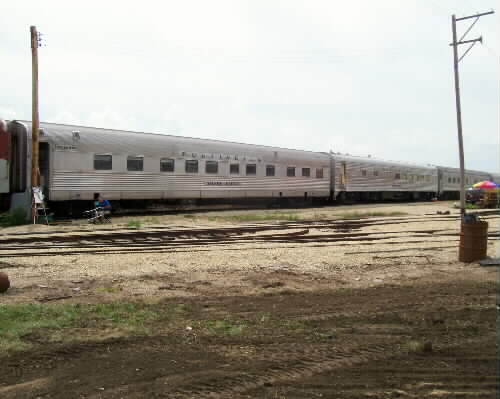
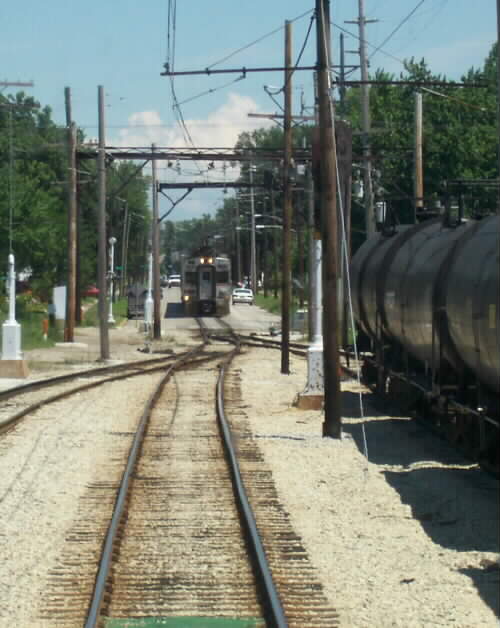
EXTRAS AND EXTRAS. World War II was the last great railroad war. Steven Spielberg is making a movie based on Flags of our Fathers, a biography of the six troopers who raised the flag on Iwo Jima. But vintage passenger trains are not exactly abundant on the common carriers. Solution: hire the Silver Cars from the Illinois Railway Museum.

These cars received a mechanical refit to be able to travel to the Chicago area, as well as new glazing, and a temporary Burlington paint job. (One might call these extras "stunt doubles" as Mr Spielberg's original plan was to hire the Nebraska Zephyr, but those cars were damaged in a switching oops. Preservation railways are subject to all the hazards of the common carriers with the additional difficulty of locating spare parts.

Inside, the cars still show evidence of their use on Amtrak. Silver Ridge, because of its unusual floor plan, was not converted for head-end power in Amtrak's Heritage Fleet rebuilds. Remember purple-and-orange, carpeting halfway up the walls, and paisley upholstery?


Slumbercoach Loch Sloy has its Northern Pacific lettering, which would be correct for trains running on the Burlington as well. In the movie it might show up immediately behind the diesel ... anachronism alert!


The double Slumbercoach room provides a toilet and sink as well as double bunks. Today's Superliner roomette eliminates the plumbing in order to provide somewhat wider bunks. There's not much luggage space in either configuration as there isn't enough headroom in the corridor for the luggage space the Viewliner sleepers provide.

The museum has made some improvements in the grounds. This shelter once served Springfield Avenue in Rockford, Illinois. After the end of interurban service, someone adaptively reused it as a doghouse. (If not for doghouses, chicken coops, diners, and cottages there'd be a much thinner supply of preservable city and interurban cars.)


The collection is going to receive shelter as well. These tracks are grouped in such a way as to permit sheds to be built over them, probably for maintenance purposes so as to allow for more display space in the existing carbarns. The museum recognizes that storage has opportunity costs, and cars kept under roof must earn their keep in some way.


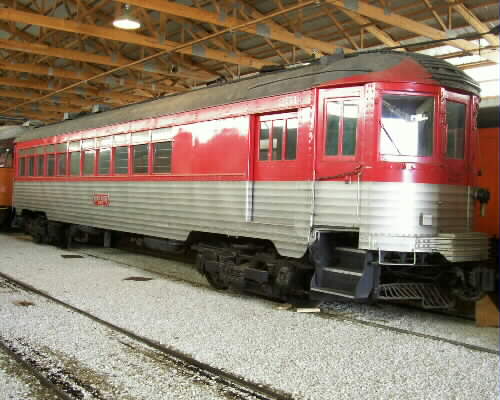
Inside one of the existing barns, a clear shot of North Shore baggage-coach 251. The North Shore Line attempted to match the steam railroads' silver cars with silver paint and carefully applied shadow markings.


Here is the oldest steam locomotive in the collection, an Illinois Central small Suburban Tank. It is set up for decent visibility over the coal bunker in order to run bunker-first in one direction. The Boston and Maine Budd Car behind it is set up with control cabs on each end, again, to make turning a suburban train less challenging.


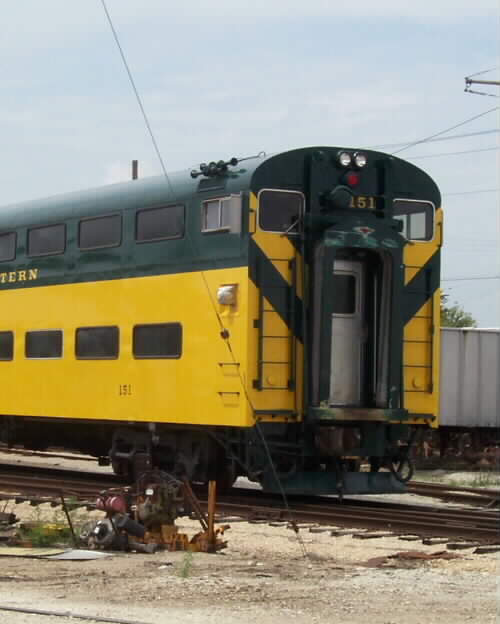
The Chicago solution has been to provide a control cab on one end of a coach, and a diesel on the other end of the train (and despite the profusion of grade crossings, passengers are allowed at the engineer's end.) But it makes one feel a bit old to look at this car and remember that cars in this style and coloration were running from Geneva into Chicago in 1986, when I started at Northern Illinois.


The pioneer Fairbanks-Morse diesel switcher, which runs, was on the diesel house lead.


The dispatcher's office has a working signal control panel. The museum has a number of webcams now, including one that provides live updates of the model board.


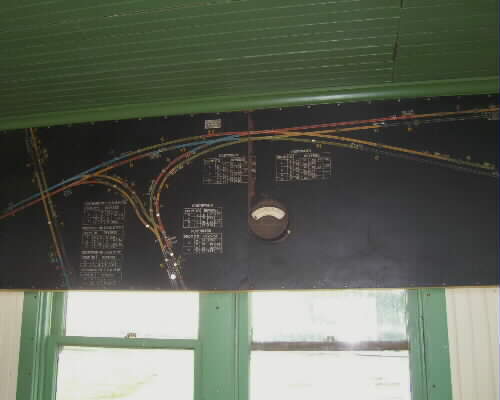
Inside the tower, a preserved track diagram offering visual aids to the signalman. This is South Upton Junction on the North Shore Line.


The view of a diesel train from the tower.


Some pot signals recently obtained from North Western Station during a rebuilding of the Lake Street interlocking. These look like British "shunting signals" but they were used to give the road out of and the route into the station. Some signals had one or two stars on the back side that illuminated to give the road to a train so long that the engine was beyond the end of the platform.


At the main station, a North Shore Line train using older cars that never received the Silverliner treatment.
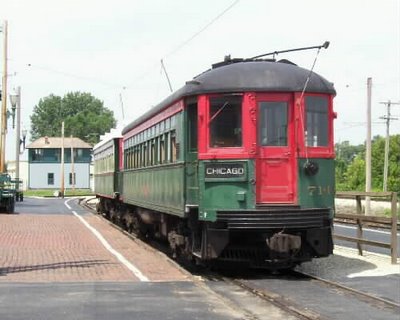

The day of my visit, the museum was setting up for a vintage automobile show.


I don't know whether this car was an early arrival or the property of a museum member.


Here's a screenshot, taken from the museum's tower camera, of the show.


The next big event will be a Day Out with Thomas, the weekends of the 19-20 and 26-27. The Chicago Tunnel Company did not deliver this shipment of Thomas toys for the upcoming Day Out with Thomas.


Thomas now has some new of friends, including a Claud Hamilton and a Stirling Single from the Victorian era, a Streak from the streamliner era (scroll down to Spencer), and a Q1 (Neville), Ivatt Suburban Tank (Arthur), and a 9F (Murdoch) from after the war. No doubt many of those push-toys will be going home with tired toddlers in the next few weeks.
PRICE TAKERS. Rising input prices induce leftward shifts of supply curves, but substitution behavior by producers and consumers matters.

In 2005, Briggs [and Stratton] blamed high costs of steel, aluminum, copper, plastics and energy for a 4.5% price increase for the hundreds of thousands of engines it built for the lawn-and-garden industry. If ever there was a year that a price increase was justified, 2005 was it, Chief Financial Officer James Brenn said in a conference call with analysts.

The same could be true for many companies this year. In a recent national survey of manufacturers, 59% of the respondents said they added surcharges on products to help cover higher commodity costs. Sixteen percent said they would move factories overseas to get relief from high prices.

Companies have had mixed results in recovering their material costs, said Dan Meckstroth, chief economist with Manufacturers Alliance, the Arlington, Va., trade group that conducted the survey.

"Often it comes down to who has the most muscle," he said. "If you have a strong market position, your customers might not have a choice but to accept price increases. But if you are one of many suppliers for the same product, it may be very difficult" to get customer cooperation.

High material costs have pushed some automotive industry suppliers into bankruptcy. The automakers, with their own problems, have been reluctant to accept price increases from suppliers.

Thus, more challenges for policy analysts. On one hand, "muscle" means consumers have fewer options to play one vendor against another: textbook price searching behavior. On the other, "muscle" might mean figuring out ways to serve consumers more cheaply, such as using cheaper labor, where available, with the more expensive materials.
PROFITING BY THE IGNORANCE OF OTHERS? Eras of "energy crisis" provide all manner of Teachable Moments for industrial economists. (I find myself assuring students, or is it reminding myself, that although we could devote the entire semester to energy prices, we won't.) Take a couple of news items. One shows the Principle of Complements at work.

"I think everybody's very cautious about buying a larger SUV right now. They're great vehicles, but they do use more gas, and I think that's where people are concerned," said Dennis Worthy, general manager of the auto auction near Caledonia.

Worthy said prices for bigger used SUVs have fallen as demand has waned, but prices for smaller, fuel-efficient used cars have increased.

The lack of interest in gas-gulping used SUVs is just one sign that rising gasoline prices - which might climb further because of the BP pipeline problem in Alaska - are changing the market for cars.

The article also illustrates why economists keep on invoking ceteris paribus.

The run-up in gas prices clearly has cut the demand for vehicles that use a lot of fuel, but U.S. automakers haven't been nimble enough to adapt quickly, some experts said.

"They were making money hand over fist for a lot of years, so that makes it hard to change," said Jay Baron, president and chief executive of the Center for Automotive Research in Ann Arbor, Mich. "It's difficult to come up with new kinds of vehicles. . . when sales are going well."

Even though sales of big SUVs are dropping, it's way too early to start writing an obituary for SUVs, others contended. Not everybody wants a smaller vehicle, and many still consider the convenience and their personal needs - such as roominess - worth the cost of the gas it takes to keep an SUV or a bigger vehicle running.

We still have some work to do distinguishing long-run from short-run adjustments, as well as making sense out of optimal inertia. Established firms frequently get clobbered by surprises. But somebody had to come up with the idea of the SUV. It did not spring in full obnoxiousness off of Henry Ford's drafting table. Economists also like to think in elasticities. Here's why.

[Paul] Taylor [of the National Automobile Dealers Association] noted that every dollar increase in a gallon of gasoline from now on will be smaller as a percentage than the boost to $2 from $1 and to $3 from $2.

The average price of a gallon of unleaded gas in metro Milwaukee on Monday was about $3.23 a gallon, according to Milwaukeegasprices.com

"People make adjustments about the prices of gasoline in the context of all the expenses associated with buying and operating a new car," Taylor said.

In the two years after a 1997 increase in the price of a gallon of gas, from about $1.25 to $1.30 to $1.60 to $1.70, he noted, the purchase of four-cylinder autos went up about 5% in models in which less-efficient six-cylinder engines also were an option.

Relative prices, relative prices. Another article shows that the confusion over what constitutes competition never goes away. There's this "minimum mark-up" law in Wisconsin that applies, or does not apply, to motor fuels.
The 1930s-era minimum mark-up law requires wholesalers to charge gas stations at least 3 percent more than they paid. Gas stations in turn must tack on at least 6 percent more at the pumps. The law's supporters say it prevents large retailers from underselling smaller gas stations and driving them out of business.
There's a cause to nail your colors to the mast for! Support your right to pay higher prices to buy at independent gas stations!
The Wisconsin Petroleum Marketers and Convenience Store Association issued a statement Tuesday saying the state's minimum mark-up protects small businesses from competitors who could undersell them.
If the underselling is by businesses using some improvement that's practicable on a small scale, such that a multiplicity of firms continue to serve the market, that's the textbook model of atomistic competition. But what happens if the improvement is one that's only practicable on a large scale? (At this stage, there are no large-scale improvements in ethanol blending comparable with the Standard Oil Trust's improvements in kerosene distribution in the late 1800s.) And if the improvement is being tested by a dominant firm? Then things get more interesting.

Banking representatives have been beating down the doors in Congress to get it to block Wal-Mart's bid to open a bank. The giant corporation has asked the Federal Deposit Insurance Corp. to give it a charter for a bank in Utah, a move that the bankers see as just the first. Wal-Mart insists that the bank will be used only to process debit and credit card transactions at its stores.

But bankers, particularly smaller community banks, are worried sick that Wal-Mart will start with the limited-service banks and eventually turn them into full-service financial institutions. Suddenly, the same folks who have fought any governmental "interference" with Wal-Mart's employment practices want the government to help them control what they now agree is a beast.

Wal-Mart could do to those community banks what it did to the locally owned hardware store.

(As if banks aren't entering into partnerships with retailers. There are TCF branches in Jewel-Osco -- isn't the integration of a grocer and a druggist anticompetitive?) But there is a connection. A Jewel-Osco or a Wal-Mart or a Meijer provides under one roof the services that used to be offered behind multiple sole-proprietor storefronts. As of this evening, Wisconsin's governor has directed that the minimum markup law does not apply to ethanol blends in gasoline. Hence another policy lesson: efficiency isn't the only goal.

[Governor] Doyle told state Department of Agriculture, Trade and Consumer Protection regulators not to enforce the 1930s-era law that requires that gas prices go up by 9.18% between wholesalers and retailers. The Legislature this year debated but failed to pass a measure that would have repealed the minimum markup law for all fuels.

"More and more drivers are turning to ethanol-based fuels because they are cheaper, and that is a trend we want to continue," Doyle said.

But the governor's order was an election-year gift to ethanol producers, said Erin Roth, executive director of the American Petroleum Institute that represents major oil companies. The move could hurt those convenience stores and other retailers who don't sell ethanol-blended fuel as price-weary consumers shop for the lowest prices, Roth said.

"It's an incentive for people to buy ethanol-blended gasoline," Roth said. "He ought to do it on all fuels."

Sure, but there are a lot more cornfields in Wisconsin than there are crude oil wells. Now if one could extract the methane from the cow-flops ...
FACING THE MUSIC. The Northern Illinois University statement on the one-year probation imposed by the National Collegiate Athletic Association is up.

Northern Illinois University will not appeal an NCAA Committee on Infractions ruling handed down today in which the committee acknowledged “mitigating circumstances” and imposed a reduced minimum penalty.

Instead, NIU officials say the report and its one-year probation penalty brings closure to a long-standing case involving a former women’s basketball player. NIU first notified the NCAA of possible violations more than two years ago.

“At the heart of this case was a faculty member who, at the request of the athletic department, reached out to help a struggling student,” said NIU President John Peters. “We’re grateful to the infractions committee for recognizing that context and for acknowledging that NIU’s excellent compliance history strongly influenced their final decision.”

The Northern Star reports that two individuals no longer associated with the university received letters of reprimand. (If they're no longer with Northern Illinois and these reprimands are not a matter of public record, do the responsible officials at their current employers have any way of knowing this?) The Star's sports editor recognizes that the probation can lead to adverse entries on the permanent records of others.

Despite the fact that it was a former NIU athlete and she was a part of the women's basketball team only, all of NIU athletics will feel the effects of the probation. This shows one of the NCAA's major flaws in it's current system when it comes to situations like these.

If anyone in any sport at NIU commits an infraction in the next year, then that could equal seriously bad news for the athletic department. We're talking the possibility of a loss of scholarships or even the loss of postseason play, which other schools like Michigan and Georgia have experienced in the last few years.

But he has a few things to learn about what "institutional reputation" means. The other teams can bask in the association with a bowl-winning football program, and, in the classroom, the strengths of an accounting program or the weaknesses of an area studies program can affect the academic reputation of the university taken together. Tell me who your friends are and all that.

The university is already responding to the probation. I recently attended an event at which the compliance coordinator reminded boosters that there were rules governing booster interaction with students and potential students.
ADAPTIVE REUSE. With diesel-powered commuter trains providing the only service into Metra's North Western Station, much of the former Chicago and North Western crew room and baggage facilities under the trainshed north of the Washington Street commuter concourse has been idle. Metra will be realizing some rental income from those properties after they're converted into MetraMarket. But isn't calling it Chicago's first French-style fresh food market a bit Arch Deluxe? The Reading Terminal Market, which has been under the trainshed at Philadelphia's Reading Terminal for years, has long offered vegetables, cheese, meat, fish, baked goods and flowers (as well as restaurants and taverns, not to mention scrapple, apple pan dowdy, and shoo-fly pie.)
TO THE FIFTH POWER. According to Site Meter, my 100,000th visitor arrived from Oak Brook Illinois looking for "erica christenson wikipedia." My post may not have been what the visitor was looking for, although it is fitting that the post matching the search is one on college follies.

The way the various counters work, there is probably some other contender for the 100,000th visitor somewhere back in April. Thanks to all for your continued interest.

7.8.06

HOW IT CAME UNDONE. Earlier this year I reviewed On the Wrong Line: How Ideology and Incompetence Wrecked Britain's Railways, which was very critical of the way in which British Railways became the part-private, part-subsidized, and part-public attempt to provide the rail equivalent of a road network it is today. But British Railways were not fragmented simply to implement libertarian fantasies about what a rail system should be. Stephen Poole, who worked for British Rail up to one of its restructuring, wrote about his experiences in Behind the Crumbling Edge, a not-at-all-favorable portrayal of the nationalized railroad that becomes Book Review No. 25. The railroad Mr Poole hired out on was very much the general purpose common carrier, still serving Britain's legacy heavy industries including the then-publicly held collieries and steelworks, and blending loose-coupled unbraked slow freight trains with express passenger trains and all manner of commuter and branchline local passenger trains, often shepherded from station to station under manual block rules. There was ample potential for things to go wrong, and it did. That operating staff (not necessarily train crew men in militant unions) bought into the view of the railroad as a social service agency not necessarily committed to precision transportation did not help. That's not to say the railroad's administration didn't recognize there were problems, but getting things changed brings to mind university policymaking on a bad day (see p. 183.)
Schemes such as Driver Only Operation and Penalty Fares, which were good ideas in essence, were largely the brainchildren of managers who moved from post to post and who wanted to leave their mark as they went along. At one time you couldn't really hope to be able to use their mark individually because of the nightmare of negotiation and consultation required before change could be contemplated.
Not surprisingly, things went wrong. The word "muddle" turns up frequently as a description of what the railroad attempted to do. One suspects, however, that Mr Poole is a bit skeptical of the thinking that started with the perfectly valid observation of motor and air carriers competing with the railroad being carried through to the suggestion that the railroad itself be restructured in order to provide railroad units competing with other units. (In my view a restoration of competition by creating independent companies running on competing lines, perhaps going so far as to re-introduce competition between the Midland and the North Western might have made more sense than the creation of service-specific operating companies. Mr Poole does not spell out his preferred view, although he refers to some "mismanagement" in the transition.) Given all that happened on British Railways, Mr Poole's acceptance of an early pension, comparing the old system's investment in some recent management training with East Germany's investment in Berlin Wall guarding in 1985, shows much more grace under tough circumstances than I would be capable of showing in public.
THEY ARE BEGINNING TO CATCH ON. The backward bending supply curve is not just for the blackboard.
"Common in academia, sabbatical leave is becoming a more common tool in business," the [Society for Human Resources Management] says on its Web site (www.shrm.org). "As adapted by many non-academic organizations, sabbaticals are provided to allow employees to pursue education, engage in personal projects or attend to special family needs."
That's the analogy. Here's the context.

[Robert W. Baird's Leslie Dixon] has been in human resource management for 19 years, and in the last decade, she has seen a surge in consideration of leaves and flexible work arrangements that let employees better balance work and life.

"We have had more people asking," she said. "The more we look at it, the more we realize that, to attract and retain the best people possible, we needed to have" such policies.

The changing face of the work force also is forcing such changes, said Shelley Jurewicz, executive director of the Young Professionals of Milwaukee.

Younger employees see time flexibility as much more important reasons to stay with an employer than do most companies, she said.

"You are going to have to put energy into these emerging top benefits if you want to compete for talent," she said.

But not everybody has yet caught on. The coffee bar at the local vendor of lottery tickets and Marlboros in a box (the modal purchase of almost everybody waiting in front of me) now sells a coffee with extra caffeine.

There are some subtleties to labor force participation that call for further research.
IN HIAWATHA'S FOOTSTEPS. Last week Monday, I sent an internet order to a British video producer called Video 125. The packet of DVDs were in my mailbox Saturday. Well done.

6.8.06

HOW IT ALL WENT WRONG? Shelby Steele had time on a long drive to meditate on how President Eisenhower might have been able to use what we so delicately call "a racial slur" among his golfing buddies without anybody influential making a fuss, and President Clinton some years later being able to take what we used to call "indecent liberties" with the college help and get away with it. The result of his meditation is White Guilt, Book Review No. 24. Much of this meditation is familiar to people my age: Fifties conformism, state-sponsored segregation at odds with the plain language of the Declaration of Independence, and a war to contain communism that appeared to be going noplace offered young people the opportunity to bundle their expected boundary-testing with what they understood as a more thoroughgoing and internally consistent re-evaluation of established ways of doing things. As is often the case, James Michener's Kent State sums up what was emerging (p. 137): "Vietnam, and our treatment of minorities. Corruption, and our indifference to ecology." (In those days we were still close enough to "Chicks say yes to guys who say no" that Mr Michener's source did not include sexism and homophobia, but those came along in due course.)

Professor Steele was able to experience those days with the zeal of a black man recently empowered by the new dispensation, and with the cleverness of a smart man who saw the points of advantage: thus he was able to act "authentic" without being brought up short by his Chicago Transit supervisor at his summer job, or by his university's president when he and his fellow militants submitted their "non-negotiable" demands. (Yes, younger readers, we did talk that way once.) But he later discovers that something has gone wrong. Turn to page 174.
By the mid-eighties the schizophrenia imposed on me as a black who was identified with the left had become unbearable. I had no interest in becoming a conservative. I just instinctively disliked the left's disregard of principles that had always been important to me. Worse, I had been terrified of the Faustian bargain waiting for me at the doorway to the left: we'll throw you a bone like affirmative action if you'll just let us reduce you to your race so we can take moral authority for "helping" you.
He's not becoming conservative, but he is being mugged by reality. Along the way, he encounters the Silent Generation relic from Hell. You know the type: Don't judge the Great Society by what happened. Give us credit for our good intentions. Bleah. And here's where he sees us (p. 176).

The left abandoned its compassionate Jeffersonian liberalism of the early civil rights era in favor of the dissociation that enabled it to respond to the crisis of white guilt (broadened by the sins of sexism, Vietnam, and environmental indifference.) In this crisis, if you could win moral authority for a society threatened with revolution, you would be given real political power. So, in trading in principles for dissociation, the left stumbled onto the formula for power that would see it through the next several decades.

But this was a deal with the devil. In choosing dissociation over principles the left became impotent; without demanding principles it could not solve the very social problems that justified its existence.

The contemporary right, Professor Steele notes (if "right" is even the right descriptive) has renounced its intentions to restore the segregationist order, and it is in a position to judge the dissociational left by the fruits of its policies. It's not so much Professor Steele left the left as it is the left left him. Page 180: "And if I've learned anything in all of this, it is that if you want to be free, you have to make yourself that way and pay whatever price the world extracts."

So for all that, why nearly 200 pages of meditation? At the end, we're left with Professor Steele's original puzzle, but no insights on what might have been done differently? Was it necessary that delegitimizing white supremacy necessarily meant the end of constraints on people in power taking liberties with interns? Was there any way to implement, say, a more consistent civil rights policy in which the power of the state could neither be used to prohibit people from associating or doing business with each other, nor to compel them to do either? And what other policies might have helped Black America deal with the reality Professor Steele notes that the end of institutionalized racism brought with it both freedom and responsibility, which are scary in their own way.

And in some places the book stretches to make a point. Sure, the O. J. Simpson criminal trial might have been a consequence of white guilt, but mightn't the prosecution's witness confessing that cops planted evidence, and the prosecutor's request that the defendant attempt to put an Isotoner driving glove over a plastic protective glove had something to do with it?
COSMOPOLITANS. These blue-collar aristocrats, metalworkers for Milwaukee's In-Place Machining, will go anywhere.

Apart from a cowboy-like spirit of adventure, what keeps In-Place workers competitive are their well-worn passports - their tickets to the global economy. In-Place makes them a condition of employment.

The passports put them in a distinct minority. According to the U.S. State Department, 25% of Americans own passports. While that number has risen in recent years, it lags the 39% of Canadians, 40% of Germans and 70% of British who have passports.

That gives In-Place an edge in a nation that struggles to connect with the 95% of the world's population that lives outside the U.S. According to the Commerce Department, the U.S. runs a chronic trade deficit with nearly every trading region around the globe, exporting 53 cents of goods for every $1 Americans import.

Do we have to have a refresher course on comparative advantage? Someplace has to specialize in the repair of heavy machinery, including formerly classified offshore drilling rigs and gas-turbine generating stations in Kirkuk. (Yes, Kirkuk is in Iraq.) Might as well have it in Milwaukee, where the machine tools and control systems that made the assembly line happen were made.
GOVERNMENT FAILURES. The "Rippers" for worst rail transportation agencies are up.
These are the "not-so-coveted" awards, and are, once again, totally arbitrary. Generally, either vague Construction Documents, or even covert attempts to skewer a Supplier or Contractor have resulted in strained relationships, higher costs, and lower quality.
Among the offenders is the North San Diego County Transit District, which is working on what a correspondent tells me is a new commuter rail project using German Desiro diesel-multiple-unit cars (here are some in Hungary, and the British have electric versions of them, they'd look good in turquoise with salmon pinstripes) and going under the name of "Sprinter," which brings to my mind Thomas the Privatised Tank Engine contemplating Selina the Sprinter Unit's curves. (There's a Sprinter Unit simulator on offer from Train Sim.)
A VICTORY ONE CAN LIVE WITH? July's Reason includes an article on the difficulties of nation-building. Authors Justin Logan and Christopher Preble, both affiliated with the Cato Institute, are not pleased with the Bush Administration's turnabout from Governor Bush's 2000 skepticism about using the U.S. military for nation-building.
That’s why we’re alarmed that the Bush administration has created a nation-building corps from America: the State Department’s new Office of the Coordinator for Reconstruction and Stabilization, which was established by Congress in July 2004. The office’s mandate is to “help stabilize and reconstruct societies in transition from conflict or civil strife, so they can reach a sustainable path toward peace, democracy, and a market economy.” Meanwhile, a November 2005 Defense Department directive makes stability operations a “core U.S. military mission.” Such operations would involve on-the-ground assistance, not unlike the provisional reconstruction teams in Iraq...
Deeper into the article, however, is the material I'd like to expand upon.
In the most thorough survey of American nation-building missions, the RAND Corporation in 2003 evaluated seven cases: Japan and West Germany after World War II, Somalia in 1992–94, Haiti in 1994–96, Bosnia from 1995 to the present, Kosovo from 1999 to the present, and Afghanistan from 2001 to the present. Assessing the cases individually, the authors count Japan and West Germany as successes but all the others as failures to various degrees. They then try to determine what made the Japanese and West German operations succeed when all the nation-building efforts since have failed.
The authors note one possible source of the difference.
Although “postconflict success often depends on significant political changes,” it said, the “barriers to transformation of [an] opponent’s society [are] immense.” And in the absence of a decisive outcome between warring parties (such as happened in World War II), there is always a danger that violence will continue.
Put another way, the road to a successful transformation of the adversary might involve actions the victor might regret. Here's Professor Bainbridge with some specifics.

[T]he greatest generation had doubts about the morality of the strategic bombing campaign even in the midst of the war. The British denied Bomber Harris a peerage in 1946 (although they did offer him one in 1951, which he refused), even though they gave peerages to virtually all of the UK's other major World War II commanders at that time. Bomber Command did not get a separate campaign medal. And so on.

Indeed, there seems little doubt but that the strategic bombing campaign violated the precepts of a just war. In particular, it violated the tenets of proportionality and discrimination. Proportionality holds that the response to aggression should not be disproportionate to the original aggression. Was the deliberate firebombing of Dresden or Hamburg, say, proportional to the Blitz? As for discrimination, there is no doubt that Bomber Harris and his US counterparts deliberately targeted German and Japanese citizens.

His summation:
[A] just war must be fought justly. And we do the so-called greatest generation no service if we ignore their serious moral failings in this regard. The West, after all, is supposed to be the good guys.
But how much of the difference in effect between the Blitz and the thousand-plane raids was attributable to incompetence on the German side? And what persuasion is permissible against citizens of a bellicose government? Chris Bertram of Crooked Timber takes one position.
[T]he current actions of the Israeli government , in bombing facilities like Beirut Airport and a power station in Gaza, in deliberately making civilians suffer (and in many cases causing their deaths) are illegal and disproportionate, words that don’t do justice to the bloody reality. Collective punishment and reprisal are not permissible actions, but that is plainly what is going on here. Lebanese people are being killed as a matter of policy in order to put pressure on the Lebanese government.
Betsy's Page takes another.
Just imagine if there was a breakaway terrorist group in northern Mexico that sought to destroy the United States and was lobbing rockets across the border into the United States killing and endangering all the people who lived in the Southwest. Suppose Mexico was helpless to stop those renegades and so we launched attacks against them ourselves. And then you had some thoughtful people throughout the globe telling us that we needed to negotiate with those terrorists.
Note in her hypothetical that the Mexican government, as appears to be the case with the Lebanese government, is not capable of being a government, which is to say, maintaining its monopoly on violence. The German and Japanese militaries were not rogue militias acting independently, perhaps with some encouragement from other powers. That makes identifying the "warring party" to be on the receiving end of a "decisive outcome" somewhat more difficult. (And many policy-makers continue to work under the impression that there are oppressed everyday Muslims held hostage to the ambitions of a few crazies.)
THE WEBMASTER IS BUSY. The Tribune's Ends of the Line visits Elgin Big Timber. Photographs are not yet available, perhaps because the Tall Ships and Lollapalooza also have photo series going.

A note about that station name: some people gripe that Metra simply named their relatively new station on the west side of Elgin (which is strategically positioned near a crossing of the Union Pacific line to Belvidere and Rockford as well as a logical jumping off place for Hampshire and Genoa, if DeKalb County ever gets its act together, on the Milwaukee, er, Iowa, Chicago & Eastern) for the nearest mile road, as unlike on much of the Metra system, there was never a station there in the steam era. But there's nothing particularly unrailroady about the station name. Consider Manchester London Road (now Piccadilly) or London Liverpool Street (if only the concourse building at Penn Station could have been "redeveloped" as sensitively) or the New Haven's Route 128.

3.8.06

OUCH. Inside Higher Ed notes, "NCAA Rule Breaking at Northern Illinois." The specifics:
The NCAA Division I Committee on Infractions has placed Northern Illinois University on probation for one year for limited violations in women’s basketball, mostly related to extra benefits given to a student-athlete by a faculty member. This was the university’s first major infractions case.
Well, the specifics aren't real specific.

The extra benefits began in December 2003, concluded in June 2004 and totaled nearly $2,000, according to the public report from the committee.

The committee noted that the relationship with the faculty member began after a former assistant director of athletics placed the student-athlete in contact with the professor for mentoring due to personal difficulties the student-athlete was experiencing at the time.

According to the infractions committee’s report, the former assistant director of athletics provided a cursory explanation of NCAA guidelines to the faculty member, specifically that student-athletes cannot receive benefits beyond what any student at the university could expect to receive.

However, the former assistant director of athletics did not monitor the relationship; follow-up regarding potential extra benefits being received by the student-athlete; report the potential for extra benefits to appropriate staff at the university; and provide the faculty member any in-depth NCAA rules education prior to and during the relationship with the student-athlete.

As a result, the committee cited the assistant director of athletics for failure to monitor the situation. It noted the student-athlete should have realized the benefits were improper as well.

I had coverage of this story when it broke. The Association takes a somewhat dimmer view of the case than the university did.

While the university considered the violations to be secondary in nature, the committee concluded the violations were major. Even though the student-athlete’s relationship with the faculty member was not based on athletics and the faculty member had a history of being generous with others, those facts were mitigating factors only related to possible penalties, the committee said.

The committee added that it took into account mitigating factors when considering penalties in the case.

“The violations were in the context of a relationship conceived out of a concern for the welfare of a student-athlete, and the faculty member who provided the extra benefits did not have an athletic motivation in her actions,” the committee wrote in its report.

The player in question has since left the school, there has been a coaching change in women's basketball, and the kids have been performing well off the court.

WHY WE HAVE PEER REVIEW.

Ohio University's Richard Vedder and some of his colleagues have set up something called the Center for College Affordability and Productivity and commenced publishing a weblog. Professor Vedder was a member of the Spellings Commission on Higher Education and the content of the weblog suggests Center members will use the site as an extended minority report on the Commission's statement.

One post caught my eye as it offers me an opportunity to get around to a book review I have been putting off. Professor Vedder has a frank exchange of views with Gary Becker.
Two events over the weekend demonstrated once again something that I already knew -- that the Higher Education Establishment in America is in a state of denial about the reality that America's colleges and universities are increasingly costly and inefficient -- and probably, at the broader social level, not a sector on which we should be devoting huge amounts of new resources without some fundamental changes.

In Boston on Saturday, I got into a bit of a civilized contretemps with a man I greatly admire, Professor Gary Becker of the University of Chicago, a Nobel laureate in economics and truly a great economist. I had suggested that empirical work I had done shows that perhaps new government investments in higher education have low rates of return, since state government appropriations and state economic growth are negatively correlated -- more spending, lower growth. He replied that we as a nation underestimate the true rate of return on higher education. College graduates commit fewer crimes, are less likely to be unemployed, have fewer low birth weight babies, etc. (Some other data from the estimable postsecondary.org even suggests that college educated drunk drivers are more likely to wear seat belts than their less educated drunken colleagues).

Like most good scholars, Becker is usually very fastidious about taking into account other factors that might explain the phenomenon he is investigating. But not here. I would speculate that if the individuals who graduated from college had gone into construction as semi-skilled or unskilled laborers, they likely would have been more responsible citizens than average Americans. College students are, on average, brighter, more motivated, more disciplined, etc., than non-college graduates. College admissions is a screening process, and the truly non-bright, poorly motivated, undisciplined individuals either do not apply for admission or are rejected. Many of the positive virtues attributed to college education may have been largely (or even completely) developed elsewhere -- in the home, through church attendance, etc. Becker seemingly dismisses or ignores some evidence that might suggest higher education's role in determining the quality of our lives may be less unambigously positive.
The negative correlation argument appears in Going Broke by Degree: Why College Costs too Much, which I read long ago and now offer Book Review No. 23. On one hand, I'm likely to sympathize with a man who can note (p. 213)
The corruption of college athletics, the occasional scandals over college admissions, the growing politicalization of the academy, lax standards, the construction of extremely luxurious facilities, and excessive student party-going threaten public trust in our institutions of higher education, along with the immense subsidies that allow universities to operate as they do.
On the other hand, if he's going to write about "undisciplined individuals [who] either do not apply for admission or are rejected" today, has he rethought "Although students are probably no more accomplished academically and arguably less so than their parents" (p. 112) or his case for performance-based scholarships to attenuate the moral hazard of subsidies that he suggests "would lower somewhat the scandalously high attrition rate" (p. 225) or his suggestion that universities outsource their remediation to Sylvan Learning (p. 179?) (He does not suggest that Sylvan send the bill to the high schools that dropped the ball in the first place.) One thesis of Going Broke by Degree is that third-party payments attenuate the incentive for the universities (the state-supported ones thanks to taxpayers, the privates thanks to endowments and student loans) to contain their costs, which is logical enough, but the book also maintains that those third-party payments induce students and parents to make inefficient choices of college. (He leaves unexplored the possibility that the low tuitions (relative to equilibrium) name colleges charge (to boost their selectivity rating, see p. 19) also induce inefficiently many applications and admissions. (Regular readers know where I stand on this point.)

But it is to that asserted negative correlation between college spending and state economic growth rates I must turn. Professor Vedder reports two such regressions. In the first, (p.135)

(Change in?) Personal Income Per Capita (1977 to 2002) = 35.837 (1.172) - 11.933 (Level of?) Higher Education Spending (3.570) - 0.004 1977 Income Per Capita (1.957) + 1.402 Taxes as Percent of Income, 1977 (1.070) + 0.091 Changes in Taxes as Percent of Income, 1977-1999 (0.064) - 0.476 Percentage Workforce in Unions (1.582) + 0.164 Age of State (4.362) + 0.152 Percent Days the Sun Shines (0.831) + 0.912 Percent Population over 65, 1981 (1.177). The adjusted R2 is 0.641 and the equation F-statistic (what are the degrees of freedom?) 12.170. The t-statistics are in parentheses and I have bolded the estimates with t-statistics greater than 2.

Going Broke by Degree is a publication of the American Enterprise Institute and as such might be susceptible to editing in such a way as to highlight favorable findings. The editors did not require Professor Vedder to provide much by way of description of his sample (are we looking at 51 observations, showing the average annual growth rate in fifty states and the District of Columbia over a 25 year interval, or are we looking at a panel of 51x25 observations?) That makes a difference for the equation F-statistic as well as for the interpretation of some of the t-statistics close to 2, such as the coefficient on 1977 income per capita. And a referee for Review of Economics and Statistics or Regional Science and Urban Economics would raise a number of questions about potential autocorrelation in the case of a panel. There's also an obligation for a researcher to say something more about specification. We're not looking at estimates of an indirect utility function, which has some basis in theory, or the Becker-Mincer kitchen sink, which is a generally accepted specification. By way of explanation we get, "I included seven variables used in table 7-1 for control purposes (to approximate more closely the usual assumption of 'holding everything else constant')." At least these seven variables occur in levels, preempting the gripe I raise about people using "controlling for" rather than "dummying out," a frequent feature of the kitchen sink regression. But why these seven? Why not the won-lost record of the nearest pro football team or width of temperature range, January to July or square miles of waterfront?

A few pages later comes another regression, which is even more troubling.

(Change in?) Personal Income Per Capita (1977 to 2002) = 44.570 (1.760) - 13.002 Higher Education Spending, 1980 (4.431) - 6.583 Change in Higher Education Spending, 1980 - 2000 (1.533) + 1.186 Percent Population 18-24 Years Old, 1981 (0.561) - 0.004 Income Per Capita, 1977 (2.397) + 2.320 Average Tax Burden (1.875) - 0.705 Average Percentage of Workforce in Unions, 1973, 1984 (2.214) + 0.130 Age of State (4.213) - 0.232 Energy Production, 1977 (2.649). The adjusted R2 is 0.690 and the equation F-statistic is 14.925. In this regression Professor Vedder reports that his sample is 48 observations.

This result is autistic number-crunching. (That's my single biggest complaint with the book, as there are other examples in other chapters, most of those, however, not concealed behind the phony precision of a regression estimate.)

We're supposed to believe that 25 years of change in personal income per capita can be captured in a single set of regressors with a different set of control variables "To deal with a possible problem of omitted-variable bias" (p. 139.) Possible problem?? How about a very real problem of specification bias (there is no theoretical framework in the book or in the footnotes leading to the choice of this data base and set of regressors) or an even greater problem of aggregation bias (the college-age population in 1981 will be prime-age workers in 2002, but that workforce is being augmented by subsequent graduates, and where have the retirees gone?) I fear that Going Broke by Degree will convince people who are already convinced, but it won't do much to convince the unconvinced, particularly those with a working knowledge of statistical inference.
THE VALUE OF RESERVE CAPABILITIES. Last month, I suggested that Wisconsin's hiring of conspiracy buff Kevin Barrett was evidence of sloppiness in their hiring. The writers at ACTA Online expand the argument.

The discussion about University of Wisconsin lecturer Kevin Barrett has rightly swung away from academic freedom to issues of hiring and internal review: Ringing evocations of academic freedom in Barrett's case both misconstrue academic freedom--which is not the freedom to push political viewpoints or junk science in class, and which is not the freedom to teach whatever one wants however one wants--and deflect attention away from the real issue at hand, which is how Barrett came to be hired in the first place. UW clearly needs to pay more attention to its hiring processes, and it needs to pay particular care to its mechanisms for evaluating applicants for part-time teaching jobs of the sort Barrett has. Instead, it has issued ringing endorsements of academic freedom: "We cannot allow political pressure from critics of unpopular ideas to inhibit the free exchange of ideas," says Provost Patrick Farrell. "That classroom interaction is central to this university's mission and to the expansion of knowledge. Silencing that exchange now would only open the door to more onerous and sweeping restrictions."

But UW is not alone in either its casual approach to hiring adjunct lecturers or its apparent lack of established procedures for assessing what teachers are teaching and whether they are teaching well. Nor is it alone in its willingness to fall back on hollow evocations of academic freedom when weaknesses in its present personnel practices are exposed.

The statement has elements of a Complex Proposition. On one hand, Wisconsin, like every other large university, often finds itself having to cover a class or three on short notice. Each department chairman (often, the department administrator on the chairman's authority) probably has a list, an extra board if you will, of people who would be willing to pick up a class on short notice. And for the most part, those appointments are quite satisfactory, and the adjunct faculty members have considerable rapport with the students. (Those followings develop all too frequently as those people are filling in on a variety of courses over the year or two that a cohort of majors spends in-department.) On the other hand, the post hints at the possibility that the real problem is with the existence of the extra board. Perhaps the trustees and administrators ought take another look at the consequences of their calls for cost-cutting and for reducing the tenure-depth of departments. If departments are not allowed to offer tenure-track and tenure lines, despite being "enrollment-impacted," but are authorized the use of the extra board, does it come as a surprise that every so often someone who does not measure up will be called off the extra board? On the other hand, to formally investigate the extent of the extra board might raise the possibility that James Michener hinted at in Kent State: What Happened and Why? years ago, namely that the universities (whether it's our MAC rival Kent or Northern Illinois or Wisconsin or Yale) are using sweated labor.

The Milwaukee Journal-Sentinel ran a guest column by ACTA's Charles Mitchell that trots out the usual nostrums, rather than address the extra board itself.
ACTA proposed that course of action in a July 17 letter to the UW Board of Regents and several administrators. Our letter encouraged them to perform an institutional self-study of the classroom environment, institute post-tenure review of faculty, assess hiring and promotion practices to ensure that quality of research and teaching - not ideological litmus tests - are the criteria for job security, incorporate intellectual diversity concerns in guidelines on teaching and include intellectual diversity issues on course evaluations.
If Mr Barrett is called off the extra board at a per-class fee that is less than a month's gross pay for a senior professor, and never placed on the tenure track, what good will the post-tenure review be? Why not review the expense-preferense behavior of administrators and trustees that puts departments in the position of having to go to the extra board? Designing a course evaluation to include "intellectual diversity issues" sounds like an exercise in wheel-spinning in the making.

And replacing a Complex Proposition with a False Dichotomy doesn't help matters.
So if UW-Madison wants to avoid the kind of headlines it is getting right now, its leaders have a choice: They can bet that no one else on the faculty will ever again say anything to raise the ire of a state legislator, or they can implement some simple and proactive reforms to show they care about the education students are receiving.
You mean there isn't an efficient level of legislative discontent? Or that keeping Madison enrollments sufficiently small that the university relies less on the extra board might not produce headlines of a different kind?

SECOND SECTION. Inside Higher Ed's look at the academic job market.
Faculty members have for years been complaining that the higher education job market is growing the most in part-time positions. Data released by the Education Department Wednesday back up that contention. While the figures aren’t new, the department’s 10-year look at college and university employees shows that employment growth has been uneven — in some cases dramatically so.
And yes, dear reader, your perception of a proliferation of administrators and functionaries is correct.
QUESTION OF THE DAY: State Fair chief baker Dave Schmidt.
"Every now and then I get someone who's standing in line who says 'I've never eaten a cream puff,' and I'm like, 'Oh my God, where are you from? Illinois?'"

1.8.06

A HISTORIC WAY TO SOME UNUSUAL MUSEUMS.

Last Friday's Ends of the Line series in the Chicago Tribune, featuring South Bend, (the rivet counters caught the Tribune erroneously referring to Metra) was accompanied elsewhere in the paper by an article on the troubles of Gary, Indiana at its centennial. Left unstated in either article was that the South Shore Line, which still reveals vestiges of its interurban heritage, serves both cities. I've blended photos that accompany both Tribune articles with a few of my own, from a recent inspection of the Last Interurban.

A book titled Duneland Electric divides the South Shore into four sections. Starting from Chicago, the first section is trackage rights on the Illinois Central, now known as Metra Electric. Just north of Kensington (115th Street), where the South Shore begins, is the headquarters of The Pullman Company. The headquarters building was an arson victim a few years ago. Restoration is in progress.


From Kensington to Gary, the South Shore is a two-track suburban operation "in the shadow of the steel mills." There's a stretch along the Indiana Toll Road where the cars are able to leave everything on the highway behind. There are not many good photo locations through this stretch.

Gary's beaches are also in the shadow of the steel mills.


That sky looks hazy and humid and nasty, just the kind of day for building a sand castle or taking a swim. The water in Lake Michigan gets tested regularly. The beaches of the South Shore are generally safe to swim in.

The Duneland Electric section of the South Shore begins somewhere east of Gary, where the interurban leaves behind the steel mills and the parallelling railroads.


The ancient and the modern at Beverly Shores: the South Shore's one remaining "Insull Spanish" station, a lamp-post that looks like it could have come from Plasticville, and (edited out) a crawling-message annunciator sign.

The meet at the city limits: this has been a tradition at Sheridan siding in Michigan City for nearly 100 years. I've deliberately posted a long shot to illustrate the northbound train trundling through the streets of Michigan City.


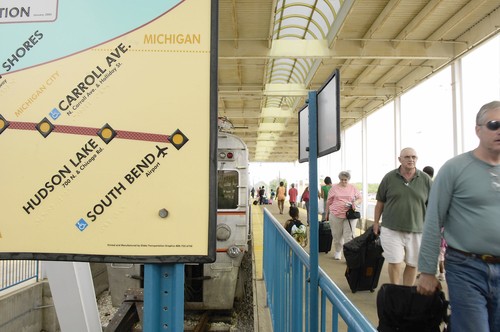
East of Michigan City comes the "interurban time machine": fewer freight trains, and more frequent cars at weekends than on weekdays. Hudson Lake is the one remaining station between Michigan City and South Bend.


It is a flagstop. The South Shore has installed solar-battery strobe lights for passengers to activate in advance of the train (they have timers that cut out after 15 minutes.) Milwaukee Electric used a more primitive version of this system at some shelters years ago. But until recently, the South Shore timetables carried the notation fStops on signal (use light at night.) The ritual throughout the Midwest was to bring some matches and a rolled up newspaper and hope to get the newspaper lit in sufficient time for the motorman to see the light and stop the car. (But I suppose with modern flame-retardant papers and water-based inks the strobe is more reliable.)

South Bend is home to a number of tourist attractions beyond the expected Old Notre Dame. There's an indoor whitewater training center.


Chicago Tribune photograph by Alex Garcia.

The Studebaker Museum has an exhibit at the airport inviting guests.


Once upon a time, Studebaker sponsored Mister Ed. (This was before the Karlson household had a television. We finally bought a television. A few weeks later came the Cuban Missile Crisis, followed over the next few months by the end of the North Shore Line, the assassination of President Kennedy, and Studebaker's exit from car manufacture. Put that dummy variable in your regressions!)

The South Bend airport recognizes that passengers waiting to check in and people meeting incoming passengers might take an interest in airport operations.


I realize with security what it is, we'll never see Detroit's open air observation deck, let alone Milwaukee's balconies above the jetways again, but airports that have done everything to hide their operations from their clientele are missing something.

This Delta plane has just arrived from Atlanta. Somebody could fly to South Bend and ride the interurban to Dune Park or Hammond or change to the Metra Electric at Kensington.


Outside the airport is a recently-opened war memorial. The crosses have dog tags but no names yet.


The South Shore's station at South Bend does not lend itself to unobstructed views of trains and passengers. The Tribune photographer makes a good effort at an artistic composition in tight quarters.


Chicago Tribune photograph by Alex Garcia.

The approach to the airport has interurban-like tight curves.


The first mile or so toward Chicago bring to mind the side-of-road trolley of the early years of interurban service. Worth a look if you're in the Chicago area.
WE ALREADY KNOW. The University of Wisconsin continues to make a bad defense of academic freedom.

The university’s chancellor, John D. Wiley, said that he was baffled by [CIA 9/11 conspiracy buff Kevin] Barrett’s beliefs but that they were irrelevant in the classroom, where he must stick to a syllabus that has been approved by the department. That syllabus includes a week devoted to the war on terror.

A 10-day university review had determined that Mr. Barrett presented a variety of viewpoints and that he had not discussed his personal opinions in the classroom, Mr. Wiley said.

“I think it would be a serious mistake for legislators to try to get in and micromanage curriculum,” said Mr. Wiley, who added that university officials would keep an eye on Mr. Barrett by meeting with him throughout the semester. “We don’t go around and question all our instructors to find out what all their views are.”

No, because you don't have to. "The University of Wisconsin is an affirmative action employer." Your "commitment to diversity" is a job qualification, and there are any number of remarks a search committee member can make at a job interview or on a campus visit to tease out the requisite sympathetic head-nod. Your promotion and tenure application might ask you to spell out the ways in which you have contributed to "Design for Diversity" and made efforts to "incorporate multiculturalism" in the classroom. (I can name promotion applications that have made these, and similarly insulting, requests of candidates.)

But the New York Times does a rather poor job of circling the wagons in defense of academic freedom.

At the University of Colorado, a committee voted in June to fire Ward L. Churchill, an ethnic studies professor who had compared some victims of the Sept. 11 attacks to a Nazi official. Professor Churchill appealed this month to keep his job.

And early this year at Northwestern University, Arthur R. Butz, a tenured professor of engineering, drew strong criticism after saying he agreed with the belief of the president of Iran that the Holocaust was a myth.

Mr Churchill was given his walking papers for academic misconduct (made-up credentials and plagiarism), not for making a botch of the "banality of evil" argument. Professor Butz has given Northwestern the opportunity for a long time to dis-associate itself from his private views as long as he does not bring them into the classroom. His current profile on a student gripe site suggests from the timestamps that some people added reviews when the story broke.
MUSICAL VISUALIZATION. The DeKalb Municipal Band performed Johann Strauss's Blue Danube tonight, which I can never listen to without wondering what happened to those Pan Am shuttles to the Space Station Hilton we were supposed to have by now.
APPLIED VERTICAL RESTRAINTS. Saturday night's chorizo race was a one-off.

Lost in the local and national hubbub over the introduction of a fifth Racing Sausage to the Klement's lineup at Miller Park is the fact that Major League Baseball, which has authority over such merchandising and licensing matters, has put the Chorizo back in the freezer.

Baseball has strict rules for clubs that want to introduce a new mascot, uniform or logo change, and the Chorizo got caught up in the rules.

According to Susan Goodenow, an MLB spokesman, baseball wants to be sure that fans tie into new characters or promotions from a marketing and licensing standpoint.

Suppressing inter-sausage competition in order to foster the league's image?

She said baseball granted the Milwaukee Brewers a special dispensation allowing the character to participate in last Saturday's Sausage Race as part of Cerveceros Day at Miller Park.

But for the Chorizo, it was one and done for 2006. And with it went a public relations campaign that got Klement's and the Brewers national publicity.

We are dealing with a business that has some of the characteristics of a regulated industry. It won't go quite as far as "The existing sausages are capable of performing the race. If more interesting races are desired the existing sausages can race faster. The Chorizo is incompetent to participate in a sausage race."

But there is the potential for some deal-killing attorney to decide that some people are having too much fun.

Dan Lipke, Klement's senior vice president of sales and marketing, said the company had no problems putting the Chorizo on the physically unable to perform list for the rest of the season.

"Everything in sports and business is a work in progress," Lipke said. "It is what it is."

Lipke said the downtime would enable Klement's and the Brewers to design new marketing and promotion programs for the five racing sausages.

"But baseball has the final say," he said.

If Major League Baseball acts like a cartel, I'll let you know. Spam and mash for any killjoys.
INCENTIVE-COMPATIBLE RENT SEEKING? The University of Chicago retains its management agreement to operate Argonne National Laboratory for the Department of Energy.

A law enacted by Congress a few years ago calls for competitive bidding to determine the operators of national labs, and the university mounted a huge effort to maintain its historic role managing Argonne.

"We spent millions to compete," said Thomas Rosenbaum, University of Chicago research vice president.With more than 100 positions that are joint appointments at Argonne and the university, the two institutions are closely intertwined. University leaders said that their main concern was maintaining research synergies. The lab employs about 2,900, including about 1,000 scientists and engineers.

While expensive and harrowing for the university, the bidding process was valuable because it caused a review of Argonne's management that will result in improved operations, Rosenbaum said.

As an example, the number of days lost to accidents at Argonne must be low enough to rank the lab among the top 10 percent of safely operated research labs when compared to private industry, Rosenbaum said.

"We have to meet quite explicit performance targets," he said.Lab safety, especially concerning nuclear materials, has been a major concern at the Department of Energy. Argonne management was cited in March for lax security and safety that occurred over many years dating back to 1999. While calling the lapses serious, energy department officials said that no major injuries resulted.

Several other federal labs have been cited for safety lapses, and the federal law requiring competitive bidding was enacted in part because of problems at the government's nuclear weapons lab near Los Alamos, N.M.

Other nearby universities worked with Chicago, but the private sector stayed away.

In preparing its bid, the University of Chicago recruited Northwestern University and both University of Illinois campuses in Urbana-Champaign and Chicago to join Argonne's board of governors and scientific advisers. It also recruited BWX Technologies Inc., which has a long history of nuclear manufacturing work, as a subcontractor for nuclear operations at Argonne.

Jacobs Engineering Group Inc. was also hired by the University of Chicago to bring project management and safety expertise to Argonne's operation.

With all major research universities in the state behind a single bid and the relatively low annual management fees offered, the process failed to attract any contender from the private sector such as Bechtel and Lockheed Martin.

Disclaimer: I hold a renewable short-term appointment with Argonne as an energy and environmental policy scientist. A number of physicists at Northern Illinois use the Advanced Photon Source as a research tool.
DEVELOPING BOTTOM-FEEDING STRATEGIES? A Philadelphia Inquirer report sees strategic planners in higher education anticipating the next enrollment crunch.

"Some institutions are going to struggle to find students," said Brian Prescott, a researcher for the Western Interstate Commission for Higher Education, a policy organization created by the legislatures of 15 states. It has projected the number of high school graduates nationwide since the 1960s.

Traditionally, public institutions and elite private universities have so many more applicants than available seats that they should be able to weather the downturn without much trouble. Harvard, Prescott said, will still be Harvard.

"But an average private college in Pennsylvania may not be able to maintain the same level and quality of students, while their competitors in the Southeast or the West may be OK," Prescott said.

Perhaps there's a way out of the social waste inherent in remediation, which the Cincinnati Enquirer (you say "inquirer," I say "enquirer," let's call the whole thing off???) suggests is a non-trivial waste.

Education experts say this isn't just about a student taking a few extra classes. Remediation, which often affects minorities from poor families in low-income public districts, has an impact that stretches from families to schools to taxpayers.

Remedial needs strain the student, who might pay hundreds or thousands of dollars for classes that don't count toward a degree.

"At first I thought it was going to hold me back," said Daniel Williams, 18, a 2006 Woodward graduate who'll be in a remedial program at the University of Cincinnati when fall classes start.

They strain colleges, too, which devote instructors, classrooms and supplies to classes that ideally wouldn't be necessary.

And they strain the state - in essence, taxpayers - to the tune of about $30 million a year in remedial costs. While that's less than 2 percent of the overall higher education budget, "We would never say that $30 million isn't a lot of money," [Ohio Board of Regents staffer Darrell] Glenn said.

"It would be really good if we could take that $30 million and use it for something else."

But perhaps the greatest problem is what so often happens to students who require remediation: They struggle. They fail. They drop out. They lose the earning power of a college degree.

The state tracked a group of students for six years and found that among the remedial students, only 15 percent earned a bachelor's degree in that time; nearly three times as many nonremedial students received their degrees.

"The biggest effect of having 40-something percent of students not ready for college is that, lo and behold, the ones not ready when they start are much less likely to get a degree," Glenn said.

But apparently the state universities would like to have the enrollments, Mr Prescott's suggestion that the enrollment downturn is going to bite at the less-famous private colleges first.
"I think there is a mindset in Ohio that college is a luxury, not a necessity," said Jonathan Travel, the Regents' vice chancellor for educational linkages and access. "To me, it's a whole system, and it's easy to blame the whole system, too ... (but) we're all in this together."
Might it help to think of higher education as conferring primarily private benefits (that can be appropriated by the degree-holder) and ending the fiction of large spillover benefits from spending money on remediation and climbing walls and subsidies for football fields? Harder question: what is the social waste in the less-known private colleges taking up the remediation cause as a way of keeping the buildings full?
CAPITALIST ACCUMULATION? Syem-pyat-dyesyat has a certain ring to it.

The producer of America's best-selling ketchup, Heinz, has launched an effort to squeeze more of its brand onto Russians' dinner plates and challenge its Russian counterpart, Baltimor, as king of the condiments.

H.J. Heinz Co.'s European division finalized a deal in April to buy a majority stake in Petrosoyuz, a privately owned St. Petersburg food manufacturer that is a major player in the world of ketchup, mayonnaise and other spreads.

The article goes on to explain that "Baltimor" is a reference to the Baltic Sea. "Petrosoyuz" sounds a lot like a Soviet-era term for an industrial complex near Leningrad.

Heinz established itself in Moscow by becoming sole source of catsup to McDonald's in Russia, much as it has long been in the States.