26.1.11

WHITE HOUSE ON THREE. Our President's policy hopes face a strong reality check.


Gateway Pundit image via Betsy's Page.

His football prognostication also faces a reality check.  (Via Charlie Sykes).
President Obama probably did not help his reelection campaign much in Wisconsin when he predicted a Chicago Bears win over the Green and Gold in the NFC championship game and announced he would attend the Super Bowl to watch his home team compete for the Lombardi trophy in person.

After a White House press pool spray with President Hu Jintao in the Oval Office last week, a cameraman asked President Obama "If the Bears win, are you going to the Super Bowl?"
"Oh we're going," President Obama replied. "No doubt."
Those comments stung like frostbite in the bitter cold of the frozen tundra. Even players on the Packers took notice of the president's bold prophecy, and while the president's future schedule no longer includes the prospect of a trip to Dallas to attend Super Bowl XLV, the NFL's 2009 Defensive Player of the Year Charles Woodson told the rest of his Packers teammates to make their own plans to see the president at the White House.
"The president don't wanna come watch us [go] to the Super Bowl?" Woodson asked his teammates in the locker room during a huddle following Green Bay's 21-14 victory on Sunday. "Guess what? Guess what? We'll go see him!"
Our President also endorsed the Jets in a rally at Albany last week, thereby endearing himself to Franco's Italian Army, or whatever name the Steeler faithful go by these days.

The two largest followings away from the home state constitute Pittsburgh's fans and Packer Nation.  In Wisconsin, Republicans took advantage of a number of follies by the Democratic governor and legislature to take control of the state house, and there were some changes in Harrisburg last November.  How is that hopey-changey stuff working out?
LET THE THING BE PRESSED.  More reaction to Academically Adrift, this from the U.S. News education weblog.
In one of the book's few bright spots, students who majored in one of the liberal arts, such as philosophy, economics, chemistry, biology, and languages, did experience "significantly higher gains in critical thinking, complex reasoning, and writing skills over time than students in other fields of study."
Those are disciplines in which there are meaningful performance tests, as well as the opportunity to test the ideas one plays with against observational or experimental data.
Why are so many students seemingly sleepwalking through school? Because they can. The authors argued that among the culprits is an educational system that doesn't expect much from its undergraduates. Many students can graduate from college without spending much time reading or writing. According to the researchers, 37 percent of students reported spending fewer than five hours a week on homework!
The Chronicle of Higher Education provides a book excerpt, which for the present is in front of the subscription wall.  A Chronicle news analysis appears to endorse the proposition that higher education should be higher.
In the statistical analysis that sums up their book, they identify two significant college-level variables. First, all else equal, students' CLA scores are more likely to improve if they report that faculty members at their college have high expectations. Second, students' scores are more likely to improve if they say they have taken at least one writing-intensive course and at least one reading-intensive course in the previous semester.
It might sound trite, [coauthor Richard] Arum says, but those observations boil down to the lesson that colleges must find ways to build cultures of academic rigor. He says that task is something that each campus will need to do for itself. It would be a huge mistake, he believes, for the government to impose a new learning-accountability regime from outside.
Donna Heiland, vice president of the Teagle Foundation, which also supported the study, agrees. "Even though this is a book with a lot of sobering news," she said, "I think it also contains some things to be encouraged by. First of all, it's encouraging to see new evidence that college does have an effect"—that is, that writing-intensive and reading-intensive courses actually do improve the CLA scores of students across the ability spectrum.
"It would be depressing to think that students just sorted themselves into colleges based on their SAT scores and life histories, and then essentially marched in place," Ms. Heiland said.
What is depressing is that graduates are not equipped to reconstruct their civilization from scratch, should that be required, let alone to take an interest in its construction or deconstruction.
Among the most troubling findings from the postgraduate survey, Mr. Arum says, is that 30 percent of the recent graduates said that they read a newspaper "monthly or never," even online.
"How do you sustain a democratic society," Mr. Arum said, "when large numbers of the most educationally elite sector of your population are not seeing it as a normal part of their everyday experience to keep up with the world around them? We need higher education to take the institutional responsibility for educating people broadly to see this as a basic part of civic life."
The Chronicle's Kevin Carey summarizes: 'Trust Us' Won't Cut It Anymore.
Critics like Charles Murray will probably say those students should not have gone to college in the first place. But that would amount to condemning them for the failures of their institutions, because the study found that how much students learn has a lot do with how much colleges ask them to work. After controlling for demographics, parental education, SAT scores, and myriad other factors, students who were assigned more books to read and more papers to write learned more. Students who spent more hours studying alone learned more. Students taught by approachable faculty who enforced high expectations learned more. "What students do in higher education matters," the authors note. "But what faculty members do matters too."
Charles Murray's position appears to be that real higher education is hard work, and College Lite is a fraud on everybody, a position that the higher education lobby might be pushed to accept, preferably out of pride, but out of necessity if recognize the breach of trust they must.
Students majoring in the humanities, social sciences, hard sciences, and math—again, controlling for their background—did relatively well. Students majoring in business, education, and social work did not. Our future teachers aren't learning much in college, apparently, which goes a long way toward explaining why students arrive in college unprepared in the first place.

Financial aid also matters. The study found that students whose financial aid came primarily in the form of grants learned more than those who were paying mostly with loans. Debt burdens can be psychological and temporal as well as financial, with students substituting work for education in order to manage their future obligations. Learning was also negatively correlated with­—surprise—time spent in fraternities and sororities.
Or pursuing the supposedly lucrative but genuinely soul-deadening degrees in the expectation of being able to pay off those loans?  Apparently working one's way through university is no longer an option.
The study makes clear that there are two kinds of college students in America. A minority of them start with a good high-school education and attend colleges that challenge them with hard work. They learn some things worth knowing. The rest—most college students—start underprepared, and go to colleges that ask little of them and provide little in return. Their learning gains are minimal or nonexistent. Among them, those with a reasonable facility for getting out of bed in the morning and navigating a bureaucracy receive a credential that falsely certifies learning. Others don't get even that.
Consider too that the study measured the growth of only those students who were still in college two and four years later. The all-too-common dropouts weren't included. It's a fair bet their results were even worse.
Who is hurt the most by all this? Students saddled with thousands of dollars in debt and no valuable skills, certainly. Even worse, workers who never went to college in the first place, languishing in their careers for lack of a college credential. To them, the higher-education system must seem like a gigantic confidence game, with students and colleges conspiring to produce hollow degrees that nonetheless define the boundaries of opportunity.
Who else is hurt?  The students with a decent high school education, solid work habits, and ambition but without the money or connections or extracurriculars or spectacular talents to get into the most selective universities, who might find themselves bored or overwhelmed at the sub-prime party schools?  As long as there are more people capable of doing the top-tier work than there are spaces in top tier entering classes, there are opportunities for other universities (are you listening?  Northern Illinois?  Wayne State?  Whitewater?) to restore that trust and do their students a service.  The professors who pursued an academic vocation, only to be steered into a simulacrum of scholarship to keep up appearances and to be pressed to go easy on the clientele, in order for the retention and completion rates to look good?  The employers who end up having to provide the training in fundamentals the universities, heck, the high schools failed to do?
Fortunately, the way forward is clear. The students who learned the most in the study came from all manner of academic backgrounds. Nobody is doomed to failure.
Colleges can start by renewing their commitment to the liberal arts. Let's be honest—a lot of students are majoring in business simply because they plan to get jobs in businesses and need a degree of some kind to do it. Making college less vocational will actually help more students learn the skills they need to succeed in their careers.
The study suggests that we have overcomplicated the practice of higher education. It comes down to what it always has—deep engagement with complex ideas and texts, difficult and often solitary study, the discipline to write, revise, and write again. What students need most aren't additional social opportunities and elaborate services. They need professors who assign a lot of reading and writing. Professors, in turn, need a structure of compensation and prestige that rewards a commitment to teaching. Some object that today's hedonist undergraduates won't do the work. But the research suggests otherwise. Colleges are responsible for taking the first step toward reaching a newer, higher equilibrium of mutual expectations.
Let the thing be pressed.
Deep down, everyone knows that learning has long been neglected. But they don't want to know. Policy makers who have poured gigantic sums of money into financial-aid programs designed to get people into college don't want to know that many of the graduates, leaving with degrees in hand, didn't learn anything. College presidents don't want to know, because fixing the problem means arguing with faculty. Faculty don't want to know, because it would expose the weakness of their teaching and take time from research. Students don't want to know, because they'd have to work harder, and it would undermine the value of their credentials.
There are market tests, and those market tests are undermining the value of credentials faster than any curricular reform will.

24.1.11

A RATE YOUR STUDENTS MOMENT. Stoner cap: check. Disengaged expression: check. Earbuds: check. Slouch: check.


Chicago Sun-Times photo by John J. Kim.

The Bears' medical staff removed Mr Cutler from Sunday's Packer victory for a medial collateral ligament tear.  He took some stick from callers to Chicago and Milwaukee radio stations for not showing more interest in the proceedings on the field.

Those callers might be our current students' future senior job-mates, shift supervisors, office managers, directors of personnel, or executive vice-presidents.

Be guided accordingly.
RECLAIMING HIGHER EDUCATION.  Yesterday, we noted anthropologist Lionel Tiger questioning the verities of his discipline.  Last October, we surveyed introspection in sociology.

Meanwhile, Inside Higher Ed notes a vision for the future worked out at a conference of faculty unions.
Participants reviewed and many expressed support for a set of organizing principles contained in a draft document called "Quality Higher Education for the 21st Century" that was prepared by the California Faculty Association. It advocates for more scrupulous analysis of calls to reform higher education. "Wholesale embrace of change without careful thought and deliberation can take us in the wrong direction," the document states, "not toward reforming higher education but, in fact, toward deforming precisely those aspects of American higher education that have made it the envy of the world."
Yes, changing the formula for Coca-Cola, or letting Brett Favre retire and unretire, will have deleterious effects.  Picking the wrong elements of current practice ditto.
The document stakes out seven broad principles: increased inclusivity and access for students; a broad, diverse, liberal arts curriculum; less reliance on contingent as opposed to tenure-track faculty; incorporating technology with an eye toward maintaining educational quality; more judicious balancing of short-term cuts with long-term costs; better state support; and the adoption of evaluation metrics that go beyond graduation rates.
Those proposals do not address the problems of inefficiently many students in college, coreless curricula that deteriorate into gen-eds to get out of the way, the latest computer fads, regressive transfers, or degree programs that fail market tests.
PROCESS, NUANCE, FAILURE.  Kay Hymowitz of City Journal recalls the litigious impulse of activists, back in the days of the sheltered industrial economy the U.S. inherited after World War II.
The second-wave feminists of the 1960s and 1970s who revived the moribund suffragette movement came of age during and after World War II, a time when confidence in Washington was high. Modeling their aspirations on the civil rights movement, they saw government as the vehicle they would ride to their liberation. America’s powerful strain of don’t-tread-on-me libertarianism was largely quiescent, and Great Society liberalism was the default mode for the young and educated. Bringing legal complaints before judges and lobbying legislators, bureaucrats, and civil servants to take action on a multitude of “women’s issues”—that is, barriers standing in the way of female advancement—seemed the only way to go.
Technocracy, expertise, Presidential Power.  Ms Hymowitz argues the formula didn't work for everybody, particularly for all ambitious women.
Tech geeks, businesswomen, and ranchers: not Lesley Stahl feminism, that’s for sure.
Further unsettling the feminist framework was the vigorous maternalism of the newcomers. Many heartland women had seen in feminism’s enthusiastic careerism, as well as its resentment of men and domesticity, an implicit criticism of their own lives. Hence their rejection of the feminist label even as they joined the workforce and lived lives that looked, in many respects, consistent with the movement’s principles.
Vanguardism is like that.  The corrective is coming a little late for me, but come it will.

23.1.11

FOUR MORE QUARTERS TO PLAY. Summon the echoes: Halas. Lombardi. Arctic temperatures.


Milwaukee Journal-Sentinel photo by Benny Sieu.

The Packers have one more game. The Steel Curtain. The tradition of the Sixties. The tradition of the Seventies. On the Cowboys' field in two weeks.
HIGHER EDUCATION SELF-DESTRUCTS.  Lionel Tiger doesn't call it the chickification of the university, but you get the idea.
This is clearly a reason for the growing disenchantment and ineffectiveness of male students which has led to a disproportionate ratio of female to male graduates is at least 40% male to 60% female. From their first day of school, males are less successful than females. Even in nursery school, four of five students expelled are boys (how does anyone get expelled from nursery school?) and the overwhelming number of victims of Ritalin are boys.
This largely reflects the ability of women to succeed in the system and the plight of men to flounder. However it becomes necessary to question the system itself, if only because it is largely publicly supported and such a discordant result of taxpayer money is in itself volatile. The system has often very mushily configured sex-gender,-males- females, as post-modern derivatives of cultural norms rather than focusing on the nature of sex itself. In this formulation, there is no essential sexual reality, only its description, evaluation, and codification as if life were a series of competing magazine articles.
Perhaps he protests too much, but he is correct to fear that his discipline has lost the good of the intellect.
This sort of folderol recently prompted the American Anthropological Association to question the use of the term "science" in its description of its work. Surely everyone knows everything is relative, science is just a style, a chimpanzee is just a congeries of attitudes to chimpanzees, post-modern argumentativeness renders discrete realities into conceptual hash. There also rests here an approach to males which demeans and discourages them such as the rape seminars which are common as first day programs in countless colleges such as my own Rutgers.
Meanwhile, the job markets for engineers, computer programmers, accountants, and (dare I say it) investment managers remains stronger than those for cultural studies majors.

21.1.11

THE SOCIOLOGY OF A LIGHT BEER COMMERCIAL.

Stony Brook sociologist Michael Kimmel seeks to understand contemporary coming of age of young men.  The result of his example-gathering is Guyland: The Perilous World Where Boys Become Men: Understanding the Critical Years Between 16 and 26.  Perhaps I could reduce Book Review No. 5 to an epigram: if the subtitle has a subtitle, you probably know what the conclusion is.  The shame is that Professor Kimmel concludes with a laudable proposal.
In the end we need to develop a new model of masculinity.  Young men must understand on a deep level that being a real man isn't going along with what you know in your heart to be cruel, inhumane, stupid, humiliating and dangerous.  Being a real man means doing the right thing, standing up to immorality and injustice when you see it, and expressing compassion, not contempt, for those who are less fortunate.  So much of Guyland encourages cowardice -- being a passive bystander, going along with what seems to be the crowd's consensus.
John Wayne and Spencer Tracy got that, but we're not going there.  The opportunity to rebut the Susan Faludi of Stiffed or the Christina Hoff Sommers of The War Against Boys, two volumes that got into the Cold Spring Shops library before the Superintendent got into the Fifty Book Challenge is there, but apart from brief mention of their arguments, there is little systematic or organized reaction, let alone rebuttal, to their suggestions respectively that the information economy upends some of the ways once available to men to demonstrate their usefulness, or that expanding opportunities for women too often has a zero-sum basis in which the men must be held back.  Professor Kimmel notes the yob phenomenon, something that Yob Nation notes involves destructive behavior by men and women, but his excursion into Guyland looks at a different social phenomenon than soccer mobs, public shagging, and excessive drinking.
It's easy to observe "guys" virtually everywhere in America -- in every high school and college campus in America, with their baseball caps on frontward or backward, their easy smiles or anxious darting eyes, huddled around tiny electronic gadgets or laptops, or relaxing in front of massive wide-screen hi-def TVs, in basements, dorms, and frat houses.  But it would be a mistake to assume that each conforms fully to a regime of peer-influenced and enforced behaviors that I call the "Guy Code," or shares all traits and attitudes with everyone else.  It's important to remember that individual guys are not the same as "Guyland."
In fact, my point is precisely the opposite.  Though Guyland is pervasive -- it is the air guys breathe, the water they drink -- each guy cuts his own deal with it as he tries to navigate the passage from adolescence to adulthood without succumbing to the most soul-numbing, spirit-crushing elements that surround him each day.
Not that there's anything new about spirit-crushing elements.
Society everywhere is in conspiracy against the manhood of every one of its members. Society is a joint-stock company, in which the members agree, for the better securing of his bread to each shareholder, to surrender the liberty and culture of the eater. The virtue in most request is conformity.
In Professor Kimmel's view, the conformity so obtained is not that virtuous: beer, sports, babes, sports, internet smut, beer, sports, video games, beer, crude music, babes, gadgets, sports, beer.  The closest approximation I can come up to for a working hypothesis behind such apparently self-destructive behavior is the identity-politics notion of resentment.  See page 166.
They're tired of "being made to feel like losers," as many of them put it.  They're tired of feeling that the game is over before they've even started to play.  They're tired of putting the damned toilet seat down every time, of saying "he or she" on their term papers, of calling people of color "people of color."  They're tired of feeling like there's no mobility -- or if there is, someone else is climbing over them on the ladder of success.
As if affirmative action didn't exist.  As if mandatory rape awareness sessions didn't exist.

And as if the Sixties didn't happen.  Much of Guyland focuses on the minefield that is male-female interaction in the era of the hook-up.  The young ladies have lots of opportunities, and lots of confidence.  But too many of them for Professor Kimmel's liking still play the roles assigned to them by the light beer commercial, and his new age sensibilities apparently predispose him to ignore the possible evolutionary stability of Guyland.
Professor Laurie Rudman, of Rutgers University in New Jersey, said: 'Our findings demonstrate that men encounter prejudice when they behave modestly.'
They also raise the possibility that men may avoid behaving modestly because they risk backlash when they do.
Changes in gender roles that have afforded women more financial independence have not yielded relaxed demands for men.
'Men are still required to uphold masculine ideals that require chronic exhibitions of strength while avoiding signs of weakness.'
Likewise, his discontent with the b**ch or slut dichotomy of the Guy Code fails to recognize the possible influence of the Sixties.  Abortion and contraception were never primarily about rape, incest, or life of the mother: women say yes to men who say no was an antiwar slogan.  Under the new dispensation, a Guy has no reason to believe that a babe who turns him down is doing so as a general principle.

Ultimately, then, Professor Kimmel's sensibilities are likely to keep Guyland from changing many people's minds.  Collect the grossest examples of fraternity initiation rituals and call them homoerotic: a reader with older notions of propriety and perversity is unlikely to be more favorably disposed to the new dispensation.  Show your new age bona fides:  a reader who gets the point of Rush Limbaugh's new castrati schtick will nod.

(Cross-posted to 50 Book Challenge.)
UNIVERSITIES ARE FAILING AT THEIR MISSION.  Retired political scientist Abraham Miller is not surprised at the reaction to Academically Adrift.  The failure begins with the parents.
Look — if your child did well in high school, got excellent SAT scores, and signed up for a demanding major, you have nothing to worry about, except the price tag. And if that’s not a problem, you can stop reading right here.
But plenty of you parents know you have children who rarely cracked a book, got mediocre high school grades, and really have no interest in the demands of a real college learning experience. They got into less demanding schools or curricula, or you’re paying out-of-state tuition money for the privilege of sending your kid someplace he couldn’t have gotten into if he lived in-state.
The walking tour revealed what those parents really wanted.
I’ve been on the orientation tour with you, as the young man and young woman decked out in their school-spirit sweat shirts took you around the campus. And what kinds of questions did you ask? When you went to the library, you were inspired by the building. You asked not a word about the collection or the on-line computer stations. You wanted to know about the social life, the shopping, and how well the athletic teams were doing. When was homecoming, so you could plan your visit?
I remember when one set of parents asked how much people studied per class, what the intellectual demands were, and were there a lot of term papers in the liberal arts courses. The tour guides were dumbfounded, and the rest of you looked at this couple like they were the biggest bunch of party poopers. You kept some distance from these parents during the rest of the tour, as if they had a visible case of leprosy. Their son was an engineering major, and he did very well in school. By the way, they were sufficiently disgusted with the guides’ lack of intellectual concern that they wrote a letter about it to the faculty.
One wishes, however, that Professor Miller had taken more responsibility for straightening out his students.
Your son probably ended up in my class. He was the kid who slouched in his chair and sat in the back entertaining himself with his Nintendo or cell phone. At least, that’s how he behaved when he bothered to show up for class. Sometimes he disrupted class by coming late and being sure to walk across the front of the lecture hall to draw attention to himself. I wished that on such occasions he had the grace to have pulled his Levis above his underwear. But that was too much to ask.
The next time you think the Superintendent is cranky, read the rest of the post.
A CHEDDAR CURTAIN HAS COME DOWN.  USA Today visits Chicago and Green Bay.
Green Bay and Chicago share proximity to Lake Michigan, Midwestern grit and bluntness and a zeal for sports, but not much else.
Chicago's population dwarfs Green Bay's, 2.8 million to 101,412. Green Bay's tallest building is the nine-story Bellin Building; Chicago has the 110-story Willis Tower. Chicago has the Bulls, the Blackhawks, the Cubs and the White Sox. Green Bay has the Packers and a unique connection to the team, which is owned by the community.
All three million of those Chicagoans vacation in Wisconsin, many of them maintaining second homes in the two northernmost counties of Illinois, Vilas and Door.
"There's a natural connection between Illinois people and Wisconsin people, not always pleasant," says [author David] Maraniss, who has homes in Washington, D.C., and Madison, Wis. "Wisconsin people are always complaining about Illinois drivers coming up for summer vacation and ruining their state. On the other hand, they're putting money in Wisconsin. They need the Illinois people. And Chicago is really the big city for Wisconsin."
Illinoisans need the Wisconsin people, too.  Well-off parents in Illinois send their spawn to the University of Wisconsin to stretch their minds, and Illinois businesses and universities hire Wisconsin graduates to show the flatlanders the proper use of their minds.  (The biggest Wisconsin alumni chapter outside Wisconsin is in Chicago.)

A related article notes that three of the NFL's Final Four do not have cheerleaders.
The [Packers' since disbanded] Golden Girls were drawn from a dance studio, and included some national champions in baton twirling. They are in the Packers Hall of Fame, but the team did away with cheerleaders in 1988, after a TV station poll found fans were split 50-50 on whether they were needed.
What for?  Football is supposed to be played on a fall afternoon, with perhaps a hint of snow in November, with a blast furnace or paper mill in sight of the stadium.

There is still a blast furnace not far from the Napoleonic Wasteland of Soldier Field.

20.1.11

HIGHER EDUCATION AS IF IT MATTERED.  Inside Higher Ed interviews Richard Arum, co-author of Academically Adrift, from the early reactions to it a likely candidate for a book review.
Arum said that the problems outlined in the book should be viewed as a moral challenge to higher education. Students who struggle to pay for college and emerge into a tough job market have a right to know that they have learned something, he said. "You can't have a democratic society when the elite -- the college-educated kids -- don't have these abilities to think critically," he said.
It helps if headquarters considers students as potential critical thinkers, rather than as a revenue source.
And the book acknowledges that many college educators and students don't yet see a crisis, given that students can enroll, earn good grades for four years, and graduate -- very much enjoying themselves in the process. But in an era when "the world has become unforgiving" to those who don't work hard or know how to think, Arum said that this may be a time to consider real change.
The culture of college needs to evolve, particularly with regard to "perverse institutional incentives" that reward colleges for enrolling and retaining students rather than for educating them. "It's a problem when higher education is driven by a student client model and institutions are chasing after bodies," he said.
The analysis in the book stresses that there is significant variation within institutions, not just among institutions, with students in some academic programs regularly outperforming others at the same campuses. Arum said this suggests that institutions can improve student learning by making sure that there is some consistency across disciplines in the rigor of requirements. "You need an internal culture that values learning," he said. "You have to have departments agree that they aren't handing out easy grades."
Further, he said that colleges need to shift attention away from measures of "social engagement" (everything that's not academic) and toward academic engagement, even if some of those measures of non-academic engagement help keep students engaged and enrolled. "It's a question of what outcome you want," he said. "If the outcome is student retention and student satisfaction, then engagement is a great strategy. If, however, you want to improve learning and enhance the academic substance of what you are up to, it is not necessarily a good strategy."
Minding the Campus also notes publication of the book.
Since our copy of the book arrived only today, we haven't finished reading it, but we assume that its huge welcome in educational circles has a lot to do with the many books and articles deploring the lack of study on our campuses, the large number of college grads working at low-level jobs, books arguing that partying is the main activity of a great many collegians, and articles such as Peter Sacks' here reporting on the all too common disengaged and academically tone deaf college students of today. We will have more to say later about Academically Adrift.
Years ago, my economics colleagues at Wayne State argued that a time of budgetary stringency offered an opportunity for the university to cut costs by raising standards, enrolling fewer students in the first place, and devoting fewer resources to a retrospective of high school.  It has been a thirty years' war, but the logic and the fiscal circumstances again align.
CROSSING THE FIFTY.  Just north of the Illinois-Wisconsin border is State Highway 50, which, at least in Kenosha County, separates the Bear zone from the Packer zone.  The boundary is probably fuzzy: at last night's basketball game, there were more than a few green coats and stadium blankets (when the Convo is relatively empty, it's chilly) in view.

Sunday's game is not the first time the Bears hosted the Packers for an opportunity to play in the league championship game.  The same thing happened on December 14, 1941.  The Chicago Sun-Times offers a recollection, including a box score.

That Bear team had most of the same personnel who ran up the score on Washington, 73-0, the previous season.

18.1.11

OUCH. A video, possibly from Taiwan, noting the visit of the mainland's president Hu Jintao to Washington, D.C.

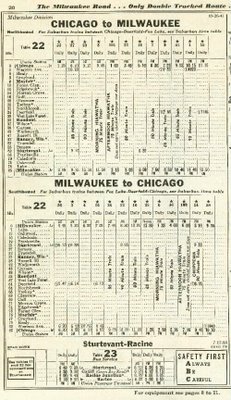
GIVE THEM FREE REIN TO 110. A Milwaukee Journal-Sentinel report acknowledges the potential for faster Hiawathas. Proposed running times will be the fastest ever.

Here is the 1941 train schedule.


The proposed timings with some infrastructure improvements between the Airport station and the beginning of Metra territory, inclusive of intermediate stops, are encouraging.


The article envisions additional trains.
A separate $12 million federal grant, unaffected by the Milwaukee-to-Madison controversy, is already paying for upgrades to the platform at the Mitchell International Airport station and to the Hiawatha tracks, and the state can use the remaining $2 million from the larger grant for Hiawatha upgrades.

With a third train, the Hiawatha could add an eighth, and perhaps even a ninth, daily round trip, Beitzel said. Hiawatha ridership has grown more than 99% since Amtrak and the state added a seventh round trip in late 2002.

Jay Sorensen, a Shorewood-based transportation consultant, said the Hiawatha attracts an even higher proportion of affluent business riders than his former employer, Midwest Airlines. He says authorities could double the Hiawatha's frequency "and demand would rise to meet that.... They could make it so blindingly convenient, by having trains every half-hour, that people say, 'Why am I driving?'"
That's probably wishful thinking, even the North Shore Line, before Highway 41 was doubled through Racine and Kenosha County, offered hourly service.  Journal-Sentinel editors endorse the train, and the Hiawatha line makes Metro's list of most promising rail corridors.
IN THE APPROVED FORM WITHOUT PUNCTUATION ERASURE OR INTERLINEATION.  THE BOOK OF RULES IS STRICTER ABOUT THE FORM OF TRAIN ORDERS THAN SHAKESPEARE IS ABOUT THE FORM OF A SONNET

THE DISCIPLINE OF WRITING A SONNET DEVELOPS STUDENT SKILLS
MAKE THE STAKES HIGHER.  The first two years of college: a waste?
Nearly half of the nation's undergraduates show almost no gains in learning in their first two years of college, in large part because colleges don't make academics a priority, a new report shows.
You think that third party payments and enrollment for its own sake and enabling the high schools' failures might have something to do with it?

A longer version of the article gives reason to question yet another fad.
The study also showed that students who studied alone made more significant gains in learning than those who studied in groups."I'm not surprised at the results," said Stephen G. Emerson, the president of Haverford College in Pennsylvania. "Our very best students don't study in groups. They might work in groups in lab projects. But when they study, they study by themselves."
Group projects: yet another manifestation of the tragedy of the commons.
It is fascinating to see A students put their names on papers that they would never dream of submitting for individual assignments. The most common explanation for those occurrences is that the A students do their portions to their standards, and then they sit back and assume that the rest of the team will do their part.
I envision that the previous sentence will lead some readers to say that such results are not a big deal – I’m the professor; I should grade according to performance. If students submit poor work, they should receive their low grade and sleep in the bed that they made. I agree, but there is also no such thing as a perfect assignment. There are other issues in play.
If one student takes charge of a team project, that student will inevitably contribute more to the project than other students. In turn, professors navigate those waters by building in a peer evaluation system to align the final grade with student effort.
Interesting, also, how relative prices matter.
While many students submit team projects below their individual standards, the collaboration rarely results in F-level work. It takes a real effort to fail a team project because one member usually does not let that happen. Because these projects often pass, they do more to bolster the grades of weaker students than help the stronger students. I have witnessed F’s become D’s and D’s become C’s because of team project performance. Thus, I regrettably pass weaker students onto other professors solely because someone else’s work helped them get through my class.

When I raise the grade inflation issue with others, they tell me that I should weight the project low enough that it cannot cause such a grade enhancement. But in doing that, the lower weighting invites poor performance, and students devote their energy to other assessments that matter more towards their course average (I call this the insanity of weighting something 10%).
The article considers a number of strategies professors might consider to encourage and elicit the right kind of effort.

It helps if headquarters considers students as potential critical thinkers, rather than as a revenue source.

17.1.11

I READ THE NEWS TODAY, OH BOYRonald Reagan, religious freedom, and vanguardism.
Michael Petrov, president of the Digital Edge data management firm in Staten Island, notes that in his opinion, the Democrats are “micro-managing the economy,” and that “Government is affecting small business more and more. It’s the same as what's happening in Russia.” Petrov identifies Democrat-supported policies restrictive of business as fundamentally akin to the Soviet Union’s brutal centrally-planned command economy, where the state controlled and owned the means of production, assets, and investments, resulting in massive inefficiency, corruption and socioeconomic stagnation, with an eye toward the “just allocation” and the “redistribution of wealth.”
Never mind seeing Russia from Wasilla, they can see it from the Narrows.
SOMEBODY HAS TO DO THE HEAVY LIFTING. Book Review No. 4 takes up David Coates's A Liberal Tool Kit: Progressive Responses to Conservative Arguments, is a Praeger offering that has been promoted in mailings to academicians and it's on offer at academic prices (read: higher than the prices Morning Sun charge for full-color railroad picture books. There are no guaranteed student loans or $700 book allowances for train-spotters.)

The book crosses the line into polemics. Professor Coates admits as much, by way of making a case for the necessity of his work, at page 7.
Debating [powerful conservative arguments] is a serious and important endeavor. But there are other arguments out there too -- arguments of less force and value -- that need to be cleared away first. These arguments have a different purpose. They exist less to stimulate debate than to close it down, and they are disseminated less by intellectuals within the conservative movement than by their more populist outriders, who collectively make up a kind of right-wing "heavy brigade." We eventually will have to compete with the pedigree conservatives, but first we need to deal with their rottweilers.
Leave aside the sloppy mixing of metaphors and the lack of knowledge of matters military in that excerpt: the shame is the opportunities the book misses.


The introduction promises more:
  • We need to deal with the alternative point of view in all its complexity.
  • We need to balance complexity in argument with clarity in presentation.
  • We need to design arguments that can run the gamut from sound bites to theses.
  • We have to anchor our case in solid and reliable evidence.
  • The problem specification has to be superior
  •  ... and the logic has to be tight.
That's what frustrates about the book. On the one hand, in some chapters it recognizes that there is diversity of perspective on the Right (Heritage is different from Cato); on the other hand, when it reverts to dealing with the rottweilers, it gives the impression that Lou Dobbs or Rush Limbaugh or Michael Savage are the frontier of conservative thinking.  (Tes, I'm referring specifically to immigration policy; it's that unit where drawing a distinction between Heritage and Cato, as well as distinguishing pro-market from pro-business policies would be particulary fruitful).

Furthermore, Professor Coates fails to engage the greatest challenge to the progressive project: the culture of failure that contributes to persistent poverty and underemployment.  In urban slums, that culture provides reliable Democratic voters; in hardscrabble suburbs and rural communities, the Christian right.  Thomas Sowell's Black Rednecks and White Liberals gets closer to the heart of that policy challenge.

(Cross-posted to 50 Book Challenge.)

ENROLLMENT MANAGEMENT ENCOURAGES STUDENT AFFAIRS.

I'm inverting the title of a real university office as a way of returning to the subject of sex imbalances on campus. "How many women entering higher education realize they are going to de facto Women's Colleges?" The topic has provided material for lots of commenters over the last few years. There's a useful summary at 11D:
One downside to having college campuses that skew female is it kills dating. If you take out the social misfits and the guys with girl friends, there are slim pickings indeed. And the slim pickings end up setting the rules. Even this guy with the zit on his neck.

Because there is a huge competition for the few datable men on campus, male dating rules win. The article describes a woman grabbing a strange guy in a bar and dragging him onto the dance floor to get his attention. Women sleep with guys right away, in order to get noticed. No guy needs to settle on one girl, when he has sororities of girls desperately throwing themselves at him with the hope of getting noticed.
That analysis is superficial, as the poster notes in her conclusion.
My first job after college was working as an editor of computer books. I went to the COMDEX conference to showcase our books. The other editors and I were the only women among the sea of computer nerds. I liked that ratio. Too bad they were all geeks.
Put another way, contemporary mating practices and admissions policies might not be evolutionarily stable. That doesn't stop commenters from drawing all sorts of Deeper Implications.
THE WORLD'S FASTEST DIRT TRACK RAILROAD.    The Milwaukee Road ran its Hiawathas behind steam locomotives running on jointed rail in some places ballasted by sandstone.

The Chinese fast electric trains might be continuing the tradition.
Stephen Chen, in the South China Morning Post, writes this past week that there are “Judgment Day” Fears for Chinese High-Speed Rail:

“Construction of the mainland’s massive high-speed rail network is in danger of becoming a victim of its own success. The breakneck speed at which track is being laid means engineers are likely to have to sacrifice quality for quantity on the lines’ foundations which could ultimately halve their lifespan. The problem lies in the use of high-quality fly ash, a fine powder chemically identical to volcanic ash, collected from the chimneys of coal-fired power plants. When mixed with cement and gravel, it can give the tracks’ concrete base a lifespan of 100 years.

According to a study by the First Survey and Design Institute of China Railways in 2008, coal-fired power plants on the mainland could produce enough high-quality fly ash for the construction of 100 kilometers of high-speed railway tracks a year. But more than 1,500 kilometers of track have been laid annually for the past five years. This year 4,500 kilometers of track will be laid with the completion of the world’s longest high-speed railway line, between Beijing and Shanghai. Fly ash required for that 1,318-kilometre line would be more than that produced by all the coal-fired power plants in the world.”
Milwaukee was able to keep the trains rolling by installing heavy rail and employing lots of track walkers.  China is still notionally a socialist country, and keeping comrades employed as track walkers with shovels and lining bars is in that tradition.

16.1.11

LIFE AFTER COLLEGE IS THE REVENGE OF THE NERDS.  Astronaut Bernard Harris speaks truth to high schoolers.
Harris says many youngsters don’t have voices of encouragement in their lives.“I’m here to remind you that geeks—the people with knowledge and education—rule the world,” Harris tells the Baton Rouge students. “If someone teases you about being smart, look them in the eye and say, ‘Someday, you’re going to be working for me.’”
His words had some effect on at least one student.
Listening in the auditorium is eighth-grader Tanayri Rodriguez, who afterward says her encounter with Harris has her rethinking her career plan to work in a hair salon.  “Maybe a marine biologist!” she says. “I’d like to go down to the bottom of the ocean and see if I can find something new there.”
It's likely that she will, should she persevere.  We have better maps of the back side of the Moon than we have of the bottom of the Atlantic Ocean.

PUSHING THE LIMITS OF WISHFUL THINKING.

There is a Fourth Turning section at Cold Spring Shops, and sensible thinking along generational lines occasionally gets its due. On the other hand, there's Tom Osenton's Boomer Destiny: Leading the U.S. through the Worst Crisis Since the Great Depression. Book Review No. 3 is not going to be complimentary. Imagine potted Strauss and Howe meeting Obama hagiography in the style of a business writer, with the intellectual coherence that suggests.


Mr Osenton suggests that President Obama, born in 1961, will be the late Baby Boomer that organizes the other Boomers to do the hard things to Save The Nation, in the same way that Franklin D. Roosevelt organized the Harvard Alumni Club Missionary Generation to ...  (Yes, I've heard the same sort of thing from Democratic Party cheerleaders and from academicians, some of whom should know better, but the former are to be understood for what they do and the latter sometimes marshal an argument with refutable propositions).
PAYBACK.  A few years ago, Michael Vick and the Atlanta Falcons ended the Packers' home playoff undefeated streak.

The Packers have had to work some to get into the playoffs, and so far the work is paying off.  Michael Vick is now with the Eagles, and he had his team in a position to win late in the game.  Tramon Williams picked him in the end zone.

That earned the Packers a trip to Atlanta.  The offense put together four straight touchdown drives, and Tramon Williams ended the first half with an interception return for a touchdown.

By game's end, the stadium was occupied by Wisconsinites.  Joseph Johnston could not be reached for comment.

13.1.11

PAY FOR PERFORMANCE. The recently concluded American Economic Association job meetings included policy-relevant sessions.
Chairman Bernanke is by no means the only prominent economist worried about the fiscal outlook and how it will affect our economy. The American Economic Association devoted a great deal of time to the subject at its annual meeting that concluded Sunday. International Monetary Fund First Deputy Managing Director John Lipsky said the U.S. must “lay out the basis for credible medium-term fiscal adjustment” soon. He praised the proposal from the Bowles-Simpson Fiscal Commission. CBO Director Douglas Elmendorf discussed the bleak fiscal outlook and pointed out that there are no easy solutions.
The recently concluded Modern Language Association job meetings included a lot of play value.
I tried, but it is nearly impossible to parody the Modern Language Association (MLA) Convention’s yearly orgy of political correctness, anti-capitalism, and Theory, just concluded in Los Angeles. Rumor was that the MLA had “gotten better,” but if so, I didn’t hear it. Wondering “why literature matters,” I heard that the possibility that Helen actually sent a double to Troy shows how much “we need simulacra that are then exposed” and how “wars are fought and people die for illusion” and how “they also die for the narrative.” That’s how you use apparent literary analysis to (wink, nudge) criticize the Iraq War (as though the whole golden apple-Aphrodite deal was real in the first place).
There's more, including a Che Guevara tee-sighting.
LIFE IMITATES FATE IS THE HUNTER. No stalling out on the beach this time.
A United Airlines flight from Chicago to Germany was forced to make an emergency landing in Canada after a pilot spilled coffee on the plane's radio equipment.
I had this news item flagged to post once my internet connection was restored, but in the interim I discovered another news reporter who also remembered his classic movies.
A Transport Canada report said United Flight 940 was diverted to Toronto late Monday and landed safely at Pearson International Airport. In a twist reminiscent of the plot of the 1964 Glenn Ford movie 'Fate Is the Hunter', the coffee spill caused distress signals to go out, including code 7500, which means hijacking or unlawful interference.
Well done, Rob Gillies.
NEITHER MENCKEN NOR MISES. There is much to ponder about the persistence in prosperous, technology based division of labor societies of ancient superstitions and belief in the implausible. It was with that in mind that I purchased Charles P. Pierce's Idiot America: How Stupidity Became a Virtue in the Land of the Free. The back cover was provocative enough. Herewith the Three Great Premises of Idiot America:
  • Any theory is valid if it sells books, soaks up ratings, or otherwise moves units.
  • Fact is that which enough people believe. Truth is determined by how fervently they believe it.
  • Anything can be true if someone says it loudly enough.
Ah, perhaps we get, in this slim volume, a deconstruction of the fundamental tenets of social constructivist theories, which, stripped of the sesquipedalian words, scare quotes, and run-on sentences postulates precisely as above.

I suppose, given that the book was on offer in a railroad station bookstore, it might have been of the same heft as the business-fad paperbacks snapped up by on-the-make sales managers in the airports. The introduction, however, is intriguing enough.
The foundations of Idiot America had been laid long before. A confrontation with medievalism intensified a distressing patience with medievalism in response, and that patience reached beyond the politics of war and peace and accelerated a momentum in the culture away from the values of the Enlightenment and toward a dangerous denial of the consequences of believing nonsense.
So, perhaps we will have an elaboration on the consequences of losing the good of the intellect, or of the denial of coherent beliefs of any kind. Perhaps so. That puts us in the realm of Mises's Human Action, albeit in fewer pages and without the challenges of rendering in English thoughts laid out in German.

Nope. We get some free association, in which the follies of James Madison (yes, he might have been instrumental in ordaining and establishing the Constitution of the United States, but he also picked an unnecessary fight with King George and got the People's House burned in the bargain), the proto-new-agey writings of Ignatius Loyola Donnelly, sometime politician and town planner (Nininger, Minnesota never rated a Hiawatha stop), and the commercial success of a Creation Museum in which club-wielding cavemen herd dinosaurs in the best Fred Flintstone style become the basis for a lament about the success of the Tea Party or the popularity of Sarah Palin or Glenn Beck's television ratings or George W. Bush winning re-election, or something.

Thus it's not Mencken either, nor will it help wonks win elections. It did, however, make for a quick Book Review No. 2, as I was able to read it in the course of a frustrating quest for hobby shops and have time for a nap on the train home.

(Cross-posted to 50 Book Challenge.)
PUSHING ON A STRING. Once upon a time, an endorsement of probity would characterize a person as sounder than The Roman Catholic Church, The Pennsylvania Railroad, or The Republican Party. Those institutions are shrunken, or gone, but thanks to United States monetary policy, U. S. corporations look relatively stronger.

For the first time on record, investors are demanding a smaller premium to own U.S. corporate bonds than global company debt.

Bondholders demanded 166 basis points more in yield to hold U.S. investment-grade company debt instead of Treasuries at the end of 2010, compared with an average 169 basis-point spread worldwide, according to Bank of America Merrill Lynch data. On Dec. 3, 2008, companies issuing debt in the U.S. paid 653 basis points more than Treasuries while corporations selling around the world paid 503 basis points more than sovereign governments offered investors in their debentures.

The shift highlights confidence in North America’s economic recovery as companies across the Atlantic in Europe contend with the cost of bailing out Greece and Ireland while waiting to see whether the fiscal crisis ensnares more countries. The U.S. economy is forecast to grow faster this year than either the euro region or Japan, according to Bloomberg surveys.

“In the U.S. you have a little more optimism while in Europe you have more concerns about the sovereigns,” said Greg Venizelos, a credit strategist at BNP Paribas SA in
London. “The sovereign issues are holding back spreads in Europe.”

The Federal Reserve’s second round of so-called quantitative easing will boost returns for U.S. bond investors, said John Brynjolfsson, chief investment officer of
Aliso Viejo, California-based hedge fund Armored Wolf LLC. The program, also known as QE2, calls for the central bank to buy $600 billion in Treasuries through June.

‘Strong Stimulus Package’

“With the strong stimulus package and QE2, I expect 2011 to be a relatively strong economy and corporate bonds tend to do pretty well in that environment,” Brynjolfsson, who oversees $362 million, said Dec. 3 on Bloomberg Television. “Even if corporate yields rise a little bit it’s likely spreads tighten, which corporate bond managers like to see.”

Whether those rising yields are anticipations of inflation remains for future research.

11.1.11

THE LIMITS OF WISHFUL THINKING. There have been a few technical difficulties to start the new year, some self-inflicted (why does the transition to a new computer have to involve reloading all the programs from scratch?) and some exogenous (the joys of running electrical and telephone cables in the same tunnel). Thus a stack of books waiting to be reviewed, and we commence the 2011 Fifty Book Challenge with Book Review No. 1.

Sometimes, when the post-modernists work at being serious, they are at their funniest. So it is with Marc Bousquet's How the University Works: Higher Education and the Low-Wage Nation. It's definitely in the cultural studies tradition, with promiscuous use of scare quotes and sesquipedalian prose. Cary Nelson, he of the American Association of University Professors, Defender of the Faith, writes a foreword that sets the tone.
To theorize the contemporary university is to recognize that there was nothing inevitable about its formation. It did not have to be, and it can still be dismantled. Set a $200,000 limit to faculty salaries and a $300,000 limit to upper administrative salaries. Limit coaches to $300,000 as well. At my institution, even the president's assistants earn $300,000; I'd cut their salaries by 50 percent. Redirect the money saved to hiring assistant professors, raising part-timer salaries to parity and graduate student employee wages to the cost of living, and eliminating all tuition payments for poor and lower-middle-class students. Deny administrators the right to fund gratuitous pet projects at the expense of a principled salary schedule. If administrators refuse to comply, sit in their offices, sit in front of their cars, block campus streets, block access to buildings, picket their houses. Use nonviolent civil disobedience to force change. Or, if that seems too confrontational, form a union and negotiate those matters at the bargaining table. Increasingly, graduate employees and contingent faculty are doing just that. The key decisions about the job system are made on your own campus when budget priorities are set. Take the money in your own hands. You have nothing to lose but your colleagues' chains.
The focus of the work is on the supposed business model being deployed by universities. There are some ideas that might merit further study, although someone with a working understanding of actually existing business, organization theory, economics, and the proper use of plain English is likely to do a better job. Thus does Professor Bousquet draw comparisons between the behavior of health maintenance organizations and institutions of higher learning. There is one absent referent, however. Both medical care and higher education are full of third-party payments. Nobody really knows what the opportunity cost of a textbook or a passive progressive splint is. His discussion of the origins of management fads as a way to stress the supply chain is intriguing. One wonders, though, whether organizations prone to stressing themselves rather than maintaining their core focus are injuring themselves (creatively destroying themselves?) and whether coming up with the Next Big Thing in operating systems or automotive drive trains has anything in common with helping the young skulls full of mush develop their jive detectors. His metaphor of the university as a computer desktop is interesting, in part because of what he doesn't understand. Perhaps it is instructive to think of the senior manager as a coordinator, facing a computer desktop, clicking on the right icon, and getting the task done, never mind the stresses that mouse click causes on the circuits and individuals responsible for getting it done.

That's where Professor Bousquet's lack of understanding of economics bites him. The point of a division of labor society is to have individuals in place to do the things one does not know how to do, and one contributes by doing for others the things they do not know how to do. (Alfred North Whitehead got that right.) Markets exist to provide incentives for people to develop those talents rather than develop other talents. That's not how Professor Bousquet sees it (pp. 90-91):
Charles Eliot's University Administration portrait of faculty life radiates a confident paternalism that remains viable in many ways today. Despite sporadic press coverage of the term faculty and graduate employees who do 75 percent of the teaching in higher education, the public image of the professoriate remains that of Stanley Aronowitz's "last good job in America": tweedy eggheads effortlessly interpellated in a system of rational, meritocratic reward, administered on a generous scale by a trusteeship of honorable men. Indeed, for faculty in certain overwhelmingly male-dominated disciplines, Eliot's picture is accurate enough. In engineering or business at a research institution, the phenomenon of a generously compensated young male wage earner on track to a quadruple family wage (say, $140,000) by the age of forty is quite common.
To an economist, there's a simple explanation. Market tests exist. In the Wolkenkuckucksheim of cultural studies, however, that's too simple an explanation.
For most others, and especially the majority of women faculty, like "Lucy Snowe" working off the tenure track in the feminized liberal arts, the wages are similar to those of the women who stitched and laundered Eliot's shirt. (The author's use of the educator-heroine of Charlotte Bronte's Villette refers to the condition of nineteenth-century schoolteachers, who often compared their compensation unfavorably to that of needleworkers, whose circumstances were then, as now, a byword for extreme exploitation.) In every region of the United States, women faculty teach for as little as a few hundred dollars per course, frequently earning less than $16,000 for teaching eight courses a year, without benefits.
Supply and demand don't exist in this formulation.
A chief component of Snowe's oppression is the very idea that this arrangement is fair or rational, the inevitable -- and impersonal -- consequence of some such guarantor of the public good such as a "market" in the wages of women (and the men who do such "women's work" as writing instruction in higher education). She characterizes her injuries in the terms employed by survivors of domestic violence with the intention of underscoring the systematic solidarity of the oppressor's logic -- the web of beliefs, loyalties, privileges, and institutions composing the patriarchy itself, not just the individual abuser.
Neither do there exist testable implications. The paragraph rambles to an observation that the oppression requires the sanction of the victim -- but it does not require a John Galt to lead the vanguard into hiding, all it requires is fewer people to enroll in doctoral programs generating that excess supply of Ph.D.s Withdraw that sanction and the substitution of graduate students and temporary faculty for tenure-line faculty fails for want of an industrial reserve army. (Professor Bousquet uses that argument to rebut the suggestion that graduate programs enroll fewer students, as the students provide the cheap labor, giving the management the incentive to keep running the graduate programs. But without the novices and postulants, the order collapses.) That's too simple. The author has to establish his common room cred hence (turn to page 195 and pour yourself four fingers of vodka).
Berelson and Allen don't need the idea of "the market" because they don't need to fantasize an elastic relationship between demand and supply such that controlling the "supply" represents an action affecting the whole system. For Orr, the problematizing of the concept of the supply is a real intellectual convenience, because it both (a) offers the fantasy of doing something to "the market" (i.e. balancing it) by "controlling" or "regulating" supply (1186, 1191), and (b) diverts attention from the real problems of "demand" (i.e. the willingness of administrators to use nondegreed flexible labor instead of degreed persons in jobs). Orr and his successors need "the market" to legitimate the fantasy of a supply-side fix, a fantasy that averts the consciousness of political struggle that would quickly transpire if the concept of "demand" were problematized.
Sound and fury, signifying nothing. No wonder cultural studies is failing the market test. It does not have to take all of higher education down with it.

(Cross-posted to 50 Book Challenge.)
TRAINS ON THE MOVE, OR OTHERWISE. Bloomberg reports progress in England and China. The comparisons with the U.S. are not encouraging.
Unlike almost every other developed nation, the U.S. has no national transportation strategy. The nation fails to raise taxes that are supposed to pay for roads and rails. Gasoline taxes, for example, cover only about 50 percent of road projects, much lower than in the past, according to recent Federal Highway Administration figures.
The analysis refers to public projects. Improvements in the freight railroad infrastructure go on, unseen and generally unremarked.

America certainly isn’t developing the design, construction and management capacity to build on a large scale to global standards.

Looking at renderings of the West Kowloon Terminus, I see giant roof-supporting columns that ascend through the 600-foot- long atrium like intertwined tree limbs. From the exterior, the heavily planted roof, threaded with walkways, curves in a great U around a parklike plaza, which will lead to the West Kowloon Cultural District, a waterfront complex of parks and arts institutions that will rise just to the south.

Once upon a time, The New York Central could give us Buffalo Central Terminal and the Michigan Central Station, neither of which ever realized their full potential as railroad stations and office towers, both of which remain compelling as ruins. Cleveland's Terminal Tower is doing somewhat better, although with only rapid transit at track level, and with a more practical heavily planted roof.


The fallout from the November election has led to changes in transportation spending in the states.
"High-speed rail" conjures up images of sleek bullet trains that whip around Europe and Asia at over 200 m.p.h. (320 km/h), but so far Obama is pushing bullet trains only in California and Florida. Much of his program is actually "higher-speed rail": gradual upgrades to Amtrak lines that share track with freight railroads and can never exceed 110 m.p.h. (180 km/h). This is not crazy. When the goal is to provide alternatives to long drives and short flights, top speeds matter less than overall trip times, and relatively modest investments can generate real improvements that attract new riders — which in turn can generate momentum for additional investments, and so on. Slicing an hour off Chicago–St. Louis makes sense. Improving Charlotte-Raleigh in North Carolina makes sense.
But Ohio and Wisconsin said no to even those modest investments, and California picks up some of the money instead.

California fortunately got more than half of the $1.2 billion diverted from Ohio and Wisconsin, which will help it expand its first link to cover 120 miles (190 km) between Fresno and Bakersfield, the Central Valley's two largest cities.

That said, no one in their right mind would spend billions of dollars to build a Fresno-Bakersfield line in isolation either. It could only make sense as a jump-start for a line connecting L.A. to San Francisco in less than half the driving time; laying track around the densely populated endpoints would have been much more expensive, controversial and time-consuming than in the primarily agricultural Central Valley.

The French, and to some extent the British, use a similar approach, with TGVs and Eurostars going onto existing, in some places 150 year old, trackage to enter cities.

The editorial comment that concludes the article, however, places too much faith in public-supported internal improvements.
By then, the first stakes will be sunk in Florida, and opponents will be mocking the Tampa-Orlando project as a ridiculous relic of a free-spending era, while supporters will be hailing it as an inspiring throwback to the days when America dreamed big and built big. It will be a proxy for a larger argument about the role of American government, and the outcome may well determine whether Obama gets to ride the train as President — and, perhaps, whether the train ever really leaves the station.
Once upon time, the passenger railroads dreamed big and built big, and the freight railroads still do. Moon shots and Manhattan Projects have biased too many analysts' thinking.

2.1.11

STARTING AFRESH. The Packers picked just enough passes to earn a playoff spot.

THE ORIGINAL THINKERS CAN BE STRONGER.

A recent Colman McCarthy column in the Washington Post arguing that ROTC has no place on university campuses got a number of the leading lights of the Rightosphere angry, with Vodkapundit identifying it as a self-fisking column. The constraints of the printed page might have compelled an earlier generation of writers to offer pithier rebuttals. Consider this passage from the column.
When I suggested that Notre Dame's hosting of ROTC was a large negative among the school's many positives, [university president Theodore] Hesburgh disagreed. Notre Dame was a model of patriotism, he said, by training future officers who were churchgoers, who had taken courses in ethics, and who loved God and country. Notre Dame's ROTC program was a way to "Christianize the military," he stated firmly.

I asked if he actually believed there could be a Christian method of slaughtering people in combat, or a Christian way of firebombing cities, or a way to kill civilians in the name of Jesus. Did he think that if enough Notre Dame graduates became soldiers that the military would eventually embrace Christ's teaching of loving one's enemies?
Good going, pick a theological fight with a priest. The simplest rebuttal, however, comes from William F. Buckley. At page 55 of the paperback edition of Quotations from Chairman Bill is a reflection on military-sponsored research in academic departments that applies as well to military science.
Would we really be better off breeding a class of government-scientists unexposed to the leavening influence of the humanities, such as them as survive in the nation's colleges and universities? Do they really believe we would then be better off? Because that is exactly what is going to happen if the militants have their way.
It's from Mr Buckley's 15 February 1969 "On the Right" column. The decline of the humanities has been going on for a long time.
A CALL FOR ADMINISTRATIVE MODESTY. Peter Berkowitz's Obama and the State of Progressivism, 2011 returns to familiar ground (if one of your frames of reference is the futility of taming complexity).

But progressivism went astray owing to a defect in its basic orientation. It rejected the sound principles of government embodied in the Constitution, because of a critical difference of opinion about human nature. Progressives believed that great improvements in the moral character of humanity and in the scientific understanding of society had rendered the Constitution’s scheme of checks and balances — or better its separation, balancing, and blending of power — unnecessary to prevent majority tyranny and the abuse of power by officeholders. Whereas the makers of the American Constitution believed that the imperfections of human nature and the tendency of people to develop competing interests and aims were permanent features of moral and political life, progressives insisted that progress allowed human beings, or at least the most talented and best educated human beings, to rise above these limitations and converge in their understanding of what was true and right. Indeed, according to the progressives the Constitution’s obsolete and cumbersome institutional design was a primary hindrance to democratic reforms to which all reasonable people could agree and which upright and impartial administrators would implement. It is a short step from the original progressives’ belief that developments in morals and science had obviated reasonable disagreements about law and public policy and dissolved concerns about the impartiality of administrators to the new progressives’ belief that in domestic affairs disagreement is indefensible and intolerable.

The paradox of American progressivism, old and new, is rooted in the gap between its professed devotion to democracy, or the idea that the people legitimately rule, and its belief that democracy consists in a set of policies independent of what the people want. The paradox may not inhere in every single progressive utterance or program, but it typifies progressivism as a whole. It certainly receives expression in the disjunction between official progressive aims. On the one hand, progressives proclaim their intention to democratize American politics by making it more responsive to the will of the people and giving the people greater say in government. On the other hand, progressives favor the steady enlargement of the national government’s responsibilities, which increases the distance between the people and government, while supporting the expansion of an educated administrative elite, which reduces government’s accountability to the people.

It's a long article, touching on a number of ideas of political philosophy, provocative in places, worth your time reading it.
INSPIRED BY THE RAILROADS? Cadillac's latest slogan is "The New Standard of the World." (Once upon a time, The Pennsylvania Railroad was The Standard Railroad of the World. Despite carrying a great deal of the men and materiel to win in Europe, the carrier dropped the slogan in 1946.) A commercial for the CTX sedan claims its shape is derived from a drawn arrow. (But unlike Hiawatha, the CTX did not go forward with such fleetness that the arrows fell behind it. Just as well, no matter how stylin' the car is, it is to a train as a pop can is to a car.)