9.5.22

MARIUPOL IS NOT GOING TO BE ANYBODY'S STALINGRAD.

A few industrial complexes in Stalingrad somehow managed to hold out until the Soviet Army could lift the siege.

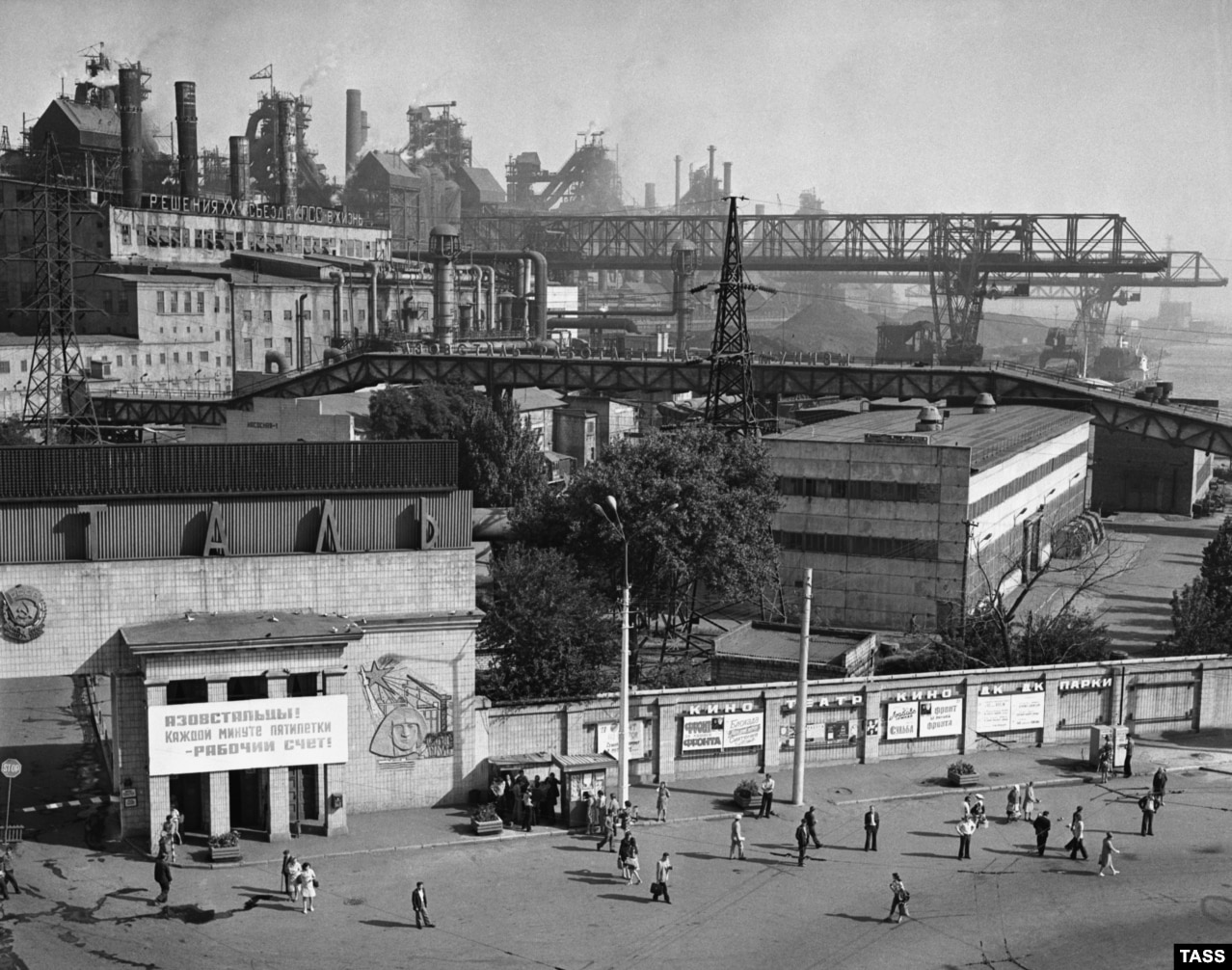
The steel complex Azovstal in Mariupol has, unsurprisingly, that Stalin era look to it.


Soviet news agency Jen Psaki Tass 1978 photo retrieved from Radio Free Europe.

The factory is the kind of facility where defenders, by holing up in it, can make life miserable for the attackers, although until recently, there were civilians hiding as well.  Should Russia achieve control of the coastal strip and other bits of Eastern Ukraine, they'll have a lot of trashed industrial capacity to rebuild, that is, if they can raise the capital to do so.

In Moscow, the Victory Day celebrations were understated.
In the end, what was notable about Russian President Vladimir Putin's speech during Victory Day ceremonies was what he did not say.

He did not declare a general mobilization for all-out war against Ukraine.

He did not declare victory in a war that is now in its 75th day.

He made no threat about Russia's nuclear arsenal, something he and other officials have done repeatedly in recent weeks.

He mentioned Nazis but not "de-Nazification," one of the Kremlin's declared goals for the war.

He did not even make a general call to rally around the flag, to gird the Russian population for great sacrifice in, or because of, the war.
In addition, the air show that is often part of this parade didn't happen.  No "Z" rune in the sky (if you look at it from a different angle, it's Napoleon's "N.")  No fly-past of the Russian version of the Looking Glass plane.  (Does the Ukrainian air force have the capability to identify and take down that plane, which has a distinctive signature on radar, and it's not that far from Charkow to Moskau?)

Taken together, the parade might have been an exercise in managing expectations.  "If you watch Putin in the videos, he seems pensive and detached. Taken as a whole, the event seemed to acknowledge that things are not going well."  That post also provides a transcript of the Tsar's speech, which at twelve minutes is still shorter than what they'd run Leonid Brezhnev or Konstantin Chernenko out to mumble through.

The Tsar himself is not standing atop Lenin's tomb to deliver that speech.  Watch the video closely, you'll see a big hoarding surrounding the tomb.


Editorial note: I swapped out a ninety minute program for the two hour program from  London's Telegraph. The substitution has better sound, without anyone talking over the parade music.  As far as I know, no Ukrainian hackers changed the content.  That was not the case on Russian state television.  "On-screen program descriptions were replaced with the hackers' text when viewed on smart TVs, [British Broadcasting Corporation] reported."

CAR TROUBLES ARE PART OF COURSE MANAGEMENT.

Matt "Dean Dad" Reed discovers that Brookdale Community College was designed with the Suburban Experiment in mind.
For context, my college isn’t residential, and it doesn’t have subway service. There is local bus service, but it only runs when and where it runs; even after we worked with the bus company on scheduling, for most students and employees, it isn’t a practical option. And due to its location in the county, the main campus really isn’t walkable from anywhere except a few very upscale neighborhoods, which isn’t where we tend to draw.
I hear you, dear reader, he's writing about New Jersey, isn't he?

Yes.


That's Brookdale just east of Holmdel.  The map is zoomed out to include the site of the former Locomotive Workshop swap meet.  That property has since been sold.  More than a few of the diesels, as well as several of the steam locomotives you see on the Gloucester Branch, came out of that shop.

At one time, the proprietor hosted a swap meet, and that's why I'm vaguely familiar with the area.  It's possible to purchase some wide open space, even in New Jersey, including a house with some outbuildings suitable for machining metal.  The announcements of the swap meets included instructions on getting there by bus from a New Jersey Transit rail station, as, unusual though this might seem, there are people working in O Scale (which can consume a lot of space) living in thickly settled places like New York or Hoboken, and making do without a car.  But there was ample parking on the Locomotive Workshop grounds for people driving in from, shall we say, Illinois.

There's also ample parking at Brookdale, even if it's a first-come-first-served free-for-all.
Brookdale has the charming quirk of open parking, by which I mean it doesn’t have separate lots for faculty, staff and students. It’s all just parking, like at a mall. The downside of that is that my car has absorbed a few scratches and dings over the years. The upside is that I get a pretty good exercise in sociological fieldwork every time I walk to or from my car. I don’t see many late-model BMWs or Audis out there. Ten-year-old Corollas are well represented.

For students who are already struggling, and whose commutes may be a gallon each way, these costs add up quickly. Of course, gas isn’t the only thing getting more expensive, but for someone who has to get to campus for classes and who doesn’t live near a bus line, it’s essential.
Who knew that "free" community college might come bundled with a car as the price of getting there.  When that's the case, bad weather or a failed battery or what have you can come at the worst possible time, such as exam week.

It's probably scant consolation for Brookdale students keeping the beater going that the rudimentary bus service is some sort of a backup plan.  That might be easier than at Kiswaukee College.  "The 120-acre campus is located in a rural setting six miles west of Northern Illinois University in DeKalb County."  If you don't have a driving license, good luck.  "Kishwaukee College, in cooperation with Voluntary Action Center of DeKalb, provides limited bus transportation between the College and the DeKalb/Sycamore area through TransVAC and to the Rochelle area through the Lee-Ogle Transportation System (LOTS)."  Those towns are along the passenger-train-unfriendly Union Pacific.  If you're coming from Genoa or Cortland or Sandwich or Waterman, good luck!

It's more than the suburbs and the arterial roads that took shape in the expectation that personal transportation would always be a bargain.

8.5.22

CHECK OUT THE PROGRESS.

The T1 Trust announce an open day for next weekend.


There has been some serious scratchbuilding going on over the winter.


The next step for this steamer will be a frame.  Northeastern ferroequinologists who want to see something in steam do have a Mallet Compound in Cumberland and a Reading Northern north of Reading to look forward to.

SEND THE BAD DEBT TO THE HIGH SCHOOLS.

I've long been of the view that higher education's "retention" problem is a self-inflicted consequence of admitting unprepared students and calling it access.  "The problem in higher education is not one of insufficient entry, the problem is one of excessive entry, excessive remediation, and reality checks deferred but not diminished."  My preferred solution has been for the universities to identify the high schools that are turning out students who have to take remedial courses and send them the bill.  I'm prepared to be patient, at least one state now has a law requiring the state's universities to identify the high schools.

It's Massachusetts senator Elizabeth "Fauxahontas" Warren who gives me the next development of that idea.  It's on a television show called "The View," and somebody asked her whether forgiving outstanding student loans was less than equitable to students who worked their way through college, or paid off their loans, or to people who hadn't even been to college.  The senator had an instructive deflection.  "In fact, 40 percent of the people who have student loan debt do not have a college diploma. Think about that."  Let's say that argument isn't going over so well. "Warren makes very clear there are no good answers to this question. Instead she points to the 40% of debt holders who never finished degrees - what a great argument for targeting relief instead of a massive bailout for doctors, lawyers, and members of Congress making 6-figures."

It's not surprising that she made it, though, the argumentum ad misericordiam is a pet distraction for self-styled progressives, as it has the effect of guilt-tripping people, suggesting that somehow Sandy's case for living at Lindsey's expense is more meritorious because of the sad state of Sandy's existence.

It's possible that the senator has only begun.
It won’t take Warren long to come up with a plan to expand her debt-forgiveness plan into a broader reimbursement for anyone who took out student loans, even those who paid them off. Warren will call it “educational justice,” or maybe “predatory loan reparations,” even though (a) they’re hardly predatory in either terms or enforcement, and (b) politicians like Warren have been pushing these programs for decades.

It won’t take long before Warren and her pals will shift from student-loan forgiveness to full and retroactive reimbursement for college educations, followed by zero-tuition access paid for by everyone else.
That's not as crazy as it sounds, particularly with as much of that bad debt being racked up by students enrolling at proprietary institutions of higher education.

It should be clear by now that any such widespread spending will be of deflated dollars printed by Democrat-controlled congresses.  Reality will have a say.
In The America That Worked(TM), the common schools understood their mission to include preparing informed citizens and inculcating the habits of the upper middle class. Yes, that America was more sanguine about young people who didn't develop those habits opting out. On the other hand, forty years of enabling fecklessness and calling it inclusion puts us in a position where a respected public policy shop is calling for federal money to make community colleges more effective at doing what the high schools used to do as a matter of course. Perhaps the liquidity constraint that is going to bite on the government will encourage policymakers to look at restoring the older order, for lack of resources.
Perhaps that will include recognizing that making student loans to young people who haven't been properly prepared to finish high school is setting them up to be in arrears on loans for degrees they weren't properly prepared to start.  Put those high schools on the hook for their failure.

MARINATE IN THE SMUG.

An Atlantic writer called James Parker thinks he's being funny when he writes, "Greg Gutfeld has owned the libs all the way to the top of the ratings," and continues, "You notice this, of course, because like me you’re a simpering liberal reared on toothless consensus comedy."  I suppose that's an attempt at humor, but keep reading.
In the counterworld of Gutfeld!, there is no eclipse of the republic, no fascist sludge on the rise, no QAnon nibbling at the roots of reason, and barely any racism—or at least not as much as everybody says there is. There are only regular, Gladiator-loving, cow-eating Americans, and the venomous wokery that seeks constantly to bum them out.
We might believe you, Mr Parker, if you didn't scold so much.

6.5.22

GETTING THE FREQUENCY AND CONNECTIVITY RIGHT.

My initial impression of Florida East Coast's Brightline service was that it might not be serious about connecting to other modes.
Although Brightline will run into a Miami station also served by Tri Rail (is this a different station from the Miami commuter train station with platforms too short for Amtrak?) and I saw a billboard along Interstate 95 and within view of Tri Rail passengers sitting on the east side of their trains advising Brightline nonstop to Fort Lauderdale, my sense is that the carrier views itself as catering to a different traffic base than either Amtrak or the Commuter Rail operators of southern Florida, perhaps a rolling gated community in the same way that the Acela service (which, note, offers only Business and Acela Custom seating, and provides a separate lounge with free treats, although no beer vendors) functions in the Official Region.  What that model does to the political economy of trains, which are either subversive of the established order because they democratize freedom of movement, or are a collectivist plot to make the masses easier to manage, I don't know.
In Orlando, Brightline and the Sun Rail commuter operator are working that problem. "Businesses who would have been bypassed by Brightline’s original route between Orlando International Airport and Disney World have pledged $125 million toward a route which would serve them through a joint route used by both Brightline and commuter operator SunRail."  There is a value proposition here, and a federal porkulus to get the varying interests to work together.
Although the route’s exact path and costs still haven’t been determined, Universal Studios Orlando and International Drive businesses, including the Orange County Convention Center, today said that along with the $125 million commitment for rail and station construction, they will donate 13 acres for a station site, guarantee $13 million in annual ticket sales to Brightline, and provide $2 million each year for track maintenance.

The new “Sunshine Corridor” would be used by both SunRail commuter trains on frequent headways and hourly Brightline service. Brightline will eventually continue on to Tampa utilizing tracks in the median of Interstate 4.

Currently, the only public transportation option between the airport and downtown Orlando is a Lynx transit bus that can take more than an hour; cab and ride-share fares are in the $50 range.
It makes sense to provide a single station where the services can connect. Contrast that with Frankfurt's airport, where there a Regiobahnhof and the Fernbahnhof is a half-day's forced march away.

FRIDAY short TAKES.

Who knew we'd be talking about this?  "A sex strike by Democrat women would end the need for abortions."  We won't cross picket lines on this one.


We’re done being nice. This week's roundup of pithy elaboration of traditional Cold Spring Shops themes follows.

SPONSORED RESEARCH IS RISK-AVERSE AND UNIMAGINATIVE.

I've come close to, but never explicitly said, that the use of the national institutes and national endowments to support academic research is censorship per se.  The closest I have come is to suggest that creativity that might otherwise be unbridled and more enthusiastic gets diverted into chasing whatever it is the institutes, endowments, and charitable foundations are funding.  "Whether the work so funded is better than the work professors develop on their own initiative remains to be seen."  It might be worse than that.  "Even if it's not that bad, the sponsored research imperative diverts thoughtful people from playing with whatever ideas appeal to them (yes, many of them might turn out to be bad or trivial, but that's how emergence works) in order to follow what appears to be a Hot Topic (the tragedy being that by the time those grants and working papers hit the conference and journal circuits, the discipline's stars are on to other things) or to make some money."  (That post might have had one of the last references to Stanford's John Ioannidis that didn't have something to do with Wuhan coronavirus.  We'll let the public health types clean up their own systematic biases.)

THE RETURN OF THE GREAT LAKES CRUISE.

There used to be a utilitarian car transport and excursion service plying the Lakes, and there are services catering to Europeans who will fly to Montreal or Buffalo and then call at the lakeside cities.  Like many other things that involved people having fun in closed quarters, that was pretty well shut down for two years of corona tyranny.

The good news is the cruise boats (to use the Great Lakes locution) are back, and they're getting bigger.
The Viking Octantis is a Seawaymax vessel and it will begin a summer season where 33 port calls by various cruise ships are planned. This season will bring more than 10,000 passengers to the city, according to a statement from the City of Milwaukee. That is compared to the 10 stops made in 2019 before Great Lakes cruising halted for two years due to the COVID-19 pandemic.
Seawaymax is a little smaller than Welland Canal and a lot smaller than Soo Locks, as passengers might discover should they head for Lake Superior at the right time.  Milwaukee is a new stop for Viking's inland cruises.
This is the first time the ship will designate Milwaukee as an embarkation and debarkation port, according to the city.

“Milwaukee is a great destination. It’s a city filled with attractions and hospitality. That’s what cruise passengers will find here,” Mayor Cavalier Johnson said. “As word spreads, I anticipate even more travelers will cruise to Milwaukee.”

Port Milwaukee recently received $3.5 million in Capital Tourism grant funding from the state to build new Seawaymax infrastructure at South Shore Cruise Dock.
I'm going to have to look into this "embarkation and debarkation" because a circle trip out of Milwaukee or Chicago is a lot more convenient than having to join at Montreal.

Friday's arrival merited television coverage.  The weather felt more like Gales of November than Summer Breezes, but that's life in the north country. I have to check out this "South Shore Cruise Dock," with the boat coming under the Hoan Bridge and using the Kinnickinnic turning basin, she could be mooring at the old Grand Trunk Western ramp.

5.5.22

WHAT WOULD WE EVER DO WITHOUT EXPERTS?

Better.  "The temptation of traffic engineers, however, is to provide complexity and call it intelligent design."

That was a rant about overdesigned rotaries, but the lesson generalizes.  Consider what happened when some people in a Bellingham, Washington neighborhood engaged in some impromptu traffic taming.
Residents of the neighborhood along Eldridge Avenue were frustrated by what they perceived as the city’s lack of response to traffic-calming requests. So they consulted resources recommended by Strong Towns on the concept of “tactical urbanism,” where a neighborhood implements small, affordable steps to address a problem from the bottom up.

They created their own traffic-calming infrastructure. They built curb “bump outs” to narrow the roadway, consistent with the city’s design guidelines, but with vinyl pylons, traffic cones, chalk, and flowers instead of concrete. It cost them $250.

One of the community members who worked on the traffic-calming project, Sachin Pai, has three elementary-school-aged children who live in the neighborhood along Eldridge Avenue. Pai said the city told them traffic calming was not allowed on streets classified as secondary arterials. “We wanted a short-term solution we could implement in two weeks, rather than a project identified in a six-year timeline.”

So one Saturday morning they just did it. The change was immediate.
But a speeder didn't like it. Neither did the road commissioner, and it was all hands to clear the roads.
The person who ordered the community’s traffic-calming project removed is Eric Johnston, Public Works Director for the city of Bellingham. Johnston has worked for the city for more than a decade, starting as a city traffic engineer and taking the public works helm in 2019. He knows the streets of this Western Washington town as well as anyone. In a 45-minute conversation, Johnston didn’t strike me as a cranky old man ignoring the pleas of the public.

The Eldridge Avenue community’s traffic-calming project was in conformance with design standards, but it was not signed off by a professional licensed engineer, Johnston said.

“It’s never appropriate to install traffic control without the permission of the regulatory authority,” he said. “As a human being I recognize the need for safety and addressing people’s concerns… I don’t discount their frustrations. I have the same ones. It’s normal and natural, but it doesn’t mean we take the law into our own hands. We follow the law.”
Whether "the law" will act in a reasonable amount of time, say, by the time school is out for the summer for the kids to be able to play stickball or street hockey, remains to be seen.

Note, though, the first instincts of a bureaucrat: without expert sanction, it's not valid, and your individual initiative is "inappropriate."  And thus does the routine of deference to school boards and public health officials, their obvious failures notwithstanding, get support from elsewhere in the administrative state.

THE UNDOING OF K-MART.

The corona tyranny provided ample opportunities to revisit the directive Field Marshal William Slim issued to his officers.  "I tell you as officers, that you will not eat, sleep, smoke, sit down, or lie down until your soldiers have had a chance to do these things. If you hold to this, they will follow you to the ends of the earth, if you do not, I will break you in front of your regiments."

Thirty years ago, a cashier at a K-Mart saw, first-hand, what happens when the suits lost sight of that, and a few other, simple concepts.

First, apparently the managers misrepresented their terms of employment.
I needed money for school, so I wanted as many hours as possible. Kmart advertised and offered me 20-24 hours a week. Great! I turned down an offer at Walmart for more hours at Kmart.

But then, they rarely scheduled me for more than 16. I asked why. The HR manager told me she "never promises hours," and Kmart policy prohibited part-time people from working more than 24 hours a week, so they deliberately kept the hours below that so you wouldn't take an extra shift and go over 24.
Sometimes, having the opportunity to take an extra turn or two is a good thing.

Second, nobody seemed to care too much about the scanning system working.  One day, that proved to be an error too far.
One memorable day the computers went down. This meant that we had to go throughout the store gathering prices for every item. Customers were angry, lines snaked through the store, and the front-end manager told the cashiers we would not get breaks because things moved so slowly.

At 12:00, the entire management team stepped away from the mess of angry customers and long lines, went over to the in-store cafe, and ate lunch together.

We could see them from the cash registers, laughing and talking.
There might not have been a William Slim at headquarters in Troy, but each of those angry shoppers carried a field marshal's baton in their wallet.  "You don't get a break if your employees don't get breaks. Perks? Your employees better get them before you do."

It took a while for the market tests to come in, but come in they did, and K-Mart has been broken.

THE EMPTINESS OF LITERARY THEORY.

I've made it clear for a long time where that line of inquiry stands.  "The dearth of testable implications, let alone teachable moments elsewhere in the academy contributes much to the low estate in which many observers hold it."  It was empirically empty then, it is destructive implemented as public policy now, and I've been able to fill up lots of posts supporting those claims.
Authors have private information. Readers have private information. Authors of letters to family or friends of long standing have private information that includes the reader's likely response to the author's choice of words. Authors can push readers' buttons, or not, accordingly. Authors of letters to a newspaper, let alone of essays or books, cannot be sure what readers' buttons will be pushed, or in what way. That, alone, makes the construction of any formal system of understanding texts sufficiently rigorous and replicable to be referred to as a theory, let alone as Theory, difficult. Ad hoc is more like it.
That's old, as the links to The Valve have probably long since rotted.  So, too, it probably is with Critical Mass.  The point David Foster makes, in the reprise of a post from some time ago, bears repeating.
In university humanities departments, theory is increasingly dominant–not theory in the traditional scholarly and scientific sense of a tentative conceptual model, always subject to revision, but theory in the sense of an almost religious doctrine, accepted on the basis of assertion and authority. To quote Professor “X” once again: “Graduate “education” in a humanities discipline like English seems to be primarily about indoctrination and self-replication.”

The experiences of Professor “X” are far from unique. Professor “Y,” chair of an English department, describes his experiences in interviewing for a new job (also in an e-mail to Critical Mass). “How truthful could I afford to be about my growing dissatisfaction with theory? Should I trump up some ghastly theoretical allegiances, or should I just come clean about my desire to leave theory behind to try to become genuinely learned?” He decided to do the latter, cautiously. In his job talk, he said:

“The writings I’ve published draw on a number of different theoretical perspectives…the overarching goal I’ve set for myself in my scholarship, though is gradually to lessen my reliance on the theories of others…” He sensed at this point that he had lost the support of about three quarters of his audience, and he was not offered the job. Those who did like the statement were older faculty members–one of whom later told Prof “Y” that she hadn’t heard anyone say something like this in twenty years.
It's a self-referential pile of Seussian turtles, until it collapses. "I am arguing that theory should be balanced by factual knowledge and empiricism, and that it should never be allowed to degenerate into dogma."  Degenerate into dogma it did, but reality will have the final say.

4.5.22

GETTING THE GOODS OUT.

Trains correspondent Keith Fender reports on Ukrainian railroaders keeping the freight moving despite Russian attempts to block the railroads.  "As the Russian military adjusts its strategy and goals following the failure of its original invasion of Ukraine that began Feb. 24, it has increased strategic attacks on the network of national rail operator Ukrzaliznytsia (UZ) in the west of the country, largely through missile strikes."

Ukraine's transportation network was set up to move the agricultural output to Black Sea ports, and the rail lines that have a common gauge on both sides of the border serve Stalin era steel plants.  That makes getting the agricultural output that will be available for sale to market harder. Russian targeting appears also to include the electric power supply.
April and early May have seen the Russian military seek to disrupt Ukrainian transport and communications within areas still controlled by the Ukrainian government, as far west as its borders with European Union/NATO countries. This has led to multiple attacks on the rail network, which has been crucial to the movement of civilian refugees, humanitarian aid, and military supplies. It has also had a damaging impact on Ukraine’s ability to maintain its export of food.

In advance of the main Russian attack in the Donbas, which began in mid-April, the region’s rail network was subject to missile and artillery attacks. The network in the Donbas is electrified at 3kV D.C., unlike most of the rest of the UZ system, which uses 25kV A.C., although many secondary lines are not electrified at all.
There are diesel locomotives on hand to assist with disruptions on the electrified lines.

The bigger challenge, though, is to keep those freight lines fluid.
UZ is now trying to move some freight to European countries, from where it can be exported using ports on the Baltic Sea in Poland or Germany. But this has been slowed by a lack of freight cars, as well as red tape and the need to deal with a change of track gauge at the border with Poland or other countries.

Ukraine, like all countries of the former Soviet Union, uses 5-foot broad gauge track, while neighboring European Union countries use standard gauge. As there are no freight cars with automatic gauge-change equipment, every car heading from Ukraine to its EU neighbors either has be lifted on jacks so standard-gauge trucks can be swapped for the broad-gauge ones. The even more time-consuming option is to transload cargo from cars of one gauge of those of the other. This is fairly quick for freight in containers, but for bulk loads like grain, iron ore, or coal, containers are not normally used. The same problem in reverse applies to European cargo entering Ukraine.

In early April nearly 25,000 cars carrying various export goods including vegetable oil, iron ore, metals, chemicals, and coal were waiting to cross Ukraine’s Western border into Poland; of these 1,100 carried grain.
The article notes, without assessing responsibility, that some rail targets within Russia have been damaged.

THE PUBLIC POLICY BUNDLES ARE TOO DARNED BIG.

I refer to that as the aggregation problem of governance.  Econ Log's Nathan Goodman has provided an instructive taxonomy and breakdown of the ways governance therefore goes wrong.

First, the voters are notionally in charge (the principals, in economic language) with the elected officials acting as agents of the principals.  Then, the elected officials empower Wise Experts to implement that General Will, only at another remove.  And yes, stuff can go wrong.
The politician is meant to act on behalf of the voter, as the voter’s agent. But due to information asymmetries, there is room for the politician to act against the voter’s interests.

In real-world governments, there are multiple layers of principal-agent problems. In addition to the relationship between voters and politicians, there is also the relationship between politicians and bureaucrats. Just as politicians are supposed to act on behalf of voters but may instead act opportunistically, bureaucrats are supposed to act on behalf of politicians but may instead act opportunistically. Bureaucrats have specialized knowledge about their bureaus that politicians lack, which creates information asymmetries. This creates space for opportunism by bureaucrats.
That means we're at the mercy of those empowered experts to issue the correct regulations consistent with legislative intent (look no further than the past two years of corona tyranny to see how that turned out) and if that fails, we're hoping that the judicial review will come out right.

Second, because of the information costs implicit in voting, we end up voting for bundles of policies.  Let's see how this outrage over abortion policy plays out, are there sufficiently many people put off by soft on crime policies, inflation, and corona tyranny who will still return the politicians who support abortion under most circumstances to office?
Even when voters do know about a political action they find unacceptable or upsetting, their ability to offer feedback by voting is still limited. One reason for this is that in most elections issues are bundled. When you vote for a presidential, congressional, gubernatorial, or mayoral candidate, you are not voting in a referendum on any specific policy issue. Instead, you are voting to elect a politician, who will then have increased power to act on all their policy preferences. There is no way to signal that you are voting for a particular candidate based on their foreign policy views but disagree with their views on financial regulation.

This poses problems, because a voter might know about some action or policy by an incumbent politician that they strongly condemn. However, while they strongly oppose the politician on that issue, they may disagree with the politician’s opponent even more strongly on another issue. They may therefore feel that they cannot in good conscience vote against the incumbent, even though they would like to offer negative feedback.
That elections tend to devolve to a binary choice, and disaffected voters are often reluctant to reject a binary choice between bundles that are each horrible in their own way makes the outcome of that second paragraph more likely to be bad.

Mr Goodman's final point is less persuasive.
Voters face an additional difficulty. They can never directly observe what might have happened had an election gone the other way. For example, pro-peace voter might be disappointed by a candidate’s foreign policy, but still credibly wonder whether the other candidate may have been even more aggressive abroad. Or a voter may be disappointed in economic activity during a given politician’s presidency but have no way to discern how much of that can be credibly attributed to the president.
That's just reality batting last.  You don't get do-overs in life, and the best you can do is support as much of the bundle you got as you can, and work to change the policy elements that aren't turning out the way you like.

THE LIMITS TO ROAD SOCIALISM.

A Planetizen post links to a longish Guardian report, the message of which at first blush comes as a surprise.  "A Freeway Rebellion Rises in the Unlikeliest of States: Texas."  It's true, as the reports note, that there's not much in the way of rail rapid transit or Commuter Rail in the state, apart from Dallas and Fort Worth.  It's also true, as you'd expect of Guardian coverage, that the public spending on roads has an element of regressive transfer to it.
“It’s just plain Jane boring lanes, more and more lanes,” said Fabian Ramirez, a structural engineer whose property in Houston’s Northside district is set to be flattened as part of a controversial $9bn project to widen and realign the city’s highways. “There’s no train, there’s no bus, there’s no anything that supports mass transportation. It doesn’t exist. They [Texas DoT] love concrete. I mean, geez. I love building stuff, but I also have a moral compass.”

Ramirez said repeated expansions of highways in Houston have invariably destroyed homes in Black and Latino neighborhoods like his. “All of these Black and brown neighborhoods are being attacked by this expansion,” he said. “I should be able to enjoy being Mexican in Houston in 2022 without somebody trying to push me out of my neighborhood.”

City leaders in Texas, meanwhile, have also started to question the car-centric status quo. San Antonio planned to narrow a two-mile stretch of Broadway Avenue, a key thoroughfare, and add protected bike lanes, only for Texas DoT to overrule the city in January to halt it, citing fears over worsened traffic congestion. Ron Nirenberg, San Antonio’s mayor, accused the state of “1950s thinking” and a “religious fascination” with highway expansions.
In part, the highway commission is constrained by the authority the legislature provides it, which is ... to be the highway commission. (There is a railroad commission in Texas, but they concentrate on oil wells. Go figure.)
“Highways are essentially fossil fuel infrastructure but we haven’t really heard about them in climate discussions until now,” [environmental policy advocate Ben] Holland said. “It’s just been universally accepted that it’s too hard to get people out of their vehicles and provide alternatives. There is certainly a car culture here, but in large part that’s because it’s been mandated.”

In Texas, the mandate for the supremacy of roads comes via the state constitution, which requires that highways are funded to the exclusion of almost anything else that moves people around. About 97% of the $30bn a year the state gives its transportation department is spent on highways, leaving very little for buses, trains or bicycles. This focus is etched into the stone of the department’s headquarters, which is named the State Highway Building, a title carved above a triptych of native Americans on a horse, a pioneer wagon and a car.
Keep reading, though, and you see the dawning of wisdom.
America’s zeal for large, wide roadways can be traced back to the federal highway act of 1956, which spawned what was the largest public construction program in US history. A new network of 41,000 miles of highway would crisscross the country, connecting cities, improving travel times and helping upgrade roads that were in a dangerous condition. Dwight Eisenhower, then US president, called the project “essential to the national interest”.

Throughout the 1960s and 1970s the highways were, however, pushed through the core of America’s cities, mostly through communities of color that didn’t have the political clout to avoid being uprooted. An estimated 1 million people were forced from their homes as hulking highways cleaved neighborhoods in half, transforming dense, walkable communities into dislocated, often forlorn places that were left with a stew of toxic air pollution from the rumble of passing cars and trucks.

As the highways filled up with traffic, a series of road expansions and widenings occurred, causing more displacement and in many places failing to alleviate the congestion.
If you think transportation is expensive now, just wait until it's free.
Trains and buses can share the load, especially for people unable to afford the punishing expense of a car, but experts say the root of the issue is that most roads are free to use and subsidized by government. “Anytime you make something cheaper and more convenient to use, then people will use more of it,” said Holland.
Ultimately, the logic of a market test wins out, even though the road commissioner, like the public health official or the college regent, makes his salary by demanding an exemption from market tests.
“The Katy Freeway is the classic example of hope over experience, that this will be the 12ft of pavement that will make congestion go away,” said Michael Manville, an expert in urban planning at the University of California. “If gasoline was free and we simply built more gas stations when we had a shortage that would be an insane scenario, but we suspend that understanding with roads. We just build more lanes.”
Thus, Houston is one enormous traffic jam. It might be even worse if Houston had the sort of zoning other cities have, but that's the irony. You hope to alleviate congestion by giving the roads away, and you get a shortage of roads.  Perhaps they'll learn.

SO MUCH WOKENESS, SO LITTLE WINNING.

Longtime sports scold Richard Lapchick is back, with a familiar wheeze.  "College sports not living up to the ideals of social justice and equal opportunity."

Brace yourself, it's the usual nose counting and box ticking.
I find myself disappointed each year when we release the College Sport Racial and Gender Report Card (RGRC). I knew that I wanted to work toward creating more opportunity for women and people of color in professional sport. Somehow, I naïvely thought that college sports would take care of itself. So here we are more than five decades later as we release the 2021 College Sport Racial and Gender Report Card, published by The Institute for Diversity and Ethics in Sport (TIDES) at the University of Central Florida. It is embarrassing that of all the report cards we do, college sports consistently has some of the worst results. This year was no exception.
I cavil at the bundling of "diversity" with "ethics" although the mind contemplates the dilemma of a sports program that ticks a lot of diversity boxes and yet is one under-the-table bonus away from the death sentence.  That, however, is too adult a problem for elderly activists, who think that nose counting is a prima facie argument for implicit biases or something.
The failure starts at the top of the athletic departments: 82.3%, 89.9%, and 90.5% of athletic directors at Division I, II and III, respectively, were white. And 71.6%, 68.1% and 61.3% of athletic directors were white men.

The pipeline for the AD positions is almost nonexistent for people of color. At the associate athletic director level, white people held 84.0%, 87.3% and 90.7% of these positions in Divisions I, II and III, respectively. White men hold 58.0% of associate athletic positions in Division I, 51.5% in Division II, and 47.9% in Division III.

In addition, the senior woman administrator position is held by an overwhelming majority by white women, who represent 79.0%, 85.1% and 91.0% of these positions in Divisions I, II and III, respectively.
The horror!

At Northern Illinois University, there are plenty of noses of color to count.  Enough, apparently, for an award (if not for a gold star from that institute for diversity and ethics).  "Northern Illinois University (NIU) athletics won the NCAA and Minority Opportunities Athletic Association's Award for Diversity and Inclusion for the second time."  It's apparently easier to work at winning diversity awards than it is to, oh, win games.
In 2013, NIU established the Diversity Integration Group (DIG) in order to “discuss ongoing diversity, equity and inclusion (DEI) efforts and participate in DEI actions.”

“Diversity, equity and inclusion are woven into the fabric of NIU’s athletic department,” the NIU athletics site states.

DIG members include athletic coaches, administrators, student-athletes, a coordinator for undocumented student support, and directors of the Center for Black Studies, Gender and Sexuality Resource Center, and Latino Resource Center.

The university’s hiring practices are focused on racial and gender diversity as “NIU is the only Football Bowl Subdivision school led by a female president whose director of athletics, head football coach and head men's basketball coach are all African American," the NCAA states on its website.
They're losing enrollment, and faculty and staff job actions have become a feature of late.  Apparently, though, repeating at this diversity award doesn't even involve setting those beginning of the season goals.
DIG chair Courtney Vinson told Campus Reform that the group’s goal was “never to win the award.”

“The goal for us is always to make sure we are creating environment spaces for our staff and our student-athletes and our coaches that aren’t riddled with bias,” she continued. “Like we want people to be their authentic selves.”

“The award is icing on the cake,” Vinson concluded.
Maybe winning a few games ought to be more of a value. Women's volleyball put the latest iteration of the freak flag as their social media avatar, then barely made the conference tournament, and bowed out after one game. They used to be better.  The basketball teams?  There's a lot of diversity, inclusion, and equity virtue signalling on social media and during games, and the ladies are still making the grade.  Conference tournament appearances?  Not so much.  But Richard Lapchick doesn't worry about the winning.  "Those seeking change must push harder to keep the momentum created by the racial reckoning. Our voices need to be amplified, and our messages for diversity and inclusion to become operating principles in our athletic departments and at the NCAA headquarters."  Maybe "mediocre teams" qualify under the rubrics of diversity and inclusion.

3.5.22

THE RETURN OF THE SUMMER WEEKEND TRAIN.

That used to be a tradition anywhere that lakes and forests beckoned, and once upon a time, such trains were common throughout the northeast.

This summer, Amtrak, despite its inability to field cross-country trains on a dependable basis, will be making an attempt at a weekend service to the Berkshires.
The Berkshire Flyer will depart from New York Penn Station at 3:16 p.m. on Fridays and arrive at Joseph Scelsi Intermodal Transportation Center in Pittsfield at 7:12 p.m. The train will make all the intermediate station stops as the typical Amtrak Empire Service train does on Fridays, including Yonkers, Croton-Harmon, Poughkeepsie, Rhinecliff, Hudson, and Albany-Rensselaer Station in New York. The Sunday return trip, making all the same station stops, will depart Pittsfield at 3:00 p.m. and arrive in New York City at 7:05 p.m. Tickets sales start in May.
Once upon a time, there were passenger trains from Grand Central Terminal as far as Chatham, N.Y. along the Harlem Line, and to Pittsfield by way of Danbury with stops at Lenox and Stockbridge along the New Haven.  Some of those trains included dining and parlor cars.

There will be the usual Amtrak food service on these extended Empire Service trains, and scheduling is with the arts-and-music crowd on mind.  (They're sod out of luck on croissants, at least on the train.)
“CSX will honor our commitment to pilot new passenger service, the Berkshire Flyer, … on our network this summer,” CSX Senior Director of Passenger Operations Andy Daly said. “CSX has a long history of working in partnership on projects that benefit both passenger and freight rail service, and we are looking forward to soon bringing New England stakeholders a safer, more reliable freight rail network with our acquisition of Pan Am.”

“I would like to thank officials in the Connecticut Valley Region for working with our Administration to launch this pilot passenger rail service,” Massachusetts Lt. Governor Karyn Polito said. “The Berkshire Flyer will make it easy for residents to travel to take advantage of opportunities to visit museums, attend concerts, shop, enjoy hiking and bicycling, and enjoy all that Massachusetts has to offer.”
That's the same CSX that closes the Boston and Albany for construction each summer, and Lake Shore Limited passengers might have to change to a connecting train, or use a bus.  We'll see how that works out.

Those trains out of Grand Central?  I think the Pittsfield trains came off north of Danbury as part of the transition to Amtrak.  The Chatham trains, which stayed in New York for the length of their run, lasted for a few more years until the suburban counties around New York City got their act together on Metro-North, and the final schedules made a number of the suburban line stops along the way.  Even with a reverse move at Rensselaer, these trains might get to Pittsfield more quickly, and connections from the Vermont and upstate New York trains might have some use.  If the connections are dependable. 

THE TOOLS OF INTELLECTUAL INQUIRY FORGED BY THE SCOTTISH ENLIGHTENMENT ARE POWERFUL INDEED.

Texas historian Steven Mintz argues that proposition.
I, for one, am struck by how today much of today’s cultural debates takes place within the confines of liberal discourse. The most forceful critics of “woke” ideas almost invariably draw on the language of liberalism: that their adversaries do not tolerate free speech and diversity of opinion, that their emphasis on equity and diversity is at odds with equality before the law, and that their desire to use the administrative state to advance their agenda violates individual rights and threatens the freedom of civic institutions.

If the humanities are not only to persist but to thrive, these humanities disciplines must speak more forthrightly to the issues of our time—yet with the breadth of perspective that history, philosophy and political theory offer.

A multidisciplinary approach to liberalism and its critics is truly essential today, when we do need to do more to examine how this nation’s political and legal institutions actually function, to understand how social change takes place, and to find ways to instill the civic values and forms of conduct that make democratic self-government possible, including tolerance, civility, respect for nuance, complexity and perspective, and a willingness to engage in respectful dialogue.
What he does not write, but what he easily could argue, is that it is those tools of inquiry that structure the wokist criticisms.
And, perhaps most important of all, how liberalism shapes public discourse.

The so-called consensus school of historians that dominated the history profession during the two decades following World War II was often accused of downplaying the profundity of the conflicts and the depth of the inequalities within American society. In fact, many of the most prominent consensus historians were anything but blind to this society’s divisions and conflicts, but they argued that these controversies and struggles largely took place within the broad contours of a dominant liberal ideology.

This ideology attached extraordinary emphasis upon freedom, personal and economic and individual rights, including the sanctity of property rights, and tolerated exceedingly high levels of inequality even as the society professed a belief in a kind of democratic egalitarianism in which all citizens were endowed with certain inalienable rights.
If you don't use Enlightenment tools of inquiry to argue that some kinds of tolerance are repressive, whatever you are using will sooner or later go off on your arguments.

THE ABSENCE OF A VALUE PROPOSITION SHOWS UP IN THE ROYALTIES.

Remember this?  "There might be a value proposition that expands the appeal of the women's game."

Remember this?  "Better, though, to think about expanding the fan base than to keep doing the same thing."

It's apparently easier, though, to whinge about inequities rather than to take any of my advice.
According to a recent study of college [image licensing] deals by Opendorse, 71.7% of deals have gone to men, while only 28.3% have gone to women. The same study showed that the most-compensated college sport by far is football — the male-only sport takes 50.6% of endorsements overall, with women’s basketball a distant second at 18.5% of total compensation. To put it simply, women college athletes are receiving fewer sponsorships, and less compensation overall than their male peers.
That doesn't surprise me, as it was college football players who wanted to be compensated for their names and bodies being featured in Madden and similar video games who brought suit and got to supplement their stipends with royalties.  I'm not sure what those basketball players are trading on, it's probably not video games.

Take care of the value proposition, and the royalties will take care of themselves.

YOU'D THINK HOMELAND SECURITY WOULD AT LEAST KNOW WHO THE CONGRESSMEN REPRESENT.

The announcement of the latest form of thought police is straightforward enough.
A new board at the Department of Homeland Security will focus on countering misinformation and disinformation, Homeland Security Secretary Alejandro Mayorkas told lawmakers today, with Wilson Center fellow Nina Jankowicz separately confirming that she would be executive director of the board.
Nobody bothered to check, though, on the credentials of a sympathetic member of Congress.
During a hearing before the House Appropriations Subcommittee on Homeland Security to discuss the president’s fiscal year 2023 budget request, Rep. Lauren Underwood (D-Ohio) stated that disinformation is a “huge threat to our homeland” and said Mayorkas has “noted that it’s a concern of yours at the border with human smuggling organizations peddling misinformation to exploit vulnerable migrants for profit.” Citing the Senate Intelligence Committee’s report on tactics used in the 2016 election campaign, she added that “foreign adversaries attempt to destabilize our elections by targeting people of color with disinformation campaigns.”

“A newer trend that we saw in the 2020 election and already in the 2022 midterms is that disinformation is being heavily targeted at Spanish-speaking voters, sparking and fueling conspiracy theories,” Underwood said to Mayorkas. “DHS and its components play a big role in addressing myths and disinformation in Spanish and other languages. Can you share what steps you’ve taken and what future plans you have to address Spanish-language myths and disinformation through a department-wide approach?”
Lauren Underwood represents a district in Illinois that includes part of DeKalb.  The district comprises diverse communities, with more than a few naturalized citizens having Spanish as their first language.  An in-kind contribution from a government agency to a member of the Party of Bigger Government is the Chicago Way, isn't it?

I have to check whether my area of DeKalb is now in Representative Underwood's district.

2.5.22

STEAM LOCOMOTIVES CONNECT PEOPLE.

We've understood this point for several years.  Apparently, though, if you're going to report on the phenomenon for readers of New York's Times, you have to describe it in a word salad of elegant variation.
I stood beside the railroad tracks in the heat of the Texas summer, listening intently for the distinctive sound of a steam locomotive. Other than the cicadas chirping from the nearby mesquite trees, I couldn’t register anything out of the ordinary. I closed my eyes to heighten my sense of hearing — still nothing.

Suddenly the harsh dinging of a railroad crossing bell broke the silence. I flinched reflexively as the candy-striped mechanical arm descended to block the road a few steps away from me. It wouldn’t be long now.

Moments later, a metallic whine began emanating from the tracks to my right. The high-pitched sound of the vibrating steel railhead grew slowly more pronounced. Turning to look down the line, a faint glimmer of light caught my eye: The pulsing headlight of a vintage 4-8-8-4 steam locomotive had appeared on the horizon.

As it rounded a distant curve, the passenger cars trailing behind it came into view, curiously distorted by the heat waves that hung low over the roadbed. The wail of the locomotive’s whistle rang through the air, and steam exploded from the machine’s cast iron valves with a deafening hiss. I stepped back from the tracks and watched the steel colossus barrel by at track speed, the warmth of its boiler cutting through the ambient heat of the muggy August day.

The engine’s massive driving rods chugged back and forth repeatedly, propelling the old beast down the tracks. The locomotive’s tender followed immediately behind, its large white Union Pacific lettering passing in a blur. Then, almost as quickly as it appeared, the locomotive — Union Pacific 4014, the largest operating steam locomotive in the world — and its string of streamlined passenger cars disappeared around a bend.
It goes on like that for a few more paragraphs, before getting to the reporting on the spectators.
And the Big Boy would make dozens of brief whistle stops in small trackside towns along the way.

And so it was that in August 2021 I joined the crowd of rail enthusiasts following Union Pacific 4014 to Fort Worth. The Big Boy sat on static display as thousands of spectators filed into a gravel lot near the city’s Amtrak station. Youngsters — many of them dressed in engineer overalls and pinstripe caps — tugged at their parents’ arms in excitement. A steady parade of modern diesel locomotives passed by on adjacent tracks, their engineers and conductors leaning out the windows of their own cabs to get a better look at the mighty relic of yesteryear.
Are we reading about people turning out to watch trains, or have we gotten into that coastal anthropology in which the odd rituals of the Flyovers are subjected to anthropological scrutiny?
For many Americans, encountering a train is merely an inconvenience. Freight trains can block road crossings for long stretches at a time; their loud horns can be heard at all hours of the night; occasionally they even derail in a terrifying fashion. Never mind the fact that many of our consumer goods are moved by rail at some point, or that vital raw materials — steel, lumber, sand, petroleum products — as well as produce and other perishables are commonly transported on our nation’s freight rail system.

And yet, even to nonenthusiasts, there’s something mesmerizing about witnessing this particular locomotive — though I struggle to explain exactly why that is. Perhaps Union Pacific 4014 reminds us of a time when our communities were more connected with one another. During the golden era of railroading, after all, practically every major city and town in the United States was linked by passenger railroad. And in those days a town’s train station might have acted as the social hub of the community: It was where the day’s mail arrived, where telegraph operators sent and received messages from around the world, where loved ones shared teary goodbyes and joyful hugs of reunion, where marching bands escorted parades of fighting men as they marched off to participate in two world wars in as many generations — and where they returned home, both the living and the dead.
News flash: if it's in steam, people will turn out. Yes, Big Boy is spectacular, and yes, it is a railroad's more-than-grudging acknowledgement that people, not all of them train enthusiasts, take an interest in what the railroad does, at least when you're not calling attention to your inability to switch the lineside industries. And yes, for some reason people still speak of "choo choo" and "chugging."
Perhaps the Big Boy’s draw is more closely tied to the sense of awe one feels at our collective ability to harness simple elements like water, fire and carbon with such ruthless and graceful efficiency. Or maybe beholding steam locomotives like Union Pacific 4014 simply reminds us of the wide-eyed wonders of childhood, long since dulled by the seemingly endless demands of grown-up life.
Or, perhaps it's a welcome break from routine when you're far from the always-on temptations of Broadway.
My day in Texas ended at a former Southern Pacific rail yard some 25 miles north of College Station, where, as usual, a sizable crowd had gathered to watch the impressive train pull into town. Traffic on neighboring roads slowed to a crawl as motorists craned their necks for a view of the locomotive.

Big Boy let out a cloud of steam as it slowed to a stop just shy of a highway overpass. A few dozen onlookers climbed up the concrete embankment of the overpass to snap photos. Before long a local police officer showed up on the scene. Apparently annoyed by the traffic jam snarling the otherwise quiet town, he began shouting orders for the crowd to disperse.

It quickly became evident, though, that the die-hard train enthusiasts had no plans to comply. One gentleman turned to the officer and delivered a plea for mercy: The crowd wasn’t blocking traffic, nor were they doing anything illegal, he argued. Others in the group nodded their heads and echoed the same message. Sensing that the group of spectators wasn’t going anywhere, the officer gave up and walked back to his squad car in defeat. A cheer went up from the crowd before they turned their attention back to the star of the show.
Now, if Amtrak would also recognize that it has natural allies among the train enthusiasts and the steam spectators, and put on a competent show on board.

ALL THE ELEMENTS OF A FOURTH TURNING.

It's Nouriel Roubini, with his usual warnings, but he's sometimes on point.  "Technology-led disinflation will not shelter us from a storm of fast rising prices amid economic slowdowns."  There's more in play, though, than the usual finger pointing.
For starters, we have seen a retreat from globalization and a return to protectionism. This reflects geopolitical factors and domestic political motivations in countries where large cohorts feel ‘left behind’. Geopolitical tensions and the supply snarls are likely to beget greater re-shoring of manufacturing from China and emerging markets to advanced economies, or near-shoring to allied countries. Either way, production will be misallocated to higher-cost regions.
That the administrative apparatus of the self-styled rules-based international order has come up short on pandemic mitigation, on Putin containment, and on having the backstop technologies to fossil fuels in place isn't helping.
Making matters worse, the politics of bashing fossil fuels and demanding aggressive decarbonization has led to underinvestment in carbon-based capacity before renewable energy sources have reached a scale sufficient to compensate for a reduced supply of hydrocarbons. Under such conditions, sharp spikes in energy prices are inevitable. And as the price of energy rises, ‘greenflation’ will likely hit prices for the raw materials used in solar panels, batteries, electric vehicles (EVs) and other clean technologies.

Public health is likely to be another factor. Little has been done to avert the next contagious-disease outbreak, and we already know that pandemics disrupt global supply chains and incite protectionist policies as countries rush to hoard critical supplies such as food, pharmaceutical products, and personal protective equipment.
Strap in, and recognize that reality bats last.

THE LINCOLN HIGHWAY WILL GO ON A ROAD DIET.

We noted that possibility last summer.  It looks like there is some porkulus money available to make it happen.  The sidewalks along the downtown four blocks or so will be wider.
The reduction of lanes, which will create “five to six feet of sidewalk space” will make downtown DeKalb safer for pedestrians, according to the April 25 City Council agenda. The city has also added “historic lighting, better signage, wider pedestrian-friendly ‘eyebrows’ at the intersections,” to the design.

“What we’re looking at is the possibility of having wider sidewalks on both sides by taking out one of those four lanes and basically splitting it on the north and south side,” City Manager Bill Nicklas said.
The rationale appears to be traffic taming.
Since that time, the city has obtained permission from the Illinois Department of Transportation to move forward with the work, meant to curb speeding truck traffic in the area and encourage more pedestrians, city officials said.
I've been skeptical for some time about that "truck traffic" rationale.  "Apparently keeping federal money coming for the upkeep of state highways, which I understand is one reason DeKalb's main street remains a truck route, is still preferable to providing a truck bypass all the way around town."  On occasion, the city puts extra truck enforcement to work downtown, for a while.

Business interests downtown have long been of the view that their downtown would be a better draw for shoppers if Lincoln Highway didn't look like a truck route.  Apparently that does not go far enough as to come up with some other way of raising maintenance money, which would stop coming from Springfield or Washington if that ceased to be a truck route.

There is no announced day for construction to start.  City officials hope to have the work done by the start of Corn Fest, in late August.  Count me among the skeptics.  It is always the hope that the road work will be done by the time the students return, and there's almost always something still in progress when the students return.

1.5.22

MORE THINGS TO GET STEAMED UP ABOUT.

Four Thanksgivings ago, I was musing on what might develop on the rails.  "So what will we see first, restoration of a through Chicago - Pittsburgh - Philadelphia train, or the construction of a from-scratch new T1, or should I just stick to improvising in my basement."


The basement improvisations continue apace.  Joe Biden is too addled to even figure out that a through train from Chicago to Philadelphia and New York is possible.  But the people who are scratchbuilding a full scale T1 are raising money to erect the underframe.  "It’s time for our project to enter a new phase: the engineering and construction of a welded locomotive frame for what will eventually become Pennsylvania Railroad T1 No. 5550. This will be the single biggest, most complicated, and most challenging fundraising effort yet in the 7-year history of this project."  Your tax-deductible contributions are welcome.  For $25K, you can have your name engraved on the frame.

CONSUMERS ARE NOT FISH.

Come see the paternalism inherent in the progressivism.
Supporters of the ban on menthol cigarettes that the Food and Drug Administration (FDA) proposed today say it is "a racial justice issue." They are right about that, but not in the way they mean.

What they mean is that 85 percent of black smokers prefer menthol cigarettes, compared to 30 percent of white smokers. "The number one killer of black folks is tobacco-related diseases," Phillip Gardiner, a tobacco researcher and activist, told Slate's Julia Craven after the FDA announced plans for the ban last year. "The main vector of that is menthol cigarettes and flavored cigars."
It's all For Your Own Good. Wise Experts know better than you, dear reader, what "disinformation" on social media is, what additives to cigarettes are dangerous, how much beer you should drink, and whether your business ought remain open during flu season or not.
Action on Smoking and Health welcomed the FDA's ban, calling it "a major step forward in Saving Black Lives" and averring that "menthol advertising violates the right to health of Black Americans."

Although menthol and nonmenthol cigarettes pose similar hazards, the FDA says menthol makes smoking more appealing and harder to quit. As Guy Bentley, director of consumer freedom at Reason Foundation (which publishes this website), noted this week, the evidence on the latter point is mixed. But even if it were clear that menthol smokers are less likely to quit, that would not necessarily mean menthol cigarettes are inherently more "addictive." That debate tends to obscure the tastes, preferences, personal characteristics, and circumstances that are crucial to understanding why some people never smoke, some start but eventually quit, and others continue smoking.
In the name of all that is equitable, do black smokers have the same agency over their cigarette purchases as any other smokers? Is this stance by the Wise Experts in Washington anything other than patronizing, as well as paternalistic?

The mind-set of people who would ban menthol cigarettes, or malt liquor, or anything else that isn't a metrofexual addiction, is one in which consumers are too easily netted by slick marketing and packaging.
As the menthol ban's proponents see it, even the choice to start smoking is not really a choice, because consumers—in this case, black consumers in particular—are no match for Big Tobacco's persuasive wiles. Gardiner cites the industry's history of "predatory marketing," while the anti-smoking Truth Initiative condemns "relentless profiling of Black Americans and vulnerable populations" by brands like Kool, Salem, and Newport.

That's one way of looking at it. Here is another: The federal government is targeting the kind of cigarettes that black smokers overwhelmingly prefer, precisely because black smokers overwhelmingly prefer them. The FDA also worries that menthol cigarettes appeal to teenagers, another "vulnerable population." Public health officials are thus treating African Americans like children in the sense that they don't trust either to make their own decisions.
Exactly! All of public policy is about protecting the children, even if it means treating adults like children.
The federal government is implicitly denying the moral agency of black people, suggesting that they, like adolescents, are helpless to resist the allure of "predatory marketing" or the appeal of menthol's minty coolness. In the FDA's view, persuasion is not enough to break Big Tobacco's spell; force is required.
Never mind that such force simply incentivizes people to sell illicit menthol cigarettes.  Even the broken conscience that is the American Criminal Civil Liberties Union sees it.
As the ACLU et al. see it, the FDA is ignoring the lessons of drug prohibition by blithely adding another target to the list of arbitrarily proscribed substances. "Tobacco policy will no longer be the responsibility of regulators regulating, but police policing," they said. "Our experience with alcohol, opioid, and cannabis prohibition teaches us that that is a policy disaster waiting to happen, with Black and other communities of color bearing the brunt."
As the article notes, cracking down on crack cocaine was supposed to be to reduce the disparate impact of overdoses.  But it's not the buyers and sellers of illicit drugs, which might include malt liquor and menthol cigarettes, that the law intends to protect.  It is the good feeling of Karens who vote, and who like being reassured that policies are being put in place for the good of the benighted.

EMPTY SHELVES BIDEN.

Sometimes, all you can do is attempt to be funny.
In a viral social media post shared on Facebook and Twitter [a while ago], Kwik Trip announced it is experiencing a disposable coffee cup shortage and invited customers to fill coffee with any container of their choosing for 99-cent refills.

While Wisconsin-based gas station chain claimed online that the shortage was a result of its cup supply getting stolen by another gas station, Kwik Trip director of public relations John McHugh said it's actually a supply chain issue.
It's possible the containers are somewhere at sea.
"They were just being humorous. No other convenience store chain stole our cups," McHugh said. "Although I'll be honest with you, if that were to happen, I think we probably would be fine with it because it means that they would be giving us free marketing using our cups with their coffee."
In addition -- waste not, want not -- the chain would prefer that you pay attention to your capacity to drink in your choice of a carry-out cup.
"We are asking our guests to make sure that they're responsible in what they bring. Whatever they use to drink their coffee, that's what they should bring in," McHugh said. "We're discouraging people from bringing in giant coolers and only taking one sip of coffee, then dumping the rest of it. We just want to be responsible stewards of our food products."
The way things have been going, nobody is going to be dumping coffee, as the prices have been going up.

FAILING BASIC MARKETING.

With great hopes, a grocery store opened in what the policy types call a food desert.  Now it's going away.
Phillip Backstrol was thrilled when a Whole Foods Market opened in Englewood six years ago. The 65-year-old neighborhood resident prefers to shop there for the variety of organic vegetables.

“I thought it was great,” said Backstrol.

Now, Backstrol will need to drive somewhere else to find that extensive of a selection of fruit and vegetables.

The company on Friday announced plans to close the Englewood store that had opened with great fanfare as the anchor of a major development at 63rd and Halsted streets in a area long considered a food desert.

Another store, in the DePaul University Welcome Center in Lincoln Park, is also among six U.S. stores the chain plans to close in the coming months, although officials set no dates for the shutdowns.
The Detroitification of Chicago continues.
Shoppers at the Englewood location were shocked Friday to hear they were losing not just a major grocer, but also a local hub; the store had been the site of community meetings, wine tastings and other events.

Lashay Shambley, who works nearby at the Chase Bank at 62nd Street and Western Avenue, said she’s not sure where she’ll get lunch now.

“There’s nothing but Popeyes, McDonald’s and Wendy’s,” said Shambley, 21. “I kind of looked toward Whole Foods for like a healthy escape.”
Local politicians have opportunities to posture, and whinge about how inequitable it all is.
Local Ald. Stephanie Coleman (16th) said she was “blindsided” by Friday’s “devastating” announcement.

“This is disappointing news that Whole Foods has decided to close the doors on our only grocery store of fresh foods and fresh produce,” said Coleman, who accused the chain of moving to “renege” on its commitment to the community.

“When I think about other communities on the North Side in Streeterville and River North, they have multiple grocery stores. ... From Englewood to Edgewater, we should have the same opportunities, the same resources, the same retail opportunities as any other any other no matter what our ZIP code is.”
Shouldn't retail opportunities go where they're rewarded? Is it that the Popeyes and Wendy's offerings are cheap, or that they're tasty, that they're still trading in Englewood?
Since the store first opened, an Aldi and a Go Green Community Fresh market opened along the same block, but those stores don’t have nearly the range of offerings as a full-service grocer.

Still, some said the news was not surprising. While the store initially offered cheaper prices than other Whole Foods locations, many complained the upscale chain was too expensive for the area.

“They said they were going to have lower prices for Englewood but they didn’t make that promise real,” said one nearby resident, who didn’t want his name used.

Ald. Jeanette Taylor (20th), whose ward boundary is across the street from the store, said she’s not at all surprised the store derisively known as “Whole Paycheck” was closing.

“Whole Foods was just expensive. And a lot of people did not shop there,” she said.

“I got a raise, and I can’t afford Whole Foods. It’s not cheap.”
Apparently some public money was involved in getting a Whole Foods set up in that neighborhood, and the developer who took the public money is now responsible for finding another grocer for that location.
Before the city land that includes Whole Foods was sold to developer Leon Walker for $1, the City Council approved a redevelopment agreement that requires a grocery store to be located on that parcel through 2027.

That means Walker will have to find a grocer to occupy the site, sources said.

Walker confirmed in an interview Friday that officials are actively looking for a new tenant. No timeline has been set.

“We’re working together with the city and the aldermen and the community to find the best replacement operation to take advantage of this opportunity,” he said.
The mayor at the time Whole Foods opened was current ambassador to Japan Rahm Emanuel, who, of course, was conspicuous at the opening of the store, and conspicuously unavailable for comment at press time,

Your tax dollars at work.

DEFINING EXCELLENCE DOWN.

It's in the strategic plan, colleagues.
The University of Illinois at Urbana-Champaign will soon require all faculty members to submit a diversity statement to be considered for tenure or promotion.

Andreas C. Cangellaris, UIUC’s provost, announced the change this week, saying that in order to meet the goals of its current strategic plan, the university must “catalyze innovation and discovery, find novel and proactive ways to educate students from all walks of life, and develop ever-deeper connections with the public we serve.”

All of that requires that UIUC “recognize and support a wider range of contributions to the excellence of our institution,” Cangellaris added.
That article was dated April 1 of this year, but the jargony language and the "wider range of contributions to excellence" is precisely more evidence of the continuing special-educationization of higher education. Put the idea in the same box with feminist nutrition and indigenous climatology.
William Bernhard, executive vice provost for academic affairs, said UIUC began working to update its tenure and promotion policy more than two years ago, to better align it with the strategic plan. The policy update also carves out a clear place for DEI contributions in the tenure and promotion process, he said, as individual faculty members or departments had long been “squeezing” this work into the service criterion of their faculty reviews.

The provost’s office describes the new DEI requirement as a one-page-maximum personal statement detailing “specific individual and/or collaborative activities aimed at supporting diversity, equity, and inclusion, as well as access.” Candidates should “include a discussion of the context, importance, and impact of their contributions along with their future plans for contributions. The candidate may choose to organize the statement by topic, activity, domain (e.g., research, teaching, and service), or in another manner.”
Whoop! There it is. Rather than recognize that Urbana are in the same business as the Ivies, they see as the way forward increased efforts in access-assessment-remediation-retention.  I doubt very much that the Scottish Enlightenment or classical political economy or the antiquities merit mention in any inventory of "diverse perspectives in courses departmentwide."  That indigenous cosmology, though.

Our universities are being run into ridiculousness by terminally stupid people.