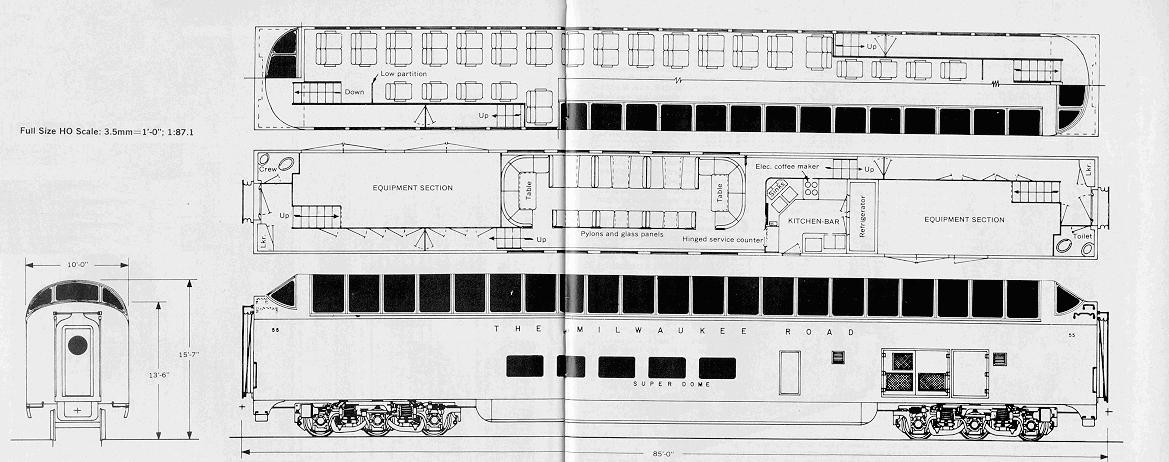
MAY 1 WAS A SATURDAY IN 1971. That was the first day of Amtrak. I should scan some of the slides I took in Milwaukee that day. The Milwaukee Road washed the locomotives and 1948 series Hiawatha coaches and a cafe car for the few Chicago trains that remained, and the first scheduled Pacific Coast train since the Olympian Hiawatha came off featured a well-scrubbed Burlington Northern consist with what came close to a matched set of Burlington Northern F units leading.
National Train Day will be May 9. I will be riding the Stolypin car to Grading Gulag.
1.5.10


29.4.10
WE MIGHT BELIEVE YOU IF YOU USED YOUR INSIDE VOICE. Onetime pollster for President Clinton, now regular on Fox Opinion, Dick Morris has collaborated with Eileen McGann on How Obama, Congress, and the Special Interests are Transforming ... A Slump into a Crash, Freedom into Socialism, and a Disaster into a CATASTROPHE ... And How To Fight Back. Maybe the title will be longer than the resulting Book Review No. 8, or at least longer than my comments on it. It's not a Regnery book, and the mustering of statistics is impressive and the analysis at time reasoned. But I'm going to repeat something I wrote about a previous policy polemic. "The class of polemic that pins its hopes on the right people taking power in Washington tends not to impress me." A longer and more carefully documented polemic that pins its hopes on the same thing ... in this instance specifically praying for Republican victories in upcoming special elections -- yes, I'm behind on my Book Reviews, and the authors specifically had Virginia and New Jersey and some outside hopes for Massachusetts in mind -- is ultimately an unimpressive polemic, particularly if it first notes that the troubled assets and fiscal stimulus programs in place as of early 2009 are forms of corporate welfare, next that some of Congress's most Vocal Tribunes of The People are in fact rent-seeking Privileged Insiders, only to make the case for replacing those insiders with Genuine Tribunes of The People, rather than proposing something more fundamental, such as limiting the scope of the National Government because that would be in The Public Interest. (Such a development would not be in the interest of Earnest Washington Polemicists, because they'd have less by way of rent-seeking or outright corruption to write about.) And, not surprisingly, there is no such philosophical consistency in Catastrophe (I think the rest of that is a split sub-title). There is, for example, a chapter calling for the (subsequently enacted) specification of obligations air carriers have to passengers on delayed planes, who become Tarmac Hostages. Here, the rent-seeking is in the form of air carriers influencing Members of Congress. Pretty crummy influence, you'd think the carriers could pry loose some money for more airports or for improvements in the air traffic control system, rather than blocking so-called Passenger Bills of Rights.
And for all the charts, and the naming of names, the authors' case for objecting to health care reform rests on a few horror stories out of Canada rather than on a principled and intellectually consistent argument.
OK, I'm now longer than the title and sub-title, but I'll let Lynne Kiesling summarize.
(Cross-posted to 50 Book Challenge.)
And for all the charts, and the naming of names, the authors' case for objecting to health care reform rests on a few horror stories out of Canada rather than on a principled and intellectually consistent argument.
OK, I'm now longer than the title and sub-title, but I'll let Lynne Kiesling summarize.
I think that those who want barriers to corporate forms of political expression because of its injection of money into politics are naive in the extreme. Put another way, money has always influenced politics, and it always will, so comparing real-world politics to an idyllic, utopian republic is an exercise in futility. Wherever we use political institutions to decide outcomes that affect the well-being of any collection of individuals, those individuals are going to attempt to influence the processes leading to those outcomes. Even under BCRA restrictions on corporate political expression, lobbying, rent seeking, and money have continued to determine political outcomes.I suspect that will be true no matter how many polemicists of how many stripes argue along the lines of "their representatives corrupt, our replacements better."
(Cross-posted to 50 Book Challenge.)
WHEN THE SPORTS BUBBLE POPS. A USA Today investigation of the positional arms race in college basketball suggests that it's much harder for a program such as Butler or Northern Iowa, let alone Cornell, to become a presence in the national tournament than it is to make the odd appearance.
A Brian Goff post at The Sports Economist suggests the basketball tournament is not as much of a them-that-has-gets organization as USA Today suggests.
Schools with less budgetary cushion, such as Northern Iowa, can't keep spending their way into a regular basketball tourney spot. "I think the hurdle is more in sustaining than it is in achieving," Northern Iowa athletics director Troy Dannen says.There is anecdotal evidence to this effect elsewhere, with, for example Wisconsin-Milwaukee supplying Bo Ryan to Wisconsin and then supplying Bruce Pearl to Tennessee.
A Brian Goff post at The Sports Economist suggests the basketball tournament is not as much of a them-that-has-gets organization as USA Today suggests.
With students and trustees questioning increased spending on sports in the face of falling state support and broken endowment funds, whether the relatively obscure conferences can continue the positional arms race remains to be seen. The table in the post, however, suggests that the tournament seeding committee consider sending fewer middle of the pack teams from the so-called power conferences and more second-place teams from the mid-majors to the field of 65 or 68 or whatever it is going to be.The decade long performances of programs such as Gonzaga, Memphis, Xavier, and Butler are very impressive. To find programs averaging more than a win per year, one has to look at places like Kansas, North Carolina, and Duke. Their performances stand above past national champs such as Louisville or Louisville and way out front of champs-turned-strugglers like Arkansas. The talking heads who like to refer to how Gonzaga hasn't beaten X or advanced past the Sweet 16 in more than a decade just don't get it.
While my interests here lie mainly with individual team performance, some interesting conference comparisons jumped out also. For example, five different teams from Butler's relatively obscure Horizon league have won NCAA tourney games, four from Gonzaga's WAC, and a whopping seven from the Missouri Valley have won. More competition at the conference level, such as the MVC, both helps and hurts individual teams -- helps by playing better competition, raising seeds and hurts by making it tougher to make the tournament.
LOWER THE STRESS LEVEL. A traveling carnival set up on Annie Glidden just north of the old graduate student apartment building. It's a student project called Spring Fever Carnival. The timing -- during the so-called Reading Day and the Saturday and Sunday before finals week -- is not to everybody's liking. But cramming is unproductive, and an opportunity to unwind -- within reason -- that doesn't involve the usual heavy drinking appeals to me.
28.4.10
IF YOU CAN'T EXPLAIN IT, DON'T TRADE IT. There's a Peter Lynch video depicting some Boston middle-schoolers researching companies to do their Stock Market Game (TM) projects in which Mr. Lynch tells the students not to buy a company if they can't explain what it does. Presumably those students will not be foolish enough to buy tranched mortgage-backed securities, even if the president of the investment banking house is making the pitch. That's one of the nuggets in Michael Lewis's The Big Short, a timely Book Review No. 7. The incompetent president in question makes a cameo appearance on page 218. And fans of the military aphorism "Bullshit Baffles Brains" will find the glossary on pages 126 and 127 particularly instructive. An overpriced bond is "rich." The s*****est bonds (thank you, Senator Levin) in the packages of bonds that are themselves convex combinations of mortgages in which the commingled interest and principal payments are the income out of which the package pays interest are the "mezzanine tranches." If nothing else good comes of the shakeout in financial markets, perhaps we will see the end of MBA bafflegab and the cult of the CEO.
It helps, however, if a few individuals (perhaps someday our Stock Market Game (TM) students) do more than see their way through the bafflegab and wordnoise, and figure out how to hedge against the complicated financial products. That's what Steve Eisman and Michael Burry, who gets off one of the greatest lines in the history of obsession, "Only someone who has Asperger's would read a subprime mortgage bond prospectus" (p. 183) did. The currently notorious John Paulson, of the Goldman Sachs trades, makes a cameo appearance, but most of the action is on the up-and-up, and it features people who made a straightforward inference: some assets will fail catastrophically, and valuing them with a model in which failure occurs according to a slow and manageable stochastic process leads to a stinking pile of rich mezzanine tranches. Which, if the proper short contract exists, can make the person holding that contract stinking rich when that catastrophic failure occurs. Which it did. And what's more amusing was how cheaply the people who created those short contracts made them. None of the Smart Money believed those contracts would ever come due. Until they did. Oops.
The book also notes, in more than one place, an important tradeoff in the creation of mortgage-backed securities, tranched collateralized debt obligations, and default swaps. When those instruments were working correctly, people who otherwise might not have been able to obtain houses were able to obtain houses, and banks and savings and loans were able to originate more loans than otherwise they could. Had the lenders been more careful, the new financial products might have become accepted as ways to enhance the wealth of people previously consigned to rental housing. If memory serves, other spectacular failures including junk bonds and the technology stocks, also had the effect, for a while, of enhancing the wealth of people otherwise consigned to the margins of the asset markets, or to doing business with loan sharks.
The book makes clear some rather technical ideas, and it is a quick read.
(Cross-posted to 50 Book Challenge.)
It helps, however, if a few individuals (perhaps someday our Stock Market Game (TM) students) do more than see their way through the bafflegab and wordnoise, and figure out how to hedge against the complicated financial products. That's what Steve Eisman and Michael Burry, who gets off one of the greatest lines in the history of obsession, "Only someone who has Asperger's would read a subprime mortgage bond prospectus" (p. 183) did. The currently notorious John Paulson, of the Goldman Sachs trades, makes a cameo appearance, but most of the action is on the up-and-up, and it features people who made a straightforward inference: some assets will fail catastrophically, and valuing them with a model in which failure occurs according to a slow and manageable stochastic process leads to a stinking pile of rich mezzanine tranches. Which, if the proper short contract exists, can make the person holding that contract stinking rich when that catastrophic failure occurs. Which it did. And what's more amusing was how cheaply the people who created those short contracts made them. None of the Smart Money believed those contracts would ever come due. Until they did. Oops.
The book also notes, in more than one place, an important tradeoff in the creation of mortgage-backed securities, tranched collateralized debt obligations, and default swaps. When those instruments were working correctly, people who otherwise might not have been able to obtain houses were able to obtain houses, and banks and savings and loans were able to originate more loans than otherwise they could. Had the lenders been more careful, the new financial products might have become accepted as ways to enhance the wealth of people previously consigned to rental housing. If memory serves, other spectacular failures including junk bonds and the technology stocks, also had the effect, for a while, of enhancing the wealth of people otherwise consigned to the margins of the asset markets, or to doing business with loan sharks.
The book makes clear some rather technical ideas, and it is a quick read.
(Cross-posted to 50 Book Challenge.)
27.4.10
THE BOOKWORM IS IN REHAB. It's easier to read books than to type up reviews. But with my left arm slowly regaining function, and with the semester winding down, there should be time (first stolen as procrastinating with the grading, then as required to decompress) to unleash another sequence of Book Reviews. Whether we will see the fifty remains to be seen. First, though, the first quarter report for 2010. Please follow the link for the date the report was posted to read the diary entry, or book review, at Fifty Book Challenge. I evaluated some books as particularly good (+) or particularly bad (-).
Ooooooo
(Cross-posted to Fifty Book Challenge.)
- The Best Years: 1945-1950, 10 January 2010.
- Super Freakonomics: Global Cooling, Patriotic Prostitutes, and Why Suicide Bombers Should Buy Life Insurance, 16 January 2010. (-)
- No Less Than Victory: A Novel of World War II, 29 January 2010. (+)
- The American Civil War: A Military History, 4 February 2010. (+)
- Secrets of The Lost Symbol: The Unauthorized Guide to the Mysteries Behind The Da Vinci Code Sequel, 13 February 2010. (-)
- An Imaginary Tale: The Story of i, 28 February 2010. (+)
Ooooooo
(Cross-posted to Fifty Book Challenge.)
26.4.10
WHAT A PAIR OF E UNITS CAN DO. The latest issue of Railway, featuring the final twenty years of British Railways, includes a brief tribute to the extremely successful High Speed Trains, still going strong after thirty years of service. As built, these were a pair of 2250 hp power units, one at either end of an eight- or nine-car formations, with enough power to cruise at 140 mph (officially on test, unofficially until the Road Foreman and the Master Mechanic put some overspeed governors that would cut the trailing unit out). Some of the prime movers have been replaced, but the trains themselves continue to make the case on the Great Western and elsewhere in the United Kingdom that fast running need not require catenary and exotic tilting mechanisms.
In North America, the idea of putting a pair of souped-up Genesis diesels (perhaps with better lines) at either end of a ten car formation of double-deck California cars and giving the resulting train free rein to 110, or to 140, appeals. (Once upon a time, you would run a pair of E units around the train and you'd be limited to 117 for short times. The British concept with the power at each end goes one better.)
In North America, the idea of putting a pair of souped-up Genesis diesels (perhaps with better lines) at either end of a ten car formation of double-deck California cars and giving the resulting train free rein to 110, or to 140, appeals. (Once upon a time, you would run a pair of E units around the train and you'd be limited to 117 for short times. The British concept with the power at each end goes one better.)
IT'S NOT THE CRIME, IT'S THE COVERUP. Jack Bauer lands on the Fox-5 helipad, but does not force his way past the receptionist to get to Glenn Beck's blackboard. Meanwhile, the Lady President stands godmother to the peace agreement while Natasha Fatale gets waterboarded and Richard Nixon gloats as William Ruckelshaus resigns on principle.
Why am I even watching this?
Why am I even watching this?
PICTURE OF THE DAY. The role of Nature in CO2 emissions is not necessarily greater than human action.


Information is Beautiful visual via Voluntary Xchange
25.4.10
IF WE'RE STILL FREE, IT IS NO THANKS TO YOU. On Patriots' Day, MSNBC's Chris Matthews closed his evening show with a commentary challenging Tea Party adherents and other opponents of the Obama administration and the MSNBC worldview to, if they continued to enjoy their freedom in ten years, admit that much of their current campaigning is hype and fear-mongering. That challenge came a day after guests on Mr Matthews's Sunday morning show accused Sarah Palin, Glenn Beck, and Rush Limbaugh of conduct approaching sedition. Donald Sensing provides additional context, and some fact-checking. Mr Matthews revisited the sedition argument on this morning's show, with no retraction forthcoming. That comes as no surprise.
No one is more authoritarian than a successful left-wing revolutionary: he rises to power by extolling dissent, then stays in power by suppressing it.The rest of the article is hyperbolic: but keep in mind that the mind-set of the current administration is that of the practitioner of liberating tolerance.
THE TIME OF THE TROLLEY. Yes, that's the title of a Kalmbach book about the 1890-1958 version of the streetcar. The American Association of Retired Persons, however, would have its members believe that the time of the trolley is now.
The original streetcar systems expanded in such a way as to connect to streetcar systems in neighboring towns, and thus was born the interurban. And Hilton and Due's The Electric Interurban Railways in America is available in paperback, should readers be interested in how the first interurban network evolved. (There is, of course, a hardcover version in the Cold Spring Shops research library.)
The language of the excerpt is instructive. Some opponents of public spending on rail projects claim that doing so takes money from road projects that people use. But people use the roads because money that could have been spent on rail projects, or left with the taxpayer in the form of lower fuel, tire, and property taxes, was spent on the roads to encourage people to relocate in such a way as to take advantage of them.For decades 95 %, or more, of federal money for transportation has been used for highways that encouraged sprawl development far away from urban centers. Recently, more investment has been made in rail and bus transit for commuters from the suburbs to get to urban centers. Now, there’s a new emphasis -- make these urban centers attractive places to live, work and play a 24-hour city with diversity and appeal for all ages. Access to mobility without a car is crucial to the success of this movement, so the Obama administration is supporting so-called urban circulators, public transportation projects that help people get around within a community. Last spring such projects, if shovel-ready, were eligible for money from the federal stimulus package. Last December the administration announced $280 million for urban circulator projects, with an emphasis on streetcars. Announced in February, a new round of federal grants totaling $1.5 billion will help out several streetcar projects.
Streetcars “fit in very well with the concept of livable communities,” U.S. Transportation Secretary Ray LaHood told the AARP Bulletin last fall. “You’ll see neighborhoods really embrace the idea.”
At least 40 cities—Tucson, Ariz., and Detroit among them—have lines in the works, and the next one is scheduled to open in Washington, D.C., by 2012. Encouraged by easier access to federal funding, as many as 40 more cities—from tiny Cripple Creek, Colo., to sprawling Los Angeles—are exploring the possibility of building new lines, according to the American Public Transportation Association.
The original streetcar systems expanded in such a way as to connect to streetcar systems in neighboring towns, and thus was born the interurban. And Hilton and Due's The Electric Interurban Railways in America is available in paperback, should readers be interested in how the first interurban network evolved. (There is, of course, a hardcover version in the Cold Spring Shops research library.)
THE ABDICATION OF MR. CHIPS. Jonathan B. Imber argues that professors themselves have the responsibility for degrading the academic vocation.
The transformative seeds were already planted in post-war enthusiasms for an academic culture in which gaining grants would eventually be matched by how many "public intellectuals" a school can boast. New opportunities to escape the timeless responsibilities of teaching abound. A controversy has ensued over what is being called the "outsourcing" of grading, taken out of the hands of the instructor (and/or teaching assistants) and given to companies who employ graders in Singapore, India and Malaysia. Along with accounts of the growth of adjunct faculty hired to teach a lot for very little, students and their families, it is argued, are hardly getting their money's worth. Editorialists at the Harvard Crimson complained that outsourcing evaluation "brings up concerns about the quality of contact that students are receiving in large classes." Outsourcing is the wrong description for giving over this particular responsibility of teaching to anyone other than the teacher. After all, teaching assistants have been overseeing grading in large lecture courses in universities for many decades. But this oversight was in principle part of learning to teach by learning to evaluate. Of course, it is easy to view such a principle cynically and to acknowledge that graduate students seeking to unionize have been given over to another kind of class struggle that marks the end of teaching as it once was embraced and practiced.That's not to say that the faculty-student non-aggression pact isn't part of the problem.
Perhaps where evaluation is outsourced, instructors no longer feel compelled to observe even the pretense that the students they teach are persons of sufficient complexity to deserve being taught with that in mind. I fear a degree of complicity on the part of students and teachers alike where real evaluation is evaded for reasons that do not need to be spelled out too clearly. The willingness to commit $50,000 a year to maintain as much distance from teachers as possible is not entirely the fault of teachers. On the other hand, the willingness to work for an organization that charges $50,000 a year in order to enable faculty to avoid students as much as possible degrades the academic vocation in ways that Nisbet, Rieff, and Bloom already saw on higher ed's horizon.Why not buy a degree from an online university, Professor Imber seems to be suggesting, if many of the faculty and students at the high-end universities are effectively e-mailing it in anyway?
AUTHORITIES AND AMENITIES. An American Heritage article on interurbans, written by longtime traction expert William D. Middleton shortly after the North Shore Line quit business and sold its Electroliners to Philadelphia Suburban, noted that the 'Liners' tavern lounges probably faced an uncertain future after the Southeastern Pennsylvania Transportation Authority takeover. "The new trains contain a vanishing amenity, a bar-lounge section for suburban commuters. How long this service will last is problematical, especially in view of the impending takeover of the line by a transit authority. Authorities and amenities rarely go together." The bar cars remained in service as long as the 'Liners did. Mr Middleton, however, was a prophet. The last common carrier commuter bar cars, on the New Haven line to rich peoples' country, may not be replaced.
Authorities have to consider the opportunity cost of amenities.
Having survived numerous attempts at prohibition and outlasted its brethren in the suburbs of Chicago and New Jersey, the bar car out of Grand Central Terminal is now facing its gravest threat: the great recession.Notice my use of "common carrier commuter bar cars." Metra removed the sales racks from the vestibules of selected cars assigned to the Milwaukee North and West, Wisconsin Division, and Rock Island lines in order to provide more seats and more vestibules for in-a-hurry commuters to block. But one subscription club car (the article incorrectly states its age, it's rebuilt from a postwar lounge car once assigned to the Overland Route) continues to roll from Chicago to Kenosha, primarily for Lake Forest swells.
A new fleet of cars will soon replace the 1970s-era models now used by commuters on the Metro-North Railroad line heading to Connecticut. But with money tight, railroad officials said they could not yet commit themselves to a fresh set of bar cars, citing higher costs for the cars’ custom design.
“They’re being contemplated,” said Joseph F. Marie, Connecticut’s commissioner of transportation. “But we have not made any final decisions.”
Authorities have to consider the opportunity cost of amenities.
Defenders of the boozy commute say it helps raise revenue: After expenses, bar cars and platform vendors made $1.5 million last year, up from $1.3 million in 2008. (Officials would not say if a bar car makes more money than a car with the normal number of seats.) So far, 300 new train cars have been purchased, featuring airline-style headrests and graceful luggage racks. But officials say the bar cars remain a low priority, and may not be ordered.That "more money than a car with a normal number of seats" is significant. The Dining Department of the North Shore Line operated at a profit right up to the end, but there weren't enough riders buying Electroburgers, Mellow-tang Wisconsin cheese sandwiches, and cold Blatz with their tickets to save the railroad. But catch that "A decision was made." Mr Everhart doesn't want to be the target of the swells' wrath.
“A decision was made early on that more seats on the trains was our top priority and that bar cars — as popular as they are — could wait,” said Judd Everhart, a spokesman for Connecticut’s department of transportation, which operates New Haven Line trains in conjunction with Metro-North. “It was about that simple.”
Among the anxious is Cesar Vergara, a Ridgefield, Conn., resident and a veteran train designer who created the interior of Metro-North’s new commuter cars, known as M-8s. As part of his contract, Mr. Vergara designed several concepts for a modern-day bar car, including more space for group seating and a smaller, more streamlined bar to replace the current cramped setup. But he acknowledged that his vision may never become a reality.Mr Vergara is better known as the stylist who came up with the slab-sided Genesis diesels detracting from the front end of Amtrak trains everywhere outside the electric zone. "Kind of like in a pub" is unlikely to work in a rail environment, although a configuration with a passageway along one side of the car, a serving counter in the middle, and lounge areas to either end has possibilities.
“The M-8 bar car, right now, is in a very political realm,” Mr. Vergara said. Indeed, Connecticut rail officials would not provide images of the prototype designs, which have been reviewed by focus groups, although Mr. Marie, the commissioner, mused a bit on what might work. “It would be nice to create a row-bench type of environment,” he said. “Kind of like in a pub.”
MORE FUN TO WATCH IT IN PERSON. The Northern Illinois School of Music now provides live Internet streams of concerts, including today's spring steel pan concert. (The highlights have not yet been uploaded to the You Tube channel.) While streaming video is a great benefit to our friends on the islands and in South America, there's nothing quite like watching the performers close up and in 3-D. The next concerts will be November 14, 2010, and April 17, 2011, the latter including an appearance by the steel band from Miami University of Ohio.
24.4.10
THE ALL WEATHER MODE. Trains Answer The Call – Record Passenger Volumes On Numerous Train Routes Seen. The experience, however, might not be positive enough for European travelers inconvenienced by that volcano to ride again.
Keep scrolling and you'll find a post that answers a question that might have occurred to some observers.
(That said, Burlington Northern shut down in Oregon and Washington for a few days when Mt. St. Helens, which it owned at the time, blew up in May 1980.)
(You mean this volcano did what Dowding and Harris never managed?)By Friday the no-fly zone has spread to much of France, Germany, Holland, Scandinavia, Belgium and Poland. Already by Thursday evening passengers in the UK began flooding Eurostar’s terminal in London’s St. Pancras station in hopes of taking a train to either Paris or Brussels and then continuing on to other European destinations by any transportation means available. The sudden rush on Eurostar train ticket counters prompted Eurostar to issue press releases that only confirmed ticket holders should appear at the rail stations. This move was misinterpreted by a few news agencies, including CNN International, as a possible sign that there were technical difficulties due to volcanic ash with Eurostar trains. In fact there were zero technical issues on Eurostar, only incredibly high demand.
But difficulties on the rail system in continental Europe did exist. A labor strike against certain TGV rail lines was underway in Paris and other parts of France and later on Saturday morning in Hamburg, Germany vandals torched a truck parked underneath a railroad bridge in the harbor city. The fire from the vandalized truck in turn severely damaged cables for the track signals between Hamburg Hauptbahnhof (central station) and Hamburg-Harburg station, thus severing rail corridor between northernmost Germany as well as Denmark from the rest of Germany and Europe for at least the rest of the weekend.
In Britain a window for trans-Atlantic flights to land and take-off from the airports in Prestwick and Glasgow opened up for a brief period over the weekend. But rail transit had to play a major roll with the moving of thousands of passengers to/from Manchester, Birmingham and London and southwestern Scotland. Recently completed upgrades to the so-called “West Coast Main Line” helped keep passengers moving reliably and quickly along this important rail corridor.
In the massive Frankfurt airport waiting lines for ICE trains to Cologne, Amsterdam, Berlin, Hamburg and Munich at the airport’s high speed rail station approached 500 meters long as Germany’ flag carrier, Lufthansa, entered a total flight shut-down, the first time ever in the German airline’s history. Similar stories were repeated across western Europe, including Paris CDG airport, Amsterdam, London Heathrow and Gatwick, Copenhagen, Zürich and Milan.
Nearly all major European rail lines responded to the crisis by adding extra trains where they could and increasing staffing at train stations in or near major airline hubs. Ulrich Homburg, president and general manager of passenger train operations for Deutsche Bahn, stated that the rail company was doing everything possible to transport airline passengers by placing its employees on high alert and ramping-up staffing of stations, trains and call centers, as well as taking measures to increase and maximise the amount of rolling stock in operation over the coming days. With the volcanic activity in Iceland apparently intensifying, the well-developed rail network in Europe is proving to be an invaluable back-up to its traditional rival.
Keep scrolling and you'll find a post that answers a question that might have occurred to some observers.
Trains are in general powered by diesel engines or electric motors. In both diesel engines and electric motors, cooling air velocity is substantially lower than in aircraft turbine engines. In diesel engines, combustion temperatures are likewise significantly lower than in a modern aircraft turbine engine, while peak temperatures in electric traction motors are many hundreds of degrees below the melting point of volcanic ash, in-fact just slightly hotter than a common hair dryer. In addition, a diesel engine is not dependent on small, fragile compressor blades for its power. Even the turbocharger in train engines is a centrifugal design which is not nearly as sensitive to erosion induced problems as the bladed axial-flow compressors in jet engines and turboprops. And in most rail applications both the intake air for diesel engines, and the cooling air for electronics and traction motors is cleaned by either filters or centrifugal dust/ particulate separators or both. The reciprocating engines (gas or diesel) in automobile engines are similar to diesel engines in trains as far as sensitivity to airborne sand and grit, in other words, as long at the air filter is not clogged, there is no issue with operation in volcanic dust.We're not talking about snow outside the Chunnel here, people. And have you ever looked closely at a moving train ... it kicks up dust. Highball!
(That said, Burlington Northern shut down in Oregon and Washington for a few days when Mt. St. Helens, which it owned at the time, blew up in May 1980.)
QUESTION THAT FAILED MODEL. I use a four-word formulation to summarize what higher education is doing wrong. Access refers to lowered admission standards. Assessment does everything but perform market tests and enable professors to make mid-course adjustments to fine-tune student performance. Remediation is the consequence of access. Retention ensures that the unprepared receive something resembling a degree, all the same.
Although the formulation is mine, I may not be the most caustic observer in my corner of the academic blogosphere.
That's the second act.
Although the formulation is mine, I may not be the most caustic observer in my corner of the academic blogosphere.
What she said.Far be it from UD to keep you from attending an exciting summit with the vice-president’s wife where the international news media films you wringing your hands over your obnoxious students. If that’s the picture of your college you want to broadcast to the world, go to it.
But there are other things you can do about the situation.
That's the second act.
Retention problem, Cold Spring Shops version: the ambitious students are the ones who are leaving.Why hold classes if you can’t hold classes?
UD’s heart goes out to this writer — this still-serious student. If it’s not too late, and if she can afford it, the student should drop out of UMaine and find a serious school.
EVOLUTIONARY STABILITY. I'm still working on a longer post on the impossibility of a Surf City equilibrium in higher education. It should be up before Surf City is overtaken by events.
Social Construction is Subject To Constraints.
[T]he most profound impact of our college culture isn't in the voting booth but in the four walls of the home, as a generation struggles with the long-term effects of the degradation of male-female relationships. But he also reminds me that there is hope; that students are not the pawns of their environment and can reverse course. That which has changed can be changed back. There are ebbs and flows of cultural fashion, and the common currency of one generation is counterfeit to the next.Be sure to read the post's sources.
All of the ideology in the world can't replace reality, and the reality is that sex has emotional consequences and that the two sexes do not experience those consequences in the same way. A culture of men without virtue or heart and women stripped of any sense of real connection is not ultimately sustainable — no matter how many times tradition is denigrated and gender roles are mocked.I may have to change the masthead:
Social Construction is Subject To Constraints.
22.4.10
THAT NEBULOUS GREATER GOOD. President Nixon indeed had something on the Russians. But Jack Bauer was able to scare a biznesman (on trial for some minor offense in New York) into confirming that the GRU, or whatever they call themselves these days, had indeed planted Natasha Fatale in CTU. (Although she has the physique of a body-builder, she's probably a little too young to be an East German marathoner born Helmut.)
But despite the Ball-Busting Woman President having ample evidence that the Russians facilitated the murder of the president of Somewherestan as a way of impeding the peace agreement, the process is more important than the truth. Never mind that when the truth comes out, the peace will be broken in ways more dramatic than whatever she's trying to avoid. Nuance begets failure.
Perhaps, however, the truth will come out. At the end of the episode, Jack Bauer skips his debriefing by hijacking a helicopter. Perhaps, given that the next hour begins at 10 am Eastern, he's going to crash Bill Hemmer and Megyn Kelly's morning news show, it being prudent to land on a Manhattan helipad before one of those CTU drones establishes missile lock on him. I hope the final two hours of the show will not be he and Glenn Beck diagramming the vast conspiracy behind all the episodes on that famous blackboard.
But despite the Ball-Busting Woman President having ample evidence that the Russians facilitated the murder of the president of Somewherestan as a way of impeding the peace agreement, the process is more important than the truth. Never mind that when the truth comes out, the peace will be broken in ways more dramatic than whatever she's trying to avoid. Nuance begets failure.
Perhaps, however, the truth will come out. At the end of the episode, Jack Bauer skips his debriefing by hijacking a helicopter. Perhaps, given that the next hour begins at 10 am Eastern, he's going to crash Bill Hemmer and Megyn Kelly's morning news show, it being prudent to land on a Manhattan helipad before one of those CTU drones establishes missile lock on him. I hope the final two hours of the show will not be he and Glenn Beck diagramming the vast conspiracy behind all the episodes on that famous blackboard.
PASSING THE TORCH. Hobey Baker award winner Blake Geoffrion begins his professional career with the Milwaukee Admirals. The Admirals, of the American Hockey League, are in a playoff with their traditional rival, the Chicago Wolves. The Wolves recently signed another Wisconsin hockey star.
Mr Chelios, who also wore the red sweater for a few seasons, has at least one championship ring from Wisconsin, in the early 1980s."It was unbelievable," said Geoffrion, who also won the Hobey Baker Award last weekend. "On the ice for the first time with him, I was kind of in awe a little bit even though my dad said not to be like that at all.
"It was pretty cool. I said, 'Hello, Mr. Chelios.' He was like, 'What's up, kid.' That was my little moment with Chris Chelios and I'll remember it the rest of my life."
15.4.10
RIDING THE RAILS. Some good news from Amtrak. There's more ridership on the midwestern corridor routes.
Give them free rein to 110.
More travelers seeing the benefit of rail over air travel for trips of 500 miles or less, as evidenced by the quote from Amtrak spokesman, Marc Magliari, "While Amtrak considers the car its primary competition, the rail service has captured about 16 percent of the combined air-rail market between Chicago and St. Louis."That the airlines seek to make the boarding process even more unpleasant by charging for use of the in-cabin storage compartments -- so you funnel through that one door even more slowly as the transactions take place is only inducing further substitutions.
Give them free rein to 110.
Subscribe to:
Posts (Atom)