At the start of the northern hemisphere hurricane season, I put a pin in the dire warnings. "The first day of June is the administrative start of the hurricane season, and the doom-sayers are doing what they normally do. NOAA Predicts 'Extraordinary' Atlantic Hurricane Season as Ocean Temperatures Soar."
The season has been extraordinary, but not in the way the doomsayers anticipated.

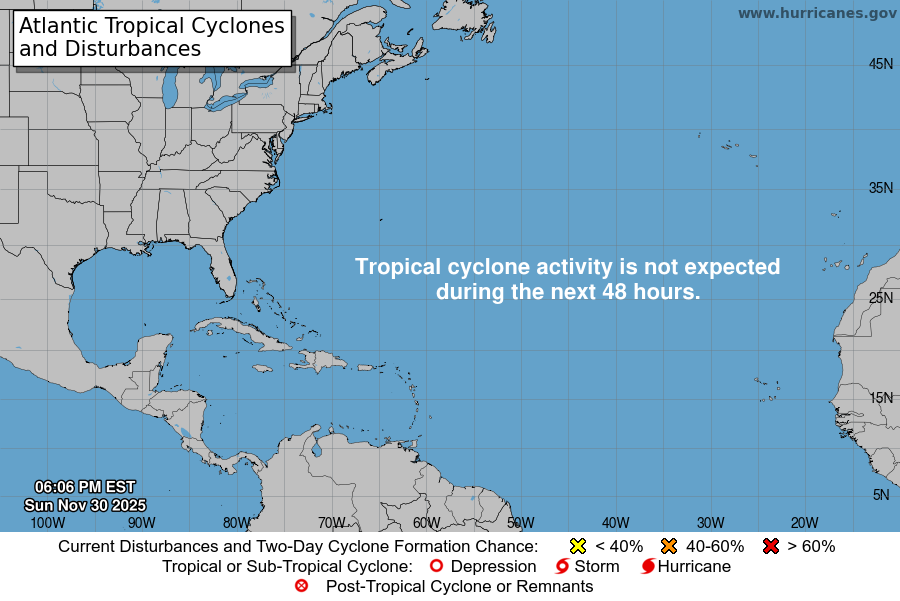
National Hurricane Center graphic retrieved from MSN.
A Washington Post contributor, Matthew Cappucci, asks, "When will hurricane season roar back to life?"
A week later, it's Nichts Neues im Osten.

None of which deterred Mr Cappucci.
No storms are in the forecast any time soon. In fact, the rest of August may go without a single named storm forming. And as September looms, many are wondering when — or if — the Atlantic will awaken again.We'll see. As early as June 3, natural events were leading to a revision of priors. "The nation's McPaper runs the scary headline. 'Unprecedented ocean temperatures make this hurricane season especially dangerous.'"
Forecasters are doubling down on their predictions for a hyperactive season, with enough named storms to exhaust the conventional naming list used by the National Hurricane Center. Researchers at Colorado State University are calling for a season nearly twice as active as average, as measured by a metric called ACE, or Accumulated Cyclone Energy. That measures how much energy storms churn through across a season.
In the near term, it looks like the calendar will flip to September uneventfully — but then the temporary reprieve will come to a grinding halt. Storm activity is likely to increase as next month begins, and a flurry of storminess is probable deeper into the month.
Yes, those hot oceans were scary. "A crucial system of ocean currents is heading for a collapse that ‘would affect every person on the planet.’" Perhaps so, although there isn't enough computing capacity to capture the effects of temperature, salinity, the rotation of the earth, and Mr Limpet clearing his throat on the ocean currents.
A new study published Tuesday in the journal Nature, found that the Atlantic Meridional Overturning Current – of which the Gulf Stream is a part – could collapse around the middle of the century, or even as early as 2025.The fear-mongering continued over the winter. "Beyond the tipping point: The Collapse of Ocean Currents and its Weather impact on the United States and Europe." That article gets into the fluid dynamics, and, to its credit, includes a caution. "No ocean current ever flows in a straight line, as seen in many graphics. It is actually very complex, with a lot of dynamics and swirling across the North Atlantic. It has a lot of smaller swirls of water, both warm and cold, very similar to the jet stream in the atmosphere." And sometimes the complexity confounds the chroniclers. "Party Over for Alarmists as Sea Temperatures Plunge Around the World."
Scientists uninvolved with this study told CNN the exact tipping point for the critical system is uncertain, and that measurements of the currents have so far showed little trend or change. But they agreed these results are alarming and provide new evidence that the tipping point could occur sooner than previously thought.
The AMOC is a complex tangle of currents that works like a giant global conveyor belt. It transports warm water from the tropics toward the North Atlantic, where the water cools, becomes saltier and sinks deep into the ocean, before spreading southwards.
It plays a crucial role in the climate system, helping regulate global weather patterns. Its collapse would have enormous implications, including much more extreme winters and sea level rises affecting parts of Europe and the US, and a shifting of the monsoon in the tropics.
These days we must of course welcome any outbreak of scientific head-scratching in the usually ‘settled’ climate business. Temperatures suddenly go down and scientists are seemingly clueless as to why it happens. Yet temperatures go up and it is all due to global warming and humans must return, instanter, to a pre-industrial societal and economic hellhole. In fact, scientists have little idea how a great deal of weather suddenly changes and how the sea and atmosphere warms and cools. Over 100 super-computer models are simply not up to the job of explaining natural variation in a chaotic, non-linear atmosphere. The fact that some scientists are perplexed when temperatures go down, but full of fear-mongering explanations when they go up, says it all.I'll let Stephen "Vodka Pundit" Green deliver what might qualify as a Friday short take, but for that post having swelled to Gargantuan proportions already: "When things are getting worse, climate scientists enjoy the certainty of knowing exactly what's going on and why. When the trend lines improve, it's a much less newsworthy mystery."




No comments:
Post a Comment