Conditions were more complicated on the North Shore Line, the much-lamented and more than a little bit missed Chicago North Shore and Milwaukee. Yes, the railroad operated entirely in the Central Time Zone. After the War, though, Illinois observed Daylight Saving Time whilst Wisconsin did not. So much for agricultural interests favoring Daylight Saving Time. The cock crows at sunup, irrespective of what's on the clock, and farm kids know about morning chores before they head off to school. Thus, when Wisconsin did adopt Daylight Saving Time, that ended on the final Sunday in September, whilst Illinois stayed with it until the final Sunday in October.
Showing posts with label interurbans. Show all posts
Showing posts with label interurbans. Show all posts
14.7.26
DOES ANYBODY KNOW WHAT TIME IT IS?
Fittingly, a troupe that debuted as Chicago Transit Authority (the eponymous agency brought legal action to get that name changed) asked that question. For years, the South Shore Line, properly the Chicago South Shore and South Bend, issued all-year-around printed timetables, advising that all published times shown were those in effect in Chicago. When both Indiana and Illinois were on Standard Time, the South Bend passenger had to mentally add an hour; for that part of the year when Illinois and the Indiana Region observed Central Daylight Time, the South Bend passenger might not have had to make any changes, as Indiana was far enough west in the Eastern Time Zone for those counties on Eastern Standard Time to stay on Eastern Standard Time. Those changes might not have inconvenienced too many passengers on the east end of the railroad, as, well into the 1960s, the railroad offered a memory pattern schedule with hourly South Bend Limiteds, with Gary Expresses on the half hour. Conditional and positive stops for the morning Limiteds sufficed to serve any passengers from LaLumiere or Hudson Lake or New Carlisle for Bendix or downtown South Bend. These days, the conditional stops are gone, although with all trains pulling out of Michigan City to form South Bend departures, there are morning departures for any local passengers so inclined.


8.7.26
A RAINY FREEDOM WEEKEND FOR RAILWAY PRESERVATION.
The Chicago Aurora and Elgin Railroad quit business on 3 July 1957 upon receipt of a favorable court ruling. The Wheaton Shop blackboard is now property of the Fox River Trolley Museum.


Preservation operations began on a short stretch of electrified trackage in 1966. For Indepedence Day, visitors were offered rides at the 1966 price of fifty cents.

A short stretch of the Aurora Elgin and Fox River Railroad remained in service as a diesel-powered railroad to move coal from an interchange with Illinois Central to the state hospital in South Elgin. The Railway Electric Leasing and Investment Company made a deal with the railroad to operate trolley cars, initially on a very short stretch of electrified track.
7.7.26
CLOSING DOWN AHEAD OF THE RAIN.
In 1957, the Chicago Aurora and Elgin Railroad abruptly suspended all service just past noon on 3 July. Passengers at Desplaines Avenue were more than a little bit cranky when the train they were hoping to board all of a sudden was moved past the platform without boarding, and nobody offered any substitute transportation. Things got more interesting as offices closed for the holiday.

These days, the Illinois Railway Museum offer visitors a chance to experience living history, as we documented for 2016 and 2017. Everybody is in on the plot and there's no unpleasantness when the trains set down at the Seemann Road platform.
Last week Friday, the show was ready to go on, but the weather gods had their own say. For safety reasons, no electric cars operate during thunderstorms, and to protect the vintage cars, the wood interurbans, which the cash-strapped interurban continued to operate right up to the end, do not run in the rain.
At about 11.30, it looked like business as usual at Wheaton, where steel cars from Elgin and Aurora combined to make up a mid-day Chicago Express.

A few Chicago and North Western Bi-Level Commuter Streamliners were operating in those days, although the control cab cars and push-pull operation came later. The smoke is rising off Shay 5, which was pulling a short coach train. The threatening skies are to the northwest.
24.6.26
SIXTY YEARS TO GET FROM SKOKIE TO HARMSWOODS.
Perhaps the only thing longer than a forever war or a negotiation with Iranians is the procedural wrangling over restoring a few miles of rapid transit track through the Skokie Valley.
When the North Shore filed for abandonment in 1958, Chicago Transit Authority (public ownership came in 1945) considered purchase of the high speed line as far as Waukegan. North Shore's own ridership studies had a plurality of the commuters boarding at Dempster Street with relatively light loads north of Briergate. As the Transit Authority has a large maintenance facility along the North Shore just west of the drainage canal in Evanston, it was relatively inexpensive to buy only the North Shore property from west of that facility to Dempster. But no sooner was the North Shore gone than some people wanted it back.Getting even the next section, to somewhere near the Old Orchard mall, which somehow still exists as a mall, has been newsworthy for years. "Sometime in the late 1980s a friend, in making conversation, asked if I was aware the Transit Authority wanted to extend the Skokie Swift to Old Orchard. My reaction: it used to go to Milwaukee. Surprised reaction. No surprise." At the time, there were a few more people still living who had ridden the North Shore Line.
22.6.26
TRANSPORTATION MIRACLES REQUIRE PREPARATION.
Reason contributors, including Liz Wolfe, have a troubling blind spot where road socialism is concerned. "New Jersey Transit is preparing backup ferries to help with demand as fans try to make it to the World Cup. I kind of love how they assume public transit will buckle under the pressure."

Not-a-tall. I heard one senior law enforcement official describe the World Cup as "multiple Super Bowls" in multiple cities in three countries over six months. Let's bear in mind that the National Football League unaccountably scheduled a Super Bowl for the Meadowlands, and more people than New Jersey Transit anticipated rode the trains. Lesson learned.
It is not, however, the World Cup, or the Super Bowl, or New Jersey Transit that concerns me. Rather, it is a centennial. "In 1926, the North Shore Line built a much larger temporary station, and borrowed rolling stock from the Chicago Rapid Transit Company, for a one-day International Eucharistic Congress at Mundelein. A rainstorm provoked an early departure for many pilgrims, and the railroad handled it."

In less than ten score years, Chicago went from "mission" territory to birthplace of a Pope. Strictly speaking, the aforementioned XXVIII International Eucharistic Congress took place in Chicago and at St. Mary of the Lake seminary, then east of a village called Area (pronounced a-REE-a) and subsequently renamed for George Cardinal Mundelein, who made no small plans. Neither did the seminary, now known as the University of St. Mary of the Lake, not to be confused with the California university that keeps turning up in intercollegiate sports tournaments. Nor did Samuel Insull, whose country farm was near the seminary. For that matter, the cardinal offered the Vatican the use of St. Mary of the Lake as emergency quarters during the War. The Pope might not have had any divisions, but he was no coward.
5.6.26
PROGRESS OF A CENTURY.
North America's first stretch of electrified high speed railroad opened in June of 1926. In the winter of 1960, rail enthusiasts were gathering for final rides.


Unattributed photograph, probably a Kodachrome, retrieved from The Trolley Dodger.
The North Shore Line built this section of railroad in order to offer service between Milwaukee and Chicago that wasn't jousting with automobiles on street trackage and subject to franchise restrictions requiring limited trains to stop on the streets of Wilmette.
29.5.26
DISCOVERING THE ELECTRIC PRESERVATION RAILWAYS OF THE STATE LINE.
Mercedes Streeter of The Autopian stumbles upon the East Troy Electric Railroad.
Countless historic American streetcar and interurban lines have disappeared since their heyday, but I found a place where you can still experience a commute like it’s 1920. This is the East Troy Electric Railroad, Wisconsin’s last running interurban railroad, and it’s one of the most tranquil rides you’ll ever take that doesn’t even surpass 15 mph.We've called attention to the East Troy Electric Railroad numerous times. It's unusual among preservation railways in that its busiest season is fall, for apple picking and leaf peeping.
The East Troy Electric Railroad is one of my favorite kinds of museums. Nestled in the town of East Troy in southeastern Wisconsin, this museum doesn’t really have the marketing of the Illinois Railway Museum or the federally recognized status of the National Railroad Museum. Instead, it’s a museum that you hear about through word of mouth or stumble upon on social media, and it has the same kind of lovely charm as a mom-and-pop shop. The museum is small enough that, if you’re not paying attention, you could drive right by it and not notice it was there.
15.5.26
AN INTERURBAN RETURNS TO HOME RAILS.
Well, a short stretch of rail close to its old home rails.
The Village of Villa Park is working with Illinois Prairie Path, labor unions and two railroad museums to give new life to a piece of west suburban transit history.The Roarin' Elgin shut down late enough into the emergence of a railway preservation movement in these United States that there were interested buyers of cars for preservation, and its inability to attract sufficient capital to completely replace its fleet of wooden cars with steel cars meant a substantial roster of wood cars of relatively low scrap value were available to preservation enthusiasts. At one time, the seven cars numbered 315-321 all remained in preservation. Car 318 was the casualty of a rough shunt on Penn Central en route from Indiana to Wisconsin and became a parts donor to sister cars in the Illinois Railway Museum collection. Car 315 is being rebuilt at the Rockhill Trolley Museum in Pennsylvania in closer to as-built condition, meaning revealing the stained-glass arched upper sash windows that many an interurban covered over to make the car look more streamlined, and Car 316 has received a similar backdating at the Fox River Trolley Museum. Car 319 returned from an Ohio mobile home park to the Illinois Railway Museum a few years ago, and it often runs in the Roarin' Elgin wood car train.
The Chicago Aurora and Elgin Railroad was an electrically powered interurban rail line that connected much of west suburban Kane, DuPage and Cook counties to the Loop. Passenger service operated between 1902 and 1957, and freight service ended two years later. Most of the railroad’s right of way, including the portion that went through Villa Park, was converted into the Illinois Prairie Path walking and biking trail.
Now, Villa Park plans to bring one of the old CA&E railcars, known as Car 321, to the former train station near the intersection of Ardmore Avenue and Central Boulevard. Union laborers would restore the exterior to its original condition and rehab that interior so it can be used to host community events. The village plans to build a short stub track to mount the railcar on, and a shed to protect it from the elements.
22.1.26
FRIDAY WILL BE A SNOW DAY FOR CHICAGO OFFICE WORKERS.
No longer do railroads employ legions of extra men to shovel out switch points and service the heaters. Thus when cold and snow are on offer, management prefers to avoid diverging moves where practicable. "With severe cold forecast for the Chicago region, Metra has made the decision to operate reduced schedules on all its lines on Friday, Jan. 23." The reduced schedules are for the most part the Saturday schedules, hourly or two-hourly for much of the day, with very few expresses and none of the Elmhurst or Congress Park turnback trains, and McHenry is out of luck.
9.10.25
THE HIAWATHA DIVISION SERIES.
The Milwaukee Brewers and Chicago Cubs are playing for the right to play in the National League's championship series, which for the moment still means representing the National League. On Wednesday, the Brewers worked with Amtrak and the state operators of the Hiawatha to decorate train 332. "The 8:05 a.m. departure train on Wednesday will be transformed into the themed Brewers Express, complete with the famous Racing Sausages, the Brewers 4-1 Force, and other members of the Brew Crew who will send off fans headed to this afternoon’s crucial game."

The stock of 332 turns as the 11.08 Borealis from Chicago to the Cities. The game itself started at 4 pm, and no special return working was laid on.
Fans had to figure out their own transportation from Union Station to Wrigley Field. Get to the L in the State Street subway and board a train signed for Howard. Or, for that North Shore Line experience, get on a Ravenswood train at Washington and Wells and ride around the Loop.
Once upon a time, there was a North Shore Line experience on game day.

To the end, the North Shore Line's timetable noted that trains would set down southbound and pick up northbound at Addison on the days the Cubs or Bears played. The five Electroliners each way (this is the 801-802 set northbound) featured a tavern-lounge section with beer and sandwiches.
17.9.25
TRACTION ORANGE AND PUMPKIN ORANGE.
The harvest fest trains return to East Troy. Railway preservation is a volunteer-operated, volunteer-built enterprise, using, in East Troy, a stretch of track the village purchased in 1939 to keep carload freight service to local industries.
“The volunteers took ownership of the whole thing without the village, and we've been running ever since,” said Jim Feyerherm, the operations manager.Their peak season is fall, and we've documented all sorts of events on the East Troy Railroad.
Today, trains operate on weekends after Labor Day and include themed experiences such as dinner trains, Harvest Fest rides, and Christmas trains that feature Santa’s workshop.
“It's fun, it gives you a mission, and it's filled with happy people,” said volunteer Tammy O’Connell, who has been with the railroad for two years. “The volunteers are just a big happy family.”
The Harvest Fest train takes passengers on a 30-minute ride from East Troy to the Elegant Farmer.
“We take people from here down to the Elegant Farmer where they can get off so they can pick their apples. They can go on hayrides, they can do all of that—a lot of fun things,” Feyerherm said.
That's the last post for the week. Time for some time away. Find yourself a preservation railroad, or an Oktoberfest, and go to it.
4.9.25
PRESERVATION RAILWAYS HAVE THEIR BASKET CASE PROJECTS, TOO.
Last month, we saw some model railroading projects that included swap meet purchase, acquired cheaply, that will require a good deal of work before they run.

Preservation railways also take on basket case projects, as that is frequently the condition in which old and rare examples of the railroading art present themselves.

Such is the case with Car 162 at the East Troy Electric Railroad. It might be the oldest extant car from a 1915 order Brill built for the Chicago and Milwaukee Electric Railway. Sister car 160 is in regular service at Illinois Railway Museum. Builder records suggest 162 was finished and delivered first.
The car was in the collection of a Connecticut museum for many years, where it was stored outside, and museum curators recognized they couldn't conserve everything, and perhaps cars representing railways closer to home ought be conserved first. Thus it arrived at East Troy, and it is in the well-equipped repair shop to be worked on until the active-service cars rotate in for their winter overhauls.
15.7.25
A PROTOTYPE FOR EVERYTHING.
Some years ago I found somebody's attempt at building an interurban car that never got finished and wound up as a bargain purchase at a swap meet.


My thinking: perfect control trailer to pair with a doodlebug.

Now comes "Unexpected New York Central" at Hicks Car Works, and among the photographs, a Michigan Railways heavy steel combine, repurposed as control trailer MT-9.

Image linked from Hicks Car Works.
The prototypes all went for scrap. The model is back in the shop line somewhere, awaiting onboard power to be put on the doodlebug first.
10.7.25
THE PERILS OF RAILWAY PRESERVATION.
During our time away from social media, I worked in visits to two preservation railways on my way home. My first call was at the Pennsylvania Trolley Museum, which recently opened its interpretive center.


Each of those kiosks with step stools for the littlest ferroequinologists offers a different interactive, in the best, old-school Museum of Science and Industry way, way to introduce people to a late nineteenth century technology. And yes, that interurban car at left includes a controller, brake handle, and video screens for a visitor to attempt to control an electric car. In real life, think "handling an automobile on an icy street."
9.6.25
A PROJECT OVER A CENTURY IN THE MAKING.
Make no small plans, urges Alexander Kofman for the High Speed Rail Alliance.

That project envisioned only the most generous of curves once the line got around the southern tip of Lake Michigan.

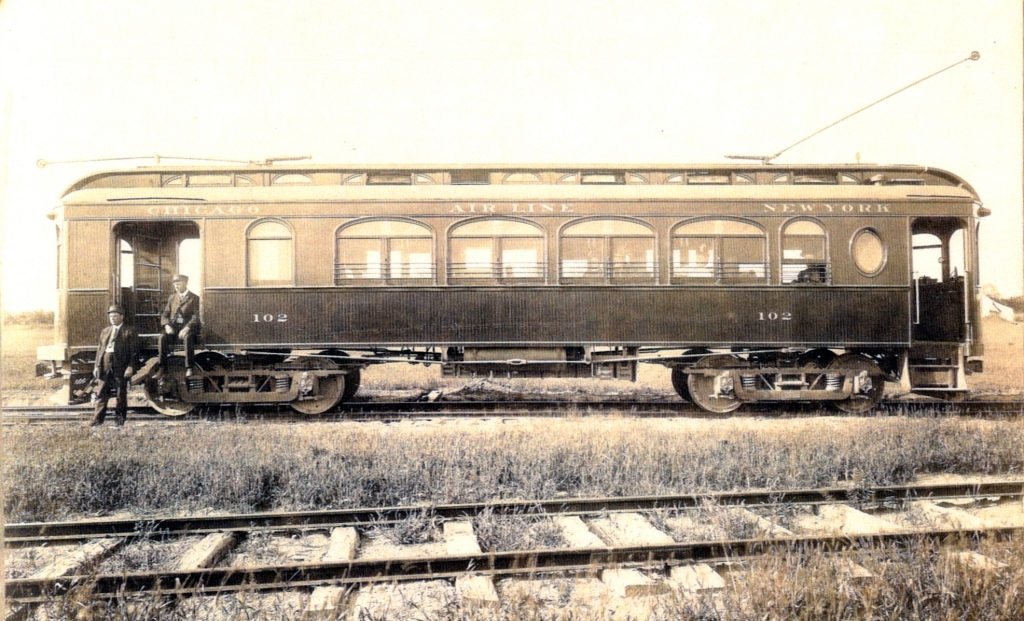
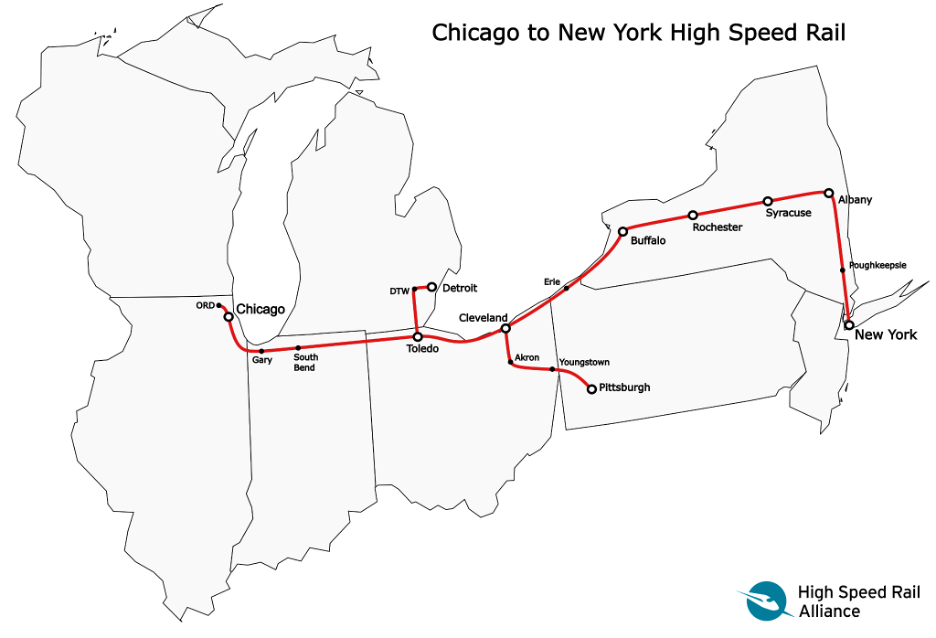
In the same 20 years that it would take to design and build high-speed rail between Chicago and St. Louis, Milwaukee, or Detroit, a wider-ranging effort could instead design and build a line of national scope and importance. Industry and government are equally capable of planning small projects and megaprojects. If it would take us the same 20 years to fight for a short line as for a long one, we should go big. We should aspire to meet the moment and demand the project the country really needs: a high-speed line connecting Chicago and New York.For what it's worth, at the start of the twentieth century, within two decades a short line intended to connect Chicago to New York did fund raising, bought rolling stock, built about 25 miles of track, ran some trains, and quit before the United States entered the War to End All Wars.
The route proposed for this high-speed line essentially follows the current route of the New York section of Amtrak’s Lake Shore Limited, which follows the shore of Lake Erie to connect to the population centers in Western New York before turning down the Hudson River to serve New York City. A high-speed line will require a dedicated right of way for much of its length, but limited track-sharing may be possible, especially in the approaches to Chicago and New York. The exact routing is beyond the scope of this proposal; we can envision the route at a high level and call out the larger communities that would be expected to receive service, but without getting into route choices at the local scale.

If your objective is to provide a high-speed rail line that permits ten-hour timings, your railroad will be an undertaking of Biblical proportions. Ev'ry valley shall be exalted, every hill made low, the crooked straight, and the rough places plain.The proposed routing for 2025 and beyond envisions going around, rather than through, the Alleghenies.Air Line proposal map from Mary MacLane's Air Line historical photos.
On the other hand, that's only a 90 mph railroad. Upgrade it for field-shunted Electroliners and you're in New York about 7 1/2 hours after you've left Chicago, and if you give it the fourth-generation Electroliner treatment and you can have your coffee in New York and meet a client for lunch in Chicago.


The amusing part, dear reader, is that the gentleman who promoted the original Chicago-New York Electric Air Line, back when the interurbans were the dot.com craze of the era, started his musings on such a project on a New York Central train which, as it approached Albany, was farther from Chicago than it was upon leaving New York.
21.4.25
THE CHALLENGES OF RAILWAY PRESERVATION.
The Chicago Aurora and Elgin electric railway might have quit business in an unusual way, the day before Independence Day in 1957; it never had the money to completely replace its wood interurban cars, buying a few from the North Shore Line after the War to cover the slowest trains; and it lasted long enough for railway preservation to become a pastime. There wasn't as much scrap value in those wood cars as in the steel cars, which could be had relatively cheaply. (As opposed to the steel cars: one Pullman in preservation, two Cincinnatis, and four of the ten St. Louis cars built after the War.) There are still a dozen wooden cars in preservation, in varying stages of operability.
7.2.25
THE WORLD THE TRACTION COMPANIES MADE.
It looked a lot like the so-called fifteen minute cities.
Picture living in a bustling neighborhood where all your friends, basic needs, and even your job are reachable by a quick walk or bike or bus ride. (Something many people experience, possibly for the first and last time, on college campuses.) In such a city, parking areas may have been reclaimed as urban greenways, chance encounters with neighbors might be more common, and small local businesses would proliferate and thrive.Just what we need, a new sort of intelligent design to undo the effects of a century of not-so-intelligent design.
This vision is sometimes referred to as “the 15-minute city,” a concept pioneered by Franco-Colombian scientist and mathematician Carlos Moreno. It means basically what it sounds like: Instead of expecting residents to get in their cars and drive long distances to work, run errands, and take part in social activities, cities should instead be designed to provide those kinds of opportunities in close proximity to where people live, reducing overdependence on cars and increasing local social cohesion.
“It’s an invitation to reinvent our lifestyles and urban practices to build a better future, where sustainability, equity, and well-being are at the heart of our concerns,” Moreno writes in the book. I spoke with Moreno over Zoom and e-mail about the growth of the 15-minute city concept, some sources of backlash, and whom he hopes to reach with his new book.Sure. Chant the right worship-words and hope for the best.
12.12.24
THE CREATIVITY OF COLD SPRING SHOPS.
I refer to the original, the repair shops of The Milwaukee Electric Railway and Light Company in the Cold Spring Park neighborhood of Milwaukee. We called attention, nearly three years ago, to their work obtaining extra seating capacity by stretching classic steel interurban combination cars into three-truck articulated units.
21.10.24
STEAMING INTO INDIAN SUMMER.
I'm referring to a series, "Steam in Indian Summer," in Trains nearly seven decades ago.
The first frost arrived in DeKalb about on time, last week, although it was kind of anomaly in the midst of a prolonged late summer warm, dry spell. (No, I'm not going to wish for rain, you have to be careful what you ask for these days.)
The preservation railways, though, have been wrapping up their summer season, and getting into fall harvest mode.
27.9.24
THEIR PEAK SEASON IS FALL.
Most preservation railways wind down their operations after Labor Day, perhaps rolling out a few haunted trains or pajama parties with Santa. For years, though, the electric railroad running out of East Troy has been busiest in the fall, with leaf peepers out for hayrides and children of all ages picking out pumpkins or buying apples.

Now Chicago's WGN-TV have called attention to the railway.
John Lauber has been with the museum in its various incarnations since the first trolleys started running in 1972. That's likely his vintage Studebaker in front of his store, and two of the modernized South Shore arks further modernized as a diner train behind. Inside, the soda fountain and the ice cream freezer work, while most of the inventory is of vintage merchandise.
Just a two-hour trip from Chicago can take you across the Wisconsin border, and, in another sense, back in time to see a piece of century old transportation history from Chicago still riding the rails.I've embedded the clip from WGN's You Tube channel as that link is likely to stay active longer.
You may know East Troy, Wisconsin as the home of Alpine Valley, but the village of 4,687 people is also home to the East Troy Railroad Museum.
“We get a lot of Chicago people coming in from there,” said John Lauber, the owner of an East Troy ice cream shop. “It’s almost like stepping back in time.”
John Lauber has been with the museum in its various incarnations since the first trolleys started running in 1972. That's likely his vintage Studebaker in front of his store, and two of the modernized South Shore arks further modernized as a diner train behind. Inside, the soda fountain and the ice cream freezer work, while most of the inventory is of vintage merchandise.

Do the math, none of us are getting any younger, and this might be the final season for J. Lauber's, unless one of the employees continues the tradition.
Find yourself a preservation railway and go to it. Have a Green Cow and buy a pumpkin while you're there.
Find yourself a preservation railway and go to it. Have a Green Cow and buy a pumpkin while you're there.
Subscribe to:
Posts (Atom)