28.2.17

NUBBELVERBRENNUNG.

This year, from a saloon called Gleis 7.


The Nubbel gets an unusual send-off.  Watch!

It's the custom in these events to send up Established Institutions, such as the Church, and sometimes the Military.  I bet the videos that pop up later tonight and into Lent will have more than a few send-ups of Our President.

COMPETITIVE MARKETS ALLOCATE RESOURCES EFFICIENTLY.

This tribute to the recently departed Kenneth Arrow, at A Fine Theorem, clarifies how restrictive the sufficient conditions for emergent Pareto efficiency are.  I'll even cut the author some slack for believing in the Fatal Conceit.
My read of the literature on [general equilibrium] following Arrow is as follows. First, the theory of general equilibrium is an incredible proof that markets can, in theory and in certain cases, work as efficiently as an all-powerful planner. That said, the three other hopes of general equilibrium theory since the days of Walras are, in fact, disproven by the work of Arrow and its followers. Market forces will not necessarily lead us toward these socially optimal equilibrium prices. Walrasian demand does not have empirical content derived from basic ordinal utility maximization. We cannot rigorously perform comparative statics on general equilibrium economic statistics without assumptions that go beyond simple utility maximization. From my read of Walras and the early general equilibrium theorists, all three of those results would be a real shock.
Repeat with me: there is no such thing as an all-powerful planner.  That noted: existence of competitive equilibrium follows from a narrow set of sufficient conditions.  Uniqueness and stability of that equilibrium: harder still.  On the flip side, the absence of the sufficient conditions does not lead inexorably to a set of circumstances where Someone In Authority (not necessarily an all-powerful planner) can find a Pareto improvement.  It's even hard in the presence of the sufficient conditions.
This is literally the main justification for the benefits of the market: if we reallocate endowments, free exchange can get us to any Pareto optimal point, ergo can get us to any reasonable socially optimal point no matter what social welfare function you happen to hold. How valid is this justification? Call x* the allocation that maximizes some social welfare function. Let e* be an initial endowment for which x* is an equilibrium outcome – such an endowment must exist via Arrow-Debreu’s proof. Does endowing agents with e* guarantee we reach that social welfare maximum? No: x* may not be unique. Even if it unique, will we reach it? No: if it is not a stable equilibrium, it is only by dint of luck that our price adjustment process will ever reach it.
There are some subtleties involving separating hyperplanes that the reader must understand, before giving up on the case for rearranging endowments.  But "main justification for the benefits of the market?"  It's probably harder than that: has anyone come up with a set of sufficient conditions under which Partially Informed Wise Experts achieve an allocation of resources that is Pareto-superior to an allocation of resources that Partially Informed participants in a distributed network reach.  Impound nonconvexities, including externalities and club goods, in ceteris paribus and tell me what you come up with.

A FOOL'S ERRAND.

Flatlanders escaping to Wisconsin will have to deal with construction-related congestion along Interstates 90 and 39 between the Cheddar Curtain and Madison this waterpark season.
According to the latest version of the Department of Transportation's road construction schedule, more than half of the 45-mile stretch of Interstate between Beloit and Madison will be torn up at times as 10 major projects are set to roll out.

That work, according to plans the DOT showed The Gazette, will include overpass replacements between Janesville and Madison and a 10-mile expansion of the Interstate's northbound lanes starting north of Edgerton.

Thus would begin the long-awaited—or some might say, long-deferred—expansion of I-90/39. The massive $1 billion project aims to widen I-90/39 from four lanes to six from the state line north to Madison—and beef it up to eight lanes through Janesville.
The usual spinners will deal in the usual spin about a little inconvenience now for a faster trip to the tourist traps in the future.  Except that won't happen.
The Beloit-Janesville lane expansion is just one lane project that will cause temporary traffic diversions, multiple temporary closures and an untold number of orange construction barrels along the Interstate—but it's a portion of heavy construction that will run right up the gut of Janesville's east side, where traffic bottlenecks under normal conditions rank among the heaviest on I-90/39's Wisconsin corridor.

The 12-mile stretch of road's two-year tear up offers one snapshot of traffic disruption linked to a project that could last at least five more years on a highway that is one of the main funnels into Wisconsin for interstate commerce and tourism traffic.

Walker said last fall that the I-90/39 expansion is one project he doesn't want to see derailed as the state works on a new budget.
It doesn't matter, after the work is done, whether there are four lanes each way through Janesville, or eight, or ten. Traffic will expand to fill the available lanes.  If that's not enough aggravation for one day, note the subtle intrusion of the sunk cost fallacy.
State Rep. Amy Loudenbeck, R-Clinton, in an interview last week said she was encouraged by the fact that projects on the I-90/39 expansion appear to be on track.

Loudenbeck is a member of the legislative Joint Finance Committee, a group that in the past has led shaping of the legislative version of the state budget, which is ultimately submitted to the governor.

That fact—and the fact the DOT already has carried out tens of millions of dollars in sideline work linked to the project, including multiple overpasses rebuilt and widened to support expanded lanes on I-90/39—have made Loudenbeck more optimistic that I-90/39 project could continue to roll out as planned.
The upgraded overpasses give the highway department the option of widening the interstates, should they choose to exercise it.  But exercising the option, and causing more traffic congestion now in the hopes of mitigating it later?  Doubtful.

UNBUNDLING CHURCH AND STATE.

In the Insta Pundit "Change" file we find "Alabama moves to separate marriage and state."

That's a topic I've been following for some time, because it lets me get away with post titles like "intercourse becomes clothed with a public interest" but behind the wisecracking, there's a Deep Policy Question.
Doesn't that imply a competence for the state in protecting the interests of children that it has not demonstrated when it comes to providing education, or school lunches, or safe neighborhoods?

Put another way, the culture is doing just fine in protecting children -- in neighborhoods where the adults act responsibly, and not so well -- in neighborhoods where the adults don't. Maybe it's time for the editors at National Review to unbundle government from culture, or Caesar from Christ?
That appears to be precisely what the Alabama bill, not yet law, envisions. "Civil or religious ceremonies would have no legal effect upon the validity of the marriage. The state would only recognize the legal contract signed by the two parties entering into the marriage."  In so doing, the bill would undo the bundling of church and state that has made so much of what ought to be a straightforward contract between consenting adults a frontline of the Culture Wars.  "But that turns the civil institution -- as opposed to the religious sacrament -- of marriage into a contractual agreement (with no-fault divorce, it's notarized dating) for the benefit of adults."

Interesting that Alabama, for so long a punchline to the Coastal Elite, is achieving precisely the kind of unbundling in which two people can register a legal marriage contract, whether the local fundamentalist church, synagogue, or mosque rejects it or the local reform congregation solemnizes it notwithstanding.  The Tenth Amendment Center's post intriguingly turns appellate judges into auxiliary bishops.
Removing state meddling in marriage would render void the edicts of federal judges that have overturned state laws defining the institution. The founding generation never envisioned unelected judges issuing ex cathedra pronouncements regarding the definition of social institutions, and the Constitution delegates the federal judiciary no authority to do so.

Constitutionally, marriage is an issue left to the state and the people.
Further, when reproduction no longer is clothed with a public interest, the unbundling of the secular contract from the sacred sacrament becomes a restoration of the status quo that even Stephanie Coontz, with a New York Times imprimatur, doesn't denounce as turning the clock back.
In the mid-20th century, governments began to get out of the business of deciding which couples were “fit” to marry. Courts invalidated laws against interracial marriage, struck down other barriers and even extended marriage rights to prisoners.

But governments began relying on marriage licenses for a new purpose: as a way of distributing resources to dependents. The Social Security Act provided survivors’ benefits with proof of marriage. Employers used marital status to determine whether they would provide health insurance or pension benefits to employees’ dependents. Courts and hospitals required a marriage license before granting couples the privilege of inheriting from each other or receiving medical information.
The Tenth Amendment Center post notes that the power to license is the power to forbid.
Put another way, under a licensing scheme, marriage is not a right, nor a religious institution, but a privilege granted by the state and limited by its requirements.

Consider this: In the same way a driver can lose their license if they break certain traffic laws, a man or woman, theoretically, could one day find their marriage license revoked for breaking certain “marriage” rules, whether it pertains to child rearing, or their religious and political convictions.
To an extent, this revocation already exists, in the form of the child protection bureaucracy putting children in protective custody, under guises pertinent to child rearing or to convictions.  That might be beyond the capability of governance to fix.  Instilling bourgeois habits in young people before they become parents might still be a good idea.  Reclaim the culture.  Stop enabling the dysfunction.

THE FORGES OF THE ARSENAL OF DEMOCRACY.

As featured in an Office of War Information short on the steel works of Youngstown, Ohio.

Post edited and updated to present the full original video, which includes vignettes of the steel men at home, their children at school, and their symphony orchestra.  The country is at war, the outcome is still in doubt, and yet the message is optimistic.

There are a number of action shots among the furnaces and mills.  We'll see an open hearth crew poking the tap hole open with a long prod.  I don't envy the front man, closest to the door.  One wrong move ...  The other ways to get the tap hole open are to use a stick of dynamite, or go underneath the furnace with an oxygen lance, both of which are risky as well.


Closing observation: "When the war is over, we're going to face problems."  Yes, and the narrator probably didn't anticipate half of it.

27.2.17

NO MAN CAN KINDLE THE EKPYROSIS.

In What Does Steve Bannon Want?, New York Times scribe Christopher Caldwell (on loan from Weekly Standard) suggests Mr Bannon still thinks he can.
There are plenty of reasons for concern about Mr. Bannon, but they have less to do with where he stands on the issues than with who he is as a person. He is a newcomer to political power and, in fact, relatively new to an interest in politics. He is willing to break with authority. While he does not embrace any of the discredited ideologies of the last century, he is attached to a theory of history’s cycles that is, to put it politely, untested. Most ominously, he is an intellectual in politics excited by grand theories — a combination that has produced unpredictable results before.

We’ll see how it works out. Barack Obama, in a similar way, used to allude to the direction and the “arc” of history. Some may find the two theories of history equally naïve and unrealistic. Others may see a mitigating element in the cyclical nature of Mr. Bannon’s view. A progressive who believes history is more or less linear is fighting for immortality when he enters the political arena. A conservative who believes history is cyclical is fighting only for a role in managing, say, the next 20 or 80 years. Then his work will be undone, as everyone’s is eventually.
And complex adaptive systems will do what they d**n well please, the Fatal Conceits of Theoreticians, whether they think they're riding the arc of history or the hamster wheel of history notwithstanding.

TEN YEARS AGO.

City University of New York's K. C. Johnson became more sympathetic to scholars of the right after the vilification he got (the link now goes to the memory hole) for investigating the trumped-up charges (oh, if we had the terms "fake news" and "alternative facts" in the vernacular back in the day) against the Duke lacrosse squad.  "Really, the absolute refusal of the Group of 88 or other players in this affair to apologize or tone down their behavior in any way, as if all of the facts are the same now as they were on March 29th, and to show no indication they've comprehended anything … it's depressing."

But the tendency of the people in power in higher education to let "the right," loosely speaking, to win the logical arguments by default has a long pedigree.  Over the weekend, I was tossing stuff and I came across a Washington Monthly 20th Anniversary issue, from October 1989 (they hadn't yet twigged to the reality of Communism crumbling, such were deadlines in those pre-internet days) with the cover featuring "Why higher education is neither."  This article came out about a year after Charlie Sykes's Prof Scam, and many of the points the authors make could have as well have been made by Mr Sykes, or any of the other Tories.  The argument they raise in response to the Canon Conflicts back in the day generalizes.
What's unfortunate is that while the conservative reformers have diagnosed the ailment correctly--curricula diluta--they've tended to offer a suspiciously narrow cure: a canon composed almost exclusively of Western, and male, influences. Liberals have responded by dismissing the idea of a core altogether--ceding leadership to the Right--rather than working to institute their own core, one that preserves greatness as the standard but doesn't stop at William Bennett's borders.
In how many other ways to the Folks In Charge of higher education continue with business as usual, and no indication that they've comprehended anything?

26.2.17

A HOLDOVER OF FAIRBANKS-MORSE INFLUENCE IN RUSSIA?

Here's a Bryansk-Built A-B-A set of the new 3TE25K2M diesel locomotives being delivered for use on the Baikal-Amur Main Line.
Designed to haul 7 100 tonne freight trains on the 2 800 km Baikal-Amur Magistral route between Taksimo, Tynda, Komsomolsk-na-Amure and Sovetskaya Gavan on the Pacific coast, the 9·3 MW locomotive has three six-axle sections with microprocessor controls and AC traction motors.

Initial testing is to be undertaken at Kurbakinskaya in Kursk oblast before the locomotive is transferred to the BAM route.
I've been led to understand that an early series of Soviet diesels borrowed the layout of the cooling system from the Erie-Built, which, in turn, borrowed it from a submarine (there being Fairbanks-Morse opposed-piston diesels in submarines, so why not?) and these new diesels have the same radiator layout.
Unattributed image retrieved from Railway Gazette.

To continue the Erie comparisons, each unit has about the same power rating as General Electric's contemporary ES44AC or ES44C4.  The Russian units (does the TE still stand for "teplo?") look prettier, but on a Powder River coal train, it's the oomph, not the aesthetics.

On the other hand, with the Erie-Builts, you had the aesthetics.  Well, the U.S. railroads had Raymond Loewy and the Soviets didn't.


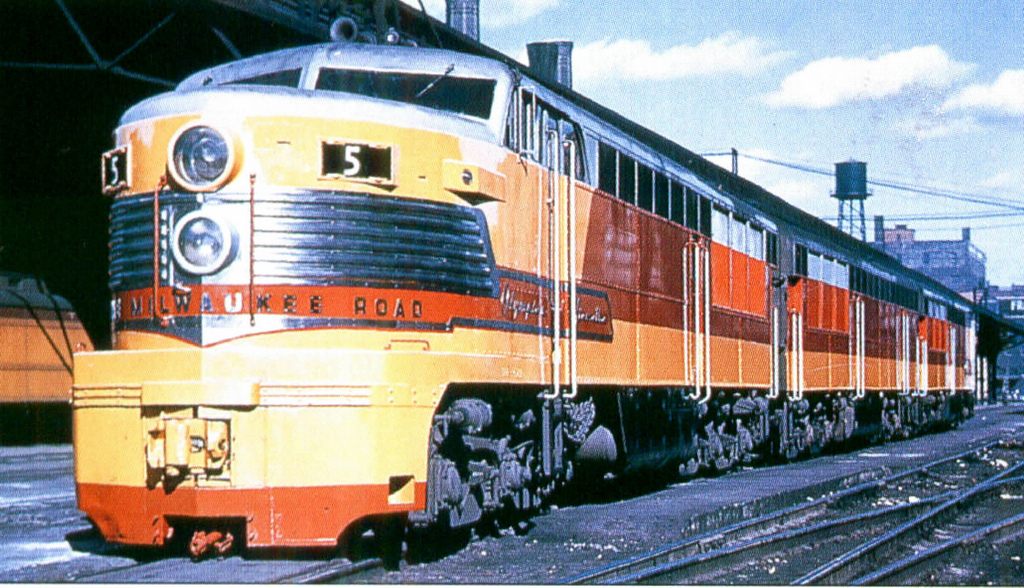
Milwaukee, Wisconsin, sometime in the late 1940s.

The Milwaukee Road purchased these Erie Builts, with the special trim and lettering, to haul The Olympian Hiawatha between Chicago and Seattle, a distance of about 3500 km, without the change to electric locomotives in the Mountain West.  Elsewhere in the States, Kansas City Southern hauled long freight trains through the western Ozarks with four unit sets, rated at 6.8 MW, about what two of the current Russian units are good for.  Milwaukee's Erie-Builts didn't last long in Olympian Hiawatha service, although they stayed on corridor trains and in commuter service until the trust certificates expired.

WHEN YOU MAKE MEN WITHOUT CHESTS.

In National Review, Steven Watts contemplates redemptive masculinity, from John Kennedy in the era of men in gray flannel suits, to Donald Trump in the era of near men in red flannel pajamas.
Thus, for many in heartland America, the denigration of men and the erosion of the very notion of masculinity have become disturbing features of modern culture. The modern Democratic party, with its unwavering devotion to gender-identity politics, is seen as the vessel for this unsettling culture. Many Democrats simply insist that gender issues are no longer topics for searching debate but settled imperatives — skeptics or opponents are automatically castigated as sexist stooges of the patriarchy. The Democratic party has made itself into a display case for trophies of unfettered gender expression and declining masculinity.

In terms of personalities, President Obama has been Exhibit No. 1. Much of middle America recoiled from a man who refused to hold to his own “red line” in Syria, knuckled under to the Iranians hell-bent on developing nuclear weapons, embraced a strategy of “leading from behind,” failed to stand up to Russia and China, and refused to condemn radical Islam because of a P.C. sensitivity about offending Muslims. In a world where a host of fanatical jihadists are bent on murdering Americans, many citizens winced at what they saw as the president’s soft metrosexual image.

Hillary Clinton has been Exhibit No. 2. Famously, she condescendingly condemned her traditionalist opponents as a “basket of deplorables” who are “racist, sexist, homophobic, xenophobic, Islamaphobic — you name it.” With her notoriously philandering, predatory husband in tow, she became almost a caricature of the hectoring P.C. zealot determined to cram sensitivity down everyone’s throat.

Enter the outlandishly male Trump. No matter how crudely, he promised a remedy. His brash assertions that he would stand up to the nation’s enemies and negotiate strict new trade deals, and his Mixed Martial Arts–style slam-downs of political opponents and critics seemed to demonstrate a clear masculine toughness. Even his crude sexual rhetoric and apparent misogyny, which understandably outraged many, elicited only shoulder-shrugging unconcern in middle America, where it was seen as a by-product of his aggressive masculinity. Trump’s barrage of Twitter counterattacks against critics, a source of much consternation among the commentariat, delight his supporters for the same reason. They see the short, sharp Twitter blasts as a weapon of masculine assertion — when someone hits you, you hit back even harder — that are beyond the control of the P.C. police in the media.
And yet, punching back at the people who deconstruct normality and call it progress isn't enough.  There must be a foundation of order, or else one unraveling gives way to another.  In such an order Mr Trump would be outside the realm of the respectable.  But these days, respectable means you can't insult voters on your way to the presidency (see those deplorables) although insulting other aspirants (Little Marco, Crooked Hillary) is simply Speaking Truth to Power.)
Trumpism expresses a genuine, understandable yearning to reestablish some sense of sexual normalcy, some accepted standards in our culture so that gender identity will not be fluid to the point of utter formlessness, so that marriages and families and the basic building blocks of society may rest on a firm foundation. Trumpism reflects an instinctive Burkean belief in middle America that society is rooted in personal morality and webs of shared standards and loyalties and responsibilities, and that if we dissolve sexual norms, we might be pulling the thread that then unravels the whole. In flyover country far from leviathan cities and the insular safe spaces of the academy, the fraying of the sexual order and the anxiety over degenerating masculinity have created legitimate fears of social disintegration. Trump’s hyper-masculine image of strength and vigor soothe such anxiety.

At the same time, Trump’s masculine style has a disturbing implication. Of JFK and Trump, both strongly male presidents, the earlier candidate was cool, sophisticated, intellectual, elegant, and sexually alluring while the latter is bombastic, vulgar, uninformed, and sexually aggressive. This contrast reflects deep personality differences between two individuals, but it also says something about Americans’ growing narcissism and addiction to celebrity, entertainment, and the gospel of self-fulfillment. Kennedy advanced as an individual who had political experience and policy expertise; his celebrity provided a glamorous veneer. Trump has ascended as man in whom celebrity is nearly all, with his political principles replaced by loutish self-aggrandizement. With the elevation of the Donald, who is almost a cartoon version of JFK, to the pinnacle of national leadership, we see not only fear about the decline of the American male but also distressing evidence of the larger decline of American culture.
What was I saying about the cultural conflict that must be resolved before a new values regime emerges?

22.2.17

TEN YEARS AGO.

It's actually a throwback to sixteen years ago, with some questions that might be germane to a Fourth Turning.

February 2007 was before the housing bubble popped, and perhaps the carnage in the financial markets was the catalyst for the saecular crisis.  But the answers to the questions Fourth Turning gurus William Strauss and  Neil Howe proposed generally had answers in the negative in 2007, the answers didn't change much by 2008 or 2009, and more recent developments aren't what the prophets expected.
  • Are leaders describing the problem in larger rather than smaller terms, proposing grand solutions, and seeking to destroy (and not just contain) enemies?
Ten years ago, gridlock and limited wars were still the order of the day.  The Iraq surge might have been starting.  Mr Obama took office in 2009 with helpful majorities in the House and the Senate and plenty of discontent with the Way Things Were.  And yet the "Patient Protection and Affordable Care Act," two lies for the price of one, is unsustainable, the stimulus was a give-away to rent-seekers, and the less bellicose foreign posture did nothing to contain foreign enemies.

Today, is "Make America Great Again" a grand solution, or a grandiose slogan?  More importantly, might the destruction to come be of the major political parties, which have abandoned most pretenses of comity, let alone bipartisan consensus?
  • Is there a shift away from individualism (and civil liberties) toward community purpose (and national survival)?
Perhaps, but the values regime that will define what that purpose is is not yet taking form.  Or, there are two competing visions, one involving a community purpose of greater freedom, the other being a community purpose of coalescing identity politics interests.
  • Are the old "culture wars" arguments beginning to feel lame, ridiculous, even dangerous to national unity?
The culture wars arguments are what brought people out to vote for Mr Trump and the Republican majorities, and the culture wars arguments are motivating the resistance.  Perhaps those are the contradictions that must be settled before a new values regime implants.
  • Is the celebrity culture feeling newly irrelevant? Is youth fare becoming less gross and less violent?
Seriously?
  • Is immigration reversing? Are mobility and openness declining? Is there more nativism in our culture and less "globalism" in our commerce?
Yes, although eight years of economic stagnation will do that.  Plus finding ways to extract oil and gas locally.
  • Is there a new willingness to pay a human price to achieve a national purpose? Will we harness technology only to reduce casualties and inconvenience, or also to achieve a total and lasting victory?
Not yet.  Until there's some sort of agreement on that national purpose, it's unlikely.
  • Is each generation entering its new phase of life with a new attitude? Are aging boomers overcoming narcissism? Are Gen-Xers on the edge of midlife, circling their wagons around family? Are Millennials emerging as a special and celebrated crop of youth?
Hardly.  The Millennials are the cohort everyone older loves to hate on, and their successor cohort, at least the visible ones at the high-end colleges and in entertainment, come off as snowflakier still.  Meanwhile, the aging boomers are still taking sides, either with the jocks or with the hippies.

Might we be looking at another Civil War anomaly?  In that saeculum, the Panic of 1857 and secession came in short order, and in Fourth Turning morphology, the period of unraveling was too short.  This time around, though, the unraveling goes on and on without any emergent outline of a resolution.  Perhaps history does rhyme, but as if in the forms favored by avant-garde poets.

MAKING THE CASE FOR STEEL.

The Association for Iron and Steel Technology invited students to "produce a three-minute original video that highlights advanced technologies in steelmaking."  The submissions participated in a contest.  I don't know how much longer the contest announcement will remain a live link.

One of the entries, "Steel: An Awakening," illustrates the changing nature of the steel works.  It will put into context some of the developments highlighted in my recent review of City of Steel.


Another video from the Association, "The Art of Steelmaking," rebuts the presumption that the steel works is an "iron-spouting dinosaur."  Plenty of vintage footage before the contemporary technology rolls out.  Enjoy.


Here are some still shots of the iron-spouting dinosaurs that didn't make it past the 1980s.

21.2.17

AUGMENTING THE POWER OF MEN.

Once upon a time, steel was a metal hard-won, from iron that itself might be coaxed a few drops at a time from a simple blast furnace, or extracted at great hazard through the muscle power of iron puddlers, then to be converted into small bunches of steel in crucibles that took a lot of hand labor in hot conditions to handle properly.

Then came the Bessemer converter to remove some carbon from the iron, perhaps with a proper heat of steel as the end product, the open-hearth reverberatory furnace, a scaling-up of the puddler's furnace, to obtain a more precise steeling of the iron.  To make that steel on a larger scale required greater inputs of iron, and to reduce ores in the quantities envisioned meant improvements in logistics and in blast furnace practice.

Put all these things together and you have Kenneth J. Kobus's City of Steel: How Pittsburgh Became the World's Steelmaking Capital During the Carnegie Era, our Book Review No. 4.  Mr Kobus worked in the steel mills of Pittsburgh, and was intrigued enough by what he saw to dig into archives and corporate records and put together a story of the accumulation of small advantages accompanied by occasional Aha! moments that converted steelmaking from a hot, dangerous, artisanal business to a hot, less dangerous, industrial activity.

And for all the Popular Perspective of the Gilded Age steel works being a dark, satanic place, the reality of technical change is one of providing safer working conditions in which fewer men can produce tonnages the old-time puddlers and crucible handlers would find inconceivable.  And the safer working conditions turned out to be more productive working conditions as well.  For instance, in the early Bessemer and open hearth plants, furnace tapping and ingot teeming took place in the same pit.  Rearrange the plant and put in travelling cranes to move the larger ladles, now the teeming doesn't have to stop each time a furnace is tapped.  Likewise, the early iron furnaces had to be charged by hand, one wheelbarrow at a time, through an open top.  And yes, all sorts of toxic gases came out of that open top.  Work out a skip hoist and an air lock that can handle the weight of the charge, and one hazard to the furnaceman's health is mitigated.  Then figure out how to transport molten iron from blast furnace to open hearth, rather than casting pigs to reheat in a cupola furnace before charging that iron into the converter.  Also, improve the rolling machinery, in order that achieving the final shape of the steel doesn't require strong men working in close proximity to hot steel to muscle it into shape.  One steelworker characterized the conditions as "working aside of hell ahead of time," whether with the cupolas, in the tapping and teeming pit, or alongside the rolling mills.

Thus, yes, Andrew Carnegie and his financiers made a lot of money.  But their gains coexisted with improvements in working conditions and compensation in the mills, in the quality and quantity of steel available for final consumption, and in the energy intensity of the business.  (And the improvements go on.)

In part, Pittsburgh (and the western slope of the Alleghenies generally) emerged as the center of the steel trade because of existing ironmaking technologies and nearby coal deposits, although ultimately the competitive advantage would go to a plant with a deep water port, such as near Chicago or Cleveland.  But that's a story for a different line of research.

(Cross-posted to 50 Book Challenge.)

IN PLACE OF FIRELESS COOKERS.

The plant switcher is an interesting, sometimes obscure part of railroading.  The fireless cooker looks like a steam locomotive, but it's a thermos bottle on rails that creates superheated steam from water by using up a charge of high-pressure steam in order to move cars around.  They're useful in places like powder mills, ammunition depots, and chemical plants where a stray spark might not be welcome.

In Germany, Wartsteiner have purchased a battery-powered critter for shunting inbound and outbound cargo at the brewery.
The 34 tonne vehicle has the capability of hauling up to 12 wagons at the brewery’s container terminal. As well as lowering noise and emissions, the use of the battery- powered vehicle instead of the previous diesel shunting locomotive will eliminate the need to have a refuelling point with its associated environmental requirements.

The 2·5 tonne battery is able to provide power for several days of operation on a three-shift basis before needing to be recharged via a cable to a 400 V mains outlet.
That's more endurance than the fireless cooker exhibited, those might be capable of going eight hours before having to take on a new charge of steam.  I like the way batteries are becoming more durable and more powerful.  It's likely that many of my model locomotives will have battery power and wireless control.

Breweries using electric locomotives for plant switching, though?  They used to be bigger in Texas.


Pearl Brewery saw fit to preserve Motor No. 2 of its Texas Transportation Company in San Antonio, after they modernized the factory and turned much of the complex into an upscale shopping area along the northern extension of the river walk.

Wartsteiner's critter is a more compact unit, but perhaps not as charming as Pearl's motor.  Long may it shift cars.


Unattributed image retrieved from Railway Gazette.

AS THE SAECULUM TURNS?

In The American Conservative, Robert W. Merry credits Donald Trump with perceiving a crisis of the status quo.
The campaign year of 2016 turned out to be a year of crisis politics writ large, manifest not just in Trump’s rise but also in the remarkable run, in the Democratic primaries, of democratic-socialist Bernie Sanders, the Vermont senator.

As the surprise-laden year unfolded, more and more analysts cast their thinking toward the angers and frustrations within the electorate that were driving the country in entirely unanticipated directions. Elements of the crisis now were seen and probed. But few captured its full magnitude.

It was nothing less than a crisis of the old order, a crisis of the crumbling status quo. Its most significant manifestation was the political deadlock that gripped official Washington and rendered it incapable of political action. Many saw this as a problem in itself, but in reality it was merely a stark manifestation of the status quo crisis. As the old order of American politics began to disintegrate, the two parties clung ever more tenaciously to their familiar and time-tested positions, defaulting to an increasingly rigid groupthink stubbornness and shunning any thought of political compromise. Far from grappling with the crisis of the old order that had descended upon America and the world, the party elites couldn’t even acknowledge its existence.

But the country was at an inflection point. It desperately needed a new brand of politics that could break the deadlock and set it upon a new course toward its future and destiny. In such times, a gap inevitably emerges between the political establishment, guided by the lessons of the past (increasingly irrelevant lessons, as it happens), and the electorate, always ahead of the establishment in seeing the need for new political paradigms, new dialectical thinking, and new coalitions designed to bust up political logjams and set the country upon a new course.
Put another way, a Fourth Turning is an emergent phenomenon.  And it's precisely the old saecular order, the one of Franklin Roosevelt and Happy Days are Here Again, that is now untenable.
FDR’s power consolidation has created over time a collection of elites that has restrained the body politic in tethers of favoritism and self-serving maneuver. Wall Street dominates the government’s levers of financial decision-making. Public-employee unions utilize their power (they can fire their bosses) to capture greater and greater shares of the public fisc. Corporations foster tax-code provisions that allow them to game the system. “Crony capitalism’’ runs rampant. Members of Congress tilt the political system to favor incumbency. A national-debt burden threatens the country’s financial health. Uncontrolled immigration threatens the country’s sense of security and, for many, its sense of nationhood. The nation’s industrial base has been hollowed out, and the vast American working class—the bedrock of the FDR coalition—is squeezed to the point of desperation.
Not to mention being squeezed into a basket of deplorables, but I digress.

THIS IS WHAT SEPARATION OF POWERS LOOKS LIKE.

Rebecca Berg of Real Clear Politics observes the lion lying down with the lamb.  Red-State Dems Thread the Needle in Working With Trump.
Ten Democratic senators will face re-election fights next year in states where Trump won; of those, five hail from states where he won by double digits. But with their party base screaming for blood, those incumbents could find themselves swimming against the partisan tide in both directions, torn between working with Trump or denouncing him.

In a meeting at the White House earlier this month, one of those vulnerable Democrats, Sen. Jon Tester of Montana, explained his compromise approach to the president. “I will work with you when I can,” Tester said, according to a Montana NBC affiliate, “and I will hold you accountable when I must.”
That's not a bad stance for any Member of Congress to take, whether in the majority party or the president's party.  Might be particularly useful for Democrats, working with normals in Real America, if they have any hope of escaping their marginalization to the coasts.  But doing the right thing isn't what Democrats do, not these days.
Democrats have firmly rejected Trump from the outset — with protests and angry constituents at town-hall meetings harkening back to the Tea Party movement in 2009 and 2010, which propelled Republicans to historic gains in Congress.

For red-state Democrats like [West Virginia senator Joe] Manchin, the challenge will be to find the “common denominator between the agenda of the grassroots organizations and all the voters in the state, including the Trump voters,” said Sen. Chris Van Hollen, the chairman of the Democratic Senatorial Campaign Committee this election cycle.

“My view is that these senators are going to be reaching out to all the people in their state, progressives and others, and making the best decision,” Van Hollen added.
In Illinois, Senator Durbin recognizes that his, too, is a rump coastal party, in his case that uneasy coalition of privilege and the third world we know as Chicago.
“I live in a blue island in a big red sea,” said Sen. Dick Durbin, who hails from Illinois, “and a lot of these folks are not that lucky politically.”

Even then, Durbin faces acute pressure from his party’s base that he cannot always satisfy. “There are people in my state that want me to vote ‘no’ on everything,” the Democratic whip said. “They’re mad at me because I voted for some of Trump’s nominees.”
But the Leading Lights among the Democrats have gone from Bipartisan Consensus to Beyond Principled Opposition in ein Augenblick.
The art of politics is often a delicate balance between stoking partisan fire and then containing it. But recent political trends have seemed to incentivize burning everything down. Sen. Elizabeth Warren, a leading face of the Democratic opposition to Trump, has promoted such an unyielding approach.

“It's not an either-or choice, and Democrats who are making it out to be aren't doing their colleagues in tough races any favors,” said one Democratic strategist who works on Senate campaigns.
That might be why Senator McConnell went to the trouble of making Fauxahontas a Martyr to the Cause.  Another preachy, sanctimonious scold in a pantsuit?  Bring it, he might be suggesting.

20.2.17

WHEN ELITE CONSENSUS FAILS.

If, emulating Hayek, we contemplate a Fatal Conceit, then there must be a time for morbidity and mortality to render futile what the Wise Experts aspire to do.  And when the signs of decline set in, suggests John Judis, they might manifest themselves among the people as a populist insurgency.  Thus comes his The Populist Explosion: How the Great Recession Transformed American and European Politics.  It's a Columbia Global Report, and yet a readable, tightly argued product for Book Review No. 3.

THE CASE FOR MARKET TESTS.

The business honor society Beta Gamma Sigma recognized Northern Illinois University graduate Jeffrey Aronin with a Medallion for Entrepreneurship.

Mr Aronin's entrepreneurship included the marketing of an artificial steroid, something that Margaret "University Diaries" Soltan laid off on his business school days as learning "how to jack up the price."

The problem, dear reader, is that thanks to all the third parties involved in the researching, testing, and prescribing of medications, there is no price discovery.
Those who need costly medications can face thousands of dollars in deductible and co-insurance payments, depending on how their insurance plans cover drugs and whether they get help from patient assistance programs. Even with insurers covering most of the expenses, that coverage can come at a cost to all consumers in the form of higher premiums.

"This idea that the vast majority of people out there are just paying flat $20 copays, it's based on an old understanding of what insurance (does)," said Rena Conti, a University of Chicago associate professor of health policy who studies drug prices.
Note carefully: covering most of the expenses.  Manufacturer puts a number on an invoice, but nowhere in the writing down of that number are there any market tests by which that number bears any resemblance to the marginal cost, nor can it, as the biochemists working whether on grants, consulting contracts, or salaries, have few opportunities to shop their skills on an open market.
Aronin said the company set the list price of deflazacort, which will be sold under the brand name Emflaza, at $89,000 based on resources it invested to bring the drug to market and complete clinical studies, as well as to fund future research and ensure broad patient access through insurer reimbursement and its own assistance programs.
"Based on resources" is corporate-speak for "wild-ass guess."  "Ensure broad patient access through insurer reimbursement" is corporate-speak for "They make wild-ass guesses too."

In the absence of market-tested betterments, you get wild-ass guesses.  Maybe the cross-subsidies work out well for people of modest means.  On the other hand, in the presence of market-tested betterments, you get continuous improvement and cheaper stuff.

THE DEFLATING SPORTS BUBBLE.

The city of Chicago, having received the fewest votes, did not host the 2016 Summer Olympics.  Rio de Janeiro got the honor, and the World Cup, and the financial hangover.
Around two years ago, the state government started delaying civil servants’ salaries and pension checks. Right now public employees, such as professors from the State University of Rio de Janeiro, are still receiving part of their wages for December, with no expectations for a year-end bonus. There are many reports of state employees who don’t have enough money to pay rent or buy food. For a while now, state hospitals have been unable to afford equipment, supplies and salaries. The education budget has also been slashed. Even police officers and firefighters have threatened to strike over late paychecks.
The State of Illinois has been stiffing vendors for years, but so far the first responders are getting paid. And that's without the extra burdens of building Olympic facilities for short-term use.
The budget disaster in Rio could be attributed to many factors, such as the fall in the oil prices, the expansion of the government payroll and the general recession. But there’s no doubt that reckless spending on the World Cup and the Olympics played a role. The city of Rio will be paying off the debts it amassed for years, while it also now has to maintain the arenas it built.
For all of Chicago's troubles, at least the three Stanley Cup celebrations and one World Series celebration since 2009 have made use of existing infrastructure, although the rent-seeking in Wrigleyville is getting out of hand.  Plus an America's Cup qualifying race on better water.  But perhaps, Clout City and the Combine notwithstanding, Brazilians still do corruption better.
As a result of all this, Rio’s governor is trying to pass more than 20 austerity measures. He seems to have decided that the population had effectively joined the party and now wants to split the cost of the beer. The measures include salary reductions and higher social security payments for civil servants, tax hikes, an increase in public transportation fees and the end of many social programs such as rental subsidies for the homeless. The state has also signaled it will sell off the public water supply and sanitation department to private investors.

Meanwhile, it keeps granting significant tax exemptions to telephone companies and other businesses. According to a report from the Agência Pública, a Brazilian investigative journalism agency, just 50 companies received $8 billion of tax exemptions between 2007 and 2010. They include luxury jewelry brands, beauty salons and massage parlors. Others are online retailers that barely generate jobs. The suspicion is that these companies have given big donations to political campaigns.
The New York Times assures us that Carnival will go on as scheduled, anyway.

ROLL BACK THE IMPERIAL CULT.

National Review's Kevin Williamson wants to abolish Presidents Day.  Worst.  Holiday.  Ever.

I suspect he'd be in an even less cheerful mood if he is, as I currently am, listening to Hardball with Tingles and the usual crop of Smug Establishmentarians giving the usual suspects a tongue bath.  (Although Tingles expresses some surprise that Dwight Eisenhower becomes No. 5 in the latest poll of historians, behind Lincoln, Washington, and the Roosevelts, Franklin first.  Perhaps historians are finally figuring out that it was during the Eisenhower era that America was Great?  John Kennedy is still ahead of Reagan and Lyndon Johnson, but there used to be sentiment that Lyndon Johnson belonged in the top five ...)

Mr Williamson is not so impressed.
The presidency today is a grotesquerie. It is a temporary kingship without the benefit of blood or honor or antiquity, which is to say a combination of the worst aspects of monarchy with the worst aspects of democracy, a kind of inverted Norway. (King Olav V, the “folkekonge,” was famous for using public transit.) It is steeped in imperial ceremony, from the risible and unworthy monkey show that is the State of the Union address to the motorcades and Air Force One to the elevation of the first lady (or, increasingly, “First Lady”) to the position of royal consort; our chief magistracy gives the impression of being about five minutes away from purple robes, if not togas. (There is in Philadelphia a wonderful statue of Ben Franklin in a toga, which one can sort of imagine so long as one also imagines him chugging beer with the wild boys in Tau Delta Chi.) And what kind of god-emperor does not have a national day set aside for worshiping him and his kind?

This is nuts.
If the Trump presidency is the vehicle by which people question the Cult of the Presidency and the expectation of Bright Shiny Things, bring it!

While we're at it, perhaps we can be more precise about the roles of the president.  Head of State for ceremonial occasions, sure.  But head of government?  Not really.  The distinction works better for parliamentary monarchies, for instance Queen Elizabeth is Head of State for the United Kingdom, and the Prime Minister is Head of Government, by virtue of being Majority Leader.  That's not how the Federal Constitution works.
The president of the United States is the chief officer of the federal bureaucracy, the head of one branch of a government that has three co-equal branches. Strictly speaking, it is not given to him even to make law, but only to see to the enforcement of the laws passed by Congress (and maybe to veto one here and there) and to appoint appropriate people, like the former CEO of Carl’s Jr., to high federal offices. In the legislative branch, the House of Representatives is the accelerator and the Senate is the brake; the Supreme Court, the Constitution, and the Bill of Rights are pretty much all brake; the presidency is a kind of hybrid, sometimes pressing for needful reform and action, sometimes standing in Congress’s way when it is rash or overly ambitious. The architecture of our constitutional order is a complicated and delicate balance.
Now is the time for the fanatical Turf Trump Out types to figure this out. The irony ... calling for authoritarian methods to head off what those types see as an authoritarian presidency??  A military coup?  Seriously?  Some kind of procedural action by the Washington bureaucracy (the permanent government or the deep state if you will)?  Once you embark on that course ...

That's what gridlock is for.  Embrace it.
But the president is not the tribune of the plebs. He is not a sacred person or the holder of a sacred office. He is neither pontifex nor imperator. He is not the spiritual distillation of the republic or the personification of our national ideals and values. (Thank God Almighty.) He is not even primus inter pares like the chief justice of the Supreme Court [c.q.] or the Patriarch of Constantinople. He is the commander in chief in time of war (which, since we have abandoned the advice of Washington and Eisenhower, is all of the time, now) and the chief administrator of the federal bureaucracy. That is it.

But men demand to be ruled, and they will find themselves a king even when there is none. (Consider all of the hilarious and self-abasing celebration of Donald Trump as an “alpha male” among his admirers, an exercise in chimpanzee sociology if ever there were one.) But they must convince themselves that they are being ruled by a special sort of man; in ancient times, that was the function of the hereditary character of monarchies. In our times, it is reinforced through civic religion, including the dopey annual exercise that is Presidents’ Day.

Abolish it. Mondays are for working.
A number of local schools take Presidents Day off, rather than Lincoln's Birthday, which used to be a secular holy day here in the Land of Lincoln, but at Northern Illinois University, it has always been a busier working day, with high schoolers coming in to check out the place.

THE CASE FOR MAINTENANCE.

The Oroville Dam, where construction crews are toiling to prevent a failure of Johnstown proportions, is a visible symptom of a greater rot.  "The points of failure in Oroville's infrastructure were identified many years ago, and the cost of making the needed repairs was quite small -- around $6 million. But for short-sighted reasons, the repairs were not funded; and now the bill to fix the resultant damage will likely be on the order of magnitude of over $200 million."  That's assuming the current patching succeeds and no further evacuations, particularly in extremis, occur.  And Oroville is one of the better dam sites??  "Oroville is one of the best-managed and maintained dams in the country. If it still suffered from too much deferred maintenance, imagine how vulnerable the country's thousands and thousands of smaller dams are. Trillions of dollars are needed to bring our national dams up to satisfactory status. How much else is needed for the country's roads, rail systems, waterworks, power grids, etc?"

Meanwhile, it's still a closely-run thing at Oroville, according to dam contractor Scott Cahill.  "Well, when they allowed just a bit of water to run over the emergency spillway they soon found with the velocities of only a portion of the water that could be moving over that emergency spillway. They had such severe scour that they anticipated a failure of the structural elements within 45 minutes."

Nobody is saying Johnstown, but should the spillway scour back to the dam, that sounds like a failure of Johnstown proportions.  Plus a lesson, if people will mind it.  "The question being, can we trust our government to disseminate information to us in our best interest?"

WINTER IS MODEL RAILROAD SEASON.

We've been enjoying weather conditions more like early April in the State Line, but the various model railroads in the area are having their operating sessions, filling the gap between the end of football and the beginning of March Madness.

With the State of Maine Northern still under construction (although an open day will be coming in March) some of its power is helping out on The Milwaukee Road.


The Weaver USRA Light Pacific isn't as fast as a Hiawatha steamer, and here she's pulling the Savanna to La Crescent plug that connects with the westbound Sioux at Marquette.  The mail car might be handed off to an overnight mail train at La Crescent.


The Weaver diecast 2-8-0 is returning empty meat reefers to the packing houses of western Iowa and southern Minnesota.  Once the home railroad is finished, its job will be to pick up coal from Salem Wharf destined for Boston and Maine coal docks and factories along the old Boston and Lowell and Boston Concord and Montreal lines.


I built this tank car a quarter century ago.  Start with a basket case Lionel tank casting, some Plastruct shapes, and wood for the underframe, and put the whole thing together.  There used to be some carping against the oil business, expressing the hope that Exxon could be made Humble again.  Thus the lettering on the car.  Look closely at the tracks.  In railroad yards, some of the consignments get shaken out, here limestone and iron ore.


This tank car has been visiting on the Fox Valley club for nearly twenty years.  It's a cast metal Walthers car from the bronze age of O Scale, it weighs a lot, and I bought it in rough shape at a swap meet.  Pegasus and Mobil were trademarks of the Socony Vacuum Oil Company.

The tank cars will likely be repatriated, as much of the home heating in New England is by oil, and the tank cars will be switched at dockside.

15.2.17

A FLOCK OF BLACK SWANS.

That's the story line of George Packer's The Unwinding: An Inner History of the New America, our Book Review No 2.  The thesis of the book advances the logic of saecular decline and fall, although that idea does not explicitly appear anywhere in its pages.
If you were born around 1960 or afterward, you have spent your adult life in the vertigo of that unwinding.  You watched structures that had been in place before your birth collapse like pillars of salt across the vast visible landscape -- the farms of the Carolina Piedmont, the factories of the Mahoning Valley, Florida subdivisions, California schools.  And other things, harder to see but no less vital in supporting the order of everyday life, changed beyond recognition -- ways and means in Washington caucus rooms, taboos on New York trading desks, manners and morals everywhere.  When the norms that made the old institutions normal began to unwind, and the leaders abandoned their posts, the Roosevelt Republic that had reigned for almost half a century came undone.  The void was filled by the default force in American life, organized money.
Unwinding follows a number of people from 1978 through to about 2012.  Some of these people are famous, some of them obscure, a number of them actually living in the Carolina Piedmont or trying to hold body and soul together in the Mahoning Valley or going from rich on paper to underwater on their mortgages in Florida, while in Silicon Valley, the new technology masters of the universe, not exactly organized money, prosper alongside expanding pockets of poverty just the other side of the expressway.  And in Washington, the expanded opportunities for women to participate in the labor force enhance the opportunities for family rent-seeking, with one half of the power couple in government service and the other half lobbying or working for the press corps or in a university.

Perhaps the strength of the work is that it simply relates the stories, and leaves the policy implications, the quest for stylized facts, the formulation of testable hypotheses to others.  Likewise, the deconstruction of The America That Worked(TM) is simply the background against which these people, for better or for worse -- and for many, it is unrelentingly worse -- make do.  The identification of causes and the identification of consequences are also left to others.

(Cross-posted to 50 Book Challenge.)

A NEW BIG BLOW FOR WESTERN SIBERIA.

The Russian Railways are testing a new, liquefied natural gas fueled, gas turbine electric locomotive.


Sinara Group photograph retrieved from European Railway Review.

The turbine locomotive is Russia's latest attempt to move American style freight trains across greater than American style distances, starting with the Egorshino–Alapayevsk–Serov-Sortirovochny line. I doubt that there are any roads like the old Lincoln Highway across Nebraska for pacing the trains. "The locomotive has been designed to drive trains with increased weight and length. In May 2016, during a test run, the GTh1-002 drove a train weighing 9,000 tons on the 700km Surgut–Voinovka route without the need to refuel en route."

That's the same rationale that drove the Soviet railroad system to contemplate the 4-14-4, and Union Pacific to roll out a fleet of gas turbines.

But Union Pacific never put a control cab on the tender of its 8500 horsepower (later upgraded to 10,000 horsepower) turbine sets.


The turbine set, and the Centennial series diesels that replaced them, are in preservation at the Illinois Railway Museum.  These days, if you want the oomph to move a Powder River coal train, a pair of 4400 hp diesels with alternating current drive can get the job done.  They might be too big and too heavy to fit Ivan's rails.

Union Pacific did operate one double-ended turbine locomotive of 4500 hp, at the time that was the same power as a three unit set of Electro-Motive or Alco freight diesels.


The problem with any turbine locomotive is that the power plant is only efficient at full power and cruising speed.  Trains cannot be brought to cruising speed as rapidly as jet aircraft are.  We'll see how well this Russian experiment, cleaner-burning fuel or not, works out.

FINDING THOSE MISSING MARKETS.

Now that Republicans have working majorities in the House and Senate and a president who ran on the Republican ticket, they can no longer pass symbolic repeals of the two lies for the price of one Patient Protection and Affordable Care act without having something substantive to take its place.  Here, from W. R. Mead, is the challenge.
The core problem with American health care is that our delivery system is antiquated, horribly regulated, and overpopulated by vested interests who have built sweetheart deals for themselves into the structure of the system. As a result, we pay much more for health care than we should or can. The result is a system that has all kinds of urgent, fix-me-now problems: access for the poor, affordability for the middle class, quality of care, and so on. But these cannot be fixed in the short term. The party that owns the status quo owns a wretched mess that it cannot actually fix no matter what it does.

What we need is the presence of mind to prioritize the long term, unglamorous work of installing incentives and reforms that reduce costs even as we take short term palliative methods to relieve distress. Obamacare was by and large though not totally a failure in this respect; we will see if the Republicans can do better.
For "incentives and reforms that reduce costs," think market-tested betterments.

THE POWER OF URBAN AGGLOMERATION ECONOMIES.

The 2016 presidential vote stratified in a number of ways, including a preponderance of the Democratic vote originating in counties that generated a lot of national income, or perhaps it was a preponderance of national income originating in counties that generated a lot of Democratic votes.

Apparently, despite the loss of the blue collar aristocrats and the Marshallian entrepreneurial nexus for heavy industry, Milwaukee is again generating income.  Perhaps the shift from being a net recipient of state spending to a net contributor to state revenues reflects Wisconsin fiscal policies that have changed from 2009 to the present, or perhaps there's new life in new commercial ventures.  And perhaps there are new agglomeration economies for future researchers to investigate.

THE CUPCAKES HAD TO TAKE A NAP.

Marquette University's Young Americans for Freedom invited Ben Shapiro to speak, and, mirabile dictu, he was able to speak.  "Shapiro, the editor-in-chief of DailyWire.com and the host of 'The Ben Shapiro Show,' spoke for about twenty minutes and then answered questions from a line of liberals and conservatives that stretched the length of the lecture hall."  That's not to say the no-platformers slunk away.
Chrissy Nelson, a program assistant with Marquette University’s Center for Gender and Sexualities Studies, encouraged people in a Facebook post to register for the free tickets and then not show up, a tactic meant to deny students the chance to see Shapiro speak.

During his talk, Shapiro addressed the controversy, calling Nelson “a professional useless person.”

“She said she got that suggestion from one of the directors of diversity on campus as noted before,” Shapiro said. “A little ironic that the director of diversity wants to ensure that people can’t hear diverse points of view.”

The Facebook post has since been deleted, and Angelique Harris, the director of the center where Nelson is employed, said in an interview that Nelson is being reprimanded.
Marquette have a history of suppressing intellectual inquiry.  Let us be grateful that Ms Nelson is being reprimanded, rather than facing firing, or an appearance before the Holy Inquisition.

NO MAN CAN KINDLE THE EKPYROSIS.

Apparently, Donald Trump's advisor Stephen Bannon, after dipping into The Fourth Turning, thinks he can.  Historian David Kaiser sort of shares that view, and he expounds on that in Time.
The power of Strauss and Howe’s theory of crises comes from its lack of a specific ideology. My own interpretation of it is that the death of an old political, economic and social order creates an opportunity for any determined movement or leader to put a new vision in place. To use the most striking example, both the United States and Germany were in the midst of a terrible economic and political crisis in 1933. The United States turned to Franklin Roosevelt and the New Deal; Germany turned to Adolf Hitler and National Socialism.

In 2009, when Bannon and I met, I hoped that Barack Obama and the Democratic Congress would use the economic crisis of our own age to revive the values of the New Deal. Bannon obviously had other ideas about where the crisis would lead.
Yes, in The Fourth Turning, the saecular Crisis exposes enough flaws with the old values regime that a new values regime emerges.  Ekpyrosis is Greek for "now the new phoenix arises from the ashes."  But the new values regime is a response to the contradictions inherent in the old values regime, and in the Strauss and Howe approach, there is no remorseless Hegelian dialectic under which all the contradictions can be ground out for once and for all, and no Vanguard to Lead the People to The Glorious Future.  (In Strauss and Howe, that's actually desirable, as the Inexorable March of Progress inevitably sacrifices all generations before the Glorious Future becomes the Glorious Present on the Altar of Progress.  Never mind that the Romans had the saeculum but they didn't have steam locomotives or smart 'phones.)

DON'T GET PUNISHED FOR BEING COOPERATIVE.

With this academic year's tenure decisions, to the extent that anybody is taking tenure decisions these days, proceeding past the college and university level and on to the trustees, there might be a few academicians getting the good news.  Inside Higher Ed's Kerry Ann Rockquemore outlines the three biggest mistakes newly tenured professors commonly make.
Mistake #1: You act as if nothing has changed when everything has changed. The primary mistake that newly tenured faculty make is that they continue working as if they are still racing against a ticking tenure clock. The fear of not winning tenure led them to work long hours and to neglect their health, relationships and leisure. And then when they win tenure, they keep working as if nothing has changed.
There's truth to that, particularly with academicians neglecting all else to pursue their research.  On the other hand, a tenure evaluation is also a way, particularly in departments with ambitions, to distinguish the careerists racking up minimally publishable units from the genuinely intellectually curious.  It's not so much that the latter are racing only the tenure clock, rather, the game is afoot, and they want to snare it.  And, dear reader, if you're only now asking the questions about work life that Ms Rockquemore suggests, perhaps you're being toasted with a poisoned chalice.  Figure out the fit with your department and your university starting from day one.
Mistake #2: You don’t know who you are or what you want. Before you earned tenure, you had to work hard to meet externally imposed expectations for your research, teaching and service. The greatest gift (and challenge) of winning tenure is that now you get to choose your posttenure pathway. What will your direction be for the next five to seven years? Do you want to be a public intellectual, a master teacher, an institutional change agent, a disciplinary superstar, an administrator or something else entirely?

Clearly, there are both differential consequences and rewards for whichever path you choose, but the key is that it’s your responsibility to identify what you want and then move in that direction. The mistake I see newly tenured people repeatedly make is that they have spent so long pleasing others that they no longer know who they are, much less what they want.
Here's where the cooperative get punished.  A department that is interested in developing its incoming faculty -- and this is true more often than not once you get away from the fifty institutions aspiring to the top ten, where failure to earn tenure is de rigueur -- is going to protect probationary faculty from most of the administrative scutwork and the fever swamps of the process worshippers.  But those committees have to be filled, and the next installation of dues-paying for the rising academic features a heavy dose of committee chores.  Choose wisely: that's one way in which a case of professor burnout can come on quickly.  In that earlier post, I urged a strategy of saying No, or Hell, no, to many of those requests.  Perhaps there's more.  The tenured faculty are stewards of their university.  Perhaps it ought be part of their calling to ask whether this committee, this initiative, that deanlet, that administrative office, is necessary.

That leads directly to the third error.
Mistake #3: Your ambivalence leaves you a player in other people’s games. When newly tenured faculty members show up in the fall with no agenda of their own, they have no filter for assessing incoming requests, and they’re left reacting to request upon request without any sense for when to say yes or no. They’re so used to pleasing others that they feel flattered to be asked to do invisible, labor-intensive and unrewarded work that doesn’t move them in any particular direction (but often advances other people’s agendas). They quickly find themselves spreading their energy in so many different directions that they end up working longer and harder than they did during their pretenure years. Then one day they wake up and several years have slipped by, and despite all of their hard work, they can’t point to any one area of notable individual accomplishment. Instead, they’ve helped a whole bunch of other people realize their goals. This is how and why many tenured professors become bitter, angry and resentful.

When you have a clear posttenure pathway, you are prepared to approach these requests very differently. You create opportunities instead of reactively accepting responsibilities. You pass every request through a simple filter, asking yourself: Will this move me in the direction of my five-year goals? If yes, the answer is yes, and if not, the answer is no. And instead of relying on your pretenure mentoring networks, you actively construct a new mentoring network that will support your five-year goals and help you to develop the specific skills and experience you need to get there.
There might now be enough experienced faculty members with experience only in the downsizing, business-faddish, special education-enabling, virtue-signalling institutions of higher learning for such mentors to emerge.  Judging by the comments to the essay, though, faculty morale is pretty low, and perhaps the most effective mentoring oughta be offered to aspiring Ph.Ds before they sit the GREs.  That is, Don't sit the GRE and take a nap until the urge goes away.

13.2.17

FEASIBLY FASTER TRAINS.

Trains and Travel meditates on Chicago.
Chicago is still the heart of passenger rail in America. It’s “home port” for most of Amtrak’s long-distance trains—nine of them originate in Chicago. It would be nice if there were more, of course, but those nine trains fan out from Chicago and cover a good deal of the country. There are regional trains with Chicago as a terminus, too—trains extending into Michigan and to parts of southern Illinois. The track between Chicago and St. Louis is being upgraded and those trains will soon be running at 110 miles an hour. And trains are already running at 110 along stretches of routes linking Chicago with cities in Michigan.

High speed rail is wonderful, as anyone who has traveled by train almost everywhere else in the world will attest. But the next logical step for the Amtrak network outside of the Northeast Corridor is to increase speeds on existing short-haul routes from a maximum of 79 mph up to 110. Shorter running times always attracts more riders.
Just as Cold Spring Shops have been urging for years.  But let's aim higher.  The E units of the early Diesel Era were good for 117 mph; for nearly forty years British Rail and successors have been running their fixed-formation Inter City 125 diesel trains at 125 mph, and those trains are good for 140.  There's little reason for all the extra spending on electrification and trackage to get another 60 to 100 mph out of the trains.  At the margin, it's spending a lot of money to shave off a few seconds.

I'd add: more frequent trains, and better connectivity among the corridors at Chicago.

WHEN WILL THEY LEARN?

In St. Paul, Minnesota Nice school administrators fretted about school suspensions having a disparate impact on completion rates and imprisonments.  But easing up on troublemakers enables troublemakers.  City Journal's Katherine Kersten recently followed up on St. Paul, and her article's title, No Thug Left Behind (via Power Line) offers scant consolation.
[Former fourth grade teacher Aaron] Benner—a leader among teachers critical of the racial-equity policies—spoke forthrightly to the St. Paul school board. “I believe we are crippling our black children by not holding them to the same expectations as other students,” he told its members. St. Paul students, Benner wrote the following year, “are being used in some sort of social experiment where they are not being held accountable for their behavior.” Safety, not teaching, had become his “number one concern,” he said.
Mr Benner is an American of African extraction, for all the respect it got him from the inadequately socialized hellions of color, and from the administration.  "Benner says that district leaders pushed him out of his school and fired his aide. He now works at a private school."

Make no mistake, it is inadequate socialization, and the administrators and their Ever Concerned Facilitators on Consulting Contracts are enabling it. Here's the social science.
[St. Paul's school] discipline policies rooted in racial-equity ideology lead to disaster. This shouldn’t be surprising, considering that the ideology’s two major premises are seriously flawed. The first premise holds that disparities in school-discipline rates are a product of teachers’ racial bias; the second maintains that teachers’ unjustified and discriminatory targeting of black students gives rise to the school-to-prison pipeline.

In 2014, a groundbreaking study in the Journal of Criminal Justice by J. P. Wright and others discredited both these claims. [Likely this paper - ed.]The study utilized the largest sample of school-aged children in the nation. Unlike almost all previous studies, it controlled for individual differences in student behavior over time. Using this rigorous methodology [c.q.], the authors concluded that teacher bias plays no role in the racial-equity suspension gap, which, they determined, is “completely accounted for by a measure of the prior problem behavior of the student.” Racial differentials in suspension rates, they found, appeared to be “a function of differences in problem behaviors that emerge early in life, that remain relatively stable ove time, and that materialize in the classroom.”

Why do black and white students, as groups, behave differently at school? Black students, on average, “are less academically prepared for school entrance” and bring with them deficits in many social and emotional skills, the study found, over which their parents do not exert control. The authors point out that, while a number of earlier studies have suggested pervasive teacher bias as a factor in the racial-equity discipline gap, “some scholars and activists” show “clear motivations” to present the discipline gap as a civil rights issue, “with all the corresponding threats of litigation by the federal government.”

As for the school-to-prison pipeline, the authors appear to view the concept largely as an effort to link “racial differences in suspensions to racial discrimination.” Under these circumstances, they emphasize, “where careers are advanced, where reputations are earned, and where the ‘working ideology’ of scholars is confirmed, the usual critical and cautionary sway of scholarly investigation, critique, and insight becomes marginalized or usurped.” Schools should make efforts to correct the problem behaviors of young students, the authors say. If they fail to do so, early patterns of “disruptive and unregulated behavior” can become entrenched, and lead eventually to school failure, dropping out, and potentially to encounters with the justice system. In the St. Paul schools, however, equity ideology makes such constructive correction impossible.

The deepest source of the racial-equity discipline gap is profound differences in family structure. Young people who grow up without fathers are far more likely than their peers to engage in antisocial behavior, according to voluminous social-science research. Disordered family life often promotes the lack of impulse control and socialization that can lead to school misconduct. The City of St. Paul does not make out-of-wedlock birth data public. However, Intellectual Takeout, a Minnesota-based public-policy institution, has determined through a FOIA request to the Minnesota Department of Health that 87 percent of births to black, U.S.-born mothers in St. Paul occur out of wedlock, compared with 30 percent of white births. Tragically, the problem we confront is not so much a school-to-prison pipeline as a home-to-prison pipeline.

Who pays the greatest price for misguided racial-equity discipline policies? The many poor and minority students who show up at school ready to learn. The breakdown of order that such policies promote is destined to make these children’s already-uphill struggle for a decent education even more daunting.
What are we now, almost fifty years since the Moynihan Report, and still the folks who make public policy haven't figured out that if the village has few redeeming features, the babies being born there face a grim future?