Showing posts with label 87th Infantry Division. Show all posts

9.5.25

EIGHTY YEARS AGO.

The Allies are again commemorating the end of the War in Europe.  My meditation from ten years ago is sufficiently on point that I will simply quote the bulk of it.

Some four score years ago, the survival of constitutional republics and market economies, namely the institutions most friendly to emergence and evolutionary stable interactions, was very much in doubt, and the future looked very much to belong to the totalitarian state.


Saalfeld, Germany, June 1945.  John Karlson photograph.

There was no guarantee of victory going in, no guarantee that the ending would be one conducive to the emergence of expanded freedoms.  Thus, at the end of the war, the Perpetually Aggrieved inherited a starting position for their efforts much more favorable than it could have been.  Unearned privilege?  You decide.

Imagine a social order in which a Montgomery bus boycott, a Pettus Bridge, a march in Cicero would seem to non-Aryans as if a stroll in the park compared to life under a North American version of the Nuremberg Laws.

Imagine a social order in which expanded labor force participation for women might as well be a hallucination, given official encouragement of large families and official discouragement of the single life.

Imagine same-sex dating and mating criminalized so stringently that a Stonewall Bar would seem more like a car-port than a closet.

Imagine a Middle East free of conflict, because there would be no Israel, and whatever differences Shia and Sunni have with each other are secondary to Persians being Aryan and Bedouins being Semitic.

And thus, dear reader, whatever grievances you might have with the way things are, keep in mind that there's stuff in your privilege knapsack that you might not otherwise have.

26.12.16

FRITZ BAYERLEIN'S DALLIANCE.

With the Christmas season come the recollections of the Battle of the Bulge, which began on Beethoven's birthday in 1944, and continued through the Festive Season and into some time in January.  There were some among the Western Allies who were hoping to have the European war done by Christmas, and there were a few people in the German command, most notably one named Adolf, who expected that a setback in the west would fracture the alliance and lead to a separate piece.

I've made reference to this battle before, including a recollection of Sgt. Karlson about going into action with the 87th Infantry Division earlier in December, in the Saar.  But then came the Ardennes offensive, and his unit, relatively new in theater, was attached to Third Army to hustle north toward a place called Bastogne.

Book Review No. 29 commends Peter Caddick-Adams's Snow & Steel: The Battle of the Bulge, 1944-1945.  Mr Caddick-Adams has combat experience in Iraq and Afghanistan and has made the time to walk and read the battlefields.  He also works a fair number of stories into the history of what might be better understood as a campaign (it covered more ground than, for example, McClellan's abortive Peninsula Campaign of 1862).  We learn, for instance, that a journalist came up with the name for the event, eschewing the traditional "salient."

The offensive failed, for a number of reasons.  One of them, the author argues, is the relatively inexperienced U.S. units holding the front line in the Ardennes, which the conventional wisdom held was not of strategic importance, gave a good account of themselves; in addition, the infantry had enough tanks on hand to give the Germans the impression they were confronting forces of greater strength than their intelligence had estimated.  Another is the failure of German logistics: it is difficult for an army dependent on motor fuel to travel a greater distance from its base than the fuel trucks can go without consuming the fuel, and moreso off paved roads, or cross-country, or detouring around those towns that appeared to be more strongly held ...  And the horse-drawn artillery (imagine modern looking field pieces, but hitched to a caisson and six horses in a fashion that Marshal Ney or Colonel Hunt would recognize) was slower and more prone to bogging down.  Thus all the commanders got behind schedule.  Panzer Lehr's Bayerlein, for example?  Read the book.

(Cross-posted to 50 Book Challenge.)

11.5.15

IMAGINE.

Over the weekend, the Allies commemorated the end of the Second World War in Europe.  It's an opportunity for the Perpetually Aggrieved to check their privilege.  Some four score years ago, the survival of constitutional republics and market economies, namely the institutions most friendly to emergence and evolutionary stable interactions, was very much in doubt, and the future looked very much to belong to the totalitarian state.


Saalfeld, Germany, June 1945.  John Karlson photograph.

There was no guarantee of victory going in, no guarantee that the ending would be one conducive to the emergence of expanded freedoms.  Thus, at the end of the war, the Perpetually Aggrieved inherited a starting position for their efforts much more favorable than it could have been.  Unearned privilege?  You decide.

Imagine a social order in which a Montgomery bus boycott, a Pettus Bridge, a march in Cicero would seem to non-Aryans as if a stroll in the park compared to life under a North American version of the Nuremberg Laws.

Imagine a social order in which expanded labor force participation for women might as well be a hallucination, given official encouragement of large families and official discouragement of the single life.

Imagine same-sex dating and mating criminalized so stringently that a Stonewall Bar would seem more like a car-port than a closet.

Imagine a Middle East free of conflict, because there would be no Israel, and whatever differences Shia and Sunni have with each other are secondary to Persians being Aryan and Bedouins being Semitic.

And thus, dear reader, whatever grievances you might have with the way things are, keep in mind that there's stuff in your privilege knapsack that you might not otherwise have.

9.1.06

SIXTY YEARS AGO. Sgt. Karlson receives an honorable discharge at Fort Meade in Maryland.


Battles: Ardennes, Rhineland, Central Europe.
Recognition: Good Conduct Medal, American Theater Ribbon, Meritorious Unit Award, Victory Ribbon, European-African-Middle Eastern Theater Ribbon.

15.6.05

SIXTY YEARS AGO.

Sgt. Karlson's unit will soon finish its occupation duties in Saalfeld and return to Paris. The Pacific War is still in progress, with Iwo Jima serving as an air base, Okinawa still being contested, and the 87th among the European Theater divisions intended to stage to Okinawa in preparation for the invation of Japan.

By now, the men have managed to bring cameras into theater and here are a few pictures.

The Germans did fight hard.


Here two GIs take a break from recovering plane pieces. I don't know what we're looking at, but credit the pilot for keeping most of the crew accommodation intact in the crash landing.

Bernie and Willy

In the background is the house Sgt. Karlson's unit, the Headquarters Battery of the 912th Field Artillery appropriated (in Belgium they asked permission first, in Germany they simply evicted the occupants.)

Here's the observer and radio group for Headquarters Battery.

Saalfeld, June 1945
Back row: PFC Frank G. Roberts, radio operator, Swannoa, N.C.; T/5 Clarence C. Van Fleet, fire director, Middletown, N.Y.; PFC Robert Crook, bugler, Meridian, Miss.; T/4 Louis N. Fasula, radio operator, Rotterdam Junction, N.Y.; T/5 Henry E. Gemino, radio operator, Elmont, Long Island, N.Y.; T/5 John F. Reckus, radio operator, Wilkes-Barre, Penn.; T/4 Charles Yesline, radio operator, Pittsburgh, Penn.
Center: T/5 Lawrence J. Eckenberger, radio operator, Long Island, N.Y.
Front: T/5 Anthony J. Trapino, radio operator, Madison, Wis.; T/5 Tony Turner, driver, Virginia; Cpl. Douglas R. Cuthbert, radio operator, Coal City, W.V.; Cpl. Frank G. Lunsford, liaison, Ohio; T/5 Elvin A. Dittberner, radio operator, Lodi, Wis.; T/4 Bernard E. Wielechowski, radio operator, Ambridge, Penn.

Sgt. Karlson took the pictures. Some of the other information comes from a notebook his mother maintained for the duration of his hitch. The notebook makes interesting reading in that it lists the contents of assorted care packages (to use a term not yet invented), the dates they were mailed from Milwaukee, and the dates and locations they were delivered. Many did arrive at the front lines before the Germans packed it in.

Stars and Stripes published this abstract of the 87th's work in Europe.

30.5.05

SIXTY YEARS AGO. Sgt. Karlson's unit has been on occupation duty in Saalfeld, in southeastern Germany.

9.5.05

SIXTY YEARS AGO. Sgt. Karlson has time to write a letter home from Muldenberg. An excerpt.
It is again a beautiful day, too warm for these wool shirts but that's all we have. I am sitting on a little grassy mound in front of our house over-looking a very pretty valley in which a small town is scattered haphazardly about. The house definitely 4th rate but the lights work. The hills across the valley are all wooded in pine and look beautiful in the evening sun. The scattered quilted pattern of cultivated fields break up the spaces between the houses. The evening air is still and quiet, the closest approach to a tranquility that I haven't seen for a long time. Birds are singing. Looking across at the woods I must again remark about how beautiful they are and how beautiful they are all over Germany.
European war over, winter over, short rations still the order of the day; time to smell the flowers.

8.5.05

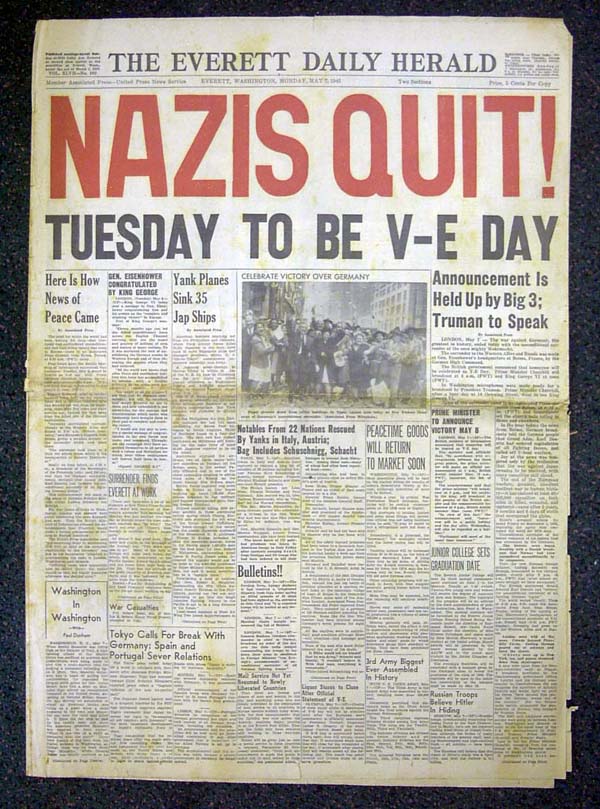
SIXTY YEARS AGO.

NAZIS QUIT!

is the headline in the European theater edition of Stars and Stripes. Sgt. Karlson's unit has moved to Muldenberg, a few kilometers from Hammerbrucke.


13.4.05

SIXTY YEARS AGO. Harry Truman becomes President, succeeding Franklin Roosevelt, who suffered a cerebral hemorrhage at his Warm Springs, Georgia Southern White House. The 2nd Armored and 83rd Infantry are on the Elbe. Sgt. Karlson's unit is headed for the Czech border.

2.4.05

SIXTY YEARS AGO. Sgt. Karlson sends home some impressions of German infrastructure, heading east out of Braubach toward Villmar.
As you know, things happened pretty fast after the Rhine crossing and the next two days we travelled fast and for some of the distance on one of the "Autobahns," super highways. They aren't bad -- no grade crossings, double lane, etc. -- better than Highway 41 between Milwaukee and Chicago only because 41 has quite a few grade crossings.
Photos from that stage of the campaign show the U.S. military using both the eastbound and westbound lanes as eastbound lanes, with trudging columns of German prisoners hiking westbound in the median strip.
After crossing France and Belgium on numerous roads of questionable quality, and some which couldn't even be called roads, the super highways were a great pleasure.
Off the Super Slab, the Herrenvolk still don't get it.
Germany had better roads and more of them than either France or Belgium, but even so they can't hold a candle to the roads in the U.S. Ours are wider, straighter, smoother and much better thru towns and cities. Europe doesn't have farm houses along the highways as we do, but the farmers live in numerous little settlements dotting the country-side and each of these little towns with crooked, narrow streets slow up travel a lot.
The Germans had other plans for internal improvements, including a three-meter-gauge super railroad, the Breitspurbahn. None of that was built.


On the other side of the world, the Marines are coming to grips with a piece of real estate called Okinawa. Mitch at Shot in the Dark has his own Sixty Years Ago going.

18.3.05

SIXTY YEARS AGO. Sgt. Karlson's unit crossed the Mosel and billeted a week in Marienroth, between the Mosel and the Rhine. The weather improved to summery, and he had time to go on a hike (rather than a patrol) in the hills. The Third Army was making good progress in Germany.

17.3.05

SIXTY YEARS AGO. Sgt. Karlson has been on the move for the past two weeks. His unit left Manderfeld, Belgium, occupied an empty house in Losheim, Belgium, before crossing the now-pacified Siegfried Line into Germany. Wilkommen Deutschland. "Spent a cold, rainy night on a muddy hillside in a pup tent." Thence to Lessendorf, then a week in Fuesdorf. The entire week was rainy with extremely dark nights. Their next move is to south of Koblenz, again in the mud and rain.

6.2.05

SIXTY YEARS AGO. Sgt. Karlson's unit is quartered in a farmhouse outside Manderfeld, Belgium. "20 GIs slept all over the floors, while the family stayed in one room. Rainy, cold, but not so frigid. Rest of the Battery lived similarly in 4 nearby houses."

On February 7, the Russians crossed the Oder River.

29.1.05

SIXTY YEARS AGO. Soviet troops overran an abandoned prison and factory complex near Krakow that the world would later know as the Auschwitz-Birkenau. IsraPundit (via Photon Courier) has a collection of remembrances.

Sgt. Karlson's unit has been chasing the Germans out of Luxembourg and Belgium.

17.1.05

SIXTY YEARS AGO. Sgt. Karlson moved from Freux to Jenneville, Belgium. But that proved not to be his unit's direction of advance.
Then turned around and headed through Luxembourg, Luxembourg City and arrived in the town of Berborg, Lux., just south of the City. Had a nice room here and six hour radio shifts. Snowy and cold. Stayed in the former home for the blind so there was plenty of room. Stayed 10 days here and fought the Nazis all the time. Shortly before the end of January, headed back to Belgium, spending one-night stops in uncomfortable spots chasing the Wehrmacht which was retreating rapidly. Heavy fighting through January, and returning to Belgium, following the Germans.
A different letter notes that the Wehrmacht was "rolling pretty fast just then -- in reverse!"

7.1.05

SIXTY YEARS AGO. Sgt. Karlson went to Freux for the next 11-12 days and stayed in a fairly decent house. While there, he received his first boxes from home.

31.12.04

SIXTY YEARS AGO. Sgt. Karlson was playing an away match under somewhat more adverse conditions than those in San Jose.
Huddled ride in open trucks to Recogne, Belgium (near Neuf Chateau). Very cold. 14 radiomen spent New Year's Eve sleeping in a room the size of the front bedroom at home. Cold!
The Germans, however, have scored their 14 points, and the rally is about to begin.