Showing posts with label game theory. Show all posts

27.7.26

BOREDOM IS SOPHISTICATION.

That's true of soporific public radio.


That's true of serious film (pronounced fillllllm).

That's true of juried art exhibitions.

Why should footie be any different?
It's “the beautiful game,” and for most of my adult life I’ve been patiently informed, usually by someone who calls it fĂștbol, that I simply lack the sophistication to appreciate it. But they’re wrong. Soccer isn’t beautiful. It’s boring, and it has nothing to do with sophistication.
The author documents a number of things, including outcomes often indistinguishable from a coin flip.

After a dozen footie-relevant posts in the past two months, it's time to put the dodecahedron back in the locker for a while.  That is, once stoppage time is done.
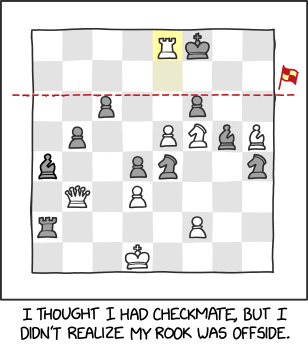

Sorry, I couldn't resist that parting shot!

Find yourself a circus and go to it.

6.7.26

WHY NOT END THE GAME WHEN THE STREETLIGHTS COME ON?

That might be a problem in the developing world, where aspiring players might make do with a vacant lot, but streetlights might be nonexistent or unreliable.

Determining the end of a footie game?  It's the complete opposite of football, where Vince Lombardi could say "you don't lose, but sometimes the clock runs out on you" with near certainty on when that clock was going to run out, as the two minute warning began as a pause to synchronize the unofficial scoreboard clock with the official timekeeper's stopwatch.  These days the scoreboard clock is almost always right, and the two minute warning a water break for the players, a bathroom break for the fans, and an opportunity to sell colored water in blue cans to guys who will thus have to take another bathroom break.

Once the clock gets to ninety minutes, a functionary notes there will be a few more minutes of "stoppage time," determined by a formula that might be more arcane than sailing's handicap rating formulas.  Even then, there's no well-defined end to it.

24.6.26

ISRAEL GETS A SAY.

Andrew Fox suggests that's what might be motivating the latest round of phony peace talks.
Iran needs time first. Time to get oil moving through Hormuz again, but in a way that makes the reopening of the Strait of Hormuz conditional, reversible, and politically useful. Tehran’s position goes beyond simply “open” or “closed”. Every barrel, every tanker, every demined shipping lane, and every assurance to markets comes at a price.

That price is leverage over Washington’s relationship with Israel. The conflict in Lebanon between the IDF and Hezbollah is now central. Iran has been explicit that the talks must focus on the Lebanon ceasefire, the terms for reopening Hormuz, oil sanctions, and access to frozen assets. In other words, Hezbollah is being inserted into the US-Iran negotiations as a test of whether Trump can restrain Israel.

This is the Hezbollah-shaped wedge Tehran is trying to drive between Washington and Jerusalem. Iran needs Hezbollah to remain a persistent enough problem that every Israeli action in southern Lebanon can be turned into an Iranian complaint about American bad faith. Israel strikes, Iran claims the memorandum has been breached, and Trump either pressures Israel or risks Hormuz. The point is to trap Washington between oil prices and Israeli operational freedom.

Trump has already shown Tehran where the pressure point lies. The president has today publicly threatened Iran, including over Hormuz and Hezbollah, while JD Vance has tried to project a softer, deal-making tone from Switzerland. Vance said the talks had made “great progress”, while Trump was simultaneously warning that Iran must stop its “proxies in Lebanon” or face harder strikes.
Iran's control over the strait is a wasting asset: every day construction progresses on pipelines from Gulf Arab oilfields to ports beyond the reach of those Iranian speedboats.  Israel remains a sovereign country, as, on paper, does Lebanon, and progress in cooperation between those governments to re-establish Lebanon's monopoly on violence over Hezbollah or any other insurgent or criminal organization, further limits Iran's ability to make mischief.  And who knows what sort of internal politicking is going on in Iran?
Internal allocation is a matter of internal dispute. Hardliners will want money for rearmament and deterrence. The security state will want money for surveillance, prisons, salaries, and coercive capacity. Ordinary Iranians will want relief after war, sanctions, inflation, and exhaustion. Every dollar that returns to Iran becomes part of an internal struggle over what kind of state survives this war.
Here's where the Iranian propensity to dicker as if a faculty committee doling out $1.38 in merit money might work to the advantage of the United States, Israel, and the Gulf Arab countries that are not currently parties to the negotiations.

17.6.26

A FACULTY MEETING, WITH HIGH EXPLOSIVES.

There is a fourteen point "memorandum of understanding" circulating that appears to be what diplomats are using to, for the moment, restore the free transit of oil at market prices through the Strait of Hormuz.  The Institute for the Study of War offer their analysis in their 16 June briefing.

11.6.26

SHOWING THEM WHAT THEY WANTED TO SEE?

On Tuesday, we noted the quiet movement of tankers out of the Arabian Gulf along the Omani side of the Strait of Hormuz and with the shepherding of the United States Navy.  That story was coming out a week ago.  "The Strait of Hormuz is more open than previously thought as the U.S. shoots down Iranian drones threatening ships and provides ‘naval overwatch’."

Apparently the Navy setting its blockade line at the Iranian - Pakistani border was thought through.  That the Iranians were not seeing many ships moving, and that their enablers in the palace guard media were scoffing at how ineffective Project Freedom was made the likes of CNN and MSwhatever part of an information operation.
The operation consisted of Very Large Crude Carriers, we'd call them "supertankers," exiting through Hormuz without their Automatic Identification System, the maritime equivalent of an aircraft transponder shut off. Once in the Gulf of Oman, these vessels rendezvoused with other tankers and were emptied via ship-to-ship transfers. The empty tankers then headed back into the Persian Gulf to pick up a new load of oil from the UAE, Saudi Arabia, Bahrain, Qatar, or Iraq. This kept the number of ships in the Persian Gulf stable and provided no hint of Washington running its own "dark fleet" of oil smugglers. Wash, rinse, repeat.

It also explains the U.S. Navy's aggressiveness in the Gulf of Oman in turning around inbound ships bound for Iran. Yes, it served to support the blockade, but it also prevented an Iran-bound ship from stumbling upon a transfer operation and blowing the whistle when they made port.

The blockade runners were covered by a $40 billion war insurance pool furnished by the Development Finance Corporation. Oddly enough, this was another Trump administration initiative that was derided as a failure.

It looks like President Trump's announcement was made because the whole operation was about to become public.
It wasn't so much that the United States was not in a hurry to reopen the strait as it was that keeping the Iranians from profiting by their blockade might have better been accomplished by having only a few ships risk the passage while transloading out of Iranian sight.  "Assuming the accuracy of Trump's statement, it means Iran doesn't control the Strait of Hormuz and can't prevent other Gulf countries from exporting oil. This means the only people Iran is blockading are itself."

Whether that was the cargo that broke the mullahs' economy and that's why they might be signing an agreement remains to be seen.  Here comes the weekend, prepare to be whipsawed.

THE ANACONDA'S COILS CONTINUE TO TIGHTEN.

This morning, Red State's Ward Clark reported "Trump Announces Bold New Kharg Island Move to Crush Iran Regime."


Iran some errands, and someone in Iran ran to the hot line.  Teri Cristoph, also with Red State, filed a different story.  "Did Iran Just Blink? Trump Abruptly Cancels Thursday Night Strikes (but Keeps Iran's Ships Boxed In)."  That's approximately where we were two months ago, and as one might expect of Red State regulars, the hotheads are again losing patience.  No confirmation from Teheran, although all sorts of claims by Our President that all the other countries of Asia Minor are participating in this round of diplomacy.

10.6.26

LET THE THING BE PRESSED.

Last week, Gatestone Institute contributor Con Coughlin contended, "Renewing Military Strikes Against Iran Is the Only Way to End Its Nuclear Ambitions."  As of this evening, those strikes are on again, at least for now.  Mr Coughlin's contention concludes, "With the American president continuing to insist he is under no pressure to reach a deal with Tehran, the intransigence of Iranian leaders could ultimately persuade him that, in order to ensure the Iranians have no chance of resuming their nuclear and ballistic missile programme, he has no alternative but to resume military action against the regime."


What part of "turn over your nuclear dust and we'll stop whacking you" do the mullahs and their gangbanger proxies not understand?  Perhaps Our President will take that position.  He's supposedly taking calls from somebody in Iranian leadership asking him to stop the bombing.  I hope his response is something along the lines of "turn over your nuclear dust and we'll stop whacking you."  Otherwise it's more of the same.  In The (Not Detroit) Free Press, Aaron MacLean counsels, "Mr. President, Don’t Let Tehran Dupe You."  Strategic patience, in his view, isn't working, and Trumpian mercurial treatments of Israel and the Gulf Arab states looks foolish.
Despite the leverage the United States has over Iran, in the form of the blockade and the very substantial U.S. military force still in the region, Iran does not behave as though it is particularly deterred. But Trump certainly seems to act as though he is deterred. Along with his dogged pursuit of a deal, his fear of escalation is another Obama-esque aspect of the president’s current approach, even if the overall comparison has its obvious limitations.
Perhaps Our President is drawing on the experience he obtained working with the people one encounters in the building trades and building services in New York, and he's trying a mix of charm and force.  Mr MacLean's predictions from a couple of days ago might not have aged well.
Tehran certainly seems contemptuous of the risks it faces from the American military capacity in their neighborhood, given the president’s refusal to return to major combat operations in the face of repeated Iranian aggression since the start of the so-called ceasefire—and now, his demonstrated willingness to restrain the Israelis.

The Iranians know the president’s options are limited: taking a bad deal, returning to major combat, or waiting. The first option is politically difficult at home, and the president seems deterred from major combat—but he does say he is content to wait.

The Iranians, meanwhile, are trying to make “waiting” as painful an option as possible. They want to force him to weaken his bargaining position. The question now is whether they succeed, or if Trump rediscovers the confidence and resolve that he projected when this episode began.
We'll see what the next couple of days of kinetic action, or not, brings.

9.6.26

IN THE ABSENCE OF A MANAGER, GIVE STRATEGIC PATIENCE A CHANCE.

Pajamas Media's Rick Moran suggests "The War Has Shattered the Iranian Leadership Structure, Making an Agreement Next to Impossible."  There wasn't much of a "regime" before hostilities commenced, but the hotheads are in the saddle in Persia.
The Iranian leadership structure, as chaotic and contentious as it is in peacetime, was shattered by the decapitation strikes that not only took most of the key decision makers off the board but also drove a hysterical paranoia among the survivors, pitting the major factions against each other in suspicion and fear.

The Islamic Revolutionary Guard Corps (IRGC), always a power behind the throne since the founding of the Islamic Republic, was forced to step into the spotlight and take over.
Whether Ahmad "Klingon" Vahidi is still in charge of the revolutionary guards, or not, the True Believers still have the muscle, but apparently even a military dictatorship in a country that has institutionalized the faculty meeting as a governing style doesn't have the authority to reach a consensus on the terms they'd like to dictate to the infidels.
Vahidi is the hardest of hardliners, ordering the attacks on Gulf states and U.S. bases in the region. When President Masoud Pezeshkian apologized to those countries, promising it would never happen again, Vahidi reportedly went ballistic. He severely reprimanded the president, and the attacks resumed.

His biggest problem is that even after sidelining the pragmatists like Pezeshkian and Mohammad-Bagher Ghalibaf, the current speaker of the Iranian parliament, other factions with diverse economic, religious, and policy goals complicate his job enormously. As much as Vahidi may want to be a dictator, the bureaucracy won't let him. He can only do so much to influence events.
I suspect the bureaucracy would like to hang onto their nuclear program, and they might prefer to have everything settled at once, rather than recognize the Strait of Hormuz as international waters and sell some oil now and hope for the best getting the sanctions lifted once the nuclear material is in United States hands.  But what the process-worshippers are discovering is that the faculty meeting approach to making policy has its limitations.
The clerics, while little more than figureheads, are nevertheless important to the legitimacy of the Iranian regime. Vahidi and the rest of the IRGC must pledge their allegiance to the supreme leader and at least appear to obey the clerics.

"Iran is an 'Islamic Republic," writes Amatzia Baram of the Middle East Forum. "Constitutionally and in the eyes of many Iranians, 'The Rule of the [Islamic] Jurist' (velayat-e faqih), the legacy of former Ayatollah Ruhollah Khomeini, is still binding."

Nour News, an outlet affiliated with Iran’s Supreme National Security Council, "acknowledged what it described as a growing 'chronic disorder of governance' inside Iran, arguing that the country suffers not from a lack of information or resources, but from an inability to make 'timely, decisive and rapid decisions.'"
While they dither, perhaps the best thing to do is let the anaconda's coils tighten.

8.6.26

TESTING THE LIMITS OF STRATEGIC PATIENCE?

Israel and Iran traded shots over the weekend.  The anaconda's coils continue to tighten, and Our President doesn't seem troubled.  “I am going to call Bibi right now and tell him not to retaliate. Each of them had their fun. Israel had its strike, and Iran had its strike. We don’t need another one.”  As of this afternoon just a little bit south of Wisconsin, the fireworks appear to be over.

5.6.26

THE MANAGER HAS TO APPROVE.

The ritual for buying a car used to involve one of the dealer's floor sales representative doing most of the dickering: we can hope for precisely the make, model, and options you want to be scheduled in a month, or we can put you in something similar right now, and perhaps at a lower price; here's what I think I can get the manager to sign off on your trade-in, and have you considered financing through us?  But whatever the buyer and the floor representative shook hands on still had to be cleared by the manager, who was the dealer's last chance to extract more favorable terms from the buyer.  Once upon a time, my dad and a floor representative had a price sheet worked out and my dad wrote a deposit check, then the representative went to the manager, and came back with the manager's extractions.  My dad asked for the deposit check back.  The dealership caved: evidently making a sale today was better than having the deposit check go out the door.

27.5.26

BIG PAYROLLS, NO GUARANTEES.

The Chicago Cubs are off to an interesting opening third of their season, two ten game winning streaks, and a losing streak at ten games and counting.  "Cubs Players Forced to Swallow Bitter Pill as Craig Counsell Makes Unwanted Record."


So it often is with the so-called large market teams, there's no salary cap in major league baseball which offers owners of such teams the opportunity to hire premium players at premium prices.  But they have to perform.
[F]or a few MLB insiders, the Cubs players are to blame and not Counsell.

“I’m not really sure it’s his fault…This has to do with some of the players not living up to the contracts that were signed,” 104.3 The Score’s Mike Mulligan said in a podcast.

The Cubs entered this week hoping to end their losing streak. However, after taking the beatings from the Astros, the Cubs started the week by losing to the Pirates. Their Monday loss against the Pirates is their ninth straight loss. “We’ve gotta play better, we gotta swing the bats better, we gotta pitch better, we need more guys contributing to good stuff,” Counsell said on Monday afternoon. “And as a coaching staff, we gotta figure out a way to get the players there. Offensively, we are equipped to be way more consistent than this and way better than this. We need to show it.”

Against the Astros, the Cubs’ pitching staff allowed 15 runs in three games. On Monday, the pitching improved, giving up just 2 runs, but the offense faltered.
So it sometimes goes in the regular season, the Brewers won all six regular season games with Los Angeles's Dodgers (if they were the Brooklyn Trolley Dodgers, are they the Roger Rabbit Dodgers in Los Angeles?) and you-know-who made short work of the Brewers en route to another World Series.

The Brewers are in the middle of a gantlet of strong teams that has included sweeps of the Yankees, Cubs, and Cardinals, and they're off to Houston next.  We are, however, only a third of the way into the season.

26.5.26

TAKING LEAVE OF THE MID-AMERICAN IN STYLE.

Northern Illinois University's baseball team won the Mid-American conference tournament in the sweetest possible way, defeating Toledo in their final appearance in that tournament.
The Huskies won their program-record 35th game on the season to make the occasion even more special. This is NIU's first MAC baseball title, sending the Huskies to the NCAA Regionals next week. In four games at the MAC Tournament this week, NIU outscored its opponents 32-9 and trailed only once. The Huskies' pitching staff had a 1.80 earned run average and held teams to a .193 batting average.
That earned Northern Illinois the sole Mid-American bid to the national tournament, which begins with a double elimination regional round reducing a field of 64 to eight teams that play best two out of three on the home fields of the top four seeds to qualify for the double-elimination College World Series in Omaha.

22.5.26

QUIET FLOWS THE DONALD.

Over the past two weeks, diplomats all over Asia Minor have been attempting to negotiate something resembling a peace deal, or perhaps, to use the term of art, an accord, among the United States, Iran, Israel, and the Arabian Gulf countries.  It has National Review's Noah Rothman asking, "Has TACO Tuesday Finally Come to Iran?"  And yes, the past two weeks of diplomacy have Iran hawks in the United States who want to send the mullahs to their virgins losing patience with Our President.


That there are conflicting reports about why the United States so rapidly suspended their effort, "Project Freedom," to get cargo ships on their way from the Gulf to their destinations only adds to the hawks' frustrations.  Mr Rothman quotes a social media post (how diplomatic communications have changed, Charlie Brown) from Our President that the project was paused after one night at "the request of Pakistan and other Countries."  Pakistan's request might have been to give peace a chance.  The other countries might have made that request because the operating orders for the mission offered insufficient air defense for, say, Emirates oil terminals or Kuwaiti desalination plants.  Or it might be that in getting those ships through, the Arleigh Burkes expended the contents of their magazines.  James Joyner notes, "Leaked estimates are at substantial variance from administration claims."  He has sufficient integrity to complain about intelligence bureaucrats leaking material for their own reasons.

19.5.26

PROGRESS?

As of this afternoon, the latest edition of the Victor E. Garden is being planted, and the ongoing negotiation over nuclear materials that the current owner doesn't want to part with goes on.  Perhaps Commander Salamander is asking the right question, "If Iran Wants to Rule Rubble, Should we Let Them?"
We’re in it now, and at this stage—having taken away the Islamic Republic’s conventional heft and ability to maintain her proxies—we have to deal with the secondary effects—getting the free flow of goods at market prices out of the Strait of Hormuz choke point…while keeping pressure on the Islamic Republic.

We are trying to find some agreement with the forces ruling the Islamic Republic that seem content to destroy Iran as long as they rule over the rubble, and impoverish everyone else as long as it helps support goal #1.
There's a division of war objectives, with the United States concentrating on restoring freedom of navigation and taking control of the fissile material, the Israelis seeking an end to non-governmental organizations with weapons cutting up on their borders, and who knows what ancient rivalries are playing out among the Gulf Arab states and Persia, who are not parties to the cease fire, such as it is, the United States and Israel have mostly been respecting.

18.5.26

CEASE AND DESIST THIS POINTLESS PALAVER?

There are multiple layers of conflict in Asia Minor.  The United States seek freedom of seas, including transit of the Strait of Hormuz, and an end to Iranian nuclear weapons work as long as the crazies are in charge of former Persia.  Israel's government have their own, more salient fears, of an Iranian hot rock, while they and the Lebanese seek some sort of recognition that Lebanon's government have the monopoly on violence in Lebanon, whether or not the Hezbollah militia like that.  Recently, news has come out that the United Arab Emirates and Saudi Arabia have been trading shots with Iran, both in the closing days of Epic Fury and after the so-far frustrating negotiations between Iran and the United States began.

12.5.26

THERE IS NO MEDIAN VOTER.

A few days ago, somebody on a radio interview noted that "winner take all" had migrated from the way 48 states assign electoral votes to the way a state with its government controlled by one political party now had leave to apportion its Congressional districts in such a way as to take all the House seats being contested.  That prompted Josh Barro, the Democrat-leaning son of a Republican-leaning father, to suggest, "The way to compensate for a less-favorable map is by winning a larger share of the vote, so Democrats must move closer to the median voter."

NOBODY WANTED THIS.

According to Reason's Jason Russell, the collegiate sports cartel made an unpopular decision at the wrong time.
March Madness is growing from 68 teams to 76 teams for both men and women, even though no one asked for this—not fans, anyway. The vast majority of public sentiment has been against expansion, while conference leaders and coaches have pushed for expansion (it's a lot harder to get fired if your mediocre team somehow slides into the tournament).
It's not as if the cartel managers are doing everything they can to keep the four or five power conferences from bolting, which comes as no surprise.  "How long have I been carrying on about College Sports, Inc. realigning until there are four major conferences of sixteen teams each and the National Collegiate Athletic Association becomes irrelevant?"

11.5.26

IT'S CALLED SURRENDER.

Predictably, Jake Johnson with Common Dreams takes the side of the mullahs.  "Iranian Official Says Trump Rejected Peace Proposal That Was ‘Reasonable and Generous.’"  Foreign Ministry mouthpiece Esmail Baghaei is whining like an overindulged child.  “Is our proposal for safe passage through the Strait of Hormuz unreasonable?  Is establishing peace and security across the entire region irresponsible?”

Yes, and yes, because what remains of his government would like to control ingress to and egress from the Arabian Gulf, and Herr Baghaei's vision of peace and security still includes paid gangbangers masquerading as religious believers chanting "death to Israel," internal security forces punishing dissent with death, and work continuing on a nuclear weapon.

29.4.26

AYATOLLAH-MAHT?

Victor Hanson suggests Iran's government has imploded.  It could be worse than that.  "It is one thing for the people to be ruled by globally feared autocrats armed to the teeth, but quite another to be governed by humiliated, now-impotent incompetents and buffoons."

Sooner or later, the mullahs' control over information in the country is going to run afoul of reality.  State radio can broadcast the latest demands they are making of Israel or the United States all they want.  Sooner or later the people might start asking "Where are those concessions from infidels?"  Probably just before they start asking "Where is rice at grocer?"  "When your country faces the prospect of hunger riots, you are not winning the war."

Turn over the fissile materials.  Stop funding proxies elsewhere in Asia Minor.  Compensate the Gulf Arab states for those damaged hotels.

Let the anaconda's coils tighten.

21.4.26

LET THE ANACONDA'S COILS TIGHTEN.

As of this afternoon, Pakistani diplomats have forwarded a request from Iran to continue the cease-fire.
President Donald Trump said on Tuesday that he will not go forward with new strikes on Iran at the request of Pakistani officials, extending the ceasefire between the U.S. and Iran.

Trump said Pakistani Prime Minister Shehbaz Sharif and Field Marshal Asim Munir asked the U.S. to “hold our Attack on the Country of Iran until such time as [Iranian] leaders and representatives can come up with a unified proposal” to end the war.

Trump added that the U.S. will continue to blockade Iranian shipping in the Strait of Hormuz, which has served as a key point of tension between the two countries.
No "unified proposal" suggests that the mullahs' ten point plan that Code Pink types endorsed, only yesterday, as "a workable basis for negotiations" might no longer be operative.  You'd think, if this Iranian academic correctly assesses the situation as “Iran believes it has the upper hand and that this must be established in any future confrontation,” that somebody would have informed the Pakistani mediators that the Iranian negotiators stand by their ten points, and then it would be up to National Command Authority to make counter-offers.

Our President seems to be in no hurry to send negotiators to Pakistan, which suggests he's standing by his base position, which is that the nuclear physics ends, the funding of terrorist proxies in other countries ends, the Strait of Hormuz  remains an international waterway with no tolls, and Iran's ports are closed until those conditions are met.
