30.1.16

THIS WILL BOOST U.S. NEWS RANKINGS SALES.

Sara Goldrick-Rab proposes that higher education reframe the way it talks about itself.
College isn’t what it used to be. Today it’s full of those so-called “nontraditional” students in need of “remediation” and lots of “financial aid.” We have to adapt in order to accommodate their “needs” and “deficiencies.”

Right?

Nah.

This common discourse is all kinds of wrong. Today’s students are regular people. The privileged people are “nontraditional!” Those fortunate few who get to attend amazing high schools with great college preparation and who can afford college easily — they are in the minority. But colleges have long focused on catering to that elite group’s whims and desires, never referring to their “challenges” with, for example, conspicuous consumption.
I concur in part and dissent in part.  It is a libel to think of first-generation or non-traditional as synonymous with less capable of handling college work. That's her Tenth Suggestion.  I'd rank that as the First Suggestion.  Requiring administrators to teach a class?  I'd amend that to say, an upper-division class in a traditional field.  Carla Montgomery of Northern Illinois did so, in geology.  Joshua Lawrence Chamberlain at Bowdoin did so, years ago, in anything but mathematics, with rebel bullet fragments in his gut.  None of this Retention 101 stuff.  Professors advising students?  Helps both the professor and the student negotiate the bureaucracy.

And yet, without a commitment to provide such students with the intellectual challenges that are de rigueur at the hundred institutions claiming to be in the top twenty, the same dynamic of avoiding the subprime party schools and the institutions that are reprising high school will be at work.

GETTING OFF THE LIBERAL PLANTATION.

I believe the editorial writers of The Wall Street Journal coined that phrase.

Tea Party image.

Now comes Margaret Kimberley, calling out Michigan's politicians in a similar way.
Hillary Clinton stated the obvious, that the governor should ask for federal help. In return for stating the obvious Clinton received an endorsement from Flint’s mayor Karen Weaver.

That act shows that there is in fact no useful black politics in this country. The mayor had a golden opportunity to advocate for her constituents. She could have said that Flint deserved at least as much as Syrian terrorists. She could have demanded full restitution for property owners and free health care for residents poisoned by the water supply. She could have made those demands and withheld any endorsement without a commitment to restore her city. She could have acted like the bankers who pushed Detroit into bankruptcy with derivative schemes and still elbowed their way to the front of the line to be paid first.

Instead she acted like the supplicants that all black politicians end up becoming. Weaver was eager to get on the band wagon for some paltry reward like being a super delegate for Hillary while people in Flint can’t drink, wash or bathe without donated water.

Flint is ground zero in the campaign to get black people out of the nation’s cities. Once that happens capital will suddenly reappear and Flint will be declared “up and coming” or “hot.” Those words will be a sign that the neo-liberal mission has been accomplished. The poisoned people will be gone and the people who should have represented them will still be in place. Unless of course someone is willing to fight for a truly democratic country.
There's nothing new under the sun. Anybody else remember when "urban renewal" was transformed, Cockney-rhyming-slang fashion, into "Negro removal?"
Michigan’s emergency financial manager system – a weapon of corporate dictatorship imposed selectively on heavily Black and brown cities and school systems – is the lead-tipped point of the spear that is gutting urban Black America. It is not a unique instrument – and certainly not a Republican invention – but part of Wall Street’s tool kit to starve, bulldoze, redline, over-price, oppressively police, and even poison Black people out of the urban centers.
With, then and now, the connivance of technocrats and Democrat politicians.

NOW GO AFTER THE INTELLECTUAL FOUNDATIONS.

A computer science instructor at Portland Community College (via College Fixpushes back against the latest addition to Identity Politics Spring, which now adds "Whiteness History" to April (poor, overworked April, but February and March are already spoken for by the Oppression Olympics gold and silver medalists.)

He's thinking about the right things, but the intellectual foundations of his argument are much deeper.
We are told that power must be redistributed in a more equitable manner. But power isn’t distributed like coupons.
He's focusing on power, rather than on "privilege." These are distinct concepts, neither of which appear on the project's announcement page.  Loosely, "power" is the ability to compel others to do what you want, and "privilege" is the ability to interact easily with others.  Thus, the dissenting view addresses both concepts, although incompletely.
Power is acquired by personal effort. It is not given. But by all means teach the skills of acquisition of power. Become proficient in English. There is one of the most powerful tools available. Become proficient in the use of a computer and you will have at your fingertips a tool more powerful than any human before you has ever possessed.
Perhaps that's a gripe about the identity-politics complex stealing resources from the academic departments, which is a useful thing to do.   But without a stronger understanding of the meaning of the term, and about the evolutionary stability of mutually beneficial interactions, it's an incomplete gripe.

If, dear reader, you want to encourage students to master the fundamentals rather than whine about injustice, please consider this.
Let's suppose, for the sake of argument, that the Perpetually Aggrieved would like to extend the set of automatic operations [that people engage in almost instinctively] to offering employment or retail assistance or endorsement without regard to race, creed, color, national origin, family circumstance, or university degree.  Then there'd be less reason to call attention to flawed politically correct arguments, because there'd be fewer flawed politically correct arguments in the first place.
Perhaps the way forward is for the diversity bureaucracy at Portland Community to stop excusing the shortcomings of affirmative action admits, or something, or at least to stop mau-mauing the white students and faculty. That might be where the letter of protest is going.
But the grievance industry doesn’t want people to acquire personal power. It wants to reinforce their identity as victims. Only by keeping targeted groups convinced of their own powerlessness can it maintain its own control over them. The equity and inclusion people, the community organizers, the women’s resources groups, the minority studies “scholars” all reap huge benefits from their sordid and self-serving business.
Yes, and here is why their business is sordid and self-serving.
Bourgeois interacts with bourgeois: agreements are made, agreements are kept, mutually beneficial interactions emerge, living conditions improve.

Underclass interacts with underclass: lives are made worse, or lives are ended.

Underclass interacts with bourgeois: someone gets swindled, or the gentry intellectuals seek the sanction of the victim to get the bourgeois to kick in for the maintenance of the underclass.
The protest letter, incomplete though it is, represents a victim removing his sanction. Let the rebellion continue.

COMPETITION BIDS UP PRICES.

Fast Company reports that the day care business is not exempt from that law of conservation.
Recent analysis from the Economic Policy Institute (EPI) found that in 33 states and the District of Columbia, infant care costs exceed the average cost of in-state college tuition at public four-year institutions.
There's probably a simple regression analysis to run and clarify the extent to which higher day-care bills track female labor force participation and household incomes.  But it's rare to see, to a first approximation, day care expenses tracking incomes.
"Women lose $11,000 a year on average because of the pay gap, which incidentally is just about the average yearly cost of child care in the U.S.," Tracy Sturdivant, cofounder and codirector of Make It Work, a campaign to advance economic security for working women, men, and families, points out.
At the margin, oughtn't the equilibrium working mom be indifferent between staying attached to the labor force (which makes the so-called pay gap go away) or leaving the labor force (which depresses lifetime earnings).  Am I missing something here, to observe that the price of a service reflects the value of its marginal product?  But Ms Sturdivant isn't going to let an arbitrage argument get in the way of a good rant.
In order to retain talented parents, Sturdivant says there are some things employers can do to ease the strain, beginning by ensuring they're paying women and men the same amount for equal work.

"Additionally," she says, "employers can support working parents through policies like fair, flexible scheduling, paid sick days, and paid family leave, so that they’re never forcing their employees to choose between work and family."
It's likely that employers are already paying comparable workers comparable salaries, otherwise there are arbitrage opportunities for workers or for corporate raiders. It's also likely that managers don't want to antagonize single or empty-nester employees by sticking them with extra work and calling it a family-friendly policy.  And workers might be opting off the 24/7 treadmill, kids or not.

29.1.16

INSTITUTIONS ARE CIVILIZATION

I've recently remarked favorably on research by Yale historian Timothy Snyder, whose work focuses on a part of the world that figures in my own history.  He recently finished another book, Black Earth: The Holocaust as History and Warning, that appears to be advancing the thesis that Hitler blamed "the Jews" for the moderating institutions by which people resolved their differences rather than killing each other.  And thus, mediating institutions put the stronger at a disadvantage relative to the weak.  I'm going to have to read through the work, to see how he develops this argument.  I have a vested interest, in years of teaching economics, of commending the mediating institutions, including the rules of contract, fraud, property, and propriety, in benefitting the stronger and the weaker alike.

But Professor Snyder has also taken, recently, to the popular press to caution the enlightened layman that a similar terror might be one bad harvest or one bad batch of immigrants away, should the objective circumstances be trying enough.  Thus, in a Guardian essay from last fall, here is the way the mediating institutions might crash, and why that would be bad.  (There's a lot more in the essay, by all means read it.  I have only the message about institutions this afternoon.)
States should invest in science so that the future can be calmly contemplated. The study of the past suggests why this would be a wise course. Time supports thought, thought supports time; structure supports plurality, and plurality, structure. This line of reasoning is less glamorous than waiting for general disaster and dreaming of personal redemption. Effective prevention of mass killings is incremental and its heroes are invisible. No conception of a durable state can compete with visions of totality. No green politics will ever be as exciting as red blood on black earth.

But opposing evil requires inspiration by what is sound rather than by what is resonant. The pluralities of nature and politics, order and freedom, past and future, are not as intoxicating as the totalitarian utopias of the last century. Every unity is beautiful as image but circular as logic and tyrannical as politics. The answer to those who seek totality is not anarchy, which is not totality’s enemy but its handmaiden. The answer is thoughtful, plural institutions: an unending labour of differentiated creation. This is a matter of imagination, maturity and survival.
If that sounds a little like emergence plus a conservative habit of mind plus be careful in deconstructing institutions, good!

PREPARE THE BUNNIES PROPERLY

Last week, Mount St. Mary College president Simon Newman committed a Kinsley gaffe, with a perhaps tongue-in-cheek, perhaps over-the-top suggestion that some cuddly bunnies had to be drowned.  Regular readers know where I stand.  "Stop admitting unprepared people and calling it access.  And stop enabling underachievement and calling it retention."

At Slate, Rebecca Schumann concurred in part.
Newman’s clunkers are also part of a larger—and important—conversation about the best ways to help struggling freshmen. Amazingly enough, there are some cost-effective and relatively easy solutions to be implemented here—solutions that treat “force the student out” as a last resort.

First, and this is the most important of all possible suggestions: Don’t accept many marginal students in the first place.  The admissions committee of any given institution is supposed to know exactly what it takes to succeed there—so if a student’s application isn’t strong enough to give her a probable chance of earning a baccalaureate from the 22nd-best regional university in the Northern United States within five years, reject that application. If an institution isn’t competitive enough to ensure a mostly strong freshman class, then that is a larger systemic problem that no amount of bunny-drowning can alleviate.
Indeed, there is much else to recommend in that article, including the dig she gets in at Bain Capital. Presumably Mr Newman took the Mount St. Mary job for purposes other than stripping the assets and closing the corporate shell down.  "If Newman wants a better bottom line, then he should try to strengthen his institution’s academics (or, if we’re being cynical, build a water park)."

That is, either recognize you are in the same business as the Ivies and compete for those students and that faculty, or compete with the sub-prime party schools.

But what do you do if your mission statement is that of the common carrier?  That's where Matt Reed finds himself.
I don’t know if she intended to write off the entire community college sector in one fell swoop, or if she just didn’t realize she was doing it.  But either way, I must object.

Although Schuman’s piece is supposed to be a rebuttal, she and Newman actually share a core assumption: capability is a discrete quality inhering in individual students, and it can be sussed out and measured quickly and easily.  They disagree only on timing: Schuman prefers to sort out the unworthy or incapable before admission, while Newman waits until a few weeks into the first semester.  Either way, though, success comes from exclusion.

The founding assumption of community colleges as a sector is that the epistemology behind exclusion is false.  We don’t know who will succeed until they have a chance.  Ability sometimes wears disguises.  The way community colleges discern ability is by letting people in and giving them a chance to show what they can do.
Yes, and second chances are as American as the infield fly rule and French toast in the dining car. We don't track people for college or the trades from the age of twelve the way the Germans with their "free" college do.  And yet, as Robert Kennedy used to say, we can do better.
The willed naivete of open-admissions requires effort to sustain.  It increasingly cuts against the grain of a culture that seems to have made peace with economic polarization.  It requires tolerating failure -- neither denying it nor punishing it -- in a culture that believes in “performance funding.”  It means embracing economic and racial diversity in a culture that increasingly defines a “good” neighborhood or school by the absence of poor and/or brown people.  Sometimes it even means choosing to disregard Big Data and give some longshots a chance, just because it’s the right thing to do.  Choosing ethics over data feels almost radical these days.  Efficiency is great, but it only makes sense against some larger goal.  It’s not a goal in itself.
That last sentence echoes my "efficiency is a goal, but not the only goal" that two generations of economics students got from me in public policy classes.  But among the comments to Mr Reed's post we find gripes that too many disengaged and unprepared students sap faculty morale and erode the college's job placement performance.

State legislators in Wisconsin and Tennessee are already calling for state universities to identify the high schools that are sending Distressed Material their way, and perhaps, one of these days, those high schools will have to compensate the universities for the remedial courses.  Per corollary, how long will the legislators consent to funding two sets of high schools, one without ashtrays, and another with?  By the time the prospective collegian gets to high school, he might already have been passed along to middle school without the basics out of elementary school, passed along to high school without the middle school material, then sent along to college reading at the sixth-grade level.

There has to be a better way.  Perhaps, though, legislators are reasoning backwards.  First identify the high schools, then you might have a better idea where the underachieving middle schools and elementary schools are.

YOU WIN MORE BY DEFUNDING THEM THAN BY EATING THEIR TABLE SCRAPS.

Here's Charles Marohn of Strong Towns, suggesting that the best thing Government can do for "crumbling infrastructure" is to go away.  Or perhaps, which might be even more difficult, stop creating expensive and lightly used ribbon-cutting opportunities for pork-barrelling politicians.
At this point, communal [local government] funds must be for [road] maintenance only with any system expansion being paid by some form of user charge. #nonewroads

And if this means that states and the federal government, unable to resolve the complexities of successfully growing a centralized economy without the opiate of transportation spending, devolve funding to the local level for all but the critical systems of interstate travel, then that works too.

And as a final word, for those of you hoping to fund transit, pedestrian and cycling improvements out of increased state and federal dollars, I offer two observations. First, you are advocating for high-return investments in a financing system that does not currently value return-on-investment. You are going to finish way behind on every race, at least until we no longer have the funds to even run a race. Stop selling out for a drop in the bucket and start demanding high ROI spending.

Second, the cost of getting anything you want is going to be expansive funding to prop up the systems that hurt the viability of transit, biking and walking improvements. Every dollar you get is going to be bought with dozens of dollars for suburban commuters, their parking lots and drive throughs and their mindset continuing to oppose your efforts at every turn. You win more by defunding them than by eating their table scraps.
Two elaborations.  First, there is no such thing as "successfully growing a centralized economy."  Complex adaptive systems do what they d**n well please.  Second, business-as-usual with "bipartisan compromise" always works this way.  Want a slice of bread, bicycle riders?  Make sure the truckers get six loaves.

TAKING THE LONG VIEW.

In National Review, Kevin D. Williamson suggests that a "conservative crack-up" is what happens when the aging hippies have had some kind of mushroom.
Conservatives have won important debates and political victories on everything from taxation to free speech to foreign policy. Those conservatives who complain that the Right hasn’t accomplished very much forget where the country was in 1955 when National Review was founded and central planning was assumed by all the right people to be the model of the future, or where the country’s domestic policies stood in 1980 or its national-security policies in 2000.
To paraphrase Our President, airlines are deregulated, freight railroads are profitable, and the Soviet Union is dead.

That emergent Democrat majority of nontraditional Americans?  Not yet.  Perhaps this crack-up talk is more fear masquerading as smugness.

Not bad for a bunch of squares.  Time on task, getting the message out, matters.  And stay the course.
Conservatives are good at it. Despite vast piles of money and stores of energy directed at the project, there is no left-wing talk radio of any real significance to speak of, unless one counts the bland suburban progressivism of NPR. Fox News on a good night exceeds in audience share the rest of its cable news competitors combined. It surely is not lost on our counterparts on the Left that the peaks of Republican-party power have coincided with the influence of organized conservatism and its journals, whereas the apex of Democratic power came under Bill Clinton, who ran as hard against the campus-crusader radicalism of The Nation and Mother Jones as he did against George H. W. Bush. Mrs. Clinton is running against that same radicalism, albeit less convincingly and less successfully.
But the Trendy Perpetually Aggrieved must have their narrative.
Popularity isn’t quality — we can be sure that Kanye West will sell more music than Beethoven this year, and that more young Americans will acquire STDs than Ph.D.s — but if you are a broadcaster or a political campaign, it cannot be ignored, either.

[Tales of a crack-up are] in essence a vast exercise in concern-trolling by progressives. National Review et al. have, in this analysis, simply been too effective, driving the Republican party to such exotic reaches of extremism that it is — do pardon me for noticing — winning previously unimaginable political victories in Wisconsin, New Jersey, Michigan . . .
The conservative temperament, dear reader, is not about presidential elections or about the polls or even about specific policies. It is about fundamental principles.
But regardless of what happens on Election Day 2016, we will wake up in a world in which property rights need to be secured, free trade protected and expanded, government limited, the rule of law honored, children reared, citizenship cultivated, and enemies defeated. These are among what Russell Kirk called “the permanent things,” and the defense of them, which we call “conservatism,” is the permanent burden of free people. That isn’t going anywhere.
So mote it be.  Stay the course.

THE SENIOR NONCOMS MATTER.

Here's Marc Bousquet, in Inside Higher Ed, eight years ago, and focusing on labor protection for contingent faculty, but note that he opens his article with a case for staffing the weeder courses properly.
First-year students are more likely to persist to their sophomore year when high-stakes “gate-keeper” courses are taught by permanent faculty, and campus unions generate significantly greater undergraduate experience of tenure-stream faculty, observe two studies just released at the annual convention of the American Education Research Association.
Indeed.
[I]t's a task better entrusted to more experienced faculty, for the same reason the recruit's first encounter with the military is a senior noncom.  (Yeah, I'm repeating myself, but no matter how many times I explain this, some goldbrick figures out how to screw it up.)
If you're serious about retention and completion, take the entry level courses seriously. Perhaps then the students also will, rather than looking at them as something to get out of the way.

KUDOS.

Congratulations to Coach Jane Albright on guiding teams to 500 wins, most recently at Nevada, after stops at Northern Illinois, Wisconsin, and Wichita State.  Northern Illinois and Wisconsin haven't developed comparable programs since.

28.1.16

BE CAREFUL WHAT YOU ASK FOR.

Now that 2016 is here, Thom Hartmann's The Crash of 2016: The Plot to Destroy America -- and What We Can Do to Stop It strikes me as a logical Book Review No. 3.

Mr Hartmann has been active in left politics since the days of the Students for a Democratic Society, and his radio show regularly features Vermont's Senator Sanders helping take telephone calls.  Thus, the left perspective, with the sainted Franklin D. Roosevelt and the nasty Republicans plotting to hamstring Our President don't come as a surprise.

But the Plot is as much about the failure of people to learn from history and about the fading of previous catastrophic events from public consciousness as the people with living memories of the events pass.  Standard Fourth Turning stuff, and Mr Hartmann notes as much.

In his case, though, the plotters are the "economic royalists" and the forgotten history is that of the financial sector taking on ever more risk and trading on ever more irrational exuberance until ... pop goes the bubble.  Thus goeth the robust middle class with a lucky few getting richer and many being reduced to paupers.

Perhaps there's something to that history.  Capital formation through the expansion of credit with fractional reserve banking makes for more investment, meaning more machinery for workers to work with, although it's at the risk that if enough loans go bad, the banks run out of money.  Crash.  Afterward, people with memories of a bad crash tend to be more careful with their money, and in their dealings with financial institutions, than those who do not.  Thus it takes a few generations until financial instruments that increase the credit expansion multiplier return as people with no memories of the crash see the returns but not necessarily the risk.  Because a credit expansion multiplier can tend to infinity if there are ways for lenders to lend all the cash without holding reserves, which is what derivative securities enable, there's the potential for serious troubles when some of those investments go bad.

But Mr Hartmann cherry-picks his history to make his case.  The lost America that Worked(TM) of one-income blue-collar homeowners owed itself more to the destruction of industrial capacity in the rest of the world during World War II (an "unproductive" government expenditure in Mr Hartmann's thinking) and to a rough bourgeois discipline instilled by Uncle Sam in all those young working men who survived the war than to the New Deal and strong unions and the Welfare State.  As the rest of the world rebuilt, the comparative advantage in routine manufacturing would have left the United States, tariffs and industrial policy or not, and the counterculture took care of the discipline.  (In the Rust Belt, there's also a willful anti-intellectualism at work making those states less receptive to state-of-the-art industry and labor relations.)

In Mr Hartmann's political economy, globalization is not a Marshallian improvement that moves three or four people in India or China or Brazil or Poland into the middle class for each Midwesterner rendered redundant as an undesirable exchange.  Thus, he's no fan of removing restrictions on trade.

The corker, though, is when he, after making the case for protective tariffs for traditional manufacturing, turns to environmental degradation (did you know the banksters brought you that hundred dollar barrel of oil?  Why aren't they using those powers today?  I'm also looking at you, Senator Sanders.) He complains that protective tariffs keep Brazilian biofuels out of the United States.  Iowa corn farmers and ethanol blenders wouldn't have it any other way.  Never let consistency get in the way of a good polemic.

I used the "be careful" warning in the title because among Mr Hartmann's policy reforms is a revision of the United States Constitution to clarify language in the First and Fourteenth Amendments to make clear that legal persons are something other than biological persons, and biological persons alone enjoy citizenship and free speech rights.  He's also candid about the usurpation of powers by the Supreme Court beginning with Marbury v. Madison.  There are plenty of Tea Party libertarians who would agree, but for different reasons.  Would make for an interesting constitutional convention if the libertarians and the non-vanguardist leftists showed up in force.

And, as there will again emerge a generation that knows not financial excess first hand, it will start again in eighty years.

(Cross-posted to 50 Book Challenge.)

THIS IS HOW ASSIMILATION BEGINS.

The festive part of Karneval is about to begin in the Rhineland, and local authorities have been explaining to the new arrivals what is and is not done.
Bonn carnival chief Christoph Arnold went with representatives of the police and the local integration commissioner Colette Manemann to a refugee centre to hand out the leaflets in person.

In Cologne one of the points raised on the leaflet - which is printed in Arabic too - is also about alcohol, which Muslims are not supposed to consume.

It reads: 'Many in Cologne will be drinking beer or other alcoholic beverages at carnival time, but of course there is no obligation to do so.

One Syrian called Noble, 19, who has been in Germany for four months, confessed to being bemused about the celebrations, saying: 'It's something people don't do where I'm from. People drink alcohol, dress up - this is all very strange.'
Try it, you might like it.

THE PERPETUALLY AGGRIEVED EAT THEIR OWN.

The fun part about Oppression Olympics is watching the grievance peddlers invalidate all the other grievances.  "There's something of the Big-Endians and Little-Endians, or perhaps of the Upper Judea Liberation Front, in that sort of sectarianism."

David Thompson joins in the fun.
By pre-emptively denouncing those who disagree as bad people, as racists, fascists, haters, etc., and doing so irrespective of evidence or reasonable inference, the denouncer short circuits any attempt to address the actual issues – say, by shutting down discussions before they can happen - while simultaneously elevating himself as a good person, a champion of the downtrodden.
Mr Thompson's anecdote is about the Perpetually Aggrieved at California State, Los Angeles, the safety school for people who couldn't get into California at Irvine, pronouncing anathema on the local Young Americans for Freedom chapter.
What matters is the shortcut to piety, or pseudo-piety. It’s a piety that’s lazy, bogus and unearned, and fundamentally insincere; but hey, for some that’s good enough. It’s both a badge of status and a viable weapon.
Habits developed getting angry with those evil conservatives are equally useful getting angry with those evil other kinds of Democrats.
Supporting Barack Obama cost me some friendships I never got back.

And now social media seems entirely taken up with Clinton and Sanders supporters hurling juvenile insults at each other. Just from a social-psychological standpoint, it fascinates me that Hillary supporters are utterly unconscious that they are just as bad as the so-called “Bernie bros.” They seem to feel entitled to stoop to whatever kindergarten-level insult they want about Sanders and his supporters while patting themselves on the back for being mature and un-divisive. The Sanders people also indulge in cheap insults, but most of them (that I’ve seen) seem a tad more self-aware about it. Both sides are equally bad at over-simplifying issues, mindlessly repeating second-hand talking points and painting everything in black-and-white terms. There’s lots of political naïveté out there.
But Mahablog also senses the cracking of the old order.  "My sense of things is that this election is going to break some old molds."

Bring it.

QUESTION THE PRESIDENTIAL CARGO CULT.

I'll never lack for opportunities to elaborate on this theme.  "It may take the failure of one or more of the New Deal or Great Society or Hope and Change constructions to trigger the emergence."  Trumpmania is the latest manifestation of the fundamental contradiction.
In that sort of environment, it is also difficult to make the case that perhaps a weak and ineffectual government is a reason to place less reliance on the machinery of government.  Perhaps, though, Mr Trump's "make America great again" is a ritual incantation of the presidential cargo cult.
But there's a fine line between Executive Power and A Man on a White Horse, and there's more than a little fear of fascism in Trumpmania.  Julian Adorney of The Federalist points out that we're hearing "Happy Days are Here Again."
FDR was both powerful and destructive. He was not Mussolini, but he ran roughshod over the rule of law, and dramatically transformed American politics—which should serve as an example of what a Trump presidency might look like.
Yes, and Mr Roosevelt didn't have a pen and a smart-phone.
In fact, a Trump presidency could be even more dangerous, because the powers of the presidency have expanded. The White House can place citizens on terrorist watch lists—spying on them and preventing them from flying. The president can order U.S. citizens who are abroad, like Anwar Al-Awlaki, to be assassinated without a trial.
Rolling back overweening government, however, involves a long twilight struggle, in which the opposition stands there with its principles, and the establishment stands there with its installed base of voters and palace guard Morale Conditioners.
This doesn’t mean a Trump presidency would lead to brown shirts on the street. But there is more to fascism than goose-stepping and military style uniforms, and Trump, like FDR, displays many such characteristics. So when people look at Trump’s agenda and claim “it can’t happen here,” they’re ignoring history that’s not even a century old. Not only could such things happen, they already have.

The only sure way to guard against Trump is to roll back the enormous power of the government that he would be managing. History, even in the United States, shows that dangerous men dupe voters and take power. We should shrink government so that when they’re elected, they take as little power as possible.
The gentry liberals, and the academic-entertainment complex, have done much damage, as have the rent seekers.  But like any other ruling class, they will not relinquish power graciously.

27.1.16

I'M OK, YOU'RE RAGE-HOLIC.

Thus does Commentary's Christine Rosen call out the tendency of the chattering classes to sneer at normal Americans.
Some forms of anger are now considered more culturally legitimate than others. As a result, we spend less time examining the sources of people’s anger and more time arguing over which people have the “right” to be angry.
It's easier to dismiss or to sneer or, to use the academic term, to marginalize people, in order to dismiss, rather than to engage, their disagreements.
Similarly, by pointing out the supposedly irrational and dangerous anger of their political opponents (and thus establishing their “moral credentials”), cultural mandarins of the left can then readily indulge in their own vitriol without ever having to figure out what might be stirring these other people.

Although Trump’s rage against the Republican machine is an easy thing to lampoon, he is tapping into a mistrust of authority and sense of betrayal that is felt among a wide swath of the electorate. The angriest people are middle-aged and middle class. Why? More than half (52 percent) of the people polled byEsquire felt that the American Dream no longer existed; a similar number (54 percent) said, “The U.S. was once the most powerful country but isn’t anymore.” The same percentage felt that they were worse off than they had expected they would be when they were younger. And they aren’t wrong.
But, because it's disaffected "privileged" people, their complaints don't matter.

Standard operating procedure for the Angry Left.  Consider the way Kimberly N. Foster privilege-shames Julie Delpy.  I don't pay much attention to culture-studies or to Hollywood, perhaps you, dear reader, have.  But should you?
You can tell what degree of privilege someone holds when they believe sincerely that experiencing marginalization grants one some sort of elevated status. In the discussions of discrimination in which they cannot take part, the more privileged lament the lack of attention paid to their own struggles. They take any opportunity to recenter themselves lest for one moment their feelings not be the focus.

When intersectional feminists skewer white feminism, we are attacking this self-indulgence. It is the kind of thinking Actress Julie Delpy displayed when she turned a legitimate exploration of sexism in the film industry into an illogical rambling that attempted to paint white women as society’s most oppressed group.
Foster is OK and Delpy is rage-holic.
Delpy, herself, has a gender problem. She’s privileged Black Male voices. Black women are at the center of this activism, yet they are stripped of their due in the name of justice for white women. They are unseen.

Those who experience more than one kind of marginalization are right to be leery of white women’s crusades for equality. They do not include us. When Patricia Arquette or Julie Delpy speak of a more just and equal world, they are not envisioning one in which they stand beside Black and Latina women. The multiple oppressions we experience complicate these discussions in ways they care not to address, so they’ve idealized scenarios in which we are not present because we are mere obstacles to their self-actualization.

Delpy could have made a gesture toward unity to tackle both the racism and sexism in Hollywood, but these white actresses do not believe these struggles to be fully recognized are connected. Their frustration stems from feeling like their rightful position as next in line is threatened. This is where White Feminism errs. Grievances of People of Color are viewed as an insult or an hurdle even to those who would benefit from greater visibility of discrimination. But the needs and concerns of white women must always always priority, and this underscores how individual they believe this fight to be.
The true error is in the Angry Left seeing standing as entirely zero-sum. Perhaps there can be only one Super Bowl winner, or only ten nominees for Best Actor, or only 1700 matriculants per year at an overrated university.  But applying quotas, while it might serve as an incentive, might also be a narcotic.  (And thus no "black" movies among the nominees because this year's crop is more tendentious than the rest of the offerings, featuring the other freakazoid fairy tales.)

All of which leads Pajamas Media's Stephen Kruiser to quip, "let the progressive victim subgroups cannibalize themselves."

Thus, the phenomenon Ms Rosen calls out is simply standard operating procedure, at least among the Angry Left.
There is something both brilliantly instrumental and stunningly condescending about the efforts of the self-appointed cultural and media elite to disqualify the emotions of the majority of Americans. In doing so they suggest not only that their opponents are wrong on the facts, but also that they are irrational, immature, and possibly dangerous, like a child having a tantrum. This makes serious conversation—and useful political debate—impossible. And it makes people very, very angry.
The generalization to disqualifying the emotions of middle-aged white feminists is straightforward. But that's defensible, at least among the culture-studies types, because intersectionality.

The best thing to do with those Excessively Earnest People is to laugh at them.  That's the one thing they can't stand.

DID MONETARY FORCES CAUSE THE GREAT RECESSION?

The Grey Lady deploys David Beckworth and Ramesh Ponnuru to suggest that the housing bubble was not, by itself, the trigger of the crash.
What the housing-centric view underemphasizes is that the housing bust started in early 2006, more than two years before the economic crisis. In 2006 and 2007, construction employment fell, but overall employment continued to grow, as did the economy generally. Money and labor merely shifted from housing to other sectors of the economy.

This housing decline caused financial stress by sowing uncertainty about the value of bonds backed by subprime mortgages. These bonds served as collateral for institutional investors who parked their money overnight with financial firms on Wall Street in the “shadow banking” system. As their concerns about the bonds grew, investors began to pull money out of this system.
Financial markets, like any other market, exist to reallocate resources. Every day, market transactions head off the emergence of bubbles, but nobody notices. And market transactions can roll back bubbles, but that gets harder. Particularly, as is the case with these mortgage-backed securities, when supposedly low-risk assets prove not to be.
In retrospect, economists have concluded that a recession began in December 2007. But this recession started very mildly. Through early 2008, even as investors kept pulling money out of the shadow banks, key economic indicators such as inflation and nominal spending — the total amount of dollars being spent throughout the economy — barely budged. It looked as if the economy would be relatively unscathed, as many forecasters were saying at the time. The problem was manageable: According to Gary Gorton, an economist at Yale, roughly 6 percent of banking assets were tied to subprime mortgages in 2007.
I've got one of Mr Gorton's books in the stack of stuff to review. I've also been working on a railroad. Guess what's getting most of the effort these days.

But history rhymes ...
It took a bigger shock to the economy to bring the financial system down. That shock was tighter money. Through acts and omissions, the Fed kept interest rates and expected interest rates higher than appropriate, depressing the economy. This point is easy to miss because the Fed lowered interest rates between September 2007 and April 2008. But raising rates is not the only route to tighter money.
Anna Schwartz and Milton Friedman wrote something about this once.
Between late April and early October, the Fed kept the interest rate over which it has most direct control, the federal funds rate, at 2 percent. But when the economy weakens, the “natural” interest rate — the rate that keeps the economy on an even keel — falls. By staying in place, the Fed’s target interest rate was rising relative to that natural rate. The gap between expected interest rates and the natural rate was rising even more. Fed officials spent the late spring and summer of 2008 warning that rates would have to rise to combat inflation. Futures markets showed a sharp increase in expected interest rates.

Market indicators of expected inflation fell sharply that summer, a sign that the economy was getting weaker and monetary policy tighter. Nominal spending showed the change. After growing for years at a relatively steady rate, it began to drop.
Foreseeable, but poorly foreseen?
In their early August meeting, some Fed policy makers nonetheless anticipated that they would raise rates soon. Inflation expectations and nominal spending kept falling. In mid-September, shortly after the collapse of Lehman Brothers, the Fed refused to cut interest rates further, citing the risk of inflation. (To his credit, Chairman Ben Bernanke subsequently admitted that not cutting rates then was a mistake.) It did not cut rates until weeks after the crisis had become undeniable.

It was against this backdrop of tighter money that the financial stress of 2007 turned into something far worse in 2008. With nominal spending falling at the fastest rate since the Depression, households, businesses and banks all had incomes lower than they had expected. That made servicing debts and paying wages harder than expected. It also lowered asset values, since those were premised on expected streams of future income.
Sounds like an opportunity to research the permanent income hypothesis.  But apparently the policy lessons of the Great Depression haven't yet caught.
[T]he crashing economy made the housing crisis worse, too. That’s why the standard account of the crisis took hold. It’s true, after all, that housing fell and then, along with the economy, plummeted. Untangling cause and effect is tricky. But the timeline is a better match for the theory that the Fed is to blame. The economy started to tank not right after housing began to fall, but right after money tightened.

We could have had a decline in housing without a Great Recession. That’s what we went through for two years. What we could not have had without a Great Recession was a decline in nominal spending. If it had cut rates faster, or merely refrained from talking up future rate increases, the Fed might have kept that decline from happening or at least moderated it. Australia had a housing boom and debt bubble, too, but kept a steadier monetary policy. The consequence was a mild correction, but nothing like our Great Recession.

It took decades for the Fed’s responsibility for the Great Depression to be widely accepted and it may take that long for most people to see its responsibility this time around. The Fed of 2008 feared inflation too much and recession too little. It placed too little weight on market expectations about future conditions and on how its behavior affected those expectations. If these mistakes go unrecognized, they could well be repeated.
That's got to be sobering for generations of macroeconomists who have taught that countercyclical monetary and fiscal policies depression-proof a developed economy.

THE ROOTS OF POPULIST RAGE.

Don Surber declares the causes that impel Tea Party Conservatives to the Separation.
Having elected Bush 43 in 2000, what did conservative voters get? Another Cabinet office -- the Department of Homeland Security -- and a doubling of the national debt, after having spent the 1990s finally getting the budget balanced again. Oh and they got that jackass John Roberts as the chief justice and chief defender of Obamacare.

I left out No Child Left Behind, which further expanded federal control of local schools. Also, Bush championed the right to home ownership in 2006, which resulted in mortgages for the unworthy in 2007, which led to the financial collapse of the Western world in 2008, which led to President Obama and the restoration of the House of Lyndon Baines Johnson.

Then, came 2010. Tea Party conservatives flipped the House with the best showing in 64 years for Republicans -- a net gain of 63 seats in the House and 7 in the Senate. And what did the Tea Party get? The blame for not taking the Senate -- an effort that would have required an 11-seat gain. That slur -- that slam -- came after the Republican Party abandoned Christine O'Donnell, Sharron Angle, and John Raese.
It is, however, populist rage, not necessarily conservative rage.
Trump is bringing Democrats, independents and unregistered people into the party. Losing just to meet some conservative purity test is a luxury Republicans no longer can afford.

Washington conservatives -- Cable News Conservatives -- overlook the fundamental principle of conservativism, and that is giving everyone the same opportunity. America is best when she is a capitalistic society that builds railroads and industry. The idea that only career politicians are qualified to hold public office is not conservative.

But this year's election is not about conservativism or liberalism. The survival of the nation is. It's not about entitlements or foreign policy or balancing the budget. It is about protecting the borders. We are reduced to that basic an issue because Washington has failed to protect the nation from two simultaneous invasions. Trump's response to Muslim terrorism in San Bernardino led to a chorus of clucked tongues on cable TV, but the people watching at home cheered.
The railroads can do well enough without transportation bills, thanks in part to deregulation, and industry is muddling through, without necessarily the armies of workers carrying lunch pails.

But the self-despising multiculturalists who make up the Democrat establishment have been undermining the very bourgeois conventions and the notion of buying into America, which will not turn out well for their own base, but it may be up to normal Americans to protect the Democrat base from the Democrats.
Trump is forming a third party. It is called the Republican Party. His plan is to have his coalition of conservatives, moderates and liberals take over the party. If he wins and Will and the National Review don't like it, too damned bad. They had their chance for 28 years after Reagan departed. They blew it. Maybe Karl Rove can milk a few million more from the trust fund saps and form a third party. Call it the Milk Party, and use a cash cow as a mascot.
Nine months to go. Whether Mr Trump will look more like a leader or like a petulant frat boy remains to be seen.  First votes soon to be counted.

25.1.16

THE CASE FOR THE LIMITED TRAM LINE.

Reason's Samuel Scheib offers constructive criticism of streetcar projects.
By the mid-1920s developers were no longer concerned about getting rail extended to their subdivisions, and after World War II transit use fell off a cliff.

But back in Europe, a transformation of street-level rail transit was under way. While Americans were abandoning their cities for suburbs, Germans were busy reconstructing war-torn urban cores and looking for less expensive alternatives to the underground metro.

The result was called stadtbahn, or city rail, which combined the best parts of the streetcar (strassenbahn) and underground (U-bahn).  Stadtbahn ran at street grade but was isolated from other traffic; had multiple cars, each with one or two double-width doors that would all open together at platforms for passengers to board and alight; and relied on fares that were paid off the vehicle, checked by roving inspectors. Stops—stations really—were spaced between a half mile and a mile apart. It was fast, efficient, relatively inexpensive, and entirely new to the transit world. “These were truly vehicles of mass transportation,” says Gregory Thompson, professor of transportation planning at Florida State University and chairman of the Transportation Research Board’s Light Rail Committee.

“Three features of light rail became apparent to North American [light rail transit] proponents after the reconstruction of Germany,” Thompson says. “The vehicle must be separated from traffic through medians or running on the other side of the sidewalk from automobiles. Stops, as with an underground, should be at intermediate distances, not as frequent as bus stops.” Rapid entry and exit of the vehicles was paramount. “You have to use all available doors and take the driver out of the [payment] loop.”
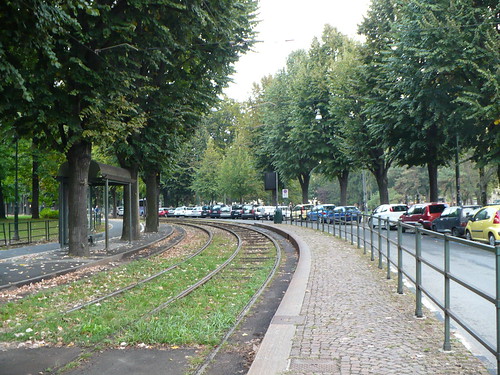
Here's an example from Turin, Italy.


Note that elaborate mainline-railroad-strength overhead wire supports and compound catenary are not necessary.

Multiple cars with double-width doors?  Those rolled out of Cold Spring Shops nearly a century ago.


These units are laid up out of service at the West Allis Car Station in 1932.  Passengers paid the conductor on each car, and stops were at street corners.

Mr Scheib is less optimistic about tourist streetcars.
There is nothing inherently wrong with streetcars as transit. The problem is in how they are deployed. The original streetcar systems were largely straight-line routes serving central business districts. The point was to get people to the CBD, where they would move around on foot. To this day the urban cores that lend their names to multi-county regions remain the most engaging, comfortable, and interesting places in the metro area to walk. The buildings are varied, attractive, and close to the sidewalk, street trees are common, and fenestration allows two-way communication between occupants of the buildings and the people on the street.
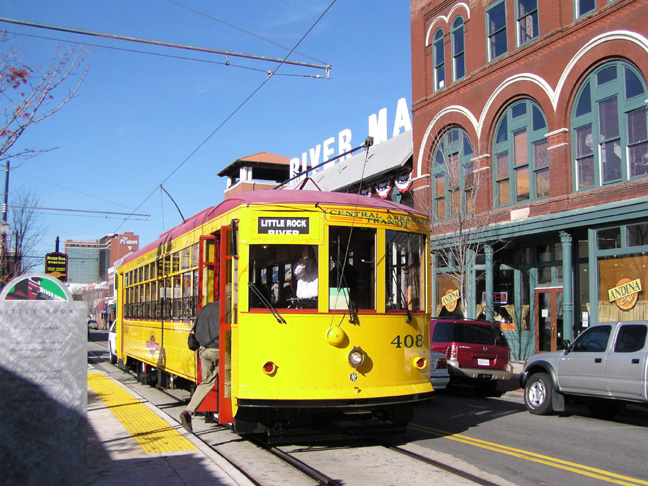
Sometimes, as is the case in Little Rock, the streetcar and the streetscape get built at the same time.


Mr Scheib is correct, though, in suggesting that city boosters not treat streetcars like toy trains.  "Transit projects should be built not to create demand but to serve the demonstrated needs of the public."

Sometimes, that can be a streetcar in a busy shopping area, and sometimes it's the limited tram line.

RISING UP ANGRY.

I keep finding material to keep up the theme of disaffected normal Americans.  And the chin-pullers keep wondering why the rabble won't stay in its place.  On the left, there's Chris Matthews and the usual effete snobs sneering at home-schoolers.  On the right, there's National Review attempting to excommunicate Donald J. Trump.

Too late, suggests Robert Oscar Lopez.
The tightly knit Brahmin caste feels the need to intervene.  They must rush in and correct the thought processes of the conservative masses, because they see many things in the pro-Trump movement that discomfort them.  Yet the elite brain trust of conservatives, with their editorial positions and contributor contracts at FOX News, are doubling down too late on a platform whose time came and went.  The deeper issue isn't Donald Trump at all; it's the Brahmins and their increasing tendency to misread what's going on in the lives of their readers.
Put another way, the chattering classes, whatever their political leanings, have gone back to the same script too often.  But their failures are all around us.
[National Review's] authors acknowledge that these constituencies are angry, feel let down, view recent years as times of betrayal, aren't all that impressed by dogma right now, and are now open to someone – specifically Trump, though it might have been anyone who came along with new media savvy – who doesn't even agree with their ideology at all but who represents a cathartic rebellion against the experts who've continually misled them.
And the rebellion is more populist than conservative, at least in the modal connotation of conservatism.
Most conservatives have a general sense that individuals should be decent, self-reliant, and God-fearing, traits intrinsic to America's earliest roots.  But they don't own businesses.  They want a functioning government that helps people who need help.  They decide tough issues based on right and wrong, not on clauses in the nation's founding document.  And they don't want to live in a world where everything is for sale to the highest bidder.  Trump might not be the best purveyor of these principles, but he's the common man's weapon against the thought leaders who've been betraying the principles for over twenty years.  And payback is a you-know-what.
Put another way, there might be a lot of voters who could get on board with Senator Sanders, but for the Democrats infatuation with the counterculture.

There's a lot more in Mr Lopez's essay, should you want more specifics.

Katie Kieffer is also thinking about the insurrection to come.
Americans are ready to unshackle themselves from the two-party system. You and your friends can agree on this: we need far more choices in terms of whom we elect to represent us in Washington.
She's no fan of Senator Sanders, but she evaluates his message as "eerily inviting."  She's also on-board with an end to the cult of the Presidency and the default of the Conventional Wisdom.
It’s dangerous to expect a rebel to be a savior. No human being can save us from ourselves. Only God can do that. We must urge each other to carefully research all the candidates.

That said, there’s enormous hope and encouragement in knowing that your neighbors crave real reform and are no longer afraid to break free from the restrictions of the two-party system. Share this with your friends and encourage them to lobby for more parties; more choices; and more transparency in the political process.

Just as a snowstorm persuades schools to declare a snow day and give students a respite, a blizzard of discontented voters can force Washington to give voters a break and start anew. Let it snow, let it snow, let it snow!
Nine months to go.

WHY LIFE MANAGEMENT SKILLS MATTER.

It's in a Planetizen inquiry about the kinds of suburbs that have promising futures.
To answer this question, let's look at the advantages of suburbs over cities. One set of advantages relates to social homogeneity—that is, a wealthy, well-educated citizenry, which usually leads to low crime and schools with good reputations (because children from privileged backgrounds tend to have high test scores and to avoid violent behavior towards neighbors). Like it or not, well-off people tend to prefer places full of similarly affluent people.
How many times do I have to explain that institutions are emergent, and academic achievement and mannerly behavior produce prosperity?  Like it or not, self-segregation by well-off people is evolutionarily stable, and a virtuous cycle of responsible behavior and increasing prosperity follows.

But in lamenting the dynamic of suburban decline, the post misses a normative point.
[High-end suburbs] may be very expensive, but their very expensiveness keeps out the social diversity that might put their advantages at risk. The only possible threat to these suburbs' popularity is a collapse of suburban real estate values so massive that their mansions become affordable to the poor, or perhaps statewide policies that wipe out the economic differences between one suburb and another.

Many middle- and upper-middle-class suburbs and exurbs, such as Atlanta's Alpharetta and Cleveland's Solon, have the same advantages but are significantly cheaper. In the short run, these suburbs are in a strong position: they are cheaper than good city neighborhoods and safer than the not-so-good ones. However, they are at some risk in the long term. If they ever become so affordable that they gain some critical mass of disadvantaged residents, eventually their test scores will start to plummet, and they will lose their appeal to middle- and upper-class families.
Catch the conjunction of "disadvantaged residents" with "falling test scores?"

Time to end the pernicious cult of authenticity and stress those middle-class habits in all schools.

IT'S THE RENT-SEEKING, STUPID.

At Reason, Scott Shackford gets to the root cause of Government Failure.
It's the increasing size and scope of federal government power that causes both the heavy lobbying and the bureaucratic nightmares. The more the government can control what big business may and may not do, the more money those corporations are going to spend—indeed the more money they need to spend—to influence those policies in their favor. The federal bureaucracy defends itself above all things, as does any bureaucracy. It will always make sure there is more work to do and a that there is a need for an increasing number of employees.
Thus, any attempt at expanded executive powers or comprehensive reform or any of the other usual nostrums will end up disappointing people.  "The challenge is getting [the chattering classes] understand that this is the nature of big government and inherent in federal bureaucracy, and not because of a particularly special political dynamic that is in play just at this moment."

To reduce the influence of money in politics, reduce the influence of government.  Everything else will follow.

24.1.16

COMPETITIVE MARKETS ALLOCATE RESOURCES EFFICIENTLY.

And yet, not all markets operate competitively.  The purist can suggest that, as real firms are not infinitesimal, and no agent is fully informed, there are no competitive markets.  The pragmatist can note that economies of large scale relative to demand and irreversibilities lead to markets served by relatively few firms that can conspire to take advantage of consumers, or to a monopolist that can do so without any messy conspiracies.

Allocative efficiency, however, is a useful starting point for the study of economics, in that it provides a basis for evaluating observed outcomes.  We thus contrast situations in which there are no mutually beneficial rearrangements of resources (allocative efficiency) with situations in which such rearrangements remain (allocative inefficiency) as a prelude to thinking about how the rearrangements might be realized.  In the vulgar version of the Welfare Economics Paradigm, these are the market failures that warrant government intervention.

There are more subtle ways to think about inefficiency, and there is no shortage of efforts by scholars and polemicists to provide a framework within which people might study economics without being led into fantasylands.  But to do so well takes a lot of work, and perhaps the vulgar version of the Welfare Economics Paradigm exists to alert the intelligent layman to the possibility that not everything is easy.

On the other hand, to propose to dispose of the logic of competition completely can lead to errors of a different kind.  That's the message of Book Review No. 2, featuring Michael Perelman's Railroading Economics:  The Creation of the Free Market Mythology.  Professor Perelman is a disaffected economist.  He opens by explaining that "railroading" functions both as a noun (a metaphor for a low-marginal-cost business with large and long-lived sunk costs and economies of large scale relative to total demand) and as a verb, "the ideological straitjacket of modern economics, which teaches that the market is the solution for all social and economic problems."

But the reader will learn little about cartel problems or empty cores or the wide variety of situations in which economies of scale are achieved at levels of output small relative to total demand, which is to say either about the very careful analysis generations of economists, working under the rubric of industrial organization, have brought to bear on the major departures from competition, or about the practical reason that teaching competition is useful both as positive economics and as intellectual ammunition in debating normative positions when the student, professor, or policymaker ventures into political economy.

Perhaps that is Professor Perlman's intent.  Here's his conclusion.
I do not pretend to have a road map that can guide you to the future.  I can say that our present economy is inadequate and that changes are afoot that will make it more so.  I do know that our present economic thinking precludes us from commencing on the hard and joyous work of building a better world in which the economy will not continue to produce for the narrow interests of those who control capital.  In that spirit, I call for the end of economics and the beginning of something better.
I'll give Cafe Hayek's Don Boudreaux the final word. "What is required of anyone wishing to cast doubt on the efficacy of private-property markets guided by real-world market prices is a believable explanation of how the economy might be operated better by an alternative system."

Critique is simple.  Praxis is hard.

(Cross-posted to 50 Book Challenge.)

HOWARD DEAN SPILLS THE BEANS.

Chris Matthews seems obsessed with distinguishing Socialists from Democrats.  So far, Debbie "Blabbermouth" Schultz has deflected his question by arguing that distinguishing Republicans from Democrats is more important, and the Dowager Empress has gone to the "issues the people care about" dodge.

It's easy enough to find theoreticians who will point out that Vermont's Senator Sanders is no socialist.
Socialism distinguishes itself from capitalism, fascism and other political/economic systems by this fundamental requirement: the state or the community shall own the means of production. That means public ownership and control of corporations, especially major ones like power companies and auto makers. In November Bernie Sanders delivered a speech at Georgetown University to define his brand of socialism. “I don’t believe government should take over the grocery store down the street or own the means of production,” he said. So Sanders, by definition, is not a socialist.
Thus the senator, who caucuses with the Democrats, and who renounces a third- (or fourth?) party candidacy for fear of stealing votes from the Democrat nominee and putting a Republican in the White House, might as well be just another self-styled-progressive Democrat.
Sanders is a Democrat in every way but the name. Running in Vermont, Sanders had to distinguish himself from Democrats to establish his own brand. But once he got to Congress in 1990, he voted with the Dems, nearly 100 percent of the time. The Democratic establishment funded his 2006 senate campaign, including $10,000 from HillPAC, Hillary Clinton’s funding arm.  He caucused with the Democrats in the Senate. And by the way, he’s running as a Democrat.
But none of that deters Mr Matthews from attempting to distinguish Democrats from socialists.

On his January 6 Hardball program, he got the political class to tell the truth.


First among the talking heads is Joy Reid, who characterized the Dowager Empress as "Just as 'progressive' as Bernie Sanders."

Then came former Vermont governor and national committee chairman Howard "I Scream You Scream" Dean who said the neighborly thing. "Let me stand up for Senator Sanders." He went on during the show to confirm that the Democrats and the social democrats are pushing for the same thing.  That's not available in the excerpt, which ends after six minutes with Mr Matthews and the governor saying a lot of nothing about some poll.  But for Mr Dean, nationalizing the commanding heights of the economy is not required.

Put another way, no difference.  But economist Irving Fisher could have told you that, nearly a hundred years ago.

DIFFICULT DAYS ARE AHEAD.

A Spiegel report on the aftermath of New Year's Eve wilding in Germany suggests the country suffers from self-inflicted fractures.
New Year's Eve marks a shift because it crystallized a widespread unease with state inaction. The happenings on the square between the Cologne Cathedral and the main train station was as symbolic as they were real: symbolic of the state's powerlessness in the face of chaos and crime.
When the wizards of smart mess up, the public will be receptive to claims that they are being governed by stupid people.  And the wizards of smart messed up.
It has felt this week as though voters, if they don't feel like their concerns are being taken seriously by Merkel's conservatives or her Social Democratic coalition partners, will search for answers from other, more radical groups. As such, Cologne will be a test for Berlin.

But this hectic, fervid and, at times, hysteric, week has also been about much more: Namely it has been about all of the issues that the right-wing populist party Alternative for Germany (AfD) and the xenophobic movement Pegida have been shouting about for months. It was about Merkel's refugee policies and the upper limit for refugees demanded by her conservative Bavarian allies. Added to that was the perpetual problem of violence against women. It was about the integration of foreigners, the danger of a societal split over the refugee question and a shift to the right in Germany. But it was also about the quality of the work done by the police and about a state being unequal to the task facing it. It is a lot to think about. The role of the "lying press" can't be forgotten either. And yet, it still isn't entirely clear what actually happened on New Year's Eve in Cologne.
The article goes on to describe, to the best of the writers' ability, what actually happened. It is not for the faint of heart.  Their conclusion?  "German society is becoming increasingly divided."

Ten months to the U. S. presidential election.

Germans are also losing patience.

THE PEOPLE LOSE PATIENCE.

At City Journal, Fred Siegel writes of a soft civil war.  We start with the universities failing at their mission.
Collapsing standards in high schools and colleges reinforced one another. Ill-prepared college freshmen increasingly needed remedial assistance. They arrived at college equipped with the politically correct attitudes appropriate for what passed as “higher education” in the humanities and “social sciences.” They left with their attitudes reinforced. Likewise, academia increasingly marginalized or repelled students with less politically correct views. The sixties-born faculty repeatedly replicated itself.
We end with normal Americans rebelling against the self-despising multiculturalists.
What rankles most among workaday white Americans is that, even as their incomes and life expectancies decline, and even as the protections promised in the Fourteenth Amendment are eviscerated in favor of new minority carve-outs, they’re accused of benefitting from “white privilege.” The rise of Ferguson’s Michael Brown and Baltimore’s Freddy Gray—the first a thug, the second a small-time drug dealer—as black icons of white oppression, exemplify the perversions of Obama’s America. Fifty years after the passage of the Civil Rights Act, a dramatically diminished racism is asked to account for the ongoing infirmities of the inner-city underclass.

Trump is both a reaction to and expression of liberal delusions. [Historian Arthur] Schlesinger’s fears have largely come to pass; we’ve become what he called a “quarrelsome spatter of enclaves.” Schlesinger was too much a part of the elite to imagine that the class he always thought of as representing the best of the future would come to be despised by a broad swath of Americans for its incompetence and ineffectuality.
By their fruits shall ye know them. Sometimes it takes longer to recognize that the fruits are rotten.

At Commentary, John Podhoretz suggests the recognition is leading to some kind of political tipping point.
The preferred explanation for which Trump and Sanders pose as the solution is that politics has failed to work effectively, it’s broken, and someone needs to come in and fix it. That view misses the scope of the problems these two candidates are actually addressing.

Put simply, nobody in American elite life — not in politics, not in finance, not in the intellectual world — has been able to find a convincing explanation for the transformative negative changes that characterize our time. These changes are spiritually and possibly literally earth-shattering. The family is falling apart and being redefined at the same time. Incomes have stagnated. Small stateless actors with global reach due to the Internet threaten the disruption and destruction of everyday life in places major (Paris) and minor (San Bernardino). And for many the ethnic complexion of America is changing in ways it has never changed before.
Put another way, the time for constructively harnessing discontent may have passed.

TAMING GREED.

Jay Bookman summarizes the basis of political economy.
The secret to capitalism's success is its ability to take one of mankind's most powerful emotions - greed - and harness that emotion to drive economic progress. By greedily pursuing our own individual self-interests, the theory goes, each of us contributes almost accidentally to greater prosperity for everybody.
Led "as if by an invisible hand" and all that.

The fun begins because the incentive is a means to an end for some participants in the society of perfect liberty, and an end in itself for others.  That's before we dig into such things as monopolies, cartels, and rent-seekers.

Hence Mr Bookman's frustration.  "If there is a better, more productive system for meeting the physical needs of human life, we haven't found it yet."

DISTINGUISHING TRAFFIC TAMING FROM CONGESTION CREATION.

Samuel Staley of the Reason Foundation suggests that greater traffic congestion hampers the working of labor markets.
The time spent stuck in traffic or on a slower commute or journey is time not spent shopping, eating at home with family, playing or working.

Longer commutes limit the size, scope and depth of labor markets. Firms have less access to workers because workers generally don't look for jobs far from where they live. And it's well established among urban economists that workers will accept lower paying jobs in order to avoid too long of a commute.
He concedes, though, that there are two different types of congestion. There's the kind of generalized highway crowding that additional lanes can not ameliorate, and there are the local traffic-taming measures to make commercial districts safer for bicyclists and pedestrians.
Traffic congestion's localized impacts, however, may not be quite as negative for certain types of neighborhoods. The key is understanding the difference between regional and localized congestion. And different strategies for disparate mobility problems may be necessary.

John Norquist, CEO of the Congress for New Urbanism, recommends that traffic analysts distinguish between "through traffic" and traffic intended for local destinations, citing a case in Milwaukee where city officials preserved several city blocks of retail business instead of widening the road to improve traffic circulation. On the block level, congestion may be a sign of economic success, but the congestion itself still inhibits mobility and circulation. Congestion still has a negative impact. The question is whether congestion can be reduced, or even eliminated, while also preserving the features of the block that make it economically successful. On the block level, eliminating congestion may not be practical or feasible.

But what is good for the block is not necessarily good for the region. Most transportation policymakers focus on regional congestion, not the relatively isolated nodes or places that many planners envision when they consider the supposed benefits of low circulation. Congestion relief is typically focused on improving traffic flows along miles of congested roadway and intersections.
Perhaps there are some busy nodes that might be better served by an interurban, or full-fledged commuter trains.  Public money spent on improved exurban roads might well be a regressive transfer.

And Reason's Robert Poole suggests that the expressways might work well as for-profit enterprises.
Despite America’s 19th-century history of privately franchised toll roads, most people have trouble seeing highways as businesses. If they have been exposed to economics, they think of roads as classic examples of “public goods,” which must be provided by government because there’s no way to exclude those who won’t pay for them. While that might be mostly true for city streets and boulevards, it is not a problem for limited-access highways, where entry can only occur at certain points and charging for use is easy thanks to 21st-century electronic tolling, which is eliminating toll booths altogether. Just as electric utilities can charge variable rates to encourage customers to not use power-hungry appliances during periods of peak demand, expressway companies can charge more during rush hour to encourage motorists to shift nonessential trips to off-peak times.

In light of ever-worsening congestion, America’s urban freeways constitute a massive case of government failure. They do not give their customers reliable mobility, and their method of financing (via flat-rate fuel taxes) vastly undercharges urban users (especially during rush hours) and generally overcharges rural highway users, whose roads cost far less to build. And without market pricing, we don’t know how much urban expressway capacity people would be willing to pay for.
Per corollary, we don't know how much Passenger Rail capacity people are willing to pay for, either.  But the rent-seeking truckers continue to collect their subsidies.
Chronic freeway congestion ought to be intolerable to Americans. It’s a crude form of rationing, based on time instead of money, like Soviet bread lines. The idea that everyone should be equally miserable, stuck in congestion, is similarly un-American. HOT lanes and toll concessions have given us a glimpse at a better future.
Indeed.