30.9.26
MORE STEAM TRAINS TO CONNECT PEOPLE.
THE SECRET IS OUT.
The goals of the AI companies and the goals of the mathematical community are severely misaligned. We see these as part of broader alignment issues impacting other scientific and creative professions, as well as the whole of society.A retired mathematician's comment suggests the use of algorithms might not affect the academic enterprise much in any event.
Research mathematics deals with understanding basic structures of shapes, numbers, and natural phenomena. Over the course of generations, it has built a large corpus of sophisticated ideas, methods, abstractions, and other tools to comprehend the mathematical landscape. In turn, modern technologies and sciences are based on mathematical tools.
I have literally never used AI in any of my research. My area is obscure enough that I doubt AI would have much interest any time soon in the research I do. Slightly more broadly, the big unsolved problems in my field (e.g. the Alperin weight conjecture) could maybe be finished by AI, but (best case scenario for AI) it would be pretty transparent that it was putting the finishing touches on a project that humans had been building up for decades (for instance, the McKay conjecture and the Height Zero conjecture were around in my field for decades, and have recently been solved by humans - humans who spent years putting the finishing touches on work that others had spent decades building up).His concluding remark, however, motivated my thesis. "And a person reading about the proof of Fermat's Last Theorem might be inspired to sharpen their analytical skills, learn some math, and that could develop into something useful. Like developing AI, oddly enough."
HOW'S THAT CONFERENCE REALIGNMENT GOING?
The Other Huskies were bitten by the Georgia State Not Southern Panthers 35-14 last week. Props to NIU for equally distributing its losses, with one each to teams in the Big Ten, Missouri Valley, Big 12 and Sun Belt. That is, as we say on "Marty & McGee" "apro-pro" because I can never remember which conference NIU is now in.Not that it matters this Saturday, as they have the Flying Byes of Open Date U., to use Mr McGee's terminology, followed by an evening homecoming game with the Flying Falcons of Air Force, which also play in the Mountain West. Off we go, into the bowl chase yonder. Both the university's orchestra and the community symphony orchestra have performances scheduled for that Friday and Saturday.
29.9.26
THE RACE TO ELEVEN WINS.
Some of my favorite Brewers memories don't begin at a ballpark.Until 1971, I was able to listen to, and suffer through, Brewer games on WTMJ, with Merle Harmon, and later Bob Uecker, on the play-by play; for the last forty years I've been able to enjoy the day games, but must make do with, or without, a scratchy radio broadcast of the night games, including much of that season-ending series win in Philadelphia and the sweep of the Cardinals.
They begin on a hot Wisconsin summer night with my dad, my brother, and me fishing on Half Moon Lake in Carson Park while Bob Uecker called the game on the radio. You could hear the water, the insects, maybe somebody fumbling with tackle, and Ueck describing baseball as only he could.
Those nights became part of what the Brewers mean to me.
There were ballpark memories, too. I remember going to the Met in Minneapolis and watching Larry Hisle hit two home runs against the Twinkies, including one off the fair pole.
Years later, sitting in the left-center field bleachers at the Metrodome, I had binoculars on home plate while Paul Molitor stole home while Robin Yount stood at the plate. It remains one of the greatest baseball moments I've ever seen in person.
And I know what some of you are thinking: the MLB lost some of you as a fan. I respect that. For me, however, baseball is part of me.
Growing up in Eau Claire, Wis., it meant it was easier to see the Brewers play the Twins than to drive three hours to Milwaukee County Stadium.
THE BITTER FRUITS OF ADULTISM.
I’ve never considered taking a drink into an interview. I’m not even comfortable taking one if offered. I don’t do it because it’s generally a short enough process that it’s unnecessary.That's Tom Knighton, reacting, correctly, to the most recent first world problem: should a job-seeker bring an iced coffee to a job interview. His conclusion?
And frankly, saying you need to stay caffeinated to talk to a potential boss sends signals I don’t know that I’d have been a fan of.
The problem here is that people are opining on this sort of thing often without asking a question of why we tended not to bring beverages to interviews in the first place. It’s one of a thousand examples of people seeking to upset the status quo without understanding why the status quo exists.
On the flip side, many of those who are upset over it may not even know why they’re upset over it. I doubt anyone came right out and said, “You guys tend to be so boring that I need as much caffeine as possible to stay awake to talk to you.” They just got bent out of shape from the start.
These little rules are common, but they generally all start from somewhere, and like Chesterton’s Fence, we need to understand them and why they exist before we set about dismantling them.
Perhaps more importantly, why do you think you need it inside with you for a 20-minute interview? Or do you just need to knock down doors for the sake of knocking them down?Call me old school, bringing your own drink, hot or iced, into an interview, let alone food, signals a lack of seriousness. If the interviewer offers you coffee, tea, or water, politely accept or decline: the prudent thing might be to decline, the offer might be to put you at ease or perhaps as a test of your impulse control.
If so, be careful, because you might be on the other side of that desk and have to deal with someone just like you, only worse, and have no recourse left because of what you did at the time.
COMPLEX ADAPTIVE SYSTEMS, DOING WHAT THEY D**N WELL PLEASE.
The 2026 hurricane season has been remarkable, from the potentially record-breaking calm in the Atlantic Ocean to the hyperactive eastern and central Pacific Ocean.Maybe it's time to look more carefully at the observations and recalibrate those extrapolation models, which are excessively sparse anyway.
Only seven tropical storms have formed in the Atlantic, while 18 tropical storms and hurricanes have formed in the Pacific. In a normal year, the Atlantic and the eastern Pacific hurricane basins see similar activity, with 14 to 15 named storms, including seven to eight hurricanes by the time the season ends on Nov. 30. This year, the Atlantic hasn't yet produced a single hurricane, while the eastern Pacific has already produced eight.
What's interesting about this season is that a few of the storms that have occurred in the two basins originated in Africa and were influenced by the same powerful climate phenomenon, El NiƱo. But the results have been very different, with fierce hurricanes in the Pacific and unremarkable tropical storms in the Atlantic.
28.9.26
THE LIMITS TO THERAPEUTIC CULTURE.
As a psychiatrist and a faculty member, I have noticed a growing trend among students: Everyday emotions are increasingly described as psychiatric diagnoses. Students are no longer simply sad—they are depressed. They aren’t just stressed—they are anxious. With this lens, normal developmental challenges like academic pressure, relationship struggles and social adjustment are now filtered through the language of mental illness.It's likely that anyone in medicine has ample horror stories of people who come in with all sorts of fearful questions, that is, if they don't question what the practitioner is spelling out.
While casual use of mental health terminology and self-diagnosis isn’t new, social media has dramatically expanded its reach.
I'M DONALD TRUMP AND I APPROVE THIS MESSAGE.
The National Republican Senatorial Committee (NRSC) is apparently seeking regulatory guidance on a very serious campaign-finance matter: how exactly should it report Hasan Piker’s generous contributions to the Republican Party?I wonder what rights a political influencer has to his social media clips that get quoted, either in full (the most effective way to attack a person is to show him unedited) or in part (which also puts the person on the back foot, spending time showing how he's taken out of context). Those social media clips will be dropping, what with Election Day about five weeks away.
In a letter to the Federal Election Commission, the NRSC asked how it should quantify the value of Piker’s commentary, which reaches millions across Twitch and other digital platforms. After all, when a prominent left-wing streamer repeatedly says things so inflammatory, divisive, and politically self-defeating that they may as well be GOP advertising, surely someone has assigned a dollar value to the service.
CHOKE ON IT.
25.9.26
AFTER THEY'VE TRIED EVERYTHING ELSE.
TAKE THE MULLAHS' STOOGE UP ON HIS OFFER.
Iran's president said Wednesday that his people have been "victims of terrorism" by the United States, delivering a rare wartime speech at the U.N. General Assembly a day after President Donald Trump said he may "annihilate" the Islamic Republic if a deal isn't reached soon to end the nearly seven-month war.Gee, you think riling up your starveling base to yell "Death to Israel, death to America" for nearly a half century is a good way to win friends and influence people? Reap what you sow, stooge.
The defiant speech by President Masoud Pezeshkian marked a striking instance of a foreign leader addressing the world body while their country is at war with the host nation. While defending his country, Pezeshkian held up large photos of the late Supreme Leader Ali Khamenei and the more than 150 Iranian schoolchildren killed on the first days of the war.
"We have only defended ourselves. We are not terrorists," Pezeshkian said at the General Assembly. "Our innocent people have been the targets of cowardly attacks and aggressions imposed upon our country. And we defended ourselves with utmost strength. America and Israel attacked us."
He added of the United States: "Yes they did hit us, but we did not bend the knee." Toward the end of his speech, Pezeshkian called out Trump by name.The stooge had to posture that way because his political masters in Teheran speak their own language of force. "Iran has presented the US with a roadmap to end the war that echoes the two countries' June agreement — a 60-day ceasefire, the reopening of the Strait of Hormuz, and groundwork for further talks — The National reported." Same nonsense, different talking head. Renounce the nukes, Iran, and stop funding those proxies, and then we can lift the sanctions and let your leaky ships sail.
"It must be understood by Mr. Trump and those who seek to bully us that we are ready for dialogue and diplomacy and negotiations without accepting the language of force," he said.
Shortly after, both U.S. and Israeli officials blasted the speech, saying that it was hypocritical for the Islamic Republic to present itself as the victims of the world.
U.S. Secretary of State Marco Rubio told reporters: "I don't know what standing Iran has to lecture anyone on human rights or the international system when they habitually violate it."
ADAM SMITH CORRECTLY DIAGNOSED THE SITUATION YEARS AGO.
To widen the market and to narrow the competition is always the interest of the dealers ... The proposal of any new law or regulation of commerce which comes from this order, ought always to be listened to with great precaution, and ought never to be adopted, till after having been long and carefully examined, not only with the most scrupulous, but with the most suspicious attention. It comes from an order of men, whose interest is never exactly the same with that of the public, who have generally an interest to deceive and even to oppress the public, and who accordingly have, upon many occasions, both deceived and oppressed it.I wouldn't name the author, rather I'd ask students if anyone had an idea who it was. More than a few for Karl Marx and sometimes I'd get a J. S. Mill, both good choices. It's in The Wealth of Nations, Book I, Chapter XI.
In principle, the concept of the independent commission is a delegation of powers from the executive and legislative functions of government to subject specialists, holding the ability to implement legislative intent without burdening those legislators with determining what the price of a streetcar ride or the content of a sandwich served to economy class fliers was to be.Does anyone seriously think that, should the leading developers of artificial intelligence, or machine learning if you will, will not cultivate the members of any agency Congress or a legislature sets up to regulate their competition? It doesn't even take the kind of insider majority on the boards, as Mr Slivinski fears. Wouldn't the management of any business subject to that regulation figure out where the board members play golf, when their birthdays and anniversaries are, what their children aspire to, in order to capture the agency, no matter how stocked with idealists it might be, with kindness?
Like most principles, the concept sounded better on paper or sketched on a chalkboard than they did in practice. A left-leaning commentator of the nineteenth century responded to the creation of the Interstate Commerce Commission with an epigram to the effect of the agrarians and the communists getting their laws, and the robber barons keeping their railways. The same lesson applies to any other independent regulatory commission, or to the more recent administrative state agencies to which we turn.
The problem with any delegation of legislative authority to an agency is that the people most affected by the agency decisions will take the greatest interest in what the agency does. In the early years, a farmer might have a keen interest in what the rate on a carload of grain is, or an environmentalist in the acid content of power plant smoke. Over time, though, the regulatory procedures become codified, and boring, and the agrarians and communists of the next generation find other shiny objects to get worked up over, whilst the railroaders or power companies or television stations or air carriers or baby formula manufacturers find ways to get along by going along in such a way as to capture the agencies. The agencies thus become cartel managers, protecting the incumbent firms, and the best thing to do might be to reduce their powers and banish them forever.
24.9.26
PERMISSIONLESS INNOVATION.
I applaud this market experiment with a, shall we say, unusual kind of leisure spot.The "unjust criticism?" It brings to mind a parody of the late Yogi Berra's observation, phrased as "They're so inclusive nobody goes there any more." Lift a mask requirement on Saturdays, alienate the "immunocompromised disabled divas," never mind that there still is a mask requirement all the other days the bar is open. Benjamin Bartee is less than impressed. "One night per week without the muzzle, in 2026, in a town with nary a single case of COVID, was enough to warrant the avalanche of outrage from the 'disabled community.'"
But the experiment is failing. And yet some people – ignorant of the foundation, working, and benefits of free markets – are unjustly criticizing the owners of this experiment for trying to salvage it.
RONALD REAGAN, VINDICATED.
Iranian citizens have witnessed some dazzling laser shows recently — but they’re not the kind you’d see at a Metallica concert.A Navy man I spoke with at an early spring swap meet (we were figuring out whether a 3-D printed Phalanx turret was O Scale: it was) confirmed the existence of such systems. They're cheaper to operate either than Phalanx, with its depleted uranium slugs, or the SM series surface-to-air interceptors. But they use a lot of electricity and apparently have noisy capacitors to generate the laser pulses. Ships, however, have turboelectric power plants for propulsion.
The US military has been deploying lasers in the Strait of Hormuz to knock out regime hardware, taking out “drones and incoming cruise missiles at a much lower cost than using more expensive kinetic weapons like missiles,” the Department of War recently confirmed.
The US project to harness laser power has been 50 years in the making and outstrips the capabilities of any other military on Earth.
Laser technology works by drawing energy from generators or battery packs which is then converted into light particles called photons. The photons are then concentrated as a single beam, which is only visible under infrared light, not the naked eye. They heat the surface they are directed onto until it explodes or melts.That might be, at a more modest scale, how laser-assisted secondary cataract removal works, only with quieter capacitors and carefully calibrated energy.
GREAT MOMENTS IN IDENTITY POLITICS.
The current feminist wave, which includes the belief that women are inherently superior leaders due to their peaceful nature, has been undercut by millions of women openly cheering homicide. "The Clancy trial has somehow caused feminists to argue that women are completely controlled by their hormones," said legal expert Ben McCray. "They now vehemently say that women are so weak and feeble that they can't even be held responsible for their own actions. The nation now agrees with their assessment."Psychiatrist Sally Satel had thoughts about that argument. Satire or not, the women of the fevered brow do a pretty good job of bringing on the mockery simply by being their authentic selves. Not too long ago, Indiana Fever reserve Sophie Cunningham, who shies away from the culture wars, noted, "You can be girly, and you can go out and kick someone's a**."
23.9.26
ALL ROADS LEAD TO BYZANTIUM.
Reuters reports researchers just mapped the network of roads that Romans connected across Europe to parts of the Middle East and Northern Africa to better understand the world's first continental travel route, and find out if all roads do indeed lead to Rome. It turns out they don't.That finding should be no more surprising than, say, the railroads converging at Chicago. A via triumphalis such as the Appian Way might be a useful setting for a procession Ottorino Respighi could set to music, or perhaps as a place to display the suffering carcasses of rebels, as in Spartacus.
The study published earlier this week mapped out the roads into what the Roman network could have looked like at the peak of the empire's power, sometime between the 2nd to 4th centuries AD. That network of main roads and little countryside paths didn't centralize in Rome, though. Tom Brughmans, classical archaeologist at Aarhus University in Denmark and one of the leads on the project, told Reuters that, "...when we consider all movement within the entire Italian peninsula, we were shocked to discover that the most central road actually follows the opposite Adriatic coastline, bypassing Rome altogether."
The roads of the empire actually met in Constantinople, or Istanbul, Turkey, as it is known today. There the city was more centrally located, as it bordered both Europe and Asia along the Bosporus Strait, where ancient ferries were known to easily traverse between the two continents.
THE UNITED NATIONS, FAILING AT ITS CORE MISSIONS.
A look at the resolutions passed by last year's General Assembly—often nonbinding, unlike those of the U.N. Security Council—shows an organization that meddles in the domestic politics of its members while failing to pursue its stated mission to "maintain international peace and security."That might be about as well as any international organization can do. Each country gets one vote in the General Assembly. That's obviously less than democratic, if you apportion by population. Five permanent members of the Security Council can gridlock anything they don't like. Its continued existence at least gives the sort of process-worshipper who sees value in a rules based international order as something to invoke, or perhaps an opportunity to write position papers.
Active wars rage in Asia, Africa, Europe, and the Middle East, with internecine conflicts erupting yearly in Latin America and the Caribbean. Yet the previous General Assembly passed five times as many U.N. resolutions directed at Israel as any other nation, including countries with notorious human rights records like Cuba, Iran, and Myanmar.
Thanks to its unwieldy organizational structure, the U.N. is highly susceptible to waste, fraud, and abuse. It can't enforce the policies it adopts, and its actions often depend on the whims of the Security Council, whose five permanent members opportunistically exercise veto power. Unable to do much to curtail global conflicts, the U.N. has focused on issues better handled by domestic governments, like environmental laws and racial justice.
The incongruent nature of its mission and what happens in practice are perhaps best seen in the U.N.'s Human Rights Council, which is currently presided over by a representative of Indonesia, whose government sanctions arbitrary killings, torture, and crackdowns on dissent, according to the State Department's 2024 Country Reports on Human Rights Practices.
YES. NEXT QUESTION?
The setting was certainly an interesting choice on the part of the “Euphoria” star, who spent the better part of last year running from the controversy over her ad for American Eagle Outfitters—also a sponsor of this year’s Stagecoach—in which, following a brief explainer on genetic determinism, a voice-over boasted of the blond, blue-eyed actress’s “great jeans.” The inspiration had seemingly been “Genes,” a near-identical ad that Brooke Shields did for Calvin Klein in the nineteen-eighties, but, in 2025, jokes about Sweeney’s supposed physical supremacy appeared to be giving free press to a right-wing talking point. By then, conservatives had concocted a theory that the fifties-pinup physique of Sweeney, a registered Republican, was an affront to progressive sensibilities; a year earlier, the National Post, a right-leaning news site, had raised the question “Are Sydney Sweeney’s breasts double-D harbingers of the death of woke?” While we were pretending not to be looking, breasts had somehow become Republican-coded.Read on, and the basis for her confusion is clear. "When I was growing up, in the early two-thousands, 'conservative' meant conservative. The right was the party of George W. Bush, abstinence-only sex education, and Christian evangelical teens who recited chastity pledges and wore promise rings under the banner of 'True Love Waits.'"
21.9.26
ROLLING INTO THOSE EARLIER SUNSETS.
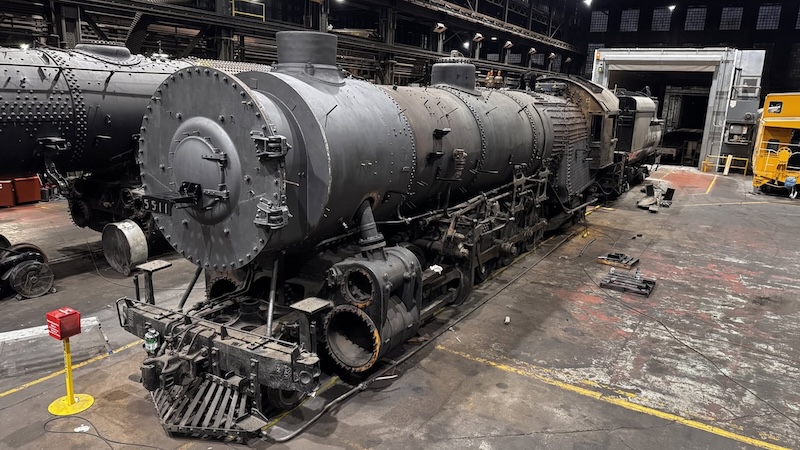
They're leading the westbound Gull past the steel works and into Boston staging. If I weren't as obsessive about having interiors in the cars I build, there'd be diners and parlor cars for the day trains. The Gull got in before breakfast time, hauling Farmington milk for Borden, Maritimes fish, assorted parcels (were a few boots put on board at Freeport?) and interline sleepers from Halifax, Calais, and Van Buren. After the passenger train clears, the morning switcher goes to work, delivering scrap metal for the Open Hearth shop, then crossing over to work General Electric on the inward side.
LET GO AND START OVER.
At the end of my third year as a Ph.D. student, I had nothing to show for it. No publications. No data to analyze. No conference presentations. Despite years of long hours and hard work, I had no publishable results. I lost my confidence, my sleep and—most painfully—the joy in doing science. I started thinking that my next and only logical step was to quit my program.That wasn't for lack of an interesting question. "I had been offered a project investigating the causes of Alzheimer’s disease, one of the most devastating neurodegenerative illnesses of our time." The researcher did perform useful work in identifying a dead end. Unfortunately, sometimes the most promising of projects, which understanding Alzheimer's is, turn into a research dead end, and you don't get a Minimal Publishable Unit for null results.
Not only was the new project promising and technically feasible, but I had the chance to get exposed to new methodologies and scientific processes, including handling research ethics submissions, navigating material transfer agreements and contributing to big grant applications. My energy levels were restored, as was my faith in my supervisor.That prior work? Bygones are forever bygones. Second time through, though, the cultural capital this student developed in the first project might have helped with the submissions, agreements, and applications.
About two years into the new project, I have now presented at three international conferences and published my second research paper in a well-respected journal, as well as other commentaries, reviews and opinion pieces, on both gliomas and, surprisingly, Alzheimer’s disease. I have made international friends and collaborators who keep fueling my passion for top-notch science.
BUCKLE IN.
WHAT PRICE IGNORANCE?
If, during the next Super Bowl, even 10 percent of the nation’s data centers were to be summarily switched off, the people of the United States would be on the verge of revolution.Thus, a data center might be a switching center to keep the wireless internet and cell phone conversations working, something it does so well that the eternally ditzy former vice president could wave her hands about that data "cloud" being all around us, sort of like Yoda's Force but lacking the capability to lift your spacecraft, er, your campaign, out of the swamps of Dagoba. Or it might include actual computers, although Tyler Cowen recently noted that computing capacity is still a constraint on artificial intelligence doing anything intelligent. That doesn't surprise me: businesses and universities might have phased out their legacy mainframes, but true supercomputers still exist and they're still useful. That Chat GPT prompt the above message complains about is going through that water and power to search through the information at its disposal, way more rapidly than the most assiduous of file clerks with the best associative memory. Those data centers might be coming up with another "most strikeouts against switch hitters by any major league pitcher since 1908," or more quickly comparing millions of x-rays or gene sequences, and perhaps the computing capacity is finding a proof of Fermat's Theorem that does fit the margin of a Renaissance textbook.
The term we have chosen to describe the technology I have discussed here is “the cloud.” But, of course, there is no such thing. There are just data centers and the computers that run inside them. Conceptually, “the cloud” is a useful abstraction. But if taken too literally, it blinds us to an important reality: Each one of the 5,427 data centers in the United States is a real place, full of rows of real machines, that run on real electricity, and that are maintained by real people. Your data — by which I mean your emails, your bank account, your business files, your photographs of your kids — are sitting somewhere on a real hard disk. If I drove to where that hard disk is and smashed it up with a pickaxe, it would break, and the only reason that you probably would not permanently lose the data that it once held is that the data also exist in some other real location, on another real disk, in another real person. Bluntly put: The integrity of your data — and of your ability to access it whenever you want — is the result of your having cheap access to lots of different data centers, in lots of different places, so that if something bad happens to one of them, your stuff is backed up elsewhere.
18.9.26
DETERMINISTIC CHAOS.
The Tilt-A-Whirl, for example, spins its passengers in one direction, then another, sometimes hesitating between forays and sometimes swinging abruptly from one motion to another. A rider never knows exactly what to expect next.That's without the clutch operator selectively reducing or increasing the speed of rotation the better to get a car into an extreme spin cycle. You get sufficient deterministic chaos without the clutch operator.
Yet these complicated, surprising movements arise from a remarkably simple geometry. A passenger rides in one of seven cars, each mounted near the edge of its own circular platform but free to pivot about the center. The platforms, in turn, move at a constant speed along an undulating circular track that consists of three identical hills separated by valleys, which tilt the platforms. The platform movements are perfectly regular, but the cars whirl around independently in an irregular manner. Moreover, there is essentially just one adjustable parameter–the rate at which the platforms move around the track.
When the platforms travel at very low speeds, the cars complete one backward revolution as their platforms go over each hill. In contrast, at high speeds a car gets slammed to its platform’s outer edge and stays locked in that position. In both cases, the motion is predictable.
What happens at intermediate speeds?
To model dynamical systems like the Tilt-A-Whirl, mathematicians, scientists, and engineers use equations that describe how the positions and velocities of a system and its components change over time in response to certain forces.
It’s convenient to characterize a system’s dynamics by plotting how its position and velocity evolve over time. Each plotted point represents the system’s state of motion at a particular instant, and successive points generate a winding line through an imaginary mathematical space (known as phase space) representing all possible motions. Different starting points generally initiate different curves.
A simple, repeating motion, like the to-and-fro oscillations of a swinging pendulum, appears as a circle or some other closed curve. Such a plot shows that the system cycles through precisely the same state of motion again and again at regular intervals.
More complicated sequences of movements produce tangled paths that wander through phase space, sometimes never forming a closed loop.
To describe the Tilt-A-Whirl’s dynamics, physicists Bret M. Huggard of Northern Arizona University and Richard L. Kautz of the National Institute of Standards and Technology found a mathematical equation that approximates the motion of an idealized Tilt-A-Whirl. In essence, the movements of an individual car resemble those of a friction-impaired pendulum hanging from a support that is both rotating and being rocked back and forth while the pendulum swings. Solving the equation determines how a Tilt-A-Whirl car would behave under various conditions.That's right, there was a publishable article on the physics of the Tilt-a-Whirl.
The resulting jumbled mixture of car rotations never repeats itself exactly, which gives the Tilt-A-Whirl its lively and unpredictable character. Indeed, no two trips are ever likely to produce exactly the same thrills and chills.That orchestration might shake some change loose from a rider's pockets, or it might require that spinning car to be hosed out afterwards. But I digress.
At the same time, the mathematical model used by Kautz and Huggard predicts that chaotic motion would occur at a speed close to the 6.5 revolutions per minute at which the ride is normally operated.
Interestingly, Tilt-A-Whirl fanatics know by experience that they can actually take advantage of this sensitivity. They can affect the motion of a car by throwing their weight from side to side at crucial moments, turning cycles with little or no action into thrilling whirls.
"Thus, it would seem that aficionados of the Tilt-A-Whirl have known for some time that chaotic systems can be controlled using small perturbations," Huggard and Kautz observed.
It turns out that Tilt-A-Whirl operators can also take advantage of this sensitivity. Software engineer Dave Boll described his experience one summer running a Tilt-A-Whirl, "which is easily the most entertaining carnival ride to operate."
Why? The operator can actually orchestrate the movement of individual cars. A single lever controls the ride's speed, so an operator can slightly retard or accelerate the ring of platforms at any moment. By applying just the right amount of velocity change at exactly the right time, it's possible to spin a particular car. For example, if a car is currently not spinning, is about to go uphill, and is positioned toward the inside, accelerating the platform will send the car into a very fast spin.
FISCAL INCONTINENCE.
IT'S STILL SURRENDERING WITH A SHRUG.
For a long time, Cold Spring Shops has called attention to the folly of admitting unprepared students and calling it access. "[S]tate institutions that were separate but not equal during Jim Crow remain less than equal today. And thus, does access beget assessment and remediation and fretting about retention." We've always been clear-eyed about where that leads. "When you admit unprepared students and call it access, what do you have to do to boost retention?"Apparently, you retain by accommodating the unpreparedness. “Students on University of California campuses may struggle with basic math, but they are graduating at record rates.”
16.9.26
PROFESSIONAL SPORTS IS A YOUNG PERSON'S GAME.
THE THOUSAND DESCRIPTIONS OF RENT SEEKERS.
Two problems immediately emerged. First, this enlargement of government power raised the value of possessing government. Second, government interventions produce unintended consequences. As a result, rather than repeal the original measure, governments frequently respond with another intervention, followed by another. The unintended consequences multiply, and so do the interventions. Growth grinds down to a halt.There is a risk in blowing all the interventions up and starting over. Mr Geloso uses the accretion of interventions in Chile leading to a quasi-Marxist government gaining control over a corpse, after which a military coup and shock therapy might have been the most extreme form of starting over. On a smaller scale, abolishing the Interstate Commerce Commission and privatizing Conrail might have done some good, that is, until the regulatory state started adding on again.
The danger for the United States is not that it has reproduced Chile in 1973. It plainly has not. (Yet.) The danger is that American politics is beginning to reproduce the underlying dynamic: rival movements encouraging one another to abandon liberal restraints.By "liberal restraints," he means modestly ambitious governance with enumerated, separated, and limited powers. That's not how one makes a name in "public service," and that's how things go wrong. "There must first be a long process of politicization of every aspect of social and economic life. Reverse that politicization and you halt the weakening."
GREAT MOMENTS IN LEFTIST LUNACY.
As a Black woman who works at the intersection of parks and water, I am watching the ongoing push to restore protections at Bears Ears and Grand Staircase-Escalante closely. We know that access to the outdoors is already racialized in this country, much like access to clean air or safe drinking water.Is that intersection north or south of wells and water? Somehow an ongoing spat between ranchers and conservationists in Utah, with Barack Obama expanding the boundaries of western monuments it's probably wise to have an air-conditioned four-wheel drive car to get to, only for Donald Trump to shrink them for Joe Biden ... you know how this is going to play out.
Today, many Black neighborhoods are cut off from the waterways that sustained earlier generations. Despite their cultural and ecological importance, many lakes and streams across the Midwest and the country have been industrialized, polluted, or paved over. This has real consequences for community health and safety, from deadly flooding to toxic taps.What earthly connection "this" has to do with the latest round of cowboys and Indians in Utah I don't know, but at Common Dreams, emoting trumps logic.
Fortunately, parks and clean water are two areas where people across the political spectrum agree: The public good must be put above corporate profit, keeping public lands in public hands, and preventing pollution at the source to ensure safe and affordable water in every home in America. And we’re seeing people rise up.Nowhere in her lament over those western monuments do we see any acknowledgement of how badly those public lands have been mismanaged by those public hands. Sad!
15.9.26
TRAINS ARE MADE FOR RUNNING.
The very first thing a dealer scans for isn’t the trains themselves. It’s the cardboard sitting next to them.There's even a category called "new in box" referring to rolling stock that has not been taken out of the box.
Original packaging protects against dust, moisture, and warping, and its presence signals a collector who understood what they had. A box in solid shape quietly raises the offer before a single piece even changes hands.
THAT MOSLEM BABUSHKA.
Hadija Amajoud, who has taught at a provincial special education school in Assenede since 2022, was wearing a headscarf when she began working at the school, accoridng to local broadcaster VRT as cited by Anadolu Agency.Margaret "University Diaries" Soltan objects to that very postmodern "his or her own convictions."
A disciplinary procedure was launched after Amajoud made clear that she did not intend to remove her headscarf while teaching.
The ACOD trade union said it intends to challenge the dismissal before the Chamber of Appeal in Brussels, saying that the case could establish an important precedent concerning religious freedom and neutrality in education.
Amajoud questioned how far an employer can go in restricting a teacher's personal freedom and described the provincial administration's interpretation of neutrality as "purely political."
"Actually, no one is neutral. Every teacher stands in front of a class with his or her own convictions," she said.
In free societies, teachers strive to keep their convictions away from the front of the class, so that liberal, exploratory discourse can prevail.That might say more about life in an industrialized tribal society, which is what Belgium is, as distinct from a free republic in which tribe is secondary. That Moslem babushka might, to European eyes, be a symbol either of the submission of women under the submission that is Islam, or of the hopes of Islam to conquer Europe.
This woman – who has lost her teaching job because she refuses to take off her hijab while in front of a room of students in Belgium – thinks God commands her to express her religious convictions, and model female modesty, at all times. Her conviction of this is so intense that she – unlike many Muslim women – would never think of removing her scarf for the duration of her classes. She would rather ruin her life than follow the law on this. The law is secular, and in this instance that doesn’t count.
SOONER THAN YOU THINK.
"We have, as everybody now knows, $40 trillion of debt. Now, historically, if you go back over the last, let's say, 300 or 400 years, whenever a country paid more interest on its debt than it did for its national security, that's a sign of weakness in the country. Right now, we've crossed that threshold. We're now paying more in interest every year than we are paying on our national defense, and we're paying a trillion dollars in interest, a little bit more than that now, but we pay about a trillion dollars in national defense. And as that continues, the interest goes up, and the money available for defense goes down. That tends to weaken your national security."That might depend on the going concern value of the United States, as people might still be willing to hold Treasuries to finance the production of Tomahawks and Patriots and all the other tools the Pentagon possess to stay protected against flying Iranian gas mains and whatever else the primitives are cobbling together, and the dollar might still be less shaky than all the other candidates for global reserve currency.
A "disorderly bond sell-off" is now the top market tail risk. Investors remain bullish, however, on corporate earnings, the AI investment cycle, and economic growth."Disorderly bond sell-off" is trader-speak for "all at once." Buckle in.
US Treasury yields have faced upward pressure throughout September, driven by persistent signs of inflation and elevated crude oil prices.
LET'S GET REAL ABOUT CRUDE OIL PRICES.
Oil prices are very far away from crisis levels in real and nominal terms.
— Daniel Lacalle Official Account (@dlacalle_IA) September 9, 2026
Brent is near $96 per barrel. In today's dollars, the 2008 crisis peak was $202, the Arab Spring $183, the 1980 oil shock $162 and the 2022 Ukraine war spike $139.
Each geopolitical event creates new… pic.twitter.com/MA9T1WIVkC
14.9.26
THROWING MONEY AROUND.
Reflexive apologists for Trump’s proposal have tended to focus on the sins of the other party — pointing, for instance, to the unnecessary and inflationary stimulus checks that the Democrats issued in 2021, and to President Joe Biden’s illegal attempt to forgive student loans. But this isn’t a defense, so much as a confession. Those policies were bad, and the Republican Party opposed them. That they were attempted was a disgrace; it was not a catch-all excuse for further reckless behavior. Whatever problems may exist in the American economy in 2026, there is no need for a round of debt-financed $5,000 checks. The central problem of our political era is the persistence of inflation and the associated increases in the cost of everyday goods. Trump’s suggestion would worsen, rather than improve, that issue.Or, following the Babylon Bee, satire is the best response. "Trump Pledges That If Voters Defeat Socialism In November, They Will Each Get An Equal Redistribution Of Wealth From The Government." I vaguely remember something called Ricardian equivalence, and Robert Barro asking, "Are Government Bonds Net Wealth?" There might be a corollary involving helicopter droppings, er, printed money, although even in a hyperinflationary environment, having a windfall of helicopter droppings leaves you slightly less badly off than if they fall on your neighbor.
The role of the federal government within the U.S. economy ought to be to provide a stable framework within which free people may thrive. When it taxes, it ought to tax predictably and consistently, with the purpose of covering its spending. When it spends, it ought to spend on those functions that only the national government can fulfill. President Trump’s proposal cannot be squared with the federal government’s proper role — nor, for that matter, can it be justly described as “policy.”
LET THE THING BE PRESSED.
Iran does not need to defeat the United States conventionally. To deny Washington a decisive political victory, it needs only to preserve its governing institutions, retain sufficient retaliatory capacity, and make continued warfare costly enough that the United States cannot impose its preferred outcome at an acceptable price.How many pallets of rial did she get paid for that clanker, and how valuable will they be next week?
Iran cannot match the United States and Israel militarily. But it benefits from geography, a strategy tailored to a stronger adversary, and the advantages of fighting on its own territory, as well as a leadership that views the conflict as existential and has shown a willingness to absorb enormous costs rather than surrender. After six months, that military pressure has still not brought Washington closer to securing its demands. The United States can continue to destroy targets and degrade Iranian capabilities, but unless that pressure changes Iran’s political calculations, further escalation risks producing more destruction without producing a settlement.That pressure might be having the desired effect.
Israel's Channel 14 reported from sources inside the regime that Mohammad Bagher Ghalibaf, the blusterous blowhard serving as Iran's Parliament Speaker, was caught admitting to others inside the government that the regime won't be able to stand this economic pressure much longer.That's Duane Patterson in Hot Air, itself a propaganda site, and yet the anaconda's coils well might be tightening. The current national role model is Wimpy, paying you Tuesday for a lamb shank today, "The same way the regime is — by putting everything on credit. As long as everyone just borrows from everyone else but no money actually changes hands, it'll work for a while until the food runs out and the banks collapse."
GRASPING AT PINS.
The National Hurricane Center's Atlantic hurricane forecast is out and it relies on that stronger El NiƱo. "NOAA predicts below-normal 2026 Atlantic hurricane season." There was already at least one named Atlantic tropical storm this season. That heat wave east of the Mississippi during Freedom Weekend? We used to call that the lazy, hazy, crazy days of summer.That doesn't deter breathless journalists from breathlessly anticipating stirrings in the doldrums.
The 2026 Atlantic hurricane season is tracking significantly behind historical norms and may set a new record for its delayed activity. As of this week, the first hurricane of the season has yet to form, far behind the average first occurrence date of August 11."Historical norms" refers to a moving average over the past eight decades, give or take, and it is the same category error your weather reader says when he predicts tomorrow will be way hotter or way colder "than it should be" or when a month's rainfall comes in above or below that moving average. Complex adaptive systems do what they do. As of Saturday, "Atlantic Hurricane Season Sets Record for Latest First Hurricane Formation," in the vacuously true sense that there were none yet.
The current record for the latest first hurricane formation in the Atlantic is September 11, set by Hurricane Gustav in 2002 and tied by Hurricane Humberto in 2013.
FACULTY REQUIRING MINDERS?
Student journalists with The Alestle at Southern Illinois University Edwardsville wanted to do something reporters do every day: interview university employees.A branch campus of a directional state university with a history of corruption might be so placed on the academic food chain that one might wonder whether the minders are to protect the faculty from being exposed as career minor leaguers or to protect the students from doing the sort of thing Normal's rejects might do.
But SIUE’s communications office insisted on coming along and sitting in on multiple interviews between Alestle journalists and university staff. When a student journalist tried to arrange a solo interview, the director of communications said her presence was “non-negotiable” and that “approval of the interview is ultimately [her] decision.”
11.9.26
PROUD TO BE AN AMERICAN.
š„ THIS is how you become an American.
— Louis Montoya (@montoyalouis1) September 6, 2026
Cincinnati Reds slugger Eugenio SuƔrez fled Venezuela, missed two games to take the citizenship test, passed, and came back to the ballpark as a U.S. citizen.
His teammates changed his walk-up song to Lee Greenwood’s “God Bless the USA.”…
THE NOT-SO-COLLATERAL DAMAGE OF LIBERATING TOLERANCE.
A 9/11 widow just rent rogue in NYC…
— Geiger Capital (@Geiger_Capital) September 11, 2026
She read her husbands name and then called out Islamic terror and Saudi Arabia.
She called out Bush, Obama, Biden and JD Vance/Trump while they sat right in front of her. The entire crowd at ground zero cheered. pic.twitter.com/xICEZL6FOv