Showing posts with label climaquiddick. Show all posts
Showing posts with label climaquiddick. Show all posts
21.7.26
SELF-INFLICTED JOYLESSNESS.
"The easiest way to be miserable" and "absolutely unnecessary," notes Derek Hunter.


13.7.26
CLIMATE CULTISTS NEVER REST.
It's the middle of July, which we used to refer to as the "dog days," either as a reference to Sirius, the Dog Star, prominent in the summer sky, or to the sort of humidity leading a prudent dog to do nothing.


It's not that heat waves haven't happened before.
90 years ago today, Wisconsin's hottest temperature on record was recorded! 🔥
— Wisconsin State Climatology Office (@WI_ClimateSCO) July 13, 2026
A scorching 114°F in Wisconsin Dells took the cake, but many other locations weren't far behind.
July 1936 was the state's (and the nation's) hottest month on record. #wiwx pic.twitter.com/PVqCapQ2qi
6.7.26
TIME TO PLACE A PIN OR TWO?
Going into Freedom Weekend, we saw "El Niño is 'strengthening rapidly,' forecasters warn. Here's what it could mean for your weather." The Narrative is in the secondary headline. "Think more Pacific hurricanes, a wetter and colder winter across the southern U.S. — and potentially the hottest year on record."
4.6.26
PEAK COMMON DREAMS.
I read them so you don't have to. "GOP Gerrymanders Make the South’s Black Communities More Vulnerable To Data Centers."
20.5.26
ALMOST TIME FOR PLACING PINS.
The northern hemisphere hurricane season begins on the first of June, and the National Hurricane Center will release their hurricane forecast on 21 May. Reality sometimes falls short of the fears, which prompts Red State's Beege Welborn to quip, "We're always big fans of those underperforming years."
Anthony "Watts Up" Watts takes stock of the past quarter century of forecasts.
NOAA’s May outlooks land within their stated range for named storms roughly 17 of 25 years; about 68%, just shy of their own 70% confidence target. The hurricane count accuracy is similar. That said, NOAA aims for a range (not a point forecast), so some “hits” are easier than others in wide-range years.There are additional challenges to extrapolating, including total tropical storms, including those that fail to intensify enough to warrant a name, and the ranges for expected severe storms within the range of all storms.
What made 2025 interesting was the story behind the numbers: despite a below-average number of named storms and hurricanes, the season had an above-normal accumulated cyclone energy rating of 130.8 units, and three Category 5 hurricanes formed; the second most of any year on record. So NOAA got the count right, but the intensity distribution was extreme. Tropical storms and hurricanes during the 2025 season were 50% more challenging to predict compared to average.We'll take stock sometime after Oktoberfest. We were otherwise occupied when the 2025 hurricane season gave way to Advent, and our observation after that First Sunday of Advent snowstorm that it would not be wise to bet on an ice age by February, at which time we noted the count and intensity outcomes referred to in that quote.
22.4.26
WE'RE STILL HERE.
It's Earth Day, and it's worth noting, yet again, how a cause that might have been motivated by the Cuyahoga River catching fire, by inedible fish in some of the Great Lakes, or by the health risks that rescue divers ran in Chicago, was quickly captured by the scare-mongers.

That's how our 2024 post opened, and it continued with a few examples of the recent scare-mongering.
Our 2025 post called attention to a half-century and counting of failed forecasts.

We also noted, "Somewhere the doom-sayers are doing their thing."
2.4.26
TOO EARLY TO BE PUTTING A PIN IN IT?
Hurricane season begins on the first of June. (I have no memories of a sappy love song rhyming "typhoon" and "monsoon" along with the obligatory "moon" and "June" and sometimes "spoon" and "croon.") That doesn't stop the punters from getting their first guesses out. "Atlantic hurricane season forecast 2026: 11-16 named storms predicted by AccuWeather."
Roman priests might have examined the stones in chicken gizzards. These days, the entrails are more liquid.
A developing El Niño will be one of the biggest forces shaping the 2026 Atlantic hurricane season, and is one reason the number of storms could be near to below historical averages. Still, hurricane preparedness is critical as multiple storms could make landfall in the United States this season.It's foolish to live in the North without the snowblower serviced before the season and situational awarness on those days when maritime tropical air collides with continental polar.
16.3.26
LET'S PUT A PIN IN THIS, TOO.
It has been our practice, the last few years, to note the hurricane projections at the beginning of summer for later evaluation at the beginning of Advent. Perhaps it's time to highlight the doom-saying of doomsday environmentalists. Take Bill McKibben. Please? "It’s About to Get Even Hotter—Can We Learn From It?" He has to introduce his doomsaying with a lot of contextualizing.The good Lord willin', the crick don't rise, and the mullahs don't nuke, we'll see more frustration for Bill McKibben, heir to Paul Ehrlich in the "good doomsday copy that's wrong" class of celebrity experts.
It’s already hot, all over the world and here in the United States. That’s been a little hidden these past months, because the country’s population and power center—the northeast corridor from Boston to DC—has had a cold winter; until the last few days of rapid-onset mud season it’s felt like an old-school winter in New England (with sublime skiing, which has kept me sane). And Minnesota, the source of much of the year’s news so far, was cold too, at least in bursts. But we’ve been the exception: in fact, it was the second-warmest winter on record in the continental US, and that’s because the West broke every possible record.That air masses might not be respecters of calendars or political boundaries might be of secondary importance, and we'll see how this latest dose of polar vortex to the northeast and heat dome to the southwest (I apologize for using the doomsday environmentalists' new euphemisms for what I've always understood as "cold snap" and "heat wave") plays out and let's get to the projection I want to pin down.
All this is happening during a La Niña “cool phase” of the Pacific, something that will soon change. I alerted you exactly a month ago to the likelihood we were going to see an El Niño kick off sometime this summer; in the last few weeks the chances of that have grown stronger, and more to the point it looks like it could be an exceptionally strong “super” version of the warming current. The normally cautious-almost-to-a-fault climate scientist Zeke Hausfather came out with his new forecast Thursday afternoon.Because extrapolation models are so good at extrapolating. Let's take stock around Oktoberfest.
- We’re going to see temperatures unlike any that humans have seen before, which means we’re going to see chaotic weather unlike humans have seen before.
- I do not think it’s fear-mongering to warn that fire may be a serious danger this season in the West.
- All I’m saying is, the next six months could be the ultimate in teachable moments, with rapidly rising prices for oil, and rapidly rising temperatures.
19.2.26
A CASE FOR MORE CAPITALISM.
Common Dreams contributor Ginger Cassady, a blonde with the Rainforest Action Network, gripes, "Oreo’s Sweet Image Hides a Bitter Truth About Forests and Human Rights." Why? "Oreo may seem harmless. But when palm oil is sourced from destroyed rainforest or land taken without consent, the cost is not just environmental—it is human." That's what markets, property rights, and rules of contract are for. Their absence leads to bad outcomes.
Oreo is marketed as “milk’s favorite cookie.” But behind that familiar blue package is a supply chain tied to rainforest destruction and violence against the people who defend their land.Catch the non sequitur bridging those paragraphs? The "people," presumably tropical natives, don't have the property rights to "defend their land," which would mean selling the palm oil on their property to the highest bidder. That highest bidder might well be Mondelēz, but the blonde ginger would rather rile up readers by invoking the grasping food conglomerate rather than the absence of property rights that lead to the destruction of the rain forests, with the ultimate depletion of the palm oil, and thus, the Oreo.
Mondelēz International, the corporate giant that makes Oreo, has built a global snack empire worth nearly $40 billion a year. Its products line grocery shelves across the country. What most consumers never see is the palm oil that goes into those products—or the damage connected to its production.
29.1.26
WRINGING OUT THE ATMOSPHERE.
In the summer of 2023, there was more water in the atmosphere, which affected summer humidity. "That volcano, it transpires, was at just the right depth to superheat water enough to push through the water pressure at depth and boil off into the atmosphere. More water in the atmosphere, more humidity, more air you can wear, and in corn country the evening aspiration of the corn plants manifests itself." Atmospheric water can be an effective greenhouse gas, that is, until the next rainfall.
16.1.26
BY WAY OF COMIC RELIEF.
The Order of Perpetual Misery are at it again, with perpetual scold Stan Cox unleashing another jeremiad. "How to Save the World: Give Up War, Cars, and Leaf-Blowers... and Unveil the Stars." The thinking becomes even more wishful in the subtitle. "It’s imperative that we stand up to the forces of ecocide, while developing a more realistic vision of the better world that awaits us once we’ve jumped off the growth-by-carbonization bandwagon." Imperative, huh? Well, I suppose a guy with a beard worthy of Nathan Forrest would want to keep up the skeer about a climate emergency that isn't.
The number of environmental disasters and their destructiveness are only ratcheting up in step with increases in global greenhouse gas emissions, ever more extraction of key minerals, the ever-greater exploitation of biological resources, and outbreaks of resource wars (most recently with the US assault on Venezuela). All of that is linked to one crucial phenomenon: the single-minded pursuit of economic growth by the owning and investing classes. Not surprisingly, they reap the lion’s share of the benefits from such growth and bear next to none of its devastating consequences.Imagine, dear reader, what the total weight of stuff would be if all those Third Worlders who used to eke out a living on a dollar a day had to devote their higher earnings to buying the radio or record player or land-line telephone they might have purchased but for the current generation of entrepreneurs having provided the same capabilities with a much lower material intensity. Economists don't have a good grasp of economic growth in the sense of more stuff and more people, let alone what it would look like with rising living standards shared among fewer people using advanced stuff. I note, further, that an increasing share of what we used to understand as the middle classes are participating both in the growth, and perhaps treating the noise of those leaf blowers as a tolerable consequence.
Though it’s seldom highlighted, the world economy has indeed reached an astounding physical scale. During the past century, resource extraction has doubled every 20 years or so. Indeed, humanity reached a grim milestone in 2021, when the global quantity of human-made mass—that is, the total weight of all things our species manufactured or constructed—surpassed the total weight of all living plant, animal, and microbial biomass on this planet. And worse yet, that mass of human-made stuff continues to grow, year by year, even as the natural world diminishes further.
12.12.25
SPONSORED RESEARCH IS RISK-AVERSE AND UNIMAGINATIVE.
That's been my position for years.
I've come close to, but never explicitly said, that the use of the national institutes and national endowments to support academic research is censorship per se. The closest I have come is to suggest that creativity that might otherwise be unbridled and more enthusiastic gets diverted into chasing whatever it is the institutes, endowments, and charitable foundations are funding. "Whether the work so funded is better than the work professors develop on their own initiative remains to be seen." It might be worse than that. "Even if it's not that bad, the sponsored research imperative diverts thoughtful people from playing with whatever ideas appeal to them (yes, many of them might turn out to be bad or trivial, but that's how emergence works) in order to follow what appears to be a Hot Topic (the tragedy being that by the time those grants and working papers hit the conference and journal circuits, the discipline's stars are on to other things) or to make some money."In The (Not Detroit) Free Press, Peter Savodnik suggests it's worse than that. "For years, those who questioned the calamity of climate change were treated like pariahs. Now, their day of vindication has come."
5.12.25
IT IS DECEMBER, AND IT IS BEARS WEEK.
How many times must I remind readers that the weather weenies love to scare people? "Triple polar vortex sends temperatures plunging in central and eastern U.S. as 1st Arctic cold blast moves in."
Oh, please.
The first of three rounds of cold Arctic air from a shifting polar vortex has sent temperatures plunging across the central and eastern U.S., threatening centuries-old record lows in cities and towns from Iowa to Maine.Which raises the possibility of a White Christmas at Cold Spring Shops headquarters, just like the ones we used to know.
And meteorologists forecast two more blasts of frigid temperatures for millions of people over the next two weeks.
“The week will end with some of the coldest air of the season so far, as a front advances from the Midwest into the Northeast and mid-Atlantic,” said Renee Duff, AccuWeather senior meteorologist.
“A displacement of the polar vortex is allowing Arctic air to seep into the central and eastern U.S.,” Duff said. “A second cold outbreak is in the forecast next week, and a third round of frigid air is likely during the middle of the month.”
Right in time for professional football's title drive. The Packers host Chicago, play at Denver, then play Saturday evening at Chicago, and after Christmas host Baltimore (the former Browns, not the Colts). Foul weather cities with outdoor stadiums all.
2.12.25
COMPLEX ADAPTIVE SYSTEMS DOING WHAT COMES NATURALLY.
Oh, did the North Atlantic hurricane season end Sunday? Sorry, we were otherwise occupied.


That's the most snow recorded in one storm in DeKalb in November, courtesy of what the Weather Channel referred to as "Bellamy." "Chan" is now churning up the Atlantic Coast, with ripples of annoying snow in here midafternoon, that after the consensus was for it all to have been done last night.
28.10.25
CALIFORNIA HITS BOTTOM, KEEPS DIGGING.
'Twas the night before Christmas, and all through California, Governor Newsom scratched internal combustion cars off future gift lists. Yes, that link goes to a satire post that nevertheless has some grounding in reality.
Among this year's proscriptions, because what is the use of a Democrat governor who doesn't issue foolish ukases, is any resale of full sized coaching stock. "California governor signs bill banning resale of retired diesel rail equipment." There is retired diesel rail equipment because the only part of the slowly-taking-shape high speed rail connection between San Francisco and Los Angeles is the electrification of the Bay Area commute zone from San Francisco to San Jose. There is a ridge of hills between San Jose and the north end of the high speed line project that has not been surveyed for construction, and I bet a crew of Chinese immigrants with pickaxes and mules could build that stretch faster than whatever environmentally friendly concatenation of machinery California approves of these days will, if they ever will.
What good, dear reader, is a self-styled progressive who doesn't signal his virtue?
California Gov. Gavin Newsom has signed into law a bill prohibiting state agencies from reselling or otherwise transferring older diesel-powered rail equipment after it has been decommissioned by a public agency.I am at a loss for how best to mock a policy that, as a commenter at Trains notes, leaves residents of poorer countries in their cars.
SB 30 was introduced last December by Sen. Dave Cortese (D-San Jose) in response to Caltrain’s sale of retired equipment for use to start a commuter rail operation in Lima, Peru [see "“Caltrain equipment …,” Trains.com, Nov. 15, 2024]. When the bill was passed by the Senate in May, Cortese said in a press release, “I believe California should be leading the world in clean energy — not shipping our pollution problems elsewhere.” But at the time the bill was introduced, a Caltrain representative pointed out a U.S. State Department study had determined the transfer of the equipment to Lima would take 4,000 cars off the road and remove 20,000 metric tons of pollution from the air [see “Caltrain equipment sale to Peru sparks legislation …,” Trains.com, Dec. 8, 2024].
The bill bans such sales unless the diesels involved meet EPA Tier 2, 3, or 4 standards; the diesel engines are removed; or the sale is approved in a public hearing. It was one of dozens that Newsom announced he had signed or vetoed earlier this week.
23.10.25
THERE IS NO END TO THE ENVIRONMENTALIST WACKO LUNACY.
Now footie's World Cup has to go. For the polar bears. "We’re football fans who see no alternative: The CO2 party must end."
Never mind that footie has been enough of a leftist virtue signal that "soccer mom" became a political category. Never mind that Rush Limbaugh called attention to the adverse health effects of heading the ball with his "Keep Our Own Kids Safe" campaign. The latest compression of the intersectional singularity is Urgently Necessary.
Football is more popular than Jesus of Nazareth and John Lennon combined. And at first glance, it seems like a pastime that doesn’t harm the environment: Players just need a ball, some space, and the desire to run. But the data are shocking: Football is directly responsible for 0.3-0.4% of the world’s annual carbon dioxide emissions, equivalent to Denmark’s emissions. The Wall Street Journal reports that in 2024 the sport generated more than 30 million metric tons of carbon dioxide from fossil fuels as a source of energy, equivalent to 150 million barrels of oil. Every match at the men’s World Cup finals emits between 44,000 and 72,000 tonnes of greenhouse gases, the same as 30,000 to 50,000 cars on British roads each year. Recent studies estimate that emissions from the cup will range between 1.65 and 3.63 million tonnes of carbon-dioxide equivalent between 2000 and 2026.No, that is not parody, it's offered In All Earnestness.
Let’s also consider football’s basic equipment: boots and balls. Generations of kangaroos have been slaughtered, with the blessing of the Australian government, as raw material for “k-leather” boots, while balls from Pakistan are made from petroleum-derived synthetic leather, rubber, and cotton extracted from plant species, and leather and glue obtained from animals slaughtered before their natural lifespan. The 60 million balls sold in 2010 travelled from the sewing workshops in Sialkot to the professional football pitches of Europe and the Americas. The balls emerge from these frequently clandestine sewing workshops to a carbon cycle of transport companies, customs administrations, equipment, the advertising industry, sporting goods retailers, and department stores. The chain turns a ball costing 63 rupees (€0.62) into a product retailing for over €100.
Sponsorship by companies with high CO2 emissions alone is responsible for 75% of sports emissions, as it stimulates demand for highly polluting products and lifestyles. The large eco-laundering multinationals use football to cover up their environmental shame. For example, shortly after Repsol spilled thousands of barrels of oil on 1,400 hectares of Peru’s Pacific coast in 2022, killing native life and destroying the livelihoods of thousands of people, the company signed a sponsorship with the national team. The motto of the project, also associated with supporting youth and women’s representatives, was “Let’s look to the future.” In Spain, Repsol and Petronor have signed an agreement to supply renewable energy to Athletic Club de Bilbao that supposedly demonstrates the multinational’s commitment to decarbonization. But the UK’s Advertising Standards Authority found Repsol distorted its environmental commitment by highlighting production of synthetic fuels and biofuels, which only account for a small fraction of its core business—fossil fuels.The accounting doesn't bother to fret over that larger fraction of the fossil fuel use accounted for by all those minivans schlepping all those aspiring Carli Lloyds and Leonel Messis to practice and camp and the games. That's because they have much bigger things to fret about.
The 2026 men’s World Cup is expanding to include 48 national teams. For the first time, matches will be held in three huge countries: Canada, Mexico, and the United States, across four time zones, in 16 venues separated by several thousand kilometers, each with derisory public transport. Five and a half million spectators are expected, who will need to use the map to locate the venues: Mexico City will mark the southernmost point, Vancouver the north, Boston the east, and San Francisco the west. In terms of logistics, practically all travel will be by air due to a primitive railway infrastructure. Radio France refers to this as a “very carbonated cocktail.” The New Weather Institute with Scientists for Global Responsibility estimates that aviation emissions “will increase by 160% to 325% in each of the three tournaments in 2026, 2030, and 2034” compared to recent World Cups.The horror! But environmentalist wackos, like any other puritanical sect, are people perpetually fretful that somebody is having fun. Have no fun, they urge. "We’re football fans who see no alternative: The CO2 party must end. Abolish the World Cup!"
I have no plans to attend or to watch any World Cup games. Where can I sell carbon offsets?
9.10.25
FIRE PREVENTION WEEK.
In the early days of Cold Spring Shops, we offered a trivia question borrowed from a newspaper Sunday supplement. "Late in the 19th Century, a tragic fire occurred in Peshtigo, Wisconsin, in which more than 1,500 lives were lost. Yet this event was journalistically overshadowed by a simultaneous tragedy in which only 300 lives were lost. Where did this latter tragedy occur, and why is this question on the website today?"
Because we post out of Illinois, we had correct answers in the Haloscan comments the same day.
25.9.25
19.8.25
COMPLEX ADAPTIVE SYSTEMS DOING WHAT THEY PLEASE.
In "Hurricane Warning Warning," Power Line contributor Bill Glahn notes, "It’s that time of the year. Time to frighten everyone to death for every thunderstorm in the Atlantic basin for the next three months." Or, perhaps, to give The Weather Channel travelling squad opportunities to travel, or perhaps to collect overtime.

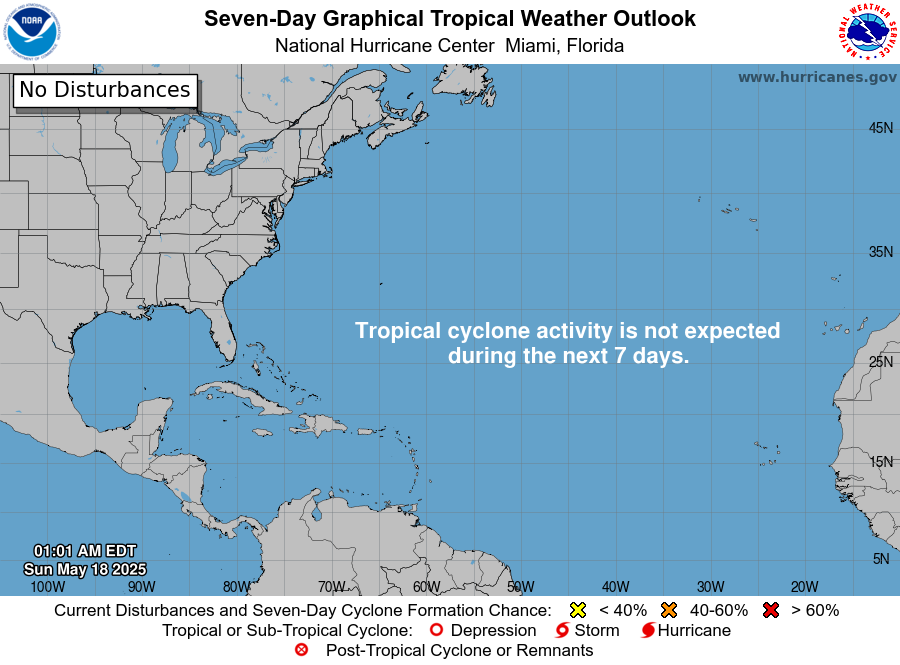
From the National Hurricane Center, the state of play as of midafternoon Tuesday, is Erin drawing on lots of warm sea water and causing beach warnings along the Outer Banks.

Mr Glahn continues,
Media outlets are desperate for clicks, but few readers will feel the impacts of this distant storm.Around 4 pm yesterday, The Weather Channel were running an Erin special going through all the possibilities for the beaches further north, and the desk staff seemed a bit apologetic about having to break away from their hurricane speculations to report on training thunderstorms rolling into Chicago. (The electrical storm displays were spectacular.) Last weekend the trains rolled into Milwaukee, now it's Chicago's turn, and the trains will keep running until all that extra atmospheric water from an undersea volcanic eruption precipitates out.
Erin has already caused significant problems in the eastern Caribbean, and authorities are already taking precautionary measures in North Carolina’s Outer Banks. But the rest of the Northern Hemisphere can relax. Until the next overhyped, megastorm forms.
It is too soon to draw any conclusions about how the 2025 hurricane season will play out. Last year, it was quiet toward the end of August but then came a couple of hurricanes bringing major flooding and a possible blot on the Jarrett regency's copybook. There have been five named storms thus far in the Atlantic. There are currently no tropical cyclones in the eastern or central Pacific.
11.7.25
FRIDAY short TAKES.
Donald Trump Is Not Gonna Bomb Iran. (Never mind.) We finished the job.

The eternally unpleasant. "My people don’t fly the American flag. In fact, we hate the flag and what it represents: a deeply flawed nation. And we don’t like the Americans who proudly wave it either. Patriotism has always been for other people, or other generations." Read it in full, she gave up on the people she thought of as "my people."
Winning. "Biden is quoted as saying, 'Many of the things I worked so damn hard, that I thought I changed in the country, are changing so rapidly.' You can almost hear everyone who voted for Trump answering, 'Yes, that’s the point.'"
Political economy is hard. "Republicans once talked seriously about aligning taxes and spending. They cared about economic distortion, simplicity, and broadening the tax base. Now, too many just want the sugar rush of tax cuts without fiscal discipline. Meanwhile, Democrats want to vastly expand the state and pretend that billionaires alone can foot the bill. Both sides are wrong. The math doesn't work, and the morality of the reckless spending is worse."

A lot can happen in three weeks. The resumption of pithy elaborations on traditional Cold Spring Shops themes will focus today on the more timely topics. The mix of pessimistic labels is deliberate.
Subscribe to:
Posts (Atom)