
Photo by Elsa for Getty Images retrieved from Washington Free Beacon.
Both games ended 2-1 in overtime. The women played on Thursday. During pool play, they beat Canada 5-0 (which was a common margin of victory all the way to the gold medal game). Years ago, Wisconsin's men's team won the Western Collegiate Hockey Association tournament final, putting up ten on North Dakota. Sure enough, North Dakota got another shot at Wisconsin for the national title, and won that game.
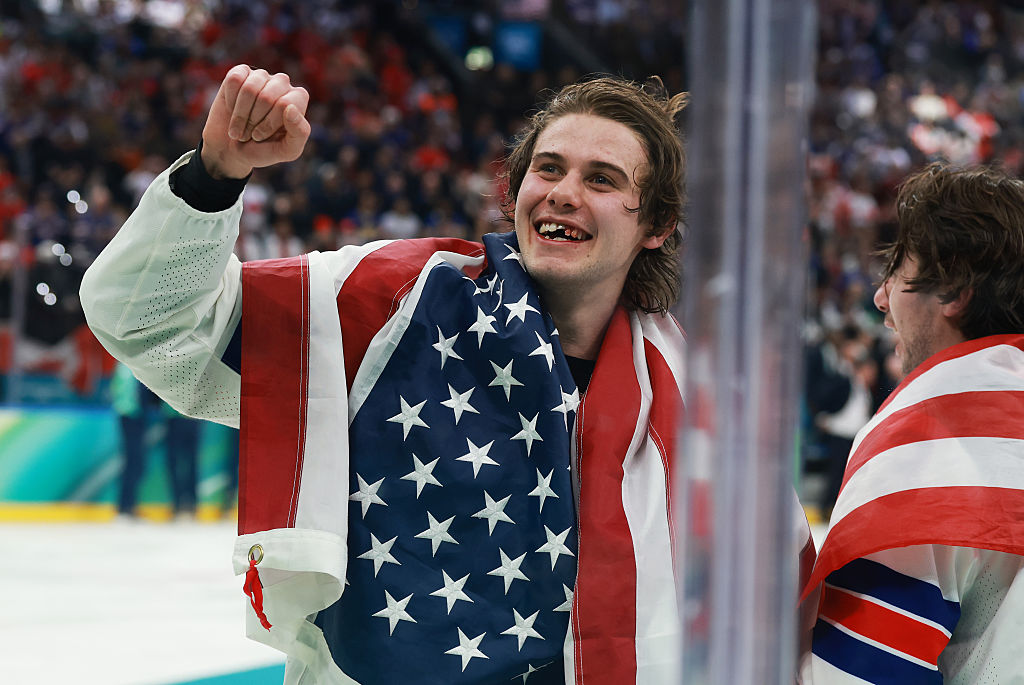
The men played on Sunday. Both teams arrived at the gold medal game undefeated. On paper, Team Canada looked like the better squad, and during much of the game all the play was in the United States' zone. But after Canada got the equalizer in the second period, no team scored in regulation, that despite Team U.S.A. having a four minute power play after Jack Hughes, pictured above, had a close encounter with a high stick. During that power play, a United States player committed a penalty, and Canada, rather than go on the attack with five skaters and an empty net, went with five skaters, one of whom did his best Bobby Orr impression skating circles in his own zone to facilitate a longer power play for their side. Nobody scored. Nor did Canada score on a subsequent five-on-three power play. Thus it went to overtime, and on occasion the team that looks to be exerting the most pressure comes up short in overtime. Ask the Minnesota men how their title games against Harvard, Union, and Quinnipiac turned out. Jack Hughes got the winning goal, hustling into position to convert a two-on-one goal rush into a three-on-one.
The editors at the Free Beacon immediately turn the outcome into that New Cold War.
What an end to the 2026 Olympic Games for Team USA. On the final day of competition in Milan, Italy, the Americans defeated the Canadians in an overtime, sudden-death, gold-medal game. Twenty-four-year-old Jack Hughes scored the winning goal. It was particularly sweet, and amazing, because in the third period he had his face bashed in so brutally that the Canadian thug who did it was assessed a double penalty.The Olympic movement of the late nineteenth century started as a way to provide friendly and peaceful competition but that "youth of all nations" brought the snake of national chauvinism into the arena, and as early as 1936 the games became a way for first the host nation and then the competitors more generally to make a case for the superiority of their social systems and their ideologies. If that involved crooked judges in the contests not settled by time or score, or bottom surgery for East German sprinters, well, it was all in The Interest of The State.
"I looked on the ice and saw my teeth," Hughes said after the game. The picture of Hughes celebrating with an American flag and a smile with a dark, bloody gap where his central incisors used to be belongs on the cover of Sports Illustrated, >Time magazine, a Wheaties box—whatever. It’s a new miracle on ice.
The phrase is, of course, reminiscent of 1980, when an American team of ragtag amateurs defeated the four-time consecutive gold medalist Soviet Union, a team composed of professional players, and went on to defeat Finland to take the gold. Canada isn’t as evil as the Soviet Union was, though there have been moments recently, such as the January 16, 2026, Canadian government press release from Beijing headlined, "Prime Minister Carney forges new strategic partnership with the People’s Republic of China," when it has seemed ominously hostile. (For the record, the final medal count in the Winter Olympics had the United States with 33 medals total and China with 15.)
The hockey boys’ Milan medal is particularly resonant for America’s Jewish community. Jack Hughes and brother Quinn, also a member of Team USA, are Jewish. They were Bar Mitzvahed. Their mother, Ellen Weinberg-Hughes, was a member of the U.S. Women’s National Team and served as player development coach for the U.S. Women’s Team that also won gold in Milan. As Sequoia Capital partner Shaun Maguire put it in a post on X, "For the last year there has been a whole lot of ‘just asking questions’ about Jewish Americans loyalty … Jack Hughes (Jewish) is the perfect metaphor. Taking a stick to the face to win Team USA gold against Canada. Then spouting pure patriotism."
The reference was to Jack Hughes’s immediate postgame interview: "This is all about our country right now. I love the USA. … I’m so proud to be American today. … Just a ballsy, gutsy win. That’s American hockey right there. … We’re USA. We’re so proud to be Americans. This night was all for our country. … We’re so proud to win for our country."
As in 1980, it was a bigger win than just on ice. The miracle isn’t just a hockey game outcome but a country that renews itself with new generations of competitors who are not ashamed of America but are proud.
At the (Not Detroit) Free Press, Will Rahn strives to avoid the geopolitics.The full post riffs on Canadians defining themselves, and their country, as Not The States.
Sunday’s gold medal game between Team USA and Canada could have easily been a lopsided affair. The Canadians had built perhaps the best team ever to grace the ice. They were undefeated heading into Sunday’s matchup. But so, too, were the underdog Americans, who clinched the win in overtime.The convention is to count medals won by sports, meaning one figure skater counts the same as twenty hockey players in the gold medal count. Make of that what you will. Mr Rahn also manages to get a dig in at footie.
The victory capped off a fantastic Winter Olympics for Team USA, bringing the final gold medal haul to 12, a new American record, behind only Norway’s 18. And it erased some sour moments when U.S. athletes found themselves mired in political controversy.
In un-American sports such as men’s soccer, the players flop to the ground in pretend agony whenever someone touches them. But that’s not how hockey players roll. Hughes washed the blood off his face and took his next shift. If he were in great pain, and one imagines he was, you wouldn’t have known it. Instead, he readied himself for revenge.That's fitting. "Footie is popular with eight-year-old girls in the United States, and adolescent males all over the Third World." He concludes his essay with a hope for comity, at least in These United States.
As the Americans, wrapped in the Stars and Stripes, celebrated on the ice, several of them went into their locker room and brought out Johnny Gaudreau’s jersey, where it had been hanging the entire tournament. Johnny Hockey, as he was sometimes known, was killed by a drunk driver 18 months ago in his native New Jersey. They then brought Gaudreau’s children down from the stands so they could be part of the team photo on the ice.Comity within these United States is scarce on the ground. "After Team USA Wins Gold, HuffPost Gets Ratioed Into the Sun for Claiming the US Flag Is a 'Turn-Off'." Well, Puffington Host. Comity with Canada might be harder to find these days either.
They won this game for Gaudreau and his family. Of that there can be no doubt.
But the men of Team USA also won it for all of us—the left, the right, and everyone in between. Hockey may not be America’s favorite sport, but it was on Sunday. Put out more flags. Raise them for Gaudreau, for the Hughes brothers, for Matt Boldy and Connor Hellebuyck and all the rest.
Canada: "If your only mission in life is not to be your obnoxious neighbor Steve, with his giant pickup truck and his noisy house parties, then how could you possibly avoid becoming just a bit more sanctimonious every day?" https://t.co/HN0Lb4pBmA
— Stephen Karlson (@StephenKarlson) February 21, 2026
I once heard a left-leaning comedian say that nations have a character like individuals, and that America was like a testosterone-driven thirteen year old boy, and Canada like a smart, educated forty year old woman.Then comes Don Surber with “Out Of Nowhere Canada Became Poorer Than Alabama. How Is That Possible?” That's the headline, surf over for the details and the snark.
I think this comparison was more apt than he knew. Because it precisely describes both the surface appearance AND the way that appearance falls apart when you look more closely, and discover that the thirteen year old boy rebuilds classic hot rod engines in his dad's garage, and just took the GED because high school is boring, and that the forty year old woman is, in fact, educated in some form of grievance studies, and is an insufferable self-righteous Karen, complete with that haircut.




No comments:
Post a Comment