14.12.08

MAKE THE OBVIOUS INFERENCE. A Chicago Tribune article about Illinois kleptocracy conjectures, "Blagojevich's arrest may be the final straw that shatters Illinois' political culture of 'pay to play'." It concludes with a reformer making a predictable suggestion.
"Rod Blagojevich has really illustrated that the policy of the State of Illinois is that we leave the bank vault open and we allow candidates to go in and grab what they can," said Cynthia Canary, director of the Illinois Campaign for Political Reform. "The intense excesses of Blagojevich beg us to rethink the role of money in Illinois politics."
An accompanying article suggests kleptocracy is a suboptimal environment for business growth.
Yes, Illinois is a far cry from Louisiana: Its economy is far more vibrant, its workforce more skilled, its population more educated. But the image of corruption is an important intangible factor that can affect a state's economic vitality, some economic development experts say. It signals to businesses that rules are squishy and the economic deck is stacked.
The author found several Wisconsin Ph.D.s, David Audretsch, Tim Bartik, and David Merriman, to amplify and reinforce the fundamental point.

Both articles are correct on the interpretation of events. Both articles miss a more fundamental point: state government is in a position to dispense many favors, which brings forth the rent-seekers. (It reminds me of a wisecrack attributed to Thorstein Veblen, who, when a dean or college president criticized him for playing house with a much younger woman, asked "What do you do when she moves in?") For lack of a better alternative, the model of enumerated and constitutionally limited government powers looks more attractive, as a check on the temptation for rent-seekers to pay and for office-seekers to expect to be paid.

The Tribune is correct in part.
That leaves a political financing system that resembles an addiction. Firms that rely heavily on state business readily donate to candidates as a cost of doing business—and are regularly rewarded with continued contracts and funding. Politicians then demand even higher campaign donations from the firms.
Less state business, fewer rents to seek, less pay-for-play, q.e.d.
CHASED FROM THE SPANISH MAIN. The Packers' French Army Retrospective continues in Jacksonville. My copy of How The States Got Their Shapes notes that French North America (later known as the Louisiana Purchase) was wherever a Frenchman could go without encountering resistance from a Spaniard or an Englishman.
The Packers might have had reason to bicker. After all, they lost on a late drive for the third consecutive week. Carolina beat Green Bay 35-31 two weeks ago with a 55-yard drive in the final two minutes. Houston kicked a field goal as time expired in last week's 24-21 victory.
Thus endeth the slim playoff hopes.

11.12.08

RESTRUCTURING HIGHER EDUCATION.

The American Prospect's David Kirp reviews Charles Murray's Real Education, and finds much to object to.

Because Murray thinks that innate differences in cognitive ability guarantee that most people cannot do the intellectual heavy lifting that serious higher education demands, truth No. 3 -- too many children go to college -- inescapably follows. "No more than 20 percent" of students can do college-level work, says Murray, and "10 percent is a more reliable estimate."

Putting aside the faulty statistical analysis that leads Murray to that dour conclusion, this "truth" is rebutted by the fact that about 35 percent of young adults, not 10 percent, have a bachelor's degree. To Murray, these figures show that standards in higher education have been debased, but most undergraduates are learning something of value. University College London economist Pedro Carneiro concludes that "even if we take the most pessimistic estimates for the return to education for those outside the elite (who economists would call the marginal students), they are probably above 7 percent per year of college, and they are not lower for a year of a B.A. as opposed to a year of any other type of post-secondary schooling." Employers aren't dumb. If high school graduates were just as productive, companies would hire them and save boatloads of money.

High school graduates are not just as productive, however, in part because the high schools have allowed postsecondary education to offer no-penalty do-overs.
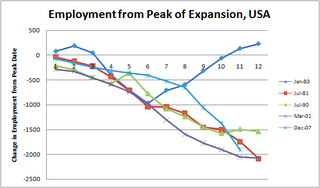
COMPARATIVE RECESSIONS. Here's a chart from Tom McMahon.


Here's another one, from King Banaian.


King has been suggesting the 1982-1983 recession (it was the second dip of a double-dip that began in 1979) is the historical example most like today's. Clearing out the excess of multiple bubbles is different, however, from clearing out the excess of monetary and fiscal stimulus rendered messier by those mid-1970s wage and price controls.
THIS SOUNDS ABOUT RIGHT. I got it from Kids Prefer Cheese, although several other sites I visited today were helping propagate it.


Pass it along.

10.12.08

QUOTE OF THE DAY. Joanne Jacobs reviews Sweating the Small Stuff: Inner-City Schools and the New Paternalism.
“Nagging is love,” I used to tell my daughter. “I am a much-loved child,” she’d reply. And so it is: if you care about a kid, you tell her what she’s doing right and what she’s doing wrong. You stick with her when she makes mistakes. You honor her successes. You nag. In Sweating the Small Stuff: Inner-City Schools and the New Paternalism, David Whitman finds that idea replicated in education. To give disadvantaged students a shot at college and mainstream success, he argues, schools must teach “not just how to think but how to act according to what are commonly termed traditional middle-class values.”
The review is in City Journal, which suggests she's preaching to the converted. All the same, instilling the Habits of Effective People is cheaper than all the other educational reforms we've been offered, something to keep in mind in straitened financial circumstances, with evidence of the failure of the more expensive therapeutic approaches all around us.
UNDOING PAST VANDALISM. The January issue of Railway brings news of a planned upgrade of London's Euston Station, including additional tracks and revised passenger flow patterns.


The redevelopment has been public knowledge since March 2007.

Network Rail said the cramped and dingy surroundings would be transformed into a light and airy thoroughfare for the 55 million passengers who use the station each year.

The unloved entrance to the station will also undergo a transformation, though it is unlikely the deal will involved resurrecting the Victorian arch that was bulldozed in the 1960s to make way for the current building.

British Land, which was selected as a preferred bidder, said the passenger improvements would be funded by unlocking the commercial development of the site.

Imagine. A railroad station in the basement of a skyscraper.


The Railway news brief describes the plan as employing "airport-style segregation for arriving and departing passengers on different levels." That description will certainly make sense to contemporary observers. The segregation of passenger traffic on different levels is a railroad invention.


The North Jersey Coast train leaves at a quarter to four. Look closely for the sign reading DOWN STAIRS FOR INCOMING TRAINS. Pennsylvania Station and Euston Station both went for 1960s redevelopments that have not aged well at all. Economic uncertainties appear to have put on hold the planned rebuilding (keep scrolling, it's down there) of Penn Station including passenger facilities in the Post Office.

9.12.08

BLAGO TO JAIL. If it's a new jail, he probably collected $200 to let the contracts.
The complaint contends Blagojevich, a Democrat, threatened to withhold substantial state assistance to the Tribune Co. in connection with the sale of Wrigley to induce the firing of Chicago Tribune editorial board members critical of Blagojevich.

The governor is also accused of obtaining campaign contributions in exchange for official actions — in the past and recently in a push before a new state ethics law takes effect Jan. 1.
Transversality conditions. Not just for qualifying exams anymore.

The transcript of the evidence makes me nostalgic for the days of [expletive deleted]. The President of the United States, and the Chicago Cubs, are two more supplicants to be reminded who is boss.

The editorial board of the Chicago Sun-Times calls for the governor's speedy departure from office.
In Blagojevich’s case, federal agents have been swarming over every part of the governor’s life for years. His friend and fund-raiser Tony Rezko has been convicted for political corruption in Blagojevich’s administration.

So what kind of man — knowing all this — continues to shake down businesses and puts a Senate seat up for sale? What combination of hubris, stupidity and greed is at work here?
That Rezko reference stirs the right. Michelle Malkin has a caption contest.


Gateway Pundit is in full cry. Wizbang's Michael Laprairie wonders if we're going to have a replay of the Clinton years.

During the 2008 Presidential campaign, it was well known that Barack Obama had a number of embarrassing skeletons in his closet, particularly the close rapport between Obama and crooked Chicago slumlord Tony Rezko, and Obama's cozy relationship with the Chicago Democratic Party political machine, perhaps the most corrupt organization in America, with only the possible exception of the Louisiana Democratic Party political machine.

The mainstream press published several interesting investigative pieces a year or so before Obama became the Democratic party nominee, but saw no need to keep that information above the page fold during the final months of the campaign. Instead, they chose to destroy Sarah Palin. And Obama's minions actively fought to silence anyone who sought to publish information about the connections between Obama and Bill Ayres.

Now, the Chicago Political Machine appears to be imploding. And there's also that pesky problem of campaign donation fraud that the mainstream press had previously found totally uninteresting.

Will Barack Obama, like Bill Clinton, be forced to endure four or eight years of embarrassing criminal investigations because the press failed to do their job and fully delve into his past

Right now, it doesn't look good for Obama. Lord, forgive our press, for they did not tell us what they knew.

Jake Tapper of ABC asks readers to consider his confession.

I hope that we will not hear the Democrats and their legacy media sycophants asking everybody to cut the new President some slack in recognition of the seriousness of the national security and economic situations. We have observed a massive expansion of government activity in the past eight years, with no little thanks to the national greatness conservative crowd. A government that is large enough to manage every aspect of our lives is a government that is attractive to influence seekers, and to the politicians willing to engage in pay-for-play. When that government is in the hands of people predisposed to use its powers expansively, the opportunities for the corrupt and the corruptible expand. Perhaps the reintroduction of Clinton-era establishment figures, susceptible to only Arkansas-level corruption, ought reassure.

There is one cheerful side to this story. The University Ethics Act is a creature of the Blagojevich administration, with the sponsorship of one Barack Obama in the state senate. The training university employees must undergo each year fosters great cynicism (Scrolling, scrolling, eyes a-rolling). It did, however, provide us with great amusement today when we could all crack wise about how we all face threats if we don't do our training, and some of us have been given do-overs because we did it too fast in the judgement of some anonymous time monitor, and our governor decided that the Gift Ban and Conflict of Interest didn't have to apply to him until it did. In conversations I have learned of other malfeasance attributable to Rod the Indicted, which I will document and report on once I get out of grading jail.

Our friendly connection at University Diaries, a source of great scorn for mandatory faculty training of all kinds, is also enjoying the moment.
DIFFUSION. New Census figures suggest a population migration that reflects both the effect of and the slow disappearance of Sundown Towns (review here.)
For the first time, Hispanic, black, Asian and other nonwhite residents account for half the population of the nation’s largest cities, according to new census figures.

Further, the data document a rapidly growing ethnic diversity in small-town America as well.
In the absence of barriers to migration, diffusion patterns converge.
“Not only are new immigrant minorities spreading away from metropolitan areas, but they are now moving to small places, both within, outside and far beyond traditional settlements,” said William H. Frey, a Brookings Institution demographer.

Dr. Frey said the shifts so far this decade “reflect economic forces that have driven middle-income whites and some blacks to smaller places, thus creating jobs in construction and other low-skilled industries for immigrant minorities in small suburbs and exurbs across the country.”
Future historians might identify as the most significant consequence of civil rights legislation the message it sent to potential immigrants of other than Northern European extraction that the United States are serious about equal treatment under the law.
OF MORE THAN THEORETICAL INTEREST. Today's Breaking Views in the New York Times suggests the tax code keeps liquidity tied up overseas.

On its own, an international tax amnesty won’t resolve the credit crisis or repair the economy. But given the limited effectiveness of some of the more expensive government programs, it’s hard to see how it would hurt.

The basic idea would be for Congress to legislate a window through which American companies could bring home dollars held abroad without paying corporate taxes of some 35 percent.

This would provide a fillip of liquidity to businesses, especially as even some of the most stable and solvent companies have been forced to pay huge premiums to obtain financing. Combined with the tax savings an amnesty would generate, companies would have greater resources to invest in research, development, capital spending and jobs.

That sounds a little like the Talmudic theft amnesty and the offering of a reward for the return of stolen goods, and a little like an immigration amnesty, which regular readers have encountered before.

Referees raise the objection that an amnesty is the source of a time-inconsistency problem, in that the granter of the amnesty is creating an incentive for people to misbehave (library fines and parking tickets come to mind) in anticipation of a future amnesty.

So too, with the tax amnesty.
There’s also the message another tax break would send. If companies believe that American authorities will grant them similar forbearance every few years, they wouldn’t bring money back home during good times. That would not just deprive the government of tax revenues, it would distort corporate behavior.
Distortion is a loaded term. Price signals distort business behavior all the time. But we call it allocative efficiency under some conditions, and in other conditions we evaluate the tradeoffs.
Still, finding a fair and efficient way to repatriate cash during a crisis could foster an economic recovery at relatively low cost to American taxpayers. One compromise might be to offer companies an amnesty if they agree to maintain certain employment levels for a set period of time.
That policy generates a different sort of social waste. But failed companies generate little in the way of jobs or of taxable income for owners and workers.

8.12.08

I KNOW I'VE MADE SOME VERY POOR DECISIONS.

Dave. Stop, Dave.


Word reaches Cold Spring Shops that General Motors can assure us now, very confidently, that they feel much better.
General Motors today unveiled an unusually frank advertisement acknowledging it had "disappointed" and sometimes even "betrayed" American consumers as it lobbies to clinch the federal aid it needs to stay afloat into next month.
I know everything hasn't been right with me, Dave.
The print advertisement marked a sharp break from GM's public stance of just several weeks ago when it sought to justify its bid for a U.S. government on the grounds that the credit crisis had undermined its business in ways executives could never have foreseen.
The tape that plays after the last notes of "Bicycle Built For Two", however, does not refer to something extraordinary dug up on the Moon.

What's a little more unusual is a company coming out and apologizing for just being generally lousy over the past couple of decades. But that is essentially what GM is doing now, with a curious campaign touting its journey on "the road to redemption." GM has run big two-page ads in major newspapers and also spins its tale on the Web.

Like all ad campaigns, the bottom line is that GM, right now, is a fine, high-quality company, whose products you should buy immediately. It's the journey to this obvious destination that's interesting. "Thirty years ago, GM quality was the best in the world," the print ad starts. "Twenty years ago, it wasn't."

And apparently the company muddled along in a sub-par manner for 10 years before deciding to change. "The hard part [was] breaking out of our own bureaucratic gridlock," the ad copy continues, and "learning some humbling lessons from our competitors." After a "painful" decade of effort, they're now back up to snuff, putting out great cars, etc., etc. The ad cites positive consumer-satisfaction research and recent automotive awards, presumably the hook for the campaign. "The road to redemption has no finish line," the copy concludes. "But it does have a corner. And it's fair to say we've turned it."

GM says that campaign is aimed at the apparently large segment of the car-buying public that simply won't consider its models. The company's North American president calls it "a unique effort to reach those consumers whose perceptions of GM are out of step with today's reality." I suppose that's reasonable, but let's say you're one of the thousands who did buy a GM car in the 1980s and 1990s. You, apparently, were a sucker. Your vehicle was not put together by a company with "a true culture of quality in every division." That's not what I'm saying—it's what GM is saying.

The code was placed in the computer's memory banks when Discovery left Earth orbit in 2003.
General Motors is running a new ad campaign in which they effectively admit they built lousy cars from the mid-seventies to the turn of the millenium. But their new stuff is really great, it really is! We appreciate your honesty, guys, but it can't erase bad memories of the '78 Malibu we owned for 6 months.
A restructuring or a managed liquidation is a bad thing?
I'M SATISFIED. Three weeks ago:
I won't be satisfied unless Badgers and Huskies both get bids.
Badgers got theirs.

University of Wisconsin coach Bret Bielema, with a 28-10 record in three seasons, and Florida State coach Bobby Bowden, with a 381-123-4 record in 43 seasons, are at opposite ends of the coaching spectrum.

It's no surprise they have different views of their upcoming meeting in the 2008 Champs Sports Bowl.

"This is how it has changed," Bowden, in his 33rd season at Florida State, said during a teleconference Sunday night. "If you're not playing for the national championship . . . who cares?

Given the expectations in Tallahassee and in Madison at the beginning of the season, that's logical. (In 2000, Wisconsin was returning much of its team after two straight Rose Bowl wins, but after a season that included a shoe scandal, they earned a rematch with a similarly chastened UCLA (motto: On! Wisconsin!) in one of the late-December games.)

Huskies got theirs.

It was announced Sunday night that the Huskies would play in the Independence Bowl in Shreveport, La. Dec. 28 at 7 p.m. The game can be seen on ESPN.

“We felt like we had a chance [of going to a bowl game], we really did,” [first-year coach Jerry] Kill said. “It’s certainly exciting to know we’re going now, there’s no question about that.”

The Huskies will take on Louisiana Tech (7-5) of the Western Athletic Conference. Louisiana Tech’s campus in Ruston, La. is roughly an hour from Shreveport, giving the Bulldogs a virtual home game.

The weather here is not conducive to outdoor practice. On the other hand, the strange patterns that sometimes arise in late December or early January can make DeKalb positively balmy. That Silicon Valley Classic had worse playing conditions than would have prevailed in DeKalb.

Northern Illinois was once a member of the same conference as Louisiana Tech for football. I forget the name of that conference, although it wouldn't be far off to call it the Harriman Lines Conference, with teams in Illinois and Louisiana and Nevada and California.
ABUSING ACCESS. Our new all-online grade reporting system requires a date of last attendance to be provided for any student who earns a failing grade. A message from headquarters tells us why.

After the Senate meeting on Thursday, we sought direction from Vice Provost Gip Seaver on the new policy of assigning a date of last attendance for students who earn an F or U grade.

Dr. Seaver explained that this new method of determining last date of attendance was adopted as a way to deal with our having been cited more than once by federal auditors for not providing timely information in cases of student "abandonment" of course work. That concept refers to students enrolling to receive financial aid, sometimes at more than one institution, and then "voluntarily withdrawing" (leaving, abandoning) their course work. This is viewed as fraud, as such students are receiving a financial aid award under false pretenses. The university has an obligation to report to the federal government those students who receive federal financial aid, then abandon all of their courses.

Dr. Seaver said: "We are under a time deadline to respond to the Feds and typically have difficulty meeting that deadline, thereby placing us in violation of Federal law. . . . [In new system,] upon receiving all of the grades, we can follow up on those students who received financial aid and appeared to leave the institution having earned no credit. Therefore we can comply with the law and resolve our continuing problem with the external auditors (they did not like our procedure and have been consistent in noting that we are not meeting the specified time deadline)."

Student loan welfare scams, imagine that. Headquarters doesn't see it quite that way.
The date of last attendance is only germane for those students who "abandon" all course work in a term. If multiple faculty provide differing dates, the university will report the one most advantageous to the student. In such cases, students are invited to submit their own independent evidence if they can document their participation in the semester past the date assigned by the faculty member. As long as faculty use their best professional judgment to determine, based on all available information, a date of last participation in the course, the university will defend faculty if any disputes that arise from students contesting the assigned date.
What's a little welfare fraud, if it fosters access?
Highlighting another aspect of the affordability crisis, the study notes that financial aid granted by colleges and universities tends to go to those who can already afford an education. The educational institutions use their financial aid funds largely to attract the most qualified students to improve their rankings, rather than to help those most in need of financial assistance.
Those few institutions that game the rankings are doing so in response to a perceived flight to quality, not because of animus against poor but striving students.
AUCUNE. The Packer defense continues its impression of the French Army.

Prussia, 1871.
In some ways, Houston still resembles an expansion team, still seeking a winning season in its seventh year of existence. Their exuberance in victory offered a telling counterpoint to the Packers' grimness in defeat.
Third Reich, 1940.
New Orleans put up 51 points on the Packers two weeks ago but the Saints' output of 416 yards wasn't an avalanche. On the other hand, Houston's 549 yards were the most against Green Bay since the Washington Redskins gained 552 on Oct. 17, 1983, in what remains the highest-scoring Monday night game, a 48-47 Packers victory.
Norway, 1050 is left to the reader as an exercise.

7.12.08

EMERGENCE CAN NOT BE MANAGED. Thomas Friedman's Hot, Flat, and Crowded is his latest attempt to peddle policy nostrums in sound-bite form. It's not filling Book Review No. 46 with spoilers to note that he's reacting to anthropogenic global warming, instant connectivity among the world's elite (perhaps aided by just-in-time logistics), and expanding population (much in the poorer corners of the world and increasingly aware of the prosperity elsewhere). Mr Friedman suggests these three phenomena interact in ways that have the potential to end badly. The book would be more believable if the author had stuck to the logic and the content. Mr Friedman's metaphor-chopping is a source of amusement among serious writers, and his attempts to improve on simple formulations annoy. Consider the efforts by some scientists to develop renewable energy cheaper than coal. Because somebody summed the formula in the equation "RE less than C" Mr Friedman decided that some longer, convoluted formula would be better, despite it being so long that he had to explain it again each time he used it. It is asking too much of the author to deal with the effects of the Hotelling principle for exhaustible resources. The principle suggests that renewable energy is not likely to be cheaper than coal (because the backstop technology puts an upper bound on price appreciation) but that does not preclude creativity in developing such things.

The greater error, however, is in Mr Friedman's confidence in expertise as the precondition for greener technologies, summarized at page 336.
As far as I am concerned, China's system of government is inferior to ours in every respect - except one. That is the ability of China's current generation of leaders - if they want - to cut through all their legacy industries, all the pleading special interests, all the bureaucratic obstacles, all the worries of a voter backlash, and simply order top-down the sweeping changes in prices, regulations, standards, education, and infrastructure that reflect China's long-term strategic national interests - changes that would normally take Western democracies years or decades to debate and implement. That is such an asset when it comes to trying to engineer a sweeping change, like the green revolution, where you are competing against deeply embedded, well-funded, entrenched interests, and where you have to motivate the public to accept certain short-term sacrifices, including higher energy prices, for long-term gains. For Washington to be able to order all the right changes and set up the ideal market conditions for innovation, and then get out of the way and let the natural energy of the American capitalist system work - that would be a dream.
And yes, I'm grumpy at having to work through the entire collection to get to that. Elsewhere in the book, Mr Friedman notes the fluctuations in fossil fuel prices that dampen incentives to develop renewable energy sources and wind and solar infrastructure and suggests the merits of a carbon tax as a simpler spur to such development.

Perhaps the troubles of the hot, flat, crowded world involve excess reliance on experts and planners and pundits.

(Cross-posted to 50 Book Challenge.)
ADMINISTRATIVE INCOMPETENCE. The University of Oregon, a source of great amusement a few years ago, is the gift that keeps on giving. Repeat with me: the track and field championships are amateur sports. It has nothing to do with money. Nike is an Oregon company. That's coincidence.

A DEFICIENT BUSINESS CASE.

The behavior of senior management of the legacy car companies reminded me of the special pleading of mediocre students. Others have come to the same conclusion, taking a bit more time with the analysis. The Corner presents a lengthy (for its format) essay by Jim Manzi with the title GM's Magical Thinking.
The point of this document was supposed to be the presentation of the plan to achieve these operational improvements. But there’s no there there. I guess somebody who’s never read a real business plan might mistake this document for one, but it’s a joke. It’s basically a list of assertions of amazing improvements, entirely discontinuous with actual performance to date, that they will achieve. What's missing is any real indication of how they will go about accomplishing this.
(Citation via Sykes Writes) The evaluation offers a policy implication.
[The proposal] exists to provide political cover to members of Congress. But if that’s the case, it’s an unintentionally beautiful illustration of why industrial policy fails. It’s both economically crucial and very hard to allocate capital well; that’s why people who are good at it make so much money. Businesses struggle to do this well, and they’re really trying. What do you think the odds are that this is a wise use of money, when the people involved are barely pretending to try?
So far I haven't seen anyone suggest we owe Saddam Hussein's heirs an apology, for rejecting his report to the U.N., which had some details right.
GETTING THE INCENTIVES RIGHT. A Minneapolis Star-Tribune editorial, suggesting enhanced state support for higher education, inadvertently on purpose establishes that the source of poverty and inequality is not college.
Growth & Justice researchers calculate that each year’s “class” of about 10,000 Minnesota high school dropouts will deprive the state of $10.6 billion over their lifetimes, in lower tax revenues and higher outlays for things like food stamps, Medicaid, housing subsidies and criminal justice services.
A commenter recognizes the error in logic.
The problem is the awful education our children are receiving in K-12. How can you increase the number of college graduates when a majority of students who graduate from high school are woefully unprepared for college?
The comment concludes,
Our economy must depend on the elite to produce enough to trickle down.
The prosperity does trickle down, in that the high achievers are doing the work the under- and never-achievers don't. but the income inequality is a consequence of higher returns to skill in the presence of diminished supply of skill.

5.12.08

THE GLORY OF FERROEQUINOLOGY. This pacing sequence, from west of Wisconsin Dells, features Milwaukee 4-8-4 261 returning from New Lisbon.

The train is going only a little faster than the Estonian steam train we noted last week. The location, however, is historically significant: this is the Sand Country east of New Lisbon through Mauston and Lyndon Station over which the world's fastest scheduled steam trains rolled. Imagine a streamlined, 300 psi 4-6-4 with eleven on at double 261's speed, or possibly, just possibly, touching 125 or 126 before the engineer has to check for the curves and the bridge at the Dells, just another day at work.
WORST CASE. I'm doing my preparations for our search on the expectation that there will be a search. There is a scary worst-case scenario.

At the Board of Trustees meeting, President John Peters said NIU has already had to use its own local funds in large part to maintain operations such as payroll.

“We have been working on this for several months,” he said. “We have in place a series of financial contingency plans that hopefully protect educational quality and jobs.”

The plans consist of NIU freezing all but the most crucial new hires, reducing expenditures on travel and equipment and scaling back on operations.

We're currently working on the anticipation of a 2.5 percent rescission, but the article suggests a gubernatorial holdback of up to 8 percent. Yikes.
HIDDEN MESSAGES. My department is doing a search. I'm reading letters of recommendation. Two phrases perplex. One reads "would recommend to departments that value teaching and research." Is that a veiled way of saying "would recommend to all but the top X departments", where X has variously been twenty or fifteen or nine (??!?) or five. Do search committees in departments that fancy themselves in the top fifteen when they're realistically in the top forty disregard those applicants, or do they consider those applicants as realistic hires that will improve their standing? And what does an aging search committee member in a mid-major make of either phrase? That the candidate will work well with students who might not be as self-motivated as the ones at the "value research" programs? That the candidate has an outside chance of writing papers that will get into top journals? That the candidate will write large numbers of papers just good enough to get into archival journals? Such statements might be accurate appraisals for the benefit of those top departments, where they have many more dossiers to read than I do. I'm not sure what they do for me.
THE SHAPE OF A MARKET-DRIVEN RESTRUCTURING. A USA Today story on some new Nissan panel trucks opens ominously.

As if Detroit automakers don't have enough trouble.

While the Detroit 3 were in Washington pleading for a bailout, Nissan showed off a pair of new vehicle concepts Thursday that take aim at the market segment that is one of the few remaining gravy trains for the domestics: smaller commercial trucks.

The two concepts are aimed at showing how Nissan will make a run at the delivery and utility truck markets — vehicles for businesses that need plain, dependable wheels for everything from flower delivery to mobile workspace.

But keep reading. The automotive creative class still agglomerates in the neighborhood of Detroit, or perhaps of Ann Arbor.

The Japanese maker says it will start with three truck models in 2010. It is yet to be seen how much they will incorporate of the ideas unveiled at the Nissan Design America studio in Farmington Hills, Mich.

The smaller of the two concept trucks, the NV200, has a novel cargo bay that slides out and is powered by a small diesel engine. The larger one, a world-debut Nissan billed as one of its biggest concepts ever, was built on the frame of a Titan pickup. The NV2500 was shown outfitted as a mobile office for a home builder.

The physical capital is also there.

With Nissan planning to end production of Titan and collaborate with Chrysler on a pickup based on the new Dodge Ram, a final version of a similar-size truck could vary substantially.

But if these concepts become reality, they could drive one of the strongest efforts yet by an import brand to finally get a foothold on one of Detroit's last profit bastions. Ford Motor, General Motors and Chrysler together have 95% of the smaller commercial truck market, says Len Deluca, a Ford director for truck sales.

Different ownership and different management might raise the going-concern value of that capital. On the other hand, perhaps the winning move is to build some new capacity.

It may help that Nissan will build its new trucks in the USA. It's spending $118 million to expand its Canton, Miss., plant to build the three models.

Nissan plans to produce a truck lineup to the smaller midsize category, known in the industry as a Class 5, says Joe Castelli, a Nissan North America vice president.

He says the timing is just right. The truck line should be ready just as the economy is starting to recover. "There is still a good opportunity," Castelli said.

The more forward-looking of the U.S. parts suppliers that know how to convert plastic and steel into truck subassemblies are planning to provide those things to Nissan, and perhaps to Toyota for those Tundras. (Kia is going to have to rethink Santa Fe and Sedona as nameplates, but that's a different kind of post.)
PROFITING BY SELLING WINS. Over the years I've had some fun with the [State] University of [New York at] Buffalo's efforts to achieve prominence in Division I football. Tonight, however, I recognize their success. David Letterman's favorite BCS team, Ball State, was on the way to a score that might have put the Mid-American title game away in the third quarter. Two long fumble returns for touchdowns later, Buffalo were in control, with head coach Turner Gill, a veteran of the Packer front office, being being the object of speculation by the broadcasters as a possible head coach in a more visible conference. Buffalo will play a January game in the International Bowl.
The bowl bid is the second in Buffalo’s 94 years of collegiate football, but will mark the first invitation that is accepted. The 1958 Bulls were initially invited to play in the Tangerine Bowl against Florida State, but later turned down the bowl bid when it was learned that two of Buffalo’s African-American players would not be allowed to compete against white players at the game site.
Buffalo's cheering section had a difficult ride to Detroit, but when they got there, they made themselves heard, using some of the same routines we use at Northern Illinois.

In one of those posts about Buffalo's football aspirations, I noted,
On the other hand, some pretty good economists are at Buffalo. New York's stinginess might have prevented them from getting more. Northern Illinois has received some favorable publicity and perhaps a few enrollments because of football success, although the True North capital campaign reflects the reality that there were plenty of positive things happening elsewhere long before anybody noticed those wins.
We are still capitalizing on the recognition our 2003 run at the Bowl Championship Series games brought us. Buffalo's football success will generate some buzz. Their administration's proposal to play to their academic strengths becomes accordingly more interesting: can a state university offer a persuasive alternative to the increasingly threadbare traditional havens for the valedictocracy?

4.12.08

BIPARTISANSHIP. That's the political class working to fleece the rest of us in such a way to enhance their chances of election. The dynamic is at work in the hearings on bailing out the legacy car companies.

Detroit automakers' best hope for Washington aid is a bipartisan plan to speed the release of $25 billion in already-approved loans under the Energy Independence and Security Act (EISA). But long-simmering hostilities between the California and Michigan delegations on auto issues threaten the deal. California legislators want that money to subsidize their own Silicon Valley-based auto industry, which they argue is the future of American transportation.

The Detroit Three automakers have driven the perception that the $25 billion package to help pay for "retooling" factories to make more fuel-efficient cars under increased gas mileage standards and a possible additional $25 billion bridge loan are rescue packages meant for Detroit alone. But a letter from U.S. Sen. Diane Feinstein, D-Calif., on Thanksgiving Eve makes clear what few taxpayers know: The billions in auto loans are a giant honey pot intended for any auto manufacturer in the nation.

In fact, Tesla Motors, a struggling San Jose start-up manufacturer of electric cars in Feinstein's back yard, has already applied for $400 million in EISA loans to build a new plant for making a luxury $60,000, battery-powered family sedan.

So while some members of Congress tut-tut Detroit executives for wasting money on private jets, Washington is entertaining taxpayer-financed loans for an automaker that caters to Silicon Valley millionaires.

Perhaps Lexus is onto something: the new trinket to appease the trophy (which I learn is now the toxic) wife will be an electric sports car.

I'll return to the substance. Automobile manufacturing is not equivalent to the North Central States.

Once synonymous with Detroit, the "American auto industry" now depends on your geographical perspective. To Southerners, it's foreign transplants like BMW and Hyundai. To Midwesterners, it's General Motors, Ford and Chrysler but also Honda and Toyota. And to the West Coast, it's alternate-fuel startups like Tesla Motors and Fisker Automotive.

That is why Feinstein wrote Senate Majority Leader Harry Reid: "I do not support disadvantaging the next generation of American automobile companies in an effort to save the first generation."

Another columnist suggests the legacy car companies' difficulties are self-inflicted.

Those outside the Detroit bubble also know that Japanese, Korean and German automakers are opening plants in more states, are keeping more workers on payrolls that generally have been expanding, are losing fewer sales in harsh times and claim, altogether, a larger chunk of the American auto market than Detroit does.

Detroit's retreat into Fortress Midwest and its deep financial problems, made dire by this fall's credit crisis and plunging consumer confidence, have sent a message to those left behind, on the outside, and it's probably more negative than positive. That may not fully explain what's actually changing inside these companies -- and I don't think it does -- but it shaped a perception based in some measure of reality.

To use a tale from higher education, the 1980 Chrysler bailout is analogous to a professor inventing an extra credit assignment in response to a sob story from a weak student. The same student then goes on to miss the final examination and returns with another sob story. The consequences of preserving unproductive automobile companies, however, are more serious than the consequences of loosing on the world a corner-cutting graduate, who will be sorted into something commensurate with his or her talents in finite time.
RECOGNIZING THE EXCESS DEMAND. Inside Higher Education reports an intriguing proposal from the New York State university at Buffalo.

At a time when most state leaders in New York are talking about cutting back, John Simpson sounds emboldened by comparison.

Simpson, president of the State University of New York’s Buffalo campus, says the state’s $2 billion budget shortfall presents an opportunity. With a renewed sense of urgency, Simpson is pressing lawmakers to enact a series of reforms that would challenge longstanding traditions in New York. Simpson’s recommendations include allowing Buffalo, and perhaps a few other significant research campuses in the 64-campus system, to raise its tuition at a higher rate than the rest of the four-year SUNY campuses.

The proposal is a long way from being implemented. It's encouraging to read something that isn't obeisance to access-assessment-remediation-retention or devoting more resources to beer and circus.

Clearing out the subprime components of the New York system will not be easy.
While tuition is an important issue, [Stony Brook president Shirley] Kenny says she’s equally concerned that the state doesn’t allocate enough of its own funding to the research centers within SUNY. But there are political realities that make it hard to believe lawmakers would fund university centers at a higher rate if it meant having to close or cut the funding of some of the SUNY colleges with dwindling enrollments, she said.
There's excess capacity in access-assessment-remediation-retention. It makes no more sense to preserve it now than it did to preserve Chrysler in 1979.
EVERYTHING OLD IS NEW AGAIN. I've put up a few posts about the misguided efforts by the late Schlitz Brewing Company to boost productivity by the use of chemical additives in their beer. It killed the company, which is now a division of a reconstituted Pabst Brewing Company. At one time, Schlitz was property of Detroit's Stroh Brewing, and after years of false steps, the real Schlitz is back in the Motor City.

Schlitz's Classic 1960s beer is back on shelves after nearly three decades, prompted by demands from aficionados here and across the country hankering for the maltier, full-bodied lager. The beer was altered in the late 1960s and 1970s to meet changing consumer tastes and boost production.

"Our goal was to bring back the taste of the 1960s when beer wasn't watered down," said Brad Hittle, chief marketing officer at Schlitz. "The response has been overwhelming, and we're proud to bring back the beer that generations of Schlitz lovers enjoyed over the years."

It wasn't "watered down, it was "chemically enhanced" by some highly credentialed biochemists brought in to "improve" on centuries of Bohemian and Bavarian traditions.

The first cases of the classic 1960s formula, based on the original recipe, arrived in Metro Detroit a few weeks ago. Schlitz, now owned by Pabst Brewing Co., officially kicks off the beer's return to Metro Detroit today with deliveries to several bars and stores. The brew has been available in Chicago, Minneapolis and Milwaukee, where Schlitz was founded in 1856.

The classic Schlitz should be welcomed by today's beer drinkers, who are more choosy than previous generations and drink different kinds of beers on different occasions, said Julia Herz, spokeswoman for the Colorado-based Brewers Association.

Speaking of "choosy," today was the last day of classes, which is occasion to draw down the inventory of Sprecher chilling in the garage. When that runs out, I'll make do with Guinness. There is Pabst in the larder, but that's to strengthen the chili.

The story of the return of the original Schlitz recipe to production is a canonical example of the folly of downsizing.

The company decided to go back to the 1960s recipe a couple years ago after being inundated with phone calls and letters from customers who wanted to share their thoughts and memories of the original Schlitz beer.

The recipe, however, was never documented. So in 2006, the company's award-winning brewmaster, Bob Newman, interviewed former brewmasters to piece together the classic recipe. A year later, Newman had enough information to re-create the formula, and the first batch of original Schlitz beer was distributed to stores and bars in Minneapolis, Chicago and Milwaukee to rave reviews.

The beer is more expensive because better quality ingredients are being used.

"It's maltier, hoppier and more full-bodied," said Justin Kelly, brand manager for Schlitz.

If not for the lateness of the hour and the knowledge of a busy work day tomorrow, that would be occasion for yet another Sprecher. Roll out the barrel!
HERE WE GO AGAIN. Headquarters is preparing us for a recision.

We have been asked to ‘hold back’ or reserve 2.5% of our general revenue budget for the current fiscal year. However, given the size of Illinois’ budget deficit in the context of an increasingly unfavorable economic outlook, we need to be prudent and prepare for the possibility of further reductions this year and in FY2010.

Meeting the FY09 reserve request from the Governor’s Office of Management & Budget requires stringent attention to spending at all levels. We have been working diligently since September on financial contingency plans aimed at maintaining educational quality and programs and protecting student, faculty and staff employment. Freezing hiring except for critical areas, reducing and managing all expenditures including travel, equipment, and general operations are just some of the ways we have prepared for this mid-year budget reduction. Yet our work is far from over: state revenue projections show little improvement over the next 12 months, and recovery is not expected to begin before mid-2010.

As we anticipate the Governor’s budget message in February, signs are pointing to a very austere FY2010 budget. Now, more than ever, we need to reaffirm our priorities as a university community: commitment to our students, engagement with our region, pursuit of new knowledge and tireless support for each other. The work of the university will go on, as it has for more than a century.

Business as usual is not an option. Now is the time to think, seriously, about taking advantage of that excess demand for perceived prestige degrees, by pricing to reflect the excess demand and raising admission standards.

A Northern Star report suggests scrutiny for the amenities, which might not be all bad.
It is not known how fees and tuition will be affected as it is a long and detailed process, but of the things students may notice that will be impacted by these budget cuts, [Northern Illinois president John] Peters said, will be equipment, recreation, student activities and anything requiring “one-time expenditures.”
The article goes on to note changes in the commencement ceremony, changes motivated by the propensity of many in attendance to get up and leave before the ceremony continues. The fact that many people are that nyekulturny says more about the failure of society's institutions to inculcate the Habits of Effective People and about the fruits of access-assessment-remediation-retention than I could say in 8,500 post.

3.12.08

ADVERSE SELF-SELECTION. During my stay in Detroit, a neighbor once mentioned that Warren police would advise Blacks to not let the sun go down on them in that suburb. Now comes James W. Loewen's Sundown Towns, which confirms that, and tells much more about the attitudes and unofficial policies that rendered what the press and the policy makers called de facto residential segregation, generally in the North, effectively de jure segregation, despite the Supreme Court having made the controlling laws unconstitutional as early as 1917. Professor Loewen began his work after hearing a number of stories similar to my Warren experience, only in central Illinois, near Decatur. He began his work with the prior that he might be able to find maybe fifty such towns in the contiguous 48 states. The subject of Book Review No. 45 is a book that claims over 400 in Illinois alone. Information technology operates in such a way today that the book is relatively short (although I will argue it could be shortened and expanded) with much supporting evidence in an instructive website. The website is straightforward. The book repeats itself, and it tends to sensationalize. It may not be necessary to repeat the text of the canonical sundown sign numerous times, as Professor Loewen does. The story he tells at page 222 about the small child thinking a sign bans crayons after dark (the local term being "colors") only to learn it's a politer variation on the usual locution is much more persuasive. Likewise, he alternates between invocations of official policy and unofficial tradition in describing other indicators of sundown towns. The most glaring such illustration is the tradition of the six p.m. siren, which residents of at least one Illinois town told him, or not, was a reminder to any Blacks doing business in that town. At that town's latitude, six p.m. is after sunset five months out of the year, and long before sunset three months. As a reinforcement of oral tradition, however, it works. That oral tradition served as the principal technology of control. The Supreme Court might have ruled in 1917 that sundown ordinances were unconstitutional, but if town officials behaved as if there were no such controlling legal authority, the law might as well be in effect. (Police and private security workers harass railfan photographers on the same principle.)

Professor Loewen suggests that some isolated small towns still cling to their sundown principles. Many of them have been bypassed by the modern economy, leading to a situation in which descendants of the Black population, chased out after real or imagined crimes, or labor strife, or unprovoked meanness, cluster in the urban ghettoes, while descendants of the White population that provoked the chasing cluster in their sundown towns. The recreational drugs are different, the music is different, the crabbed lifestyles are the same, Black Rednecks and White Liberals in microcosm.

The book's focus on sundown suburbs, which generally did not post signs, and enforced segregation through the real estate market, or zoning restrictions that raised the construction cost of a house, is more instructive, as current patterns of suburbanization, and the current prestige hierarchy among suburbs is, according to Professor Loewen, path-dependent.

There's a prima facie case in Greater Detroit, where a very poor neighborhood in northeast Detroit abuts Grosse Pointe, with a well-kept and well-fenced park for Grosse Pointe residents in plain sight of the houses in Detroit. There's also a concrete wall built by a developer in order to separate neighborhoods in Detroit itself, in order that White citizens could qualify for Federal Housing Administration mortgages in a neighborhood on one side of that wall. A visit to Google Maps will confirm the existence of the wall. Locate Wyoming and Eight Mile, go to maximum zoom, and look between Madison and Birwood, a few blocks west of Wyoming.

The phenomenon, however, generalizes. Professor Loewen suggests that the resulting segregation on racial and class lines deprives people of opportunities to broaden their horizons. He offers suggestions for people who would like to change things. Here, however, his analysis becomes too ambitious. In the absence of universal vouchers, residential choice is school choice. Professor Loewen attempts to argue that people bidding up house prices in order to pursue better test scores for their children is misguided owing to biases in the test design. He also argues that a high-schooler with a high test score in a district with a lower average test score is at no disadvantage relative to a high-schooler with the same test score in a district with a higher average test score, inadvertently conceding some value in the standardized tests. Perhaps he's right. On the other hand, the school district with the lower test score might be one in which the lower-performing students are dragging down the level of instruction that goes on. That's an incentive for parents to shop for school districts with higher test scores, sundown history or not.

Cross-posted to 50 Book Challenge.
HEDGE FUNDS WITH LIBRARIES. Thus does Joe Malchow of Minding the Campus refer to the well-endowed, if somewhat less so than three months ago, private universities. There's plenty of blame to go around. There's also this.
I have frequently thought that the redemption of our universities was to be found in their economics faculties; these, at least in recent years, have learned to live as isles of their own; they operate, budget, hire, and think independently of the moribund intellectual-administrative alloy that girds the rest of a university against intellectual impiety. Somehow the English, Women's, Native's, Social, Geographic, and Religion departments persistently find common cause with their administrators, the aegis of the latter protecting the barren quarry of the former. As a longsighted professor recently observed to me, it isn't the economics faculty who dominate the decision-making processes; it is those who need the charity; and it is not the economists who are moved into executive positions; it is quite purposefully those who are not adept at making decisions that would upset the school's comfortable stasis.
Amen.
PUNISHED FOR BEING RESPONSIBLE. Former Madison mayor Paul Soglin doesn't like it.

Two charge card companies wrote to me. The interest rates on my charge cards are going up.

That is the thanks I get for borrowing money and paying it back, making on-time charge card payments, and supporting the bailout.

I got a letter from one company today that said, "we are changing your Card Agreement...

Doughnuts from the Doughnut Factory: $3.00

A ride on Madison Metro: $1.50

Discovering that "from each according to his ability" is a formula for fleecing the responsible: Priceless.
POP GOES THE SPORTS BUBBLE? The Houston Comets have been liquidated by the league. Commentary at The Sports Economist. That may be professional basketball with female players, a tough sell in any season, but particularly in summer. But how explain Alabama football, where some students supplement their financial aid by selling their tickets, prompting University Diaries to quip,
Maybe this is happening because the school’s started to be more selective in its admissions, and it’s now saddled with serious students for whom there’s not a strict equivalence between going to class and going to a football game.
That's a testable hypothesis. If, however, families that would participate in the positional arms race are tempering their ambitions for their children with practicality, 'tis a consummation devoutly to be wished, as Milt Rosenberg likes to say.
OUCH. Professor Munger.

I think that the place of Theory in Poli Sci is something more than intellectual history. At least, it should be. Ideas matter, or they MAY matter. Even the most doctrinaire Marxist historian thinks that the particular ideological superstructure erected around evolving economic relations matters for how the society functions. So, even if self-interest and materialist forces of weather, resources, and population movements are the driving forces behind history, ideas matter.

Grad students at Duke have to take at least one Theory course. Sometimes it works (students feel it is valuable), sometimes it doesn't. But I certainly find it useful to have a Theory group of faculty to talk to. (Two of our theory faculty are formally joint with our very good Philosophy Dept., btw, for those who think Political Theory is Philosophy, Poor Done). There are many questions that have troubled human societies for thousands of years. Sure, we have no definitive answer, but knowledge of the history of the arguments is something any educated person should have.

Check the rest of it out, and the discussion that inspired it.
REPOSITIONING? The Lexus Christmas commercials are back, with the same annoying music and the same ridiculous bows on the cars.

Gone, though, from the commercials I've seen so far, are the upscale neighborhoods and the implied appeasement of the trophy wife of past years. Instead, it's male Thirteeners, one with the cliche dirty-face goatee, flash-forwarding from some adolescent best present ever to ...

Diminished expectations? Or a change in the way people calculate value?

2.12.08

DIVISION OF LABOR. Last week, Alaska governor Sarah Palin pardoned a turkey at a turkey farm and then gave an interview that causes vapors at the Huffington Post, and scoffing elsewhere, with Armed Liberal unimpressed. Mark Steyn is saltier. Tim Blair kept track of reactions around the web. Power Line had the best comment.
Yes, it's quite a scandal in Liberal Land. Sarah Palin actually doesn't mind when turkeys are killed, almost in her very presence. Which is the rub, I suppose. Unlike the Governor, most liberals make sure they're somewhere else when animals are being slaughtered for food.
The post also suggested that Norman Rockwell conceived of Harry Potter.


Sisu has more about the technology of turkey decapitation, if you're curious.

The wisecrack about Liberal Land, however, provokes a contrast between the economic way of thinking and what passes for thinking in the fever swamps of culture studies.

I sometimes introduce economics to students with a series of questions we will develop answers to, including "Who does the things we don't know how to do?" and "Who does the things we don't want to do?" I got them from somebody else, but the source is in my office and it's slipped my mind.

The butchering of turkeys is something that many of us, including Cousin Reginald, don't know how to do, and methods of animal slaughter, including the Cone of Turkey Death, might be messier because meatpackers are able to find people who will do the work for low wages. There's more on the topic in Eric Schlosser's Fast Food Nation, which I read some time ago, before I became involved in the Fifty Book Challenge. Mr Schlosser is no fan of the contemporary meatpacking business, and his work is in the tradition of Adam Smith's and Karl Marx's and Alfred Marshall's recognition of the downside of specialization and division of labor, captured most pungently in Marx's "appendage of a machine" and only slightly less colorfully by Marshall's "work of no elevating character."

Perhaps the Power Line post wishes to conjure up the image of the limousine liberal, quite content to eat meat that someone else has cut up, and per corollary, quite content to have other peoples' children attend the urban common schools.

That's not, however, the only possible source of the squeamishness Mr Steyn and Mr Blair had such fun with. Perhaps the Huffington Post writer has spent time in the fever swamps of cultural studies, in which the commercial butchering of animals becomes an example of the absent referent.

I was struggling to find a way to explain why people eat animals and why it is so difficult to discuss the issue. I realized that it was because of what I call the structure of the absent referent: Behind every meal of meat is an absence: the death of the animal whose place the meat takes. The "absent referent" is that which separates the meat eater from the animal and the animal from the end product. The function of the absent referent is to keep our "meat" separated from any idea that she or he was once an animal, to keep something from being seen as having been someone.

Never in the history of intellectual endeavour has so much effort been devoted by so many to so little. From that we get The Sexual Politics of Meat, which I skimmed one lazy afternoon years ago, to be unimpressed by its efforts to treat housewives preparing roasts for their husbands and deer hunting as manifestations of the same hierarchy of dominion, but the author saw fit to offer a sequel, The Pornography of Meat, and the late unlamented Lingua Franca suggested there would soon be a new library category, "patriarchy and meat." Sometimes the only thing to do is to snicker. Smith and Marx and Marshall got the essentials right. The rest is distraction.

CAPTURING CARBON. A Nightly News feature described a project that is growing algae as a source of biofuels. Because algae photosynthesize a lot of carbon, one way to promote its growth is to pipe power plant exhaust into lagoons, thereby keeping the carbon out of the atmosphere.

The latest issue of Trains arrived in my mailbox. I did find some time to look at it, despite end-of-semester deadlines, to discover a report on the fireless steam locomotive. The first such locomotives were commissioned by Pierre Gustav Toutant Beauregard, better known as the aggressor at Fort Sumter and later the recipient of Grant's counterattack at Shiloh, who, as administrator of New Orleans, asked a French engineer to build him something clean for the dockside railroads.

Some North American power plants charged later versions with exhaust boiler steam, and used them to switch the coal cars. Around here, the switcher, if there was one, was more likely an electric locomotive. (I'm claiming the research paper on this one!) The article noted that the Meiningen works built fireless steam locomotives as late as 1988. Unlike the Trabant, this product of the Peoples Republic of Prussia was pretty good.

There is some work on latter-day fireless steam locomotives, including the application of heat pump technology and the use of the sun to extend the locomotive's range. The challenge is to develop a locomotive as powerful as the genset and hybrid locomotive, with lower operating costs, and preferably a lower first cost. It's not the kind of thing to attract the attention of policy makers, which increases the likelihood of us seeing one that works.
MATH SURE IS HARD. But there are no remedial math classes at Northern Illinois.
NIU doesn’t technically offer any remedial courses, as the math courses are taught by Kishwaukee College, meaning that there are no remedial courses taught at NIU in any subject besides math, said Brent Gage, assistant vice provost of enrollment services.
The particulars are more convoluted.

A quarter of NIU students take remedial math courses, said Mathematical Sciences Chair William Blair.

Those students who are unable to place into MATH 110 are “directed to take the courses KISH 096 or KISH 098, offered on the NIU campus by Kishwaukee College in order to prepare students for MATH 110,” Blair said.

“This 25 percent figure has been more or less stable over the past few years,” he added.

Incoming students come in two types, where math is concerned.

Alan Zollman, associate professor of mathematical sciences, said he has noticed more remedial math courses offered and more students enrolled in them this semester than in years past.

“It could be two reasons,” Zollman said in a previous interview of why this change has occurred. “Students are less prepared than they should be. And maybe we have more students than we’ve had before.”

Zollman said there aren’t as many average or C students in his classes as there used to be. His classes are filled with mainly A, B, D and F students, he said. The fact that there are more below-average students, at least in Zollman’s estimation, could be another reason why there are more students taking remedial math classes this semester.

I'd still like to see our institutional research office identify the high schools that are sending us students not ready for university mathematics, and our controller bill them for redoing the work they didn't do.

I have learned a bit more about the remedial math efforts here, and will provide additional material in a few days.

1.12.08

THE IRONY OF DEMOCRACY. I still have the 1971 edition I purchased for "Introduction to Politics," which had the number Political Science 101 at Wisconsin. It opens, "Elites, not masses, govern America." That observation is not necessarily a complaint: the book offers ample evidence that mass attitudes toward democracy are sometimes negative and sometimes illiberal.

Now comes a video featuring interviews with Obama voters that suggests scant voter awareness, at least in a cherry-picked sample.


I found this video at Sykes Writes, accompanied by recognition that a small sample says little. I also found a link to a Zogby survey, using the sampling techniques pollsters have developed, that reaches a similar conclusion.
Just 2% of voters who supported Barack Obama on Election Day obtained perfect or near-perfect scores on a post election test which gauged their knowledge of statements and scandals associated with the presidential tickets during the campaign, a new Zogby International telephone poll shows.
I'll give Irony of Democracy authors Dye and Ziegler the last word.
It is the irony of democracy that the responsibility for the survival of liberal democratic values depends on elites, not masses.
I'll also note that the book is approaching middle age, with a silver anniversary edition on offer.
HIGHER EDUCATION'S SHERLOCK HOLMES MOMENT. I sometimes use Sherlock Holmes to reinforce an important but unintuitive point of economics. "When you have eliminated the impossible, whatever remains, however improbable, must be the truth." The observation continues, "It is stupidity rather than courage to refuse to recognize danger when it is close upon you." Where higher education is concerned, the danger is close, and according to the dean at Anonymous Community, it has been closing in for some time. He summarizes a conversation with a graduate school friend.

As we caught up and I regaled him with stories of the repeated, and accelerating, cycles of cuts with which I'm dealing, he mentioned that it seemed like in bad years, higher ed gets killed, and in good years, it only treads water. It never actually gains.

While there are exceptions here and there, it struck me as essentially accurate. The cycle is decline-plateau-decline-plateau-decline, with the plateaus getting progressively shorter. With each 'recovery,' only a fraction of the previous decline's loss is restored, and then another (and worse) decline starts.

That cycle is contemporaneous with the expansion of access-assessment-remediation-retention, beer and circus sports programs, and higher education as summer camp. In some subset of higher education, there has been a proliferation of administrators. The post does not provide background on which universities were surveyed (there being gaps in the bar chart) or which individuals were classified as "professional and executive staff."

Higher education's response, however, appears to be more of the same. Here's University Diaries, elaborating on a student response to an Arizona State strategic plan.
Presidents of universities are not, as you say, “simply” trying to keep their schools from sinking. Some of them are doing things with money that help their schools sink. They’re giving too much money, time, and attention to sports. They’re giving themselves and other administrators excessive compensation. They’re paying professors and graduate students too little.
They're also taking advantage of the willingness of professor wannabes to cobble together a full time job out of five or six temporary assignments at two to four colleges. Although many administrators indulge themselves like Brezhnevite apparatchiks, the system requires the sanction of the victim.

The issue, however, is not one of students being denied access. It is one of poor performance stemming from too much access.

Some observers of the American campus might call today “The Age of the Slacker.” Higher numbers of young people than ever before attend four-year colleges, but graduation rates are low. Disengaged students seem to be everywhere: they are the ones who reject active learning, disrupt classrooms with rude behavior, and try to get the curriculum “dumbed down” by their refusal to perform to their abilities.

These disengaged students seem to care little for their education, other than to accumulate enough paper credits to receive a diploma that will permit them to gain better employment. The reasons are myriad: low expectations and a focus on self-esteem in K-12, technological distractions, and so on. And many university officials avoid dealing with them, in order to maintain high enrollments.

Go read the full article. There are several observations from economists that capture the challenges of teaching economics, a technical subject that is often a required course for people whose focus may be on the credential.

My focus, however, is on the market test as the credit crunch and the wealth effect cut into that excess demand for prestige degrees. (I have written a lot about that.) Perhaps, to continue that Sherlock Holmes metaphor, the substitution behavior of prestige seekers is the object Holmes found because he looked for it. The editorial writers at USA Today deputise for Watson.
The recession has triggered a quiet panic in higher education. Some parents are insisting that their children apply, or transfer, to less expensive public colleges. Those public schools, meanwhile, face sharp drops in funding from state legislatures.
The editorial proposes the usual remedies. The situation offers the public universities the opportunity to tighten admission standards, encourage professors to raise the bar in class, and raise tuitions to encourage selection out by individuals who disengage because the current price structure induces indifference between participating and not participating.